

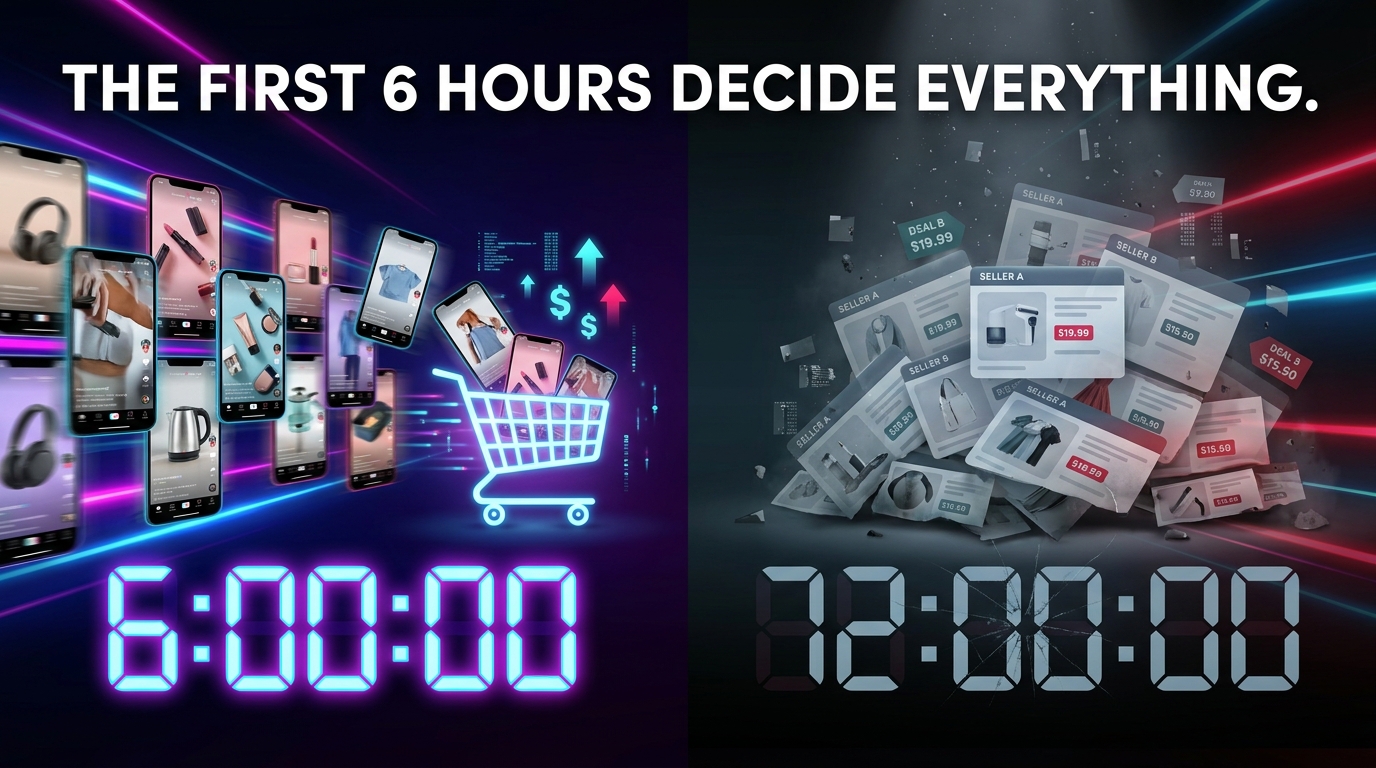

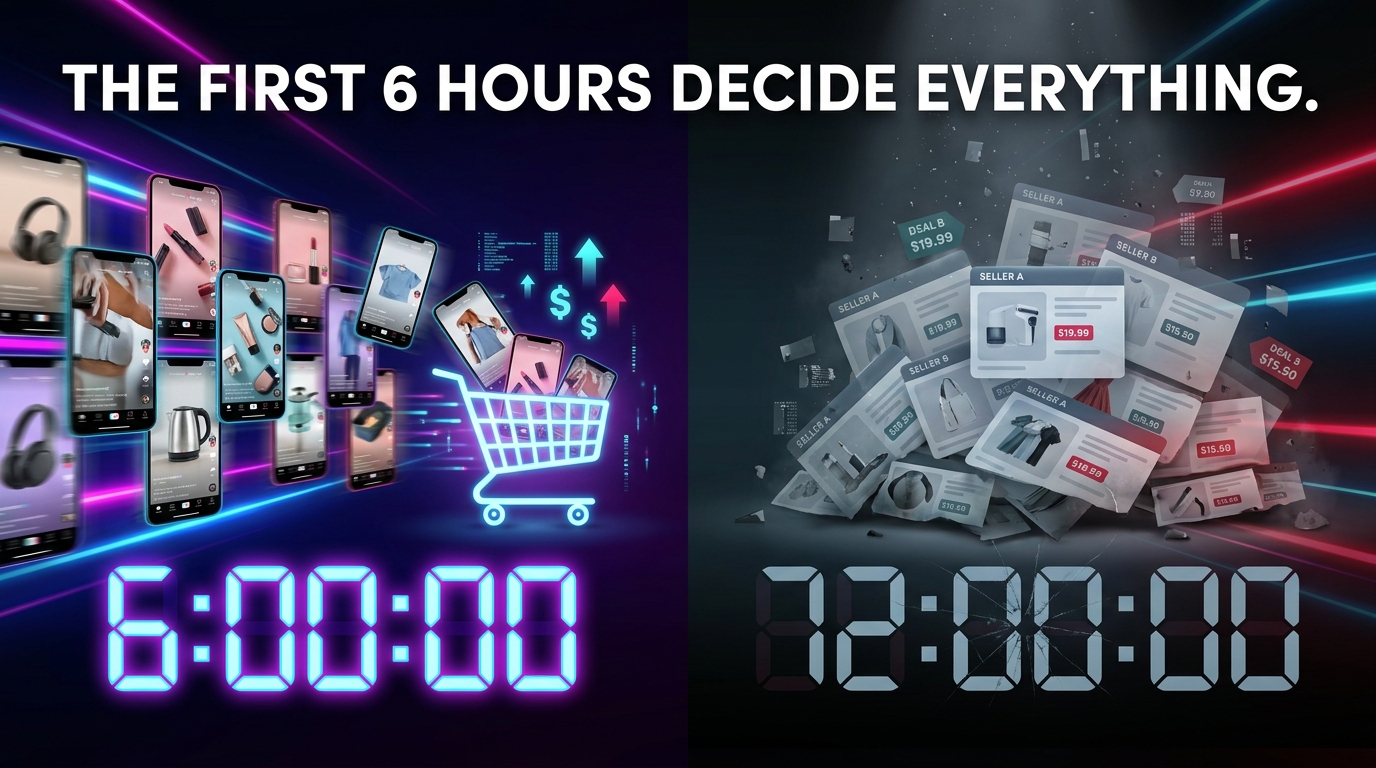
Somewhere right now, a product is going viral on TikTok. A sound is accelerating through the algorithm. A format is being replicated by hundreds of creators. And the clock — the one that separates profitable early movers from everyone else — is already running.
That clock runs for roughly six hours before the window starts closing. Not 24 hours. Not 48. Six.
Most TikTok Shop sellers think trend hijacking is about being fast. It is — but fast at what, exactly? Speed without system is just chaos. The sellers consistently capturing early-trend GMV aren’t moving faster because they work harder. They’re moving faster because they’ve built something structural: a detection stack, a pre-staged operation, a creator network on standby, and a listing workflow that compresses what used to take days into a few hours.
This article breaks down the mechanics of that six-hour window: what the algorithm is actually doing during it, what the data says about early-mover advantage, how the operational system works in practice, and what it costs — in real dollars and positioning — to miss it. This is not a trend-chasing playbook. It’s an argument for treating speed as an infrastructure problem, not a motivation problem.
TikTok Shop is on track to generate an estimated $100–112 billion in global GMV in 2026. The sellers winning disproportionate share of that aren’t necessarily the ones with the best products or the largest budgets. They’re the ones who understood early that on this platform, timing is the competitive moat.
The Four Phases of a TikTok Trend (And Where the Money Actually Is)
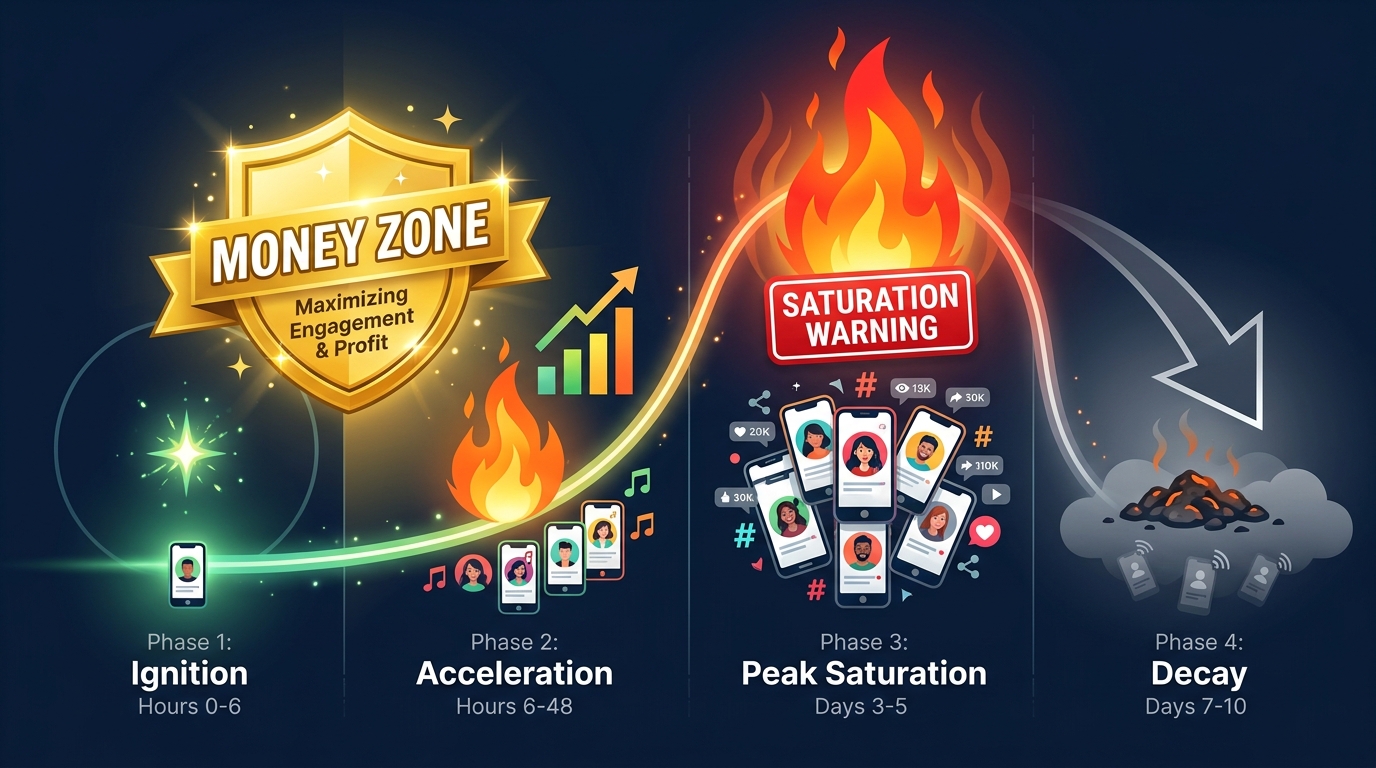
Before you can hijack a trend, you need to understand what a trend actually is — structurally. TikTok trends don’t just “happen.” They move through predictable phases, and each phase has a completely different competitive environment, algorithm behavior, and revenue potential.
Phase 1: Ignition (Hours 0–6)
This is where a trend is born. Usually, a single creator — often a mid-tier account with 50,000 to 500,000 followers, not a mega-influencer — posts content using a sound, format, or product in an unusual way. The algorithm, responding to early watch-time and completion signals, begins pushing the content to a broader test audience. The hashtag either doesn’t exist yet or has fewer than a few thousand uses. Product search volume on TikTok Shop is near zero.
This is also where the money is. Competition is essentially nonexistent. The algorithm is hungry for related content to serve alongside the original post. A seller who publishes shoppable content linked to the same sound or format in this phase gets surfaced in a low-noise environment, capturing feed real estate before the rush.
Phase 2: Acceleration (Hours 6–48)
The original post has broken out of its initial test pool. Larger creators begin replicating the format. The sound appears in the “Trending” tab of TikTok Creative Center. Hashtag use starts climbing. Product searches begin — slowly at first, then rapidly. This is the first phase where most sellers even notice a trend exists.
Early Phase 2 is still commercially viable, particularly for sellers with a tight operational system. But the window is narrowing. Creator competition is rising. The algorithm is now serving more content around the trend, which means any new video needs stronger engagement signals to earn equivalent reach compared to Hour 1.
Phase 3: Peak Saturation (Days 3–5)
This is the phase most brands are still in when they finally publish their trend content. The sound is everywhere. The format has been replicated thousands of times. Mega-creators have joined. CPMs on trend-adjacent ads have risen. Conversion rates on trend-linked products may still be decent, but margin compression is beginning as new sellers pile in and undercut on price.
Publishing shoppable content during peak saturation is not worthless — but the return is a fraction of what early movers captured. The algorithm has already identified its preferred content for this trend and is recycling it over newer entries.
Phase 4: Decay (Days 7–10+)
The trend is functionally dead for new entrants. The sound feels dated. The format has been parodied. Early sellers are either liquidating inventory or have moved on. Any content published here primarily serves as brand noise rather than a revenue driver. Industry analysts have consistently found that by Day 7, engagement on trend-based content drops by 60–80% from peak.
The takeaway is stark: there are only two commercially interesting phases — Ignition and early Acceleration. Everything else is diminishing returns at best, brand embarrassment at worst. The entire premise of a trend hijacking operation is to detect trends in Phase 1 and publish before Phase 2 is halfway through.
Why the Algorithm Favors Early Content — The Ignition Phase Explained
Understanding why the first six hours matter requires understanding what TikTok’s algorithm is actually doing during that period — and what it’s looking for.
The Initial Distribution Pool
Every new video posted to TikTok enters what content analysts call the “ignition pool”: a small, algorithmically selected test audience, typically a few hundred to a few thousand users who are profiled as likely to engage with that content type. The algorithm isn’t yet sure what to do with the video. It’s running a test.
During this test period — roughly the first 60 to 120 minutes — it measures several signals simultaneously: completion rate (how many people watch to the end), rewatch rate (how many play it more than once), the 3-second retention rate (how many people don’t swipe past in the first three seconds), shares, saves, and comment velocity. These signals together determine whether the video gets promoted to the next distribution pool, which is typically 10–50 times larger.
Why Early Content Gets a Structural Advantage
When a trend is emerging, the algorithm is actively trying to fill feed slots with related content. A sound that’s gaining traction creates demand for more content using that sound. Content associated with a newly trending hashtag gets tested with slightly larger initial pools because the algorithm’s internal signals suggest users want to see more of this type of content.
An early video tapping a trend also benefits from lower competition for those feed slots. When there are 50 videos using a sound, the algorithm has fewer options. When there are 50,000, it becomes highly selective, prioritizing content with demonstrated performance history. Early content gets tested before that selectivity kicks in.
The Compounding Effect
Early TikTok Shop content linked to a trending sound or format also benefits from a compounding dynamic. A video that performs well in Hour 1 accumulates engagement data — which influences how the algorithm treats that seller’s subsequent videos. Strong early performance builds what operators sometimes call “account momentum”: a short-term boost where the algorithm gives a seller’s next several videos slightly larger initial test pools. This compounds across a trend hijacking window, meaning early movers get better performance not just on the first video but on the 3rd, 5th, and 7th angle they test.
This is why “be first” is about more than just the first video. The seller who publishes five angles in the first six hours while testing different hooks is building a compounding data advantage that a 24-hour-late seller cannot replicate regardless of content quality.
Building Your Trend Radar: The Signal Stack That Catches Trends at Hour Zero
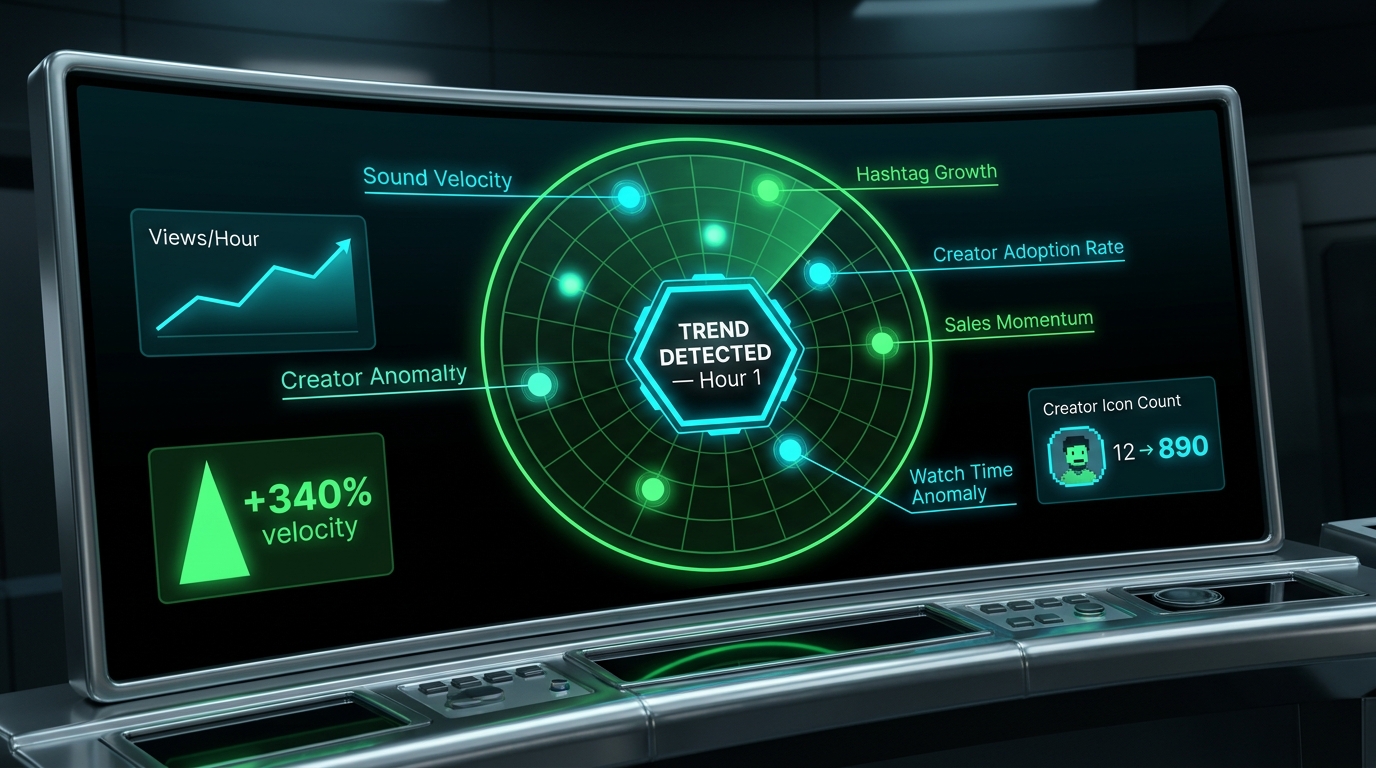
The most common failure mode in trend hijacking isn’t slow execution — it’s late detection. Sellers who learn about trends from their personal For You page, from industry newsletters, or from competitor observation are already behind. By the time a trend is visible in those channels, it’s typically in Phase 2 or Phase 3.
A genuine trend radar operates on earlier signals. Here’s how the tool stack breaks down.
Tier 1: Native TikTok Intelligence
TikTok Creative Center remains the baseline. Its “Trending” section surfaces sounds, hashtags, and creator content sorted by growth velocity. The key is filtering by category and by growth rate — not by total views. A sound with 2,000 uses but a 1,200% weekly growth rate is far more actionable than one with 800,000 uses growing at 3%. The Seller Opportunity Center, available directly within TikTok Shop’s seller backend, surfaces product categories and items with rising search volume. These signals often appear before the content trend becomes obvious.
Sound velocity is a particularly underused signal. When a sound’s weekly use count doubles or triples over 24 hours, it’s frequently a precursor to a broader format trend. Tracking sounds specifically — not just hashtags — gives earlier warning because sounds spread faster than associated hashtags.
Tier 2: Third-Party Velocity Tools
Dedicated TikTok Shop intelligence platforms like FastMoss, Kalodata, and Sell The Trend’s TikTok Shop Explorer surface product-level sales velocity data. These tools show which specific SKUs are experiencing order rate acceleration — often before the content that’s driving those orders becomes widely visible. If a product goes from 200 orders per day to 1,800 orders per day over 48 hours, something is happening even if you haven’t seen the video yet.
WinningHunter and Virlo specialize in early-signal detection, tracking engagement anomalies — unusually high save rates, share-to-view ratios, or comment velocity — that typically precede viral distribution. Pentos and TrendTok offer sound and creator tracking with the ability to set alerts on specific velocity thresholds, which is closer to what a professional trend desk actually needs.
Tier 3: Cross-Platform Validation
The final layer is cross-platform cross-referencing. Tools like Exploding Topics surface breakout searches appearing across Google, Reddit, and TikTok simultaneously. A topic gaining traction across multiple platforms simultaneously tends to have longer commercial legs than a TikTok-only micro-trend. This layer helps prioritize which trends are worth mobilizing full operational resources versus which to watch with one creator.
The Signal Protocol
Rather than monitoring all these tools manually, high-performing sellers configure alert thresholds: sound velocity crossing a specific weekly growth percentage, a product crossing a specific daily order volume, a hashtag hitting a specific hourly usage growth. These alerts route to a dedicated Slack channel or operations dashboard. When three or more signals align simultaneously on the same product category or format, that’s the trigger to activate the execution stack.
The goal is to eliminate the human scrolling step entirely. A professional trend radar shouldn’t require someone to notice a trend — it should tell them one is happening.
From Spotted to Live in Under 6 Hours: The Operational System
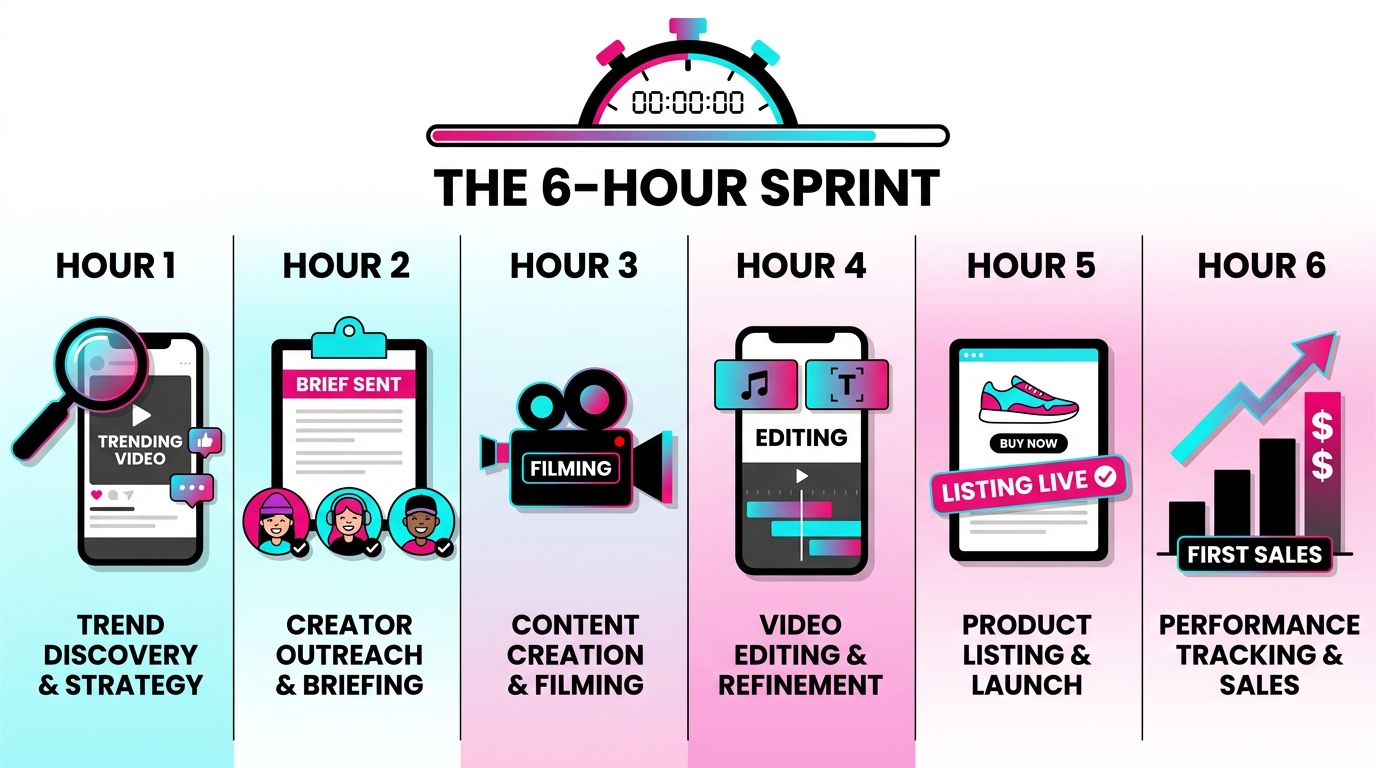
Detection is the easy part. The harder question is: once you know a trend is happening, how do you go from zero to published, shoppable content with a live product listing in under six hours? The answer is that you don’t figure this out when the trend happens. You build the system before any specific trend exists.
Hour 0–1: Trend Confirmation and Brief Activation
When an alert fires, the first action is confirmation, not deployment. The operator reviews the signal stack: Is this a single-creator anomaly or a multi-creator pattern? Is the product actually available to ship? Does it map to existing SKUs? Does the trend format match the brand’s product category?
If the answer to those questions is yes, the trend brief activates. This is a pre-built document template — more on the specific architecture in the next section — that the operator fills in with the specific trend variables (the sound, the format, the hook angle, the product being linked) and sends to the creator roster in a single action. Some operations use a group chat template that makes the entire brief distributable in under ten minutes.
Hour 1–3: Creator Execution
The creator brief arrives. Creators who are already pre-onboarded, have the product in hand (or can quickly access it), and understand the brief format begin filming. The brief shouldn’t require back-and-forth. It should be self-contained: here’s the sound, here’s the hook angle, here’s the product link, here’s what the performing content looks like, here’s the one rule you must follow. Anything that requires clarification is a sign the brief template needs work.
Ideally, multiple creators are briefed simultaneously with slightly different hook angles. Rather than hoping one creator gets it right, deploying three to five creators with different approaches means the operation is testing angles in parallel — which serves both the immediate trend window and longer-term content learning.
Hour 3–5: Listing and Content Go Live
Simultaneously with creator filming, the product listing update or new listing goes live. If the product already exists in the TikTok Shop catalog, this means updating the title, description, and primary image to reflect the trend angle. If it’s a new SKU, it means publishing the pre-built listing draft. Creator content is uploaded and pinned to the product immediately upon completion.
The sequencing matters. Content that goes live before the listing is optimized wastes traffic. A listing that goes live before content exists has no driver. The two must be synchronized, which is why the operational system treats them as a single deployment rather than two separate tasks.
Hour 5–6: Monitor and Iterate
The first hour of data is critical. Which creator’s angle is getting stronger completion rates? Which hook is driving saves rather than just views? What’s the add-to-cart rate on the listing? At Hour 5, the operator can already make informed decisions about which content to boost via affiliate commission incentives and which angles to expand with additional creators. The trend window is still open. Hour 6 is not the end — it’s the decision point about how hard to push.
The Listing Speed Problem — Why Your Product Page Is the Real Bottleneck
Most trend hijacking conversations focus entirely on content speed. The overlooked bottleneck is the product listing itself. Content that drives traffic to an unoptimized, incomplete, or mismatched listing is not trend hijacking — it’s audience acquisition for someone else’s listing.
What “Listing Ready” Actually Means
A listing optimized for trend traffic has several non-negotiable elements in place before the trend fires. The product title should be updated within the first hour to include language that mirrors how the trend is describing the product. If the trend’s hook is “this thing does X,” and your listing title still uses the generic product category name, you’re creating cognitive dissonance at the moment of purchase decision.
The primary product image should reflect the same visual context as the trending content. TikTok Shop conversion is highly visual — buyers scrolling past your listing after watching trend content are pattern-matching for consistency. A product image that looks like a generic white-background studio shot while the trending format is “real person, outdoor use, casual” creates friction that kills conversion.
Price anchoring also matters in the trend window. Early-trend buyers are motivated by novelty and FOMO, not primarily by price comparison. This is the window where you can price at full margin, because competition is low and urgency is high. Sellers who reflexively drop price during a trend are giving margin away unnecessarily.
The Pre-Built Draft System
High-performing TikTok Shop operators maintain a library of near-complete listing drafts for their most trend-susceptible product categories. These are fully formatted pages — title structures, description templates, image sets, pricing — that need only minor customization to go live. When a trend fires, the operator isn’t building a listing from scratch. They’re editing a draft that’s 80% complete.
This sounds obvious. Most sellers don’t do it. They treat listing creation as something that happens after a product is sourced, rather than as an infrastructure investment made in anticipation of demand. The sellers who’ve internalized the six-hour constraint have flipped this: listing readiness is built before the need exists.
Review and Fulfillment Compliance
Speed of listing publication is only valuable if the listing passes TikTok Shop’s compliance review without delay. Listings with problematic claims, missing documentation, or policy violations get held in review — which can cost hours. Maintaining pre-approved listing frameworks, with compliant language structures already validated, eliminates this delay. It’s another reason why listing infrastructure built in advance beats listing creation under pressure.
Creator Brief Architecture for Trend Hijacking
The creator brief is the critical handoff document between the seller’s trend detection and the creator’s execution. A bad brief produces bad content, slow turnaround, and frustrating back-and-forth. A well-architected brief produces diverse, high-quality content in 60–90 minutes from an affiliate network that’s pre-disposed to act fast.
What the Brief Must Include (And Exclude)
A trend hijacking brief should be a single page — ideally a single screen on mobile, since most creators will read it on their phones. It must include five things: the specific sound or format being targeted with a direct link, the product link with the creator’s affiliate tracking code already embedded, one primary hook angle with one sentence of explanation, one non-negotiable constraint (this might be brand safety, claim compliance, or a specific product feature to demonstrate), and a time expectation (publish by X time).
What it must not include: a full creative script, multiple alternative concepts, lengthy brand guidelines, or requests for approval before posting. Each of those elements adds time and creates friction that competes with the trend window. Creators who receive over-specified briefs either ignore the specification or lose hours trying to comply with it. The brief’s job is to aim the creator at the target, not to control every frame of the shot.
Pre-Onboarding: The Real Unlock
The brief only works if the creator already has the product. This is the most underappreciated preparation step in trend hijacking operations. Sellers who maintain a “seeding bench” — a roster of 20–50 pre-onboarded affiliate creators who already have product samples — can activate any of those creators instantly on trend detection. There’s no shipping delay, no waiting for a sample to arrive, no onboarding conversation to have.
Building a seeding bench is an upfront investment with asymmetric payoffs. The cost of seeding product to 30 creators who might not use it immediately is fixed and bounded. The return from having those 30 creators ready to activate within two hours when a trend breaks is unbounded — it’s precisely the kind of operational leverage that makes the six-hour window achievable.
TikTok Shop affiliate content already accounts for roughly 42% of US TikTok Shop GMV as of mid-2026. Sellers who treat their affiliate roster as an on-demand media network rather than a passive program are capturing a disproportionate share of that percentage.
Hook Library for Speed
Rather than inventing hooks in real time, high-performing teams maintain a hook library: a collection of proven opening frames, questions, and pattern interrupts organized by product category and content format. When a trend fires, the brief pulls from the hook library to suggest the angle — saving creative concepting time without constraining the creator’s execution.
A good hook library is updated weekly based on actual performance data. Hooks that drove strong 3-second retention in previous campaigns become templates for future briefs. This turns content performance history into structural speed advantage.
Inventory Staging: The Pre-Positioned Seller’s Advantage
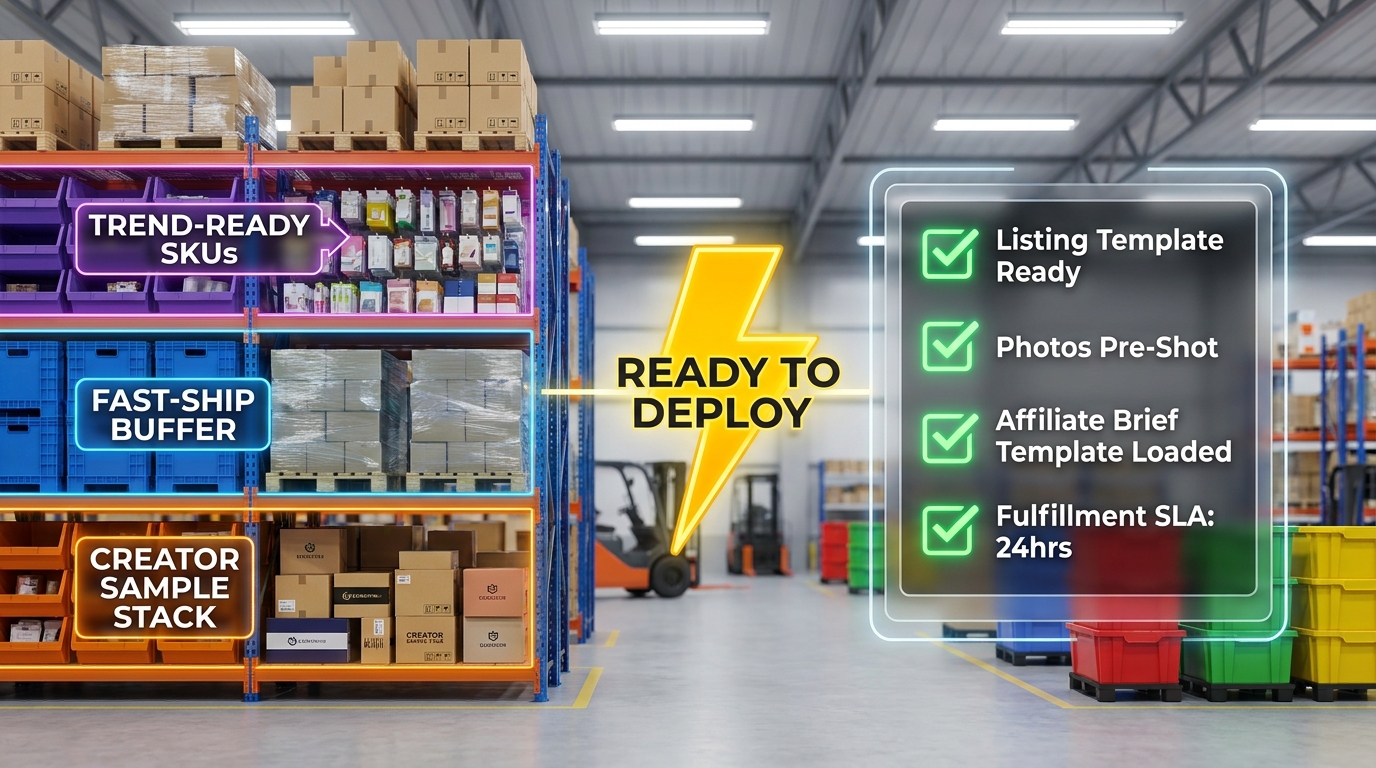
There is a version of trend hijacking that generates a lot of content views and very few actual sales because the product runs out of stock in the first 12 hours. This is arguably worse than missing the trend entirely: you’ve paid for creator content, you’ve built listing traffic, and you’ve handed the conversion to a competitor who had inventory ready.
Inventory staging for trend readiness is a distinct operational discipline. It’s not standard inventory management. It treats certain SKUs as pre-positioned trend assets rather than standard stock.
Identifying Trend-Susceptible SKUs
Not every product in a TikTok Shop catalog is equally likely to be caught in a trend. Certain product characteristics correlate strongly with trend vulnerability: visual novelty (products that look interesting on screen), functional demonstration potential (products where the “reveal” moment is satisfying to watch), price points under $40 (where impulse purchase thresholds are lowest), and category alignment with historically trend-prone segments like beauty, personal care, kitchen gadgets, and novelty electronics.
Sellers who identify these SKUs in advance can apply a different inventory approach to them. Rather than maintaining minimum reorder points based on historical baseline sales, they pre-position a “trend buffer” — typically 2–4 weeks of peak sales volume held at a fast-ship location — specifically in anticipation of demand spikes that cannot be predicted but can be prepared for.
The Fulfillment SLA Question
TikTok Shop’s algorithm factors fulfillment reliability into seller scoring. A burst of orders that ships slowly or generates cancellations can hurt a seller’s standing in ways that outlast the trend itself. This makes fulfillment capacity as important as content speed during a trend window.
Pre-staged inventory should sit at a 3PL or fulfillment center capable of same-day or next-day processing on surges. Some operators maintain a small overflow facility separate from their main warehouse specifically for trend-response fulfillment. The cost is a fixed overhead against which the insurance value is: never losing a trend window to a stockout.
Small Bet, Fast Inventory Learning
For products not yet in the catalog — opportunistic sourcing plays where a seller identifies a trend and needs to quickly source a matching product — the data-driven approach is a small initial order with fast replenishment capability lined up in advance. Placing an order for 200–500 units while maintaining a manufacturer relationship that can ship a follow-on order of 2,000–5,000 units within 72 hours gives the seller both the speed of early content and the capacity to scale into sustained demand.
The worst outcome is to place a massive speculative inventory order based on an emerging trend and find that the trend peaked before the inventory arrived. Small bets with fast replenishment lines is structurally superior to big bets with slow lead times on a platform where trend cycles measure in days.
What “Late” Actually Looks Like — The Cost of Missing the Window
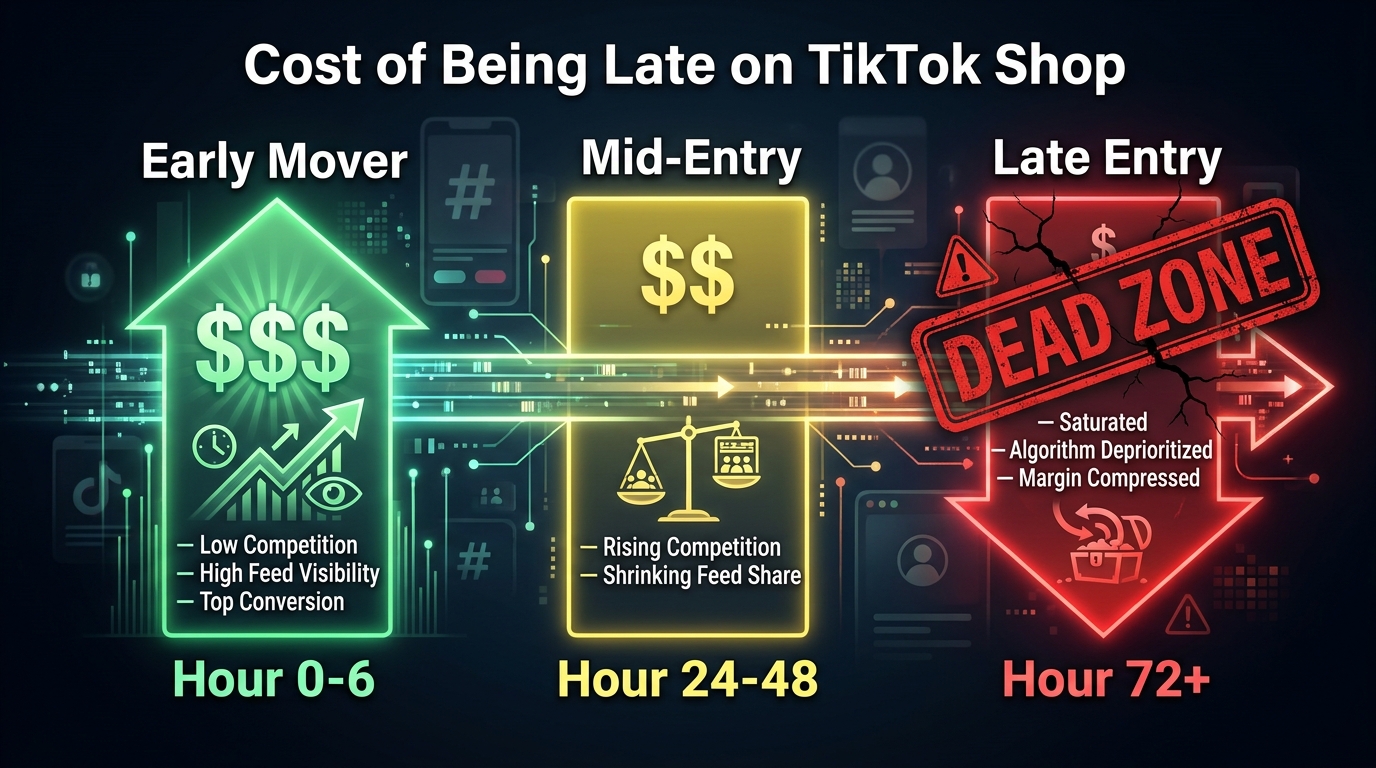
The gap between early-mover and late-entry performance isn’t marginal — it’s structural. Understanding exactly what “late” costs makes the case for investing in the operational system more convincingly than any abstract argument about speed.
The Feed Visibility Gap
TikTok’s algorithm fills feed slots related to a trend with content that already has engagement signals. A video published in Hour 1 that accumulated 40,000 views and a 7% engagement rate by Hour 6 will continue to receive feed placement because the algorithm has confirmed it performs. A video published at Hour 48 on the same trend has no history — it enters the ignition pool competing against content that already has proven signals.
For a TikTok Shop seller, this translates directly to impressions per dollar. Early content generates free organic reach. Late content requires paid promotion to achieve equivalent visibility. In practice, some operators report spending 3–5x more on paid amplification for late-trend content to generate equivalent traffic compared to early organic content. The early-mover advantage isn’t just about being first — it’s about the structural economics of paid versus earned reach.
Price Pressure and Margin Compression
As a trend matures, seller competition increases rapidly. Multiple sellers listing products in the same trend-driven category creates downward price pressure. Sellers entering at Hour 72 are often competing against early movers who have already accumulated reviews, social proof, and algorithm-favored listing scores. The late entrant must undercut on price to compete — which erodes the margin that the trend opportunity was supposed to generate.
Early movers, by contrast, face little competitive pricing pressure during the Ignition phase. They can price at full margin, capture the highest-value buyers first, and build a review base that will protect their position even when competitors arrive later.
The Brand Authenticity Cost
Late-trend content doesn’t just underperform commercially — it signals something to the audience. TikTok viewers are highly attuned to formats feeling stale. When a brand joins a trend that peaked four days ago, the content reads as opportunistic rather than culturally aware. Comments on late-trend brand content often reflect this: the format triggers irony and mockery rather than engagement. This creates a brand perception cost that extends beyond the specific trend, teaching the audience to view the brand as a follower rather than a participant.
This is distinct from creating polished late content that happens to use a still-relevant sound. The issue is that by the time approvals, production, and scheduling complete in a typical brand workflow, the trend has moved beyond the point where even excellent execution can recover the moment. The solution isn’t faster creative production — it’s removing the approval layers that assume there’s time to be deliberate.
When NOT to Hijack a Trend
Not every trend is worth the operational activation cost. A disciplined trend hijacking operation includes an equally disciplined filter for when to pass.
Product-Trend Mismatch
The most common reason to skip a trend is that the product doesn’t genuinely fit. Forcing a product into a trend format where the connection is unclear or contrived doesn’t just underperform — it creates cognitive dissonance for viewers. If the trend is a cooking demonstration format and you sell phone accessories, the creative gymnastics required to make that work will produce content that feels inauthentic enough to actively harm brand perception.
A useful filter: can you articulate, in one sentence, how the trend naturally demonstrates a genuine product benefit? If the sentence requires more than one “and,” the fit is probably too forced. Skip it and wait for a better trend.
Trend Origin Sensitivity
Some trends originate in cultural contexts that make brand participation inappropriate — trends rooted in personal trauma, social issues, or specific community experiences. A brand that participates opportunistically in these trends risks association with exploitative behavior that is distinctly visible on TikTok, where the community actively calls out inauthentic participation.
Part of a brand’s trend protocol should include a brief origin assessment: where did this trend start, and is there any reason brand participation would be read as exploitative or tone-deaf? This takes 5–10 minutes and protects against reputational risk that no amount of GMV recaptures.
Saturation Detection
Some trends look emergent in your detection tools but are actually already saturated in specific creator communities. If a sound has 50,000 uses but those uses are concentrated in a single niche creator community, the trend may not have commercial application even if it technically meets velocity thresholds.
Cross-checking the first 100 results for a trending sound against purchase intent signals — are the videos showing products, showing purchase decisions, creating commercial interest — is a quick proxy for whether a trend is a GMV opportunity or just a creative format with no commercial application.
When Your Supply Chain Can’t Support It
Finally, if the relevant product isn’t in stock and cannot be restocked within the viable commercial window of the trend, the right decision is to pass. Publishing trend content that drives traffic to an out-of-stock listing or a 3-week fulfillment time damages seller metrics and customer experience without generating revenue. The operational discipline of trend hijacking includes knowing when the infrastructure isn’t ready to execute, and choosing not to deploy rather than executing poorly.
Measuring Whether Your Hijack Actually Worked
Trend hijacking without measurement is just trend chasing. The difference between building a repeatable advantage and getting lucky occasionally is whether you’re capturing data that improves your system over time.
The Metrics That Actually Matter
Vanity metrics — view count, likes, follower growth during the trend — don’t tell you whether the operation succeeded. The metrics that matter are conversion-centric: add-to-cart rate from trend-linked content, revenue per video published (which captures both the conversion rate and the traffic volume), early order velocity (the number of orders in the first 24 hours as a proxy for how well the timing worked), and listing click-through rate from video.
A trend hijack that generates 2 million views but a 0.3% conversion rate is underperforming. A trend hijack that generates 200,000 views with a 4.8% conversion rate is a success. The difference is often in listing quality, product-trend fit, and price point — factors that are within the seller’s control and should be captured as learning for the next execution.
Speed-to-First-Sale as a System Diagnostic
One of the most useful operational metrics is time-from-trend-detection to first-recorded-sale. This single number captures the efficiency of the entire system: how fast the signal fires, how fast the brief goes out, how fast content is created and published, how quickly the listing converts. Tracking this metric across multiple trend events shows whether the system is improving, staying flat, or degrading.
Best-in-class operations in mid-2026 are achieving first sales within 3–4 hours of trend detection. Average operations are more typically in the 12–24 hour range. The gap between those two numbers is the operational gap — and the good news is that most of the improvement is structural rather than requiring harder work from the team.
Post-Trend Inventory Analysis
After each trend event, a review of inventory behavior is as important as content performance. Did the product stockout? Did it overstock? Was the initial inventory position appropriate for the demand generated? This analysis feeds directly back into the inventory staging model, calibrating future buffer positions based on actual demand curves rather than speculation.
Over time, a seller running consistent post-trend inventory reviews develops a product-specific demand model for trend events: this SKU typically generates X orders per 100,000 trend-content views, with a demand curve that peaks at Y hours and declines to baseline within Z days. That model is a genuine operational asset — one that compounds with each trend event.
Speed Is a System, Not a Skill
The most important reframe in this article is the one embedded in its title: trend hijacking is won — or lost — before any specific trend exists. The sellers moving fastest in the first six hours of a TikTok trend aren’t reacting more quickly. They’re executing a system that was designed, tested, and refined specifically for this scenario.
That system has five components: a multi-signal trend radar that detects before the FYP makes it obvious; a pre-onboarded creator network with product already in hand; pre-built listing infrastructure that compresses live publishing from days to minutes; an inventory staging model that never lets a stockout waste a trend window; and a measurement framework that turns each trend event into data that improves the next one.
None of these components requires a large team or a significant budget to build. They require deliberate construction before the pressure exists. The sellers who’ve done that work find that the six-hour window — which feels impossibly short to most — is actually sufficient. The sellers who haven’t built the system find that even 72 hours isn’t enough, because the bottleneck isn’t time. It’s structure.
Practical Starting Points
- Audit your current detection time: From the moment a trend breaks, how long before your team is aware of it? If the answer is more than four hours, your radar needs upgrading before anything else does.
- Identify your top 10 trend-susceptible SKUs and build pre-complete listing drafts for all of them this week. This is a one-time investment that pays every time a trend fires.
- Seed product to 20 micro-affiliate creators and build a pre-brief template. Run one drill — an internal exercise where you simulate a trend alert and measure how long the system takes to get to published content.
- Stage a trend-buffer inventory position on your two or three most trend-likely products. Even one week of surge-demand buffer is meaningfully better than zero.
- Establish your pass criteria: Define in advance what product-trend mismatch looks like, what saturation looks like, and when your supply chain state means you should sit a trend out. Written criteria eliminate the pressure-driven bad decisions that happen in real time.
TikTok’s global GMV is tracking toward $112 billion in 2026. The channel is large enough that even a seller capturing a marginal slice of trend-driven demand can build a substantial business. But that margin isn’t random — it concentrates in the sellers who understand that on TikTok, six hours isn’t a constraint. It’s the whole game.
Trend hijacking isn’t a tactic you deploy. It’s an operating posture you build. The question isn’t whether your team is fast enough — it’s whether your system is ready enough.