


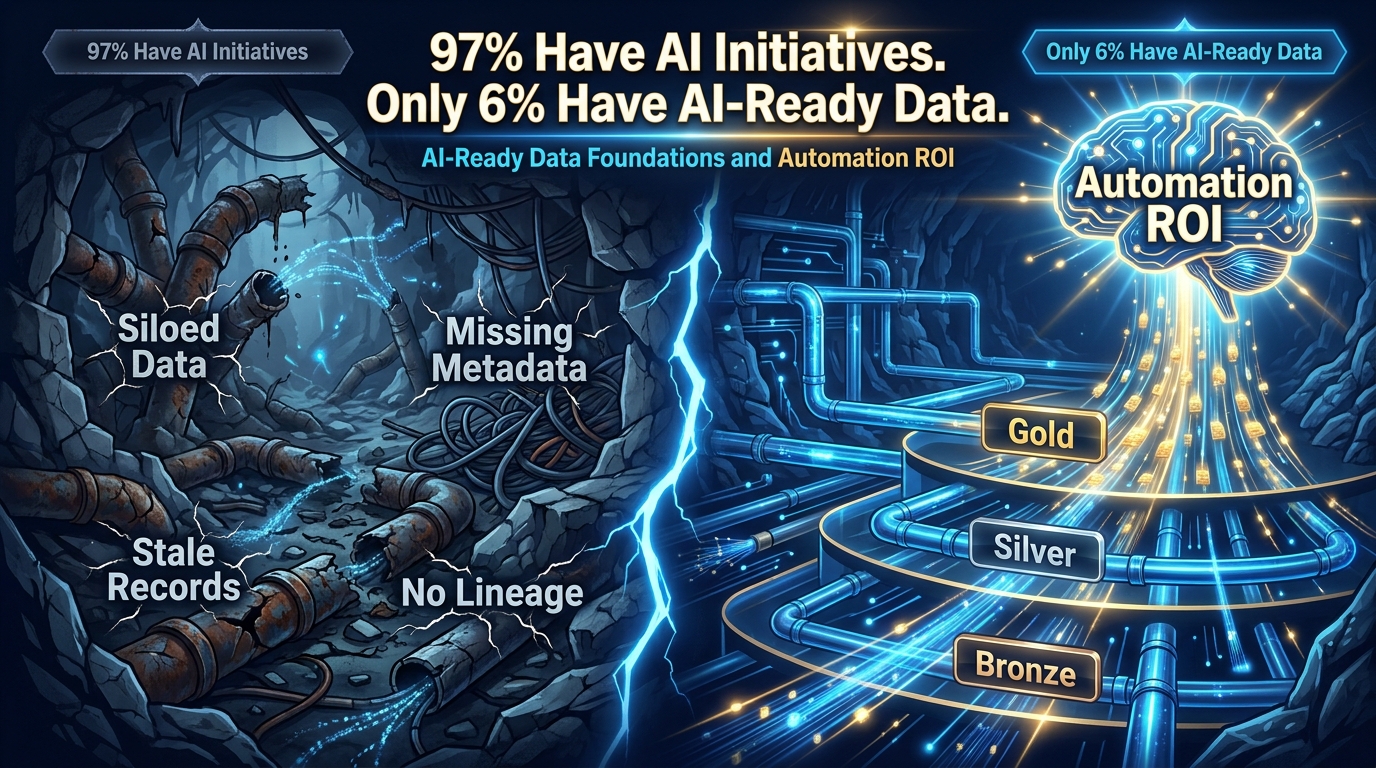

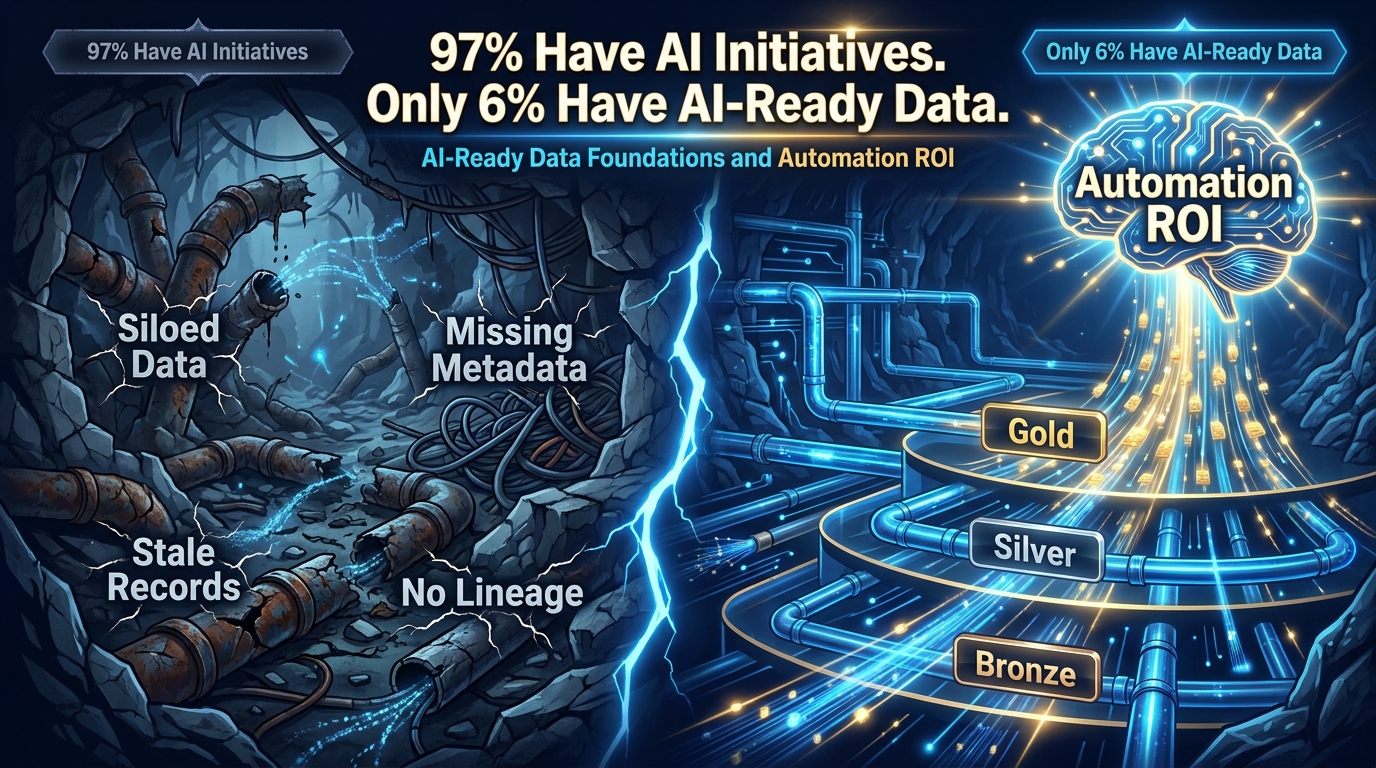
There is a number that should reset every board-level AI conversation happening in enterprise right now: 6%. According to Dun & Bradstreet’s 2026 AI Momentum Survey — a study of 10,000 businesses across 32 countries — just six percent of organizations say their enterprise data is fully ready to support AI at scale. Meanwhile, 97% of those same organizations report active AI initiatives.
That gap is not an AI problem. It is a data infrastructure problem masquerading as an AI problem. And it is the single most consistent reason that automation projects deliver impressive pilot metrics and then quietly stall when someone asks why the ROI never hit the business case.
The conversation around AI ROI has been dominated by questions about model selection, vendor platforms, and prompt engineering. What has received far less rigorous attention is the substrate those models run on — the data pipelines, governance structures, metadata layers, and architectural decisions that determine whether an AI system has anything trustworthy to act on in the first place.
This post examines that substrate in detail. Not the theory of it, but the mechanics: what AI-ready data actually requires at the infrastructure level, where the specific failure points are, what the architectural options look like in practice, and what a realistic roadmap to remediation involves. If your automation investments are underperforming, the answer is almost certainly buried in one of the sections below.
The Data Debt Nobody Quantifies — Until the Automation Stalls
The language of “data quality” has been used in enterprise contexts for decades, usually filed under IT hygiene and treated as a perennial background concern. In the context of AI automation, it is something categorically different. Poor data quality does not just produce slightly wrong outputs — it poisons model training, breaks agent workflows, corrupts decision loops, and introduces the kind of silent errors that only surface when an automated system has already made hundreds of wrong decisions at scale.
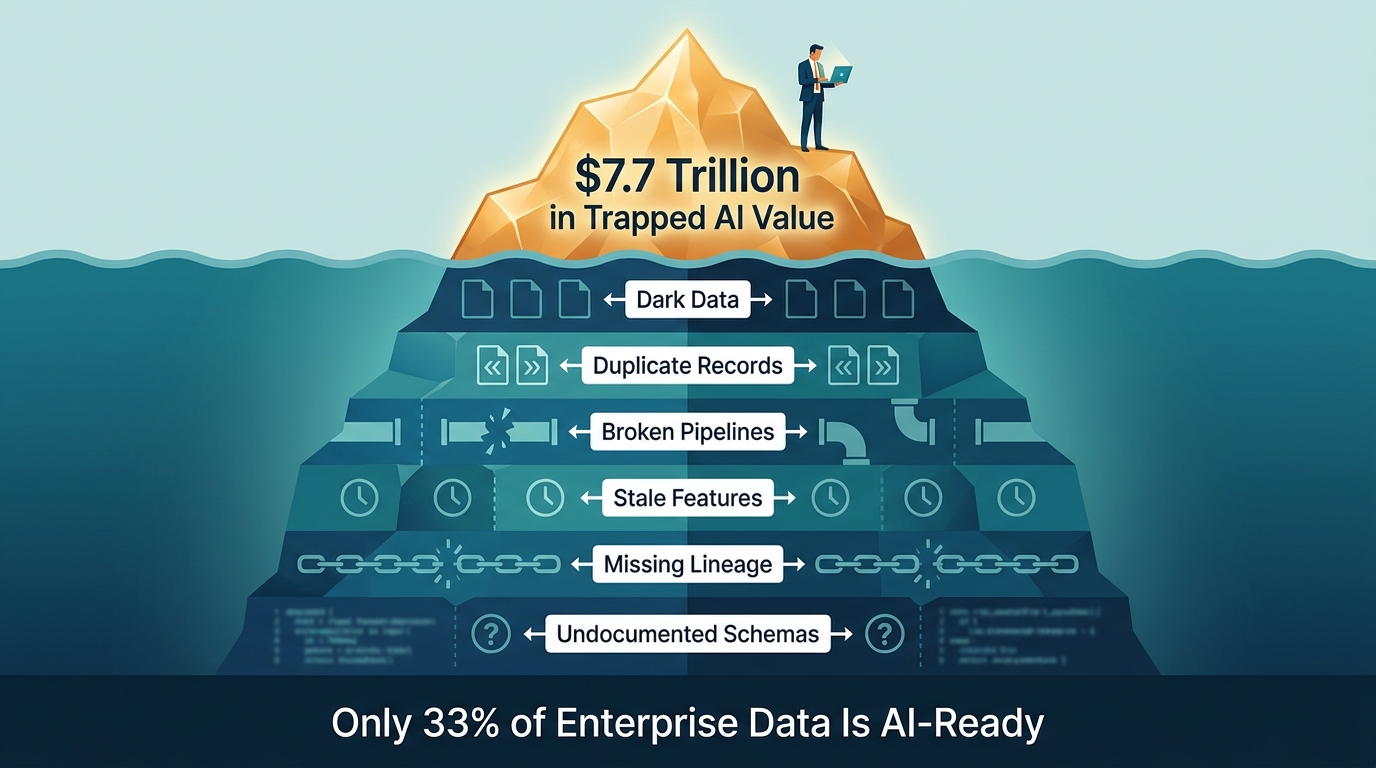
The numbers that have emerged in 2026 put a dollar figure on this for the first time with any real precision. Research cited across multiple 2026 data strategy reports places approximately $17.9 trillion in enterprise AI value as currently trapped by readiness gaps. Of that, data debt alone — the accumulated backlog of undocumented schemas, inconsistent identifiers, broken lineage, and untracked data transformations — accounts for roughly $7.7 trillion. Poor data quality is estimated to cost the average large enterprise around $12.9 million per year in avoidable losses, rework, and missed opportunities.
What Data Debt Actually Looks Like in Production
Data debt accumulates the same way technical debt does: through small, rational shortcuts made under time pressure that compound into structural liabilities. The most common manifestations in enterprise environments are:
- Undocumented schema changes: A source system updates its data structure. No one updates the downstream pipeline. The AI model consuming that data quietly begins training on malformed records.
- Orphaned transformation logic: ETL scripts written years ago that no longer reflect how the business defines a metric — but still run every night.
- Dark data: Structured and unstructured data that exists in the organization but has never been cataloged, classified, or made accessible. Estimates suggest enterprises typically access and use fewer than 20% of the data they actually hold.
- Inconsistent entity resolution: “Customer ID” means different things across CRM, billing, and support systems. When an AI agent tries to reason across them, it is reasoning about three different things it believes are one.
- Missing provenance: A dataset is available, but no one knows where it came from, what transformations it has been through, or whether its timestamp is when the event occurred or when it was logged.
Why This Matters More for AI Than for Traditional Analytics
Traditional BI and analytics can absorb a certain level of data messiness. A human analyst looking at a dashboard can apply judgment, spot obvious anomalies, and contextualize outliers. An AI model or automation workflow cannot do any of that by default. It takes the data as given.
This is the core asymmetry. When you move from human-in-the-loop analytics to automated AI decision-making, your tolerance for data quality degradation drops to near zero — particularly in production workflows where errors compound across thousands of decisions per hour. Gartner’s prediction that 60% of AI projects lacking AI-ready data will be abandoned through 2026 is not pessimism; it is a description of what happens when you build automation on a cracked foundation.
The hidden irony is that organizations often discover this bottleneck only after significant AI investment. The model is purchased, the platform is deployed, the use case is defined — and then the data assessment reveals that the underlying estate cannot support it. Remediation at that point costs five to ten times more than it would have cost to address the foundation first.
What “AI-Ready Data” Actually Means at the Infrastructure Level
The phrase “AI-ready data” gets used loosely. In vendor materials it often means little more than “data we can ingest.” For practical purposes — the kind that determine whether your automation delivers ROI — it means something specific and demanding across five dimensions.
1. Completeness and Accuracy
AI-ready data must be complete enough that models are not constantly imputing or ignoring missing values in ways that skew outputs. It must be accurate enough that the records reflect ground truth, not legacy errors preserved through years of migration. This is table stakes, but it is where most estates fall down first. The D&B 2026 survey found that only 23% of firms use formal data quality frameworks to manage their environments — which means 77% are operating without systematic verification of what they claim their data represents.
2. Consistency and Standardization
Consistency means that the same concept is represented the same way across systems. A product SKU should mean the same thing in the warehouse system, the order management platform, and the CRM. A date should follow the same format. Status codes should be enumerated and documented. When they are not, joins fail silently, aggregations produce nonsense, and AI models learn contradictions rather than patterns.
3. Lineage and Provenance
AI-ready data comes with a clear chain of custody. You can trace any field in a model’s training set back to its source, through every transformation it passed through, with timestamps and transformation logic documented. This matters both for debugging (when a model behaves unexpectedly, lineage tells you where to look) and for compliance (increasingly, regulatory frameworks require organizations to demonstrate what data an AI system was trained on and how).
4. Timeliness and Freshness
AI systems making automated decisions need data that reflects the current state of the world at the time the decision is made. This is more complex than it sounds. A fraud detection model that is four hours stale is a fraud detection model that misses four hours of patterns. A customer personalization workflow running on yesterday’s behavioral data is personalizing for a customer version that no longer exists. Freshness requirements vary by use case, but they must be explicitly defined and enforced — not assumed.
5. Discoverability and Accessibility
The final dimension is whether AI systems and the teams building them can actually find and access the data they need without weeks of ticket queues and manual exports. This requires a governed data catalog — an inventory of what data exists, what it means, who owns it, how to access it, and what its quality profile looks like. Without this, data scientists and ML engineers spend the majority of their time on data archaeology rather than model development. Studies consistently show that data preparation and access account for 60–80% of AI project time in organizations that lack mature catalogs.
Four Ways Data Breaks Automation — and Where to Find Them
Rather than treating data problems as a single undifferentiated mass, it is more useful to categorize the specific failure modes that most commonly derail automation projects. Each has a distinct signature and a distinct remediation path.
Failure Mode 1: The Schema Drift Problem
Source systems change. APIs evolve. Databases get new columns and deprecated fields. In a mature data infrastructure, these changes are tracked through schema registries and data contracts — formal agreements between data producers and consumers about what the data will look like and how changes will be communicated. In most enterprises, they are not. The result is that AI pipelines built on a schema at month one are quietly consuming a different schema at month six, often without any error thrown — just silently degrading output quality.
The signature of schema drift is model performance that erodes gradually over time without any obvious trigger. If your automation was working well six months ago and is producing worse results now with no change to the model, schema drift is a primary suspect.
Failure Mode 2: The Feature Staleness Trap
Many enterprise AI models rely on pre-computed features — aggregated signals like “average order value over the last 30 days” or “number of support tickets in the last quarter.” These features are computed by pipelines that run on a schedule. When that pipeline fails, runs late, or produces incorrect outputs, the model consuming the feature does not know. It receives a stale value and treats it as current.
Feature staleness is particularly pernicious because it tends to affect the most predictive signals first — precisely because the most complex, high-value features tend to be computed through the longest and most fragile pipeline chains. The automation continues to run, producing outputs that look plausible on the surface but are grounded in historical state rather than current reality.
Failure Mode 3: The Training-Serving Skew
Training-serving skew occurs when the data a model was trained on differs — in distribution, format, or processing logic — from the data it receives when deployed in production. This is one of the most common sources of AI automation underperformance, and it is also one of the hardest to detect because the model produces predictions without flagging that anything is wrong.
It typically happens when model training is done in a data science environment with a specific set of preprocessing steps, and those steps are re-implemented (imperfectly) in the production serving pipeline. Small differences in how nulls are handled, how timestamps are rounded, or how categorical variables are encoded create systematic distributional gaps between training and serving — gaps that translate directly into degraded decision quality at scale.
Failure Mode 4: The Governance Black Hole
The governance black hole describes what happens when AI workflows consume data that no one fully owns, understands, or monitors. It is the accumulation of the first three failure modes into a systemic condition: data is flowing, automation is running, decisions are being made — but no one can answer basic questions about the data’s provenance, freshness, or accuracy with confidence. In regulated industries, this is a compliance liability. In all industries, it is an automation ROI liability because there is no reliable mechanism to detect when something has gone wrong.
The 2026 data governance research makes clear that only a small minority of enterprises have governance frameworks sophisticated enough to prevent this. The shift required is treating governance not as a policy and documentation exercise but as a technical system — a set of automated controls, monitoring rules, and ownership structures embedded directly in the data infrastructure.
Data Mesh vs. Data Fabric: The Architecture Choice That Shapes Everything
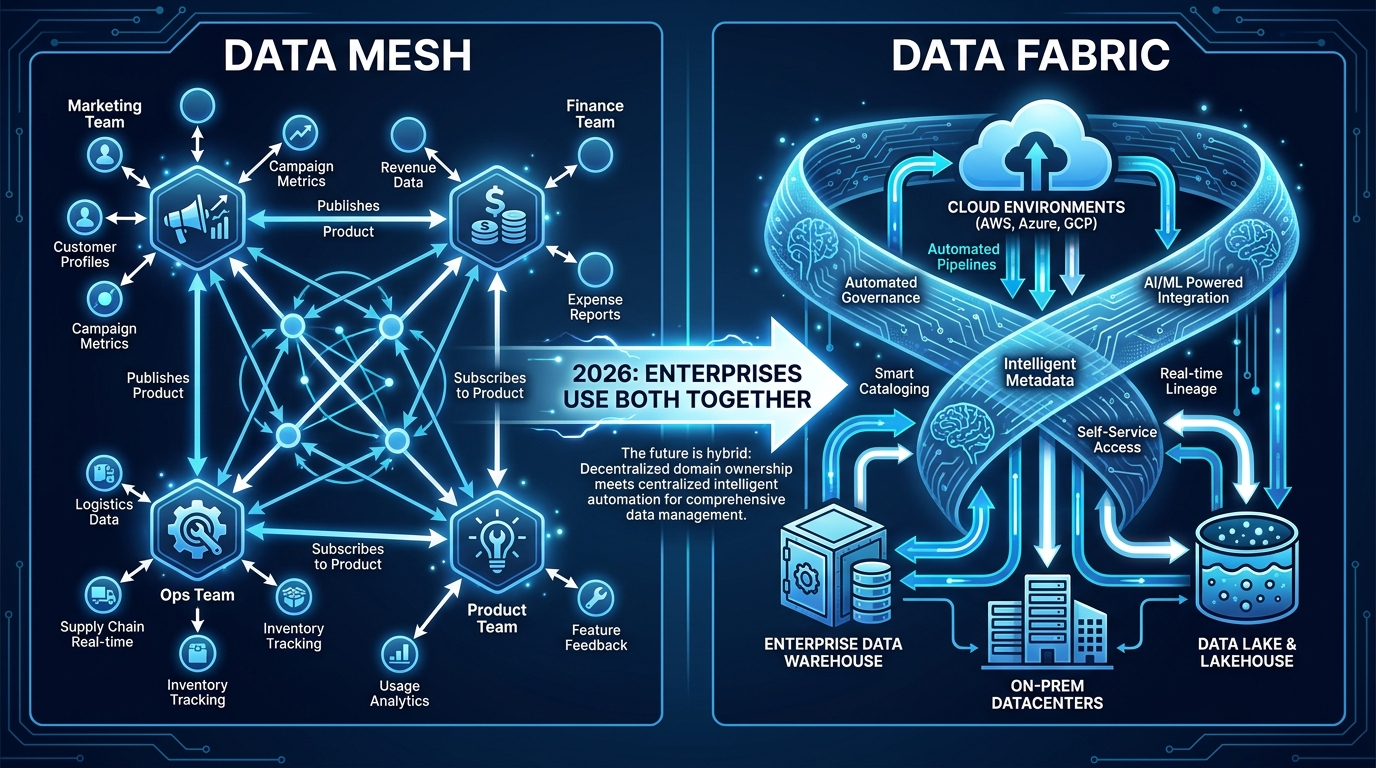
The two dominant architectural paradigms for enterprise data infrastructure — data mesh and data fabric — have been positioned as competing choices for several years. The practical reality in 2026 is that the most successful enterprise AI programs are not choosing between them. They are using both, and understanding why requires clarity on what each actually does.
Data Mesh: Fixing the Organizational Problem
Data mesh is fundamentally an organizational and operating model, not a technology choice. Its core insight is that centralized data teams cannot scale to meet the needs of large, complex enterprises — and that the solution is to decentralize data ownership to the domain teams that are closest to the data and most accountable for its quality.
In a data mesh model, the marketing team owns and publishes marketing data products. The finance team owns financial data products. The logistics team owns supply chain data products. Each domain treats data as a product: it has a defined interface, service-level agreements for quality and freshness, documentation, and a named owner who is accountable for its reliability. Governance is federated — there are enterprise-wide standards, but enforcement and stewardship happen at the domain level.
The AI automation benefit of this approach is significant: when data products have explicit owners and quality SLAs, the failure modes described above become easier to detect and remediate. There is a named person accountable when a feature goes stale or a schema changes without notice. The problem is that data mesh by itself does not solve the technology integration challenge — it still requires a layer that can federate access, enforce consistency, and automate cross-domain discovery.
Data Fabric: Fixing the Technology Problem
Data fabric addresses the technology side. It is an architecture layer — typically implemented through a combination of a metadata catalog, an integration platform, and automated governance controls — that sits across an organization’s entire heterogeneous data estate. Data fabric does not care whether your data lives in a cloud warehouse, an on-premises database, a SaaS application, or a streaming platform. Its job is to provide a unified, metadata-driven view of all of it, with automated lineage tracking, policy enforcement, and access control.
The intelligence in a data fabric comes from its metadata engine. By automatically profiling data as it lands, tracking how it moves and transforms, and using that metadata to make recommendations about data quality, access, and usage, the fabric reduces the manual overhead of data management significantly. In AI contexts, this translates to faster discovery of relevant datasets, automated quality alerts, and the kind of end-to-end lineage that compliance frameworks increasingly demand.
Why 2026’s Best Programs Use Both
The convergence happening in 2026 positions data mesh and data fabric as complementary layers: mesh defines the ownership model and produces domain data products; fabric provides the automated integration and governance layer across those products. Together, they address both the organizational accountability problem and the technical integration problem — which is why organizations running hybrid architectures consistently report faster time-to-value for AI use cases than those that have pursued either approach in isolation.
The practical implication for enterprises planning their AI data infrastructure is to stop treating this as an either/or technology selection decision. The question is not “mesh or fabric” — it is “how do we implement the mesh ownership model in parallel with building the fabric automation layer, and in what order?”
The Lakehouse Stack: Why the Bronze-Silver-Gold Architecture Is the Right Starting Point
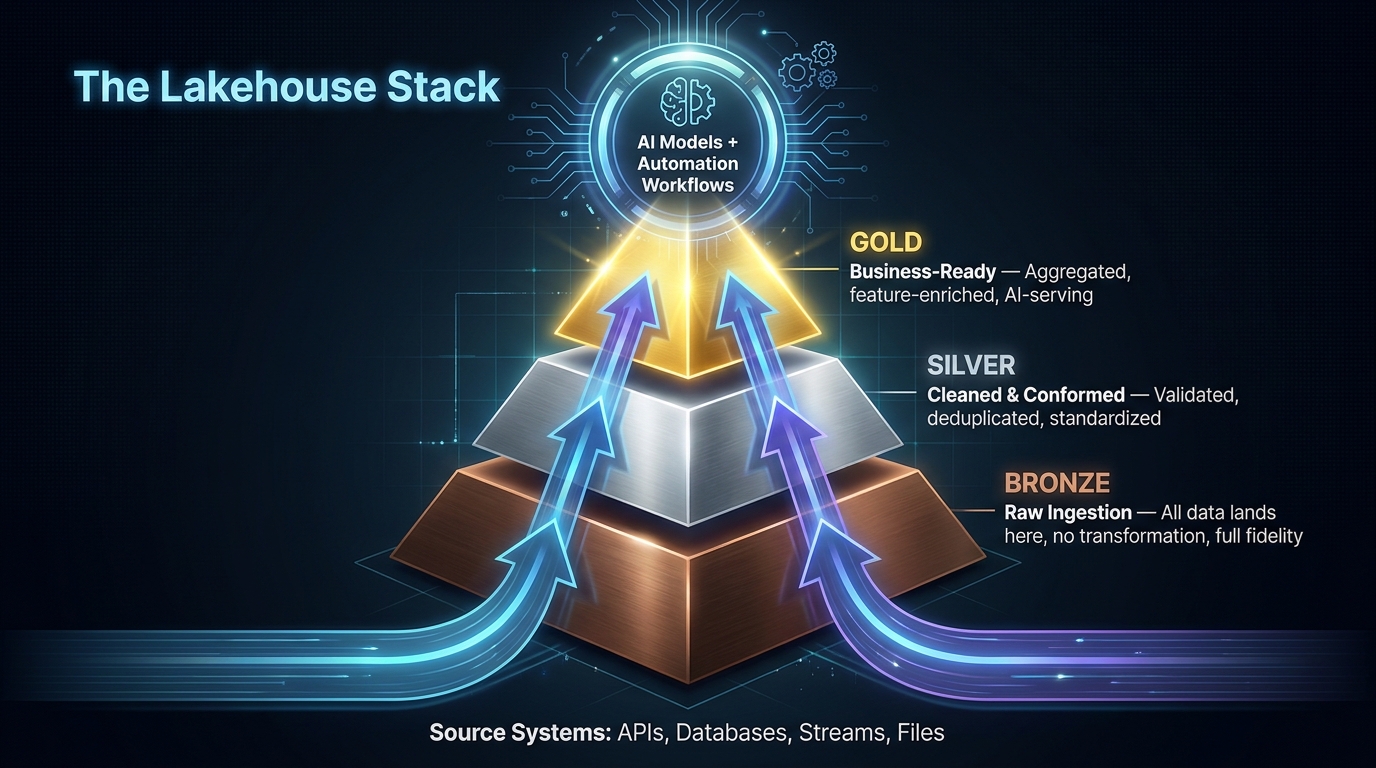
Whatever organizational model an enterprise chooses, the technical backbone of an AI-ready data foundation in 2026 is almost universally the lakehouse architecture — specifically, the medallion layering pattern that separates data by its processing state.
Bronze: The Immutable Landing Zone
The bronze layer is where raw data lands, exactly as it arrives from source systems. Nothing is transformed. Nothing is filtered. Everything is preserved with its original timestamps and structure. This layer is the enterprise’s source of truth for what data it received, when, and from where.
The critical property of the bronze layer is immutability. Once data lands, it does not change. This creates a complete historical record that enables two things that AI systems depend on heavily: point-in-time replay (the ability to reproduce the exact dataset that existed at any historical moment, which is essential for retraining models with the data they would have seen at the time of a decision) and full auditability (the ability to trace any downstream artifact back to its exact source record).
Modern lakehouse formats — Apache Iceberg and Delta Lake being the most widely adopted — support this through built-in versioning and time-travel capabilities, allowing organizations to query the state of any table at any point in its history without maintaining separate snapshot archives.
Silver: The Conformance Layer
The silver layer is where raw data becomes trustworthy. This is where validation rules run, duplicates are resolved, formats are standardized, and entity resolution logic is applied. It is also where data contracts take effect — the silver layer is the enforcement point for the quality SLAs that domain teams have committed to in the mesh model.
A well-constructed silver layer produces data that is clean and conformed but not yet business-specific. The goal is general-purpose trustworthiness: a silver-layer customer record has a validated, resolved identifier, consistent field names, and a verified freshness timestamp — but it has not yet been aggregated, enriched, or shaped for any specific use case.
This distinction matters because different AI use cases will need to transform and aggregate data in different ways. Keeping the silver layer use-case-agnostic preserves the reusability that makes the architecture scalable. When every team builds its own transformation layer from bronze to the shapes it needs, you get proliferating pipeline duplication and the governance problems that come with it. When silver is shared and conformant, gold-layer transformations become lighter, faster, and easier to audit.
Gold: The AI-Serving Layer
The gold layer is where data is shaped for specific consumption: business reporting, ML model training, feature serving, RAG retrieval, and agentic AI workflows. Gold tables are purpose-built aggregations, joins, and feature computations that reflect the specific requirements of a use case.
In AI automation contexts, the gold layer is where feature engineering happens, where embeddings are pre-computed, where context windows are structured for language models, and where the aggregations that power automated decisions are maintained. The gold layer changes more frequently than bronze and silver because it reflects evolving use cases — but it should always be derived entirely from the silver layer, never directly from bronze. That provenance chain is what makes the entire architecture auditable and reliable.
Format and Storage Decisions That Matter
The shift to open lakehouse formats — particularly Iceberg, which has become the de facto standard for large enterprise deployments — matters for AI readiness in ways that go beyond storage efficiency. Iceberg’s support for schema evolution allows source system changes to be accommodated without breaking downstream pipelines. Its partition evolution allows query optimization to change over time without rewrites. And its support for row-level deletes enables compliance with data deletion requirements (GDPR, CCPA) without rebuilding entire tables — a requirement that has tripped up organizations that built their estates on immutable blob storage without thinking through the compliance implications.
Governance as a Technical System, Not a Policy Document
The gap between how enterprises think about data governance and what AI-ready governance actually requires is substantial. Most governance programs in large organizations consist of a data stewardship committee, a set of policies in a document repository, and a catalog tool that is partially populated and irregularly maintained. This is governance as bureaucracy. What AI automation requires is governance as code — automated, enforced, observable, and embedded in the infrastructure itself.
Data Contracts: The Governance Primitive
The most significant shift in enterprise data governance practice in 2026 is the adoption of data contracts as a first-class infrastructure concept. A data contract is a formal, machine-readable agreement between a data producer (a team or system) and its consumers about what the data will contain, what quality guarantees apply, how changes will be communicated, and what the SLAs for freshness and availability are.
Data contracts are typically implemented as schema definitions combined with quality rules, versioned in source control alongside application code, and enforced by a validation layer that runs at the point of ingestion into the bronze layer. If a source system sends data that violates the contract — wrong schema, out-of-range values, unexpected nulls — the pipeline rejects it and alerts the producer before the bad data can propagate downstream.
This is governance that actually prevents data quality failures rather than just reporting them after the fact. For AI automation, where a single bad batch can corrupt a model’s decision-making for hours before anyone notices, the difference between proactive contract enforcement and reactive quality monitoring is the difference between a manageable incident and a significant business impact.
Automated Lineage: The Debuggability Requirement
Lineage — the ability to trace every data artifact back to its source — is governance’s most underappreciated component in AI contexts. When an automated decision is wrong, the debugging process starts with “what data did this model see?” If the answer requires a manual investigation that takes days, the organization cannot iterate on its AI systems at any meaningful speed.
Modern data platforms — Databricks Unity Catalog, Apache Atlas, OpenLineage, and similar tools — provide automated column-level lineage as a platform feature rather than a manually maintained diagram. Every transformation is logged. Every model training run records exactly which data it consumed and at what version. Every pipeline output records its upstream dependencies. This lineage graph becomes the organization’s most valuable debugging and compliance asset as AI automation scales.
Access Control That AI Systems Can Navigate
AI-ready governance includes access control that is granular enough to enforce privacy and compliance requirements but flexible enough not to starve AI systems of the context they need to operate. The two most common failure modes here are over-restriction (data is so locked down that ML engineers spend weeks getting access to datasets they need, dramatically slowing development cycles) and under-restriction (sensitive data flows into AI training and inference contexts where it should not, creating compliance exposure).
The 2026 standard for AI-ready access control is attribute-based access control (ABAC) implemented at the platform level, with automated classification of sensitive data fields and dynamic masking or filtering applied based on the consuming system’s permissions. This requires that sensitive data be tagged and classified — which returns to the metadata management problem. Governance is ultimately a metadata problem, and the organizations that solve governance are those that invest in metadata infrastructure as a first-class technical system.
Feature Stores, Vector Databases, and the Emerging AI-Native Data Layer
Beyond the lakehouse foundation, AI automation in 2026 requires a second layer of infrastructure purpose-built for the specific ways AI models consume data. This layer has three primary components that are increasingly converging into a unified AI-native data layer.
Feature Stores: Solving the Training-Serving Skew
A feature store is a centralized repository for pre-computed ML features — the derived signals and aggregations that models use as inputs. Its primary technical purpose is to serve the same feature values in both offline training and online inference contexts, eliminating the training-serving skew described earlier.
The mechanics are straightforward: when a feature is defined, the store computes it from the upstream data and writes it to both an offline store (for batch training) and an online store (for low-latency serving during real-time inference). Because both paths compute the feature from the same definition against the same data, skew is structurally prevented rather than managed through vigilance.
Beyond skew prevention, feature stores deliver reusability benefits that compound significantly at scale. A feature representing “customer average order value in the last 90 days” might be useful for five different models across fraud, personalization, inventory planning, customer churn, and pricing automation. Without a feature store, each team computes it independently — creating five separate pipelines with potentially five different implementations. With a feature store, it is computed once and served to all consumers, with a single owner accountable for its accuracy and freshness.
Vector Databases: The Retrieval Layer for Language Models and Agents
The proliferation of large language model applications — RAG systems, copilots, and agentic workflows — has created a new data infrastructure requirement that traditional databases handle poorly: high-dimensional vector similarity search. Vector databases (Pinecone, Weaviate, Milvus, Qdrant, and the vector search capabilities now embedded in Postgres and Elasticsearch) store embeddings — dense numerical representations of text, images, or structured data — and support approximate nearest-neighbor search across those embeddings at low latency.
For enterprise AI automation, vector databases serve two primary functions. First, they power retrieval-augmented generation: before an LLM generates a response or makes a decision, relevant context is retrieved from the vector database and injected into the model’s context window. This is what allows LLM-based automation to work with proprietary organizational knowledge rather than relying solely on what was in the model’s training data. Second, they serve as agent memory: agentic AI systems that take sequences of actions across multiple steps need to store and retrieve previous context. Vector databases provide the episodic memory layer that makes this possible.
The critical governance requirement for vector databases is that the data loaded into them — and the embeddings derived from it — must be subject to the same access control and quality standards as the rest of the data estate. An enterprise that carefully governs its relational data but loads unclassified, ungoverned content into a RAG vector store has created a significant compliance and quality gap in a part of the infrastructure that is increasingly central to automated decision-making.
The Convergence Trend: Unified AI-Native Data Platforms
The most significant architectural development in 2026 is the convergence of feature stores, vector databases, and RAG infrastructure into unified platforms. Modern feature stores are adding native vector retrieval. Vector databases are adding structured metadata filtering that makes them useful for feature serving. Cloud data platforms are adding LLM and embedding pipelines as native features.
This convergence is reducing the number of moving parts that organizations need to manage — which matters enormously for the governance and observability story. Every additional system in the AI data stack is another failure point, another access control boundary, and another lineage tracking challenge. The trend toward consolidation reflects a maturing recognition that the complexity of managing a fragmented AI data layer is itself a significant ROI drag.
Real-Time Streaming: The ROI Multiplier Most Automation Programs Underprioritize
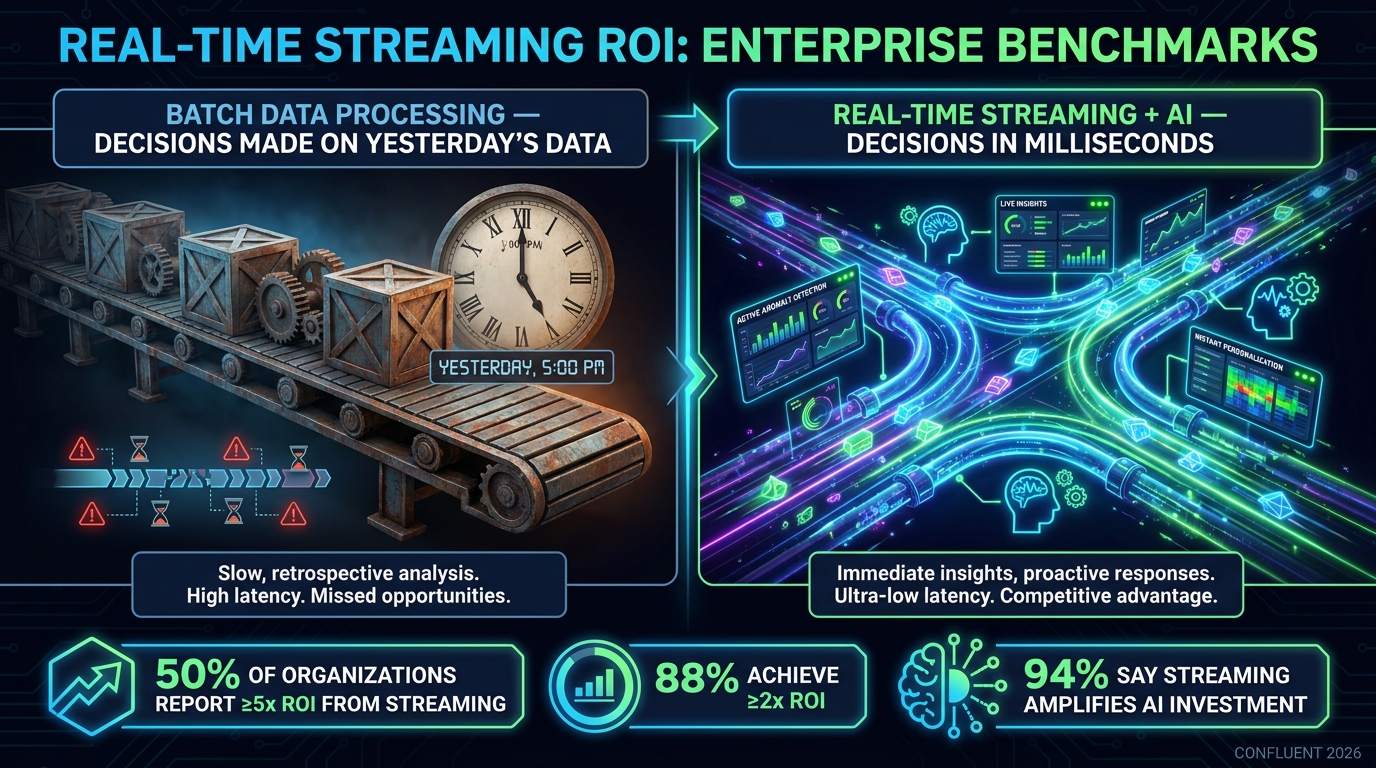
Most enterprise AI automation programs are built on batch data pipelines. Data is collected, processed, and made available on a schedule — hourly, daily, sometimes weekly. For many use cases, this is adequate. For an expanding set of high-value automation scenarios, it is a fundamental constraint on ROI.
The Confluent 2026 data streaming report documents the financial case with unusual clarity: 50% of organizations deploying real-time data streaming report at least 5x ROI on that investment. 88% achieve at least 2x ROI. And 94% of technology leaders say streaming amplifies their AI investments — a figure that reflects how fundamentally the ability to act on current data changes what AI automation can accomplish.
Where Real-Time Streaming Changes the Automation Calculus
The use cases where real-time streaming most dramatically expands automation ROI share a common characteristic: the value of a correct decision degrades rapidly with time. Consider fraud detection. An automated fraud scoring model running on batch data from six hours ago does not score the transaction being processed right now — it scores an approximation of the customer based on historical behavior. A streaming architecture allows the model to score transactions using behavioral signals from the last few seconds: devices seen, locations visited, velocity of activity. The quality difference is not marginal; it is the difference between catching fraud and retrospectively knowing you missed it.
Similar dynamics apply to inventory and supply chain automation (where real-time demand signals prevent both stockouts and overstock decisions made on stale forecasts), to customer experience personalization (where in-session behavioral signals produce meaningfully better recommendations than daily recalculated preference profiles), and to operational maintenance automation (where sensor streams enable predictive intervention before failure rather than after).
Streaming Architecture Essentials for AI
Implementing streaming for AI automation is not simply a matter of switching from a batch ETL tool to Kafka or Kinesis. It requires rethinking several aspects of the data architecture simultaneously.
Event schema management becomes more critical in streaming contexts than in batch, because events arrive continuously and any schema error immediately affects downstream consumers. Schema registries — tools like Confluent Schema Registry that enforce Avro or Protobuf schemas on every message — are not optional infrastructure in a production streaming AI system; they are the mechanism that prevents schema drift from becoming a real-time incident.
Stateful stream processing is required for most AI-relevant use cases, which means maintaining running aggregations and window computations across the stream rather than just routing raw events. Tools like Apache Flink and the Kafka Streams API provide the stateful processing capabilities needed to compute streaming features — but they introduce state management complexity that has no equivalent in batch architectures. Organizations moving from batch to streaming for the first time significantly underestimate this operational complexity.
Idempotency and exactly-once semantics matter enormously when a stream is feeding automated decisions. If a payment confirmation event is processed twice because of a network retry, and the downstream automation treats each processing as a distinct event, the consequences can range from annoying (duplicate confirmation emails) to severe (duplicate transactions). Designing streaming pipelines with exactly-once guarantees requires deliberate architectural choices at every layer of the stack.
The Hybrid Batch-Streaming Architecture
Real-time streaming does not replace batch processing — it complements it. The most effective 2026 AI data architectures use a Lambda or Kappa hybrid model: real-time streams handle high-velocity, time-sensitive signals, while batch pipelines handle the large-scale historical computations that inform model training and complex aggregations. The critical integration challenge is ensuring that models consuming both streaming features and batch-computed features do not experience inconsistency between the two — which is where feature stores with both online and offline serving capabilities become essential.
The Five-Phase Roadmap to AI-Ready Data
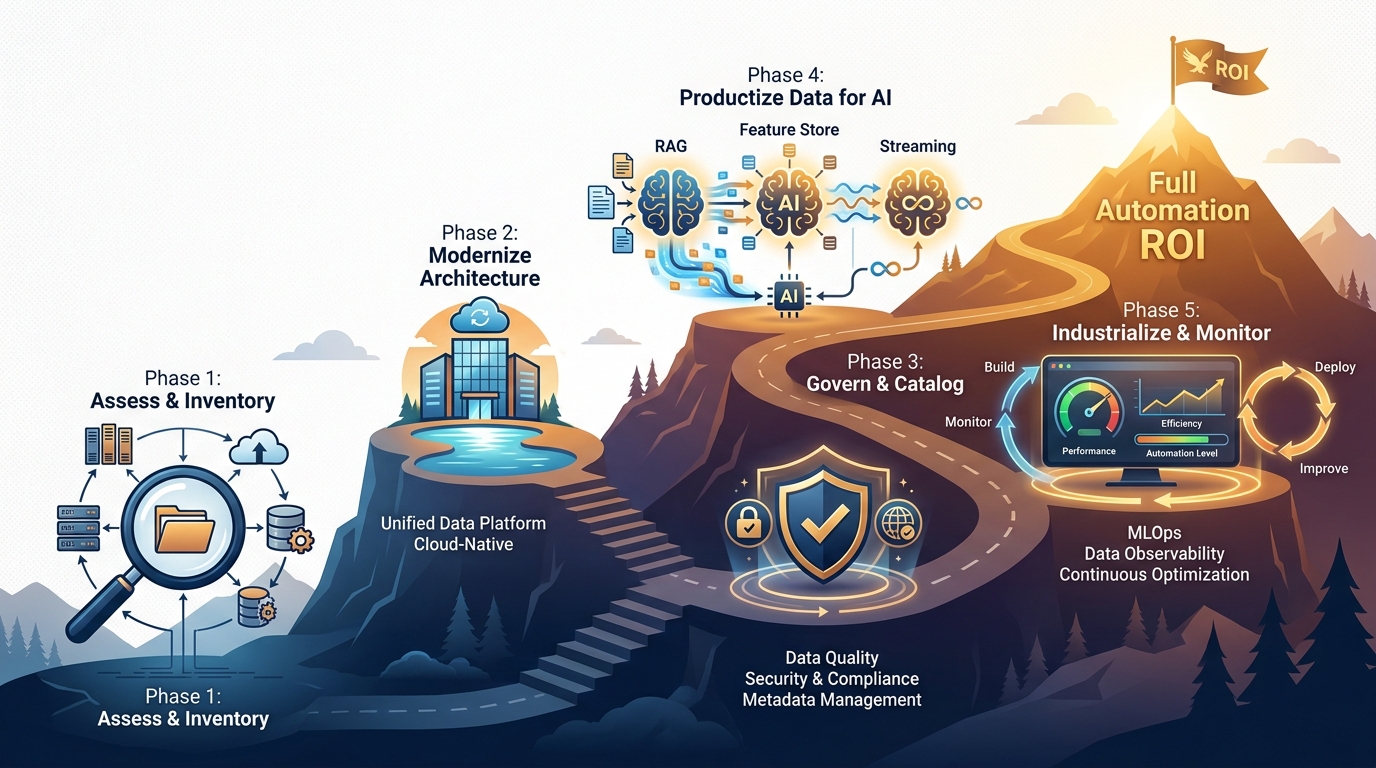
The research and architecture described above can feel like an overwhelming remediation agenda. The practical question is where to start and in what sequence to proceed. Based on the pattern of successful enterprise AI data programs, a five-phase roadmap emerges consistently.
Phase 1: Assess and Inventory (Weeks 1–8)
Before any infrastructure investment, the organization needs a clear-eyed picture of what it has. This means a structured data estate assessment covering: what data sources exist and where they live, what the quality profile of each source is (completeness, accuracy, freshness, lineage), what AI use cases are planned and what data they require, and where the gaps are between current state and what those use cases need.
The output of Phase 1 is not a gap report that lives in a PowerPoint. It is a prioritized inventory of data assets, quality profiles, and a gap map tied to specific AI use cases with quantified impact. This is what allows Phase 2 investment to be targeted at the highest-value remediation rather than spread across the entire estate.
Critically, Phase 1 should select two to three flagship AI use cases to anchor the entire data readiness program. Abstract data quality programs without a use case forcing function almost universally stall. When data remediation is visibly tied to a specific automation that the business cares about, it gets funded and prioritized differently.
Phase 2: Modernize Architecture (Months 2–6)
Phase 2 addresses the foundational technology layer: implementing or migrating to a lakehouse architecture with medallion layering, selecting and deploying the catalog and governance tooling, and establishing the streaming infrastructure for use cases that require it.
The critical discipline of Phase 2 is to avoid the “big bang migration” approach that has derailed many data modernization programs. The more effective pattern is to build the new architecture in parallel with existing systems and migrate data assets incrementally, starting with the sources that feed the Phase 1 flagship use cases. This delivers value faster and provides a working reference implementation that makes subsequent migrations easier.
Phase 3: Govern and Catalog (Months 3–9, overlapping with Phase 2)
Governance implementation should run in parallel with architecture modernization, not follow it. The reason is that data contracts, quality rules, and access policies need to be defined before data lands in the new architecture — retrofitting them after the fact is significantly more expensive and disruptive.
Phase 3 involves implementing data contracts for high-priority source systems, bootstrapping the data catalog with the assets identified in Phase 1, establishing automated quality monitoring with alerting, and defining the metadata standards that all new data assets must adhere to. It also involves the organizational work of establishing domain data ownership — identifying who owns what data, what their quality commitments are, and how escalations are handled.
Phase 4: Productize Data for AI (Months 6–12)
Phase 4 is where the foundation becomes directly useful for AI consumption. This involves building out the feature store with features required by the flagship use cases, populating the vector store with organizational knowledge for RAG applications, and constructing the gold-layer data products that AI models will train and infer on.
The product mindset is essential here: each data asset produced in Phase 4 should be treated as an internal product with a defined interface, a quality SLA, versioning, and documentation. This discipline ensures that data products built for one AI use case can be reused by subsequent use cases without rebuilding — which is where the compounding returns of a well-executed data foundation begin to appear.
Phase 5: Industrialize and Monitor (Month 9 onwards)
Phase 5 is the ongoing operational mode that the first four phases make possible. It involves deploying automated data observability across the full stack, implementing ML monitoring for model drift detection, establishing the incident response processes for data quality failures, and building the continuous improvement loop that keeps the data estate fit for purpose as AI use cases evolve.
The key metric of Phase 5 success is time to detect and remediate data quality incidents. Best-in-class organizations in 2026 measure this in hours, not days. That detection speed is what enables AI automation to operate with high reliability at scale — because problems are caught and corrected before they propagate into thousands of automated decisions.
Measuring Data Readiness: The Metrics That Actually Matter
Data readiness is not a binary condition. It exists on a spectrum, and moving organizations need a way to track progress that goes beyond subjective assessment. The following metrics form a practical data readiness scorecard that can be tied directly to automation ROI outcomes.
Data Quality Metrics
- Completeness rate by source: The percentage of expected fields present and non-null across each source system feeding AI use cases. Target: 98%+ for features used in automated decisions.
- Schema contract violation rate: The percentage of incoming data batches or events that violate their defined data contracts. Target: less than 0.1% per source per day.
- Duplicate entity rate: The percentage of entity records (customers, products, transactions) that are not cleanly resolved to a single canonical identifier. Target: less than 1%.
- Data freshness SLA attainment: The percentage of data assets that meet their defined freshness SLAs. Target: 99%+ for AI use cases with real-time or near-real-time requirements.
Pipeline and Infrastructure Metrics
- Pipeline reliability rate: The percentage of pipeline runs that complete successfully without intervention. Target: 99.5%+ for production AI pipelines.
- Mean time to detect data incidents: How long it takes from the moment a data quality failure occurs to the moment it is detected by automated monitoring. Target: under 30 minutes for real-time systems, under 2 hours for batch systems.
- Feature serving latency (p95): The 95th percentile latency for feature retrieval in online serving contexts. Target varies by use case, but for real-time decision automation typically under 20ms.
Governance and Discoverability Metrics
- Catalog coverage: The percentage of data assets used in AI use cases that have entries in the data catalog with complete metadata. Target: 100% for production AI use cases.
- Lineage coverage: The percentage of gold-layer data assets for which complete column-level lineage can be traced back to source. Target: 100% for regulated use cases, 90%+ for others.
- Data access turnaround time: The time from a data access request by a data scientist or ML engineer to their ability to work with the data. Target: under 2 business days through self-service catalog access.
- Data owner assignment rate: The percentage of data assets with a named, current owner. Target: 100% for production AI use cases.
Connecting Data Metrics to Automation ROI
The most important discipline is connecting these technical metrics to business outcomes. Data readiness metrics that float in a data engineering dashboard without business visibility quickly lose prioritization support. The cadence that works is a quarterly review where data quality trends are presented alongside automation performance metrics — showing, for example, how the reduction in feature staleness incidents correlates with improved model accuracy, and how improved model accuracy correlates with automation decisions that delivered measurable business value.
This linkage is what converts the data foundation from an IT infrastructure program into a business-level investment with a visible return. And it is this visibility that sustains the multi-year commitment that building a genuinely AI-ready data foundation requires.
What the 6% Are Doing Differently — and What It Takes to Join Them
The Dun & Bradstreet finding that only 6% of enterprises have fully AI-ready data is striking, but it raises an obvious follow-on question: what are those organizations doing that the other 94% are not?
The patterns that distinguish the data-ready minority are consistent across the research. First, they treat data as a product — with the discipline of product development applied to data asset creation: defined owners, explicit quality standards, versioning, and ongoing maintenance. This is not a technical decision; it is an organizational one. It requires that data engineering and data stewardship be treated as first-class functions with clear accountability structures, not as support services for analytics teams.
Second, they made governance investments early — before scaling their AI programs — rather than trying to retrofit governance onto a data estate that was already powering production AI systems. The cost of governance implementation scales with the complexity and size of the AI program it is governing. Organizations that start governance late pay a significantly higher price for the same level of control.
Third, they have linked data investment to specific AI business outcomes. The data foundations that get funded and maintained are the ones that have visible, measurable connections to business results. Abstract data quality programs, however well-intentioned, tend to lose prioritization when competing for budget against projects with clear P&L visibility.
Fourth — and this is the element that is most frequently underestimated — they have invested in metadata infrastructure as seriously as they have invested in storage and compute. A well-populated, actively maintained data catalog with automated lineage, quality scoring, and access control is the organizational knowledge graph that makes everything else work. Without it, even a technically excellent lakehouse architecture becomes an expensive filing cabinet where things are difficult to find and impossible to trust completely.
“AI readiness is ultimately a metadata problem. Organizations that understand this build catalogs and governance as infrastructure. Organizations that don’t understand this build models on data they can’t fully explain.”
The 6% figure is not a ceiling. It is a description of where the industry is at a particular moment in a technology maturation curve. The organizations that invest now in the foundation — while competitors are still discovering that their automation programs are bottlenecked by data quality — have a compounding advantage. Every use case they build on a solid foundation is faster to deploy, more reliable in production, and easier to audit. Every use case built on fragmented, ungoverned data carries escalating remediation costs and reliability risk.
Conclusion: The Foundation Is the Strategy
Enterprise AI strategy in 2026 is almost entirely a conversation about applications, models, and use cases. Where should we deploy AI? Which processes should we automate? Which vendor platform should we choose? These are real questions with real strategic implications. But they are secondary questions. The primary question — the one that determines whether the answers to all the secondary questions actually deliver the returns they promise — is whether the data infrastructure beneath them can be trusted.
The evidence that it usually cannot is not subtle. 97% of organizations have active AI initiatives. 6% have data ready to support them at scale. 60% of projects lacking AI-ready data will be abandoned. 70–85% of AI project failures trace back to data quality. These numbers describe an industry that has dramatically accelerated its AI ambition without proportionally accelerating the foundational investment that ambition requires.
The path forward is not complicated in concept, even if it is demanding in execution. Assess your data estate honestly against the specific requirements of your planned AI use cases. Build the lakehouse architecture with proper layering. Implement governance as a technical system, not a policy program. Productize your data assets with the discipline of product development. Extend to streaming where the ROI case warrants it. Build out the feature and vector store layer for your AI consumption patterns. Measure progress with metrics that connect to business outcomes. And do not wait for the AI use cases to be in production before starting.
The organizations that will scale automation ROI in the next two to three years are not the ones with the most sophisticated models. They are the ones whose data can be trusted by the models they deploy. Fix the foundation, and the automation ROI follows. Leave it unfixed, and the ROI projections remain projections.
Key Takeaways
- Data readiness is the primary AI ROI bottleneck in 2026 — not model quality, platform choice, or use case selection. Address it explicitly and early.
- Only 6% of enterprises have fully AI-ready data, despite 97% having active AI initiatives. The gap between initiative and readiness is where ROI dies.
- Data debt has a quantified cost — approximately $7.7 trillion in trapped AI value globally, and $12.9 million per year per average enterprise in avoidable losses.
- AI-ready data has five dimensions: completeness and accuracy, consistency and standardization, lineage and provenance, timeliness, and discoverability. All five must be addressed.
- Data mesh and data fabric are complementary, not competing — mesh fixes the organizational ownership problem, fabric fixes the technology integration problem.
- The medallion lakehouse architecture (bronze/silver/gold) is the right technical starting point for most enterprises — it provides immutability, auditability, and the layered quality progression that AI systems need.
- Feature stores prevent training-serving skew — one of the most common and hardest-to-detect causes of AI automation underperformance.
- Real-time streaming amplifies AI ROI substantially — 50% of deployers report 5x+ ROI — but requires architectural rethinking beyond simply replacing batch tools.
- Governance must be implemented as technical infrastructure, not policy documentation. Data contracts, automated lineage, and attribute-based access control are the operative mechanisms.
- The five-phase roadmap (assess, modernize, govern, productize, industrialize) provides a sequenced path that delivers value incrementally rather than requiring a big-bang transformation.