

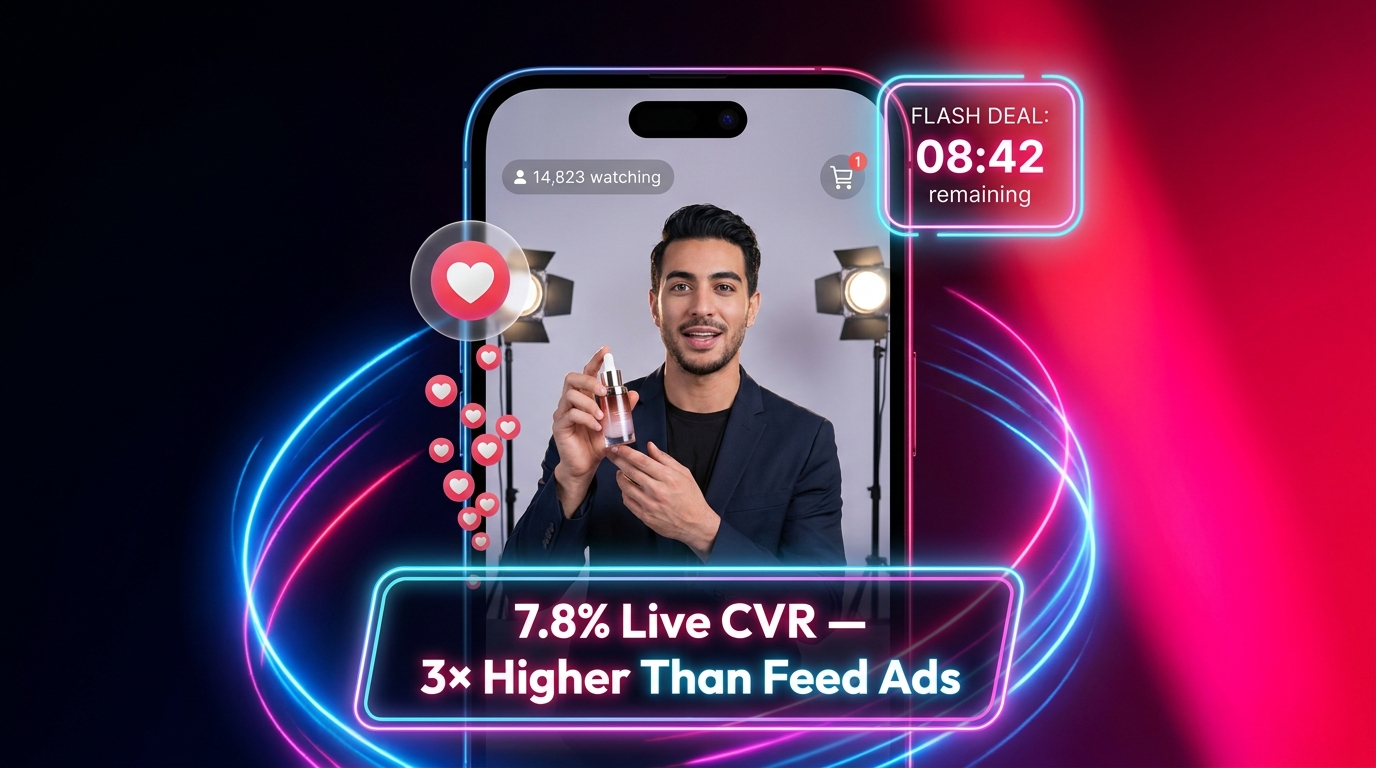

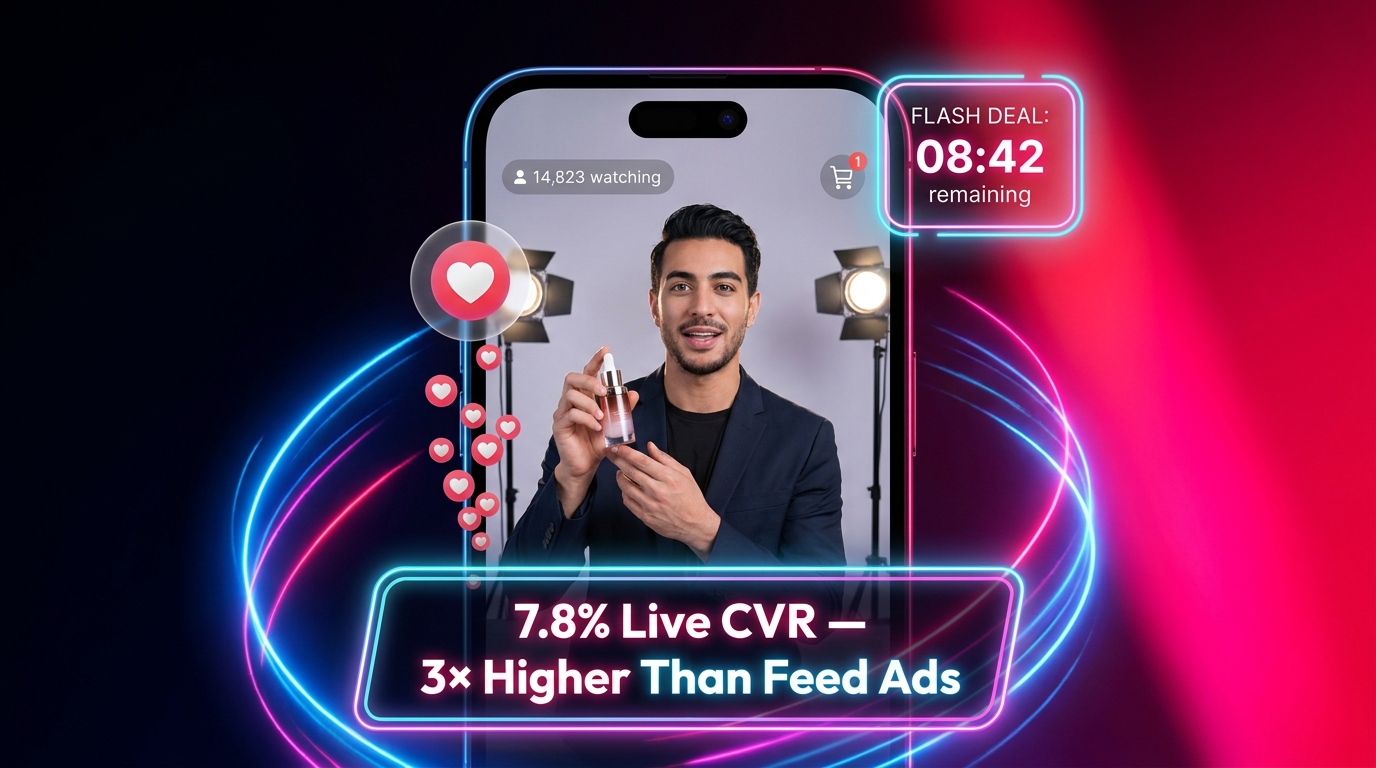
TikTok Shop’s live commerce channel is doing something that most e-commerce formats cannot: it’s converting browsers into buyers at a rate of 7.8% on average — more than three times what traditional feed ads deliver. At the top end, the best-performing live streams clear 8–12% conversion rates, numbers that would make most paid search managers check their attribution model twice.
But here’s the uncomfortable truth most sellers won’t tell you: the majority of TikTok Shop lives are underperforming badly. Low viewer counts plateau early. Products get demoed but never bought. Hosts run for 90 minutes and close three orders. The platform isn’t broken for those sellers — their funnel is.
TikTok Live shopping isn’t a broadcast format dressed up as commerce. It’s a compressed sales funnel — one that takes a stranger from zero awareness to checkout in under eight minutes when it’s engineered correctly. The difference between a $200 live and a $20,000 live usually isn’t the product, the audience size, or even the host’s personality. It’s whether the funnel architecture was built deliberately or assembled by accident.
This guide breaks down every layer of that architecture — from the 72-hour warm-up cascade that primes your audience before you even go live, to the micro-conversion signals that determine how aggressively TikTok distributes your stream, to the post-stream retargeting window that most sellers leave completely untouched. If you’re live selling and not hitting consistent conversion rates above 5%, something in the funnel is broken. Here’s how to find it.
Why TikTok Live Sells Differently Than Every Other Channel
Before diving into the funnel mechanics, it’s worth understanding what makes TikTok Live commerce structurally different from every other format — because the tactics only make sense once you understand the underlying psychology at play.
Discovery Commerce, Not Intent Commerce
Traditional e-commerce — Amazon, Google Shopping, even TikTok’s own Shop Tab — runs on intent. A person searches for “blue light glasses,” browses listings, reads reviews, and buys. They arrived with a purchase objective already formed. The seller’s job is to not lose them.
TikTok Live operates on an entirely different principle. Users who stumble into a live room via the For You Page weren’t searching for anything. They were scrolling for entertainment. This means the live seller is competing not with other product listings, but with the next video in the feed — a dance, a funny clip, a news story. The bar for capturing attention isn’t “have the best listing.” It’s “be more compelling than whatever comes next.”
This discovery-first, low-intent entry point is actually a massive advantage when handled correctly. Viewers arriving without intent are highly susceptible to impulse — they’re in an open, receptive mental state. But it also means the funnel has to do more work. There’s no pre-existing desire to channel. The live stream has to create desire from scratch, usually within the first 30 seconds of a viewer entering the room.
The Live Room as a Compressed Funnel
In a traditional marketing funnel, awareness, consideration, and purchase might play out across days or weeks of touchpoints. In a TikTok Live room, all three stages have to happen in minutes — sometimes in under five. A viewer enters, watches a demo, sees social proof from the chat, hears a price reveal, notices a countdown timer, and taps “Add to Cart” before their next scroll instinct kicks in.
According to data from MomentIQ’s 2026 live commerce analysis, TikTok Shop LIVE can be mapped as a five-stage micro-funnel: Join → Engage → Click Product → Add to Cart → Checkout. Each transition is a micro-conversion, and each one has a measurable drop-off rate. The sellers who understand which stage is bleeding the most are the ones who know where to focus their improvement energy.
Live also adds a dimension that no static format can replicate: social proof in real time. When a viewer sees 400 people in the room, watches the “cart” animation fire every few seconds, and reads comments like “just ordered mine!” — those signals collapse the consideration phase dramatically. The decision-making environment is fundamentally different from browsing a product page alone.
The 5-Stage Micro-Funnel: Where Viewers Actually Drop Off
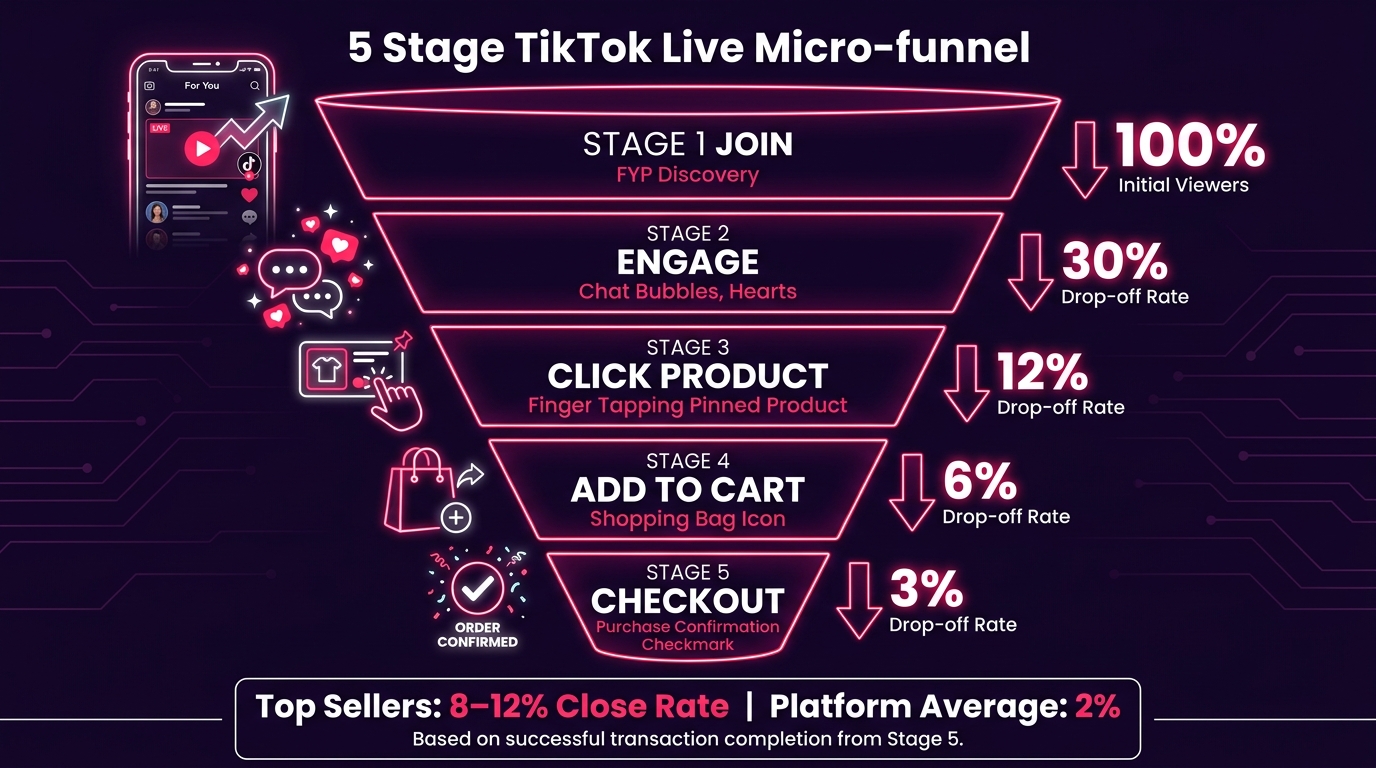
The most useful reframe for any live seller is to stop measuring success by peak concurrent viewers and start tracking the funnel stage-by-stage. Each of the five stages has distinct failure modes — and confusing them leads to applying the wrong fix in the wrong place.
Stage 1: Join (Impression → Room Entry)
The first conversion is getting a viewer from the FYP into your live room. TikTok surfaces live streams in a viewer’s feed as a preview card — a small thumbnail showing a moment from the stream, the host’s username, and a viewer count. The click-through from preview to room entry is your first drop-off point.
What drives this click? Primarily three things: an on-screen visual that creates curiosity or excitement (a dramatic demo, a striking product, the host’s energy), a viewer count that signals social proof (more viewers means more people have decided it’s worth watching), and the host’s face and aesthetic fitting the viewer’s interest graph. This is why cold-starting a live with zero viewers is so damaging — the preview card shows “0 watching” and almost nobody clicks in.
Stage 2: Engage (Stay and Interact)
Once someone enters the room, they’ll make a second decision within about three to five seconds: stay or scroll away. This is where the majority of live viewers are lost. Engagement at this stage — typing a comment, tapping a heart, responding to a question the host asks — is what converts a passive viewer into an active participant. And active participants buy at significantly higher rates than passive watchers.
The host’s job in this stage is to manufacture a reason to respond immediately. Asking “Where are you watching from?” or “Have you tried this before?” gives people an easy, low-stakes entry point into the chat. Once a viewer has typed in the chat even once, the psychological investment in the stream increases — they’re no longer a spectator, they’re a participant.
Stage 3: Click Product (Pinned Product Interaction)
This is where most mid-tier live sellers leak the most revenue. Viewers are watching, the host is demonstrating the product, but nobody is clicking the product card pinned at the bottom of the screen. The reason is almost always the same: the host isn’t directing attention to it explicitly and repeatedly enough.
Unlike a website where the product image and buy button are the primary visual elements on screen, in a live room the host is the dominant visual. The shopping bag icon at the bottom is a secondary UI element that most new viewers don’t even know exists. Getting clicks requires explicit, repeated verbal direction — “tap the bag at the bottom,” “click the orange button you see right now” — combined with a pause that gives viewers time to actually do it.
Stage 4: Add to Cart
Getting a viewer to click the product card is not the same as getting them to add to cart. The product detail page that appears when they click represents a micro-pause in the buying momentum — a moment of re-evaluation. Clean, clear product pages with good images, accurate pricing, and strong review counts matter here even inside a live context. Sellers who treat their product listings as secondary to their live performance often lose buyers at this exact stage.
Stage 5: Checkout
TikTok Shop’s in-app checkout is one of the platform’s biggest conversion advantages. Because payment credentials are stored and the checkout flow is native — no redirect to an external website, no re-entering card details — the friction between “add to cart” and “order confirmed” is minimal. Top sellers report checkout-to-order completion rates above 70% when the cart is already populated. The main leakage here happens when buyers add to cart but then the stream ends before they complete checkout, losing that urgency context. This is why revisiting cart abandonment during the stream (“still have things in your bag? Flash price ends in two minutes”) is such a standard tactic among high-performing hosts.
The 72-Hour Pre-Stream Warm-Up Cascade
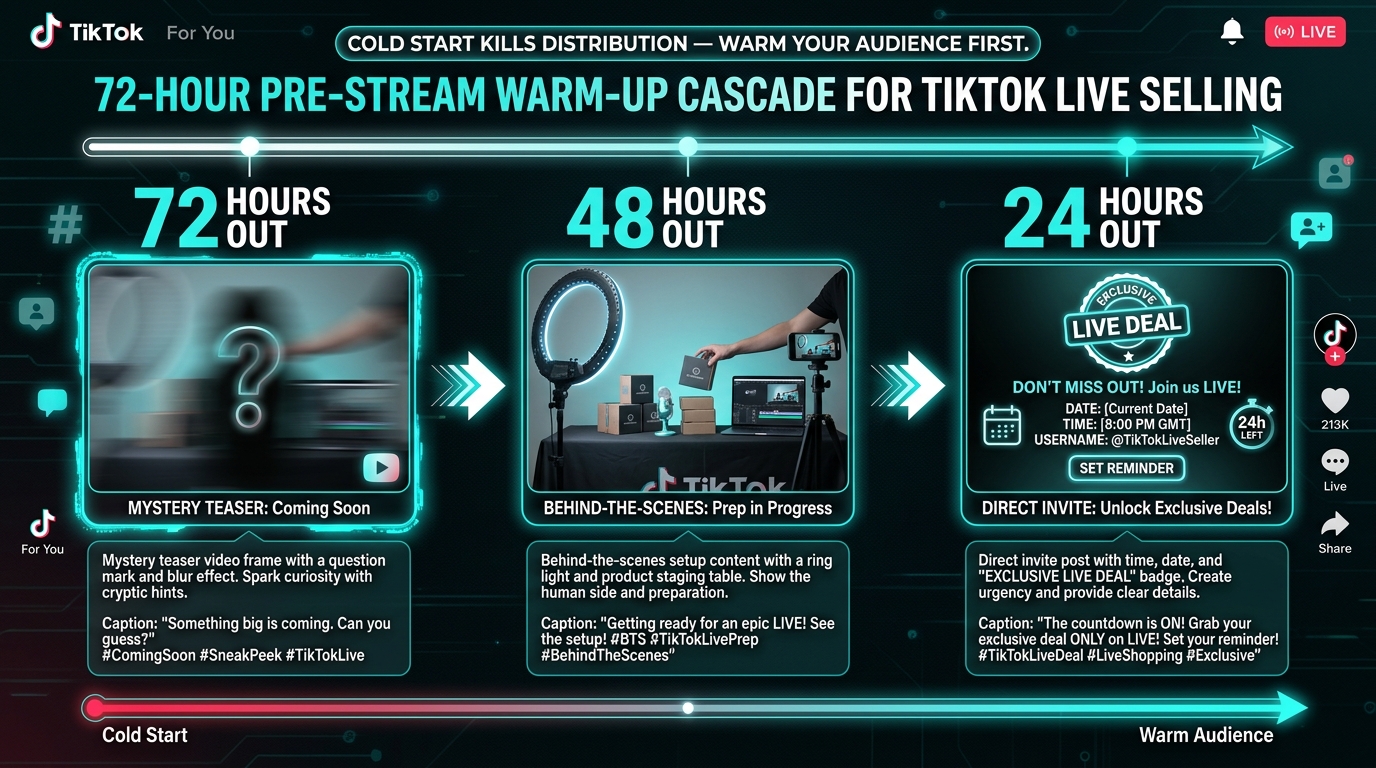
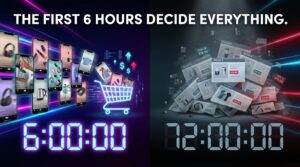
One of the most common structural mistakes live sellers make is treating the live stream as the entire event. In reality, the funnel starts days before you go live. The difference between a stream that opens to 12 concurrent viewers and one that opens to 200 usually comes down to what happened in the 72 hours before the stream began.
Why the Cold Start Is a Distribution Killer
TikTok’s LIVE distribution algorithm uses early engagement signals — specifically, watch time, chat interactions, and viewer retention in the first few minutes — to decide how broadly to push your stream to the FYP. A cold start, where you go live with zero warm audience and sit at 2–3 concurrent viewers for the first 10 minutes, sends weak signals. The algorithm interprets low early engagement as “not interesting enough to amplify” and distribution stays minimal.
Contrast that with a stream that opens to 80 viewers who showed up specifically because they’d seen teaser content and marked their calendars. Those 80 viewers are commenting, hearts are flying, the chat is active — and the algorithm reads those signals as a stream worth pushing. The first five minutes of early, warm engagement can be the difference between reaching 500 total viewers or 5,000.
The Three-Stage Teaser Sequence
Top TikTok Shop brands and creators use a structured pre-live content sequence to build anticipation and pre-qualify their audience before the stream goes live. The framework follows a consistent pattern across different categories and sellers:
72 Hours Out — The Mystery Tease. Post a short video (15–30 seconds) that hints at something coming without giving it away. Show a blurred-out product, the corner of a package being opened, or a “we have something big coming” hook. The goal here is curiosity, not information. You want people to comment asking “what is it?” — those comments seed the algorithm with engagement and prime followers’ FYP feeds to show them the next post in the sequence.
48 Hours Out — Behind the Scenes. Show your setup. The ring light being adjusted, products being arranged on a table, the host doing a mock demo. This type of content performs well because it feels authentic and exclusive — viewers feel like insiders getting a preview. It also reinforces the reality of the upcoming live, making it feel like an event worth showing up to rather than just another video.
24 Hours Out — The Direct Invite. This is your most explicit pre-live post. State the time, date, and strongest offer clearly: “Tomorrow at 7PM EST — live-only pricing on [product], we’re doing [X% off] for the first [N] orders, follow to get notified.” Include a follow CTA so TikTok can push a notification when you go live. This post can also be pinned to your profile and shared via TikTok’s built-in LIVE event scheduling tool, which generates an RSVP reminder notification.
This three-post sequence doesn’t require high production. In fact, lower-production “raw” content often performs better for pre-live warm-up because it reads as authentic rather than promotional. The objective isn’t views — it’s warming a specific subset of your audience who are likely to buy and priming them to show up at the right time.
The First 90 Seconds: How the Algorithm Decides Your Fate
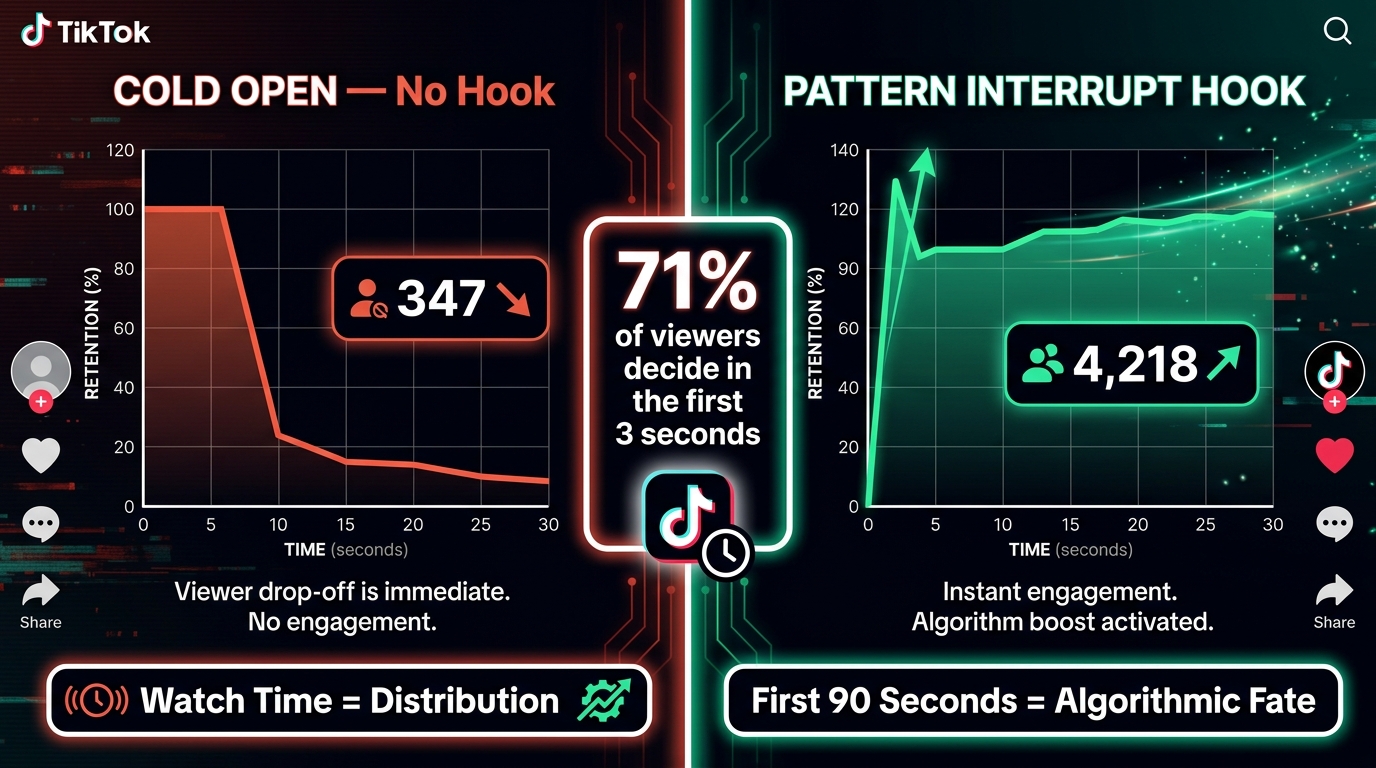
If the pre-stream cascade determines whether a warm audience shows up, the first 90 seconds of the live determines whether the algorithm decides to send cold discovery traffic. This window is your distribution audition — and most sellers waste it on housekeeping.
What the Algorithm Actually Measures
TikTok’s LIVE recommendation engine tracks a cascade of behavioral signals to evaluate stream quality in real time. In 2026, the primary signals weighted for distribution decisions are:
- Retention past 30 seconds: Streams where a meaningful percentage of viewers watch past the 30-second mark are treated as high-quality content and pushed more aggressively to cold audiences on the FYP.
- Comments-per-minute in the first three minutes: Active chat is the most readable proxy for genuine engagement. A stream with 50 viewers generating 40 comments per minute signals stronger interest than a stream with 200 viewers generating 5 comments per minute.
- Watch time duration: How long the average viewer stays is a stronger signal than how many viewers enter. The algorithm would rather push a stream that keeps 100 viewers for 15 minutes than one that attracts 1,000 who all leave in 30 seconds.
- Shopping interactions: Product card clicks, bag opens, and add-to-cart events tell the algorithm this is a commerce-quality stream, which activates distribution to audiences with a purchase-intent behavioral history.
Engineering the Opening 90 Seconds
The structural failure most live sellers make in their opening is leading with greetings: “Hey, how’s everyone doing tonight? Welcome, welcome! Let me know where you’re watching from!” This is not a hook. It’s a preamble that gives every new viewer a five-second window of “nothing happening here” before they scroll away.
The pattern interrupt open works entirely differently. It starts in the middle of something happening. The host is already demonstrating the product. Or they open with a bold claim: “This product has been sitting in my cart for six months and I finally caved — let me show you why.” Or a visual hook: the product doing something dramatic before any words are spoken. The goal is to force the viewer to think “what is that?” before they can make the exit decision.
According to behavioral research on short-form video consumption, approximately 71% of viewers make their stay-or-scroll decision within the first three seconds of entering a room. That window is even shorter on TikTok Live because the platform has conditioned users to expect immediate value — anything that reads as filler or setup triggers the scroll reflex.
The First Minute Interaction Loop
After the hook, the first 60–90 seconds should include at minimum one direct question to the audience (generating comments), one visual product moment (generating product interest), and one explicit “if you’re new here” statement that gives late joiners context without losing the people who have been watching since the start. This loop structure becomes the template for the entire live — but getting it right in the first 90 seconds is what separates streams that build momentum from streams that plateau.
The Live Loop Script: Built for Late Joiners, Not Just Early Arrivals
One of the unique structural challenges of live selling — compared to a pre-recorded video or a product page — is that your audience is constantly rotating. Viewers enter and exit throughout the stream. Someone who joins 20 minutes in has missed everything you’ve said so far. If your script is linear — intro, demo, pricing, close — every late joiner misses the setup and arrives mid-close with no context. They scroll away.
The Looped Product Segment Structure
High-converting live sellers don’t script a beginning-to-end presentation. They script a repeating loop — a self-contained product segment that can be entered at any point and still makes complete sense. Each product cycle runs approximately 45–60 seconds and follows a consistent structure:
- Hook (0–5 seconds): A pattern interrupt or bold visual that grabs attention regardless of when the viewer arrived. “Watch this stain disappear in three seconds” or “This costs $12 and replaces a $90 product.”
- Problem identification (5–15 seconds): Name the specific problem the product solves. This is fast and concrete — not a general category but the exact pain point. “You know that feeling when your concealer creases by noon? That’s what this is for.”
- Product reveal and demo (15–35 seconds): Show the product in use. Not just hold it up — actually demonstrate it working. The demo before price reveal is a deliberate sequencing choice: showing value before the cost means the brain anchors the perceived value higher before the actual price lands.
- Social proof injection (35–45 seconds): Call out chat activity, reference reviews, or read a comment from a buyer. “I see Sarah in the chat just ordered — let us know what you think!” Real-time social proof is exponentially more persuasive than quoted testimonials because it’s happening right now, in front of the viewer.
- Price reveal and CTA (45–60 seconds): State the price, the live-exclusive benefit, and the direct call to action. Explicit and specific: “Regular price is $38, live price is $24, tap the bag at the bottom right now.”
This loop repeats — not word-for-word, but structurally — for every product segment throughout the stream. Each late joiner gets the full context. Each product gets a fair conversion window. And the host has a repeatable framework that keeps energy consistent rather than building toward an exhausting linear close.
Rotating Energy Every Three to Five Minutes
Beyond the product loop structure, top-performing live sellers deliberately vary the energy of the stream every three to five minutes to prevent attention drift. A high-intensity sales moment is followed by a more conversational interaction segment, then a product demo, then a Q&A moment, then back to high-intensity. This rhythm mirrors the natural attention cycle of online video viewers and prevents the “background noise” effect where the stream is still playing but nobody is actively watching.
Flash Deal Architecture: Countdown, Anchoring, and Scarcity
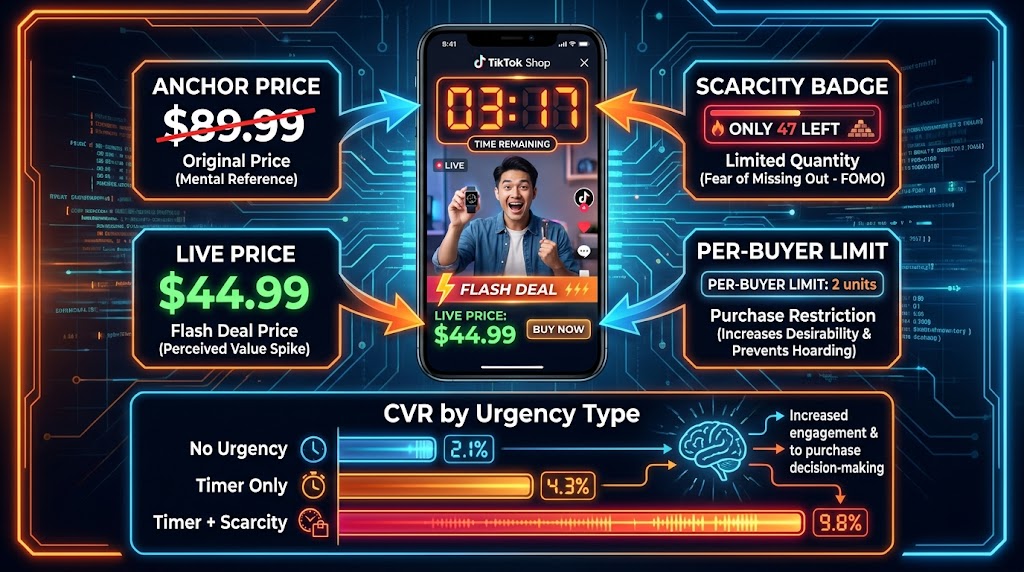
Flash deals are the highest-leverage conversion tool available in TikTok Shop’s live feature set — and they’re built directly into the platform via LIVE Manager. But a poorly executed flash deal can feel manipulative and damage trust, while a well-executed one creates a genuine buying moment that viewers actually appreciate. The difference is in how the deal is constructed, communicated, and timed.
How LIVE Flash Sales Work Mechanically
Within TikTok Seller Center’s LIVE Manager, sellers can create LIVE Flash Sales on eligible products directly during a stream. The setup requires: selecting the product (identified with a lightning-bolt indicator for eligible SKUs), setting the discounted price or percentage, optionally setting an inventory cap (the number of units available at the flash price), and choosing whether to add a per-buyer purchase limit. Once activated, a countdown timer appears on screen for all viewers, and TikTok’s in-app UI highlights the deal visually in the Shopping Bag.
The timer and inventory counter visible to viewers aren’t just informational — they’re active purchase psychology triggers. The countdown creates what behavioral economists call temporal scarcity: the sense that a loss is imminent if action isn’t taken. The inventory counter creates social competition scarcity: the sense that other people are claiming the offer right now and it might run out before you act.
Price Anchoring Before the Reveal
The sequence in which you introduce pricing during a live is as important as the price itself. The anchoring technique involves establishing the “regular” value clearly before revealing the live price. “This retails at $79.99 in-store and on the website” is the anchor. “Your live-exclusive price today is $42” lands differently after that anchor than it would if you just said “it’s $42” cold.
The anchor creates a mental reference point that makes the discount feel more significant. Research on price psychology consistently shows that the perceived value of a discount is driven not just by the absolute saving but by the relative gap between anchor and offer. A $20 discount from $79 feels more meaningful than the same $20 discount from $45, even though the saving is identical.
A critical implementation note: the anchor price must be a genuine, verifiable regular price. TikTok Shop’s policies — and increasingly its algorithmic review — flag deceptive pricing where a “regular price” is inflated specifically to manufacture a false discount. Beyond policy compliance, savvy viewers who google the product mid-stream and find the same price elsewhere lose trust in the host instantly. Real deals outperform manufactured ones in both conversion rate and long-term audience trust.
Scarcity That’s Actually Scarce
Scarcity messaging — “only 50 units at this price,” “first 20 orders get a free gift” — is one of the most powerful live-selling tools, but also one of the most abused. The effectiveness of scarcity depends entirely on whether the viewer believes it’s real. When a host says “only 10 left!” for the third time in 20 minutes on a product with no visible inventory counter, viewers stop believing the urgency. The fourth time they hear it, it actively reduces trust.
The inventory cap feature in LIVE Flash Sales creates genuine, visible scarcity — the counter actually counts down as units are claimed, and viewers can see it. This is significantly more persuasive than verbal scarcity claims because it’s verifiable in real time. Setting a genuine inventory cap of 50 or 100 units at the flash price creates authentic urgency that doesn’t require the host to perform emotional pressure.
Pinned Products and the Shopping Bag Conversion Bridge
The product card pinned at the bottom of the live stream interface is the most direct conversion mechanism TikTok Shop provides — and it’s chronically underused. Getting a viewer to tap that card is a distinct micro-conversion from getting them to watch, engage, or even ask about the product in chat. The gap between “interested viewer” and “shopping bag opener” is where a significant portion of live revenue is lost.
What Pinned Products Actually Do
When a seller pins a product during a live, TikTok displays the product card as a persistent, tappable element at the bottom of the screen for all viewers. Tapping it opens the product detail page in a slide-up panel without exiting the live stream — the video continues playing while the viewer browses the product. This seamless overlay experience is one of TikTok’s most valuable conversion design choices because it eliminates the context-switch cost of leaving the live to shop.
TikTok’s official seller guidance recommends maintaining at least one pinned product visible at all times during a live session, with product rotation every five to eight minutes to keep the pinned card feeling fresh and relevant to what the host is currently demonstrating. Hosts who demo a product for three minutes without changing the pinned card to match are missing the moment of peak purchase intent.
Verbal and Visual Direction to the Bag
The most consistent behavioral pattern among high-converting live hosts is explicit, repeated, and specific direction to the shopping bag. Not “check the link below” (there is no link below) or “you can find it in the store” (vague and requires navigation effort). Specific: “Tap the orange shopping bag icon you see at the bottom of your screen right now.” Then pause. Wait for the animation that shows a viewer has opened the card.
This directness feels unnecessary to sellers who assume viewers know how to navigate the UI. But a meaningful portion of TikTok Live viewers — particularly those newer to live commerce or older demographics — genuinely don’t know the tap-to-shop mechanic exists until a host explicitly shows them. Teaching the mechanic in real time isn’t condescending; it’s one of the highest-ROI 10 seconds in the entire stream.
Rotating Products for Ongoing Relevance
Beyond keeping the pinned product matched to the current demo, rotating through a planned product sequence throughout the live serves a secondary algorithm purpose. Product interactions — card clicks, bag opens, add-to-carts — are positive commerce signals that TikTok’s distribution system reads as evidence that the stream is driving shopping behavior. A stream with consistent product interactions throughout its duration will receive broader distribution than one with interactions clustered in a single burst.
Planning your product rotation before the live — including which products to lead with (typically your most visually compelling or best-reviewed), which to use as midstream re-engagement moments, and which to save for a closing “last chance” push — is part of the pre-stream scripting process that separates deliberate live commerce from improvised selling.
Co-Hosting and the Brand-Creator Duo Format
Solo live selling has a natural ceiling. A single host has one energy level, one voice, one demographic appeal, and one audience. The co-hosted live format — a brand or seller pairing with an external creator for a joint stream — breaks through several of those constraints simultaneously. It’s one of the fastest-growing live formats on TikTok Shop in 2026, and the conversion mechanics behind it are worth understanding in detail.
Why the Duo Dynamic Works
The brand-creator co-hosted live creates a fundamentally different viewer experience than a solo brand stream. The creator brings authenticity, an established audience relationship, and a viewer demographic that the brand may not organically reach. The brand brings product knowledge, inventory control, and pricing authority. When the dynamic works, the result is a conversation about the product rather than a presentation of it — and conversations convert at higher rates than pitches.
The chemistry between host and co-host also generates more natural entertainment value, which increases average watch time. Two people interacting, reacting, sometimes disagreeing about a product, creates authentic moments that viewers read as genuine rather than scripted. That authenticity is particularly valuable on TikTok, where viewers have a finely tuned detector for promotional content that feels manufactured.
According to Darkroom Agency’s 2026 TikTok Shop LIVE playbook, co-hosted and creator-led lives are among the most recommended formats for brands looking to accelerate their TikTok Shop GMV, precisely because the creator’s established audience relationship shortens the trust-building phase that a brand account would need to do from scratch.
Choosing the Right Creator Pairing
Not all creator pairings produce conversion results. The common mistake is selecting a co-host based on follower count alone. A creator with 500,000 followers in the fitness space may have zero conversion relevance for a kitchen gadget — their audience’s purchase intent in that category is low regardless of their trust relationship with the creator. Category alignment matters far more than raw audience size.
The most effective co-host pairings share these characteristics: the creator has a demonstrated history of product recommendations (not just lifestyle content), their audience is already in the habit of acting on their suggestions, and there’s a genuine use case for the creator to interact with the product naturally rather than reading from a brief. An authentic moment of a creator actually discovering something surprising about a product — live, unrehearsed — can be the highest-converting 30 seconds in the entire stream.
Structuring the Co-Host Revenue Split
The commission structure for co-hosted lives typically works through TikTok Shop’s affiliate system, where the creator earns a percentage of each sale attributed to viewers who interact with the product card during the live session. Commission rates in TikTok Shop range broadly depending on category and negotiation — beauty and personal care often sit between 10–20%, while electronics tend to be lower. For dedicated long-form co-hosted lives, brands often supplement the platform commission with a flat appearance fee, particularly for creators with proven live-selling track records.
Post-Stream Retargeting: The 72-Hour Follow-Up Window
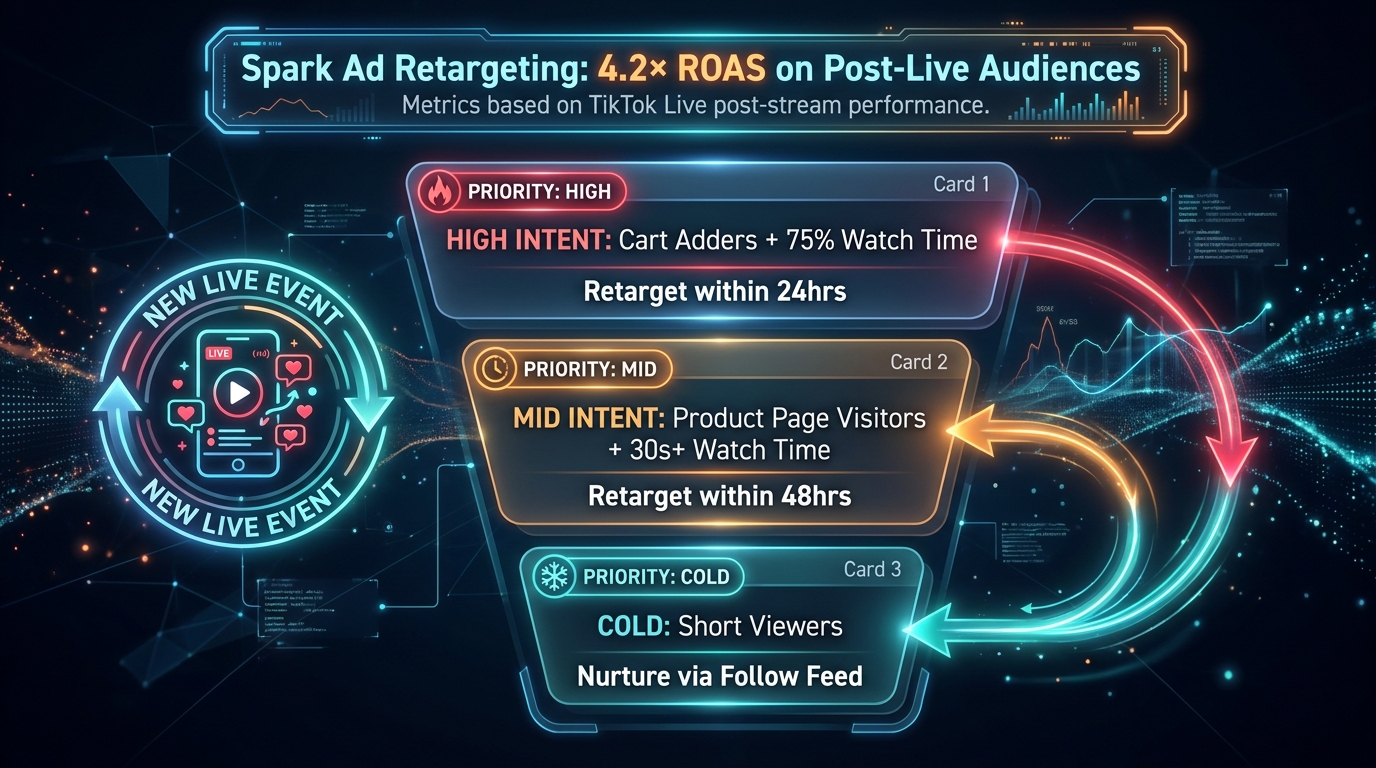
The live stream ends. Most sellers close the app and consider the event complete. But the viewers who watched your stream, added to cart, clicked your product card, and didn’t complete purchase represent a warm, high-intent audience that is dramatically cheaper to convert through retargeting than cold traffic — and they’re most reachable in the 24–72 hours immediately following the stream.
Segmenting Your Post-Live Audience
Not all post-live viewers are equal, and treating them as a homogenous retargeting pool wastes budget and produces mediocre ROAS. The most effective post-live retargeting strategy segments the audience by their behavior during the stream:
Tier 1 — High Intent: Cart adders who didn’t complete checkout, viewers who clicked the product card, and people who watched 75% or more of the live session. These viewers have signaled strong purchase consideration. They should be retargeted within 24 hours with Spark Ads showing the specific product they interacted with, often including a reinforcement of the live-only offer or a new reason to act (“back in stock,” “extended for 24 hours”).
Tier 2 — Mid Intent: Viewers who watched for 30 seconds or more without clicking through to products, and followers who were notified but didn’t tune in. These viewers have brand familiarity but lower declared purchase intent. They respond better to short-form content that highlights the product in use — a 15-second clip repurposed from the live, showing the most compelling demo moment.
Tier 3 — Cold Discovery: Viewers who entered briefly, watched a few seconds, and left. These aren’t lost causes, but they require more nurturing before a direct purchase ask makes sense. Adding them to a broader lookalike audience for future live streams or Shop Tab ads is more cost-efficient than direct retargeting in the short term.
Repurposing Live Moments as Spark Ads
One of the most underutilized tactics in TikTok Shop live commerce is the Spark Ad conversion of live replay content. TikTok allows sellers to clip and promote moments from live streams as organic-style ads that run in the FYP. The best clips are typically the product’s most visually dramatic moment — the before/after, the unexpected result, the genuine viewer reaction in the chat — stripped of any preamble and running as a self-contained 15–30 second video.
These clips carry an authenticity signal that polished studio content can’t replicate. Viewers who see a clip of a real live room, with real chat activity visible and a real person reacting genuinely to a product, read it as a peer recommendation rather than an advertisement. When linked directly to the product’s TikTok Shop page, these clips can maintain conversion performance for one to two weeks after the original live, effectively extending the revenue window of each session.
The Email and SMS Bridge
TikTok Shop’s native ecosystem doesn’t include email or SMS — but the post-purchase and post-stream moment is one of the best opportunities to bridge that gap. Sellers who build an off-platform CRM audience from their TikTok Shop customers can deploy email or SMS follow-ups that reference the live session, create urgency around remaining inventory, or announce the next live date. This cross-channel reinforcement compounds the conversion effect of each live stream and builds a loyalty audience that doesn’t depend entirely on TikTok’s algorithm for re-engagement.
Measuring What Actually Matters: Micro-Conversions Over Vanity Metrics
The most reliable indicator that a seller is struggling with their live funnel is their choice of success metric. Sellers who celebrate or lament based on peak concurrent viewer count are measuring the wrong thing — and optimizing toward the wrong outcome. Peak viewers is a distribution metric, not a commerce metric. A stream with 2,000 peak viewers and 12 orders is a fundamentally different problem than a stream with 400 peak viewers and 60 orders.
The Metric Stack That Actually Predicts Revenue
The metric hierarchy that maps to revenue performance runs approximately as follows:
- Average watch time per viewer: This is the root signal. Short average watch times (under 60 seconds) indicate a hook problem or a relevance problem — people aren’t staying long enough to hear the pitch. Increasing average watch time is the highest-leverage metric to move first.
- Product card click rate: Of all viewers who entered the room during a product demo, what percentage clicked the product card? Below 3–4% usually indicates insufficient verbal direction to the bag, a mismatch between demo content and the pinned product, or a product-to-audience fit issue.
- Add-to-cart rate from product page views: Once someone opens the product card, how many add to cart? Low rates here typically indicate a product listing problem — poor images, weak copy, insufficient reviews, or pricing that doesn’t match the live’s perceived value.
- Cart-to-checkout completion rate: How many cart adds convert to completed orders? Rates below 50% often indicate technical friction (payment issues, address errors) or urgency erosion — the viewer added to cart during a flash deal moment but then the deal expired or the stream ended before they completed checkout.
- Revenue per viewer (RPV): Total GMV divided by total unique viewers. This is the single most useful composite metric for comparing live performance across streams of different sizes. A stream with 200 viewers and $1,200 in GMV ($6 RPV) is fundamentally outperforming a stream with 2,000 viewers and $4,000 in GMV ($2 RPV).
Reading the Data to Diagnose Funnel Stage Problems
The value of tracking micro-conversions is that they tell you exactly where the funnel is breaking — so you fix the right thing. Low average watch time is an opening hook problem. Good watch time but low product click rate is a bag direction or product pinning problem. Good click rate but low add-to-cart rate is a listing quality problem. Good add-to-cart but low checkout completion is an urgency or friction problem. Each failure mode has a distinct fix, and applying the wrong fix to the wrong stage produces no improvement and a lot of wasted effort.
TikTok’s LIVE Manager dashboard provides most of these metrics in near-real-time during a stream and in a post-stream analytics view within Seller Center. The habit of reviewing these metrics after every live session — not just the final order count — is the single most reliable behavior that separates sellers who compound their live performance over time from those who plateau.
Building a Repeatable Live Commerce Engine
Everything covered in this guide only produces sustainable results if it’s systemized — turned from a one-off good stream into a repeatable, compounding process. The brands and creators generating consistent five and six-figure monthly GMV from TikTok Shop lives aren’t doing something wildly different each time. They’re running a refined, documented process that gets slightly better with each iteration.
Consistency Compounds Algorithm Distribution
TikTok’s LIVE algorithm has a memory. Accounts that go live consistently — at the same times, on the same days, with strong performance metrics across sessions — build a historical performance reputation that influences future distribution. An account with 50 consistent lives averaging 7% conversion will receive more algorithmic support for its 51st live than an account with 5 sporadic lives averaging similar metrics. Consistency isn’t just about audience habit-building — it’s about building a distribution track record with the algorithm itself.
The minimum viable live frequency for building this track record is typically three to four lives per week for the first 60 days. This is a significant time commitment, which is why many brands separate the live commerce function from other content roles and invest in dedicated live hosts rather than relying on founders or general social media managers to run lives ad hoc.
The Feedback Loop That Drives Improvement
The most productive post-live ritual isn’t celebrating a good GMV day or recovering from a disappointing one. It’s running a 20-minute structured review: What was the average watch time? Which product had the highest click rate? Which moment in the stream generated the most chat activity? What was the drop-off pattern over time? What would we change next session?
Document these reviews in a live performance log — a simple spreadsheet with session date, metrics, what worked, what didn’t, and one specific change to test next time. Over three months of consistent live selling with this feedback loop in place, most sellers can identify the two or three highest-leverage variables in their specific funnel and build toward them systematically.
Category-Specific Patterns Worth Knowing
Not all product categories perform identically in TikTok Live, and understanding the category-level patterns helps set realistic benchmarks and inform product selection for live formats. Beauty and personal care consistently generates the highest live conversion rates, partly because the visual demonstration format is particularly well-suited to makeup, skincare, and haircare — you can show the result in real time, which is the most persuasive form of evidence in those categories. Fashion performs strongly when sizing and styling questions can be addressed in real time by the host. Home goods and kitchen products benefit from the “wow moment” demo structure — the before/after reveal that works well in the compressed live loop format.
Electronics and higher-ticket items tend to have longer consideration cycles that don’t perfectly match the live impulse-purchase dynamic — though they can work well when the live creates awareness and the post-stream Spark Ad retargeting handles the consideration-to-purchase close at the viewer’s own pace.
The Bottom Line
TikTok Shop’s live commerce format is generating a $33.1B trailing GMV run rate as of Q1 2026, with live sessions driving 26% of total platform sales — a share that has nearly doubled since 2024. Those aren’t numbers built by sellers who go live occasionally and hope for the best. They’re built by operators who understand that a TikTok live room is a funnel — one with five distinct conversion stages, each with its own failure mode and its own lever for improvement.
The sellers who consistently outperform aren’t the ones with the biggest followings or the best production setups. They’re the ones who warm their audience before going live, engineer their opening 90 seconds to earn algorithmic distribution, loop their product scripts to capture late joiners, deploy flash deal mechanics honestly and strategically, direct viewers explicitly to the shopping bag, segment and retarget their post-live audience within 72 hours, and review their micro-conversion data after every session.
That’s not a complex system. But it is a deliberate one. The gap between a $200 live and a $20,000 live is almost always a series of small structural decisions that compound across the session — not a single secret move that only some sellers know about.
Build the architecture intentionally, measure the right things, and iterate consistently. That’s how a live room becomes a revenue engine.
Key Takeaways at a Glance
- Start the funnel 72 hours before going live with a three-stage teaser cascade: mystery tease → behind-the-scenes → direct invite.
- Engineer your first 90 seconds around a pattern interrupt hook — start in the middle of something, not with greetings.
- Script product loops, not linear presentations — every segment should make complete sense to a viewer who joins midstream.
- Use LIVE Flash Sales with visible inventory countdowns for genuine, verifiable scarcity rather than verbal pressure tactics.
- Say the shopping bag direction explicitly and repeatedly — “tap the orange bag at the bottom right now” converts better than any subtle UI nudge.
- Segment your post-live audience by behavior (cart adders, long watchers, short viewers) and retarget within 24–72 hours with Spark Ads.
- Track Revenue Per Viewer (RPV) as your primary composite metric — it’s the one number that captures both conversion quality and stream efficiency.
- Go live consistently (3–4x per week minimum in early ramp) to build an algorithmic distribution track record that compounds over time.