


Most brands treating TikTok Shop as an affiliate channel are thinking about it backwards. They post products to an open plan, wait for creators to apply, send a discount code, and then wonder why their GMV is inconsistent and their creator roster churns every 60 days. The product is on the platform. The affiliate infrastructure exists. But it doesn’t work — at least not the way they hoped.
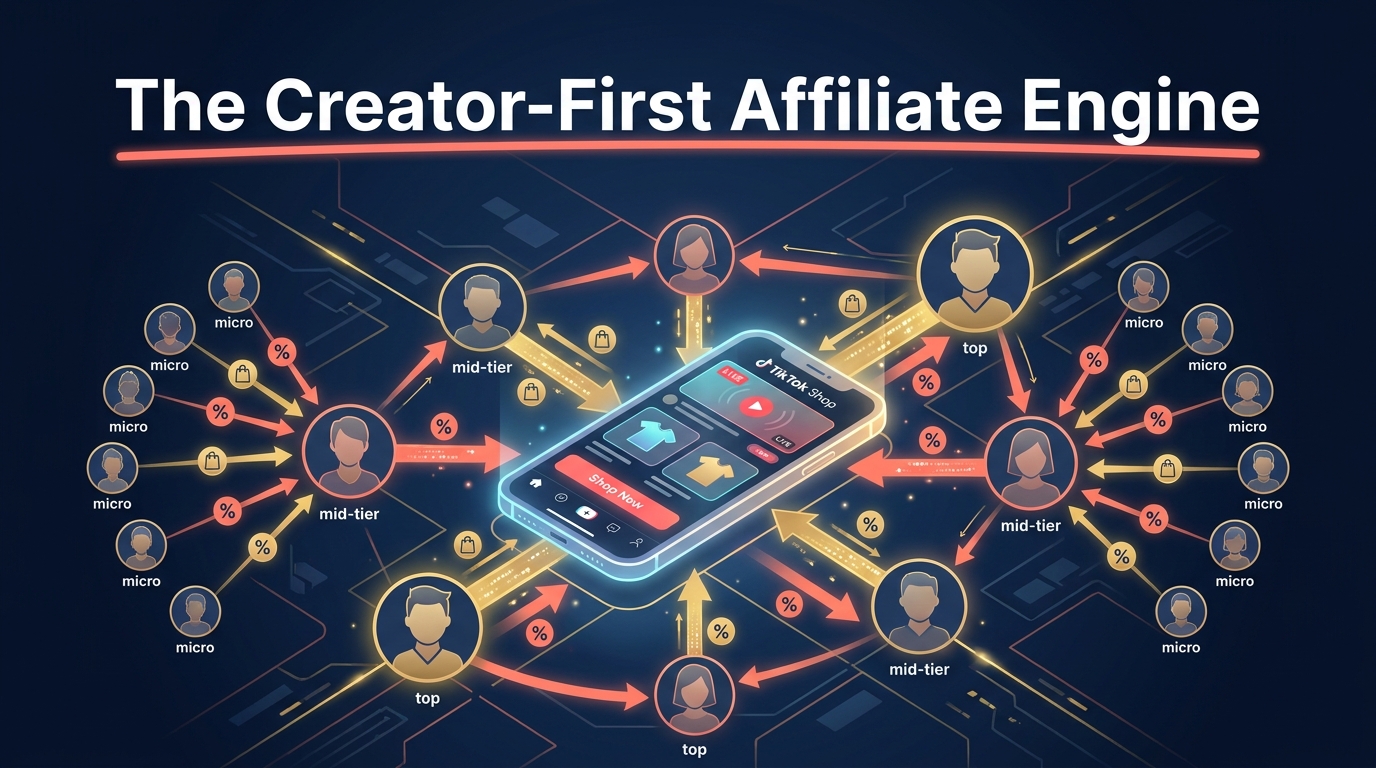
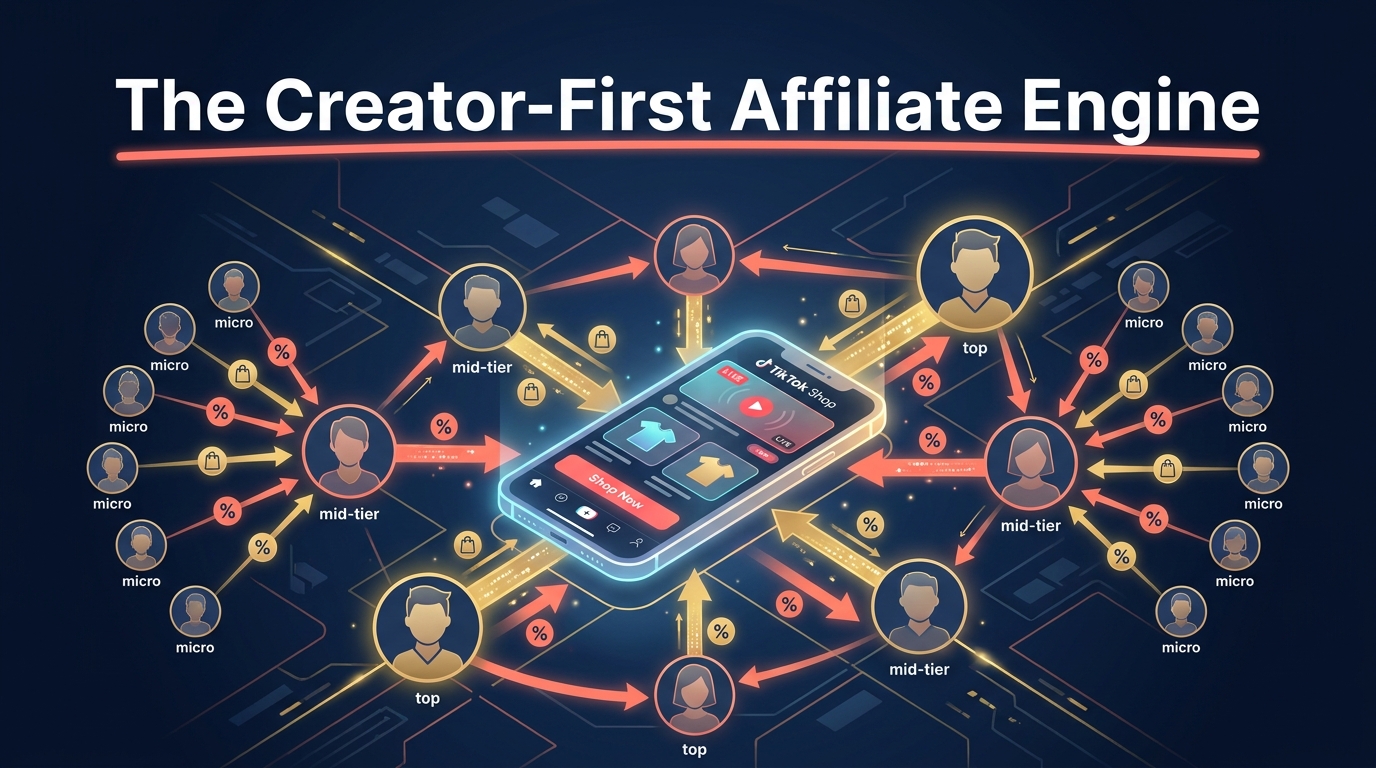
The fundamental error is structural: they’re building a channel, not an engine. A channel is passive. It waits for creators to find products and decide to post. An engine has moving parts — intake systems, filters, activation mechanisms, feedback loops, and escalation paths that make consistent output inevitable rather than accidental.
In 2026, approximately 42% of US TikTok Shop GMV flows through affiliate creator content, making it the platform’s single largest sales driver. But that GMV is not evenly distributed. It concentrates — hard — in programs that treat creators as the primary strategic asset and build infrastructure around them accordingly. The top 0.5% of creators generate an estimated 38% of affiliate revenue. The top 10% drive around 90% of total program GMV.
That power-law distribution isn’t a platform problem. It’s a program design problem. The brands capturing disproportionate share aren’t doing it by finding better creators — they’re doing it by building better systems around the creators they already have. This article breaks down exactly how that works: from recruitment architecture and seeding strategy through commission design, creator activation, LIVE shopping integration, and the retention models that separate programs with durable GMV from ones that require constant restarts.
This is not a beginner’s overview of what TikTok Shop is. This is an operational blueprint for brands and managers ready to build something that compounds.
Why Affiliate-First Funnels Fail — and What Creator-First Actually Means
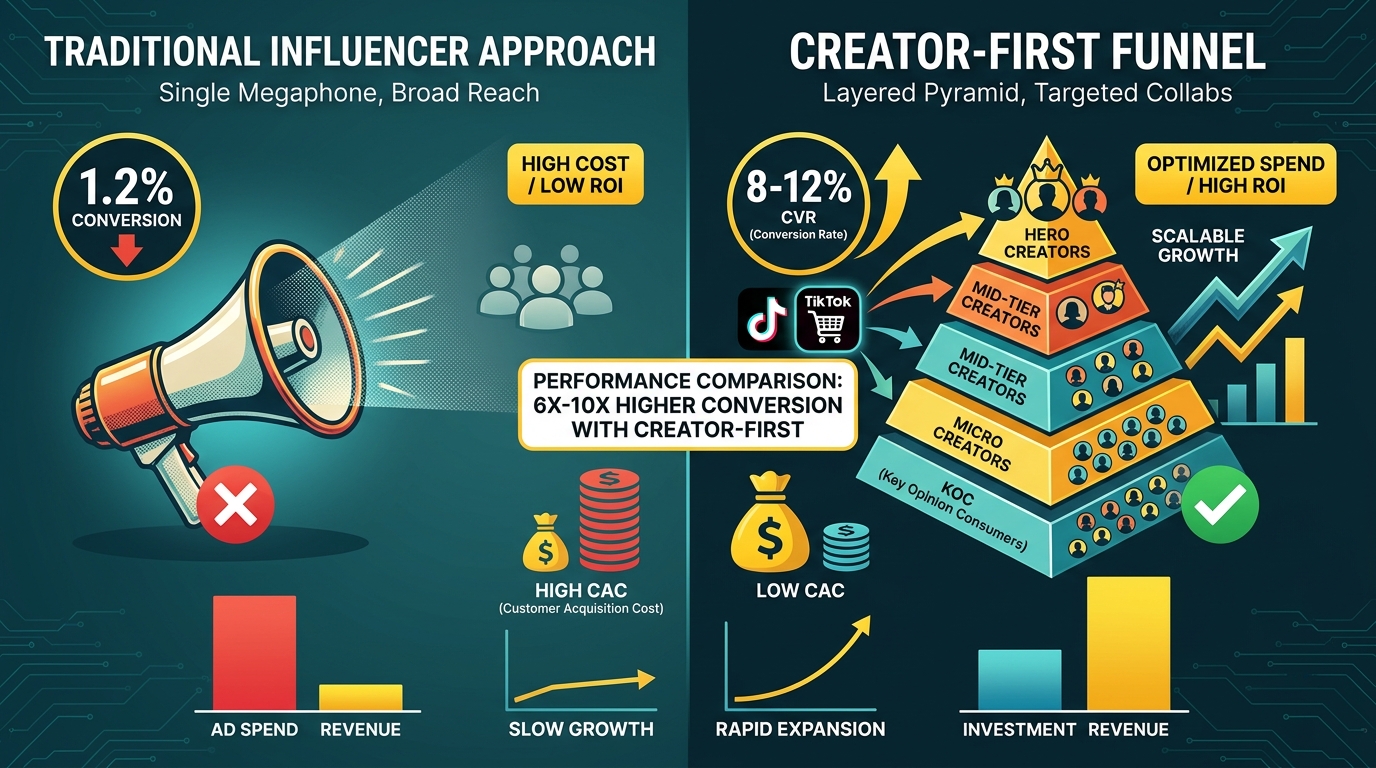
The affiliate-first model treats TikTok Shop the way brands once treated Amazon affiliate programs: make it easy for anyone to link, set a commission rate, and let volume handle the rest. It’s a low-friction, high-coverage approach that sounds logical until you look at what the data actually produces.
Platform-wide, affiliate creator content converts at approximately 3.2% view-to-purchase on average. That number sounds workable until you realize that well-managed, targeted creator collaborations regularly reach 8–12% CVR. The gap between those two figures — roughly 3x to 4x — is almost entirely explained by program design, not creator quality or product category. The same creators, posting the same content type, perform at dramatically different rates depending on whether the brand has built real infrastructure around them or just enabled access.
The Five Failure Modes of Affiliate-First Programs
Follower-count selection: Brands filter by audience size rather than conversion history. A creator with 400,000 followers who has never driven a tracked purchase is a liability. A creator with 28,000 followers and a 6% historical CVR is an asset. Affiliate-first programs rarely have the data infrastructure to tell the difference at intake.
Passive activation: Brands approve creators and wait. The median time between creator approval and first content post, in programs without structured onboarding, is longer than most brands expect — and many creators never post at all. Without a structured activation sequence, approval rates mean almost nothing.
Flat commission structures: A single commission rate for all creators in all volume tiers removes the incentive for high performers to stay. Top creators who drive meaningful GMV will eventually get better offers elsewhere, or simply shift their attention to products where the economics feel more proportional to their contribution.
No content guidance: Sending product without any angle, hook suggestions, or positioning framework forces creators to figure out how to sell your product from scratch. Most won’t invest that time for a commission-only relationship. The content that gets made is often generic and converts poorly.
No feedback loop: Affiliate-first programs rarely close the loop between content performance and program decisions. Which creators convert? At what rate? Which content formats are driving the most attributed orders? Without this data flowing back into recruitment and retention decisions, programs can’t improve systematically.
What Creator-First Actually Requires
A creator-first model doesn’t mean being creator-centered at the expense of business outcomes. It means recognizing that the creator’s ability to produce authentic, high-converting content is the actual mechanism driving revenue — and then building every piece of program infrastructure around supporting and rewarding that mechanism.
Concretely, that means: selecting creators based on performance signals rather than vanity metrics; seeding product in ways that make posting natural rather than obligatory; providing positioning guidance that helps creators tell a better story without scripting them; structuring commissions so that growth is rewarded in ways creators actually feel; and building retention systems that treat top creators like partners rather than vendors.
The shift from affiliate-first to creator-first is less about tactics and more about who the program is designed to serve. When creators succeed, the GMV follows. The brands that have figured this out are building compounding programs. The brands that haven’t are resetting their creator roster every quarter.
The Creator Recruitment Architecture — Finding Who’s Actually Going to Convert
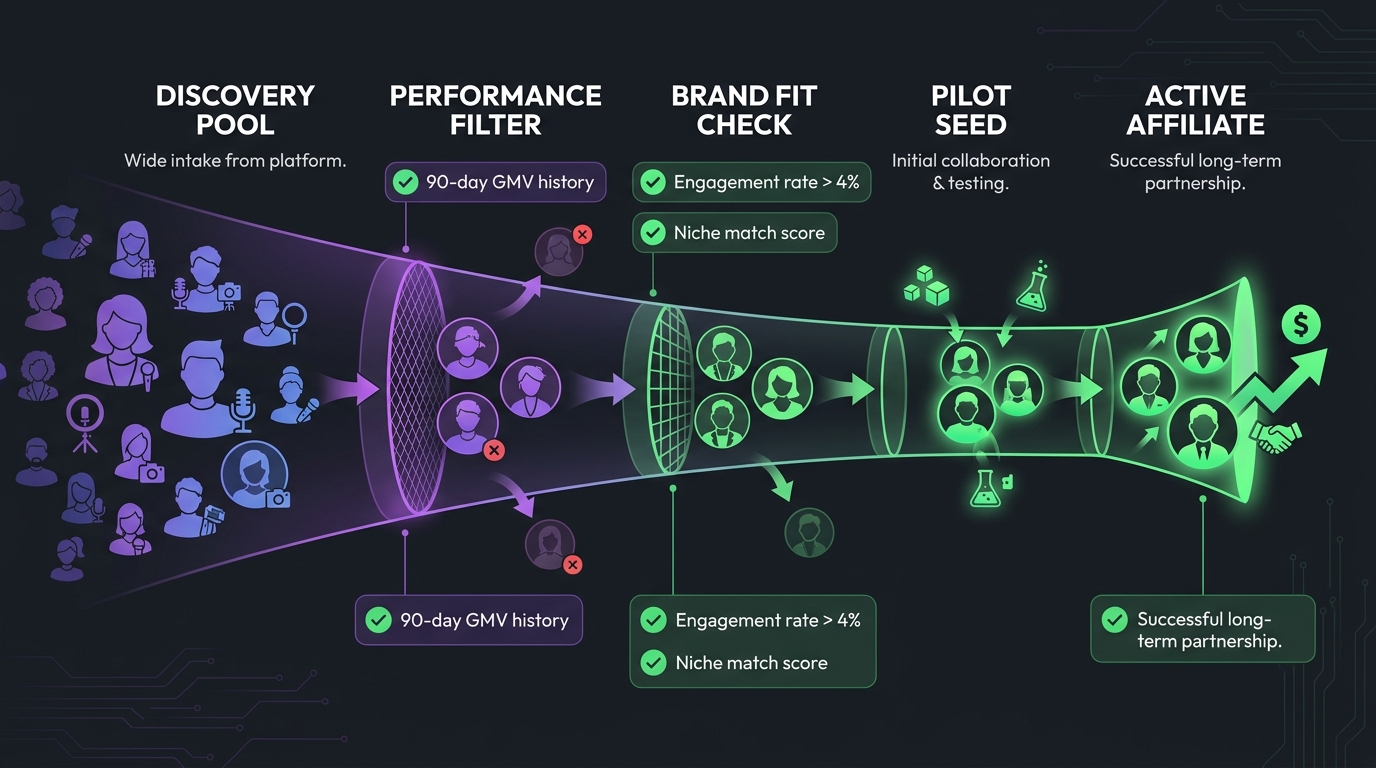
The creator recruitment process is where most programs either establish a strong foundation or doom themselves to churn. Getting this right requires treating recruitment not as a single action — posting to an open affiliate plan and waiting — but as a multi-stage pipeline with explicit filters at each gate.
Stage 1: Discovery Pool
The starting point is casting a wider net than most brands initially expect. TikTok’s Affiliate Center allows brands to search creators by niche, GMV performance, follower range, and content type. The most effective operators in 2026 are supplementing this with off-platform discovery — scanning hashtag communities, niche-specific subreddits, Discord servers, and affiliate communities where active Shop creators congregate.
The goal at the discovery stage is not to filter aggressively. It’s to build a large enough pool that subsequent stages have good material to work with. A common threshold for well-run programs: 200–500 potential creators in the discovery pool for every 20–30 you intend to actively recruit.
Key sourcing signals at this stage include: creators who are already posting organically about your product category (not your brand necessarily — your category), creators who appear in the “similar creators” recommendations on TikTok for verified converters you’ve already worked with, and creators whose content comment sections show active purchase questions, which is a strong intent signal.
Stage 2: Performance Filter
This is where follower count gets deprioritized decisively. The performance filter should screen for actual commerce indicators:
- 90-day GMV history: Has this creator driven measurable Shop revenue in the last three months? TikTok’s Affiliate Center surfaces this for creators who have opted to make their metrics visible. Brands should request access to this data before any product send.
- Engagement rate: A minimum 4% engagement rate (likes, comments, shares, saves relative to reach) is a common threshold. Below this, even well-produced content tends to have insufficient organic reach to convert at scale.
- Content cadence: Creators who post fewer than three times per week tend to have lower activation rates in affiliate programs. Frequency correlates with creator habits that support consistent affiliate output.
- Video completion rate: Where accessible, completion rates above 35–40% indicate content that holds attention long enough to move viewers toward a purchase decision.
Stage 3: Brand Fit Check
Performance signals alone aren’t sufficient. A high-converting creator in the wrong niche, or one whose content positioning conflicts with how your product needs to be presented, can actually damage brand perception even while driving short-term sales.
The brand fit check should assess: audience demographic alignment with your target customer; content tone and production style relative to where your brand sits in the market (mass-market humor versus premium lifestyle requires different creator profiles); and any recent brand associations or content patterns that could create reputational risk.
This isn’t about finding creators who seem like the brand. It’s about finding creators whose audience trusts them on exactly the problem your product solves.
Stages 4 and 5: Pilot Seed and Active Affiliate
Recruitment doesn’t end at approval. The fourth stage — a pilot seed — is where the relationship actually begins. Product is sent before any formal commitment is requested. This changes the dynamic: it signals that the brand is investing in the relationship, not just extracting from it. The pilot seed is also diagnostic — post rates in this phase (20–40% without follow-up systems, 40–60% with structured follow-up) are strong early predictors of creator reliability.
Creators who post from the pilot seed and whose content demonstrates genuine engagement with the product move to active affiliate status. Those who don’t post, or who post but with content that shows no meaningful product engagement, are deprioritized for further investment — not necessarily removed, but not escalated into the tiered system either.
Product Seeding as a Strategic Asset — Not a Giveaway Program
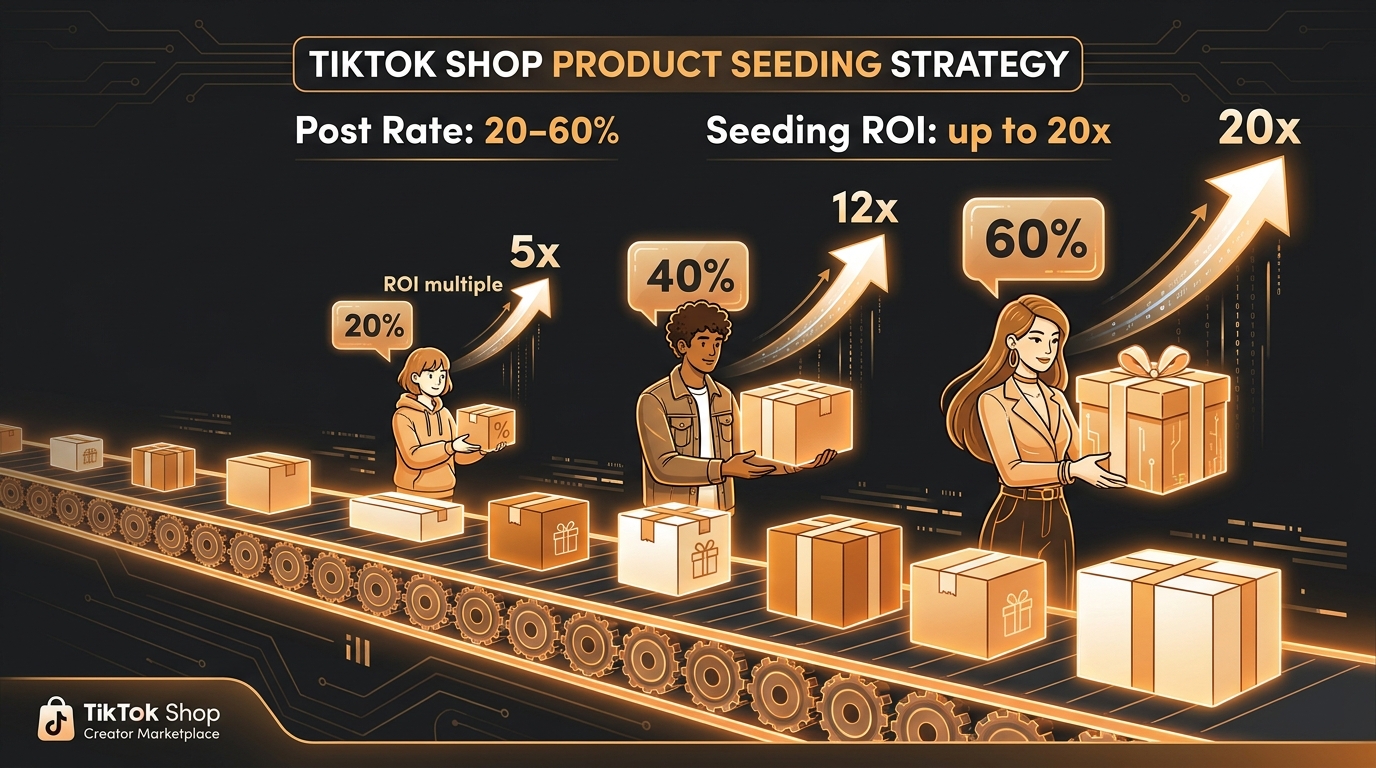
Product seeding — sending free product to creators with no formal posting obligation — has acquired a slightly chaotic reputation in some circles. The impression is that you’re sending expensive samples into the void, hoping someone makes a video. When seeding is run without structure, that impression is sometimes accurate. When it’s run as a data-driven acquisition and testing mechanism, the economics are compelling.
Current data from 2026 programs shows post rates of 20–60% among gifted creators, with typical ROI on sample cost ranging from 5x to 20x. Programs at the high end of those ranges are not getting lucky. They’re applying specific methods that move the numbers deliberately.
The Waterfall Seeding Model
The most effective seeding programs in 2026 run what operators describe as “waterfall” seeding — multi-wave product sends that function as progressively qualifying tests. Wave one goes to the broadest pool: vetted creators who match performance and fit criteria but haven’t yet demonstrated brand-specific conversion. The goal is data, not GMV. You’re measuring post rate, content quality, engagement on those posts, and attributed clicks and purchases.
Wave two targets creators who posted from wave one — and specifically, those whose content generated above-average engagement or conversion signals. This group gets a second product send (ideally a complementary or higher-ticket item), with a more explicit invitation to join the affiliate program at a specific commission tier. By the time you’re investing in wave two creators, you have concrete evidence that they can convert your specific audience on your specific product.
Wave three is reserved for the top performers from waves one and two — creators who have now demonstrated real GMV potential and are candidates for targeted collaboration, retainer arrangements, or exclusivity conversations.
The Follow-Up Protocol That Doubles Post Rates
The single highest-leverage intervention in any seeding program is structured follow-up. Programs without follow-up see approximately 20–30% post rates. Programs with a systematic three-touch follow-up sequence — a message when the product ships, a check-in 48 hours after expected delivery, and a content support message at day 7 — consistently report post rates in the 40–60% range.
The follow-up messages shouldn’t feel like pressure. They should add value: content angle suggestions, a relevant trending hook they could adapt, a quick note that this product is moving fast and their audience would likely respond well. Creators who feel supported produce better content. Creators who feel transacted with ghost you.
Measuring Seeding ROI Properly
Seeding ROI is often calculated wrong. Brands divide attributed sales revenue by product cost and call it done. That misses the actual value. Each creator who posts is also generating a piece of content that lives on TikTok for months, continues to drive organic views and purchase clicks long after the initial posting, and provides data that improves future recruitment decisions. The residual value of seeded content — content that continues to convert 60 or 90 days after posting — often exceeds the immediate GMV attribution.
A more complete seeding ROI model tracks: immediate attributed GMV (30 days post-posting), residual GMV (31–90 days), content quality score (whether the video becomes a Spark Ads candidate), creator activation rate (did this seed move them into active affiliate status), and long-term creator LTV if they join the tiered program. Brands that track all five of these metrics make significantly better seeding investment decisions than those focused only on immediate return.
Writing the Brief That Doesn’t Kill the Content
Brand briefs sent to affiliate creators are one of the most over-engineered and simultaneously under-thought elements of most TikTok Shop programs. Brands either send nothing (too little structure) or send a five-page document with mandatory talking points, preferred camera angles, and required disclosures (too much structure). Both approaches produce worse content than a well-designed, minimalist brief.
The 2026 consensus among TikTok Shop operators who are consistently generating high-conversion creator content is this: one page, maximum. The brief should tell the creator three things — what the product is for (not what it does), what problem it solves, and what angles have worked for similar products. Everything else should be left to the creator’s judgment.
The Anatomy of a High-Performing Creator Brief
Product positioning statement (2–3 sentences): Who this product is for and what specific problem or desire it addresses. Not a feature list. Not a brand story. A positioning statement that makes it immediately obvious how the creator should frame this in their content. Example: “This serum is for people who’ve tried three or four moisturizers and still feel like their skin looks tired by noon. It’s not about hydration — it’s about luminosity that holds.”
Three content angles: Offer three distinct ways to approach the content, from different emotional entry points. One might be a problem-solution frame. One might be a “I didn’t expect this to work but” skeptic-to-believer arc. One might be a before/after or use-case demonstration. The creator picks the angle that fits their voice. They don’t adapt to yours.
Hook suggestions, not scripts: Provide four or five opening hook options — the first three seconds of a video are disproportionately important for both retention and TikTok’s content distribution algorithm. These aren’t mandatory. They’re starting points. Example hooks: “I’ve used [product] every morning for three weeks and I need to tell you what happened.” Or: “This is the product the dermatology community has been quietly recommending forever.”
Proof points the creator can use: Specific data, testimonials, or third-party validation that the creator can cite naturally if it fits their angle. Not “our product is clinically tested.” Instead: “In a third-party user study, 87% of participants reported visible difference in 14 days.” Creators who can cite specific, credible proof tend to convert better than those who can only speak to their personal experience.
What to avoid: One short paragraph on guardrails — specific claims that can’t be made, competitive comparisons to avoid, or regulatory language that applies. This should be the briefest section. If your “what to avoid” list is longer than your “angles” section, you’ve written a compliance document, not a creator brief.
The Feedback Loop That Improves Briefs Over Time
Briefs should be living documents, not static files. After each wave of creator content, review which angle performed best (by CVR and engagement), which hooks generated the highest retention rates, and which proof points were cited most often by top-converting creators. The next brief for that product family should reflect those learnings. Within three rounds of this process, most brands find that their brief-to-conversion pipeline improves significantly because they’re essentially crowdsourcing the winning creative strategy from their best creators.
Commission Architecture — Building Tiers That Incentivize Performance
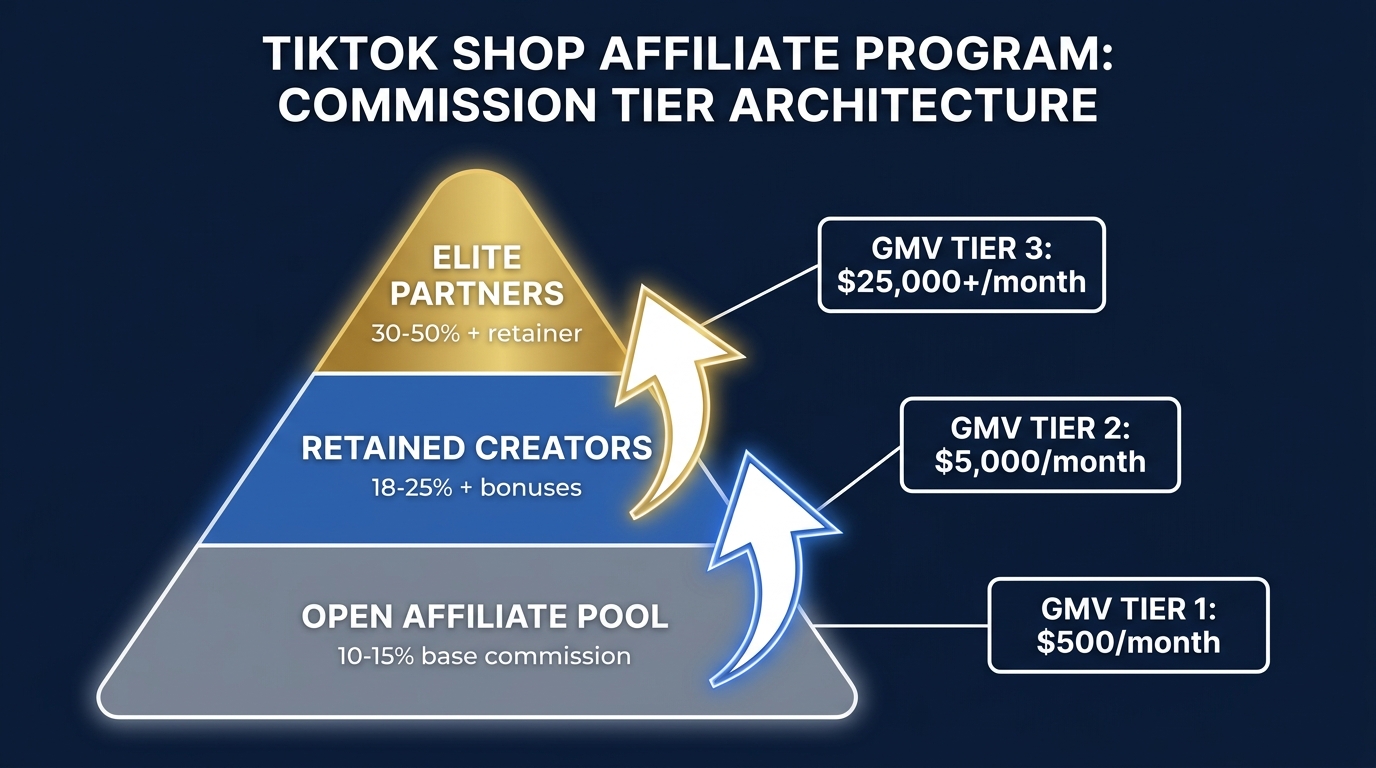
TikTok Shop’s commission mechanics give brands significant flexibility — seller-set rates from 1% to 80% are technically permitted, with different rates for open plans versus targeted collaborations. In practice, open plan commissions cluster around 10–15%, while targeted collaborations for higher-performing creators typically negotiate 18–30%, with top-tier or exclusive arrangements sometimes reaching 40–50%.
Most brands set a single commission rate and leave it there. This is a structural error that makes it impossible to build the kind of creator loyalty that compounds program performance over time. A flat commission treats a creator doing $300/month in GMV the same as a creator doing $30,000/month. The former may have potential worth developing. The latter is a business-critical asset. Your commission structure should reflect that distinction explicitly.
Building a Three-Tier Commission System
Tier 1 — Open Affiliate Pool: This is your baseline open plan. Set at 10–15% commission, available to any approved creator who joins your affiliate program. The threshold to enter this tier should be low — you want to cast broadly here and let performance data identify the creators worth elevating. Creators in Tier 1 receive standard seeding access, basic brief support, and first access to new product launches.
Tier 2 — Retained Creators: Creators who hit a monthly GMV threshold — typically $1,000–$5,000 depending on your category and average order value — qualify for Tier 2. This tier runs on targeted collaboration commissions (18–25%) supplemented by milestone bonuses: a cash payment when GMV crosses $2,500 in a month, another at $5,000. Tier 2 creators get priority access to exclusive products, co-creation opportunities (limited editions or bundles featuring their name or handle), and direct access to a brand contact rather than a support ticket queue. This last point is more valuable than most brands realize — creators at this level have choices, and responsiveness signals respect.
Tier 3 — Elite Partners: Creators consistently driving $10,000–$25,000+ per month in attributed GMV. This tier is typically managed on individual negotiated arrangements: commissions in the 30–50% range, monthly retainer payments (ensuring a consistent content volume even in slower sales periods), and often some form of creative co-investment — the brand funds production costs, provides dedicated product inventory, or contributes to LIVE shopping session setup costs. Elite partners are effectively co-revenue stakeholders, and the arrangement should feel like that to both parties.
The 30-Day Lock Rule and Why It Matters
TikTok Shop now requires a 30-day notice period before brands can decrease commission rates. This was introduced to protect creators who build content strategies around specific commission economics and then have the rug pulled. It’s also a forcing function for brands to think more carefully before setting initial rates. Brands that have used commission rate reductions as a cost-management tool have found that creator churn follows rate cuts reliably — and that the GMV cost of that churn typically exceeds the margin saved on commissions. Design your commission architecture for the long game from day one.
Bonus Mechanics That Drive Content Volume
Beyond base commissions, volume-based bonuses work well for driving consistent posting behavior. Structures that have generated strong results: posting bonuses for creators who publish at least four affiliate videos in a calendar month; GMV sprint bonuses during product launch periods or seasonal moments; and content quality bonuses for videos that exceed a threshold engagement rate, regardless of immediate conversion. The last category is particularly valuable — it rewards creators for building audience trust, not just immediate clicks, and tends to produce a more loyal follower base that converts better over multiple purchase cycles.
The Activation Gap — Getting Creators From Approved to Posted in Under 14 Days
Approval rates are a vanity metric in TikTok Shop affiliate programs. What matters is activation: the percentage of approved creators who post at least one piece of affiliate content within a defined window. Without structured onboarding, industry data shows activation rates of roughly 10–15% within 30 days. With guided onboarding flows, that figure rises to 40–50%.
The gap between those two numbers represents an enormous amount of wasted recruitment investment. Every creator your brand vetted, seeded, and approved who never posts is a sunk cost. Activation systems are the mechanism that turns sunk costs into working assets.
The 14-Day Activation Sprint
The most effective activation framework currently used by high-output TikTok Shop programs is a 14-day sprint structure with defined touchpoints at each stage:
Day 0–1: Welcome sequence. This is not a generic “thanks for joining” message. It’s a personalized note that references something specific about their content and explains exactly what happens next — product ships within X days, here’s your affiliate link, here’s the brief, here’s who to contact with questions. The onboarding message sets the tone for the entire relationship. Generic feels like a system. Personalized feels like a partnership.
Day 3–4: Product status check. Message the creator confirming delivery (or providing tracking). Include the brief for the first time at this stage — if you send it too early, it gets lost before the product arrives. Offer one specific content angle recommendation based on their last three or four posts. Show that you’ve actually watched their content.
Day 7: Content support check-in. Ask if they have questions about the product or the brief. Offer to jump on a quick call if they’re interested in talking through angles. This touchpoint exists primarily to catch creators who are willing but stuck — unsure how to position the product or worried their audience won’t connect with it. Removing those friction points here prevents them from becoming ghosting behaviors at day 14.
Day 10–11: Social proof injection. Share a piece of content that another creator made about the product that’s performing well. This serves two purposes: it removes the uncertainty of “will my audience like this” (social proof that similar content works), and it demonstrates content format inspiration without being prescriptive. “Saw this from another creator and thought you might find it interesting” is a far more effective message than “here are our posting guidelines.”
Day 13–14: Urgency signal. A genuine one, not manufactured. If there’s a price change coming, inventory constraint, or seasonal relevance window that’s closing, share it. “We’re heading into the back-to-school period and this is typically when this product spikes — thought you might want to know before posting.” Relevance windows create natural motivation to act.
Cohort-Based Activation Tracking
Track activation by creator cohort — groups of creators who entered the program in the same week. This turns individual creator behavior into program-level data you can actually act on. If your week-12 cohort has a 50% activation rate but your week-8 cohort has a 20% rate, the difference almost always points to a specific change in your onboarding sequence, seeding volume, or brief quality that you can identify and fix. Treating creators as individuals makes this learning invisible. Treating them as cohorts makes it systematic.
Scaling LIVE Shopping Within Your Affiliate Program
LIVE shopping on TikTok Shop converts at roughly 7.8% on average — significantly higher than the 3.2% baseline for standard affiliate video content. In categories like beauty, health, and home goods, LIVE sessions from high-trust creators regularly exceed 10–12% CVR, and average order values in LIVE sessions often run 3–5x higher than those from video commerce. These numbers make LIVE shopping one of the highest-return formats in the TikTok Shop ecosystem.
Most affiliate programs treat LIVE as an afterthought — something a creator might decide to do on their own, at their own initiative. The brands generating the most LIVE GMV are instead building LIVE as a structured component of their affiliate program, with dedicated creator tracks, product support, and session investment.
Identifying LIVE-Ready Creators
Not every strong affiliate creator is a strong LIVE creator. The skill sets are related but distinct. Video content allows for editing, retakes, and post-production optimization. LIVE is real-time — errors stay on screen, dead air is expensive, and the creator’s ability to manage a live chat while demonstrating a product while tracking session metrics is genuinely demanding.
LIVE-ready creators typically demonstrate: existing comfort with live formats (check their posting history for any live content), an engaged community that actively responds to their calls to action, product explanation skills (watch three videos and assess how naturally they move from hook to product feature to purchase motivation), and a chat management style that feels energetic rather than anxious under comment pressure.
The Product Curation That Makes LIVE Sessions Work
LIVE sessions with too many SKUs perform worse than focused sessions built around two or three products. Brands should curate LIVE shopping product lists with the creator’s specific audience in mind. Winning LIVE session structures: one flagship product that the session is nominally “about,” one complementary add-on that naturally extends the flagship (bundles drive AOV), and one limited or exclusive item that creates urgency for viewers to purchase during the session rather than adding to cart and forgetting.
Product selection for LIVE should also account for margin — commission rates for LIVE content should reflect the higher-effort format. Many brands offer 2–5% additional commission on LIVE-attributed sales versus standard video attribution, or set specific LIVE product commissions at the higher end of their tier structure to make it worth the creator’s time investment.
Supporting LIVE Creators at Scale
Brands serious about LIVE as a GMV driver invest in session support that most affiliate programs don’t provide: pre-session product knowledge packets (detailed cards about each featured SKU — not marketing copy, actual product specs, common questions, and use-case language the creator can deploy naturally mid-session), post-session GMV analytics within 24 hours, and session scheduling support so that LIVE timing aligns with the creator’s peak audience windows rather than just brand convenience.
Retention, Churn, and the Creator Cohort Model
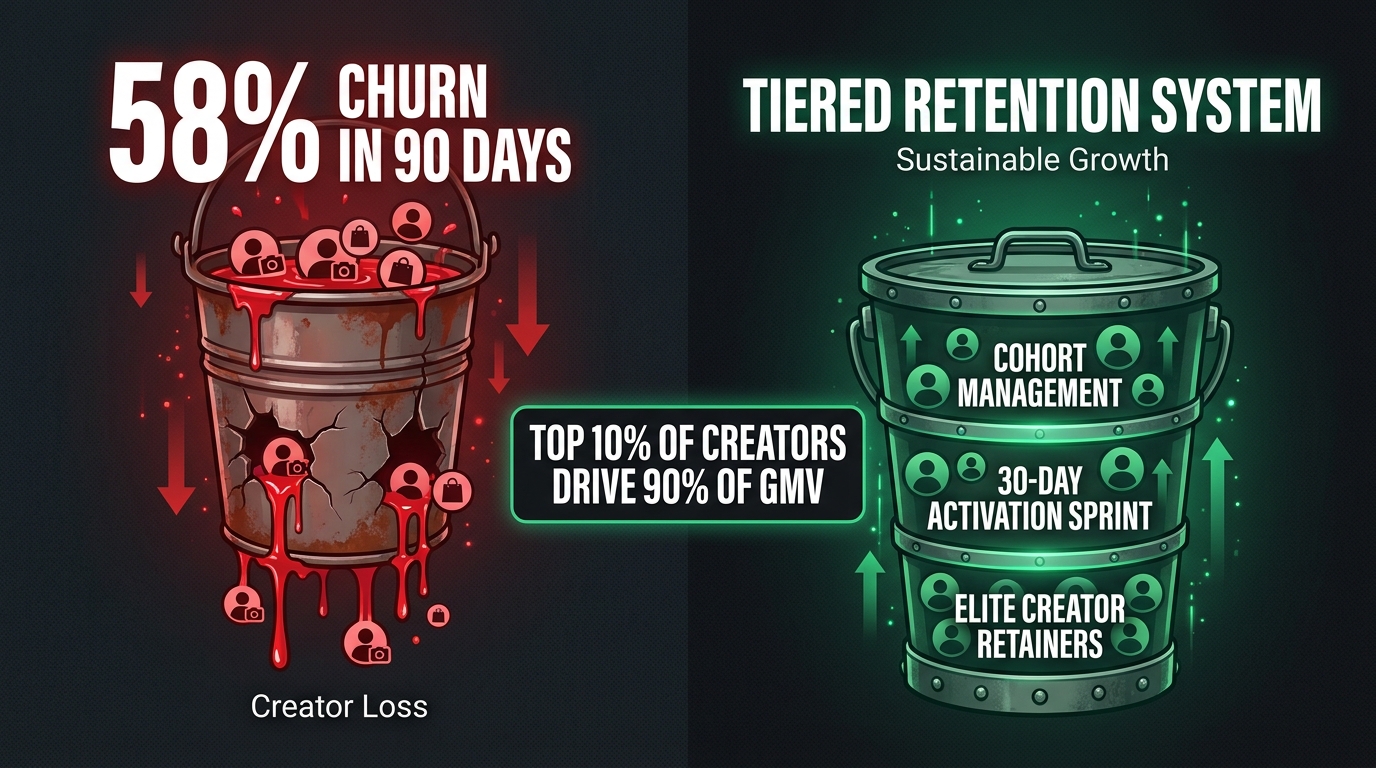
Creator churn is the silent killer of TikTok Shop affiliate programs. Industry analysis suggests approximately 58% of affiliate creators churn within 90 days of joining a program — meaning more than half of the creators you recruit, vet, seed, and activate will have stopped posting for your brand within three months. This isn’t primarily a creator reliability problem. It’s a program design problem.
Creators churn for predictable reasons: they feel undervalued relative to their contribution; they have no clear path to better economics as their performance grows; they can’t get responsive support when they have questions; they have no ongoing relationship with the brand beyond receiving product; or they simply drift toward other programs that are more active in communicating with them. All of these are addressable with deliberate program design.
The Three-Tier Retention System
The most effective creator retention model in 2026 operates across three distinct management tracks that reflect creator tier:
Mass Sampling Track: Tier 1 creators in the open affiliate pool are managed primarily through systems and automation rather than personal attention. The investment here is in a clean, fast onboarding sequence, clear brief delivery, and responsive (but not necessarily human) support channels. The expectation is that a significant percentage of this group will churn — the goal is to identify the 15–20% who have genuine performance potential and move them into the next tier quickly.
Retained Creator Track: Tier 2 creators receive active management. This means a named contact at the brand or agency (not a support ticket), monthly check-in messages that reference their specific performance (“your April GMV was strong — we’d love to send you the summer collection for first access”), product inclusion in new launch previews, and invitations to creator community events or brand briefings. The goal of this track is to make the brand feel like a real partner rather than just a commission source.
Elite Partner Track: Tier 3 creators need strategic management, not just relationship management. These conversations include quarterly performance reviews, co-planning sessions for upcoming content calendars, discussion of exclusive product opportunities, and increasingly, conversations about the creator’s own growth goals and how the brand can support them. Elite creator relationships that endure do so because the brand has found ways to help the creator succeed beyond just commission income — whether through production resources, audience exposure, co-branding opportunities, or strategic introductions.
The Reactivation System for Churned Creators
Not all churned creators are permanently lost. The 30–60 day window after a creator stops posting represents a reactivation opportunity that most brands ignore. A targeted reactivation outreach at this point — not a generic “we miss you” email, but a specific message referencing their past performance and offering a concrete new opportunity — can recover 15–25% of creators who have gone quiet. The message should feel like an invitation to something new, not a complaint about something past. “We just launched X and based on your audience I thought you’d be perfect for the launch cohort” works. “We noticed you haven’t posted in a while” doesn’t.
Analytics That Actually Tell You What’s Working
TikTok Shop’s affiliate analytics dashboard provides data that most brands are reading at the wrong level of abstraction. They look at total program GMV, total creator count, and average commission paid — and make decisions based on those aggregate numbers. That’s like navigating by checking your fuel level and ignoring the map. The data that drives program improvement lives in creator-level and content-level metrics, not program-level averages.
The Six Metrics That Drive Creator-First Program Decisions
GMV per creator (by tier): Not total GMV or average GMV across all creators. GMV segmented by tier and then by individual creator within each tier. This surfaces your actual top performers versus your theoretical top performers (based on follower count or category activity) and informs who should be elevated in the commission structure.
Content-to-purchase attribution rate: For each piece of affiliate content, what percentage of viewers who clicked the product link completed a purchase? This is different from overall CVR because it isolates the content quality variable from the audience size variable. A creator with 50,000 followers and a 9% content-to-purchase rate is more valuable than one with 300,000 followers and a 1.5% rate — but you won’t see that in aggregate program data.
Time-to-post (by cohort): How long does it take creators in each recruitment cohort to publish their first affiliate content after joining? This metric directly reflects onboarding effectiveness. If cohort time-to-post is decreasing quarter over quarter, your activation systems are working. If it’s flat or increasing, there’s friction in your pipeline that needs identifying.
Creator LTV: Total attributed GMV over the creator’s lifetime in the program. Segmented by acquisition source (did they find you through the open plan, through seeding, through targeted outreach?), this metric tells you which recruitment channels produce the highest-value creators — and where to allocate your next recruiting investment accordingly.
Post cadence consistency: How many affiliate posts per month does each creator average? And is that number stable, growing, or declining? Declining cadence is an early warning signal for churn — catching it early allows for intervention before the creator stops entirely.
Residual content performance: What percentage of total affiliate GMV in a given month comes from content posted in prior months? High residual performance (above 30%) indicates that creators are producing content with lasting conversion value — the content keeps working long after posting. Programs with high residual GMV are fundamentally more efficient than those dependent on constant new content for revenue maintenance.
Building a Creator-Level Dashboard
TikTok’s native analytics provide most of these data points, but not in a format optimized for program management decisions. The investment in a lightweight creator management dashboard — whether built in Airtable, Notion, or a purpose-built affiliate management tool — that pulls TikTok Shop data and organizes it by creator tier, cohort, and post history pays for itself quickly in sharper program decisions. Brands managing 50+ active creators without this infrastructure are making significant decisions on incomplete information.
The Spark Ads Bridge — From Organic Creator Content to Paid Amplification
The most effective TikTok Shop programs in 2026 aren’t choosing between organic creator content and paid advertising. They’re using organic affiliate content as the creative supply chain for paid campaigns — and the mechanism that connects them is Spark Ads.
Spark Ads allow brands to amplify existing organic creator content as paid advertisements, with the creator’s original post remaining on their profile (building their account) while the brand pays for expanded distribution. Critically, Spark Ads carry the social proof of the creator’s existing engagement — the likes, comments, and shares from organic reach transfer to the paid version, making it look like genuinely popular content rather than a paid placement.
Identifying Spark Ad Candidates from Your Affiliate Pool
Not every piece of affiliate content is worth amplifying. The indicators that make a creator video a strong Spark Ads candidate: organic video retention above 40%; engagement rate on the post above 5%; comment-to-like ratio above 3% (indicating that the content is generating substantive response, not just passive scrolling); and clear product mention within the first five seconds. Videos that meet all four criteria typically perform significantly better as Spark Ads than average paid creative — because they’ve already proven audience resonance in the real world.
The Creator Permission Protocol
Running Spark Ads requires creator authorization, which is a step many brands handle awkwardly and which can damage creator relationships if approached transactionally. The right framing: “We’d love to put some spend behind your video — this boosts your views and organic reach at no cost to you, while we pay for the additional distribution.” Creators with some understanding of the platform dynamics typically agree immediately. For Tier 2 and Tier 3 creators, Spark Ads authorization can be built into the collaboration agreement upfront so it’s not a separate conversation each time.
Targeting Logic for Creator-Sourced Spark Ads
The audience targeting for Spark Ads built from affiliate content should start with look-alike audiences modeled off purchasers — not just video viewers or link clickers, but actual completed purchases. This seeds the algorithm with the most conversion-positive signal you have. Layering in interest targeting based on the specific product category (rather than broad lifestyle segments) further concentrates spend against people most likely to complete a purchase.
Importantly, Spark Ads should not attempt to reach the creator’s own audience — that audience has already seen the content organically. The value of the paid layer is reaching new audiences who haven’t been exposed to the creator or the product, leveraging the proven creative to convert cold traffic. Retargeting campaigns against viewers who watched more than 50% of the original video without purchasing are a strong secondary use case that typically shows higher ROAS than cold traffic amplification.
Measuring the Combined Attribution Stack
Brands running both organic affiliate and Spark Ads from the same creator content need attribution models that account for both channels without double-counting. TikTok’s attribution window settings matter significantly here — using a 7-day click attribution window for Spark Ads while also tracking organic affiliate purchases (which have their own attribution) can create overlap that overstates total program performance. The solution is a consistent attribution policy (typically last-touch with a 7-day window) applied uniformly across organic and paid channels, supplemented by incrementality testing that measures true lift from paid amplification against organic-only periods.
Conclusion: Building the Engine, Not the Campaign
The creator-first affiliate engine is not a campaign. It’s not a launch strategy or a holiday play. It’s an operational system that compounds over time — each recruitment cycle producing better quality creators than the last, each creator brief generating more useful performance data, each retained top-tier partner driving higher GMV per content piece as their audience trust in the product deepens.
The data is clear about what works. Affiliate creator content drives 42% of US TikTok Shop GMV. Programs with structured onboarding activate creators at 3–4x the rate of passive programs. Waterfall seeding returns 5–20x on product cost. Top-10% creators drive 90% of program GMV — which means the brands capturing that concentration are investing systematically in finding, activating, and retaining those creators before competitors do.
The Seven Operational Priorities
If you’re building or rebuilding a TikTok Shop affiliate program with a creator-first model, these are the operational priorities in sequence:
- Rebuild your recruitment pipeline around performance signals, not follower count. Set explicit filter criteria for each stage before you make any new outreach.
- Design a waterfall seeding program with three waves and a defined follow-up protocol at each stage. Track post rate, content quality, and GMV per sample as your primary seeding KPIs.
- Create brief templates for your top three product categories. Keep each to one page. Include three angles, five hook options, three proof points, and a short guardrails section. Update them after each creator wave.
- Build a three-tier commission system with explicit GMV thresholds for tier movement and milestone bonuses at each tier. Communicate the tier structure clearly to all creators at onboarding so they understand what growing with you looks like financially.
- Implement a 14-day activation sprint for every new creator cohort, with defined touchpoints at days 0, 3–4, 7, 10–11, and 13–14. Track time-to-post by cohort and optimize the sequence quarterly.
- Develop creator-level analytics tracking GMV per creator, content attribution rate, post cadence, and creator LTV. Review this data weekly, not monthly.
- Establish a Spark Ads pipeline for top-performing affiliate content. Define your selection criteria, build a creator permission protocol, and set targeting logic before the first campaign launches.
Brands that execute on all seven of these priorities build programs that become increasingly difficult to compete with over time — because the data advantage, the creator relationships, and the content learning compound together in ways that can’t be easily replicated by a competitor starting from zero.
The brands still running spray-and-pray affiliate programs will keep resetting. The ones building engines will keep accelerating. At 42% of platform GMV and growing, the stakes of getting this right have never been higher.