

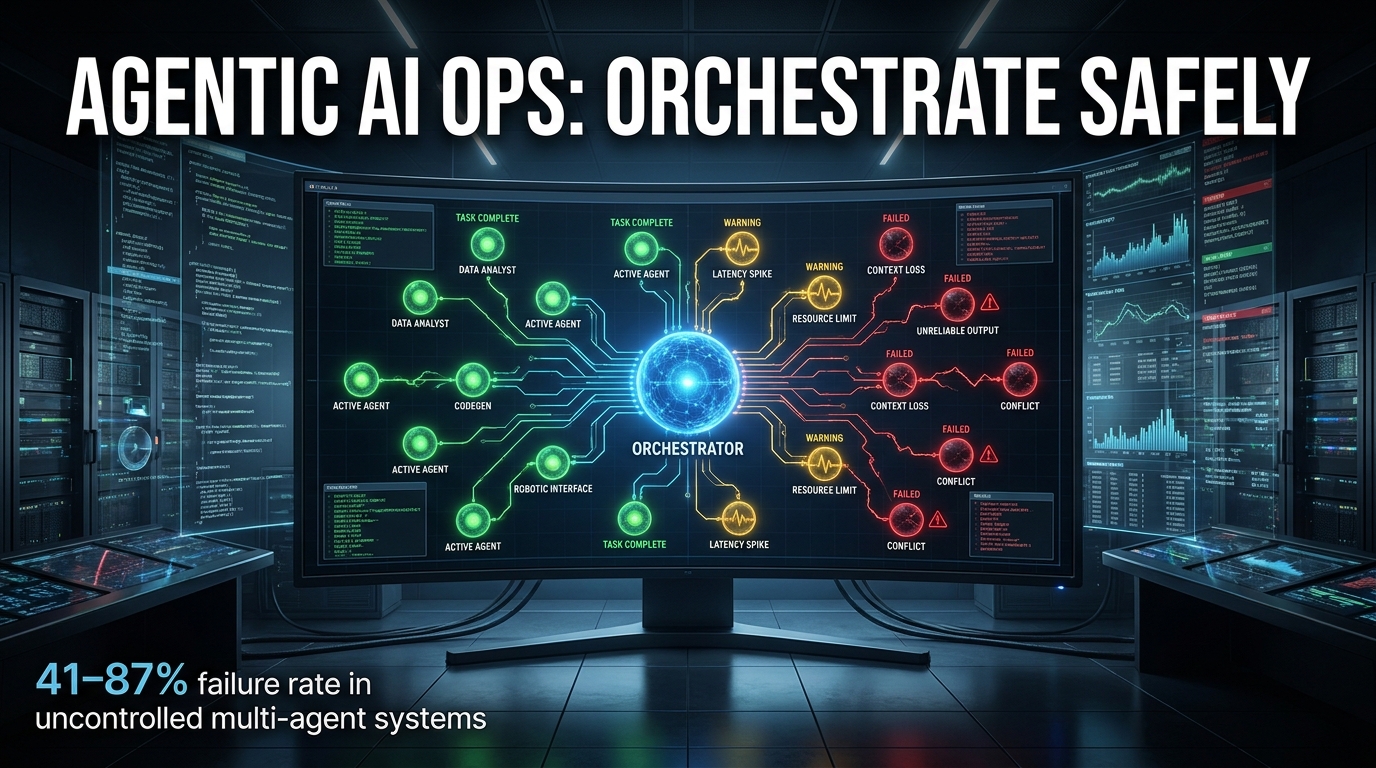

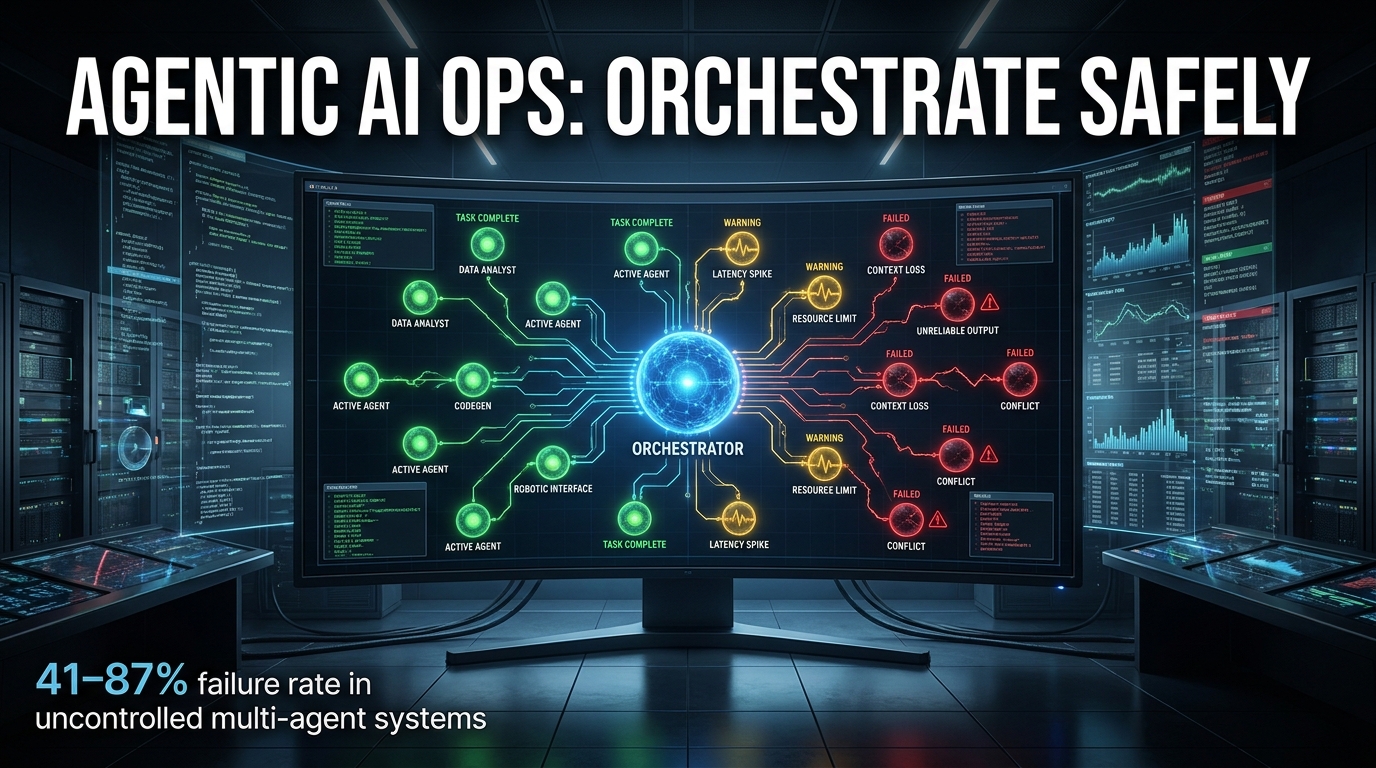
There is a number that should make every engineering leader uncomfortable right now: somewhere between 41% and 87% of multi-agent AI systems fail under production-like conditions. That figure comes from MAST-style studies analyzing more than 1,600 execution traces across seven major orchestration frameworks in 2026. It is not a theoretical projection. It is what actually happens when organizations wire agents together and send them into the wild.
The uncomfortable truth is that most of these failures have nothing to do with the quality of the underlying models. The models are often fine. What breaks is everything around them — the coordination logic, the tool boundaries, the verification steps, the cost controls, and the governance structures that should be holding the system together.
This is the control plane problem. Enterprises have invested heavily in individual agents — tuned, prompted, and benchmarked to perform specific tasks. But they have treated the orchestration layer as an afterthought, assuming that connecting capable agents would naturally produce capable systems. It does not. Multi-agent systems are not the sum of their agents. They are a function of how those agents are governed, routed, constrained, and observed.
This post is about building that governance layer correctly. Not just the patterns — though those matter — but the full architecture of a production-ready multi-agent system: the protocols that make agents interoperable, the failure modes that will catch you off guard, the security posture required when agents can act autonomously, the observability stack that tells you what is actually happening, and the human oversight model that does not grind speed to a halt. If you are moving from agent experiments to agent operations, this is the ground-level engineering guide you need.
Why Single-Agent Thinking Breaks at Multi-Agent Scale
Most teams build their first multi-agent system by reasoning from single-agent experience. A single agent works: you give it a prompt, a set of tools, and a context window, and it produces output. So a multi-agent system should just be several of those running in sequence or in parallel, right?
This assumption is the source of most early failures. Single-agent systems fail locally and visibly — the output is wrong, the tool call errors out, the context overflows. Multi-agent systems fail systemically and silently — one agent’s output becomes another agent’s input, errors compound across hops, and by the time a failure surfaces it has already propagated through three layers of the pipeline.
The Error Amplification Problem
In a single-agent system, a 10% error rate means 10% of outputs are wrong. In a three-agent pipeline where each agent operates at 90% accuracy, the compound accuracy of the full pipeline drops to approximately 73%. Add a fourth agent and you are at 66%. This is not a model quality problem — it is a systems design problem, and it follows the same math as any composed system where individual error rates multiply.
The implication is significant: the same model that performs acceptably in isolation can be part of a system that fails nearly a third of the time, without any individual agent behaving incorrectly by its own standards. Each agent is doing what it was asked. The failure lives in the architecture.
Context and State Are Not Free
Single-agent reasoning depends on context held within one context window. Multi-agent systems have to manage state across agent boundaries, which creates an entirely new class of problem. Who owns the canonical state? How is it passed from agent to agent? What happens when an agent modifies state that another agent is concurrently reading? How is state recovered after a partial failure?
Without explicit answers to these questions baked into the architecture, multi-agent systems accumulate what practitioners call “ghost state” — information that some agents are working from but others are not, leading to contradictory actions, duplicated work, and undetectable inconsistencies that degrade output quality over time.
The Coordination Tax
Research from mid-2026 breaks down failure modes across multi-agent production traces into three major categories: system and specification design issues (approximately 44% of failures), inter-agent coordination and alignment failures (approximately 32–37%), and task verification failures (approximately 23–24%). The coordination category is particularly instructive because it is almost entirely invisible during development — agents that pass unit tests fail in production when they encounter the actual outputs of peer agents rather than the clean test inputs they were developed against.
The solution is not to build smarter agents. It is to treat coordination, state management, and verification as first-class architectural concerns from the beginning — which requires a fundamentally different design mindset than single-agent development.
The Five Canonical Orchestration Patterns
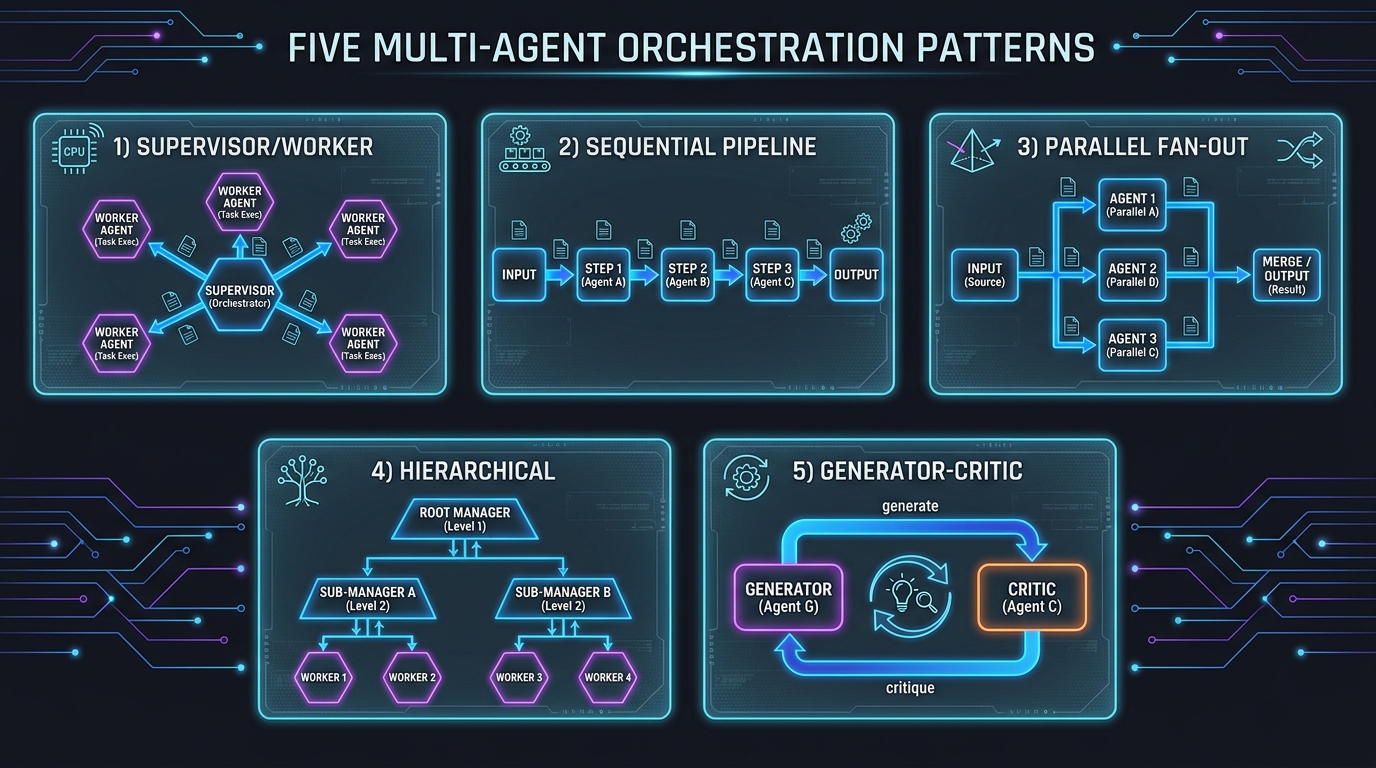
Production multi-agent systems in 2026 have converged on five core orchestration patterns. Each has specific strengths, failure modes, and use cases. Choosing the wrong pattern for a task is itself a common failure mode — not because the pattern is broken, but because the coordination and verification requirements differ significantly.
1. Supervisor / Worker (Hub-and-Spoke)
One orchestrator agent receives the goal, decomposes it into subtasks, routes each subtask to a specialized worker agent, and aggregates the results. The orchestrator handles retry logic, handles failure escalation, and maintains the canonical state of the overall task.
This is the dominant production pattern because it creates a single point of coordination control, which simplifies observability, audit, and policy enforcement. The risk is single-point-of-failure at the orchestrator level: if the orchestrator produces a bad decomposition, every downstream worker faithfully executes the wrong task. This is why orchestrator outputs should always be treated as the highest-value evaluation target in your monitoring stack.
Best suited for: Complex multi-step tasks with heterogeneous subtasks, workflows requiring centralized audit, regulated environments needing a single coordination record.
2. Sequential Pipeline
Agents are arranged in a fixed order, each receiving the output of the previous agent as its input. No routing decisions are made at runtime — the topology is static and predetermined.
Pipelines are predictable and easy to observe, which makes them good for regulated workflows where every processing step must be explicitly documented. The weakness is brittleness: a failure at step N blocks everything downstream, and there is no dynamic rerouting. Pipelines also accumulate latency additively across every agent in the chain, which makes them poorly suited for time-sensitive workloads.
Best suited for: Document processing, compliance review workflows, content transformation chains, ETL-style operations where each step refines a single artifact.
3. Parallel Fan-Out with Merge
A single input is dispatched to multiple agents simultaneously, each processing it independently, and their outputs are merged by a synthesizer agent or aggregation function. Fan-out can be homogeneous (same agent type working on different data shards) or heterogeneous (different specialist agents working on the same data from different angles).
Fan-out dramatically reduces latency compared to sequential processing, but introduces concurrency complexity — the merge step must handle partial results, conflicting outputs, and agents that complete at different times. Without explicit merge logic, fan-out becomes a source of exactly the contradictory outputs and ghost state problems described above.
Best suited for: Research and synthesis tasks, large document analysis, scenarios where multiple expert perspectives need to be integrated, any workload that benefits from parallelism.
4. Hierarchical (Multi-Tier Supervision)
The hierarchy extends the supervisor pattern across multiple tiers: top-level manager agents handle strategic decomposition and route to mid-level coordinator agents, which in turn manage pools of specialized worker agents. This mirrors how large human organizations structure complex work.
Hierarchical systems can handle genuinely complex, long-horizon tasks that exceed any single agent’s context capacity. The cost is added latency at each tier, compounding coordination overhead, and significantly harder observability — tracing a failure across three tiers of delegation requires end-to-end distributed tracing from the start. Teams that add hierarchy without adding observability infrastructure consistently report that these systems become “black boxes” within weeks.
Best suited for: Long-horizon autonomous tasks, enterprise workflows spanning multiple departments, systems where different subtask categories require qualitatively different expertise and decomposition logic.
5. Generator-Critic (Adversarial Refinement)
One agent generates a candidate output; a separate critic agent evaluates it against a rubric and returns structured feedback; the generator refines the output accordingly. The loop runs for a fixed number of iterations or until the critic’s evaluation exceeds a quality threshold.
Generator-critic dramatically improves output quality for tasks with clear evaluation criteria — code correctness, factual accuracy, adherence to specifications. The risk is runaway loops: without hard iteration caps and a termination condition that does not require perfect scores, the critic can continuously find minor issues and drive token consumption far beyond budget. Iteration caps and cost circuit breakers are mandatory for this pattern.
Best suited for: Code generation and review, document drafting with quality requirements, any task where the evaluation criteria can be formalized and the cost of a substandard output is high.
The Protocol Stack: MCP and A2A as Complementary Infrastructure
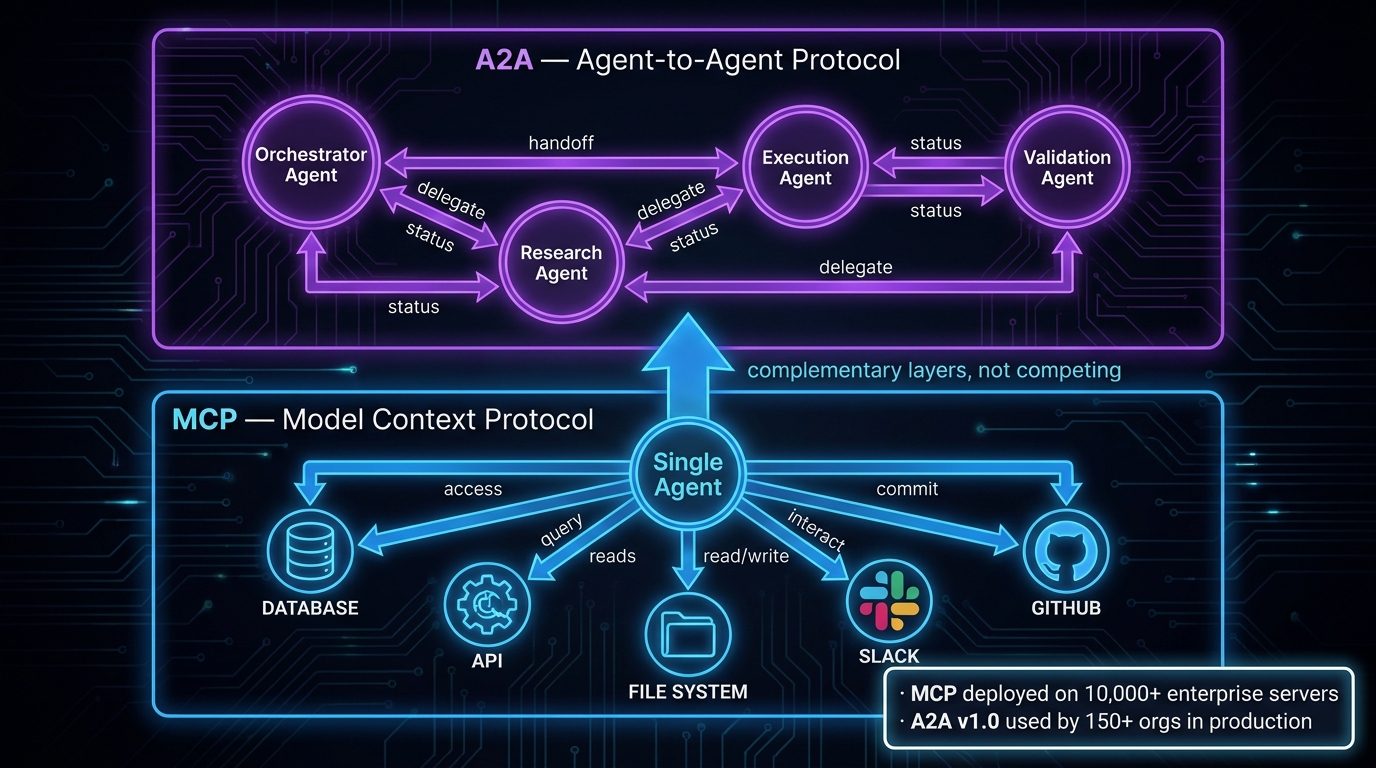
Before 2025, every multi-agent integration was a bespoke implementation: custom tool connectors, custom agent-to-agent messaging, custom schemas for passing context between systems. This fragmentation meant that every new agent added to a system required new integration work, and that security and governance had to be re-engineered for each connection. Two protocols have fundamentally changed this picture: Anthropic’s Model Context Protocol (MCP) and Google’s Agent-to-Agent protocol (A2A).
The critical architectural insight is that these are not competing standards. They operate at different layers of the stack and solve different problems.
MCP: Standardizing the Agent-to-Tool Interface
MCP standardizes how a single agent connects to external resources — databases, APIs, file systems, SaaS platforms, internal data stores. Instead of every agent implementing its own connector for each tool, agents implement a single MCP client interface, and tools expose MCP server endpoints. The agent does not need to know the specifics of any particular tool; it just needs to know how to make MCP calls.
By mid-2026, MCP had been deployed across more than 10,000 enterprise servers with over 97 million SDK downloads — numbers that reflect genuine adoption, not conference announcements. The protocol’s impact on development speed is concrete: teams that previously spent weeks building and maintaining bespoke tool integrations now build MCP servers once and reuse them across any compliant agent in their ecosystem.
The security implications are equally significant. Because all tool access flows through the MCP interface, it becomes a natural point for access control, audit logging, and rate limiting. Rather than trying to govern tool access at the model level — where it is opaque and unreliable — organizations can enforce policies at the MCP server level, where they can be audited and tested independently of any particular agent.
A2A: Standardizing the Agent-to-Agent Interface
A2A, which reached v1.0 in early 2026 and had been adopted in production by over 150 organizations by mid-year, operates at the agent communication layer. It defines how agents discover each other’s capabilities, how one agent delegates a task to another, how status is communicated back up the delegation chain, and how long-running workflows maintain continuity across agent handoffs.
The key A2A primitive is the “agent card” — a machine-readable capability declaration that allows an orchestrator to discover what tasks a given agent can handle, what inputs it requires, and what outputs it produces. This capability discovery mechanism is what makes dynamic routing possible: rather than hardcoding which agent handles which task type, orchestrators can query the agent registry at runtime and route based on current agent availability, specialization match, and cost.
Using Them Together
In a production architecture, MCP and A2A are layered. Each individual agent uses MCP to access the tools and data it needs. The orchestration layer uses A2A to coordinate between agents — routing tasks, tracking delegation chains, and maintaining workflow state. An orchestrator that needs to call a research agent uses A2A for the delegation; the research agent uses MCP to access the databases and APIs it queries. The layers do not interfere; they compose cleanly.
Teams that adopt both protocols report a significant reduction in integration overhead and a corresponding improvement in governance: because all tool access and agent-to-agent communication now flows through standardized interfaces, policy enforcement, audit logging, and anomaly detection can be applied uniformly rather than being re-implemented for every connection.
The Seven Failure Modes That Will Actually Hurt You
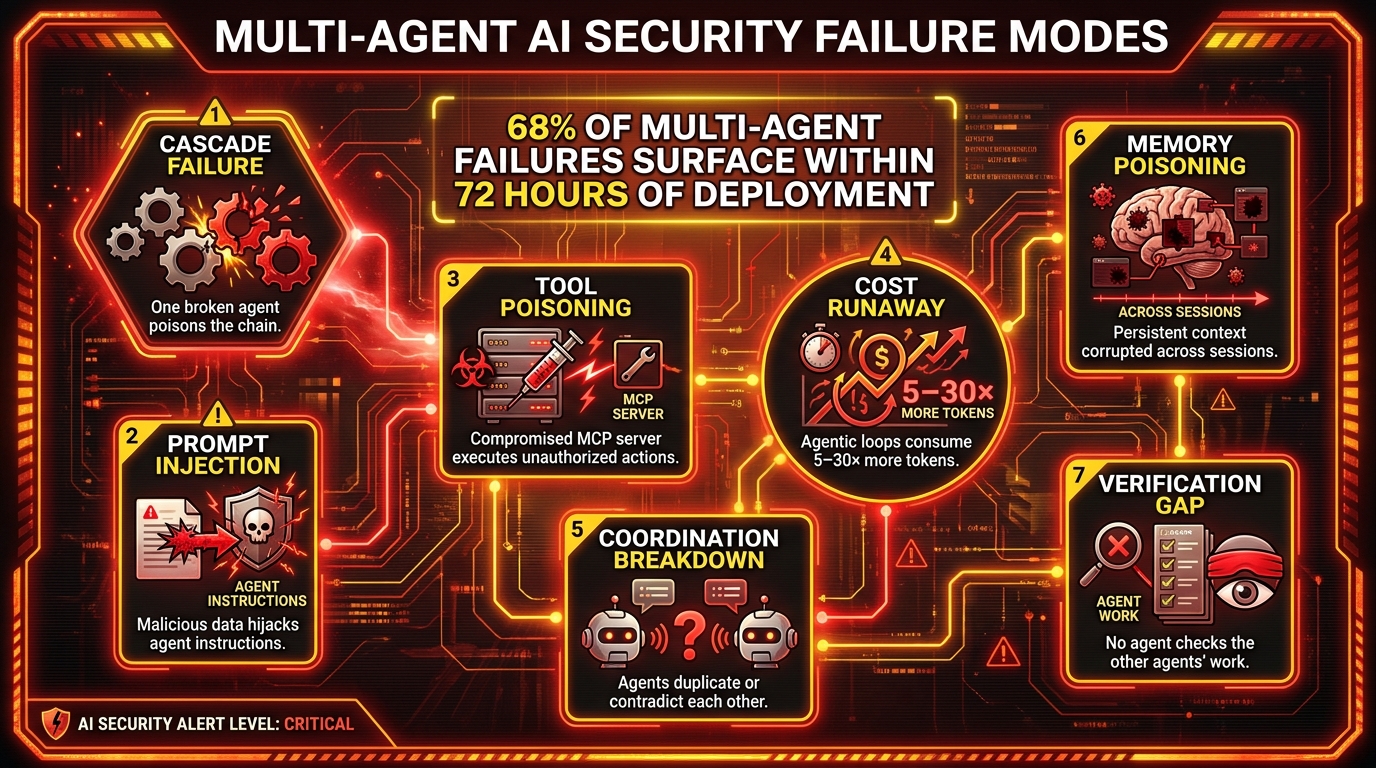
Enterprise risk assessments for multi-agent AI in 2026 have consistently identified seven failure categories that account for the overwhelming majority of production incidents. Understanding each one at a mechanistic level — not just as a label — is necessary for building systems that do not exhibit them.
1. Cascade Failure
The most structurally dangerous failure mode: one agent produces incorrect output, downstream agents treat it as ground truth, and the error propagates and compounds through the pipeline. By the time a human observer sees a bad final output, the root cause may be buried three agent hops back in a trace that was never instrumented.
Cascades are prevented architecturally, not at inference time. The key mechanisms are: output validation schemas between each agent hop (reject malformed outputs before they become inputs), agent-level confidence signaling (agents declare uncertainty rather than silently producing low-confidence outputs), and circuit breakers that halt pipeline execution when validation failures exceed a threshold.
2. Prompt Injection
In multi-agent systems, the attack surface for prompt injection expands dramatically compared to single-agent deployments. An agent that reads data from the web, from user-generated content, or from external databases can encounter adversarially crafted content that attempts to override its instructions. In a multi-agent context, a successful injection in one agent can influence every downstream agent that trusts its output — effectively hijacking an entire workflow through a single corrupted data source.
Security practitioners have documented real-world multi-agent prompt injection incidents in 2026 involving email processing agents, web research agents, and document analysis agents. The consistent mitigation pattern is to treat agent inputs from untrusted sources as data, not instructions — using strict parsing schemas and sandboxed processing rather than passing raw external content directly into agent context windows.
3. Tool Poisoning
Tool poisoning is the MCP-era variant of supply chain compromise: a malicious or compromised MCP server returns tool results that include embedded instructions designed to manipulate the calling agent’s behavior. Because agents treat tool responses as authoritative data, a poisoned tool can be more effective at hijacking agent behavior than a direct prompt injection.
The mitigation requires treating every MCP server as a potential adversarial input source: validate tool response schemas, apply content filtering to tool outputs before they enter agent context, and maintain an allowlist of trusted MCP servers with cryptographic verification of server identity.
4. Cost Runaway
Agentic loops and retry logic drive token consumption at 5 to 30 times the rate of equivalent non-agentic workloads. In generator-critic loops without hard iteration caps, in orchestrators that retry failed subagent calls aggressively, and in hierarchical systems where task decomposition generates more subtasks than expected, token costs can escalate from budgeted to catastrophic within a single task execution.
The Linux Foundation’s Tokenomics Foundation, announced in mid-2026, reflects how seriously enterprises now treat token cost governance — it is the AI equivalent of cloud FinOps and addresses the same fundamental problem: costs that were manageable at pilot scale become unsustainable at production scale without explicit metering and control infrastructure.
5. Coordination Breakdown
When multiple agents operate on shared state without explicit concurrency control, they can produce contradictory actions: two agents simultaneously updating the same record, an agent acting on a task that a peer agent has already completed, or parallel agents writing conflicting conclusions to a shared output. These failures are particularly hard to detect because each agent’s individual behavior may be correct — the problem only manifests in the interaction.
6. Memory Poisoning
Agents with persistent memory — the ability to recall information across sessions — introduce a new attack surface and a new failure mode: corrupted or adversarially manipulated memory that causes an agent to behave incorrectly in future sessions based on a past interaction. Unlike in-context manipulation, memory poisoning can have a durable effect on agent behavior that persists across resets and is difficult to detect without explicit memory auditing.
7. Verification Gaps
In a system where Agent A’s output becomes Agent B’s input, who checks Agent A’s work? In most multi-agent architectures, the answer is: no one. Agents are trusted by their successors in the pipeline, which means a subtly wrong output at any stage propagates unchallenged. The verification gap is the most structurally simple failure mode to describe and the most consistently overlooked in practice — because adding verification agents costs tokens and latency, and both feel like inefficiency rather than insurance.
Building the Agent Control Plane
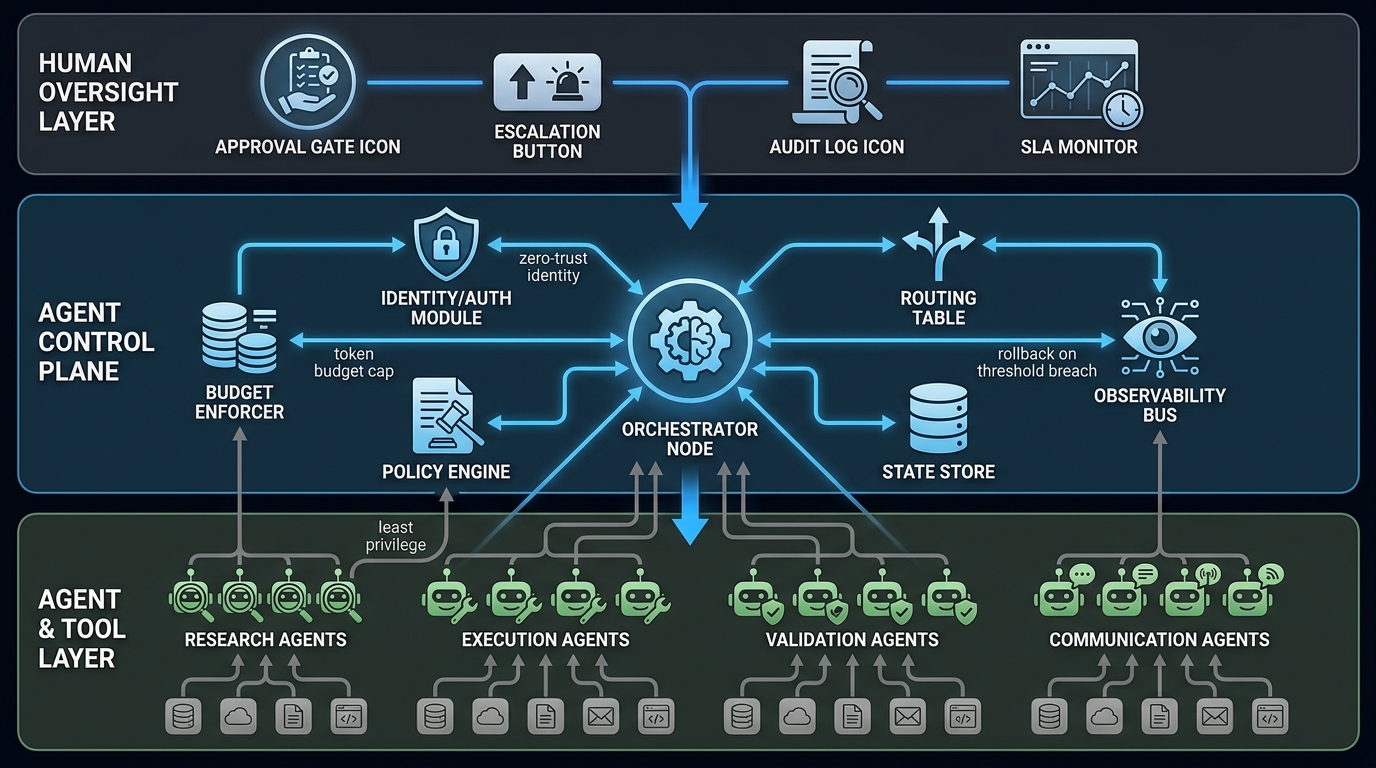
Industry analysts have been unambiguous about where the competitive differentiation in agentic AI is heading: not to the models themselves, which are becoming increasingly commoditized, but to the control plane that orchestrates them. The agent control plane is the layer that sits between your business logic and your individual agents, handling identity, routing, policy enforcement, state management, cost control, and observability as centralized, governable infrastructure.
Building this layer correctly from the start is significantly easier than retrofitting it onto an existing multi-agent system. The following components are the non-negotiable foundation.
Agent Identity and Least-Privilege Access
Every agent in your system should have a distinct cryptographic identity — not just a name in a config file, but a verifiable credential that can be used to enforce access control at the tool and API level. This identity is the foundation of zero-trust architecture for multi-agent systems: rather than trusting agents by virtue of being inside your network or your orchestration framework, every action is authorized against an explicit policy that specifies what this particular agent, with this particular identity, is allowed to do.
Least privilege means that a research agent that only needs to read from a set of databases should have no write permissions and no access to APIs outside its designated scope, even if the orchestration framework technically makes those APIs available to agents. Over-privileged agents are the primary reason that prompt injection and tool poisoning attacks have such large blast radii: a compromised agent with broad permissions can do far more damage than one operating within tight constraints.
Practical implementation: assign each agent a service account or token with explicit scope, rotate credentials regularly, and log every credential use. Build your MCP server ACL policies to enforce these boundaries at the server level rather than relying on the agent itself to stay within bounds.
The Policy Engine
A centralized policy engine evaluates every proposed agent action against a set of organizational rules before the action is executed. Policies might specify: which tools an agent class can access, which data categories an agent can read or write, what action rate limits apply, and which actions require human approval before execution. The policy engine is separate from the agents themselves — its rules cannot be overridden by agent instructions, and it operates as a hard constraint rather than a soft guideline.
Policy engines become especially important in regulated industries. An agent operating in a financial services context needs to be demonstrably constrained from accessing certain data categories, producing certain outputs, or taking certain actions — and that constraint needs to be auditable by compliance teams, not just asserted in documentation.
Dynamic Routing with Agent Cards
Rather than hardcoding which agent handles which task type, production control planes use runtime routing based on agent capability declarations (A2A agent cards), current agent health and availability, task complexity classification, and cost optimization rules. An orchestrator that needs to handle a legal document review can query the routing layer for the best available agent for that task type — which might be different depending on the time of day, current load, or which specialized agents are within budget for the current billing cycle.
State Store and Concurrency Control
The canonical state store for a multi-agent workflow should live in the control plane, not inside any individual agent. This means agents read and write shared state through controlled interfaces rather than holding it locally — which enables concurrent agents to coordinate, enables recovery from partial failures, and creates an auditable record of how state evolved throughout a task execution.
Optimistic locking, task ID namespacing, and explicit state transition events (rather than mutable shared state) are the concurrency primitives that prevent the coordination breakdowns described in the failure modes section.
Cost Containment and Blast Radius Control
Token cost management for agentic AI is not a reporting function — it is a runtime control problem. The distinction matters: a reporting function tells you how much you spent after the fact; a runtime control prevents runaway spend before it happens. Enterprises that treat token cost as a post-hoc accounting concern are the ones that discover five-figure overnight charges from a looping agent the hard way.
Hard Budget Caps in the Hot Path
Every task execution in a production multi-agent system should have an explicit token budget assigned at the point of invocation. This budget flows through the orchestration layer and is decremented as agents make calls. When the budget is exhausted, the task is terminated or escalated — not silently continued at the organization’s expense.
Practical implementation requires: per-run token budgets set by task type and complexity class, per-agent token allocation within a run (so one runaway agent cannot consume the entire task budget), per-user and per-team daily and monthly ceilings enforced at the API gateway layer, and explicit escalation logic for tasks that legitimately require more tokens than their initial allocation.
Loop Counters and Circuit Breakers
Every agent loop — whether a generator-critic iteration, an orchestrator retry, or a planning-execution cycle — must have a hard maximum iteration count that is enforced at the runtime level, not dependent on the agent deciding to stop. When the loop counter is reached, the circuit breaker triggers: the current output is captured as-is, the relevant human is notified, and the task is either escalated or gracefully failed with a structured error.
Circuit breakers should also trigger on cost velocity anomalies, not just absolute counts. An agent that is consuming tokens ten times faster than the expected rate for its task type is a signal that something has gone wrong — whether a prompt injection attack, an unexpected data size, or a specification error — and should be halted for inspection before costs compound further.
Model Tier Routing for Cost Optimization
Not every subtask in a multi-agent workflow requires frontier model capabilities. Many subtask types — format validation, simple classification, data extraction from structured sources, template filling — can be handled by smaller, faster, cheaper models without meaningful quality loss. A cost-aware routing layer that matches task complexity to model tier can reduce per-task costs by 40–70% in heterogeneous workflows, based on patterns reported by enterprise teams in mid-2026.
The key is building a task complexity classifier into the orchestration layer that routes simple subtasks to cheaper models automatically, escalating to frontier models only when the task requires genuine reasoning, synthesis, or judgment. This is not a capability compromise — it is a recognition that using a frontier model to validate a JSON schema is financially equivalent to using a surgeon to apply a bandage.
Observability That Actually Works in Production
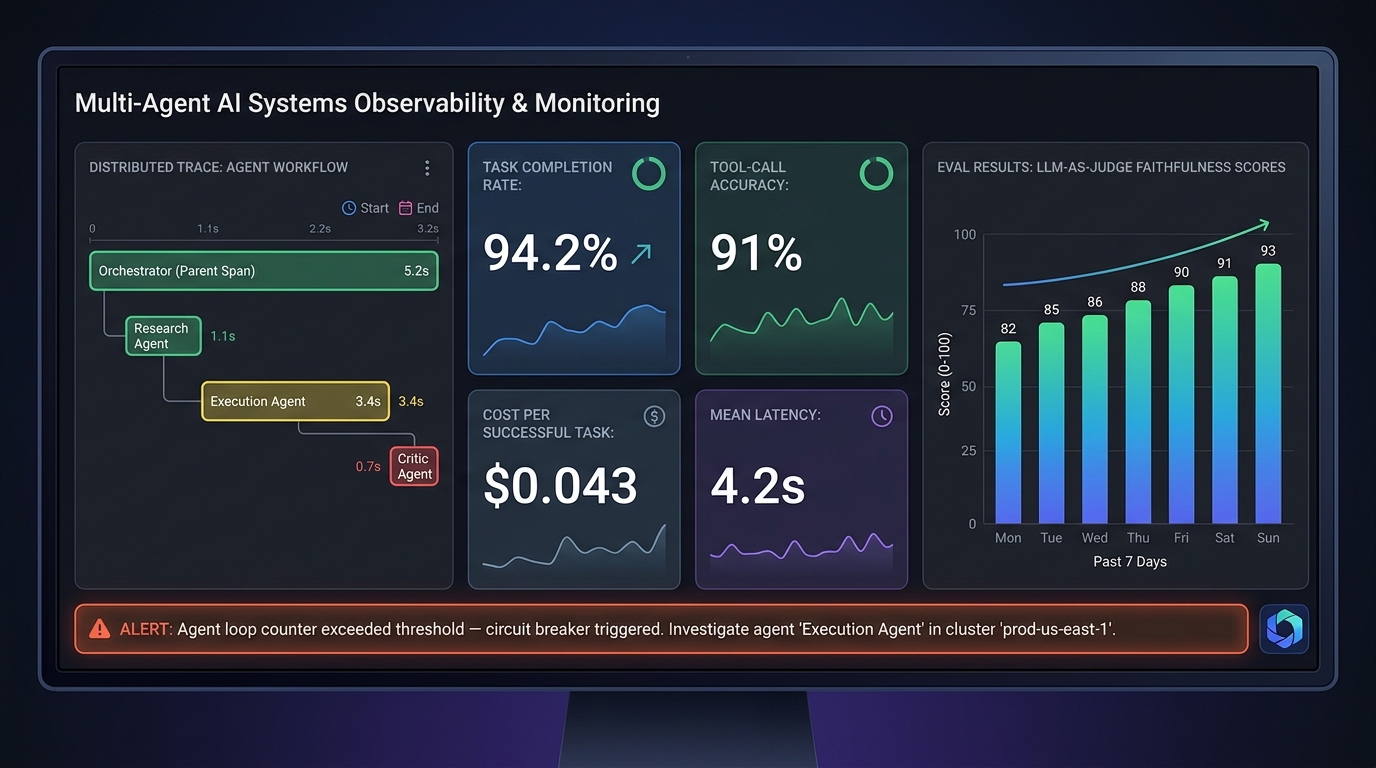
Observability for multi-agent systems is categorically different from observability for traditional software services. You cannot reason about a multi-agent system from individual agent logs — the behavior of the system emerges from the interactions between agents, and those interactions are only visible if you trace them end-to-end. Most teams underinvest in multi-agent observability during development and pay the price in production: systems that cannot be debugged because there is no record of what actually happened.
End-to-End Distributed Tracing
The non-negotiable foundation is OpenTelemetry-based distributed tracing applied across every agent in the system, with parent-child span relationships that reflect the actual delegation and execution structure of the workflow. Every task starts a root trace span. When the orchestrator delegates to a subagent, a child span is created. When the subagent makes a tool call, a grandchild span is created. The result is a complete, hierarchical record of every action taken during a task execution, with timing, inputs, outputs, and errors captured at each node.
This trace is not just a debugging tool — it is the primary substrate for evaluation, anomaly detection, and compliance auditing. Every other observability capability depends on the quality of this underlying trace data. If your traces are incomplete, your evaluations will be blind to the failures they should be catching.
The Core Production Metrics
Multi-agent systems require a different metric set than conventional application performance monitoring. The metrics that production teams in 2026 have converged on as the most informative are:
- Task completion rate: The percentage of initiated tasks that reach a successful end state, broken down by task type, orchestration pattern, and agent configuration.
- Tool-call accuracy: The proportion of tool calls that return valid, expected results — a leading indicator of prompt injection and specification drift.
- Cost per successful task: The fully-loaded token cost divided by tasks that actually succeeded. Cost per attempt without this qualifier hides the real economics of a failing system.
- Mean end-to-end latency: Measured from task initiation to final output, broken down by agent hop to identify bottlenecks in the coordination chain.
- Loop iteration depth: For iterative patterns, the distribution of iterations-to-completion. A rising mean or widening variance signals specification problems or evaluation drift before they manifest as cost incidents.
- Escalation rate: The proportion of tasks that trigger human review. This metric should be actively monitored — both a rising escalation rate (system confidence is falling) and a falling escalation rate (system may be making decisions it should not be making autonomously) are signals worth investigating.
Continuous Evaluation: LLM-as-Judge in Production
Static offline evaluation — running agents against a benchmark test set before deployment — is necessary but not sufficient for multi-agent systems. Production data distributions shift, tool outputs change, and orchestration behavior evolves in ways that pre-deployment benchmarks cannot anticipate. Continuous online evaluation samples production traces, applies automated evaluation criteria using LLM-as-judge scoring, and flags regressions as they emerge.
The evaluation should be attached to traces at the agent level, not just the final output level. A final output that looks acceptable can be the product of a highly dysfunctional multi-agent interaction — escalating costs, incorrect intermediate reasoning, and near-misses that got lucky. Trace-level evaluation catches these problems; output-level evaluation masks them.
Critically, evaluation failures from production should automatically become regression tests in your offline evaluation suite. The failure library grows continuously, and your quality gates become progressively harder to pass as your system has encountered more real-world edge cases.
Human-in-the-Loop Design: Where to Put People Without Killing Speed
The conversation around human oversight of autonomous AI agents is often framed as a binary: either humans approve everything (safe but slow) or agents act autonomously (fast but risky). This framing is operationally useless. Real human-in-the-loop design is about identifying the specific decision points where human judgment adds value, building approval flows that are fast and frictionless, and making autonomous execution the default for everything else.
The Action-Risk Classification Framework
Every action a multi-agent system can take should be classified along two dimensions: reversibility and consequence magnitude. Actions that are easily reversible and have low consequence magnitude — reading data, generating draft content, classifying records — can be fully autonomous. Actions that are irreversible or have high consequence magnitude — sending external communications, modifying production data, making financial commitments, triggering downstream physical processes — require a human approval gate.
This classification drives the architecture of your human oversight layer. Low-risk actions flow through the system without interruption. High-risk actions generate approval requests with structured context — here is what the agent proposes to do, here is why, here is the relevant supporting data — and are paused until a human responds. The approval interface should be designed to minimize the cognitive load on the reviewer: the default in most real deployments should be one-click approval with the relevant context pre-staged, not an email chain that requires a human to reconstruct the agent’s reasoning from scratch.
Human-on-the-Loop vs. Human-in-the-Loop
For workflows where interrupting for approval at every high-stakes action would be operationally impractical, the human-on-the-loop model provides a middle ground. The agent acts autonomously but generates a contemporaneous audit log and a summarized decision record that a human reviewer can check asynchronously. If the reviewer identifies a problem, there is a defined correction and rollback procedure. The key requirement is that “on-the-loop” is never applied to truly irreversible actions — the asynchronous review model only works when there is something left to reverse.
Escalation Path Design
Every automated workflow needs a defined escalation path for scenarios that fall outside the agent’s decision authority. This path should be explicit, tested, and fast. Agents that hit decision boundaries should escalate clearly — not silently fail, not produce a low-confidence output without flagging it, and not loop indefinitely waiting for information that will never arrive. Poorly designed escalation paths are a significant contributor to the 68% of multi-agent system failures that surface within the first 72 hours of production deployment — often because the system encounters a real-world edge case that its testing never anticipated, and there is no graceful handling for it.
Security Hardening for Multi-Agent Systems
Security for multi-agent AI systems cannot be treated as a post-deployment hardening exercise. The attack surface of an autonomous agent system is fundamentally different from a conventional application — agents actively consume data from the environment, interpret it, and take actions based on that interpretation, which means adversarial content in the environment can directly influence system behavior in ways that have no equivalent in traditional software security.
Zero-Trust at Every Layer
The zero-trust principle — never trust, always verify — applies at every communication boundary in a multi-agent system. Agent-to-tool calls are authenticated, not assumed to be authorized by virtue of originating from within the orchestration framework. Agent-to-agent messages are signed and verified, not assumed to be trustworthy because they arrive on an internal message bus. External data processed by agents is treated as potentially adversarial, not as neutral input.
This is not paranoia — it is recognition that a system capable of acting autonomously at scale can cause catastrophic damage if its trust assumptions are violated. The cost of implementing zero-trust authentication is measured in engineering hours. The cost of a successful attack on an over-trusted multi-agent system is measured in regulatory penalties, customer harm, and reputational damage.
Input Sanitization and Output Validation
Every external input to an agent should pass through a sanitization layer before entering the agent’s context window. This includes: content fetched from URLs, records retrieved from databases, tool responses from MCP servers, and messages passed between agents. The sanitization layer does not need to be intelligent — it needs to be strict. Validate structure against an expected schema. Strip or escape content that matches prompt injection heuristics. Enforce length limits that prevent context overflow attacks.
Output validation applies the same discipline to what agents produce before it flows downstream. A structured output schema that the orchestrator enforces on every subagent response is both a coordination tool and a security control — a malformed or unexpected output is rejected before it becomes the input to the next agent in the chain.
MCP Server Governance
As MCP adoption scales, the MCP server becomes a high-value attack target. A compromised MCP server can inject malicious content into any agent that queries it — at scale, across every workflow that uses that server. MCP server governance practices emerging in 2026 include: a formal allowlist of approved servers with cryptographic identity verification, automated scanning of MCP server responses for injection patterns, network segmentation that prevents MCP servers from accessing resources outside their intended scope, and regular security audits of server implementations and configurations.
From Pilot to Production: A Governance Framework That Holds
The gap between a multi-agent pilot and a production-grade multi-agent system is not primarily a technical gap — it is a governance gap. Pilots succeed in controlled conditions with limited scope, clean data, and human observers who catch problems before they compound. Production systems encounter adversarial conditions, unexpected data, and scale that makes continuous human monitoring impractical. Bridging that gap requires an explicit governance framework, not just better code.
Staged Rollout with Hard Reversion Gates
Multi-agent systems should not be deployed to full production traffic on day one. A staged rollout model — shadow mode, limited traffic, broad traffic, full production — with explicit quality thresholds that must be met at each stage before progression creates the feedback cycles needed to catch production-specific failure modes before they affect the full user base.
Shadow mode is particularly valuable for multi-agent systems: run the agent system in parallel with your existing process, compare outputs, and measure divergences without exposing the agent’s outputs to real consequences. The divergences you find will reveal specification gaps, edge cases, and coordination failures that no test suite will have anticipated.
Agent Lifecycle Management
Individual agents within a multi-agent system will need to be updated independently — model changes, prompt updates, tool additions, configuration adjustments — without taking the entire system offline. This requires treating each agent as a versioned, independently deployable service with its own rollout and rollback capability. A centralized agent registry in the control plane tracks which version of each agent is currently active, enables rapid rollback to a previous version when a regression is detected, and provides the audit trail that compliance teams require for regulated workflows.
Regulatory Readiness
EU AI Act obligations that came into force in phases through 2025 and 2026 apply directly to enterprise multi-agent systems in high-risk application categories. The documentation requirements — logging of autonomous decisions, explainability of outputs, human oversight evidence — are far easier to satisfy if they are built into the architecture from the beginning than retrofitted onto a system that was designed without them. The control plane is your primary compliance asset: its audit logs, policy engine records, and approval workflows are what you present to regulators, not scattered application logs from individual agents.
The Red Team Before You Scale
Before expanding a multi-agent system’s scope or increasing its autonomous authority, run an adversarial testing exercise that specifically targets the multi-agent attack surface: prompt injection through each external data source the system consumes, tool poisoning through each MCP server, escalation bypass attempts, and budget exhaustion attacks. Red-teaming individual agents is not sufficient — the adversarial scenarios that matter most for multi-agent systems are the ones that exploit the coordination and trust relationships between agents, not the ones that target a single agent’s reasoning.
The Operational Mindset Shift: Running Agents Like Infrastructure
The most durable lesson from organizations that have successfully moved multi-agent AI systems into stable production is cultural, not technical. They stopped treating agents as products to be shipped and started treating them as infrastructure to be operated. The difference is significant.
Products are deployed and assumed to be done. Infrastructure is monitored continuously, upgraded incrementally, and subject to operational runbooks for known failure modes. Products have a release cycle. Infrastructure has an operating model. When an agent system is treated as a product, the first sign of trouble is often a production incident. When it is treated as infrastructure, the first sign of trouble is a metric divergence that triggers an investigation before anything fails visibly.
This mindset shift has concrete operational implications. Teams running multi-agent systems as infrastructure maintain on-call rotations for agent health, just as they do for critical application services. They write runbooks for the failure modes they know about — what to do when the orchestrator produces a bad decomposition, when a subagent’s tool-call accuracy drops below threshold, when escalation rate spikes, when cost velocity anomalies trigger circuit breakers. They run regular game days that deliberately inject failures into the system to verify that their recovery procedures actually work.
The organizations that have reached this level of operational maturity are reporting the outcomes that everyone wants from agentic AI: 40–80% improvements in workflow efficiency, material reductions in human time spent on repetitive cognitive tasks, and enough governance confidence to expand agent scope into higher-stakes domains. They got there not by building smarter agents, but by building better operations around the agents they already had.
What to Actually Do Next
If you are currently running multi-agent pilots or planning your first production deployment, the research and patterns in this post translate into a concrete prioritization framework. Here is what to do, in order, before you scale.
- Instrument first. Before you add a single new agent, add distributed tracing across every agent you already have. You cannot govern what you cannot see. OpenTelemetry with parent-child spans is the standard; start there and build up your metric baseline before anything else.
- Choose your orchestration pattern deliberately. Map your specific workflow to the five canonical patterns. Identify which pattern’s failure modes you are most exposed to, and design your mitigation for those failure modes before the pattern is in production.
- Implement MCP for tool access. If you are not already using MCP for tool connectivity, migrate your next integration to it rather than building another bespoke connector. The governance dividend compounds as your agent ecosystem grows.
- Build hard cost controls into your runtime. Per-run token budgets and loop counters are not optional for production systems. Implement them before your first high-volume workload, not after your first cost incident.
- Map your action risk classification. For every action your system can take, explicitly categorize it by reversibility and consequence magnitude. Build your human approval gates around the high-risk categories. Automate everything else.
- Red team the coordination layer specifically. Test your system’s behavior when one agent produces wrong output, when a tool returns adversarial content, and when the orchestrator encounters an ambiguous decomposition. The individual agents will likely pass — the system will likely fail. Find the failure in testing, not in production.
- Write your first operational runbook. Document the three most likely failure scenarios for your current system, what the signals look like in your observability stack, and what the response procedure is. Review and update it after every production incident. This runbook is the beginning of your operational maturity.
The teams winning with agentic AI in 2026 are not the ones with the best models. They are the ones who figured out that orchestrating agents safely is a discipline in its own right — one that requires engineering rigor, operational investment, and a governance mindset that most AI teams have not yet built. The control plane is not a nice-to-have. It is the product.