


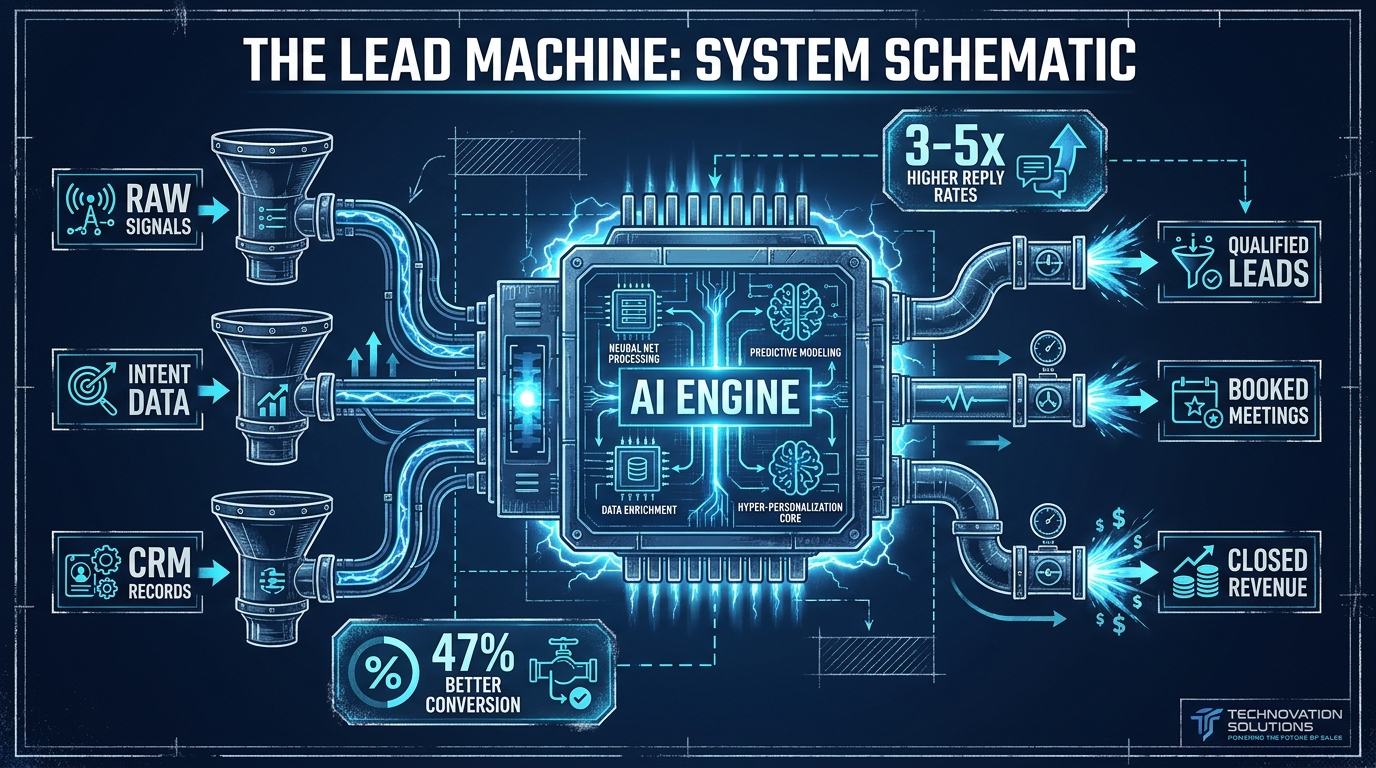

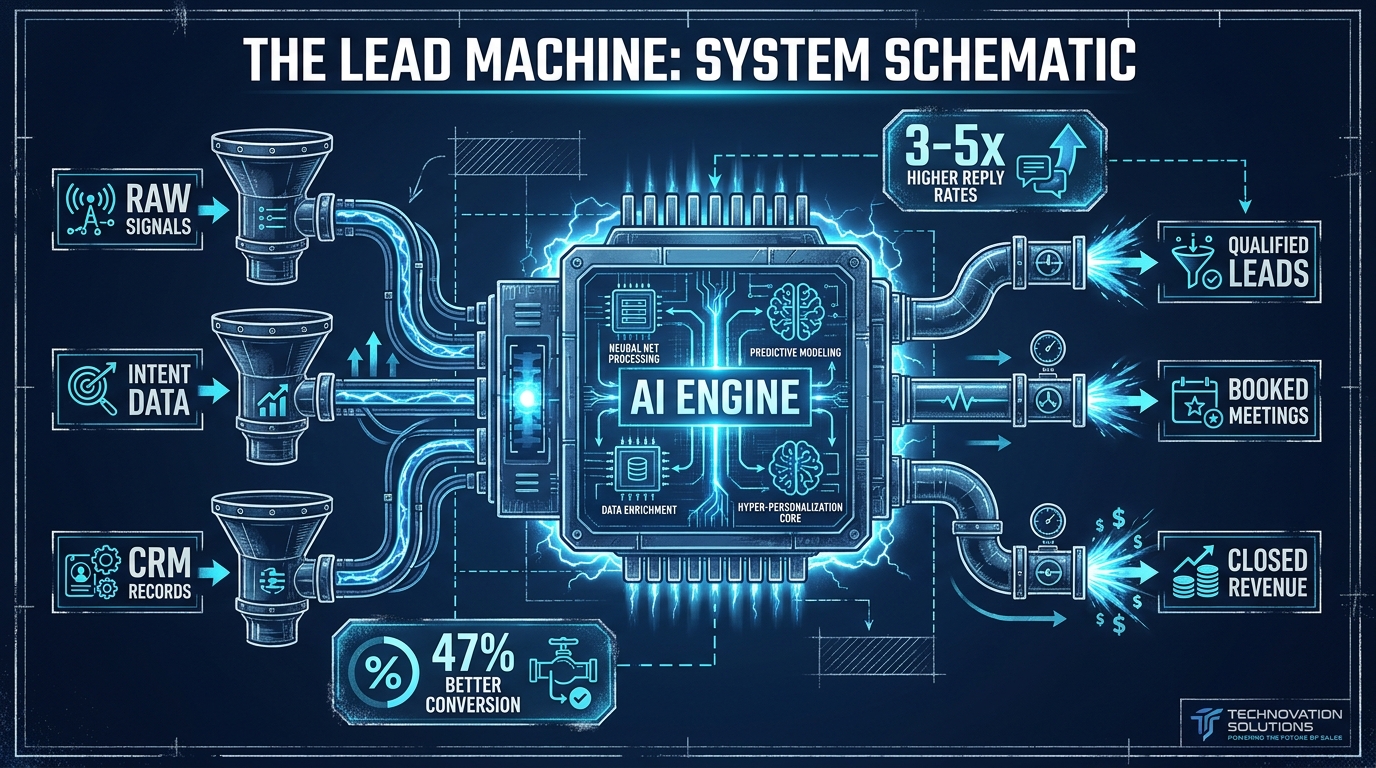
Most B2B teams talk about their prospecting motion as if it’s a single thing — a tool they bought, a sequence they set up, a campaign they launched. It isn’t. A real prospecting system is a machine: a collection of interdependent layers that each need to be calibrated, maintained, and connected correctly or the whole thing underperforms.
The AI revolution in B2B sales has not made this simpler. It has made each layer more powerful — and the failure modes at each layer more expensive. Teams that hand AI a bad ICP get AI-scale bad outreach. Teams that automate without enriched data flood their CRM with junk. Teams that skip qualification AI see their MQL-to-SQL rates crater, dropping to as low as 9.8% by 2026 benchmarks — a 24% relative decline from two years prior.
This post is not a buyer’s guide to AI sales tools. It’s an operational breakdown of what a full AI prospecting machine actually looks like when it’s working, where the tolerances are tight, and what typically breaks first. We’ll go layer by layer — from ICP definition through signal ingestion, scoring, enrichment, multichannel sequencing, AI personalization, qualification, and pipeline measurement — and call out the failure modes at each step so you can build something that runs reliably, not just something that looks impressive in a demo.
If you’re ready to stop buying tools and start engineering a system, this is where to begin.
Why “Lead Machine” Is the Right Metaphor — and Why Most Teams Build Theirs Wrong
The word “machine” matters. A machine has components. Each component has a specific function. The components are connected in a specific order. If one component is undersized, the machine runs below capacity. If one component is missing entirely, the machine breaks at that point regardless of how good everything else is.
Most B2B teams don’t build a machine. They buy a stack. They subscribe to a data provider, add a sequencing tool, integrate with their CRM, hire SDRs to manage it, and call it a pipeline. The difference is critical: a stack is a collection of tools. A machine is a system with intentional throughput design.
The throughput problem
In manufacturing, throughput is limited by the slowest stage — the constraint. Goldratt’s Theory of Constraints applies directly to prospecting: it doesn’t matter how sophisticated your outreach personalization is if your ICP definition is wrong. It doesn’t matter how good your ICP is if your data is stale. It doesn’t matter how clean your data is if your qualification process is slow.
The most common AI prospecting failure pattern in 2026 isn’t bad technology — it’s AI amplifying a broken upstream stage. Teams use AI to send 10,000 emails per week to the wrong people, rather than 500 emails to the right people. The AI didn’t fail; the machine design failed.
What the winning architecture looks like
The teams that are seeing 3–5x higher reply rates and 47% better lead-to-deal conversion from AI prospecting share a common architecture: they treat AI as the operating system of a sequential pipeline, not as a replacement for any one piece of it. Each layer feeds the next with cleaner, higher-intent inputs. The AI’s job at each stage is to increase the signal-to-noise ratio — not to increase volume.
That architecture runs in six layers: signal ingestion, AI scoring, CRM enrichment, multichannel sequencing, personalization, and qualification. Miss any one of them, and the machine runs rough. Get all six right, and you get the numbers that make prospecting look easy from the outside.
The ICP Problem: Why Most AI Prospecting Starts Already Broken
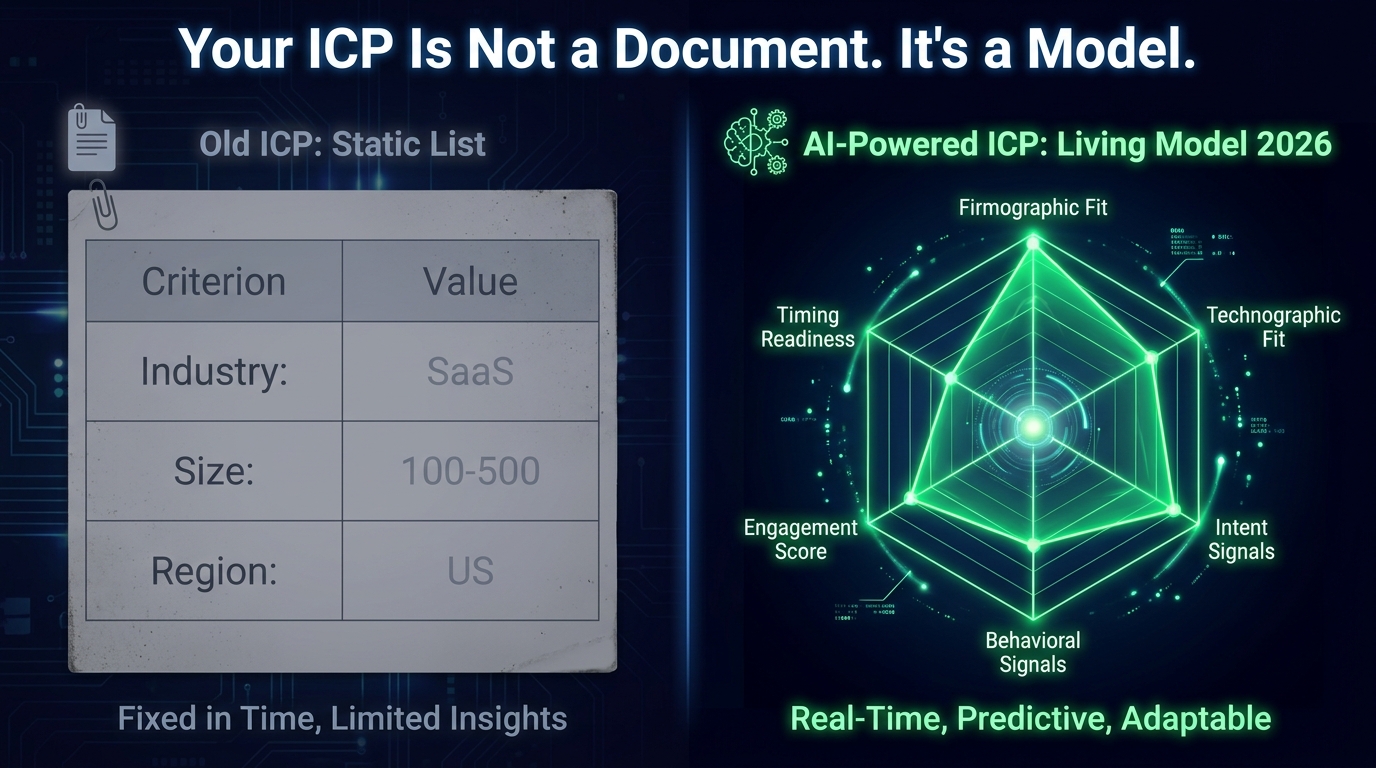
Before a single signal is ingested, a single lead is scored, or a single email is sent, the ICP question has to be answered correctly. And in 2026, the ICP question is not the one most teams think it is.
The old question: What kind of company do we sell to?
The new question: What is the real-time, multi-signal definition of a company that is most likely to buy, retain, and expand with us right now?
Static ICPs are a machine design flaw
A static ICP — the kind that lives in a Google Doc and says “Series B SaaS companies, 50–500 employees, US-based, HR buyer persona” — is not a prospecting input. It’s a starting filter. The problem is that most teams use it as the primary filter, which means they’re targeting companies that match a historical pattern, not companies that are actively in-market today.
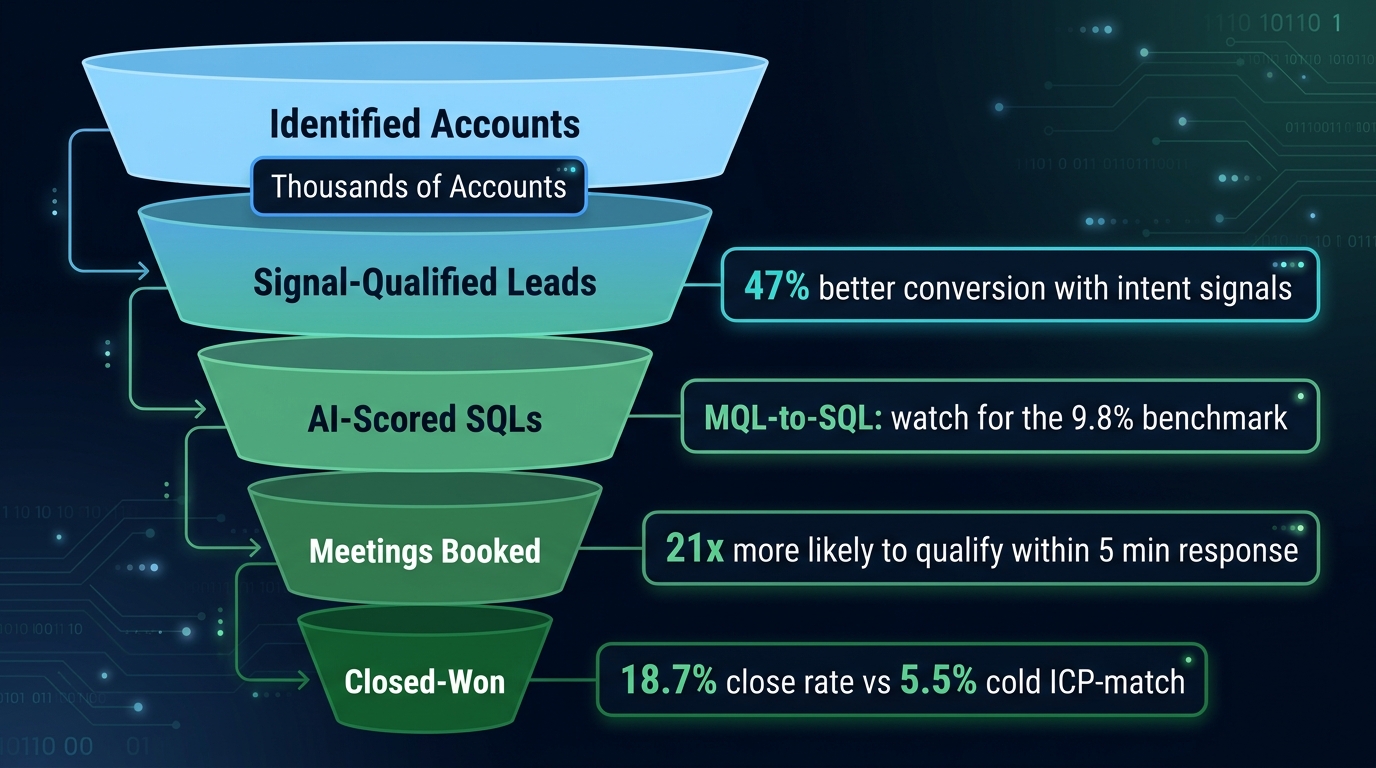
Intent data research from 2026 cohorts consistently shows that ICP-matching alone produces close rates around 5.5%. When intent signals are layered on top of ICP fit, close rates jump to 18.7% in the same cohort analysis. That’s a 3.4x improvement from the same type of account — just better timed.
Building the multi-layer ICP model
Modern ICP definitions in AI prospecting systems are structured around four dimensions, each of which the AI ingests and weights:
- Firmographic fit: Industry, company size by headcount and revenue, geography, funding stage, growth trajectory. This is the baseline filter — necessary but far from sufficient.
- Technographic fit: What tools the company currently uses, which solutions they’re likely replacing, which platforms they integrate with. A company running your primary integration partner’s platform is a fundamentally different prospect than one running a competing stack, even if the firmographics match.
- Behavioral fit: Has this account engaged with your content, visited your pricing page, downloaded a resource? First-party behavioral signals are the highest-quality input available to your AI model — use them first, supplement with third-party data second.
- Intent signals: Third-party intent data (from platforms like Bombora, G2, or 6sense) showing that people at this account are actively researching your solution category — reading comparison content, engaging competitor review pages, consuming topic clusters related to your product.
The closed-won audit: where your real ICP lives
The fastest way to build a better ICP model is to audit your last 50 closed-won deals and identify the attributes they share that your CRM doesn’t track. Common findings: deals closed in certain quarters of the fiscal year, buyers who had recently been promoted, companies that had just completed a merger or acquisition, accounts that had recently posted job openings in the function your product serves. These temporal and event-based signals become negative and positive weights in your AI scoring model — and they’re invisible in a static ICP document.
Takeaway: Before configuring any AI prospecting tool, run a closed-won attribute audit. Extract the non-obvious signals. Feed them into your ICP model as weighted inputs, not as binary filters.
Layer 1 — Signal Architecture: What Your Prospecting Engine Actually Needs to Ingest
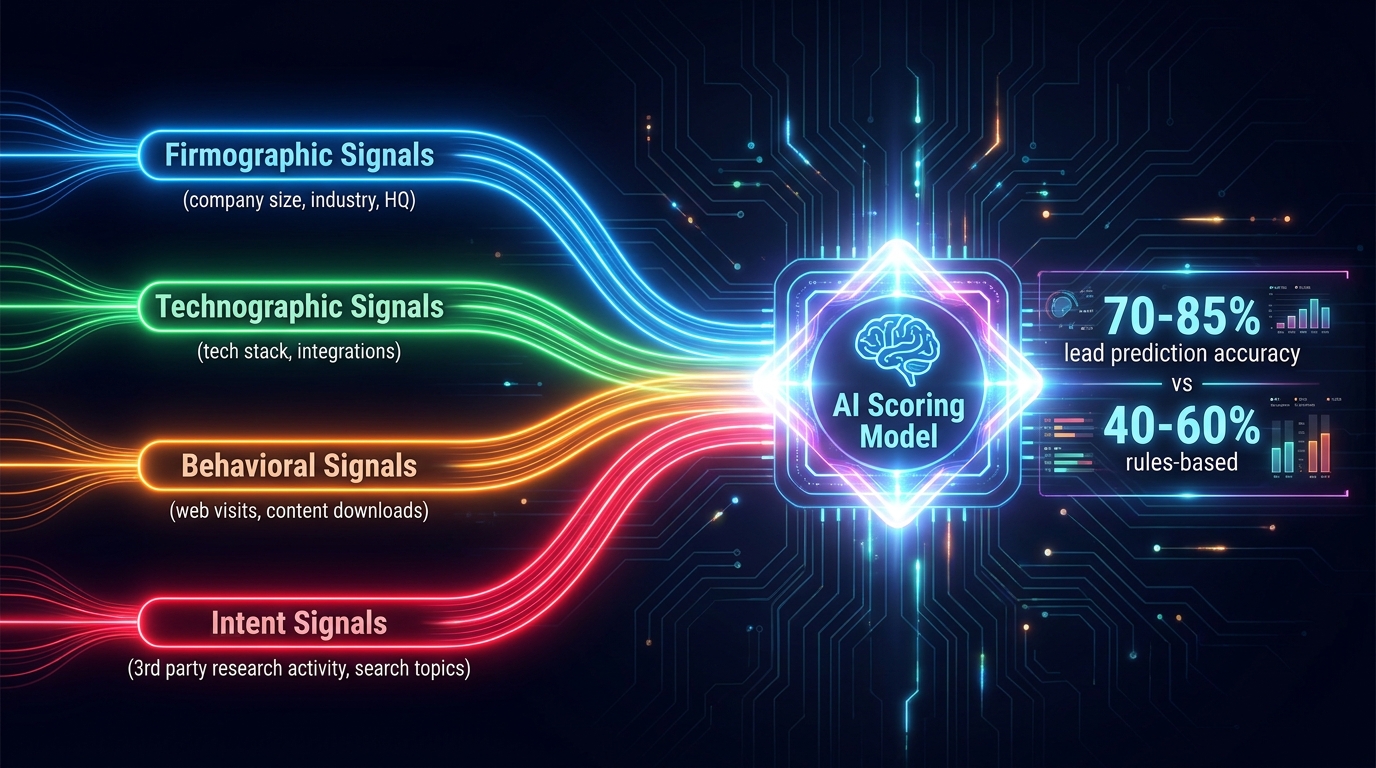
Signals are the fuel your AI machine runs on. The quality of your signals determines the quality of everything downstream. Bad signals in, bad outreach out — at AI speed and AI volume, which makes the damage much faster than it used to be.
Most teams are running on two or three signal types when they need four. And most teams are treating all their signals as equal when they have very different reliability profiles.
The four signal categories and their reliability hierarchy
First-party behavioral signals are the most reliable because they represent actual engagement with your brand. A person who visited your pricing page three times this week is more ready to buy than someone whose company appeared on a third-party intent list. First-party signals should always override third-party signals when the two conflict.
Third-party intent signals are valuable for identifying in-market accounts that haven’t found you yet. Platforms aggregate browsing behavior, content consumption, and research activity across publisher networks to surface which companies are actively researching specific topic clusters. The limitation is that intent data decays fast — a spike in research activity two weeks ago is significantly less valuable than one that happened yesterday.
Technographic signals are often underused. Knowing that a target account runs Salesforce, uses Gong for call intelligence, and recently added a headcount-tracking tool tells you far more about their operational context than their industry classification. Tools like BuiltWith, Clearbit, and Datanyze make this data accessible. The insight it enables — “you’re already using X, so our integration removes Y friction” — is highly specific and extremely hard to produce without the signal.
Event-driven signals are the most time-sensitive and often the most powerful trigger for outreach. These include: new funding rounds, executive leadership changes, product launches, M&A activity, regulatory changes in the account’s industry, and job postings that signal strategic initiatives. A company that just hired a VP of Revenue Operations is far more likely to be in-market for sales tools than one that hasn’t changed its leadership team in three years.
Signal decay and refresh rates
One of the most underengineered aspects of AI prospecting systems is signal expiry. Not all signals are equally perishable. Firmographic data decays at roughly 20–25% per year as companies change size, industry focus, and structure. Contact-level data decays at a faster rate — email addresses and job titles change as people move roles. Intent data is highly perishable, with meaningful research spikes typically having a window of two to four weeks before buying intent dissipates.
Your signal architecture needs explicit refresh rules: how often each signal source is re-pulled, how stale data is flagged, and what happens to leads whose signals expire. An AI scoring model that doesn’t know its inputs are six months old is a machine running on stale fuel.
Building the signal stack
A practical 2026 signal stack for a mid-market B2B company typically combines:
- A data enrichment layer (Apollo, Clearbit, ZoomInfo, or Clay for multi-source aggregation)
- A third-party intent data provider (Bombora, G2 Buyer Intent, 6sense)
- First-party behavioral tracking piped from your marketing automation platform
- A job posting and news aggregator for event-driven signals (Hunter.io job change alerts, LinkedIn Sales Navigator, or dedicated trigger tools)
The modern trend is toward single-platform aggregators like Clay, which pull from 75+ data providers and apply AI enrichment waterfall logic — trying the cheapest, most reliable source first and falling back to alternatives only when data is missing. This reduces cost and improves data quality simultaneously.
Layer 2 — AI Lead Scoring That Goes Beyond Firmographics
Lead scoring has existed in B2B sales since the early days of marketing automation. The problem is that most scoring models were designed by marketing teams to justify MQL volume rather than to predict actual buying behavior. In 2026, the gap between rule-based scoring and AI-powered scoring is no longer a marginal improvement — it’s a structural gap in prediction accuracy.
Rule-based vs. AI-powered scoring: the performance gap
Traditional rule-based scoring systems — “10 points for a company over 100 employees, 20 points for a pricing page visit, -10 points if they’re in an excluded industry” — achieve lead conversion prediction accuracy in the range of 40–60%. AI-powered scoring models, trained on actual closed-won and closed-lost data, achieve 70–85% accuracy in predicting which leads will convert. That 20–25 percentage point improvement in prediction accuracy has direct pipeline implications.
The reason for the gap is not AI magic. It’s dimensionality. Rule-based models can reasonably incorporate a dozen attributes. AI models can incorporate hundreds of attributes simultaneously, identify non-linear relationships between them (a funding signal alone means little, but a funding signal combined with a specific technographic profile and a hiring surge in a particular function is a very strong buying signal), and update their weights dynamically as new closed-won data comes in.
Scoring fit and intent separately — then combining them
The most effective scoring architectures in 2026 maintain two separate scores that are combined for routing and prioritization:
- Fit Score: How closely does this account match the profile of your best customers? Firmographic, technographic, and historical closed-won attributes. This score is relatively stable — it changes only when the account changes in fundamental ways.
- Intent Score: How active are signals suggesting this account is currently in a buying process? Behavioral, intent data, and event-driven signals. This score is highly dynamic — it can spike on a Tuesday and fall back to baseline by Friday.
Combining both into a routing matrix — High Fit / High Intent gets immediate SDR attention, High Fit / Low Intent goes into a nurture sequence with automated check-ins, Low Fit / High Intent gets a lightweight automated touch before any SDR investment — ensures that rep time is allocated where it has the highest expected value.
Negative scoring: the underappreciated side of AI lead ranking
Most teams focus on what makes a good lead. Fewer invest equivalent effort in defining what makes a bad one. Negative scoring signals are just as important: accounts that have previously churned, industries with poor historical LTV, accounts where a competitor has an entrenched multi-year contract, or individuals who have bounced communication attempts across multiple campaigns. AI models that incorporate negative signals produce materially cleaner lead queues and reduce the amount of time SDRs spend on unwinnable deals.
Layer 3 — CRM Enrichment and Data Hygiene as Operational Infrastructure
Your CRM is the persistent memory of your lead machine. Everything the AI learns about an account — its signals, its engagement history, its score, its routing status — lives in the CRM. If the CRM is dirty, stale, or structurally inconsistent, the AI is flying blind and every downstream output is compromised.
Data hygiene is not a housekeeping task. In an AI prospecting system, it’s operational infrastructure.
The scale of the data decay problem
B2B contact data decays at approximately 22–30% per year due to job changes, company restructuring, and contact detail updates. In a CRM with 50,000 contacts, that means roughly 11,000–15,000 records become inaccurate over the course of a year. An AI model scoring and routing these records treats stale data as current data — it has no way to know otherwise unless you build expiry logic into the system.
The consequences cascade: outreach sent to former employees, personalization referencing a role someone left eight months ago, scoring models giving high intent scores to contacts who no longer influence purchasing decisions at a company. None of these are AI errors. They’re data infrastructure failures.
Automated enrichment waterfalls
The modern approach to CRM enrichment runs on waterfall logic: for each record, the system attempts enrichment from the primary data source. If data is missing or flagged as outdated, it falls through to a secondary source, then a tertiary source, until the record is either populated or flagged as unenrichable. This approach, popularized by tools like Clay, ensures both cost efficiency (you’re not paying multiple providers for the same data) and coverage (no records are left unenriched because one provider had a gap).
Key fields to enrich continuously, not just at import:
- Job title and tenure (people change roles — your AI needs to know)
- Direct email and mobile phone (critical for multichannel sequences)
- Company headcount and revenue (growth stage changes scoring)
- Technology stack (integrations and replacement signals change over time)
- LinkedIn URL (essential for LinkedIn sequence automation)
- Recent news and funding events (for event-triggered outreach)
Deduplication and structural consistency
Duplicate records are particularly damaging in AI prospecting because they create competing scoring and sequencing threads for the same person. An SDR following up on one thread while an AI sequence runs on a duplicate record produces the kind of inconsistent buyer experience that kills deals. AI-powered deduplication (matching on name, email domain, LinkedIn URL, and company association) should run as a continuous background process, not a quarterly cleanup project.
Structural consistency — making sure that every record has the same fields populated in the same format — matters for scoring accuracy. An AI model trained on records with clean industry classifications produces worse predictions when applied to records where half the industry field says “Tech” and the other half says “Technology, Information and Internet.” Taxonomy governance is a RevOps responsibility that directly affects AI performance.
Layer 4 — Multichannel Sequencing: Coordination Over Volume
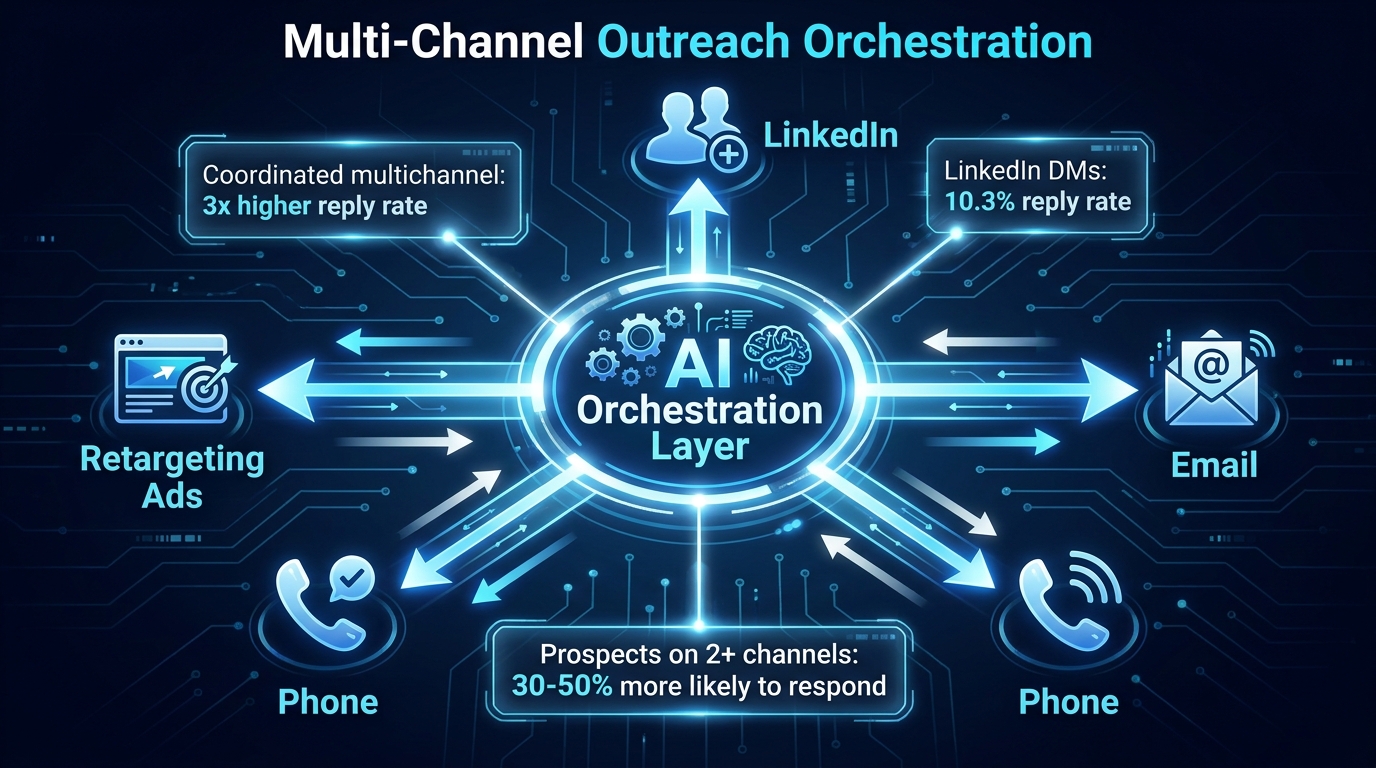
Most teams running outbound sequences in 2026 are doing it wrong — not because their sequences are bad, but because they’re running channels in parallel rather than in coordination. The difference between parallel and coordinated is the difference between noise and a coherent buyer experience.
The coordination problem in multichannel outreach
Parallel multichannel means: send an email on Monday, send a LinkedIn connection request on Tuesday, make a call on Wednesday. The channels aren’t aware of each other. The email doesn’t reference the LinkedIn request. The call doesn’t acknowledge the email. From the buyer’s perspective, it feels like three different people found them simultaneously — which creates confusion rather than familiarity.
Coordinated multichannel means: the AI tracks the prospect’s engagement state across all channels, uses each channel in a specific role, adjusts the next touch based on what happened in the last one, and presents a coherent narrative across all touchpoints. The prospect feels pursued by a single, informed salesperson — not bombarded by automation.
Channel roles in a coordinated sequence
Best-practice 2026 multichannel sequences assign specific strategic roles to each channel:
- Email: First contact. Delivers the core value proposition with enough specificity to demonstrate research. Sets up the LinkedIn request. Average reply rate: 3.8–5.1% for cold outbound, rising to 9–18% with strong signal personalization.
- LinkedIn: Warm and humanize. A connection request with a brief, personalized note — not a pitch — increases familiarity before the next email or call. LinkedIn DMs average 10.3% reply rates, significantly outperforming cold email as a first-touch channel for many buyers. LinkedIn also provides passive signal: viewing a prospect’s profile or engaging with their content creates a warm recognition effect.
- Phone: Qualify and convert. Phone calls serve a different function than email or LinkedIn — they create real-time conversation, enable objection handling, and can compress the qualification timeline significantly. AI-supported call prep (pulling recent account signals, generating a brief context summary before the call) increases connection-to-meeting conversion rates.
- Retargeting ads: Maintain presence without direct outreach. Running targeted display or LinkedIn ads to your prospecting list keeps your brand in view between direct touches. This reduces the cold-call effect on later phone attempts because the prospect has seen your name before.
The reply-first architecture: pause-on-engagement logic
One of the most important configuration details in multichannel sequencing is pause-on-reply logic — the automatic halt of all sequence steps the moment a prospect engages in any meaningful way (reply, meeting booked, phone conversation). Without this, AI sequences continue firing automated messages after a prospect has already entered a human conversation, creating the perception of a disorganized or automated sales motion.
Prospects engaged across two or more channels are 30–50% more likely to respond than those touched on a single channel. But that lift only materializes when the channels are coordinated. Uncoordinated multichannel outreach produces diminishing returns fast — and, in some cases, negative returns as recipients unsubscribe from email, disconnect on LinkedIn, and block phone numbers because the volume feels aggressive rather than relevant.
Sequence timing: data-driven cadence vs. fixed intervals
Fixed-interval sequences (“email Day 1, LinkedIn Day 3, call Day 7”) are being replaced by signal-adaptive cadences that accelerate or slow based on engagement indicators. If a prospect opens an email three times in 24 hours but doesn’t reply, that’s a strong signal to advance the sequence faster — not to wait until the scheduled Day 3 touch. AI-driven sequencing tools now use this engagement signal to dynamically reorder and accelerate sequence steps, producing faster pipeline velocity without increasing outreach volume.
Layer 5 — Personalization at Scale Without Sounding Like a Robot
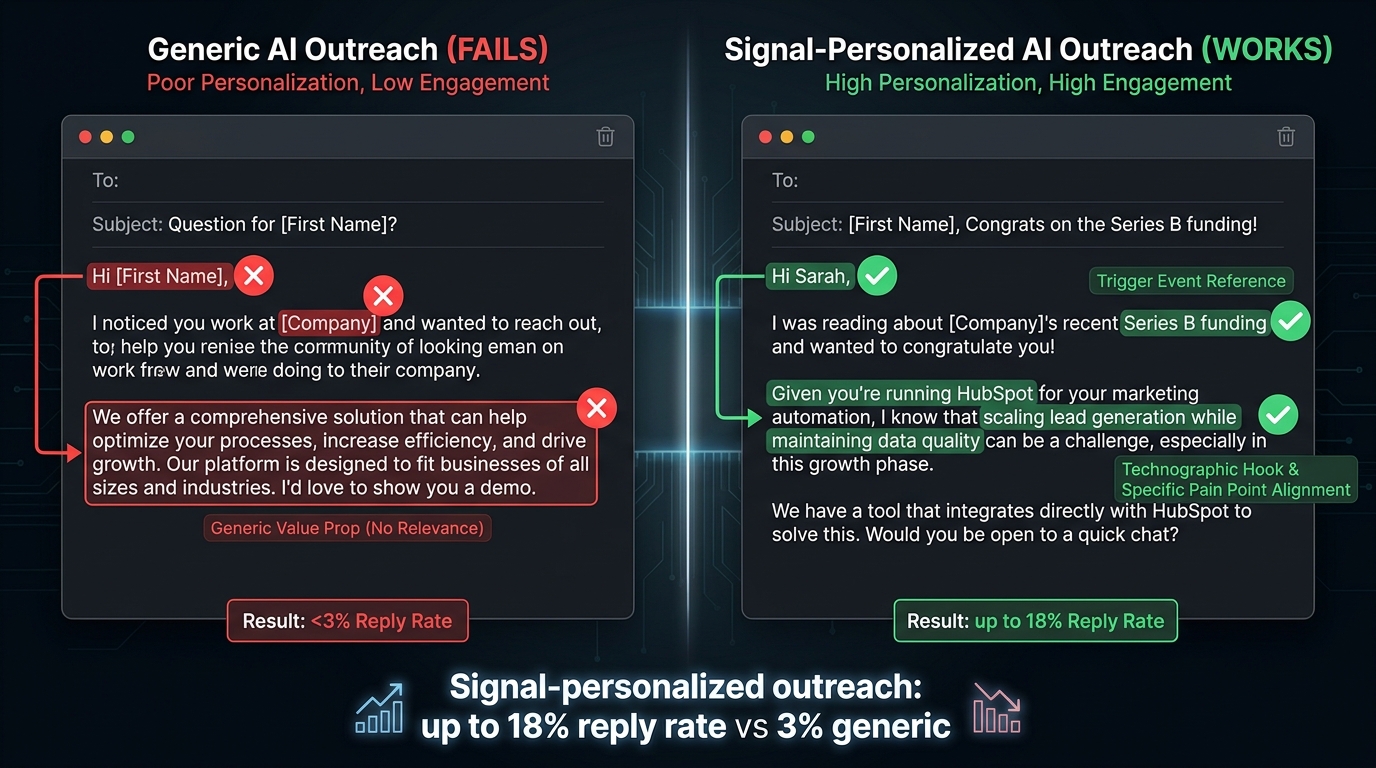
This is where AI prospecting breaks down most publicly and most visibly. The promise of AI-driven personalization is that you can send a highly specific, relevant message to thousands of prospects without writing each one manually. The reality is that most teams use AI to produce generic messages slightly faster — and their reply rates reflect it.
The baseline cold email reply rate in 2026 sits around 3.43% across broad datasets. Signal-personalized outreach using proper trigger-based inputs reaches 15–25% reply rates. The difference isn’t the AI — it’s the signal quality feeding into it.
What “personalization” actually means in 2026
Personalization is not name-merging. It is not referencing the company name and headquarters in the opener. It is not saying “I noticed you’re in the [Industry] space.” These are the personalization patterns that AI made trivially easy to produce at scale — and buyers learned to recognize them instantly as automated. They are now the signal of a lazy AI sequence, not a thoughtful outreach message.
Real personalization in 2026 is trigger-based and role-specific. It references something the AI found in real-time research: a funding round announced last week, a job posting that reveals a strategic initiative, a piece of content the prospect published, a recent company announcement. It speaks to the specific pain point for that buyer’s role — not the generic pain point for the job title. And it connects that specific context to a specific value your product delivers, not a category-level benefit statement.
The three-layer personalization model
High-performing AI personalization systems build messages in three layers:
- Account-level context: What is specific and current about this company? Recent news, funding, product launches, M&A activity, or relevant industry events. This layer is generated by the AI from enrichment data and news signals.
- Contact-level relevance: What is specific about this person’s role, responsibilities, and likely priorities? A VP of Sales cares about different outcomes than a CTO, even at the same company. AI pulls role-specific framing from closed-won conversation patterns and role archetype data.
- Offer-level fit: What specific aspect of your product or service is most relevant given the account and contact context? Not “we help companies like yours” — but “given that you just added a SDR team of 15, this is the specific feature that addresses the onboarding problem that usually comes next.”
Human-in-the-loop review as quality control
The most effective personalization workflows are not fully autonomous. They use AI to draft and populate all three layers, then route a sample of messages through human review before sending. This serves two purposes: it catches AI hallucinations (fabricated details about a prospect or company that didn’t come from real signals) and it trains the AI model over time by creating feedback on which messages actually perform.
A practical implementation: AI generates the full sequence for a batch of prospects overnight. A rep reviews 10–15% of messages, flagging any that contain errors or feel off-brand. Approved messages send automatically. Flagged messages are revised and added to the AI’s quality feedback loop. Over four to six weeks, the volume of flagged messages drops as the AI learns the team’s editorial standards.
Length, structure, and the reply-rate hierarchy
AI-generated cold emails in 2026 that perform best are shorter than most teams expect: typically 60–90 words for the initial touch, with a single specific insight, a one-sentence connection to value, and a low-friction call to action (not “let’s hop on a 30-minute call” but “does this resonate with what you’re working on right now?”). The principle is that the first email earns the right to have a longer conversation — it doesn’t attempt to deliver the full sales pitch.
Layer 6 — AI Qualification and Pipeline Velocity
Getting a reply is not the goal. Getting a qualified opportunity into the pipeline is the goal. The gap between these two outcomes is where AI qualification sits — and it’s a gap that most teams leave far too wide.
The speed problem in qualification
Response time to an inbound signal is one of the strongest predictors of qualification success. Research consistently shows that contacting a lead within five minutes makes you up to 21x more likely to qualify them compared to responding in 30 minutes. At the scale of a modern outbound and inbound pipeline, no human team can match that response window consistently.
AI qualification closes this gap. Conversational AI — deployed via chat, email, or voice — engages inbound leads in real time, runs a qualification script adapted to the lead’s context, captures BANT (Budget, Authority, Need, Timeline) or MEDDIC criteria, and either routes the lead to an SDR for an immediate conversation or books a calendar slot automatically. The lead never waits more than seconds for a first response, regardless of what time zone they’re in or what time of day they submit their information.
What AI qualifiers are actually doing
Modern AI qualification agents are not simple chatbots running scripts. They use conversation intelligence models trained on thousands of actual sales qualification calls to ask dynamic follow-up questions based on earlier answers, identify objection patterns, adapt their framing based on signals about the lead’s context, and route with nuance — sending a high-authority, high-intent buyer to a senior AE immediately while routing a junior researcher to a nurture sequence with educational content.
The qualification criteria the AI is evaluating should mirror whatever framework your sales team uses. Teams running MEDDIC feed MEDDIC signals into the AI. Teams running SPIN train the qualifier on SPIN diagnostic questions. The AI doesn’t make the qualification framework — it executes it at a speed and scale that human SDRs cannot match.
Pipeline velocity as a machine health indicator
Pipeline velocity — the rate at which opportunities move from identified lead through to closed revenue — is the most important aggregate indicator of whether your AI prospecting machine is working. It’s calculated as:
Pipeline Velocity = (Number of Opportunities × Win Rate × Average Deal Value) ÷ Sales Cycle Length
AI interventions at each layer of the machine should improve this metric predictably. Better signal ingestion increases the number of genuinely qualified opportunities at the top. Better scoring and routing improves win rate by ensuring reps work higher-probability deals. Better personalization and qualification can reduce sales cycle length by moving prospects faster through discovery and evaluation. If pipeline velocity isn’t improving as you add AI layers, the constraint is somewhere in the machine — and it’s worth finding it before assuming you need more tools.
Sales cycle compression through AI-assisted follow-up
One of the underappreciated pipeline velocity gains from AI in 2026 is in follow-up speed and consistency after the first conversation. Human SDRs forget to follow up, delay follow-up, or produce generic follow-up emails that don’t reference the specific conversation. AI-assisted follow-up — triggered by the end of a call, summarizing the conversation, extracting next-step commitments, generating a personalized follow-up email with the materials discussed — compresses the post-call dead time that often kills deals that were otherwise progressing well.
The Human-in-the-Loop Question: Where Reps Still Decisively Outperform AI
Automation maximalism is a trap. The teams seeing the best results from AI prospecting in 2026 are not the teams that have replaced the most human functions — they’re the teams that have correctly identified which functions benefit from automation and which functions still require human judgment, empathy, and adaptability.
Where AI has clear advantages
AI outperforms humans at:
- Research and data synthesis: No human can ingest and synthesize 40 firmographic, technographic, behavioral, and intent data points about 500 accounts per day. AI does this continuously and without error fatigue.
- Consistency: AI sends the same quality of outreach message at 2pm on a Tuesday as at 11pm on a Friday. Human quality varies with energy, motivation, and workload.
- Speed at scale: AI can run 50 simultaneous qualification conversations. A human SDR can run one at a time.
- Pattern recognition across large datasets: AI identifies which outreach patterns are producing replies and which are producing unsubscribes faster than any human analysis of the same data.
Where humans still hold decisive advantages
Human reps outperform AI at:
- Complex objection handling: When a prospect raises a nuanced objection (“We tried something like this two years ago and it didn’t work”), the human ability to empathize, probe for the real concern, and respond with a customized reframe is still significantly better than AI response quality in most sales contexts.
- Relationship-based selling in high-value accounts: Enterprise deals where personal trust, executive relationships, and long-term partnership positioning are central to the sale require human presence that AI cannot replicate.
- Detecting emotional context from conversation: A prospect who is technically qualified but emotionally skeptical needs a different approach than one who is excited and ready to move fast. Human reps pick this up more reliably in conversation than current AI models.
- Creative problem-solving for non-standard deals: Custom pricing discussions, partnership negotiations, and deals that don’t fit standard qualification templates require human judgment that AI cannot yet exercise reliably.
The hybrid model: what it looks like operationally
The optimal hybrid model in 2026 positions AI as the research, sequencing, qualification, and CRM operations layer, while humans own live conversations, complex objection handling, and relationship-building in key accounts. The SDR’s job shifts from “find, research, and reach out to prospects” to “have better conversations with pre-qualified, pre-researched prospects that AI has already identified and warmed up.”
This shift has meaningful implications for team structure and incentives. SDR metrics should shift from activity metrics (calls made, emails sent) toward outcome metrics (qualified opportunities created, conversation quality scores, pipeline contribution). AI takes over the activity measurement — it does the volume work. Humans are judged on outcome quality.
Measuring the Machine: Metrics That Actually Predict Pipeline Health
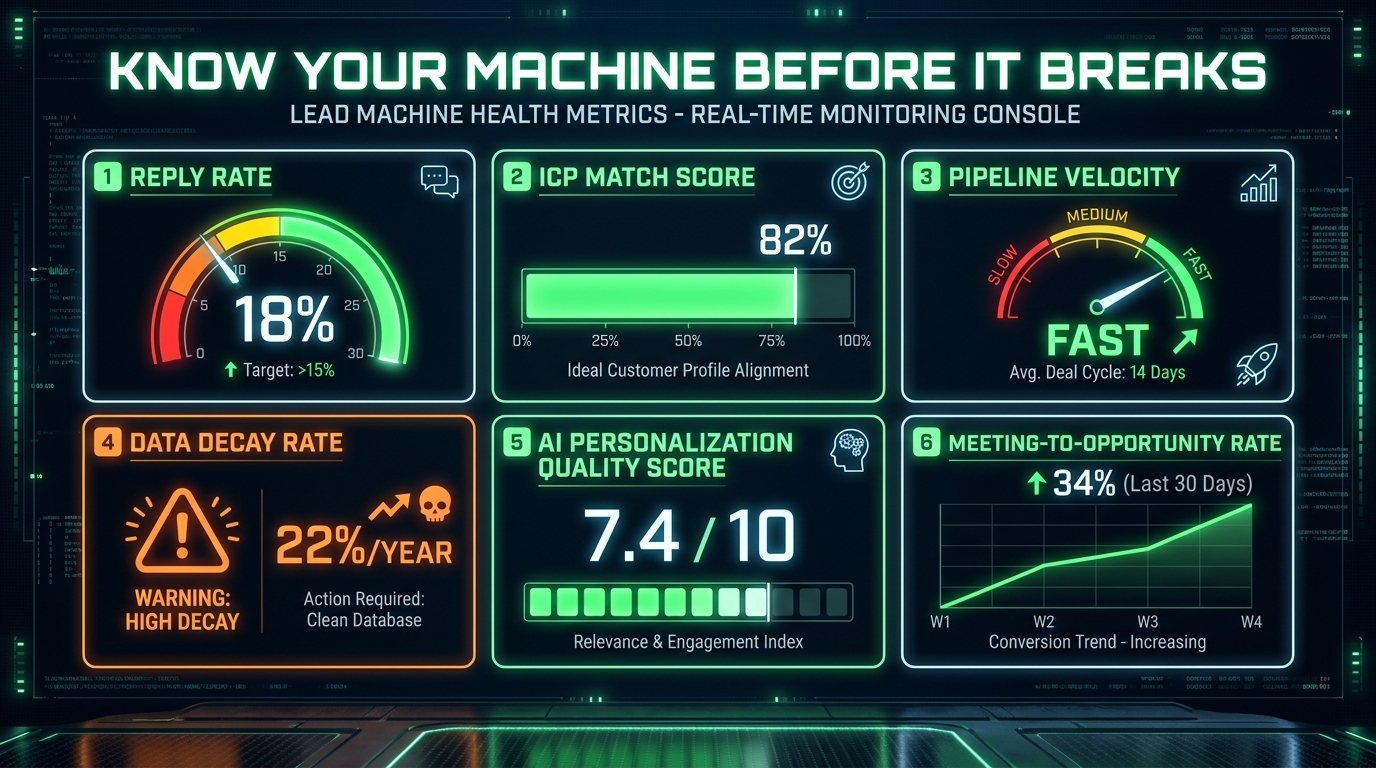
Most teams measure their prospecting motion with the wrong metrics. Activity metrics — emails sent, calls made, LinkedIn connections requested — tell you how hard the machine is working. They don’t tell you whether the machine is working correctly. For an AI prospecting system, you need a different measurement framework: one that tracks signal quality, conversion rates at each stage, and pipeline velocity indicators that predict revenue, not just activity.
The leading indicators that predict pipeline quality
These metrics tell you whether your machine is healthy before pipeline problems become revenue problems:
- ICP Match Rate: What percentage of leads entering your scoring system score above your threshold for fit? If this is dropping, your signal sources are degrading or your ICP definition needs updating.
- Signal Freshness Score: What percentage of records in your scoring model have been enriched within the last 30 days? Below 70% and your AI is scoring on stale data.
- Reply Rate by Segment: Breaking out reply rates by ICP tier, industry, and sequence type reveals which targeting assumptions are correct and which need revision. A 15% reply rate overall but 3% for one industry vertical means you need different messaging or a different ICP assumption for that segment.
- Personalization Quality Score: A sampling-based metric where a human reviewer rates a random sample of AI-generated outreach messages on specificity and relevance. If this drops, your signal inputs are getting worse even if volume is holding steady.
- Meeting-to-Opportunity Rate: What percentage of booked meetings convert to qualified pipeline opportunities? A declining ratio here signals qualification gaps — you’re booking the wrong meetings, not just fewer meetings.
The lagging indicators that confirm machine performance
These metrics confirm whether the machine’s outputs are translating to revenue:
- MQL-to-SQL Conversion Rate: The industry benchmark fell to 9.8% in 2026. If you’re above this, your AI qualification is working. Below it, you have a qualification gap.
- SQL-to-Close Rate by Source: Comparing close rates for AI-sourced leads versus inbound versus marketing-qualified leads tells you the true value of your AI prospecting investment.
- Pipeline Velocity (full formula): Track this monthly. Improving velocity without improving individual deal metrics means you’re moving deals faster. Improving velocity while also improving win rate means you’re getting better at both speed and selection.
- Cost per Qualified Opportunity: The real efficiency metric for AI prospecting ROI. As AI scales prospecting volume without adding headcount, this number should trend down. If it isn’t, the volume gains are being offset by quality losses.
Cadence of measurement
Signal-level and personalization metrics should be reviewed weekly — they change fast and early deterioration needs to be caught before it compounds through the pipeline. Conversion and velocity metrics are better reviewed monthly, as they lag the activity that created them by two to six weeks. Revenue outcomes — closed-won attribution by source — require a quarterly view to see through the noise of deal timing variability.
Where AI Prospecting Systems Break (And the Warning Signs Before They Do)
No machine runs indefinitely without maintenance. AI prospecting systems fail in predictable ways — and most of those ways are detectable before they cause serious pipeline damage if you know what signals to watch for.
Failure Mode 1: ICP drift
Your market changes, your product changes, your best customers change — but your ICP model doesn’t update. Over time, the AI scores and prioritizes accounts that match who you sold to 18 months ago rather than who you should sell to now. The symptom: win rates start declining without a clear cause, and deals that close look different from the accounts your AI is prioritizing.
Fix: Run a closed-won audit every quarter. Update ICP weights and scoring attributes based on the last 90 days of wins, not historical patterns.
Failure Mode 2: Signal source degradation
Third-party data providers change their methodology, reduce coverage, or face data quality issues. Your AI model doesn’t know the input quality has dropped — it keeps scoring leads based on increasingly unreliable signals. The symptom: lead quality feels the same on paper (scores haven’t changed) but SDRs report that prospects “don’t know what they’re talking about” when referencing the triggers that prompted outreach.
Fix: Monitor data provider coverage metrics monthly. Run spot-checks on intent signal accuracy by calling a random sample of “high-intent” accounts and asking if they’re actually researching your category. Track provider-level data freshness separately from overall ICP score.
Failure Mode 3: Personalization decay
AI personalization models degrade as the market saturates with AI outreach. What felt specific and relevant six months ago now reads like a template because everyone else has discovered the same signals and is using the same hooks. The symptom: reply rates drop on outreach that previously performed well, even with the same targeting profile.
Fix: Rotate personalization angles quarterly. If everyone is referencing funding rounds, make your hook about the operational challenge that typically follows a funding event. If LinkedIn content engagement is the universal hook, shift to technographic specifics or role-based pain points. The AI is only as creative as the signal layer you give it to work with — expanding signal types expands personalization angles.
Failure Mode 4: Automation without governance
As AI systems become more autonomous, the risk of high-volume brand damage increases. An AI that sends 10,000 emails with a factual error about a prospect’s company, a misconfigured sequence that follows up after a prospect has already told you they’re not interested, or an over-aggressive cadence that triggers spam filters — these all cause disproportionate damage to sender reputation and deliverability that takes months to repair.
Fix: Implement explicit guardrails: maximum email sending limits per domain per day, mandatory human review for any prospect who has replied (regardless of what they said), automated suppression of contacts who unsubscribe from any channel, and weekly deliverability monitoring (open rates, spam complaints, bounce rates).
Failure Mode 5: Metric misalignment
The AI optimizes for what you measure. If your AI-driven sequence tool is optimized for reply rate, it may generate sensational subject lines that generate clicks and replies without generating qualified pipeline. If your scoring model is optimized for MQL volume, it produces volume without quality. AI amplifies whatever objective function it’s given — so make sure the objective function is right before you scale the system.
Fix: Set AI optimization targets at the opportunity level, not the activity level. The AI should be rewarded (in terms of model feedback) for outreach that produces qualified pipeline, not just for outreach that produces opens, clicks, or even replies. This requires connecting your sequencing tool’s performance data to your CRM’s opportunity data — a technical integration that most teams haven’t made but that transforms the quality of AI optimization.
Building vs. Buying: The Architecture Decision That Determines Your Ceiling
The final strategic decision in building a lead machine is the build-vs.-buy question — not for individual tools, but for the architecture itself. And in 2026, this question has a more nuanced answer than “buy everything off the shelf” or “build custom AI models.”
The case for platform consolidation
The proliferation of point solutions in AI prospecting — one tool for enrichment, another for scoring, another for sequencing, another for qualification — creates integration overhead, data synchronization failures, and attribution gaps that make it very hard to measure and optimize the full machine. Platform consolidation, where a single platform handles multiple layers (e.g., Clay for enrichment plus scoring, Outreach or Salesloft for sequencing plus qualification), reduces these failure points substantially.
The trade-off is that consolidated platforms are rarely best-in-class on every individual dimension. The scoring model in your sequencing tool may not be as sophisticated as a dedicated AI scoring platform. The enrichment quality in your CRM may not match a specialized data provider. Teams need to decide which dimensions are critical for their specific motion and buy best-in-class there, accepting good-enough performance on the others.
The custom AI layer: when it makes sense
Custom AI scoring models — trained specifically on your closed-won data, your product’s specific use cases, and your market’s unique signals — outperform off-the-shelf models for teams with sufficient data volume. The threshold for custom models to outperform generic ones is roughly 500–1,000 closed-won opportunities in your historical data. Below that, the generic models (which are trained on vastly larger datasets) are usually more accurate than a custom model trained on limited proprietary data.
Above that threshold, custom models consistently outperform because they’ve learned the non-obvious signals specific to your product and buyer base — signals that no generic model ever sees. Building these models requires a data science capability or a vendor that specializes in custom GTM AI (not just pre-built SaaS tools), but for teams at the right scale, the performance lift justifies the investment.
The modular architecture principle
The best-designed AI prospecting machines are modular: each layer is replaceable without rebuilding the whole system. This means clean data contracts between layers (standardized schemas that any enrichment source can populate), API-first tool selection (so components can be swapped without custom integration work), and explicit data ownership rules (so CRM is always the source of truth, not a downstream destination).
Modular architecture also means you can upgrade individual components as the market evolves without starting over. When a new AI scoring methodology outperforms your current model, you can swap that layer without affecting the signal ingestion or sequencing layers. When a better data provider emerges, you can add them to the enrichment waterfall without rebuilding your scoring logic.
Conclusion: The Machine Either Runs — or It Doesn’t
AI-driven prospecting is not a campaign. It’s not a tool. It’s a machine — and machines either run well or they don’t. There’s no partial credit for building four out of six layers correctly. A broken signal layer means the scoring model runs on bad data. Bad scoring means the wrong leads get sequenced. Wrong leads in sequences mean SDRs have the wrong conversations. And wrong conversations mean your AI prospecting system, however sophisticated on paper, produces the same results as a generic cold email blast — just at higher speed and cost.
The teams winning with AI prospecting in 2026 are not necessarily the ones with the most tools or the highest budget. They are the ones that have thought through the machine design end-to-end, identified the constraint at each stage, and built measurement systems sensitive enough to detect degradation before it becomes a pipeline problem.
Where to start if you’re building this from scratch
- Run the closed-won audit first. Understand who you’ve actually sold to before telling any AI system who to target.
- Start with signal quality, not tool count. Two or three high-quality, continuously refreshed signal sources outperform ten stale or low-accuracy providers every time.
- Wire your AI metrics back to CRM outcomes. If your sequencing tool doesn’t know which outreach produced closed-won deals, it cannot optimize for closed-won deals.
- Build the human-in-the-loop checkpoints before scaling volume. It is much harder to rebuild sender reputation than to scale carefully in the first place.
- Measure pipeline velocity monthly. It is the single metric that aggregates the health of the entire machine into one number you can trend over time.
The lead machine is buildable. The data is available. The tools exist. What determines who builds one that actually runs is the willingness to treat prospecting as an engineering problem rather than a sales activity — and to hold every layer of the system accountable to the same standard of output quality.
That shift in thinking is where lead machines are actually built.