





Every operations team is drowning in data. The ERP is logging thousands of transactions daily. The CRM is tracking every customer touchpoint. The warehouse management system is timestamping every pallet scan. Finance is reconciling dozens of cost centers. And somewhere upstream, a scheduling system is generating shift coverage exceptions that nobody actually reads.
The average enterprise generates more operational data in a single week than its leadership team could meaningfully review in a year. And yet, the decisions that get made in most weekly ops reviews are still driven by whatever one analyst managed to pull together in a spreadsheet the night before.
This is not a data shortage problem. It is a translation problem. The gap between raw operational data and room-ready intelligence is where most organizations quietly fail — and where AI-augmented decision rooms are starting to close the distance.
This post is not about replacing your executive team with an algorithm. It is about understanding the specific architecture, cadence, and failure modes involved in building a system that takes your most important operational signals and turns them into something an intelligent team can act on in 45 minutes, every single week — reliably, without heroic analyst effort.
By 2026, Gartner estimates that 50% of business decisions will be augmented or automated by AI-powered decision intelligence systems. That figure is notable not because of how high it is, but because of how unevenly distributed that capability is. The organizations already operating with structured decision rooms are pulling away from those still cycling through slide decks and disconnected dashboards. The gap is widening fast.
Here is what actually goes into building one that works.
What a Decision Room Actually Is — And What Most Organizations Build Instead
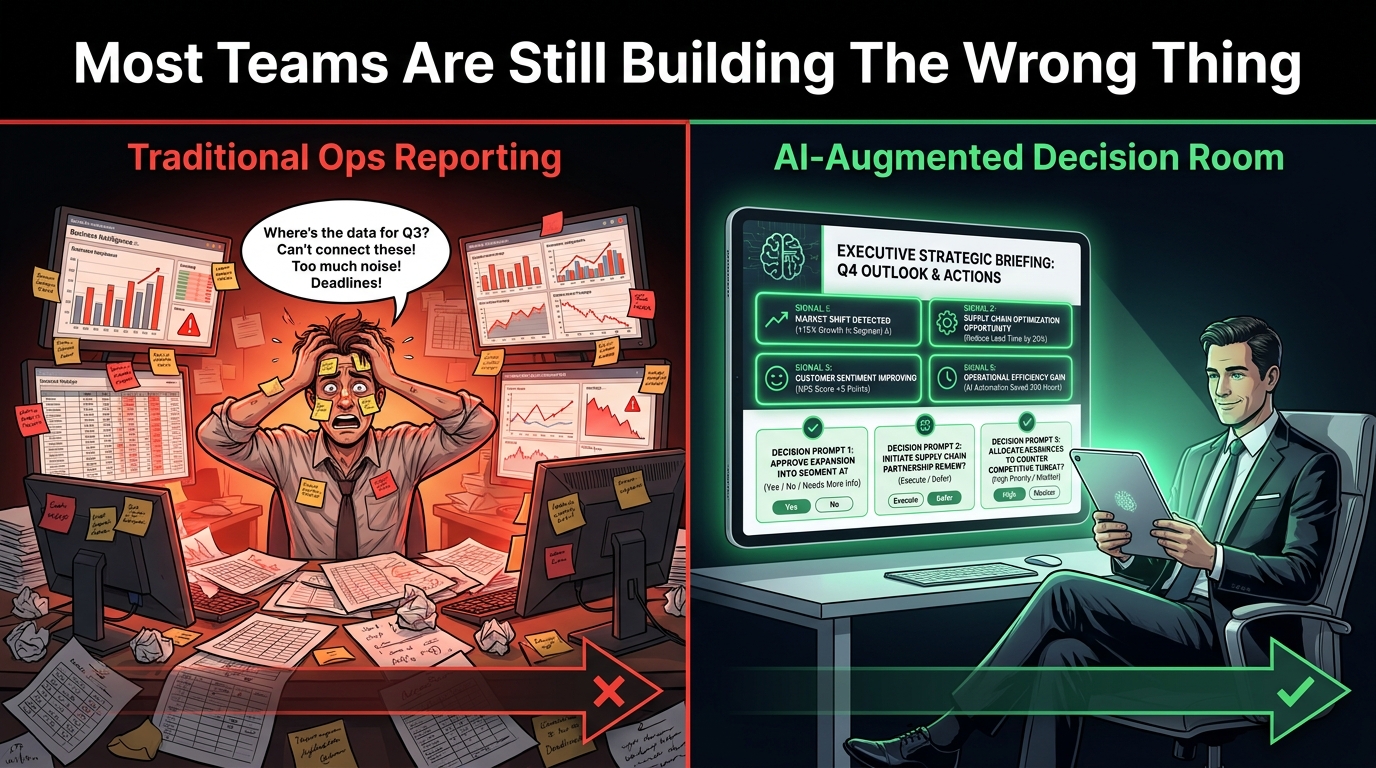
Let’s start with a definition, because the term gets used loosely and that creates real confusion when organizations try to build toward it.
A decision room is not a dashboard. It is not a reporting portal. It is not a weekly meeting where people present slides. A decision room is a structured environment — physical, virtual, or hybrid — where decision-makers convene around pre-synthesized intelligence to make specific, time-bound decisions about operations. The outputs are not insights. The outputs are decisions, with owners, deadlines, and follow-up mechanisms.
That distinction matters enormously, because most organizations build the wrong thing. They invest heavily in data infrastructure, build excellent dashboards, and then sit in weekly meetings where executives stare at visualizations and talk about what they see rather than what they will do. The meeting ends. The decisions drift. The data refreshes. The cycle repeats.
The BI Dashboard Trap
Business intelligence tools have been sold for two decades on the promise that making data visible is the same as making it useful. It is not. Visibility is a prerequisite, not the destination. When every department has its own dashboard — each with its own definitions, its own time ranges, and its own color-coding conventions — the collective result is not intelligence. It is a gallery of conflicting narratives.
According to a 2026 survey of enterprise operations leaders, the average executive attends 3.4 data review meetings per week and describes fewer than a third of those meetings as “highly useful to actual decision-making.” The rest are what practitioners now call reporting theater — structured performance of data review with no material impact on what actually happens in the business.
What AI-Augmented Adds to the Room
The AI-augmented version of a decision room does three things differently. First, it consolidates raw operational data from multiple source systems automatically, removing the analyst-as-bottleneck problem that makes traditional reporting both slow and inconsistent. Second, it applies AI reasoning — primarily large language model summarization combined with anomaly detection and trend scoring — to compress that data into a structured briefing document before the room convenes. Third, it formats the output as decisions to be made, not as data to be reviewed.
The result is a meeting that looks entirely different. Rather than opening with “let’s look at last week’s numbers,” it opens with: “AI has identified three operational signals requiring a leadership decision this week. Here they are, ranked by urgency, with supporting data and recommended response options for each.” The leadership team then spends their time on judgment, not on comprehension.
That shift — from comprehension to judgment — is the entire value proposition of an AI-augmented decision room. And it requires a very specific technical and organizational architecture to make it real.
The Four-Layer Briefing Stack: How AI Processes Raw Ops Data
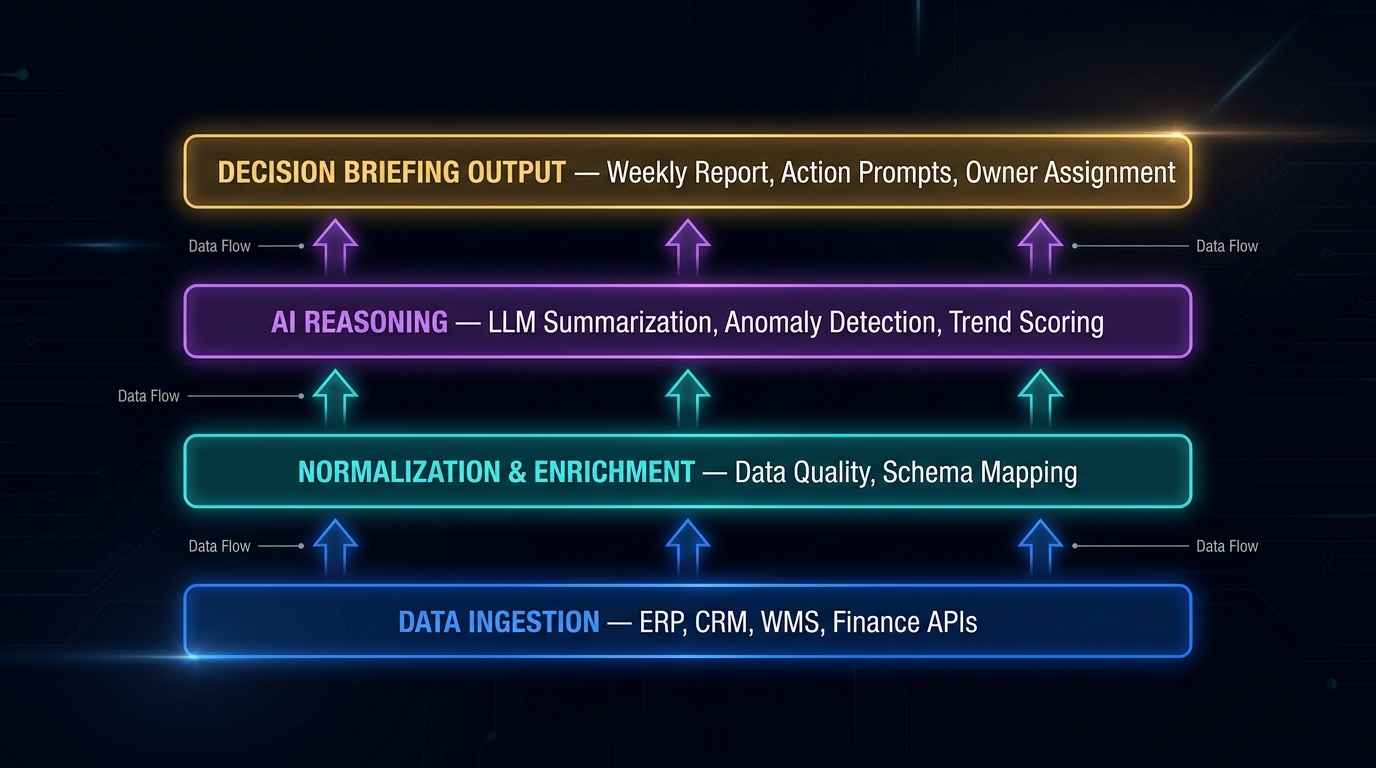
The architecture that underlies a functional AI-augmented decision room is not monolithic. It is a pipeline with four distinct layers, each of which serves a specific function and can fail in specific ways. Understanding the layers individually is what separates teams that build durable systems from those that build impressive demos that collapse under production conditions.
Layer 1: Data Ingestion
The first layer is the most unglamorous — and the most commonly underestimated. Data ingestion is the process of pulling operational data from every source system that has bearing on the decisions your leadership team needs to make each week. In a typical mid-market or enterprise organization, that means at minimum: an ERP system (SAP, Oracle, NetSuite, or similar), a CRM, a logistics or warehouse management system, financial reporting infrastructure, and potentially customer experience platforms capturing service and satisfaction signals.
The challenge is not that these systems do not have data. They all have more than enough. The challenge is that they speak different languages, update on different cadences, use different schemas for overlapping concepts, and often require different authentication patterns. A weekly briefing that pulls inventory data from a WMS on a nightly batch cycle and pairs it with CRM data refreshed every 15 minutes is not comparing equivalent snapshots. The seams in your data architecture become seams in your briefing’s credibility.
The practical guidance here: start with three to five source systems, not all of them. Map exactly which data fields are decision-relevant. Establish consistent pull timing — most teams settle on nightly batches aggregated on Monday morning, with the briefing distributed on Thursday. Build your connectors with explicit error handling so that if a source system is unavailable, the briefing notes the gap rather than silently presenting stale data.
Layer 2: Normalization and Enrichment
Raw data from source systems is rarely in a state that downstream AI can reason about accurately. Field names differ across systems. Currency values may be stored in local denominations that need normalization. Customer records may appear under multiple identifiers across CRM and billing platforms. Timestamps may be in different time zones.
The normalization layer resolves these conflicts and enriches the data with derived metrics — things like week-over-week change rates, moving averages, rolling totals, and threshold flags. This layer is where you define the vocabulary of your decision room: what counts as an “on-time delivery,” how you measure “customer escalation rate,” what the acceptable range is for “inventory coverage days.” These definitions must be explicit, documented, and version-controlled. Any ambiguity in this layer propagates upward into every briefing produced above it.
Layer 3: AI Reasoning
This is where the synthesis happens. The AI reasoning layer takes the normalized, enriched operational dataset and applies three types of processing: anomaly detection (what has changed significantly versus baseline), trend scoring (which metrics are moving in concerning or positive directions), and LLM-based narrative generation (converting the pattern findings into prose that a senior executive can read in five minutes).
The LLM summarization piece is where most organizations either over-invest or under-trust. The right role for the language model in this layer is not to invent insights. It is to describe, contextualize, and prioritize what the data already shows. The prompt architecture matters enormously here. A well-designed prompt provides the model with the normalized dataset, the anomaly flags from the detection layer, the historical baseline, and explicit instructions about output format: how many signals to surface, what decision framing to include, what to exclude.
Teams that try to let the LLM “discover” insights from raw data without structured anomaly pre-processing tend to get verbose, generic summaries that executives correctly distrust. Teams that treat the LLM as a structured narrative generator — with the hard analytical work already done upstream — get concise, credible briefings that earn trust over repeated cycles.
Layer 4: Decision Briefing Output
The top layer is the artifact itself: the weekly briefing document. Format matters more than most technical teams expect. Executives who receive a 40-slide deck every Friday disengage quickly. The briefing format that consistently performs well in practice is a single-page structured document (or its digital equivalent) with five components: a headline summary (what happened this week, in three sentences), five to ten ranked operational signals, two to four explicit decision prompts with supporting data and recommended options, owner assignments for each decision, and a one-line carry-forward on decisions made in previous weeks.
That is it. One page. The full supporting data should be available on request via a linked appendix or interactive dashboard, but the decision room meeting itself operates off the top-layer briefing document exclusively. Any meeting that requires scrolling through data tables is a sign that the summarization layer has not done its job.
Choosing Your Signal Sources: What Gets Fed Into the Room
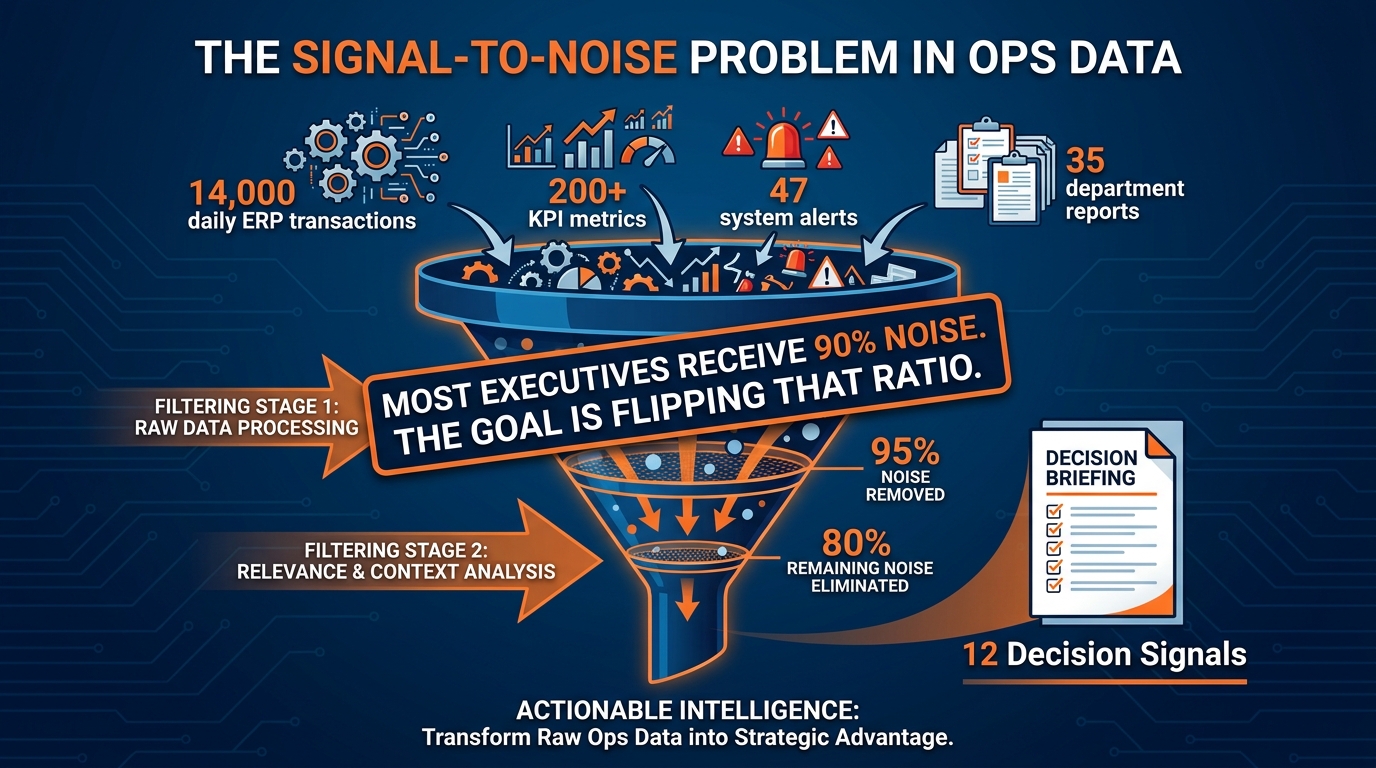
One of the most consequential choices in building an AI-augmented decision room is the signal selection problem: which of your organization’s many data streams actually belong in the briefing, and which belong in a separate monitoring environment that never reaches the leadership meeting?
This is harder than it sounds. Every department head believes their metrics belong in the executive briefing. If you let them all in, the briefing becomes a 47-metric scorecard that communicates nothing. The discipline of signal selection is partly technical and partly political — and getting it wrong in either direction creates a system that fails to serve the room.
The Decision-Relevance Test
The most rigorous framework for signal selection asks a simple question about every candidate metric: Could an executive take a materially different action this week based on what this metric shows? If the answer is no — if the metric is informational but not decision-triggering — it belongs in the appendix, not the briefing. If the answer is yes, it belongs in the primary signal set.
Apply that test honestly and most organizations discover that their truly decision-relevant weekly signal set is somewhere between eight and fifteen metrics — significantly fewer than what ends up in typical dashboard deployments. The discipline of constraining to that number is what makes the briefing actionable rather than comprehensive.
Balancing Leading and Lagging Indicators
A common failure mode in signal selection is over-weighting lagging indicators. Revenue, cost, and margin figures are essential context, but they describe what already happened. By the time they appear in a weekly briefing, the decisions that would have influenced them are already behind you.
Effective decision room signal sets deliberately balance lagging with leading indicators. For a supply chain operation, that might mean pairing “last week’s on-time delivery rate” (lagging) with “current supplier lead time variability against 30-day average” (leading). For a customer operations team, “this week’s CSAT score” (lagging) pairs with “open escalation ticket age distribution” (leading). The leading indicators give the room something to act on in the present cycle. The lagging indicators provide the validation layer for decisions made in previous cycles.
External Data and Market Context
A mature briefing stack also incorporates a limited set of external signals that contextualize internal performance. Commodity prices if procurement is a significant cost driver. Freight index data if logistics is material to margins. Competitor pricing signals if you operate in a category where real-time price sensitivity is high. Industry-specific regulatory calendars if compliance events affect operational cadence.
The key is selectivity. External signals that broaden the context without enabling a specific decision add length without value. A weekly briefing that opens with four paragraphs of macroeconomic context before reaching the operational substance has fundamentally misjudged the room’s purpose.
The Summarization Layer: How LLMs Convert Data Noise Into Decision Narrative
The LLM summarization layer is where most of the architectural debate happens in 2026, and with good reason. This is the component that determines whether the briefing earns trust from its readers or gets quietly ignored after the first few cycles.
Why Prompt Architecture Is the Real Differentiator
The quality of LLM-generated briefings is not primarily a function of which model you use. In practical production deployments, the quality difference between leading models is significantly smaller than the quality difference between well-structured and poorly structured prompts feeding the same model. Teams that treat prompting as an afterthought produce generic summaries. Teams that invest in prompt engineering as a core discipline produce briefings indistinguishable from skilled human analysis.
A high-performance briefing prompt does several things simultaneously. It provides the model with explicit context about the organization — what it does, what its primary operational levers are, what its most important thresholds and targets are. It supplies the pre-processed anomaly and trend data from the layer below. It specifies the desired output format precisely, including section headings, signal count limits, and the framing of decision prompts. And it instructs the model to flag its own uncertainty — to mark signals as “requires validation” when the underlying data shows inconsistency or when the pattern deviates from historical norms in a way that might indicate data error rather than genuine operational change.
That last element — explicit uncertainty flagging — is one of the most important design choices in the summarization layer. Executives who discover that a briefing confidently reported a data artifact as an insight will not trust the system again quickly. Briefings that transparently note “this signal shows an unusual pattern — recommend verifying against source data before acting” earn significantly more trust than those that project false confidence.
Narrative Structure That Executives Actually Read
The narrative structure of the briefing output is its own discipline. Research on how senior leaders process written intelligence consistently points to the same format preference: conclusion first, evidence second. Write the headline — what the most important thing is this week — before presenting any data. Name the decision that needs to be made before walking through the analysis that supports it.
This inverts the structure most analysts naturally write in, which is evidence first, conclusion last. That structure forces executives to read to the end before understanding the point. For a weekly briefing they are scanning at 7 a.m. on a Thursday, that structure ensures the most important information gets the least attention.
The model should also maintain a consistent voice across briefing cycles. Variance in tone, structure, and vocabulary between weeks creates cognitive friction that degrades the reading experience over time. Part of the value of an AI-generated briefing is its consistency — executives should be able to navigate it on muscle memory by the third or fourth cycle, which requires the format to be stable.
Handling Multi-Modal Data
Operational data is not always numerical. Customer verbatim feedback, supplier communications, field service reports, and audit logs are all text-rich operational data sources that carry decision-relevant signals. A sophisticated summarization layer incorporates sentiment analysis and thematic extraction from text-based sources alongside quantitative time series data.
In practice, this means running a separate natural language processing pipeline over unstructured operational text — extracting themes, sentiment shifts, and recurring issues — and feeding those outputs into the main summarization prompt as structured inputs rather than raw text. This prevents the model from spending most of its reasoning budget on parsing prose and keeps the focus on the decision-relevant themes that surface from that analysis.
Cadence Design: Building the Weekly Rhythm That Actually Drives Decisions
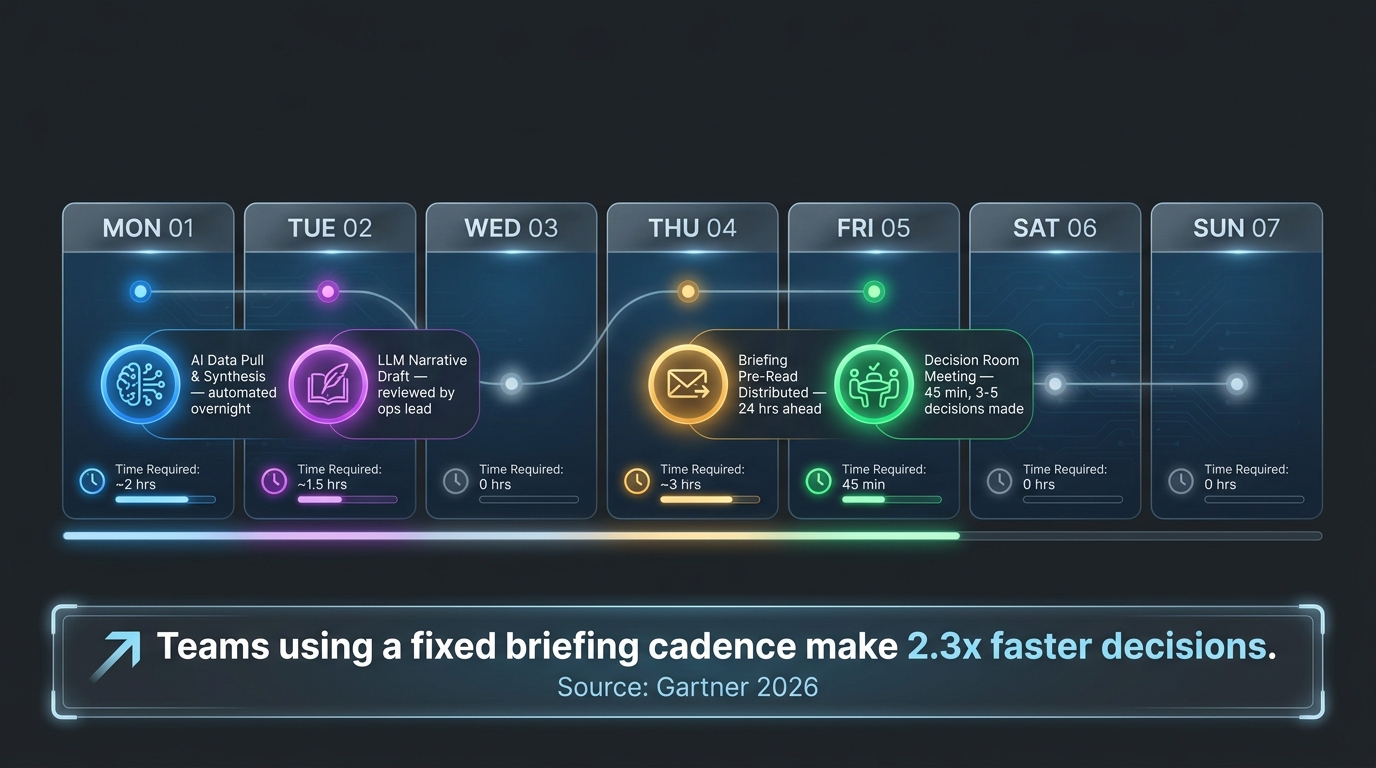
The architecture of the briefing stack matters. But cadence — the specific rhythm of when data is pulled, when AI processing runs, when the briefing is distributed, and when the decision room convenes — is equally important and gets far less design attention.
A weekly briefing that lands in inboxes 15 minutes before the meeting has not been read. A weekly meeting that happens on Monday morning is making decisions off data that is already five days old by mid-week. A decision room that has no carry-forward mechanism makes the same operational mistake across multiple consecutive cycles because there is no institutional memory of what was decided and what was supposed to happen as a result.
The Weekly Stack in Practice
The cadence pattern that consistently performs well in production environments follows a structured weekly arc:
- Sunday/Monday overnight: Automated data pull from all source systems. Normalization and enrichment layer runs. Anomaly detection produces the scored signal list.
- Monday/Tuesday: LLM summarization runs against the enriched dataset. The resulting draft briefing is routed to a designated operations lead for human review — not for rewriting, but for validation of any flagged uncertainties and for confirmation that the signal ranking reflects genuine operational priorities versus data artifacts.
- Wednesday: Final briefing document is prepared, incorporating the ops lead’s validation notes. The briefing is formatted and packaged.
- Thursday (24 hours before the meeting): Briefing distributed to all decision room participants. This 24-hour pre-read window is non-negotiable. Executives who receive the briefing simultaneously with the meeting start are effectively not briefed — they are being ambushed with data in a room where they are expected to make decisions.
- Friday (or whichever day the decision room meets): 45-minute meeting. The first five minutes review carry-forward items from the previous week. The remaining time is allocated by signal — typically 8-10 minutes per major decision item, with the discussion focused on which of the AI-recommended response options to authorize, who owns execution, and what the success metric for the decision is.
Meeting Discipline and Anti-Patterns
The weekly decision room meeting has its own set of failure patterns that undermine otherwise well-designed systems. The most common is reopening the data during the meeting — a participant who has a different view of the numbers opening their own dashboard to “check something.” This introduces inconsistency, extends meeting duration, and implicitly signals distrust in the briefing, which corrodes the system’s authority over repeated cycles.
The meeting discipline rule that experienced practitioners consistently recommend: the briefing document is the authoritative source for the meeting. If someone believes a number is wrong, they flag it for post-meeting investigation and the decision is either deferred until the next cycle or made on the basis of the briefing data with an explicit note that the underlying figure requires validation. Questions about the data are not answered in the room. Decisions about what to do given the data are made in the room.
A second important anti-pattern is scope creep in cadence. Once a weekly decision room becomes useful, there is organizational pressure to expand it — to meet twice a week, to add more metrics, to invite more participants. Each of these expansions should be resisted by default. The value of a weekly decision room is its regularity and constraint. A meeting that balloons from 12 participants to 28 over three months has stopped being a decision room and started being an information distribution event with an inflated guest list.
Why Most AI Briefing Systems Collapse Within 90 Days
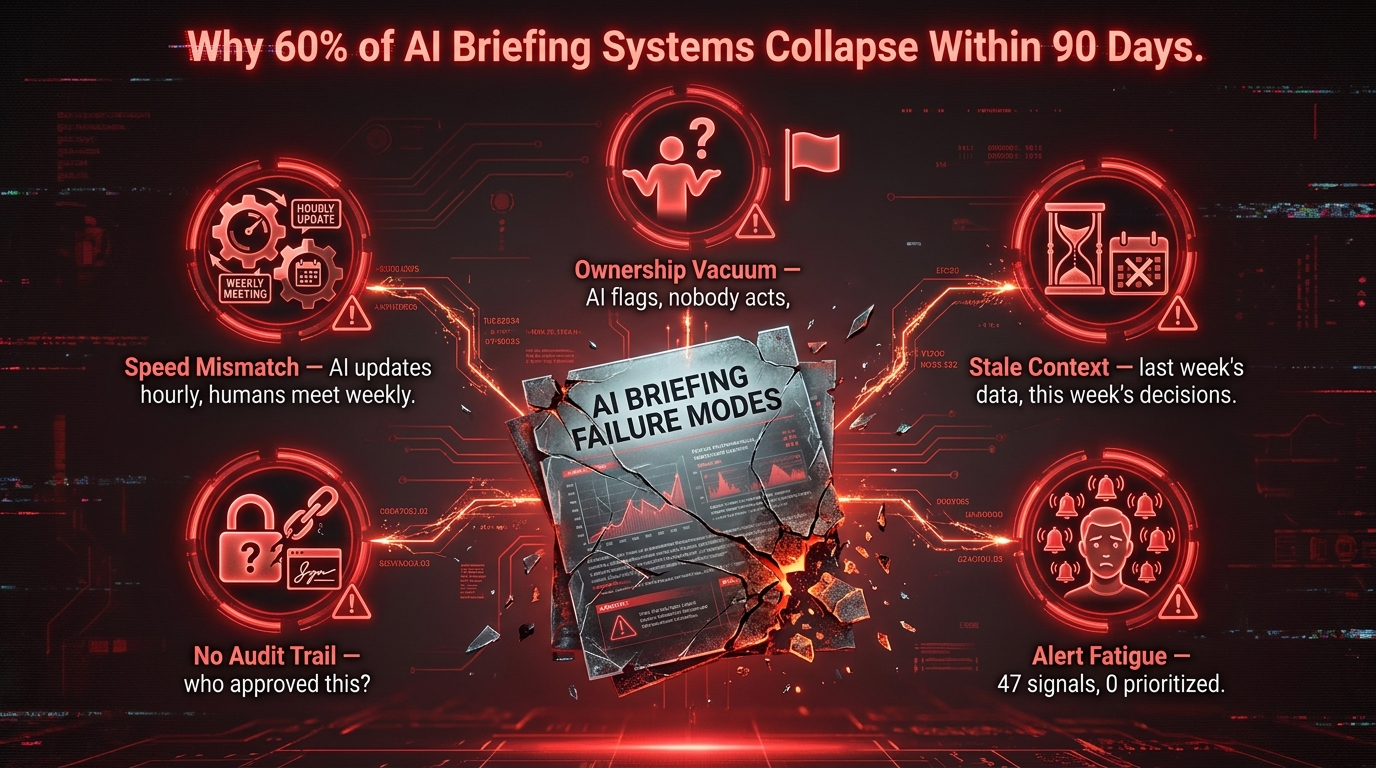
The most sobering data point for anyone building an AI-augmented decision room is also the most instructive: the majority of these systems are abandoned or quietly allowed to atrophy within their first three months of operation. Not because the technology fails. Because the organizational conditions for sustaining them were never properly established.
Understanding the specific failure modes — and why they tend to cluster in the 60-90 day window — is the most practical preparation for building a system that survives beyond its initial momentum.
Failure Mode 1: The Ownership Vacuum
AI surfaces an operational signal. The briefing document routes it to the room as a decision item. The room discusses it. And then nobody is explicitly accountable for doing anything about it. This is the ownership vacuum — the gap between decision-as-insight and decision-with-an-owner.
It appears most acutely when decision room outputs are treated as recommendations rather than directives. The fix is structural: every decision item that exits a room meeting must have a named owner, a completion date, and a success metric that the AI layer will automatically track in the following week’s briefing. Without that loop closing, the system becomes a sophisticated way of identifying problems that nobody is responsible for solving.
Failure Mode 2: Speed Mismatch
AI systems can detect operational anomalies within minutes of data becoming available. Human decision-making systems, with their weekly meeting rhythms and approval chains, operate on a significantly slower clock. The mismatch between these cycles creates a specific frustration: by the time a signal surfaces in the weekly briefing, the window for the most impactful response has sometimes already closed.
This is not an argument for more meetings. It is an argument for a tiered intervention model alongside the weekly rhythm. Some signals should trigger asynchronous micro-decisions — brief Slack or email notifications with a binary choice that can be approved outside the room by a designated decision-owner without convening the full group. The weekly room handles strategic and multi-stakeholder decisions. The asynchronous micro-decision layer handles urgent but bounded operational choices that cannot wait seven days.
Failure Mode 3: Context Drift
The AI summarization layer is trained — explicitly or implicitly — on a set of assumptions about the organization’s operational context. When that context changes significantly (a new product line, a major customer exit, an operational restructuring), the briefings continue to be generated against the old context. The signals look plausible but are framed against baselines that are no longer accurate. Decisions get made based on intelligently presented but fundamentally miscalibrated analysis.
Context drift is insidious because it is not immediately visible. The briefing still arrives on schedule. The format still looks right. But the normalization baselines and anomaly detection thresholds are gradually diverging from operational reality. The fix is a mandatory quarterly context review: a structured session in which the operations lead audits every configured parameter in the briefing stack — thresholds, baselines, signal definitions, decision-room composition — and updates them to reflect the organization’s current operating state.
Failure Mode 4: Alert Fatigue
Early-stage briefing systems tend to surface too many signals. The initial instinct is to be comprehensive — to make sure nothing important is missed. But a briefing that surfaces 25 signals per week trains executives to skim, which defeats the entire purpose. Signal count creep, where the briefing grows from eight signals to fifteen to twenty-two over its first two months, is one of the surest predictors of eventual system abandonment.
The counter-discipline is a hard cap — typically ten signals per briefing — enforced at the AI layer. If the anomaly detection model produces fifteen flags in a given week, the scoring system must prioritize down to ten before the narrative layer sees them. The remaining five are automatically logged in an appendix for the ops lead to review outside the room. This constraint forces the system to get better at prioritization rather than better at comprehensiveness.
Failure Mode 5: No Audit Trail
A weekly decision room without an audit mechanism is generating accountability gaps. When a decision is revisited three months later — because it did not produce the expected result, or because circumstances changed — the absence of a clear record of what was decided, by whom, on the basis of what data, creates genuine organizational risk. In regulated industries, that risk is amplified.
The audit layer does not need to be elaborate. A structured decision log — capturing the date, the signal that triggered the decision, the option selected, the owner, the target date, and the AI model and data version that produced the briefing — is sufficient for most operational purposes. The requirement is that it is maintained consistently and that the AI layer automatically references the log when generating carry-forward items in subsequent briefings.
Human-in-the-Loop: Where Judgment Cannot Be Delegated
The technical architecture of an AI-augmented decision room is sophisticated. But the most important design decisions are human ones — specifically, where in the process human judgment must be inserted, and what happens when AI recommendations conflict with the experience-based instincts of the people in the room.
The Three Non-Negotiable Human Checkpoints
Every AI-augmented briefing system that sustains leadership trust over time has at least three explicit human checkpoints built into its workflow. The first is the ops lead validation step — the human review of the AI-generated draft briefing before distribution. This review is not about editing for style. It is about catching AI errors, validating that flagged anomalies represent genuine operational signals rather than data artifacts, and confirming that the signal ranking reflects the organization’s actual priorities in the current week. A 30-minute review by someone who knows the operation deeply is enough to catch the category of error that most quickly destroys leadership trust in AI-generated content.
The second checkpoint is explicit escalation authority within the meeting itself. Any participant in the decision room must have the right to pause a decision and invoke human judgment review — to say “I have direct operational knowledge that contradicts this signal, and I need the decision to wait while we validate.” This authority must be built into the meeting protocol explicitly, not treated as a disruption of the AI-driven flow.
The third checkpoint is the post-decision outcome review. When a decision made in the room produces a measurably different result from the AI-recommended projection, that outcome is logged and fed back into the model’s calibration. This is not automated retraining in the data science sense — it is a structured feedback loop that a human analyst uses to update thresholds, reframe signal definitions, and adjust the prompt architecture based on observed prediction errors.
The Trust Calibration Problem
Organizations building AI decision rooms face a fundamental trust calibration challenge. Executives who arrive skeptical may dismiss AI-generated briefings even when they are accurate. Executives who arrive credulous may defer too heavily to AI recommendations even when their own operational knowledge should override them.
The most effective approach to trust calibration is transparent track record maintenance. Starting from the first briefing cycle, the system tracks how often AI-flagged signals led to decisions that produced the projected outcomes, and how often those signals proved to be false positives or misdirected. That track record is included in the briefing itself — a running hit rate that gives executives a calibrated basis for how much weight to give AI recommendations in any given domain. A system that earns trust through demonstrated accuracy over time is significantly more resilient than one that asks for trust as a precondition.
Governance, Auditability, and the Question of Who Signs Off
In 2026, AI governance has moved from aspiration to requirement in most enterprise contexts. Regulatory pressure in financial services, healthcare, and increasingly in supply chain operations has accelerated governance expectations for AI-assisted decision making. Even in industries without explicit AI regulation, the reputational and operational risk of an undocumented AI-influenced decision that goes wrong is significant enough to warrant formal governance architecture.
What AI Governance Looks Like in a Decision Room Context
Governance for an AI decision room is not primarily about the AI models themselves — though model governance, version control, and bias monitoring all matter. It is primarily about the decision process. For governance purposes, what matters is that every decision made in a decision room can be traced back to the specific data it relied on, the specific AI output that informed it, the human approval step that validated that output, and the individual who authorized the decision.
This documentation requirement is most easily met when it is built into the system architecture from the beginning rather than retrofitted. Decision logs, AI output versioning, and briefing distribution records should be automatically generated as part of the weekly workflow, not assembled manually after the fact. Organizations that rely on meeting minutes and email threads for this traceability are creating governance gaps that become significant liabilities at scale.
Model Risk Management
For organizations in regulated industries, AI-driven decision support systems increasingly fall under model risk management frameworks. This means that the LLM and analytical models used in the briefing stack need formal validation — documentation of what the model does, what its known limitations are, how it performs across different operational conditions, and what controls exist to prevent its outputs from being acted upon when they fall outside validated operating parameters.
This sounds more complex than it is in practice. The core governance artifact is a model card for each AI component in the briefing stack — a one to two page document that states the model’s purpose, its training context, its known failure modes, and the human controls that bound its operational scope. That document is reviewed quarterly alongside the context review described earlier, and it provides the foundation for any regulatory inquiry or internal audit that requires documentation of AI’s role in operational decision-making.
Data Privacy and Retention
Weekly briefing systems aggregate operational data across multiple source systems. In most enterprise contexts, this creates data handling obligations — questions about how long briefing documents are retained, who has access to what operational data, and whether any of the data that flows through the briefing stack carries regulatory classification (GDPR-sensitive customer data, for instance, or financial data subject to SEC record-keeping requirements).
These questions are best answered before the system goes into production rather than after. A pre-deployment data privacy review — conducted with the organization’s legal and compliance teams — that maps every data source to its handling requirements and establishes retention and access policies for briefing artifacts is the governance equivalent of building on solid ground. It takes a few weeks and prevents problems that would otherwise take months to unwind.
Implementation Roadmap: Building Your First AI-Augmented Decision Room in Eight Weeks

The single most common reason organizations delay building AI-augmented decision rooms is the belief that they need to resolve their data quality problems first. That belief, while understandable, produces indefinite inaction. The reality is that a functional first version can be operational in eight weeks with deliberately limited scope, and the discipline of building it is one of the most effective forcing functions for resolving the data quality issues that would otherwise remain theoretical.
Weeks 1–2: Scope Definition and Signal Selection
Start by selecting one operational domain — not the entire business. A supply chain team, a customer operations function, a regional P&L unit. Define the three to five source systems that hold the data most relevant to that domain. Convene a working session with the domain’s operational lead and the executive sponsor to identify the ten KPIs that are genuinely decision-relevant by the test described earlier. Document what “anomalous” means for each — what threshold constitutes a signal worth surfacing versus normal variance.
Do not try to build a complete KPI taxonomy in this step. Ten metrics, clearly defined, with explicit anomaly thresholds, are worth more than fifty metrics that are loosely specified. The initial scope will expand naturally in subsequent cycles as trust and capability develop. Starting small is not a constraint — it is the methodology.
Weeks 3–4: Ingestion Layer and Data Validation
Build the data connectors to your three to five source systems. Establish the pull timing and the error handling protocols. Run the pipeline for two weeks without any AI layer — just ingest and normalize the raw data, validate that it matches what the source systems actually contain, and resolve the field definition conflicts and schema mismatches that will inevitably surface.
The temptation to skip this validation step and move straight to the AI layer is strong. Resist it. A single week of data quality issues that surface after the LLM is already generating briefings is far more damaging to leadership trust than a week of delay at the start. Get the foundation right before adding the synthesis layer.
Weeks 5–6: AI Reasoning and First Draft Briefings
With clean, validated data flowing through the pipeline, build the anomaly detection layer and develop the LLM prompt architecture. Run the AI reasoning layer for two weeks and produce draft briefings each cycle. Do not distribute these to executives yet. Instead, have the ops lead review each draft against their own direct operational knowledge and score the briefing on signal accuracy, signal prioritization, and narrative clarity.
Use this feedback to iterate on the prompt architecture and anomaly detection thresholds before the briefing goes live. Two weeks of closed iteration with an expert reviewer will catch the majority of systematic errors that would otherwise undermine leadership trust in the first production cycle.
Weeks 7–8: First Live Decision Room Cycles
In week seven, distribute the first production briefing to the decision room participants with a clear framing: this is the first cycle, feedback is expected, and the system will be refined based on what the room observes. Hold the first decision room meeting with explicit discussion time at the end for meta-feedback on the briefing format itself — not just the operational content.
In week eight, incorporate the feedback from cycle one, run the second cycle, and begin tracking the decision log and carry-forward mechanism. By the end of week eight, you have two operational cycles of an AI-augmented decision room, a feedback mechanism, and a data foundation for measuring the system’s accuracy over time. That is enough to demonstrate value, earn institutional support for expanding scope, and establish the governance foundation for doing so responsibly.
The 90-Day Review
Schedule the context review at week twelve — the point at which, if the failure mode data is instructive, many systems begin to show the first signs of atrophy. Audit the signal definitions, the anomaly thresholds, the decision log, and the model track record. Assess whether the scope should be expanded to include additional operational domains or whether the current domain needs deeper coverage before breadth is added.
The 90-day review is also the right moment to evaluate whether the weekly cadence is the correct cadence for the domain. Some operational functions benefit from a bi-weekly cycle with higher-level strategic framing. Others need a twice-weekly cycle with a lighter-weight briefing format. The initial eight-week build should be treated as a calibration period, with cadence adjustments made at the 90-day mark based on evidence rather than assumption.
What Separates Durable Systems From Expensive Experiments
The organizations that have built AI-augmented decision rooms that are still running two years after their initial deployment — producing genuine operational improvements and evolving with the business — share a small set of characteristics that are worth naming explicitly.
The first is executive co-ownership. The most durable systems have an executive sponsor who attends the decision room, uses the briefing personally, and visibly champions the discipline of the format — refusing to let the meeting expand beyond its scope and holding the ops lead accountable for briefing quality. When the executive sponsor treats the AI-augmented briefing as an optional tool that supplements the meeting rather than the primary artifact that structures it, the system gradually degrades under organizational pressure from participants who prefer the old format.
The second characteristic is investment in the ops lead role. The human validator who reviews the AI draft briefing before distribution is not a junior analyst doing a quick pass. It is a senior operational professional who combines deep knowledge of the business with enough technical literacy to recognize when the AI reasoning layer is producing a confident-looking error. Organizations that try to automate this review step or staff it with junior team members consistently produce briefings that lose executive trust within the first few months.
The third characteristic is patience with the iteration cycle. The briefings that earn the most trust in the room at month six bear limited resemblance to the first production cycle. The prompt architecture has been refined. The signal definitions have been sharpened. The anomaly detection thresholds have been calibrated against observed outcomes. The decision log has been growing for six months and is now a genuine institutional memory asset. None of that happens in eight weeks. It happens in eight months. Organizations that evaluate the system after one month and adjust course based on early roughness are abandoning the effort precisely when it is beginning to develop real value.
Conclusion: The Real Work Is Institutional, Not Technical
The technology required to build an AI-augmented decision room in 2026 is mature and accessible. The data pipeline components, the anomaly detection frameworks, the LLM summarization capabilities — these are all available, battle-tested, and deployable without cutting-edge AI research expertise. What is not mature and accessible is the organizational discipline that makes these systems useful rather than decorative.
Building a decision room that actually drives decisions — rather than one that generates impressive briefing documents that inform wide-ranging discussions that result in no clear ownership — is fundamentally an institutional design challenge. It requires explicit signal selection with genuine constraint, a cadence discipline that is protected from organizational entropy, human validation checkpoints that are taken seriously rather than treated as formalities, and a governance layer that makes the system auditable and sustainable at scale.
The organizations that will look back in 18 months and describe their AI decision room as one of their most valuable operational investments are not necessarily those with the most sophisticated data infrastructure. They are those that made the organizational commitments required to use the briefing as it was designed — as the authoritative basis for structured weekly decisions, with owners, deadlines, and accountability built into every cycle.
The data has always been there. The gap was never a data gap. It was always a translation gap — between what the systems know and what the room needs to decide.
Actionable Takeaways
- Start with one domain and ten metrics. Do not try to brief the entire organization in cycle one. Constraint is the methodology.
- Build the validation layer before the AI layer. Clean, schema-consistent data from three to five source systems is more valuable than 30 partially connected sources feeding an LLM.
- Distribute the briefing 24 hours before the meeting. Executives who receive the briefing in the room are not briefed — they are ambushed.
- Cap signal count at ten per cycle. Enforce this at the AI layer, not as editorial judgment after the fact.
- Every decision needs an owner and a date before the meeting ends. Without that loop closing, the system is a sophisticated way of documenting problems nobody is solving.
- Schedule the 90-day context review before you launch. Put it in the calendar on day one. It is the single most effective defense against the failure modes that cluster in that window.
- Maintain a transparent track record. Show the room how often the AI signals led to correct decisions. Trust built on demonstrated accuracy is the most durable kind.