



TikTok Shop’s live commerce channel is now the platform’s highest-converting sales format — and by a significant margin. While standard product listings on the Shop Tab convert at roughly 1.5–3% and short-form video drives 2–4% conversion, well-executed live streams are consistently hitting 8–12% session conversion rates. In some peak-performer rooms, that number climbs higher still.
But “well-executed” is doing a lot of heavy lifting in that sentence. Most brands going live on TikTok Shop are not hitting those numbers. They’re running long, rambling streams, throwing a single discount at the camera, and wondering why their chat is empty and their GMV is flat. The format rewards a specific kind of discipline — one that combines engineered offer architecture, scripted-but-spontaneous talk tracks, and a show structure calibrated to how TikTok’s algorithm actually distributes live content.
This piece breaks down the mechanics of that discipline. Not the surface-level “go live more often” advice, but the actual operating system underneath high-performing TikTok Shop lives: how to build an offer stack that layers value without destroying margin, how to script each product cycle in under 60 seconds, how to structure a full show so it converts from minute one to minute ninety, and how to build a weekly cadence that compounds over time. These are the levers that separate brands doing six figures a month from live to brands doing six figures a stream.
Why Live Commerce Outperforms Every Other TikTok Shop Format
Before getting into the mechanics, it’s worth understanding why live converts at the rate it does. The gap between live shopping’s 8–12% conversion and standard e-commerce’s 1.5–3% isn’t random — it’s structural, and understanding the structure helps you design better shows.
The Compression of the Decision Cycle
In a standard product listing, a shopper is alone with a page. They can leave, compare, research, sleep on it, and return — or not. The decision has no time pressure and no social context. Live commerce collapses that decision window by introducing three simultaneous forces: a countdown (limited time), a crowd (other buyers in the chat), and a trusted human voice (the host) delivering information in real time.
Behavioral economics research on livestream commerce describes this as a dual-process buying model: a fast, emotional route driven by entertainment, parasocial connection with the host, and visible social proof from the chat; and a slower, rational route that the time pressure actively suppresses. When those forces are engineered deliberately — not left to chance — the result is compressed decision-making, higher add-to-cart rates, and faster purchases.
The Algorithm Actively Rewards Live Engagement
TikTok’s algorithm surfaces live content based on real-time engagement signals: comments, shares, new viewer joins, watch duration, product pin clicks, and purchases. Each of these signals feeds back into distribution — a room that’s hitting high engagement gets pushed to more For You pages, which drives more viewers, which drives more engagement. It’s a flywheel that doesn’t exist for static listings.
This means that a well-structured live show with high engagement can organically build its own audience mid-stream. The first 10–15 minutes of a live are the most critical for algorithmic seeding; brands that nail the opening hook don’t just convert better — they get more viewers to convert in the first place.
The Scale of the Opportunity
TikTok Shop’s projected global GMV for 2026 sits around $112 billion. Of that, live shopping now accounts for an estimated 25–41% of total platform GMV, depending on the market. In Southeast Asia, where live commerce is most mature, individual streams regularly hit seven figures in a single session. Western markets are earlier in that curve but accelerating fast. Brands that invest in live infrastructure now are building capability that will compound as the format scales.
The Offer Stack Architecture: Engineering Value Without Destroying Margin
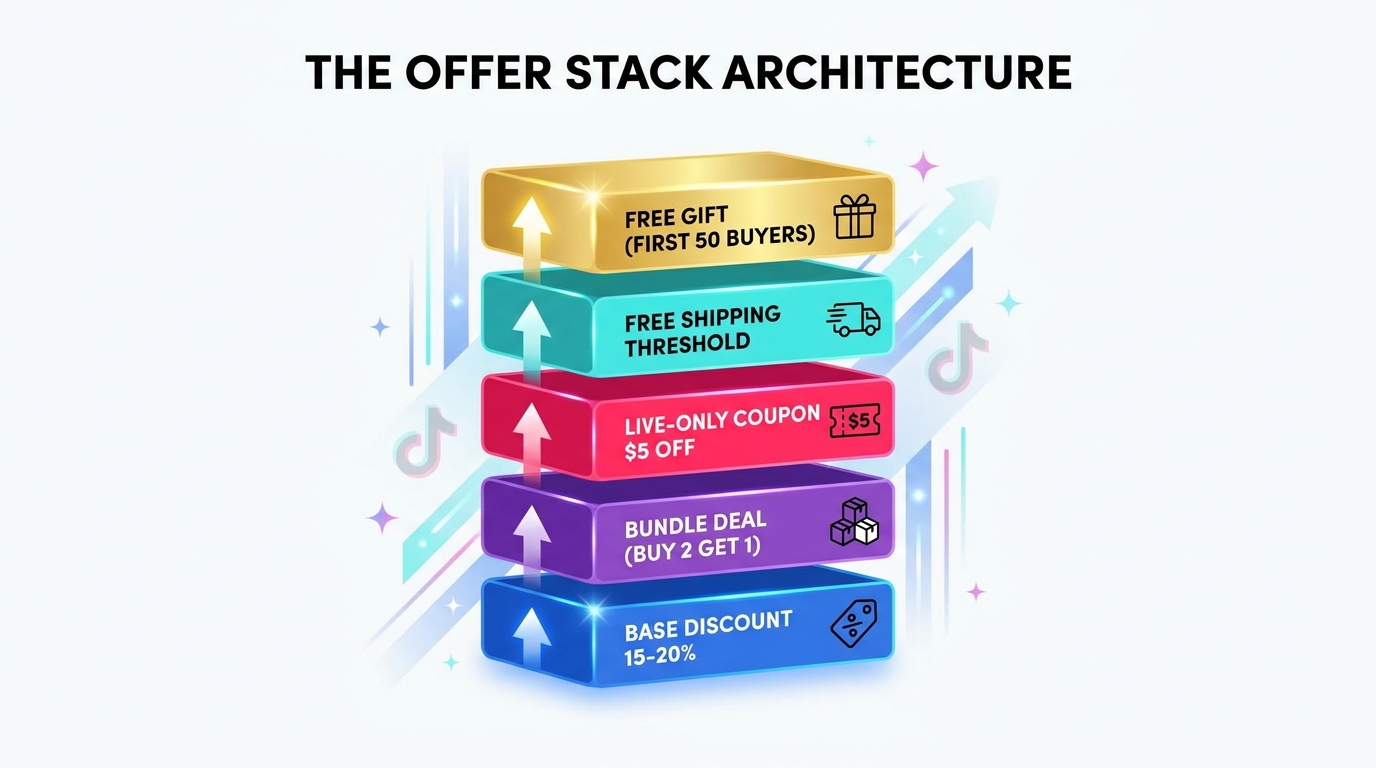
The single most common error in TikTok Shop live offers is treating “offer” as synonymous with “discount.” A percentage-off isn’t an offer stack — it’s a single lever. High-performing live rooms are engineering multi-layer offer architectures that raise perceived value, increase average order value, and create several distinct urgency moments throughout a single stream. Here’s how the architecture breaks down.
Layer 1: The Base Discount (Anchor-Setting)
Every live offer starts with a visible, straightforward product discount — typically 15–25% off the listed price. This functions less as the actual conversion driver and more as an anchor: it establishes the baseline deal and makes every layer on top feel like additional gain. The base discount should be visible on screen via TikTok’s built-in promotion tools before the host says a word about it. Shoppers scrolling in mid-stream should be able to immediately identify that a deal is active.
The rule of thumb for base discount sizing: it needs to be meaningful enough to visually stand out in the product card, but not so deep that you have no room to escalate. Brands that open with a 40% base discount have no escalation headroom — there’s nowhere to go for the flash deal moment. A 15–20% base creates space for a live-only coupon, a bundle deal, and a flash escalation, all of which feel like genuine additional value.
Layer 2: Bundle Construction (AOV Architecture)
Bundles are the primary AOV driver in live commerce. The mechanics are simple: instead of selling one unit at a discount, you’re selling two or three units at a total price that’s more attractive per unit but higher in absolute terms. A well-constructed bundle does two things simultaneously: it raises the average transaction value and it creates a natural comparison point (“if you buy one, it’s $X; if you grab the bundle, you’re getting each one for $Y”).
Effective bundle design for live needs to be visually clean and verbally simple. The host should be able to explain the bundle deal in under 15 seconds. Complex bundles (“buy two of this, one of that, and use this code for an additional 10%…”) lose viewers immediately. The test is whether a viewer who just joined the stream can understand the bundle deal within 30 seconds of arrival.
Layer 3: Live-Only Coupons (Platform-Powered Urgency)
TikTok Shop supports live-only coupon drops — limited-quantity discount codes that can be released at a specific moment during the stream. These function as a conversion spike mechanism: a few hundred viewers watching passively suddenly have a reason to act in the next 90 seconds. Structurally, live-only coupons work best when they’re dropped at a pre-planned moment (typically after the first or second product demo), announced verbally with a short countdown, and promoted visually via on-screen text or the host holding up the code visually.
The quantity limit is important. A coupon with 500 available units to an audience of 200 viewers creates no urgency. A coupon with 30 available units creates visible scarcity. The chat filling with “I GOT ONE!” comments serves as social proof that the deal is going fast, which accelerates purchases from viewers still on the fence.
Layer 4: Free Shipping Thresholds (Friction Removal)
Shipping cost is one of the most reliable conversion killers in e-commerce. In a live stream context, where purchase decisions are being made quickly, the psychological cost of a shipping fee can tip a borderline buyer toward abandoning the cart. Free shipping — particularly when tied to a spend threshold — removes that friction and simultaneously encourages AOV lift (“just add one more thing and your shipping is free”).
The threshold needs to be calibrated against your average order value. Setting the free shipping threshold at double your AOV means most buyers won’t hit it and the incentive loses meaning. Setting it at 1.1–1.3x your AOV makes it attainable, which is when it becomes a genuine purchase accelerator.
Layer 5: First-Buyer Free Gifts (Scarcity + Social Proof)
The top of the offer stack — reserved for peak urgency moments — is a free gift for the first N buyers. This tactic exploits both scarcity (limited quantity) and social competition (the visible race to be among the first). When the host announces “the next 20 buyers get [product] included for free,” the chat typically explodes with purchase notifications and “I just bought!” comments, which triggers FOMO-driven purchases from viewers watching but not yet buying.
Free gifts need to be high-perceived-value, low-actual-cost items. A product sampler, a complementary SKU, or branded merchandise works well. The product itself should be held up physically — visible in the camera frame — so viewers can see what they’re racing to get.
Offer Psychology: The Behavioral Architecture Under the Stack
Understanding why these layers work at a psychological level isn’t just interesting — it helps you deploy them more precisely and avoid over-using tactics in ways that blunt their effectiveness.
Anchoring and Reference Price Manipulation
Every price judgment a viewer makes during a live stream is relative — relative to the original price they see crossed out, relative to the “normal” price the host states verbally, relative to other products they’ve seen that day. Anchoring is the process of deliberately setting that reference point high before introducing the deal price. Effective live hosts don’t just say “this is $29” — they say “this normally retails for $55, it’s on our website for $45 right now, but for the next eight minutes it’s $29 with the bundle.” Each step down from the anchor makes the final price feel increasingly like a bargain.
FOMO vs. Urgency: Knowing the Difference
FOMO (fear of missing out) and urgency are related but distinct psychological mechanisms, and elite live hosts deploy them at different moments. Urgency is time-based: a countdown, a limited window, a “this ends in three minutes” call. FOMO is social and loss-based: watching others buy, seeing inventory count down, knowing the deal won’t exist tomorrow. Urgency gets people to act now. FOMO creates the emotional state that makes people want to act. The most effective live scripts layer urgency cues (timers, countdown language) on top of a FOMO foundation built through social proof (“over 40 orders placed in this stream already”), inventory visibility (“we only brought 60 units today”), and creator exclusivity (“you can only get this price in this room”).
The Parasocial Trust Multiplier
One underrated dimension of live commerce conversion is the role of parasocial trust in compressing buyer hesitation. Research on livestream commerce consistently identifies the host’s perceived authenticity and relationship quality as a significant conversion driver — often more significant than the offer itself. Viewers who feel they “know” the host, trust their recommendations, and enjoy their presence will buy at lower discount thresholds than anonymous viewers who just landed in a room. This is why hosts who interact with commenters by name, remember returning viewers, and share genuine reactions to products consistently outperform technically polished but impersonal presenters.
The Reset Loop: How TikTok’s Algorithm Rewards Cyclical Show Structure
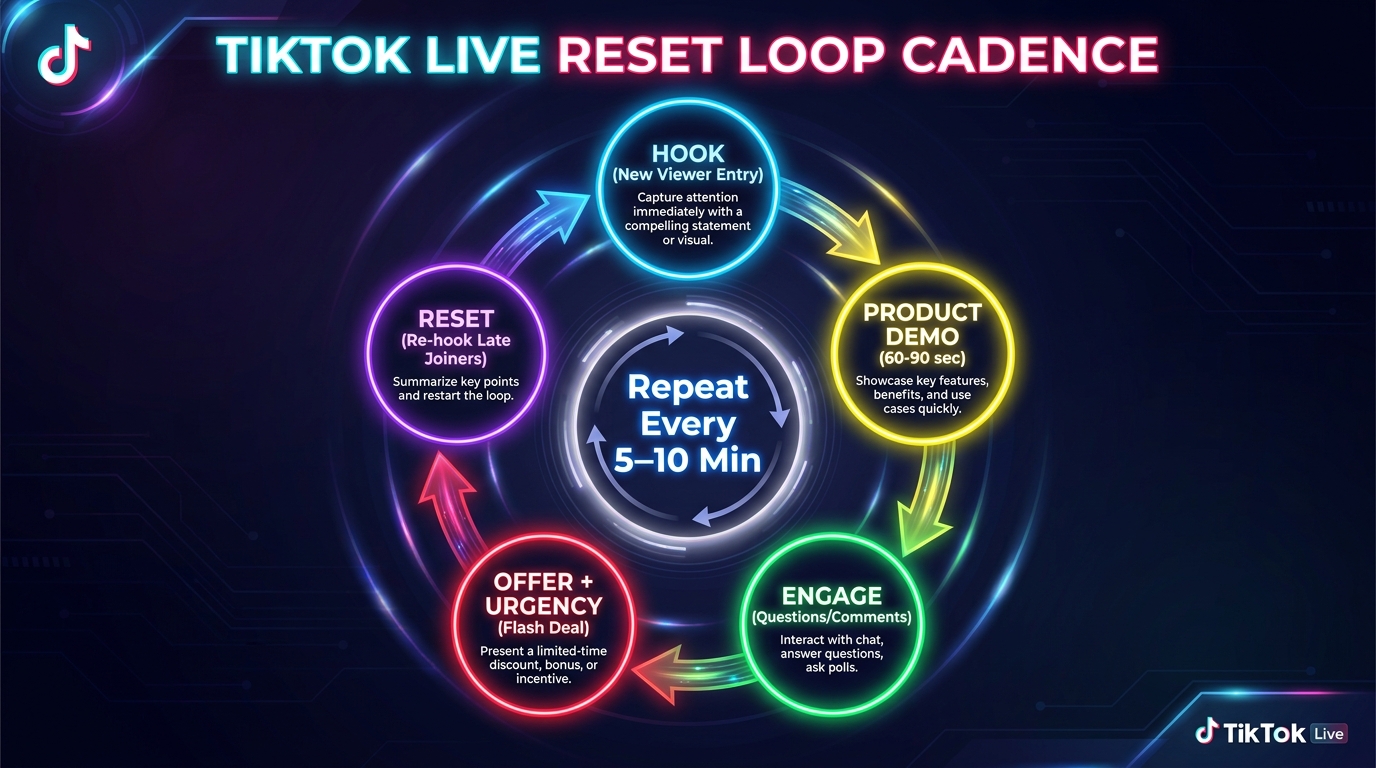
The single most important structural insight in TikTok Shop live selling is this: at any given moment during your live, a meaningful percentage of your viewers have been watching for less than two minutes. TikTok’s algorithm continuously surfaces your live stream to new users — people who have no context for what you’re selling, no awareness of the deal you already announced, and no relationship with the host yet. If your live stream is structured like a linear narrative with a beginning, middle, and end, those late-joining viewers will drop off within 30 seconds of arriving, because they can’t orient themselves.
The reset loop is the structural solution to this problem. Instead of a linear narrative, your live is engineered as a repeating cycle — a 5–10 minute loop that gives every new viewer a complete, orientation-to-offer sequence that makes sense whether you’ve been watching for 90 minutes or you just arrived.
Anatomy of One Reset Loop
Station 1: The Re-Entry Hook (30–60 seconds)
Every loop begins with a hook that works for a first-time viewer: a pattern interrupt, a surprising claim, a product demonstration from scratch, or a direct-camera statement of what’s happening (“We’re live and we’ve got something you haven’t seen before — stay for two minutes”). The hook should not assume any prior context. Avoid “as I was saying earlier…” or “back to what we were discussing…” — these phrases are death sentences for new viewer retention.
Station 2: Product Demo (60–90 seconds)
The demo is tight, visual, and focused on one product benefit at a time. Hold the product close to the camera. Show texture, size, function — whatever the listing image can’t communicate. Verbal demos work best when they’re structured around a concrete use case rather than abstract feature lists: “If you’re someone who [problem], this is exactly what you need because [solution].”
Station 3: Engagement Harvest (60–90 seconds)
Ask a direct, answerable question to the chat: “Drop a 1 in the comments if you’ve been struggling with [problem].” Or run a quick micro-poll: “Which color are you grabbing — black or white, tell me in the chat right now.” This segment serves multiple purposes: it generates engagement signals for the algorithm, it surfaces buyer intent (“I want this!”), and it maintains the conversational feel that distinguishes live from a recorded ad. Read comments aloud. Name-check viewers. Respond to questions directly.
Station 4: Offer + Urgency (60–90 seconds)
Re-state the current offer as if it’s the first time anyone in the room has heard it — because for the viewers who just joined, it is. Activate a specific urgency mechanism: a countdown (“this coupon expires in four minutes”), inventory visibility (“we’ve got 18 units left”), or a social proof trigger (“45 people have already grabbed this today”). This is the conversion moment of the loop — the call to action needs to be explicit, direct, and repeated: “Tap the shopping bag icon below, find this product, and check out right now.”
Station 5: Reset Signal (15–30 seconds)
Close the loop with a bridge to the next one: “Okay, amazing — we’ve got more coming. Stick around because in about three minutes we’re dropping something even better. Share this stream if you’ve got friends who need [product category].” This accomplishes three things: it retains viewers who just bought, it prompts organic sharing (a powerful distribution signal), and it teases the next loop to suppress drop-off.
The Micro-Script Framework: Per-Product Talk Tracks That Convert in Under 60 Seconds
Within each reset loop, the product demo segment runs on a tightly structured micro-script. The structure is simple: Hook → Problem → Product → Proof → Offer → Close. Here’s what each element means in practice, with example language that can be adapted to almost any product category.
Hook (5–10 seconds)
Start with a statement that stops a scrolling viewer in their tracks. Not “Hi everyone, welcome to our live!” — that’s context for people already watching. A real hook speaks directly to the problem the product solves: “If you’ve ever wasted $40 on a [product category] that did nothing, you need to see this.” Or a visual hook: hold the product up in a way that creates immediate visual curiosity before saying anything.
Problem (10–15 seconds)
Name the specific frustration your target buyer has experienced. Be concrete, not generic: “Most [product type] on the market right now do [specific problem thing] — they [specific failure mode] and you end up back at square one within three weeks.” The goal is active recognition — the viewer should be nodding, thinking “that’s exactly what happened to me.”
Product (20–30 seconds)
Introduce the product as the direct response to that problem. Demonstrate physically — don’t describe what it looks like, show it. If it’s a skincare product, apply it on camera. If it’s a kitchen tool, use it on the ingredient you have prepared. If it’s an apparel item, put it on. Visual demonstration is the differentiator that listing pages can’t replicate, and it’s the core reason live converts at 3–10x the rate of static content.
Proof (10–15 seconds)
Add a rapid social proof injection: a customer result (“we had someone in last week’s live who said [result]”), a review stat (“it’s got 4,800 reviews and the most common thing people say is [specific claim]”), or a quick on-screen testimonial clip if your production setup allows. Proof doesn’t need to be lengthy to be effective — one concrete, specific data point outperforms a paragraph of vague superlatives.
Offer (10–15 seconds)
State the offer clearly and completely: “Normally this is [anchor price]. In this stream right now, you’re getting [deal price] with [bundle/coupon/free gift detail]. That’s [value framing — e.g., ‘nearly half off’].” Do not rush this segment or treat it as obvious — viewers need to hear the full math, especially new arrivals.
Close (5–10 seconds)
Give a single, unambiguous call to action with a time parameter: “Tap the bag, grab this now — I’m only keeping this price live for the next five minutes and then it goes back up.” One instruction. One action. No optionality.
Scripting the Full Show: Opening, Peak, and Wind-Down Blocks
The micro-script governs individual product segments; the show script governs the overall arc of the live. A well-designed 60–90 minute live has a distinct emotional shape — it builds, peaks, and closes — and that shape affects both viewer retention and conversion performance across the session.
The Opening Block (Minutes 0–10): Seed and Warm Up
The first ten minutes of a TikTok live are the highest-stakes segment algorithmically. TikTok is actively deciding whether to push this stream to wider audiences based on early engagement signals: how quickly comments start flowing, how long early viewers stay, and whether product pin interactions are happening. This is not the time to ease in slowly — it’s the time to establish the show’s energy immediately.
Best practice for opening blocks: don’t sell anything in the first two to three minutes. Instead, use the opening to establish the host’s voice, create energy, and drive engagement with a question or interactive element that gets the chat moving. A simple “Where are you joining from?” or “Drop a YES if you’ve been to one of our lives before” gets comments flowing without asking for purchases, and those comments are the algorithmic signal that sets the distribution tone for the rest of the stream.
At roughly the three-minute mark, transition into the first product teaser — not a full demo, but a promise: “We’ve got something new today that you haven’t seen anywhere else — stick around for the next few minutes.” This creates anticipation and suppresses early drop-off. The first full product reveal and offer activation should happen around the seven-to-ten minute mark, when the room has warmed up and early engagement has seeded the algorithm.
The Escalation Block (Minutes 10–50): Building to Peak GMV
The middle portion of the live is the primary GMV engine. This is where the reset loop runs continuously, typically with product rotations every 10–15 minutes. Each new product should escalate from the previous one in some dimension — either higher value, stronger offer, or more visual interest — so the overall energy of the stream is climbing rather than plateauing.
The escalation block should contain at least two distinct “spike moments”: pre-planned urgency beats where a live-only coupon drops, a free gift offer activates, or the host deploys a flash deal with a short countdown. These spike moments are the highest-converting moments of the entire stream, and their timing should be deliberate — typically around the 20-minute and 40-minute marks, to capture viewers who arrived at the start and viewers who joined mid-stream.
The Wind-Down Block (Minutes 50–90): The Encore Offer
Elite live rooms don’t just trail off — they engineer a final conversion spike in the last 15–20 minutes. The encore offer is typically the best deal of the stream: either the deepest discount, the highest-value bundle, or a genuinely scarce last-chance moment (“we’ve got 12 units of the [premium product] left and we’re not bringing it back at this price”). This gives viewers who browsed throughout the stream a final reason to commit.
The wind-down block also serves a retention purpose: consistent viewers who stay through the encore are the brand’s most valuable live audience members. They should be acknowledged directly (“You’ve been here the whole time — thank you, and this one’s for you”). This acknowledgment reinforces parasocial loyalty and increases the likelihood they return for the next live.
Cadence and Timing: When to Go Live, How Often, and How Long
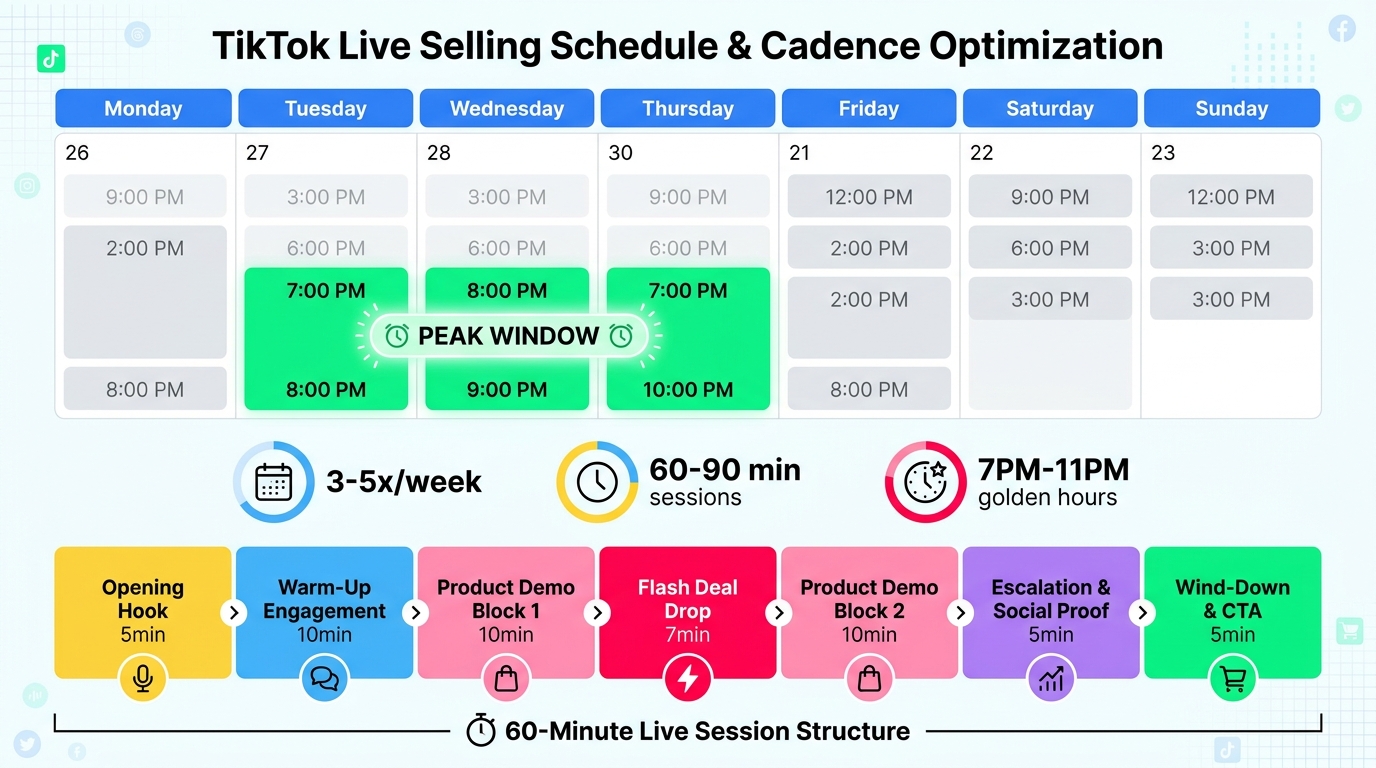
The cadence question — when and how often to go live — gets less strategic attention than scripting and offer design, but it compounds over time in ways that can be the difference between a live program that builds audience momentum and one that starts from zero every session.
Timing: The Golden Hours
Current data consistently points to evening windows as the highest-performing time slots for TikTok live commerce in Western markets: roughly 7 PM to 11 PM local time, with Tuesday through Thursday showing the most consistent engagement. This aligns with “lean-back” viewing behavior — people are at home, phones in hand, not in task mode. Morning windows (7–9 AM) and lunch windows (12–2 PM) show secondary engagement peaks, particularly for working-from-home audiences.
For US-based sellers, the timezone fragmentation of the audience matters. A live at 7 PM Eastern reaches East Coast evening viewers but hits West Coast during their workday. If your data shows significant West Coast audience, a 7 PM Pacific start — which is 10 PM Eastern — may capture a different, less competed-for peak. The right answer is always your own analytics, not a universal benchmark: TikTok Shop’s Seller Center shows audience geographic breakdown by session, and that data should drive your timing decisions after your first few test streams.
Frequency: How Many Lives Per Week
The research consensus for established live programs sits at 3–5 sessions per week. Below three sessions per week, it’s difficult to build audience familiarity and algorithmic momentum — TikTok’s live distribution rewards consistency, and an account that goes live daily will, over time, build a larger and more returning live audience than one that goes live sporadically. Beyond five to seven sessions per week, diminishing returns typically kick in: the audience pool for your specific niche has a ceiling, and over-saturation can flatten per-session performance.
For brands launching a live program from scratch, the practical starting cadence is two to three sessions per week for the first four to six weeks, focused on testing timing, offer structure, and script variations rather than maximizing GMV. The data gathered in those early sessions — specifically which offer types drive the highest spike moments, which products generate the most chat engagement, and which time slots build the fastest audiences — is more valuable than any initial GMV number.
Session Length: The 60–90 Minute Optimal Window
Session length is a balance between algorithmic rewarding of long watch times and the practical limits of viewer attention and production quality. TikTok’s algorithm rewards longer sessions through increased distribution over time — a 90-minute live generates more data signals than a 30-minute one, and the platform learns more about your audience. But a 90-minute live that runs out of energy at the 45-minute mark is worse than a crisp 60-minute live that maintains intensity throughout.
The practical optimum for most brands is 60–90 minutes, with a clear structural plan for every 10-minute block. Sessions shorter than 45 minutes rarely have time to build the algorithmic momentum that drives organic discovery mid-stream. Sessions longer than 2 hours require professional hosts with the endurance and skill to maintain energy throughout — valuable once a live program is mature, but a significant production challenge in early-stage builds.
Product Pin Strategy: The 8–15 Minute Rotation Rule
The product pin is the mechanic that connects your verbal offer to a purchasable item in TikTok Shop. When a product is pinned, it appears as a visible, tappable card at the bottom of the live screen — the direct path from watching to buying. Pin strategy is often treated as an afterthought (just leave your main product pinned), but it’s a meaningful conversion lever when managed deliberately.
The Rotation Logic
The optimal product pin rotation interval is 8–15 minutes, aligned with the reset loop cycle. Leaving a single product pinned for the entire live sends two negative signals: it removes novelty (viewers habituate to static pins and stop interacting with them), and it fails to serve viewers who arrived mid-stream and have no interest in the product currently pinned. Rotating the pin every 8–15 minutes keeps the product card fresh, signals to the algorithm that interactive shopping activity is happening, and aligns the visual product card with whatever the host is actively demonstrating.
Pre-Planning the Pin Sequence
The pin sequence should be mapped in the run-of-show document before the live begins, not managed reactively during the stream. A moderator or off-camera operator handling pin swaps frees the host to maintain conversational energy instead of navigating the Seller Center during the live. The sequence should follow the show’s escalation logic: anchor products early, escalate to higher-value or higher-margin items in the middle, and deploy the most compelling offer in the pin for the encore block.
Pin-Based CTAs: Verbal and Visual Sync
The pin performs best when the host’s verbal CTA is explicitly pin-referenced: “Look at the bottom of your screen — tap that product card right now, that’s where you grab this deal.” Many viewers watching TikTok live — particularly those who haven’t purchased through TikTok Shop before — don’t know that the product card is a direct purchase shortcut. Explicit verbal instruction, combined with the host physically gesturing toward the bottom of the screen (which maps to the pin location on viewer devices), dramatically increases pin click-through rates, particularly among first-time buyers.
What Kills Conversion: The Most Expensive Mistakes in Live Commerce
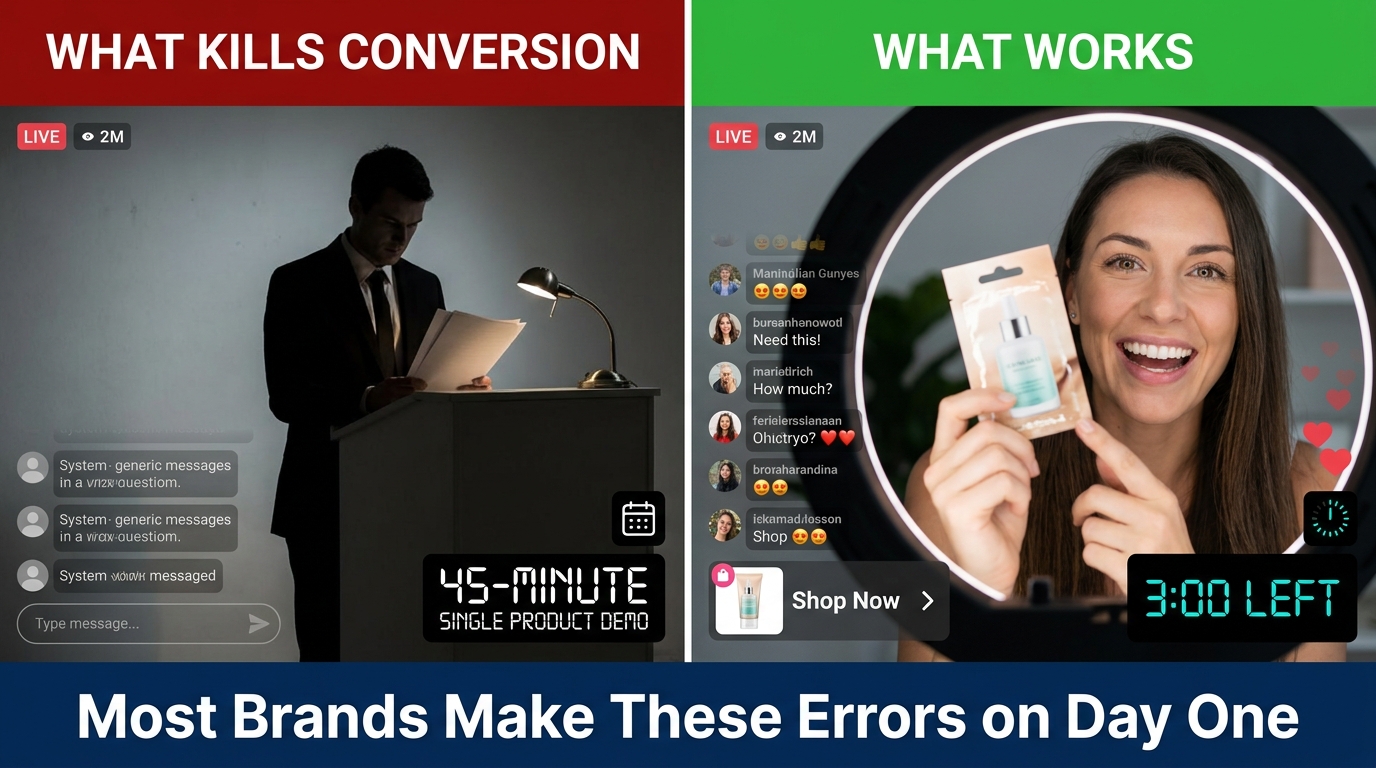
The most useful way to understand what works in live commerce is often to study what fails. The patterns of failure in TikTok Shop live are surprisingly consistent across brands and categories — and most of them stem from the same root cause: treating live like a format you already understand rather than one with its own specific logic.
The TV Shopping Mistake
The most common structural error is running a TikTok live like a QVC or HSN segment: a polished, scripted monologue delivered to a passive audience, with slow product build-ups and professional camera angles that prioritize production quality over personality. This feels like an ad. TikTok viewers — particularly Gen Z and Millennial audiences — are deeply calibrated to detect and reject ad-feel content, and they drop off almost instantly when a live stream triggers that filter.
The fix isn’t lower production quality — it’s a different kind of quality. Good audio matters (bad mic work is genuinely conversion-killing). Clean framing matters. But the energy, pacing, and interactivity of the host matter more than the visual production standard. A host in front of a simple backdrop who is genuinely engaging, reacting, and conversing will outperform a polished TV-style presenter on TikTok Live nearly every time.
Dead Cadence: The Single-Product, Full-Stream Format
Running a 60-minute live to sell one product, without rotation or structural variation, is a cadence mistake that consistently underperforms. Viewers who’ve seen the product once and not bought have revealed their answer — repeating the same pitch doesn’t change that answer. Product rotation, even if you’re primarily promoting a hero SKU, is what keeps retention high and gives late-joining viewers something new to respond to.
Fake Urgency
Urgency that isn’t real destroys trust faster than any other tactic. A “last chance” offer that reappears the following day, a “limited stock” claim on a product with unlimited availability, a countdown that resets — these are noticed. TikTok audiences share information in comments, in DMs, and in other creator rooms. The moment a viewer discovers that your urgency cues are manufactured, they don’t just stop trusting the offer — they share that discovery. Real urgency, even if it’s architecturally designed (a genuine limited coupon quantity, an actual end time), performs sustainably. Fake urgency performs once and then costs you audience.
Ignoring the Chat
A host who delivers a scripted pitch without interacting with the chat is wasting TikTok’s most powerful conversion tool. Comments are buying signals, objection flags, and engagement amplifiers simultaneously. A viewer who asks “does this work for [specific use case]?” is a high-intent buyer waiting for confirmation — addressing that question on camera converts the asker and every viewer with the same unvoiced question. Structured chat monitoring, either by the host directly (in lower-traffic rooms) or by a dedicated off-camera moderator (in higher-traffic rooms), is a non-negotiable component of any serious live program.
Launching Without Promotional Seeding
Going live without any pre-announced promotional seeding — no prior content driving awareness, no “we’re going live tonight at 8” posts — means starting every session from algorithmic zero. TikTok will distribute your live based on its early engagement signals, but those signals need to be seeded by initial viewers. Brands that pre-announce their live sessions via posted content in the 24–48 hours prior consistently see higher initial audience pools, faster algorithmic distribution, and stronger opening-block engagement. A simple short-form video or TikTok Story (where available) pointing to an upcoming live is the minimum promotional infrastructure for a recurring program.
Measuring What Matters: The KPIs That Reflect True Live Performance
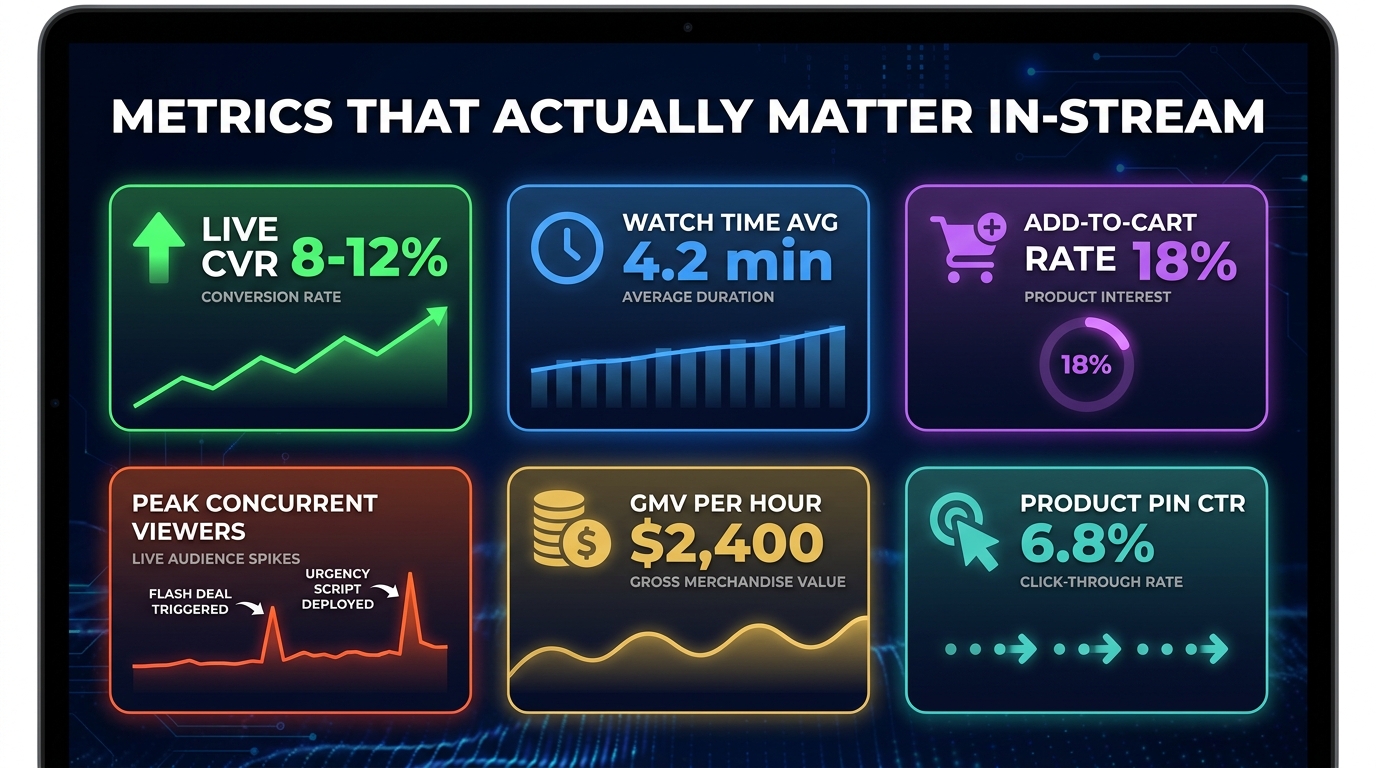
Live commerce generates a large volume of performance data, and the temptation is to optimize for the most visible number — GMV — without understanding the upstream metrics that drive it. Sustainable live program improvement requires a layered measurement framework that distinguishes between distribution metrics (how many people did TikTok show this to?), engagement metrics (how did they behave?), and conversion metrics (how many bought, and at what value?).
Distribution Metrics: Reach and Exposure
Peak Concurrent Viewers (PCV) is the most important distribution metric — it reflects the maximum number of simultaneous viewers in your room at any point, which is a proxy for how hard the algorithm is pushing your content. Tracking PCV over time and correlating it with in-stream events (which segments caused the peak, which caused drops) tells you exactly where your content is working algorithmically.
Total Viewers (cumulative unique viewers over the session) versus PCV tells you about audience retention: a high total viewer count with a low PCV suggests that TikTok is delivering traffic that drops off quickly (a structural issue — usually the hook or early engagement), while high PCV relative to total viewers suggests strong retention of a smaller initial seed audience.
Engagement Metrics: Quality Signals
Average Watch Duration is the engagement metric most directly correlated with algorithmic amplification. TikTok prioritizes distributing live content from rooms where viewers stay. An average watch duration under 2 minutes typically indicates early hook failures or cadence problems. A watch duration of 4–6 minutes is benchmark for a well-structured live; above 7 minutes indicates strong host-audience connection and content quality.
Comments per Viewer and Product Pin Click-Through Rate (CTR) are the two engagement metrics most directly connected to conversion potential. High comment volume per viewer signals a genuinely interactive room — which is both an algorithmic positive and a conversion precursor. Product pin CTR (the percentage of viewers who tap the pinned product card) is the most direct signal that your verbal CTAs and pin strategy are working; benchmark CTR for well-run rooms sits around 5–8%.
Conversion Metrics: The Bottom Line
Live Session Conversion Rate (purchases divided by unique viewers) is the primary metric for overall live health. Tracking this per session and per product gives you both a macro view of show performance and a granular view of product-level conversion, which informs future offer design and product rotation sequencing.
Average Order Value (AOV) per live session reveals whether your bundle and layering strategies are working. A rising AOV trend over multiple sessions, without a corresponding drop in conversion rate, is the best possible signal: your buyers are both converting at the same rate and spending more per transaction.
GMV per Hour is the operational efficiency metric that matters for scaling decisions: it tells you the revenue output of each hour of live production and informs decisions about session length, staffing, and production investment. A live program generating $500 GMV per hour has a very different scaling calculus than one generating $3,000 per hour.
Building a Repeatable Live Machine: The Compound Effect of Consistency
Individual live sessions, no matter how well-executed, are less valuable than a live program — a consistent, recurring show that builds audience familiarity, algorithmic momentum, and operational efficiency over time. The difference between brands that do well in a single live and brands that build genuine live commerce businesses comes down to whether they’ve built a machine or just run an event.
The Run-of-Show Document
Every live should be planned with a run-of-show (ROS) document: a timestamped outline of what happens when. The ROS doesn’t script every word (that would produce stiff, ad-feel content), but it maps: which products are being shown in which order, which offer layers activate at which timestamps, when each live-only coupon drops, when the flash deal moment hits, and what the escalation and encore offer are. With a well-prepared ROS, a host can maintain conversational spontaneity while never losing the structural shape of the show.
Post-Live Review Cadence
The highest-return investment in a live program isn’t production equipment or script refinement — it’s a structured post-live review. After every session, the data from TikTok Shop’s analytics dashboard should be reviewed against the ROS to identify: where viewer drop-off spiked, which product demos generated the most pin CTR, which urgency moments produced the clearest GMV spikes, and which offer layers had the highest attachment rates. This review, repeated consistently, compounds into an increasingly optimized show design that improves measurably over months.
The Audience Momentum Flywheel
Perhaps the most undervalued asset of a consistent live program is the repeat viewer base it builds over time. TikTok notifies users when accounts they follow go live, and viewers who have watched and bought from a live before are significantly more likely to return, watch longer, and convert again. A brand running three lives per week and doing post-live review consistently will typically see a step-change in performance somewhere in weeks six through twelve, as returning viewer rates climb and the algorithmic distribution machine learns the account’s content quality well enough to push it to broader audiences.
This compounding effect is why frequency and consistency outperform peak individual session quality in the long run. A brand that runs three well-structured, medium-production lives per week will outperform a brand that runs one highly produced live per month — because the live commerce channel rewards the same things the broader TikTok algorithm rewards: consistency, engagement quality, and improvement over time.
Conclusion: The System Behind the Stream
TikTok Shop live commerce at scale isn’t about energy or personality alone. It’s an engineered system — and understanding the architecture of that system is what separates brands generating real GMV from those treating live as an experiment they gave up on after two sessions.
The core architecture is this: an offer stack that layers value at multiple price points and AOV thresholds, built on psychological foundations that make urgency and scarcity feel real rather than manufactured. A reset loop structure that serves new viewers and returning viewers simultaneously, aligned to the algorithmic signals TikTok uses to distribute live content. Micro-scripts that compress each product pitch to under 60 seconds without sacrificing depth or persuasion. A full-show arc that builds, peaks, and closes deliberately. A cadence and timing strategy that builds audience momentum rather than starting from scratch each session. And a measurement framework that turns every live into a learning event, compounding performance over weeks and months.
None of this requires a Hollywood production budget. It requires preparation, structural discipline, and an honest post-show review process. The brands getting the highest live GMV per dollar of production cost aren’t the ones with the most expensive equipment — they’re the ones who understand that live commerce is a system, and they’ve built theirs deliberately.
Actionable Takeaways
• Design your offer as a stack with at least three layers (base discount, bundle, live-only coupon) before going live — not as a single percentage-off
• Build your show structure around a repeating 5–10 minute reset loop, not a linear narrative
• Script product segments to the Hook → Problem → Product → Proof → Offer → Close framework and time them under 60 seconds
• Rotate product pins every 8–15 minutes and give explicit verbal instructions on how to tap and purchase
• Run 60–90 minute sessions at 3–5x per week during your audience’s peak hours (typically 7–11 PM local)
• Review TikTok Shop analytics after every session and compare against your run-of-show to identify the specific moments that drove or killed GMV
• Pre-seed every live with promotional content in the 24–48 hours prior to drive initial audience and algorithmic signal