


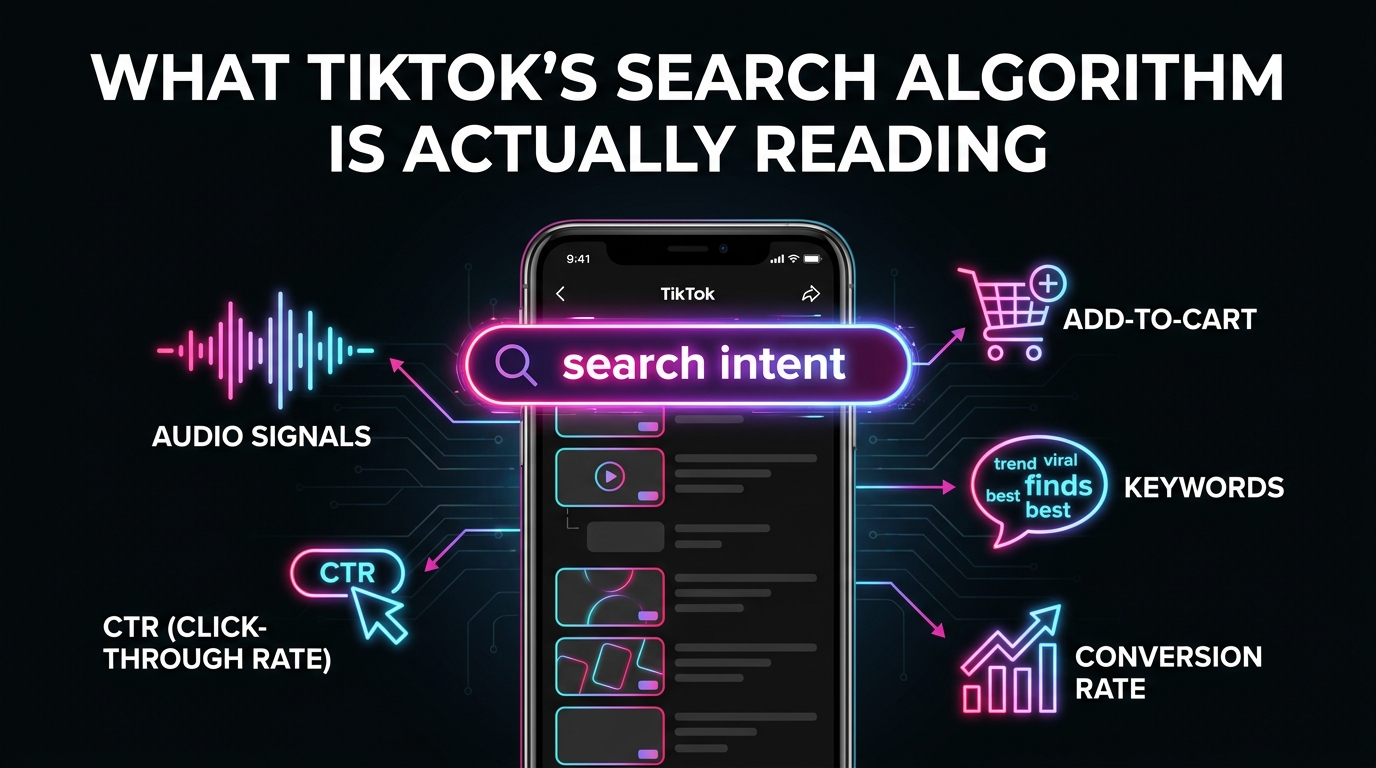

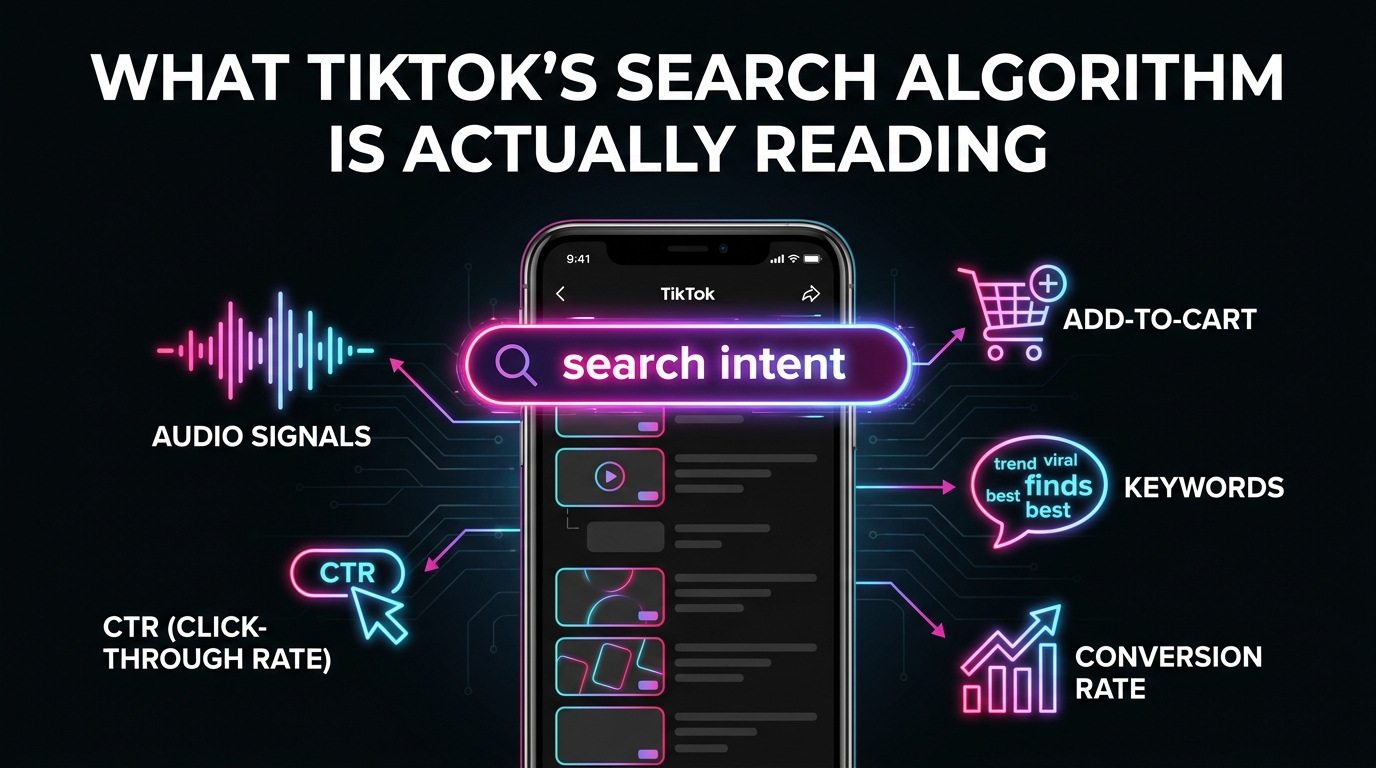
TikTok’s search volume is up 174% year over year. About 23% of all TikTok sessions now include a search interaction. And 67% of Gen Z users report using TikTok as a search engine. These numbers tell one story clearly: TikTok is no longer a discovery-only platform where the algorithm decides what you see. Increasingly, users are arriving with intent. They are typing queries. They are searching for answers, products, demonstrations, and comparisons — and then they are buying.
The problem most TikTok Shop sellers have is that they are still optimizing for a version of the algorithm that no longer exists. They are treating TikTok like a content virality machine, hoping a trending sound or a fast hook pushes their product into enough feeds. Meanwhile, a smaller group of sellers has figured out something different: TikTok has built a parallel ranking system underneath the For You Page, one that operates explicitly on search intent signals — and it rewards product listings and content that satisfy those signals, not the ones that entertain.
This post is specifically about that system. Not the basics of TikTok SEO (keywords in your title, hashtags in your caption — that ground has been covered). This is about what TikTok’s search algorithm is actually reading when it decides which product ranks first for a given query: the behavioral signals it weighs, the multimodal content it indexes, how it classifies query intent types, and where the real conversion math lives for sellers who understand the difference between head terms and long-tail intent.
If you have been doing TikTok Shop SEO and wondering why your keyword-stuffed titles are not moving the needle, the answer is almost certainly in what follows.
Why Search Intent on TikTok Doesn’t Work Like Google (or Amazon)
The instinct, when thinking about TikTok search, is to import frameworks from Google or Amazon. Both platforms have mature, well-documented search systems. Google ranks web pages by authority, relevance, and user satisfaction signals. Amazon ranks product listings primarily by sales velocity, keyword relevance, and customer satisfaction metrics. TikTok does neither of these things — and misapplying either framework is the root cause of most failed TikTok Shop search optimization efforts.
The Discovery-to-Decision Architecture
On Google, the search journey is almost always intent-first. The user knows they want something, they type it, and the engine matches them with the best result. On TikTok, the more common pattern runs in the opposite direction: discovery first, decision second. A user scrolls their For You Page, encounters a product being demonstrated, gets curious, and then — crucially — opens the search tab to verify, compare, or find that product again. The search query that follows is downstream of an emotional or visual trigger, not upstream of it.
This means the intent signals TikTok’s search algorithm is designed to read are fundamentally different from Google’s. They are less about matching an explicit declared need and more about recognizing the behavioral footprint of a user who has moved from passive browsing into active consideration. TikTok describes its search surface as an “intent layer” that sits on top of discovery — the moment a user transitions from watching to researching.
How TikTok Search Differs from Amazon Search
Amazon’s A9/A10 algorithm is built around purchase probability. It weights keywords, price competitiveness, review count, and above all, sales velocity. A product that sells consistently for a given keyword will rank above a product that is optimally keyworded but converts poorly. The ranking signal is clear and commercial.
TikTok’s search ranking shares some of that commercial orientation — conversion rate matters — but the platform layers in a set of engagement and content-quality signals that Amazon’s algorithm does not have access to. TikTok can watch a user watch a video about a product, see them pause, rewatch a specific five-second segment, tap through to the listing, add to cart, then abandon. Each of those behaviors is a signal. Amazon can only see what happens after someone lands on a product page. TikTok sees the entire pre-purchase behavior chain, and that data shapes its search rankings in real time.
The Social Proof Dimension
There is a third difference that rarely gets discussed: social proof as a ranking input. On TikTok, the visible engagement on a product video — comment counts, share counts, the presence of user-generated follow-up content — is not just a trust signal for the buyer. It is a signal to the algorithm that the product is satisfying a genuine user need. A product with 4,000 comments asking “where can I get this?” is demonstrating intent saturation that neither Google nor Amazon can measure in the same way. TikTok’s search system reads that community engagement as evidence of unmet demand, and it adjusts rankings accordingly.
The Five Signal Buckets TikTok’s Search Algorithm Actually Weighs
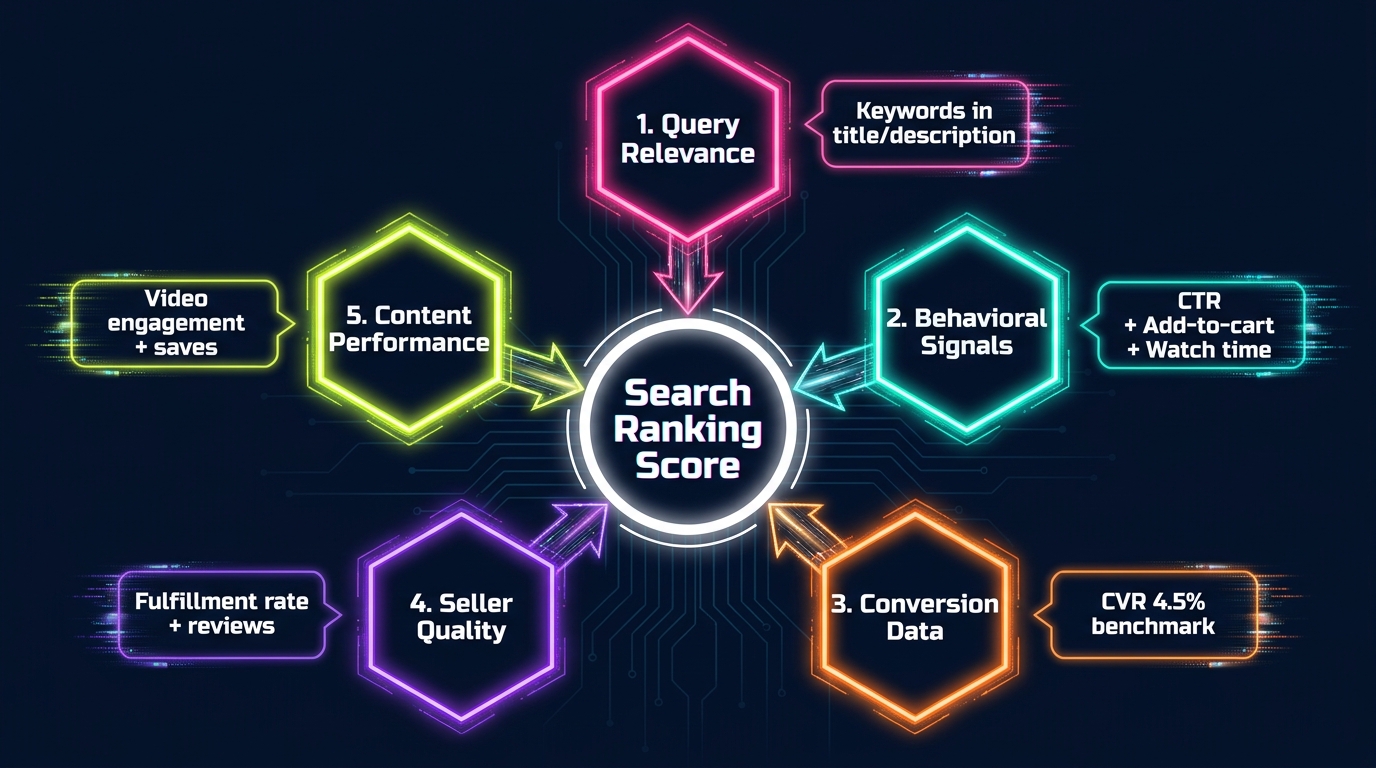
TikTok does not publish a ranking specification document. But the combination of seller guidance from TikTok’s own educational resources, analysis from TikTok-focused agencies, and reverse-engineering by practitioners has produced a working model of the signal categories the algorithm weighs. These five buckets appear consistently across credible sources and align with what sellers report when they test ranking changes systematically.
Bucket 1: Query-to-Listing Relevance
This is the most surface-level signal and the one sellers typically address first — and often exclusively. TikTok matches user search queries against the text content of product listings: primarily the title, then the description, then attributes and tags. Exact keyword matches carry weight, but the system has moved meaningfully toward semantic matching, meaning it can identify that a listing for “water-resistant running jacket” is relevant to a query for “gym jacket that keeps you dry,” even without an exact phrase overlap.
Within the title, word order matters. Keywords placed in the first 20 characters of a product title carry more indexing weight than the same keywords placed at the end of a 60-character title. This mirrors behavior in Amazon’s algorithm and reflects how truncated titles display in search results — the beginning is what users see.
Bucket 2: Behavioral Intent Signals
This bucket is where TikTok’s search ranking diverges most sharply from traditional SEO. TikTok tracks a dense set of post-click and post-view behaviors: click-through rate from search results, dwell time on product pages, video watch completion rates for content associated with a listing, saves, shares, rewatches of specific segments, and add-to-cart actions. The algorithm interprets these behaviors as real-time evidence of whether a listing is genuinely satisfying the intent behind a given query.
A listing with a 3% CTR from search results but an 18% add-to-cart rate is telling the algorithm something specific: users who click are highly motivated. That signal can outweigh a listing with a 9% CTR but a 2% add-to-cart rate, because the latter suggests the listing title is attracting curiosity-driven clicks that do not convert to genuine consideration.
Bucket 3: Conversion and Commerce Data
Once a user reaches the purchase decision stage, TikTok tracks conversion rate (completed purchases divided by unique product page views), units sold per day, gross merchandise value associated with specific search-driven traffic, and return/refund rates. Strong conversion rates for a particular query confirm to the algorithm that the listing is not just attracting the right clicks — it is closing them. Return rates are a negative signal: high return volumes suggest the product is not delivering what the listing promised, and TikTok penalizes this because it degrades the user experience of its commerce ecosystem.
Bucket 4: Seller and Shop Quality
TikTok assigns quality scores to shops based on fulfillment performance, review velocity, review ratings, and policy compliance. These scores act as a ranking modifier that amplifies or suppresses the effectiveness of a listing’s other signals. A product with excellent keywords and strong conversion signals will still struggle to rank if it sits inside a shop with a 3.1-star average rating, a 12% late dispatch rate, and three policy warnings. Seller quality functions like a domain authority equivalent — it sets a ceiling on how high any individual listing can climb.
Bucket 5: Content and Creator Performance
Unlike Amazon, TikTok’s search ranking explicitly incorporates the performance of video content associated with a product. When creators — whether the brand’s own account or affiliate creators — publish videos that are tagged to a product listing, the engagement data from those videos (views, watch time, saves, shares, comment sentiment) feeds back into the listing’s search ranking. A product with five high-performing creator videos tagged to it will typically outrank an equivalent product with none, even if the core listing metadata is identical. This is TikTok’s social commerce architecture making itself visible in the ranking system.
Behavioral Intent Signals — What Happens After the Click Matters More Than the Click
Of the five signal buckets, behavioral intent signals are the least understood and the most consequential for sellers who want to improve their search rankings in the medium term. Most sellers focus on keywords because keywords are editable. Behavioral signals feel more mysterious — they emerge from how real users interact with your listing, which feels less controllable. But that perception is wrong. Behavioral signals can be shaped, and understanding how they work changes the entire approach to listing construction and creative strategy.
The Watch-Time Signal and What It Reveals
TikTok’s algorithm treats watch time on product videos as one of its most informative signals. When a user finds a product video through search and watches 80% or more of it before proceeding to the listing, that behavior tells the algorithm the content is genuinely resolving the user’s query. When users consistently drop off at the two-second mark, the algorithm reads that as a mismatch — the thumbnail or hook promised something the content did not deliver.
For sellers, this creates a clear instruction: the hook of your product video needs to directly address the search query that is sending users to it. If users are finding your vitamin C serum by searching “vitamin C serum for dark spots,” your video’s first three seconds should speak to dark spots specifically. Not skincare generally. Not “my skin routine.” The specific problem the search query reveals. When the hook matches the query intent, watch time goes up. When watch time goes up, search ranking improves.
Add-to-Cart as a Positive Ranking Signal
Add-to-cart behavior is treated as a strong purchase-intent confirmation. TikTok can distinguish between a user who clicks a product and immediately leaves versus one who scrolls the listing, views images, reads reviews, and adds to cart even if they do not ultimately purchase. That deliberate, multi-touch engagement pattern is read as genuine consideration, and it boosts the listing’s relevance score for the query that drove the visit.
The practical implication is that listings which generate strong “browse depth” — users who spend time with them rather than bouncing — rank better over time. This puts a premium on product listings that answer the user’s questions within the listing itself: clear sizing information, multiple product images, honest and thorough descriptions, and a visible review count. The listing needs to be worth staying on.
The Rewatch Signal: TikTok’s Most Underrated Metric
TikTok can detect when a user rewinds and watches a specific segment of a video again. This rewatch behavior is an exceptionally strong intent signal because it indicates the user encountered information they found compelling enough to revisit — typically a specific product claim, a before-and-after visual, a price point, or a demonstration of functionality. Videos that accumulate high rewatch rates on particular segments tell the algorithm that those segments are satisfying information needs that users care about.
For sellers building creator briefs, this is actionable intelligence. Structuring product videos so that the most specific, verifiable product claim appears at a predictable moment — and ensuring creators present it in a way that invites rewatching (holding up the product label, zooming into a result, showing a side-by-side comparison) — is one of the underused techniques for building behavioral signal strength.
Negative Signals and the Return Rate Problem
Just as positive behaviors boost ranking, negative behaviors suppress it. High return rates signal a mismatch between what the listing promised and what the product delivered. High bounce rates from product pages (users who click through from search and immediately exit) signal that the listing did not satisfy the query. Unfulfilled orders and poor review scores feed back into the seller quality score that modifies every ranking signal the listing generates.
Sellers who inflate their search position through Search Ads without addressing underlying listing quality often find themselves in a trap: the ads drive clicks, the poor listing experience drives bounces and returns, and the behavioral signal data that comes back from those interactions is actively working against organic search ranking. Paid spend and organic ranking need to be managed as a system, not in isolation.
Multimodal Indexing — How TikTok Reads Audio, Captions, and On-Screen Text
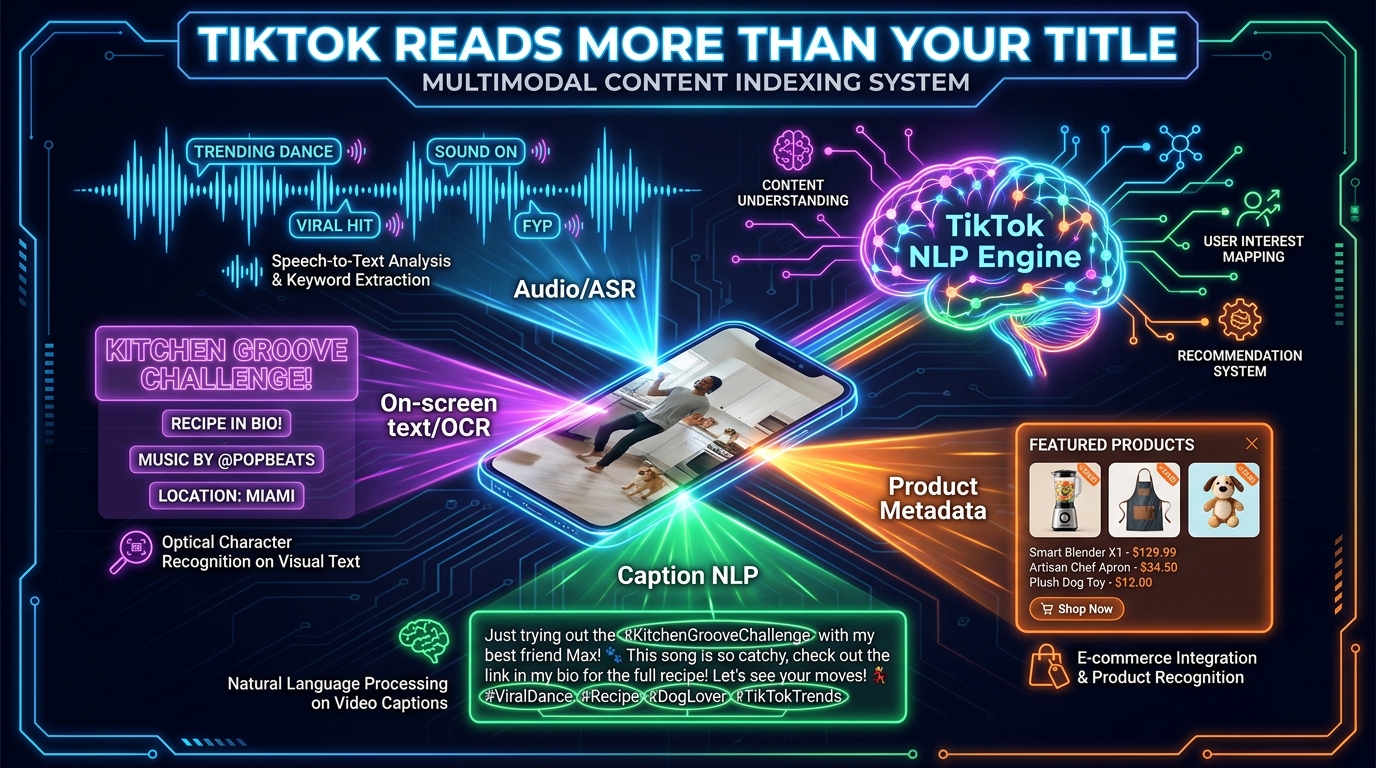
Here is something that most TikTok Shop sellers have not fully absorbed: TikTok’s search ranking system indexes far more than the text fields in your product listing. The platform deploys automatic speech recognition (ASR) to transcribe spoken audio in videos, optical character recognition (OCR) to read text overlays and on-screen graphics, and natural language processing (NLP) to extract semantic meaning from captions and descriptions. All of these are live inputs into the relevance scoring for a product’s search ranking.
This is not hypothetical. TikTok has built its content understanding infrastructure at a scale that makes multimodal indexing a core architectural feature rather than an experimental capability. The same technology that allows TikTok to surface a video about “acne-safe foundations” in response to a search for “foundation for acne-prone skin” — without those exact words appearing in the caption — is the technology powering search ranking for products in TikTok Shop.
Audio Signals: What Your Creator Says Matters as Much as What the Listing Says
When an affiliate creator records a video for your product and says “this is perfect if you have dry, flaky skin in winter,” TikTok’s ASR system transcribes that audio, extracts the semantic content, and associates it with the linked product listing. Your product is now indexing for queries like “skincare for winter dry skin,” “flaky skin routine,” and “dry skin product winter” — even if none of those phrases appear in your product title or description.
This creates a significant opportunity for sellers who think carefully about creator briefs. Rather than giving creators loose creative direction, the most effective approach is to brief them with specific problem-solution language that you want indexed: the exact phrases your target customers use when they describe their problem, the use-case scenarios where the product is relevant, and the comparison language that comes up when buyers are evaluating alternatives. Creators who speak naturally using that language are, in effect, expanding your keyword index through audio.
On-Screen Text and OCR Indexing
On-screen text overlays in TikTok videos — the animated text captions that creators add to annotate their content — are read by TikTok’s OCR system and treated as additional indexable content. A creator who adds text overlays reading “Before: constant breakouts / After: clearest skin in years” is generating OCR-readable content that maps to search queries around skincare results, acne, and breakout treatments.
Sellers who provide creators with suggested on-screen text elements — specific callouts, feature highlights, before-and-after labels — are deliberately seeding OCR signals. This is a lightweight optimization that most brands skip because they think of on-screen text as a creative choice rather than a technical one. It is both.
Caption and Description NLP
TikTok’s NLP processing of written captions and product descriptions goes beyond keyword detection. The system can identify semantic clusters — groups of words and phrases that belong to the same topic domain — and uses them to build a relevance map for the content. A product description that reads naturally and thoroughly explains the product’s benefits, use cases, and target customer is generating richer semantic signal than one that lists keywords in awkward, disconnected sentences.
This has an important implication for listing copy strategy: writing for humans and writing for the algorithm are the same task on TikTok. Dense, natural-language descriptions that address user questions directly — “Who is this for? What problem does it solve? How do you use it? What results should you expect?” — produce better NLP signals than manually keyword-stuffed copy, and they also convert better when users read them. The two optimization goals converge.
Query Types and How to Map Your Products to the Right Intent Tier
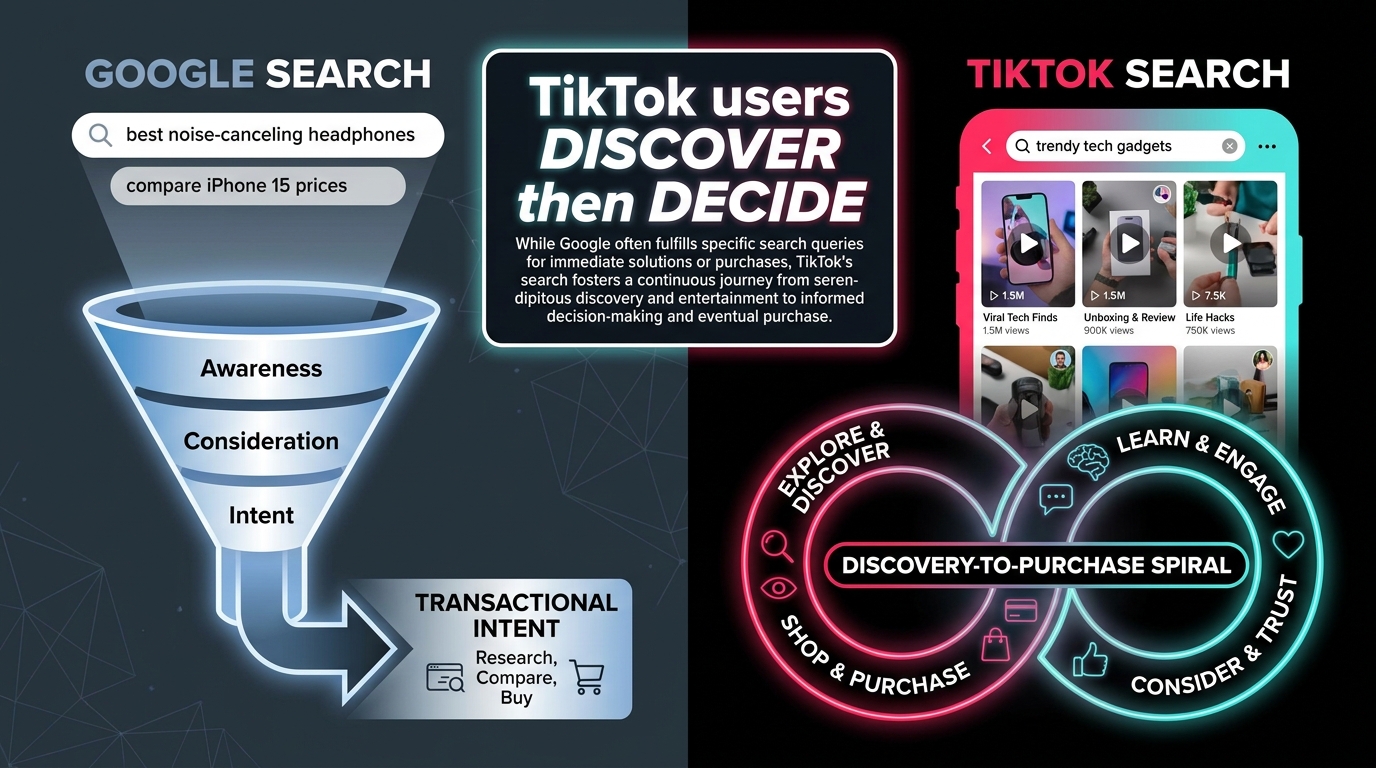
Not all searches on TikTok are equal. The platform’s search queries can be mapped onto a spectrum of intent types, and understanding where your product fits on that spectrum — and which query types drive the most conversion for your specific category — is a prerequisite for targeted search optimization. Treating all queries the same produces mediocre results across all of them.
Informational Queries: The Top-of-Funnel Entry Point
Informational queries are the most common type of TikTok search: “how to get rid of dark circles,” “best way to clean white sneakers,” “why does my hair get frizzy in humidity.” Users asking these questions are not necessarily in buying mode yet. They are in problem-awareness or solution-exploration mode. The intent is to learn, not to purchase.
Products that compete effectively for informational queries need associated content — videos, creator content, or brand-created educational material — that genuinely answers the question. A brand selling an eye cream should have creator videos that explain the causes of dark circles and position the product as a relevant solution, not just a “try this product” pitch. Informational query optimization is a content investment that builds awareness and warms audiences toward eventual purchase.
The conversion path from informational queries is longer, but it seeds the behavioral signal data (watches, saves, profile visits, return visits) that eventually feeds into the purchase intent signals TikTok tracks. Informational content that performs well builds a reservoir of engaged, warm prospects.
Commercial Investigation Queries: The Critical Middle Tier
This is the most commercially valuable and underserved query tier on TikTok. Commercial investigation queries look like: “best vitamin C serum under $30,” “is X brand or Y brand better for oily skin,” “honest review of [product name],” “does [product category] actually work.” Users at this stage have moved from problem-awareness to solution comparison. They know what type of product they want; they are deciding which specific one to buy.
TikTok’s search system treats commercial investigation queries as high-intent surfaces and routes conversion-optimized content toward them. For sellers, ranking for these queries requires two things working simultaneously: product listing optimization that positions your product clearly in the relevant comparison category, and creator content that directly addresses the comparison questions these users are asking. A well-optimized product page with five creator “honest review” videos attached to it will dramatically outrank a product with better keywords but no associated review content.
Transactional Queries: The Ready-to-Buy Signal
Transactional queries are the clearest purchase signal TikTok search generates: “buy [product name],” “[product name] TikTok Shop,” “[product name] discount code,” “where to get [trending product].” Users making these searches have already made or nearly made their purchase decision. They are looking for the specific product and the mechanism to buy it.
Competition for transactional queries on TikTok is fierce because every seller who knows what they are doing is targeting these terms. The differentiation comes at the listing level: which product has better reviews, more compelling images, a more compelling price point, faster shipping, and a stronger overall listing experience. The ranking signals for transactional queries weight conversion data most heavily — because the algorithm knows that users searching these terms are ready to buy and is trying to route them to the listing most likely to successfully complete a transaction.
Post-Purchase Queries: An Overlooked Opportunity
There is a fourth query type that rarely appears in TikTok Shop SEO guides: post-purchase search. Queries like “how to use [product],” “does [product] work for [specific concern],” and “[product name] before and after” are made by users who either own the product already or have seen it and want social proof before buying. These queries are growing as TikTok becomes the primary platform for product education and community-driven decision-making.
Brands that publish how-to content, results demonstrations, and use-case guides for their products are capturing these queries and building the behavioral signal data (high watch time, saves, shares, comments) that improves ranking across all query tiers. Post-purchase search optimization is underrated because the direct revenue attribution is harder to see — but the ranking benefits flow back into commercial and transactional query positions.
Long-Tail vs. Head Terms — Where the Conversion Math Actually Lives
The distinction between head terms and long-tail terms on TikTok Shop is consequential in ways that are different from how it plays out on Google or Amazon. On those platforms, the long-tail advantage is primarily about lower competition and more affordable cost-per-click. On TikTok, the long-tail advantage is structural: it is about intent matching.
Head Terms: High Volume, Low Precision
A head term search like “face moisturizer” generates enormous volume on TikTok. Tens of thousands of users search it every day. But the intent behind that query is wildly varied: some users want moisturizer for oily skin, some for dry skin, some for anti-aging, some for acne, some for men’s skincare, some for budget options, some for luxury options. The query tells the algorithm almost nothing about what the user actually needs.
Products that rank for head terms on TikTok face two problems. First, they are competing with every seller in the category, including established brands with strong seller quality scores and thousands of reviews. Second, even if they rank well, the variety of intent behind the query means that many of the resulting clicks will bounce — users who wanted something specific find a generic product that does not match their specific need. That bounce behavior is a negative ranking signal that accumulates over time, gradually suppressing the listing’s position.
Long-Tail Terms: Lower Volume, Higher Intent Alignment
A long-tail query like “moisturizer for combination skin that doesn’t pill under makeup” is a different proposition entirely. The user has already done their thinking. They know their skin type, they have a specific use-case concern (pilling under makeup), and they are looking for something that satisfies both. The conversion rate for this query is dramatically higher because the user arriving on a listing that matches this description does not need to be convinced — they need to be confirmed.
Industry data from across e-commerce channels consistently shows that long-tail queries represent over 75% of total search volume in mature search environments, and they convert at rates significantly higher than head terms. TikTok’s search environment is still maturing, but the directional pattern holds. Sellers who identify specific, use-case-driven long-tail queries their products genuinely satisfy — and build their listings, descriptions, and creator briefs around those queries — accumulate better behavioral signals faster than those competing on volume.
The 60-Day Long-Tail Test
A practical approach that advanced TikTok sellers use is the 60-day long-tail validation cycle. The process starts in TikTok’s Keyword Planner (available in Ads Manager): identify 15 to 20 long-tail queries in your product category with meaningful but not dominant search volume. Optimize your listing title and description around two to three of the most specific ones. Brief two to three creators to make videos that speak directly to the use case those queries describe. Run low-budget Search Ads against those queries for 30 days to accelerate behavioral signal generation. After 30 days, audit which queries are generating strong CTR and add-to-cart rates. Reallocate creator brief budgets toward the best-performing query themes and double down for another 30 days.
This cycle is not a shortcut — it takes consistent investment. But it produces a compounding effect: the behavioral signals from successful long-tail queries raise the listing’s overall quality score, which eventually improves performance on broader mid-tail and head terms as well.
Keyword Placement Architecture — Where Your Words Need to Be
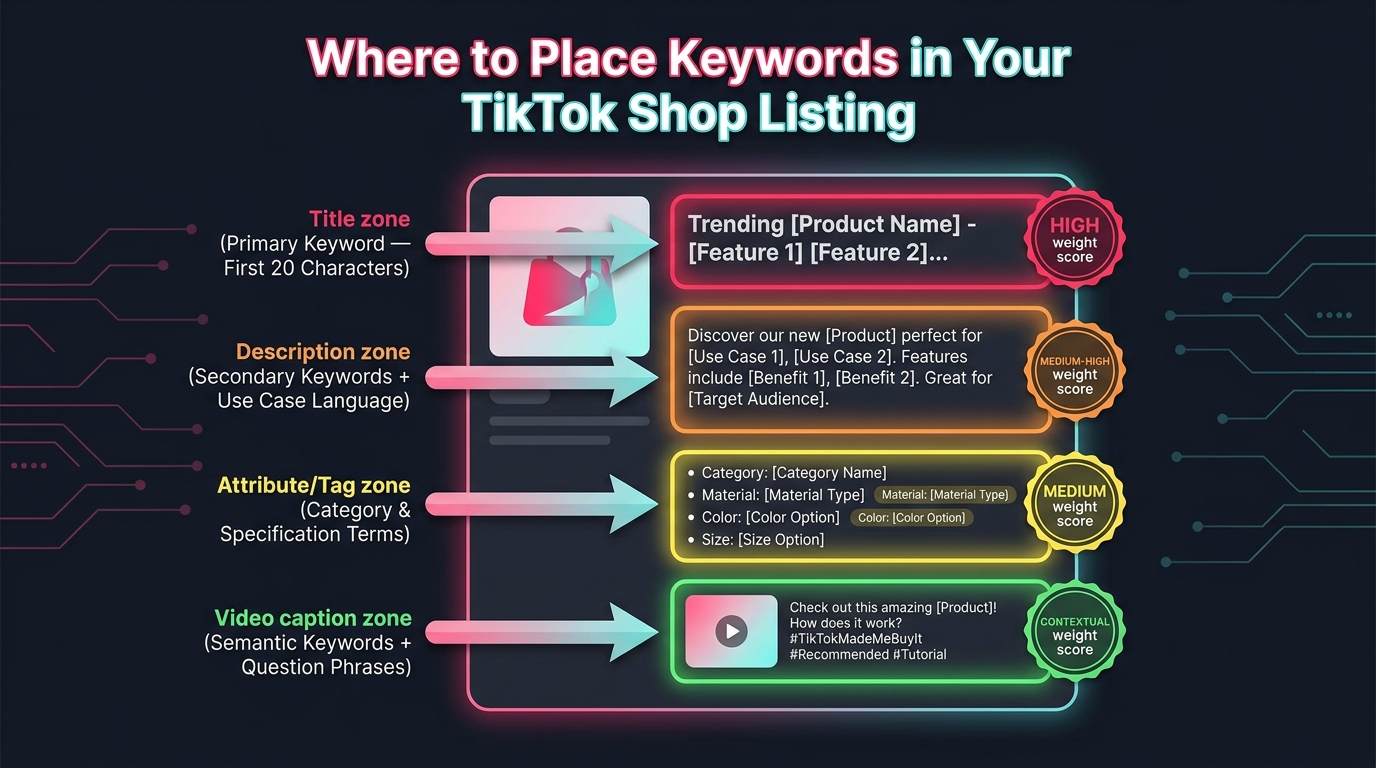
The question of where to place keywords in a TikTok Shop listing is not complicated, but most sellers get the priority order wrong. They invest more energy in description length than title precision, or they focus on hashtags while leaving the attribute fields empty. The architecture matters because different fields carry different indexing weights, and the algorithm applies those weights asymmetrically.
Title: The Highest-Weight Field
Your product title is the primary text field the search algorithm indexes. It should lead with your primary keyword within the first 20 characters. The title should be readable, not a keyword dump — TikTok’s NLP processing can identify keyword-stuffing patterns and does not reward them. A clean, descriptive title that places the most important search term at the front outperforms an exhaustive keyword string that reads like a list.
A practical title structure: [Primary keyword] + [Key differentiator] + [Secondary keyword or use case] + [Brand or variant if relevant]. For example: “Vitamin C Brightening Serum — Dark Spot Correction for Oily Skin” performs better than “Vitamin C Serum Brightening Anti-aging Dark Spots Skin Care Face Serum Best.” The first version is indexable and readable; the second is stuffed and penalized by semantic coherence checks.
Description: NLP Territory
The description field should be treated as an NLP optimization surface, not a keyword insertion slot. Write it in clear, problem-solution-oriented prose that naturally incorporates secondary and semantic keywords. Lead with the most important information (what the product is and who it is for), follow with how it works, and close with what results to expect. Address the questions your target customer is likely to be asking when they search for a product like yours.
Descriptions that read like genuine product education — addressing real concerns, using natural language, providing specific and verifiable product details — generate better NLP relevance signals and also convert better when users read them. The algorithm rewards the same copy that serves the buyer.
Attributes and Tags: Category Precision
Product attributes — the structured data fields for specifications like material, size, color, skin type compatibility, age range — are frequently filled in incompletely or incorrectly. This is a missed opportunity. Attributes allow TikTok’s search system to match products with highly specific, filter-based queries. A user who searches “foundation for mature skin SPF 50” is implicitly filtering by skin concern and product feature simultaneously. If your foundation’s SPF value and skin concern compatibility are accurately entered in attributes, the product surfaces for that query. If they are blank, it does not.
Video Caption and Audio: The Extended Keyword Surface
As established in the multimodal indexing section, captions on associated videos and spoken audio in those videos are both indexed. This means the total keyword surface area for a TikTok Shop product extends well beyond the listing itself into the creator content ecosystem. Sellers who manage a roster of affiliate creators and provide structured briefs — including the specific language to use, the questions to address, and the search queries to reference — are effectively expanding their indexable content with every video published.
A product with 20 creator videos, each naturally using different semantic variations of the core query cluster, has a far broader search footprint than a product with a perfectly optimized listing and no associated video content. This is why creator strategy and search strategy need to be planned together, not separately.
The Search → Shop → Convert Funnel: Using Search Ads to Validate Intent
TikTok Search Ads occupy a specific and strategically useful role that many sellers underestimate. They are not primarily a revenue-generation tool in the short term — their cost-per-acquisition from search is often higher than well-optimized organic search traffic. Their primary value is as an intent validation and behavioral signal acceleration mechanism.
How TikTok Search Ads Work in 2026
TikTok Search Ads place product listings and video ads at the top of search results for specified keywords. Sellers can target by exact match, phrase match, or broad match, and TikTok provides AI-assisted keyword suggestions that pull from real user search behavior. The ad system now supports full keyword planning with search-volume-style guidance and recommendation clustering around intent-related query groups.
Best practices from 2026 seller guides consistently recommend building ad groups around intent themes rather than individual keywords — for example, grouping all queries related to “dry skin repair” rather than targeting individual terms like “dry skin cream” and “moisturizer for dry skin” separately. Intent-themed ad groups produce more coherent behavioral signal data and give the algorithm cleaner information about what type of user is responding to a particular creative approach.
Using Search Ads to Accelerate Organic Signal
Here is the mechanism most sellers miss: Search Ads generate real user behavioral data — CTRs, watch times, add-to-cart rates, conversion rates — against specific keywords. That behavioral data is not isolated to the paid channel. It feeds back into the organic relevance signals for the product listing. Running a modest Search Ads budget against a carefully selected set of long-tail queries for 30 to 45 days generates a body of behavioral signal data that can meaningfully improve the product’s organic ranking for those queries.
This is a deliberate strategy, not a side effect. It requires that the creative paired with Search Ads is high quality (because poor behavioral signals from ad traffic are still negative signals), that the targeting is precise (to avoid generating poor-intent clicks), and that the listing is optimized to convert the traffic the ads send. Managed correctly, Search Ads function as a ranking investment as much as a direct revenue tool.
Keyword Harvesting from Search Term Reports
TikTok’s Search Ads search term reports show the actual queries that triggered ad impressions and which of those queries generated conversions. This is among the most valuable keyword research data available to TikTok Shop sellers — it is real, intent-demonstrated user language, not keyword tool estimates. Sellers who run Search Ads campaigns for 60 days and mine the search term reports for high-converting query variations they had not identified will have a direct pipeline to the exact language their best customers use. That language should then be incorporated into product titles, descriptions, and creator briefs.
Seller Tools for Diagnosing Your Search Intent Alignment
Understanding how your listings are performing against search intent signals requires data, and the tools available for collecting that data in 2026 have improved significantly. TikTok’s native tooling handles part of the picture; third-party platforms fill in the gaps.
TikTok Creative Center: Keyword Insights
TikTok’s Creative Center provides a free Keyword Insights tool that surfaces trending search terms, rising queries, and keyword volume data within TikTok’s search ecosystem. For TikTok Shop sellers, the most valuable use of this tool is identifying informational and commercial investigation queries in your category that have significant volume but limited competition — the mid-tier intent queries that offer the best organic opportunity.
The Creative Center also surfaces trending sounds, hooks, and content formats associated with high-performing content in specific categories. While this is primarily a creative resource, the overlap with search data makes it useful for identifying what users in a category are interested in — and what content formats are generating the behavioral signals the algorithm rewards.
TikTok Ads Manager: Keyword Planner
The Keyword Planner inside TikTok Ads Manager provides search-volume-style data for specific queries, AI-assisted keyword suggestions grouped by intent theme, and competitive landscape indicators. Sellers do not need to be running active Search Ads campaigns to access keyword planning data — the tool is available independently and provides actionable baseline intelligence for listing optimization.
The most valuable function for intent alignment diagnosis is the intent clustering feature: the tool groups related queries by implied intent theme, allowing sellers to see whether their current listing vocabulary maps to the intent themes their target customers are actually expressing in search. Gaps between the language in your listing and the language in the intent clusters are directly actionable listing optimization opportunities.
Third-Party Analytics: Kalodata, FastMoss, and Shoplus
Third-party TikTok Shop analytics platforms — Kalodata, FastMoss, and Shoplus are the most commonly used in 2026 — provide competitive intelligence that TikTok’s native tools do not: product search ranking tracking, competitor listing analysis, affiliate creator performance data, and category-level search trend tracking. These platforms allow sellers to see how their products rank for specific queries over time, identify competitors who are gaining ranking and diagnose why, and track which creators are generating the strongest behavioral signals for products in their category.
The most actionable use of these tools for intent signal alignment is competitive listing analysis: identifying the top-ranking products for your target queries, auditing their titles, descriptions, and associated creator content, and identifying the specific language patterns and intent signals that their listings are generating. Effective competitive analysis on TikTok Shop is not about copying — it is about understanding what intent signals the algorithm is already rewarding in your category.
Common Intent Signal Errors Sellers Make (and How to Fix Them)
Most TikTok Shop search ranking problems trace back to a small set of recurring errors. These are not obscure mistakes — they are systematic misunderstandings of how the intent signal system works, and they are fixable once identified.
Error 1: Optimizing for Impressions, Not Intent Match Rate
The most common error is prioritizing reach and impression volume over the precision of intent matching. Sellers who optimize for broad head terms generate large impression numbers that look impressive in dashboards but produce weak behavioral signals — high bounce rates, low watch completion, low add-to-cart rates. The algorithm reads this pattern as poor relevance and gradually suppresses the listing’s search position.
Fix: Audit your current search query mix. Identify which queries are generating clicks but producing poor behavioral signals (high CTR, low add-to-cart, low watch time). Deprioritize or narrow those queries. Identify the queries where behavioral signals are strong and invest more keyword alignment, creative, and ad budget there.
Error 2: Treating Creator Content as Separate from Search Strategy
Many sellers manage their creator/affiliate program and their TikTok Shop SEO as completely separate functions. The creator team optimizes for views and engagement; the SEO effort focuses on listing metadata. This disconnect means that creator content is not generating the search-relevant audio and semantic signals that could be boosting organic ranking, and listing metadata is not being informed by the real user language creators encounter in their comments and engagement.
Fix: Create a shared keyword and intent brief that goes to both the SEO/listing team and the creator brief team. Ensure creators are speaking to the specific intent themes you are optimizing for. Review comments on high-performing creator videos for organic user language that should be incorporated into listing copy.
Error 3: Neglecting the Seller Quality Score
Sellers who work intensively on listing optimization but ignore their shop’s review velocity, fulfillment performance, and customer satisfaction metrics are running with a cap on their ranking potential they may not know exists. The seller quality score operates as a ranking multiplier — even excellent listing signals get moderated if the shop quality score is poor.
Fix: Treat shop quality metrics as a ranking prerequisite. Set operational benchmarks for review rating (target above 4.5 stars), fulfillment rate (below 5% late dispatch), and return rate (below category average). Monitor these in Seller Center and address problems at the operational level before investing in listing optimization.
Error 4: Keyword Stuffing Titles
Despite clear evidence that TikTok’s NLP processing penalizes incoherent keyword lists in titles and descriptions, many sellers still pack their titles with every relevant term they can fit. The result is titles that neither read naturally nor generate strong semantic relevance signals, because the NLP model cannot extract a coherent intent theme from a disconnected list of terms.
Fix: Rewrite titles in natural, readable prose with the primary keyword leading. Test the rewritten title by reading it aloud — if it sounds like something a human would say when describing the product, it will likely produce better NLP signals. Track ranking and behavioral signal changes over the following 30 days after the rewrite.
Error 5: Ignoring Post-Click Listing Quality
Sellers who work hard on getting to the top of search results but have thin, low-quality listing pages — few images, sparse descriptions, no reviews, unclear sizing or specifications — are undermining their ranking with their own listing. Users who click and immediately bounce are generating the worst possible behavioral signal, and that signal compounds over time.
Fix: Audit product pages for listing completeness. Ensure every listing has a minimum of five images (with at least one lifestyle shot), a complete and well-written description, fully populated attribute fields, and a visible review count. A higher-quality listing converts better and generates better behavioral signals simultaneously.
What’s Coming Next in TikTok Search Ranking
The trajectory of TikTok’s search ranking system in 2026 points clearly toward greater sophistication in intent detection, not less. Several developments on the horizon — some already visible in current platform behavior — are worth tracking.
Voice Search and Conversational Query Handling
Voice-initiated search is growing on TikTok, particularly among mobile-native younger users who use voice input as naturally as they type. Conversational queries generated by voice search tend to be longer and more natural-language in structure: “what’s a good moisturizer for really dry skin that isn’t greasy” rather than “non-greasy dry skin moisturizer.” TikTok’s semantic search capabilities need to handle these conversational structures accurately, and the platform is actively improving its NLP processing to do so. Sellers who write their listing descriptions in natural conversational language — the same way a knowledgeable friend would describe the product — are already ahead of this shift.
AI-Assisted Intent Classification
TikTok is developing increasingly sophisticated AI systems for classifying user intent at the query level — not just matching keywords but inferring the underlying goal behind a search. The platform’s access to a user’s prior behavioral data (what they have watched, what they have bought, what they have saved, which creators they follow) allows intent classification that goes far beyond the content of the query itself. A user with a purchase history of premium skincare products searching “face serum” is expressing different intent than a user with no skincare purchase history making the same search. Personalized intent classification at this level will increasingly influence which listings surface for which users, and it will reward sellers who have strong behavioral signal histories across a well-defined target audience segment.
Review Velocity as a Ranking Accelerant
Review velocity — the rate at which new reviews are accumulating, not just the total count — is emerging as a more significant ranking signal. A product with 50 reviews posted in the last 30 days is providing more current behavioral confirmation than a product with 500 reviews accumulated over two years. TikTok’s algorithm appears to weight recency in review signals, which means sellers need active post-purchase review solicitation strategies, not just long-term review accumulation.
Search Within LIVE Shopping
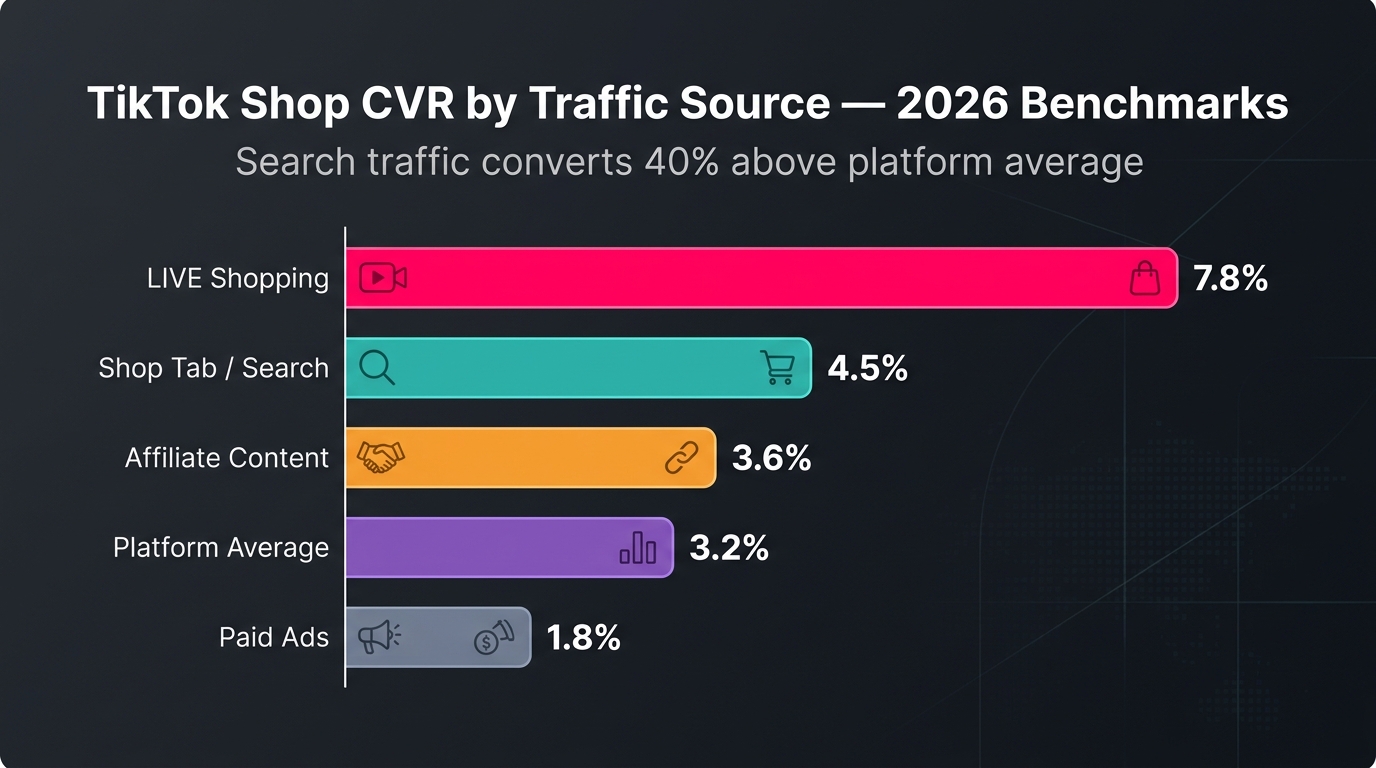
TikTok is progressively integrating search functionality with its LIVE shopping environment. Users watching a LIVE stream who search for a product demonstrated in the stream encounter a search-informed product display that blends real-time commerce intent with the LIVE session’s social proof. This intersection of the platform’s two highest-converting surfaces — LIVE shopping at 7.8% CVR and search at 4.5% CVR — is likely to create a new and powerful intent signal layer that current ranking models have not fully incorporated yet.
A Practical Intent Signal Audit: Where to Start This Week
The breadth of TikTok’s search intent signal system can feel overwhelming to map all at once. The practical approach is to treat it as a layered audit rather than a simultaneous overhaul. Start with the signals that are most directly controllable and work outward.
Week 1–2 — Listing Audit: Review every active listing for title precision (primary keyword in first 20 characters, natural language structure), description quality (NLP-friendly, problem-solution prose, naturally incorporating secondary keywords), attribute completeness (no blank fields), and image count (minimum five per listing). Fix gaps before adding any additional traffic.
Week 3–4 — Query Mapping: Use TikTok’s Keyword Planner to identify the query intent clusters most relevant to each product. Map current listing vocabulary against those clusters. Identify language gaps and update titles and descriptions to close them. Prioritize three to five long-tail queries per product that you will target specifically in the next 60 days.
Week 5–8 — Creator Brief Integration: Update creator briefs to incorporate the specific intent-cluster language identified in the query mapping exercise. Brief creators to address the specific questions behind your target queries in their video scripts and on-screen text. Ensure creators are tagging products correctly in every video.
Week 9–12 — Search Ads Validation: Run Search Ads campaigns against your target long-tail queries with modest budgets. Monitor search term reports weekly for high-converting query variations you had not identified. After 60 days, harvest the best-performing query language and incorporate it into listing updates and new creator briefs.
Ongoing — Behavioral Signal Monitoring: Use Seller Center analytics alongside a third-party tool (Kalodata or FastMoss) to monitor which queries are generating strong behavioral signals and which are producing poor ones. Adjust targeting, creative, and listing copy based on what the behavioral data reveals. This is not a one-time exercise — it is an ongoing optimization rhythm that compounds over time.
TikTok Shop’s search intent signal system is genuinely complex, but it is not opaque. It rewards sellers who understand that the algorithm is trying to solve the same problem they are: connecting the right product with the user who most needs it. Align your listings, your creator content, and your advertising with the language and behaviors of that user — not with gaming a ranking system — and the algorithm will work for you rather than against you.