


TikTok Shop sellers who have been operating under last year’s assumptions are walking into a minefield. The platform’s 2026 compliance overhaul isn’t a minor policy tweak or a round of seasonal enforcement — it’s a structural reset that changes how ads are reviewed, how accounts are scored, how pricing is scrutinized, and how creator partnerships must be disclosed.
The changes are rolling out across multiple policy areas simultaneously, which means sellers who are only focused on one issue — say, their video creative — may be compliant there while unknowingly racking up violations in pricing, fulfillment metrics, or affiliate disclosure. The enforcement system is no longer forgiving. One area of non-compliance can now cascade into account-wide restrictions that cut ad reach, freeze funds, or worse.
This post breaks down every major rule change sellers need to understand in 2026: what the policies actually say, where enforcement is already hitting, what actions will get your listings pulled or your account suspended, and exactly what you need to audit and fix this week. This isn’t about generic “best practices” — it’s about specific policy language and the concrete operational decisions that put you on the right side of TikTok’s compliance framework.
Let’s start with the scoring system that sits underneath everything else.
The Account Health Rating: The Scoring System That Now Controls Everything
Every compliance issue discussed in this post ultimately feeds into a single number: your Account Health Rating, or AHR. Understanding how this system works — and what specific scores mean for your ability to sell and advertise — is the essential foundation for everything else.
From Violation Points to AHR: What Changed
TikTok Shop’s legacy enforcement model used a simple Violation Points accumulation system. Sellers received points for infractions, and once they crossed certain thresholds, penalties kicked in. That system had one major problem: it was relatively easy to game. Points decayed over time, violations were siloed from each other, and many sellers treated it as a tax they could absorb.
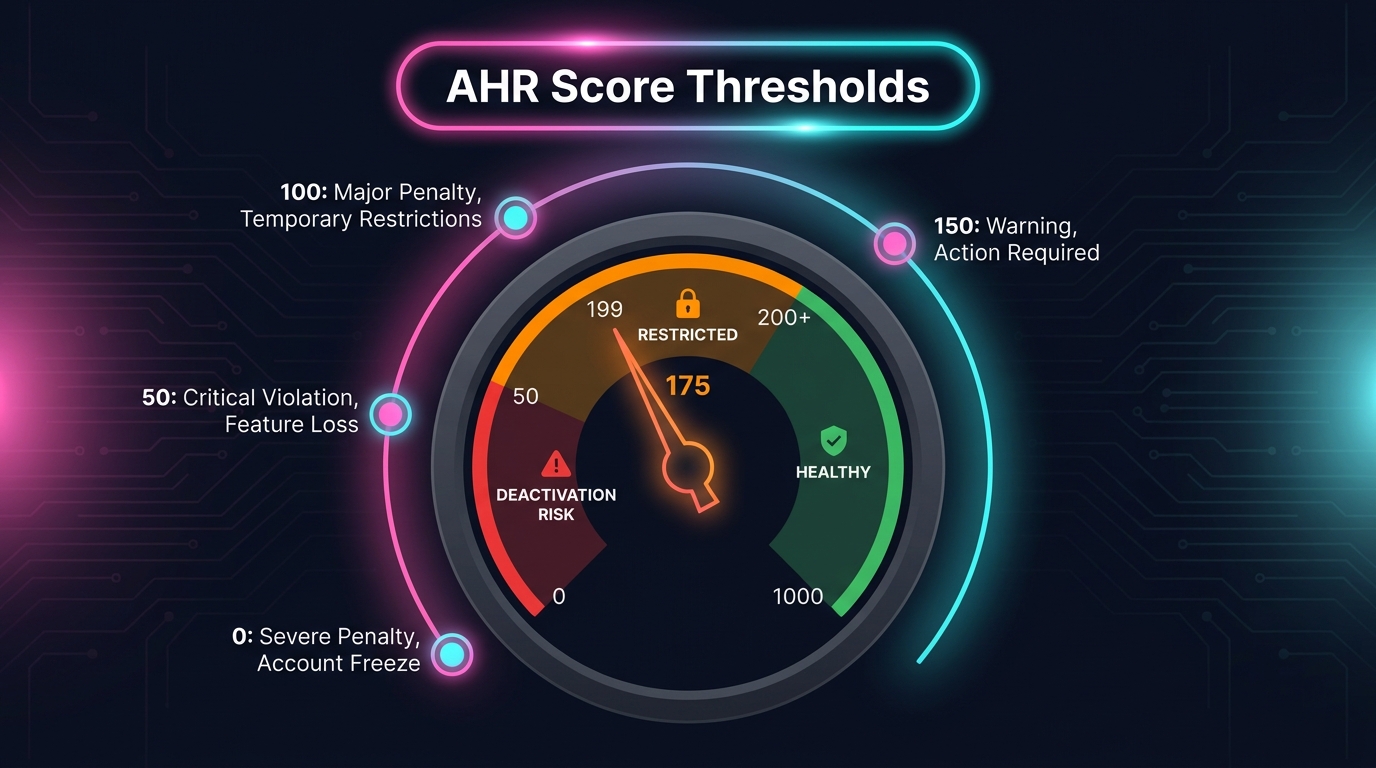
The new Account Health Rating flips that logic. Instead of accumulating penalty points, you start with a score and lose it. Every seller begins with 200 AHR points on a scale of 0 to 1,000. Your score reflects your last 180 days of activity, which means there’s no infinite clean-slate reset — your history follows you in a meaningful rolling window. Improvement is possible, but it takes sustained clean operation, not just waiting things out.
The Four Penalty Thresholds You Need to Know
The AHR system has four enforcement milestone thresholds. Each one unlocks a more severe set of restrictions:
- Below 150 points: Initial enforcement actions begin. Sellers entering this zone face listing restrictions and reduced campaign eligibility. This is the warning phase — action is needed immediately.
- Below 100 points: Feature restrictions escalate. Campaign access becomes increasingly limited, and additional listings may be frozen. Fund holds can begin at this level.
- Below 50 points (the red zone): This is the critical danger threshold. Sellers here are at immediate risk of account suspension and extended fund holds. The color band changes from orange to red at this point, and TikTok’s own documentation flags this as a deactivation risk zone.
- 0 points: Permanent deactivation. There is no appeal path from zero. Your shop is closed, and funds held at this stage can be withheld for up to 365 days under TikTok’s current policy framework.
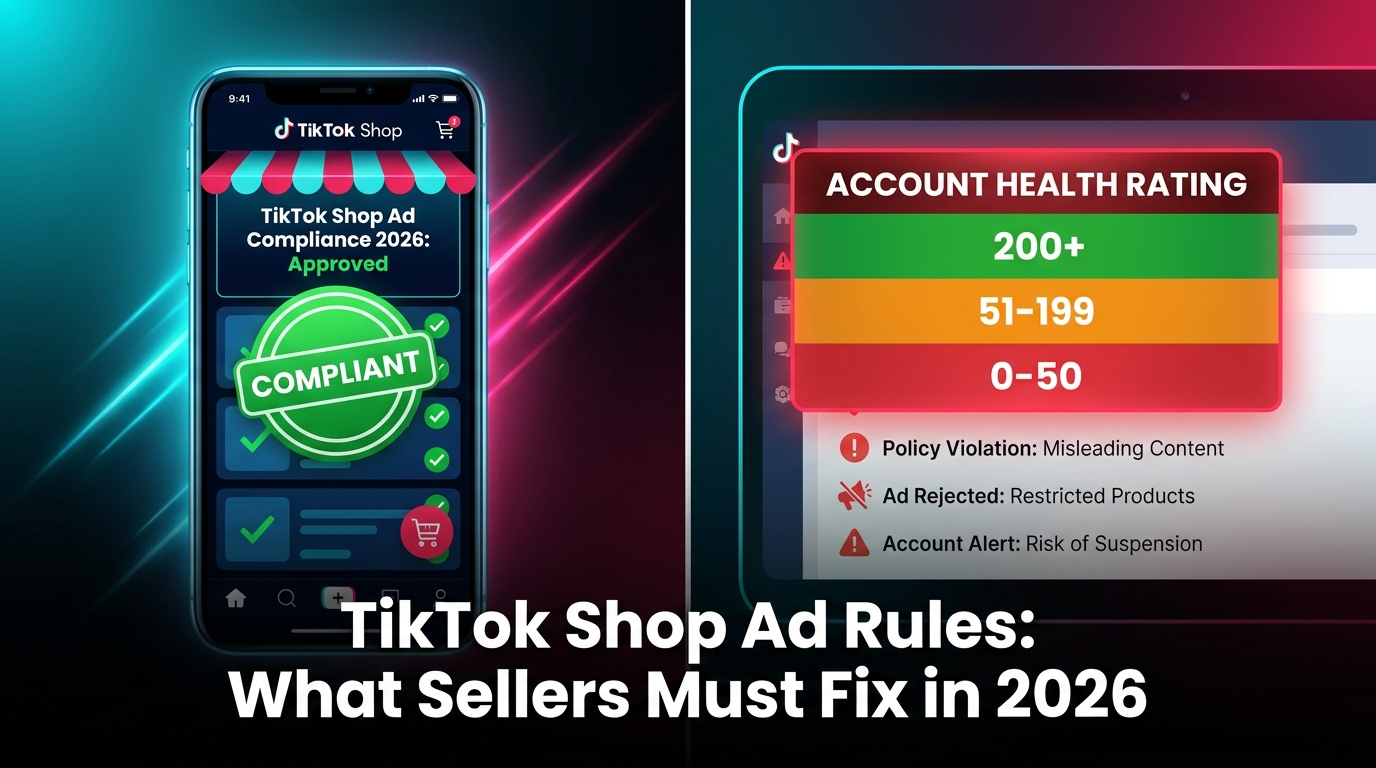
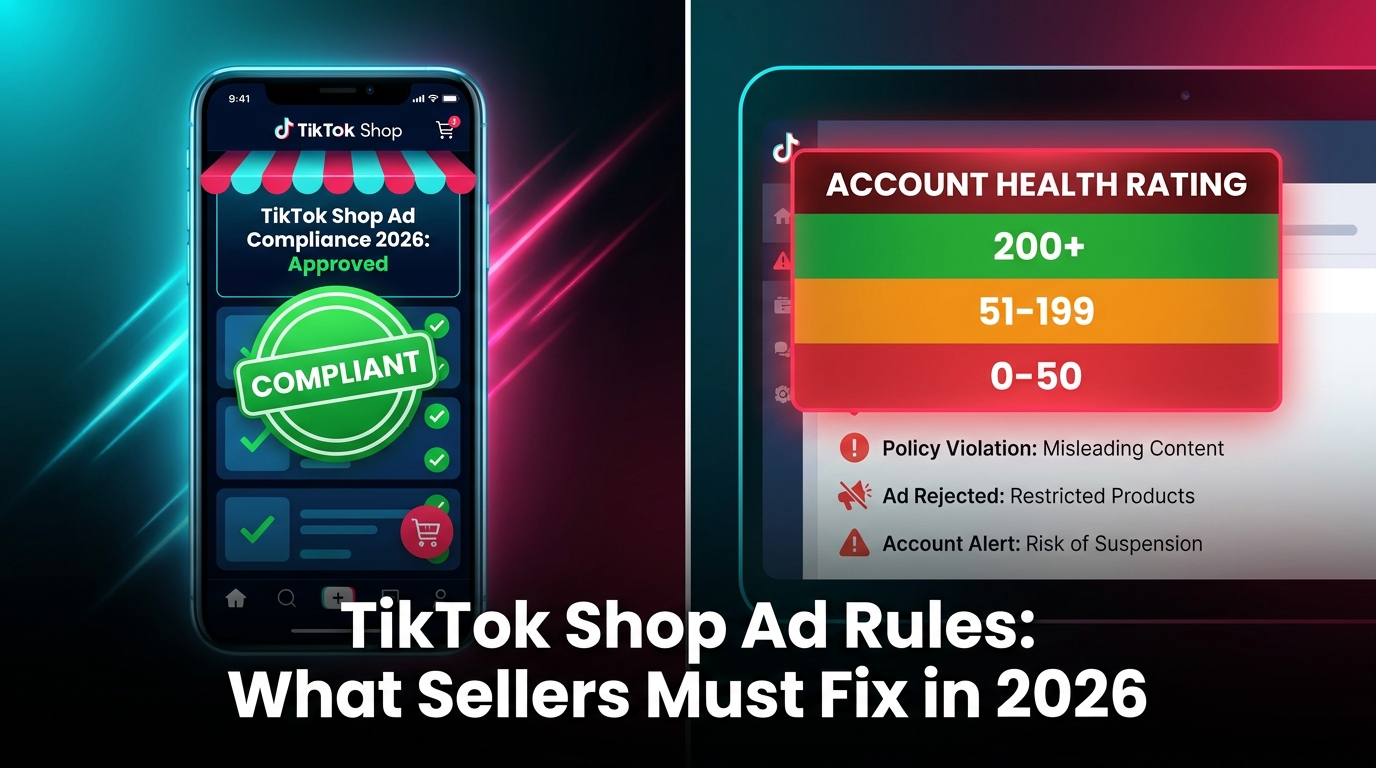
The color bands also matter for day-to-day operations: green means 200 or above, orange is 51 to 199, and red is 50 or below. Even being in the orange zone — which many sellers might consider “not that bad” — already signals restricted functionality.
How Points Are Deducted
Points are deducted for a wide range of violations, and the deduction amounts vary by severity and category. Beginning July 6, 2026, TikTok’s updated framework means that shops falling below target thresholds for their 12-Hour Response Rate (12HRR) can receive AHR deductions of 2, 10, or 20 points depending on how far below the threshold they fall. That might sound modest, but when you’re sitting at 165 points and you want to stay above 150, a 20-point deduction for consistently slow response times can push you into restriction territory almost unnoticed.
Product policy violations, misleading content flags, pricing violations, and fulfillment failures each carry their own deduction weights. The cumulative effect of several “minor” issues across different categories can be far more damaging than a single obvious violation.
The Practical Takeaway
Stop treating compliance as category-specific. Your AHR is a unified score that aggregates every type of violation, and staying healthy requires every operational area — creative, pricing, fulfillment, affiliate management — to be clean simultaneously. Fixing your ad creative while ignoring your response rate or pricing accuracy doesn’t protect you.
Pricing Accuracy Rules: Why “Fake Discounts” Are Now a Termination Risk
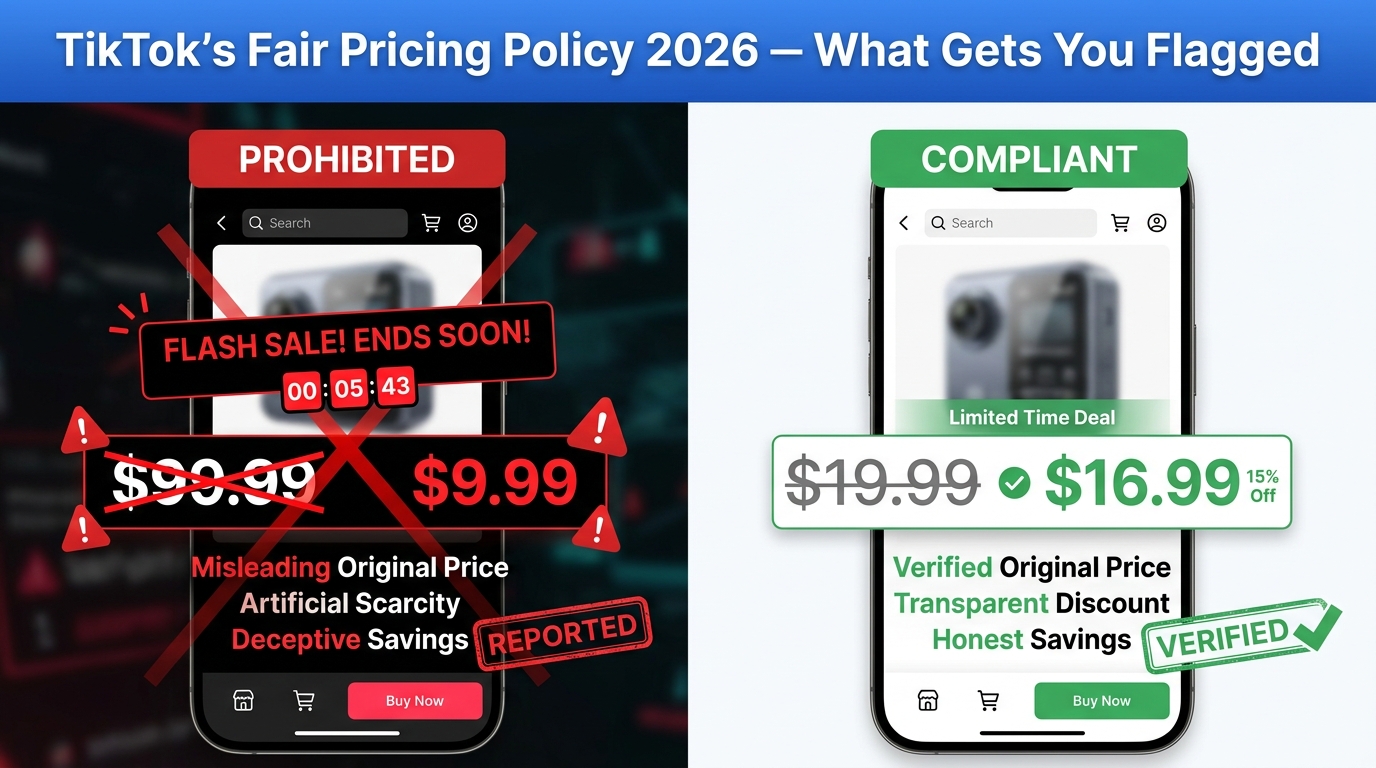
Pricing manipulation has been a persistent issue across every e-commerce platform, and TikTok Shop’s 2026 update makes clear that the platform is done treating it as a low-priority violation. The Fair Pricing Policy, combined with updated Misleading Discount Content rules, creates a specific and enforceable framework around how you can price, discount, and promote products.
What TikTok’s Fair Pricing Policy Actually Prohibits
TikTok Shop’s Fair Pricing Policy has two dimensions. The first is about absolute price levels: prices must be “fair and reasonable” relative to comparable products. A price that is suspiciously low (suggesting a fraudulent listing or bait-and-switch) is just as problematic as price gouging. Both are treated as violations.
The second — and more operationally impactful — dimension is about reference pricing and discounts. This is where most sellers are currently at risk without realizing it.
TikTok prohibits the practice of artificially inflating a “was” or “original” price to make a discount look larger than it actually is. A product that has been selling for $29.99 for the past six months cannot suddenly be listed as “was $89.99, now $29.99” unless $89.99 was a genuine, established selling price. The reference price must reflect a real price at which the product was actually sold for a meaningful period.
The Countdown Timer and Scarcity Problem
Countdown timers and scarcity indicators are not automatically prohibited — but they become policy violations the moment they are paired with fake scarcity or deceptive reference pricing. A countdown timer on a genuine 48-hour flash sale is fine. A countdown timer that resets every 48 hours indefinitely on a product that is always “on sale” is misleading content and subject to removal.
Similarly, “Only 3 left!” claims must be accurate. If your actual inventory is 500 units, claiming near-zero stock to create urgency is a misleading scarcity claim. TikTok’s content team has been flagging this pattern with increasing frequency, and it feeds directly into AHR deductions.
SKU Structure and the Lowest-Price Display Problem
One area that catches sellers off guard is SKU structure. TikTok Shop displays the lowest available price for a product by default. Some sellers have been structuring SKUs to show an artificially low price for one variation (a size or color that is rarely purchased) while the actually popular variations are significantly more expensive. This practice — using SKU architecture to mislead on displayed pricing — is specifically called out as a violation in the 2026 updates.
If your product has multiple variations with very different prices, audit whether the displayed price is genuinely representative of what most buyers will actually pay. If it isn’t, you have a policy exposure.
Frequent Price Changes as a Compliance Signal
TikTok’s policy framework also flags frequent, erratic price changes as a potential manipulation indicator. If your pricing history shows daily or near-daily changes that prevent a clear “established price” from being identified, the platform may treat any discounts you show as unsubstantiated. Stable pricing that occasionally runs genuine promotions is both a business best practice and, now, a compliance requirement.
What to Fix This Week
Audit every product listing that shows a reference price, “was” price, or strikethrough price. Confirm that the original price represents a genuine historical selling price. Review all countdown timers on your shop and confirm they are tied to actual, time-limited promotions. Check your SKU structures on multi-variation products to ensure displayed pricing is not misleading about what buyers will typically pay.
Prohibited Claims in Video Ads: The Specific Language That Gets You Flagged
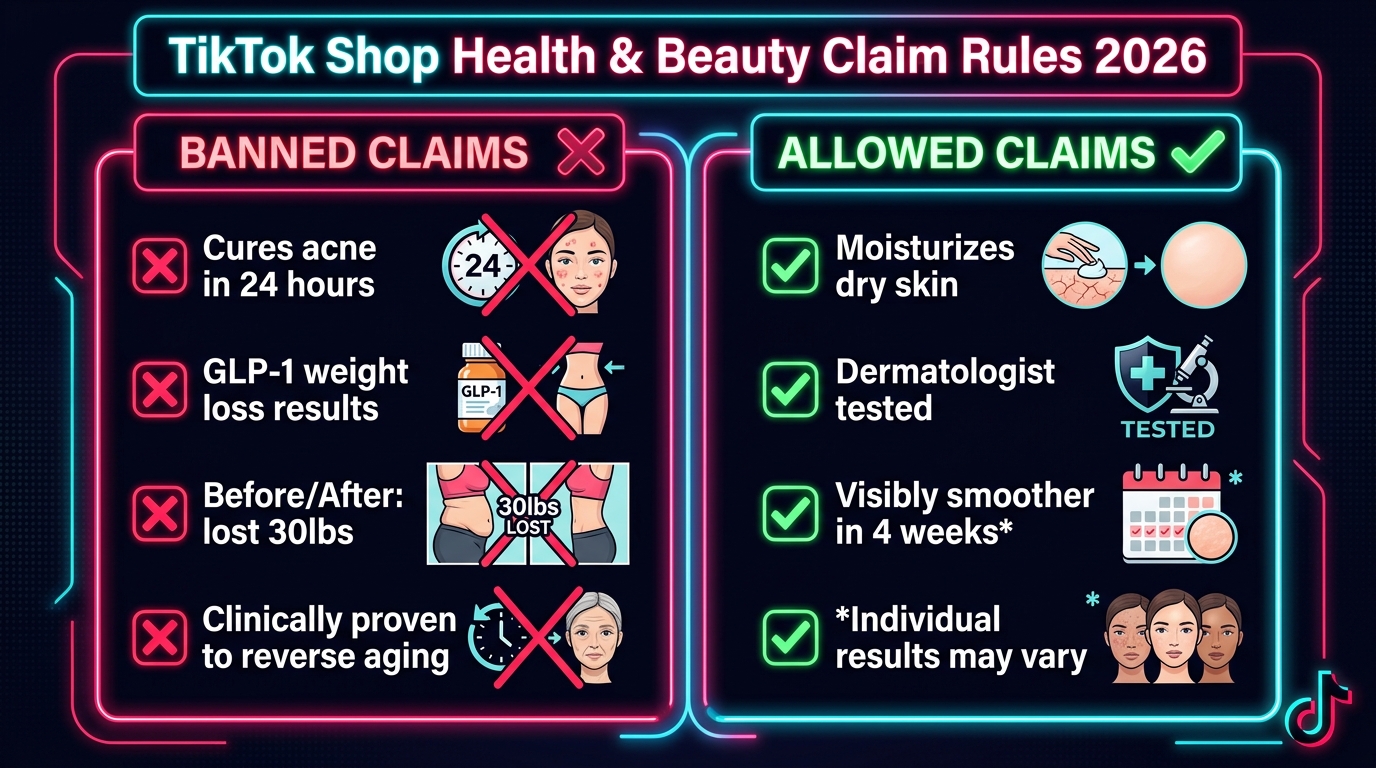
The claim rules in TikTok Shop’s 2026 ad policy are more specific and more strictly enforced than most sellers currently understand. The broad principle — “don’t make misleading claims” — has been replaced by granular category-by-category rules that determine what language, imagery, and framing are and are not permitted.
The Core Prohibited Claims Framework
TikTok’s content policy for Shop ads prohibits all claims that are false, exaggerated, or unsubstantiated. That covers the obvious territory. But the 2026 update goes further by identifying specific claim patterns that are treated as violations regardless of whether they’re technically defensible:
- Functionality claims that overstate what a product does. A skincare product cannot claim to “eliminate” wrinkles, “cure” acne, or “reverse” aging. These are medical claims, and cosmetic products cannot make them regardless of how a brand internally categorizes their formula.
- Earnings and financial outcome claims. Any claim about how much money a buyer can make using or reselling your product — even framed as typical results — requires substantiation that meets a very high bar. Vague success stories and income screenshots have been specifically called out in enforcement activity.
- Weight loss and body composition claims. This category has seen the most significant update in 2026, driven in part by the broader regulatory focus on GLP-1 medications.
The GLP-1 Line and Weight Loss Ad Rules
TikTok Shop’s May 2026 policy update included explicit additions to the prohibited health claims examples — specifically adding GLP-1 references and weight-loss claims that imply pharmaceutical-level results. This matters for supplement brands, wellness products, and any product that has been using language around “appetite suppression,” “metabolic boost,” or similar weight-management positioning.
The problem isn’t just mentioning GLP-1 medications by name — it’s making implied comparisons. A supplement ad that positions itself as achieving “similar results to what you’ve heard about” from trending weight-loss medications is exactly the pattern TikTok’s reviewers are now trained to flag. The update also extends to any language that implies your product works through pharmaceutical mechanisms when it is classified as a supplement or cosmetic.
For sellers in the wellness category, this means a complete language audit of every video ad currently running. The specific words to eliminate are not just the obvious medical terms — they include the suggestive language structures that imply medical efficacy without quite saying it directly.
Unsubstantiated “Clinically Proven” and “Dermatologist Tested” Claims
TikTok’s ad policy treats “clinically proven” as a claim that requires actual clinical evidence — not a reference to a small-scale internal study or a single dermatologist who agreed to review the product. If you cannot produce peer-reviewed clinical documentation for a “clinically proven” claim, remove it from your video ads now.
“Dermatologist tested” is a somewhat lower bar, but it still requires that an actual licensed dermatologist conducted an actual test — not just used the product personally or endorsed it. The distinction matters in enforcement.
Scarcity and Urgency Claims in Video Content
Urgency language in video ads — “selling out fast,” “almost gone,” “limited quantities” — follows the same rules as written listings. If the verbal claim in a video ad does not match actual inventory reality, it is a misleading content violation even if the product page is technically compliant. Video and listing content are evaluated as a system, not independently.
Before-and-After Content: Where the Line Actually Falls
Before-and-after imagery is one of the most effective formats in e-commerce video advertising. It is also one of the most heavily regulated. TikTok’s 2026 update clarifies exactly where the permitted zone ends and the policy violation begins — and the line is in a different place than many sellers assume.
What’s Banned and What Isn’t
The ban on before-and-after content in TikTok Shop ads is category-specific, not universal. For health, pharmaceutical, and medical treatment products, before-and-after comparisons are explicitly prohibited. A weight-loss supplement cannot show a person at their before weight and their after weight. A skincare product positioned as treating a medical skin condition cannot show cleared vs. uncleaned skin as a direct treatment outcome.
Where it gets more nuanced is in the general beauty and lifestyle categories. A hair care product can show hair before and after using the product — that is a permissible demonstration of cosmetic effect. A makeup product can show a face before and after application — that’s a cosmetic transformation, not a medical claim. The issue arises when the “before and after” framing implies that the product has treated, cured, or medically improved a condition rather than cosmetically altered an appearance.
The Language Problem with Visual Comparisons
Many violations aren’t in the imagery itself — they’re in the language that accompanies it. A creator showing a comparison of their skin before and after using a moisturizer, while saying “this cleared my eczema,” has just converted a permissible cosmetic demonstration into a prohibited medical claim. The visual may be fine; the spoken script makes it a violation.
This is why script review matters as much as visual review for video ads. TikTok’s automated review system processes audio content, and the combination of before-and-after visuals with specific verbal claim language is a pattern the system is actively trained to catch.
Filtering, Enhancement, and the “3D Effect” Prohibition
TikTok also prohibits product ads that use visual filters, digital enhancement, or what the policy refers to as “3D effect” overlays to exaggerate product results. A product demo video that has been color-graded or filter-enhanced to make the “after” result look dramatically better than it would in real conditions is a misleading functionality claim.
This matters practically: creators and brand video teams that routinely enhance footage should understand that before-and-after segments specifically are held to a stricter visual accuracy standard than other parts of a video. The “after” must represent what the product actually looks like in use, not a post-production idealization of the result.
Creator and Affiliate Disclosure: Meeting the FTC-TikTok Double Standard
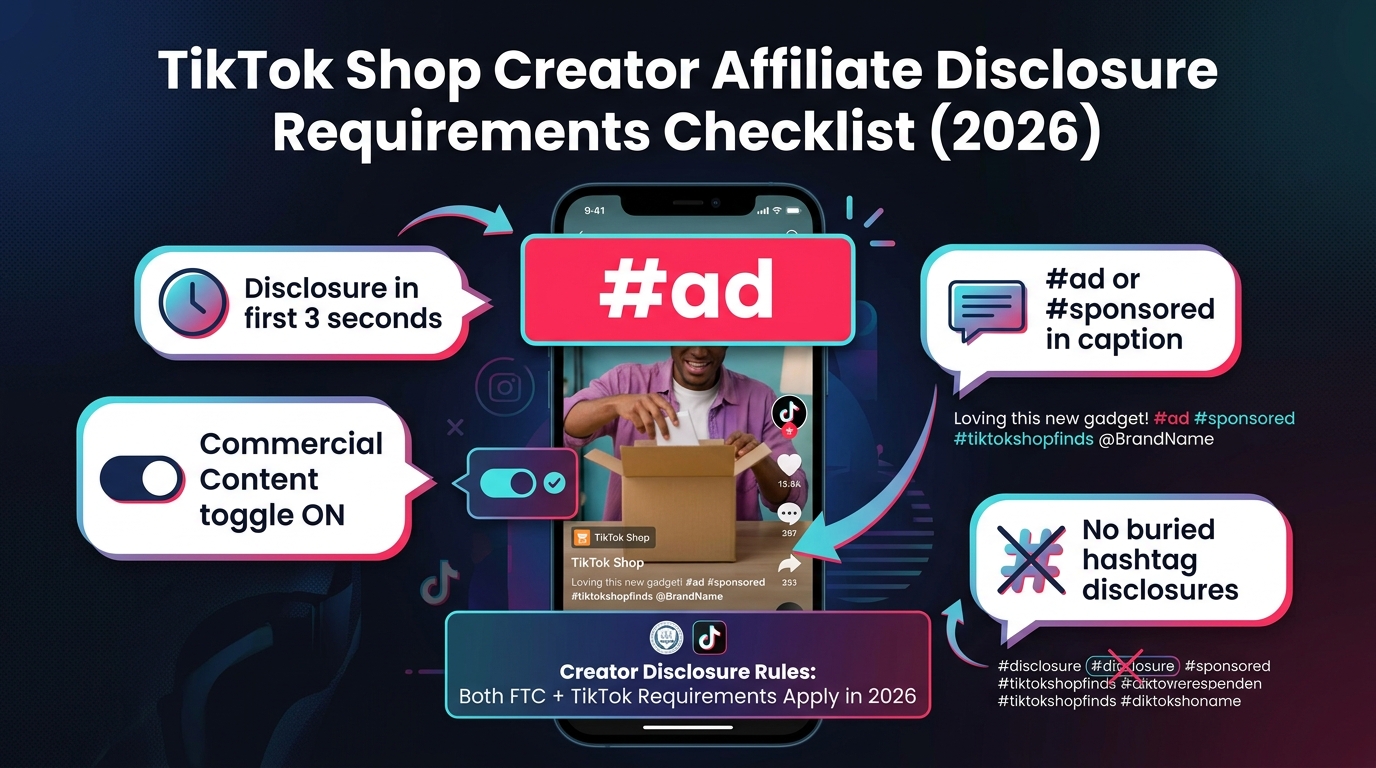
The disclosure requirements for TikTok Shop affiliate content now operate on two parallel tracks: TikTok’s own platform policies and the FTC’s Endorsement Guides. Both apply to any creator promoting products for a commission, and non-compliance with either creates enforcement exposure. What most sellers and their affiliate creators don’t fully appreciate is that the two systems have different requirements — and you must meet both simultaneously.
What Counts as a Material Connection
Under FTC rules, any “material connection” between a creator and a brand must be disclosed when the creator endorses that brand’s product. Material connections include:
- Monetary payment of any kind
- Free or discounted products received in exchange for content
- Affiliate commissions earned on sales generated
- Employment or contractual relationships with the brand
- Family or personal relationships with the brand owner
TikTok Shop’s affiliate program, by definition, creates a material connection for every participating creator. Every piece of content promoting a Shop product for an affiliate commission requires a disclosure. There is no de minimis threshold — it doesn’t matter whether the commission is $0.05 or $5,000.
TikTok’s Commercial Content Disclosure Requirement
TikTok requires creators to activate the Commercial Content Disclosure toggle for any post that promotes a brand, product, or service in exchange for compensation. This is a platform-level requirement that is separate from FTC compliance. Not toggling this setting for a paid or affiliate promotion violates TikTok’s own policies, and in 2026, TikTok’s system now actively identifies content that appears promotional but lacks the disclosure toggle — and issues warnings to creators.
The practical implication: content that loses its For You feed distribution because it appears to be undisclosed branded content will not drive sales for your Shop. The platform enforcement has real commercial consequences, not just legal ones.
Placement Rules: Where the Disclosure Must Appear
This is where most violations occur. Both FTC rules and TikTok guidelines require that disclosure be clear and conspicuous — meaning it must be placed where viewers cannot miss it. The specific problem patterns that are being enforced:
- Disclosures buried in hashtags. Hiding “#ad” among twenty other hashtags at the bottom of a caption is not a valid disclosure. The FTC has explicitly stated that disclosures must stand out from surrounding text and be positioned where viewers look.
- Profile-level disclosures. A general statement in a creator’s bio that they “sometimes work with brands” does not satisfy per-post disclosure requirements.
- Disclosures that appear only after the endorsement. If the endorsement language comes first and the disclosure appears three seconds later or below the fold in a caption, it is not sufficiently conspicuous.
- Disclosures that vanish too quickly. On-screen text disclosures in video that flash briefly and are not easily readable do not meet the standard.
The 2026 enforcement guidance from TikTok states that the strongest practice is to place a disclosure within the first three seconds of video content and in the caption text in a visible position and with the Commercial Content toggle active. Meeting two of three is not sufficient when the platform is actively reviewing for compliance.
What Brands Must Do for Their Affiliates
Brands are not absolved of responsibility when their affiliate creators fail to disclose properly. Under FTC rules, brands that direct, coordinate, or encourage affiliate content have shared responsibility for ensuring that content is properly disclosed. This means your affiliate program management needs to include:
- Written disclosure requirements in your creator brief or affiliate agreement
- Sample disclosure language that creators can use directly
- Review processes that check creator posts for proper disclosure before they run as paid Spark Ads
- A process for flagging and correcting non-compliant affiliate content
Using a non-compliant affiliate creator’s post as a Spark Ad amplifies a disclosed content violation and makes the brand the party running the non-compliant ad — not just the individual creator.
Video Shopping Ads and Spark Ads: Format-Specific Compliance You May Be Missing
TikTok’s ad formats for Shop sellers have their own compliance layers on top of the general content policies. Video Shopping Ads (VSAs) and Spark Ads each have format-specific requirements that interact with — but are not identical to — the underlying Shop seller policies.
Video Shopping Ads: What the Format Requires
Video Shopping Ads are TikTok’s native shoppable video format — they pull product cards directly into the video unit and connect to your Shop listing. This format creates a specific compliance burden because the ad content and the product listing are evaluated as a unit. The video must accurately represent what is in the product listing, including:
- Price consistency. If the video references a price, that price must match the live listing. Mismatches between video ad copy and product page pricing are flagged as misleading.
- Product feature accuracy. The product shown in the video must be the product being sold. Showing a premium or enhanced version of the product that differs from what buyers receive is a listing accuracy violation.
- Landing page compliance. The product page that shoppers reach after clicking a VSA must itself comply with all listing policies — any violation on the landing page is treated as a VSA compliance issue, not just a listing issue.
Spark Ads: The Existing Content Compliance Problem
Spark Ads allow brands to amplify existing organic creator content as paid advertising. This format creates a specific compliance challenge: the content was created organically, potentially before current policy requirements were in place, and brands are now running it as paid media.
The policy rule is clear: a piece of organic content that complies with organic content policies may still violate paid advertising policies when amplified as a Spark Ad. The threshold for claims, disclosures, and presentation accuracy is higher for paid content than for organic content.
Practically, this means every piece of creator content you plan to run as a Spark Ad needs a compliance review against ad policy standards, not just organic content standards. The review checklist should include:
- Does the content make any prohibited claims that would be acceptable as an organic opinion but not as a paid endorsement?
- Is the Commercial Content toggle active on the source post?
- Does the disclosure language meet paid ad requirements?
- Are any before-and-after elements present that could be read as medical claims?
- Are product features and pricing accurately represented?
Ad Review Timelines and the Approval Process
One operational reality sellers must plan around in 2026: ad review timelines have lengthened. TikTok’s review process now involves additional automated checks and, in flagged categories, manual review layers. Sellers running time-sensitive promotions — flash sales, limited events — need to build longer lead times into their campaign setup.
The practical recommendation is to submit ad creative for review at least 72 hours before a planned campaign start, and 96 hours or more for products in health, beauty, wellness, or any category that has historically triggered longer reviews. Submitting the day before a sale and having your ad sit in review when the sale starts is an operational problem, not a policy violation — but it’s entirely avoidable with better planning.
Fulfillment Metrics That Now Directly Affect Your Ad Reach
One of the most significant structural changes in TikTok Shop’s 2026 framework is the formal link between fulfillment performance and advertising eligibility. This connection has always existed informally — poor seller performance affected overall account standing — but the 2026 update codifies specific operational metrics as direct inputs into the AHR score and, by extension, your ability to run campaigns.
Late Dispatch Rate: The Number to Watch
TikTok’s fulfillment framework measures your Late Dispatch Rate — the percentage of orders that are not dispatched within the required window. The specific SLA varies by seller type and market, but the 2026 framework has tightened both the threshold and the penalty for falling below it.
Sellers operating with late dispatch rates above platform targets receive AHR deductions. More critically, sustained fulfillment underperformance can restrict your ability to participate in TikTok’s promotional programs — the Live Events, Deals for You, and campaign boosting features that provide additional visibility. Getting locked out of these programs while your competitors remain eligible is a competitive disadvantage that compounds over time.
Seller-Fault Cancellation Rate
Seller-fault cancellations — orders you cancel due to being out of stock, pricing errors, or operational failures — are separately tracked and scored. This metric has become more consequential in 2026 because TikTok Shop’s algorithm increasingly uses fulfillment reliability as a quality signal when determining which products get amplified in the For You feed organically.
The connection matters for ad buyers: if your organic Shop signal is suppressed by poor fulfillment metrics, your paid campaigns have less algorithmic support. The platform’s ranking system is holistic — paid and organic performance signals interact, and a poor operational track record costs you in both channels.
The 12-Hour Response Rate (12HRR) Update
As noted earlier, the July 6, 2026 policy update introduced explicit AHR deductions for missing your 12-Hour Response Rate target. This is the percentage of customer messages you respond to within 12 hours of receipt.
The deduction tiers are: 2 points for marginally missing target, 10 points for moderate underperformance, and 20 points for significant shortfall. Twenty points is not trivial at any score level. A seller operating at 170 points — already in the orange zone — can fall below the 150-point enforcement threshold from a single bad week of response rate performance.
Operationally, sellers who rely on manual customer service management need to either increase staffing coverage during peak periods or implement automated response tools for initial message acknowledgment. The 12-hour window is a clock that runs around the calendar, including weekends and holidays.
Returns Rate and Listing Accuracy
Elevated return rates are both a commercial problem and a policy signal. TikTok Shop monitors return rates as an indicator of listing accuracy — if buyers are consistently returning products because they don’t match expectations set by the listing, that pattern suggests the listing is misleading. High return rates can trigger listing accuracy reviews and, if problems are confirmed, mandatory listing updates combined with AHR deductions.
Sellers with return rate spikes should investigate whether the issue is product quality, packaging, shipping damage, or listing accuracy before TikTok’s system does it for them. Proactive fixes look different in the enforcement record than reactive responses to violations.
What Happens When You Get Flagged: The Escalation Path and Your Appeal Options
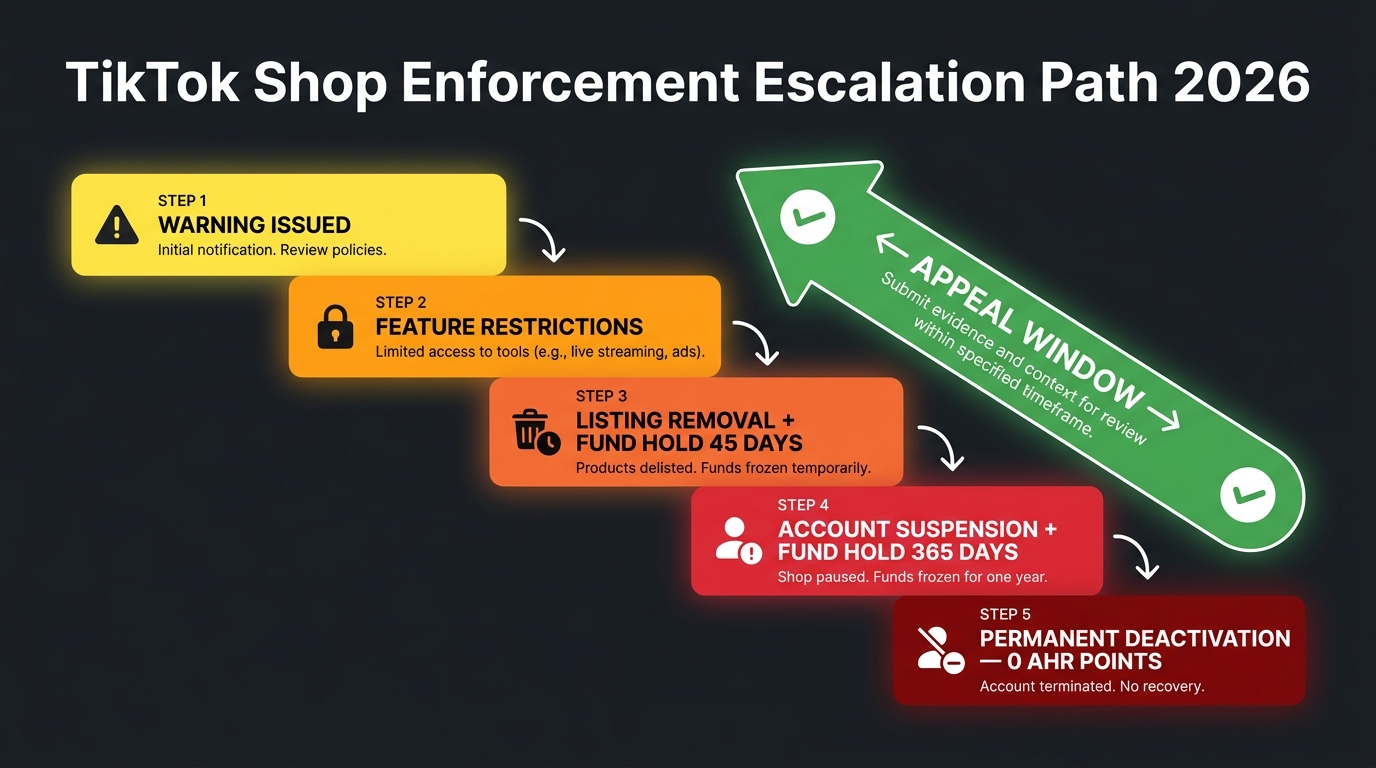
Understanding the enforcement escalation path is critical for two reasons: it tells you how fast you need to respond when you receive a notice, and it tells you which stages still have meaningful appeal options versus which are effectively final.
Stage 1: Warning Issued
The first enforcement action is typically a warning notification through Seller Center. At this stage, no AHR points have been deducted — you’ve been put on notice that a specific behavior has been identified. Warnings come with a specified correction window, which varies by violation type.
The critical mistake sellers make at Stage 1 is treating the warning as bureaucratic noise. Ignoring a warning and allowing the violating content or practice to continue converts the warning into a formal violation, which triggers AHR deductions. Stage 1 is the lowest-cost intervention point — address the issue immediately.
Stage 2: Feature Restrictions
If a violation is confirmed or a warning goes unaddressed, the next stage is feature restrictions. These can include limits on campaign creation, inability to participate in promotional programs, or restrictions on adding new product listings. Your existing listings and campaigns may continue running during this stage, which is why some sellers don’t notice until they try to create something new.
Feature restrictions are documented in your AHR history and can affect your eligibility for TikTok’s seller tiers and promotional partnerships even after restrictions are lifted.
Stage 3: Listing Removal and Fund Holds
Specific violating listings are removed, and TikTok may initiate a fund hold. A 45-day fund hold means your pending and recently settled payments are frozen while the platform investigates. For sellers with meaningful monthly volume, this is a serious cash flow disruption. The hold doesn’t mean the funds are forfeited at this stage — most are released if the investigation confirms the issues were isolated and corrected.
Appeals at Stage 3 are processed through the Seller Center appeal portal. The appeal must include documentation: evidence that the violation has been corrected, explanation of how it occurred, and if relevant, evidence that it was an error rather than intentional practice.
Stage 4: Account Suspension and Extended Fund Holds
Account suspension means your entire Shop stops operating. No new orders, no campaign activity, no platform access in the usual sense. Fund holds at this stage extend to 365 days — a full year. This is the stage where business-critical intervention is necessary.
Appeals at Stage 4 have a much higher bar. TikTok typically requires a formal corrective action plan, documentation of remediation, and may involve a waiting period before reinstatement regardless of appeal outcome. Success rates for Stage 4 appeals are significantly lower than for earlier stages, which underscores why addressing issues at Stages 1 and 2 is so important.
Stage 5: Permanent Deactivation
At zero AHR points, TikTok Shop permanently deactivates the account. There is no standard appeal path from this stage. Funds may be withheld for the extended period as part of buyer protection mechanisms. Starting a new seller account after permanent deactivation raises identity verification issues, as TikTok’s systems track seller identity and associated business information.
Sellers who reach this stage typically did so through sustained, serious violations — not a single mistake. But the warning here is for sellers who have been accumulating AHR deductions without addressing them: the path from “a few small violations” to zero points is shorter than most realize when deductions stack across multiple categories.
The Compliance Audit Checklist: What to Fix This Week
Moving from policy understanding to operational action requires a systematic audit across every area the 2026 updates affect. This checklist is organized by priority — the highest-risk items first.
Priority 1: Check Your AHR Score Right Now
Log into TikTok Shop Seller Center and locate your Account Health Rating. If you’re below 200, you are already in a restricted zone even if you haven’t received specific violation notices yet. Note your exact score and the breakdown of any deductions that have already been applied. This is your baseline — everything else on this list is about keeping it from falling further and starting to recover it.
Priority 2: Audit All Active Video Ads for Prohibited Claims
Pull every active Video Shopping Ad and Spark Ad currently running. Review the script and audio for:
- Any health or medical claims (even implied)
- Before-and-after language or framing in health, weight, or condition-related contexts
- GLP-1 references or pharmaceutical comparisons
- Earnings or income claims
- “Clinically proven,” “cures,” “treats,” “eliminates” language without substantiation
- Urgency or scarcity language that doesn’t reflect actual inventory or time constraints
Pause any ad where you identify these patterns before completing your review. Running a non-compliant ad while you audit is still accumulating exposure.
Priority 3: Review All Active Listings for Pricing Accuracy
- Identify every listing with a reference price, “was” price, or strikethrough price
- Confirm each reference price reflects a genuine established selling price
- Check multi-variation SKU structures for displayed price accuracy
- Review any active countdown timers for accuracy and legitimacy
- Check scarcity claims against actual current inventory
Priority 4: Audit Creator and Affiliate Content
- Review all active affiliate creator content being run as Spark Ads for proper disclosure
- Confirm Commercial Content toggle is active on source posts being amplified
- Check caption disclosures for visibility and placement (not buried in hashtags)
- Update your affiliate creator brief to include written disclosure requirements
- Implement a pre-amplification review step for all Spark Ad source content
Priority 5: Check Fulfillment Metrics
- Review your current Late Dispatch Rate against platform targets
- Check your Seller-Fault Cancellation Rate for recent trends
- Audit your 12-Hour Response Rate performance for the past 30 days
- Review your return rate data for any category-specific spikes that suggest listing accuracy issues
Priority 6: Set Up Ongoing Monitoring
One-time audits solve today’s problems. TikTok’s policy framework is updated regularly — the May 2026 Policy Pulse that added GLP-1 claim examples was one of several policy updates in the first half of 2026 alone. Set up a regular (monthly minimum) process to review:
- Your AHR score and any new deductions
- TikTok’s Policy Pulse updates in Seller Center
- Any new platform communications about category-specific rule changes
- Performance metrics against current SLA targets
Cross-Border Sellers: Higher Entry Bars and Additional Requirements
Sellers operating cross-border — selling into the US or UK from overseas, or selling internationally from a domestic base — face an additional layer of 2026 compliance requirements that domestic sellers do not encounter.
Elevated Eligibility Thresholds
TikTok raised the eligibility requirements for cross-border sellers in 2026, with stricter documentation requirements, longer probationary periods for new shops, and higher performance thresholds required to access full platform features. The practical effect is that cross-border sellers cannot assume parity with domestic sellers in terms of how quickly they can access promotional features, campaign tools, or higher-tier seller programs.
Market-Specific Consumer Protection Law
Cross-border sellers also carry the compliance burden of the destination market’s consumer protection laws — not just TikTok’s platform policies. Selling into the US means FTC rules apply. Selling into the UK means ASA guidelines and UK Consumer Rights Act provisions apply. TikTok’s own policies are designed to be broadly compliant with major market regulations, but they are not a substitute for market-specific legal review.
For brands in health, beauty, supplements, and financial products — the categories with the most prescriptive advertising rules in major markets — operating cross-border without market-specific legal guidance is a meaningful risk, independent of TikTok platform compliance.
Fulfillment SLA Differences
Cross-border fulfillment SLAs are different from domestic ones, and the 2026 framework applies stricter monitoring to cross-border late dispatch specifically. Longer supply chains and customs variability are not exemptions — TikTok’s SLA measurement is based on when the item ships from origin, and the window does not flex for cross-border complexity. If your fulfillment model cannot reliably meet the required dispatch window, you need either a different fulfillment arrangement or a different market strategy.
Building a Compliant Operation: What Sellers Adapting Well Are Doing Differently
The sellers who are navigating the 2026 update successfully are not those with the most elaborate legal review processes — they’re the ones who have integrated compliance thinking into their standard operating workflows rather than treating it as an external audit function.
Substantiated Claims as a Creative Advantage
Counterintuitively, the tighter claim rules are creating a competitive advantage for brands that invest in real substantiation. When everyone in your category has been using similar exaggerated language and those claims get removed, the brand that has been making conservative, substantiated claims doesn’t need to change anything — and gains relative visibility as competitors scramble to rewrite their ads.
The practical opportunity is to invest in actual clinical testing, user study documentation, or third-party verification for your key claims. A modest investment in real substantiation turns a compliance constraint into a durable marketing asset.
Compliance as a Seller Tier Signal
TikTok’s seller tier system — which determines access to promotional programs, lower commission structures, and priority customer service — explicitly uses AHR and compliance history as eligibility factors. Sellers with sustained high AHR scores and clean compliance records gain access to programs that are categorically unavailable to everyone else on the platform.
This is the structural reason why compliance isn’t just defensive — it’s a prerequisite for accessing the parts of TikTok Shop’s ecosystem where the most favorable economics exist. The promotional programs available to top-tier sellers carry lower effective costs per sale than what general sellers access through standard auction advertising. Getting and keeping a healthy AHR score is effectively a revenue optimization move.
Creator Management as Compliance Infrastructure
Brands that treat their creator network as a compliance liability (something to monitor and fix when things go wrong) are permanently in reactive mode. Brands that treat their creator brief, onboarding process, and content review workflow as compliance infrastructure are structurally protected. The investment in a clear creator brief that includes specific do’s and don’ts, disclosure language templates, and a pre-Spark Ad review step takes hours to set up once and prevents violations continuously.
Conclusion: Compliance Is Now a Competitive Position, Not Just a Checklist
The 2026 TikTok Shop ad rules update is best understood not as a burden but as a market structure change. The platform has raised the operational floor — the minimum standard you must meet to participate without restriction. Sellers who were operating below that floor on any dimension are now exposed. Sellers who were already operating above it have a structural advantage.
The Account Health Rating ties everything together: your pricing, your creative, your fulfillment, your affiliate management, and your customer response practices all feed into a single score that determines what you can do on the platform. Managing that score requires visibility across your whole operation, not just your ad account.
The sellers who will struggle most with this update are those who treat compliance as a separate function from operations — something legal or a compliance officer handles while the growth team focuses on scaling. At TikTok Shop’s current policy maturity level, that separation is no longer viable. The people running your campaigns need to understand claim rules. The people managing your creators need to understand disclosure requirements. The people running your inventory need to understand how fulfillment metrics affect your AHR.
The sellers who will benefit most are those who make compliance a first-principles part of how they build content, set prices, manage creators, and operate their shop. Not because the rules say so, but because a clean, high-AHR, policy-compliant operation earns better placement, better ad economics, and access to the promotional programs where TikTok Shop’s best-performing sellers actually operate.
Start with the audit checklist. Get your score. Fix what’s broken. Then build the processes that keep it from breaking again.