


There is a version of creator marketing that most brands are still running. They identify a handful of influencers, negotiate flat fees, send products, cross their fingers, and measure success by whether the content went up on time. When the campaign ends, the process starts over. Nothing carries forward. No compounding returns. No infrastructure. Just a series of disconnected transactions dressed up as a “strategy.”
That model is expensive, inefficient, and increasingly irrelevant.
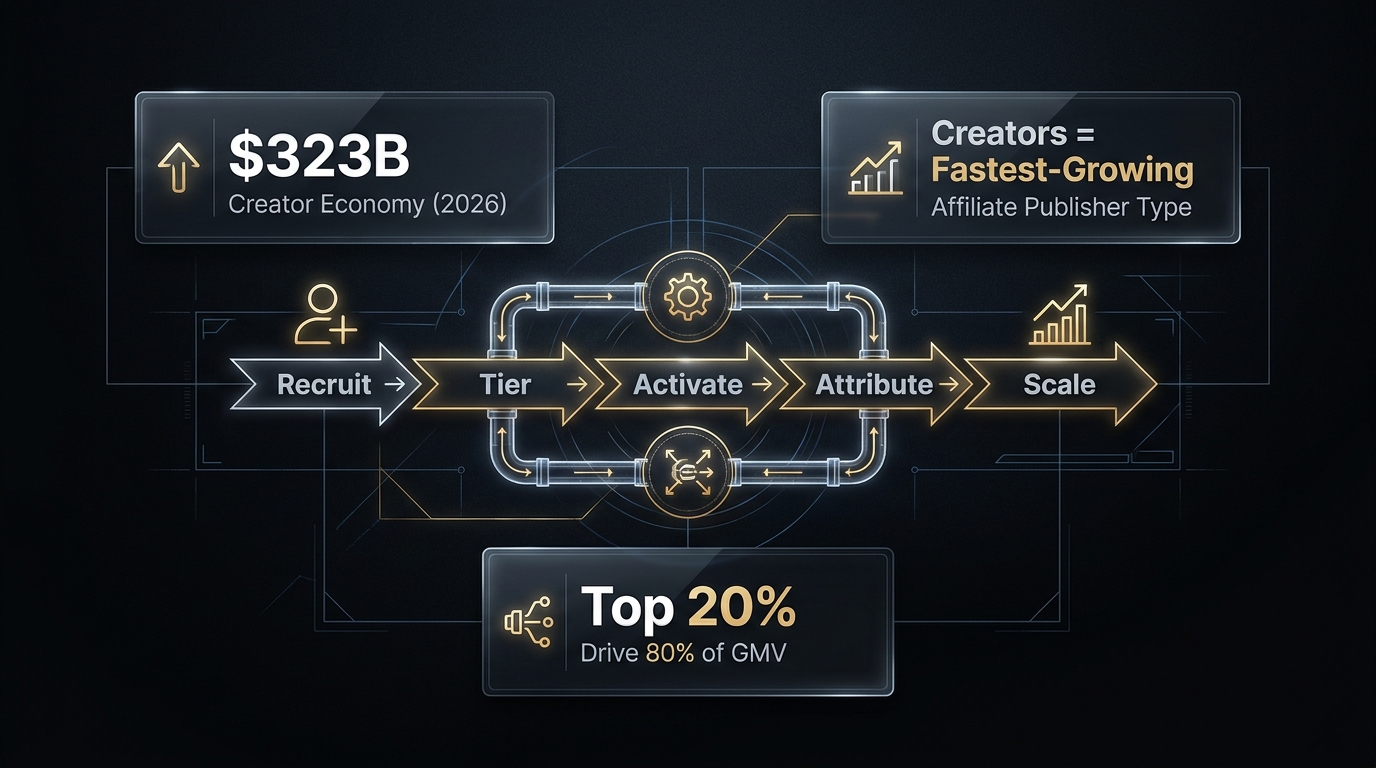
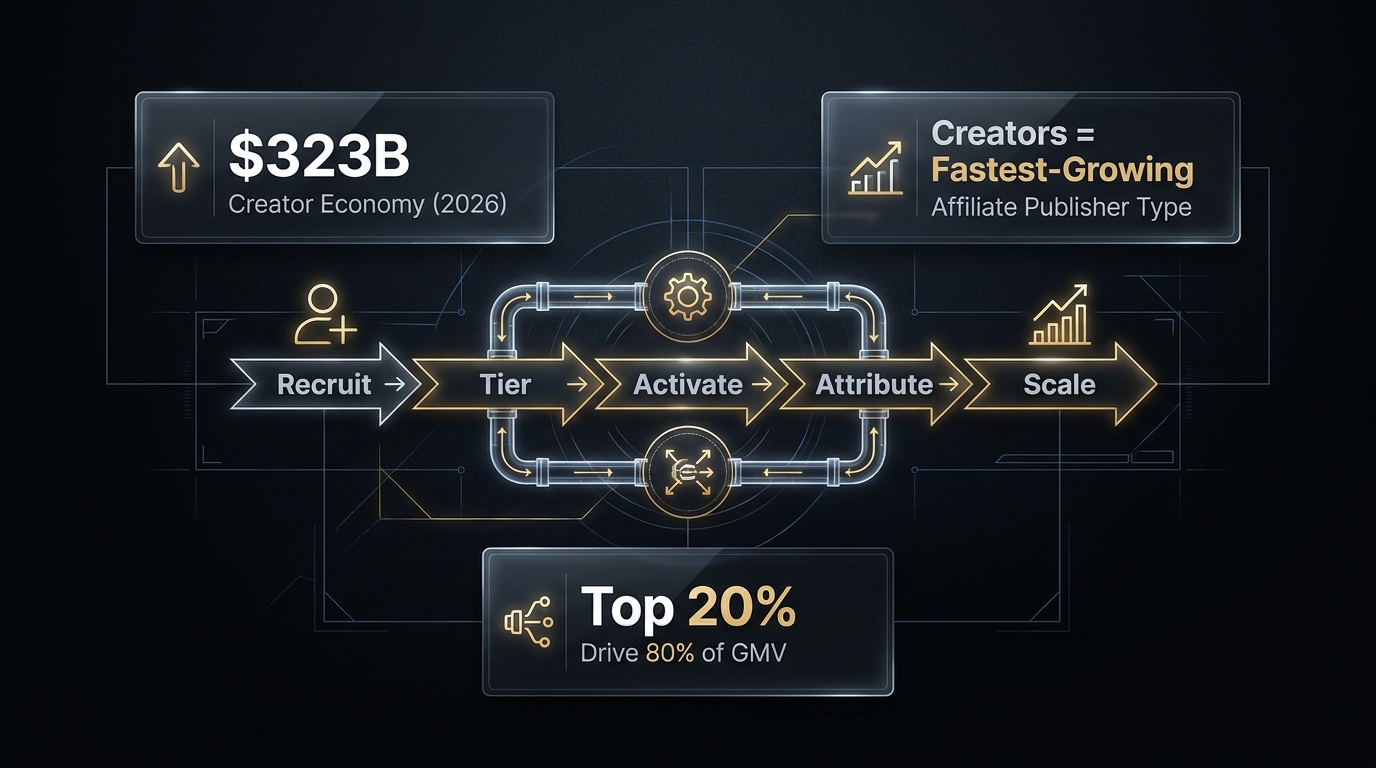
The creator economy crossed $323 billion in projected market size in 2026, and the brands capturing real, measurable returns from it are not the ones running bigger influencer campaigns. They are the ones that stopped treating creator relationships as campaigns and started building them as infrastructure — scalable affiliate engines with defined tiers, automated workflows, multi-touch attribution, and commission structures that give creators a genuine economic reason to stay.
This post is about how that engine is actually built. Not the conceptual version — the operational one. The one with decisions to make about which platform to run it on, how to tier your creator roster, what commission structure retains your top performers, and how to measure results when last-click attribution is lying to you about half your revenue.
If you have already read the general “creator affiliate marketing is growing” takes, this is not that. This is the infrastructure layer — the part that determines whether your creator program compounds or collapses.
The Old Creator Marketplace Model Is Broken — Here’s What Replaced It
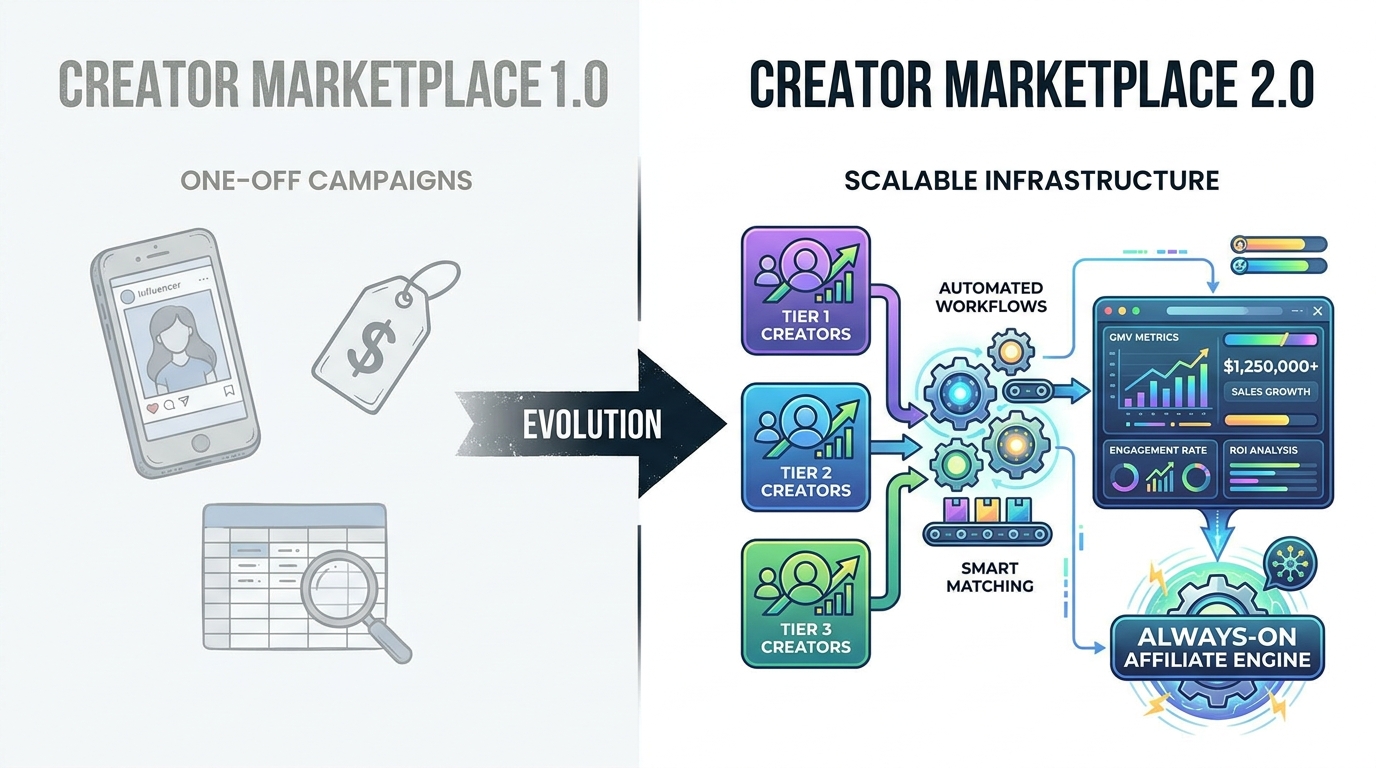
The original creator marketplace model was essentially a talent agency with a discovery layer bolted on. You searched for creators by follower count, reached out, agreed on a flat fee, received content, paid an invoice, and moved on. The platform served as a matchmaking service — and once the match was made, it stepped back entirely.
That approach worked well enough when creator marketing was a line item in the brand awareness budget. It fails completely when you try to build it into a performance channel.
Why the Campaign Model Cannot Scale
The core problem with campaign-based creator programs is that they have no memory. Every engagement starts from zero — new creator discovery, new negotiations, new briefing, new tracking setup, new content review. Brands running six campaigns a year are essentially rebuilding the same system six times. The operational cost is enormous, and the learnings from one campaign rarely transfer to the next in any structured way.
Platform-level data reinforces this. Across creator and affiliate programs, 10 to 20 percent of creators generate more than 80 percent of revenue, according to analysis across hundreds of influencer programs. In some mature programs, that concentration is even steeper — closer to 90/10 or 99/1. A campaign model has no mechanism to identify and prioritize those top performers before you have already spent the budget. You find out who drove results after the fact, and then the relationship ends before you can act on it.
What the 2.0 Model Actually Looks Like
Creator Marketplace 2.0 is not a new platform category — it is a structural shift in how brands organize creator relationships. The defining characteristics are:
- Always-on enrollment: creators can join, get vetted, and start generating affiliate sales without requiring a specific campaign to be live.
- Tiered relationships: the program has defined segments for different creator types, with different compensation structures, expectations, and support levels at each tier.
- Performance-linked economics: creators earn based on what they drive, not just what they post. Commission structures, bonuses, and escalators are built in from the start.
- Automated tracking infrastructure: link generation, UTM management, attribution, and payout calculation are handled by the system, not by a spreadsheet.
- Compounding creator relationships: top performers are retained, upgraded, and given higher-value deals over time rather than re-negotiated fresh every quarter.
EMARKETER frames 2026 as an inflection point where creators become the fastest-growing publisher type in the affiliate channel. Awin’s network data shows creator share of affiliate revenue rising from 15.9 percent to 19.5 percent year over year. These are not vanity metrics — they reflect a fundamental shift in where performance marketing budgets are moving and why.
The brands winning that budget shift are not the ones with the largest influencer spend. They are the ones that built the infrastructure to use it efficiently.
The Architecture of a Scalable Affiliate Engine
Before you recruit a single creator or set a single commission rate, you need to understand what an affiliate engine actually consists of structurally. Most brands skip this step and jump straight to tactics — which is why most creator programs plateau within six months of launch.
A functional creator affiliate engine has six core components. Every one of them needs to be defined before you scale.
1. The Enrollment Layer
This is how creators enter your program. It includes the application or discovery mechanism, the vetting criteria, the approval workflow, and the onboarding sequence. Without a defined enrollment layer, you end up with either a program that is impossible to enter (too restrictive) or one that is flooded with low-quality applicants who never generate a sale.
The enrollment layer should be selective but accessible. That means having clear eligibility criteria — niche fit, minimum engagement metrics, content quality standards, posting consistency — and an approval process that moves fast enough to not frustrate high-quality creators who have options.
2. The Tier System
Not all creators belong in the same program structure. A micro-creator with 8,000 highly engaged followers in a specific product niche needs a different relationship than a mid-tier creator with 200,000 followers posting across ten categories. Treating them identically wastes resources on one end and under-invests on the other.
The tier system defines how you segment your roster, what each segment gets in terms of compensation and support, and how creators move between tiers as their performance data accumulates. This is covered in detail in the next section — it is arguably the most important structural decision you will make in the program design.
3. The Content Activation Framework
Creators need to know what to make, for which product, and on what timeline. A content activation framework includes product briefing templates, creative guidance (without over-scripting), posting cadence expectations, and any promotional hooks or discount codes they have access to. The goal is to reduce activation friction without eliminating creative freedom — because over-scripted creator content almost always underperforms authentic recommendations.
4. The Attribution System
How you track sales back to specific creators determines how you pay them, how you evaluate their performance, and which creators you decide to invest more in. Getting attribution wrong — or using a system that systematically underreports creator-driven revenue — will destroy your program because creators will see their payouts not matching their actual impact, and they will leave for programs that credit them accurately.
5. The Compensation Structure
Commission rates, flat fees, performance bonuses, retainers, and escalators all serve different functions. A good compensation structure creates strong economic incentives to drive sales while also giving creators enough baseline compensation to justify the relationship in periods when content is not converting at peak rates. This is a balance point most brands get wrong in one direction or the other.
6. The Data and Optimization Loop
The engine should be getting smarter over time. Which creators are driving the highest AOV purchases? Which content formats convert best for your specific product category? Which commission escalator thresholds actually motivate behavior change? These questions should have answers after 90 days of operation, and those answers should be feeding directly back into your tier decisions, your recruitment targeting, and your compensation structure.
Without a data loop, you are running the same program on autopilot forever. With it, you are running a program that compounds.
Tiering Your Creator Roster: Why Volume Is the Wrong Goal
The instinct most brands have when launching a creator affiliate program is to recruit as many creators as possible. The logic seems sound — more creators means more content, more reach, more potential sales. In practice, it creates a management burden that exceeds the incremental revenue, while burying the signal of your actual top performers under a mountain of noise.
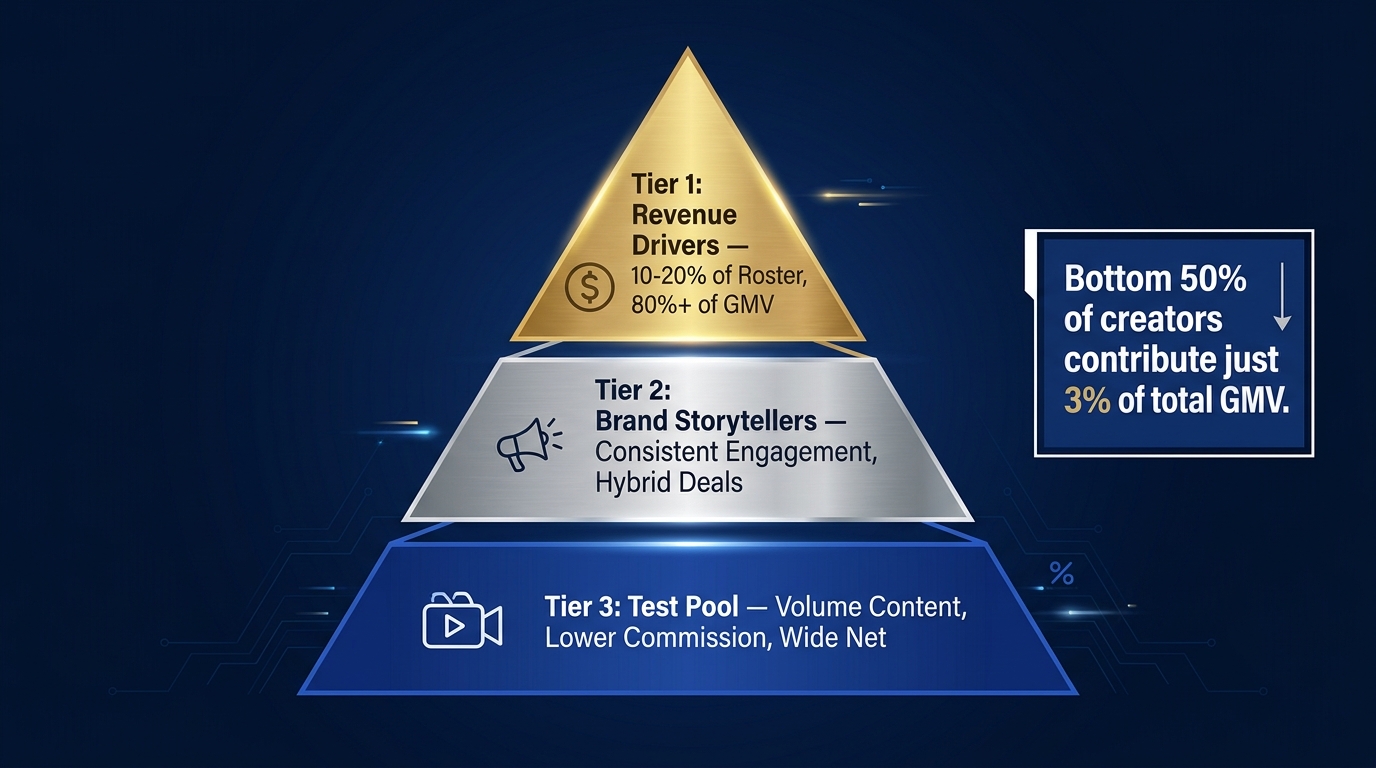
The data does not support the volume approach. Across TikTok Shop affiliate programs, the bottom 50 percent of enrolled creators contribute approximately 3 percent of total GMV. That is not a rounding error — it is a structural reality of how creator-driven commerce distributes. The Pareto principle applies more aggressively in this context than in almost any other marketing channel.
A Practical Three-Tier Framework
The most functional tier systems use three segments, defined by performance potential and relationship depth rather than follower count alone:
Tier 1: Revenue Partners. These are your proven drivers — creators whose content has demonstrated actual purchasing behavior in your product category or in adjacent categories. They represent roughly 10 to 20 percent of your active roster but should account for the majority of your attributed GMV. Tier 1 creators receive your best commission rates, priority product access, dedicated account support, and often a hybrid deal structure that blends performance commissions with a guaranteed baseline. The goal is retention at all costs — losing a Tier 1 creator to a competitor’s program has a material impact on your numbers.
Tier 2: Brand Storytellers. These creators are not necessarily driving high transaction volumes, but they produce content with genuine brand alignment — the kind of educational, trust-building posts that influence purchase decisions upstream before they ever click a link. They typically get mid-tier commission rates, access to product gifting or try-before-post programs, and regular briefing updates on new SKUs. Their value is partially attributable in your data and partially captured in brand lift and assisted conversions that only show up in a multi-touch model.
Tier 3: The Test Pool. These are newly enrolled creators or lower-volume affiliates whose long-term value is not yet determined. They operate on standard open commission rates, self-serve tools, and automated onboarding. The investment in this tier is minimal per creator — the point is to generate enough data to identify which ones warrant a move to Tier 2 or, eventually, Tier 1. Volume in this tier is fine because the per-creator management cost is low.
How Creators Move Between Tiers
Tier movement should be driven by performance metrics, not relationship length or follower growth. The specific thresholds will vary by product category and program scale, but a useful starting framework for tier promotion from Tier 3 to Tier 2 is: consistent posting over 60 days, attribution of at least X conversions or Y revenue, and engagement metrics above a defined category benchmark. Tier 1 promotion should be based on sustained GMV contribution over at least one full quarter.
Tier demotion is equally important and equally neglected. Creators who go dormant, produce content that violates brand guidelines, or whose conversion metrics drop significantly should not be retained in a high-investment tier. A program without a demotion mechanism gradually fills its high-investment tiers with inactive creators, bleeding resources without return.
The Niche Depth Advantage
One of the most consistent findings in 2026 creator affiliate data is that niche specificity consistently outperforms raw reach in driving conversions. A creator with 15,000 deeply engaged followers in the home fermentation niche will almost always outconvert a 500,000-follower generalist lifestyle account when selling a specific kitchen product. The engaged audience already trusts the creator’s judgment within that domain, and the recommendation carries genuine weight.
This means your Tier 1 should not be defined by who has the most followers. It should be defined by who has the most relevant audience for your specific product — and those two things are rarely the same person.
Recruitment That Finds the Right 20% Before You Waste Budget on the Other 80%
If the tier system defines how you manage creators once they are in, the recruitment system determines the quality of who enters. Most brands treat recruitment as a top-of-funnel numbers game — send outreach to as many potential creators as possible and see who responds. That approach works fine if your program has no fixed costs per creator. It works poorly when creator management, product gifting, and activation support each come with a real budget line.
Proxy Signals for Revenue Potential Before the Data Exists
When you are recruiting a creator into a new program, you do not yet have your own attribution data on them. You have to rely on proxy signals that predict revenue potential before it is proven. The most reliable predictors, ranked by signal strength, are:
- Category overlap: Does the creator’s existing content naturally align with your product category? This is a stronger predictor than follower count by a significant margin. A creator who has organically posted about kitchen gadgets 40 times will outperform a creator in lifestyle content posting for the first time about kitchen gadgets almost every time.
- Engagement rate vs. category benchmarks: Follower count is irrelevant without engagement context. An engagement rate below the category benchmark signals either an inactive audience or one that has grown through methods that do not reflect genuine interest.
- Posting consistency: Creators who post erratically are a poor investment because your activation depends on their content cadence. Look for at least 3 to 4 posts per week as a baseline for Tier 3 consideration; more for Tier 2 from the start.
- Link-in-bio behavior: Are they already using affiliate links or shopping tools on other products? This indicates both the willingness to operate as an affiliate and an audience that is accustomed to clicking and purchasing through creator recommendations.
- Comment quality: Generic comments (“love this!”, heart emojis) indicate low-intent audience engagement. Comments that reference specific content details, ask follow-up questions, or describe purchase intent are strong signals of a high-converting audience.
Outreach That Converts
The outreach mechanics matter more than most brands acknowledge. Creators — particularly micro and mid-tier creators who are actively building their income — receive dozens of brand outreach messages weekly. Generic templates that do not reference their specific content are deleted or ignored at very high rates.
Effective outreach in 2026 references a specific piece of content the creator has made, explains precisely why their audience is a fit for the product, and leads with the economic proposition rather than the brand pitch. Creators evaluating affiliate program invitations are making a business decision — they respond to business-language communication that respects their time and signals that you understand their audience.
Commission Structures That Creators Actually Stay For
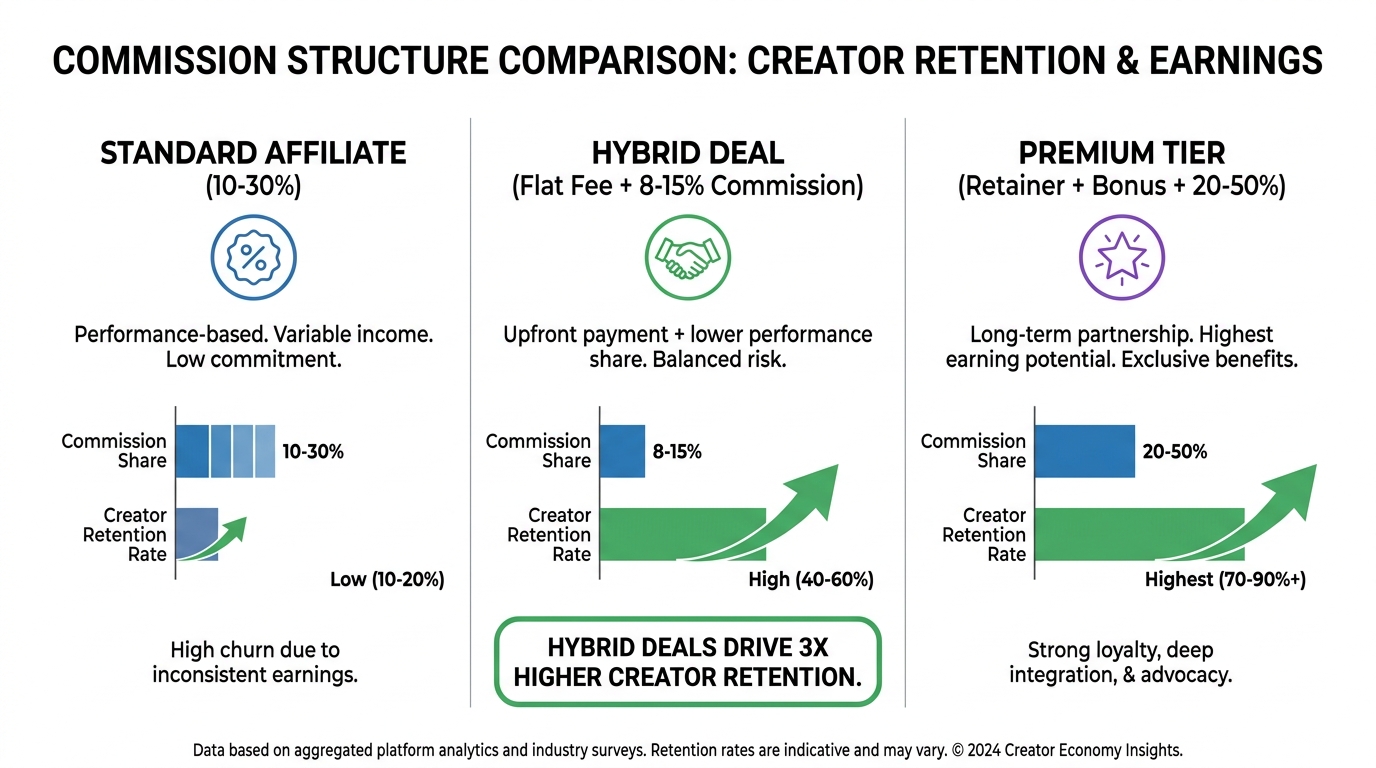
Commission structure is where most creator affiliate programs either build sustainable creator relationships or destroy them. The structure communicates two things simultaneously: how much you value the creator’s contribution, and how you think about the risk and reward balance between brand and creator. Getting it wrong in either direction — paying too little or structuring it in a way that feels unpredictable to creators — accelerates churn.
The Range Reality in 2026
On TikTok Shop — currently the most active creator affiliate marketplace in the US — standard commission rates run from approximately 10 to 30 percent for most product categories, with open collaboration rates set by sellers and targeted (private) deals often running higher for specific creators. The range of 1 to 80 percent technically exists within the platform’s rules, but the functional market for most categories clusters in the 10 to 25 percent zone for open collaboration.
Amazon’s affiliate structures run considerably lower — typically 1 to 10 percent for standard Associates rates, with specific categories reaching 20 percent. LTK and ShopMy operate on retailer-set commission rates that vary widely by brand but are generally more competitive than Amazon for fashion and beauty categories, the primary product niches where those platforms dominate.
Commission rate matters, but it is not the only variable creators use to evaluate program attractiveness. Payout timing, payment reliability, cookie window length, and rate stability all weigh heavily — in some cases more heavily than the headline percentage.
Rate Stability and the 30-Day Lock Mechanism
TikTok Shop introduced a 30-day grace period for commission rate changes in 2026: when sellers lower a commission rate, creators keep the old rate for 30 days, while rate increases take effect immediately. This is a creator-protective policy, but it also signals something important about the competitive dynamic — creators have enough options that platforms are implementing structural protections to prevent brands from cutting commissions post-recruitment.
For brands, this is a signal to approach commission rates as medium-term commitments rather than variable levers to pull quarter-to-quarter. Frequent commission changes destroy creator trust and signal instability. The brands that retain their best creators set rates they can sustain, build escalators that give creators upside as volume grows, and reserve rate adjustments for significant program restructures rather than margin management.
Return Clawbacks and Commission Calculation
TikTok Shop calculates affiliate commission as: (Revenue − Refunds) × Commission Rate. This means creators absorb the commission impact of returns, which is financially logical but creates friction when return rates spike on a specific product. Brands should communicate return rates transparently to creators before they commit to promoting specific SKUs — particularly in categories like apparel where return rates can exceed 30 percent. A creator promoting an item with a 25 percent return rate will see their effective commission cut significantly below the headline rate.
Onboarding as Infrastructure — Why Most Brands Get It Backwards
Creator onboarding is universally under-invested. Brands spend significant effort on recruitment, negotiate carefully on commission, and then deliver a welcome email, a link to a product catalog, and a vague instruction to “post when ready.” The result is a massive drop-off between creators who enroll and creators who ever post a single piece of content.
Industry data on activation rates is consistent: the majority of enrolled affiliates in any program never make a qualifying sale. A significant portion never make their first post. This is an onboarding failure, not a creator quality failure — and it is entirely preventable.
The First 14 Days Are Make or Break
Creator activation follows a predictable time curve. Creators who post within the first 14 days of joining a program are dramatically more likely to become active, ongoing contributors than those who do not post in that window. After 30 days without a post, the probability of meaningful long-term engagement drops sharply. The first two weeks are not a courtesy period — they are the highest-leverage moment in the entire creator relationship.
An effective onboarding sequence for the first 14 days includes:
- Day 1: Automated welcome with account access, link generation instructions, and a curated “starter kit” of 3 to 5 recommended products optimized for their content category.
- Day 3: First content brief with specific creative guidance — not a script, but a prompt that gives them a framework (the problem the product solves, the audience it is for, the one thing they should demonstrate).
- Day 7: A check-in from a real person (or a highly personalized automation) that asks if they have any questions about products or link setup, and surfaces any promotional hooks available that week (flash sale, new SKU launch, etc.).
- Day 14: Performance overview if any content has gone live, or a re-engagement prompt if not. This is the last natural intervention point before the creator relationship goes cold.
Product Access as Activation Catalyst
The single most effective onboarding accelerant is rapid product access. Creators cannot make authentic recommendations for products they have not used. Programs that require creators to purchase products at a discount before posting see lower activation rates than programs that provide product samples as part of onboarding — particularly at Tier 2 and above.
The gifting decision should be tied to tiers from the start: Tier 3 creators can be expected to evaluate from their own purchase experience or to promote based on product descriptions alone; Tier 2 creators should receive samples for key SKUs; Tier 1 creators should have first access to new product launches before they hit the broader market. This sequencing creates a meaningful incentive for tier advancement that extends well beyond commission rates.
Attribution in a Post-Cookie World: What Actually Works for Creator Affiliate Programs
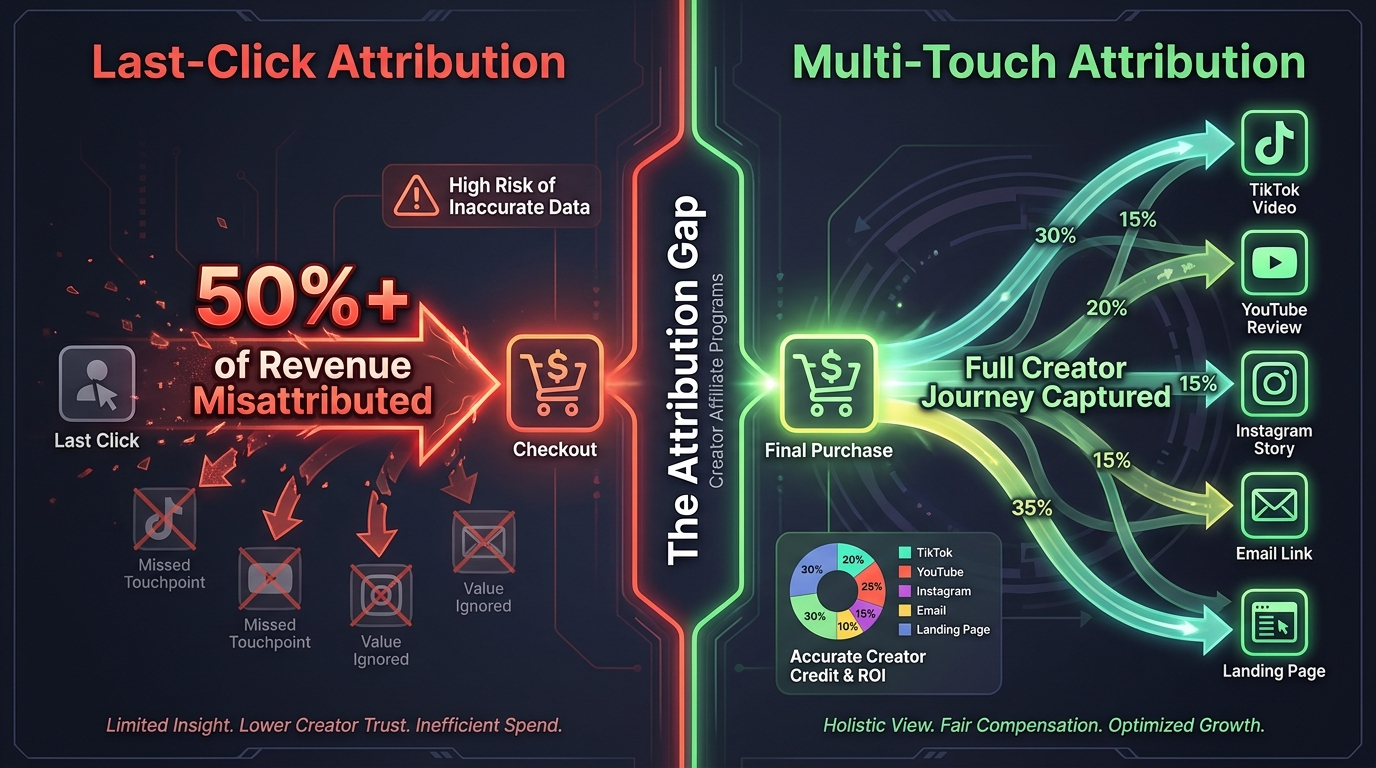
Attribution is the technical foundation of a creator affiliate engine, and it is also where the gap between what brands think they know and what is actually happening is widest. Research suggests that when brands rely on last-click attribution models, more than 50 percent of revenue is systematically misattributed — meaning a significant fraction of creator-driven sales are either credited to a different channel or not credited at all.
This matters in two ways. First, it means you are making tier and budget decisions based on incomplete data — potentially demoting or exiting creators who are actually driving significant pipeline. Second, it means creators whose sales are being undercounted will eventually figure it out, and when they do, they will leave for programs that track their impact more accurately.
Why Last-Click Fails for Creator Commerce
Last-click attribution credits the final touchpoint before purchase with 100 percent of the conversion value. In traditional affiliate contexts — where a publisher drives a click directly to a product page and the sale follows shortly after — this is a reasonable approximation. In creator-driven commerce, it is structurally broken.
A typical creator-influenced purchase journey looks nothing like a direct click. A viewer sees a TikTok review, searches the product on Google, reads a Reddit thread about it, gets served a retargeting ad, and then converts through the brand’s direct website three days later. Last-click gives all the credit to the final paid ad — crediting zero to the creator who initiated the entire purchase journey. Multiply this across thousands of transactions and you have systematically misallocated both credit and budget.
The Dual-Model Attribution Approach
The emerging best practice for creator affiliate programs in 2026 is a dual-model approach that uses multi-touch attribution for tactical, creator-level decisions and media mix modeling or incrementality testing for broader budget allocation. Neither model is perfect in isolation; together they triangulate a more accurate picture of actual impact.
For multi-touch attribution at the creator level, the practical infrastructure requirements are:
- First-party identity resolution: connecting customer accounts and purchase history to link clicks and content views to build creator-level attribution paths without relying on third-party cookies.
- Unique tracking URLs per creator per content piece: not just one link per creator, but content-level tracking that shows which specific videos or posts are driving the conversion path.
- Promo codes as supplementary attribution: unique discount codes per creator provide a backup attribution mechanism that captures sales where link tracking fails — particularly on platforms where links are not directly clickable (Instagram captions, TikTok bio links).
- Server-side event tracking: as browser-level cookie restrictions tighten, server-side tracking provides a more reliable data stream for attribution that does not depend on client-side JavaScript execution.
Incrementality Testing for Your Top Creators
For Tier 1 creators with sufficient volume, incrementality testing is worth the operational overhead. A properly run holdout experiment — where a matched audience does not see a creator’s content for a defined period — can give you a clean read on how much incremental revenue that creator actually drives versus revenue you would have captured anyway. This is particularly important for high-commission, high-investment Tier 1 relationships where the economic stakes justify the rigor.
The Hybrid Deal Model — Blending Fixed Fees With Performance Upside
Pure commission-only deals favor brands and create uncertainty for creators. Pure flat-fee deals favor creators and create no performance incentive. The hybrid deal — a guaranteed baseline payment plus a commission on sales — resolves the tension and creates the structural conditions for long-term creator retention.
The hybrid model has become the dominant structure for Tier 1 creator relationships in 2026, driven by a simple economic reality: the creators who are best at driving sales also have the most options, and pure commission deals do not adequately compensate them for the risk that a piece of content fails to convert through no fault of their own (new product launch with no social proof, competitive week in the market, algorithm changes affecting reach).
Structuring a Hybrid Deal That Works for Both Sides
A functional hybrid deal has three components:
The Guaranteed Base: This is a flat fee paid regardless of sales performance. It compensates the creator for the time investment in producing quality content and signals that the brand values the relationship independent of a single campaign’s results. The base should be meaningful enough to justify the creator’s time but low enough that the total deal economics only make sense if the commission component is also earned. Typical ranges for mid-tier creators with proven category relevance run from several hundred to several thousand dollars depending on audience size and content scope.
The Commission Layer: Applied to all attributed sales from the creator’s content during the deal window. For hybrid deals, commission rates can be set somewhat lower than in a pure-commission arrangement because the creator is not bearing all the conversion risk. The commission should still be competitive with market rates in the category — creators can easily calculate what they would earn at a competitor’s standard rate and will compare.
The Performance Escalator: This is the element most brands omit, and its absence is a retention problem. An escalator is a bonus threshold — if the creator drives sales beyond a defined GMV target, the commission rate increases for the excess volume, or a bonus payment triggers. Escalators give creators a direct financial incentive to go beyond the minimum content obligation, and they create the kind of collaborative excitement around a campaign that flat deals never generate.
The Retainer Model for Tier 1 Creators
For top-performing Tier 1 creators, some brands have moved to a full retainer structure — a monthly guaranteed payment in exchange for a defined number of posts, first access to new products, and exclusivity (or right of first refusal) within the category. This model is more common in fashion and beauty where creator relationships tend to be longer-lived and where the brand association value is as important as the direct GMV attribution.
Retainer deals require clear deliverable definitions — how many posts, which formats, which products, posting cadence — and explicit provisions around what happens if the creator goes viral in a way that materially exceeds expectations. Without that upside clause, brands get the benefit of outsized performance at a fixed cost while the creator leaves value on the table. That asymmetry erodes trust and eventually ends the relationship.
Platform Comparison: Where to Run Your Creator Affiliate Engine in 2026
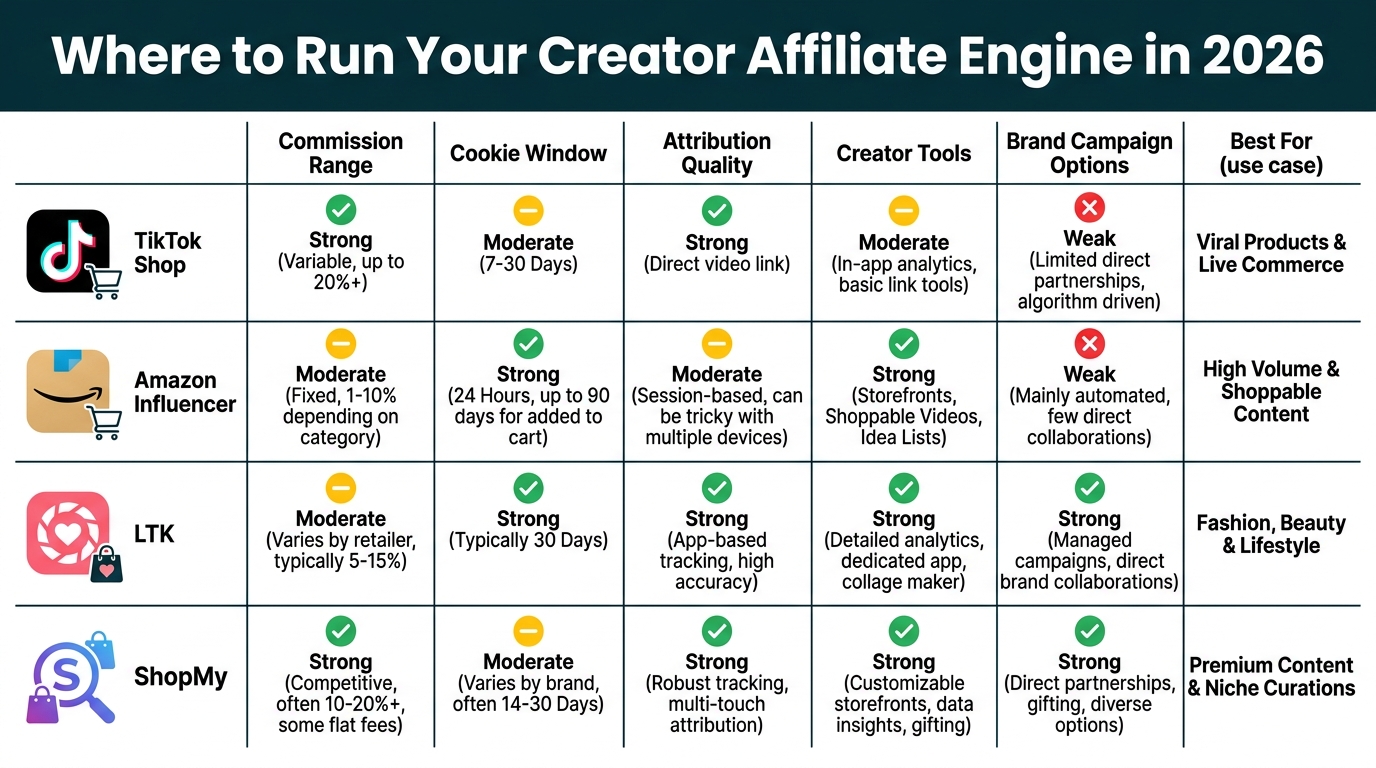
The platform question does not have a universal answer. The right infrastructure for your creator affiliate engine depends on your product category, your target customer demographics, your existing brand presence, and how much operational control versus audience reach you are willing to trade off. What follows is a practical breakdown of the four primary options in 2026 — not a ranking, but a characterization of what each platform is actually good at and where it creates friction.
TikTok Shop Creator Marketplace
TikTok Shop is currently the most active social commerce creator marketplace in the US and UK, with commission rates running 10 to 30 percent in most categories (seller-set), a two-mode collaboration structure (Open for broad creator access, Targeted for specific creator deals), and built-in attribution tracking through the platform’s native checkout. The key advantages are the platform’s purchase-intent audience and the speed of the content-to-conversion loop — TikTok’s For You Page algorithm can take a creator’s affiliate content viral within 24 hours, driving conversion spikes that are impossible in other channels.
The limitations are real, though. TikTok’s attribution data lives within its walled garden — you see what TikTok tells you about sales, but cross-platform attribution is limited. Cookie windows are relatively short, return rates can be high in certain categories, and the platform’s commission clawback structure means creators absorb the financial impact of returns. For brands, TikTok Shop works best as a volume-oriented acquisition channel, particularly for products in the $20 to $80 price range where impulse purchase dynamics are strongest.
Amazon Influencer Program
Amazon’s affiliate infrastructure — combining the Associates program with the Influencer program’s storefront capability — is the highest-conversion creator affiliate channel in existence, driven by the platform’s unmatched buyer trust and the purchase-ready nature of Amazon’s logged-in user base. Commission rates are structurally lower (1 to 10 percent in most categories, with selected categories reaching 20 percent), but conversion rates are significantly higher than on social commerce platforms because users arrive with purchase intent already established.
Amazon works best for products already sold on Amazon with strong review histories. A creator affiliate link to a product with fewer than 100 reviews will underperform significantly compared to a well-reviewed listing. For brands with established Amazon presence and strong review velocity, the Influencer program adds a meaningful affiliate layer at low structural cost.
LTK (LikeToKnow.it)
LTK operates as a managed creator marketplace with deeper brand-creator campaign infrastructure than most pure affiliate platforms. Commissions are retailer-set and vary widely, but the platform has strong penetration in fashion, home, and beauty, where its curated shopping format and dedicated LTK app user base create a high-intent shopping audience. LTK’s strength is in shoppable editorial content — the format suits product discovery rather than impulse purchase, making it better for higher-consideration categories.
The managed campaign layer means brands can run more structured creator programs through LTK than through a pure open affiliate model, but it also means less brand-side control over the exact creator mix and content approach. LTK is typically best suited as a secondary or supplementary channel rather than a primary affiliate engine.
ShopMy
ShopMy positions itself as a creator-first affiliate platform with strong tools for creator-side monetization — gifting workflows, brand chat, discount code management — and a more direct brand-creator relationship model than LTK’s managed approach. It tends to attract creators who are actively building their affiliate income as a business and who want more transparency in the brand relationship. Neither creators nor brands pay upfront fees; the platform operates on brand commissions.
ShopMy works well for brands willing to invest in direct creator relationship-building and who want more flexibility in deal structure than standard open affiliate programs allow. It is growing in beauty and wellness, where creator trust and community relationships are high-value signals.
The Multi-Platform Reality
In practice, the most sophisticated creator affiliate engines in 2026 run across multiple platforms simultaneously — using TikTok Shop for volume discovery and fast conversion, Amazon Influencer for purchase-intent conversion amplification, and LTK or ShopMy for higher-consideration categories and deeper brand storytelling. The management overhead of multi-platform operation is real, but the diversification of both creator access and attribution data is worth it at scale.
Measuring What Matters — The KPIs Behind High-Performing Creator Programs
Most creator affiliate programs measure the wrong things. They track reach, impressions, follower counts, and engagement rates — all metrics that are easy to report but only loosely connected to actual business outcomes. A mature creator affiliate engine measures the metrics that directly predict revenue contribution and program health.
The Metrics That Actually Matter
Activation Rate: The percentage of enrolled creators who post at least one piece of qualifying affiliate content within 30 days of joining. A healthy activation rate suggests effective onboarding and product access. A low activation rate — below 30 percent, which is unfortunately common — indicates a structural onboarding problem that will suppress program performance regardless of how many creators you recruit.
Revenue Concentration Index: What percentage of your total attributed GMV comes from your top 10 percent of creators? If this number is above 90 percent, you have excessive concentration risk — losing a single creator could materially impact program revenue. If it is below 60 percent, your program may be inefficiently broad, investing in too many low-performing creators at the expense of investing deeply in your proven drivers.
Creator Retention Rate (90-day and 180-day): Of creators who activated in a given cohort, what percentage are still actively posting 90 and 180 days later? Low retention rates indicate that the program economics are not compelling enough to sustain creator engagement, or that the onboarding and activation process is not delivering enough early success to build habit.
Average Order Value by Creator Tier: Tier 1 creators should be driving higher AOV purchases than Tier 3, not because they are selling more expensive products but because their audience trust translates into more deliberate purchase decisions rather than impulse buys. If Tier 1 AOV is not meaningfully higher than Tier 3, your tier definition may need recalibration.
Commission-to-GMV Ratio: What percentage of total GMV generated by the program is paid out in commissions? This is your affiliate program’s effective cost-of-sale rate and should be benchmarked against your other acquisition channels. A creator affiliate program where the commission-to-GMV ratio sits at 15 percent is a significantly more efficient acquisition channel than paid social running at a 25 to 40 percent equivalent cost when you factor in media spend plus creative production costs.
Content-to-Conversion Latency: How long does it take from a creator’s post going live to the associated purchase conversions completing? In TikTok Shop’s fast-cycle environment, this can be 24 to 72 hours. In higher-consideration categories, it might be 14 to 30 days. Understanding this latency helps you set accurate attribution windows and evaluate creator performance without penalizing creators for categories with longer purchase cycles.
Scaling Without Breaking — Automation, Guardrails, and Creative Governance
There is a version of creator affiliate program growth that is genuinely exciting: the roster expands, GMV climbs, the data flywheel starts producing useful signals, and the program begins to feel like an actual infrastructure asset rather than a side project. There is another version that looks identical from the outside but is actually a slow-moving catastrophe — brand safety violations accumulating, commission payments disputed by creators, content going out that contradicts your positioning, and no system in place to catch any of it before it becomes a problem.
Scale without governance is how programs collapse. The infrastructure that prevents collapse has three components.
Automated Workflow Systems
At 50 or more active creators, manual management of link generation, payment tracking, performance reviews, and tier changes becomes untenable. The operations need to be automated: link generation and unique tracking URL creation automated at enrollment, payment calculation automated on payout schedule (with a manual review flag for outlier amounts), tier evaluation automated against defined performance thresholds with a human approval gate before promotion or demotion takes effect.
The platforms themselves provide some of this automation — TikTok Shop’s creator marketplace handles affiliate tracking and payment for on-platform sales natively. Third-party affiliate management platforms like Impact, PartnerStack, or Grin layer in additional automation for brands running multi-platform programs. At significant scale (100+ active creators), a dedicated affiliate management platform is not optional infrastructure — it is table stakes.
Brand Safety and Content Governance
As your creator roster grows, the probability of a content piece going live that misrepresents your product, violates FTC disclosure requirements, or contradicts your core positioning grows proportionally. You cannot review every piece of creator content before it posts — that is not how creator affiliate programs operate. What you can do is:
- Provide clear, written content guidelines that creators acknowledge at enrollment — not a script, but explicit guardrails on what cannot be said, what disclosures are required, and what constitutes a misrepresentation.
- Implement a post-publication monitoring system that flags content containing specific keyword triggers or that generates unusual complaint volume in comments.
- Build explicit brand safety provisions into your creator agreements with defined consequences for violations — including the right to terminate affiliate relationships for material guideline breaches.
FTC compliance is non-negotiable. Affiliate content must disclose the commercial relationship. As a brand, you share responsibility for ensuring your creators are making required disclosures — “we did not ask them to disclose” is not a defense that protects you from regulatory action.
The Anti-Saturation Guardrail
One failure mode unique to creator affiliate programs is creator saturation — a point where so many creators in a given niche are promoting the same product that the content starts to feel manufactured and audiences begin tuning it out. This happens when program growth is optimized purely for creator count without regard for audience overlap or content volume per product.
The solution is a product-level creator density limit: define how many active creators can be simultaneously promoting a given SKU or product family at any one time, and rotate who has access if demand from creators exceeds that limit. This keeps the content feeling fresh and prevents the algorithmic penalties that come when platforms detect coordinated campaign behavior.
Conclusion — Building an Engine vs. Running a Campaign
The distinction that matters most in creator affiliate marketing in 2026 is not which platform you use, which commission rate you set, or how many creators you recruit. It is whether you are running a campaign or building an engine.
A campaign has a start date, an end date, a defined budget, and a final report. An engine has enrollment, tiers, activation infrastructure, attribution systems, and a data loop that gets smarter every week. Campaigns produce incremental revenue. Engines produce compounding returns.
The brands that are winning the creator affiliate space in 2026 — capturing the shift that EMARKETER documents as creators becoming the fastest-growing publisher type in the affiliate channel — are not the ones with the biggest influencer budgets. They are the ones that treated creator relationships as infrastructure early enough to have data, tier depth, and attribution systems working in their favor while competitors are still running one-off campaigns.
The operational reality is harder than the conceptual version. Tiering requires defining metrics and enforcing them when a Tier 1 creator has gone inactive. Attribution requires technical infrastructure investment that marketing teams rarely own or fully control. Hybrid deals require negotiation nuance that most procurement-driven brand relationships are not set up to handle. Content governance requires ongoing monitoring that does not end when the campaign does.
But the operational difficulty is precisely why it is a durable advantage. If building a scalable creator affiliate engine were easy, every brand would already have one. The fact that most brands are still running campaigns is the opportunity for the ones willing to build the infrastructure instead.
Actionable Starting Points
- Audit your current creator roster against a three-tier framework. Which creators belong where? Which are in the wrong tier based on current attribution data?
- Calculate your activation rate. What percentage of enrolled creators have posted in the last 30 days? If it is below 40 percent, fix onboarding before adding any new creators.
- Check your attribution model. Are you running last-click? If yes, identify two to three creators where you suspect significant underattribution and run a 60-day incrementality test.
- Map your highest-GMV creators to their compensation structure. Are they on pure commission? Are they retention risks? What would a hybrid deal for your top three creators cost, and what is the revenue at risk if they leave?
- Pick one platform to optimize before expanding. Multi-platform is the eventual goal, but split attention across TikTok Shop, Amazon, LTK, and ShopMy simultaneously before you have a functioning engine on any of them is a common mistake. Get one platform working at depth first.
The creator economy is $323 billion and still growing. The affiliate channel within it is accelerating. The infrastructure to capture a meaningful share of that value already exists — on TikTok Shop, on Amazon, on LTK, on ShopMy, and through the management platforms that sit above all of them. The question is not whether the opportunity is real. It is whether your program is built to capture it.