



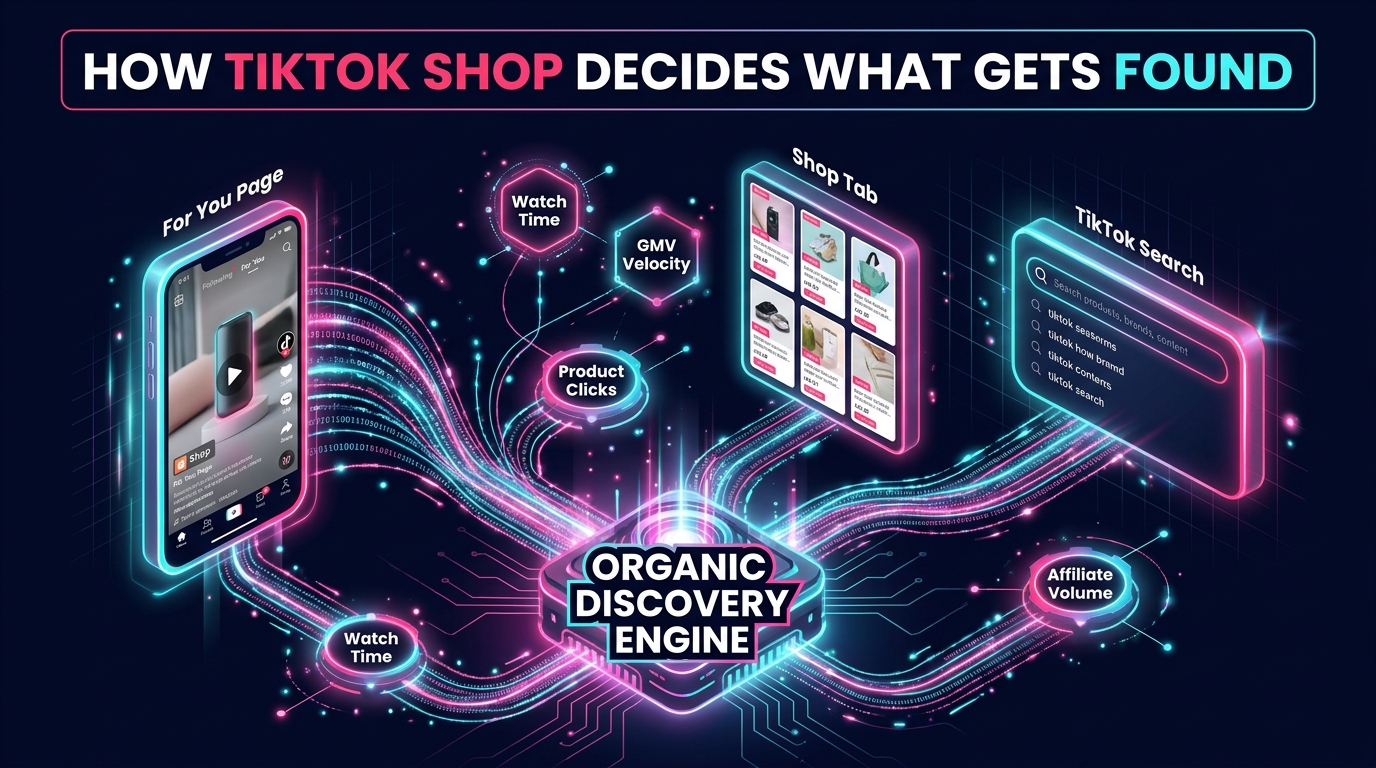
There is a persistent myth inside TikTok Shop seller communities: if your video goes viral, your product sells. If your product doesn’t sell, you just haven’t gone viral yet. This thinking puts all the weight on a single, unpredictable event — and almost entirely ignores the actual infrastructure TikTok has built underneath its commerce layer.
The reality is considerably more mechanical, and considerably more actionable. TikTok Shop’s organic discovery system isn’t one algorithm. It’s at least three distinct ranking surfaces, each with its own signal weights, its own optimization levers, and its own definition of what “good” looks like. A seller who goes viral on the For You Page but ignores the Shop Tab and Search surface is leaving two thirds of their organic discovery potential untouched.
Meanwhile, TikTok Shop is no longer a scrappy side channel. Global GMV hit $64.3 billion in 2025 and is tracking toward $112 billion or more in 2026 — approximately 70% year-over-year growth. In the US alone, TikTok Shop is projected to reach $23.41 billion in sales in 2026, positioning it to outperform the combined digital revenue of major retailers. The sellers winning in this environment aren’t just making good content. They’re engineering their presence across all three discovery surfaces with surgical precision.
This piece breaks down how TikTok Shop’s organic discovery engine actually works — from the architecture of its three surfaces, to the commerce signals that now outrank pure content performance, to the Shop Performance Score that most sellers don’t even know is throttling their reach. If you’ve been treating TikTok Shop like a content platform with a checkout button, this article is going to change how you think about the entire operation.
The Three-Surface Discovery Architecture Most Sellers Ignore
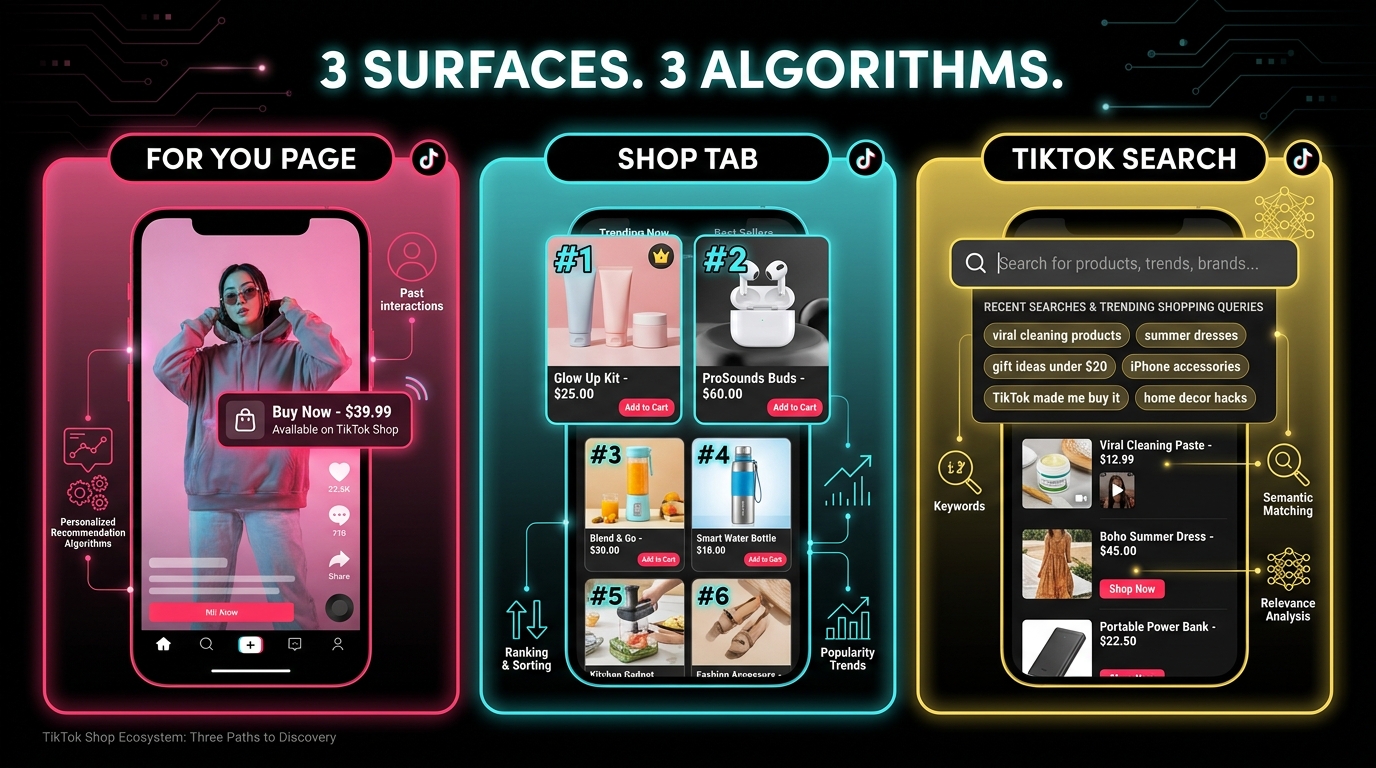
When sellers talk about the TikTok algorithm, they’re almost always talking about one thing: the For You Page. But TikTok Shop products can be discovered through three meaningfully different surfaces, each of which operates on a different logic. Conflating them is the single most common strategic error in TikTok Shop optimization.
Surface 1: The For You Page (FYP) — Shoppable Video Feed
The FYP is where most sellers focus, and for good reason — it’s the highest-volume distribution surface on the platform. When a shoppable video gets traction here, the product tag embedded in it creates a direct path from entertainment to purchase. But the FYP algorithm is fundamentally a content algorithm that has been retrofitted with commerce signals. It still starts with watch time and completion rate as its foundational inputs. The question the FYP engine is constantly asking is: does this video hold attention?
What’s changed in 2026 is that the FYP now blends content engagement with downstream commerce behavior in a way it didn’t two years ago. A video with strong watch time but zero product clicks will get some distribution. A video with slightly lower watch time but strong add-to-cart and purchase rates will get more distribution — and for longer. The platform has effectively added a commerce multiplier on top of the traditional engagement score.
Surface 2: The Shop Tab — Product Card Ranking
The Shop Tab is the product grid at the top of TikTok’s navigation. This is where users who already have purchase intent land. It functions more like a marketplace search engine than a social feed — the ranking logic here weights listing-level signals: product title keyword relevance, product card click-through rate, conversion rate once users reach the product page, review score and volume, and price competitiveness within the category.
Many sellers generate strong FYP traction but have entirely unoptimized Shop Tab listings. They’re driving video traffic to a product card that doesn’t convert, which destroys their conversion-rate signal and suppresses their Shop Tab ranking. The FYP and Shop Tab are connected systems, but they need to be optimized independently.
Surface 3: TikTok Search — The Intent Layer
TikTok has been steadily positioning itself as a search engine, particularly for younger demographics. A significant and growing share of product discovery on TikTok now starts with a search query rather than passive scrolling. TikTok’s own data suggested as far back as late 2023 that approximately 40% of Gen Z users use TikTok as their primary search engine for product discovery — and that trend has only deepened.
Search-driven discovery surfaces both organic videos and product cards based on keyword match and relevance signals. For sellers, this means that keyword optimization in product titles, video captions, on-screen text, and even spoken audio in videos affects search ranking. The sellers treating TikTok like a pure entertainment platform are invisible to the fraction of their audience that is actively searching for products in their category.
Why Surface Mix Matters for Strategy
The practical implication is that a complete organic discovery strategy requires a different playbook for each surface. FYP optimization is about content quality and commerce-weighted engagement. Shop Tab optimization is about listing quality, conversion mechanics, and review signals. Search optimization is about keyword architecture, on-video text, and content-answer match. Brands that explicitly allocate effort across all three tend to see compounding returns — because each surface feeds signals into the others.
Commerce Signals vs. Content Signals: The New Ranking Hierarchy
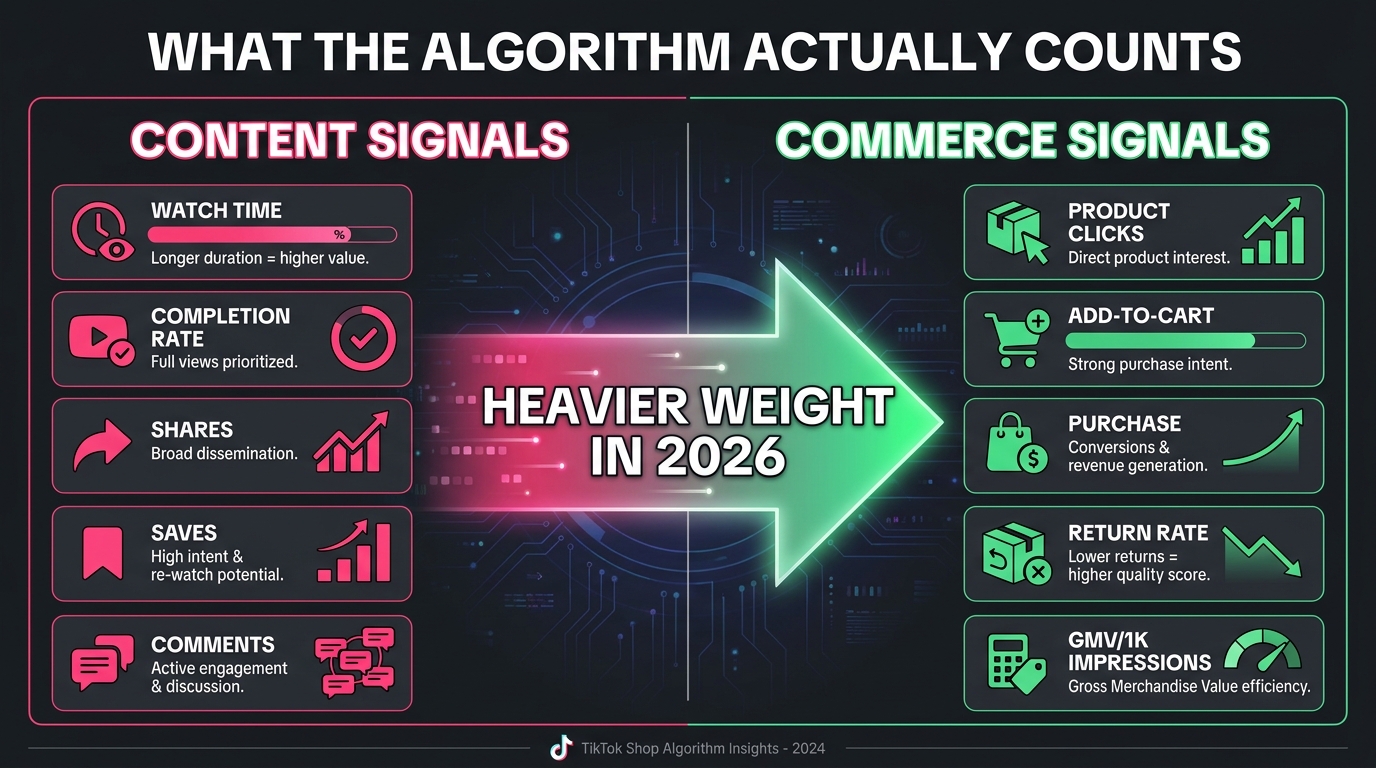
The most consequential shift in TikTok Shop’s ranking behavior over the past 18 months has been the progressive upweighting of commerce signals relative to pure content signals. Understanding the difference — and optimizing accordingly — is what separates operators running seven-figure TikTok Shop businesses from sellers who get a viral moment but never convert it into sustainable GMV.
What Content Signals Cover
Content signals are what TikTok’s original recommendation engine was built on. They include:
- Video completion rate: The percentage of viewers who watch the full video, or the average watch-through percentage for longer content. Still the single most foundational signal for FYP distribution.
- Replay rate: Whether viewers watch the video more than once, which signals high value or emotional resonance.
- Shares: One of the strongest pure content signals because it indicates a viewer found the content valuable enough to broadcast to their own network.
- Saves: Indicates the viewer intends to return to the content, a high-value behavioral signal that reflects content utility or desire.
- Comments: Volume of comments matters less than speed of comments — fast comment velocity in the first hour post-publish signals strong initial audience resonance.
- Follows from the video: When a video causes a viewer to follow the account, it signals the content was compelling enough to trigger a long-term relationship.
What Commerce Signals Add
Commerce signals are layered on top of content signals for any video that contains a product tag, and for product cards on the Shop Tab and Search surfaces. These include:
- Product page clicks: The rate at which viewers tap through to the product detail page from the in-video product tag.
- Add-to-cart rate: The proportion of product page visitors who add the item to their cart, a strong proxy for purchase intent.
- Checkout start rate: How many cart additions convert to a checkout initiated.
- Purchase conversion rate: The end-to-end conversion from video impression to completed purchase — arguably the most powerful individual signal in TikTok Shop’s commerce ranking layer.
- Return and dispute rate: Products with high return rates are algorithmically suppressed. This is a trust signal that protects buyer experience across the platform.
GMV Per 1,000 Impressions: The Meta-Metric
The most useful way to think about how these signals combine is through a proxy metric that operators increasingly track: GMV per 1,000 impressions, sometimes called revenue per mille (RPM) in a commerce context. This is essentially asking: for every 1,000 times your shoppable video appears in someone’s feed, how much gross revenue does it generate?
A video with a 60% completion rate but a 0.1% purchase conversion rate produces very low GMV/1K. A video with a 35% completion rate but a 1.2% purchase conversion rate produces dramatically higher GMV/1K. In 2026, TikTok Shop’s algorithm shows clear preference for the latter — distributing content that demonstrably converts over content that merely entertains. This isn’t a philosophical position by TikTok — it’s a commercial one. The platform makes money when transactions happen, so it prioritizes content that creates transactions.
The Implication for Content Strategy
This hierarchy means that optimizing TikTok Shop content for entertainment virality without also optimizing for purchase intent is strategically incomplete. The best-performing TikTok Shop content in 2026 creates a specific emotional or informational trigger that makes viewers want to buy — not just watch. Demonstration videos, “reaction to first use” formats, transformation before/afters, and “why I switched from X to this” narratives consistently produce higher commerce signal ratios than pure entertainment or trend-chasing content.
The Cold Start Window: What Happens in Your First 48 Hours
Every new product listed on TikTok Shop enters what the platform’s internal logic treats as a cold start period — a short, high-consequence window where the algorithm tests the product’s potential with a small initial audience, then makes a provisional decision about how aggressively to distribute it going forward. Getting this window right is one of the highest-leverage moments in an entire product launch.
How the Test-and-Expand Mechanism Works
TikTok’s recommendation system doesn’t distribute new content (or new products) broadly on day one. Instead, it makes a small initial bet: showing the content to a narrow seed audience, watching how that audience behaves, and using those early signals to calibrate how much wider to push distribution. For TikTok Shop products, this seed audience phase typically plays out across the first 24 to 48 hours.
The signals being evaluated in this window are weighted heavily toward commerce actions rather than passive consumption. A new product that generates five purchases in its first 24 hours from a limited test audience gets treated very differently than one that generates 200 video views with zero cart actions. The former has proved commercial viability; the latter has proved nothing useful for a commerce platform.
Why Organic-Only Cold Starts Fail
In the earliest days of TikTok Shop in Western markets, a well-crafted organic video could sometimes carry a new product through cold start on content quality alone. That window has closed in 2026. The algorithm’s cold start expectations have risen with the platform’s commercial maturity. An organic-only cold start — meaning you simply list the product and post one video — rarely generates the commerce signal density needed to survive the cold start window with meaningful distribution momentum.
The operators who consistently clear cold start in 2026 are doing two things simultaneously: seeding multiple creators before the official launch to generate a burst of commerce signal from multiple content sources at once, and often layering a small amount of GMV Max (TikTok’s campaign type that optimizes for shopping conversions) during the first 48 hours to ensure the algorithm has enough purchase data to work with.
The Affiliate Timing Playbook for Cold Start
One of the most operationally specific things a seller can do to improve cold start outcomes is to coordinate affiliate creator posting to coincide with — rather than follow — a product’s launch. The typical mistake is: list the product, wait for organic affiliate activity to trickle in over several weeks, then wonder why the product never gained traction. The high-performing approach is: pre-negotiate with 10 to 20 creators, send product samples ahead of launch, and coordinate simultaneous posting in the product’s first 48-hour window. The resulting burst of purchase activity from multiple content sources at once sends a strong velocity signal that accelerates the algorithm’s decision to push the listing further.
The Shop Performance Score: The Invisible Gate on Your Organic Reach
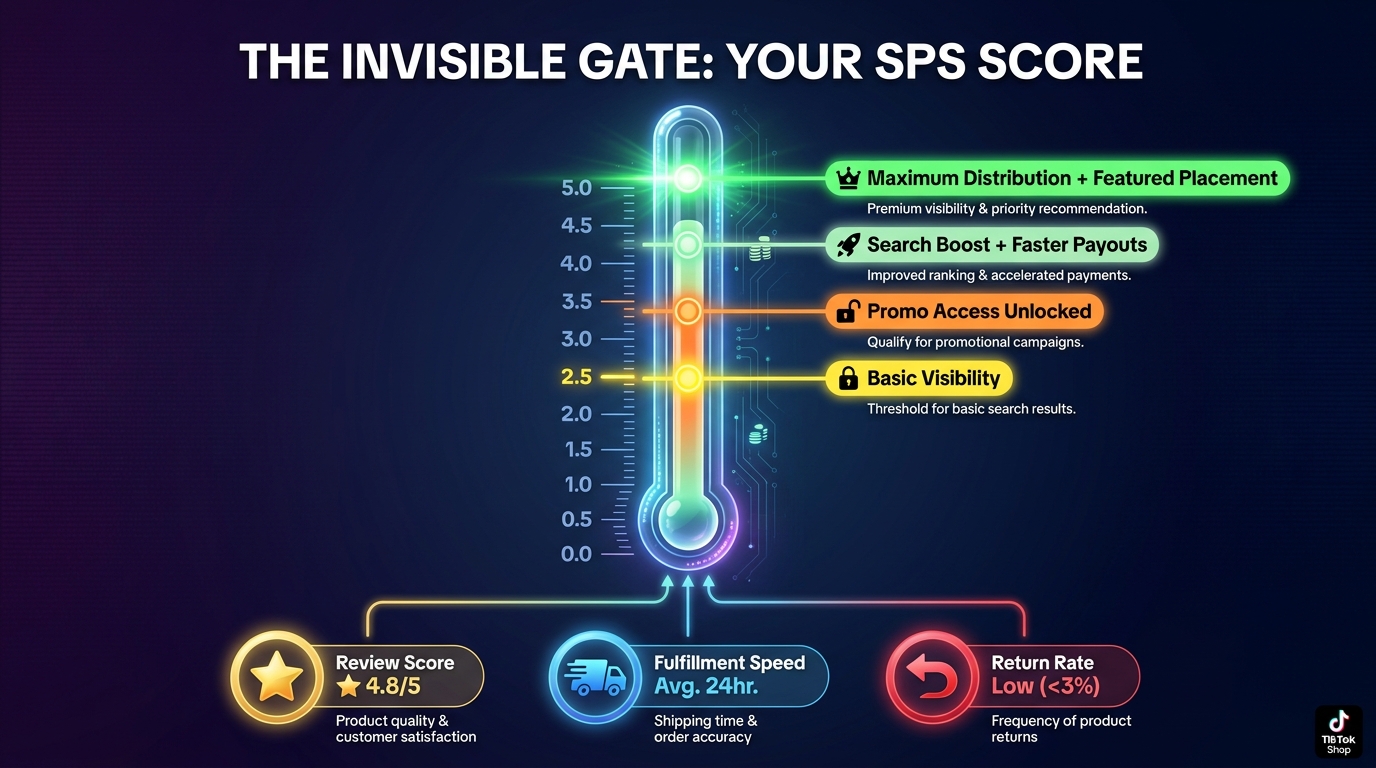
Of all the variables that influence TikTok Shop organic discovery, the Shop Performance Score (SPS) is the one that gets the least attention relative to how much it actually controls. Most sellers are aware that their “account health” matters in some vague sense. Very few understand that TikTok has formalized this into a scored system with specific thresholds that unlock or suppress organic visibility in a fairly direct way.
What the Shop Performance Score Is
The Shop Performance Score is a 0-to-5 composite score that TikTok assigns to every seller account. It aggregates three domains of seller behavior:
- Product satisfaction: Primarily driven by customer review scores and review volume. Products with consistently high star ratings (4.5+) contribute positively; products with low ratings or high dispute rates drag the score down.
- Fulfillment and logistics performance: Shipping speed, on-time delivery rate, order accuracy, and adherence to TikTok’s fulfillment SLA windows. TikTok’s 2026 fulfillment policy updates have tightened these windows and increased the penalty weight for violations.
- Customer service quality: Response rate to buyer inquiries, resolution speed on disputes, and the rate at which issues are resolved without escalation to TikTok’s own mediation system.
The score is calculated on a rolling window (typically 28 to 90 days depending on market and account tier) and updated daily in the Seller Center dashboard.
The Four Threshold Tiers That Matter
SPS isn’t just a number — it’s a gate system. TikTok has established at least four meaningful threshold levels that correspond to different tiers of platform treatment:
- Below 2.5: The danger zone. Sellers in this range face active suppression of organic visibility, reduced search ranking, and potential restrictions on promotional tools. Some sellers in this band report essentially disappearing from organic discovery until their score recovers.
- 2.5 to 3.5: The floor for basic visibility. Sellers in this range get standard organic distribution but have limited access to promotional programs and are deprioritized in competitive category ranking.
- 3.5 to 4.0: The functional growth zone. Sellers here unlock access to more promotional programs, improved search ranking weight, and faster payment settlements in some markets.
- 4.0 to 4.5+: The preferred seller tier. Sellers maintaining scores in this range get preferential treatment in search ranking, access to Featured Deals and promotional placements, priority in the Shop Tab recommendation algorithm, and in some cases, dedicated seller support and early access to new tools.
Why SPS Is Often the Hidden Bottleneck
The challenge is that SPS inputs — reviews, fulfillment, customer service — are operational, not creative. Many TikTok Shop sellers come from a content or marketing background and are well-equipped to optimize videos but have no operational infrastructure for fulfillment quality control or proactive review management. They can generate strong content, strong affiliate activity, and strong initial purchase velocity, and still have their organic reach throttled at the SPS layer because their operational performance is pulling the score below the critical thresholds.
The fix requires treating SPS as a distinct workstream, not an afterthought. That means proactively soliciting reviews (through TikTok’s native review request tools) from satisfied buyers, using Fulfillment by TikTok (FBT) where available to offload logistics SLA risk, and monitoring dispute resolution time with the same discipline applied to content analytics.
The Affiliate Velocity Flywheel: How Organic GMV Compounds
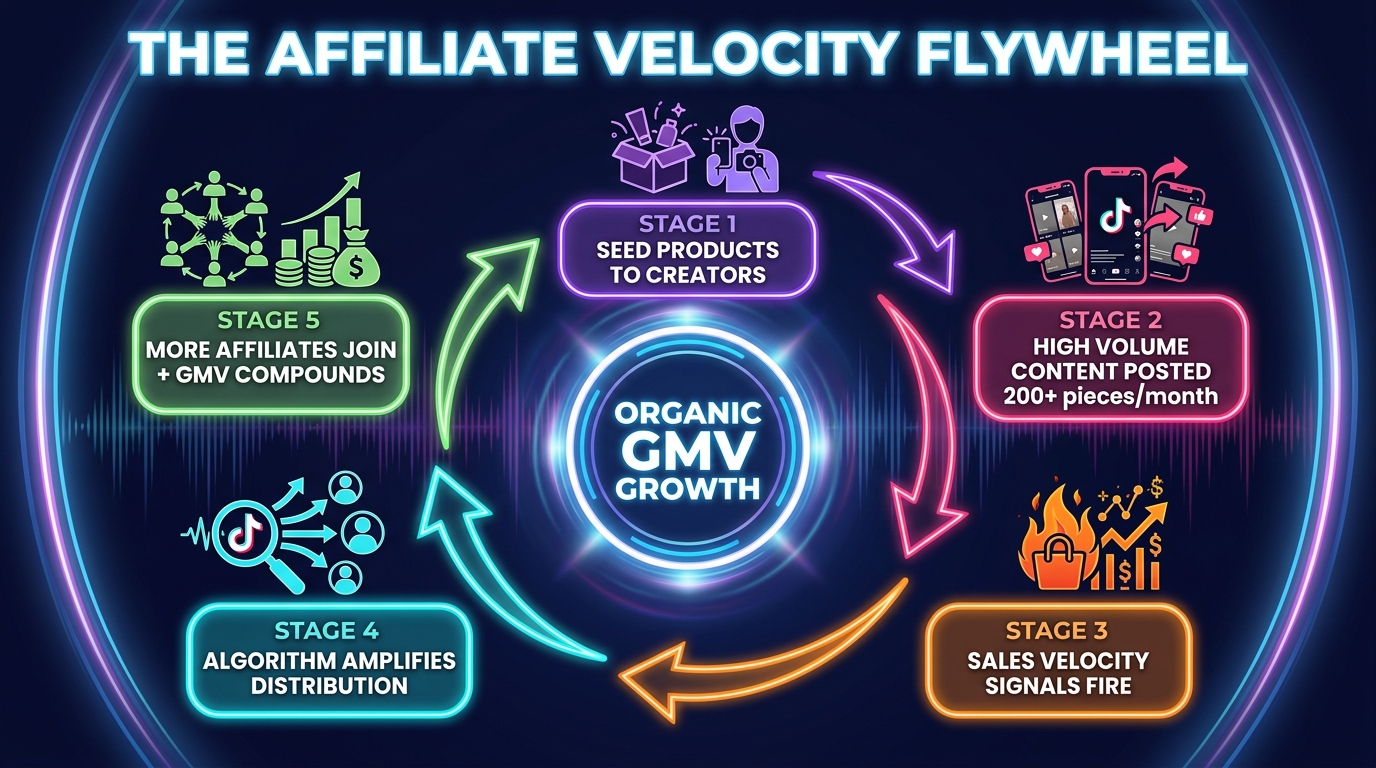
The structural growth mechanic underlying TikTok Shop’s most successful sellers isn’t virality — it’s velocity. Specifically, it’s the compounding effect that emerges when affiliate-driven content volume, sales signals, and algorithmic amplification reinforce one another in a self-sustaining loop. This is the affiliate velocity flywheel, and understanding it changes how you think about everything from creator seeding to commission rates.
How the Flywheel Turns
The flywheel has five connected stages:
- Product seeding to creators: The brand sends product to a volume of affiliate creators — not just five or ten, but often dozens to hundreds, including micro and nano creators with follower counts as low as 5,000 to 10,000.
- High-volume content posting: Those creators post over a compressed window, generating a high volume of concurrent shoppable content. Brands that hit and maintain 200 to 250+ pieces of creator content per month per product show dramatically better algorithmic traction than those averaging 20 to 30.
- Sales velocity signals fire: The concurrent content creates concurrent purchase events, generating the sales velocity and GMV signals that TikTok’s discovery engine reads as indicators of demand.
- Algorithm amplifies distribution: Sensing demand signals, TikTok’s algorithm pushes the listing further — expanding organic reach on the FYP, improving Shop Tab ranking, and surfacing the product more prominently in search results.
- More affiliates join and GMV compounds: The improved visibility attracts more creators who want to earn commissions on a product that’s clearly selling. Each new creator adds more content, more sales, and more signal — and the loop continues.
The Power Law Inside the Flywheel
One important structural reality of the TikTok Shop affiliate ecosystem is that performance follows a steep power law. A very small percentage of creator posts — often 5 to 15% — will generate the majority of a product’s affiliate GMV. This might seem discouraging, but it’s actually the argument for volume seeding. You cannot identify the 10% of creators whose audience-product fit will produce outsized results until you’ve run the experiment. Seeding broadly, tracking performance metrics per creator, and then prioritizing commission upgrades and deeper partnerships with the top performers is the systematic way to leverage the power law rather than be victimized by it.
Commission Rate as an Algorithm Lever
Commission rate isn’t purely a cost line — it’s a discovery signal. TikTok’s affiliate marketplace surfaces products to creators in part based on the commission opportunity. A product offering a 15% commission will get meaningfully more organic creator attention in the marketplace than the identical product offering 5%. In a category with multiple competing products, commission rate becomes a competitive SEO factor for attracting the volume of creator content needed to spin the flywheel in the first place.
TikTok LIVE as an Algorithm Accelerant
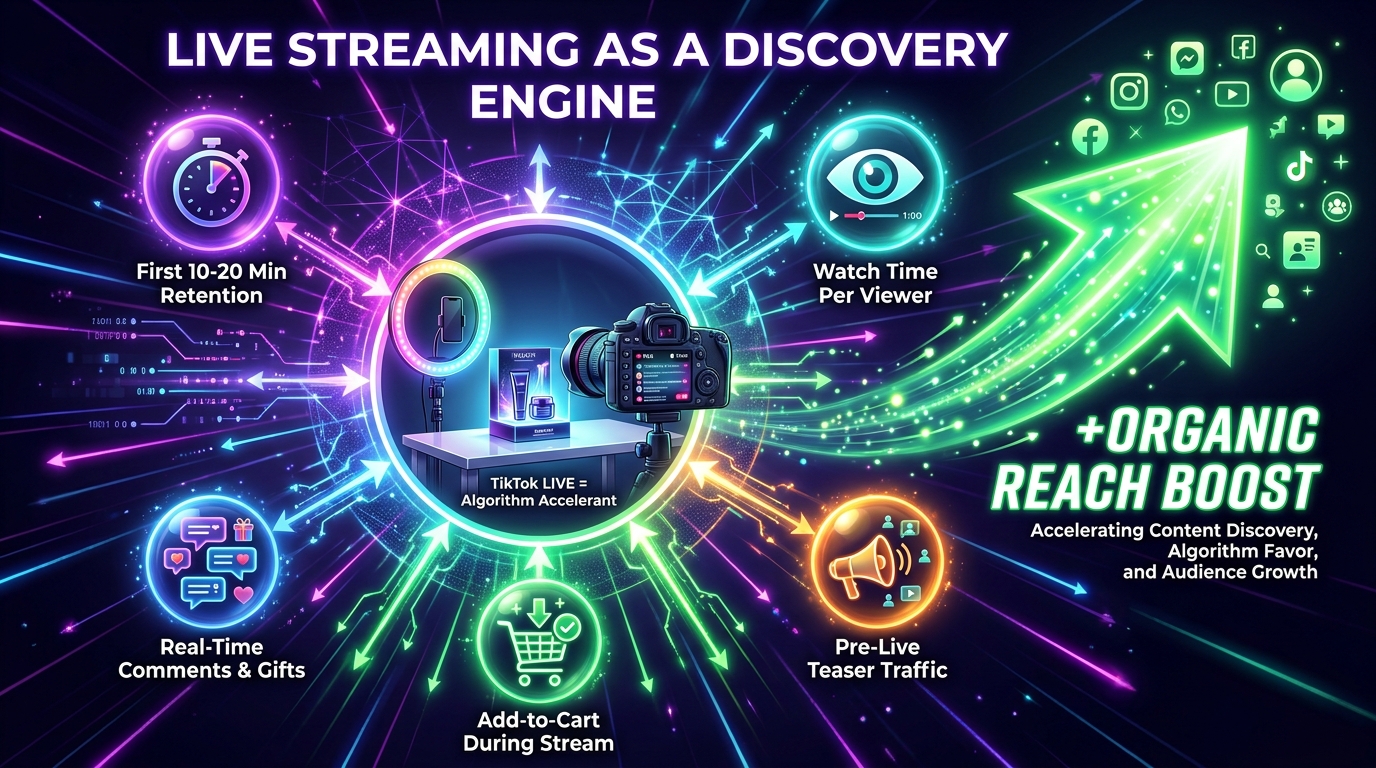
LIVE commerce is the feature that most closely mirrors TikTok Shop’s Chinese parent ecosystem, where live streaming has been the dominant commerce format for years. In Western markets, it has taken longer to gain traction — but the algorithmic advantages TikTok gives to LIVE content are substantial, and sellers who ignore it are leaving one of the most efficient organic reach mechanisms on the platform unused.
Why LIVE Gets Preferential Treatment
TikTok actively prioritizes LIVE content in its discovery algorithm for a straightforward commercial reason: live streaming drives higher engagement duration, higher commerce conversion, and creates event-driven demand that cannot be replicated by static product listings. A 2025 GlobalData survey found that 76% of consumers who used TikTok Shop had bought an item from a LIVE stream in the prior year — a conversion statistic that explains TikTok’s continued investment in the format.
The platform’s LIVE recommendation engine places active streams in front of users who have previously engaged with similar content or products. It also surfaces LIVE content in the FYP with higher organic reach than equivalent non-live content during the stream window. This creates an unusual property: a brand or creator LIVE that might get 2,000 concurrent viewers can generate the purchasing volume of a static video with 200,000 views, simply because the audience is in an active buying mindset rather than a passive scrolling mindset.
The First 10-20 Minutes Make or Break Everything
The most critical insight about TikTok LIVE’s discovery mechanics is that the algorithm evaluates LIVE streams in real time and makes distribution decisions based on early performance. Specifically, the first 10 to 20 minutes of a stream are a de facto test window. Streams that generate strong watch-time retention (measured by how long individual viewers stay in the stream), fast comment velocity, and early commerce actions (product clicks, add-to-cart, purchases) in this initial window receive progressive distribution boosts that can dramatically multiply the audience over the course of the stream.
Streams that start slowly — with thin concurrent viewership, low comment activity, and no early purchases — rarely recover to meaningful scale within the same session. This means the mechanics before going live matter as much as the live content itself.
Pre-Live Traffic Priming
Effective LIVE operators don’t just start streaming and wait for the algorithm to notice. They prime the traffic funnel in advance. The standard playbook includes: posting a teaser video in the 2 to 4 hours before a LIVE that creates urgency (limited quantities, exclusive LIVE-only pricing); using TikTok’s LIVE countdown features; sending direct notifications to followers; and coordinating with affiliates to promote the LIVE session in their own content. The goal is to ensure the stream starts with enough concurrent viewers to trigger the algorithm’s early-stage distribution boost — typically around 50 to 100 simultaneous viewers is considered a functional minimum for algorithmic traction in most categories.
LIVE-Specific Commerce Signals
Within the stream itself, the commerce signals TikTok’s algorithm tracks are similar to those for video content but measured in real time. Product pins (embedding specific products in the stream for viewers to click) that generate consistent clicks and purchases throughout the stream signal sustained demand. The frequency of purchase events per minute during the stream is a particularly powerful signal — it tells the algorithm that the stream is actively converting, not just entertaining. Hosts who time product feature moments to coincide with natural attention peaks in the stream (usually immediately after a hook, demonstration, or high-energy moment) generate better purchase frequency curves than those who simply list products in a static sidebar and hope viewers browse.
Product Listing Optimization for the Shop Tab
The Shop Tab operates more like Amazon than like TikTok’s FYP. Users who land on the Shop Tab have already decided they want to buy something — the algorithm’s job is to surface the right something. This means the optimization levers here are largely about relevance, quality signals, and conversion mechanics rather than entertainment value or content engagement.
Title and Keyword Architecture
Product titles for the Shop Tab should be engineered around the exact phrases buyers search for when they have purchase intent — not the creative language a brand uses internally to describe a product. The most common mistake is writing product titles that reflect how a brand thinks about its own products rather than how a buyer describes the problem they’re solving or the item they’re searching for.
Effective Shop Tab titles in 2026 typically follow a keyword-first format: lead with the primary purchase-intent phrase (e.g., “Vitamin C Serum for Dark Spots”), follow with the most differentiating product attribute (e.g., “20% Concentration”), and include secondary modifiers that match common search refinements (e.g., “for sensitive skin,” “fragrance free”). The title character limit forces prioritization — put the highest-volume, highest-intent keywords first.
Beyond titles, the product description and attribute fields provide additional keyword surface area. TikTok’s search indexing pulls from these fields, so thorough completion of all listing attributes — not just the mandatory ones — expands the query surface that can surface the product organically.
Product Card CTR: The First Filter
Before conversion rate matters, click-through rate matters. If users scroll past your product card in the Shop Tab grid without clicking, there’s no conversion to optimize. Product card CTR is driven primarily by the thumbnail image, the price display, and the review badge.
The thumbnail should show the product in use or in its most visually appealing presentation — static product-on-white images tend to underperform relative to contextual lifestyle images or images with a human interacting with the product. The price display should be competitive within the category, and if there’s a discount, showing the strikethrough original price increases CTR. The review count and star rating badge is a powerful trust signal — products with 50+ reviews at 4.5+ stars convert at materially higher rates than identical products with fewer or lower-rated reviews.
Promotional Mechanics and Price Levers
TikTok Shop’s platform-level promotional tools — flash deals, coupons, bundle pricing — don’t just drive direct conversions. They influence ranking. Products participating in flash deals get additional prominent placement in the Shop Tab during the deal window. Coupon codes indexed in TikTok’s deal discovery features drive additional organic impressions. The sellers who treat these promotional tools as purely a margin-compression exercise miss the fact that they function as ranking accelerants — the visibility boost during a well-structured flash deal can generate the review volume and conversion velocity that improves organic ranking long after the deal expires.
The Niche Authority Signal: Why Consistency Beats Breadth
TikTok’s recommendation engine builds a model of what each account produces and what type of user engages with it. Over time, this model affects how aggressively the algorithm tests new content from that account with relevant audiences — and how broadly it distributes it. This is what practitioners call the “niche authority signal,” and it has meaningful implications for how TikTok Shop sellers should structure their content strategy and even their catalog.
How Account-Level Topical Authority Works
When an account consistently produces content in a specific niche — say, sustainable home organization, or budget skincare for melanin-rich skin — TikTok’s model becomes increasingly confident about who to show that account’s content to. The audience pool it tests new content against is pre-filtered for relevance, which produces higher completion rates, higher engagement rates, and higher commerce signal rates from the first exposure. In other words, a well-established niche account gets a head start on cold start with every new piece of content because the algorithm already knows who its audience is.
Accounts that post broadly — beauty today, tech tomorrow, fitness the day after — force the algorithm to constantly re-learn their audience. Testing gets less efficient, engagement rates tend to drop because the audience built around one type of content doesn’t engage as strongly with unrelated content, and commerce signals suffer accordingly.
Catalog Niche Concentration vs. Broad Assortment
This principle extends to product catalog strategy. Sellers who specialize in a tight product category — all pet grooming, all maternity wear, all kitchen organization — develop a category authority signal that makes their listings more likely to surface in relevant searches and recommendations. Sellers with 500 SKUs across 15 unrelated categories essentially run 15 separate businesses under one SPS, without the niche concentration benefits that would help any single category break through.
This doesn’t mean broad catalogs can’t work on TikTok Shop. But it does mean that if you have a broad catalog, running separate content channels for distinct category clusters — rather than one catch-all account — tends to produce better algorithmic outcomes per category than trying to serve all niches from a single presence.
Cross-Video Engagement Patterns as a Ranking Signal
Another dimension of niche authority is how your existing audience behaves when new content is posted. If viewers who engaged with your previous content consistently engage with your new content, TikTok’s model reads this as an indicator that the new content is high quality and relevant to an already-established interested audience. This is sometimes called the “retained audience signal” — and it’s one of the reasons why building a genuine community of repeat viewers and buyers, rather than chasing one-off viral moments, produces compounding returns over time on TikTok Shop.
Common Mistakes That Are Killing Your Organic Reach
Understanding what drives organic discovery is useful. Understanding what actively destroys it is equally important. These are the patterns that consistently appear in underperforming TikTok Shop accounts.
Mistake 1: Low-Velocity Product Launches
Listing a product, posting one video, and waiting for organic traction to build is the most common way to waste a cold start window. As discussed, the algorithm needs a concentration of commerce signals in a compressed window to register demand. Spreading a product launch across four to six weeks of intermittent posting produces chronic low velocity rather than the signal spike needed to pass the cold start test. Compress the launch: seed more creators, coordinate posting timing, and front-load your paid support into the first 48 to 72 hours.
Mistake 2: Ignoring SPS Thresholds Until They’re a Crisis
Most sellers only look at their Shop Performance Score when they notice a sudden drop in traffic and start troubleshooting. By then, the score has already passed through a suppression threshold and recovery takes 30 to 90 days of clean operational performance to reverse. SPS should be a weekly KPI, not an emergency metric. Catching a slow decline in review scores or fulfillment compliance before it crosses the 3.5 threshold is dramatically easier than recovering from a score that’s already dropped to 2.8.
Mistake 3: Optimizing for FYP Virality at the Expense of Commerce Signals
Content teams who come from a social media marketing background sometimes produce TikTok Shop content that is highly entertaining and shareable but has a weak product-to-purchase bridge. A dance trend video where the product briefly appears might generate millions of impressions and thousands of shares, but if viewers aren’t clicking through to the product page, the commerce signal layer reads this as zero commercial value. The algorithm will distribute the video based on its content signals, but won’t apply the additional commerce-weighted amplification that drives sustainable GMV growth.
Mistake 4: Treating All Discovery Surfaces as Identical
Using the exact same video thumbnail, caption, and keyword approach for FYP content and Shop Tab listing optimization is a missed opportunity at minimum and actively counterproductive at worst. FYP content is optimized for watch-time retention — it should hook immediately and sustain attention. Shop Tab listings are optimized for purchase intent matching — they should answer “what is this product and why should I buy it” in the first 0.5 seconds. Search optimization is about keyword match — it should incorporate the exact language buyers use when actively looking. Designing for all three surfaces requires three distinct production and optimization approaches.
Mistake 5: Commission Rates Set and Forgotten
Commission rate is a dynamic competitive variable, not a one-time setup decision. As a category matures on TikTok Shop and more sellers enter, the commission rate needed to attract top creator attention rises. Sellers who set a 5% commission rate at launch and never revisit it will find that their affiliate marketplace listing becomes progressively less competitive as other sellers in the category bid higher for creator attention. Quarterly commission rate reviews — benchmarked against category competitors — are a meaningful operational cadence for maintaining flywheel momentum.
Measuring What’s Working Across the Three Surfaces
One of the structural challenges of TikTok Shop organic discovery optimization is that TikTok’s native analytics don’t make it easy to attribute GMV to specific surfaces or measure the interaction effects between them. Building a measurement framework that actually captures what’s driving performance requires combining platform analytics with some operational instrumentation.
Metrics by Surface
For FYP performance, the primary metrics to track are: video completion rate, share rate, product click rate from video (product page impressions ÷ video impressions), and add-to-cart rate from product clicks. The ratio of product clicks to video impressions is the key commerce-bridge metric — it tells you how well the video is translating attention into purchase intent.
For Shop Tab performance, track: product card CTR (impressions to clicks), product page conversion rate (clicks to add-to-cart), cart-to-purchase conversion rate, and review volume growth rate. These are marketplace-style metrics and should be benchmarked against category averages, not just tracked in absolute terms.
For Search performance, TikTok’s Seller Center provides some search impression and click data, but it’s limited. Supplement it by tracking which search queries your products appear for (using TikTok’s keyword research tools in the affiliate marketplace), and monitoring ranking position for your target keywords over time. If your ranking for a primary category keyword improves, your search optimization is working; if it stagnates, you may need to revisit keyword coverage in titles and descriptions.
The Attribution Challenge
A buyer who first discovers a product on the FYP, returns to find it through Search, and completes the purchase from the Shop Tab will be attributed in TikTok’s last-touch model to the Shop Tab. This systematically undervalues FYP and Search contribution to the purchase journey. Operators aware of this will monitor all three surfaces’ leading indicators (engagement, ranking, impressions) rather than waiting for direct purchase attribution, treating them as leading indicators of downstream GMV rather than direct revenue drivers.
Additionally, sellers with Shopify or other e-commerce integrations should use UTM tracking on any links that route traffic outside TikTok’s native checkout to triangulate the real contribution of different TikTok surfaces to overall revenue.
The Operator Mindset: What the Consistent Winners Do Differently
TikTok Shop’s organic discovery system rewards a specific operating posture — one that most sellers who come from a pure content or pure marketplace background haven’t fully internalized. The sellers generating consistent, compounding organic GMV in 2026 share a handful of operational characteristics.
They Think in Systems, Not Campaigns
High-performing TikTok Shop operators don’t launch campaigns. They build systems: affiliate seeding pipelines that continuously onboard new creators, review collection workflows that run automatically post-purchase, weekly SPS monitoring dashboards, and content calendar cadences that produce the 200+ pieces per month of creator content needed to sustain flywheel momentum. These are operational infrastructure investments, not one-time creative sprints.
They Treat the Algorithm as a Customer
The most useful mental model for TikTok Shop optimization is to treat TikTok’s recommendation system as if it were a very important customer — one whose preferences are specific and data-driven, and whose behavior you need to understand in order to earn their business. This customer wants commerce signals, not just entertainment. They want consistent niche relevance. They want operational quality signals in their SPS inputs. Give the algorithm what it wants in the language it understands, and it will give you what you want: organic distribution at scale.
They Diversify Across All Three Surfaces
The sellers most resilient to algorithmic shifts — and TikTok does periodically reweight its signals, as any platform does — are those with meaningful presence across all three discovery surfaces. An FYP-only strategy is vulnerable to content quality cycles and creator burnout. A Shop Tab-only strategy is vulnerable to pricing competition from larger sellers. A Search-only strategy is limited by the size of active search query pools in the category. Sellers with distributed presence across all three have redundancy built into their discovery infrastructure.
They Don’t Conflate Short-Term Virality with Structural Reach
Going viral on TikTok is a marketing event. Building organic discovery infrastructure is a business asset. The former creates a spike; the latter creates a floor. The sellers who have built durable TikTok Shop businesses in 2026 have used viral moments as accelerants for their underlying system — not as a substitute for one.
Conclusion: The Structural Advantage of Understanding Your Discovery Architecture
TikTok Shop’s organic discovery engine is one of the most sophisticated — and most misunderstood — commercial distribution systems in consumer e-commerce today. It rewards sellers who treat it as a multi-surface, signal-dense system rather than a single-feed entertainment algorithm. It penalizes sellers who optimize for virality without operational infrastructure. And it consistently compounds returns for those who understand its mechanics well enough to work with them deliberately.
The key takeaways for operators in 2026:
- Map your strategy to all three surfaces: FYP, Shop Tab, and Search each require distinct optimization approaches. Building presence across all three creates discovery redundancy and compounding signal reinforcement.
- Prioritize commerce signals over content signals: GMV per 1,000 impressions is the north star metric. Create content that converts, not just content that entertains.
- Architect your cold start windows: Coordinate affiliate posting, seed broadly in advance, and front-load commerce signal generation into the first 48 hours of any new product launch.
- Treat your SPS as a weekly KPI: The Shop Performance Score is an invisible gate on organic visibility. Monitor it proactively, understand what inputs drive it, and treat operational excellence as a ranking strategy.
- Build the flywheel, not the campaign: Affiliate velocity compounds. Invest in seeding infrastructure, competitive commission rates, and creator relationships that generate consistent content volume rather than periodic bursts.
- Use LIVE as a discovery accelerant: Pre-prime your audience, optimize for the first 10 to 20 minutes of each stream, and treat commerce actions per minute as your live performance KPI.
- Measure at the surface level: Don’t let last-touch attribution mislead your optimization decisions. Monitor leading indicators on all three surfaces independently.
The platform is growing at a pace that very few commerce channels have ever matched. The structural opportunity is clear. What differentiates the sellers who capture it from those who watch it happen to someone else isn’t creative talent or even product selection — it’s the discipline to understand and engineer their presence across all the places TikTok’s algorithm is actually looking for reasons to put products in front of buyers.