


Ask most Amazon sellers about their Q3 influencer strategy and you’ll hear some version of the same answer: send a few products to micro-influencers, watch for posts, hope for a spike around Prime Day. It’s a plan, of a kind. But it’s not what Creator Connections was designed for — and it’s not how the brands seeing measurable attribution are using it.
Amazon Creator Connections has been available to Brand Registry sellers for a few years now, but the program has undergone enough quiet evolution that many of the assumptions brands formed at launch are now actively working against them. The program’s mechanics have shifted. Creator behavior around it has shifted. The competitive dynamics heading into Q3 — with Prime Day confirmed for 2026, back-to-school layered immediately after, and early holiday signals already baked into the Q3 planning horizon — have made the timing and execution variables more consequential than ever.
This isn’t a walkthrough of how to click through Seller Central menus. It’s a look at what the data and observed behavior inside the program are actually telling brands right now: which commission structures are attracting the wrong creators, why the “auto-accept loophole” is quietly eroding campaign ROI for brands that don’t know to screen for it, how halo attribution works in ways most sellers have never fully mapped, and what an intelligently constructed Q3 strategy looks like when you account for all of it.
If you’re planning to use Creator Connections at any scale this quarter, these are the mechanics worth understanding before you set your budget.
What Creator Connections Actually Is — and What It Isn’t
The most common misunderstanding about Amazon Creator Connections is that it’s a traditional influencer marketing platform — a place where you pay content creators to post about your products on social media. That framing misses what the program actually does, and why it behaves differently from the outside-Amazon influencer channels most brands are already running.
The Core Mechanic: Performance-Based, Amazon-Native Commission
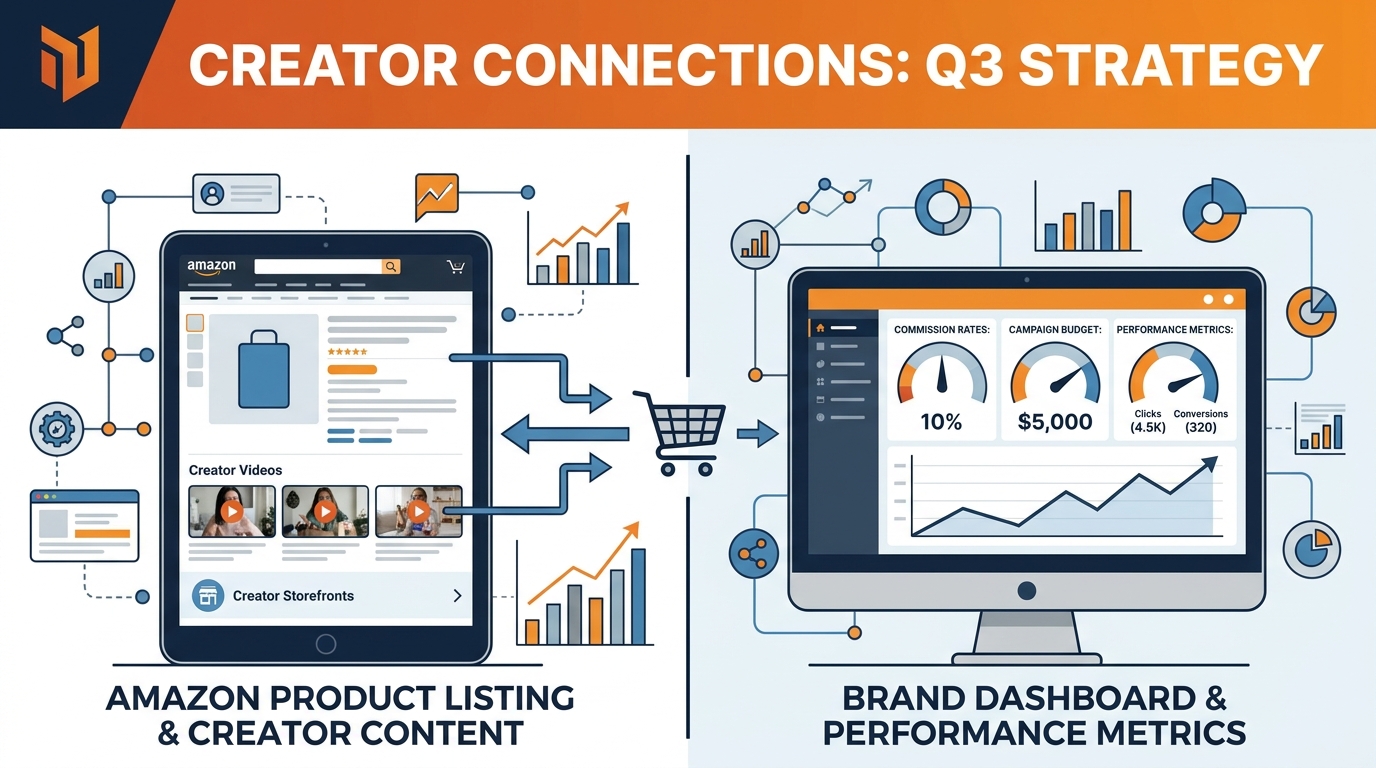
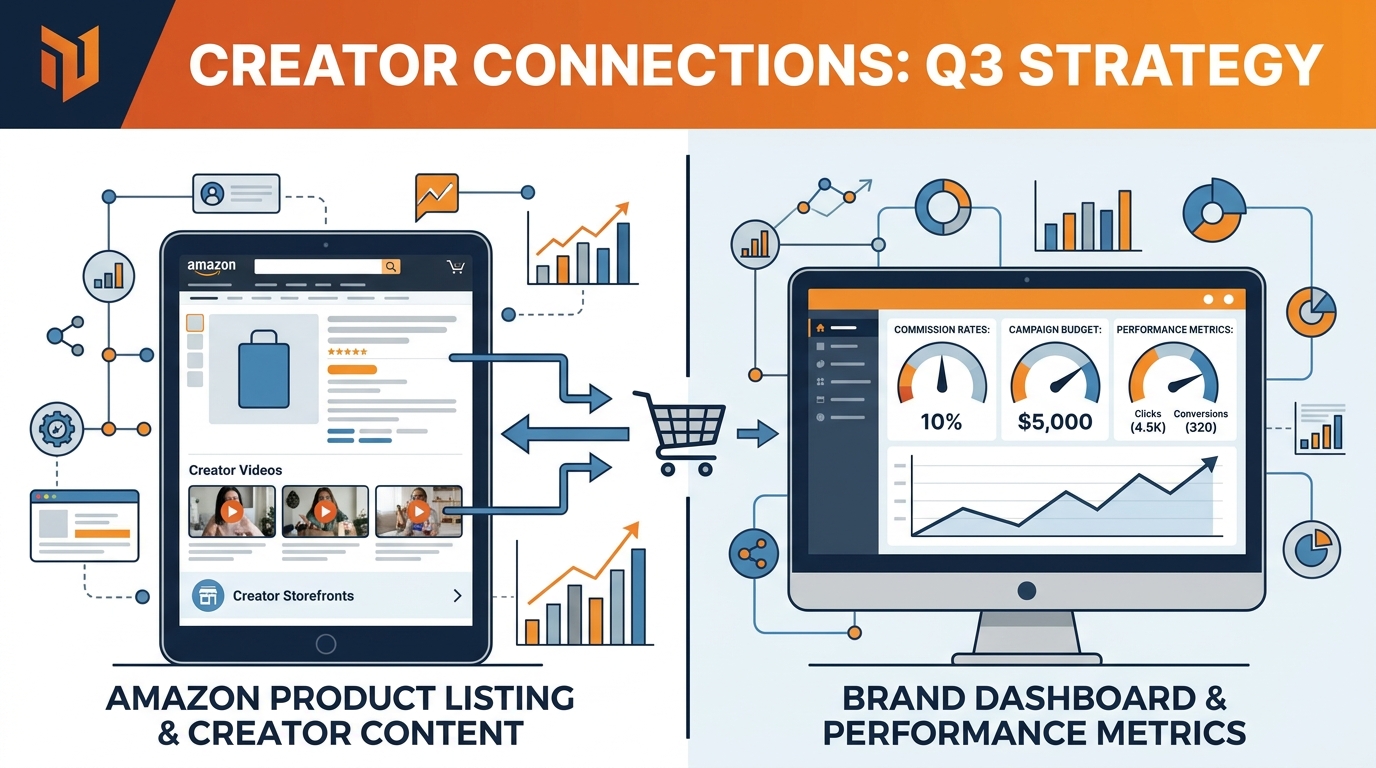
Creator Connections is an Amazon-native marketplace, housed inside Seller Central and Amazon Ads, that allows Brand Registry sellers to offer brand-funded bonus commissions on top of the standard Amazon Associates rate. Creators enrolled in the Amazon Influencer or Associates program can browse available campaigns, opt into those that match their content and audience, and earn elevated commissions on attributed sales.
The fundamental economics are important to understand. Amazon Associates already pays creators a base rate when shoppers purchase through their links. Creator Connections layers an additional commission on top — funded by the brand, set at the brand’s discretion, and paid only when a qualifying sale occurs. Brands set three variables per campaign: the total budget ceiling, the bonus commission percentage, and the campaign duration. Within those parameters, the program runs on a pay-per-sale model. There are no platform fees, no guaranteed media spend, and no payment required unless attributed sales happen.
This is fundamentally different from a standard influencer sponsorship, where brands typically pay a flat fee for a post regardless of commercial outcome. Creator Connections is performance affiliate marketing, operating inside Amazon’s own attribution system.
Who Can Use It and Who Can Access Campaigns
On the brand side, Creator Connections is restricted to sellers enrolled in Amazon Brand Registry. You need a registered trademark, and your account needs to be in good standing. The minimum campaign budget sits around $5,000, and campaigns must run for a minimum of 30 days — parameters that push the program away from one-off activations and toward more sustained programs.
On the creator side, access is limited to participants in the Amazon Influencer Program or Amazon Associates who meet Amazon’s eligibility criteria. These are creators who already have Amazon storefronts, existing review content, or affiliate links embedded in their content channels. Unlike some influencer platforms where reach is the primary credential, the Amazon Influencer Program has its own approval process tied to audience engagement and platform activity.
What It’s Not Designed For
Creator Connections is not a tool for building brand awareness from scratch. It does not directly drive off-Amazon social media exposure unless the creators involved also have active channels elsewhere (many do). It’s not a replacement for Amazon Sponsored Products or Sponsored Brands. And it’s not a mechanism for requesting specific creative deliverables — brands can provide briefs and talking points, but they cannot mandate exactly what content gets created or guarantee that any content is posted at all. That last point becomes very significant in a later section.
Understanding these structural constraints before campaign setup is what separates brands that extract real ROI from the program and those that end up with a budget drain and ambiguous attribution data.
The Q3 Calendar That Should Be Shaping Your Timeline Right Now
Q3 is the most complex quarter on the Amazon calendar for brands using influencer channels. It’s not one event — it’s a sequence of overlapping demand windows, each with different shopper intent signals, different content types that convert, and different lead times for creator-driven campaigns to gain traction.
The Three-Wave Structure of Q3
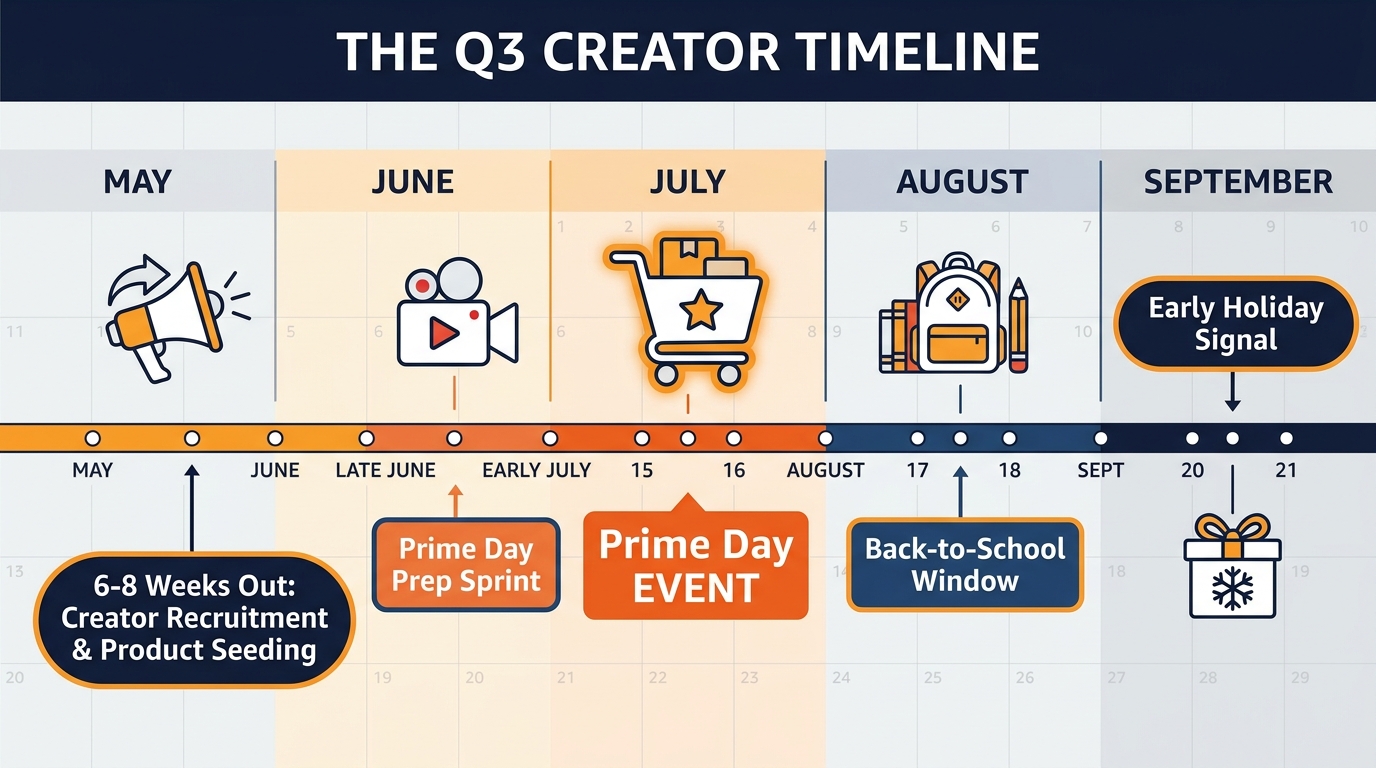
Wave 1: Prime Day. Amazon confirmed Prime Day 2026 for June, which means it falls at the edge of Q3 for most planning purposes. Prime Day is the highest-velocity traffic event on the Amazon calendar, and for Creator Connections campaigns, the key dynamic is that creator content needs to be live and indexed before the event begins. Videos on Amazon storefronts, review content on product pages, and existing affiliate links all benefit from organic traffic amplification during Prime Day when Amazon’s own promotional machinery is pushing category-level visibility. The implication: Creator Connections campaigns targeting Prime Day need to launch 6–8 weeks in advance, not the week before.
Wave 2: Back-to-School. Back-to-school is the Q3 event that most brands underinvest in from a creator standpoint. The timing is awkward — it starts immediately after Prime Day winds down, which creates a fatigue problem for brands that only activated their creator programs for the Prime event. Cardlytics analysis has shown that consumers who shop Amazon Prime Day spend 23% more online during back-to-school season and 17% more in brick-and-mortar retail than non-Prime Day shoppers. Prime Day and back-to-school are not two separate audiences — they are heavily overlapping. Creator content that doesn’t expire with Prime Day (evergreen review videos, category comparison posts, storefront collections) continues earning attributed commissions across the entire back-to-school window.
Wave 3: Early Holiday Signals. August and September are when the most analytically-oriented brands start building their Q4 infrastructure. That includes loading the creator pipeline with product seeding, running smaller Creator Connections test campaigns on products they plan to scale in October and November, and identifying which creators from the Q3 wave performed well enough to re-engage with elevated commissions for the holiday season.
Why the 6–8 Week Lead Time Is Non-Negotiable
Creator content on Amazon — particularly on-site videos that appear on product detail pages — does not surface instantly. Amazon’s indexing and content approval process takes time. Creators need time to receive product, produce content, and publish it. And attribution data from early campaign weeks is often what determines whether a creator continues posting or loses interest. Brands that set up Creator Connections campaigns two weeks before Prime Day are not running a Prime Day strategy. They’re running a post-Prime Day catch-up strategy, and they won’t see the same volume of attributed sales as brands whose creator content is already embedded in the product page ecosystem when traffic spikes.
For Q3 2026, the practical planning timeline looks like this: campaign setup and creator invitations by mid-May, product seeding and content creation window through late May and early June, creator content live by the first week of June, Prime Day activation period, back-to-school continuation with evergreen content, and Q4 pipeline review in August. That is a multi-month program, not a tactical sprint.
Product Selection: The Decision That Determines Everything Downstream
One of the most consistent patterns in Creator Connections programs that underperform is poor product selection at the campaign setup stage. Brands often select products based on what they want to sell more of, rather than what the program’s mechanics are actually designed to support. These are meaningfully different criteria.
Why Conversion Rate Is the Starting Point, Not Margin
A creator earns commission only when a shopper who clicks their content actually completes a purchase. This means the creator’s economic incentive is directly tied to your product’s existing conversion rate. A product with a 5% conversion rate will generate one-fifth the commissions of a product with a 25% conversion rate, assuming equivalent traffic. For creators who are evaluating which campaigns to opt into — and the program is entirely opt-in on the creator side — your product’s conversion potential is their primary screening criterion.
Brands that populate their Creator Connections campaigns with slow-moving or recently-launched products with no review velocity are signaling to sophisticated creators that the campaign will produce poor returns. Those creators will not opt in, or they will opt in and immediately deprioritize posting for it. The brands that attract quality creators are the ones offering campaigns on products with demonstrated conversion histories: strong review counts (typically 100+), stable star ratings (4.0 or above), and a price point in a range where the commission math actually produces meaningful creator income.
The Commission Math Creators Are Running
A creator evaluating a campaign is making a rough expected-value calculation, even if informally. Consider: a product priced at $29.99 with a 20% bonus commission yields a $6 payout per sale. If the creator’s content generates 10 attributed sales, that’s $60 in bonus commissions on top of the base Associates rate. Now run the same math on a $15 product with a 12% bonus commission — $1.80 per sale, or $18 for 10 sales. The second scenario requires the same amount of creative work for roughly 70% less return.
This is why mid-price-range products ($25–$80) with strong conversion rates consistently outperform both budget products and high-ticket items in Creator Connections programs. Budget products don’t generate enough per-sale commission to motivate quality content creation. High-ticket products often have lower conversion rates that reduce the expected-value calculation even when the per-sale commission is high.
Hero SKU Focus vs. Catalog Coverage
The instinct to include as many products as possible in a campaign is understandable — more coverage seems like more opportunity. In practice, campaigns that concentrate budget and commission rates on a small number of hero SKUs consistently produce better results than broad campaigns spread thin across a large catalog. The reason is attention economy: creators have finite bandwidth, and a campaign with one or two clearly defined hero products gives them a cleaner editorial brief to work with than a campaign featuring thirty ASINs of equal priority.
Best practice for Q3 is to identify two to four hero SKUs per campaign — products with strong conversion histories, competitive price points, and clear seasonal relevance — and allocate the bulk of campaign budget there. Secondary products can be included for coverage, but the commission rates and product brief emphasis should communicate clearly where creator focus should go.
Setting Commission Rates That Actually Attract the Creators You Want
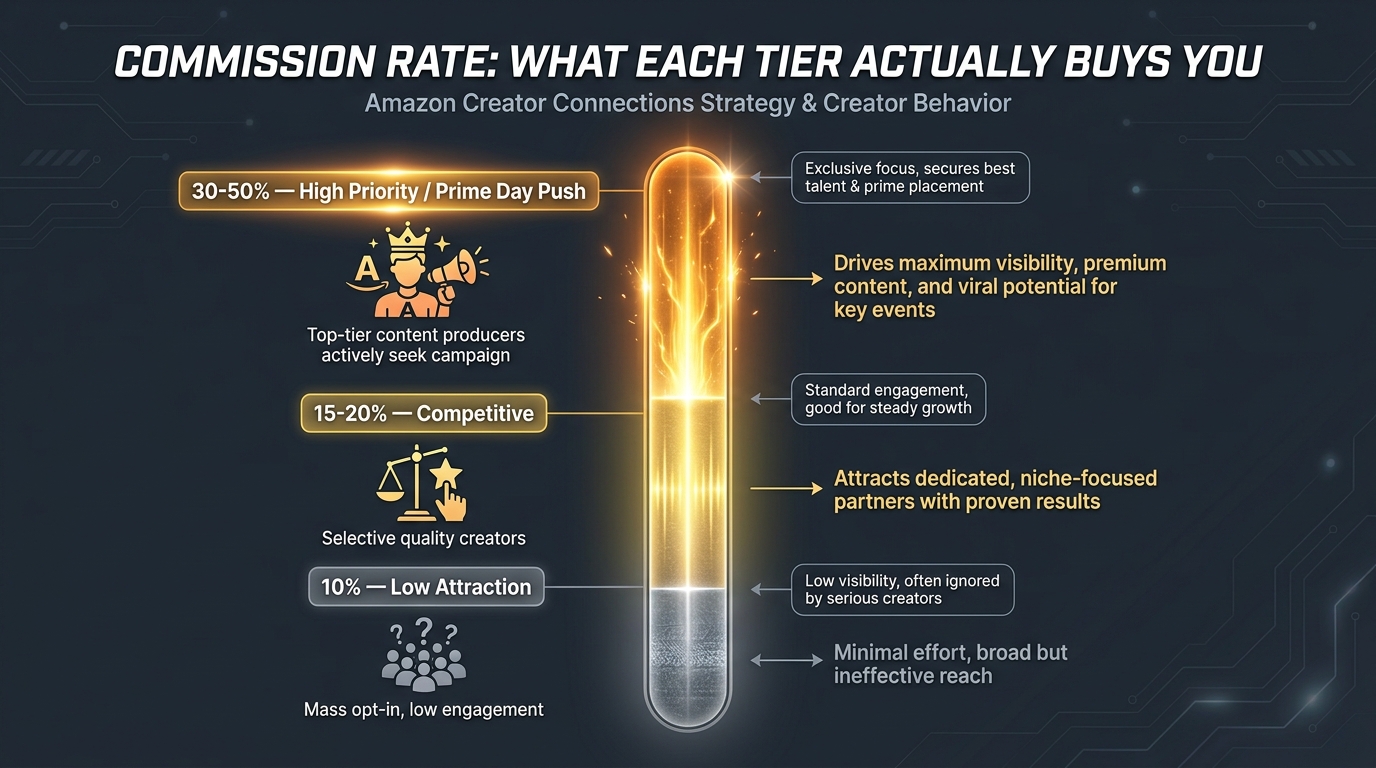
Amazon allows brands to set bonus commission rates anywhere from roughly 10% to 50% on top of the standard Associates rate. That range is wide enough to mean that commission setting is genuinely a strategic lever, not a compliance checkbox. But the way commission tiers map to creator behavior is something most brand playbooks don’t address in enough granularity.
The 10% Floor: What It Signals and Who It Attracts
A 10% bonus commission is the low end of what brands can offer. At this level, campaigns will still attract opt-ins — particularly from creators who are running automation tools (more on that shortly) and from creators who are new to the program and building their affiliate income from scratch. The problem isn’t that 10% attracts no one. The problem is who it attracts and who it filters out.
Established creators with high-performing storefronts and documented conversion track records have options. They can select from dozens of active campaigns at any given time. A 10% commission rate on a mid-priced product puts a brand at a structural disadvantage in that competitive selection process. The creators most likely to opt in at 10% are either inexperienced, highly automated in their campaign management (meaning content delivery is uncertain), or using the campaign primarily for halo commission purposes rather than active promotion.
The 15–20% Sweet Spot for Consistent Quality Creator Attraction
The 15–20% range appears to be the threshold where the quality and selectivity of opting creators meaningfully increases. At this level, experienced creators with established niches begin to see Creator Connections campaigns as genuinely competitive with what they earn from other affiliate channels. It’s still not the highest-paying tier, but it’s enough for a creator who already has existing content aligned with the product category to consider opting in and creating additional promotional material.
For standard always-on campaigns outside of major events, 15–20% is the floor serious brands should be operating at. Going lower creates a false economy — the savings on commission rates are often offset by lower content quality, less creator engagement, and higher shares of budget consumed by auto-accept behavior.
The 25–50% Zone: When to Use It and Why It’s Different
Higher commission rates — in the 25–50% range — are a tool for specific circumstances, not a permanent campaign posture. The appropriate use cases include: Q3 Prime Day windows where you are competing heavily for creator attention, product launches where you need initial velocity and are willing to subsidize early-adopter commissions, and categories where your products have naturally lower conversion rates and you need to offset the creator expected-value calculation.
At 30% and above, top-tier creators who are selective about which campaigns they post for actively begin seeking out your campaign. These are the creators with enough audience trust that when they post a review or include a product in a storefront collection, the conversion lift is real and measurable. They’re also the creators who are most attuned to whether your product converts — meaning if your listing isn’t optimized, a 50% commission rate won’t overcome a 2% conversion rate. The math still has to work on both sides.
A practical Q3 framework: run baseline campaigns at 15–18% from campaign launch through the pre-Prime Day ramp. Temporarily boost commission rates to 25–35% for a defined Prime Day window (Amazon allows campaign parameters to be adjusted during the campaign). Return to a sustainable post-Prime rate for the back-to-school continuation period.
The Auto-Accept Problem Quietly Draining Campaign Budgets
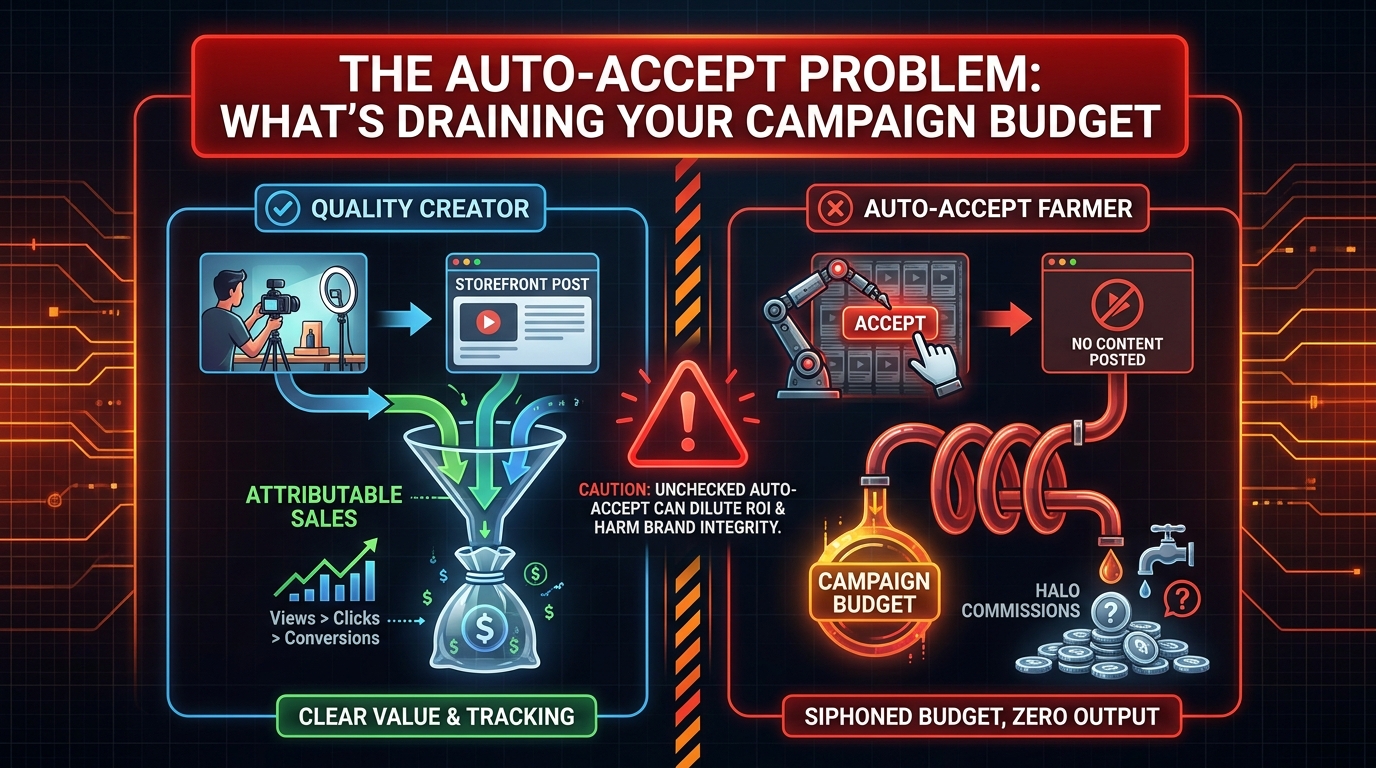
This is the Creator Connections dynamic that brands are least likely to have read about in official Amazon documentation — and most likely to have experienced without fully understanding what was happening.
What Auto-Accept Actually Means
Within Creator Connections, creators who opt into a campaign can earn halo commissions on attributed sales that happen during the campaign window — including sales on products the shopper purchases after clicking any content from that creator, within the standard 24-hour Amazon Associates attribution window. Critically, Amazon’s current program structure does not have a hard requirement for creators to post new campaign-specific content in order to benefit from halo attribution. A creator who has existing content on their storefront — review videos, collections, recommendation lists — can opt into a campaign and potentially earn bonus commissions from halo sales without creating a single piece of new content for your brand.
This gap has been exploited by a minority of creators using third-party automation tools that mass-accept Creator Connections campaigns across categories, often targeting campaigns on products the creator has never reviewed, promoted, or discussed. These tools operate by accepting campaigns at volume, theorizing that some share of a creator’s existing audience activity will generate halo commissions on the newly accepted campaign ASINs. For the creator, the risk is low. For the brand, the result is budget consumption without the corresponding content output the campaign was intended to produce.
How to Identify and Reduce Exposure
There is no single Amazon-provided filter that cleanly separates genuine content-creating opt-ins from automation-driven accepts. But there are behavioral signals brands can use during and after campaigns:
- Opt-in to sale ratio: A campaign with 80 opt-ins and 12 attributed sales suggests a large portion of opt-ins are generating no traffic or conversion. Compare this to campaigns where opt-in counts are lower but sale-per-creator ratios are higher.
- Content visibility: Manually review whether opting creators have published new content featuring your products. Amazon Influencer storefronts are publicly visible. If a creator accepted your campaign two weeks ago and has no new content mentioning your products, that is a signal.
- Campaign brief specificity: Detailed briefs that request specific content formats (video reviews, unboxing, comparison posts) create a higher friction opt-in for automation tools. They don’t eliminate the loophole, but they reduce the incentive for purely halo-farming behavior.
- Selective invitation campaigns: Creator Connections allows brands to either publish open campaigns that any eligible creator can opt into, or to selectively invite specific creators. Invitation-only campaigns dramatically reduce exposure to mass-accept behavior by limiting the pool to creators you have pre-screened.
Amazon’s Position on This Behavior
Amazon’s documentation acknowledges a mismatch: the platform’s guidance for creators says they should have at least one content link by the end of a campaign’s duration to avoid potential account standing issues. But this is not uniformly enforced, and there’s no automatic campaign-level enforcement that cancels a creator’s commission eligibility if no content is produced. Brands should not rely on platform-level policing of this behavior in the near term. The protection has to come from campaign design and creator vetting on the brand side.
Vetting Creators Beyond Follower Count
Creator Connections operates within the Amazon ecosystem, which means the follower metrics that dominate outside-Amazon influencer evaluation are less predictive of campaign outcomes than the platform-specific signals available here. Brands that screen creators the same way they’d screen a TikTok influencer are optimizing for the wrong variables.
Amazon Storefront Health as a Proxy for Quality
An Amazon Influencer’s storefront is a public-facing window into how they operate. Key signals worth evaluating before inviting a creator to your campaign include:
Content recency and consistency. A storefront with dozens of video reviews posted over the past 30–60 days signals an active creator who is treating their Amazon channel as a real business. A storefront with the last video posted six months ago suggests a creator who has deprioritized the platform — regardless of what their external follower counts look like.
Category alignment. A creator who has built their storefront around kitchen appliances and cooking products is a materially different proposition for a kitchenware brand than a creator whose storefront spans electronics, apparel, fitness equipment, and pet supplies. Category specialists have audiences with higher purchase intent in their niche. Broad generalists may have lower per-category conversion rates despite higher follower counts.
Video quality and production level. Amazon’s on-site review videos don’t need cinematic production values, but they do need to be watchable and credible. Review videos that appear hastily recorded, have poor audio, or lack substantive product information are less likely to drive conversion than videos that demonstrate genuine product knowledge.
Sales Attribution History Over Social Metrics
If a creator has run Creator Connections campaigns before and is willing to share performance context — or if you can assess their storefront traffic through mutual contacts or agency relationships — actual sales attribution data is far more valuable than follower counts. A creator with 50,000 YouTube subscribers who consistently drives 20–30 attributed sales per campaign month is more valuable than a creator with 500,000 Instagram followers whose attribution tracking shows negligible Amazon conversion.
The program’s pay-per-sale structure means that under-performing creators ultimately don’t cost you commission budget. But they do consume the setup cost of inviting them, briefing them, and potentially managing a campaign that generates noise rather than signal in your attribution data. Pre-vetting reduces that overhead and keeps your campaign data cleaner.
How Halo Attribution Actually Works — and Why It Matters More Than You Think
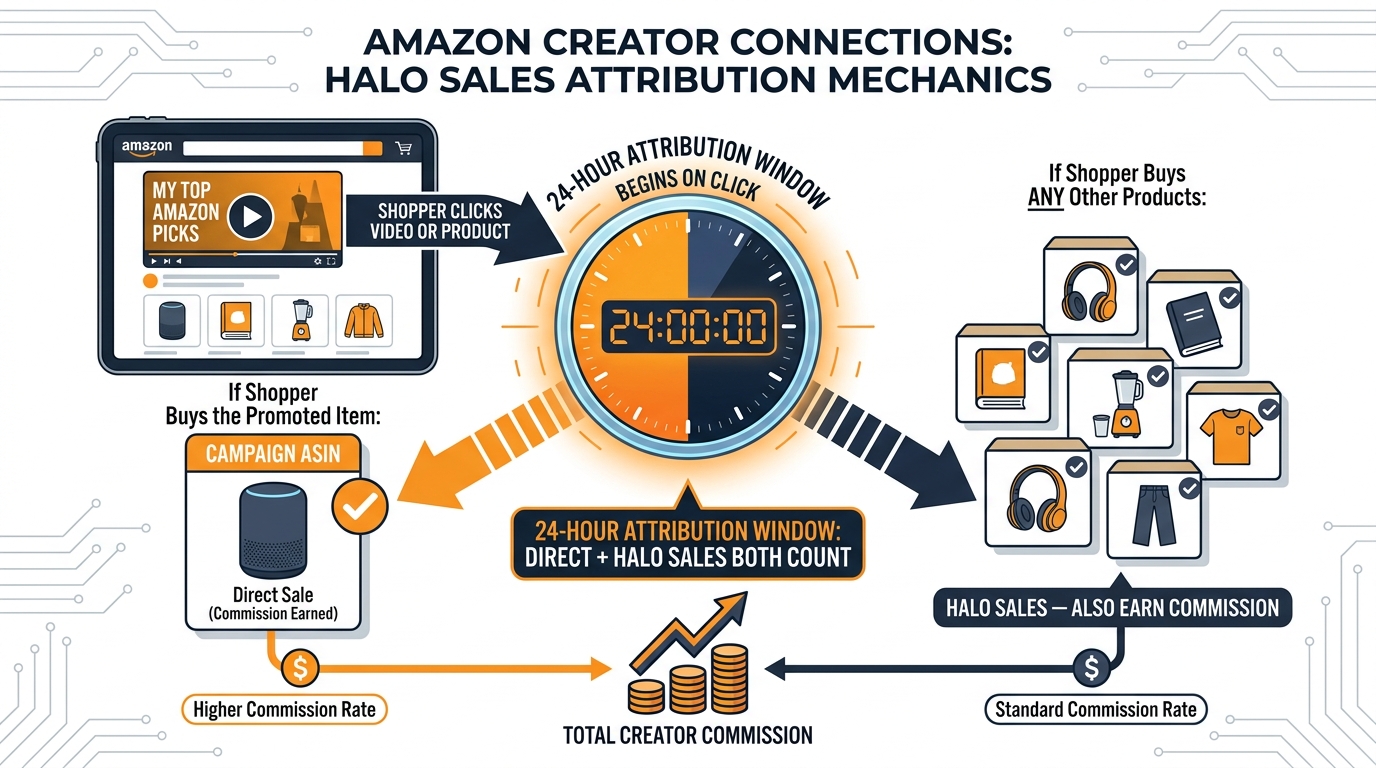
The attribution mechanics in Creator Connections are one of the most misunderstood elements of the program — both by brands evaluating ROI and by the creators participating in campaigns. Getting this right is what separates accurate performance analysis from misleading conclusions about which campaigns worked and why.
The 24-Hour Attribution Window: What Counts and What Doesn’t
Creator Connections uses the standard Amazon Associates 24-hour attribution window. When a shopper clicks on a creator’s affiliate link or Amazon storefront content, any Amazon purchase they make within the following 24 hours can be attributed to that creator, regardless of whether they bought the specific product the creator was promoting. This is the foundation of “halo sales” — purchases of products other than the campaign ASIN that are attributed to the creator’s traffic.
Here’s the practical implication for brands: if a creator posts a video reviewing your kitchen knife set, and a shopper clicks through and buys both the knife set and a cutting board (which is not in your campaign), the cutting board purchase still generates a commission for the creator if that ASIN is part of an active Creator Connections campaign from another brand, or if it’s a product where standard Associates rates apply. The brand that benefits from the halo sale depends on whose campaign the purchased product’s ASIN falls under.
For your own catalog, this means that running Creator Connections campaigns on multiple related products simultaneously increases the probability that halo sales from any one creator’s traffic convert into attributed commissions across your broader range. A shopper who discovers your brand through a creator’s review of one product and then browses your storefront page — purchasing multiple items — can generate attribution credit for several of your ASINs within that same session window.
Halo Attribution as a Strategic Catalog Tool
Sophisticated brands use halo attribution intentionally. If you have a flagship product with strong review velocity and high conversion, running a Creator Connections campaign on it while simultaneously listing your adjacent and complementary products in separate campaigns creates an attribution network effect. The flagship product drives traffic. Halo attribution captures sales of the complementary products. This is why the minimum campaign duration of 30 days matters — the halo effect compounds over time as more creators build attribution history with your product catalog.
The flip side is that halo attribution can make campaign ROI analysis complicated. If your attribution data shows $8,000 in sales from a campaign where your campaign ASIN only accounts for $4,000 in direct sales, the other $4,000 may be halo purchases of other products — including from other brands’ campaigns that ran concurrently. Interpreting these numbers requires understanding that “total attributed sales” in Creator Connections is not the same as “incremental revenue generated by this campaign for this ASIN.”
Existing Storefront Content as Attribution Infrastructure
One operationally useful implication of the halo attribution system is that creators do not need to create new content for every campaign to generate some level of attributed sales. A creator with six months of review videos on their storefront is continuously generating a traffic stream. If that creator accepts your campaign, their existing content immediately starts contributing to your campaign attribution window — even before any new campaign-specific content is created.
This is genuinely valuable for brands, as it means Creator Connections campaigns can generate some baseline return from day one of launch, rather than waiting for creators to produce fresh content. The trade-off is that this same mechanic is what enables the auto-accept behavior described earlier. Understanding both sides of it is what allows you to set realistic expectations about early campaign data.
Stacking Creator Connections with Brand Referral Bonus — The Layer Most Brands Miss
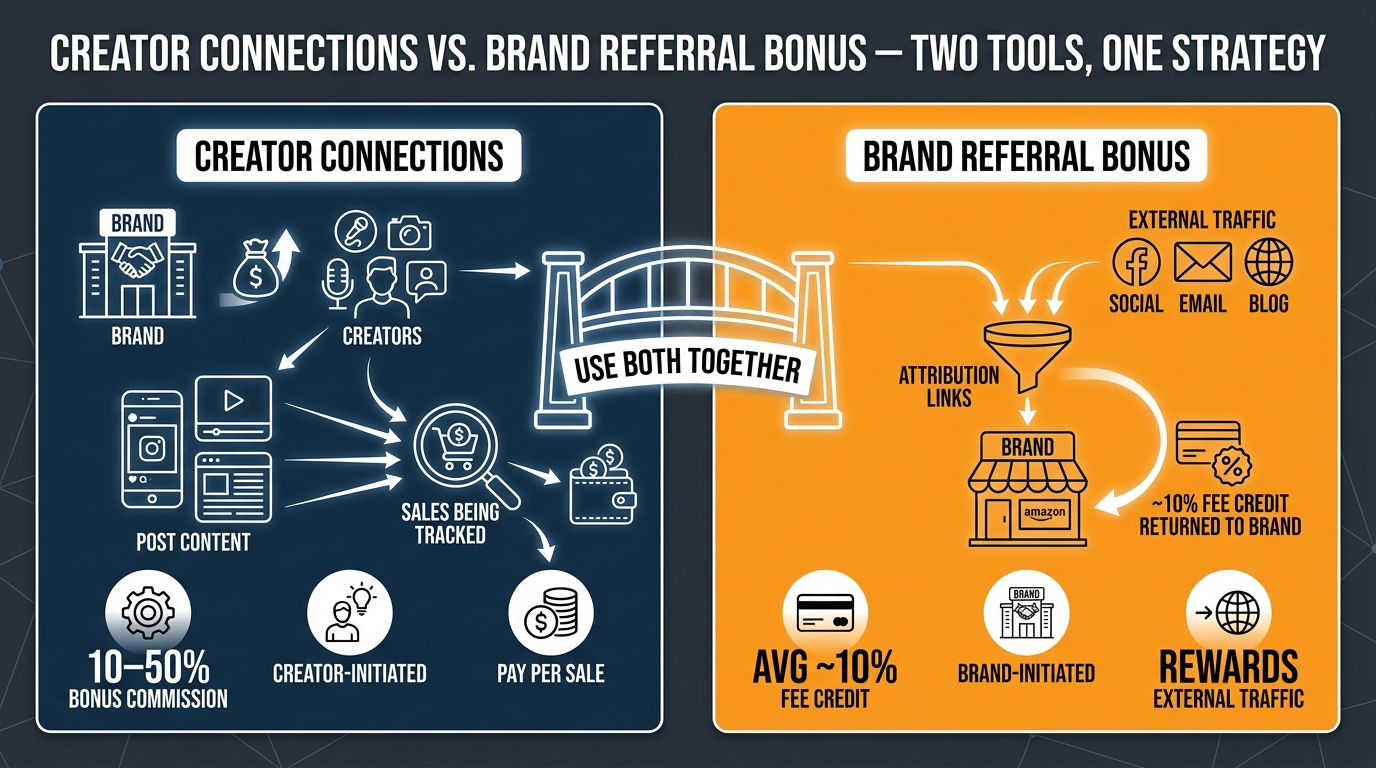
Creator Connections and Amazon’s Brand Referral Bonus program are separate tools that solve different problems — but they are not competing tools. Run together, they create a layered off-Amazon traffic and attribution strategy that compounds value in ways that neither program produces independently.
Understanding the Distinction
Creator Connections is a campaign marketplace inside Amazon. It finds creators, pays them commissions, and generates attributed sales within Amazon’s closed attribution ecosystem. The traffic it drives is creator-sourced and the commissions are brand-funded on a per-sale basis.
The Brand Referral Bonus (BRB) is a completely different mechanism. It is a fee credit program that Amazon pays to brands who drive external traffic to their Amazon listings using Amazon Attribution tracking links. When a shopper clicks a Brand Referral Bonus–enabled Attribution link from outside Amazon — from a social post, email campaign, blog article, influencer YouTube video — and makes a purchase, Amazon credits the brand approximately 10% of the sale back as a rebate on their selling fees.
The key operational point: if a creator is driving traffic from outside Amazon to your listing using an Amazon Attribution link (which creators can set up through Amazon Associates), their activity can simultaneously generate a Creator Connections commission payout to them and a Brand Referral Bonus fee credit back to you. Both sides of the equation benefit from the same sale.
The Practical Stacking Strategy
For this dual benefit to apply, creators need to be using Amazon Attribution links rather than standard storefront links when driving external traffic. This is a brief element worth including in your creator campaign brief: a clear request that creators share off-Amazon content (YouTube, Instagram, email newsletters) using Attribution-enabled links rather than generic Amazon URLs.
Not every creator will do this correctly, and not every creator’s off-Amazon traffic volume will be significant enough to move BRB numbers meaningfully. But for the subset of creators with genuine external audiences — YouTubers with review channels, bloggers with organic search traffic, email newsletter curators — this stacking becomes a real cost efficiency mechanism. You’re effectively getting a partial rebate on the commissions you pay through Creator Connections, via BRB credits generated by the same attributed sales.
At scale — across a Q3 program with multiple high-performing creator partnerships — this fee credit can add up to a meaningful offset against campaign costs. Brands that don’t know BRB exists, or who don’t realize it applies to creator-driven external traffic, leave that efficiency on the table entirely.
Measuring ROI in Creator Connections: What the Dashboard Gives You and What It Doesn’t
The performance reporting available within Creator Connections is more detailed than many brands realize, but it has meaningful gaps that require additional analytical work to interpret correctly. Understanding what the data says — and what interpretive assumptions are built into it — is essential for making spend decisions confidently.
What Seller Central Reports On
Within the Creator Connections dashboard in Seller Central, brands can access campaign-level data including: total clicks, attributed orders, total attributed sales value, total commissions paid, and the number of creators who have opted into the campaign. At more granular levels, some reporting allows per-creator breakdowns, giving visibility into which opted-in creators are generating any attributed volume versus which are consuming campaign slots without driving measurable activity.
The most useful primary ratio is commissions paid as a percentage of attributed sales — effectively your effective commission rate against total attributed revenue. If your campaign budget is $5,000 and your attributed sales are $40,000, your commissions-to-sales ratio is 12.5%. For context, this is roughly equivalent to a well-performing Amazon PPC campaign in most categories, with the added advantage that you’re paying for performance rather than clicks.
What the Dashboard Doesn’t Tell You
The attribution data in Creator Connections does not distinguish between incremental sales (purchases that would not have occurred without the creator’s influence) and captured sales (purchases from shoppers who were already going to buy the product and merely happened to click a creator’s link). This is the incrementality problem that affects all affiliate marketing, and Amazon has not solved it within the Creator Connections framework.
During Q3, this problem is amplified. When your products are getting elevated organic traffic from Prime Day deals, search visibility, and platform promotions, some portion of the attributed sales in your Creator Connections report are purchases that would have happened anyway. The halo commissions you’re paying on those sales are not buying you incremental revenue — they’re simply a tax on organic conversion that happens to route through a creator’s attribution window.
The practical mitigation is to use pre-campaign and post-campaign sales baselines to estimate incrementality. If your organic sales velocity in the 30 days before campaign launch was X units per day, and during the campaign period it rises to 1.5X, some portion of the 0.5X differential is plausibly creator-driven. This is not a perfect methodology, but it’s meaningfully more accurate than treating total attributed sales as pure incrementality.
KPIs Worth Tracking by Q3 Phase
During the ramp-up phase (pre-Prime Day), the most valuable KPI is creators actively producing content versus total opt-ins. A high ratio of content-producing creators to total accepted indicates a healthy campaign. If 40% of opted-in creators have produced at least one piece of content featuring your products, that’s a strong signal. During Prime Day itself, volume metrics — attributed orders, total attributed sales — become the primary focus. Post-Prime Day, the relevant KPI shifts to commission efficiency: are you paying more per attributed sale than the product’s existing referral fee structure would justify? If yes, scaling back is warranted until the back-to-school window creates the next demand spike.
The Always-On vs. Campaign-Burst Debate: How to Actually Decide
One of the live debates in Creator Connections strategy circles is whether the program should be run as an always-on, continuous activation or as a series of concentrated campaign bursts tied to key events. Both approaches have genuine merit, and the right answer depends on variables specific to your catalog and margin structure.
The Case for Always-On Programs
Creator Connections requires minimum campaign durations of 30 days. The attribution and content ecosystem builds over time — creator storefronts accumulate review videos, product pages build social proof from creator-driven traffic, and halo attribution becomes richer as more creators develop familiarity with your product catalog. An always-on program generates consistent baseline attributed sales, provides continuous data for creator vetting, and keeps your products in the active campaign pool that established creators are browsing for opt-in opportunities.
For brands with stable, evergreen products — items that sell year-round without significant seasonal dependence — an always-on Creator Connections structure at a sustainable commission rate (15–18%) creates a continuous performance channel that compounds over quarters, not weeks. The brand equity built through consistent creator coverage also builds review volume and storefront prominence that benefits organic search visibility.
The Case for Campaign Bursts Around Key Events
The counterargument is budget efficiency. Q3 has three distinct demand peaks — Prime Day, back-to-school, and early holiday signals — and each requires meaningfully different commission structures and creator brief emphasis. A brand running a flat always-on campaign at 15% through Prime Day is likely leaving performance on the table compared to a brand that spikes its commission rates to 30%+ for a defined Prime Day window and then scales back.
Campaign bursts also allow brands to reallocate budget dynamically. If a Prime Day campaign generates strong attributed sales at a 10:1 sales-to-commission ratio, it makes sense to extend and replenish budget. If early data suggests low creator opt-in quality or poor conversion, a campaign burst structure allows you to pause and reassess without being locked into a multi-month commitment.
The Hybrid Approach That Works Best for Q3
The most effective Q3 architecture is a hybrid: an always-on baseline campaign at sustainable commission rates that maintains continuous creator presence and attribution infrastructure, layered with temporary elevated-commission campaigns for the Prime Day window and back-to-school surge. The baseline provides continuity. The event-specific layers provide performance spikes. This also avoids the risk of launching a brand-new Creator Connections campaign right before Prime Day — a structure that starts from zero creator opt-ins at the exact moment you need maximum creator engagement.
Brands that have been running baseline Creator Connections programs since late Q2 are entering Prime Day with a warm creator ecosystem: active opt-ins, existing content live on product pages, and halo attribution already accumulating. Brands starting fresh in mid-June are paying for the privilege of building that ecosystem at the worst possible moment in the competitive calendar.
What Separates the Brands Winning with Creator Connections This Quarter
Amazon Creator Connections is not a plug-and-play channel. It does not automatically produce results just because it’s budget-controlled and performance-based. The brands generating measurable ROI from the program in Q3 share a set of operational practices that are worth naming directly.
They Treat It as Infrastructure, Not Inventory
The best-performing brands think about Creator Connections the way they think about building product page assets — as long-term infrastructure that pays returns over multiple quarters, not a campaign to be evaluated after 30 days. Creator content that lives on Amazon storefronts continues driving attributed sales months after a campaign officially ends. The creators who had good results with your products will often voluntarily continue promoting them even after a campaign expires because the commission structure (even the base Associates rate) is worth maintaining. Brands that invest in building strong creator relationships through clear briefs, timely product seeding, and fair commission structures are building an asset, not just buying media.
They Match Commission Rates to Creator Quality, Not Just Category
Rather than setting a single campaign commission rate and applying it to all products, sophisticated brands are structuring tiered campaigns — higher commission rates for hero SKUs where creator attention is most critical, lower rates for supporting products where halo attribution provides sufficient incentive. This requires more campaign management overhead, but it dramatically improves the quality of creator opt-ins for the products that matter most.
They Connect Creator Connections to Their Broader Attribution Stack
Creator Connections data is most useful when it’s read in context alongside Amazon Attribution, PPC performance data, and organic sales velocity. Brands that evaluate Creator Connections in isolation miss the compounding signals — the PPC efficiency gains when creator content improves product page conversion rates, the BRB fee credits generated by external creator traffic, the organic rank signals that accumulate when creator-driven sessions add to session count and conversion rate metrics that Amazon’s algorithm reads. The channel doesn’t operate in isolation, and the brands extracting the most value are treating it as one layer of a coordinated Amazon growth strategy, not a standalone influencer expense.
They Budget Honestly for What the Program Actually Measures
The final differentiator is expectations calibration. Creator Connections will report attributed sales that include halo purchases, organic traffic that routes through creator windows, and — during Q3 peak periods — volume that would have converted through other channels anyway. The brands that sustain Creator Connections programs long-term are the ones that have done the baseline incrementality analysis, understand the realistic contribution margin the channel delivers after commissions, and have set campaign parameters that reflect that analysis rather than an optimistic first-month projection.
Used with that level of rigor, Creator Connections is a genuinely differentiated performance channel — one that produces creator content, attributed revenue, and long-term catalog coverage simultaneously, at a cost structure that scales directly with results. Getting to that outcome in Q3 means starting earlier than you think you need to, setting commission rates that attract creators worth having, and understanding the attribution mechanics well enough to measure what’s actually happening rather than what the raw dashboard numbers suggest. That’s the work. The brands doing it are seeing it pay off.