


Here is a number worth sitting with: 63.1% of consumers now discover products on TikTok before they ever open Google. That figure, from The Influence Agency’s 2026 Yearbook survey, flips the conventional wisdom about search funnels on its head. Google doesn’t start the journey anymore — for a huge and growing share of buyers, TikTok does.
But the TikTok that’s doing this discovery work in 2026 is not the platform that most TikTok Shop sellers optimized for six months ago. The algorithm has been quietly rebuilt around two new realities: voice-style, conversational search queries and an AI-powered search layer that indexes your content very differently from the old hashtag-and-caption approach.
Most sellers haven’t caught up. Their product titles are written for 2023-era keyword matching. Their video scripts ignore spoken search signals. Their product attributes are half-empty. And they’ve never thought seriously about what TikTok’s AI assistant Tako is doing when a shopper asks it “what’s the best serum for hormonal acne that won’t pill under makeup?”
This article is about exactly that gap — and how to close it. We’ll go layer by layer through the full TikTok Shop SEO stack: how the AI search engine actually reads your products, where voice queries are breaking your current setup, what Tako’s ranking behavior means for your listings, and how to rebuild your product data, audio content, and video structure for the search engine TikTok is becoming — not the one it used to be.
How TikTok’s AI Search Engine Actually Indexes Your Products
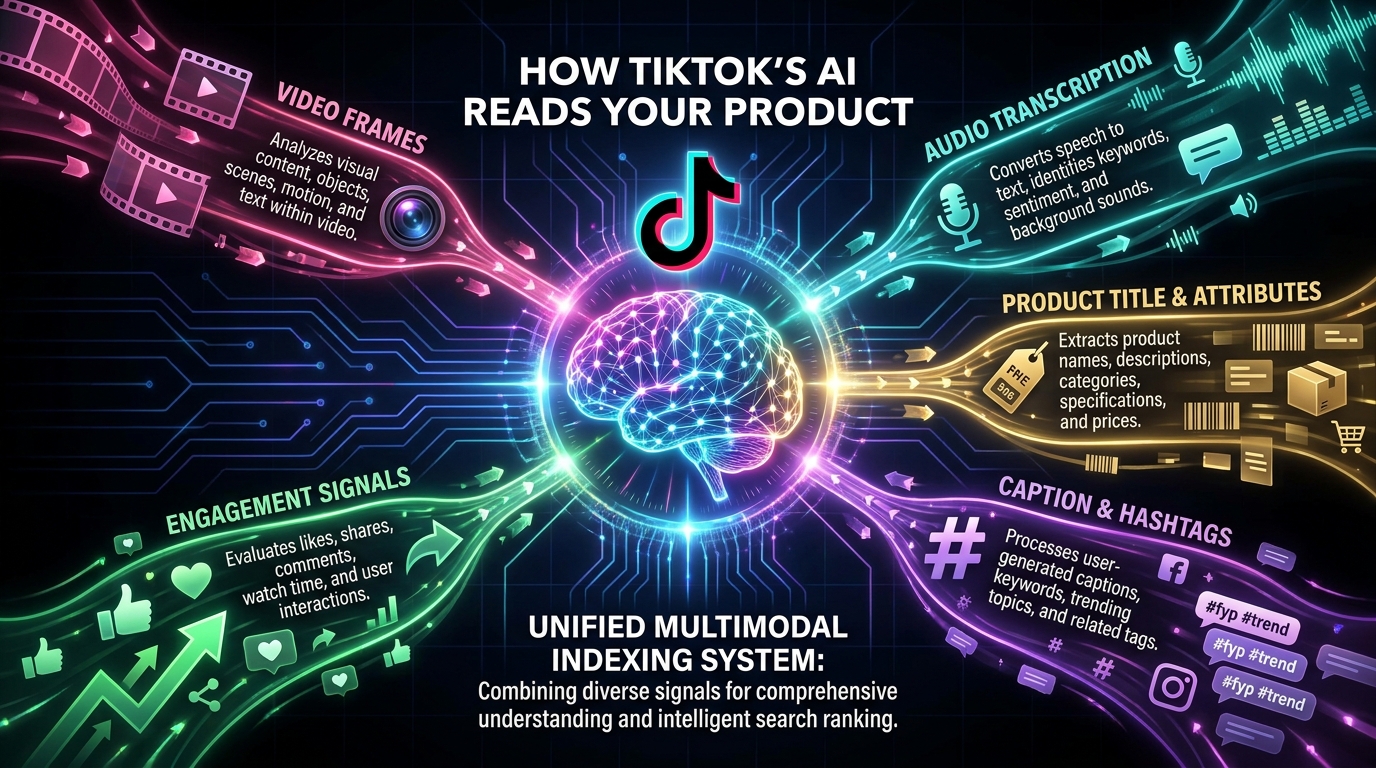
The first thing sellers need to understand is that TikTok’s search system is not a keyword database. It is a multimodal AI retrieval engine — meaning it reads, indexes, and ranks your product presence across five distinct signal layers simultaneously.
The Five Indexing Layers
1. Product metadata: Your title, description, and structured attributes in TikTok Seller Center. This is the most direct input to search ranking and the one most sellers have some awareness of.
2. Video frame analysis: TikTok’s computer vision models scan individual frames from videos linked to your product. They can recognize product type, color, usage context, and on-screen text — including text overlays and captions embedded in the video itself. A product demo showing someone applying a face cream in a bathroom is indexed very differently from the same cream being unboxed at a desk.
3. Audio transcription: Every video that features or tags your product has its audio transcribed by TikTok’s speech-to-text systems. The transcribed text is then processed as search-eligible content. If a creator says “this is perfect for anyone dealing with redness from rosacea” in their voiceover, that phrase becomes part of your product’s indexed footprint — whether or not you wrote “rosacea” anywhere in your listing.
4. Automated captions and on-screen text: TikTok’s auto-caption system generates searchable text from spoken audio. On-screen text overlays are processed through OCR (optical character recognition). Both feed the same search index as your product metadata does.
5. Behavioral and engagement signals: Click-through rate, add-to-cart rate, purchase conversion, saves, shares, and watch time all act as real-time relevance votes. The AI uses these not just to rank your content by popularity but to understand which queries your product is actually the right answer for.
Why This Matters for Voice and AI Search Specifically
Voice and AI search queries are fundamentally different from typed keyword queries: they are longer, more descriptive, more problem-oriented, and more specific. A voice-style query like “what moisturizer is good for combination skin in humid weather that doesn’t feel greasy” will surface products whose full multimodal footprint contains those concepts — not just products that have “combination skin moisturizer” in the title.
That means your product’s search surface area is now vastly larger than your listing text alone. Sellers who understand this build products that are “thick” with relevant signals across every layer. Sellers who don’t are showing up as invisible — even when they sell exactly what the shopper is looking for.
The practical implication: optimizing for TikTok’s AI search is not a one-time listing task. It is an ongoing, multi-channel content strategy where every video, every creator partnership, and every attribute field contributes to an evolving search footprint.
The Voice Query Gap: How Shoppers Actually Talk vs. How Sellers Write
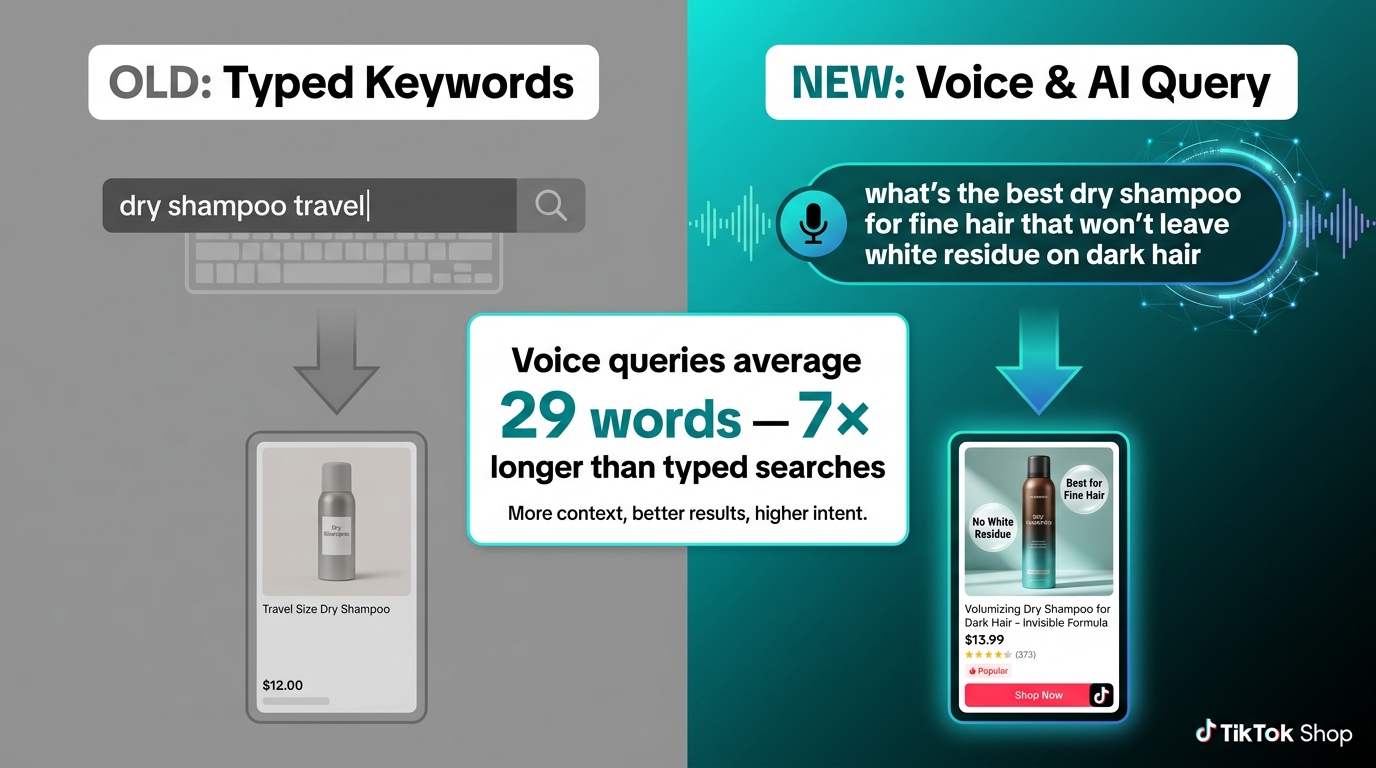
The data on how voice and AI-style queries differ from traditional typed searches is striking — and most e-commerce sellers have still not internalized it.
The average voice search query runs approximately 29 words, compared to 4–5 words for a typical typed query. That’s not a small difference. It’s a structural shift in how intent is expressed, and it represents a completely different kind of keyword to optimize for.
The Anatomy of a Voice-Style TikTok Query
Consider what actually happens when a Gen Z shopper opens TikTok, taps the search bar (or, increasingly, uses voice input), and searches for something they want to buy. They don’t type “tinted moisturizer SPF.” They say — or type conversationally — something like: “what’s the best tinted moisturizer with SPF for oily skin that doesn’t oxidize on NC30 skin tones.”
That query contains:
- A product category (tinted moisturizer)
- A functional requirement (SPF)
- A skin type qualifier (oily)
- A problem signal (oxidation)
- A personal identity marker (NC30 shade)
Your product title almost certainly doesn’t contain all five of those elements. Your description might cover two or three. But here’s the key insight: if the video ecosystem around your product — including creator reviews, your own demo videos, and auto-transcribed audio — contains all five, TikTok’s AI can and does surface your product for that query.
The Three Gaps Killing Your Voice Search Visibility
Gap 1: Generic titles that miss specificity. A title like “Tinted Moisturizer with SPF 30 – 6 Shades” is optimized for a keyword match, not a conversational match. It gives TikTok’s AI very little to work with when a query is about oxidation on a specific skin tone.
Gap 2: Descriptions written for scan reading, not semantic indexing. Many sellers write descriptions as bullet-point feature lists. These are useful for humans who are already on the product page — but they’re less useful for an AI that is trying to understand the use case and problem your product solves when evaluating it against a rich conversational query.
Gap 3: No audio-aligned keyword strategy. If your product videos never explicitly speak the terms that voice-style shoppers are searching — “for oily skin,” “won’t oxidize,” “good for medium to tan skin tones” — those signals don’t exist in your indexed footprint. You’re essentially absent from a search surface that is growing fast.
The fix is not to cram every possible phrase into your title. It’s to build a deliberate, distributed keyword strategy across all five indexing layers — with voice-intent phrases explicitly covered in your audio and video content.
Tako: What TikTok’s AI Assistant Means for Product Visibility
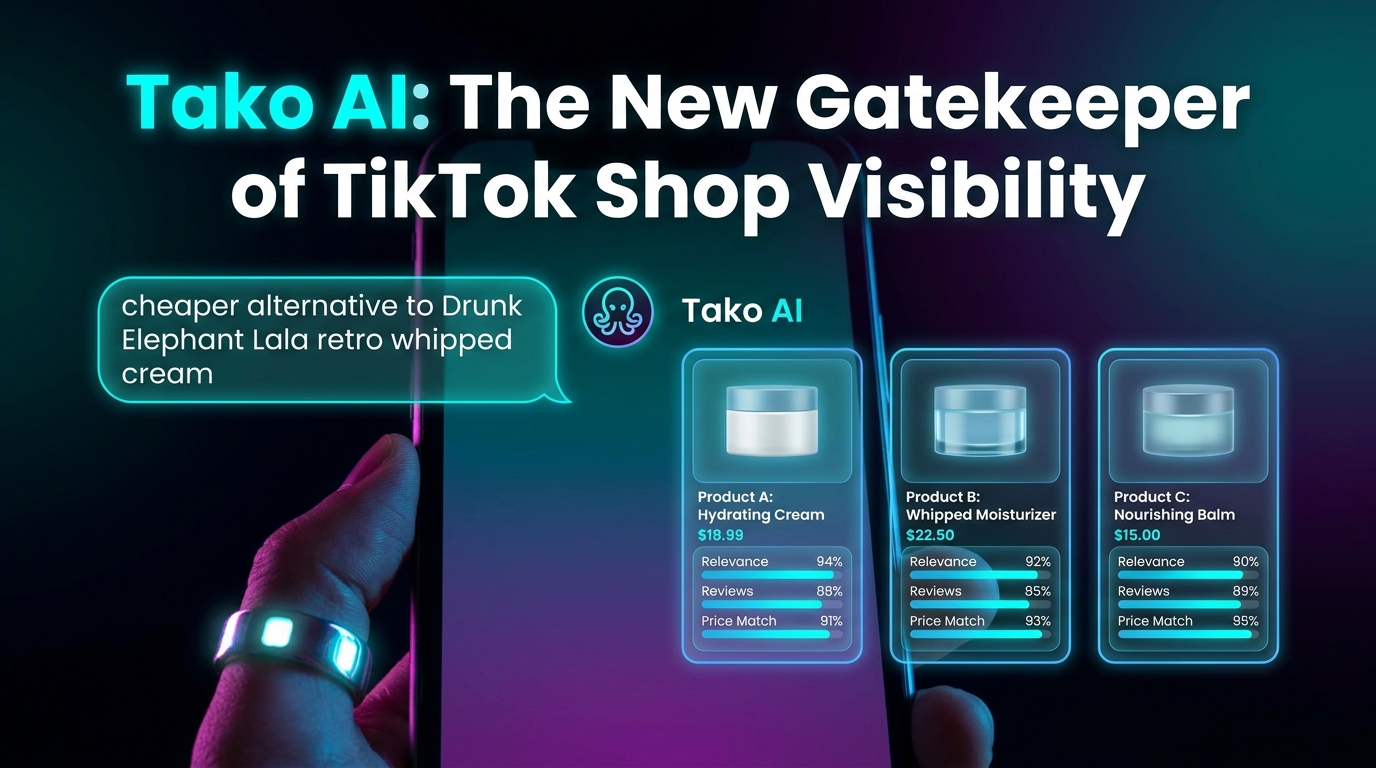
If you haven’t spent time with Tako, TikTok’s native AI assistant, you’re missing the most important new ranking surface on the platform. Tako is no longer a beta experiment — it’s now deeply embedded into TikTok’s core UX, appearing persistently on the For You Page, surfacing in notification flows, and replacing older “related search” prompts that used to appear above the comments section.
What Tako Actually Does
Tako functions as a conversational AI layer that sits between users and TikTok’s entire content and commerce catalog. When a user asks Tako “what’s a cheaper dupe for [luxury product] that actually works?”, Tako does not just run a keyword search. It:
- Parses the query for explicit intent signals (price sensitivity, desire for a functional alternative)
- Identifies the reference product category and its key attributes
- Searches TikTok’s product and video index for items that match both the category and the stated requirements
- Ranks results using a combination of relevance score, engagement history, review signals, and conversion performance
- Presents a curated set of product cards, often drawn from TikTok Shop
Critically, Tako gives significant weight to AI-native metadata — meaning products whose titles, descriptions, and indexed video content are structured in ways that make it easy for a large language model to evaluate them against a natural language query. Products described in feature-list language score lower than products whose indexed content reads like an answer to the shopper’s question.
Optimizing for Tako Specifically
There are three concrete changes that improve Tako visibility:
Use complete sentences in your product description, not just bullet points. Tako’s underlying model is better at matching a query to prose that describes a use case than it is at extracting meaning from fragmented feature bullets. “Ideal for people with combination skin who want lightweight coverage that doesn’t feel heavy in humid weather” performs better as a description fragment than “• Lightweight • Combination skin • All-weather formula.”
Front-load problem-solution language. Tako is highly tuned to commercial intent queries that are structured around a problem (“my foundation keeps oxidizing”) or a comparison (“something better than X”). Products whose indexed content explicitly names and addresses those problems rank higher in Tako’s responses.
Build a review signal base. Tako surfaces products with credible, recent review history. A 4.6-star product with 200 reviews will consistently outperform a 4.9-star product with 12 reviews in Tako’s ranking logic, because the engagement signal is thicker and more statistically trustworthy from the AI’s perspective.
Rebuilding Your Product Titles for Conversational Search
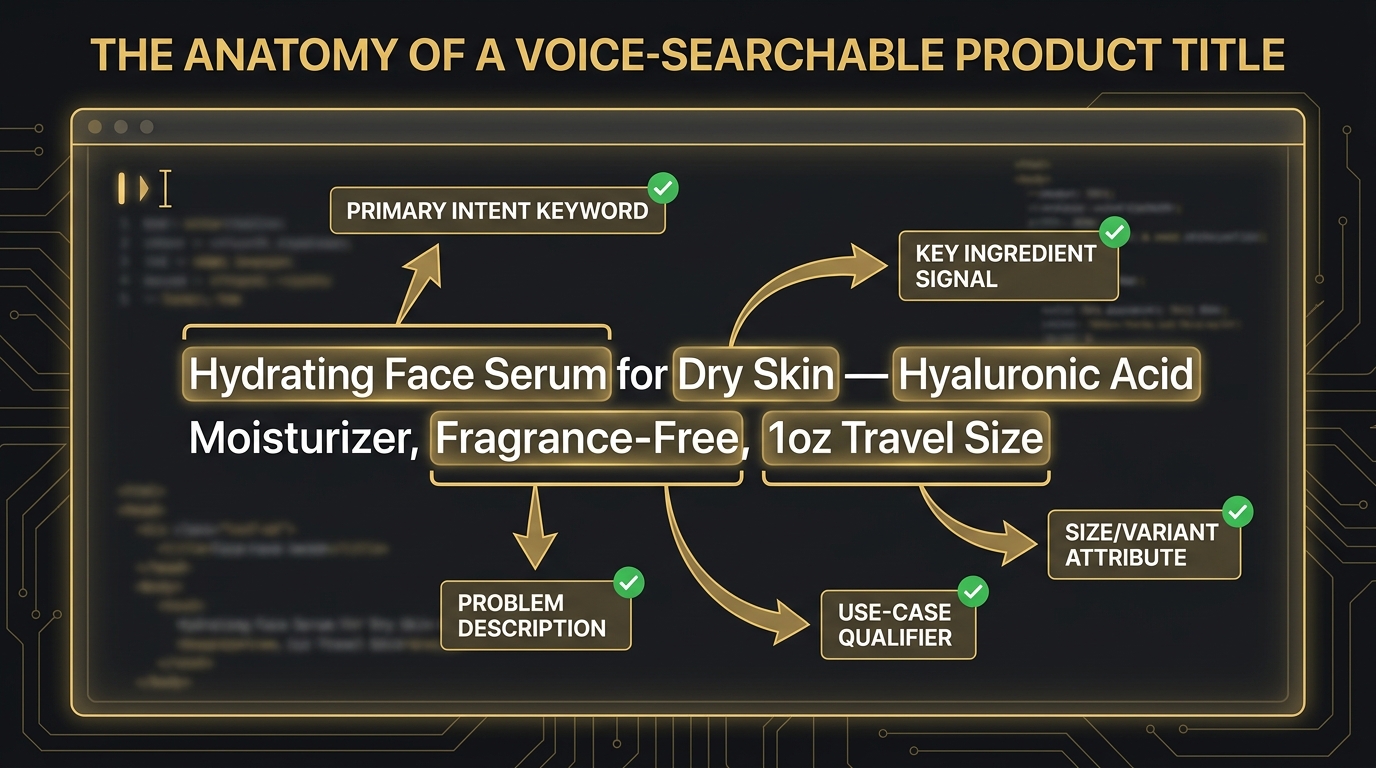
Your product title is still the single highest-weight text field in TikTok Shop’s search ranking system. But the criteria for what makes a good title have shifted substantially as voice and AI search have grown.
The Old Title Formula vs. the New One
The old approach was built around density: pack the most searched keywords into the title within the character limit, prioritizing exact-match terms. That logic worked when most searches were 2–4 word typed queries.
The new formula is built around intent legibility: write a title that reads like the beginning of an answer to a conversational search query. This sounds subtle but it changes the structure significantly.
Consider this comparison:
Old formula: Vitamin C Serum Face Brightening Anti-Aging 30ml
New formula: Brightening Vitamin C Serum for Dull Skin — Reduces Dark Spots and Uneven Tone, Lightweight, 30ml
The second version contains more of the language that appears in conversational queries (“dull skin,” “dark spots,” “uneven tone”). It also signals a problem (dullness, spots) rather than just a feature (Vitamin C). TikTok’s AI can match the second title against queries like “why does my skin look dull in photos” or “what helps with post-acne dark marks” in ways the first title cannot support.
A Practical Title-Building Framework
Structure every TikTok Shop product title with four layers:
- The outcome or problem it solves (what the shopper wants to achieve or fix)
- The product category (what the item actually is)
- The key differentiator (ingredient, technology, texture, speed, format)
- The use-case qualifier (skin type, hair type, occasion, environment)
You don’t always need all four elements, and they don’t need to appear in exactly that order. But every title should contain at least three. A title with only a product name and a volume is essentially invisible to AI-driven and voice-style search.
Character Limits and Keyword Prioritization
TikTok Shop allows up to 255 characters in product titles. Most sellers use fewer than 80. That’s a significant wasted opportunity — especially since the search algorithm parses the full title, not just the first few words.
Front-load the most search-critical terms in the first 60 characters (the portion visible in search results previews), but use the remaining characters to add the kind of problem-specific language that voice queries include. Think of the title as having two jobs: visual scannability in the first 60 characters, and AI-query coverage in the full 255.
The Audio Layer: Spoken Keywords as a Ranking Signal
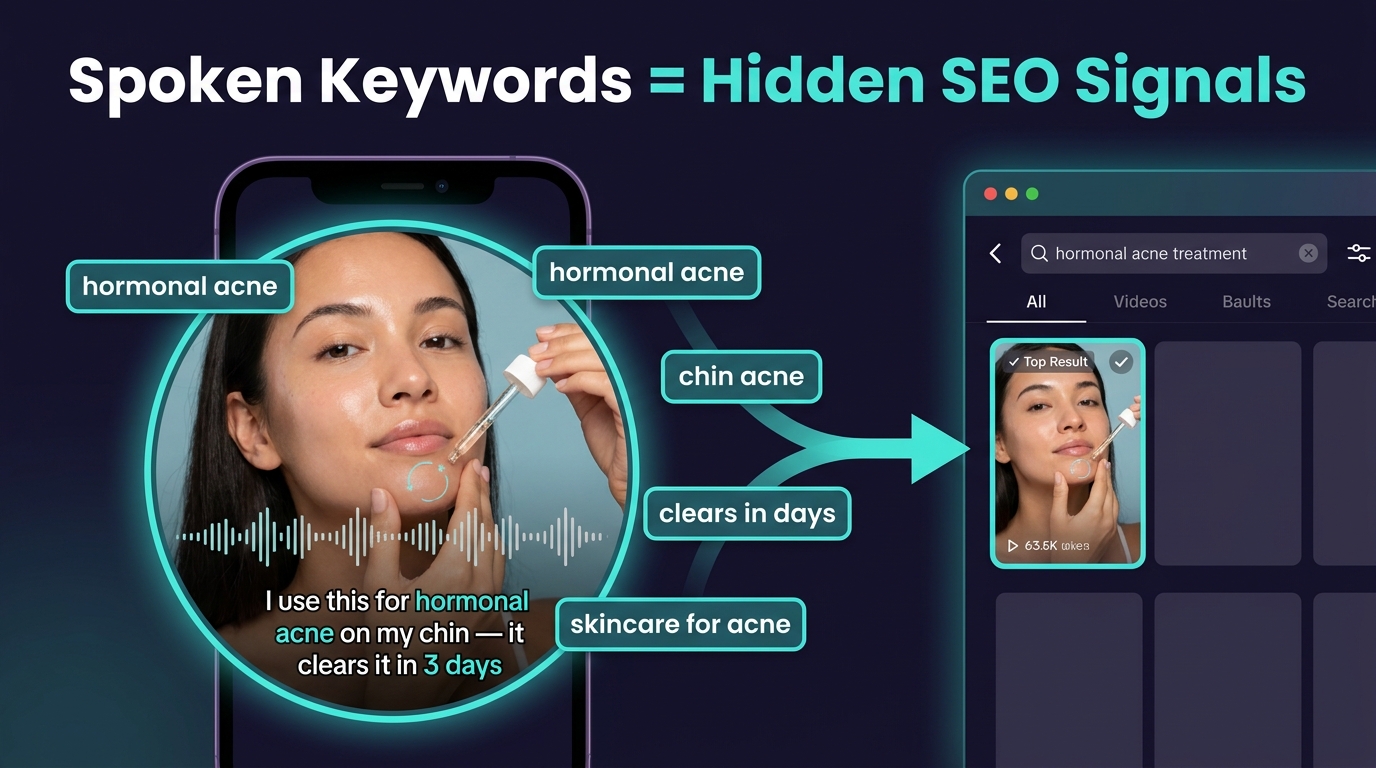
The audio layer is the most underutilized SEO surface in TikTok Shop — and it’s the one most directly connected to voice search performance.
TikTok transcribes the spoken audio in every video. These transcriptions are used by the search and recommendation systems to understand what each piece of content is about. That means every word spoken in a product demo, review, tutorial, or creator video that links to your TikTok Shop listing is potentially a searchable signal.
Why Audio Keywords Hit Differently
When a shopper searches TikTok using a voice-style query or types a long conversational phrase, TikTok’s retrieval system doesn’t just look at your product listing metadata. It also pulls from the indexed audio content of videos associated with your product. A video where a creator says “I’ve been using this for my hormonal chin acne and it’s the only thing that actually works” creates a searchable signal for “hormonal acne,” “chin acne,” and the implied intent of finding an effective solution.
None of those phrases may appear in your product title. But if they’re in your video audio — and TikTok has indexed them — your product can surface when someone searches for “what’s good for hormonal acne on chin.”
This is a form of earned search coverage that no other e-commerce platform currently offers at this scale. Amazon indexes review text. Google indexes web pages. TikTok indexes speech. That’s a genuinely different and more powerful coverage opportunity.
Building a Spoken Keyword Strategy
For your own brand videos, approach scripting the same way you’d approach writing a long-tail keyword document — except you’re writing dialogue, not metadata. Before producing any product video, list the top 10–15 voice-style queries you want to be found for. Then write your script so that at least 6–8 of those phrases appear naturally in the spoken content.
Critical principles:
- State the problem before the product. “For anyone struggling with dry patches under concealer” before you mention your serum names the search intent before naming the answer. TikTok’s AI connects the problem phrase to your product through the transcript.
- Name specific use cases out loud. “I use this as my base before SPF on beach days” creates coverage for “base before SPF,” “beach day skincare,” and “pre-sunscreen prep” — none of which need to be in your listing.
- Say long-tail qualifiers explicitly. Phrases like “for people with redness from rosacea,” “if you have fine hair that gets greasy at the roots,” or “specifically good for humid climates” are exactly the specifics that show up in voice and AI queries. Say them out loud.
Managing Creator Content for Audio SEO
When working with affiliates or influencers, audio keyword strategy is often the missing briefing element. Most creator briefs cover talking points, visual requirements, and disclosure language. Few cover which specific spoken phrases matter for search indexing.
Without overscripting (which kills authenticity and therefore engagement), you can provide creators with a list of “key phrases to include naturally” alongside the standard brief. The goal isn’t for creators to sound robotic — it’s to ensure that the audio footprint of their content captures the search terms that will drive discovery for your product over the weeks and months after the video is posted.
Structured Product Attributes: Your AI-Searchability Backbone
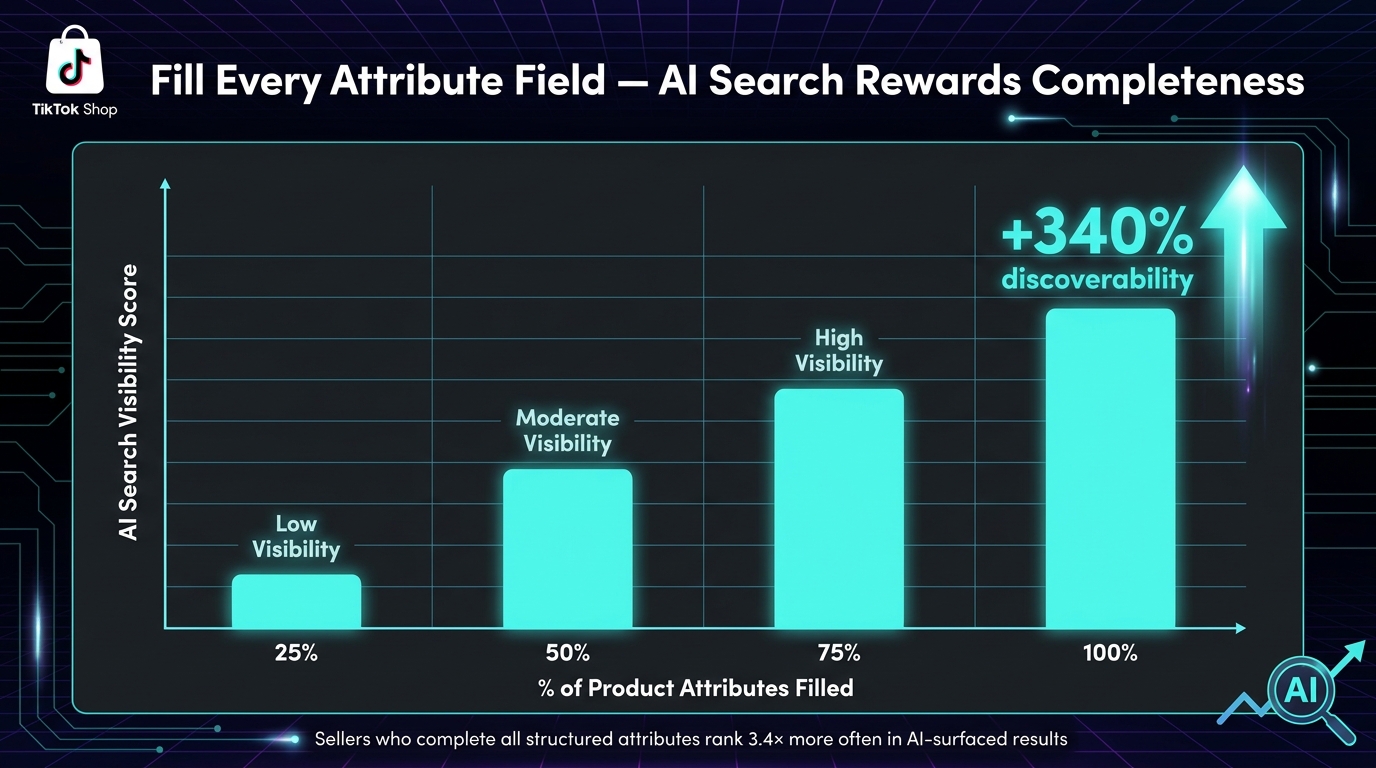
If spoken audio is the most underutilized signal layer, structured product attributes are the most neglected. Sellers routinely fill in 30–50% of available attribute fields and leave the rest blank — which is a significant self-inflicted SEO wound in a world where AI search depends heavily on structured, machine-readable data.
Why Attributes Matter More Than Most Sellers Realize
TikTok Shop’s AI search system uses structured attributes as primary filters and facets when parsing complex queries. When a shopper asks “what’s a cruelty-free, fragrance-free moisturizer under $25 for sensitive skin,” the system is not just matching text. It’s filtering against a product graph that includes structured fields: skin type compatibility, formulation flags (fragrance-free, cruelty-free), price range, and category.
If those fields are empty in your listing, your product gets filtered out before text-based ranking even begins. You’re not ranked low — you’re not ranked at all.
The difference in AI search coverage between a fully completed attribute set and a half-completed one is dramatic. Industry practitioner data suggests sellers who complete all available structured attributes appear in AI-surfaced results at a substantially higher rate than those who leave fields blank — with estimates from operators running controlled tests suggesting coverage differences of 2× to 3.4× in AI search placement frequency.
Which Attributes to Prioritize
The highest-value attributes for voice and AI search coverage depend on your category, but there are universal priorities:
Skin/hair type compatibility fields: These are used constantly in voice-style queries. “For oily skin,” “for color-treated hair,” “for sensitive skin” are among the most common qualifiers in shopping queries. If TikTok Shop offers these fields in your category, fill every one that applies.
Formulation and ingredient flags: Fragrance-free, paraben-free, sulfate-free, vegan, cruelty-free, hypoallergenic. Voice search users frequently specify these. Having them as structured attributes (not just mentioned in the description) means they act as hard filters, not just fuzzy text matches.
Use case and occasion fields: If your category offers fields for “suitable for,” “best used as,” or “occasion,” fill them with the specifics. “Daily use,” “travel,” “gym bag essential,” “beach day” — these are the qualifiers that conversational queries routinely include.
Variant-specific attributes: Shade names, sizes, scents, and capacities should be fully filled for every variant, not just the default. Voice search queries often specify the exact variant (“travel size,” “unscented version,” “medium shade”) and incomplete variant data means those queries return zero results for your listing.
The Attribute Audit Process
Go into TikTok Seller Center for your top 20 products and open each listing’s attribute section. Note every field that is blank or filled with a placeholder. Then prioritize filling those fields in order of: (1) fields that match known high-volume query qualifiers in your category, (2) fields that appear as filter options in TikTok Shop’s browse experience, and (3) remaining fields.
This is one of the highest-ROI SEO tasks available to TikTok Shop sellers right now because it is almost entirely ignored — meaning your competitive advantage from doing it is disproportionately large.
Long-Tail and Problem-First Keyword Strategy for TikTok Shop
The keyword strategy that works for voice and AI search on TikTok is structurally different from the keyword strategy that works for traditional e-commerce SEO. The differences go beyond just “use longer phrases” — they require rethinking where keywords come from and how they’re deployed.
Stop Starting with Search Volume, Start Starting with Problems
Traditional keyword research for e-commerce starts with volume: find the high-traffic terms, build listings around them. That model works reasonably well for Google Shopping and Amazon, where search volume is a reliable proxy for intent.
On TikTok, the most valuable search queries are often ones that don’t have high volume yet — because they’re being formulated by users in real time, in natural language, in ways that shift from week to week. The query “what moisturizer is good for dehydrated skin vs dry skin difference” might only be searched a few hundred times per day, but it represents extremely high commercial intent from a highly specific buyer. That buyer is essentially asking to be educated and sold to in one step.
The approach that works better is problem mapping: identify the five to ten most common problems your product solves, then expand each problem into the natural-language ways a shopper would describe it to a friend or an AI assistant. Those phrasings become your keyword targets.
Using TikTok’s Own Search Tools for Voice-Intent Research
TikTok’s search bar predictive text is a direct window into what people are actually searching. Type your base product category into the search bar and let the autocomplete suggestions appear. Those suggestions are ranked by actual query frequency. But more importantly, watch what kinds of question structures appear.
You’ll frequently see suggestions formatted as questions (“how to get rid of”), comparisons (“vs,” “alternative to,” “dupe for”), and problem descriptions (“for oily skin,” “that doesn’t crease”). These are voice-intent query structures — they’re how people who are about to buy something phrase their need when they’re using TikTok as a search engine.
Make a list of 20–30 of these suggestions for your category and filter them down to the ones that match a buying intent rather than a purely informational one. Those become your long-tail voice search keyword targets.
Distributing Keywords Across Layers
Once you have your voice-intent keyword list, you need to deliberately assign them across your five indexing layers:
- Title: Your 3–4 highest-priority, highest-specificity phrases
- Description prose: Full-sentence coverage of the problem-solution framing for 6–8 more phrases
- Attributes: Structured field equivalents of any qualifier phrases (skin type, ingredient flags, etc.)
- Video scripts: Spoken coverage of the remaining phrases, especially the most conversational and question-structured ones
- Creator briefs: A subset of phrases designated for creator audio coverage, selected for natural fit with review and tutorial content
This distributed approach means no single layer has to carry all the keyword weight — and your total search footprint is far larger than any single listing field could achieve.
Engagement Signals That AI Search Weights Differently
One of the most important things to understand about TikTok’s AI search ranking is that it uses engagement signals not just to measure popularity, but to infer relevance. This is the mechanism that connects SEO performance to content quality — and it’s why you can’t optimize your way to visibility with metadata alone.
The Signals That Matter Most for AI-Driven Ranking
Search-driven click-through rate: When your product appears in search results and someone clicks it, that’s a powerful relevance signal. A high CTR on a specific query tells TikTok’s AI “this product is the right answer to this question.” A low CTR tells it the opposite. This means your thumbnail, title, and first product image all directly affect your search ranking — they determine whether searchers click.
Dwell time and video completion on associated content: If a product video drives people to watch all the way through before clicking the Shop link, that watch time signals high relevance. If people click away after three seconds, the AI infers the content (and therefore the product) didn’t match the query well.
Add-to-cart and purchase conversion rate: TikTok Shop’s search algorithm has direct access to commerce performance signals. A product that converts well from search placements gets more search placements. This creates a reinforcing loop — and it means that a new product with strong conversion from early traffic will rank up faster than an established product with declining conversion.
Save rate: Saves (bookmarking a video for later) are a strong signal that the content is genuinely useful and the product is seriously considered. For voice and AI search purposes, a high save rate on videos associated with your product signals that the content is the right answer to a complex, research-oriented query — exactly the kind of query that voice and AI search surfaces generate.
What “Thin” Engagement Looks Like to AI Search
AI search ranking penalizes what practitioners call “thin engagement” — high impression counts with low downstream action. If your product is being served to many users via keyword matching but generating poor CTR and poor conversion, TikTok’s AI interprets this as a relevance mismatch. It will deprioritize your product for those queries and shift exposure to competitors whose signals are stronger.
This is why gaming the metadata alone — stuffing titles with every possible keyword — is increasingly counterproductive on TikTok. A product over-optimized for a query it doesn’t actually satisfy well will generate thin engagement on that query, which degrades its overall search ranking faster than if it hadn’t targeted the query at all.
The implication: focus keyword targeting on the queries your product actually satisfies well, not on every possible relevant term. A tighter, higher-converting keyword set will outperform a broad, low-converting one in TikTok’s AI search environment.
Video Content Structure for AI-Indexed Discoverability
The structure of your video content — not just its keywords — affects how TikTok’s AI search engine indexes and ranks it. Specific video formats and narrative structures are processed and scored differently by the retrieval system.
The First Three Seconds Rule
Multiple TikTok search optimization analyses confirm that keywords stated in the first three seconds of a video receive higher indexing weight than the same keywords stated later. This aligns with how TikTok’s recommendation algorithm weights early engagement — the opening seconds are the most heavily analyzed part of the content.
For voice and AI search purposes, this means your video should state a problem or use-case phrase in the opening seconds — not a brand name, not a product name. Lead with the searcher’s need: “If you have oily skin and everything slides off your face by noon…” is a far more effective opener for search indexing than “Introducing [Brand] Matte Foundation.” The first version indexes against the query. The second version only indexes against the brand name.
Video Formats That Generate Richer AI Signals
Problem-solution demos: Videos that explicitly name a problem, show the product being used, and demonstrate the result are the richest format for AI indexing. They generate spoken keyword coverage of the problem, product, and outcome — all three of which feed different parts of the search relevance signal.
Comparison and “dupe” videos: “I tested [expensive product] vs. [your product] for 30 days” generates extraordinary AI search coverage because comparisons explicitly name competing products, categories, and the evaluative criteria shoppers use — all of which appear in voice and AI queries.
Tutorial and how-to content: Tutorial videos (“how to layer your skincare products for maximum absorption”) keep watch time high and generate long audio transcripts full of problem-oriented language. They also tend to attract saves and shares — the high-quality engagement signals that AI search rewards.
Q&A response videos: Creating video responses to actual questions left in your comments section is one of the most targeted forms of voice-search optimization available. The question in the comment is often worded very similarly to how voice searchers phrase their queries. Answering it in video form — and stating the question out loud in your voiceover — creates audio-indexed content that exactly matches that query pattern.
Auto-Captions: A Non-Negotiable Setting
Enable auto-captions on every product video you post. This is not just an accessibility best practice — it is an SEO necessity. TikTok’s auto-captions are machine-readable text that feeds directly into the search index. Every video posted without auto-captions is missing an entire layer of its potential keyword coverage.
After enabling auto-captions, review them for accuracy. Mispronounced or mumbled words will be transcribed incorrectly, potentially creating irrelevant keyword signals. A five-minute caption review pass on every video protects the accuracy of your audio SEO footprint.
Testing and Measuring Your Voice and AI Search Performance
Most TikTok Shop sellers have no systematic way of knowing how their listings are performing specifically in search — let alone in AI-surfaced and voice-style search placements. That measurement gap means optimization efforts are largely flying blind. Here’s how to change that.
Setting Up a Search Performance Baseline
TikTok Shop’s analytics within Seller Center includes search traffic data broken down by keyword. Spend time in this section before you make any optimization changes — you need a baseline to measure against.
For each of your top 20 products, record:
- Total search impressions (past 30 days)
- Top 10 keywords driving search impressions
- CTR from search placements
- Conversion rate from search traffic specifically
This baseline will reveal two things immediately: which keywords you’re already indexed for (and whether they’re the ones you want), and which products have the worst search performance relative to sales volume (these are your highest-priority optimization targets).
The Voice Query Audit
Take your top 10 search keywords and classify each one as either a “short-form typed query” (3 words or fewer, generic) or a “long-tail conversational query” (4+ words, problem-specific, or question-phrased). If more than 60% of your top search keywords are short-form typed queries, you are almost certainly underperforming on voice and AI search.
The goal is to shift your keyword mix toward longer, more specific, problem-oriented terms — because these represent the queries where voice and AI search is growing fastest, and where competition is still relatively low.
A/B Testing Titles for AI Search Impact
TikTok Shop does not offer a native split-testing tool for product titles. But you can run controlled tests manually: change the title of one product, hold everything else constant for 14 days, and compare search impressions and CTR before and after. Apply the changes that perform and roll back the ones that don’t.
For audio keyword testing, compare the search performance of products that have creator videos with explicit voice-intent keywords against those that don’t. If products with keyword-aligned creator audio are attracting longer-tail search traffic, that’s evidence the audio indexing is working — and a signal to extend the same approach to your full catalog.
Tracking Tako-Attributed Traffic
As Tako becomes a more prominent surface, tracking Tako-driven traffic separately from standard search traffic becomes more important. At the time of writing, TikTok’s Seller Center analytics does not offer a dedicated Tako attribution segment — but you can approximate it by monitoring which products see traffic spikes following specific AI-assisted search events, and by tracking search traffic from query terms that are longer than 6 words (these are disproportionately likely to be AI-assisted queries).
Rebuilding Your TikTok Search Presence: The 30-Day Execution Plan
Having the right strategy is one thing. Having a concrete plan for executing it across a live catalog is another. Here is a practical 30-day rebuild sequence for sellers who want to move from hashtag-and-title SEO to full voice and AI search optimization.
Week 1: Audit and Prioritize
Pull your search performance data from Seller Center for all active products. Rank your products by search impressions × conversion rate (your most commercially valuable search-driven products). Your top 20 products on this combined metric are your optimization priority list — everything in the first two weeks focuses on these.
Also complete the voice query audit described above. Identify your top 5 target voice-intent queries per product — these are the search phrases you’re going to build coverage for across all five indexing layers.
Week 2: Product Metadata Rebuild
Rewrite titles for your top 20 products using the four-layer framework (outcome, category, differentiator, qualifier). Fill every available attribute field. Revise descriptions to include at least two full problem-solution sentences in prose format, not just bullets.
This is painstaking work but the change is typically live within 24–48 hours in TikTok’s search index. You should see measurable shifts in keyword coverage within the first 7–10 days after updating.
Week 3: Audio and Video Content
Produce or commission at least one new video for each of your top 10 products, scripted specifically to cover your target voice-intent phrases in spoken audio. Enable and review auto-captions on all existing product videos. Update your standard creator brief template to include a “spoken keyword” section.
Week 4: Measure, Iterate, and Scale
Pull your search data again and compare against the Week 1 baseline. Focus on changes in the distribution of keyword types (are you attracting more long-tail queries?) and on CTR and conversion trends for the products you optimized. Apply what’s working to the next tier of your catalog and document any tactics that are driving measurable changes for future iterations.
The Long Game: Voice and AI Search as a Compounding Advantage
Everything described in this article builds on itself over time in ways that traditional e-commerce SEO doesn’t. On Amazon, a competitor can replicate your keywords overnight. On TikTok, your voice and AI search presence is built from a combination of listing metadata, audio transcripts across dozens of videos, structured attributes, engagement history, and review signals — a layered footprint that takes months to build and is very difficult to replicate quickly.
That means the brands and sellers who invest in rebuilding for voice and AI search now are building a structural search advantage that compounds — each new video adds audio coverage, each positive review strengthens the engagement signal, each attribute filled improves filter performance. The product of all those layers becomes progressively more difficult for late movers to close.
The counterpoint is that the brands ignoring this shift are building a structural vulnerability. As 67% of Gen Z continue using TikTok as their primary search engine, and as voice-style and AI-assisted queries continue to grow as a share of total search volume, sellers whose presence is optimized only for short-form typed keywords will find their visibility declining in both relative and absolute terms.
The choice between those two trajectories is not inevitable — it’s available to any seller willing to think about TikTok search the way it actually works now, not the way it worked before.
Where to Start: The Three Highest-Impact Changes Right Now
If this article has surfaced more opportunities than you can act on simultaneously, here is the prioritized shortlist — three changes that will deliver the largest voice and AI search performance improvement for the least execution effort:
1. Complete your product attributes. Every blank attribute field is a filter you fail. Go through your top 20 listings and fill every available structured field. This is a one-time task with permanent search coverage benefits that kicks in within days of updating.
2. Add problem-solution prose to your descriptions. Beneath your existing bullet points, add two to three sentences in plain prose that describe the problem your product solves and who it’s for. Write it the way a user might speak it to an AI assistant. This gives Tako and TikTok’s AI search significantly more semantic content to match against conversational queries.
3. Script your next five videos around voice-intent keywords. Before producing any new content, write out the 8–10 voice-style queries you most want your product to appear in. Make sure those phrases are spoken out loud — not just shown as text overlays — within the first 30 seconds of each video. Enable auto-captions. That’s the complete minimum viable audio SEO strategy, and it starts generating index coverage within 24 hours of the video going live.
TikTok’s search behavior has changed. The sellers who adapt their full signal stack — not just their titles — will own the discovery results that matter most over the next 12 to 18 months.