

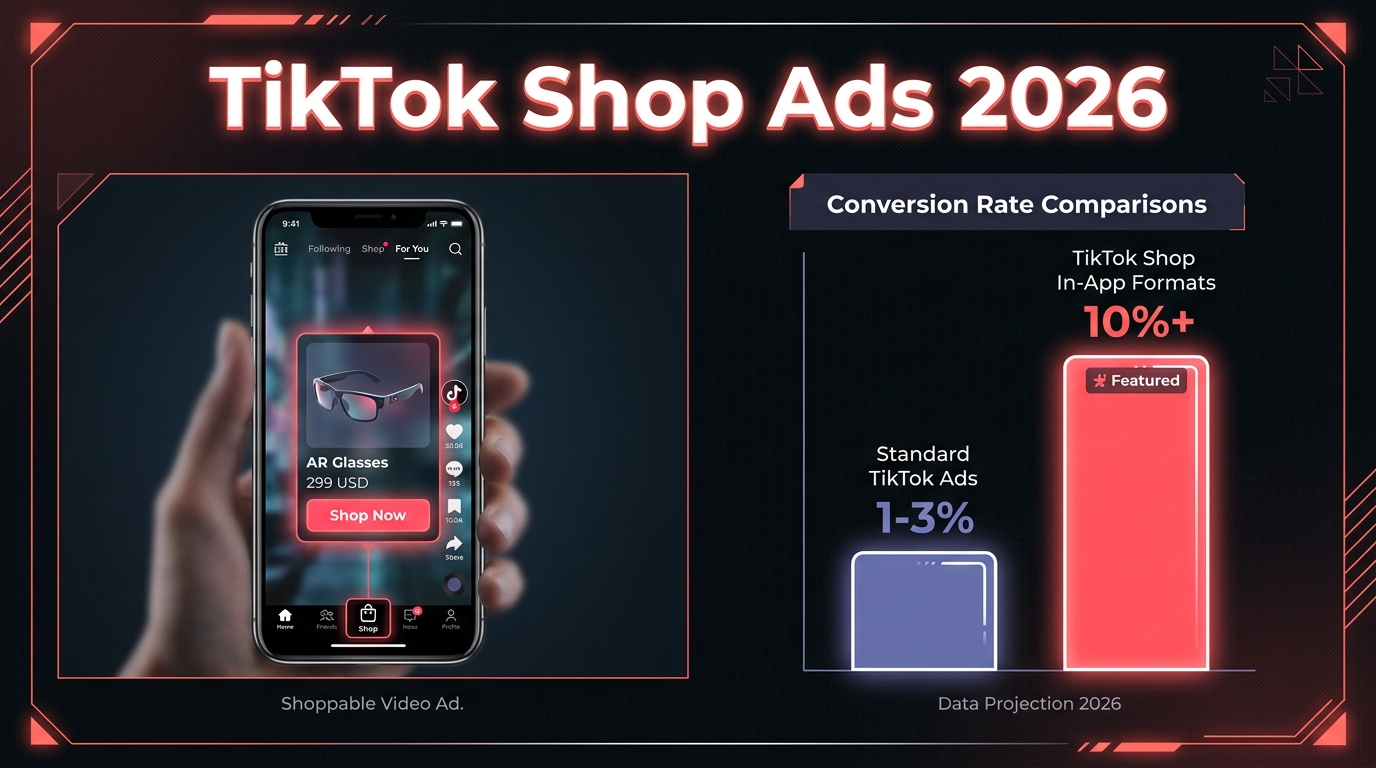

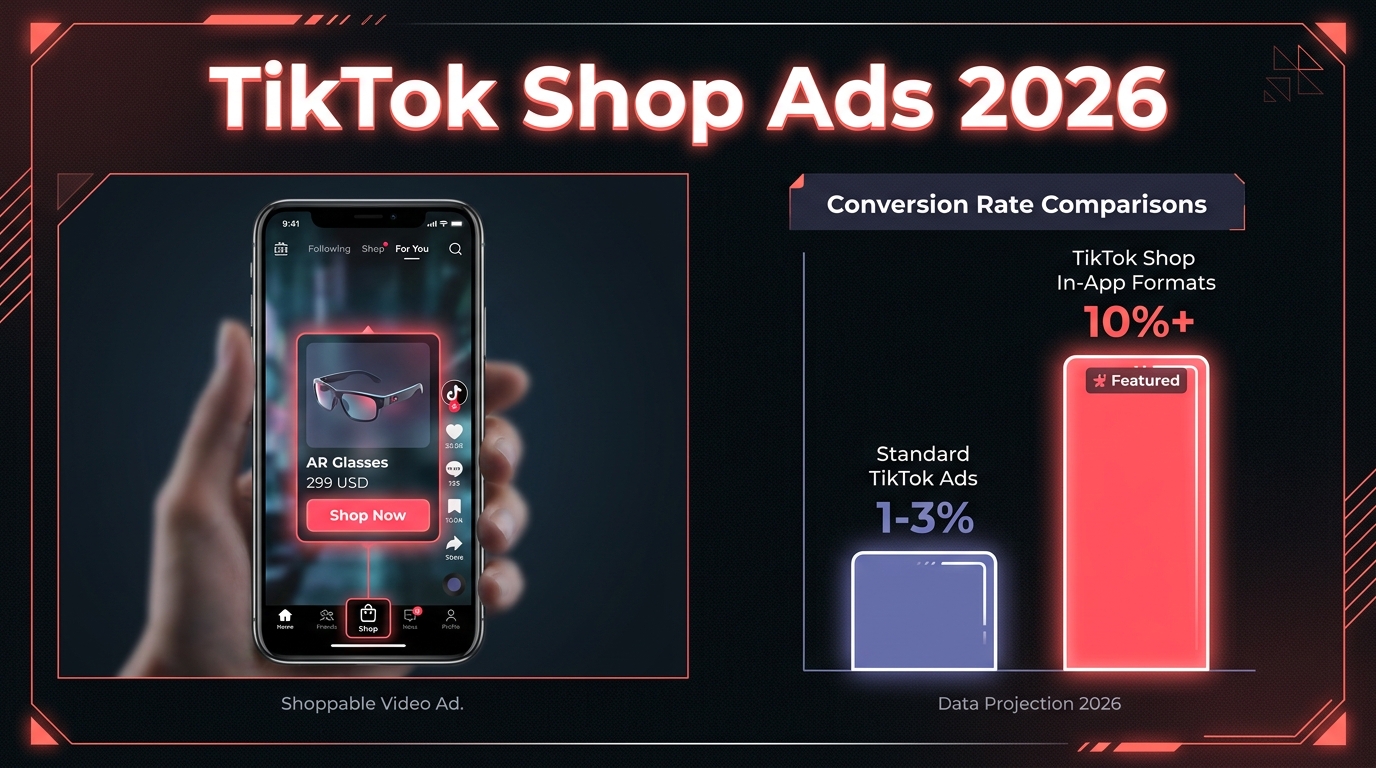
There’s a version of TikTok advertising that most brands are still running: polished in-feed videos, a link in the bio, a website landing page that loads slowly and asks too much from the user. That approach converts at somewhere between 0.5% and 3% — if the creative is good. There is a different version, built entirely around in-app commerce, that regularly converts at 10% and above. The gap between those two numbers is not a creative problem. It’s a format problem.
TikTok Shop’s ad ecosystem in 2026 is genuinely complex. There are seven distinct formats, each with different mechanics, different audiences, and vastly different performance profiles. Some are built for always-on prospecting. Some spike during live events and crash in between. Some are primarily a retargeting tool dressed up in video clothing. And one — GMV Max — is an automation layer that most brands have adopted without fully understanding what they gave up to use it.
This breakdown goes format by format: what each one actually does mechanically, where it converts and why, where it doesn’t and why, and how the formats interact when you stack them into a full-funnel strategy. The goal is not to tell you TikTok Shop ads are worth running — the numbers are fairly unambiguous on that. The goal is to give you enough precision to stop running the wrong format for the wrong objective, because that’s where most of the wasted spend lives in 2026.
The TikTok Shop Ad Ecosystem: How the Formats Fit Together
Before diving into individual formats, it helps to understand the architecture. TikTok Shop’s ad formats are not interchangeable tools that do the same job at different price points. They operate at different stages of the purchase journey, reach different audiences in different mental states, and optimize for different signals. Running them as isolated campaigns without accounting for how they interact is one of the most common structural mistakes brands make.
The Core Format Stack
As of 2026, there are six primary TikTok Shop ad formats that performance-focused brands use regularly, plus GMV Max, which sits across all of them as an automated optimization layer:
- Video Shopping Ads (VSA) — In-feed shoppable video with product card overlay and in-app checkout
- LIVE Shopping Ads — Paid traffic amplification for live shopping streams
- Spark Ads with Product Anchors — Boosted organic or creator content with Shop checkout links
- Product Shopping Ads (PSA) — Catalog-based image ads for product discovery
- TikTok Shop Search Ads — Keyword-matched ads surfaced in TikTok’s search and Shop tab
- Dynamic Product Ads (DPA) — Automated retargeting that serves the exact product a user previously viewed or added to cart
- GMV Max — TikTok’s automated sales campaign type that distributes across placements and optimizes for incremental GMV
What Makes In-App Formats Structurally Different
The conversion premium on TikTok Shop formats — 10%+ CVR versus 1–3% for traffic-to-website campaigns — is not magic. It comes from friction reduction. Every step a user has to take outside the app is a dropout point. When someone watching a Video Shopping Ad can tap a product card, see the price and reviews, and complete checkout without leaving TikTok, the funnel compresses dramatically. The user is already in a consumption mindset, already on a mobile device optimized for this interface, and the checkout flow is familiar from previous purchases.
Understanding this is important because it sets the baseline expectation correctly. If you’re comparing a TikTok Shop VSA against a Meta ad driving to a Shopify page, you’re not comparing two ad formats. You’re comparing two entirely different commerce architectures. The format you choose determines the funnel you’re operating in.
Video Shopping Ads: The Always-On Conversion Workhorse
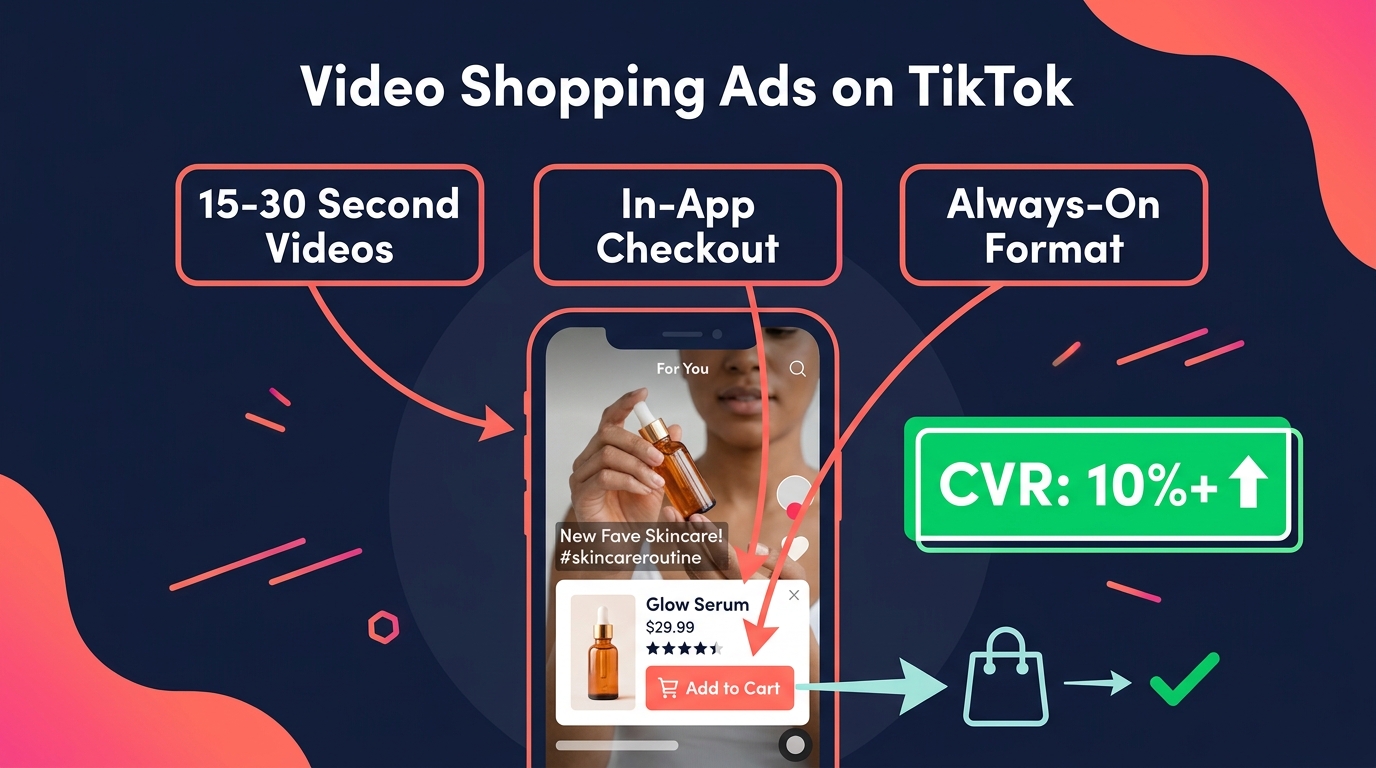
Video Shopping Ads are the format that brands should almost always start with. They are the closest thing to a reliable, scalable conversion engine that TikTok has built — and in 2026, they remain the primary prospecting format for most serious TikTok Shop operators.
How They Work Mechanically
A Video Shopping Ad is an in-feed video — anywhere from 9 to 60 seconds, typically 15–30 seconds in practice — with a product card anchored below the video content. The product card shows the item image, price, and a “Buy Now” or “Shop Now” call-to-action. When a user taps the card, they’re taken to the TikTok Shop product page and can complete checkout without leaving the app.
The critical mechanic is that the product is always visible. Unlike a standard in-feed ad where the CTA is a button the user has to notice and click, the product card is part of the ad unit itself. The user sees both the video content and the product simultaneously, which shortens the gap between attention and action.
Performance Benchmarks and Where They Come From
Industry data in 2026 consistently places Video Shopping Ads in the 7–12% conversion rate range for well-optimized campaigns — compared to 0.5–3% for standard TikTok campaigns driving off-platform. The 10%+ figure that gets cited frequently is achievable but represents the upper range, not the floor. A more conservative baseline for brands new to the format is 5–8% CVR with room to improve as the algorithm gathers purchase data.
ROAS benchmarks vary considerably by vertical. Beauty and personal care tend to perform best, with documented case studies in the 8–14x range when Spark-amplified creator content is involved. Fashion, home goods, and health products typically land in the 3–6x range. The range is wide because ROAS on VSAs is driven heavily by three variables that differ brand to brand: average order value, creative quality, and how well the product fits TikTok’s existing purchase intent.
When VSAs Outperform Everything Else
Video Shopping Ads win when you need an always-on, predictable conversion channel that can run without event scheduling or creator coordination. They are scalable in a way that LIVE Shopping Ads are not — you can run VSAs 24/7 across unlimited ad sets, A/B test creatives systematically, and let the algorithm optimize over time. For brands that need consistent daily revenue from TikTok Shop rather than event-based spikes, VSAs are the foundation of the media plan.
They also win on creative diversity. Because VSAs accept almost any video format — product demos, testimonials, unboxings, tutorials, UGC-style creator content — you can test dozens of different angles simultaneously to find what your audience responds to, and then scale spend behind the winners.
The Critical Constraint: Creative Fatigue
The biggest operational challenge with VSAs is creative refresh rate. TikTok’s algorithm distributes spend toward creatives that are generating strong early engagement signals, which means a winning creative gets high exposure fast — and fatigues fast as a result. Brands running serious VSA campaigns in 2026 are producing new creative tests every week, not every month. Treating creative production as a quarterly exercise will consistently undermine performance.
GMV Max: The Automated Layer Taking Over TikTok Shop Budgets
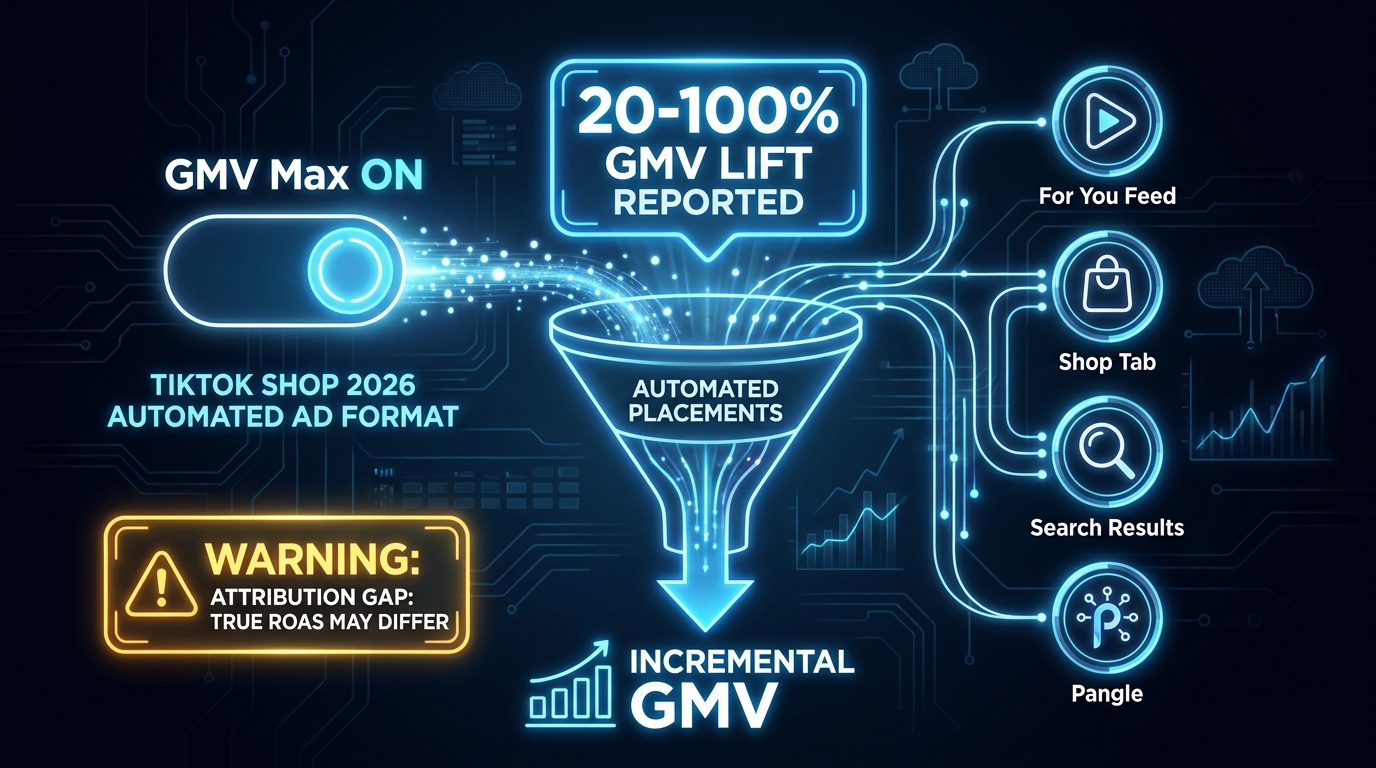
GMV Max is now TikTok’s default Sales campaign type for TikTok Shop, which means most brands running Shop ads are using it whether they made a conscious choice to or not. Understanding what it actually does — and where the numbers it reports diverge from reality — matters more than almost any other topic in TikTok Shop advertising right now.
What GMV Max Actually Does
GMV Max is an automated optimization system, not a single ad placement. When you create a GMV Max campaign, TikTok’s algorithm distributes your creative across multiple placements — the For You feed, the Shop tab, search results, and Pangle (TikTok’s partner network) — and dynamically allocates budget toward the placements and audiences generating the most incremental GMV. You provide the creative and the budget. The algorithm handles placement selection, audience targeting, and bid management.
The key word in TikTok’s framing is “incremental.” GMV Max is designed to optimize for GMV that would not have occurred without the ad — which in theory is the right optimization goal, but in practice creates complexity around measurement. TikTok also blends your organic TikTok Shop traffic signals into the optimization, meaning the algorithm is partly learning from both paid and organic behavior simultaneously.
Reported ROAS vs. True ROAS: The Attribution Gap
Here is where GMV Max gets complicated. TikTok’s reported ROAS for GMV Max campaigns typically falls in the 2–4x range, and case studies published by TikTok and its partners frequently show 20–100% GMV lifts. These numbers are real in the sense that they accurately represent what TikTok’s attribution model reports. The problem is that TikTok’s attribution model uses a view-through and click-through window that is broader than what most brands use for cross-channel measurement.
Media buyers who have run GMV Max campaigns alongside third-party attribution tools report a consistent pattern: the ROAS TikTok shows is often 2–3x higher than what an independent measurement tool attributes to the same spend. True ROAS, after accounting for view-through inflation and organic sales TikTok claims credit for, often sits closer to 1.2–1.8x. That’s still a positive return, but it changes the budget allocation decision considerably.
When GMV Max Makes Sense — and When It Doesn’t
GMV Max makes the most sense for brands that have already established TikTok Shop performance with manual campaigns and want to automate at scale. If you have a winning creative library, a catalog of products with strong TikTok purchase history, and an established Shop with reviews and ratings, GMV Max can compound that existing signal efficiently and reduce the day-to-day management overhead substantially.
It makes less sense for brands that are just entering TikTok Shop, have limited creative assets, or are testing whether a product category works on the platform. In those situations, the automation works against you: the algorithm doesn’t have enough signal to make good decisions, and you lose the diagnostic visibility that manual campaign structures provide. Starting with structured VSA or Spark campaigns and moving to GMV Max once you have proof of concept is a more defensible path.
LIVE Shopping Ads: High-Variance, High-Ceiling Commerce
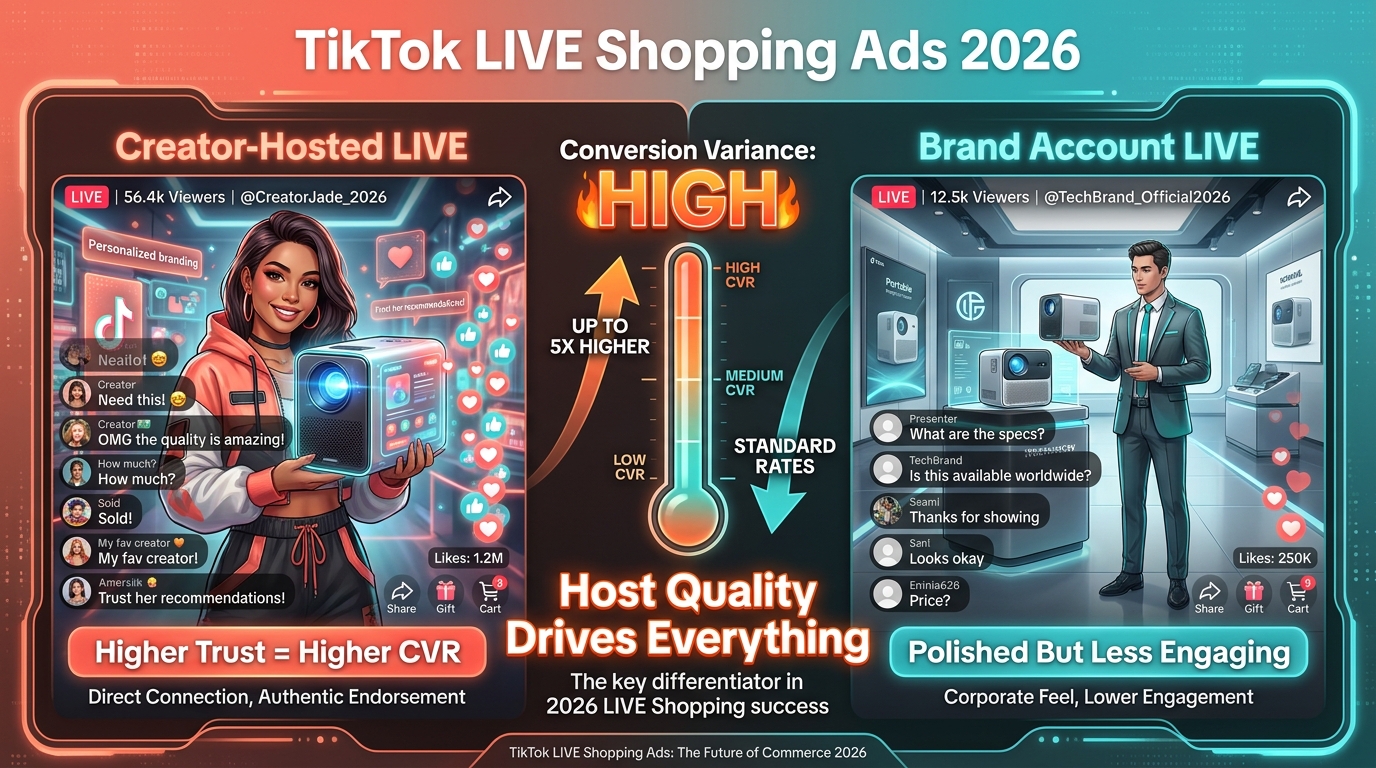
LIVE Shopping Ads are the format with the highest ceiling and the most volatility. When they work — when the host is strong, the product needs demonstration, and the live event has real energy — they can deliver conversion rates and GMV spikes that no other TikTok format matches. When they don’t work, they burn budget quickly on viewers who drop off within seconds.
The Mechanics of LIVE Shopping Ad Traffic
LIVE Shopping Ads are fundamentally a traffic amplification format. You’re not building a standalone ad — you’re paying to send additional viewers to an active livestream. The ad format captures a clip from the live stream and distributes it through in-feed placements, driving clicks back to the live event. Products featured in the stream are shoppable through pinned product cards in the live interface, allowing purchase without leaving TikTok.
This mechanic has an important implication: your conversion rate is determined by the quality of the live stream, not the quality of the ad unit. The ad gets people in the room. The host and the stream keep them there and convert them. This is fundamentally different from Video Shopping Ads, where conversion is a function of the video creative itself.
The Host Quality Variable
Available data and practitioner experience in 2026 are consistent on one point: host quality is the single largest driver of LIVE Shopping Ad performance. Creator-hosted lives — where the host has an established relationship with their audience and natural on-camera presence — consistently outperform brand-account streams run by less practiced presenters. This is not about follower count. It’s about the specific skill of conducting a commerce-focused live stream in a way that feels native to TikTok.
The trust dynamic matters significantly here. When a creator that an audience already follows recommends a product on their own livestream, the endorsement carries weight that a brand account simply cannot replicate at the same speed. Conversion on creator-hosted LIVE Shopping Ads is typically higher, though the tradeoff is that you’re sharing some portion of revenue with the creator and have less control over the presentation.
When LIVE Shopping Ads Convert Best
LIVE Shopping Ads consistently outperform other formats in specific product scenarios. Products that benefit from demonstration — skincare application, cooking equipment, fitness tools, fashion styling — convert well in live settings because the host can answer objections, show the product from multiple angles, and create purchase urgency in real time. Products with strong discount mechanics or flash sale pricing work especially well in live, where the limited-time element creates genuine urgency that a static video cannot replicate.
Product launches and seasonal campaigns are also natural fits. The event-based nature of LIVE Shopping Ads aligns well with product launches that benefit from a concentrated window of visibility and social energy. Brands running launch-day lives with paid traffic amplification report GMV spikes that can exceed their entire previous month of organic Shop revenue in a single session — but those spikes require the right product, the right host, and enough paid reach behind them to generate the audience density that makes a live event feel alive.
The Structural Weakness: Event Dependency
The core limitation of LIVE Shopping Ads is that they cannot be an always-on strategy. They require scheduling, host coordination, production setup (even minimal production), and a live traffic window that concentrates your spend into a narrow time period. For brands that cannot support consistent live production, VSAs will deliver more reliable outcomes despite the ceiling being lower. For brands that can, LIVE Shopping should function as a conversion spike layer on top of an always-on VSA foundation.
Spark Ads with Product Anchors: The Native Commerce Bridge
Spark Ads occupy a unique position in TikTok Shop’s format ecosystem because they blur the line between organic content and paid advertising in a way that is specifically valuable for commerce. When combined with product anchor links that connect directly to TikTok Shop checkout, they become one of the most efficient formats on the platform — particularly for brands with strong creator partnerships.
What Makes Spark Ads Structurally Different
A standard TikTok ad is created in Ads Manager and runs as a clearly commercial unit. A Spark Ad is a boosted version of an existing organic TikTok post — either from your own brand account or, with creator permission, from an affiliate or creator account. The ad runs under the original creator’s handle, preserving all organic engagement (likes, comments, shares) and the native appearance of organic content.
This matters for TikTok Shop specifically because the platform’s user base has developed strong ad literacy. Users can often identify conventional ad creative by its visual grammar alone — clean lighting, product-focus, explicit CTA — and their engagement pattern shifts when they recognize they’re watching an ad. Spark Ads sidestep this by running content that looks exactly like what the user’s organic For You feed would surface. When combined with a product anchor (a pinned TikTok Shop product link in the video), this native appearance carries through all the way to the purchase point.
ROAS Benchmarks from Creator + Shop Campaigns
The ROAS ceiling for Spark Ads combined with TikTok Shop product anchors is the highest of any format on the platform. Case study data from 2026 includes documented examples at 14x ROAS (Bellamianta beauty brand) and 8x+ ROAS across beauty, fashion, and DTC health categories. These figures represent top-of-distribution outcomes, not average performance — but they are achievable specifically because creator-authored content with genuine product affinity can generate both strong organic reach and conversion performance simultaneously.
The more typical range for Spark Ads + Shop anchor campaigns sits at 4–8x ROAS when the creative is strong and the product-creator fit is authentic. This is still meaningfully above what most Video Shopping Ad campaigns achieve on average, making Spark the preferred format when the creative is available.
The Creative Authenticity Requirement
The performance premium of Spark Ads is entirely dependent on authentic creative. Spark Ads built from scripted brand-produced content that happens to be posted on a creator account will not perform like Spark Ads built from genuine creator advocacy. The TikTok audience is sophisticated enough to distinguish between a creator who actually uses and recommends a product versus a creator reading a brand brief. Brands that attempt to replicate Spark Ad performance by scripting creator content too tightly consistently report results closer to standard in-feed ads than the Spark premium figures.
The practical implication is that Spark Ads at scale require a genuine affiliate and creator relationship program, not just a creative production process. Brands running 20–50 active creator partnerships, selecting which organic posts to boost based on early organic performance signals, and maintaining creator relationships with high authentic usage frequency consistently outperform brands treating Spark Ads as a creative format rather than a relationship format.
Product Shopping Ads: The Catalog Discovery Engine
Product Shopping Ads (PSAs) get less attention in 2026 performance conversations than Video Shopping Ads or Spark Ads, partly because they’re less visually dynamic and partly because their conversion mechanism is more indirect. But PSAs serve a specific function in the TikTok Shop ecosystem that other formats don’t cover as efficiently — catalog-scale product discovery.
The Structural Role of PSAs
Where a Video Shopping Ad is a narrative format — it tells a story about the product and then offers purchase — a Product Shopping Ad is a product-first format. It surfaces a product image, name, price, and rating from your TikTok Shop catalog in a format that resembles a shopping listing rather than a content feed. PSAs appear primarily in TikTok’s Shop tab recommendations and are served based on catalog matching algorithms rather than creative engagement scoring.
This makes them the right format when you need to surface a large product catalog without building bespoke video creative for every SKU. For brands with hundreds of products, VSAs require a creative investment per product that is often impractical. PSAs can be run against an entire catalog automatically, letting TikTok’s recommendation engine surface the most relevant products to users who are in a discovery mindset.
Where PSAs Underperform — and Why It Matters
PSAs consistently show lower conversion rates than VSAs for direct-response campaigns. The absence of video makes it harder to communicate product value, create emotional resonance, or address purchase objections. For products where the use case and benefit are not immediately obvious from a product image alone — most of the beauty, personal care, and wellness categories — PSAs will typically show CVR in the 2–4% range versus the 7–12% achievable with strong VSA creative.
This doesn’t mean PSAs are a weak format. It means they’re wrong for direct-response objectives. PSAs are a discovery format and should be measured on catalog coverage, CPM efficiency, and downstream retargeting audience size — not on immediate ROAS. The users who see a PSA and don’t convert immediately are valuable: they become your Dynamic Product Ad retargeting pool, and the data signal from their partial engagement informs your VSA targeting.
TikTok Shop Search Ads: The Intent Layer Nobody Talks About
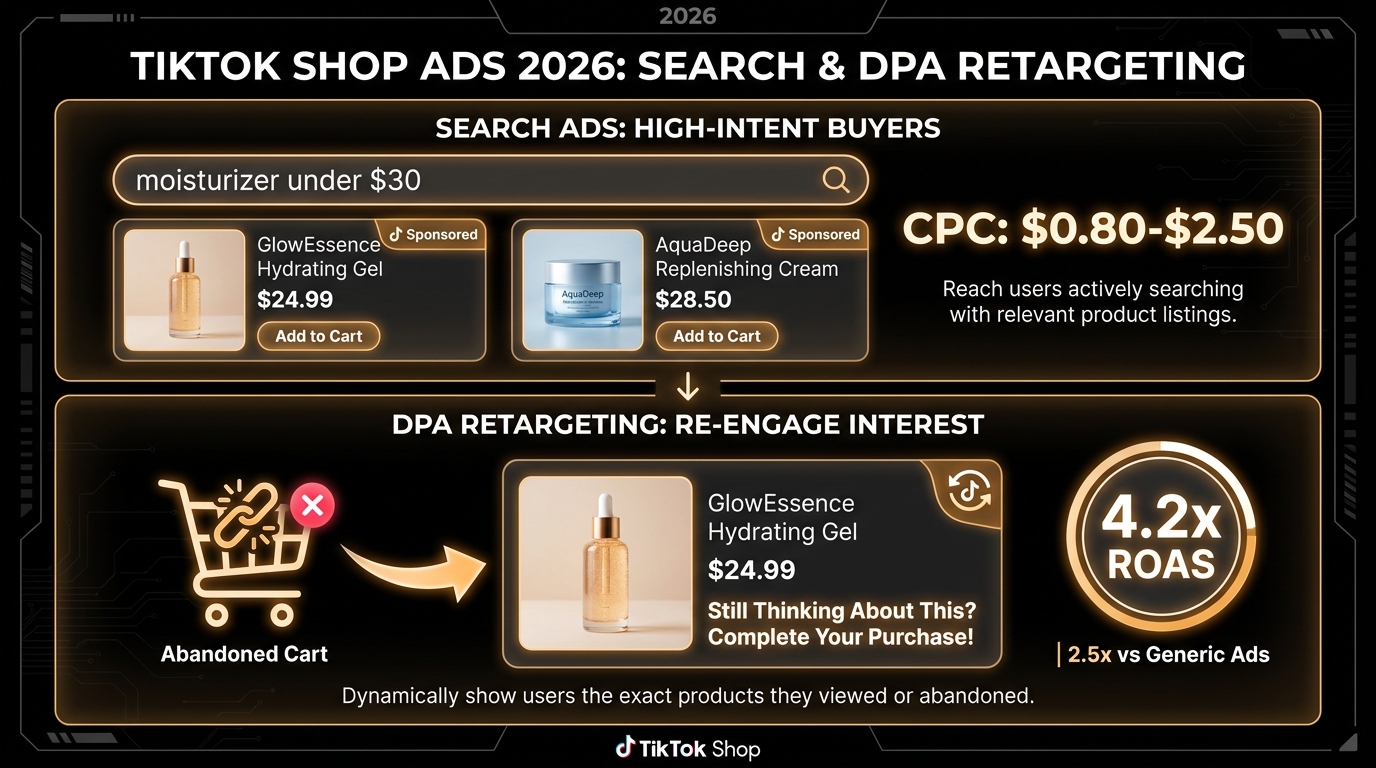
TikTok’s search behavior has changed substantially in recent years. A growing segment of TikTok’s user base now uses the platform’s search function as a primary product discovery tool, particularly in the 18–34 demographic. As of 2026, TikTok Search Ads in the Shop tab have emerged as one of the highest-intent, most underutilized placements in TikTok’s ad inventory.
Why Search Intent Changes the Conversion Equation
The fundamental difference between search-triggered ads and feed-based ads is the user’s state of mind. Someone who opens their For You feed is in a passive consumption mode — they might buy something if the right product appears at the right moment, but they weren’t planning to. Someone who types “affordable moisturizer for oily skin” into TikTok’s search bar is in active purchase research mode. That intent gap explains why TikTok Shop Search Ads show meaningfully different performance metrics than their feed-based counterparts.
Current 2026 benchmarks for TikTok Shop Search placements show CTR in the 2–6% range (compared to 1–2% for standard in-feed), CPC of approximately $0.80–$2.50, and CVR in the 3–8% range for well-optimized campaigns. ROAS of 3–5x is reported in early case studies, with the caveat that these are still emerging benchmarks — the placement is newer and less thoroughly documented than VSAs.
Search Ads as a Brand Defense and Category Capture Tool
Search Ads on TikTok Shop serve two distinct strategic purposes. The first is brand defense: if your brand name is being searched by existing customers or people who’ve seen your organic content, buying branded search terms ensures those high-intent users land on your product listings rather than a competitor’s. For established TikTok Shop brands with meaningful organic presence, branded search defense is often the highest-ROAS campaign type available.
The second purpose is category capture: bidding on non-branded category terms (“vitamin C serum,” “wireless earbuds under $50,” “gym resistance bands”) to intercept users who are shopping the category but haven’t yet chosen a brand. This requires more aggressive bidding and stronger product page optimization to convert, but it enables reach into an audience that already has purchase intent — which no amount of algorithmic targeting on the For You feed can perfectly replicate.
The Volume Constraint and How to Work Around It
The main limitation of TikTok Shop Search Ads is inventory. TikTok’s search volume is still smaller than Google’s or even Amazon’s for most product categories, which means you can’t scale Search Ads to be a primary channel for most brands. The practical approach is to treat Search Ads as a high-efficiency, lower-volume complement to VSA and Spark campaigns — running them for brand terms and your top 5–10 category keywords, capturing the high-intent bottom-of-funnel traffic, while VSAs and Spark Ads handle the majority of volume at mid-funnel.
Dynamic Product Ads: The Retargeting Format Converting at 4x
Dynamic Product Ads (DPAs) are the format that most TikTok Shop operators set up and then forget to optimize — which is unfortunate, because they consistently deliver the highest return on ad spend of any format in the TikTok Shop ecosystem when applied correctly.
What DPAs Actually Do
A Dynamic Product Ad is an automated retargeting format. It connects to your TikTok Shop catalog and your website/app pixel data, then automatically generates personalized ad creatives that show each user the specific products they have already viewed, added to cart, or engaged with. Instead of creating a single ad and targeting an audience, you set up the template and the rules, and TikTok’s system dynamically assembles thousands of personalized ad variations in real time.
The personalization is the performance driver. A user who spent 30 seconds looking at a specific pair of shoes and then navigated away is meaningfully more likely to convert when shown that exact product in a retargeting ad than when shown a generic brand ad. The psychology is straightforward: the user already expressed interest, already considered the purchase, and in many cases left only because of timing or distraction rather than an objection to the product itself.
The Performance Numbers and What Drives Them
Industry benchmarks for DPA retargeting in 2026 are among the strongest in TikTok’s ad inventory. Reported ROAS averages approximately 4.2x, compared to roughly 1.8–2.5x for cold prospecting campaigns. CTR is typically 2–3x higher than generic display ads. CVR for cart abandonment audiences — users who added a product to cart but didn’t complete purchase — is estimated at 2.5x higher than generic retargeting. Cart abandonment recovery through DPA campaigns is estimated to recover 15–25% of otherwise-lost revenue.
The mechanism behind these numbers is the combination of personalization and intent signal. DPAs don’t just show the right product — they show it to the right person at a moment when the purchase is already partially considered. Reducing the decision friction for an already-interested buyer is structurally more efficient than convincing a cold audience to become interested in the first place.
Setting Up DPAs That Actually Work
DPA performance is heavily dependent on the quality of the underlying catalog feed and the pixel data powering the audience targeting. Brands with catalog feeds that have incomplete product information, poor product images, or outdated pricing will see their DPA performance suffer even when the targeting is technically correct. The feed is the creative in a DPA campaign — its quality is as important as video creative quality in a VSA campaign.
Audience segmentation within DPA campaigns also matters significantly. Running a single DPA campaign against all site visitors produces mediocre results. Segmenting by engagement depth — viewers versus add-to-carts versus checkout abandoners — and using different bid levels and messaging for each segment produces materially better outcomes. Cart abandoners should almost always be a separate, higher-priority audience with more aggressive bidding than general product viewers.
The Creative Structure That Makes Every Format Work
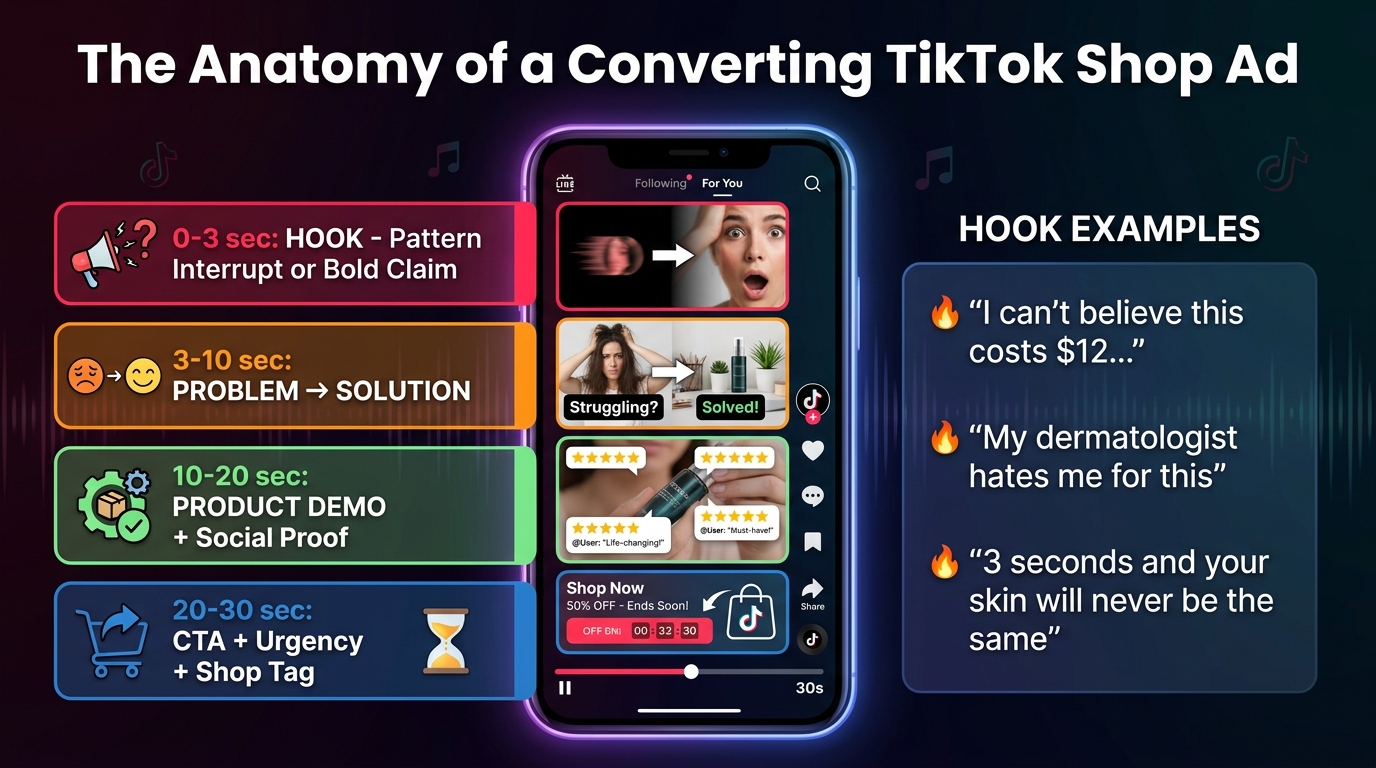
No ad format on TikTok Shop converts well with weak creative. The in-app checkout advantage reduces friction at the purchase step, but it does nothing to create the attention, interest, and desire that have to precede that step. The creative structure that converts in 2026 follows recognizable patterns — but the brands that execute them well understand why those patterns work, not just what they look like on the surface.
The First Three Seconds: Non-Negotiable
TikTok’s scroll speed is fast. The average user decides whether to continue watching a video within the first 1–3 seconds — and that decision is made almost entirely on the basis of the opening frame and first line of audio. Every format in TikTok Shop’s ad inventory is hurt by a weak opening, but VSAs and Spark Ads are particularly vulnerable because they run in a feed context where the user has infinite alternatives a swipe away.
The hooks that consistently trigger continued viewing in 2026 share a specific characteristic: they create unresolved tension immediately. “I can’t believe this actually works” creates tension because the viewer doesn’t know what “this” is yet. “I spent $400 on serums before I found this $12 one” creates tension because the contrast is provocative and the resolution (the $12 product) is withheld for a beat. The hook doesn’t have to be dramatic — it has to be unfinished. The viewer needs a reason to watch the next few seconds to resolve the tension introduced in the first three.
The 15–30 Second Conversion Structure
For TikTok Shop ads, the optimal video length in 2026 remains 15–30 seconds for most formats. The structure that performs consistently follows a four-part arc:
- Seconds 0–3: The hook. A provocative claim, a pattern-interrupt visual, or a problem statement that creates immediate tension and demands resolution.
- Seconds 3–10: Problem and solution framing. Establish the problem the product solves and position the product as the resolution. Be specific about the problem — specific problems resonate with the specific people who have them.
- Seconds 10–20: Product demonstration and social proof. Show the product being used. Include evidence — real results, user testimonials, before/after visuals if applicable. This is where objection handling happens.
- Seconds 20–30: Direct CTA with urgency. “Shop now” is fine but not enough by itself. Adding a specific reason to act now — a limited quantity note, a current discount, a bundle offer — closes the gap between interest and action.
Native UGC Style Versus Polished Brand Production
The consistent finding from 2026 creative testing across categories is that native UGC-style video outperforms polished studio production for TikTok Shop ads. “Native” here means content that could plausibly have appeared in a user’s organic For You feed — handheld camera work, natural lighting, real-person presentation, on-screen text overlays that feel like creator annotations rather than broadcast graphics.
This is counterintuitive to brands whose marketing identity is built around production quality. The reason it performs better is environmental fit. TikTok’s feed is composed almost entirely of native, creator-made content. An ad that matches that visual grammar blends into the environment in a way that allows the product message to land before the user’s mental ad filters activate. A polished brand production spot announces itself as an ad immediately, which triggers a different, more skeptical viewing mode.
The practical implication is not that brands should produce low-quality content. It’s that quality on TikTok is defined by authenticity and native fluency rather than production value. A well-lit, clearly presented creator review shot on an iPhone with good audio and a natural presentation style is higher quality for TikTok Shop purposes than a studio-produced spot with professional lighting, a branded backdrop, and a scripted voiceover.
Budget Allocation Across Formats: A Practical Framework for 2026
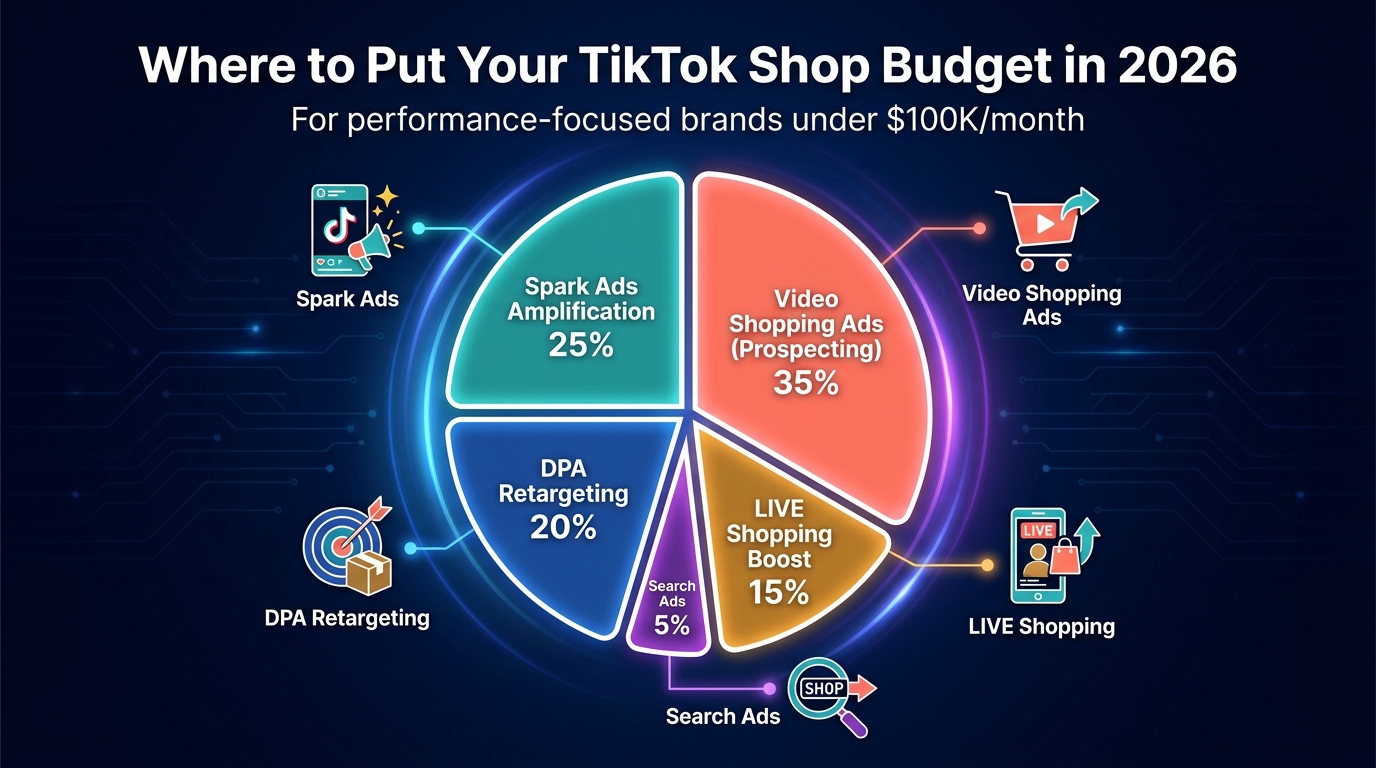
The question of where to put your TikTok Shop ad budget is not answerable with a single universal framework — it depends on your scale, creative capacity, product type, and whether you’re building a new TikTok Shop presence or scaling an established one. But there are allocation principles that hold across most performance-focused brand scenarios in 2026.
For Brands Under $10K/Month in Ad Spend
At this scale, the priority is proving product-market fit and identifying winning creative before scaling spend. The allocation that makes the most operational sense concentrates budget in two places: Video Shopping Ads as the primary conversion vehicle, and DPA retargeting to recapture the high-intent audience generated by VSA exposure. A rough split of 65–70% to VSA prospecting and 25–30% to DPA retargeting, with a small holdback for Spark Ad testing, will give you the clearest signal about what’s working without spreading budget too thin to learn anything.
At this scale, LIVE Shopping Ads and Search Ads are premature. LIVE requires infrastructure and host coordination that takes time to set up correctly. Search volume at the keyword level won’t generate meaningful spend at sub-$10K budgets for most categories. Adding these formats before VSA and DPA are optimized typically just fragments the learning.
For Brands Between $10K and $100K/Month
At this scale, the format stack expands and the allocation becomes more nuanced. A defensible benchmark allocation for a performance-focused brand in this range looks roughly as follows:
- Video Shopping Ads (prospecting): ~35% of budget — the primary new-customer acquisition channel
- Spark Ads amplification: ~25% — boosting top-performing creator and organic content with product anchors
- DPA retargeting: ~20% — with audience segmentation separating cart abandoners from general product viewers
- LIVE Shopping Ads boost: ~15% — event-based allocation around scheduled live sessions, not running continuously
- Search Ads: ~5% — brand defense plus top category keywords
Creative production budget deserves its own line item at this scale. Brands consistently running TikTok Shop ads at the $10K–$100K level find that allocating 15–20% of total ad budget equivalent to creative production is necessary to maintain the creative refresh rate that keeps VSA and Spark performance from decaying.
For Brands Over $100K/Month
At significant scale, GMV Max becomes more defensible as a primary campaign structure — but only once the brand has established strong organic TikTok Shop performance, a proven creative library, and solid internal attribution capability to triangulate against TikTok’s reported numbers. The high-scale mix typically layers GMV Max on top of a managed VSA/Spark structure rather than replacing it entirely, preserving diagnostic visibility in the manual campaigns while letting GMV Max optimize at the aggregate level.
At this scale, LIVE Shopping Ads also warrant a more significant share — typically 20–25% — because the infrastructure investment required to run consistent high-quality lives is more amortizable against a larger budget, and live events can generate single-session GMV that meaningfully impacts monthly totals.
How to Measure What’s Actually Working
Measurement in TikTok Shop advertising in 2026 requires holding two systems in view simultaneously: TikTok’s native attribution, which you need to operate the platform’s optimization tools, and an independent measurement layer, which you need to make actual budget decisions. Treating TikTok’s reported numbers as ground truth will consistently lead to over-investment in the platform relative to its true contribution.
The Attribution Problem and How to Triangulate
TikTok’s default attribution window includes view-through conversion credit, meaning a user who watched your ad but never clicked can still be counted as a conversion if they purchase within the attribution window. For awareness-building formats this is defensible. For performance formats like VSA and DPA, where you’re paying for direct response, view-through attribution often significantly inflates reported ROAS — particularly in categories where TikTok content influences purchase decisions that complete on other channels.
The most reliable measurement approach in 2026 combines three data sources: TikTok’s pixel-reported data (for platform optimization), first-party revenue data from your TikTok Shop backend (for actual orders attributed to Shop), and a holdout or incrementality test methodology for validating ROAS claims. Brands that run periodic spend-pause tests — turning off TikTok Shop ads entirely for 2–3 weeks on a geographic or audience subset — get cleaner data on true incremental revenue than any attribution model can provide.
Which Metrics Signal Real Performance by Format
Not every format should be evaluated on the same metric. Using ROAS as the primary success metric for PSAs will make them look bad while obscuring their actual contribution to the funnel. Using CPM efficiency to evaluate LIVE Shopping Ads ignores that you’re buying event traffic, not awareness reach. The format-appropriate metrics that signal genuine performance:
- Video Shopping Ads: CVR (in-app), Cost Per Purchase, 30-day reorder rate
- GMV Max: Incremental GMV vs. holdout, attributed vs. reported ROAS ratio
- LIVE Shopping Ads: Average view duration, CTR to product page, GMV per viewer
- Spark Ads: Organic amplification ratio, CVR vs. equivalent VSA creative, new customer rate
- Product Shopping Ads: Catalog reach %, downstream DPA pool size, CPM vs. category baseline
- Search Ads: Share of branded searches captured, CTR vs. organic listing CTR
- DPAs: Cart recovery rate, ROAS vs. prospecting campaigns, audience refresh rate
What the Conversion Gap Tells You About Where TikTok Shop Is Heading
The 10%+ in-app conversion rate versus the 0.5–3% off-platform conversion rate is not just a useful performance benchmark. It’s a statement about where commerce on social platforms is structurally going. TikTok has built a commerce architecture that reduces every friction point between content and purchase, and every format update in 2026 has moved further in that direction — more automation, more in-app closure, more integration between organic discovery and paid amplification.
The brands that are winning on TikTok Shop in 2026 are not necessarily the ones with the biggest budgets or the most sophisticated technical setups. They are the ones that have stopped treating TikTok as a traffic source that feeds other commerce platforms and started treating it as a complete commerce environment. That means investing in native creative that fits TikTok’s visual language, building creator relationships that generate authentic product advocacy, maintaining a TikTok Shop product catalog that is as well-optimized as their website, and structuring ad campaigns around TikTok’s in-app funnel rather than their own external funnel logic.
The format choices follow from that orientation. If TikTok is an awareness channel, you run awareness formats and optimize for reach and engagement. If TikTok is a commerce platform — which the conversion data suggests it increasingly is — you run commerce formats, you optimize for CVR and GMV, and you allocate creative and operational resources accordingly.
Actionable Takeaways
The core decisions are more straightforward than the complexity of the format ecosystem makes them appear:
- Start with Video Shopping Ads and DPA retargeting. These are the two formats with the clearest, most consistent conversion performance and the most manageable operational requirements. Get these running well before adding complexity.
- Treat Spark Ads as a relationship output, not a creative format. The performance premium comes from authentic creator advocacy. Build creator relationships first; the Spark Ads follow naturally from those relationships.
- Be skeptical of GMV Max reported ROAS until you have independent validation. The format has genuine value at scale, but the attribution inflation is real and will mislead budget decisions if you take the reported numbers at face value.
- Add LIVE Shopping Ads as an event layer once you have consistent VSA performance. Don’t let live commerce production become an operational distraction before you have a proven baseline of everyday performance.
- Build Search Ads for brand defense from day one. This is the highest-ROAS campaign type for brands with any organic presence, and the operational cost is minimal relative to the value of capturing in-market, already-interested buyers.
- Match your measurement framework to the format, not to a single universal ROAS standard. Each format plays a different role in the funnel and should be evaluated on the metrics that actually reflect that role.
- Refresh creative faster than feels necessary. TikTok’s algorithm rewards new creative with discovery reach. The brands consistently outperforming benchmarks in 2026 are treating creative production as a continuous operation, not a quarterly campaign asset.
The format gap between brands that treat TikTok as a traffic source and brands that treat it as a commerce platform is widening in 2026. The conversion data is explicit about which architecture wins. The operational question is whether you’re building toward it.