





Most TikTok Shop sellers are fighting a battle on one front when the war is being waged on four. They polish their product titles, stuff in keywords, maybe run a few affiliate campaigns — and then wonder why their listings don’t move. Meanwhile, a competitor with a simpler product and a less polished shop is consistently appearing at the top of search results and clearing inventory on autopilot.
The difference is rarely the product. It’s the signal profile.
TikTok Shop’s AI ranking engine is not a social media algorithm with a checkout button bolted on. It is a purpose-built commerce recommendation system that fuses behavioral signals, content signals, product data, and seller health metrics into a single continuous prediction about who is most likely to buy what, right now. Every time a user types a search query — or simply opens the Shop tab — that system runs a calculation against every eligible product in your category. Your ranking is the output of that calculation.
What’s striking is how few sellers understand all the inputs. Industry data from 2026 consistently shows that 48–65% of TikTok Shop sales now originate from search rather than the For You Page. Search users convert at roughly twice the rate of passive feed browsers. Yet the majority of optimization effort still targets surface-level content signals — watch time, hashtags, video hooks — while the deeper ranking layers go completely untouched.
This article maps all four signal buckets TikTok’s AI reads before it decides where your product ranks. It explains how those signals interact, how they decay, and which levers actually move your position. This is not a guide about going viral. It’s a guide about being found by the people already looking for what you sell.
How the Ranking Engine Is Actually Structured
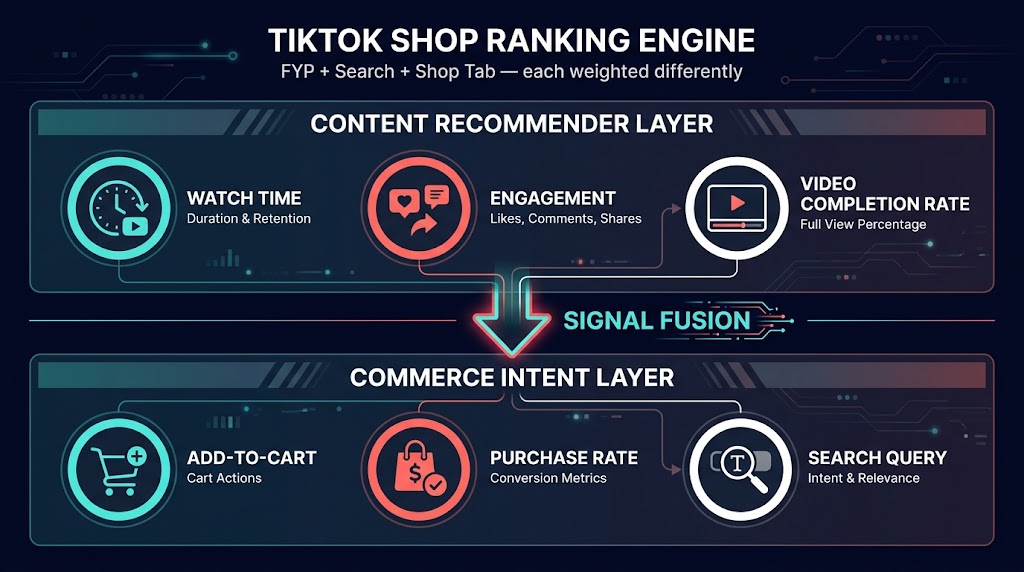
Before diving into individual signals, it helps to understand the architectural reality of what TikTok Shop’s ranking engine actually is — because it’s easy to misread it based on how TikTok presents itself publicly.
It Is Not a Social Algorithm With Shopping Features
TikTok’s general content recommender — the engine behind the For You Page — is one of the most sophisticated behavioral prediction systems ever deployed at consumer scale. But TikTok Shop does not simply inherit that engine and add product cards. It runs a layered system where the general recommender feeds a separate commerce-intent layer, which then applies its own set of signals and weights specific to purchasing behavior.
Think of it as two stacked models. The first model predicts engagement: will this user watch, like, share, or comment on this content? The second model predicts conversion: will this user add to cart and complete a purchase? These models share data, but they are not identical — and that distinction matters enormously for how sellers should think about optimization.
Four Distinct Surfaces, Four Signal Weightings
The ranking engine operates across at least four discovery surfaces, each with a different signal weighting profile:
- For You Page (FYP): Content signals dominate. Watch time, completion rate, and engagement velocity determine distribution. Commerce conversion is tracked but has a lower weight in the initial distribution decision.
- Search Results: Commerce intent signals carry significantly more weight. A user who typed a query is in a different psychological state from one who is passively scrolling — the system knows this and adjusts rankings accordingly.
- Shop Tab / Product Discovery: Listing-level signals (title, attributes, category, pricing) and shop-level health metrics take on greater importance here than on FYP or in search. This surface behaves most like a traditional marketplace search.
- LIVE Shopping: Real-time engagement signals dominate, with purchase actions during the stream feeding back into organic ranking of the underlying product listings.
The practical implication is that a product optimized only for FYP distribution can fail entirely in Shop Tab search, and vice versa. A comprehensive signal strategy has to account for how all four surfaces operate — because customers move across them fluidly, and the AI tracks that movement.
The Unified Prediction Goal
Across all surfaces, the AI is solving for one thing: predicted probability of purchase. Everything else — engagement, watch time, reviews, titles — feeds into that prediction. Understanding this changes how you think about every optimization decision. The question is never “will this make my content more engaging?” The question is always “will this make the AI more confident that someone searching for this product will buy mine?”
The Four Signal Buckets TikTok Uses
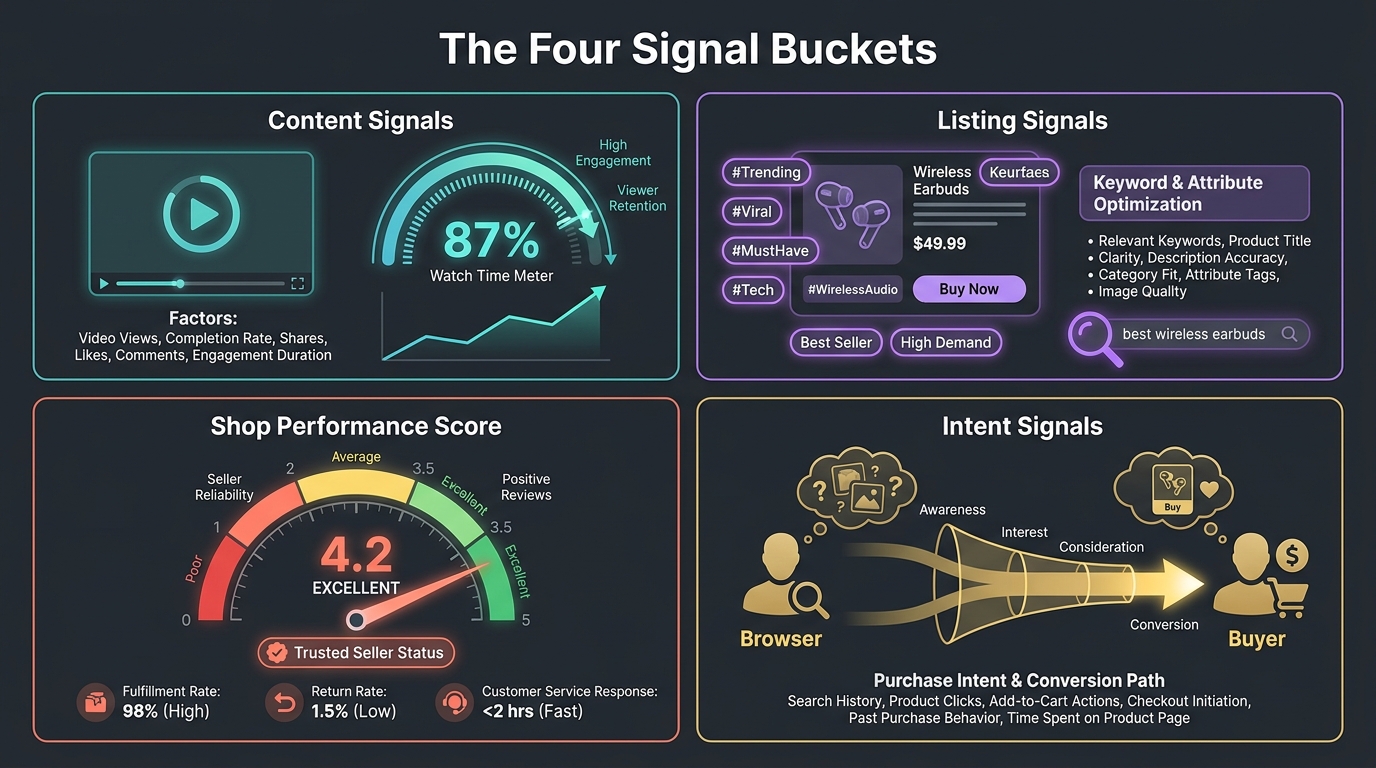
TikTok’s ranking system draws from four distinct categories of signal. They are not equally weighted across all surfaces, but all four are active in every ranking decision. Most sellers are fluent in one, familiar with a second, and have no idea the other two exist.
Bucket 1: Content Signals
These are the signals generated by how users interact with your video and LIVE content. Watch time, completion rate, replay rate, saves, shares, and product-tag interaction are the primary inputs. This bucket is where most TikTok-native optimization advice focuses — and while it matters, it is also the most competitive bucket to win on and the one that decays fastest.
Bucket 2: Product Listing Signals
These are static and semi-static signals derived from your product page: title keyword architecture, category assignment, attribute completeness, price positioning, and image quality. Unlike content signals, listing signals are relatively stable — but they set the floor of your ranking potential. Poor listing signals mean even strong content signals can’t push you to the top.
Bucket 3: Shop Performance Score (SPS)
This is the account-level health metric that acts as a multiplier on all other signals. A high SPS amplifies the value of your content and listing signals; a low SPS dampens them. Sellers often overlook SPS entirely until it drops enough to cause visible ranking suppression — at which point multiple compounding problems need to be resolved simultaneously.
Bucket 4: Behavioral and Intent Signals
These are the signals generated by what users do after they encounter your product — not just engagement, but the sequence and quality of downstream actions. Did they search for your product specifically? Did they add to cart but not purchase? Did they complete a purchase quickly after minimal product page time? These behavioral sequences tell the AI more about purchase probability than any surface-level engagement metric.
Content Signals: What the AI Reads in Your Video
TikTok’s content signal layer is more sophisticated than most sellers realize. It doesn’t just count likes and views — it reads, transcribes, and semantically analyzes the content of the video itself. This distinction is important: the AI is not just observing how users react to your content. It is reading the content directly.
Watch Time and Completion Rate Are Not the Same Signal
Both matter, but they serve different purposes in the ranking model. Watch time (absolute seconds watched) tells the AI about the video’s ability to hold attention in aggregate. Completion rate (percentage of viewers who watched to the end) tells the AI about intent alignment — did the right users find this video, or did lots of people click and immediately leave?
For commerce ranking specifically, completion rate combined with product-tag interaction rate is a particularly strong signal cluster. A video with moderate views but a high percentage of viewers clicking the product tag after completion tells the algorithm that this content is efficiently converting interest into commercial intent. That pattern gets rewarded with increased search placement.
The AI Reads Your Audio and On-Screen Text
TikTok’s content AI transcribes spoken audio and indexes the text it finds in your video — including captions, on-screen overlays, and supers. This is not a new capability, but sellers consistently underestimate its scope. A video about a skincare product where the creator says “perfect for dry skin in winter” twice during the content is being indexed for the phrases “dry skin” and “winter skincare” — regardless of whether those phrases appear anywhere in the product title or description.
This creates a significant opportunity. By scripting your key product attributes, use cases, and customer pain points into your video dialogue rather than only into listing fields, you expand the semantic footprint of your content without any additional optimization work. The AI hears it, indexes it, and uses it to match your product against queries that your written metadata might never have captured.
Product Tag Placement Timing Matters
Where and when a product tag appears in a video affects click-through rate, which feeds back into the content signal bucket. Tags placed too early — before viewer interest is established — generate impressions without clicks, which can actually suppress ranking. Tags placed after a moment of demonstrated benefit or problem-solution reveal see substantially higher interaction rates. The timing of the click matters to the AI because it correlates with genuine purchase intent versus accidental taps.
Creator Authority vs Topical Relevance
One of the most important shifts in TikTok Shop’s 2026 content signal model is the declining relative weight of creator follower count versus topical relevance to the specific product category. Multiple analyses of ranking patterns indicate that a creator with 8,000 followers who consistently produces content about kitchen equipment will outrank a generalist creator with 400,000 followers promoting the same product in a one-off video. The AI is measuring how deeply a creator’s content history aligns with the product category — not just whether their content reaches a lot of people.
For brands running affiliate campaigns, this has direct implications for creator selection. Topical authority within the category is now a more reliable predictor of search ranking contribution than raw audience size.
Product Listing Signals: The Commerce Layer
If content signals are the engine, product listing signals are the chassis. They determine whether your product is even eligible to rank for a given query — and how efficiently the AI can interpret what you’re selling. A weak listing creates a ceiling that no amount of viral content can break through.
Title Architecture: The Most Important Static Signal
The product title remains the single most important textual signal in the listing bucket. TikTok’s search ranking model reads product titles with particular attention to the first three to five words, which carry disproportionate weight for query matching. The architecture that consistently performs best follows a specific pattern:
- Primary keyword first — the exact phrase a buyer with purchase intent would type
- Key differentiating attribute — material, size, use case, or specific benefit
- Target audience or occasion qualifier — who it’s for or when/where it’s used
For example: “Wireless Earbuds Waterproof 48hr Battery for Sports and Gym Use” performs meaningfully better in search ranking than “Premium Bluetooth Audio Experience — Water Resistant Earbuds with Extended Playtime.” The second title is arguably more marketable as ad copy, but it starts with “Premium” — a word nobody searches — and buries the actual product attributes. The AI matches against search queries, not brand positioning statements.
Attribute Completeness and Category Accuracy
TikTok’s product catalog system uses a structured attribute layer — material, color, size, compatibility, audience, and category-specific fields — to build the semantic model of what your product is. Incomplete attributes are not a neutral factor; they actively reduce ranking eligibility for filtered searches and attribute-based matching.
Category assignment accuracy has become increasingly important as TikTok’s search AI has grown more sophisticated. Misassigning a product to a parent category when a more specific sub-category exists limits the product’s relevance score for the queries that sub-category is associated with. Correct, granular category assignment is a signal the AI uses to validate that the product listing is authoritative about what it sells.
Price Positioning as a Ranking Factor
Price is not purely a conversion variable — it functions as a ranking signal. TikTok’s algorithm factors price competitiveness relative to category average into its prediction of purchase probability. A product priced significantly above comparable listings in the same sub-category will receive a lower predicted purchase probability, which depresses ranking independent of any other signal.
This doesn’t mean you need to be the cheapest option. It means you need a pricing justification visible at the listing level — whether through a demonstrably superior review rating, a higher attribute completeness score, or bundled items. The AI is modeling whether a user who encounters your price is likely to buy, based on how similar users have behaved with similar products at similar price points.
Return and Refund Rate as a Negative Signal
Elevated return and refund rates are one of the fastest ways to suppress ranking across all surfaces. The AI interprets high return rates as evidence of a mismatch between what the listing promised and what the product delivered — a prediction failure that makes future purchases from that listing less reliable. Even a return rate modestly above category average will create ranking drag that compounds over time.
The Shop Performance Score: Your Account’s Hidden Multiplier
The Shop Performance Score (SPS) is the signal that most sellers discover only after something goes wrong. By then, they’re fighting ranking suppression from multiple directions at once. Understanding how SPS functions before it becomes a problem is one of the highest-leverage things a TikTok Shop operator can do.
What SPS Actually Is
SPS is a composite account-health metric scored on a 0–5 scale, calculated on a rolling window that requires a minimum of approximately 30 orders over 90 days before it becomes active. TikTok surfaces it in the Seller Center dashboard and uses it internally as a visibility modifier — a multiplier that amplifies or suppresses how effectively your other signals translate into ranking outcomes.
The components that feed SPS include:
- Fulfillment speed: How quickly orders are shipped relative to the committed dispatch window
- Order cancellation rate: Seller-initiated cancellations are weighted more heavily than buyer-initiated ones
- Dispute and complaint rate: Volume of escalated buyer complaints relative to total orders
- Review velocity and quality: Both the rate at which reviews arrive and the average rating contribute to SPS
- Policy compliance: Any listing violations, restricted-content flags, or policy actions are factored in
SPS as a Visibility Multiplier, Not Just a Badge
The most important thing to understand about SPS is that it is not merely a trust badge shown to buyers. It is a backend signal that the ranking algorithm uses to modulate the value of all your other signals. A seller with an SPS of 4.5 or above gets full signal credit for their content quality, listing optimization, and conversion rate. A seller with an SPS of 2.8 is effectively having their signal strength discounted — it’s as if all their other optimization work is being multiplied by a number below 1.0.
Canopy Management’s analysis of over $3.3 billion in e-commerce transactions across 500+ brands shows that sellers with strong optimization but poor shop health consistently underperform against sellers with moderate optimization but clean operational metrics. The SPS suppression effect is real and measurable.
The Recovery Challenge
SPS is calculated on a rolling basis, which means that historical poor performance continues to weight the score until enough new positive performance data accumulates to dilute it. A fulfillment failure event in month one can still be dragging down your SPS — and therefore your rankings — in month three. This makes prevention dramatically more valuable than recovery. Operational discipline around fulfillment, cancellation management, and dispute resolution is not just customer service work. It’s ranking maintenance.
Intent Signals: How TikTok Distinguishes Browsers from Buyers
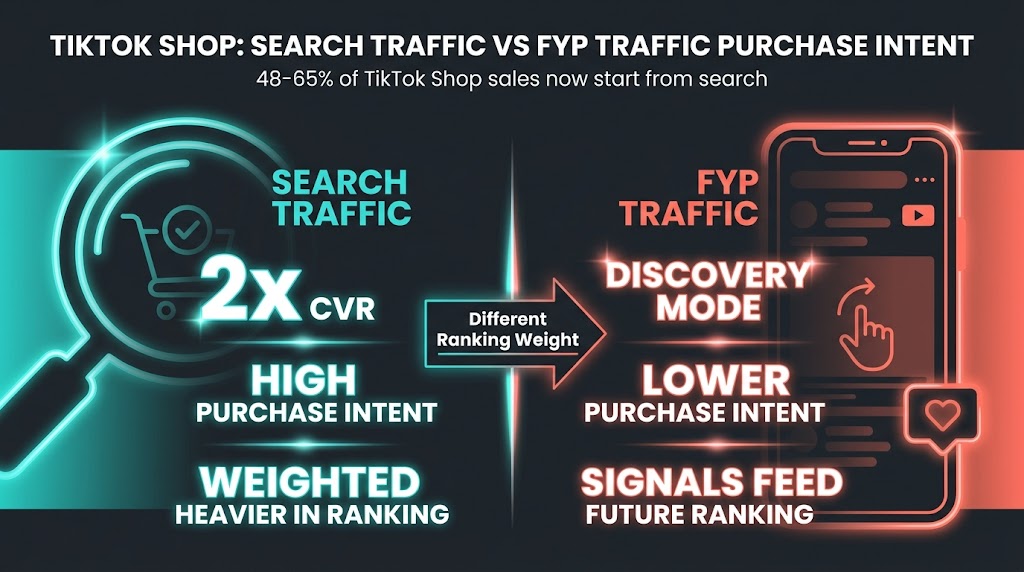
Not all user interactions carry equal weight in TikTok Shop’s ranking model. The system actively differentiates between signals generated by users in a browsing mindset versus signals generated by users in a buying mindset — and it uses that distinction to calibrate how much ranking credit each interaction delivers.
Search Traffic vs FYP Traffic: Different Signals, Different Weight
When a user types a query into TikTok’s search bar, that action is itself a signal. It tells the AI: this person has active, explicit intent. They know what they want. Any conversion behavior that follows from that search session — a product page visit, an add-to-cart, a purchase — carries higher signal value than the equivalent behavior from a passive FYP scroller who stumbled across the same product.
This creates an important asymmetry. Getting a purchase from a search-origin user improves your ranking for that keyword more than getting a purchase from an FYP-origin user. Sellers who are driving search traffic — through well-optimized listings, keyword-aligned content, and affiliate posts that appear for specific queries — are accumulating ranking signal at a faster rate than those who rely on viral FYP distribution for the same number of total sales.
Add-to-Cart Without Purchase: A Negative Signal to Manage
One of the most counterintuitive elements of TikTok Shop’s intent signal model is how the AI treats incomplete purchase journeys. Add-to-cart events are positive signals — they indicate strong commercial intent. But add-to-cart without subsequent purchase is a pattern the algorithm interprets as a friction signal or a relevance mismatch. If users are consistently adding your product to cart and then abandoning, the AI updates its prediction: this product is attracting interest it can’t convert.
The practical implications are significant. A high add-to-cart rate paired with a below-average purchase conversion rate is a ranking red flag. Diagnosing why this pattern occurs — price, product page quality, shipping cost visibility, review gaps — and addressing it is not just a conversion optimization exercise. It directly affects how the AI weights your future placement.
Session Depth and Time-to-Purchase
TikTok’s commerce AI tracks behavioral sequences at a granular level. A user who encounters a product video, clicks the product tag, reads the full description, views multiple images, checks reviews, and purchases within the same session is generating a very different intent signal profile from a user who sees three ads, visits the product page four times over two days, and eventually converts. Both are purchases — but the first session pattern signals strong product-listing alignment that the algorithm credits more heavily in the near-term ranking window.
Understanding this encourages a focus on product page quality that goes beyond keyword placement. A product page that provides complete information — clear imagery, detailed attributes, genuine reviews, accurate specification tables — reduces session friction and shortens the path from product page view to purchase. That compression of time-to-purchase is itself a signal that feeds back into your ranking position.
Semantic Search and TikTok’s Multimodal Layer

The most significant architectural evolution in TikTok Shop’s search system over the past 18 months has been the shift from keyword matching toward semantic and multimodal understanding. This change is still in progress — TikTok is rolling out capabilities at different rates across markets — but the direction is unambiguous and its implications for product visibility are already material.
From Keyword Matching to Semantic Embedding
Traditional e-commerce search works by matching the exact words in a query against the exact words in product titles and descriptions. Semantic search, by contrast, works by converting both the query and the product content into numerical representations (embeddings) and then finding products whose embeddings are closest to the query’s embedding — regardless of whether the exact words match.
What this means in practice: a user searching for “cozy bedroom aesthetic” on TikTok Shop can now be served products tagged as “boho room decor,” “neutral throw blankets,” and “minimalist lighting” — none of which contain the exact query phrase — because the semantic model understands that these products collectively represent the concept the user is searching for.
For sellers, this has two major implications. First, keyword stuffing becomes less effective as the system cares more about conceptual relevance than literal text matching. Second, the full semantic context of your content — everything in your video audio, on-screen text, product description, and even review content — contributes to your product’s conceptual footprint in the AI’s embedding space.
Visual Recognition and the “Find Similar” Layer
TikTok is actively expanding its image-recognition capabilities within TikTok Shop. In select markets, users can already upload a photo or use their camera to find visually similar products — a capability that mirrors what Pinterest and Google Lens have offered but integrated directly into a purchase-ready commerce environment.
More immediately relevant to all sellers is the existing “Find Similar” feature, which analyzes the visual content of videos to surface product matches. The AI reads the visual characteristics of products shown in videos — shape, color palette, texture, apparent material, style category — and uses these as matching signals independent of any text in the video or listing.
This means your product photography is now doing double duty. A clean, well-lit product image against a white background remains important for listing clarity. But lifestyle images that show the product in actual use contexts — with other related items visible in the frame — are feeding visual matching signals that connect your product to the broader aesthetic and use-case concepts users search for visually.
Audio as a Searchable Surface
TikTok’s AI transcribes audio in product videos and indexes that content for search matching. This is no longer an experimental feature — it is an active part of the search signal architecture. Creators and brands who script their content to include specific, searchable language about their products are building semantic signal that sits on top of their listing-level metadata.
The most effective approach is not keyword stuffing spoken content, which produces stilted, unnatural video. It’s ensuring that the specific problem the product solves, the specific material or ingredient, and the specific use context are naturally stated in the dialogue at least once. “This serum is specifically formulated for oily skin in humid climates” is not a keyword mantra — it’s a natural product claim that happens to be building multiple semantic index entries simultaneously.
LIVE Commerce Signals vs Short Video Signals
TikTok LIVE commerce and short-form shoppable video are both input channels for TikTok Shop’s ranking engine, but they generate different types of signals and those signals interact with the ranking system in distinct ways. Treating them as interchangeable is a mistake that costs sellers visibility in both channels.
What’s Unique About LIVE Signals
LIVE commerce generates a distinct class of real-time behavioral signals that short videos cannot replicate:
- Comment intensity per minute: The rate of live comments — especially product-related questions and “link?” requests — signals genuine product interest to the algorithm at a level that post-video comment counts don’t match.
- Real-time add-to-cart clusters: When multiple viewers add a product to cart within a short window during a LIVE, the AI reads this as a social proof signal that amplifies subsequent distribution of the stream.
- Watch-time retention curve during LIVE: The shape of the retention curve — how many viewers stay from the beginning versus join and leave throughout — is distinct for LIVE and affects both in-stream distribution and the shop’s credibility score.
- Purchase velocity during the stream: Sales made during a LIVE event carry a special weight in the product’s recent velocity signal, because they represent the highest-intent, most socially-influenced purchase context on the platform.
LIVE Signals Feed Organic Search Rankings
This is one of the most underappreciated dynamics in TikTok Shop’s signal architecture: a strong LIVE commerce session does not only drive direct sales during the stream. It contributes purchase velocity data, adds-to-cart data, and engagement data to the product’s overall signal profile — and that contribution persists in the organic search ranking model after the LIVE ends.
A product that gets 40 purchases during a 2-hour LIVE session will often show elevated search ranking in the 48–72 hours following the stream, even without any additional content or promotional activity. The LIVE session effectively reloaded the product’s velocity signal, and the ranking system responds to that increased velocity by surfacing the product more prominently in relevant search results.
Short Video Signals: Depth Over Volume
For short-form shoppable video, the signal quality hierarchy is increasingly: completion + product tag click + purchase > completion + product tag click > completion + engagement > engagement alone. A smaller number of videos with high completion-to-purchase funnels generates more ranking signal per video than a large volume of videos with strong engagement but weak purchase conversion.
This is why many sellers who post aggressively but without conversion-oriented video structure see ranking stagnation despite high content volume. Quantity of content creates content signals, but quality of the content-to-purchase funnel is what moves search ranking.
How Signals Decay — and Why Velocity Matters More Than Volume
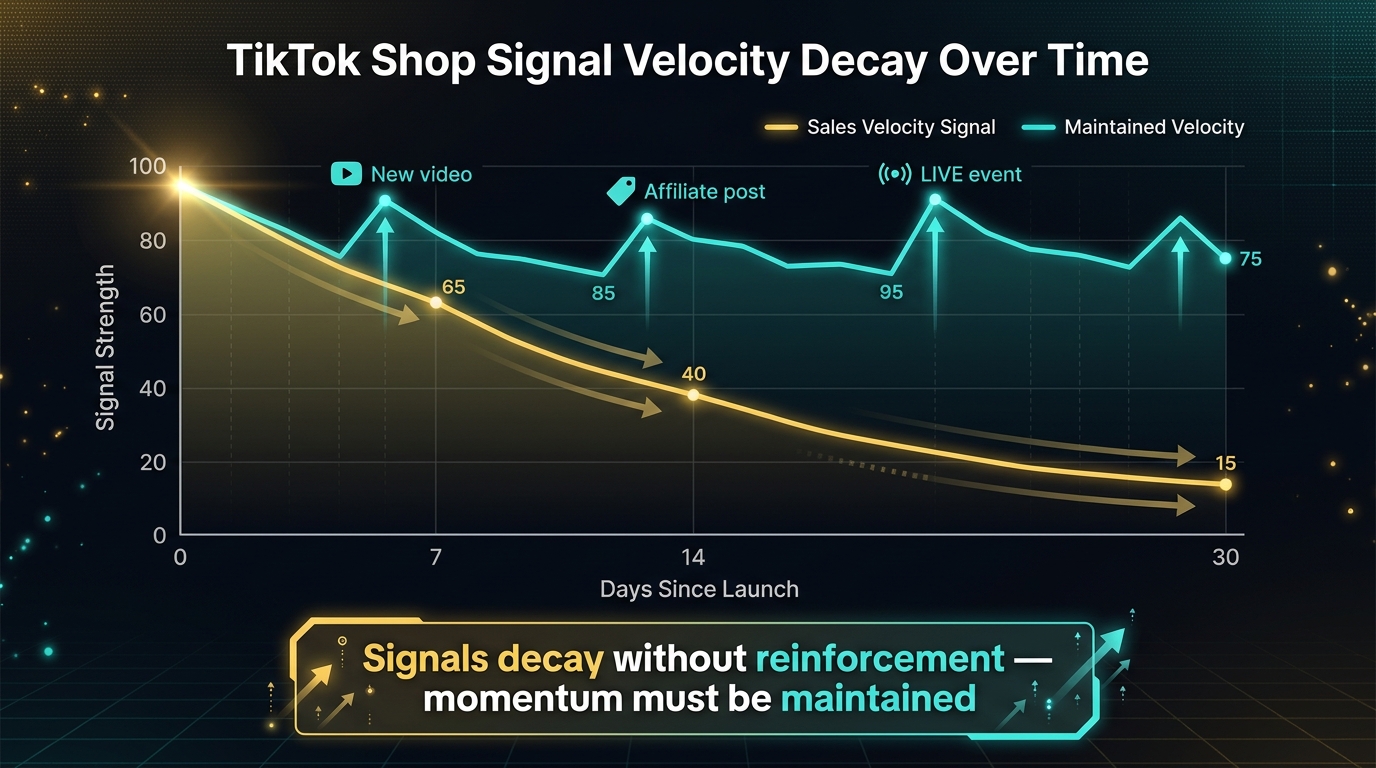
Understanding that TikTok Shop’s AI uses signals is only half the picture. The other half is understanding how those signals age — because all signals decay, and the decay rate varies significantly by signal type. Sellers who don’t account for decay end up watching strong rankings erode without being able to explain why.
Recency Weighting in TikTok’s Ranking System
TikTok’s ranking model applies recency weighting to most commercial signals. Recent purchase events carry more weight than equivalent events from 30 days ago. Recent review additions have more ranking impact than reviews received six months prior. Recent video engagement from targeted audiences counts more than historical high-performance content that is now rarely being viewed.
The general decay pattern follows a curve, not a cliff. Signals don’t disappear suddenly; they fade gradually as their relative age increases. But the practical effect is significant: a product that achieves strong search placement through a successful launch period will see that placement gradually erode if no new signals are injected to maintain the velocity baseline.
The 7-Day, 14-Day, and 30-Day Windows
TikTok Shop’s ranking calculations appear to use multiple rolling time windows simultaneously. The 7-day window captures current velocity and real-time performance. The 14-day window provides a medium-term performance picture. The 30-day window establishes baseline category authority. A product that performs well in all three windows simultaneously achieves the most stable, persistent search ranking.
This multi-window architecture explains a common seller experience: a product appears to maintain ranking even during a slow week, because the 14 and 30-day windows are still carrying strong historical signal. Then, when those windows eventually roll off the strong launch period data, the ranking drops more suddenly than expected — a delayed consequence of the velocity gap.
Maintaining Momentum Without Constant Paid Amplification
The solution to signal decay is not constant paid traffic — it’s establishing a signal maintenance cadence. The most cost-effective approach involves:
- Scheduled affiliate content: Even 2–3 affiliate posts per month that generate strong completion and product-click rates can significantly slow the decay of a product’s content signal profile.
- Periodic LIVE sessions: Monthly or bi-weekly LIVE commerce sessions that drive purchase velocity create recurring signal injections that reset the recency weighting on sales data.
- Review velocity management: Actively following up with buyers to generate consistent review flow maintains the review signal’s contribution to both listing-level ranking and SPS.
- Listing refresh cycles: Periodic updates to product descriptions, images, or attributes signal to the AI that the listing is actively maintained, which correlates with improved ranking stability in several observed patterns.
The Signal Interaction Effect: When Signals Multiply Each Other
Perhaps the most sophisticated and least discussed aspect of TikTok Shop’s AI ranking engine is how signals interact. The system is not additive — it’s closer to multiplicative. A single strong signal in isolation does relatively little. Multiple strong signals firing simultaneously can generate ranking outcomes that appear disproportionate to any individual signal’s apparent strength.
Why One Strong Signal Alone Is Not Enough
Consider two hypothetical products. Product A has an excellent viral video with millions of views and a strong completion rate — outstanding content signals. But its product listing has incomplete attributes, its Shop Performance Score is 3.1, and its add-to-cart-to-purchase rate is below category average. Product B has a modest video with 40,000 views, but its listing is fully optimized with accurate attributes and a keyword-accurate title, its SPS is 4.4, its review velocity is consistent, and its conversion rate is above category average.
In the short term, Product A may get a temporary ranking boost from the viral content signal. But in the medium term — across the 14-day and 30-day windows — Product B’s clean, consistent multi-signal profile will generate more stable and often higher placement in relevant search queries. The AI is not looking for one extraordinary input. It is looking for consistent confidence across all signal buckets.
The Compounding Effect When Three or More Signals Fire Together
The most powerful ranking patterns in TikTok Shop occur when three or more signal buckets are firing simultaneously at above-average levels. Specifically:
- A product with strong listing signals (optimized title, complete attributes, competitive pricing) provides the foundation
- A LIVE session that drives purchase velocity injects a fresh behavioral signal
- New affiliate content aligned to the product’s primary keyword creates content signals that amplify the listing’s search relevance
- A clean SPS ensures all of these signals are being applied at full value without discount
When these conditions align within the same 7-day window, sellers frequently observe what appears to be a sudden ranking surge — a product that was on page 3 for a given keyword jumps to page 1 in a matter of days. This is not a mystery or an algorithmic quirk. It is the predictable outcome of multiple high-confidence signals converging simultaneously. The AI’s predicted purchase probability for that product suddenly becomes much higher than for competing listings, and the ranking output reflects that calculation.
What a “Ranking Surge” Signal Profile Looks Like
Analyzing the characteristics of products that experience genuine organic ranking surges in TikTok Shop reveals a consistent pattern. They typically have:
- A listing that has been fully optimized — complete attributes, accurate category, keyword-aligned title — for at least 2–3 weeks before the surge
- A Shop Performance Score of 4.0 or above, sustained over the preceding 30 days
- A short-form video or LIVE session that generated both strong completion and measurable purchase events within the same 7-day window
- A review count above the category median, with a rating above 4.2
No single one of these factors triggers the surge. The surge is the output when all four are present simultaneously and the AI’s confidence calculation crosses a threshold that shifts the predicted purchase probability for this product meaningfully above its category competitors.
The strategic implication: Sellers who focus on one signal bucket at a time — first viral content, then listings, then reviews — never achieve the simultaneous signal convergence that produces ranking surges. The brands that consistently appear at the top of TikTok Shop search results are those that manage all four signal buckets in parallel, even at a lower optimization level for each, rather than achieving perfection in one bucket while neglecting others.
Building a Signal Audit: Where to Start
Armed with a complete picture of TikTok Shop’s AI signal architecture, the practical question becomes: where do you focus first? Not every shop has the same gaps, and not every signal bucket offers equal marginal return for the effort required to improve it. A signal audit starts with an honest assessment of where your current profile stands across all four buckets.
The Four-Bucket Audit Framework
Work through each bucket systematically:
Content Signals Audit: Pull the last 30 days of video performance data. For each video with product tags, look at the ratio of product-tag clicks to total views. A ratio below 2% suggests either the product tag placement timing needs adjustment, the product relevance to the video content is weak, or the call-to-action is absent. For LIVE sessions, examine whether purchase velocity was concentrated in the first 20 minutes or distributed throughout — a front-loaded pattern suggests the session wasn’t long enough to sustain momentum.
Listing Signals Audit: Check every listed product for attribute completeness against TikTok’s full attribute schema for its sub-category. Missing attributes are immediately addressable. Verify that your title puts the primary search keyword within the first three words. Check your price position against the top 10 organic results for your primary keyword — if you’re priced more than 15% above the category median, you need either a visible differentiation signal (review count, bundle) or a price adjustment.
Shop Performance Score Audit: Your current SPS and its component breakdown are visible in Seller Center. If your SPS is below 3.5, this is likely your highest-priority fix because it’s suppressing every other signal. Identify which component is pulling the score down — fulfillment speed issues and cancellation rates are the most common culprits and the most directly addressable.
Intent Signal Audit: Look at your add-to-cart to purchase conversion rate for each active listing. The category benchmark varies, but if your conversion rate from product page view is below 5%, you have a friction signal that the AI is counting against you. Common causes include insufficient product imagery, missing specifications, few reviews, or a price that looks uncompetitive without clear justification.
Priority Order for New vs Established Shops
For new TikTok Shop sellers (fewer than 90 days, fewer than 100 total orders), the priority order is: listing signals first, SPS foundation second (through operational discipline from day one), intent signal reduction third (through strong product page quality), and content signals fourth. You cannot build SPS without orders, and you cannot get orders without a findable listing. Start with what you can control immediately.
For established sellers with existing order history and a degraded SPS, the priority flips: SPS recovery is almost always the first lever because it’s the multiplier on everything else. Improving your listing, content, and intent signals while your SPS is suppressed is like filling a leaking bucket. Fix the leak first.
For scaling sellers who already have clean operational metrics and optimized listings, the focus shifts to the multi-signal convergence play: timing LIVE sessions, affiliate content drops, and listing refresh cycles to create coordinated signal injection windows rather than letting them occur randomly. Intentional signal convergence engineering is where the most experienced TikTok Shop operators are now competing.
What This Means for the Next 12 Months
The trajectory of TikTok Shop’s AI search system is clear, even if the precise timeline of specific features remains uncertain. Three developments are worth tracking closely because they will shift the signal architecture further.
Semantic search will deepen, making keyword stuffing less effective and conceptual content more valuable. As TikTok’s embedding-based search model matures, the gap between sellers who understand how semantic indexing works and those who are still stuffing exact-match keywords into titles will widen. The sellers who are thinking about their products in terms of the concepts, aesthetics, problems, and use cases they represent — and expressing those through authentic content — will have a durable advantage.
Visual search expansion will reward product photography investment. As image-recognition-based discovery becomes more widely available across TikTok Shop markets, the quality and diversity of your product images will become a more significant ranking input. Products with only a white-background hero shot will have a smaller visual matching footprint than products with a range of contextual lifestyle images that show the product in different use settings.
The SPS framework will likely become more granular. TikTok has shown a clear intent to use seller operational data as a ranking lever, and the current 0–5 SPS framework is relatively coarse. More granular sub-scores for specific operational dimensions — shipping speed, return rate by product category, dispute resolution time — would allow the ranking system to apply more precise signal discounting to specific products rather than entire shops. Sellers who are already maintaining clean metrics across all operational dimensions will have nothing to worry about. Those who have uneven performance across different product lines may find themselves with a more complex set of account-health factors to manage.
Conclusion: Four Buckets, One Ranking — Start Auditing Now
TikTok Shop’s AI search ranking system is not a mystery, but it is genuinely complex. It reads your content, your listing, your shop’s operational record, and the behavioral sequences of every user who has ever encountered your products — and it combines all of that into a single predicted purchase probability score that determines where you rank.
The sellers winning at TikTok Shop search in 2026 are not necessarily the ones with the most viral content or the lowest prices. They are the ones who have built a consistent signal profile across all four buckets: content that drives qualified engagement and product clicks, listings that the AI can fully interpret and accurately match to user queries, a Shop Performance Score that acts as an amplifier rather than a suppressor, and a product page experience that compresses the path from intent to purchase.
None of these improvements require extraordinary effort in isolation. The challenge — and the opportunity — is doing all four simultaneously, and understanding how they compound each other when they’re all firing at once.
Start with your audit. Identify which signal bucket is your biggest gap. Fix it. Then engineer the moments when multiple buckets can converge — a LIVE session supported by fresh affiliate content, landing on a fully optimized listing, for a shop with a clean SPS. That convergence is what the AI is looking for. Give it the confidence to rank you first.
Key Takeaways
- TikTok Shop’s ranking engine runs a two-layer model: a content recommender and a commerce intent layer, each with different signal weights across FYP, Search, Shop Tab, and LIVE surfaces.
- The four signal buckets are: Content Signals, Product Listing Signals, Shop Performance Score, and Behavioral/Intent Signals. All four are active in every ranking decision.
- Search-origin purchases carry more ranking signal value than FYP-origin purchases — building search traffic directly accelerates ranking improvement.
- The Shop Performance Score (SPS) acts as a multiplier on all other signals. A low SPS discounts the value of everything else you do.
- TikTok is moving from keyword matching to semantic and multimodal search — spoken audio, visual content, and conceptual relevance are now active ranking inputs.
- LIVE commerce sessions inject purchase velocity data that feeds back into organic search rankings for 48–72 hours after the stream ends.
- Signals decay on rolling 7, 14, and 30-day windows — velocity maintenance through periodic content, LIVE sessions, and review flow is as important as initial optimization.
- The biggest ranking gains come from multi-signal convergence: when three or more buckets are firing simultaneously at above-average levels within the same 7-day window.