

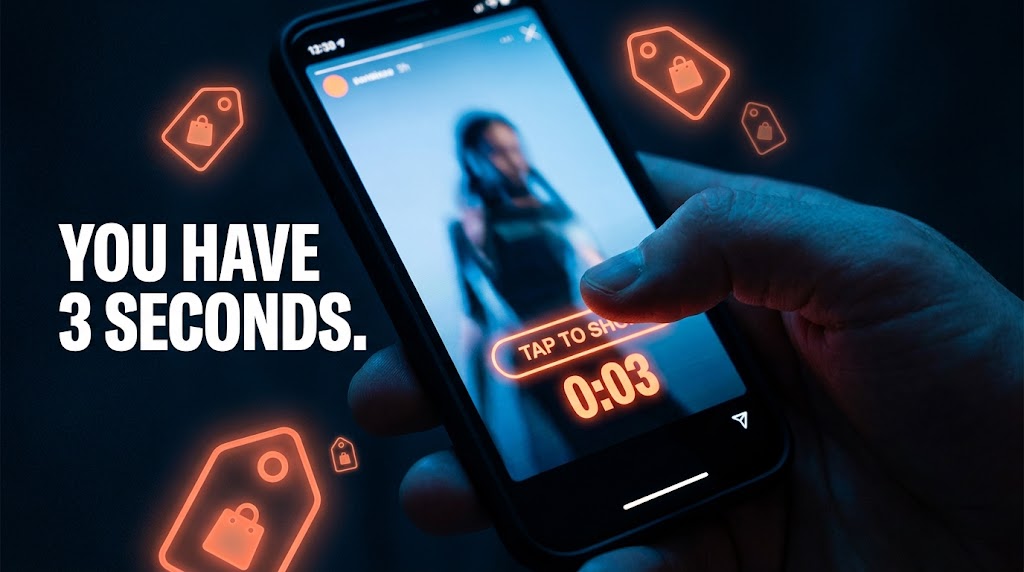

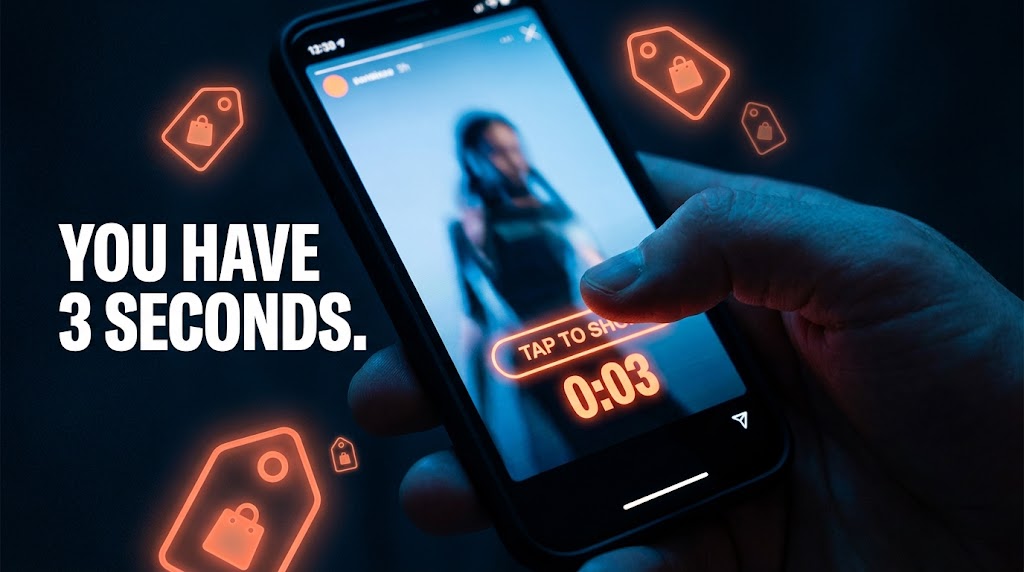
Somewhere right now, a potential customer is scrolling through their phone at 1,000 pixels per second. They are not looking for your product. They are not in “shopping mode.” They are in escape mode — killing time between meetings, waiting for a coffee, or lying in bed resisting sleep.
And in roughly three seconds, they will either stop for your video or they won’t.
That moment — those first three seconds — is the entire game for shoppable video. Not your production budget. Not your product quality. Not even your price point. The hook is the gate. If the gate doesn’t open, nothing else happens.
Yet most brands still approach shoppable video production backwards. They spend 80% of their effort on mid-video features, product demos, and checkout integrations — then slap a generic opening onto the front and wonder why their view-through rates are dismal. The shoppable layer is doing its job. The hook is failing at its.
This guide is built differently. It starts where every sale actually starts: the first three seconds of attention. From there, we’ll walk through the complete engineering stack — hook archetypes, script architecture, platform-specific rules, friction mapping, measurement frameworks, and systematic testing loops — that separates shoppable videos that convert at 4–8% from those that barely crack 1%.
The data is real. The frameworks are practical. And the goal is a repeatable, testable system you can apply to your next video today.
What Makes a Shoppable Video “Shoppable” — And Why Most Brands Get It Wrong
Before we talk hooks, let’s be precise about what we mean by “shoppable video,” because the term gets used loosely in ways that create confusion and, worse, poor strategy.
A shoppable video is not simply a video that appears near a Buy Now button. It’s an interactive video format where product tags, overlays, or embedded purchase paths allow a viewer to go from watching to buying without leaving the content environment. The purchase action happens within the experience, or with a single tap to a frictionless product page. The operative word is within.
The Three Layers of a Shoppable Video
Think of shoppable video as having three distinct layers that must work in harmony:
- The Attention Layer: The hook — visual, audio, and textual elements in the first 1–3 seconds that earn the viewer’s continued watch. This is where almost all brands underinvest.
- The Desire Layer: The body content that builds product-specific desire through demonstration, social proof, storytelling, or problem-solution framing. This is where most brands over-invest.
- The Action Layer: The shoppable mechanics — product tags, overlays, swipe-up links, cart buttons, embedded checkout — that convert desire into transaction. This is where most brands’ technical investment goes.
The mistake most brands make is treating the Action Layer as the shoppable video itself. They integrate beautiful product tags, build smooth checkout flows, and A/B test button colors — then attach a dull, slow, unmemorable opening. The shoppable infrastructure is excellent. But because the Attention Layer failed, 70% of potential viewers are already gone before the product tag even appears.
The Numbers That Should Reorder Your Priorities
Consider this benchmark data: shoppable videos placed early in a video see a 12.7% conversion rate on interactive product elements. The same elements placed at the end of the same video convert at just 6.8%. The difference isn’t the tag. It’s where the viewer’s attention is when the tag appears. Peak impulse happens early — when curiosity and emotional engagement are highest.
Interactive shoppable videos also deliver 3x longer viewing times compared to passive equivalents, 14x higher click-through rates, and 2x the conversion rates of standard video formats. The opportunity is enormous. But it only materializes if the hook does its job first.
The mindset shift required here is significant: your shoppable video is not a product video with a buy button. It is an attention-capture system with commerce built in. The distinction changes everything about how you write, shoot, and measure it.
The 7 Hook Archetypes That Drive Purchase Intent
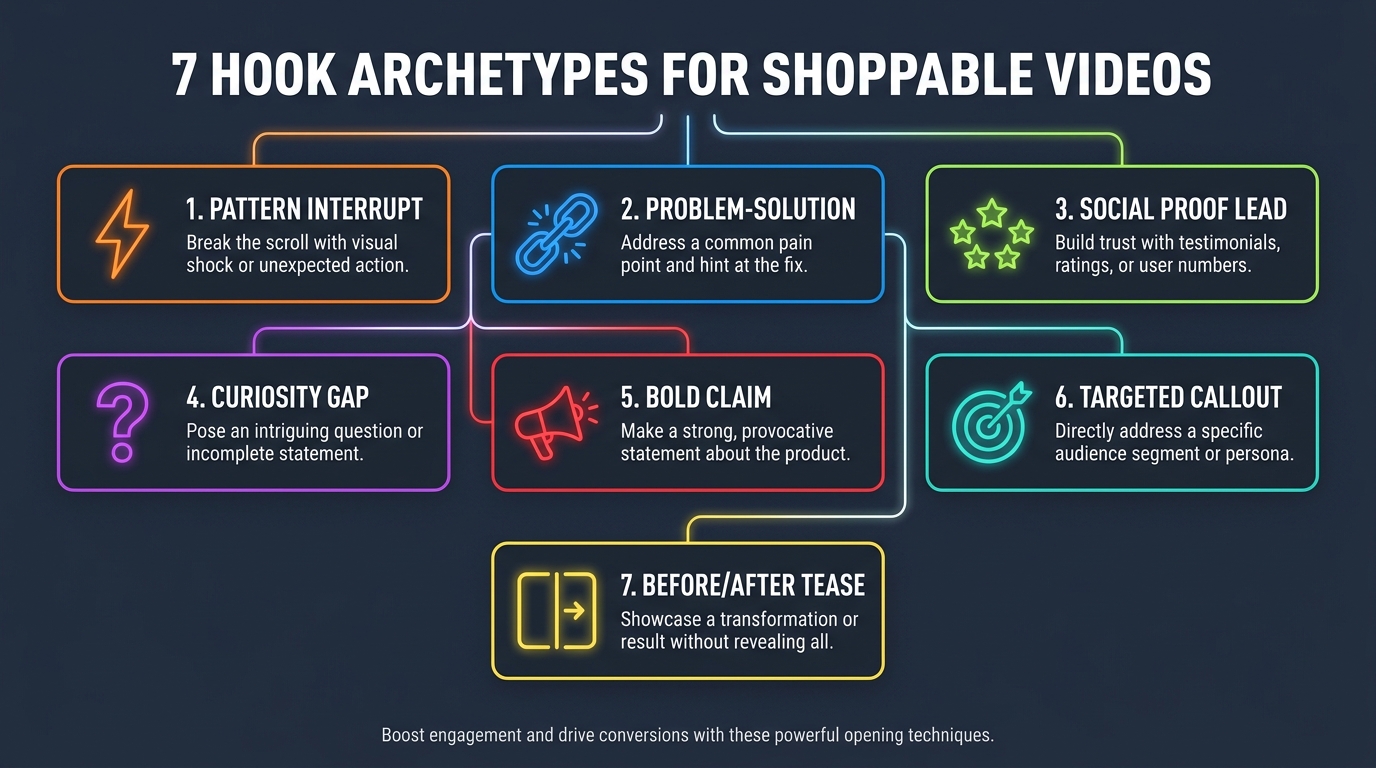
Hooks are not random. The ones that perform — across TikTok, Instagram, YouTube Shorts, and on-site video players — consistently fall into recognizable categories. An analysis of over 45,000 high-performing video clips identified six to eight dominant hook types. For shoppable ecommerce specifically, seven archetypes appear most reliably in top-converting content.
Understanding these isn’t about copying templates. It’s about understanding the psychological mechanism each one triggers — because that mechanism is what causes a thumb to stop.
1. The Pattern Interrupt
The most primal hook type. Human attention evolved to notice things that are different from the expected environment. A sudden zoom, an unexpected sound, a visual that breaks the rhythm of the feed — these force the brain to pause and process before the viewer even makes a conscious decision to stop.
In practice: an extreme close-up on a product texture that’s oddly satisfying; a creator speaking mid-sentence as if the video already started; a sudden black screen with white text; an unexpected physical action with the product. The goal is disruption of the scrolling pattern, not disruption for its own sake. The interrupt must immediately connect to product relevance.
Best for: Fashion, beauty, food/drink, novelty products, any category where visual distinctiveness can be weaponized.
2. The Problem-Solution Hook
State the pain first. Lead with the frustration, the failure, the inconvenience — in the exact language your customer uses internally. Then immediately signal that relief is coming. The product is the solution, but you don’t introduce it yet. You introduce the problem so precisely that the viewer thinks “wait, that’s me.”
Example opening lines: “Why does this keep happening every single morning?” / “I ruined another white shirt doing this.” / “Nobody tells you that [common product category problem] gets worse with every option you try.”
Best for: Health and wellness, skincare, home goods, fitness, productivity tools — any product that solves a clearly articulable pain point.
3. The Social Proof Lead
Open with the evidence, not the product. Feature a number, a review quote, a transformation result, or a volume metric in the very first frame. Trust precedes desire — showing proof before the viewer even knows what they’re looking at creates a curiosity pull: “What is this 10,000-person-reviewed thing?”
Research consistently shows that videos leading with social proof deliver stronger purchase intent than those that build to it. The psychology is simple: evidence-first framing activates the social proof heuristic (“if thousands of people love this, it must be worth my attention”) before any objection can form.
Best for: Any DTC brand with strong review velocity, repeat-purchase products, Amazon-native brands expanding to social video.
4. The Curiosity Gap
Create information asymmetry. Give the viewer enough to make them want to know more, but hold back the resolution. This is the “wait for it” and “you won’t believe what happened” mechanic — but applied to products with genuine craft, so it doesn’t read as clickbait.
The key is specificity. A vague tease (“This product changed my life”) creates no gap. A specific tease (“I tested this every day for 30 days — here’s what actually happened to my skin on day 22”) creates one. The gap must feel answerable within the video’s length, and the answer must deliver.
Best for: Skincare transformations, fitness results, food/recipe reveals, any product where the outcome is visually demonstrable.
5. The Bold Claim Hook
State the most audacious true thing about your product — up front, without qualification. Not a feature. A claim. “This is the only [category] that actually does X.” / “I’ve tried 47 [product types] and nothing comes close.” / “This replaces three products you’re already buying.”
Bold claims earn attention through cognitive dissonance. The viewer’s internal response — “that can’t be right” — is itself the hook. They watch to evaluate the claim. The shoppable video’s body content then has to substantiate it. This hook type has a high ceiling and a steep floor: if the claim feels hollow, trust evaporates instantly.
Best for: Brands with a genuine, demonstrable point of differentiation. Does not work for commodity or me-too products.
6. The Targeted Callout
Name your customer directly in the first frame. Not their demographic — their situation. “If you’re someone who [specific scenario] —” or “Hey, [specific activity] people —” or “For anyone who’s ever had [specific problem].” The more precisely you name the viewer’s current reality, the more visceral the stop-scroll response.
This hook works because specific beats general every time. “For anyone who’s ever spilled coffee on a white shirt while rushing to a meeting” outperforms “For busy professionals” by orders of magnitude. The specificity signals to the right viewer: this is about me.
Best for: Niche products, products with a specific use case, brands where audience targeting is tight.
7. The Before/After Tease
Flash the result in the first half-second, then pull back to the beginning. This is the outcome-preview structure: show the transformation, then say “here’s how.” It works because it answers the viewer’s most fundamental question — “what does this product actually do?” — before they’ve had time to decide whether to watch.
The critical execution detail: the “after” state shown must be visually distinct enough from ordinary life to register in under a second. Subtle improvements don’t tease well. Dramatic before/after contrast does. The larger the visible gap, the stronger the hook.
Best for: Beauty, skincare, home organization, fitness, food — any product with a visually compelling transformation.
The Hook-Body-Bridge-CTA Architecture: A Full Script Framework
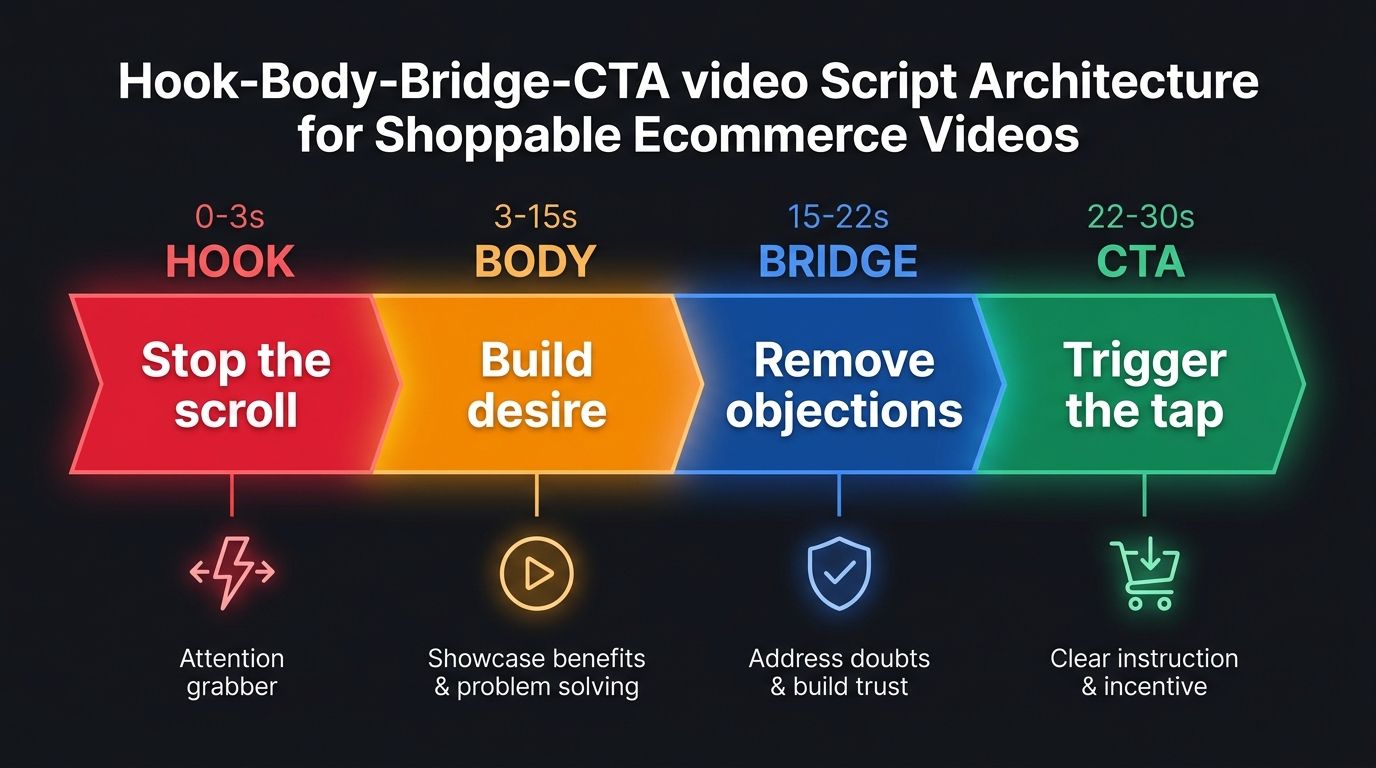
Most shoppable video script advice stops at three components: hook, body, CTA. That framework works for awareness content. For shoppable video — where you’re asking someone to stop, watch, trust, and transact within 30 seconds — it leaves out the most important conversion element: the bridge.
The full architecture for a 30-second shoppable video looks like this:
Phase 1: The Hook (0–3 seconds)
This phase has one job: earn the next three seconds. Not the sale. Not brand recognition. Just the next three seconds. Everything in this phase should be chosen for its ability to interrupt the scroll pattern and create a micro-commitment to watch more.
Key rules for this phase:
- Lead with motion or sound in the first half-second — static opening frames are scroll deaths.
- Put your most compelling element (visual, text, claim, face expression) before the 1.5-second mark.
- Avoid logos, intros, or brand names as your opener unless your brand is already highly recognizable.
- Use on-screen text that mirrors the spoken hook — platforms serve video with sound off by default for a large percentage of users.
Phase 2: The Body (3–15 seconds)
Now that you have attention, use it to build desire. The body phase delivers on whatever promise the hook made — showing the product in action, demonstrating the solution to the problem, or providing the evidence behind the social proof claim.
This phase should be tightly edited. Every second that doesn’t add new information or advance desire is a second where drop-off risk increases. Use b-roll to maintain visual dynamism, cut on action rather than pauses, and ensure the product is visible or referenced throughout — not just mentioned once. The product is always the hero, even in lifestyle footage.
The body phase should also do one important piece of psychological work: it should make the viewer feel that not having this product is the problem. Before they see the CTA, the absence of the product should feel like a deficit. This is desire construction, and it happens in the body phase.
Phase 3: The Bridge (15–22 seconds)
This is the phase most scripts omit entirely, and it’s the conversion killer. The bridge exists to neutralize the primary objection standing between desire and action. What is the one thing a viewer who wants this product tells themselves to justify not buying it right now?
For most ecommerce products, the bridges are: price hesitation (“Is it worth it?”), quality skepticism (“Does it actually work like that?”), risk aversion (“What if it doesn’t work for me?”), or logistical friction (“Is this going to be complicated?”). The bridge phase addresses one of these — directly, briefly, and credibly.
Bridge examples in practice:
- “Under $40, and it ships in two days.” — addresses price and friction simultaneously.
- “Over 10,000 reviews. 4.9 stars.” — addresses quality skepticism with social proof.
- “30-day return policy. Zero questions asked.” — addresses risk aversion.
One sentence. No over-explaining. The bridge’s job is to quietly remove the last barrier before the CTA fires.
Phase 4: The CTA (22–30 seconds)
The call to action in shoppable video is not an afterthought — it’s a behavioral trigger that must be specific, immediate, and visually obvious. Weak CTAs (“check it out,” “learn more,” “click the link”) underperform precise CTAs (“tap the orange cart icon below,” “click the tag on the product,” “swipe up to shop now”).
Research on TikTok Shop video structure shows that explicit instruction-based CTAs (“tap the orange cart”) consistently outperform vague prompts. The viewer doesn’t resist buying — they resist ambiguity. Make the action obvious.
The CTA phase should also contain a visual action cue: a product tag pulsing, a button appearing, the creator physically pointing to or tapping the overlay. When the visual and audio CTA are synchronized, conversion rates improve significantly versus audio-only instructions.
Platform-Specific Hook Rules: TikTok, Instagram, YouTube, and On-Site Embeds
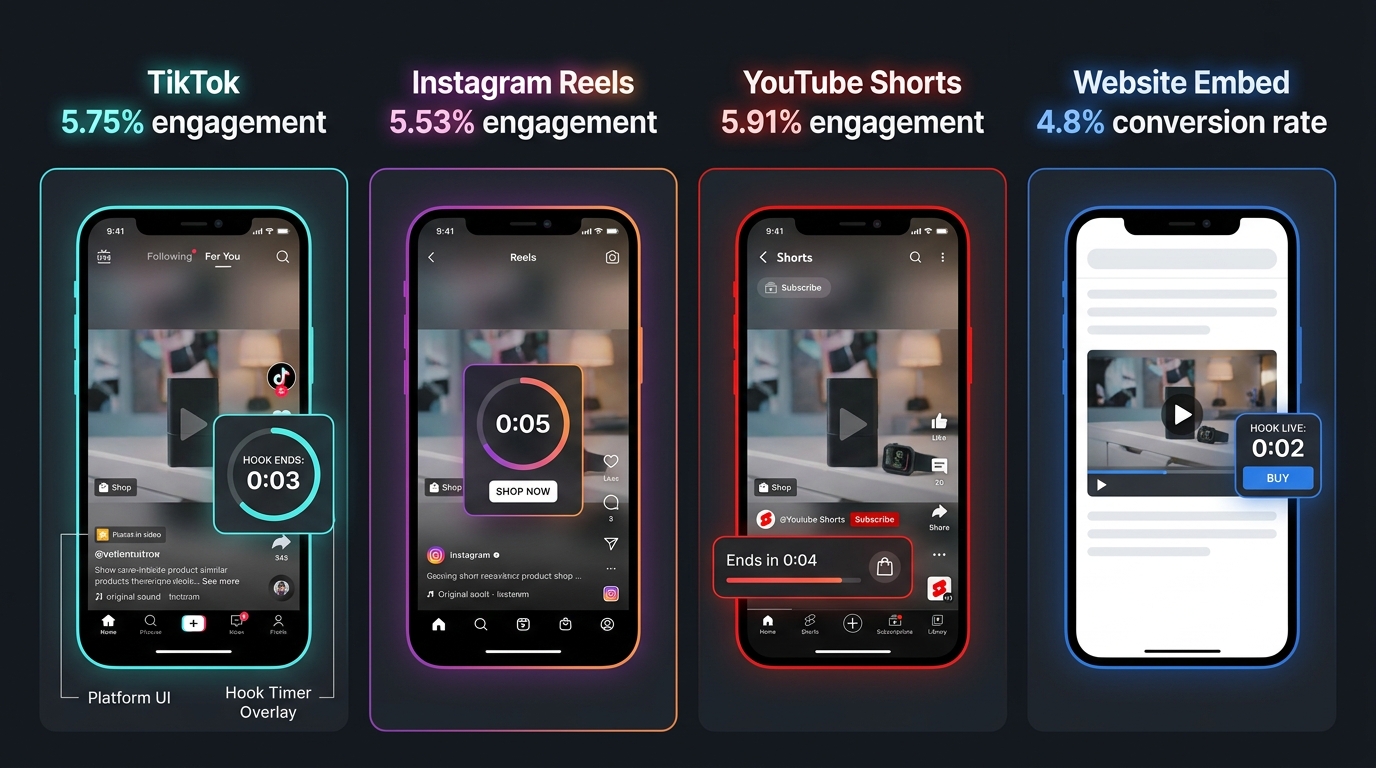
A shoppable video that crushes it on TikTok will often underperform if reposted verbatim to Instagram Reels or embedded on a product page. This isn’t a myth — it’s a structural reality. Each platform has a different content environment, a different viewer psychology, and different shoppable commerce mechanics. Hooks need to be engineered with platform-specific context in mind.
TikTok: The Chaos Feed
TikTok’s engagement rate of 5.75% for shoppable formats is among the highest of any social platform — and for good reason. TikTok’s algorithm surfaces content to users who have never heard of your brand. Your hook is often the only brand impression that viewer has ever had.
TikTok hook rules specific to the platform:
- No slow-burn openings. TikTok’s swipe behavior is faster than Instagram’s. If the first frame doesn’t register as interesting within 0.8 seconds, the thumb moves. Research on TikTok Shop specifically shows that hooks combining a pattern interrupt plus product relevance in under 3 seconds drive the highest 3-second hold rates.
- Sound is active. TikTok is predominantly watched with sound on — unlike Instagram where sound-off is common. The audio hook (a distinctive word, sound, or music drop) matters as much as the visual hook.
- Native aesthetics outperform polished production. High-production-value video on TikTok often reads as an ad immediately, triggering scroll reflex. Slightly rough edges, natural lighting, and authentic framing lower the “ad detection” response and keep viewers watching.
- TikTok Shop CTAs should be hyper-literal. “Tap the orange cart” — not “shop now.” The platform’s specific UI needs to be named so viewers who haven’t used TikTok Shop before know exactly what to do.
Instagram Reels: The Aesthetic Feed
Instagram Reels delivers a 5.53% engagement rate for shoppable formats and benefits from a user base that is generally more comfortable with intentional commercial content than TikTok’s audience. The platform skews toward aspiration and aesthetics.
Instagram-specific hook considerations:
- Visual quality matters more here. Instagram audiences have higher production-value expectations. A hook that leans heavily into visual beauty or lifestyle aspiration performs better on Reels than on TikTok.
- Captions are critical. Studies show that videos with captions on Instagram yield dramatically higher brand affinity scores. A significant portion of Instagram video is consumed with sound off, especially in professional or public contexts.
- Lead with outcome over process. Instagram users are outcome-oriented browsers. Show the result of using the product, not the process, in your hook — then walk backwards to the how.
- The 3x mobile interaction advantage of Reels comes almost entirely from hook-driven shares. Content that gets shared on Reels tends to have hooks that triggered an emotional “I need to send this to someone” response — relatability, aspiration, or humor.
YouTube Shorts: The Discovery Feed
YouTube Shorts has the highest engagement rate of the three — 5.91% — partly because YouTube’s search-intent context means some Shorts viewers are already in an investigative mindset. They found your content because they were looking for something adjacent to your product.
Shorts-specific hook dynamics:
- Curiosity gap hooks over-index here. YouTube’s search-discovery context means viewers are in information-seeking mode. Hooks that promise specific information (“here’s what actually happens when you use this for 30 days”) outperform pure pattern interrupts.
- Interactive product tags on YouTube generate 10x the CTR of passive video — but only when placed early. Optimal tag placement for conversion sits between the 8 and 15-second marks in a 30-second Short.
- Repurposing caution: YouTube Shorts audiences have lower tolerance for content that feels like it was clearly made for TikTok and reposted. The horizontal text-heavy formatting common in TikTok content reads as low-effort on Shorts and reduces performance.
On-Site Embeds: The Highest-Intent Placement
On-site shoppable video — embedded on product pages, category pages, or landing pages — operates in a fundamentally different psychological context than social platforms. Visitors who land on your product page have already passed the discovery threshold. They’re evaluating, not browsing.
This changes hook strategy significantly:
- The pattern interrupt is less necessary. Site visitors don’t need to be jolted out of a scroll; they’re already stopped. Your on-site hook can be more deliberate — leading with a specific use case, a product detail, or a testimonial statement.
- Video on landing pages boosts conversions by 86% regardless of hook quality, because the bar for “better than no video” is low. But optimized on-site hooks push conversion rates from 4.8% (average with video) toward the 8%+ range seen in top-performing product page implementations.
- Length norms differ. On-site viewers will tolerate slightly longer hooks — up to 5 seconds — because they came with purchase intent. Social viewers won’t. Keep social hooks at 1–3 seconds and on-site hooks at 3–5 seconds.
- Auto-play with muted sound is standard for embeds. Build your on-site video hooks to work completely in silence — every word of the hook should appear as on-screen text.
The Friction Map: Why Great Hooks Fail at the Buy Button
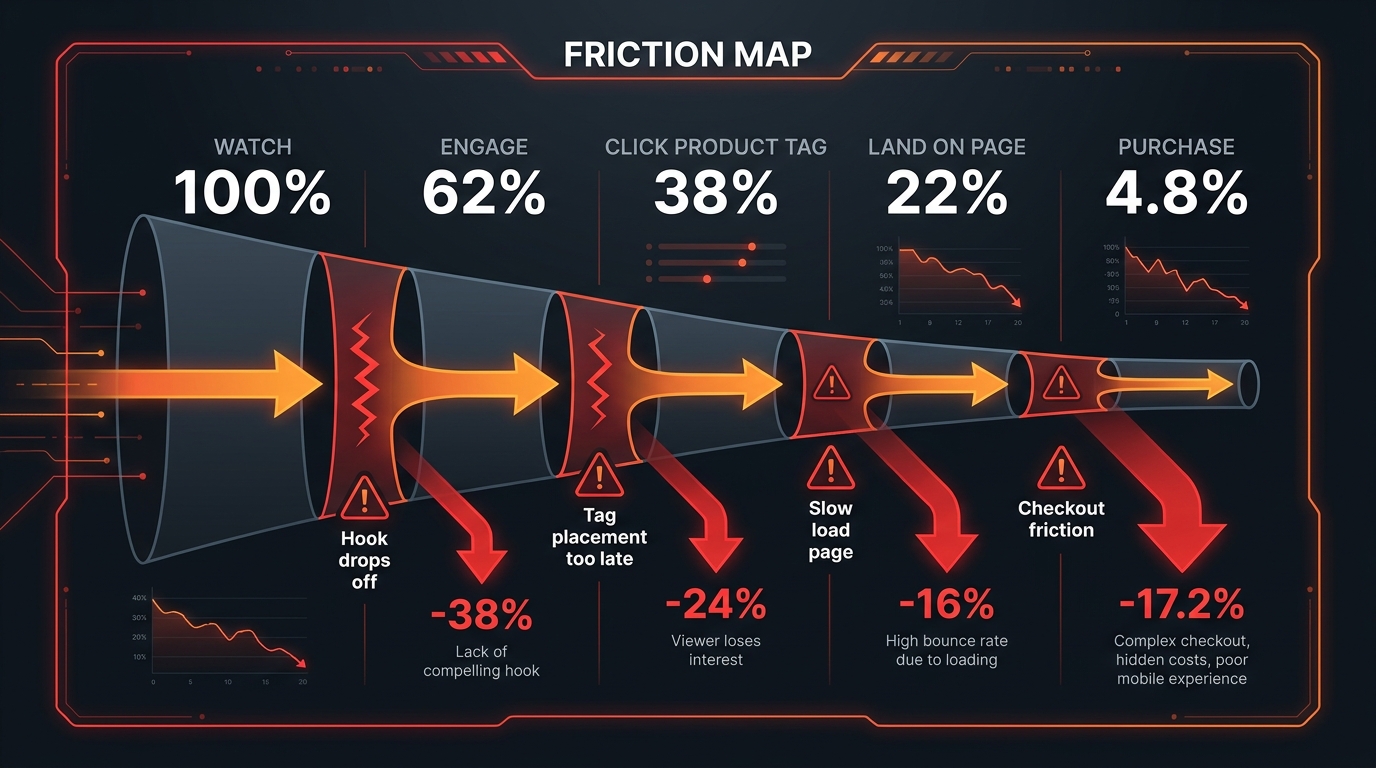
Here’s a scenario that plays out constantly in shoppable video analytics: you nail the hook. Three-second hold rate is strong. Watch time is above average. Viewers are completing the video. But add-to-cart is low and conversion is flat.
This is the friction map problem — and it’s distinct from a hook problem. It means the hook and body are working, but something between the product tag and the checkout is breaking the chain.
Friction Point 1: Tag Placement Timing
Product tags that appear before a viewer is invested in the content interrupt rather than assist. Tags that appear after the peak of desire has passed miss the impulse window entirely. The research is clear: product tags appearing between the 8–15 second mark of a 30-second video convert at 12.7%, compared to 6.8% at the end. That’s not a small gap — it’s nearly double.
The practical rule: time your product tag to appear approximately 2–3 seconds after your most compelling product moment — the moment where desire is at its peak but the viewer hasn’t yet mentally moved on. The tag should feel like a natural extension of desire, not an interruption of it.
Friction Point 2: Landing Page Load Speed
A viewer who taps a shoppable tag and waits more than 2 seconds for a page to load is statistically unlikely to convert. Mobile page speed is the single most underestimated friction point in shoppable video commerce. You can build the perfect hook, the perfect video, the perfect product tag — and lose the sale to a slow server response time.
Shopify brands using purpose-built shoppable video tools (Videowise, Whatmore, Tolstoy) benefit from compressed video delivery that’s page-speed optimized. If you’re running shoppable video through standard product pages or third-party video embeds without compression, audit your mobile page speed before anything else. Google’s Core Web Vitals thresholds are your benchmark.
Friction Point 3: The Message-Page Mismatch
This is the most invisible friction point and one of the most destructive. When a viewer taps a shoppable tag after watching a video that led with a specific promise — a particular color, a specific use case, a particular price — and lands on a generic product page that doesn’t immediately reinforce that promise, cognitive dissonance kills the conversion.
The fix is not always a custom landing page (though that helps). Often it’s simpler: ensure the first above-the-fold image on the landing page matches the product presentation in the video. If your hook showed the product in black, don’t land on a page defaulting to beige. If your hook was about a specific feature, ensure that feature is the first thing visible on the page.
Friction Point 4: Checkout Complexity
Shoppable video’s core promise is frictionless buying. Every click between “I want this” and “I bought this” degrades conversion probability. Brands that have implemented one-tap checkout through TikTok Shop’s native checkout or Shopify’s accelerated payment options (Shop Pay, Apple Pay) see measurably better conversion-from-video rates than those routing viewers through standard multi-step checkout flows.
If your shoppable video strategy requires viewers to navigate a traditional checkout process, your video is doing half the work that shoppable commerce is capable of. The video-to-purchase path should be as close to two taps as possible: one tap to tag, one tap to buy.
Measuring What Actually Matters: KPIs Beyond Views and Likes
Shoppable video generates a uniquely layered analytics picture that most brands are only half-reading. Optimizing for views and engagement rate alone is like optimizing a retail store for foot traffic without measuring sales. You need the full measurement stack — and you need to understand which metrics are leading indicators and which are lagging ones.
Hook-Specific KPIs
3-Second Hold Rate: The percentage of viewers who watch past the 3-second mark. This is the primary measurement of hook effectiveness. Industry benchmarks vary by platform, but a strong hook should hold 65–75% of viewers through the first 3 seconds on TikTok and Instagram, and slightly higher on YouTube Shorts where intent context is stronger. If your 3-second hold rate is below 50%, the hook — not the product, not the price — is the problem.
50% Completion Rate: The percentage of viewers who make it to the video’s midpoint. For a 30-second video, this measures whether your body phase is sustaining the attention the hook generated. Below 40% completion means the hook over-promised and the body under-delivered. Significant mismatch between hook type and product category often surfaces here.
Engagement Density: Comments, saves, and shares per 1,000 views — not total counts. Saves and shares are particularly high-signal for shoppable content because they indicate purchase consideration: a viewer saves a video they intend to return to when they’re ready to buy. High save rates with low immediate conversion are a purchase-intent signal that’s often missed.
Commerce-Specific KPIs
Product Tag Click-Through Rate (CTR): The percentage of viewers who tap a shoppable product tag. Industry benchmarks run between 0.65–0.90% for passive video; interactive shoppable video with well-placed tags can hit 10x that range. This metric tells you whether the desire phase worked — viewers who built purchase intent will click tags; viewers who didn’t won’t.
Add-to-Cart Rate from Video: Measured as a percentage of tag clickers who add to cart. A strong product-market fit with clear value prop should generate 30–40% add-to-cart from tag clickers. Below 20% usually indicates landing page or message-match problems, not video problems.
Average Order Value (AOV) from Video: Shoppable video benchmarks from platforms like Whatmore show 38% higher AOV when cross-sell products are incorporated into the video narrative. If you’re running video as a single-product channel, you’re leaving order value on the table.
Video-Attributed Revenue: The gold metric. Not views, not engagement — actual revenue tracked back to video interactions. Most shoppable video platforms provide this through UTM parameters, pixel-based attribution, or native analytics. Set this up before you launch your first video. Everything else is directional; this is definitive.
The Attribution Caveat
Last-click attribution systematically undercounts shoppable video’s contribution to revenue. A viewer who saves a video, returns two days later, and purchases through a direct link will not show up in your video attribution. Multi-touch attribution models — even simple linear ones — will reveal that video is influencing far more of your revenue than last-click suggests. Build this into how you report and justify video investment internally.
Production Realities: Hook-First Shooting vs. Edit-In-Post
There are two schools of thought on how to produce hooks for shoppable videos, and they produce measurably different results. The first school edits hooks in post-production: you shoot a complete video, then decide which clip is most compelling to lead with. The second school plans and shoots the hook first, then builds the rest of the video around it.
The data consistently favors the hook-first approach — but it requires a different production mindset.
Why Edit-In-Post Hooks Underperform
When you shoot a product video without a specific hook strategy and then select the “most interesting” clip to lead with, you’re making a post-production guess about what will stop a scroll. That guess is informed by aesthetic preference, not behavioral data. It also means your hook is constrained by footage that wasn’t designed to work as a hook — it was designed to work as part of a longer narrative.
The most common symptom of an edit-in-post hook is a video that starts at a natural moment in the product story (showing the product being opened, or a creator beginning to explain something) rather than at a moment of maximum visual or emotional impact. Natural moments are not necessarily stopping moments.
The Hook-First Shooting Framework
Hook-first production starts with a question: What single image, phrase, or sound would make my ideal customer stop scrolling? Only after that question is answered do you plan the rest of the video.
In practice, this means shooting three to five distinct hook variants for every shoppable video — not as afterthoughts, but as the primary production output. Each hook variant uses a different archetype (pattern interrupt, problem-solution, before/after tease) and different camera angles, lighting, or opening actions. The body and CTA footage remain constant across variants.
This approach produces test-ready videos that can be deployed simultaneously across platforms and audiences to identify which hook archetype outperforms for your specific product and audience. It’s not more expensive than traditional production — it requires slightly more pre-production planning and approximately 20–30 additional minutes of shoot time per hook variant.
Practical Hook Shooting Guidelines
- Shoot at least 3 seconds of pure hook footage per variant before any product intro or creator framing. This ensures editing flexibility.
- Use motion in the first half-second. Static opening frames — even visually beautiful ones — do not stop scrolls as reliably as frames with movement.
- Capture close-up texture or detail shots. These serve as pattern interrupt hooks for beauty, food, and tactile products and require minimal planning or props.
- Record a “problem statement” variant where the creator leads with a frustrated or confused expression and a problem statement, with zero product visible. This performs exceptionally well for problem-solution hooks.
- Record a “result first” variant where the after-state of the product is shown before any explanation. This is the before/after tease hook.
The Testing Loop: How to Systematically Improve Hook Performance
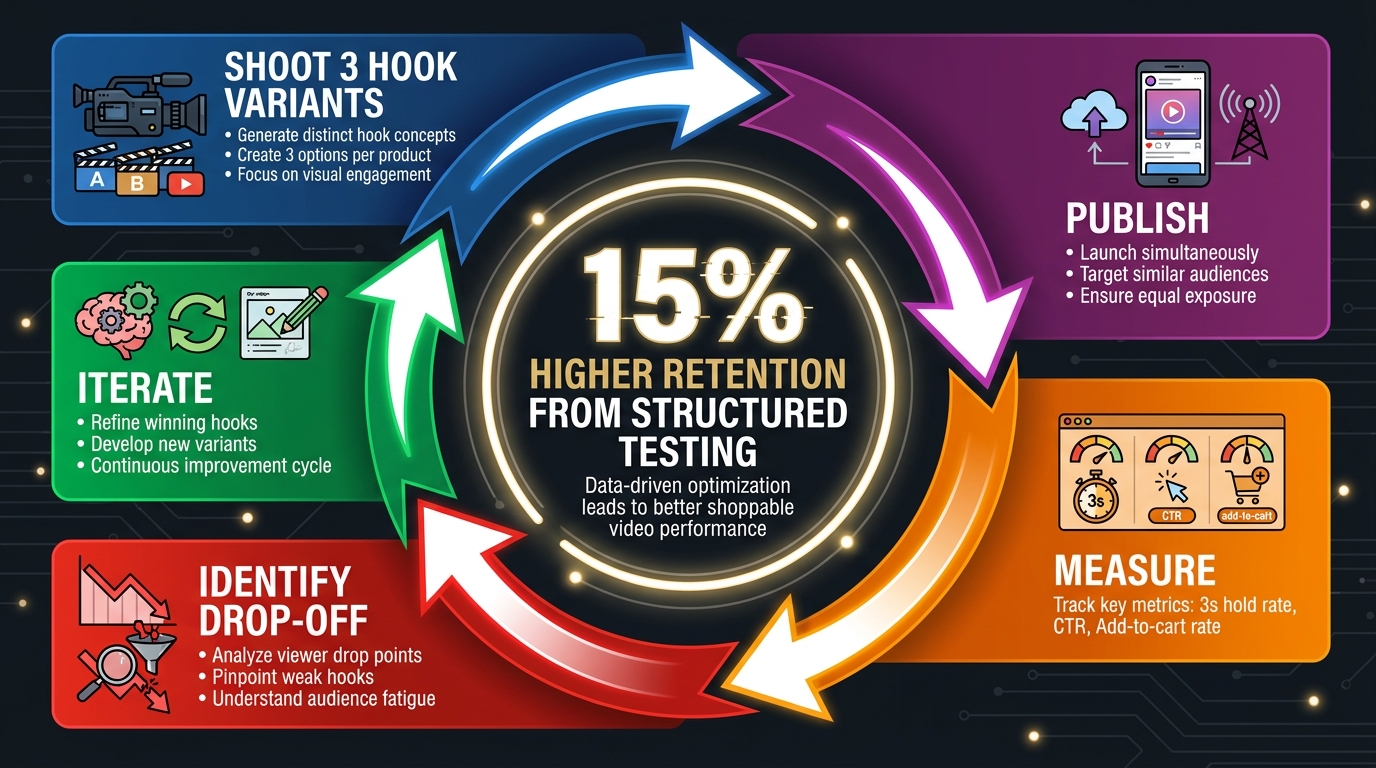
Most brands publish a shoppable video, watch the numbers for a few days, and then either scale what seemed to work or abandon what didn’t — without ever developing a rigorous understanding of why one video outperformed another. This is testing as superstition, not testing as science.
A structured hook testing loop changes that. Research shows that brands using structured video testing frameworks see 15% higher retention and significantly better conversion rates compared to unstructured publishing. The loop itself is simple; the discipline is the hard part.
Stage 1: Define the Single Variable
Every hook test should isolate one variable. If you change the hook archetype, the opening visual, the on-screen text, and the audio simultaneously — and one version outperforms — you still don’t know why. You’ve generated a winner but no learning.
Test one element at a time: hook archetype first (which type stops your audience most reliably), then opening visual (what visual element performs best within that archetype), then audio/text treatment (what language resonates), then CTA phrasing. This builds a layered knowledge base over time rather than a collection of disconnected results.
Stage 2: Publish as True Variants, Not Edits
Many brands test by publishing one video and then re-editing it later. This introduces timing bias — the first version benefits from the first wave of algorithmic distribution, which often performs differently than subsequent pushes. True testing means publishing variant A and variant B in the same time window, to similar audience segments, with the same boost/promotion budget if applicable.
On TikTok and Instagram, this means publishing two separate posts with different hooks but identical body and CTA content. On on-site shoppable embeds, this means A/B testing at the placement level — different video IDs assigned to the same page location for different visitor cohorts.
Stage 3: Read the Funnel, Not Just the Top
When evaluating test results, trace the full funnel for each variant:
- 3-second hold rate (did the hook work?)
- 50% completion rate (did the body sustain attention?)
- Product tag CTR (did desire convert to action?)
- Add-to-cart from tag click (did the landing page support intent?)
- Purchase completion (did checkout remove final friction?)
A variant with a higher hold rate but lower conversion than its peer isn’t necessarily a better hook — it might be attracting a less purchase-ready audience. Read the full funnel before declaring a winner.
Stage 4: Build a Hook Knowledge Base
After running five to ten structured tests, patterns will emerge. You’ll know which hook archetype your audience responds to most. You’ll know whether your audience watches with sound on or off. You’ll know at which second the typical viewer drops off and what that tells you about desire construction. This institutional knowledge compounds — each test informs the next, and over time your baseline performance improves because your starting assumptions are data-informed.
Keep a simple spreadsheet: hook type, 3-second hold rate, completion rate, tag CTR, conversion rate, date, platform. Review it monthly. Look for patterns. The patterns are your competitive advantage.
Choosing Your Shoppable Video Stack: Platform and Tool Comparison
The infrastructure powering your shoppable video matters — but it should be chosen after your content strategy is clear, not before. Too many brands buy a shoppable video tool, discover it doesn’t integrate with their content workflow, and end up with excellent technology producing mediocre content.
Here’s a practical breakdown of the current tool landscape by use case:
For Social-First Shoppable Commerce
TikTok Shop (native): The highest-converting shoppable environment for impulse-purchase categories. Native TikTok Shop videos that lead directly to in-app checkout eliminate almost all post-video friction. If your product category performs on TikTok, native TikTok Shop video should be your primary channel. The platform’s 45.5% user-to-buyer conversion rate is the highest of any social platform.
Instagram Shopping (native): Best for aspirational lifestyle brands where the Instagram aesthetic is part of the brand story. The 25% cart conversion boost from Instagram shoppable posts comes partly from the platform’s built-in purchase intent and partly from the curation effect — Instagram shoppers tend to be in browsing-to-buy mode more than TikTok’s entertainment-first audience.
For Shopify DTC Brands (On-Site Video)
Videowise: Strong performance data showing up to 400% on-site engagement boost. Offers swipeable video feeds, UGC integration, and page-speed optimization through video compression. Best for mid-market brands with existing UGC libraries they want to activate as shoppable content.
Tolstoy: AI-driven content distribution and native TikTok/Instagram import. Proven Shopify integration with site-wide widget distribution. Particularly strong for brands that want to automatically deploy social videos as on-site shoppable content without manual re-uploading.
Whatmore: Editor’s choice for fashion and lifestyle brands under $10M GMV. Freemium with AI auto-tagging and 1-click social imports. Page-speed safe, strong Shopify 1-click integration. The limitation is primarily geographic case study breadth — performance data is weighted toward India-based DTC cases, though Western brand implementations are growing.
For Enterprise and Live Commerce
Firework: Enterprise-grade retail platform with bulk TikTok/Instagram sync, QR code overlays, quiz features, and both WooCommerce and Shopify compatibility. Strong analytics suite measuring GMV and conversion by video. The go-to for large retailers running multi-SKU shoppable campaigns at scale.
Bambuser: Live shopping specialist delivering 4x higher engagement rates than standard Instagram live. Best for brands where live demo and real-time audience interaction are central to the purchase decision — fashion, beauty, electronics, high-consideration products.
Stack Selection Criteria
Choose your shoppable video stack based on four criteria, in order:
- Where your audience already converts — don’t force your audience to a new platform. Meet them where they are.
- Content workflow compatibility — the best tool is one your team will actually use. Friction in your content creation workflow means less content, which means fewer test cycles, which means slower learning.
- Analytics depth — you need video-attributed revenue, not just views. Ensure your tool provides it before committing.
- Page speed impact — for on-site implementations, run a page speed audit before and after implementation. A beautiful shoppable video that tanks your Core Web Vitals score will hurt more than it helps.
The Seven Mistakes That Sink Shoppable Video Campaigns (and How to Fix Them)
Beyond the hook and architecture issues already covered, several operational patterns consistently undermine shoppable video performance. These are worth naming directly because they’re not obvious — and they tend to appear in even well-resourced, marketing-sophisticated brands.
Mistake 1: Repurposing Without Reformatting
Cross-posting the same video to TikTok, Instagram, YouTube, and your website without platform-specific optimization is a widespread practice that produces universally mediocre results. What performs on TikTok (rough, native, sound-on, culture-embedded) actively underperforms on Instagram (polished, aesthetic, sound-optional, aspiration-oriented). Reformatting does not mean reshooting — it means trimming, re-cropping, adding captions where missing, adjusting hook timing for platform norms, and updating CTA language for platform-specific purchase mechanics.
Mistake 2: Using a Single Hook Per Product
A single hook variant reflects a single assumption about what will stop your audience’s scroll. If that assumption is wrong, your entire video underperforms — permanently, for that product. The consistent pattern among top-converting brands is shooting three to five hook variants per product and deploying them as a test — not as a hedge against laziness, but as a deliberate knowledge-building exercise.
Mistake 3: Product Tag Overloading
More tags do not mean more conversions. Videos with five or more simultaneous product tags create visual clutter that degrades the experience and distracts from the video narrative. Best practice for 30-second shoppable videos is one to two product tags, placed strategically at peak desire moments. For longer video content (60–120 seconds), three to four tags are appropriate, with each timed to a relevant product moment in the video.
Mistake 4: Treating Shoppable Video as an Ad Format
Shoppable video that reads as a traditional ad — polished production, brand voiceover, logo-heavy, features-first scripting — consistently underperforms content that reads as genuine. The platform environment where most shoppable video lives (TikTok, Instagram, YouTube) is fundamentally social. Content that breaks the social contract — that signals “I am an advertisement” — triggers avoidance behavior even in viewers who were pre-disposed to buy.
The fix is counterintuitive: invest more in authenticity than in production value. Creator-driven UGC, real customer unboxings, genuine demos with real reactions — these formats consistently outperform slick brand productions in shoppable contexts. The shoppable layer adds the commerce infrastructure; the authentic content does the persuasion work.
Mistake 5: Launching Without Analytics Infrastructure
A shoppable video without video-attributed revenue tracking is a content piece, not a commerce asset. Before you publish your first shoppable video, ensure your UTM parameters are configured, your pixel is firing on video interactions, your platform analytics is tracking tag click-through, and your Shopify or ecommerce platform is set up to attribute orders back to video-originating sessions. This setup takes two to four hours for most brands. Skipping it means weeks of publishing without any actionable learning.
Mistake 6: Chasing Trends Over Relevance
Trending audio, trending formats, and viral hook structures can boost discovery — but only if they’re relevant to your product category. A trending sound that works beautifully for a fitness supplement brand may actively undermine a professional skincare brand’s authority positioning. Use trend-awareness to inform, not to dictate. The question is always: “Does this trend make my product more desirable to my customer, or just more visible to everyone?”
Mistake 7: No Clear Purchase Journey Beyond the Hook
A remarkable hook creates an expectation. The rest of the video and the subsequent purchase path must fulfill it. Brands that engineer brilliant hooks but haven’t clearly designed the body, bridge, CTA, and post-click experience end up with strong watch metrics and weak revenue. The hook opens the door. Everything that follows must justify the viewer walking through it.
Conclusion: Stop Scripting Videos — Start Engineering Attention
The shoppable video opportunity in 2026 is substantial — global ecommerce is approaching $8 trillion, video drives 82% of internet traffic, and interactive shoppable formats convert at 3.2x the rate of standard video. The infrastructure has never been more accessible, the audience has never been more primed to buy through video, and the platforms have never made the transaction path smoother.
But infrastructure and opportunity don’t generate revenue. Attention does. And attention, in a world where every content category is competing for the same 3-second window, is not captured by accident.
The brands winning at shoppable video in 2026 are not those with the biggest production budgets. They’re the ones who have internalized a fundamental reframe: the video is not the product showcase. The hook is the product. Everything else — the demo, the social proof, the CTA, the shoppable tag — only works if the hook first earned the right to be seen.
That means treating hooks as engineered artifacts, not improvised openings. It means testing archetypes with the same rigor you’d apply to ad creative or landing page copy. It means building a production workflow that produces hook variants as a primary output, not an afterthought. And it means measuring the full funnel — from three-second hold rate through video-attributed revenue — to develop the institutional knowledge that compounds over time.
The framework in this guide is a starting point, not a ceiling. Your specific product category, audience, and platform mix will produce their own performance patterns that no generic guide can fully predict. But the principles are durable: attention comes first, desire is built deliberately, objections are bridged before the CTA, and friction is mapped and removed systematically.
Your Immediate Action Checklist
- ✅ Identify which hook archetype best matches your product category and shoot three variants for your next video.
- ✅ Audit your current video analytics setup — are you tracking video-attributed revenue? If not, fix that before anything else.
- ✅ Check your product tag timing in existing videos. Are tags appearing in the 8–15 second window? Move them if not.
- ✅ Run a mobile page speed test on the landing page your shoppable tags link to. Address anything scoring below 60 on Google PageSpeed Insights.
- ✅ Review your last three shoppable videos. Were the hooks shot with a specific archetype in mind, or were they edited from existing footage? Plan your next shoot as hook-first.
- ✅ Start a hook knowledge base spreadsheet — even with just your last five videos. The pattern recognition this enables is disproportionately valuable over time.
Shoppable video is not a format. It’s a discipline. And like all disciplines, the gap between practitioners who do it casually and those who do it systematically widens over time. Start engineering now.