


Here is the uncomfortable truth about livestream commerce that nobody in the marketing industry wants to say out loud: most small businesses that try it either quit after three streams or spend six months doing it wrong before figuring out what actually works.
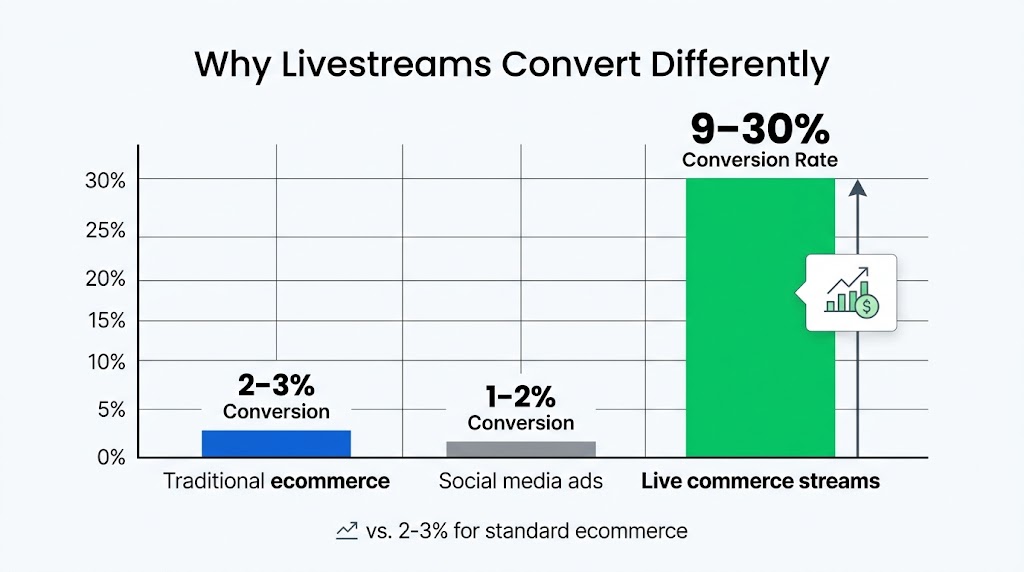
The hype is real. The U.S. livestream commerce market grew nearly 50% in a single year to hit $14.64 billion in 2025, and projections for 2026 put global live commerce well past $230 billion. Conversion rates during well-executed livestreams reach 9–30%, compared to 2–3% for conventional ecommerce pages. Those numbers are impossible to ignore.
But the gap between what the market is doing and what any individual small business is experiencing is enormous. Why? Because most SMBs approach livestreaming as a one-time marketing stunt — a product launch, a holiday event, a “let’s try this and see” experiment — rather than as a systematic, repeatable channel that compounds in value over time.
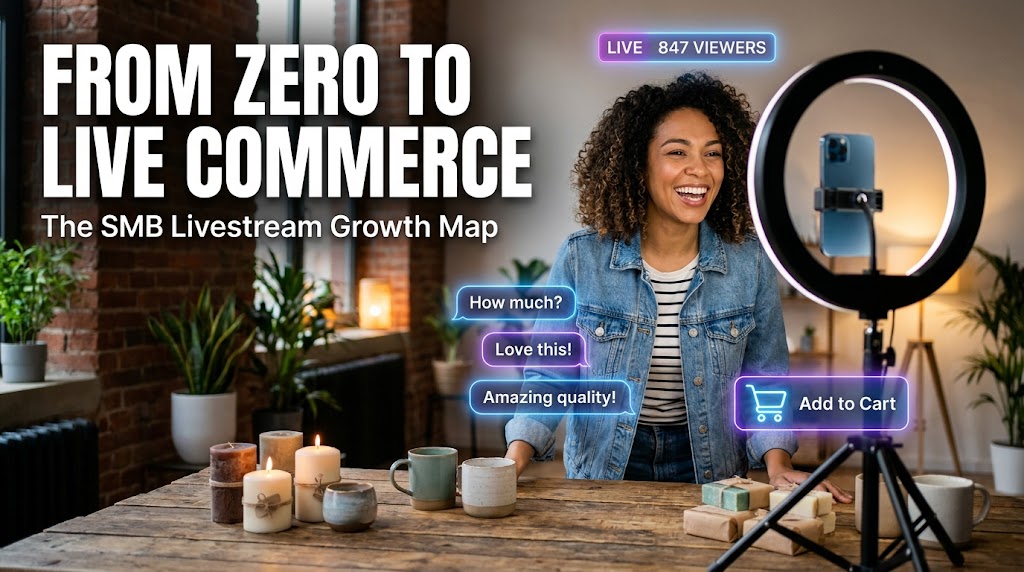
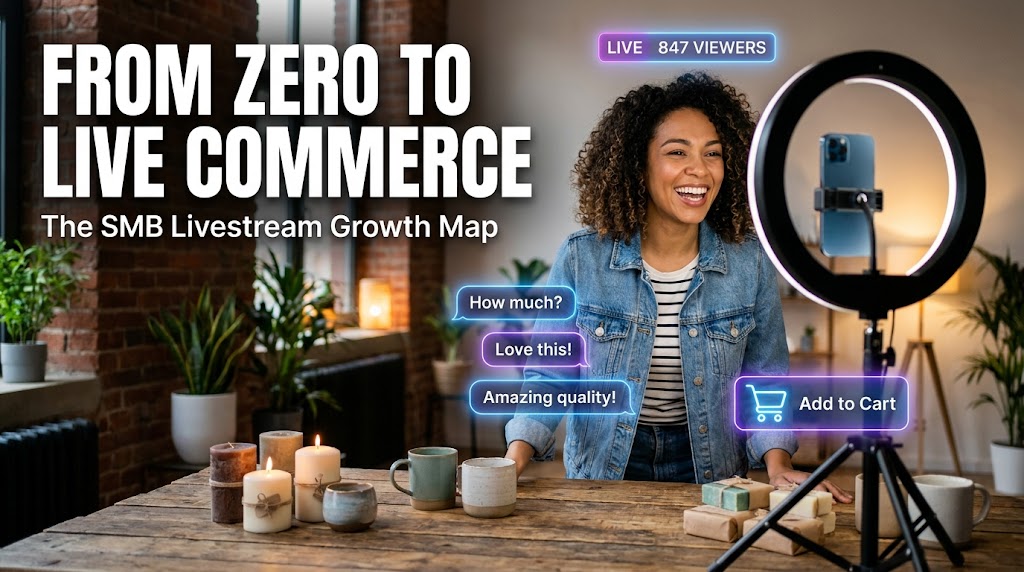
This post is not about getting your first hundred viewers. It’s about building a live channel that actually sustains itself — one that fits your business model, grows without destroying your team’s bandwidth, generates more than just direct sales, and becomes a genuine asset rather than an obligation. We’ll cover platform selection, pre-launch audience building, production realities, monetization structures, content repurposing, and the metrics that tell you whether any of it is working.
If you’ve already considered going live — or tried it and stalled — this is the operational map you were missing.
Why Livestreaming Is Different From Every Other Marketing Channel You’ve Used
Most marketing channels are asynchronous. You write a blog post, it gets indexed, someone finds it six months later. You run a Facebook ad, it delivers impressions on the platform’s schedule, and a click happens whenever it happens. Even email — your most “direct” channel — lands in an inbox and competes with a hundred other messages for attention at a time you don’t control.
Livestreaming is the opposite. It is radically synchronous. You and your audience are sharing the same moment in time, and that shared presence changes the psychology of the interaction in ways that no other format can replicate.
The Psychology of “Live”
When a viewer joins a livestream, they experience something that marketers call social presence — the sense that they are interacting with a real person in real time, not consuming pre-packaged content. This shifts the viewer from a passive consumer to an active participant. They ask questions. They make comments. They feel responsible for their choices in a way they simply don’t when browsing a product page alone.
This is why livestream conversion rates are so dramatically higher than standard ecommerce. The purchase decision isn’t made in isolation — it’s made in community. When ten other viewers are typing “just ordered!” in the chat, the social proof mechanism fires immediately. When a host answers your specific sizing question in real time, the last barrier to purchase dissolves.
The Trust Compression Effect
Building brand trust through conventional channels takes time — multiple touchpoints across weeks or months before a consumer feels confident enough to make a first purchase. Livestreaming compresses that timeline dramatically.
A small coffee roaster who goes live for 45 minutes — grinding beans, explaining roast profiles, answering questions about where the beans were sourced — creates a level of transparency and intimacy that a polished product page simply cannot replicate. The viewer has essentially spent 45 minutes “in the shop.” By the time they click buy, they already know the brand.
This trust compression effect is especially powerful for SMBs, where the owner or founder is often the most compelling asset. Large brands pay enormous sums trying to manufacture authenticity. Small businesses have it for free.
The Discovery Dimension
Unlike a website, where traffic must be deliberately driven, active platforms like TikTok and YouTube have algorithmic discovery mechanisms that can surface your livestream to users who have never heard of you. TikTok’s LIVE content gets served to non-followers based on engagement signals, meaning every stream is also a potential acquisition event — not just a retention or conversion event.
This dual function (acquisition + conversion in a single format) is rare. Paid ads can acquire but rarely convert. Email converts but doesn’t acquire. A well-executed livestream can do both simultaneously, which fundamentally changes the economics of customer acquisition for small businesses.
Platform Selection: Matching Your Business Model to the Right Stage
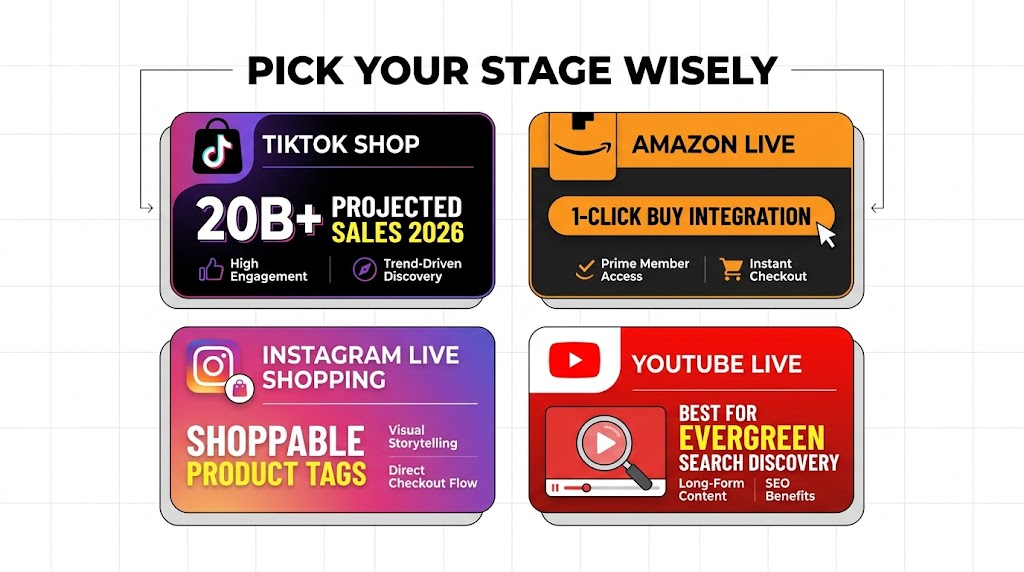
One of the most consequential decisions a small business makes when entering livestreaming is choosing where to go live. The wrong platform doesn’t just limit your reach — it misaligns your content format, your audience’s buying behavior, and your monetization options in ways that are hard to recover from without starting over.
Here is an honest breakdown of the major platforms and what they actually offer SMBs in 2026.
TikTok Shop LIVE: Discovery-First Commerce
TikTok Shop projected sales exceed $20 billion in 2026, and roughly 50% of U.S. social shoppers are expected to make a purchase on the platform. For SMBs selling visually compelling, impulse-friendly products — beauty, fashion, food, home goods, gadgets — TikTok LIVE is the most powerful acquisition tool available at no upfront cost.
The mechanics are built for commerce: you pin products to your stream in real-time, viewers tap to buy without leaving the app, and the TikTok affiliate program lets you bring in creators to co-host and share your audience. Brands that integrate Shopify with TikTok Shop report 20–40% conversion increases for their livestreamed products.
The catch: TikTok’s algorithm strongly rewards engagement consistency. Sporadic streams underperform. The platform also trends younger, which means if your core customer is over 45, you may be broadcasting to the wrong room.
Best for: Consumer product brands targeting Gen Z and Millennials, brands with visually interesting products, businesses that can commit to a regular streaming schedule.
Amazon Live: High-Intent, Marketplace-Native Commerce
Amazon Live is built for Amazon sellers, full stop. The platform integrates directly with your product listings so that viewers can purchase with a single tap, leveraging Amazon’s stored payment information. Replays persist on your storefront, generating ongoing commissions long after the stream ends — a significant difference from platforms where live content disappears.
Amazon Live viewers arrive with high purchase intent. They’re not idly scrolling — they’re on a platform they use specifically to shop. Traffic from TikTok to Amazon grew 58% in a single year, and Amazon Live builds on that intent natively.
The limitation is discoverability. Unlike TikTok, Amazon Live does not algorithmically surface your stream to new audiences in a meaningful way. You largely need to bring your own traffic, which means Amazon Live works best when layered on top of an existing audience — from TikTok, YouTube, or email — rather than as a standalone acquisition channel.
Best for: Established Amazon sellers who want to deepen product education and drive conversions from warm audiences.
YouTube Live: The Long-Game Platform
YouTube’s livestream capability is the most underrated tool for SMBs with a knowledge-intensive product or service. The platform’s search and discovery architecture means your livestreams don’t just perform in real time — they generate long-tail SEO value as recorded content that surfaces in Google and YouTube searches for months or years.
YouTube Live supports multiple revenue layers: advertising, channel memberships, Super Chats ($1–$500 per viewer contribution), and direct product integrations through YouTube Shopping. The platform’s audience skews older and has higher per-viewer purchasing power than TikTok.
The barrier is higher. Growing a YouTube audience from zero takes longer than TikTok’s algorithm can accelerate, and the production expectations are generally higher because the content lives permanently and is compared against professional-grade video. But for businesses willing to invest in the long arc, YouTube is the only platform where a live event from two years ago can still generate revenue today.
Best for: Service-based businesses, educators, software/tool companies, brands with complex products that benefit from extended demonstrations.
Instagram Live: Community Deepening, Not Acquisition
Instagram Live is best understood as a community tool, not a growth tool. It notifies your existing followers when you go live and creates an intimate setting for direct conversation. The shoppable product integration allows pinned products during a stream, and the content can be saved to Instagram Stories or Reels after the session ends.
For brands already built on Instagram — particularly lifestyle, fashion, and wellness brands with engaged follower bases — Instagram Live is an excellent way to deepen loyalty and drive conversions from a warm audience. But as a cold-acquisition channel, it underperforms dramatically compared to TikTok’s algorithmic push.
Best for: Brands with existing Instagram followings, Q&A sessions, community events, influencer collaborations.
The Multistream Option
Tools like StreamYard, Restream, and OBS allow SMBs to broadcast simultaneously across multiple platforms. For businesses with the bandwidth to manage multiple chat windows and the content that fits multiple audiences, multistreaming can dramatically expand reach. The tradeoff is that platform-specific features (pinned products on TikTok, one-click Amazon purchases) don’t always work when you’re pulling from a third-party stream.
A practical approach: start single-platform to build discipline and learn what works, then layer in multistreaming once your format is repeatable.
Building an Audience Before You Go Live
The most common reason SMB livestreams fail is not poor production quality or lack of product — it’s streaming to an empty room. Audience building is not something you do after you go live. It has to happen before.
The 3-Week Pre-Launch Window
Industry practice among successful small brands suggests a three-week promotion window before a first or major livestream event. This involves a structured sequence of content designed to build awareness, anticipation, and intent to attend.
Week one focuses on awareness: announce the upcoming stream across all owned channels — email list, social profiles, existing customers. Explain what the stream will cover and why it’s worth attending live. Week two shifts to engagement: release behind-the-scenes teaser content, product previews, or countdowns. Ask your audience what they want to see. Week three is urgency: remind, confirm, and build the expectation that something exclusive will happen during the live event that cannot be accessed afterward.
The Exclusive Incentive
Viewers need a reason to attend live rather than watch a replay. The most effective incentive structures for SMBs include:
- Live-only pricing: Offer a discount or bundle that exists only during the stream window. This creates genuine urgency without devaluing your product permanently.
- Limited inventory reveals: If you’re launching a limited-edition product, announce that it will only be sold during the live event.
- Real-time Q&A access: For service businesses, the chance to ask the founder or expert a direct question is itself a compelling reason to show up live.
- Giveaways: Prizes awarded randomly to live attendees drive attendance, though the audience quality can be lower because they’re showing up for the prize, not the product.
Leveraging Micro-Influencers for Pre-Stream Reach
Micro-influencers — creators with 10,000 to 100,000 followers in a specific niche — can dramatically accelerate pre-stream awareness for SMBs. The economics are favorable: a micro-influencer with a genuinely engaged audience in your product category will generate more conversion-ready viewers than a macro-influencer with a diffuse, high-follower audience.
Co-hosting arrangements are particularly effective. If a niche beauty creator agrees to co-host your skincare brand’s first TikTok LIVE, they bring their existing audience into your stream, and both parties benefit from the shared discovery exposure.
Production Reality: What Actually Matters vs. What You Think You Need
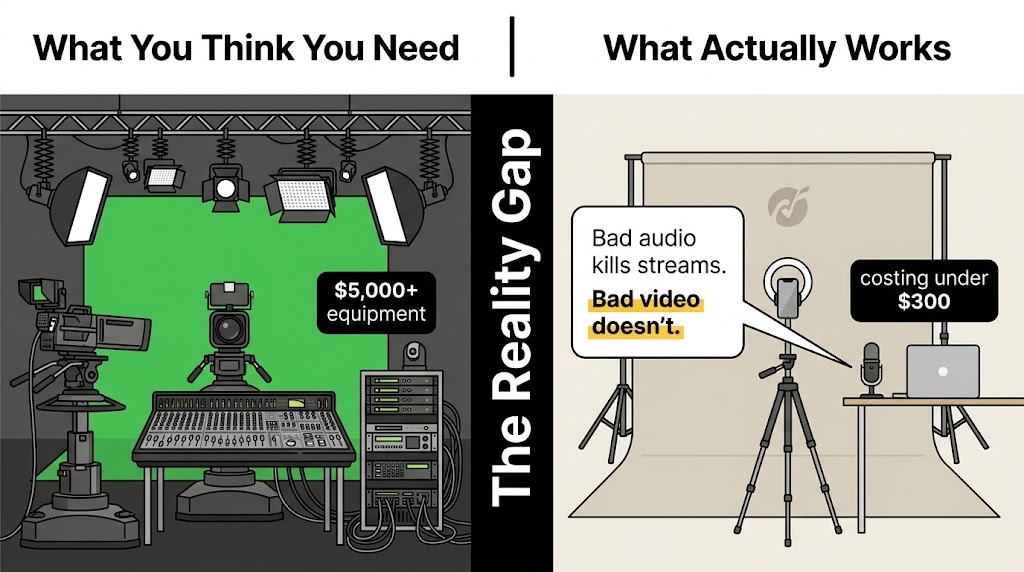
Production anxiety is one of the primary reasons SMB owners delay going live. The mental image of a “professional stream” involves expensive cameras, lighting rigs, broadcast-grade microphones, and technical expertise that feels wildly out of reach for a team of three people running a product-based business.
That mental image is wrong, and it’s costing businesses real revenue.
The Audio-First Principle
The single most important technical investment a small business can make for livestreaming is audio quality — not camera quality, not lighting, not streaming software. Industry consensus is unambiguous on this: poor audio ends a viewer’s session faster than any other production failing. Viewers will tolerate a slightly blurry video. They will not tolerate crackling, muffled, or echo-heavy audio.
A lavalier microphone (clip-on) for the host costs between $30–$80 and dramatically improves audio clarity over a built-in phone or laptop microphone. A USB cardioid microphone (the Blue Yeti or Rode NT-USB Mini are popular SMB options) runs $100–$200 and is effective for desktop setups. Either option transforms the professional quality of your stream at a fraction of what camera upgrades cost.
The Minimum Viable Setup
For most SMBs, the minimum viable livestream setup includes:
- A modern smartphone (iPhone 13 or later, recent Android flagship) mounted on a tripod — $20–$40
- A USB or lavalier microphone — $50–$150
- A single LED ring light or panel light — $30–$80
- A clean, branded background (physical backdrop or tidied space) — $0–$50
- A stable internet connection with at least 5–10 Mbps upload speed
Total investment: under $300. This setup, used consistently with good content, will outperform a $5,000 production rig used inconsistently with poor content every single time.
What to Test Before You Go Live
Production failures during a live broadcast are far more damaging than equivalent failures in pre-recorded content — there is no edit, no re-shoot, no second take. A test stream (broadcast to a private or unlisted setting) before your first public stream is non-negotiable. Test your:
- Internet connection stability (run a speed test and a 10-minute private stream to check for drops)
- Audio levels (listen back through headphones — not through the room speakers, which mask echo)
- Camera framing (ensure your face and the products you’ll demo are both in frame)
- Platform integrations (test that pinned products, links, or shopping features are functional)
- Your run-of-show (know your opening 3 minutes by heart — first impressions matter disproportionately)
The Upgrade Path
Once you’ve validated that livestreaming works for your business — that it generates revenue, that your audience shows up, that the format converts — then it makes sense to invest in production improvements. The smart upgrade sequence is: audio first, then lighting, then camera. Multi-camera setups, dedicated streaming software (OBS Studio is free, StreamYard starts at $49/month), and custom branded graphics and overlays become worthwhile investments only after you’ve proven the format delivers returns.
Livestream Formats That Drive Consistent Revenue for Small Brands
Format is the variable that most businesses underinvest in. They go live, they talk about their product, they try to sell. The stream is transactional and viewers can sense it. The formats that consistently generate revenue for small brands are the ones that lead with value and let sales follow naturally.
The Flagship Product Demo
The core of any product-based SMB’s livestream strategy should be an extended, honest product demonstration. This format works because it answers objections in real time — the exact moment a viewer wonders “but does it work on oily skin?” the host answers it, in front of everyone, with proof.
Effective product demos have a structure: introduce the problem the product solves, show the product in context (not in isolation on a white background), demonstrate multiple use cases, handle common objections explicitly, and then make the offer. The PatBO fashion brand followed a version of this at New York Fashion Week and saw 300% commerce sales increases, 79% higher average order value, and 125% more orders compared to regular sales days — all from a single livestream.
The Educational Deep-Dive
For businesses whose products require context to be appreciated — specialty food, skincare, tools, supplements, software — the educational format converts better than a direct sales approach. Teach something genuinely useful. Build the expertise of your brand in front of the viewer. Then offer your product as the natural next step.
A specialty coffee roaster streaming a 40-minute deep-dive on single-origin coffee sourcing, roast levels, and brewing methods isn’t just selling coffee — they’re selling education and authority. The product sale at the end of the stream is almost incidental, and yet the purchase intent generated by that 40 minutes of expert content is far higher than any ad could achieve.
The Flash Sale Event
Timed exclusivity is one of the most reliable conversion levers in live commerce. A flash sale — where specific products are offered at a discount available only during the stream — uses urgency, social proof, and real-time scarcity simultaneously. The chat becomes a feedback loop: when viewers see others confirming their purchases in real time, the hesitant buyer becomes a buyer.
Flash sale streams work best when they are pre-announced, scheduled at consistent times (so your audience expects them), and themed (a “Friday Flash,” a seasonal clearance event, or a product-category spotlight). Douglas, the European beauty retailer, reported a 40% conversion rate during flash sale livestreams — significantly higher than even the broad 9–30% industry benchmark.
The Behind-the-Scenes Stream
Behind-the-scenes content — showing how products are made, how orders are packaged, what the team’s day looks like — builds extraordinary brand affinity at almost zero production cost. This format requires no script and no setup beyond turning on the camera in a real environment.
For handmade, artisan, or craft businesses, this format can be transformational. Watching a candle-maker pour, label, and describe the intentionality behind their product while answering viewer questions in real time is not just content — it’s an argument for why the product is worth paying more for than the mass-produced alternative.
The Expert Interview or Co-Stream
Bringing a guest onto your stream — a customer with an interesting story, a supplier, a complementary brand founder, or a subject-matter expert — serves two purposes. It diversifies the content so repeat viewers get something new, and it typically brings the guest’s audience into your stream as well, functioning as a cross-promotion mechanism.
The key is choosing guests whose audience overlap with your ideal customer is high. A pet accessories brand co-streaming with a veterinarian creates genuine value for pet owners and surfaces both parties’ brands to new audiences simultaneously.
Monetization Stacking: Going Beyond the Sale
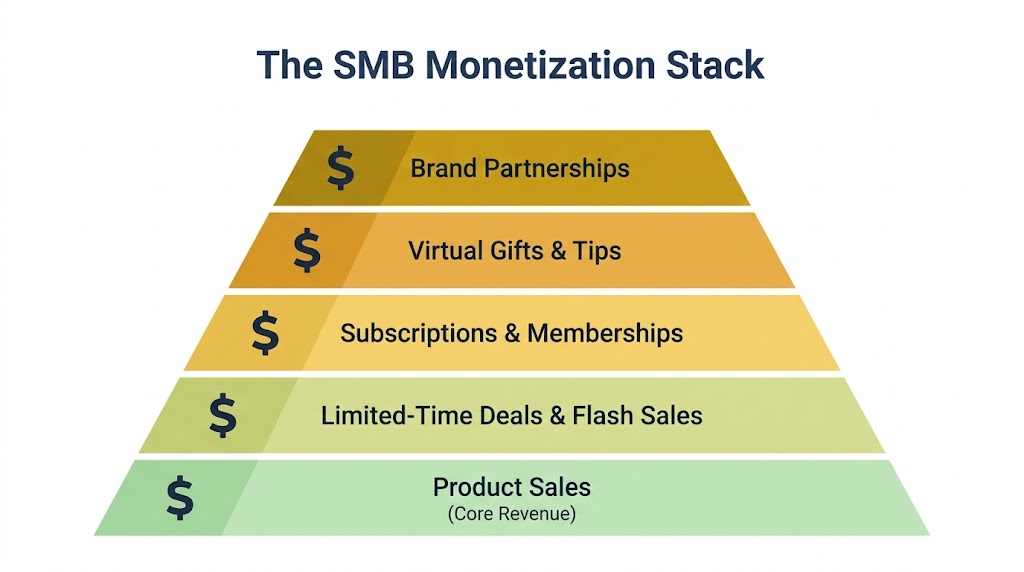
Most SMBs who enter livestreaming think about it as a single revenue stream: go live, sell products, count sales. But the businesses that build sustainable live channels understand that monetization has multiple layers, and the direct product sale is only the foundation.
Layer 1: Direct Product Revenue
This is the obvious layer — products sold during or immediately after the stream. The variables that affect this layer are your platform’s shopping integrations, the urgency mechanisms you use (flash pricing, limited inventory), and your average order value. For most SMBs, this layer alone can justify the time investment in livestreaming, but it’s not the ceiling.
Layer 2: Subscriptions and Memberships
Platforms including YouTube, TikTok (for accounts with established authority scores), and Twitch support subscription models where viewers pay a monthly fee for access to exclusive content, early product access, or community membership.
For a small business with a loyal following, a subscription model can generate predictable recurring revenue that exists entirely separately from product sales. Consider the math: 100 subscribers paying $29/month generates $2,900 in monthly recurring revenue — before a single product is sold. For brands with high-engagement communities (food, fitness, crafts, gaming accessories), this is a genuinely viable revenue layer.
Layer 3: Virtual Gifts and Tips
On YouTube, Super Chat contributions range from $1 to $500 per viewer, with the host acknowledging the contributor publicly during the stream. TikTok’s “Diamonds” gifting system allows viewers to send virtual gifts that convert to real currency. These micro-payment mechanisms feel natural within an engaged stream and add up quickly during high-attendance events.
The principle here is simple: give your most enthusiastic viewers a way to show their support beyond a purchase. Not every viewer will buy a product in every session, but they may still want to participate. Gifting mechanisms let them do that in a way that generates direct revenue.
Layer 4: Affiliate and Brand Partnerships
Once a small business has an established livestream audience — even a modest, niche audience of a few thousand engaged viewers — complementary brands will pay for mentions, integrations, and co-streams. A cooking-focused SMB with 5,000 consistent livestream viewers is an attractive partner for a kitchen tool brand, a specialty ingredient company, or a meal planning app.
The key distinction from traditional influencer marketing is that the audience here is live and highly engaged. A brand mention during a livestream carries more weight than a static post because the viewer is actively paying attention, and the host can field real-time questions about the partner product. The conversion value is demonstrably higher, which means the rates you can charge for partnerships are higher than equivalent-reach influencer arrangements.
Layer 5: The VOD Back Catalog
Every livestream you record becomes a searchable, shareable piece of evergreen content. On Amazon Live, replays generate commissions on sales made through the saved video. On YouTube, replays generate advertising revenue and can be optimized for search. The accumulated library of streams is itself an asset — it grows in value over time and continues to generate revenue without additional production effort.
Turning One Stream Into a Week’s Worth of Content
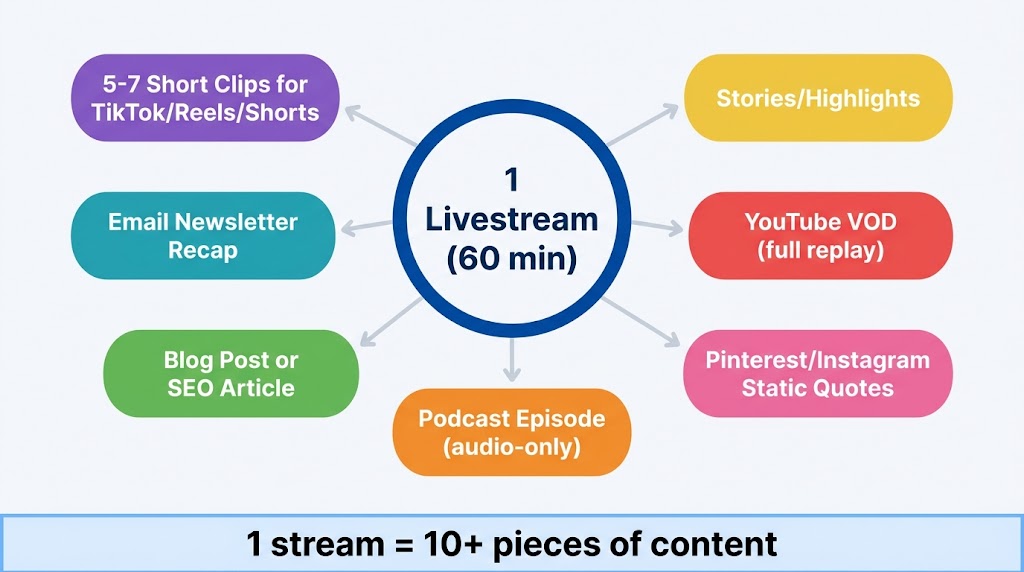
One of the persistent myths about livestreaming is that it requires enormous ongoing content effort. For businesses with limited teams and finite bandwidth, the idea of going live weekly feels like adding a part-time job to an already full schedule.
The counter to this is content multiplication — the practice of systematically extracting every piece of downstream content from a single live event before, during, and after the stream.
Planning Repurposing Before the Stream, Not After
This is the key operational insight that separates businesses who successfully maintain livestream channels from those who burn out: you must plan your content repurposing strategy before you go live, not as an afterthought once the stream is over. If you wait until after the stream to decide what to clip, where to post it, and who will edit it — it rarely happens. The post-stream energy is low, you’re moving on to the next business priority, and the content sits in a folder getting stale.
The solution is to build your repurposing plan into your stream prep. Before going live, identify: which three moments in this stream are likely to make the best short clips? What’s the headline takeaway that will become the email subject line? Is there a quotable section that would work as a static graphic?
The Repurposing Map
A 60-minute livestream, properly planned, generates:
- 5–7 short-form clips for TikTok, Instagram Reels, and YouTube Shorts (30–90 seconds each, pulling the highest-energy or most informative moments)
- 1 email newsletter recapping the stream’s key takeaways, featuring any products sold, and linking to the replay
- 1 blog post or long-form piece built from the transcript of the stream, optimized for search
- 2–3 static graphics for Instagram, Pinterest, or LinkedIn featuring quotes, statistics, or product highlights from the session
- 1 YouTube VOD (or platform replay) available for ongoing discovery and advertising revenue
- Stories or Highlights on Instagram/Facebook featuring the best 60–90 seconds
That is effectively a full week of content across multiple channels from a single live session. AI tools now make transcript generation, clip identification, and even caption writing fast enough that a solo operator or a small team can manage the repurposing pipeline without a dedicated editor.
Tools That Make Repurposing Manageable
Several platforms now offer AI-assisted repurposing specifically designed for livestream content. Opus Clip analyzes long-form video and automatically identifies moments most likely to perform as short clips based on engagement signal patterns. Descript offers transcript-based editing and can turn a recorded stream into a readable document for blog or email use. Riverside.fm records streams in high resolution for post-production use regardless of what platform you streamed from.
The goal is to make the repurposing workflow systematic enough that it doesn’t require creative decision-making every time — just execution against a known process.
The Metrics That Tell You If Your Livestream Is Actually Working
Businesses that measure their livestream performance exclusively by units sold are missing most of the signal. Direct sales are an output metric — they tell you what happened, not why, and not what to change. The metrics that give you operational visibility into a livestream program are more nuanced.
Peak Concurrent Viewers (PCV)
Peak concurrent viewers is the highest number of people watching your stream at any single moment. It tells you the ceiling of your current audience for that content type and platform. Tracking PCV over multiple streams shows you whether your audience is growing, declining, or flat — and whether promotional efforts are working.
More useful than PCV in isolation is the PCV-to-purchase rate: the percentage of peak viewers who made a purchase. A stream with 200 PCV and 20 purchases (10% conversion) is performing identically in commercial terms to a stream with 2,000 PCV and 200 purchases. If your PCV is growing but your conversion rate is falling, you may be reaching a broader but less qualified audience.
Average Watch Time
Average watch time — how long the typical viewer stays in your stream — is one of the most important signals you have. Platforms use watch time as a quality signal to decide how widely to distribute your stream (particularly on TikTok and YouTube). Short average watch times signal that your content is not retaining interest, which suppresses algorithmic distribution.
A watch time of under 3 minutes typically means viewers are joining, not immediately connecting with what they see, and leaving. This points to either a weak opening (the first 60 seconds of a stream are disproportionately important — they determine whether a casual joiner stays), poor audio or video quality, or a mismatch between the content promised in the promotion and what the stream actually delivers.
Engagement Rate During Stream
The ratio of comments, reactions, shares, and chat interactions to concurrent viewers tells you whether your audience is watching or participating. High viewer counts with low engagement suggest passive consumption — which correlates with lower conversion rates. An engaged audience that’s asking questions, responding to polls, and making comments in the chat is actively involved in the stream experience, and active involvement correlates strongly with purchase intent.
Post-Stream Replay Performance
For businesses building long-term live channels, replay metrics matter as much as live performance. On YouTube and Amazon Live, replay views generate ongoing revenue. If your live stream captures 500 concurrent viewers but the replay generates 5,000 additional views over the following month, you’re systematically undercounting the channel’s value if you only report live metrics.
Revenue Attribution by Stream
Not all sales attributed to livestreaming will happen during the stream itself. Many viewers watch, don’t purchase immediately, and then convert within 24–72 hours via a direct site visit, an email click, or a product search. Using UTM parameters on links shared during streams and in post-stream emails allows you to track delayed conversions attributable to the livestream event. Without this tracking, you’re likely underreporting the channel’s contribution to revenue.
Common Mistakes That Kill SMB Livestream Programs
Most SMB livestream programs don’t fail dramatically — they fade. They start with enthusiasm, generate disappointing early results, and gradually deprioritize the channel until it’s abandoned entirely. The pattern is almost always the result of predictable, avoidable mistakes rather than a fundamental incompatibility between the business and the format.
Mistake 1: Treating Every Stream Like a First Stream
Inconsistency is the fastest way to undermine audience building. If you stream weekly for three weeks, disappear for a month, return for a one-off event, then promise to return “soon,” your audience has no basis for forming the habit of showing up. Platform algorithms compound the penalty: irregular streamers get less distribution than consistent ones, regardless of content quality.
The solution is to commit to a frequency you can actually maintain rather than an aspirational frequency that collapses under operational pressure. Twice a month, reliably, will outperform weekly streaming done inconsistently every time.
Mistake 2: No Opening Hook
Thirty-two percent of U.S. consumers cite “inconvenient timing or format” as barriers to watching livestreams — but an equal number drop off within the first two minutes because the opening fails to grab their attention. Most SMBs open their streams by thanking people for joining and waiting for more viewers to arrive. This is a dead zone that signals to the algorithm that engagement is low, which reduces distribution, which means fewer viewers join, which confirms the algorithm’s assessment.
Open your stream with something happening immediately: a bold statement, a product you’re about to test, a question directed at the chat, a countdown to a giveaway reveal. Give viewers who stumble onto your stream a reason to stay in the first 30 seconds — before they’ve formed any opinion about whether to continue watching.
Mistake 3: Wrong Platform for Your Audience
Choosing a platform based on personal comfort rather than audience fit is a common and costly mistake. If your core customer is 35–55, building your livestream presence on TikTok means you’re working hard to reach an audience that is either not on the platform in significant numbers or is on the platform with different behavioral patterns than your target customer. Match the platform to where your actual buyer already spends time.
Mistake 4: Ignoring the Chat
Livestreaming is not broadcasting — it’s a conversation. Hosts who talk at the camera while largely ignoring the chat are missing the primary differentiator of the format. The chat is where purchase objections get raised and need to be answered. It’s where your most enthusiastic viewers self-identify, and those are the people most likely to share the stream, return next week, and become long-term customers.
If managing chat while hosting is genuinely difficult — and for solo operators it often is — designate a second team member specifically to monitor and respond to chat, escalating the most important questions to the on-camera host. Even a basic acknowledgment (“great question from Sarah — we’ll answer that in a second”) maintains the interactive dynamic that makes livestreaming different from a video ad.
Mistake 5: No Technical Rehearsal
Launching your first public stream without a private test stream is the equivalent of performing a product demo without testing whether the product works. Technical failures during a live stream — dropped audio, internet outages, camera framing that cuts off your face — damage brand credibility in ways that are difficult to recover from, particularly for audiences unfamiliar with your brand who joined via algorithmic discovery.
Building a Repeatable Livestream Schedule Without Burning Out
Sustainability is the overlooked metric of livestream success. The businesses that generate the most durable revenue from livestreaming are not the ones with the best individual stream — they are the ones that have been streaming consistently for 12 to 18 months. This is because live commerce compounds in ways that are not visible in any single session’s metrics.
Designing for Your Actual Capacity
Before committing to a streaming schedule, map your actual available capacity honestly. Account for pre-stream prep (30–60 minutes minimum for setup, sound check, and run-of-show review), the stream itself, and post-stream repurposing (2–3 hours if you’re managing it in-house). A weekly 60-minute stream requires 3–5 hours of total time per week from someone on your team — before accounting for content promotion and audience engagement.
For most SMBs, the sustainable starting frequency is one stream every two weeks. This provides enough spacing to execute the pre-stream promotion cycle properly, repurpose the previous stream’s content, and manage the operational overhead without crowding out other business priorities.
Building a Stream Theme Calendar
A theme calendar eliminates the creative overhead of deciding what to stream each week. Assign recurring themes to your streaming slots — for example, the first Tuesday of the month is a product deep-dive, the third Thursday is a Q&A and community session, and the last Friday of the month is a flash sale event. Viewers learn to anticipate specific formats, which improves return attendance rates.
Theme calendars also make content promotion templated rather than bespoke — if your audience knows the flash sale stream happens on the last Friday of each month, your promotional messaging for that event almost writes itself.
Batching Prep Work
Batching is the practice of completing similar tasks together rather than spreading them across the week. For livestreaming, this means preparing graphics, writing promotional copy, and setting up the stream environment in a single block rather than touching each element separately. Brands that batch their stream prep consistently report lower time investment per stream and more polished execution than those who approach each stream fresh.
When to Bring in Help
Once you’ve validated that livestreaming generates positive ROI — that the revenue generated exceeds the time cost plus any platform or tool fees — the question becomes whether to invest in dedicated support. A part-time content coordinator who manages the repurposing pipeline, handles chat moderation, and executes promotional scheduling can return far more than their cost if the channel has traction. This is typically the right move when your streams are reliably generating revenue but your output quality is capped by your solo capacity.
The Compounding Nature of Live Commerce: Thinking in Seasons, Not Sessions
The businesses that generate the most durable revenue from livestreaming are not the ones with the best individual stream — they’re the ones that have been streaming consistently for 12 to 18 months. This is because live commerce compounds in ways that are not visible in any single session’s metrics.
Your audience grows with each stream. Your platform algorithm learns what your content is and who it should show it to, and that learning improves over time. Your replay library accumulates, generating passive views and revenue. Your production systems get faster and cheaper as your team internalizes the workflow. Your promotional strategy gets more effective as you learn what converts your specific audience.
There is also a brand equity dimension that is genuinely difficult to quantify but real: a business that has been streaming regularly for a year has demonstrated consistency, transparency, and genuine engagement with its customers in a way that no marketing campaign can manufacture. That record of showing up builds a level of customer trust that converts into higher lifetime value, lower return rates, and higher word-of-mouth referral rates.
The PatBO case study is useful here, but it’s also exceptional — a 300% single-stream sales spike is a highlight reel moment, not a baseline. The more relevant benchmark for most SMBs is the incremental, compounding revenue growth of a business that streams consistently over a full year. The businesses achieving that kind of growth are not necessarily the ones with the highest production values or the most viral moments. They are the ones that built a system, stuck to it, and let the compounding dynamics of the channel do the work over time.
Conclusion: The Long Arc of Live Commerce
Livestreaming is not a campaign. It’s a channel — and like all channels, it requires patience, iteration, and consistent execution before it pays off in proportion to the effort invested. The SMBs that treat it as a one-time experiment will consistently be disappointed. The ones that approach it as infrastructure — something they build and maintain over time, not something they execute once and evaluate — will find it becomes one of their most efficient revenue-generating assets.
The entry point is lower than most business owners assume. A smartphone, a decent microphone, a clear background, and a genuine willingness to engage with your audience in real time are enough to start. The audience-building, the format refinement, the monetization stacking, and the content repurposing systems come later — built on the foundation of a channel that’s already proven it can convert.
Key Takeaways
- Match platform to business model: TikTok for impulse, discovery-driven commerce; Amazon Live for high-intent marketplace buyers; YouTube for knowledge-intensive products and evergreen search value; Instagram for community deepening.
- Audio quality is non-negotiable, production polish is optional: A $100 microphone will do more for your stream than a $1,000 camera upgrade.
- Build your audience before you go live: A three-week promotion window with pre-stream exclusives is the difference between streaming to an empty room and streaming to a ready audience.
- Monetization is a stack, not a single layer: Product sales are the foundation, but subscriptions, virtual gifts, brand partnerships, and replay revenue compound the channel’s value over time.
- Repurposing is planned before the stream, not after: One 60-minute stream is 10+ pieces of content if you plan for it in advance.
- Consistency beats intensity: A reliable bi-weekly stream outperforms sporadic high-production events. Algorithms reward regularity. Audiences reward it too.
- Think in seasons, not sessions: The compounding effect of 12–18 months of consistent streaming is not visible in any individual session’s numbers, but it is real and significant.
The live commerce market is still in its early-adoption phase in the United States, which means the competitive advantage of building a real, sustained livestream presence now — before the channel saturates — is genuinely available to SMBs willing to commit to the long arc.