




There’s a version of TikTok Shop that most sellers are still operating inside. It’s the one where a single viral video launches a product overnight, where the For You Page is the only distribution channel that matters, and where the winning strategy is essentially “post more and hope the algorithm picks you.” That version is increasingly a relic.
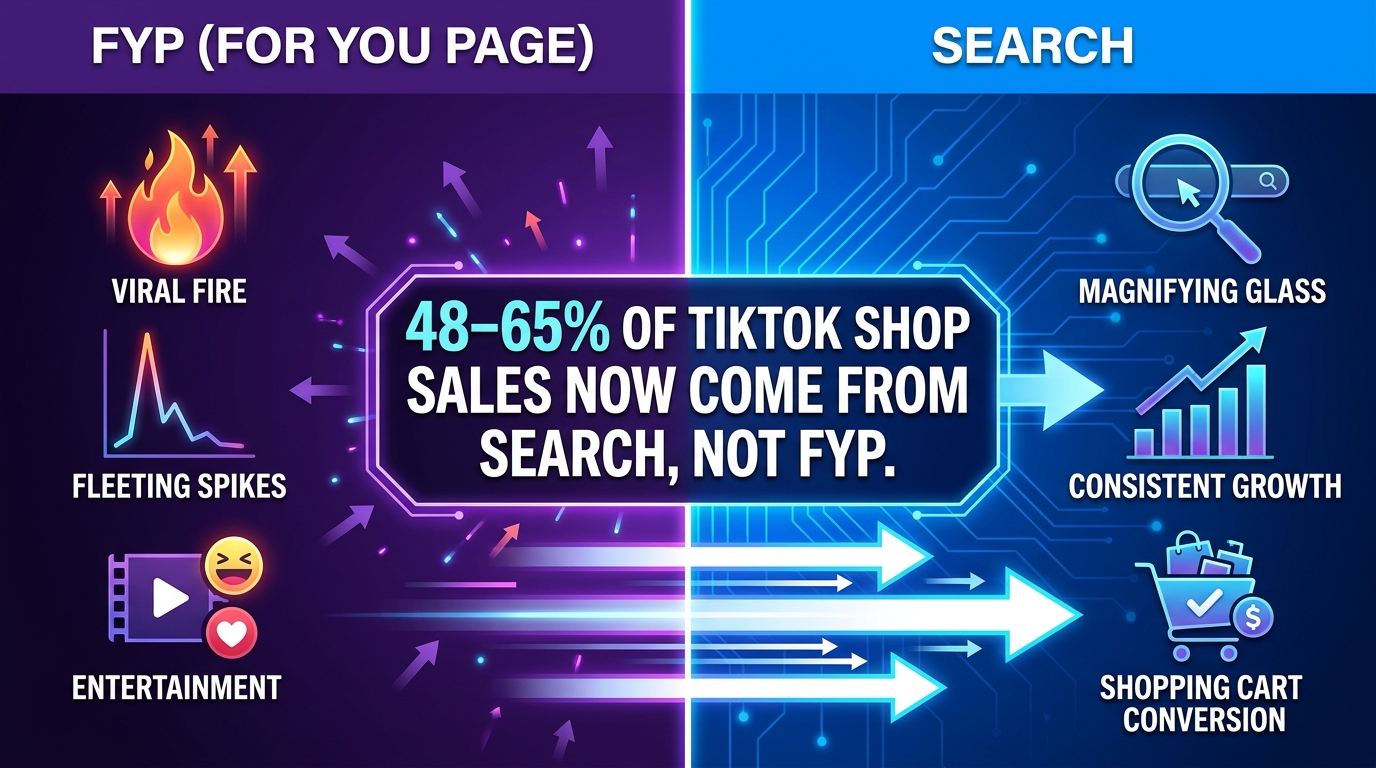
In 2026, TikTok Shop is a commerce search engine. Between 48% and 65% of all TikTok Shop sales now originate from the platform’s search function — not the FYP. Gen Z users search on TikTok 35% more than they do on Google. The platform’s global GMV is projected to reach $112.2 billion this year, up from $33.2 billion just two years ago. This is no longer a social media sideshow. It is an e-commerce marketplace with its own algorithmic logic, its own ranking signals, and its own penalties for sellers who fall short of platform standards.
What’s less understood is how, specifically, TikTok Shop decides what ranks and what doesn’t. The search ranking algorithm is not one thing — it’s a layered scoring system that reads your video content, evaluates your listing data, monitors your fulfillment behavior, and weighs your review trajectory. Get even one of those layers wrong and you can have a great product that nobody finds.
This guide breaks down every dimension of TikTok Shop’s search ranking algorithm as it operates in 2026: what it measures, how those measurements translate to visibility, and what sellers need to do differently — right now — to compete on the platform’s search results pages.
The Platform Shift That Changes Everything: TikTok Shop as a Search Engine
To understand why the ranking algorithm has evolved the way it has, you first have to accept a premise that is counterintuitive for anyone who came to TikTok as a content creator: the platform is now fundamentally oriented around purchase intent, not entertainment consumption.
TikTok’s internal data and third-party analyses consistently confirm that users searching on the platform do so with significantly higher commercial intent than users scrolling the FYP. That intent translates directly to conversion: search-driven purchases convert at roughly twice the rate of FYP-driven traffic. When a user searches “blackhead remover for sensitive skin” and clicks through to your product, they are far more likely to buy than someone who stumbled onto your product demo between two unrelated videos.
The Numbers Behind the Shift
The scale of this behavioral change is striking. TikTok Shop had approximately 475,000 active US sellers as of early 2026 — a 5,000% increase from mid-2023. Global GMV hit $66 billion in 2025 and is on track for $112.2 billion in 2026. The US alone is projected to generate $23.4 billion in GMV this year. Beauty and personal care leads all categories, with $2.49 billion in GMV — making TikTok Shop the fourth-largest health and beauty retailer in the US as of April 2026, according to NielsenIQ.
These aren’t social commerce footnote numbers. This is main-channel retail scale. And when that kind of money is at stake, the algorithm stops rewarding entertaining content and starts rewarding commercially effective content. The May 2026 algorithm update made this explicit: the platform shifted its primary ranking signals from entertainment metrics (likes, shares, watch time in isolation) to commerce metrics (product page clicks, add-to-cart events, and completed purchases). The FYP still exists. It still drives discovery. But it no longer determines search rankings — a fundamentally different scoring system does that.
Search Ranking vs. FYP Distribution: Two Different Algorithms
This is perhaps the most important structural point sellers miss. TikTok Shop operates two largely separate algorithmic systems. The FYP algorithm optimizes for content that keeps users scrolling — completion rates, rewatches, shares, and saves. The Search ranking algorithm optimizes for content and listings that convert searchers into buyers.
A video can go viral on the FYP while ranking on page five in search. Conversely, a modestly viewed but highly keyword-relevant video attached to a well-optimized listing can sit at position two in search and drive steady, consistent sales without ever trending. Understanding which system you’re actually optimizing for — or ideally, how to feed both simultaneously — is the strategic foundation everything else is built on.
Multi-Modal Indexing: How TikTok Actually Reads Your Content
One of the most significant technical changes to TikTok Shop’s search system over the past 18 months is the shift to what analysts call multi-modal indexing. In simple terms: TikTok is no longer just reading your hashtags and product title. It is actively processing the audio, on-screen text, and visual content of every video linked to your shop — and feeding that analysis into the search ranking engine.
This matters enormously for how sellers structure their content. The platform now uses two core technologies to extract keyword signals from videos:
- Optical Character Recognition (OCR): TikTok scans on-screen text in your videos frame by frame. Text you place visually in the video is recognized, catalogued, and associated with your product listing for search purposes.
- Natural Language Processing (NLP): The platform transcribes your video’s audio and processes the spoken language for keyword relevance. This is not just a transcription — NLP extracts semantic meaning, matching spoken phrases to buyer search queries even when they’re not exact matches.
The Rule of 3s: What Gets Prioritized
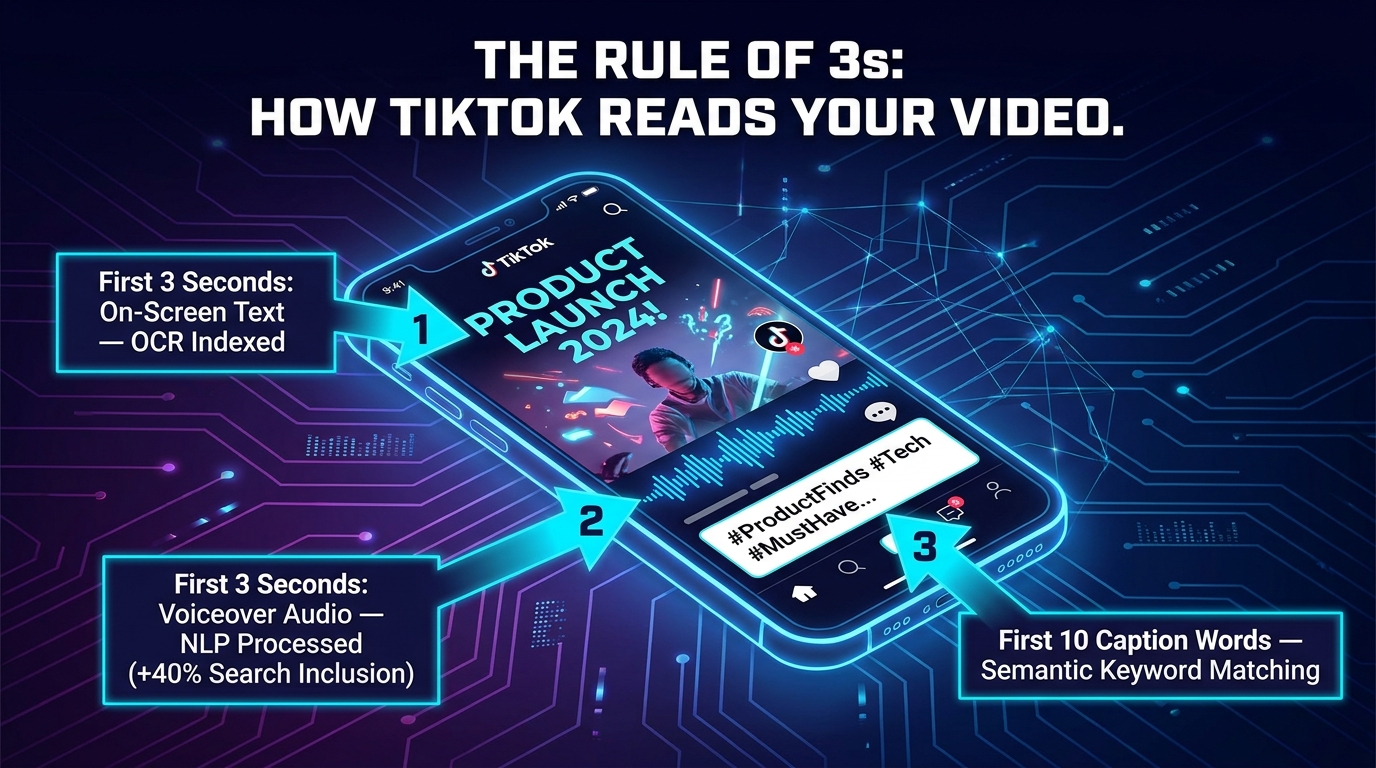
Not all video content is weighted equally. Research by multiple e-commerce analytics firms has identified what practitioners call the “Rule of 3s” — the specific content windows TikTok’s indexing system appears to weight most heavily:
- The first 3 seconds of on-screen text: Text displayed in the opening frames of your video is OCR-indexed and weighted as a primary keyword signal. If you open your video with text that matches buyer search terms, TikTok immediately has strong evidence of topical relevance.
- The first 3 seconds of spoken audio: The opening voiceover is NLP-processed and, according to analysis by Stormy.ai, contributes approximately a 40% boost in search inclusion rates compared to videos where key terms appear later in the audio.
- The first 10 words of your caption: The caption is indexed for keyword matching with explicit weighting on the opening words. This is TikTok’s version of a title tag — front-loading matters more than density.
The practical implication is clear: you have a three-second window in which TikTok is forming most of its indexing opinion about your content. Sellers who open with lifestyle b-roll, music, or branding before getting to the product are essentially wasting that window from a search ranking standpoint. The platform does not reward a slow build when it comes to search indexing.
What This Means for Video Structure
Multi-modal indexing effectively transforms every piece of creator and brand content linked to a TikTok Shop product into a search document. Your videos are not just content — they are indexed assets. This has some non-obvious implications:
- Keyword research now applies to video scripting: The same long-tail terms you’re researching for your product title should appear in your opening voiceover and on-screen text. This is not keyword stuffing — it’s alignment between what buyers search and what TikTok hears in your content.
- Audio quality is a ranking factor by proxy: If TikTok’s NLP can’t cleanly transcribe your audio because of background music, poor mic quality, or fast speech, the indexing signal degrades. Clear, deliberate speech in the opening seconds improves indexing reliability.
- The hashtag era is largely over: Multiple analyses confirm that generic hashtags like #TikTokMadeMeBuyIt contribute very little to search ranking in 2026. The algorithm draws its keyword signals from the richer NLP and OCR data. Niche, specific hashtags still provide some categorical signal, but they’ve been demoted in the hierarchy.
The Five Core Search Ranking Signals, Ranked by Weight
While TikTok does not publish an official ranking formula — no major platform does — the pattern of inputs that consistently move products up or down in search results has become increasingly clear through first-party data analysis and seller experimentation. Here are the five primary signal categories, in rough order of weight as they appear to operate in 2026.
1. Keyword Relevance (Listing + Content)
This is the foundational signal — whether TikTok’s systems can clearly associate your product and its linked content with a buyer’s search query. Relevance is drawn from multiple sources simultaneously:
- Product title: The single highest-weighted text field in TikTok Shop search. The primary keyword should appear in the first three to five words. The optimal format is: [Product Type] + [Key Attribute] + [Use Case/Benefit], kept within 80–100 characters. “Waterproof Bluetooth Earbuds 48hr Battery” outperforms “Premium Audio Accessories You’ll Love” on every dimension the algorithm cares about.
- Product description: NLP scans your description for primary and secondary keyword clusters. The first 80–100 words carry the most weight — this is where your core problem/solution framing should live, written around actual search terms.
- Video content: As covered in the multi-modal indexing section, all audio and on-screen text in linked videos contributes to keyword relevance scoring.
Keyword research on TikTok should draw from TikTok-native sources first — the platform’s own autocomplete suggestions, the Discover tab trending topics, and the “Others also searched” suggestions that appear below search results. These reflect actual buyer behavior on the platform, which often differs from Google or Amazon search patterns for the same product category.
2. Conversion Signals (Clicks, Carts, Purchases)
Since the May 2026 algorithm update, commerce conversion signals have moved to the top of TikTok Shop’s search ranking hierarchy for product listings. The algorithm measures the entire conversion funnel:
- Click-through rate from search results to product page
- Add-to-cart rate from product page
- Completed purchase rate
- Purchase-to-view rate on linked videos
A listing with a high CTR from search results tells the algorithm that your thumbnail, title, and price point are compelling relative to the alternatives. A high add-to-cart rate signals that your product page is convincing. A high purchase completion rate indicates that buyers’ expectations were met. Products that score well across this funnel are systematically promoted in search rankings — because TikTok’s commercial interest and the buyer’s interest are aligned when products actually sell.
3. Engagement Quality on Linked Content
Engagement metrics still matter — but the weighting has shifted significantly away from passive engagement toward active, intentional signals. Shares and saves now carry approximately three times the ranking weight of likes. A video being saved signals that a viewer intends to return to the product — that’s a purchase consideration signal, not just entertainment appreciation.
Video completion rate has also seen a threshold increase. As of 2026, TikTok’s distribution algorithm generally requires a 70% completion rate before expanding content beyond initial follower testing — up from approximately 50% in 2024. For search specifically, sustained watch time and rewatch rate (the percentage of viewers who replay a video) are particularly strong signals, as they indicate the content successfully demonstrated product value to interested buyers.
4. Seller Performance Score
Your Shop Performance Score (SPS) — a 0 to 5 rating maintained in TikTok Seller Center — is not just an operational metric. It is an active input into your search ranking. Products from low-scoring shops are systematically deprioritized in search results regardless of keyword relevance or content quality. More on the mechanics of this system in the dedicated section below.
5. Review Velocity and Recency
Review signals in TikTok Shop’s search algorithm are evaluated very differently from how Amazon treats them. The total number of reviews you have accumulated carries less weight than the rate at which new reviews are arriving. This is covered in full in the next section.
Review Velocity: Why 20 Fresh Reviews Beat 1,000 Old Ones
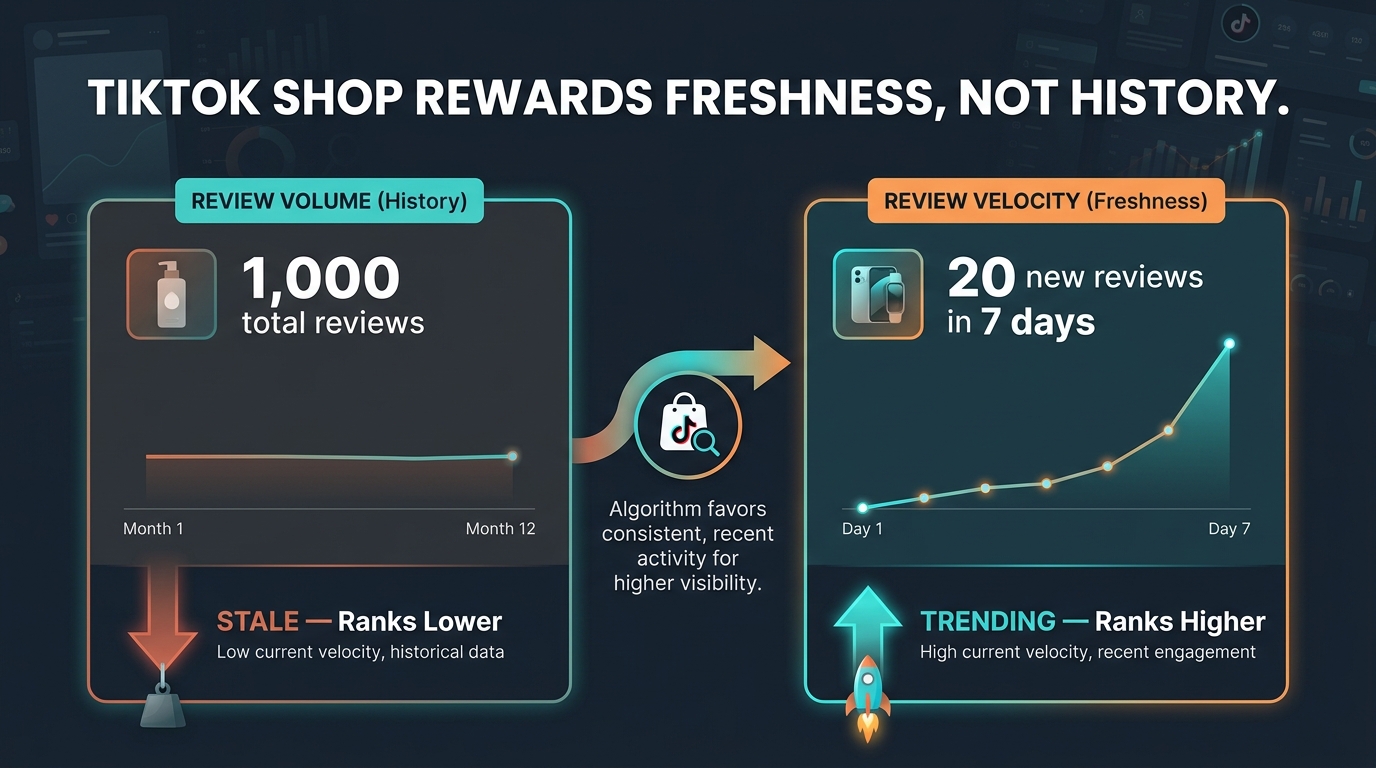
This is one of the least intuitive — and most impactful — ranking dynamics in TikTok Shop’s search system. The algorithm treats review data as a signal of current demand, not historical reputation. A product with 20 new reviews in the past seven days signals to TikTok that buyers are actively purchasing and responding to the item right now. A product with 1,000 total reviews but no new activity in three weeks signals stagnation — potentially a product that was trending but has cooled off.
What TikTok’s Algorithm Is Actually Measuring
When TikTok weights review velocity, it is using review activity as a proxy for sales velocity — the same logic that makes sales velocity a crucial ranking signal on Amazon. The platform isn’t rewarding sellers who are good at collecting reviews (though that matters for conversion). It’s using the rate of review accumulation as evidence that a product is currently selling and satisfying buyers. This matters to TikTok because the platform benefits commercially when active, in-demand products appear at the top of search results.
The evaluation window for review velocity appears to be a rolling seven-day period, with additional weight given to the most recent 24–48 hours during trend spikes. Review content also matters: keyword-rich, detailed reviews that reference the product’s specific use case contribute more semantic relevance to the listing’s search indexing than brief, generic reviews.
How to Engineer Consistent Review Velocity
The practical challenge is building a system that generates reviews at a steady, ongoing rate — not in occasional bursts. Sustainable approaches include:
- Automated post-purchase follow-up: TikTok Seller Center allows seller messaging to buyers. A well-timed, non-pushy message that asks buyers to share their experience (without explicitly requesting a positive review, which violates platform policy) can meaningfully increase review rate.
- Affiliate content driving ongoing sales: When affiliate creators are continuously posting about your product, the resulting sales create a natural and ongoing review stream. High sales velocity → consistent review flow → stronger search ranking signal. This flywheel is more sustainable than any one-time review push.
- LIVE commerce sessions: A well-executed LIVE session generates concentrated sales in a short window, which creates a burst of review velocity in the days that follow. Sellers who schedule regular LIVE sessions often see corresponding review spikes that maintain ranking positions.
One data point that illustrates the power of this dynamic: Physician’s Choice, a supplement brand, generated $2.3 million in GMV within 28 days on TikTok Shop. That result was driven not by a single viral video but by a systematic activation of affiliate creators that drove continuous sales — and continuous reviews — throughout the month.
Your Shop Performance Score Directly Controls Your Search Rank
TikTok Shop maintains a Shop Performance Score (SPS) for every seller on the platform, ranging from 0 to 5. This score is dynamically calculated across six operational metrics and is updated on a rolling basis. Critically, your SPS is not just a customer service report card — it is a direct input into your product search visibility. Products from shops with low SPS scores are algorithmically suppressed in search results, regardless of how well-optimized the listing is.
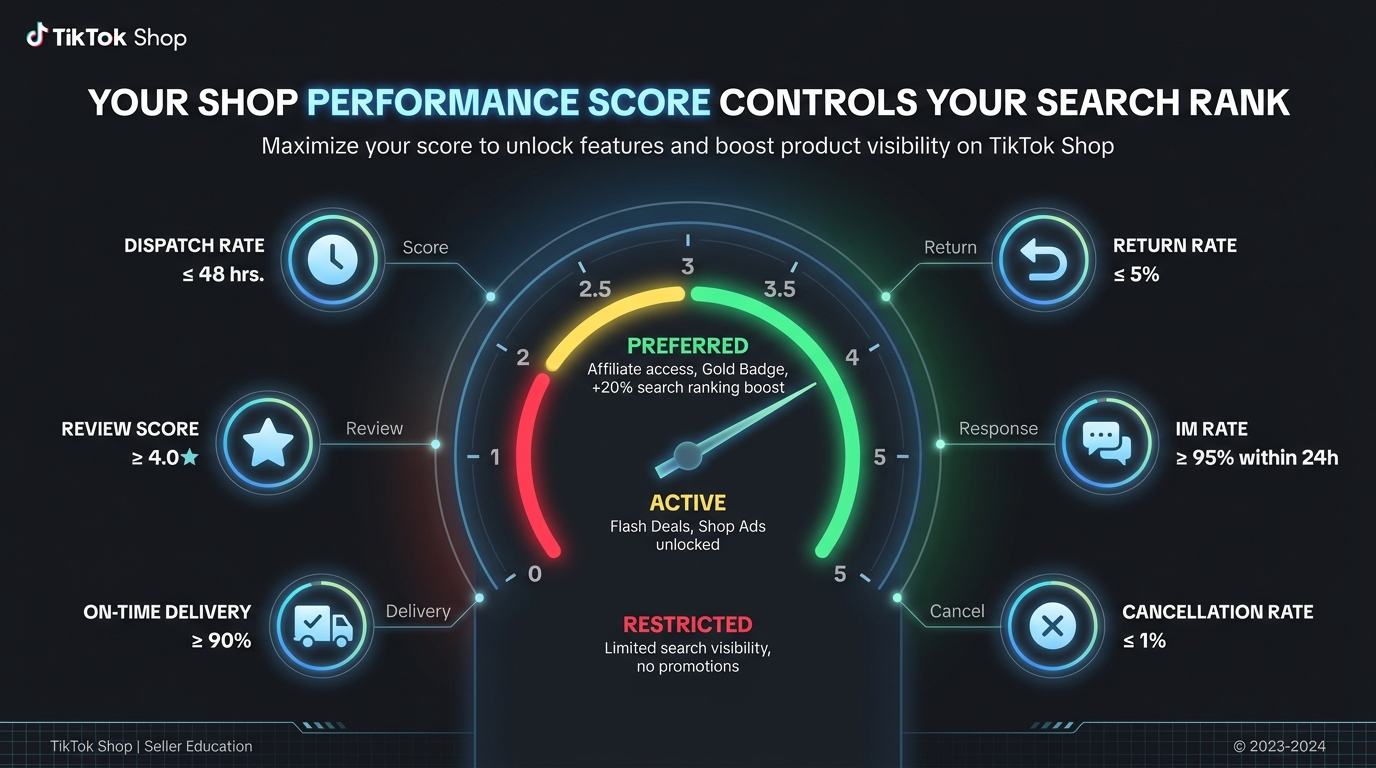
The Six SPS Metrics
TikTok calculates your SPS across these six weighted metrics — and the weights are adjusted by product category, so what’s acceptable in one category may be penalized in another:
- Negative Review Rate: The percentage of your reviews that are 1 or 2 stars. This is evaluated against category benchmarks, not an absolute standard.
- Non-Buyer Fault Return Rate: Returns that are attributed to the product being defective, not as described, or damaged in shipping. Buyer-fault returns (changed mind, wrong size selected) are excluded from this metric.
- Seller Fault Cancellation Rate (SFCR): Orders cancelled due to inventory issues, pricing errors, or other seller-side failures. The threshold in 2026 is 2.5%. Exceeding this triggers penalty point accumulation.
- On-Time Delivery Rate: Orders reaching “In Transit” status within two business days via TikTok-approved carriers. Invalid or missing tracking triggers metric drops immediately.
- IM Dissatisfaction Rate: Buyer complaints arising from seller responses (or lack thereof) in TikTok’s in-app messaging system. Response speed and resolution quality both feed into this metric.
- After-Sales Handling Time (AHT): How quickly you resolve post-purchase issues, disputes, and refund requests. The benchmark threshold is under 20 hours for initial response.
The SPS Tier System and What It Unlocks
Your SPS score determines not just your search visibility, but which platform features you can access at all:
- SPS below 2.5: Significant restrictions on search visibility, no access to Flash Deals, TikTok-Funded Promotions, or Shop Ads. Your products will appear in search results, but they will be systematically outranked by higher-scoring competitors.
- SPS 2.5 to 3.4: Active status. Flash Deals, Shop Ads, and TikTok-Funded Promotions become available. Search visibility is normal for your category performance level.
- SPS 3.5 to 4.0: Access to Affiliate Marketing programs, Campaign participation, and Short Settlement cycles. Search visibility improves meaningfully.
- SPS above 4.0: Eligibility for Gold or Silver Star seller badges, which appear directly in search results. Gold/Silver badges provide a documented 20% boost in search and recommendation visibility — a compounding advantage over unrated competitors.
The Late Dispatch Rate (LDR) has its own threshold: 4% or below is required to avoid penalty points. Penalty points are cumulative over 180-day windows and escalate from warnings to listing freezes to account suspension. TikTok does provide metric protection for carrier failures — but only when sellers use platform-approved carriers with valid tracking, so fulfillment infrastructure choices have direct ranking consequences.
LIVE Commerce as a Ranking Accelerator
TikTok LIVE commerce is often discussed primarily as a sales channel — and the conversion numbers justify that framing. LIVE sessions convert at approximately 7.4% on average, compared to 2–4% for traditional e-commerce. Viewers who watch LIVE streams purchase at a rate 22% higher than viewers of pre-recorded shoppable videos. During peak LIVE sessions with strong engagement, conversion rates can reach 10 times the traditional e-commerce baseline.
What’s less discussed is LIVE’s function as a search ranking accelerator. The mechanics work like this: a successful LIVE session generates a concentrated burst of sales in a short window. That sales velocity spike sends a powerful “currently in demand” signal to TikTok’s search algorithm. Products featured in a strong LIVE session frequently see improved search rankings in the 48–72 hours following the session — a halo effect that can persist for one to two weeks if the sessions are run regularly.
How TikTok’s Algorithm Reads LIVE Sessions
The algorithm monitors LIVE sessions in real time and uses specific signals to determine how widely to distribute the stream:
- Concurrent viewership growth rate: A LIVE session that grows its audience during the stream signals quality content; one that hemorrhages viewers suggests poor retention. The algorithm expands distribution mid-stream for sessions showing growth.
- Comments per minute: Active chat engagement signals viewer interest. Structured Q&A, polls, and real-time product demonstrations drive comment frequency.
- Product click and add-to-cart events: Each click and cart add during a LIVE session registers as a real-time commerce signal. The May 2026 algorithm update specifically identified purchase velocity within LIVE sessions as a trigger for immediate reach expansion — essentially, a mid-stream ranking boost when the algorithm detects buyers acting.
- Real purchases every 2–3 minutes: Sessions with consistent purchase cadence — not just spikes — are algorithmically favored over sessions with a single burst of purchases followed by silence.
The BK Beauty Benchmark
BK Beauty illustrates what properly structured LIVE commerce looks like. Their first LIVE event targeted $20,000 in GMV. They achieved $100,000 — five times the target — in a single stream. TikTok subsequently invited them to record a 10-hour session at TikTok’s Los Angeles studio. The keys: continuous real-time product demonstration, persistent viewer interaction, and a steady stream of urgency-driven purchase moments throughout the session. The compounding effect of those purchases on their subsequent search rankings contributed to sustained organic discovery well beyond the LIVE event itself.
The Affiliate Content Signal You’re Probably Underusing
TikTok’s Creator Marketplace and Affiliate program have been written about extensively as a revenue-sharing mechanism for brands. What’s underappreciated is their specific function as a search ranking amplifier. When multiple affiliate creators post content linked to your product over a compressed time window, two things happen simultaneously: sales velocity increases (driving conversion signals) and content volume increases (providing more indexed keyword assets).
The algorithm appears to recognize product-level content density — when multiple independent creators are posting about the same product, it is treated as an organic endorsement of current relevance. The search ranking boost from this kind of coordinated (but authentic) content activity can exceed what a single brand channel could generate even with a significantly larger content budget.
The Power Law Reality of Creator Performance
The economics of affiliate creator performance follow a clear power law: the top 20% of creators drive approximately 80% of affiliate GMV. The top 5% of creators average $80,000 in GMV per creator. This means that creator selection is not a numbers game — seeding 500 creators with random product samples is not a substitute for identifying and deeply partnering with the 10–20 creators in your niche whose content genuinely converts.
Two collaboration structures drive the highest search ranking benefit:
- Open Collaboration (Showcase): Making your product available to any qualifying creator in the affiliate program. This generates breadth — many pieces of indexed content across diverse audiences. It works best for products with broad appeal and strong visual demonstration potential.
- Targeted Collaboration: Directly inviting specific creators to promote your product at higher commission rates (20–50% vs. the standard 10–15%). Targeted collaborations produce higher average conversion rates — often 8–12% for niche-fit creators versus the 4.7% platform average. The concentrated, high-quality content these partnerships generate creates stronger search ranking signals than high-volume mediocre content.
Creator Health Ratings and What They Signal to Sellers
TikTok introduced a formal Creator Health Rating (CHR) system, running on a 0–1,000 point scale. New creators start at 200 points. The system tiers into Green (200–1,000: full platform access), Orange (151–199: reduced reach), and Red (1–150: restrictions and possible ban). A score of 0 results in a permanent e-commerce ban from the platform.
For sellers, this system matters because partnering with creators in the Orange or Red tier means their promotional content for your products receives reduced algorithmic distribution. You might commission excellent content from a creator whose CHR has been penalized — and that content will underperform in both FYP distribution and in the search signals it generates. Vetting creator CHR status before activating collaborative campaigns is now a basic due diligence step.
What Actively Suppresses Your Search Rankings
Understanding the positive ranking signals is only half the equation. TikTok Shop’s algorithm also operates with explicit suppression mechanisms that can neutralize an otherwise well-optimized listing. These are the most common causes of unexplained ranking drops in 2026.
Fulfillment Failures and Metric Threshold Breaches
As covered in the SPS section, late dispatch rates above 4% and seller-fault cancellation rates above 2.5% accumulate penalty points on a rolling 180-day window. Penalty points trigger graduated consequences: initial warnings have no immediate ranking impact, but accumulation leads to listing freezes and GMV campaign suppression before escalating to account-level restrictions. The key distinction the algorithm makes is between seller-fault failures (inventory shortages, pricing errors, mislabeled orders) and carrier-fault failures. Only the former affects your metric scores.
Review Rate Stagnation
A product with a history of strong reviews but no recent review activity will see its search ranking gradually erode — not because anything went wrong, but because the absence of fresh signals reads as reduced current demand. This is a particularly common problem for products that sold strongly during a launch window but weren’t given a system to sustain ongoing review velocity. The algorithm’s rolling evaluation windows (approximately seven days for review velocity, 60–90 days for satisfaction metrics) mean that past performance does not protect future rankings.
Keyword Mismatch Between Listing and Content
A subtle but measurable suppression signal occurs when TikTok’s NLP identifies a consistent mismatch between the keywords in your product listing and the keywords being processed from your linked video content. If your product title is optimized for “vegan protein powder” but every affiliated video discusses “meal replacement shakes,” the algorithm reads an inconsistency that reduces confidence in your listing’s relevance. Aligning the keyword architecture across listing text, video audio, and on-screen text is a basic hygiene requirement that many sellers overlook.
High Return Rates Relative to Category Benchmarks
Non-buyer-fault returns are a direct input into your SPS and, by extension, your search visibility. But beyond the metric, high return rates suggest to the algorithm that your product is not meeting buyer expectations — which is ultimately a search result quality problem. If buyers are clicking through from search, purchasing, and then returning the product, TikTok has placed a poor result at the top of the page. The algorithm corrects for this over time by deprioritizing listings with elevated return rates, even if their conversion rate looks strong at the top of the funnel.
Policy Violations and Content Flags
Content that receives policy flags — whether for misleading claims, prohibited product categories, or community guideline violations — triggers immediate de-indexing from search for the flagged content and can affect the overall account’s search visibility. Sellers operating in health, beauty, supplement, or food categories face heightened scrutiny around claims. Any video that implies medical benefits, disease treatment, or specific clinical outcomes is at elevated risk of flagging, which cascades into listing suppression regardless of how well-optimized everything else is.
A 30-Day Search Ranking Sprint: The Practical Sequence
The signals discussed throughout this guide don’t operate independently — they compound. A listing that is keyword-optimized, attached to well-indexed video content, accumulating fresh reviews, supported by affiliate creator volume, and maintained by a seller with a strong SPS score will dominate search results against competitors who have optimized only one or two of these dimensions. The following sequence is designed to activate all of them within a 30-day window.
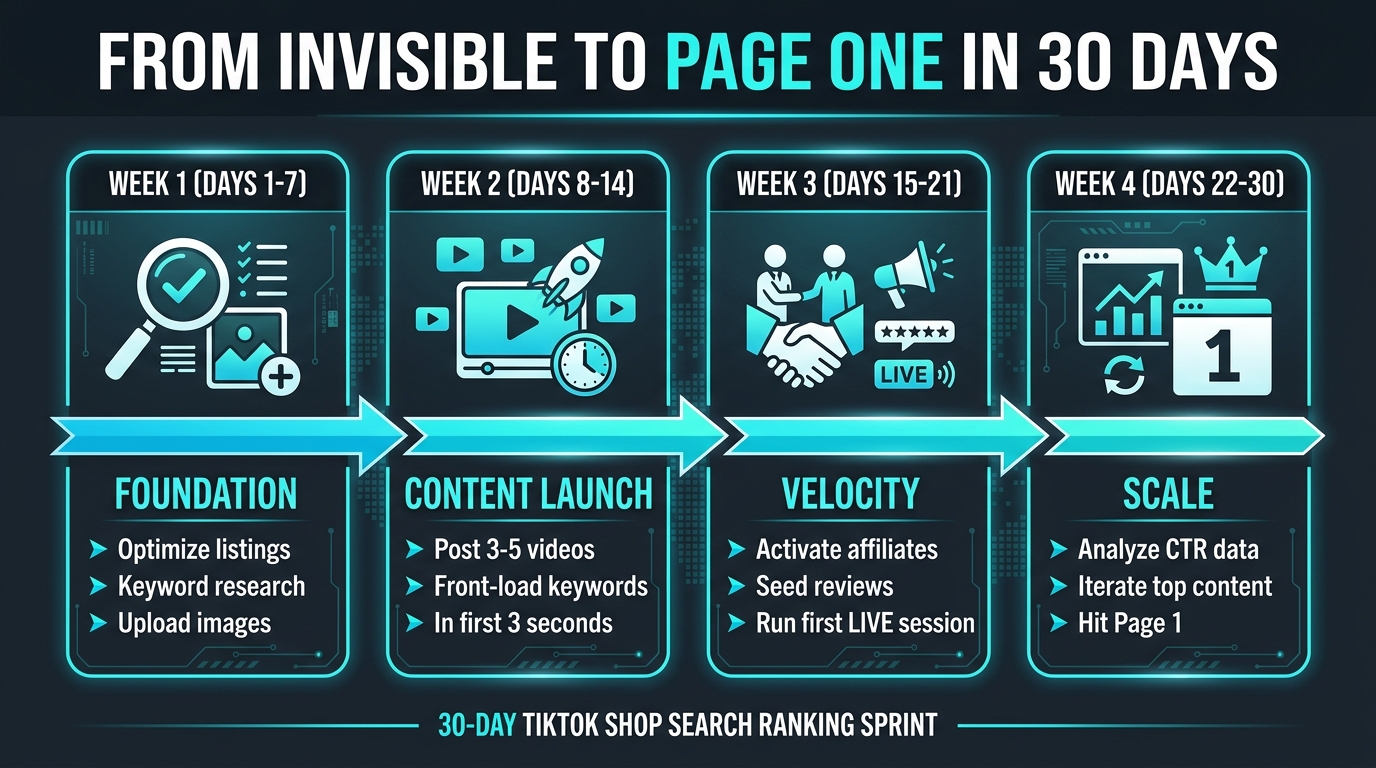
Days 1–7: Foundation and Listing Optimization
Start with keyword research using TikTok’s native autocomplete and Discover tab — not Google or Amazon keyword tools. Build a primary keyword list of 8–12 high-intent terms per product. Rewrite your product title to front-load the primary keyword in the first three to five words. Restructure your description so the first 80–100 words are a keyword-rich problem/solution statement. Upload a minimum of five product images: one clean product-on-white, one lifestyle/in-use context shot, two to three infographic-style images with feature callouts. Enable TikTok Seller Center’s “Improve Listing Quality” recommendations — these often surface suppression signals you may not have noticed.
Audit your Shop Performance Score and identify which of the six metrics is currently your weakest. Set up automated post-purchase messaging sequences if you haven’t already. Confirm that all active SKUs are backed by sufficient inventory to avoid SFCR threshold risks during the campaign period.
Days 8–14: Content Activation
Produce three to five short-form videos (15–30 seconds optimal for search ranking) for each prioritized product. Apply the Rule of 3s rigorously: keyword in on-screen text within the first three seconds, keyword in spoken audio within the first three seconds, primary keyword in the first ten words of the caption. Use TikTok’s Creator Search Insights tool (if available in your region) to identify what buyers are searching and build content that directly addresses those specific queries.
Post content at times when your target audience is most active. Monitor video-level analytics for completion rate — if it’s consistently below 65%, the content isn’t retaining viewers long enough to collect strong engagement signals for search. Revise and repost rather than continuing to push underperforming content.
Days 15–21: Velocity Building
Activate affiliate collaborations. Use Targeted Collaboration for one to three high-fit creators in your category; add Open Collaboration to generate broader content volume. Brief creators on the Rule of 3s for their own video structure — many creators have never been given this guidance and will instinctively apply it if explained clearly. Prepare an incentive for post-purchase review responses, structured to comply with TikTok’s review policy (ask for honest feedback, not explicitly for positive reviews).
Schedule your first LIVE session in this window. The goal is not to break sales records on stream one — it’s to generate a burst of purchase velocity that creates a review pipeline over the subsequent seven to ten days. Even a modest LIVE session generating 20–30 sales creates the review velocity signal discussed earlier. Promote the LIVE 24–48 hours in advance through your standard content to seed viewership.
Days 22–30: Analysis and Scaling
Pull search ranking position data for your priority keywords. Any keyword where you’ve moved from page three to page two in three weeks is a strong signal that the optimization is working — and that continued affiliate volume and review accumulation will push it further. Double down on content formats and creator styles that showed the highest CTR-to-purchase-rate ratio.
Review your SPS dashboard for any metrics that declined during the increased sales volume of the sprint. High sales activity can stress fulfillment operations — now is when SFCR and LDR violations are most likely to appear, and the time to address them before they compound. If your SPS held or improved during increased volume, you’ve validated that your operational infrastructure can support a scaled campaign — which is the foundation for sustainable Page 1 positioning.
Sellers who have implemented this full-stack approach report moving products from page three to page one within the 30-day window when all signals compound together. Analysis across multiple brands indicates that sellers who have adopted comprehensive TikTok Shop SEO practices see an average of 340% higher visibility and 156% better conversion rates compared to those relying on organic content alone.
The Bigger Picture: Where This Algorithm Is Heading
Reading TikTok Shop’s trajectory in 2026, the direction of the ranking algorithm is clear: it is moving toward more sophisticated commercial signal weighting and less reliance on social engagement signals as proxies for product quality. This mirrors the evolution of Amazon’s A9 and A10 algorithms, which progressively de-emphasized external traffic signals and keyword stuffing in favor of purchase behavior and fulfillment reliability as the platform matured.
Contextual Search Is Emerging
One of the more technically significant developments in TikTok’s search system is the early deployment of contextual search — where the algorithm attempts to understand not just what a buyer searched, but the implied use case, the viewer’s demonstrated interests based on their TikTok history, and the occasion or problem context behind the query. A search for “gift ideas under $30” is contextually different from “best skincare under $30” even though both contain similar product categories. Listings and content that are optimized for specific use-case contexts — not just category keywords — are beginning to outperform purely transactional keyword-optimized listings.
The Platform Has Financial Incentives Aligned With Seller Success
TikTok’s parent company, ByteDance, earns revenue from TikTok Shop through seller commissions, advertising, and transaction fees. This means TikTok’s commercial interest is genuinely aligned with surfacing products that convert — not just products that are popular or that generate content engagement. That alignment creates a counterintuitively transparent algorithm: if you sell consistently, fulfill reliably, and generate authentic buyer satisfaction signals, the platform has every reason to promote your listings in search. The sellers who complain that TikTok’s algorithm is opaque or arbitrary are typically those who have optimized for virality but neglected the operational and conversion metrics that actually drive the search ranking system.
What Remains Constant
The specific weights of ranking signals will continue to shift. New features — contextual AI search, visual product search via camera, integration with TikTok’s broader advertising ecosystem — will add new dimensions to how products are discovered. But the underlying principles are stable: relevance to buyer intent, evidence of current demand, conversion performance, and operational reliability. These are not gaming opportunities — they are the basic requirements of a well-run e-commerce operation. Sellers who internalize that frame stop chasing algorithm updates and start building the kind of product businesses that benefit from every algorithm update, regardless of the specific weights involved.
Key Takeaways: What to Action This Week
The TikTok Shop search algorithm has become a sophisticated, multi-layered system that rewards sellers who understand its logic. Here is a condensed summary of the most actionable points from this guide:
- Treat search as your primary channel, not FYP: Between 48% and 65% of TikTok Shop sales now come from search. If your optimization strategy is built around virality, you’re optimizing for the minority of your potential sales.
- Apply the Rule of 3s to every video: The first three seconds of on-screen text, the first three seconds of audio, and the first ten caption words are where TikTok forms most of its keyword indexing opinion. Spend more time on these three windows than on anything else in your video production process.
- Front-load your product title: Primary keyword in the first three to five words. This single change to an underoptimized listing will generate measurable ranking improvement within seven to fourteen days.
- Build a review velocity system, not just a review total: 20 fresh reviews in seven days outperforms 1,000 stagnant reviews in TikTok Shop’s ranking model. Affiliate activation, LIVE sessions, and post-purchase follow-up are the three most reliable review velocity drivers.
- Know your Shop Performance Score and protect it actively: Late Dispatch Rate below 4% and Seller Fault Cancellation Rate below 2.5% are non-negotiable thresholds. A score above 4.0 unlocks Gold/Silver badges with a documented 20% search visibility boost.
- Use LIVE commerce for ranking, not just sales: The post-LIVE search ranking halo effect is a documented mechanism. Regular LIVE sessions provide compounding benefits beyond their direct revenue.
- Vet creator CHR before collaboration: Partnering with creators in the Orange or Red health tier means reduced algorithmic distribution for the content they produce about your products — even if the content itself is excellent.
- Align keywords across listing, audio, and on-screen text: Mismatch between these sources creates a relevance inconsistency signal that actively suppresses rankings. Keyword alignment across all surfaces is basic hygiene.
TikTok Shop in 2026 is a platform that rewards sellers who do the unsexy work: keyword research, listing optimization, fulfillment consistency, and systematic review generation. The sellers who are winning in search are not the ones who went viral — they’re the ones who built an operational and content system that sends the right signals to the algorithm, consistently, over time. That’s a significant shift from how TikTok commerce worked two years ago, and it’s worth adjusting your strategy accordingly.