


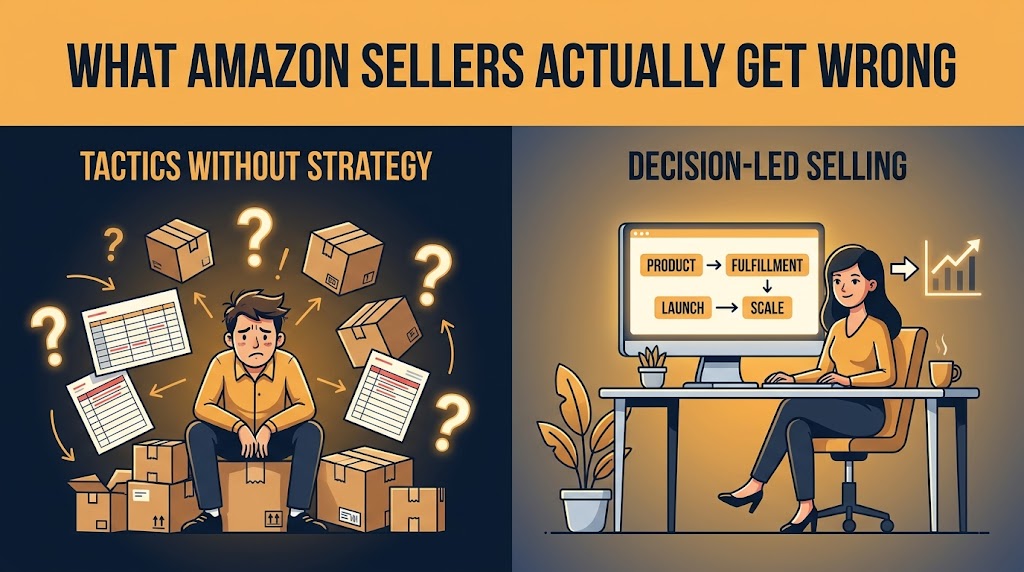

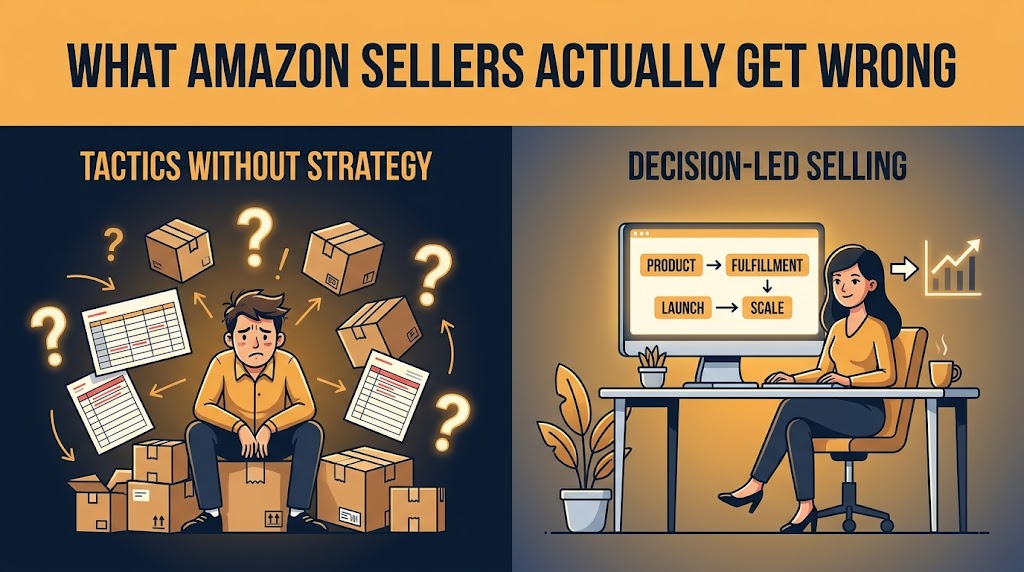
There is no shortage of Amazon selling advice. YouTube channels, paid courses, Reddit threads, Facebook groups, agency blogs — the tactics are everywhere. Keyword research. PPC bid strategies. How to build an A+ Content module. How to write bullets that convert. How to use Helium 10. How to avoid suppressed listings.
Most intermediate sellers know all of this. And yet, most intermediate sellers are also stuck.
They launch products that don’t rank. They watch their margins erode quarter over quarter. They add SKUs hoping volume will fix a profitability problem. They obsess over ad spend while their listing images are silently killing their conversion rate. They treat their account health dashboard like a fire alarm — only checking it when something’s already on fire.
The problem isn’t a lack of tactics. The problem is a layer underneath the tactics that almost no course covers: the decision layer. How you decide which products to prioritize. When to invest in external traffic versus internal PPC. Whether FBA is actually right for this SKU or just the default you’ve never questioned. How your own cognitive biases are steering your sourcing choices toward comfortable familiarity rather than actual opportunity.
This post is about that layer. It’s for sellers who already know the moves but want to understand why they keep making the wrong ones — and what a more deliberate, data-informed approach actually looks like in 2026’s competitive landscape.
The Decision Fatigue Trap: Why Bigger Catalogs Silently Kill Sellers
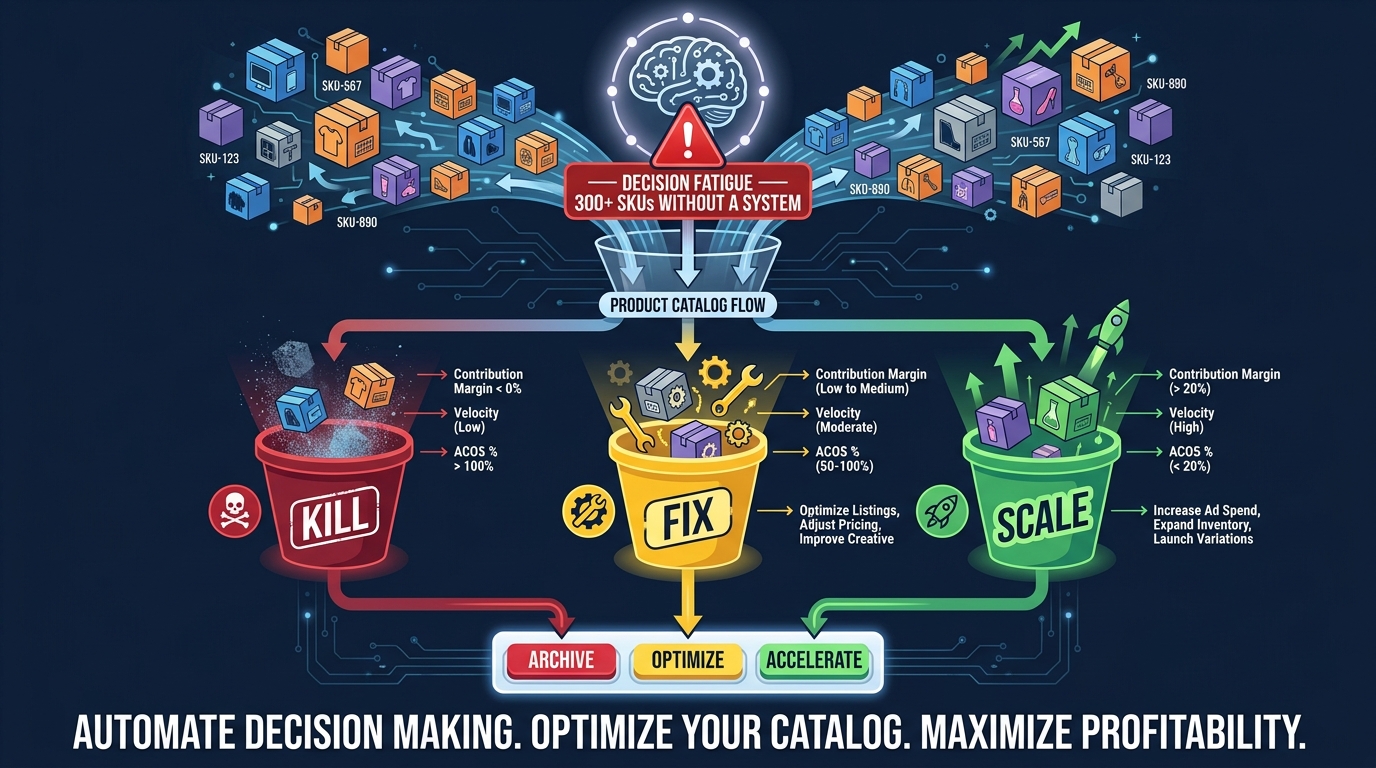
Ask most Amazon sellers what their biggest operational challenge is and they’ll say something about advertising costs or competition from Chinese manufacturers. Ask the ones who’ve been at it for three or more years and a different answer keeps coming up: catalog complexity.
When you start, decisions are easy. You have one or two products. You know your numbers cold. You optimize every detail because there’s nothing else competing for your attention. Then you scale. You hit 20 SKUs, then 50, then 150. And the decision volume — which products need new images, which ads need restructuring, which variants to keep or kill, which suppliers to reorder from — starts to compound faster than your revenue does.
What Decision Fatigue Actually Does to Your Business
Decision fatigue isn’t just a productivity concept. In an Amazon context, it has direct financial consequences. When sellers are overwhelmed by catalog complexity, they default to inertia: they keep running the same ad campaigns, keep ordering from the same suppliers, keep tolerating the same underperforming SKUs that drain storage fees and capital without producing meaningful returns.
Research into how scaling sellers manage large catalogs in 2026 points to a clear pattern: sellers who treat their catalog as a portfolio rather than an inventory outperform those who don’t. The framing matters. A portfolio has a purpose — every position either earns its place or gets replaced. An inventory just accumulates.
The Kill / Fix / Scale Framework
The most practical antidote to catalog decision fatigue is a regular triage process that forces every SKU into one of three buckets:
- Kill: Products with low contribution margin, poor velocity, and no path to improvement. These are the zombie SKUs — still breathing, still tying up capital and storage fees, but adding no meaningful value to the business.
- Fix: Products with potential that are underperforming due to a specific, addressable problem — weak images, poor keyword coverage, a pricing mismatch, a variant structure that fragments reviews. These deserve focused attention, not neglect.
- Scale: Your actual winners. These get disproportionate budget, advertising investment, and operational priority. Most sellers spread resources evenly across their catalog; the best ones pile onto their winners mercilessly.
For catalogs over 300 SKUs, experts recommend monthly batch reviews of 25-30 products at a time — cycling through the full catalog over a quarter rather than trying to evaluate everything at once. The goal isn’t perfection on every SKU; it’s ensuring that your best products are never starved of resources because your worst ones are quietly consuming them.
The “Zombie SKU” Cost Most Sellers Underestimate
FBA long-term storage fees alone can quietly drain thousands of dollars per year from sellers who’ve never audited their inactive inventory. But the cost goes beyond fees. Zombie SKUs consume attention, ad budget (if they’re running any campaigns), reorder decision bandwidth, and listing maintenance time. Each one is a small tax on your ability to focus on what actually moves the needle.
A practical rule: any SKU that hasn’t sold more than one unit per week for six consecutive months deserves a formal decision — Fix it, Kill it, or create a liquidation plan. Not a vague intention to “look at it later.” A decision, documented, with a timeline.
Your Listing Isn’t Broken — Your Images Are

If you’re running ads and getting clicks but not converting, the most common culprit isn’t your price, your title, or your bullet points. It’s your images. Industry data consistently shows that approximately 90% of buyers make their purchase decision based primarily on product images — before they read a single word of copy.
And yet, the image failures that cost sellers the most money aren’t obvious bad photography. They’re subtler than that.
The First Image Is a Click, Not a Description
Your main image has one job: earn the click from the search results page. Not describe the product. Not show every feature. Earn the click. That means it needs to stand out from the surrounding thumbnails in the search results — through clarity, scale presentation, color contrast, or an angle that makes the product look genuinely desirable.
Sellers consistently make the mistake of treating the main image as a product spec sheet: white background, centered product, technically correct but visually forgettable. If your main image looks identical to your four nearest competitors, you’re forcing the shopper to choose by price — and that’s a race you rarely want to win.
Images 2-7 Are Where Conversions Actually Happen
Once a shopper clicks through, their decision-making shifts from “should I look at this?” to “should I buy this?” That’s where images 2 through 7 do the work. Each one should answer a specific psychological question that stands between the shopper and the purchase decision:
- Image 2: “What does this actually look like in real life?” — Lifestyle shot in context.
- Image 3: “Is this the right size/dimensions for me?” — Scale reference, measurement callouts.
- Image 4: “What exactly does this product include?” — Contents/packaging shot.
- Image 5: “Why is this better than the alternatives?” — Feature comparison or key differentiator callout.
- Image 6: “Have other people trusted this?” — Social proof, review snippets, number of users.
- Image 7: “What will my life look like after buying this?” — Aspirational use case.
Most sellers upload whatever they got from their supplier plus a couple of lifestyle shots. The result is a gallery that answers maybe two or three of these questions and leaves the rest to chance.
Amazon’s AI Is Now Judging Your Images Too
In 2026, Amazon’s A10 algorithm and AI systems like Rufus and COSMO evaluate listing quality signals that include image relevance and engagement metrics. High bounce rates from product pages — shoppers who click but leave without purchasing — are a negative signal that can suppress your organic visibility over time. If your images aren’t converting, you’re not just losing the immediate sale; you’re actively telling Amazon’s algorithm that your product doesn’t satisfy searcher intent.
The investment in professional photography, including lifestyle shots, infographic overlays, and comparison images, isn’t a luxury. In the current environment, it’s a ranking strategy as much as a conversion strategy.
The Honeymoon Period Is Real — And Most Sellers Miss It Anyway
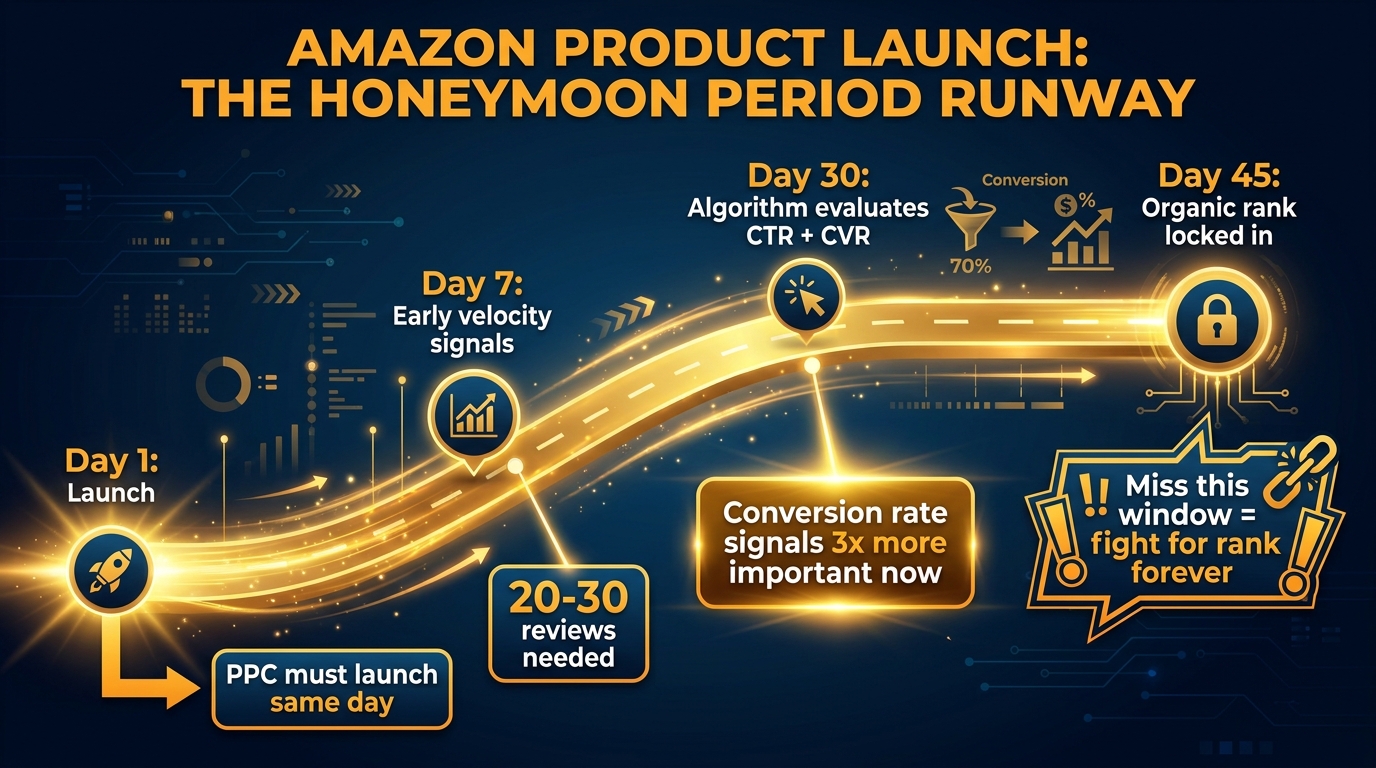
The concept of the Amazon “honeymoon period” isn’t new, but the way most sellers actually experience it is — which is to say, they don’t experience it at all. They launch a product, run some initial PPC, get a few sales, and then gradually optimize over the following months. By the time their listing is actually ready to compete, the window has closed.
What the Algorithm Does in the First 30-45 Days
Amazon’s A10/A9 algorithm provides a temporary visibility boost to new product listings during their first 30 to 45 days. This isn’t charity — it’s data collection. Amazon is trying to determine how well your product performs against intent signals: click-through rate from search results, add-to-cart rate, conversion rate, and early return behavior.
The algorithm uses this window to decide where to rank your product organically for its target keywords. High performance during the honeymoon period accelerates organic ranking and can lock in positions that would otherwise take months of sustained advertising to achieve. Poor performance during this window doesn’t just slow things down — it can create a ranking ceiling that’s genuinely difficult to break through later.
What “Ready to Launch” Actually Means
The single biggest mistake sellers make with new listings is launching before the listing is optimized. They treat launch as the starting line for optimization when it should be the finish line of pre-launch preparation.
A listing is ready to launch when it has:
- All 7-9 images fully optimized — not “good enough,” actually competitive with or better than the top three search results.
- Title, bullets, and backend terms fully indexed — using 20-30 high-relevance keywords verified through Helium 10 or Jungle Scout before going live.
- A+ Content live — even basic A+ content improves conversion rates, and having it active from day one feeds positive engagement signals during the critical window.
- An early review strategy in place — whether through Amazon Vine, the Request a Review feature, or an external launch community, you need a plan to get 20-30 reviews during the honeymoon period. Products with under 10 reviews have dramatically lower conversion rates on cold traffic.
- PPC campaigns structured and ready to activate — day one, not day three. Every day of the honeymoon period without sales data is a missed opportunity to signal purchase intent to the algorithm.
Budget Allocation During the Window
Most sellers underspend during the honeymoon period — trying to keep ACOS low in the early days — and overspend later trying to compensate for poor organic positioning. The logic should be inverted. Accept higher ACOS during the first 30 days in exchange for the sales velocity and conversion data that the algorithm needs to rank your product organically. A product that earns strong organic placement at day 45 will generate profitable sales for years. A product that launches cautiously and never ranks organically will require perpetual paid support forever.
Fulfillment Isn’t a One-Time Choice: Rethinking FBA, FBM, and SFP in 2026
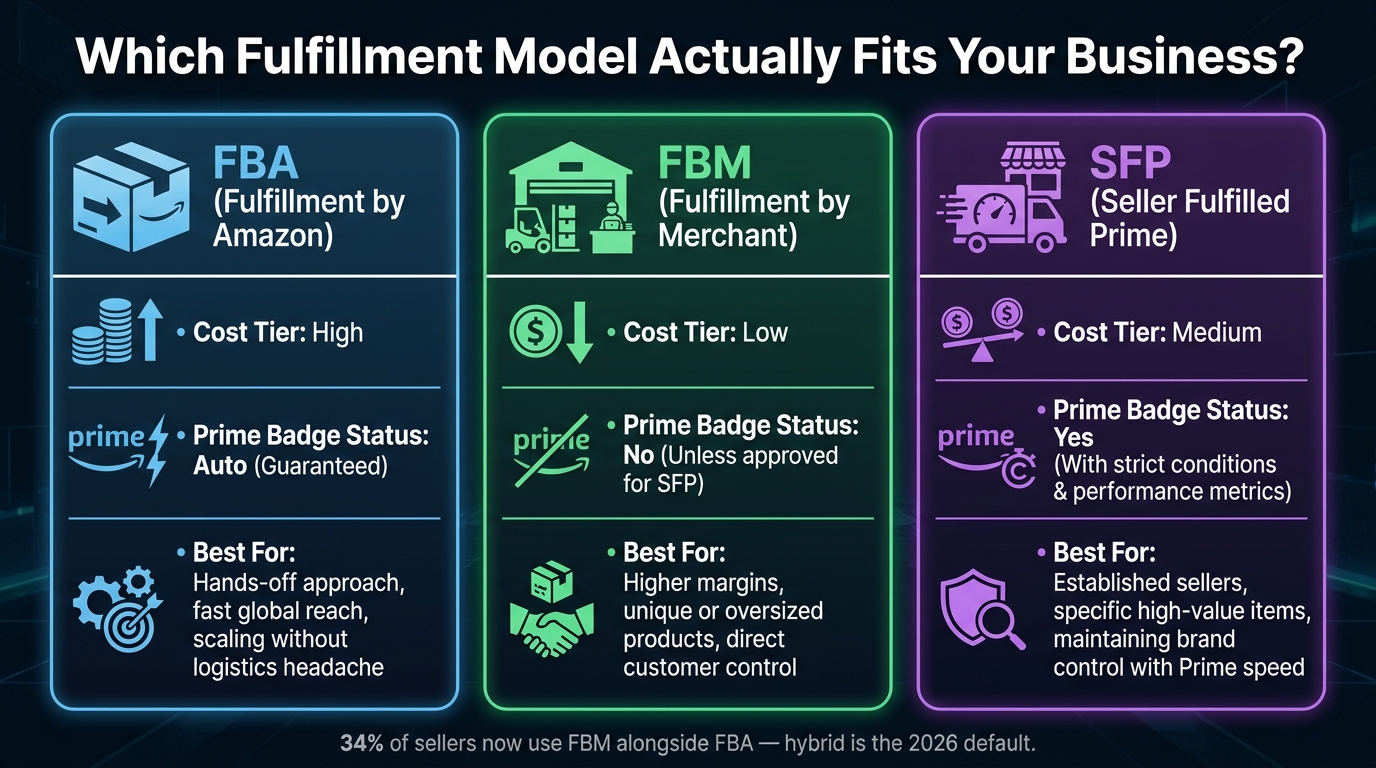
FBA is the default for most Amazon sellers, and for good reason — it delivers Prime eligibility automatically, removes the operational burden of pick-pack-ship, and generally produces better Buy Box performance. But the fee landscape in 2026 has changed significantly enough that treating FBA as the unquestioned answer for every product is a costly assumption.
What the 2026 Fee Environment Actually Looks Like
Amazon’s 2026 fee structure includes a 3.5% logistics surcharge on FBA units, inbound placement fees reaching up to $6.50 per unit for restricted-placement shipments, and tiered fulfillment fees that have risen substantially year over year. For higher-velocity, lightweight products with strong margins, these fees are manageable. For larger, heavier, or lower-velocity products, they can meaningfully compress margins — sometimes turning a viable product into a loss leader without the seller ever recalculating their unit economics.
FBM: Not a Fallback, a Strategic Choice
Fulfilled by Merchant has historically been viewed as what sellers do when they can’t access FBA — a backup plan, not a strategy. That framing is outdated. In 2026, approximately 34% of Amazon sellers use FBM for at least some of their SKUs, and a growing share are doing so intentionally for heavy, oversized, or slow-moving products where FBA storage fees make the economics unworkable.
FBM also gives sellers more control over packaging, branding inserts, and the unboxing experience — elements that matter for building customer relationships and reducing return rates. For sellers building a genuine brand rather than just an Amazon business, this control has real value.
The practical downsides are real: FBM listings typically don’t show the Prime badge (unless you qualify for SFP), which can suppress conversion rates on cold traffic. And managing fulfillment in-house or through a 3PL introduces operational complexity. But for the right products, those tradeoffs are worth the cost savings.
SFP: The Middle Ground That Requires Discipline
Seller Fulfilled Prime (SFP) allows sellers to display the Prime badge while fulfilling orders themselves — but Amazon’s eligibility requirements are strict: 97% on-time delivery, 95% tracking upload accuracy, and a cancellation rate below 0.5%. These aren’t aspirational targets; they’re gates. Miss them and you lose the Prime badge, which typically means a significant traffic drop.
SFP makes the most sense for sellers with established, reliable fulfillment operations — either an in-house warehouse with strong processes or a 3PL partner who has specifically confirmed SFP capability. It’s not the right move for sellers whose fulfillment operations are still developing.
The Hybrid Approach: Matching Method to SKU
The most operationally mature Amazon sellers in 2026 aren’t using one fulfillment method — they’re using two or three, matched deliberately to each product’s characteristics. Fast-moving, lightweight SKUs go FBA. Heavy, slow-moving, or high-margin items where you want packaging control go FBM or SFP. The decision framework is simple: run your unit economics for each product under each fulfillment scenario, including all fees, and let the math guide the decision — not convenience or habit.
The Voice of the Customer Dashboard: What Changed When Reviews Aren’t Enough
In September 2025, Amazon retired the Customer Reviews dashboard and replaced it with the Voice of the Customer (VoC) dashboard — a move that most sellers acknowledged but few have genuinely adapted to. The change isn’t cosmetic. It reflects a fundamental shift in how Amazon measures product-market fit and customer satisfaction at the ASIN level.
What the VoC Dashboard Actually Measures
The VoC dashboard surfaces three key metrics that matter for every product:
- CX Health: An aggregate score that reflects how customers experience your product — not just whether they leave a positive review, but whether the product met their expectations, arrived on time, and required no return or complaint.
- NCX Rate (Negative Customer Experience Rate): The percentage of orders associated with returns, negative feedback, A-to-Z claims, or contacts to customer service. A high NCX rate is an early warning system for listing-to-product misalignment — situations where your marketing sets expectations the product doesn’t meet.
- Root Cause Insights: Amazon now categorizes the reasons behind negative experiences and presents them to sellers. “Product description not accurate” and “Item damaged” are actionable signals that no star rating alone could provide.
How This Changes Seller Strategy
The shift from reviews to VoC metrics means that sellers who were laser-focused on review count and star rating as their primary trust indicators need to expand their view. A product can have 4.4 stars and 500 reviews while quietly accumulating a high NCX rate — a pattern that will eventually hurt both organic ranking and Buy Box eligibility.
The practical implication: check your VoC dashboard weekly, not monthly. High NCX rates on specific ASINs are often traceable to specific listing elements — inaccurate size claims, packaging that doesn’t protect the product, or feature descriptions that oversell what the product does. Catching and correcting these early prevents a slow burn that’s much harder to reverse at scale.
“82% of shoppers check reviews before purchasing, treating them as trusted as personal recommendations. But in 2026, the system measuring whether those reviews reflect reality has gotten significantly more sophisticated.”
Using VoC Data as a Product Development Signal
The most forward-thinking sellers are using VoC root cause data not just to fix listing problems but to inform product development. If 15% of your NCX complaints on a kitchen tool say “harder to use than expected,” that’s a product design signal. If 20% say “packaging arrived damaged,” that’s a logistics and materials signal. The VoC dashboard, used well, is essentially free market research on your existing customer base — which is far more valuable than the generic keyword data most sellers use for product decisions.
External Traffic Isn’t Optional Anymore: The Brand Referral Bonus Most Sellers Ignore

Amazon PPC costs have risen approximately 50% year over year in many categories. Keywords that cost $1.33 per click twelve months ago now cost $2 or more. For sellers whose entire customer acquisition strategy runs through Sponsored Products and Sponsored Brands, margin erosion from ad spend is increasingly the primary threat to profitability.
The answer isn’t to spend less on PPC — it’s to diversify where your traffic comes from. And Amazon has actually built a financial incentive to do exactly that.
The Brand Referral Bonus: Free Money Most Sellers Leave on the Table
The Brand Referral Bonus (BRB) is a program available to brand-registered sellers that credits back a percentage of the sale price on orders driven through Amazon Attribution-tracked external traffic. The standard credit ranges from approximately 5-10% of the sale value depending on category, with Device Accessories receiving up to 45% credits.
The mechanics: you create Amazon Attribution tracking links, attach them to your external campaigns (Google Ads, Meta, email sequences, influencer posts), and Amazon tracks which sales came from those sources. When those sales complete, the credit appears in your ad account to be used against future PPC spend.
In practice, a seller driving $10,000/month in sales through external traffic in a 10% BRB category earns $1,000 in Amazon ad credits — every month. That’s $12,000 per year in ad budget that costs nothing beyond the external traffic spend itself. For sellers already running Google Shopping or Meta campaigns, this credit is essentially free money for the same activity they’d be doing anyway.
The Algorithm Bonus Nobody Talks About
Beyond the financial credit, external traffic carries an algorithmic reward that may actually be worth more in the long run. Amazon’s A10 algorithm gives external conversion signals up to 3x the ranking weight of internal Amazon conversions. A shopper who discovers your brand on Instagram, clicks an Attribution link, and purchases on Amazon sends a significantly stronger organic ranking signal than one who found you through a Sponsored Products ad.
Currently, approximately 39.9% of Amazon’s traffic already arrives from external sources. Sellers who contribute meaningfully to that flow — and track it through Attribution — are building a compounding organic ranking advantage that pure PPC-only strategies cannot replicate.
Which External Channels Actually Work
Not all external traffic performs equally on Amazon. The channels with the strongest historical conversion data for Amazon attribution are:
- Google Shopping campaigns: High purchase intent, strong conversion rates, and easy Attribution link integration.
- Email marketing to an existing list: The highest-intent audience you can own. Even a modest email list of 5,000 engaged customers can drive meaningful BRB credits each month.
- Meta retargeting: Particularly effective for products with strong visual appeal. Retargeting previous product page visitors with Attribution links captures a warm audience that’s already familiar with the product.
- Creator partnerships with Attribution links: Influencer content that includes tracked Amazon links combines audience trust with algorithmic ranking signals.
The key discipline: always use Amazon Attribution links for any external traffic, even if you’re not actively thinking about BRB credits. Building the data history now creates a strategic asset that compounds over time.
Account Health as Offense, Not Defense
Most Amazon sellers treat their Account Health dashboard the way most people treat their car’s oil light: they ignore it until it demands immediate attention, then panic. This is precisely backwards for a business where a single deactivation can cost weeks of revenue and potentially cause irreversible damage to organic rankings.
The 2026 AHR Thresholds You Cannot Ignore
Amazon’s Account Health Rating (AHR) system operates on a 0-1000 scale with clear consequences at different thresholds:
- 250+ (AHA Protected): If your score is above 250 and an issue arises, you have a 72-hour window to resolve it before Amazon takes action — the Account Health Assurance protection.
- 200-249 (Healthy but Unprotected): Issues can still escalate to deactivation without the safety buffer.
- 100-199 (At Risk): Yellow zone. Automated escalation is faster, and unresolved notifications can trigger immediate suspension review.
- Below 100 (Red): Eligible for deactivation. At this point you’re in reactive mode with limited leverage.
The strategic implication: your goal isn’t to stay above 100. Your goal is to maintain 250+ consistently, which is the only threshold that provides a meaningful buffer when something unexpected happens.
The Metrics That Move Your Score Most
Three operational metrics have the highest impact on AHR and therefore deserve proactive monitoring, not reactive attention:
- Order Defect Rate (ODR): Must remain below 1%. This includes A-to-Z claims, negative feedback, and credit card chargebacks. High ODR typically indicates a product quality or fulfillment problem — fix the root cause, not just the metric.
- Late Shipment Rate: Must remain below 4% for FBM sellers. FBA sellers are largely insulated from this, but FBM and SFP sellers need reliable fulfillment processes and carrier relationships.
- Policy Compliance Violations: Amazon’s expanded Section 3 reviews in 2026 have increased scrutiny of deceptive activities, counterfeit claims, and IP violations. Even a single confirmed violation can result in deactivation that’s genuinely difficult to appeal.
Building an Account Health Calendar
Proactive sellers in 2026 treat account health like financial hygiene — there’s a routine maintenance schedule, not just crisis response. A practical weekly cadence includes:
- Check AHR score and any open performance notifications.
- Review the VoC dashboard for spikes in NCX rate on any ASIN.
- Check the Policy Compliance tab for any new flags.
- Review FBM shipment tracking compliance rate if applicable.
This takes 15-20 minutes. The sellers who do this consistently almost never face emergency suspensions, because problems that would escalate into suspensions get caught and resolved at the notification stage.
The Cognitive Biases Quietly Sabotaging Your Sourcing Decisions
Here’s an uncomfortable truth about Amazon product research: most sellers think they’re being data-driven, but they’re actually using data to confirm decisions they’ve already made emotionally. This distinction matters enormously because it determines whether your product selection process generates genuine alpha or just busy work with expensive consequences.
Confirmation Bias in Product Research
The typical product research process goes something like this: a seller sees a product doing well on social media or in a competitor’s store, gets excited about the opportunity, and then opens Helium 10 or Jungle Scout to “validate” it. The problem is that when you already want something to work, you unconsciously weight the data points that confirm the opportunity (monthly search volume, estimated revenue) and discount the ones that challenge it (number of competitors with 500+ reviews, category seasonality, supplier MOQs that create cash flow risk).
The fix isn’t to stop using intuition — pattern recognition from experience is genuinely valuable. The fix is to separate the ideation phase from the validation phase by at least 24 hours and to have a validation checklist that requires explicitly noting the strongest counter-arguments against a product before making the sourcing decision.
Availability Heuristic: Chasing the Last Success
The availability heuristic is the cognitive shortcut where we weight information that’s easily recalled more heavily than statistically representative data. In Amazon selling, this manifests as chasing the trend that just worked for someone else — garlic presses in 2016, silicone baby bibs in 2018, resistance bands in 2020. Each of these was genuinely profitable for early movers. Each was a crowded disaster for the sellers who followed the success stories.
By the time a product category is generating widely-shared success stories in Amazon seller communities, the opportunity has usually already peaked. The best opportunities in 2026 look slightly boring on first inspection — they’re in categories with steady, unglamorous demand and a limited number of competitors who’ve been coasting on old listings and haven’t invested in product or listing quality for years.
Analysis Paralysis: The Other Side of the Coin
Cognitive bias doesn’t only drive overconfidence. It also drives its opposite: the seller who does 40 hours of research on a product, convinces themselves of every possible risk, and never places an order. Some of the most consistently profitable Amazon sellers run on a “good enough to test” standard — if the unit economics work at conservative assumptions and there’s a defensible product differentiation angle, they order a test batch and let market data tell them what the model can’t. Perfect information never arrives. The market rewards execution.
The Sunk Cost Fallacy in Scaling Decisions
Perhaps the most expensive bias in Amazon selling is the sunk cost fallacy applied to struggling products. Sellers who’ve invested in sourcing, photography, A+ Content, and initial PPC for a product that isn’t working often continue investing in it — restructuring ads, tweaking the listing, trying different pricing — because they can’t emotionally accept writing off the initial investment. The rational question is never “how much have I already spent?” It’s always “given what I know now, does the expected future return justify future investment?” Often, the honest answer is no.
Building a Product Catalog That Compounds, Not Just Grows
There’s a meaningful difference between a product catalog that grows and one that compounds. A growing catalog adds SKUs. A compounding catalog adds SKUs that strengthen each other — through shared customer bases, cross-sell opportunities, brand authority in a category, and review velocity that benefits the brand as a whole rather than just individual listings.
Vertical Depth vs. Horizontal Sprawl
The most durable Amazon businesses in 2026 are built around vertical depth in a category rather than horizontal sprawl across multiple unrelated niches. A seller with 15 products in the pet care space has a compounding business: their reviews build a cohesive brand reputation, their PPC campaigns can target brand-loyal repeat buyers, their Brand Store creates a shopping experience that encourages multi-product purchases, and their external traffic investment (social, email, influencer) serves the whole portfolio rather than individual SKUs.
A seller with 15 products in 12 unrelated categories has a collection of disconnected bets. Each product fights for organic ranking independently, each advertising campaign competes for different audiences, and no single external traffic investment serves the whole business. The unit economics of running 15 independent mini-businesses are far worse than the unit economics of running one focused brand with 15 products.
The Parent-Child ASIN Strategy for Review Compounding
One of the most underused structural advantages available to Amazon sellers is the parent-child ASIN relationship. When multiple product variations (size, color, material) exist as children under a single parent ASIN, reviews from all variations aggregate under the parent listing. A new color variant launches with the full review credibility of the existing variants, rather than starting at zero.
Sellers who add new variations strategically — choosing colors, sizes, or configurations that expand their addressable customer base without requiring a completely separate launch — build review authority significantly faster than those who launch every variation as a standalone listing. The review moat compounds continuously.
Owned Audience: The Asset Amazon Can’t Take From You
The existential vulnerability of every Amazon seller is that your customer relationship is mediated by Amazon. You don’t own the customer data. You can’t email your buyers. You can’t build a retargeting audience from your product page traffic. If Amazon changes its algorithm, raises fees, or suspends your account, your revenue can disappear overnight.
The sellers building the most resilient businesses in 2026 are using Amazon as a customer acquisition channel — not as the entirety of their business infrastructure. An email list built through post-purchase sequences (within Amazon’s guidelines), a social media community, or a brand website that captures traffic from paid external campaigns gives sellers a customer relationship that exists independently of Amazon’s platform.
This owned audience becomes increasingly valuable over time: it can be used to launch new products with an engaged initial customer base, to generate Vine-eligible reviews, to test product ideas before committing to full sourcing, and ultimately to support a business valuation that isn’t entirely dependent on a single platform.
The Listing Optimization Loop: Why “Set It” Never Means “Forget It”
One of the most persistent mental models that hurts Amazon sellers is the idea that listing optimization is a launch activity. You spend six weeks building the perfect listing, you launch, and then your attention moves to the next product while the first one runs on autopilot. In a stable algorithmic environment with stable competition, this might work. Neither of those conditions applies in 2026.
Amazon’s Algorithm Is Not Static
Amazon’s search algorithm has evolved significantly in the past two years. The integration of AI systems — specifically Rufus (Amazon’s conversational shopping AI) and COSMO (its semantic understanding model) — means that keyword optimization has shifted from simple keyword density to contextual relevance and intent matching. A listing that was well-optimized for the old keyword-heavy approach may perform poorly against the current algorithm’s preference for natural language that accurately addresses what shoppers are actually asking for.
Rufus, in particular, has changed how some shoppers interact with Amazon search — using natural questions (“What’s a good gift for someone who hikes a lot?”) rather than keyword queries (“hiking gift”). Listings that answer those questions naturally — in bullets, A+ modules, or Q&A sections — are now capturing traffic that keyword-optimized-but-context-poor listings miss entirely.
The Competitor Drift Problem
Even if your listing was best-in-class at launch, your competitors don’t stand still. New entrants with better photography, more recent social proof, lower prices enabled by more efficient supply chains, or simply more current listing copy will gradually outperform a listing that hasn’t been updated since its launch 18 months ago.
A quarterly listing audit — not a complete rewrite, but a structured evaluation of main image click-through rate (available in Brand Analytics), conversion rate trends, A+ Content performance, and keyword ranking data — catches this drift before it becomes a meaningful revenue problem. The question to ask in each audit: “If I were a new shopper seeing this listing and the top three competitors for the first time, which one would I click? Which one would I buy?”
Pricing Is Part of the Listing, Not Separate From It
Pricing changes affect conversion rate, Buy Box eligibility, PPC ROAS, and organic ranking — all simultaneously. Sellers who set their price at launch and adjust it only reactively (usually when they notice declining sales) are missing the opportunity to use pricing strategically as a demand signal tool.
Small, regular price tests — raising by 3-5% for two weeks to evaluate conversion rate impact, lowering during high-traffic periods to capture velocity for ranking — generate the kind of empirical data that makes pricing decisions defensible rather than instinctive. Most sellers have strong opinions about the “right” price for their product. The right price is the one the market tells you through conversion data.
The Seller Who Wins in 2026: A Different Kind of Discipline
There’s a pattern that emerges when you look at which Amazon sellers are actually growing profitably in 2026 versus which ones are running harder just to stay still. It’s not about finding better products, running better PPC, or having lower sourcing costs — though all of those matter. It’s about a fundamentally different relationship with decision-making.
The sellers who are winning have built systems that remove judgment from routine decisions and reserve deliberate thinking for strategic ones. They don’t decide every week whether to reorder Product X — they have a reorder formula based on sell-through rate and lead time. They don’t decide ad-hoc whether an ASIN is worth continuing — they have a review cadence that forces that decision on a schedule. They don’t guess at pricing — they test it.
This systematization isn’t about removing creativity or entrepreneurial judgment from the business. It’s about ensuring those faculties are pointed at the decisions that actually require them: product development, brand positioning, market expansion, and competitive strategy. The administrative and operational layer should run on systems, not on the owner’s daily bandwidth.
The Three Questions That Drive Better Amazon Decisions
Whatever decision you’re facing as an Amazon seller — whether to launch a new product, kill an underperforming one, invest in external traffic, or restructure your fulfillment approach — three questions cut through most of the noise:
- “What does the data actually say?” Not what you expect it to say, not what you hope it says, but what it demonstrably shows. If you don’t have sufficient data, acknowledge that and calibrate your confidence in the decision accordingly.
- “What’s the cost of being wrong?” Amazon decisions vary enormously in their reversibility. A pricing test costs almost nothing to undo. A poor fulfillment model decision can cost months of suboptimal margins to unwind. Calibrate your decision rigor to the cost of being wrong.
- “Am I solving the actual problem?” Most Amazon “problems” have proximate causes (declining sales, high ACOS, bad reviews) and root causes (listing-product mismatch, wrong keyword targeting, product quality issue). Solving proximate causes feels productive and generates activity; solving root causes actually changes the trajectory of the business.
Actionable Takeaways
- Audit your catalog using the Kill / Fix / Scale framework once per quarter. Identify your zombie SKUs and make a documented decision about each one.
- Evaluate your main product images against your top three competitors. If your main image doesn’t earn the click, fix it before you spend another dollar on ads.
- Before your next product launch, confirm the listing is fully ready to convert — images, copy, A+, review strategy, and PPC structure — all live on day one.
- Run your unit economics for your current fulfillment method versus alternatives. If you’ve never done this exercise, the results will often surprise you.
- Set up Amazon Attribution for any external traffic you’re already running. Start collecting the data and earning BRB credits immediately.
- Spend 15 minutes per week on the Account Health and VoC dashboards. Prevention is always cheaper than reinstatement.
- Check your own product research process for confirmation bias. Build a validation checklist that requires you to explicitly document the strongest arguments against a product before you commit.
The Amazon marketplace in 2026 rewards sellers who operate with genuine operational maturity — not just knowledge of tactics, but the discipline to apply those tactics systematically and the self-awareness to recognize when their own decision-making patterns are the primary obstacle to growth. That’s harder than learning another ad strategy. It’s also more durable than any single tactic will ever be.