





Most sellers arrive on Amazon with the same mental model: find a product, list it, run some ads, and watch the money come in. And for a while — sometimes a long while — that model works well enough to feel like a strategy.
But there is a fundamental difference between selling on Amazon and building with Amazon. The first treats the platform as a transaction engine. The second treats it as an infrastructure layer within a larger business architecture — one that can support brand equity, multi-channel revenue, long-term exits, and genuine customer relationships.
That distinction matters more in 2026 than it ever has. With third-party GMV projected to exceed $480 billion and over 2 million active sellers competing for visibility, the sellers who are winning are not simply the ones with the best products or the lowest prices. They are the ones who have built systems — for catalog structure, for algorithmic ranking, for account protection, for brand protection, and for expansion beyond the Amazon ecosystem itself.
This guide is about architecture. Not just the tactical details — though those are here in full — but the underlying logic of how successful sellers design their Amazon business from the ground up. Whether you are launching your first product or restructuring an eight-figure catalog, the principles in this article will give you a framework that holds up against platform changes, policy shifts, and increasing competition.
We will cover the model decision that most sellers make too casually, the catalog structures that separate average sellers from elite ones, the ranking signals the A10 algorithm actually weights, the launch framework that still produces results, and the brand and account infrastructure that prevents one bad day on Amazon from becoming a catastrophic one.
Let’s build something durable.
The Model Decision Most Sellers Make Too Casually
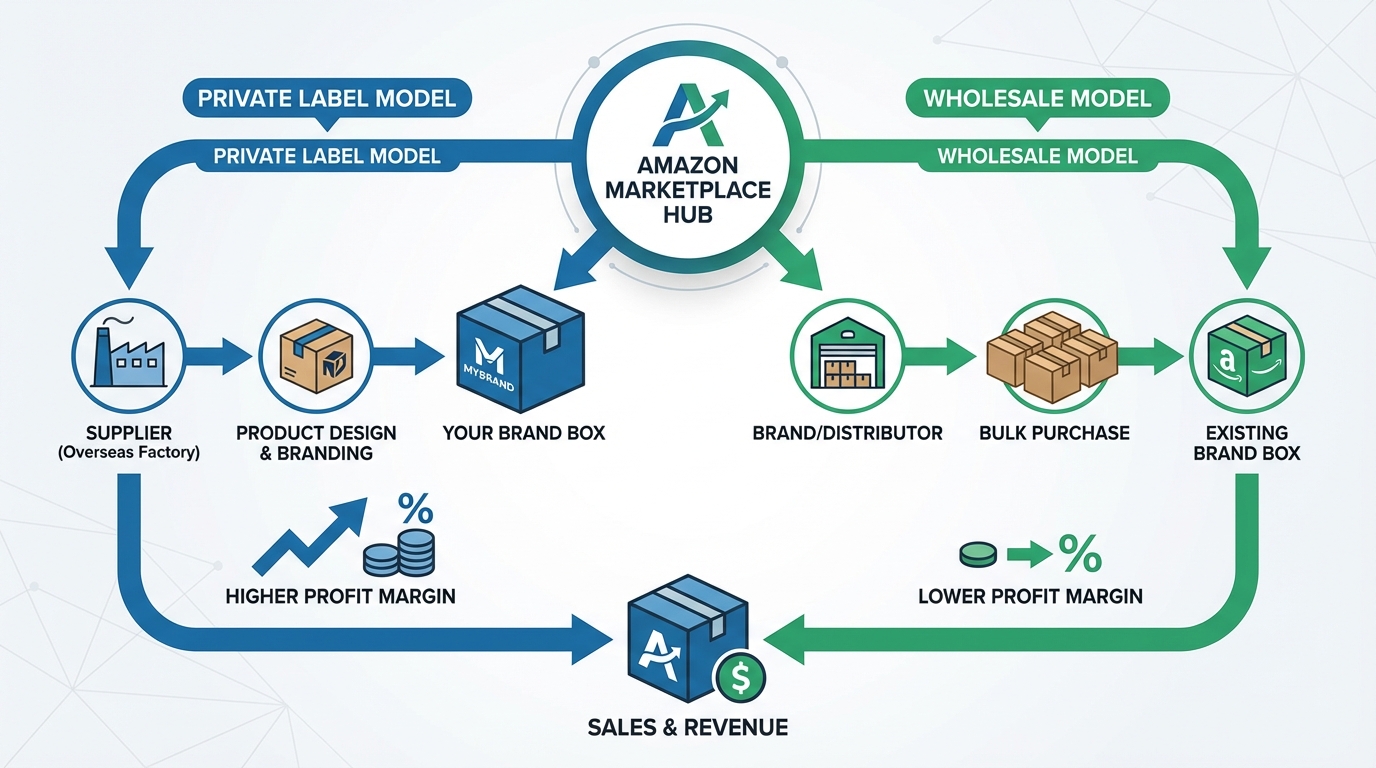
Before you build any other part of your Amazon business, you need to be honest about which model you are actually running — and whether it matches the business you want to have in three to five years. The choice between private label, wholesale, and hybrid approaches is not just a startup question. It shapes everything: your margins, your leverage, your scalability ceiling, and your exit options.
Private Label: The Brand-Building Path
Private label remains the dominant model among serious Amazon sellers in 2026, with approximately 54% of third-party sellers operating some form of it. The appeal is well understood: margins between 25% and 50%, full control over listing content, and the ability to build genuine brand equity that can eventually be sold through an Amazon FBA acquisition firm.
What is less discussed is what private label actually requires to work. It is not enough to slap a logo on a generic product from Alibaba. The private label landscape on Amazon in 2026 is filled with sellers who did exactly that and are now competing on price against dozens of near-identical products. The sellers who make private label work have invested in differentiated product development, professional brand identity, supply chain relationships that give them production advantages, and the operational patience to build sales history over months — not weeks.
The EBITDA margins for well-run private label operations typically land in the 18% to 35% range after accounting for Amazon fees, advertising, fulfillment, and overhead. These margins support meaningful valuation multiples at exit — typically 3x to 5x SDE for brands with clean financials and strong review profiles. That is the real reason the model dominates: it is not just an income stream, it is a buildable asset.
Wholesale: The Faster, Lower-Risk Entry
Wholesale — buying established branded products at volume and reselling them on Amazon — accounts for roughly 26% of third-party sellers. Margins are significantly lower (typically 10% to 20%), and you do not own the listing, the brand, or the customer relationship. But wholesale has real advantages that private label advocates often understate.
Launch timelines are dramatically compressed. While a private label product might require three to six months from concept to live listing, a wholesale account can be operational in two to four weeks. You are selling products with existing demand signals, existing reviews, and existing search volume — there is no education-of-market problem to solve. For sellers who want to learn Amazon’s operational mechanics without betting their capital on an unproven product concept, wholesale is a legitimate and rational starting point.
The ceiling is real, though. Wholesale operations that try to scale past $3 million to $5 million in annual revenue typically run into margin compression and supplier dependency issues that are structurally difficult to solve without transitioning toward brand ownership.
The Hybrid Model: Strategic Sequencing
An increasing number of sophisticated operators in 2026 are running deliberate hybrid models — using wholesale revenue to fund private label development, or using private label products as anchors while maintaining wholesale lines in adjacent categories for cash flow stability. This approach acknowledges that the two models serve different business functions and can coexist within a single seller account with proper catalog organization.
The key in a hybrid setup is never letting the operational demands of one model cannibalize the strategic development of the other. Wholesale requires supplier relationship maintenance and margin monitoring. Private label requires creative and brand investment. Trying to half-do both usually results in fully succeeding at neither.
The practical question every seller should answer: Is the work I am putting in today building an asset I can eventually sell, or am I building a job that only works as long as I keep running it? The model you choose determines the answer.
Catalog Architecture: The Foundation Serious Sellers Build First
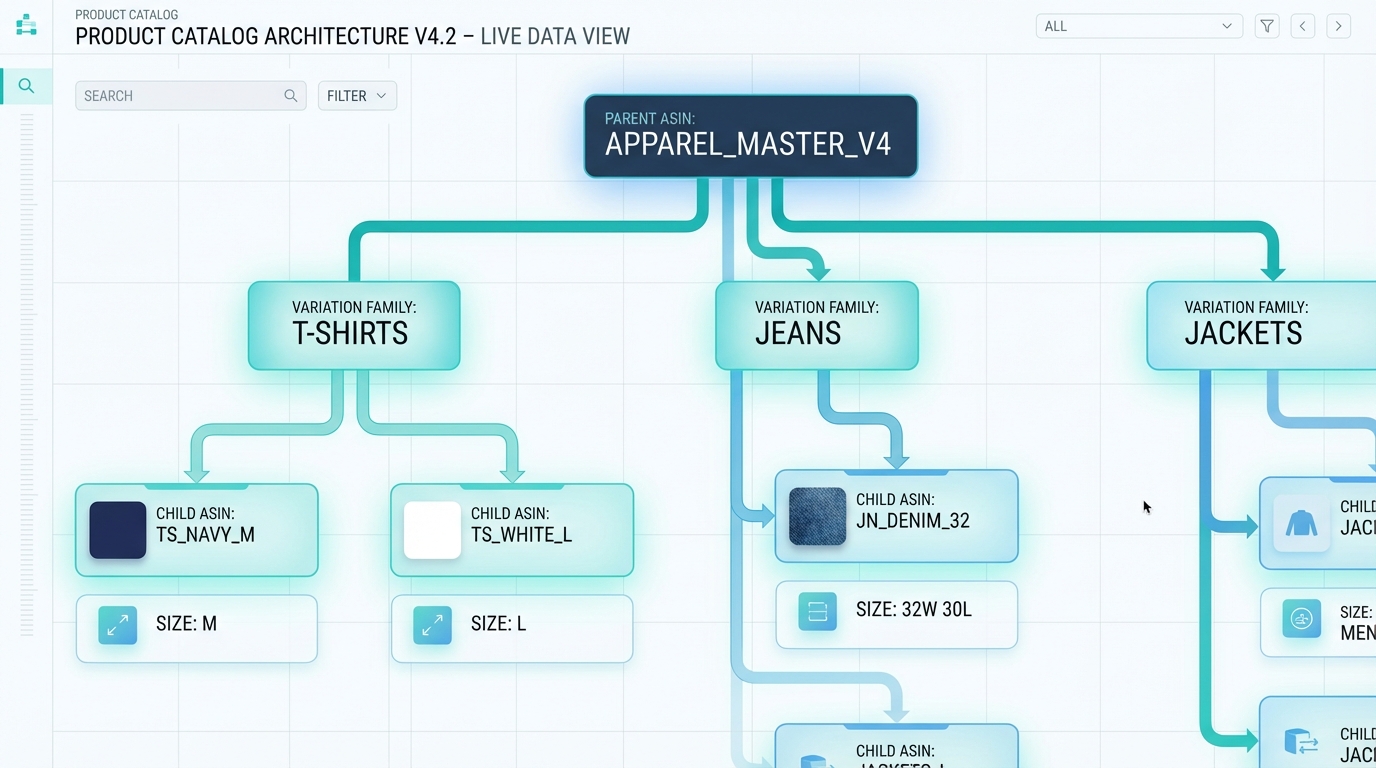
Most sellers think about listings as individual units of content. Elite sellers think about their entire catalog as an architecture — a structured system where every listing decision affects the performance of every other listing, and where the relationships between ASINs are as strategically important as the content within them.
Getting your catalog architecture right is one of the highest-leverage activities you can do on Amazon, and it is one that most sellers do wrong — not through ignorance, but because they built listings reactively (one at a time, as products launched) rather than proactively (as part of a coherent design).
The Parent-Child Variation System
Amazon’s parent-child ASIN structure allows sellers to group product variations — different sizes, colors, quantities, or materials — under a single parent listing. Done correctly, this pools sales velocity signals and review counts across the entire variation family, concentrating the algorithmic strength that would otherwise be diluted across separate standalone listings.
A parent ASIN does not appear in search results and holds no inventory itself. Its value is entirely structural: it acts as a container that aggregates the performance signals of its children. A well-structured variation family with 12 child ASINs that collectively generate 300 orders per month sends a much stronger ranking signal than 12 separate listings each generating 25 orders per month — even though the underlying sales volume is identical.
The practical implication: if you have products with logical variation relationships and they are currently listed as separate standalone ASINs, consolidating them under a parent is one of the fastest structural improvements you can make to your catalog without changing a single thing about your product or pricing.
The February 2026 Review Sharing Update
A significant change to Amazon’s variation policy took effect on February 12, 2026: review sharing within variation families is now restricted to minor variations only. Specifically, review pooling is permitted for variations in color or pattern, size (where the core function of the product remains the same), and pack quantity.
Functionally distinct products that were previously grouped under the same parent to share reviews will now have their reviews separated. For sellers who had consolidated unrelated or functionally different products into a single variation family specifically to pool reviews — a practice that was always against Amazon’s terms of service — this enforcement change has real consequences for listing performance.
The correct response is an immediate catalog audit. Review your variation families in Manage All Inventory and verify that every child ASIN within a parent is a genuine variation of the same core product. Separate any ASINs that are grouped for convenience rather than for genuine variation logic. Yes, this may temporarily reduce the review count displayed on some listings. But the alternative — a suppressed listing or a policy strike — is a far more expensive outcome.
Listing Content Architecture: Beyond Keywords
Within individual listings, the structure of your content matters as much as its content. Amazon’s algorithm reads listing elements in a hierarchy: title, then bullet points, then description, then backend search terms. Customers also read in a hierarchy, though their hierarchy is different: main image, title, price, ratings, then bullets.
Your title needs to satisfy both hierarchies simultaneously — placing primary keywords near the front (for the algorithm) while remaining readable and compelling (for the customer). Bullet points are your conversion architecture, not your keyword stuffing field. Each bullet should address a specific customer concern or desire, use natural language, and close with a benefit rather than just a feature description.
A+ Content, available to Brand Registry members, consistently lifts conversion rates — Amazon’s internal data has suggested improvements in the range of 3% to 10% for well-designed modules. The brands that use A+ most effectively are not the ones with the prettiest graphics; they are the ones that use the format to answer the specific objections that shoppers in their category most commonly have.
The A10 Algorithm in 2026: What Actually Moves the Needle

Amazon’s ranking algorithm — widely referred to as A10 in the seller community — has evolved significantly from its earlier iterations, and many sellers are still operating on outdated mental models of how it works. The most common misconception is that PPC spend alone drives organic ranking. It doesn’t — not directly, and not reliably.
Understanding what the algorithm actually weights helps you allocate your time and budget in ways that produce compounding organic rank improvements rather than perpetual ad dependency.
Organic Sales Velocity: The Primary Signal
The most heavily weighted ranking factor in the A10 algorithm is organic sales velocity — not total sales, but specifically sales generated from organic search results. When a customer searches for a product and purchases yours from the search results page without clicking a sponsored ad first, that transaction carries more algorithmic weight than the same sale generated through a paid placement.
This is a critical distinction. It means that PPC-driven sales are not algorithmically neutral — they contribute something — but they contribute less per sale than organic ones. Sellers who run aggressive PPC campaigns and see strong overall sales velocity often expect strong organic ranking improvements that never fully materialize, because a large proportion of their volume is ad-attributed rather than organically attributed.
The practical implication: strategies that drive genuine organic discovery — external traffic (Pinterest, blog content, email lists), social proof that generates search-brand queries, and keyword optimization that earns organic clicks — build ranking more efficiently than equivalent ad spend.
Conversion Rate and Click-Through Rate
The algorithm interprets conversion rate and click-through rate as signals of relevance and product-market fit. A product that gets clicked on frequently and then purchased frequently is, from Amazon’s perspective, doing exactly what the algorithm wants it to do: matching buyer intent and delivering on its promise.
Conversion rate in Amazon context means the percentage of product detail page views that result in a sale — not sessions to purchase, though that metric appears in your seller analytics. Average conversion rates vary significantly by category, but most established listings with competitive pricing and quality images sit in the 10% to 20% range. Premium products, highly specific categories, and items with exceptionally strong social proof can exceed 25%.
Improving conversion rate is one of the highest-leverage activities in the A10 era. A 3% improvement in conversion rate on a listing with 1,000 sessions per week is the equivalent of 30 additional weekly sales — with no increase in ad spend, no change in pricing, and no additional traffic needed.
Seller Authority: The Long-Game Signal
Seller authority is an aggregate score that Amazon calculates based on your account’s history: how long you have been selling, your feedback rating, your Order Defect Rate, how consistently you have maintained stock, your return rates, and the breadth of your catalog. Newer sellers start with low seller authority regardless of how good their individual listings are.
This is both a frustration and an opportunity. It is frustrating because it means new launches inherently face a headwind that established sellers do not. It is an opportunity because it means that every day you operate a clean, well-managed account, you are building an invisible asset that makes every future product launch easier and cheaper to rank.
External Traffic: The Underused Multiplier
Directing external traffic to Amazon listings — from social media, email campaigns, content marketing, or influencer partnerships — creates a ranking signal that many sellers do not fully use. Amazon recognizes off-platform traffic as evidence that a brand has real-world demand beyond the marketplace, and the algorithm reflects this.
Amazon’s Attribution program allows sellers to track which external sources are actually converting, which makes this strategy measurable rather than speculative. Sellers who build even modest email lists — a few thousand engaged subscribers — and drive them to Amazon during launch windows or promotion periods routinely see organic ranking lifts that outlast the promotional activity itself.
The 90-Day Product Launch Framework That Still Works in 2026
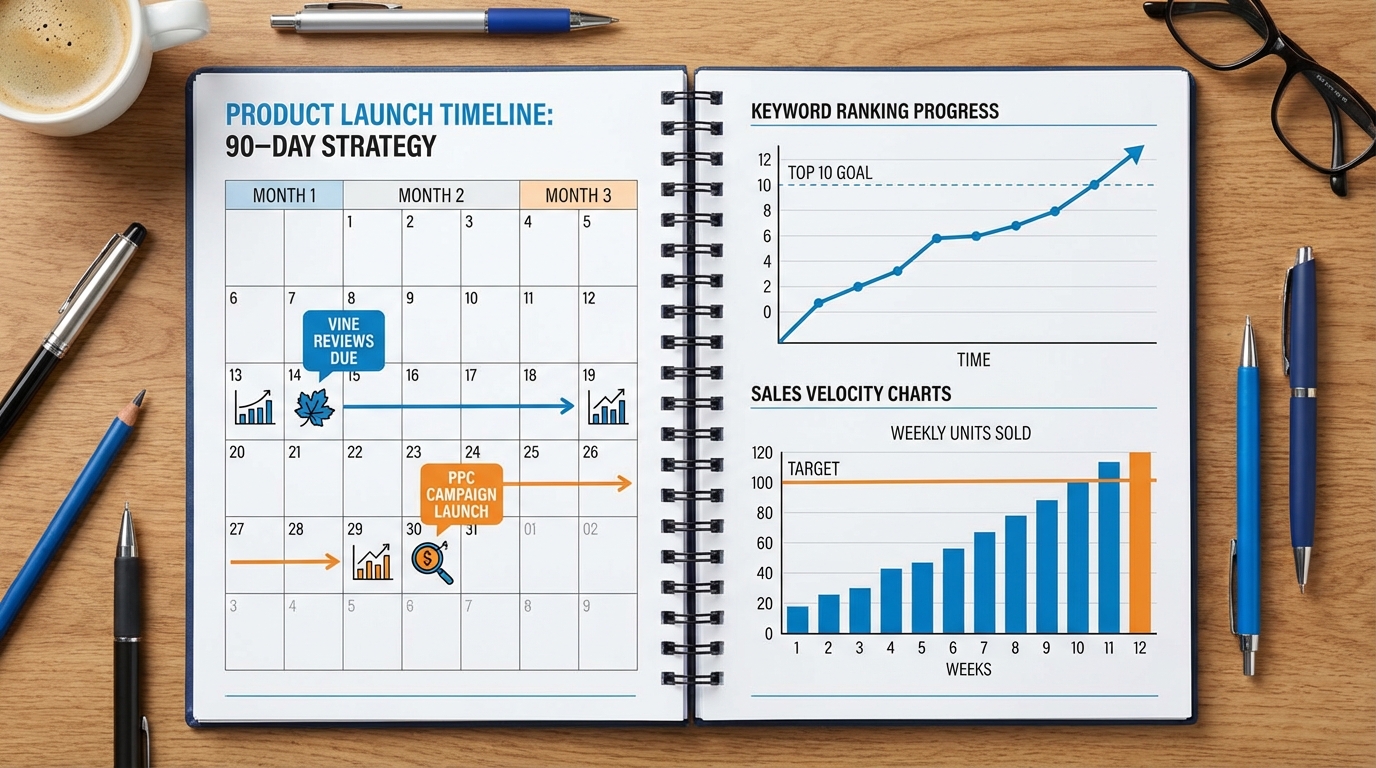
Amazon’s “honeymoon period” — the first 90 days after a new ASIN goes live — remains a real phenomenon in 2026, though it functions differently than many sellers expect. Amazon does not grant new products blanket ranking boosts. What it does is apply slightly more flexible ranking experimentation to new listings, testing them across more search result positions to gather conversion data. How you respond during those 90 days determines whether that initial experimentation results in strong permanent positioning or a quiet retreat to page five.
Pre-Launch: The Work That Determines Everything
The 90-day clock starts the moment your listing goes live — not when you start spending on ads or when your first sale comes through. This means your listing should be fully optimized, your inventory should be adequate for projected demand, and your initial review generation strategy should be ready to execute from day one.
Listing optimization before launch means completing every field in your product detail page with accurate, relevant, and well-researched content. It means having professional photography — minimum seven images, with the primary image showing the product clearly against a white background and secondary images showing scale, use context, and key features. It means having your backend search terms populated with relevant keywords that did not fit naturally into your visible copy.
Critically, it means having a realistic estimate of the daily sales velocity you need to achieve in your category to rank organically for your target keywords. This number — which varies enormously by category, from three to five units per day in low-competition niches to 50 or more in contested categories — is your operational target for the entire launch phase.
Days 1–30: Foundation and Review Generation
The first 30 days should focus on two things simultaneously: generating initial reviews through Amazon’s Vine program, and building early sales velocity through carefully managed PPC.
The Early Vine program — specifically designed for new ASINs with zero reviews — allows enrolled brands to get their product into the hands of Amazon’s Vine reviewer community before organic sales begin. The program costs up to $200 per ASIN (with costs tiered based on the number of Vine reviews requested) and is available only to Brand Registry members. Despite its limitations, it remains one of the most reliable ways to break out of the zero-review cold start that kills many new listings before they gain traction.
It is worth noting that research consistently shows organic reviews often outperform Vine reviews in conversion impact. Vine reviews can sometimes carry slightly lower average star ratings and occasionally feel more detached in tone. The goal of Vine is not to replace organic reviews but to establish a minimum social proof threshold — ideally 10 to 15 reviews — that makes subsequent organic traffic willing to purchase.
For PPC in the first 30 days, the recommended approach is broad auto campaigns supplemented by manual exact-match campaigns targeting five to ten of your highest-confidence keyword targets. Set budgets you can sustain for the full 90 days — running out of ad budget in week three of a launch is one of the most common and avoidable launch failures.
Days 31–60: Velocity Building and Keyword Isolation
By the end of day 30, you should have meaningful data: which search terms are generating clicks and conversions, what your actual ACoS is tracking at, and where your organic rank currently sits for your primary keywords. This data should drive the next phase.
In days 31 through 60, shift approximately 40% to 50% of your ad budget to exact-match campaigns targeting the keywords where your conversion rate is strongest. Add competitor ASIN targeting campaigns for 10 to 20 ASINs in your category that share your price range and review profile — these placements can generate high-intent traffic from buyers who are already deep in the purchasing process.
Continue requesting organic reviews through Amazon’s “Request a Review” feature (which sends a standardized Amazon-branded review request email and is fully compliant). Monitor your rankings weekly using a keyword tracker and note which terms have moved organically versus which are holding position only because of ad support. The goal is to convert as many ad-supported positions into organically-held ones as possible before your launch budget runs out.
Days 61–90: Consolidation and Post-Launch Positioning
The final 30 days of the launch framework are about consolidation. If your launch has worked, you should have organic rankings for multiple keywords, a review count in the double digits, and a conversion rate data set large enough to identify your listing’s genuine strengths and weaknesses.
This is the moment to make iterative improvements to your listing: testing alternative main images if CTR data suggests you are losing clicks, adjusting your pricing if conversion rate suggests you are priced slightly above the category sweet spot, and updating bullet points to address recurring themes in early customer reviews or questions.
It is also the moment to evaluate your inventory position honestly. A successful launch depletes inventory faster than projections, and running out of stock during or immediately after a successful launch is one of the most expensive mistakes in Amazon selling — you lose organic rank gains that can take months to rebuild.
Amazon Brand Registry: The Arsenal Most Sellers Only Half-Use
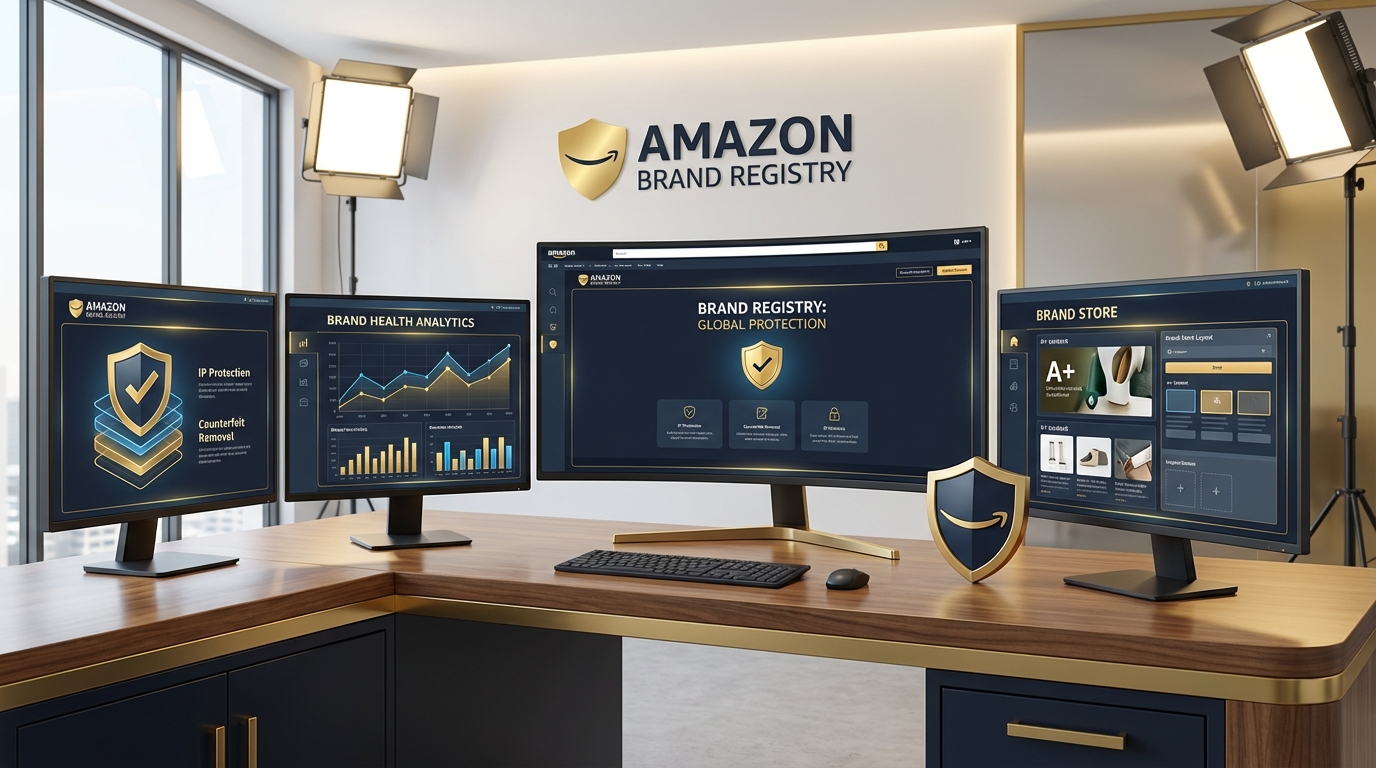
Amazon Brand Registry is consistently underused — not because sellers are unaware it exists, but because most brands enroll, activate A+ Content, and then consider the task complete. In reality, Brand Registry is a layered toolkit with capabilities that directly affect ranking, conversion, customer retention, and brand protection, and most sellers are using only the surface layer.
Brand Analytics: The Competitive Intelligence Most Sellers Miss
Brand Analytics is arguably the most valuable underused tool in the entire Amazon seller ecosystem. Available only to Brand Registry members, it provides access to data that would cost thousands of dollars to purchase from third-party research tools — and in many cases, is not available from third-party tools at all.
The Search Terms Report shows you the top search terms in your category by click and conversion share, along with the top three ASINs that receive clicks for each term. This data tells you not just which keywords are high-volume, but which keywords are actually converting buyers — a distinction that keyword research tools based on search volume alone cannot make.
The Market Basket Analysis report shows what products customers purchase alongside yours. This is an extraordinarily useful dataset for product development decisions: if you see that 30% of customers who buy your kitchen product also purchase a specific complementary item within the same session, that is a strong signal about your next product launch candidate.
The Repeat Purchase Behavior report tells you what percentage of your customers buy your product more than once, and at what time intervals. For consumable products, this data is essential for understanding your actual customer lifetime value. For non-consumables, high repeat purchase rates are a strong indicator that customers are buying the product as gifts or purchasing for different household members.
Weekly review of Brand Analytics — particularly the Search Terms Report and the Repeat Purchase data — should be a standard part of any brand’s Amazon operating rhythm. The sellers who use this data consistently make better product, pricing, and advertising decisions than those who rely on intuition or third-party tools alone.
Brand Stores, Sponsored Brands, and the Attribution Loop
A Brand Store is more than a vanity page. It is a trackable, shoppable brand destination on Amazon that receives a permanent custom URL (amazon.com/stores/[brandname]). Customers who visit a Brand Store convert at measurably higher rates and purchase more frequently — Amazon’s own data suggests Brand Store visitors have a 53.9% higher purchase frequency compared to non-Brand Store visitors.
Sponsored Brands ads — the banner ads that appear at the top of search result pages — can be configured to send traffic directly to your Brand Store rather than to a single product listing. This is valuable for two reasons: it captures the full breadth of your catalog from a single ad impression, and it builds brand familiarity with customers who are not ready to purchase on their first visit but may return through direct search later.
The Amazon Attribution program closes the loop between external marketing activity and Amazon performance data. If you run Instagram ads, Google Shopping campaigns, or email promotions that send traffic to your Amazon listings, Attribution gives you conversion tracking by source — something Amazon does not provide by default. This is the infrastructure you need to run legitimate multi-channel marketing rather than guessing at what is working.
IP Protection Tools: Using Them Proactively
The enforcement tools within Brand Registry — the ability to report trademark infringement, copyright violations, and counterfeit listings — exist for reactive use when you spot a problem. But the program’s proactive tools, Project Zero and the Transparency program, are designed to prevent problems before they occur.
Project Zero uses Amazon’s automated brand protection to continuously scan new listings and product changes that may infringe on your registered trademarks. The Transparency program applies item-level authentication codes to your products, allowing customers (and Amazon’s warehouse staff) to verify product authenticity at the point of receipt. For brands that have experienced or are at risk of counterfeiting — particularly in health, beauty, electronics, and apparel categories — Transparency is an operational investment that protects both customer trust and Buy Box eligibility.
Account Health in 2026: The New Enforcement Reality
Amazon’s Account Health Rating system has undergone significant tightening in 2026, and the enforcement changes have caught a meaningful number of previously stable sellers off guard. Understanding the new reality — and building operational systems that keep your account well inside the safe zone — is not optional for any seller who depends on Amazon for a substantial portion of their income.
The AHR Scale and What the Numbers Mean
The Account Health Rating operates on a 0 to 1,000 scale. Accounts scoring below 200 are considered “at risk” and subject to immediate review for deactivation. Accounts in the 200 to 400 range are considered “at risk” but with more time to remediate. The practical goal for any serious seller is to maintain a score above 500 consistently — not just above 200.
The key performance metrics that feed your AHR include: Order Defect Rate (must remain below 1%), Late Shipment Rate (below 4% for seller-fulfilled orders), and Pre-fulfillment Cancellation Rate (below 2.5%). For FBA sellers, the fulfillment-side metrics are largely out of your hands — Amazon controls the shipping — but ODR and policy compliance remain entirely within your control.
The 2026 enforcement changes include faster escalation timelines for unresolved notifications. Where sellers previously had days or weeks to respond to a policy notification before it affected their score significantly, the system now escalates more aggressively for notifications left unresolved past 48 to 72 hours. Setting up mobile notifications and checking Seller Central daily is no longer a best practice — it is a minimum operational requirement.
AI-Driven Suspensions and the New Documentation Standard
Amazon has significantly expanded its use of automated, AI-driven detection for policy violations in 2025 and into 2026. The system flags accounts for inauthenticity (where product invoices are insufficient or missing), multi-account linking (where shared payment methods, IP addresses, or device fingerprints connect accounts that should be separate), and intellectual property complaints with no corresponding response on file.
The documentation standard for reinstatement appeals has risen substantially. A Plan of Action (POA) that might have worked two years ago — a brief acknowledgment of the issue and a promise to do better — is routinely rejected in 2026. Successful POAs now require specific documentation of the root cause, a detailed corrective action with verifiable evidence, and preventative measures that include supply chain documentation (invoices from legitimate wholesalers or manufacturers, not retail receipts).
The single most effective thing any seller can do to protect against inauthenticity-related suspensions is to maintain complete and organized procurement documentation for every ASIN in their catalog. Every purchase order, every manufacturer invoice, every certificate of conformity should be stored in an organized system that can be retrieved and formatted into a POA within hours if needed.
The Multi-Account Risk Most Sellers Don’t Appreciate
Amazon’s account linking systems are considerably more sophisticated than most sellers realize. The platform can connect accounts through shared payment methods, shared bank accounts, shared IP addresses, shared device fingerprints, and even shared supplier invoice addresses. When one linked account receives a policy violation or suspension, the risk of chain-reaction enforcement across all linked accounts is real and documented.
Sellers who operate multiple legitimate accounts — for separate brands, separate legal entities, or separate marketplaces — need to ensure that those accounts are structurally separated: different bank accounts, different credit cards, different business addresses, separate IP addresses (using dedicated connections or VPNs), and documented business rationale for each account on file with Amazon Seller Support. This is not paranoia; it is operational hygiene for any multi-account setup.
Multi-Channel Fulfillment: Amazon’s Infrastructure, Extended
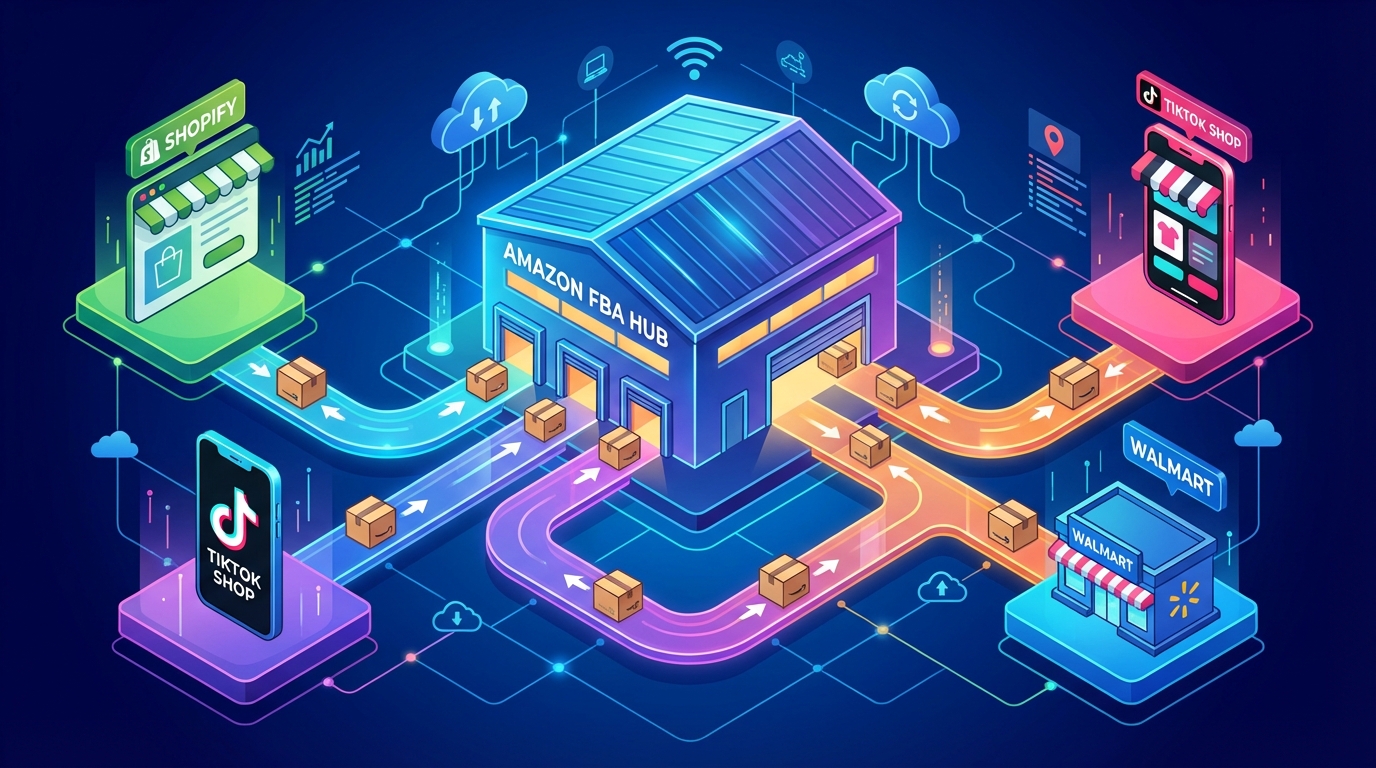
One of the most significant recent developments in Amazon seller strategy is the maturation of Multi-Channel Fulfillment (MCF) as a viable infrastructure for off-Amazon sales. For years, using Amazon’s fulfillment network to ship orders from non-Amazon channels was expensive and operationally awkward. In 2026, it has become a genuinely attractive option for brands with established FBA operations who want to expand to direct-to-consumer without building parallel logistics infrastructure.
The January 2026 MCF Preferred Pricing Program
On January 15, 2026, Amazon launched its MCF Preferred Pricing program — a tiered discount structure for sellers who use MCF at sufficient volume. Eligible sellers can receive up to 15% discounts on outbound MCF fulfillment fees, plus up to $1 in FBA credits per unit for off-Amazon fulfillment (capped at 100,000 units or 12 months).
The timing of this launch is notable: it coincides with fee increases across FBA and Buy with Prime, effectively using the preferred pricing discount to offset some of those increases for high-volume MCF users. The net effect is that for sellers already processing significant MCF volume, the program essentially neutralizes the 2026 fee increases. For sellers considering MCF but not yet committed, the program meaningfully improves the economics enough to warrant a serious cost analysis.
The Walmart MCF surcharge — previously an additional cost that made Walmart fulfillment via Amazon less attractive — has been waived through 2027, which opens a more cost-effective path for sellers who want to establish a Walmart Marketplace presence without managing separate fulfillment infrastructure.
The JLab Case Study: What MCF Actually Delivers
JLab, an audio electronics brand, documented the results of using MCF for its off-Amazon DTC sales channel and the numbers are instructive. After integrating MCF with their Shopify store, JLab achieved a 1.5-day average delivery time and saw a 55.9% increase in website conversion rate, attributed primarily to the “fast delivery” badge that MCF enables on DTC storefronts. Average order value increased by 37.5% after integrating Buy with Prime alongside MCF.
These are not marginal improvements. A 55.9% conversion rate lift means that a DTC website with MCF integration is effectively doubling the productivity of its existing traffic — without any increase in advertising spend. For brands that have invested in building traffic to their own website but are frustrated by the conversion rate gap between their DTC store and their Amazon listing, MCF offers a structural solution rather than a creative one.
The Strategic Logic: One Inventory Pool, Multiple Revenue Streams
The core appeal of MCF is operational: you maintain a single inventory pool at Amazon’s fulfillment centers and use it to serve orders from any channel — Amazon, your own website, TikTok Shop, Walmart — without holding separate stock in separate locations. For brands with predictable but variable demand across multiple channels, this consolidation reduces both working capital requirements and the operational complexity of managing multiple 3PL relationships.
The strategic implication goes further. If your Amazon FBA operation is well-run — high IPI score, good in-stock rates, Prime-eligible listings — you already have logistics infrastructure that can support meaningful DTC scale. The question is whether you are using it beyond Amazon’s own marketplace.
Inventory Intelligence: IPI Scores, Restock Strategy, and Cash Flow Engineering
Inventory management is where the theory of Amazon selling meets the financial reality of running a business. Poor inventory management is simultaneously one of the most common and one of the most expensive mistakes in the seller community — it ties up cash in slow-moving stock, restricts FBA capacity for fast-moving products, and can create stockouts at exactly the moments when sales velocity (and therefore organic rank) is strongest.
Understanding the IPI Score and Its Consequences
The Inventory Performance Index score — your IPI — is Amazon’s composite measure of how well you are managing your FBA inventory. It is calculated based on four factors: excess inventory percentage, sell-through rate, stranded inventory, and in-stock rate. The minimum threshold to avoid restrictions is 400 (on a 0 to 1,000 scale). Accounts below 400 face immediate capacity restrictions — potentially as severe as a reduction to 15 cubic feet of available FBA storage — regardless of their overall sales volume.
Scores above 450 to 500 offer better relative capacity positioning, though Amazon’s system-wide capacity allocation adjustments (which have historically been tied to Amazon’s own quarterly demand projections) can affect all sellers regardless of IPI. During May 2025, a system-wide allocation reduction cut available capacity by roughly 25% for many sellers — even those with IPI scores above 550. This is a reminder that IPI management is necessary but not sufficient for inventory security.
The Three Inventory Failure Modes
Most inventory problems on Amazon fall into one of three failure modes, and each requires a different response.
Overstocking is the most common. Excess inventory triggers long-term storage fees after 365 days, reduces your sell-through rate (which negatively impacts IPI), and ties up cash that could be deployed in faster-moving SKUs. The solution is ruthless sell-through discipline: set a price floor for clearance, use Lightning Deals or coupons to move aged inventory before it hits the 365-day threshold, and adjust future purchase orders based on actual sell-through data rather than optimistic projections.
Stockouts are the second failure mode, and they are often more damaging than overstocking to long-term business performance. Running out of stock for a top-ranked ASIN does not just cost you those sales — it costs you the organic rank position you built over months of sales history. Recovering that rank after a stockout typically requires an expensive re-launch cycle. The standard guidance is to maintain 30 to 45 days of safety stock for any ASIN where you hold meaningful organic ranking.
Stranded inventory — units in Amazon’s fulfillment centers that are not linked to an active listing — is the third failure mode and the easiest to fix. Amazon charges storage fees on stranded units and they count against your IPI. Check your stranded inventory report weekly and resolve any issues promptly.
Cash Flow Engineering for Inventory-Heavy Businesses
The cash conversion cycle for an Amazon FBA business — the time between paying for inventory and receiving revenue from its sale — is typically longer than sellers appreciate when they are starting out. Factor in manufacturing lead times (often 30 to 60 days for overseas production), ocean freight transit (another 25 to 45 days), Amazon check-in time (5 to 14 days after delivery), and then the actual sales period, and you are looking at 120 to 180 days between capital outlay and meaningful cash recovery for a new product.
This is why cash flow planning is not a finance function for Amazon sellers — it is an operational one. Sellers who scale too fast without adequate working capital often find themselves unable to reorder their best-selling products when demand is highest, which is exactly the wrong time to be cash-constrained. Building a 90-day cash reserve specifically for inventory reorders is not conservative; it is the operational standard for any Amazon business trying to grow sustainably.
Building a Business That Does Not Live or Die by Amazon’s Next Policy Change
There is a version of Amazon success that is structurally fragile: high revenue, strong margins, excellent rankings — all concentrated in a single platform, a single account, and a single traffic source. That business can disappear overnight. A suspension, a policy change, a competing product launch from Amazon itself, or a single viral negative review can reduce a multi-million dollar operation to zero active sales in 24 hours.
Building a durable Amazon business in 2026 means deliberately distributing risk across multiple dimensions while maintaining operational focus on the Amazon channel that generates the majority of your revenue.
The Multi-Marketplace Expansion Sequence
The most straightforward risk distribution strategy is expanding to additional marketplaces. Walmart Marketplace is the most accessible first step for established Amazon sellers — the platform’s seller onboarding process is simpler than it was three years ago, and products that perform well on Amazon often translate effectively to Walmart’s customer base with minimal additional content work.
TikTok Shop has emerged as a high-momentum channel for visual and consumable products, though it requires a fundamentally different content and creator strategy than Amazon. The sellers who transition most successfully from Amazon to TikTok Shop tend to be those with strong brand storytelling and genuine product differentiation — commoditized products do not benefit from the social proof dynamics that make TikTok commerce work.
The practical sequencing for most sellers: stabilize and optimize your Amazon operations first, then expand to Walmart once your Amazon catalog is performing consistently, and evaluate TikTok Shop as a third channel only when you have the operational bandwidth to manage creator relationships and content production alongside your core FBA business.
Building Off-Platform Brand Equity
Brand equity that exists only on Amazon is brand equity that Amazon can take away. The most resilient Amazon businesses are those where the brand has genuine recognition, customer relationships, and demand signals that exist independently of the Amazon algorithm.
This means building an email list — even a modest one of a few thousand customers — that gives you a direct communication channel to your buyer base. It means having a brand website that ranks for your brand name in Google search, so customers who discover you on Amazon can find you independently later. It means cultivating social media presence, whether through organic content or creator partnerships, that generates search demand and external traffic.
None of these activities need to be primary revenue drivers to be valuable. Their primary function is insurance: they ensure that your customer relationships and brand awareness are not exclusively mediated through Amazon’s systems and policies.
Account Structure and the Suspension-Resilience Framework
Account-level risk management in 2026 requires thinking about your Amazon seller account the way a CFO thinks about a legal entity structure: with deliberate attention to what assets are exposed to which risks.
If you operate multiple brands, consider whether they should be on the same seller account or separate ones. A single account simplifies management but creates a single point of failure — a suspension triggered by one product’s performance metrics or one IP complaint affects every brand in the account simultaneously. Separate accounts for genuinely separate brands (with separate legal entities, payment methods, and documented rationale) distribute that risk, though they also add management complexity.
Regardless of account structure, maintaining complete and current documentation for every ASIN in your catalog is the single most valuable protective measure you can have. The sellers who recover from suspensions fastest are not necessarily the ones with the best appeal writers — they are the ones with organized documentation that allows them to build a compelling, evidence-backed POA quickly.
Thinking Like an Owner, Not a Seller: The Architecture Mindset
Every tactical decision in this guide — variation structure, launch sequencing, Brand Registry usage, IPI management, multi-channel expansion — is more valuable when it is made within a coherent strategic framework rather than as an isolated optimization. The sellers who build genuinely durable Amazon businesses are not those who know the most tactics; they are those who understand how the tactics connect to a larger architecture.
That architecture has three layers. The first is the product layer: a catalog built on genuine differentiation, well-structured variation families, and products that have real reasons to exist beyond “the numbers looked good in Helium 10.” The second is the brand layer: Brand Registry enrollment fully utilized, off-platform equity being built, and customer relationships that exist independently of algorithmic ranking. The third is the business layer: operational systems for account health, inventory management, cash flow planning, and multi-channel distribution that make the business resilient rather than merely profitable.
Most Amazon sellers operate well at the product layer and sporadically at the brand and business layers. The goal of this guide is to help you think across all three simultaneously.
Actionable Takeaways
- Audit your catalog structure this week. Review your variation families against Amazon’s February 2026 review sharing guidelines and separate any ASINs grouped for convenience rather than genuine variation logic.
- Enroll in Brand Registry if you haven’t. The Brand Analytics data alone — particularly the Search Terms Report and Repeat Purchase Behavior report — is worth the trademark registration cost several times over.
- Run a weekly Account Health check. Set AHR monitoring as a calendar task. Check every open notification and resolve it within 48 hours. Maintain complete procurement documentation for every ASIN.
- Model your cash conversion cycle accurately. Map the actual time from inventory purchase order to cash receipt for your three best-selling SKUs. If the cycle exceeds 120 days, plan your working capital reserves accordingly.
- Evaluate MCF for your DTC channel. If you have an existing Shopify store or are considering one, run the numbers on MCF Preferred Pricing against your current or projected 3PL costs. The January 2026 program changes have made the comparison more favorable than it has historically been.
- Build one off-Amazon equity asset. Whether it is an email list, a brand-name domain, or a social media presence, establish at least one customer touchpoint that does not route through Amazon’s systems. You do not need it until you desperately need it.
- Think in 90-day cycles. The product launch framework, the IPI review cadence, the Brand Analytics review rhythm — all of these work best when you commit to 90-day planning and review horizons rather than week-to-week reactive management.
Amazon remains one of the most powerful commercial platforms in the world for product-based businesses. The sellers who build lasting success on it are not those who treat it as a traffic source. They are those who treat it as infrastructure — and who build the brand, catalog, and operational architecture to use that infrastructure at its full potential.