

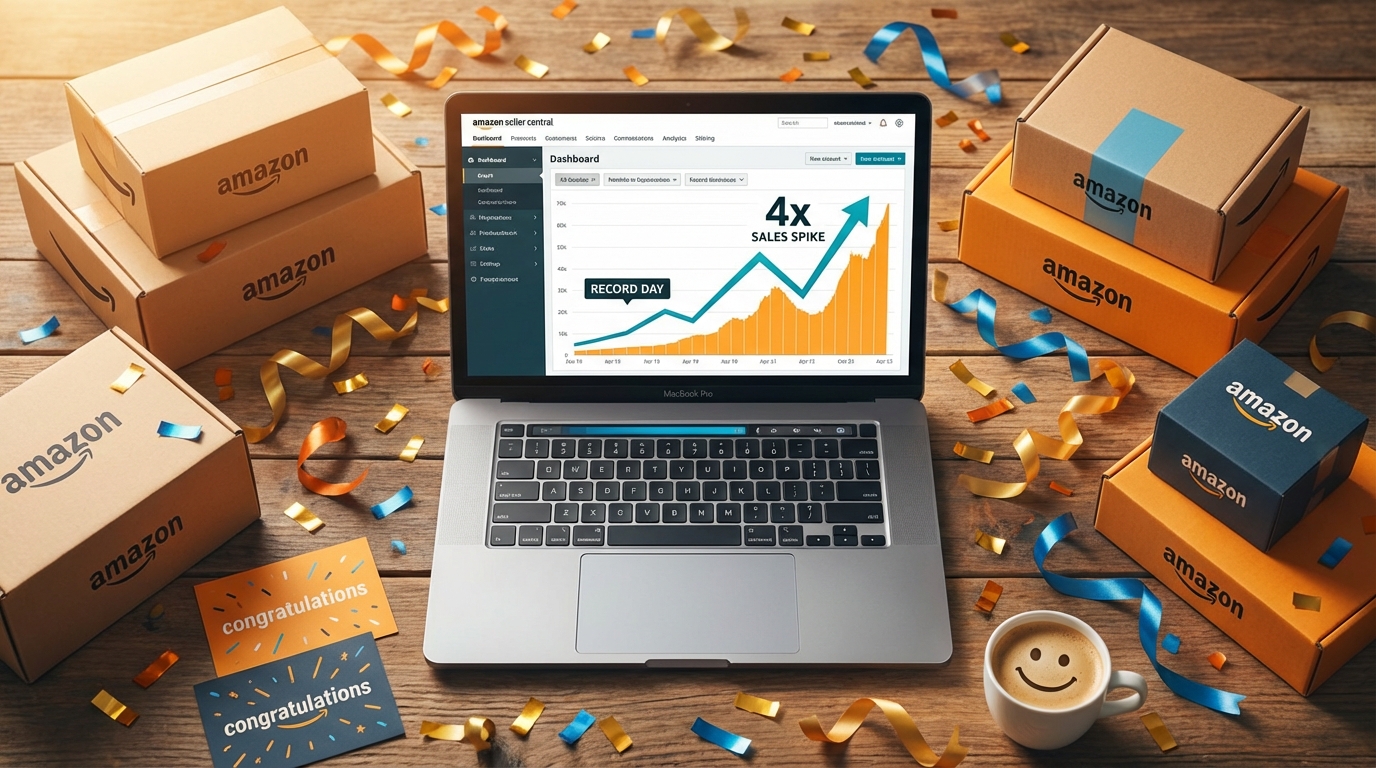

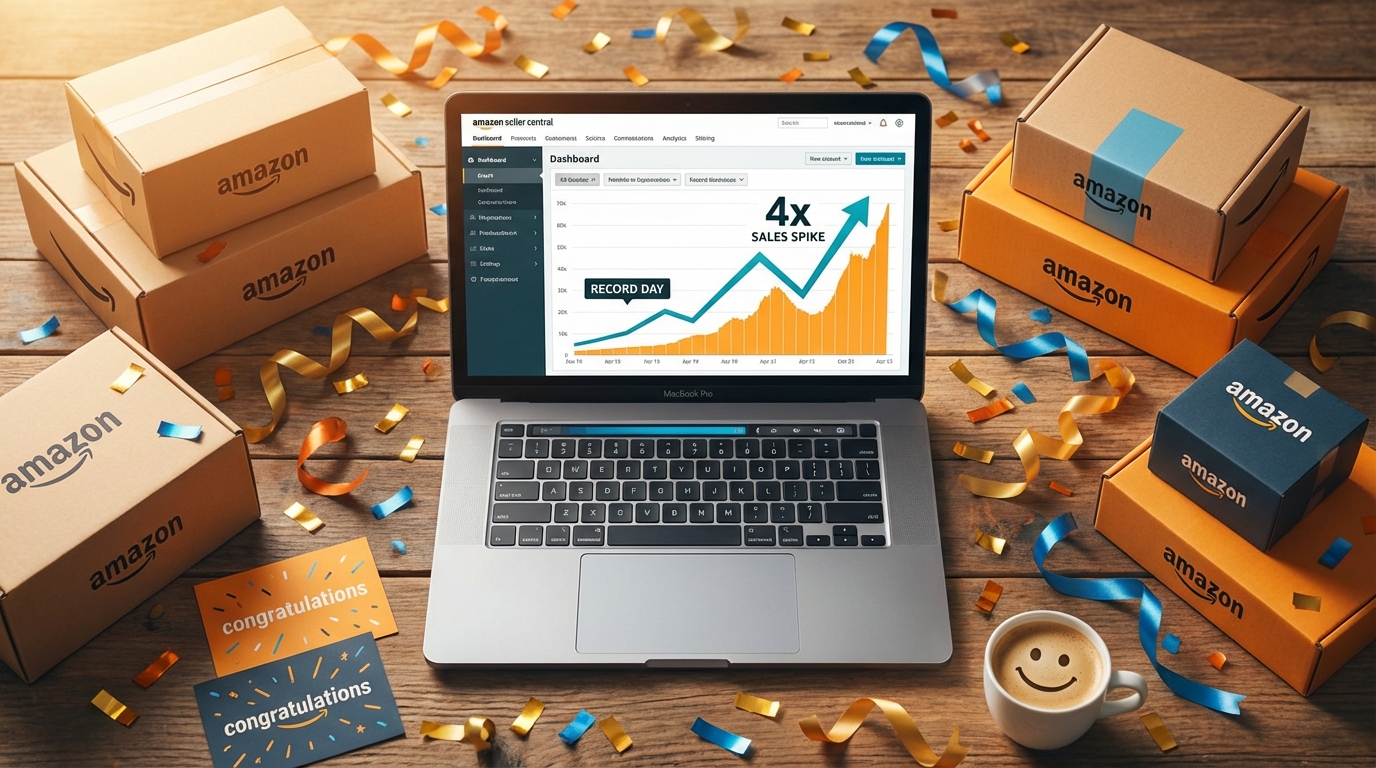
It started like any other Tuesday morning. Coffee in hand, Seller Central open — and then the number hit us like a freight train.
Our sales had quadrupled. Overnight.
Not a small bump. Not a 20% uptick from a PPC tweak. A full-blown, heart-stopping, 4x explosion in units sold — and we had absolutely no idea why. No campaign had gone live. No coupon had been activated. No lightning deal was running. The dashboard just sat there, calmly displaying a number that didn’t make any logical sense.
If you’ve been selling on Amazon for any length of time, you know exactly what that feeling does to you. It doesn’t feel like winning. Not at first. It feels like danger.
Because in the Amazon ecosystem, an unexplained spike of that magnitude has a very dark and very common explanation: a competitor placing a flood of fake orders to lock up your inventory, tanking your IPI score, and leaving you out of stock for 21 or more days while they scoop up your Buy Box and ranking. It’s one of the ugliest tactics in the marketplace playbook, and it happens more than Amazon will ever officially admit.
So we did what any experienced Amazon seller does: we started investigating. We dug into every data point we could find. We checked order patterns, buyer account ages, address clustering, return rates, and conversion metrics. We traced the traffic sources. We pulled the attribution reports.
And what we found stopped us in our tracks — for a completely different reason than we expected.
This was real. Every single order was legitimate. The sales had converted to paid. And the smiles that followed? Those lasted all day.
Here’s the full story of what happened, why it happened, and — most importantly — how you can intentionally build the same kind of external traffic engine that turned an ordinary Tuesday into the best sales day we’d had in months.
When Your Amazon Sales Spike and You Don’t Know Why
Unexpected spikes in Amazon sales are more common than most sellers talk about openly. The problem is that they can mean two completely opposite things: you’ve either struck gold or someone is trying to bury you.
The range of legitimate causes for a sudden surge is surprisingly wide. A seasonal trend might have peaked. A competitor could have gone out of stock, sending their customers your way. A social media post from an account you’ve never heard of could have gone viral. A newsletter with 500,000 subscribers might have mentioned your product in passing. Or — as in our case — a major media publication could have featured you without you even knowing it happened.
The Data You Need to Check Immediately
The moment an unexplained spike appears, your first stop should be Amazon Brand Analytics and the Business Reports dashboard inside Seller Central. Look specifically at:
- Sessions vs. Units Ordered — Is your conversion rate holding steady, or is something off? Real demand spikes tend to maintain or improve your conversion rate because shoppers arriving from a curated recommendation are already warm and intent-driven.
- Traffic source breakdown — Are orders coming from Amazon’s internal search and browse, or are they tagged to external sources? Amazon Attribution tags, if you’ve set them up correctly, will tell you exactly which channel is sending the traffic.
- Buyer account patterns — Fake orders tend to cluster around newly created accounts with no purchase history, identical shipping addresses, or sequential order timing. Legitimate orders look messy and human — different names, different states, different purchase times spread across hours.
- Order Defect Rate and return metrics — If orders are being placed and immediately returned or reported, that’s a red flag for sabotage. If the orders are clean and settled, you’re likely looking at genuine demand.
The Emotional Rollercoaster Is Real
There’s no sugarcoating this: the emotional experience of an unexplained spike is genuinely stressful. The Amazon seller community has been burned enough times by black-hat tactics that the instinct to brace for the worst is completely rational. Many sellers have shared stories of riding a sales spike high only to find their inventory held hostage weeks later.
That context matters when you’re building your strategy, because it underscores something critical: knowing where your traffic comes from isn’t just a nice-to-have — it’s a fundamental part of protecting and understanding your business. When you have attribution in place and an active outreach program running, you’re never flying blind when a spike hits. You have somewhere to look.
The First Fear: Is This a Competitor Attack?
Let’s spend a moment here, because if you’re an Amazon seller and you’ve never heard of inventory-locking sabotage, this section could save you a serious headache down the road.
The tactic works like this: a competitor — usually one who is competing for the same keyword rankings or Buy Box position — places a large volume of orders on your listing. These orders are genuine enough to pass Amazon’s automated fraud detection, at least initially. The goal isn’t to actually buy your product. The goal is to trigger a massive drain on your available FBA inventory, which then sends signals to Amazon’s fulfillment systems that you’re over-performing your replenishment forecasts.
How the 21-Day Trap Works
Once your inventory drops below a certain threshold — or depletes entirely — you’re looking at a restock lead time that can stretch anywhere from 14 to 35 days depending on your category and the current state of FBA receiving times. During that window, your listing may go out of stock, your BSR (Best Sellers Rank) crumbles, your organic keyword rankings erode, and any PPC campaigns you were running either shut off or start spending on a listing that can’t convert.
Meanwhile, the competitor who triggered this is sitting at the top of the search results, scooping up every customer who was moments away from buying from you.
The orders eventually get returned or refunded — but the damage to your ranking and your inventory cycle is already done. And because Amazon doesn’t explicitly flag this kind of activity in your dashboard, most sellers don’t even realize it happened until weeks later when they notice the pattern in hindsight.
The Red Flags to Watch For
There are several warning signs that distinguish a sabotage spike from a legitimate one:
- Orders appear in tight clusters — dozens of units sold within the same 1–2 hour window
- The buyer accounts are all recently created with no review history
- Orders are all shipping to the same city, state, or ZIP code
- Your conversion rate stays flat or drops during the spike (real demand improves it)
- Return requests begin flooding in 7–14 days later
- No corresponding increase in page sessions — sales are going up but traffic isn’t
In our case, none of these red flags were present. The orders were distributed across time zones, buyer accounts showed normal purchase histories, and — crucially — our sessions had spiked alongside the sales. Real traffic was arriving, converting at a healthy rate, and the orders were settling cleanly. That’s when we shifted from worried to curious, and started hunting for the source.

Hunting Down the Source — The Investigation
When you’re trying to trace the origin of an unexpected traffic surge, you’re essentially working like a detective. The evidence is there — you just have to know where to look and how to read it.
Our investigation started in Amazon Attribution. If you’re running any kind of external traffic program — creator outreach, influencer partnerships, email campaigns — and you haven’t set up Amazon Attribution tags for each channel, stop reading this and go do that right now. It is the single most important infrastructure investment for any seller who takes external traffic seriously.
Amazon Attribution: Your Traffic Forensics Tool
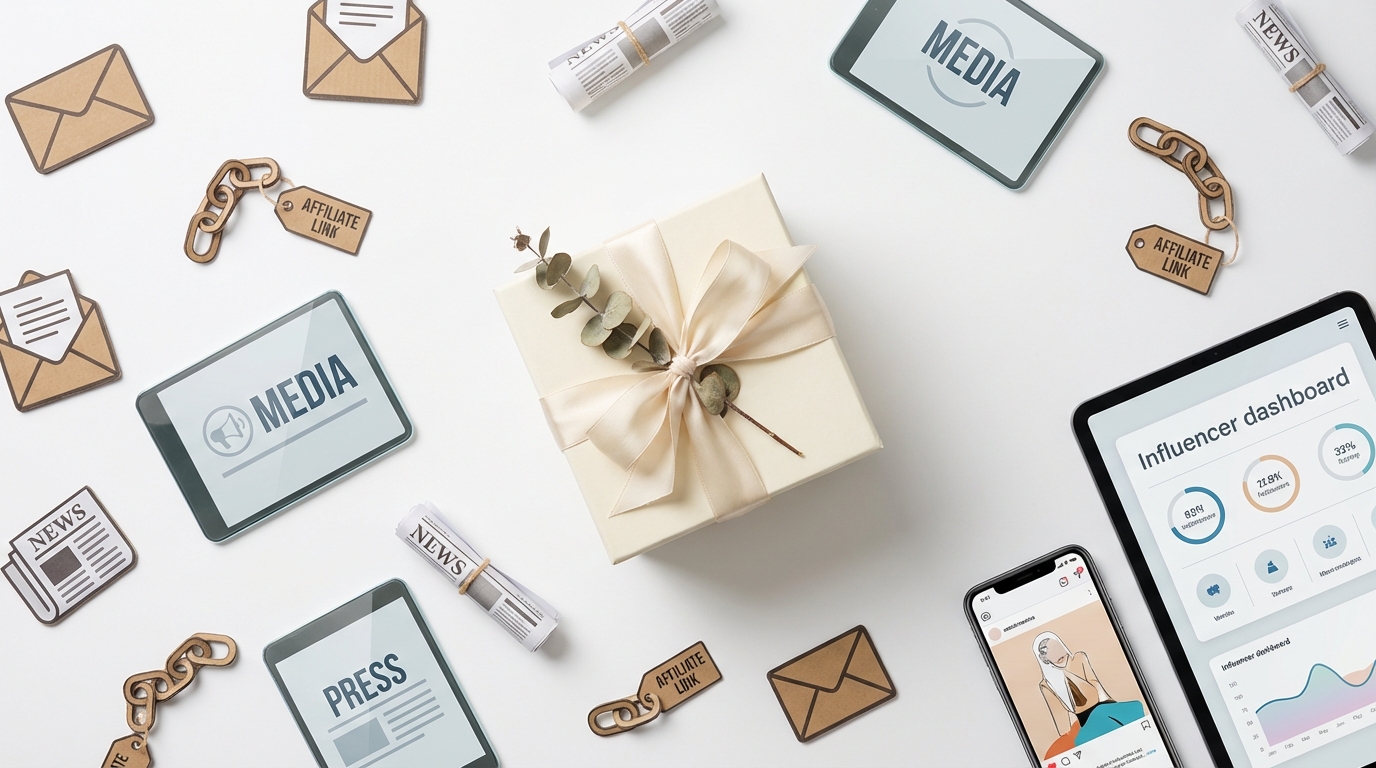
Amazon Attribution is a free measurement solution that lets you track how traffic from outside Amazon is performing. You create unique tracking tags — custom URLs — for each channel, creator, or campaign. When a shopper clicks one of those links and purchases within 14 days, that sale is attributed to the source you specified.
The data it gives you goes far beyond just knowing a sale happened. You can see:
- Click-through rates from each source
- Detail page views driven by that source
- Add-to-cart rate
- Purchase conversion rate
- Total attributed sales and units
When we pulled our Attribution report during the spike, a specific tag was lighting up. It was one we’d set up months earlier as part of our creator and affiliate outreach program — a tag associated with a general media and PR outreach campaign. The volume coming through that tag was unlike anything we’d seen from it before.
Tracing the Trail Back to the Source
We cross-referenced the Attribution data with our affiliate network dashboard. We track every creator and publication we’ve reached out to, every link we’ve distributed, and every campaign we’ve activated. When we filtered by the tag that was performing, we could see exactly which entity was responsible for the traffic.
That’s when we found it.
A PR company had picked up our product. Not through a free sample pitch. Not through a gifting arrangement or an unpaid product send. They had purchased it themselves — at full retail price — because they believed in it enough to feature it without any prompting from us. They’d found us through our affiliate program and decided our product belonged in front of their audience.
And their audience? Readers of the Huffington Post.
The Huffington Post Moment — Page 1, Listing 1
There’s a hierarchy to media coverage, and most Amazon sellers spend their early outreach efforts chasing micro-influencers with 10,000 followers or niche bloggers with a dedicated readership. Those placements matter and we’ll talk about why shortly. But every seller dreams of the day a major, nationally recognized publication decides to feature their product.
We didn’t chase the Huffington Post. We didn’t pitch them. We didn’t send a press kit, pay for a feature, or negotiate a sponsored post. They came to us — through the infrastructure of the creator and affiliate program we’d been quietly building — and placed us in Position 1 on their shopping page.
What a Huffington Post Shopping Feature Actually Means
The Huffington Post is not a small blog. With tens of millions of monthly visitors and domain authority that puts it in the top tier of online publishing, a feature on their shopping page carries enormous weight — both in direct referral traffic and in the downstream SEO and credibility signals it sends.
Their shopping content is curated by editorial teams and contributing writers who are actively searching for products worth recommending to their readers. These aren’t paid advertorials. They’re genuine editorial picks, which means the implied endorsement carries a level of trust that no amount of paid advertising can replicate.
When your product appears as the first listing on Page 1 of their shopping section, you’re not just getting traffic. You’re getting credibility. You’re getting the implicit stamp of approval from one of the most recognized media brands in the United States, delivered to readers who are already in a shopping mindset and actively looking for recommendations.
The Sales Impact in Real Numbers
The HuffPost feature hit and the traffic began flowing within hours. Our Amazon listing sessions — the number of unique visits to our product page — spiked dramatically. Because the readers arriving from the HuffPost shopping page were already warm (they’d chosen to click on a curated product recommendation), our conversion rate didn’t just hold — it climbed. Shoppers who arrive via editorial recommendations convert at significantly higher rates than cold search traffic because the recommendation itself has done much of the persuasion work.
The sales velocity surge that followed had a cascading effect on our organic ranking. Amazon’s A9/A10 algorithm reads sales velocity and conversion data as signals of product relevance and demand. When external traffic drives a sustained surge of purchases, the algorithm responds by pushing your listing higher in organic search results — which then generates even more sales from shoppers who weren’t part of the original HuffPost audience at all.
In other words: one well-placed editorial feature didn’t just drive direct sales. It gave us an organic ranking boost that continued paying dividends long after the initial wave of HuffPost traffic had passed.
Why Creator and Affiliate Outreach Works So Powerfully for Amazon Sellers
What happened to us wasn’t a fluke. It was the natural result of a system that, when built correctly, creates compounding opportunities over time. Creator and affiliate outreach is one of the most underutilized growth levers available to Amazon sellers today — and the data backs this up conclusively.
According to industry research, Amazon’s Creator Connections platform grew from 30,000 active campaigns in January 2025 to over 125,000 by April of the same year. That’s not a trend — that’s a gold rush. Brands are waking up to the reality that external traffic from trusted creators converts at rates that make paid Amazon PPC look expensive by comparison.
The Trust Equation
There’s a fundamental reason why creator-driven traffic outperforms cold search traffic. When a creator — whether that’s an individual influencer, a blogger, a newsletter writer, or an editorial team at a major publication — recommends your product, they’re lending you their credibility. Their audience trusts them. That trust transfers to your product before the shopper even lands on your listing.
Compare that to a shopper who finds your product by typing a keyword into Amazon’s search bar. They’re evaluating your listing cold — no pre-existing trust, no warm introduction, no third-party validation beyond your reviews and star rating. The creator-referred shopper arrives having already received a recommendation from someone they follow and respect. The psychological lift is significant.
Research consistently shows that nano-influencers (those with 1,000 to 10,000 followers) generate some of the highest conversion rates in the creator economy precisely because of this trust dynamic. Their audiences are tight-knit and highly engaged. A recommendation from a nano-influencer carries more weight per follower than a mention from an account with millions of followers who their audience barely feels a personal connection to.
The Affiliate Incentive Creates Sustained Effort
One of the structural advantages of affiliate-based creator outreach is that it aligns incentives in a way that pure gifting or paid sponsorships don’t. When a creator earns a commission on every sale they drive, they have an ongoing financial motivation to keep featuring your product, to create new content around it, and to recommend it again and again over time.
A one-time sponsored post from a paid influencer is a transaction. An affiliate relationship is a partnership. The creator who is earning real commissions from your product will naturally include it in more content, mention it in more contexts, and keep their audience’s attention on it far longer than a creator who received a flat fee and moved on to the next brand deal.
Amazon’s own Creator Connections program has built this insight into its architecture — offering brands the ability to layer additional commission bonuses on top of the standard Amazon Associates rate, creating even stronger incentive structures that attract high-quality creators to active campaigns. Some brands are offering commissions in the range of 10–30%, which creates genuinely meaningful income for creators who drive consistent volume.
What the Numbers Say About Case Study Performance
One documented campaign run through Amazon Creator Connections — executed by the agency Envision Horizons for a beauty brand — invited 200 creators to participate. Fifty-eight accepted, 19 created content, and those 19 creators drove 148,760 clicks, 7,500 orders, and $108,770 in sales from a total campaign spend of just $5,000. That’s a 2,175% return on ad spend. No PPC campaign in a competitive category is going to touch those numbers.
The scale of our HuffPost feature was different — driven by a PR company’s editorial decision rather than a formal Creator Connections campaign — but the underlying mechanics are the same. Trusted third-party recommendations, backed by an affiliate incentive structure, drive traffic that converts at extraordinary rates.
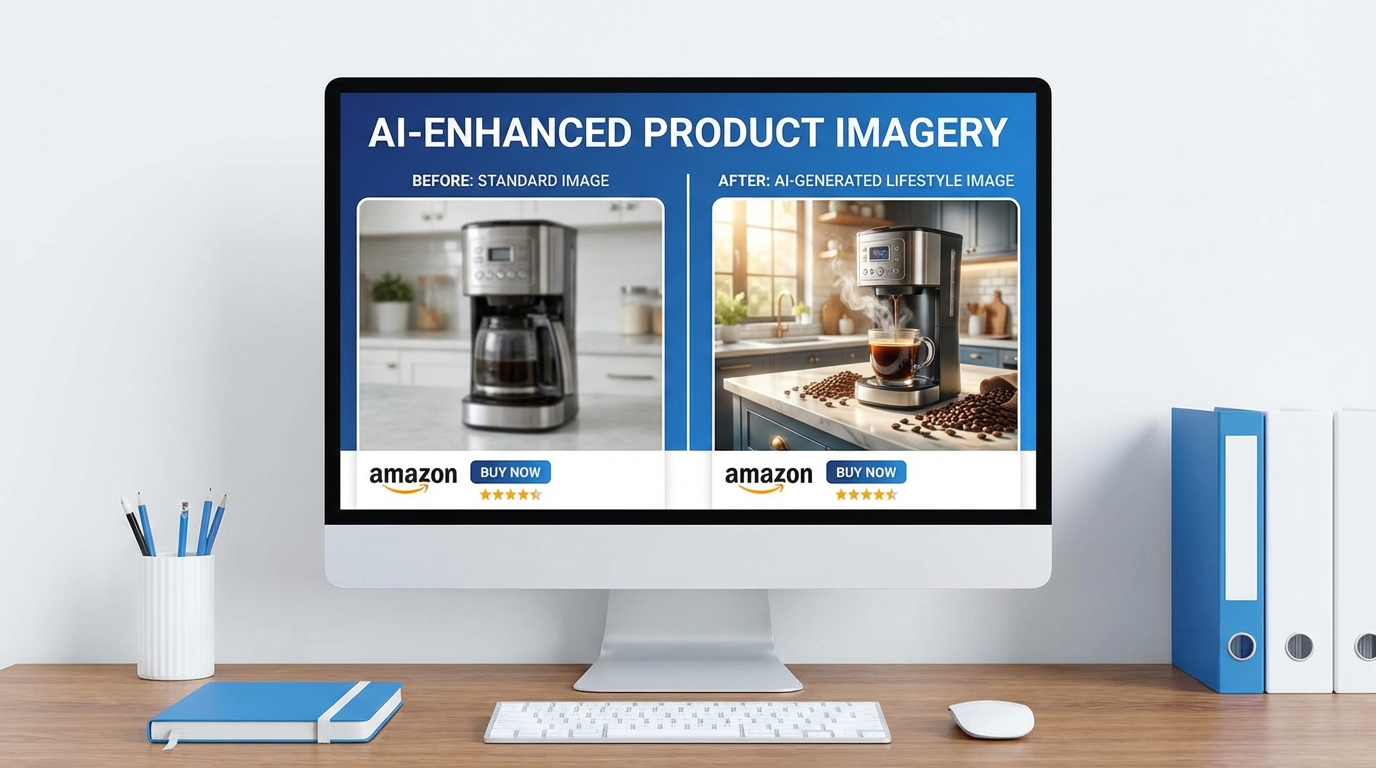
How AI Listing Images Made Us Press-Ready — The Algofuse.ai Factor
Here’s the part of this story that we cannot gloss over, because it’s one of the most important pieces of the puzzle: none of this would have happened if our listing hadn’t been visually compelling enough to earn that editorial spot.
Think about how a PR company or editorial writer selects products for a shopping feature. They’re not just evaluating the product itself. They’re evaluating the presentation of the product. Does it look professional? Does the main image catch the eye? Do the lifestyle images communicate a clear use case and aspiration? Does the overall listing convey quality and trustworthiness?
If your product images look like they were shot on a kitchen counter with a smartphone, you’re not getting featured in the Huffington Post. Full stop.
What Algofuse.ai Actually Does for Amazon Sellers
We use Algofuse.ai to generate our Amazon listing images — and it was our Algofuse-powered images that were front and center on that Huffington Post Page 1 placement.
Algofuse.ai is an AI-powered listing image generator built specifically for Amazon sellers. It doesn’t just produce generic visuals — it analyzes top-performing competitor listings for your specific keywords, then generates a complete set of Amazon-ready assets tailored to what’s actually converting in your category. That includes:
- Main images — fully compliant with Amazon’s photography standards (pure white backgrounds, correct product frame sizing, zoom-enabled resolution)
- Lifestyle images — showing the product in real-world use scenarios that connect emotionally with buyers
- Infographic images — highlighting key features, dimensions, and benefits in a visually scannable format
- Comparison charts — positioning your product favorably against alternatives
- Feature callout images — bringing specific product attributes to life visually
The platform supports 19 Amazon marketplaces and costs approximately $5 per listing — compared to $150 to $500 or more to hire a designer or photographer for equivalent quality work. The turnaround time is measured in minutes, not days or weeks.
Why Listing Images Are Your First Impression With Press and Creators
When a PR company purchases your product to evaluate it for a feature, they’re also spending time on your Amazon listing page. That listing is your digital storefront, your brand brochure, and your first impression all rolled into one. Substandard images signal a brand that doesn’t take its presentation seriously — and editorial teams won’t feature products that look like they cut corners on the basics.
The data on Amazon image quality and conversion rates is unambiguous. Research shows that high-quality product images can boost conversion rates by anywhere from 60% to 96% compared to low-quality alternatives. One documented case study showed a listing’s conversion rate jump from 8.79% to 22% within a single week of upgrading to professional photography — then climb to 31% in the weeks following.
Your listing images aren’t just for shoppers who find you through Amazon’s search. They’re your calling card to every creator, blogger, journalist, and PR professional who evaluates your product for potential coverage. Invest in them accordingly — and if you’re not yet using AI-powered tools to generate listing-ready visuals quickly and cost-effectively, you’re leaving a significant competitive advantage on the table.
“The Algofuse.ai images were front and center on the Huffington Post Page 1 shopping feature. Say what?! That’s the moment we realized great listing images aren’t just about Amazon conversion rates — they’re about being worthy of the media attention that drives those conversions in the first place.”
The Amazon Algorithm Halo Effect from External Traffic
One of the most powerful and least discussed benefits of driving external traffic to your Amazon listings is what happens to your organic rankings after the traffic arrives. Amazon’s algorithm doesn’t just reward sales — it rewards the signals that accompany quality sales, and external traffic delivers those signals in a concentrated, high-value package.
How Amazon’s A10 Algorithm Reads External Traffic
Amazon’s A10 algorithm (the current iteration of its product ranking system) places enormous weight on several signals that external traffic naturally amplifies:
- Sales velocity — A sudden, sustained increase in units sold per day signals to Amazon that your product is in high demand. The algorithm responds by improving your organic position for relevant keywords.
- Conversion rate — When external traffic converts at a high rate (which creator-referred traffic typically does), Amazon reads this as evidence that your listing is highly relevant and satisfying to searchers. This directly improves your keyword ranking.
- Click-through rate improvements — As your BSR improves and your listing climbs the search results, your click-through rate improves further, creating a reinforcing loop of ranking gains.
- Branded search volume — When a significant media feature exposes your brand name to a large audience, some percentage of those readers will later search directly for your brand on Amazon. This branded search activity is a strong positive ranking signal.
Research from multiple Amazon SEO specialists indicates that external traffic can deliver up to 3x the ranking benefit per sale compared to organic sales from Amazon’s own search. This is because external sales demonstrate demand that exists beyond Amazon’s own ecosystem — they tell Amazon’s algorithm that your product has real-world appeal that isn’t dependent on the platform’s own recommendations.
The Brand Referral Bonus — Getting Paid for Driving Traffic
Amazon has a financial incentive program called the Brand Referral Bonus that directly rewards sellers for driving external traffic. When you use Amazon Attribution tags on your external links and those links drive sales, Amazon credits you back a percentage of the referral fee — typically around 10% of the sale price.
In practical terms, this means that not only do you benefit from the sales and the ranking improvement that external traffic generates, you also receive a rebate on the fees you’d pay Amazon for those sales. It’s one of the most straightforward ROI enhancers available to Amazon sellers, and yet many brand-registered sellers aren’t taking advantage of it.
To qualify, you need to be brand-registered on Amazon, use Amazon Attribution tags on your external traffic links, and have a professional selling account. The bonus is credited to your account on a monthly basis and can be applied against future selling fees. For sellers running active external traffic programs — which, after reading this far, you should absolutely be doing — this can represent a meaningful reduction in overall cost of sales.
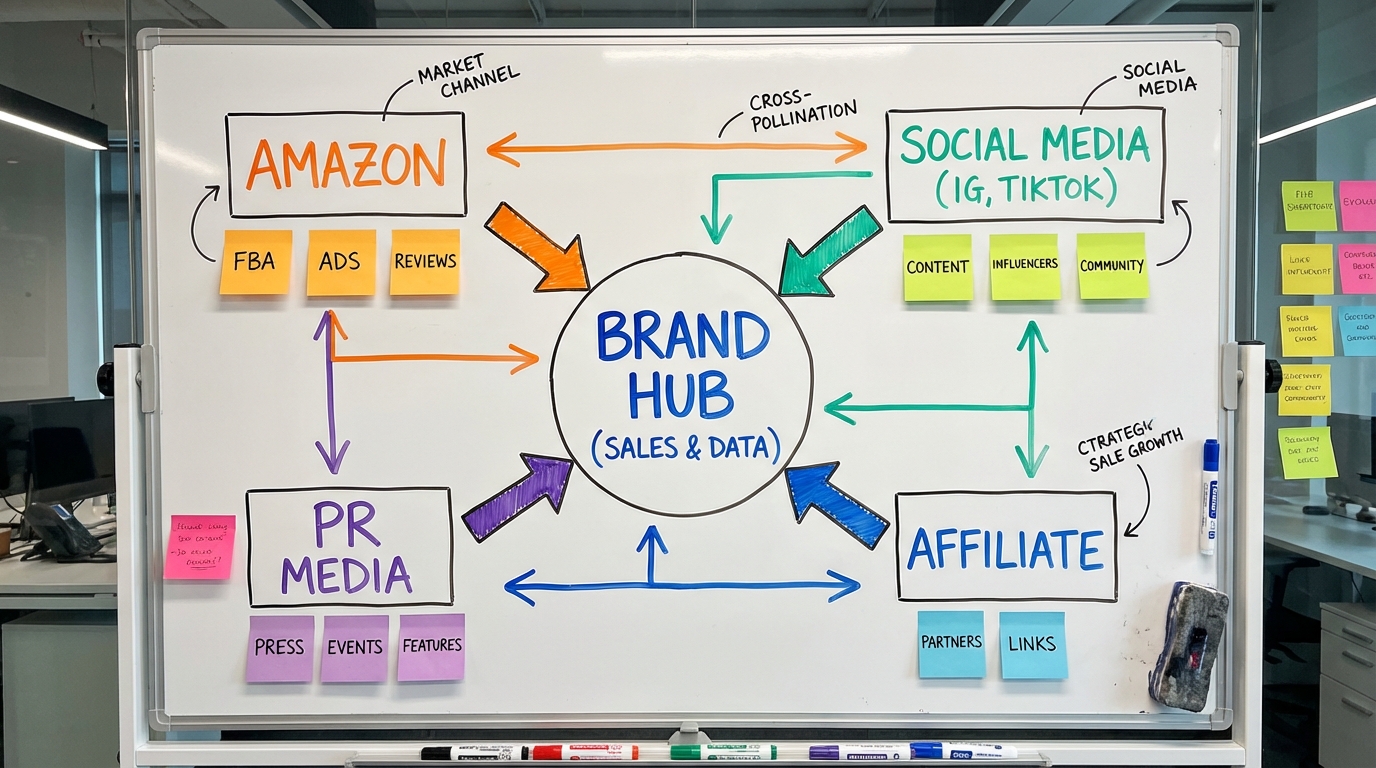
Why Amazon Cannot Be Your Only Growth Channel
Let’s step back and look at the bigger picture, because the HuffPost story illustrates something that goes well beyond a single viral moment.
Amazon is the world’s largest product marketplace, and it remains an essential channel for consumer brands. But it is a marketplace — a platform you sell on, not a platform you own. Amazon controls the rules, the algorithm, the customer relationships, the search results, and the fee structure. Any of those things can change at any time, and when they do, sellers who have built their entire business inside Amazon’s walls have nowhere to go.
The data tells a sobering story. Approximately 80% of Amazon sellers now sell on at least one additional channel, according to industry surveys — a number that has grown significantly as sellers have experienced the consequences of over-dependence. Amazon’s new seller registrations in the US fell by 44% from 2024 to 2025, largely because the market is maturing and sellers who survived the early land-grab years are now focused on building more sustainable, diversified businesses.
What Multi-Channel Actually Looks Like in Practice
Multi-channel selling doesn’t mean you abandon Amazon. It means you build a presence and a traffic infrastructure that isn’t entirely dependent on Amazon’s internal search algorithm. There are several layers to a well-rounded multi-channel strategy:
- Your own website / DTC presence — Even a basic Shopify store gives you the ability to capture customer email addresses, run your own promotions, and build a direct relationship with buyers that Amazon will never allow you to have on-platform.
- Social media content channels — TikTok, Instagram Reels, and YouTube Shorts have become significant traffic drivers for Amazon sellers. The TikTok-to-Amazon referral traffic increase has been tracked at 58% year over year among active creator partners.
- Email list building — An email list is an asset you own entirely. No algorithm change can take it away. Building one through package inserts, post-purchase flows, and DTC captures is one of the highest-leverage long-term investments any product brand can make.
- PR and media outreach — As our HuffPost story proves, editorial coverage from major publications drives real, high-converting traffic and confers credibility that paid advertising simply cannot buy.
- Retail and wholesale — Getting your product into physical retail locations (even small-scale regional ones) creates brand visibility that feeds online sales across all your digital channels.
The Compounding Nature of External Channels
Here’s what the purely Amazon-focused seller misses: every channel you build outside Amazon makes your Amazon listing stronger. When someone discovers your brand through a HuffPost article, goes to Amazon and searches for your brand name, and then buys — that branded search data feeds Amazon’s algorithm, improving your organic rankings for category keywords too. When your TikTok content drives traffic to your listing, the sales velocity boost lifts your BSR, which puts you in front of more Amazon-native shoppers who never saw your TikTok at all.
External channels don’t compete with Amazon. They amplify it.
The sellers who figure this out early build businesses that are both more resilient and more valuable. They’re not at the mercy of a single algorithm update. They have traffic sources, customer relationships, and brand equity that exist independently of whatever Amazon decides to change next quarter.

Building Your Own Creator Outreach System That Gets Results
The question you’re probably asking right now is: how do I build the kind of creator outreach infrastructure that makes something like a HuffPost feature even possible? The honest answer is that it’s not a single tactic. It’s a system — built up over time, across multiple touchpoints, with the right tools and the right positioning in place.
Here’s how to approach it methodically.
Step 1: Get Your Listing Press-Ready Before You Pitch Anyone
Before you reach out to a single creator, blogger, or PR contact, your Amazon listing needs to be in a state that you’d be proud to send to the editorial team of a major publication. That means:
- Professional, high-resolution images (main image, lifestyle images, infographics) — use Algofuse.ai if you don’t have the budget for a traditional studio shoot
- A title and bullet points that are clear, benefit-led, and free of keyword stuffing
- A+ content or Brand Story that presents your brand professionally
- A strong review count and a rating above 4.0 stars
- Pricing that makes sense for your category and target customer
PR people, editorial writers, and serious creators evaluate your listing the same way a skeptical shopper does. If anything looks unprofessional or half-finished, they’ll move on to the next product in seconds.
Step 2: Set Up Your Attribution Infrastructure
Create an Amazon Attribution account (free for brand-registered sellers) and generate unique tracking tags for every creator and channel you’ll be working with. This is non-negotiable — without attribution, you’re flying blind, and you’ll never be able to trace a future spike back to its source the way we did.
Pair this with the Brand Referral Bonus enrollment to ensure every external sale you drive earns you a credit on Amazon’s referral fees.
Step 3: Build Your Creator List Systematically
Your outreach list should have multiple tiers:
- Tier 1: Micro and nano-influencers (1,000–50,000 followers) in your product niche. These are your volume play — many relationships, consistent content, steady traffic flow. They’re also the most likely to say yes to an affiliate arrangement without requiring a large upfront payment.
- Tier 2: Bloggers and niche publishers — People who write buying guides, product roundups, and category reviews. Find these through Google searches for “[your category] best products” or “[your product type] buying guide.” These articles often include affiliate links and their authors are actively looking for new products to feature.
- Tier 3: PR companies and major media — Larger publications work through PR intermediaries who are constantly sourcing products for their editorial clients. Building relationships with these companies — often by making sure you’re discoverable through affiliate networks — is how you get in front of outlets like the Huffington Post.
Step 4: Make Your Outreach Irresistible
The most common mistake in creator outreach is making the pitch all about you. A creator doesn’t care about your product story — they care about what your product can do for their audience and what it means for their earnings or content calendar.
Your outreach message should be short, specific, and creator-centric. Lead with what’s in it for them: a strong commission rate, a product their audience will genuinely love, and a listing that will convert well (so their affiliate earnings are maximized). Include your Amazon listing link upfront so they can evaluate it immediately. Don’t bury the lead in paragraphs about your brand history.
Keep the ask simple. You’re not asking for a commitment to a multi-post campaign on day one. You’re asking them to check out the product and let you know if it feels like a fit for their audience. Lower the friction and your acceptance rate climbs significantly.
Step 5: Use Amazon Creator Connections as Your Platform
Amazon’s own Creator Connections platform is the most direct and measurable way to run structured creator campaigns. You set a campaign budget, define your commission rate (on top of standard Associates rates), and creators with active Amazon Influencer or Associates accounts can apply to participate. You review applicants, approve the ones who are a strong fit, and track performance in real time through Amazon’s native reporting.
The platform has grown explosively — from 30,000 campaigns to 125,000 in just a few months — which tells you two things: it works, and you’re competing with more brands for creator attention than you were a year ago. Standing out requires offering competitive commissions, providing high-quality affiliate assets, and having a listing that converts well so creators see meaningful earnings from their efforts.
Step 6: Don’t Stop. Keep Going.
This is perhaps the most important instruction in this entire post, because it’s the one most sellers ignore after their first success (or their first rejection).
Creator outreach is a long game. Most of the creators you reach out to won’t respond. Some who do respond won’t convert. Some who feature your product will drive disappointing traffic. And then — unexpectedly, without warning, on a random Tuesday morning — a PR company will feature you on Page 1 of the Huffington Post’s shopping section, and everything changes.
You cannot predict which creator relationship will turn into the big moment. But you can guarantee you’ll never have the big moment if you stop outreach after a slow week or two. The sellers who win with external traffic are the ones who treat it as an ongoing, systematic practice — not a campaign they run once and evaluate.
What This Whole Experience Taught Us About Brand Building
Looking back on that Tuesday morning — the spike, the panic, the investigation, the discovery — what strikes us most is how much the outcome depended on decisions we’d made months earlier. The attribution tags were already set up. The affiliate program was already running. The creator outreach system was already in motion. And our listing images were already press-ready, thanks to the work we’d done with Algofuse.ai.
We didn’t create the conditions for a HuffPost feature on the day it happened. We created those conditions weeks and months in advance, through consistent and systematic work that produced no visible results in the short term. That’s the part of the story that doesn’t get talked about enough.
The Quiet Infrastructure Wins
There’s a version of the Amazon seller journey that looks exciting from the outside: a product launch, a PPC campaign, some reviews, and then hopefully a sustained sales rate. That’s the standard playbook, and it works — up to a point.
But the sellers who build genuinely durable businesses are the ones doing the unglamorous infrastructure work alongside the product launches. They’re setting up attribution. They’re building creator lists. They’re sending outreach emails that go unanswered. They’re keeping their listings optimized with professional images even when the sales rank doesn’t warrant it. They’re showing up in affiliate networks and making their product discoverable to PR companies they’ll never directly interact with.
And then one day, the infrastructure pays off in a way they never specifically planned for.
Presence Across Channels Is Now a Competitive Requirement
The Amazon marketplace of 2025 and beyond is not the relatively wide-open frontier it was in 2017 or 2018. With over 1.6 million active sellers in the US alone — and competition in most categories intensifying — the sellers who win are the ones who bring external demand to the platform rather than competing exclusively for the demand that’s already there.
Every external traffic source you build is a competitive moat. A competitor can outbid you on PPC. They cannot duplicate your relationship with the creator who’s been recommending your product to their audience for two years. They cannot replicate the editorial trust you’ve built with a PR company that now regularly pitches your product to major publications. Those relationships and that credibility compound over time in ways that ad spend never can.
Actionable Takeaways: What to Do Starting This Week
We’ve covered a lot of ground in this post. Here’s the condensed version — the specific actions you can take right now to start building the kind of external traffic infrastructure that made our HuffPost moment possible.
This Week:
- Audit your listing images honestly. Would a journalist at a major publication be proud to feature a screenshot of your main image in their article? If the answer is anything other than an enthusiastic yes, fix it. Use Algofuse.ai to generate a complete, professional image set quickly and affordably.
- Enroll in Amazon Brand Referral Bonus if you haven’t already. It takes minutes and it immediately makes every external sale you drive more profitable.
- Set up Amazon Attribution tags for every external channel you plan to use. Create a master tracking sheet so you can see performance by source at a glance.
This Month:
- Build a creator outreach list of at least 50 targets. Include nano-influencers in your niche, bloggers who write buying guides in your category, and any relevant newsletters or online publications. Tools like Creator.co, Grin, or even manual Google research can help you build this list.
- Launch a Creator Connections campaign on Amazon with a compelling commission rate. Start at a rate you can sustain and see who applies. Review applicants carefully — look for creators whose audience matches your customer profile.
- Send your first 20 outreach emails. Keep them short, lead with creator benefit, include your listing link, and make the affiliate commission clear. Don’t expect a high response rate. A 5–10% positive response rate is normal and worth the effort.
This Quarter:
- Identify 3 PR companies in your product category that regularly produce content for major publications. Research how they discover products (many have open submission forms or are active in affiliate networks). Make sure your product is discoverable through those channels.
- Start or grow a non-Amazon presence — even if it’s just a simple email capture on a Shopify landing page. Begin collecting customer relationships that you own and control.
- Review your Attribution data monthly. Look for patterns: which creators are driving the highest conversion rates? Which channels are sending the most traffic? Double down on what’s working and redirect your outreach budget away from what isn’t.
Conclusion: The Next Spike Shouldn’t Be a Surprise
The morning we saw our sales quadruple, we were caught off guard. We’re grateful it turned out to be a wonderful surprise rather than a sabotage situation — but “grateful for a happy accident” is not a strategy.
The real lesson here isn’t that creator outreach can produce a HuffPost feature. The real lesson is that the infrastructure has to exist before the opportunity shows up. The PR company found us because we were present in the right channels. They clicked on our listing because our images looked the part. They featured us because our product delivered genuine value and was presented in a way that made editorial inclusion an easy decision.
None of that happened by accident. It happened because we’d invested in the right foundations — affiliate program setup, creator outreach systems, professional listing images through Algofuse.ai — and those foundations were quietly doing their job in the background, making us visible and ready for the moment that eventually arrived.
Your next spike is out there waiting. It might come from a micro-influencer who decides to rave about your product in their newsletter. It might come from a blogger who stumbles on your affiliate link and writes a roundup post. It might come from a PR company who purchases your product and decides it belongs on Page 1 of one of the most-read shopping sections on the internet.
You can’t control exactly when it arrives. But you can build the infrastructure that makes it inevitable.
Don’t stop. Keep going. Amazon isn’t the only growth channel out there — and the sellers who understand that are the ones building businesses that last.
Ready to get your Amazon listing press-ready? Start with your images. Algofuse.ai generates professional, conversion-optimized listing images for as little as $5 per listing — the same AI-powered visuals that landed us on Page 1 of the Huffington Post’s shopping section.