


Picking a freight forwarder for Amazon FBA is one of those make-or-break decisions that directly impacts your bottom line. It’s so much more than just ticking a box on your launch checklist. Get it right, and you have a partner who’s basically an extension of your own team. Get it wrong, and you’re looking at a business-killing nightmare of surprise fees, customs delays, and rejected shipments at Amazon’s docks.
Your Forwarder Is a Strategic Partner, Not Just a Cost
Too many sellers fall into the trap of treating their freight forwarder like a commodity, picking solely based on the lowest initial quote. This is a massive, costly mistake. A true FBA logistics partner does way more than just move boxes from Point A to Point B. They’re the guardians of your profit margins, the experts who keep you compliant, and the reason your inventory stays in stock and selling.
You can really see the difference between a basic shipper and a strategic partner play out during a product launch.
Let’s say you’re launching a new product you’ve sourced from Shenzhen. The quotes you get might look pretty similar on the surface, but the devil is always in the details. A subpar forwarder might miss something small—like the exact wording required for a poly-bag suffocation warning in your specific product category.
That one tiny oversight can cause Amazon to reject your entire shipment. Suddenly, you're on the hook for return shipping, re-prepping everything, and sending it all back in. You’re looking at weeks of delays, a nosedive in sales velocity, and thousands of dollars in costs you never planned for.
The Real-World Impact on Your Profitability
A genuinely strategic forwarder, on the other hand, sees these problems coming a mile away. They live and breathe Amazon's constantly changing FBA prep rules. Before your goods even think about leaving the factory, they’re on top of it.
For example, a proactive workflow from a top-tier forwarder might look like this:
- Booking: You provide your supplier details and a packing list.
- Supplier Coordination: The forwarder's agent contacts your supplier to confirm the cargo-ready date and FBA prep requirements.
- Pre-Shipment Check: Before pickup, the agent requests photos to verify carton labels, dimensions, and weights, catching potential issues early.
- Customs Pre-Clearance: They use your documents to pre-clear the shipment with customs while it's still on the water, minimizing port delays.
- Delivery Appointment: They schedule the final delivery appointment with Amazon, ensuring a smooth handoff.
This kind of proactive work turns a potential disaster into a smooth, profitable launch. Your products show up at the fulfillment center ready for immediate check-in, which protects your investment and, just as importantly, your brand's reputation with Amazon.
Your freight forwarder is a linchpin in your entire global supply chain. They aren't just a vendor; they become a core part of your international supply chain management strategy.
We see this distinction play out constantly. To make it crystal clear, let's break down the tangible impact of choosing the right partner versus just a cheap shipper.
Strategic Partner vs. Basic Shipper: The Bottom Line Impact
This table shows the real-world difference a high-quality forwarder makes on key business metrics.
| Metric | Top-Tier FBA Forwarder (Strategic Partner) | Subpar FBA Forwarder (Cost Center) |
|---|---|---|
| Landed Cost | 15-30% lower due to optimized customs, fewer penalties, and efficient routing. | Inflated by unexpected fees, customs delays, and re-prepping charges. |
| Inventory In-Stock Rate | Consistently high (95%+); predictable lead times keep you selling. | Unpredictable; frequent stockouts lead to lost sales and ranking drops. |
| Amazon Receiving Errors | Near-zero rejections due to expert pre-shipment prep and compliance checks. | High error rates (10-15% industry average) leading to costly rejections. |
| Account Health Risk | Low risk. Proactive compliance protects your seller account from suspension. | High risk. Non-compliant shipments can trigger warnings and account suspension. |
| Launch Velocity | Maximized. Smooth, on-time delivery helps you hit sales goals and rank faster. | Severely hampered. Delays kill momentum and give competitors an opening. |
The numbers don't lie. A strategic partner actively contributes to your growth, while a subpar one becomes a constant drain on your resources and profits.
Evidence from High-Volume Sellers
The financial payoff of a true partnership is huge. A late 2025 survey of high-volume Amazon sellers revealed that working with top-tier forwarders helped them slash their landed costs by a staggering 15-30%.
How? It came down to near-perfect prep accuracy and flawless customs clearance. Many of these sellers reported zero prep rejections from Amazon, a world away from the industry average of 10-15% error rates. You can dive deeper into how the right forwarder shapes FBA success by checking out the findings on Unicargo.com.
Ultimately, viewing your freight forwarder for Amazon FBA as a growth partner isn't an expense—it’s one of the smartest investments you can make for the long-term health of your e-commerce business.
How to Find and Properly Vet Your FBA Forwarder
Finding a solid freight forwarder for your Amazon FBA business isn't as simple as a Google search for "cheap shipping." Let’s be real, the best partners aren’t usually the ones spending the most on ads. Instead, you'll find them through trusted communities and specialized platforms where real sellers share their unfiltered experiences.
Your best first stop is private Amazon seller communities. Think Facebook groups, Discord channels, or niche forums. Sellers in these groups are brutally honest about who they work with. They'll quickly tell you which forwarders talk a big game but can't deliver, saving you a world of hurt. Their real-world recommendations are gold.
Another great starting point is a freight marketplace like Freightos. These sites let you compare multiple quotes in minutes, giving you a solid feel for the current market rates. Just remember, the cheapest quote is rarely the best. A lowball price from a forwarder who doesn't get the nuances of FBA is a recipe for disaster.
Go Beyond the Quote with Smart Questions
Once you’ve got a shortlist, the real work begins: the vetting process. This is where you weed out the generalists from the true FBA pros. Your mission is to dig into their processes, see how they communicate, and—most importantly—find out how they handle things when they go wrong. Because trust me, something will eventually go wrong.
Treat this like an interview. You’re the one hiring. Come armed with specific, scenario-based questions that test their actual knowledge of Amazon’s notoriously strict rules.
Here's a practical workflow for vetting:
- Initial Contact: Send an email with your shipment details (product, volume, origin, destination) to 3-4 potential forwarders.
- First Response Test: Analyze their first reply. Is it a generic quote or a detailed, itemized breakdown? Is it professional and prompt?
- The "Problem" Question: Ask a scenario question like, "My supplier applied the wrong FNSKU labels. What's your process for fixing this at the port of origin?"
- Reference Check: Ask for a reference from another Amazon seller they work with. A confident forwarder will gladly provide one.
A great forwarder won’t give you vague, canned answers. They'll lay out detailed, step-by-step procedures that prove they've navigated these exact headaches countless times. Their confidence should give you confidence.
The flowchart below nails this decision point perfectly—it shows the path from a risky shipper to a true strategic partner who actually protects your business.
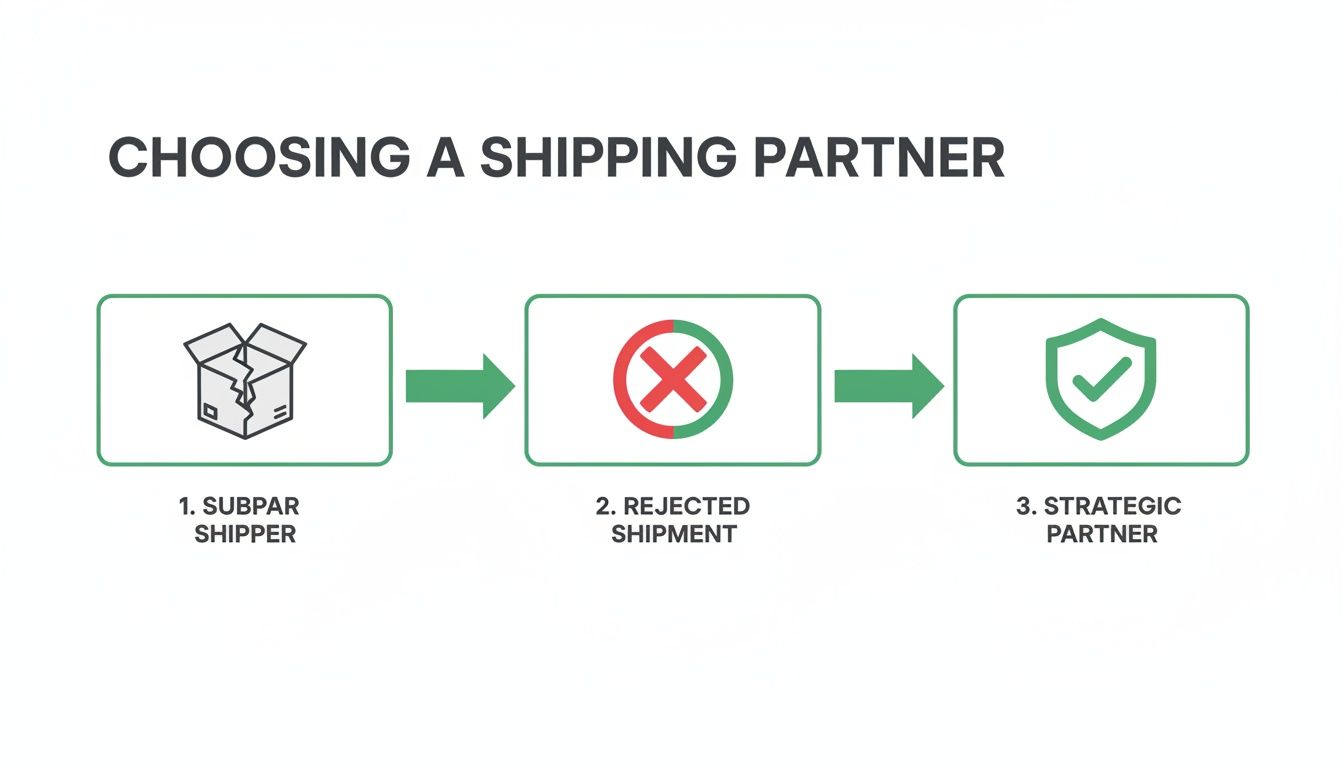
As you can see, cutting corners with a subpar forwarder is a direct line to expensive rejected shipments. A strategic partner, on the other hand, is your ticket to a smooth, predictable supply chain.
Comparing Two Potential Forwarders A Real-World Example
Let's play this out. Imagine you need to ship 50 cartons from Shanghai to an Amazon FC in California and have narrowed it down to two companies.
Forwarder A shoots you a one-line email with a cheap, all-in price. That's it. When you ask about their process for handling a prep rejection, their entire reply is, "We will let you know if it happens." Their communication is slow, lazy, and leaves you feeling completely in the dark.
Forwarder B sends over a fully itemized quote breaking down every single cost: ocean freight, customs brokerage, drayage, and the final FBA delivery fee. When you ask the same rejection question, they reply with their clear, four-step process. They explain they’d immediately notify you with photos from the carrier, present options for re-labeling at a partner 3PL nearby, and provide an exact cost estimate for the fix. If you want to dive deeper into choosing a logistics partner, check out our guide on the best 3PL for Amazon sellers.
In this scenario, Forwarder B is the obvious choice. Their quote might be a few bucks higher, but their transparency and proven expertise are invaluable. They aren’t just selling a price; they’re selling a reliable solution and peace of mind. That’s the mark of a true freight forwarder for Amazon FBA—someone who acts like a partner, not just a vendor.
Navigating Customs Documentation Like a Pro
Let’s be honest: international shipping paperwork can feel like trying to read a foreign language. But mastering the basics is the key to getting your products across borders without a nightmare scenario. Getting this documentation right isn’t just a good idea—it’s completely non-negotiable for any Amazon FBA seller importing goods.
A single typo or mismatched number on a form can trigger costly inspections, infuriating delays, and even hefty fines from customs. This is where your freight forwarder becomes your most valuable player. Think of them as your translator and guide through this maze, responsible for preparing and submitting everything correctly on your behalf.
The Three Essential Documents
While you might encounter a stack of different forms, every international shipment is built on a foundation of three core documents. Your forwarder will lean on you and your supplier to provide accurate information to get these filled out perfectly.
- Commercial Invoice: This is the big one. It's the official bill of sale for your goods, spelling out who the buyer is (you), who the seller is (your supplier), and exactly what's being shipped. It includes product descriptions, their value, and the critical HTS codes. Customs officials live by this document to calculate the duties and taxes you owe.
- Packing List: Just like it sounds, this document breaks down the contents of your shipment in granular detail. It lists the total carton count, what’s inside each carton, and the precise weight and dimensions of every box. This list must be a perfect mirror image of the physical goods in your shipment.
- Bill of Lading (B/L) or Air Waybill (AWB): This serves as the contract between you (the shipper) and the carrier. It’s also the official receipt for your goods and contains all the logistical details needed to process the shipment, like the consignee (who is receiving the goods) and the agreed-upon shipping terms (Incoterms).
A skilled freight forwarder doesn't just fill out forms. They scrutinize them. They'll cross-reference the Commercial Invoice against the Packing List to catch discrepancies before customs officials do, saving you from delays that can derail a product launch.
Why HTS Codes Are So Important
One of the most critical—and often overlooked—details on your Commercial Invoice is the Harmonized Tariff Schedule (HTS) code. This is a global system of numeric codes used to classify every product imaginable. Customs authorities use this code to look up the exact tariff or duty rate that applies to your specific item.
Getting this code wrong is a classic rookie mistake, and it can be an expensive one. An incorrect HTS code can lead to a world of hurt:
- Overpaying Duties: You could be slapped with a much higher tax rate than necessary, which eats directly into your profit margins on every single unit.
- Underpaying and Getting Penalized: If customs catches you using a code with a lower duty rate, you’ll be on the hook for the back-taxes plus some pretty significant financial penalties. It’s not worth the risk.
- Shipment Seizures: In the worst-case scenario, customs can seize your entire shipment until the mess is sorted out. This process can drag on for weeks or even months, leaving you with no inventory to sell.
A knowledgeable freight forwarder for Amazon FBA will help you or your supplier nail down the correct HTS codes for your products from the start. This simple, proactive step is absolutely vital for maintaining healthy cash flow and predictable landed costs. If you're shipping apparel, a resource like A Freight Forwarder's Guide to Harmonized Code for Clothing can be a lifesaver.
Incoterms: A Practical Scenario
Incoterms are the international rules of the road that clearly define the responsibilities of the seller and the buyer. The Incoterm you choose with your supplier determines who pays for what—and who carries the risk—at each stage of the shipping journey.
Let's walk through a real-world example. Imagine you're shipping 1,000 units of a new gadget from your supplier in Shenzhen, China. Here’s how two of the most common Incoterms would play out:
- FOB (Free On Board): Your supplier produces the goods and trucks them to the port in Shenzhen. The second that cargo is loaded onto the ship, all responsibility and cost flips over to you. Your Workflow: You hire a freight forwarder who arranges the ocean voyage, US customs clearance, and final delivery. You receive separate bills for each of these stages.
- DDP (Delivered Duty Paid): This is the ultimate "set it and forget it" option for an Amazon seller. Your freight forwarder handles the entire process from the factory door in China all the way to the Amazon FBA fulfillment center. Your Workflow: You give your forwarder the supplier's contact info. They handle everything else. You receive one all-inclusive invoice.
For most sellers, especially those just starting out, DDP is the way to go. It might look a little more expensive on the initial quote, but it gives you total cost certainty. More importantly, it removes the entire logistical headache from your plate, letting you focus on marketing your new product instead of wrestling with customs forms.
Mastering Amazon FBA Prep and Compliance Requirements
Amazon's fulfillment centers are a finely tuned machine, and their inbound shipment rules are notoriously rigid. I’ve seen it happen time and again: one small mistake—a misplaced label, a carton that's a pound too heavy—gets an entire shipment rejected at the dock. This isn't just a minor hiccup; it's a costly disaster that brings your sales to a screeching halt.
This is where a good freight forwarder for Amazon FBA becomes your most valuable player. They act as your last line of defense, catching the kind of simple errors that could otherwise cost you thousands in return shipping, re-prepping fees, and lost revenue. Making sure your products are 100% compliant before they even leave the supplier is non-negotiable.
The Non-Negotiable Carton Rules
Amazon has two absolute, hard-and-fast rules for master cartons. Violate them, and your boxes will be flagged and refused on arrival. No excuses, no exceptions. Your forwarder has to be obsessive about checking every single carton for these two things.
- Weight Limit: A single carton cannot weigh more than 50 lbs (22.7 kg). If you have an oversized unit that weighs more than 50 lbs on its own, the box must have a "Team Lift" label clearly visible.
- Dimension Limit: No single side of a carton can measure more than 25 inches. This is a practical rule to prevent boxes from getting jammed on the miles of conveyor belts inside the fulfillment centers.
An experienced forwarder never just takes the supplier's word for it. They'll be on the ground, physically spot-checking cartons to confirm the weights and dimensions are correct, saving you from a painful and completely avoidable rejection.
The Art and Science of FBA Labeling
If there's one area where shipments consistently fail, it's labeling. It’s arguably the most common pitfall for new sellers. Amazon's entire automated receiving system relies on perfectly placed, scannable barcodes to process your inventory. A forwarder who truly specializes in FBA knows these nuances like the back of their hand.
Here is a step-by-step FBA labeling workflow your forwarder (or supplier) must follow:
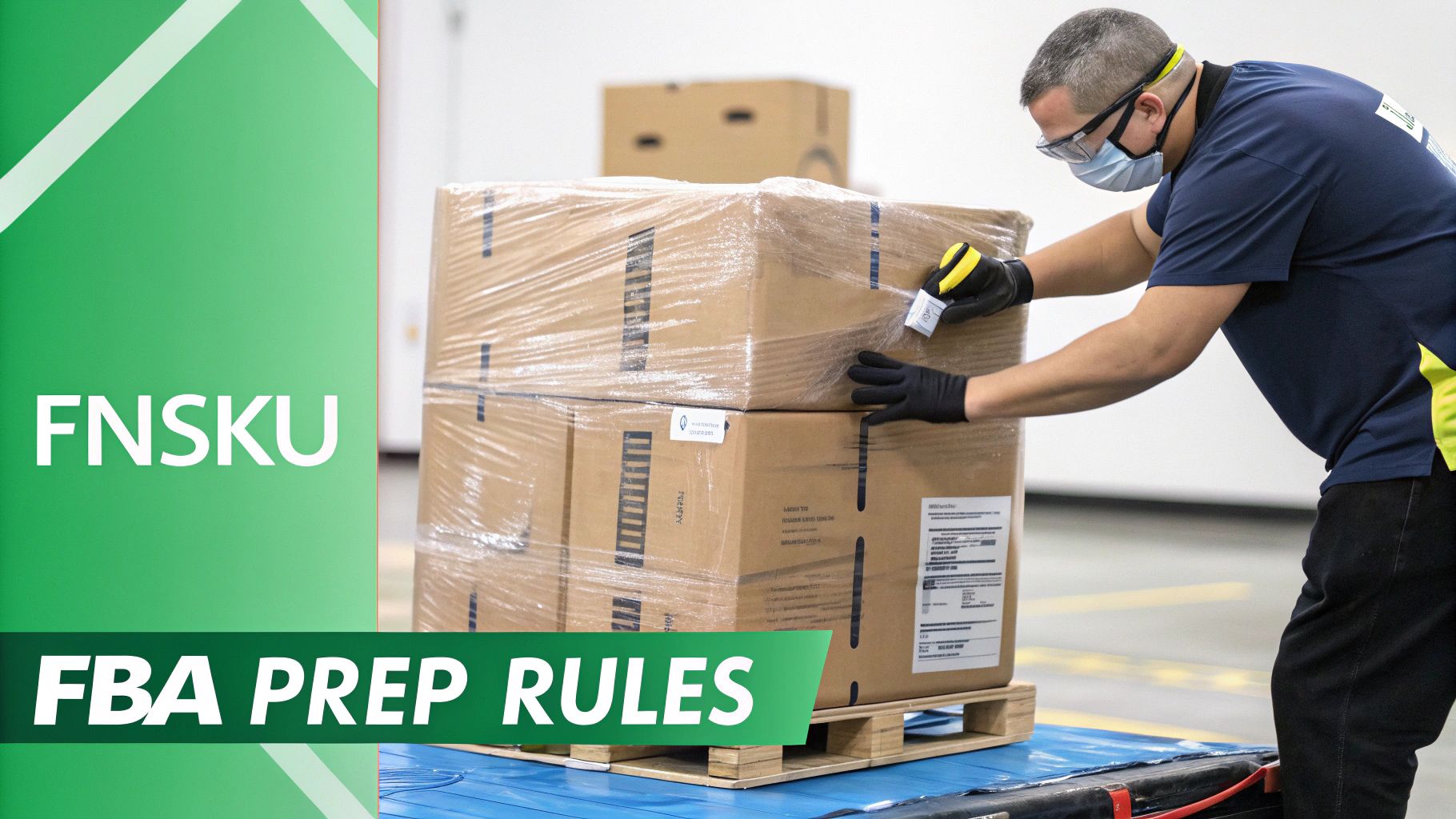
- Generate Labels: Create your FNSKU labels within your Seller Central shipping plan.
- Cover Old Barcodes: Apply the FNSKU label directly over any existing UPC or EAN barcodes on the product packaging. There should only be one scannable barcode visible.
- Apply Warning Labels: Add any required labels, such as "Suffocation Warning" for poly bags or "Sold as Set" for bundled items.
- Pack Cartons: Place the fully labeled units into the master cartons, adhering to weight and dimension limits.
- Apply FBA Box Labels: Place the final FBA carton label (generated from the same shipping plan) on a flat, clear side of each box, avoiding seams or edges.
Real-World Example: A Common Mistake
A seller is launching a garlic press. The product comes in a small retail box with a UPC barcode printed on it. The supplier is instructed to apply the FNSKU labels. However, they place the FNSKU label on the side of the box, leaving the original UPC visible on the bottom. When the shipment arrives at Amazon, scanners pick up both barcodes, causing receiving errors, delays, and stranded inventory. A good forwarder would have caught this by requesting pre-shipment photos.
This meticulous process ensures every single unit and every carton glides through Amazon's intake system. That means faster check-in times and your products going live for sale that much sooner. For sellers who want to completely offload this crucial step, dedicated Amazon FBA prep services are a game-changer.
Meticulous FBA prep isn't just about following rules; it's about safeguarding your investment. Every compliant carton protects your cash flow, prevents stockouts, and preserves your sales velocity on the world's largest marketplace.
The sheer scale of Amazon's operation is why this precision is so vital. Over 82% of Amazon's 9.7 million sellers use FBA, shipping over 5 billion products annually through more than 1,200 facilities. With that kind of volume, there's zero room for error. For ZonFlip clients, having a rock-solid forwarder is what allows them to scale confidently from a handful of sales to a thriving FBA business.
Understanding Your True Shipping Costs and Avoiding Hidden Fees
That first quote you get from a freight forwarder? It often looks too good to be true. And it usually is. The number you see upfront is almost never the final number you'll pay.
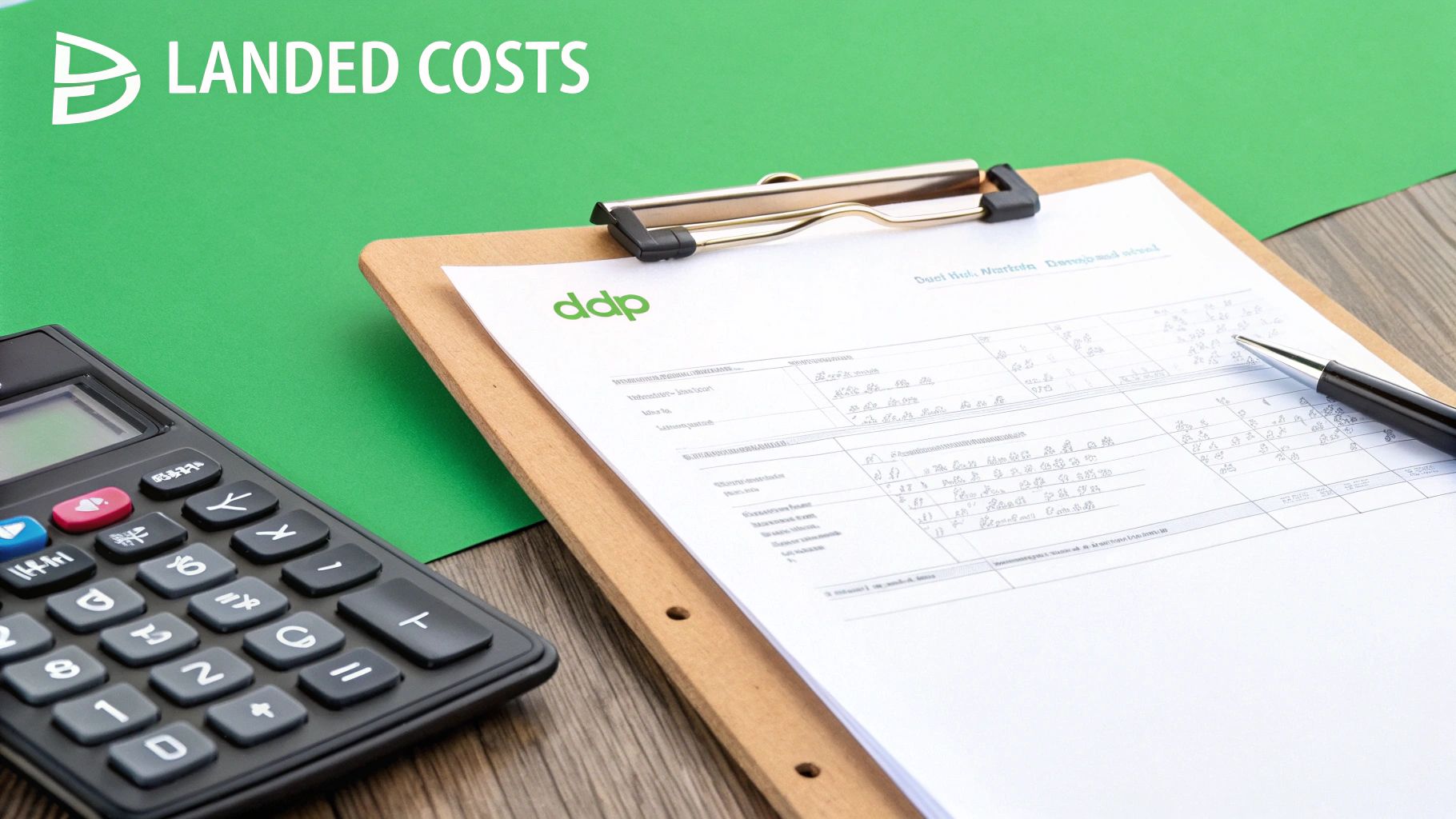
If you want to protect your profit margins, you have to get a handle on your total landed cost. This is the real, all-in price to get your product from the factory floor in China to an Amazon fulfillment center in Ohio, ready to sell.
This figure rolls up everything: the product cost, shipping fees, customs duties, insurance, and any other random charges that pop up along the way. Getting this wrong is the fastest way to turn a winning product into a money pit. It's a massive part of the puzzle when sellers ask if selling on Amazon is still worth it.
Deconstructing a DDP Shipping Quote
Let's pull back the curtain on a typical quote. Imagine you get a DDP (Delivered Duty Paid) quote to ship your inventory. A good, transparent forwarder will break it down line by line, but it's often full of confusing terms that can seriously impact your bottom line.
Practical Example: A Quote for 2 Cubic Meters (CBM) from Shanghai to LAX
- Ocean Freight: $80/CBM x 2 = $160
- Origin THC (Terminal Handling): $45
- Destination THC: $75
- Customs Clearance/Brokerage: $150
- Import Duties (e.g., at 5% of $2,000 value): $100
- Customs Bond: $50 (for a single entry bond)
- Drayage & Final Mile Delivery to Amazon FC: $250
- Total Quoted Cost: $830
Knowing what these individual pieces mean lets you compare quotes apples-to-apples and instantly spot a forwarder who’s trying to hide fees in one big, vague number.
A trustworthy freight forwarder for Amazon FBA will give you a fully itemized quote right from the start. If a quote seems suspiciously cheap and lacks detail, that’s a massive red flag. Always demand a complete breakdown before you sign anything.
The Non-Negotiable Need for Cargo Insurance
Shipping without cargo insurance is like driving without car insurance. It’s a gamble you simply can’t afford to take. A huge misconception is that the shipping line is on the hook if your goods get damaged or lost. The hard truth is that their liability is legally capped at a tiny fraction of your inventory's value—often just a few hundred dollars for an entire pallet.
I've heard horror stories. One FBA seller tried to save a few hundred bucks by skipping insurance on a $40,000 container of their best-selling product. Halfway across the Pacific, the ship hit a massive storm, and several containers, including theirs, were swept overboard. The carrier's liability paid out less than $500. The seller lost everything and was out of stock for months, nearly killing their business.
Cargo insurance is incredibly cheap, typically costing only 0.3% to 0.5% of your commercial invoice value. For that $40,000 shipment, full coverage would have been around $200. It's a tiny price to pay for total financial protection and your own sanity.
Three Common Pitfalls and How to Sidestep Them
Beyond the quote itself, a few operational hiccups can blow up your costs and create major headaches. Here are the three I see trip sellers up most often, and how you can get ahead of them.
Miscalculating Peak Season Delays: The lead-up to Q4 is pure chaos. Ports get jammed, carriers are overbooked, and shipping times become a wild guess. This isn't just a feeling; recent data showed a 37% spike in shipping delays, adding an average of 23 extra days to FBA shipments. For 78% of sellers, that delay directly hit their profits.
- How to Avoid It: Get your holiday inventory on the water by August at the latest. Talk to your forwarder and book your shipment 4-6 weeks in advance to lock in your space and a decent rate.
Poor Supplier Communication: Your forwarder is powerless if your supplier isn't ready. Delays in production or not having the cargo packed on the agreed-upon date will cause you to miss the boat—literally. That means rolled shipments and expensive storage fees while you wait for the next one.
- How to Avoid It: Create a shared timeline for your supplier and your forwarder. Check in regularly and re-confirm the "Cargo Ready Date" multiple times as it gets closer. Better yet, introduce your forwarder's local agent in China directly to your supplier to make coordination seamless.
Underestimating Customs Fees: Nothing stings like a surprise bill for thousands of dollars in duties you didn't budget for. This usually happens when sellers use the wrong product classification or aren't aware of things like anti-dumping duties on certain goods.
- How to Avoid It: Before you even pay for your inventory, ask your forwarder to help you confirm the correct HTS code and get an estimate for the duty rate. This simple, proactive step makes your landed cost calculations accurate from day one and saves you from a nasty financial shock at the border.
Common Questions About Using an FBA Freight Forwarder
Even after you've done your research, a few lingering questions can pop up and create a bit of uncertainty. Let's tackle the big ones that sellers almost always ask when they're ready to hire a freight forwarder for Amazon FBA, cutting through the jargon to give you straight, actionable answers.
What Is the Difference Between DDP and FOB, and Which Should I Use?
This is probably the question I hear the most, and for good reason. Your choice here directly impacts your workload, risk, and bottom line.
DDP (Delivered Duty Paid) is the all-inclusive, "set it and forget it" option. With DDP, your forwarder handles absolutely everything—from your supplier's factory door all the way to the Amazon fulfillment center. All the costs, including those pesky customs duties, are bundled into one single price. It’s the perfect choice for new sellers who want zero logistical headaches and predictable costs.
FOB (Free On Board) puts a bit more responsibility on your plate. Your supplier's job is done once your goods are loaded onto the ship at the origin port. From that point on, you and your forwarder are in the driver's seat, managing the ocean freight, insurance, customs clearance in the US, and the final mile delivery. FOB can offer more control and sometimes lower costs for seasoned sellers, but it definitely adds a few more moving parts to the process.
For anyone just starting their FBA journey, DDP is almost always the smarter, safer choice. It completely removes the logistical burden, gives you total cost certainty, and lets you focus on your product launch instead of wrestling with shipping complexities.
How Much Does an FBA Freight Forwarder Actually Cost?
This is the classic "it depends" question. There's no flat rate, as costs swing wildly based on your shipment's size, where it's coming from, where it's going, and whether you choose air or sea. But we can definitely talk about some realistic ballpark figures.
For a typical LCL (Less-than-Container Load) sea shipment, you can expect to pay somewhere in the neighborhood of $150-$400 per cubic meter. If you're shipping a full 40ft container, that could run anywhere from $3,000 to $7,000+, all depending on the chaos of the current shipping market. Air freight is, of course, way more expensive but gets your inventory to Amazon in days instead of weeks.
The most important rule? Always get at least three itemized quotes to compare apples to apples. And be very, very wary of any quote that looks too good to be true. It's a classic freight forwarder trick to lure you in with a low price, only to slam you with hidden fees for things like terminal handling or customs bonds on the final invoice. A good forwarder is transparent with their pricing from day one.
Should I Use My Supplier's Recommended Freight Forwarder?
This might seem like the easiest path, but I almost always advise against it. You have to remember one critical thing: the supplier's forwarder works for the supplier, not for you.
Their main goal isn't to save you money or ensure a smooth FBA delivery; it's to get the product off their factory floor with minimal effort. They are not specialists in Amazon's notoriously strict FBA requirements and have zero incentive to find you the most efficient or cost-effective route.
You are always better off sourcing your own independent freight forwarder for Amazon FBA who specializes in your destination market. Taking this one step puts your interests first and gives you direct control over your own supply chain. It's the best way to prevent expensive mistakes and frustrating communication black holes.
Is Cargo Insurance Really Necessary for FBA Shipments?
Yes. An absolute, non-negotiable 100% yes. Shipping your inventory across an ocean without cargo insurance is a gamble you simply can't afford to take.
There's a dangerous myth that the shipping line is responsible if something happens to your goods. The hard truth is that their liability is legally capped at a laughably small amount that will cover only a tiny fraction of your product's actual value. If your container falls off the ship in a storm, gets damaged in transit, or is stolen from a port, you could lose your entire investment in a blink.
The good news is that cargo insurance is incredibly cheap, usually costing just 0.3% to 0.5% of your commercial invoice value. For a $20,000 shipment, that's maybe $100 for total financial protection. It is a tiny price to pay for complete peace of mind. Don't even think about shipping without it.
Navigating the complexities of FBA logistics doesn't have to be a solo mission. At ZonFlip, we provide end-to-end Amazon account management, turning logistical challenges into growth opportunities. Let our team handle the operational details so you can focus on scaling your brand. Learn how we can protect your margins and accelerate your success at https://www.zonflip.com.