


Ask most organizations today whether they have an AI governance policy, and the answer is almost always yes. They have a document. They may have a committee. They might even have a Chief AI Officer with a dedicated budget. What they almost never have is governance that runs where the actual work happens — inside the tools, the pipelines, the approval flows, and the day-to-day decisions that determine what AI does and doesn’t do on their behalf.
This is the central governance failure of 2026, and it’s playing out at scale. Organizations have spent two years building frameworks, publishing principles, and running training modules. Meanwhile, the AI systems those frameworks were supposed to govern have kept shipping. And the employees those principles were supposed to guide have largely kept doing what’s convenient — including using tools no one approved.
The distance between a governance policy and a governance control point is not a minor implementation detail. It is the entire difference between an organization that can demonstrate accountable AI use and one that cannot. The former will navigate tightening regulation with confidence. The latter will discover its gaps the hard way — through a failed audit, a harmful model output, or a regulatory inquiry that reveals nobody knew what their AI was actually doing.
This article is about closing that gap. Not through better documents, but through better wiring. What it actually means to embed governance into the work itself, why most organizations haven’t done it, what the accountability vacuum looks like when things go wrong, and what the organizations getting this right are doing differently.
Why AI Governance Keeps Failing at the Workflow Level
The dominant failure mode in AI governance is not malice or negligence. It is structural. Governance programs are typically designed by people who don’t use the AI tools day-to-day, and delivered to people who don’t have time to consult a policy document before clicking a button. The result is a growing chasm between what the policy says and what actually happens.
Policies live in documents, not in systems
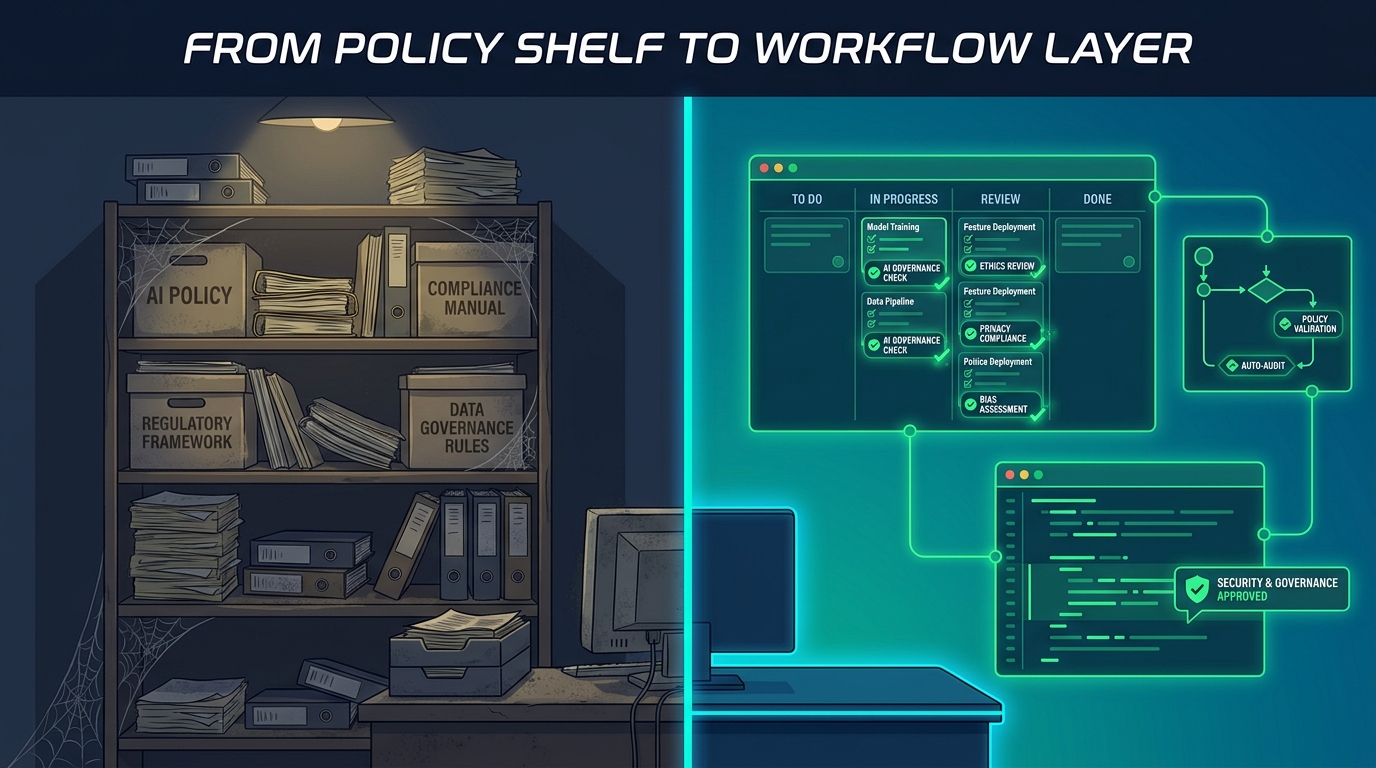
Across enterprises in 2026, the most commonly cited governance problem is that requirements exist on paper — in PDFs, SharePoint pages, and Confluence wikis — but have not been translated into operational controls over data pipelines, model serving layers, or the business applications where AI decisions are actually made. A policy that says “AI outputs affecting customer credit must be reviewed by a qualified human before action is taken” means nothing if the system routes those outputs directly to an automated action queue and nobody has built a review step into it.
This isn’t a new observation, but the scale at which it’s recurring makes it worth stating plainly. The governance design process often ends at documentation. The harder, more technical work of making that documentation enforceable — of wiring it into runtime behavior — rarely gets the same attention, the same budget, or the same executive sponsor.
Ownership is fragmented across too many functions
A related failure is what practitioners have started calling the “governance handoff problem.” AI systems typically pass through multiple teams during their lifecycle: a data science team builds the model, an engineering team deploys it, a product team defines how it surfaces to users, a compliance team reviews documentation, and a business unit owns the outcome. In most organizations, no single one of those teams has clear, enforceable accountability for what the AI does after it’s live.
Recent survey data reflects how unresolved this is. When asked who owns AI governance in their organization, enterprise respondents in 2026 spread responsibility across IT (cited by 25%), risk and compliance (18%), and cross-functional committees (the remainder) — with no clear consensus on who has the final word when something goes wrong. That fragmentation doesn’t just create confusion. It creates risk, because when accountability is diffuse, the conditions for drift and corner-cutting multiply.
Speed of deployment has outpaced governance cycles
There is also a timing problem. Traditional governance processes — risk assessment, legal review, ethics committee sign-off — were designed for software deployments that happen quarterly or annually. AI, particularly generative AI, can be deployed in days. Teams under pressure to show results are not waiting for six-week committee review cycles. They are shipping, and the governance review follows later, if it happens at all. In many organizations, the review backlog for AI systems already in production is months long and growing.
This creates a class of AI systems that are live in production, making real decisions that affect real people, with no completed governance review. The policy exists. The review process exists. But the sequence is broken.
The Shadow AI Epidemic Nobody Wants to Measure
If internal AI deployment processes have governance gaps, employee-initiated AI use has almost none. The data here is stark and getting harder to look away from.
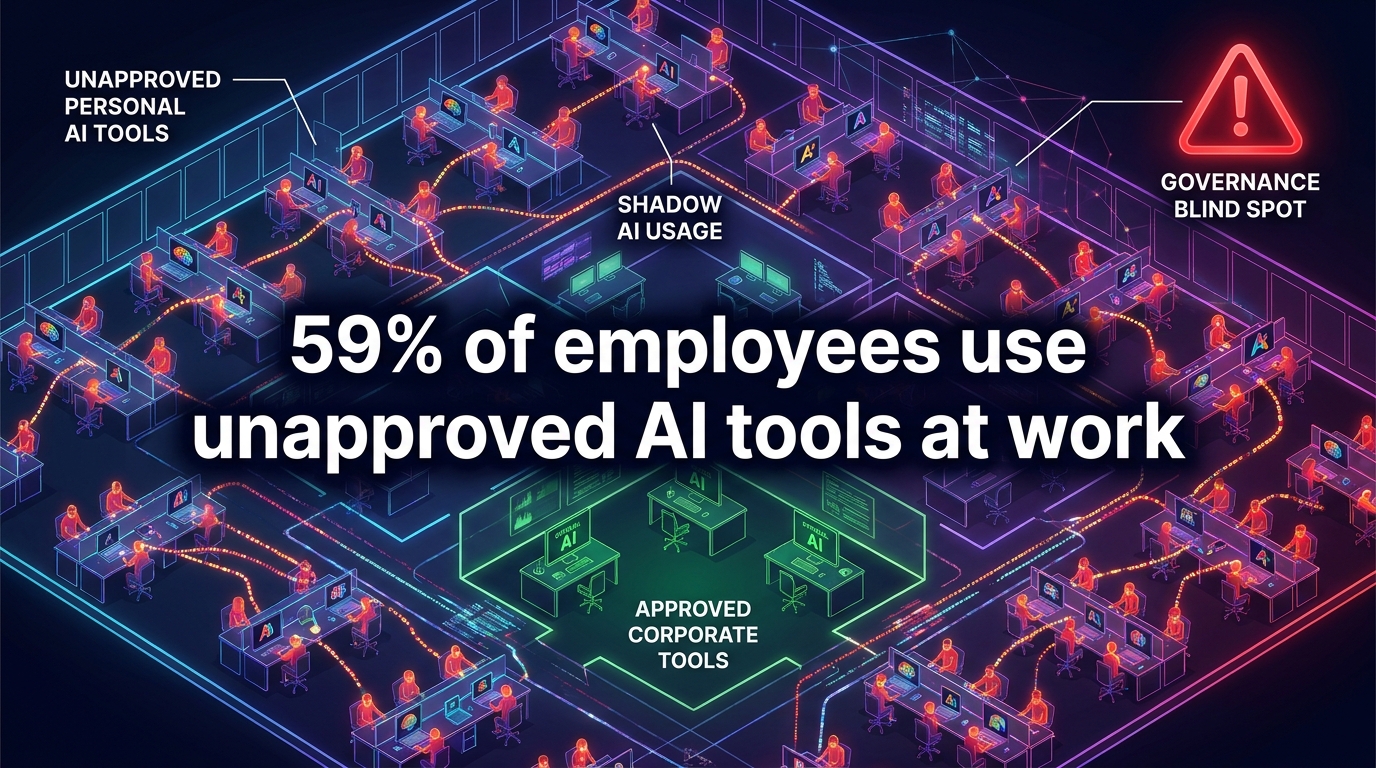
Across multiple 2026 studies, somewhere between 59% and 80% of employees are regularly using AI tools at work that their organization has not approved. The most commonly cited figure sits at approximately 59% — with only around 16% of employees relying exclusively on employer-authorized tools. That means in a typical organization of 1,000 people, somewhere between 590 and 800 are feeding work data into AI systems that IT has never evaluated, legal has never reviewed, and compliance has never inventoried.
Why shadow AI is a governance crisis, not just an IT problem
The instinct from IT and security teams is to treat shadow AI as a data loss prevention problem — and they’re not wrong that it is. Customer data, proprietary financial models, source code, legal strategy documents, and employee personal information are routinely being entered into consumer-grade AI tools with terms of service that organizations haven’t read and data retention policies they cannot audit.
But shadow AI is also a governance crisis in the broader sense. It means that a significant share of the AI-generated work product flowing through an organization — reports, customer communications, code, analyses, summaries — has been produced by systems that no one evaluated for bias, accuracy, or alignment with company policy. The governance framework, however well-written, covers none of it.
Blocking doesn’t solve it — integration does
The instinctive response to shadow AI is blocking: add consumer AI tools to the network blocklist, restrict browser extensions, prohibit unapproved AI in the acceptable use policy. This approach consistently fails, for the simple reason that employees use personal devices, mobile hotspots, and home networks. Blocking tools at the corporate perimeter reduces visibility without reducing usage.
The organizations making genuine progress on shadow AI are doing something different. They are identifying which tools employees are gravitating toward and why — often because approved tools are too limited or too slow — and then either sanctioning appropriate alternatives with governance guardrails attached, or building those capabilities into approved tooling. The goal shifts from prohibition to integration, with governance controls embedded at the point of use rather than enforced at the network edge.
“Governance that works only on approved systems governs a shrinking share of actual AI use. The only durable answer is making the governed path the convenient path.”
What “Embedded Governance” Actually Means in Practice
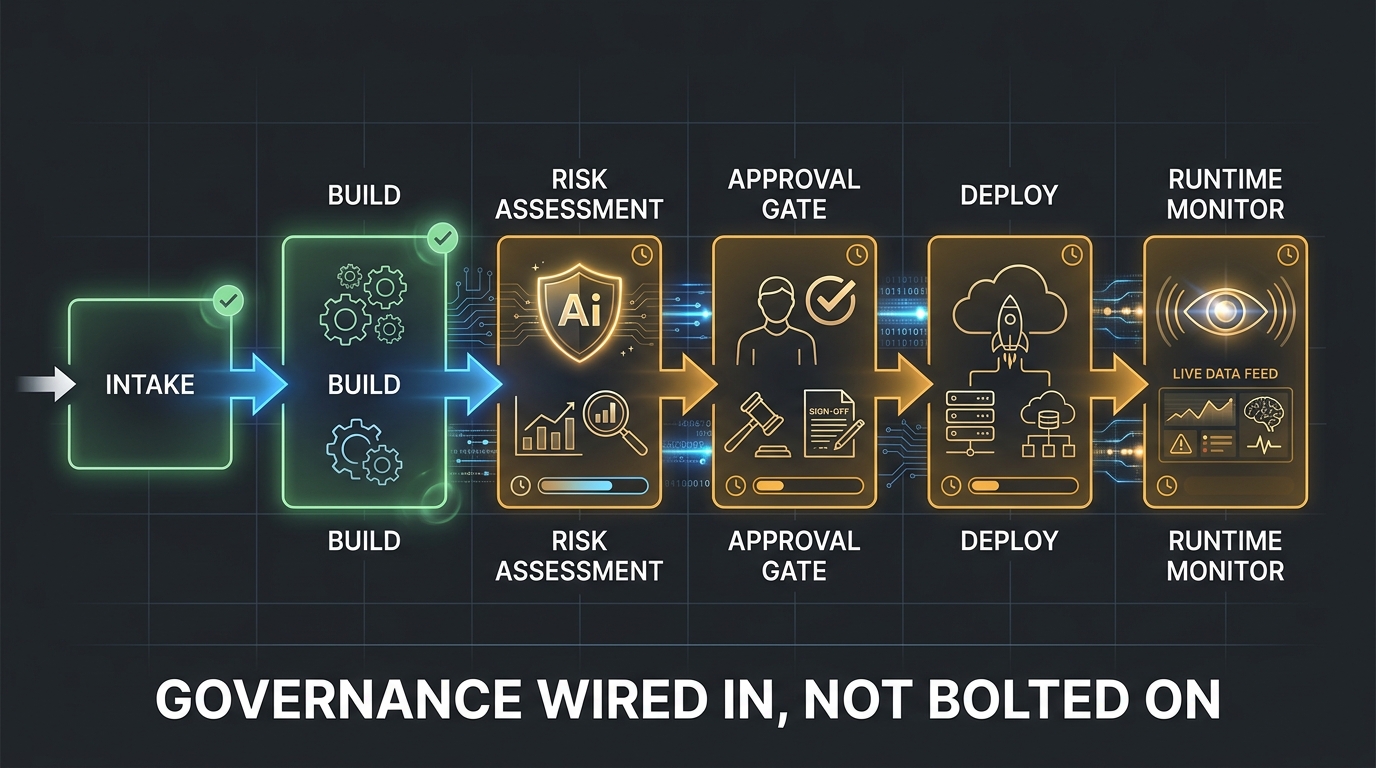
Embedded governance is a term that gets used loosely. In concrete terms, it means that governance requirements are enforced at the point where work actually happens — not reviewed after the fact by a committee, not documented in a policy that employees are expected to recall under time pressure, but built into the systems and processes that structure everyday work.
What does that look like operationally? The clearest examples come from organizations that have treated AI governance the same way mature engineering teams treat security: not as an external review layer, but as an intrinsic property of how systems are built and operated.
Tiered intake processes that match governance to risk
High-functioning AI governance programs in 2026 have moved away from one-size-fits-all review processes and toward risk-tiered intake. The logic is straightforward: an AI tool that auto-generates draft marketing copy carries a different risk profile than one that scores loan applications or recommends clinical treatments. Applying the same six-week committee review to both is simultaneously too slow for low-risk use cases and not rigorous enough for high-risk ones.
Effective tiered systems classify AI initiatives at intake — typically into three or four risk bands based on factors like the sensitivity of data involved, the degree of autonomy the system will have, the reversibility of its decisions, and the regulatory context it operates in. Low-risk initiatives get a lightweight, largely automated review. High-risk initiatives trigger mandatory human sign-off, mandatory documentation, and mandatory post-deployment monitoring. The classification itself becomes a governance artifact, logged and auditable.
Model cards and data sheets as mandatory workflow artifacts
Model cards — structured documents that capture what a model does, what data it was trained on, its known limitations, and the appropriate scope of its use — have existed for years as a best practice recommendation. The shift happening now is that forward-looking organizations are making them mandatory workflow artifacts, not optional documentation. You cannot deploy a model without a completed, reviewed model card. The model card is attached to the deployment ticket. It is checked at the approval gate. It is version-controlled alongside the model itself.
This matters because it changes the behavior of the teams building AI systems. When documentation is optional, it gets skipped under pressure. When the CI/CD pipeline won’t advance without it, it gets completed — and the discipline of completing it forces teams to articulate things they might not have articulated otherwise: what the model is not suitable for, what populations it was not tested on, what monitoring thresholds should trigger a review.
Approval gates wired into existing tooling
Perhaps the most practical advance in embedded governance is the integration of approval gates into tools that engineering and product teams already use daily. Organizations are adding pre-deployment governance checkpoints inside Jira, ServiceNow, GitHub Actions, and CI/CD pipelines. These are not additional steps in a separate system — they are stages in the existing workflow that cannot be skipped.
A deployment pull request that touches a system classified as high-risk automatically triggers a governance review assignment. The ticket doesn’t close and the deployment doesn’t proceed until that review is completed and logged. For lower-risk systems, an automated checklist runs and the results are attached to the deployment record. The audit trail is a natural byproduct of the workflow rather than a separate compliance exercise.
Runtime monitoring as an ongoing governance function
Governance that ends at deployment is governance that misses most of the risk. AI systems drift: their inputs change, their user populations change, their outputs shift in ways that nobody intended. Organizations building real embedded governance treat post-deployment monitoring as a continuous governance function, not a one-time check.
This means defining monitoring thresholds at deployment time — what level of demographic disparity in outputs triggers a review, what accuracy degradation trips an alert, what volume of user override actions signals that the model may be behaving unexpectedly — and then building those thresholds into monitoring dashboards that generate automatic escalations. The governance doesn’t just live in the pre-deployment review. It lives in the ongoing operation of the system.
The Accountability Vacuum: When AI Makes a Bad Call, Who Owns It?
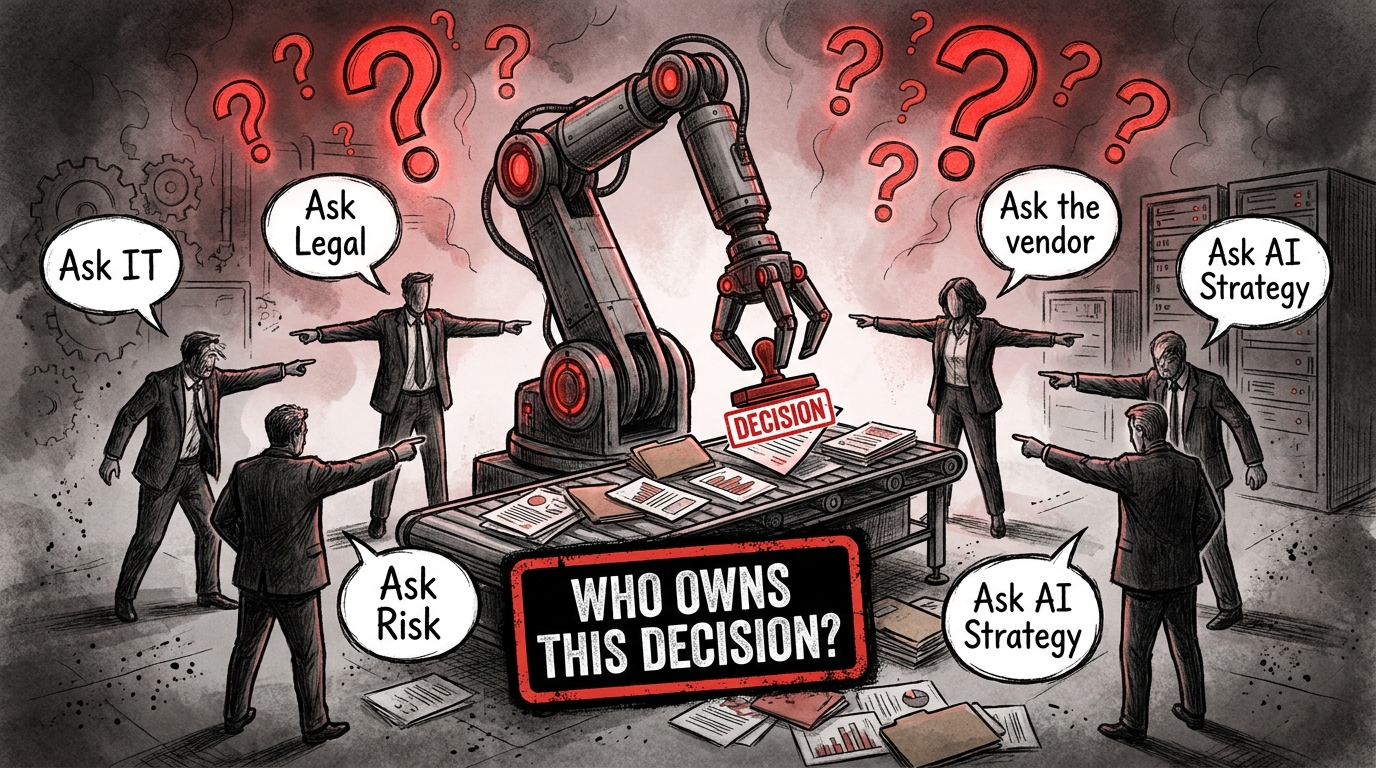
One of the most underappreciated governance problems in 2026 is what happens in the moments after an AI system produces a harmful or erroneous output. Not the PR response, not the incident report — the immediate operational question: who is actually empowered to stop this, and who is responsible for the fact that it happened?
In most organizations, the honest answer is that nobody has a clean answer. Accountability for AI outcomes is diffuse by design — spread across the team that built the model, the team that deployed it, the team that defined its use case, the vendor that supplied the underlying model, and the legal entity that operates the system. Each party has a partial view and partial responsibility. None has complete accountability. This is the accountability vacuum, and it is not a hypothetical.
The legal landscape is resolving this — in ways organizations may not expect
Courts and regulators are not waiting for organizations to sort out their internal accountability structures. Legal analysis emerging from regulatory cases in multiple jurisdictions in 2026 consistently treats AI outputs as organizational acts. If an AI-powered hiring tool systematically discriminates against applicants, the liability sits with the organization that deployed it — not with the AI, not with the vendor, and not with the individual employee who ran it. The deploying organization authorized the system’s use. The deploying organization is responsible for its behavior.
This means the accountability vacuum is not just an internal governance problem. It is a liability exposure. An organization that cannot produce documentation showing who reviewed this AI system, what controls were in place, who had authority to pause it, and what the human oversight mechanism was — that organization is exposed in ways that no policy document retroactively protects against.
How clear ownership changes behavior
The most effective mechanism for closing the accountability vacuum is not a new committee or a new title. It is the assignment of a named, single accountable owner to each AI system in production. Not “the data science team.” Not “the product squad.” One person — ideally at sufficient seniority to have actual authority — whose name is attached to that system in the governance record and who understands they are accountable for its behavior.
Recent data shows approximately 61% of enterprises have now designated an AI governance owner at executive committee level, up from 28% in early 2024. That’s meaningful progress on the program side. The next frontier is cascading that accountability downward — ensuring that every system in production, not just the governance program as a whole, has a named owner who is actively engaged with how the system is performing.
When ownership is real rather than nominal, behavior changes. System owners invest in monitoring because they know they will be the ones answering questions if something goes wrong. They resist pressure to skip review steps because they understand the personal accountability attached. They stay close to the post-deployment performance data because that data represents their exposure. Named accountability, in other words, is itself a governance control.
RACI isn’t bureaucracy — it’s the decision architecture
RACI matrices get a bad reputation as bureaucratic overhead. In the AI governance context, they are something more specific: a documented decision architecture that makes clear, for any given AI system, who can approve its deployment, who must be consulted before a major change, who must be informed of performance issues, and who has the authority to pause or shut it down. Without that architecture, governance relies on people knowing the right thing to do under pressure, which is an unreliable foundation.
Effective AI governance RACI structures in 2026 are not organizational charts dressed up in a matrix. They are system-level documents, specific to each AI deployment, reviewed at intake and updated when ownership changes. They name individuals, not functions. They specify escalation paths for specific failure modes. They are stored in the same place as the model card and the risk assessment, and they are part of the audit trail.
Human Oversight That Isn’t Theater
Of all the governance concepts that risk becoming hollow in practice, “human oversight” may be the most endangered. It sounds rigorous. It appears in every AI ethics framework and regulatory guidance document. And in many organizations, it has been operationalized in a way that is nearly useless.
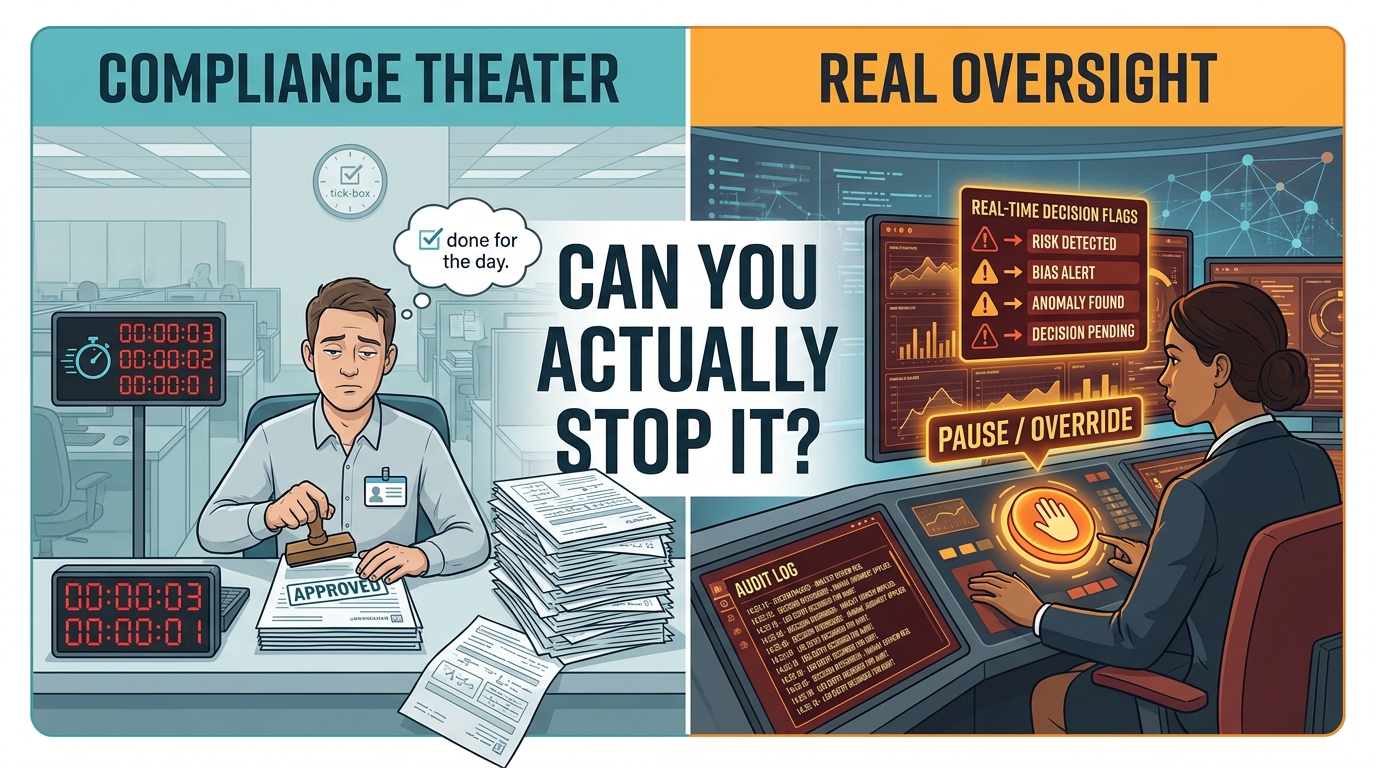
The most common failure mode is what practitioners have started calling oversight theater: a process in which a human is nominally in the loop but has no practical ability to evaluate, question, or stop what the AI is doing. The reviewer is shown a summary — not the full output and its context. They have thirty seconds between cases. The workflow is designed to make approval easy and rejection cumbersome. The system moves forward with or without a meaningful review. A human touched it. The governance box is checked.
What regulatory frameworks now require instead
The EU AI Act, now in full operational effect for high-risk AI systems as of August 2026, has forced a more specific definition of what human oversight actually requires. It is not enough for a human to nominally review outputs. The standard is that human overseers must be able to understand what the system is doing and why, must have real authority to intervene and halt operations, and must be given the technical means to actually exercise that authority.
This is a meaningful shift. It means the interface design matters — not just whether a human is in the loop, but whether the interface gives them the information they need to make a real judgment. It means the authority structure matters — not just whether someone can theoretically pause the system, but whether they will actually be supported if they do. It means the time allocation matters — a reviewer with 200 cases in their queue and no capacity to examine edge cases is not providing real oversight, regardless of what the process documentation says.
Building oversight that can actually intervene
Operationalizing real human oversight has several concrete requirements that organizations consistently underinvest in.
First, reviewers need access to full context, not summaries. If an AI system is flagging customer transactions as potentially fraudulent, the oversight reviewer needs to see the full transaction history, the model’s confidence score, the comparable cases that shaped the decision, and the customer’s record — not a binary flag and a checkbox. Context-rich interfaces are harder to build and slower to use. They are also the ones where human judgment actually adds value.
Second, override and pause authority must be real and visible. There must be a button that stops the system, and it must be reachable in normal workflow without requiring escalation to three levels of management. Organizations that require reviewers to file a ticket to pause an AI system in production have not built meaningful oversight — they have built a system optimized to keep running regardless of what reviewers think.
Third, override actions must be logged, analyzed, and fed back. Human overrides are not compliance inconveniences — they are data. Each time a reviewer rejects an AI recommendation or halts an action, that event tells you something about where the model is wrong or where the context is outside its training distribution. Organizations that analyze override patterns systematically use them to drive model improvements and recalibrate risk thresholds. Those that ignore them miss the most direct feedback signal available.
The calibration problem in oversight design
There is a genuine tension in oversight design between rigor and throughput. Meaningful oversight takes time, and AI systems often process volumes of decisions that make case-by-case human review economically and practically impossible at scale. The answer most organizations are landing on is risk-stratified oversight: full human review for high-stakes or edge-case decisions, automated monitoring with sampled human review for routine decisions, and clear escalation paths that move decisions up the review tier when anomalies appear.
The important discipline here is being honest about which tier each decision actually belongs in. The instinct under production pressure is to classify as much as possible as routine. The risk of that instinct is that high-stakes decisions get routine treatment and oversight becomes ceremonial by degrees. Governance programs that resist this pressure — that periodically re-examine their tier classifications and err toward more oversight rather than less — tend to maintain more substantive controls over time.
The Regulatory Pressure Now Forcing Workflow-Level Compliance
For organizations that have been treating AI governance as a future compliance exercise, 2026 has been a clarifying year. The regulatory landscape has moved from guidance and principles to enforceable obligations with specific operational requirements — and the obligations are workflow-level, not policy-level.
The EU AI Act: From document to operational control
The EU AI Act’s full applicability for high-risk AI systems, reached in August 2026, represents the most significant enterprise compliance event in AI to date. The obligations it creates are not satisfied by governance policies or ethics frameworks. They require demonstrable operational controls: a maintained inventory of all AI systems in use, a documented risk classification for each, technical documentation covering system purpose, training data, and known limitations, evidence of ongoing human oversight mechanisms, and audit-ready logs of deployment decisions and monitoring outcomes.
Each of these requirements is a workflow integration problem. An AI system inventory only stays current if there is a workflow that captures new AI systems at deployment and removes retired ones. Risk classification only means something if it is performed by someone with relevant expertise at the point of intake, not retrospectively by a compliance analyst who wasn’t involved in the build. Technical documentation only exists if teams are required to produce it before deployment, not after. Human oversight evidence only accumulates if the oversight process generates logs automatically.
The Act has also sharpened the distinction between AI providers — the organizations that build AI systems — and AI deployers — the organizations that use them within their own operations. For many enterprises that have licensed large language models and integrated them into their products or processes, the deployer obligations are substantial: maintaining their own risk assessments, ensuring their configuration and use of the AI system is within the scope the provider documented, and being prepared to demonstrate their own oversight controls independently of the provider’s compliance.
US and international regulatory fragmentation
While the EU AI Act provides the most comprehensive and operationally specific requirements, US enterprises face a patchwork of state-level legislation that is rapidly expanding. Colorado, California, Illinois, and Texas have all enacted or are advancing AI-specific obligations covering automated decision-making, bias testing, and consumer rights. Financial regulators including the OCC and SEC have issued model risk management guidance that increasingly applies to AI systems. Healthcare regulators have clarified that AI-powered clinical decision tools must meet existing FDA software-as-a-medical-device standards.
The fragmentation creates a governance design challenge: organizations operating across multiple jurisdictions cannot realistically maintain separate governance workflows for each regulatory regime. The practical response emerging from legal and compliance teams is to build workflows that meet the most demanding applicable standard — typically the EU AI Act for any system with EU-facing operations — and then document how that approach satisfies each applicable requirement. This “ceiling standard” approach is more work upfront and significantly less work at audit time.
The compliance readiness gap
The honest assessment of where most enterprises stand heading into the second half of 2026 is that compliance readiness is materially behind the regulatory timeline. Most organizations can demonstrate that they have policies and governance structures. Far fewer can demonstrate the operational evidence — the documented risk classifications, the training data logs, the human oversight records, the post-deployment monitoring reports — that regulators are starting to request. The organizations that built workflow-level governance early are in a position to produce that evidence. Those that relied on policy documentation are scrambling.
Sector Spotlight: What Financial Services and Healthcare Are Getting Right
Two sectors have been forced into operationalizing AI governance faster than most: financial services, where model risk management is a mature discipline with established regulatory expectations, and healthcare, where AI errors can directly harm patients and regulators have applied existing safety frameworks aggressively to AI systems. What they’re doing is instructive for any organization working to close the policy-to-practice gap.
Financial services: Model risk management as the governance backbone
Financial services firms have had model risk management (MRM) frameworks since the 2011 OCC guidance on model validation. That discipline — which requires documenting model purpose, validating model outputs, monitoring model drift, and maintaining audit trails of model decisions — maps remarkably well onto the requirements of AI governance. Organizations like regional banks and large insurers that had mature MRM programs were well-positioned to extend them to AI systems, because the workflow patterns were already embedded in how their teams operated.
The most advanced financial services AI governance programs in 2026 have extended MRM into a continuous lifecycle function: automated monitoring of model performance against defined thresholds, quarterly revalidation cycles triggered by performance metrics rather than calendar dates, clear decommissioning processes for models that fall below acceptable performance, and a central model inventory with real-time status information. These aren’t aspirational features — they’re operational realities at institutions where regulators have made clear that model failures generate supervisory consequences.
One pattern from financial services that deserves broader adoption is the concept of model “kill switch” authority: a clearly documented, immediately executable process for pausing or decommissioning a model in production, with a named person who holds that authority and an escalation path if they are unavailable. In organizations where that authority is clearly defined and tested, the response time when a model behaves unexpectedly is hours. In organizations where the process hasn’t been mapped, it’s days or weeks — during which the model continues operating.
Healthcare: Governance councils and clinical integration
Healthcare organizations face AI governance challenges that are distinctive in one important respect: the potential for direct patient harm creates a risk calculus that is fundamentally different from most enterprise AI contexts. A biased hiring algorithm is a serious problem. An AI diagnostic tool with systematically poor performance for a specific patient population is a patient safety issue.
The governance structure most commonly appearing in healthcare AI programs is a multidisciplinary governance council that combines clinical, technical, legal, and operational representation. Critically, these councils include clinicians — people who will actually use the AI tools in patient care — not just administrators and compliance staff. The inclusion of end users in governance has a direct impact on whether the oversight mechanisms that get built are ones that clinicians will actually engage with, as opposed to workarounds they’ll route around to meet their throughput requirements.
Healthcare governance programs have also been more aggressive about pre-deployment clinical validation: running AI systems in parallel with clinician decisions before going live, measuring the agreement and disagreement rates, and building that validation data into the governance record. The parallel-run approach is more expensive and slower than a direct deployment. It also generates a body of evidence about system behavior in the actual deployment context that no pre-deployment review process can produce.
The Governance Maturity Ladder: Where Most Organizations Actually Stand
AI governance maturity in 2026 is not evenly distributed. A useful working model recognizes at least four levels of governance maturity, each representing a qualitatively different state of operational control.
Level 1: Policy-only governance
The organization has a documented AI governance policy, possibly an ethics framework, and may have a designated governance owner. AI systems are being deployed without consistent review processes. No AI system inventory exists or is maintained. Governance is reactive: problems surface through incidents rather than controls. Most organizations with a self-described AI governance program are at this level, though many have elements of Level 2.
Level 2: Process governance
A formal review process exists for new AI systems. Risk classification is performed, though not always consistently. Model documentation is required but compliance is inconsistent. Human oversight is defined but may not be operationally effective. Post-deployment monitoring exists for some systems. The governance backlog — systems in production that haven’t completed review — is a known problem. Many midmarket organizations and some large enterprises sit at Level 2.
Level 3: Embedded governance
Governance controls are integrated into the tools and workflows that teams use daily. Deployment pipelines cannot advance without completing governance artifacts. The AI system inventory is maintained automatically as a byproduct of the deployment process. Risk-tiered oversight is operational. Post-deployment monitoring generates automatic alerts. Named accountable owners exist for every system in production. Override actions are logged and analyzed. A meaningful minority of large enterprises have reached Level 3 across most of their AI portfolio.
Level 4: Adaptive governance
Governance itself is treated as a system that learns and improves. Override data is used to update risk classifications and model cards. Monitoring thresholds are adjusted based on observed drift patterns. The governance framework is periodically reviewed against regulatory developments and updated proactively. Governance outcomes — not just governance process compliance — are measured and reported to the board. Very few organizations have reached Level 4 consistently across their AI portfolio. It is the direction that mature programs are heading.
A Practical Framework: Moving from Policy to Embedded Practice
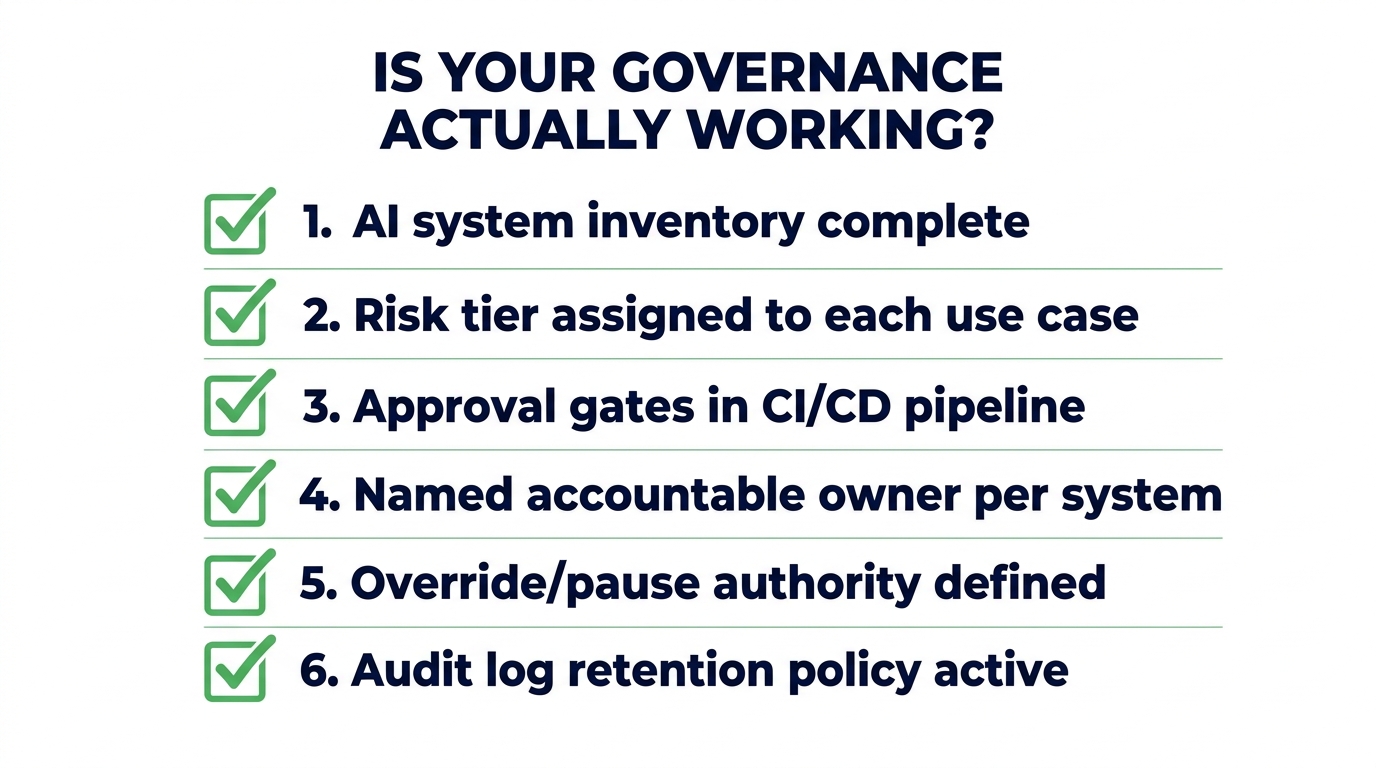
For teams ready to move from policy-level governance to workflow-level governance, the path is not a single project — it is a sequence of progressively deeper integrations. The following framework reflects what organizations at Level 2 and above have found most impactful when structured in logical order.
Step 1: Build and maintain a complete AI system inventory
You cannot govern what you cannot see. The starting point for any embedded governance program is a maintained inventory of every AI system in use — not just the ones the central team approved, but all of them, including the departmental tools that business units adopted independently. This inventory needs to be a living system, updated when new systems are adopted and when existing ones are retired, not a spreadsheet that was current six months ago.
The practical mechanism that makes inventories stay current is requiring AI system registration as part of the procurement and IT onboarding process — not as a governance layer but as a standard IT asset management step. When every new software tool goes through IT asset management regardless, adding AI classification to that process is a low-friction addition rather than a separate governance exercise.
Step 2: Apply risk tiers to every system in the inventory
Once the inventory exists, classify every system by risk tier. This does not require a lengthy committee review for every entry. Most systems can be tier-classified using a short decision tree based on: what data does this system process, what decisions does it influence, how reversible are those decisions, who is affected, and what regulatory context applies. High-risk systems get full governance review. Lower-risk systems get proportionately lighter treatment. The tier classification is documented and becomes the governance record for that system.
Step 3: Integrate governance checkpoints into deployment pipelines
For each risk tier, define what governance artifacts and approvals are required before a system can be deployed. Then integrate those requirements into the deployment workflow in whatever tools your teams use — Jira, ServiceNow, GitHub, whatever the standard pipeline looks like. The checkpoint must be in the workflow itself, not in a parallel governance process that depends on people remembering to engage it.
Step 4: Assign named accountable owners to every production system
Go through the AI system inventory and assign one named individual as accountable owner for each system. That person needs to know they hold the role, understand what it entails, and have the actual authority it requires — including the ability to pause or decommission the system if they judge it necessary. Document ownership in the governance record alongside the risk tier and the model card.
Step 5: Build oversight interfaces that enable real review
For systems with human oversight requirements, audit the actual oversight experience. How much time do reviewers have per decision? What information do they see? Can they access full context? Can they pause the system, and how? What happens to their override decisions — do they disappear into a void or generate an observable record? Close the gaps between the oversight process as designed and the oversight experience as lived.
Step 6: Establish monitoring thresholds and automatic escalation
For every system in production, define the monitoring metrics that matter and the thresholds that trigger review. Performance degradation, demographic disparity in outputs, anomalous volume of user overrides, unusual data distribution shifts — identify what matters for that system and build monitoring alerts into the operations function. Governance doesn’t end at deployment. The monitoring infrastructure is the governance control that keeps it alive.
What This Looks Like in the Daily Life of a Team
Abstract governance frameworks can be hard to translate into the lived experience of the people who actually work with AI systems. The following sketch illustrates what embedded governance looks like from the ground level.
For the engineer building an AI feature
When an engineering team begins building an AI-powered feature, the intake step in their project management tool prompts them to classify the AI use case. If it touches customer data and influences financial recommendations, it routes to a high-risk track. A model card template is assigned to the ticket and appears as a required field before the ticket can advance to code review. The model card isn’t a separate exercise — it’s a field in the tool they’re already working in. When the feature is ready for deployment, the deployment pipeline checks for a completed model card and an approved governance sign-off. Neither is optional. Neither is painful, because both are integrated into the workflow the team uses for all deployments.
For the business analyst using AI in daily work
The analyst has access to three AI tools: a company-approved summarization tool, a company-approved analysis assistant integrated into their business intelligence platform, and a writing assistant that generates draft reports. All three have been through intake classification. The summarization and analysis tools are low-tier and have automated monitoring. The report-drafting tool, because it generates content that goes to clients, has been classified as higher-risk and includes a mandatory review step before any AI-generated draft is finalized and sent. The review prompt appears automatically in the tool before the draft can be submitted. It takes thirty seconds for straightforward cases, longer for anything the analyst flags as complex. The review actions are logged automatically. No separate governance process. No memory burden. The control is in the tool.
For the governance function itself
The governance team is not running audit exercises on systems that have already been live for months. They are looking at monitoring dashboards that show live performance metrics for every production system, with anomalies flagged automatically. They are reviewing the override logs from high-risk systems to understand where AI recommendations are being rejected and why. They are updating risk tier classifications when system use expands beyond its original scope. They are conducting quarterly reviews of model cards for high-risk systems. Their work is forward-looking and analytical rather than retrospective and documentary.
Conclusion: The Policy Was Never the Point
AI governance was always meant to produce a specific outcome: AI systems that behave reliably, consistently, fairly, and accountably within the organizations that deploy them. Policies were never the mechanism for achieving that outcome — they were a statement of intent. The mechanism is the system of controls, workflows, accountability structures, and monitoring processes that make that intent enforceable at runtime.
The gap between intent and enforcement is not a document-writing problem. It is an operational design problem, and solving it requires treating governance the same way engineering teams treat security or reliability: as an intrinsic property of how systems are built, not an external layer bolted on afterward.
The organizations that have moved in this direction report a consistent benefit beyond regulatory compliance: they know, in real time, what their AI systems are doing. They can answer questions about specific system behavior quickly rather than through retroactive investigation. When something goes wrong — and in any sufficiently scaled AI portfolio, something will go wrong — they can isolate it, understand it, and address it in hours rather than weeks.
That operational visibility is the real return on embedded governance. Not the checkbox that says the policy exists. The control that ensures the policy is real.
Key takeaways for teams ready to act
- Start with inventory. Build and maintain a complete, current list of every AI system in use — including unsanctioned ones. You cannot govern what you cannot see.
- Apply risk tiers, not uniform processes. Match the depth of governance to the actual risk level of each system. Over-governing low-risk tools wastes capacity. Under-governing high-risk ones creates liability.
- Wire governance into existing tools. Approval gates and documentation requirements built into the CI/CD pipeline, Jira, or ServiceNow get completed. Those that live in separate governance systems get skipped.
- Name one owner per system. Distributed accountability is the same as no accountability. Every AI system in production needs one named individual who owns its behavior and performance.
- Test your oversight mechanisms. Ask the people doing oversight whether they can actually stop the AI when it’s wrong. If the answer is uncertain, the oversight isn’t real.
- Treat monitoring as ongoing governance. Post-deployment monitoring is not a technical ops function. It is a governance control. Define thresholds, build automatic escalations, and review override data regularly.
- Build to the highest applicable standard. For organizations with EU-facing operations, build to EU AI Act standards for all high-risk systems. Demonstrating that you meet the most demanding standard is far simpler than maintaining separate governance tracks per jurisdiction.