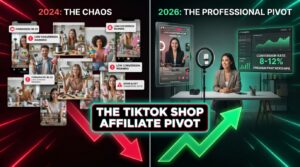


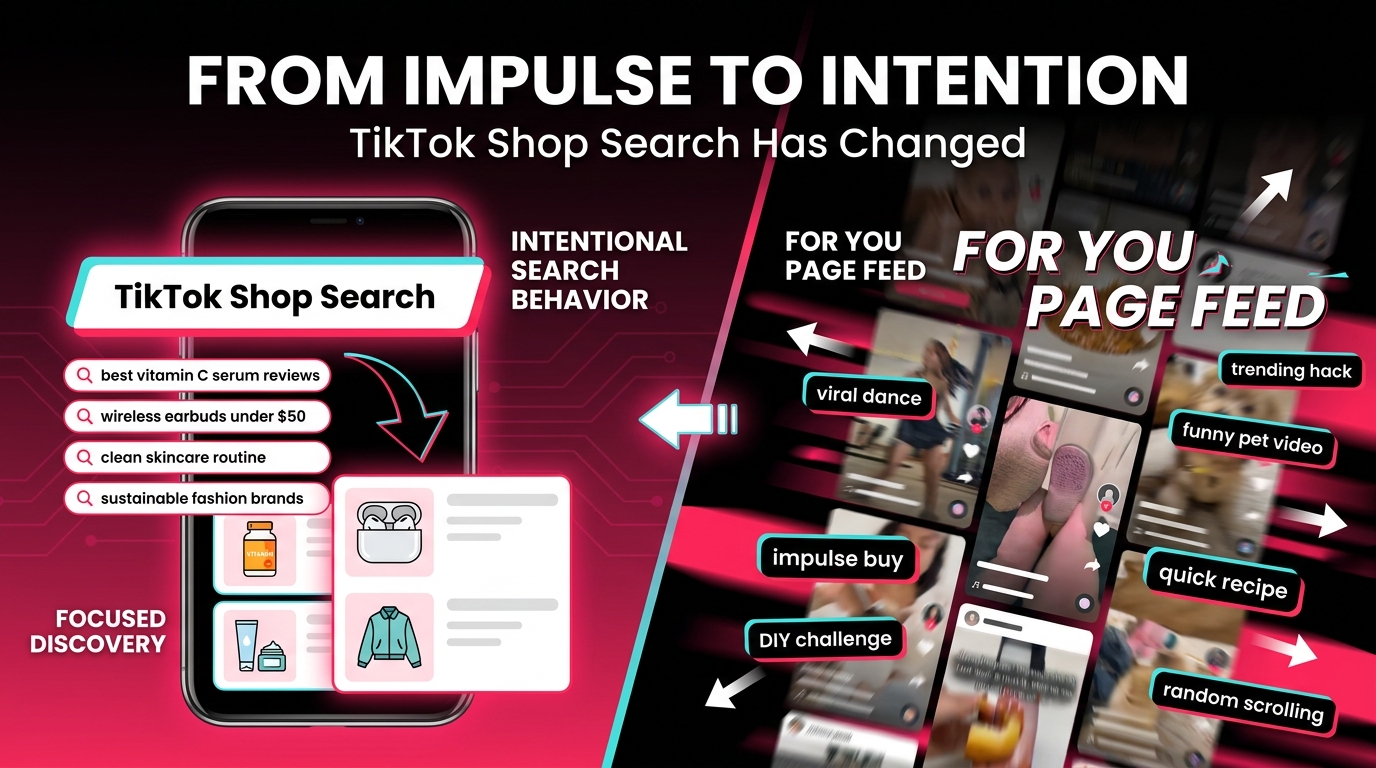

For most of TikTok Shop’s early history, the game was simple: make something go viral on the For You Page, ride the wave, cash out. The platform’s gravity pulled sellers toward spectacle — trending sounds, emotional hooks, the kind of content that stopped thumbs mid-scroll and had people buying a gadget they had never heard of thirty seconds earlier. Fulfillment was secondary. Keyword strategy was irrelevant. Reviews were a bonus. The FYP was everything.
That model worked brilliantly — for a while. But TikTok’s own 2026 trend data signals that something fundamental has shifted in how people shop on the platform. The phrase that keeps appearing in TikTok’s internal reporting and seller-facing guidance is stark: “impulse will lose to intention.” Shoppers are arriving on TikTok Shop with specific queries. They are reading reviews before adding to cart. They are using TikTok’s search bar the way they once used Google — not to browse, but to verify and decide.
This behavioral shift has forced TikTok to update how its Shop search system works. The Search Result Page (SRP) now operates under a ranking logic that is meaningfully different from the FYP algorithm — one that rewards keyword relevance, conversion rate, fulfillment reliability, and review velocity rather than raw engagement and virality. Sellers who have not recalibrated for this are losing ground to competitors who have — often without even understanding why.
This post breaks down exactly what changed in TikTok Shop’s search update in 2026, what signals now actually drive rankings, and where the gaps in most sellers’ current strategies are. The goal is not to give you a generic SEO checklist — there is already plenty of that. The goal is to help you understand the why behind the update so you can build a durable response to it.
What “Intentional Shopping” Actually Means on TikTok in 2026
Before dissecting the algorithm update itself, it is worth understanding the demand-side shift that triggered it. TikTok did not change its search ranking logic because an engineer felt like it. The change reflects a measurable evolution in how users — particularly Gen Z — are choosing to shop inside the app.
The “Why to Buy” Now Comes Before the Cart
TikTok’s 2026 trend report explicitly identifies a cultural transition underway among its core shopping demographic. Buyers increasingly demand what TikTok calls a clear “why to buy” before they commit to a purchase. This is a meaningful departure from the early TikTok Shop era, when the entire value proposition rested on frictionless discovery — you saw it, you felt it, you bought it before the rational brain could intervene.
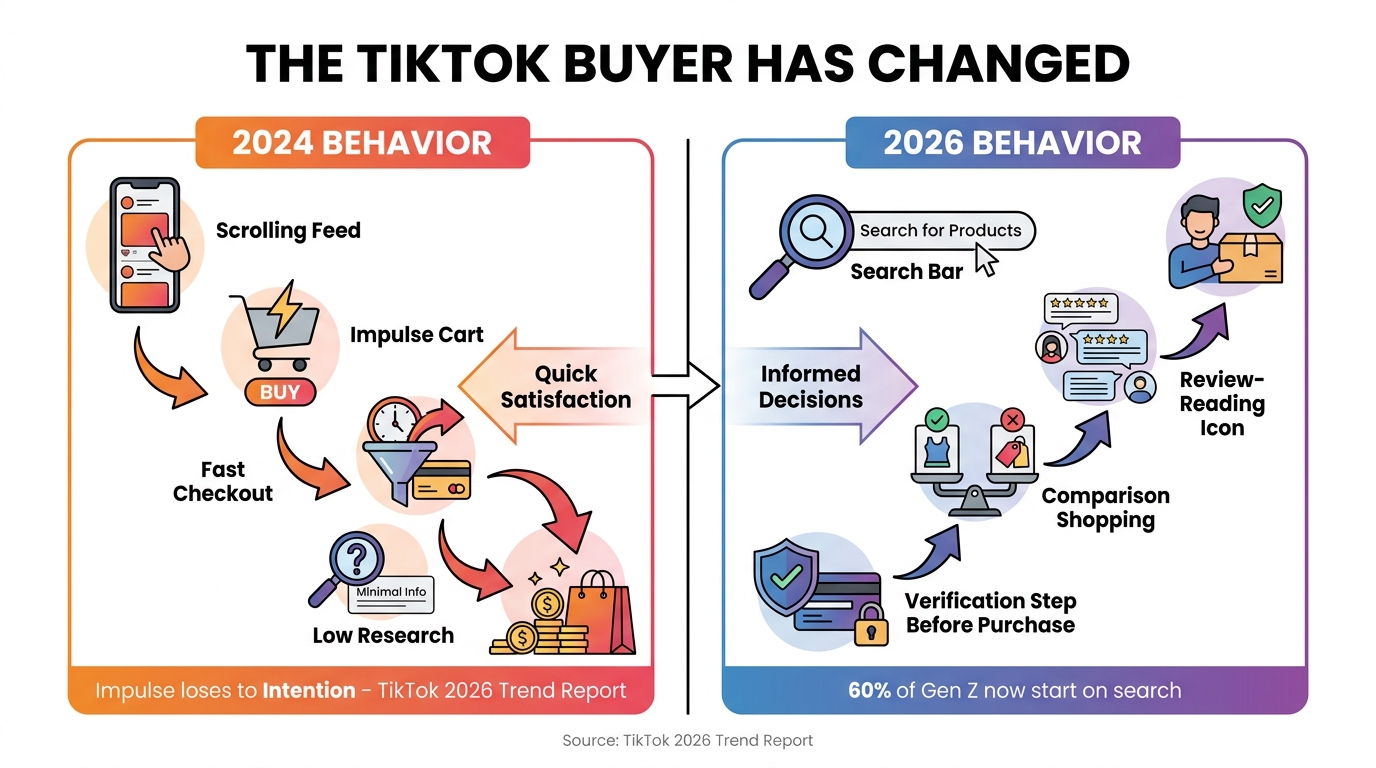
In practice, “why to buy” behavior looks like this: a user sees a product mentioned in their FYP, does not immediately click the product link, and instead opens the TikTok search bar to look up “[product name] review,” “[product name] worth it,” or “[product name] vs [competitor].” They watch two or three review videos, scroll through ratings, check the seller’s dispatch score, and only then add to cart. The impulse is still there — but it now gets routed through a verification step.
Almost 60% of Gen Z shoppers now report starting their buying journey on TikTok itself in 2026 — but increasingly that journey starts with a search query, not a scroll session. This shift from browse to search is structurally significant because it means the same user who discovered a product via the FYP may not convert until they have completed a search-led research cycle.
TikTok as a Verification Hub, Not Just a Discovery Layer
This behavioral evolution is turning TikTok Shop into something closer to a hybrid of Amazon and YouTube: a place where products get discovered and researched and purchased within a single closed-loop app experience. Users are not leaving TikTok to cross-reference on Google. They are doing the entire decision journey — awareness, consideration, social proof, purchase — in-app.
The implication for sellers is significant. The For You Page may introduce a product to a potential buyer, but the Search Result Page is increasingly where the conversion actually gets decided. A listing that looks great as a video format but has no keyword architecture, inconsistent reviews, or poor fulfillment data will lose at the moment of intent — the moment that actually matters.
Older Demographics Are Entering the Mix
An underappreciated part of the intentional shopping shift is demographic expansion. TikTok Shop’s early buyer base skewed young, impulsive, and low-AOV. As the platform has matured, older millennial and Gen X buyers have joined — shoppers who bring Amazon-trained habits with them. They look for titles that match their query. They read product descriptions. They check fulfillment timelines before committing. The platform’s search system has adapted to serve them, which in turn reinforces the behavior across all age groups.
The Search Tab Is Now Its Own Funnel — And It Ranks Differently Than the FYP
The most important structural thing to understand about TikTok Shop’s 2026 search update is that the Shop Search Result Page and the For You Page are not the same system. They have never been identical, but in 2026 the divergence is pronounced enough that optimizing for one and ignoring the other is a genuine strategic error.
Two Algorithms, Two Objectives
The FYP algorithm is designed to maximize time-on-app. It rewards content that generates watch time, reshares, comments, and emotional reactions. Commercial intent is a secondary consideration. A product that goes viral on the FYP may have terrible keyword relevance, zero review history, and a mediocre conversion rate — and the FYP will still promote it if the content scores well on engagement metrics.
The Shop Search algorithm is designed to maximize purchase probability. When a user types “wireless earbuds under $50” into the TikTok search bar, the system’s job is not to show them the most entertaining earbuds content — it is to show them the product most likely to result in a satisfied transaction. That requires a completely different ranking calculus. Keyword match, seller trust, conversion rate, and review data all become load-bearing signals.
The Scale of the Shift
TikTok has officially repositioned the Shop Tab — which includes the search entry point — as a dedicated commerce portal designed to serve users with “strong purchase intentions.” This is language that would have seemed out of place on TikTok two years ago, when everything was framed in terms of entertainment and discovery. Today, TikTok’s own Seller Center materials explicitly describe the Shop Tab as a high-intent surface, distinct from the FYP in both function and user mindset.
The traffic data bears this out. Recent seller analytics suggest that TikTok Shop search now accounts for roughly 48–65% of shop sales, with the FYP-driven discovery model accounting for the remainder. Those figures vary significantly by category and seller maturity, but the directional trend is consistent: search is becoming the majority revenue driver, and the gap is widening.
What This Means for Content Strategy
The practical implication is that sellers now need to run parallel content strategies — not a single unified approach. Content built for the FYP needs to be entertaining, native, and emotionally resonant. Content and listings built for the SRP need to be structurally sound: keyword-anchored titles, comprehensive product descriptions, strong review profiles, and backend attributes that match high-intent query categories. These are not the same optimization targets, and conflating them is expensive.
The Four Ranking Pillars TikTok Shop Search Uses in 2026
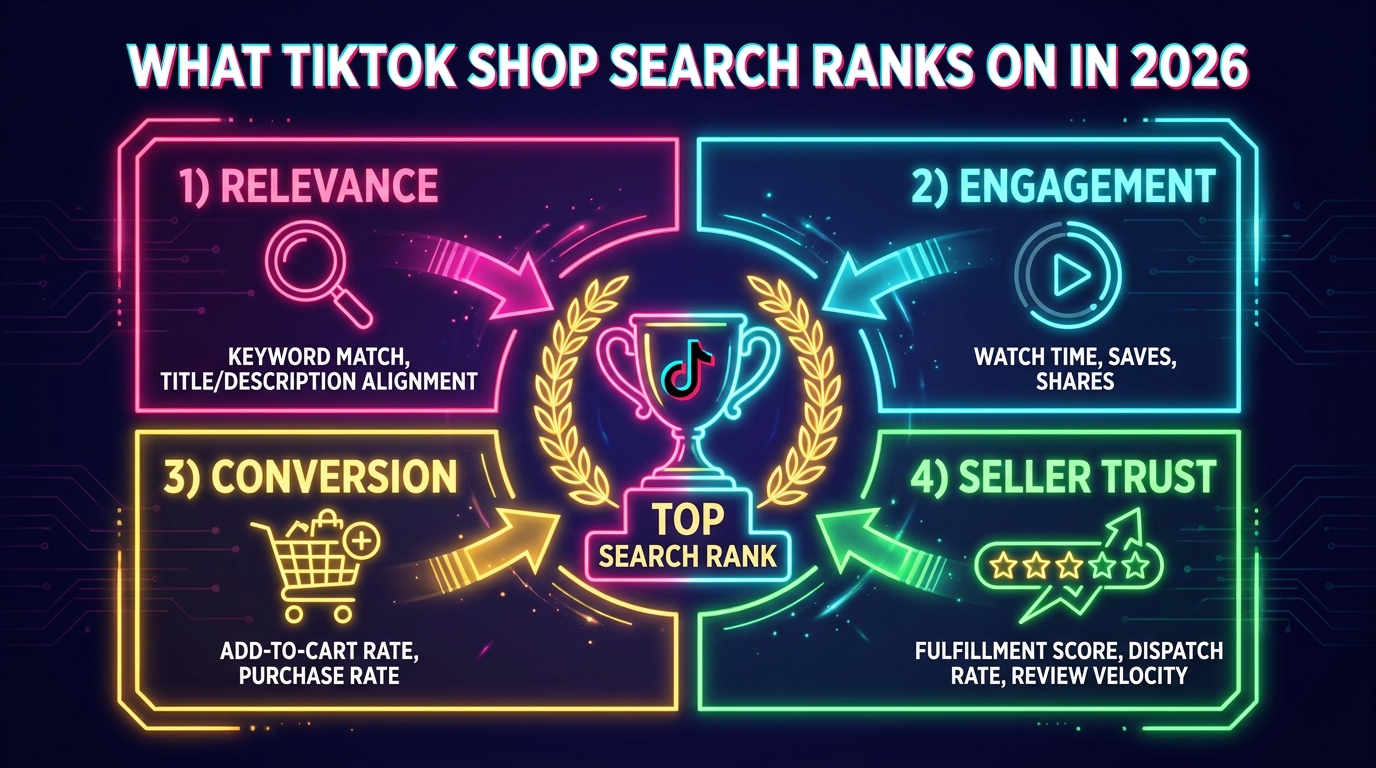
Based on TikTok’s seller-facing materials, third-party analysis, and observable ranking behavior in 2026, TikTok Shop search operates on four core ranking pillars. Understanding each one individually — and how they interact — is the foundation of any realistic search optimization strategy.
Pillar 1: Relevance
Relevance is the prerequisite. If your listing is not a plausible match to the user’s query, the other three pillars do not matter — you will not appear for that search at all. Relevance is determined primarily by keyword signals in the product title, description, attributes, and category assignment, as well as any video content associated with the listing.
In 2026, TikTok’s search system has become meaningfully better at semantic matching, meaning it can connect queries like “dark spot serum” with listings titled “hyperpigmentation treatment face oil” — but this semantic intelligence is not a substitute for explicit keyword placement. The baseline is still keyword match, and sellers who treat their titles as creative copywriting exercises rather than structured relevance signals will fall short.
Pillar 2: Engagement
Engagement signals — watch time on associated videos, saves, shares, comments, and search click-through rate (CTR) — still matter in the SRP algorithm, but their weight relative to conversion signals has shifted downward compared to 2024. TikTok’s 2026 search system is less interested in whether a product excited people and more interested in whether it converted them.
That said, engagement remains important as a proxy for buyer confidence. A product listing with associated creator videos that generate strong watch time and comment engagement signals social proof — which, for an intentional shopper in research mode, is exactly the kind of evidence they are looking for. The mechanism is different from the FYP, but engagement still feeds the funnel.
Pillar 3: Conversion
Conversion rate is now the single most powerful commerce signal in TikTok Shop’s search ranking system. Add-to-cart rate, purchase rate, and the speed at which users move from search click to completed transaction all feed directly into how the algorithm evaluates a listing’s commercial merit.
This is the biggest shift from 2024. Previously, sellers could compensate for weak conversion rates with viral content or affiliate-driven traffic spikes. In 2026, a listing with sustained high conversion rate from organic search consistently outranks competitors with higher raw view counts. Conversion is the truth signal the algorithm trusts most.
Pillar 4: Seller Trust
Seller trust encompasses shop-level metrics including overall rating, review velocity (how quickly and frequently new reviews are accumulating), fulfillment performance scores, and — effective May 28, 2026 — two new logistics metrics: Instant Late Dispatch Rate and Same-day Late Dispatch Rate. These are not soft signals. They directly feed the trust score that TikTok assigns to your shop, and a low trust score suppresses your visibility across the entire search surface.
Think of seller trust as the credit score of your TikTok Shop presence. Good scores do not automatically vault you to the top of rankings, but bad scores create a ceiling you cannot break through regardless of how well you perform on relevance and conversion.
Keyword Architecture: Why FYP-Style Copy Fails on the Search Result Page
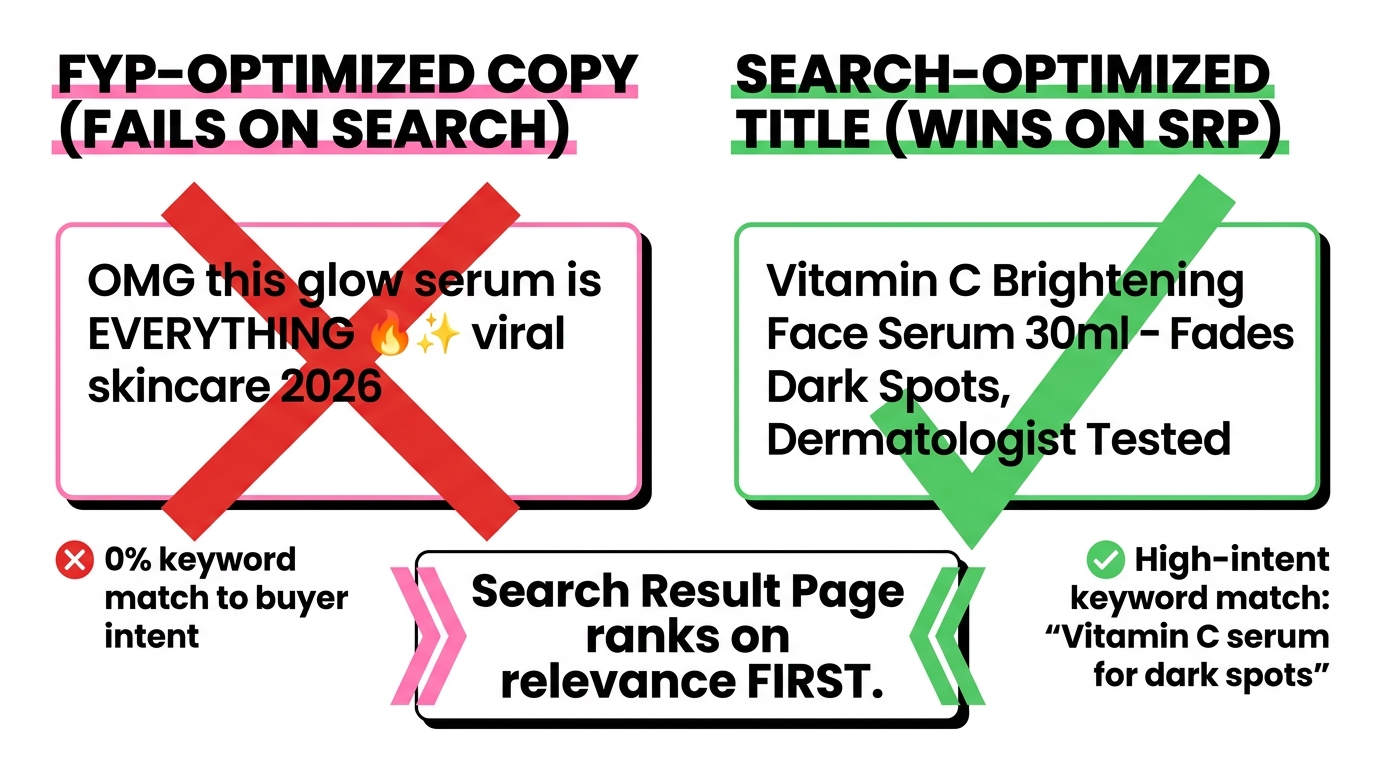
The language of TikTok’s FYP is informal, emotive, and trend-coded. Product titles written for the FYP sound like caption text: “This water bottle changed my routine 💧,” “The viral skincare everyone’s obsessed with,” “You NEED this in your life.” That kind of copy performs beautifully in a discovery context. On the Search Result Page, it is largely useless.
How Intentional Shoppers Search
Intentional shoppers search the way they would on Amazon or Google. They search by product category, specific attribute, problem statement, or comparative phrase. Real queries from TikTok Shop’s search data include patterns like: “best vitamin C serum for dark spots,” “wireless headphones noise cancelling under $40,” “non-toxic cleaning spray unscented,” “protein powder for women no bloat.” These are functional, structured queries that describe a specific need and expected outcome.
If your product title is “✨ Glow Up Serum — the one you’ve been seeing everywhere,” the algorithm has almost nothing to work with when matching it to the query “vitamin C brightening serum dark spots.” Your relevance score for that query is near zero. You have effectively opted out of the search channel for every buyer who is looking for exactly your product.
Building a Search-First Title Structure
A search-first title for TikTok Shop in 2026 follows a logic that will feel familiar to Amazon sellers: lead with your primary keyword category, follow with the most differentiating attributes, close with use-case or audience context where space allows. Approximately 60–80 characters is the practical target for mobile-displayed titles, which get truncated in the search card view.
An example of the same product optimized for each surface:
- FYP-style title: “This glow serum is literally everything ✨ – viral skincare 2026”
- SRP-optimized title: “Vitamin C Brightening Serum 30ml – Dark Spot Fading, Dermatologist-Tested, All Skin Types”
The SRP-optimized version is less exciting. That is the point. The person arriving via search already has intent — they do not need emotional activation, they need confirmation that your product is the right match for their query. The title’s job is to earn the click, not generate excitement.
Description, Attributes, and Backend Keywords
Product descriptions on TikTok Shop in 2026 function similarly to Amazon’s bullet points: they expand the keyword surface area and provide the specification detail that informs both the algorithm and the buyer. Descriptions should lead with the primary use case in plain language, follow with key ingredients or technical specifications, and include secondary search terms that capture adjacent queries.
Attributes and category selection are arguably the most underused ranking levers in TikTok Shop. Sellers who correctly populate all available attribute fields — material, size, target demographic, function, ingredient type, compatibility — give the algorithm far more surface to match against relevant search queries. Sellers who leave attributes blank are essentially asking the algorithm to guess, and the algorithm’s guesses are conservative.
Video Content as a Keyword Signal
One of the more subtle 2026 updates to TikTok Shop’s search system is the increased weight given to multimodal keyword signals. The platform’s search algorithm can now process spoken keywords in video voiceovers, on-screen text overlays, and video captions as part of its relevance scoring for associated product listings. This means that a creator video linked to your product listing that includes verbal mentions of target keywords (“this vitamin C serum is amazing for dark spots and hyperpigmentation”) actively boosts your listing’s relevance for those search queries — not just via the video itself, but as a signal for the product’s SRP placement.
This creates a coordination opportunity that most sellers are missing: briefing creators not just on the product story but on specific keyword phrases to use in their content, aligning voiceover language with the search queries you are trying to rank for.
The Commerce Signals That Now Outweigh Engagement Metrics
The most counterintuitive part of TikTok Shop’s 2026 search update for long-time platform sellers is the weight inversion between engagement signals and commerce signals. For years, the operating assumption was that if you generated enough views, saves, and comments, sales would follow. That assumption has been functionally reversed in the search context.
Conversion Rate as the Dominant Signal
TikTok’s search algorithm in 2026 explicitly weights conversion rate — the ratio of search result clicks that result in purchases — as the primary commerce signal for ranking. This makes logical sense: from TikTok’s perspective as a commerce platform, a listing that converts 4% of search clicks is worth promoting above a listing that converts 1%, regardless of which one has the more viral associated content.
The practical consequence is that sellers with well-optimized, high-converting product pages and a lean, focused SKU catalog tend to punch above their weight in search rankings compared to sellers with vast catalogs of underperforming listings. Depth of conversion on a few listings consistently outperforms breadth of listings with mediocre conversion across the board.
Add-to-Cart Rate as a Leading Indicator
Add-to-cart rate functions as a leading indicator of purchase intent. Even if a user adds to cart and does not complete the purchase, the signal tells the algorithm that your listing was compelling enough to trigger an intent action. High add-to-cart rates suggest your product imagery, pricing, and title created enough confidence for a commitment step — and the algorithm rewards that.
Sellers should monitor add-to-cart rate per listing in TikTok Shop’s analytics dashboard and treat significant gaps between add-to-cart rate and purchase rate as a pricing or friction problem, not a discovery problem. If people are adding but not buying, the listing’s search visibility is likely fine — the issue is downstream in the conversion funnel.
Recency and Sales Velocity
TikTok Shop’s search system also weights recency of sales activity. A listing that generated 500 sales last month but has slowed to 10 per week this month will gradually lose ground to a listing that has consistent week-over-week sales velocity. This favors products with reliable, repeatable demand over products that had a single viral moment months ago.
For sellers managing seasonal products or trend-dependent SKUs, this means actively planning to re-stimulate sales velocity before seasonal search windows open — through affiliate activity, search ads, or promotional pricing — rather than assuming last season’s ranking will carry over.
Search Ads in 2026: SEARCH+ Placement and GMV Max Strategy
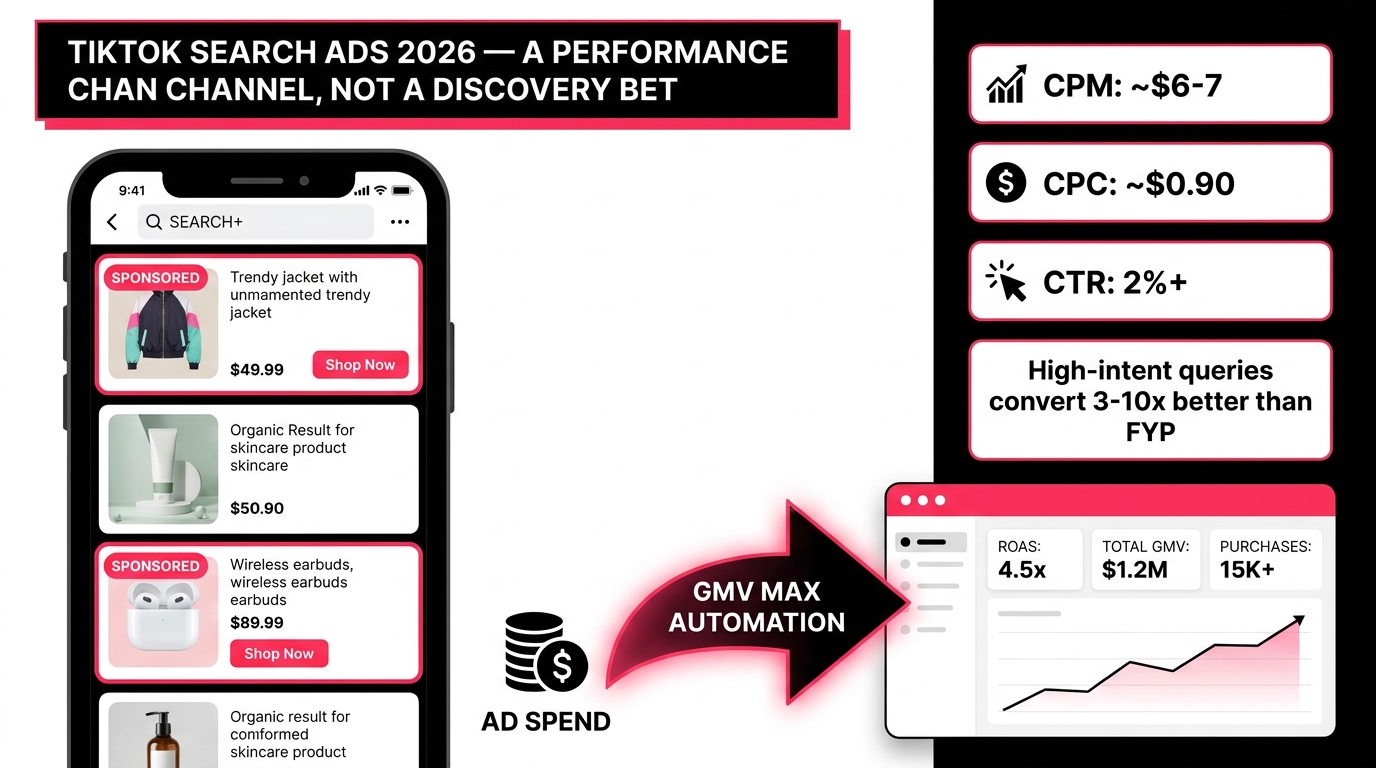
The shift toward intentional shopping has made TikTok’s search ad surfaces — collectively referred to as SEARCH+ or sponsored product placements in the Shop search results — meaningfully more valuable in 2026 than they were twelve months ago. When buyers arrive with specific purchase intent, the cost to capture that intent via sponsored placement is relatively low and the conversion probability is relatively high.
SEARCH+ Benchmarks in 2026
Current benchmark data for TikTok Shop search ads in 2026 puts average CPM at approximately $6–7, average CPC around $0.90, and click-through rate just above 2%. Compared to TikTok’s TopView and premium video ad formats, these are modest numbers — but the conversion quality is the differentiator. High-intent keyword searches convert at 3–10 times the rate of FYP-driven discovery traffic for the same products, which fundamentally changes the economics.
At $0.90 CPC with a 10% purchase conversion rate from search intent traffic, you are paying approximately $9 per acquisition from search — a cost that would be competitive on Google Shopping and would be considered exceptional by Amazon Sponsored Products benchmarks in most categories. The channel is currently underpriced relative to its conversion quality because many sellers have not yet invested in it.
GMV Max and Search Synergy
TikTok’s GMV Max ad format — a fully automated shopping ad that allocates budget across placements based on conversion probability — has become the primary vehicle for TikTok Shop advertising in 2026. Its key advantage in the search context is that it can simultaneously serve your products in the FYP discovery context and the Shop search results, letting the algorithm determine optimal budget allocation between the two surfaces based on real-time conversion signals.
For brands with well-optimized listings (strong conversion rate, healthy reviews, clean fulfillment data), GMV Max will naturally shift spend toward search placements as search conversion signals strengthen. For brands with weak listing optimization, GMV Max will default toward FYP discovery where engagement signals are easier to generate — which means you are spending on expensive discovery traffic rather than cheap conversion traffic. The quality of your organic listing directly determines where GMV Max puts your money.
Keyword Strategy for Search Ads
Unlike GMV Max’s automated approach, manual SEARCH+ campaigns allow keyword-level targeting that gives sellers precise control over which queries trigger their sponsored placements. The strongest-performing keyword categories in TikTok Shop search in 2026 follow intent patterns that mirror high-performing Amazon keywords:
- Problem-statement keywords: “dry skin face moisturizer,” “back pain relief cushion,” “bloating supplements”
- Comparison keywords: “best protein powder for women 2026,” “wireless earbuds vs AirPods alternative”
- Use-case keywords: “gym bag for women with shoe compartment,” “travel size skincare routine”
- Review/proof keywords: “vitamin C serum that actually works,” “collagen powder results before and after”
These patterns reflect the “why to buy” mentality of intentional shoppers. They are not just searching for a product — they are searching for evidence that a product solves their specific problem. Sellers whose ad copy and landing experience directly addresses that problem framing see the strongest search ad performance in 2026.
Fulfillment, Dispatch Metrics, and Why They Feed Your Search Rank
Fulfillment performance has always been a factor in TikTok Shop seller health scores, but the introduction of two new logistics metrics effective May 28, 2026 — Instant Late Dispatch Rate and Same-day Late Dispatch Rate — signals that TikTok is systematically integrating operational performance into search visibility in ways that many sellers have not yet internalized.
What These New Metrics Actually Measure
Instant Late Dispatch Rate measures the proportion of orders where dispatch does not begin immediately after confirmation for orders that carry an “instant dispatch” commitment. Same-day Late Dispatch Rate measures failure to dispatch same-day for orders where a same-day commitment was made or implied by the seller’s fulfillment setup. Both metrics create real-time feedback loops between operational execution and search visibility.
Sellers who have historically treated fulfillment as a customer service issue — something that affects returns and reviews but does not touch marketing performance — need to update that mental model. In 2026, if your dispatch rate falls below TikTok’s thresholds, the algorithm’s trust signal for your shop degrades, your search visibility contracts, and recovery takes weeks because the metrics are rolling averages, not snapshot evaluations.
The Operational Linkage Most Sellers Miss
The linkage that most sellers overlook is this: fulfillment metrics do not just affect your shop-level trust score, they affect your ability to win in search specifically. Because the search algorithm uses seller trust as a ranking pillar — not just a compliance filter — a shop with excellent keyword relevance and high conversion rates can still be suppressed in search results by a degraded fulfillment score. The pillars are weighted in aggregate, and trust operates as a multiplier on the others.
This means that fulfillment infrastructure improvements — better 3PL partnerships, tighter warehouse SLAs, more realistic shipping commitment settings — are de facto search optimization investments in 2026. Operations teams and marketing teams need to be working from the same performance metrics, not operating in separate silos.
Setting Realistic Dispatch Commitments
One of the most common — and avoidable — ways sellers damage their dispatch metrics is by offering fulfillment commitments that their operations cannot reliably meet. A seller who offers same-day dispatch to win placement in the Fast Shipping filter on the SRP, but whose warehouse processes orders in 24–48 hours, will consistently fail the Same-day Late Dispatch Rate metric, eroding the search visibility they were trying to gain in the first place.
The correct approach is to set fulfillment commitments that your actual operation can maintain at a 95%+ compliance rate, and use the advertising and keyword levers to drive enough volume to your listings to compensate for any conversion advantages that faster shipping commitments might have provided. Sustainable visibility comes from reliable performance, not from promised performance you cannot deliver.
How Seller Reviews Became a Search Ranking Engine
Reviews occupy a unique position in TikTok Shop’s 2026 search system. They are simultaneously a relevance signal (review text often contains natural-language keyword phrases that the algorithm can index), a conversion signal (more reviews and higher average ratings directly lift CTR and add-to-cart rate from the SRP), and a trust signal (review velocity is part of the seller trust score). No other single element in a TikTok Shop listing punches across all four ranking pillars the way reviews do.
Review Velocity Over Total Volume
TikTok’s search algorithm in 2026 weights review velocity — the rate at which new reviews are accumulating — more heavily than total review count for ranking purposes. This is a deliberate design choice that penalizes sellers who coasted on an early review surge and have since let their review acquisition strategy atrophy. A listing with 2,000 reviews accumulated over two years and zero new reviews in the last 30 days will rank below a listing with 200 reviews that is receiving 20 new reviews per week.
The logic is sound from TikTok’s perspective: review velocity is a proxy for ongoing sales activity and current customer satisfaction. A listing that stopped getting reviews probably stopped selling at meaningful volume, which is itself a conversion signal the algorithm would naturally penalize.
Review Content as a Keyword Source
The indexing of review text as a keyword surface is one of the most underappreciated aspects of TikTok Shop’s search update. When customers write reviews that include phrases like “this really helped with my hormonal acne,” “perfect for sensitive skin,” or “lasts all day without reapplication,” they are effectively generating long-tail keyword content that the algorithm can use to match your listing to search queries you may not have explicitly targeted in your title or description.
This creates a compounding advantage for sellers who generate consistent, detailed reviews: over time, the review corpus expands the effective keyword surface of a listing organically, catching search queries that no amount of title optimization would have targeted directly. High-review-volume listings have, in effect, a larger search footprint than their titles alone would suggest.
Managing Review Quality Strategically
Sellers serious about search visibility in 2026 should be running systematic post-purchase review request flows, using TikTok Shop’s built-in review solicitation tools, and monitoring review text for recurring keyword themes that could inform listing title and description updates. A pattern of reviews mentioning a specific use case or benefit that you have not explicitly listed in your product description is a direct signal to add that language to your copy.
Equally important: responding to negative reviews promptly and professionally is no longer purely a reputation management exercise. TikTok’s algorithm monitors review response behavior as part of the seller trust score. Shops that respond to negative reviews show higher overall trust scores than shops with identical ratings but no engagement with negative feedback.
What the Organic vs. Paid Traffic Split Means for Budget Decisions
One of the most practically important questions sellers face in 2026 is how to allocate budget between organic search optimization (which requires time and operational investment but delivers sustained, low-cost traffic) and paid search placements (which deliver immediate visibility but require ongoing spend). The traffic split data, while imprecise, offers useful directional guidance.
The Current Split and What It Implies
Expert analysis and seller data for 2026 suggests that for most scaled TikTok Shop brands, organic traffic accounts for roughly 60–70% of total search-driven revenue, with paid placements accounting for 30–40%. This ratio shifts significantly based on category competitiveness and listing maturity. In highly competitive categories — beauty, supplements, electronics accessories — the paid share tends to be higher, often reaching 45–50% for brands that aggressively defend search positions against competitors.
The implication is that organic search optimization is the higher-leverage investment for most sellers, because it creates a compounding asset (a well-ranked listing continues generating free traffic indefinitely) rather than a linear spend-to-traffic relationship. But paid search is a necessary complement in competitive categories where organic rankings are contested.
The Bootstrap vs. Accelerate Decision
For new listings — which have no review history, no conversion data, and no seller trust track record — the organic ranking system is essentially inaccessible at launch. New listings need paid traffic to generate the initial conversion signals that will eventually earn them organic rank. This is not a TikTok-specific quirk; it mirrors the Amazon Sponsored Products dynamic that most e-commerce sellers are familiar with.
The practical framework is: invest in paid search ads to generate the early conversion and review data that builds organic ranking potential, then gradually reduce paid spend as organic rank strengthens. Sellers who try to bootstrap new listings with zero ad spend typically accumulate too little conversion data to ever break into meaningful organic search positions, regardless of how well their listings are technically optimized.
Measuring True Search ROAS
A common budgeting error is evaluating search ad performance purely on in-session ROAS — the revenue directly attributed to the click within the same session. TikTok Shop search ads also generate a halo effect: they accelerate the accumulation of conversion signals that improve organic ranking, which then delivers revenue that is never attributed to the ad spend that enabled it. Sellers who measure search ROAS only by direct attribution consistently undervalue their search ad investment and underfund it relative to what the full-funnel economics would justify.
The Operational Gap: Why Most Sellers Are Still Building for 2024
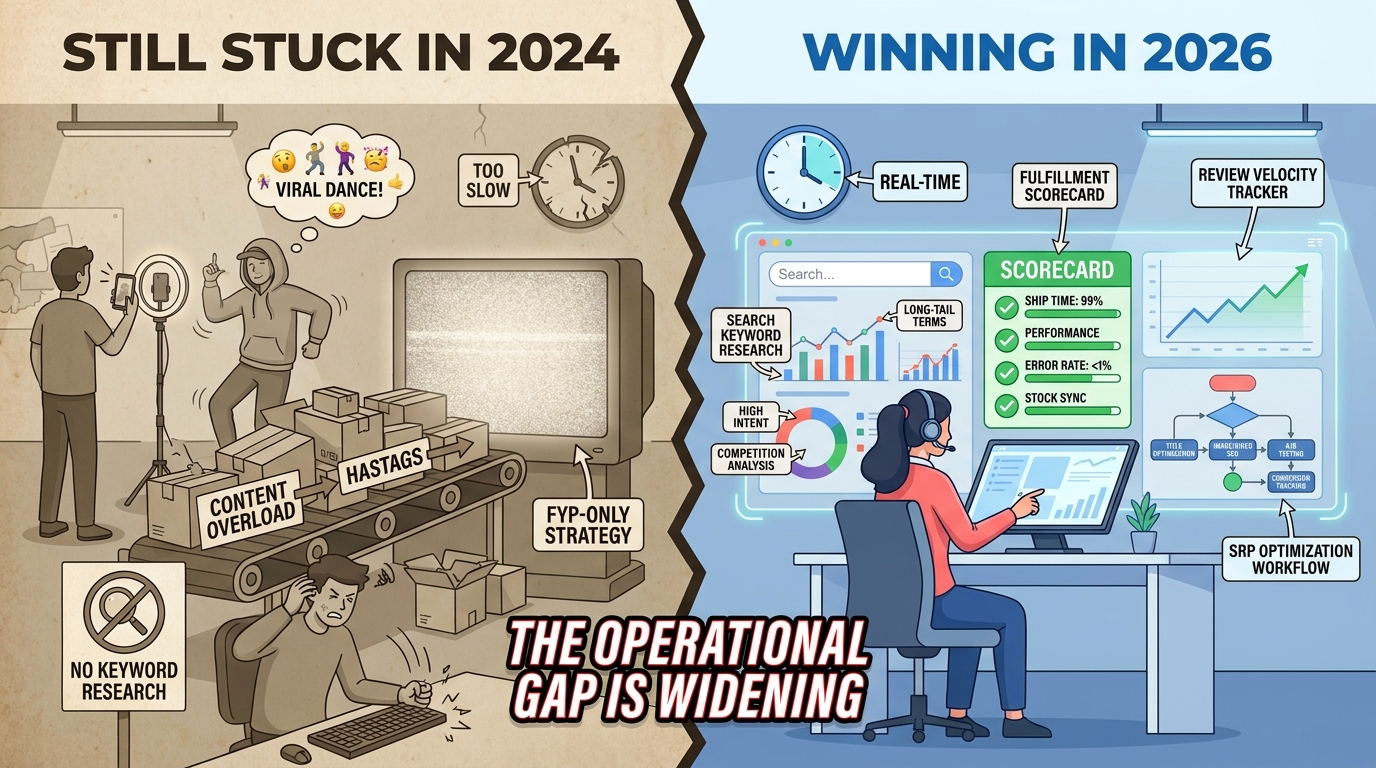
The 2026 search update is not subtle. TikTok has been signaling the shift toward search and intentional commerce in its seller guidance, trend reports, and policy updates throughout the first half of the year. Yet most sellers — even sophisticated, high-GMV operators — are running playbooks that are fundamentally designed for a different version of TikTok Shop.
The Content Team vs. Operations Team Disconnect
In most TikTok Shop seller organizations, there is a structural disconnect between the team responsible for content creation and the team responsible for operations and fulfillment. The content team optimizes for FYP virality. The operations team optimizes for order fulfillment. Neither team is optimizing for search.
Search optimization on TikTok Shop in 2026 sits at the intersection of both functions: it requires content signals (keyword-aligned titles, descriptions, and creator video language) AND operational signals (fulfillment performance, review velocity, conversion rate). A seller whose content team and operations team are not actively coordinating around search performance is leaving a significant portion of their potential search visibility on the table.
The Affiliate-First Mental Model
Many TikTok Shop sellers have built their entire growth strategy around the affiliate program — recruiting creators, managing commissions, and relying on affiliate-driven video traffic to generate sales. This model worked well in TikTok Shop’s early growth phase and remains a meaningful channel. But it is inherently dependent on FYP distribution and creator availability, both of which are increasingly competitive and expensive.
Sellers who have not built parallel search visibility are dangerously dependent on affiliate traffic that they do not control. A creator who stops promoting your product, changes their content focus, or moves to a competitor’s program can meaningfully impact your revenue in ways that a diversified search presence would buffer against. Search-driven revenue is more stable, more predictable, and less subject to creator-relationship risk than affiliate-only models.
The “Set It and Forget It” Listing Problem
Perhaps the most widespread operational gap is the treatment of product listings as static assets. Many sellers upload a listing at launch, optimize it once, and then leave it unchanged indefinitely. In a 2024 FYP-driven environment, this was survivable because listing quality was less important than creator content quality. In 2026’s search-driven environment, stale listings — with outdated keywords, accumulated negative review patterns that have not been addressed, category attributes that do not match current search behavior — progressively lose ranking.
Search-focused sellers in 2026 treat their listings as living documents: regularly audited against current search query data, updated to reflect new use cases surfaced in customer reviews, repriced to stay competitive within the conversion-rate range that maintains search visibility, and refreshed with new creator video content that keeps engagement signals active.
The Data Infrastructure Gap
Finally, there is a data access problem. Many sellers lack the analytics infrastructure to understand which of their sales are coming from search versus FYP discovery versus affiliate content versus direct link traffic. Without that traffic-source breakdown, it is impossible to understand which optimization activities are driving results and which are not.
TikTok Shop’s Seller Center analytics provide traffic source data at the listing level, but many sellers do not regularly review it or integrate it into their decision-making. Building a weekly reporting cadence that tracks search-driven traffic, SRP click-through rate, conversion rate from search, and review velocity per listing is the minimum viable analytics infrastructure for competing effectively in TikTok Shop search in 2026.
Rebuilding Your TikTok Shop Strategy Around Search Intent
The sellers who will gain the most from TikTok Shop’s 2026 search update are not necessarily those with the biggest ad budgets or the most popular creators. They are the ones who recognize that the platform has fundamentally changed its commerce logic and adapt their operations accordingly. Here is a practical framework for that adaptation.
Audit Before You Optimize
Start with a listing-by-listing audit of your current catalog. For each listing, evaluate: Does the title contain the primary search query a buyer would use to find this product? Are all relevant product attributes populated? What is the current conversion rate from search traffic? What is the review velocity over the last 30 days? What is the dispatch compliance rate? This audit will reveal which listings are genuinely search-competitive and which are invisible to search-intent buyers despite potentially strong FYP performance.
Prioritize Your Top-Converting SKUs for Search Investment
Do not try to optimize your entire catalog for search simultaneously. Identify the 20% of SKUs that generate 80% of your conversion rate, and focus keyword architecture, review velocity, and paid search investment on those listings first. A well-ranked, high-converting listing in the TikTok Shop SRP generates compounding returns as conversion signals reinforce organic ranking, which drives more organic traffic, which generates more conversion signals. Start where the compounding effect is strongest.
Brief Creators on Search Keywords
This is the single highest-leverage content change most sellers can make immediately. When briefing affiliate and owned creators for product content, provide a short list of target search phrases that you want associated with the product. Ask creators to naturally incorporate those phrases into their voiceover or on-screen text. The multimodal keyword signal this creates directly benefits SRP ranking, effectively turning every creator video into a search optimization asset rather than a pure FYP discovery play.
Connect Operations and Marketing on Search KPIs
Define shared KPIs between your content/marketing team and your operations team that directly connect to search ranking. Suggested shared metrics include: Same-day dispatch compliance rate, weekly new review count per top-SKU, search-driven conversion rate per listing, and SRP click-through rate trend. When both teams own these numbers, search optimization stops being a theoretical priority and starts being a managed operational reality.
Run Search Ads to Build Organic Momentum
For any listing you want to rank organically within 60–90 days, run focused SEARCH+ ads targeting 5–10 high-intent keywords for 30 days at a sustainable daily budget. The conversion signals generated by that paid traffic will accelerate the organic ranking potential of the listing. Track the ratio of paid-to-organic search revenue weekly, and begin scaling back paid spend as organic search conversion improves. This is the fastest legitimate path to organic search visibility on TikTok Shop in 2026 — and it is the approach that the top-performing sellers are already using.
Conclusion: The Shift Has Already Happened — The Question Is When You Adapt
TikTok Shop’s 2026 search update is not a future event to prepare for. It has already happened. The buyer behavior shift from impulse to intention is already reflected in how the platform’s search system weights its ranking signals. Conversion is already outranking engagement. Fulfillment compliance is already feeding search visibility. Review velocity is already compounding into long-term search footprint. Sellers who are waiting for clearer signals before adapting have already fallen behind the ones who read the early indicators and moved.
The good news is that the operational gap between sellers who understand the new search logic and those who do not creates a genuine competitive window. In most categories, the search result page is not yet fiercely optimized the way Amazon’s SRP is. Sellers who invest now in keyword architecture, review velocity systems, fulfillment reliability, and search ad momentum will build organic ranking positions that will be increasingly difficult for latecomers to displace.
The core insight is simple, even if the execution requires discipline: TikTok Shop has matured from an entertainment-driven impulse channel into a search-driven purchase-intent channel. The sellers who will build durable businesses on the platform in 2026 and beyond are the ones who treat it accordingly — not as a content game, but as a commerce system with its own logic, its own ranking signals, and its own sustainable growth mechanics. Building for those mechanics now is not a pivot. It is the obvious move for anyone who plans to still be competing on TikTok Shop two years from now.
Key Takeaways for TikTok Shop Sellers in 2026:
- TikTok Shop search now drives 48–65% of Shop sales — it is no longer secondary to the FYP.
- The search ranking system has four pillars: relevance, engagement, conversion, and seller trust. Conversion now carries the most weight.
- Titles written for FYP virality fail on the Search Result Page — restructure them for keyword intent.
- The two new dispatch metrics (effective May 28, 2026) directly feed your seller trust score and therefore your search visibility.
- Review velocity — not total review count — is the review signal that search ranking responds to.
- Brief creators on target search keywords to make every video a multimodal search signal, not just an FYP play.
- Run SEARCH+ ads on your top SKUs to accelerate conversion data and build organic ranking momentum.