
For about a decade, selling on Amazon has followed one basic rule: get to page one and stay there. Teams build dashboards around keyword rank. They pay for launch campaigns to create sales velocity, then defend their position with Sponsored Products bids. The whole system rests on one idea: the higher you rank, the more you sell.
In 2026, that idea has developed a crack.
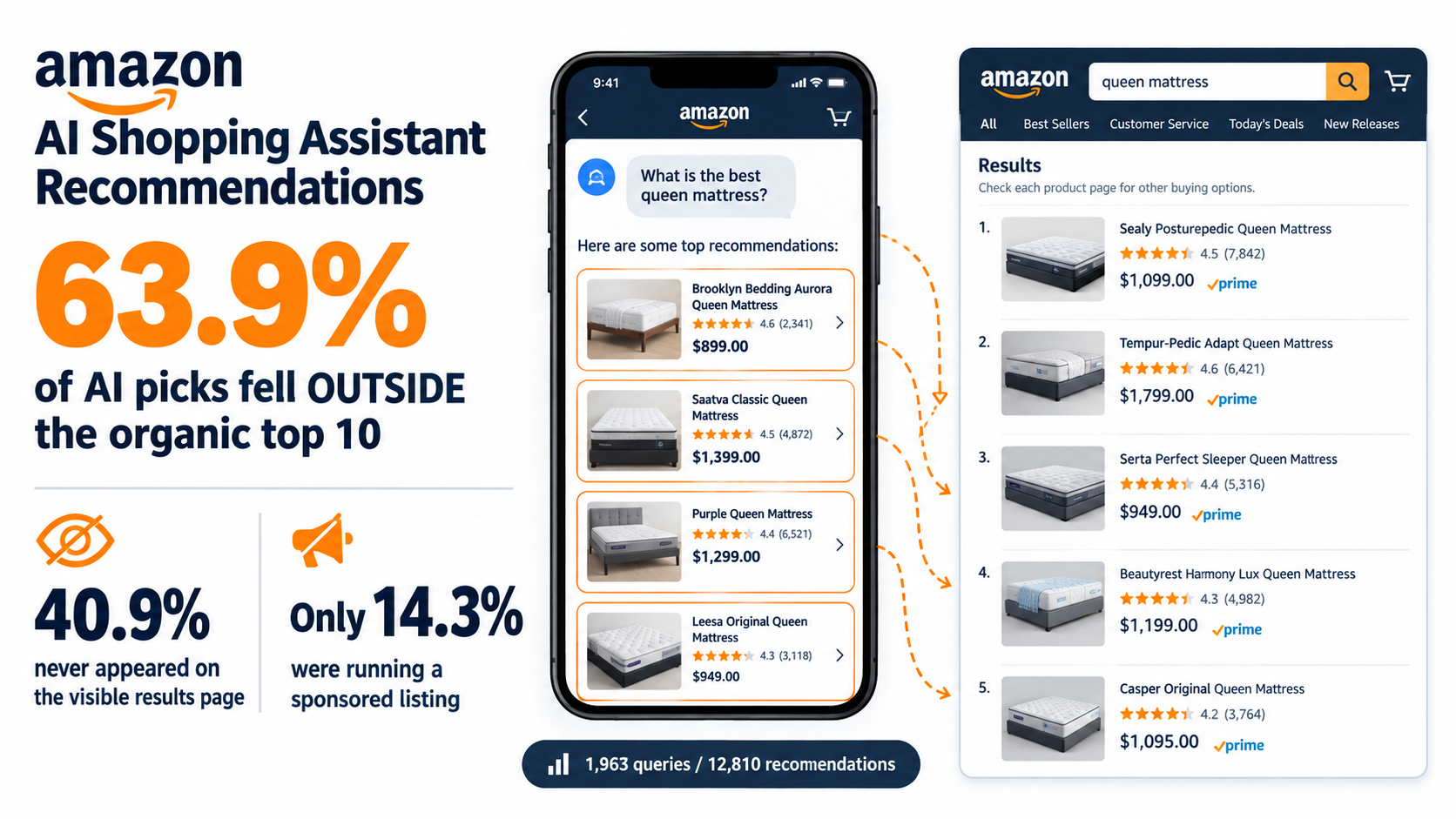
In one of the first large-scale studies of what Amazon’s AI shopping assistant recommends, 63.9% of its picks fell outside the organic top 10 for the matching search term. 40.9% never showed up on the visible results page at all. Only 14.3% were products running a sponsored listing on that search page. Shoppers who asked the assistant for the “best” option were often shown products that rank-focused sellers would never have expected to compete.
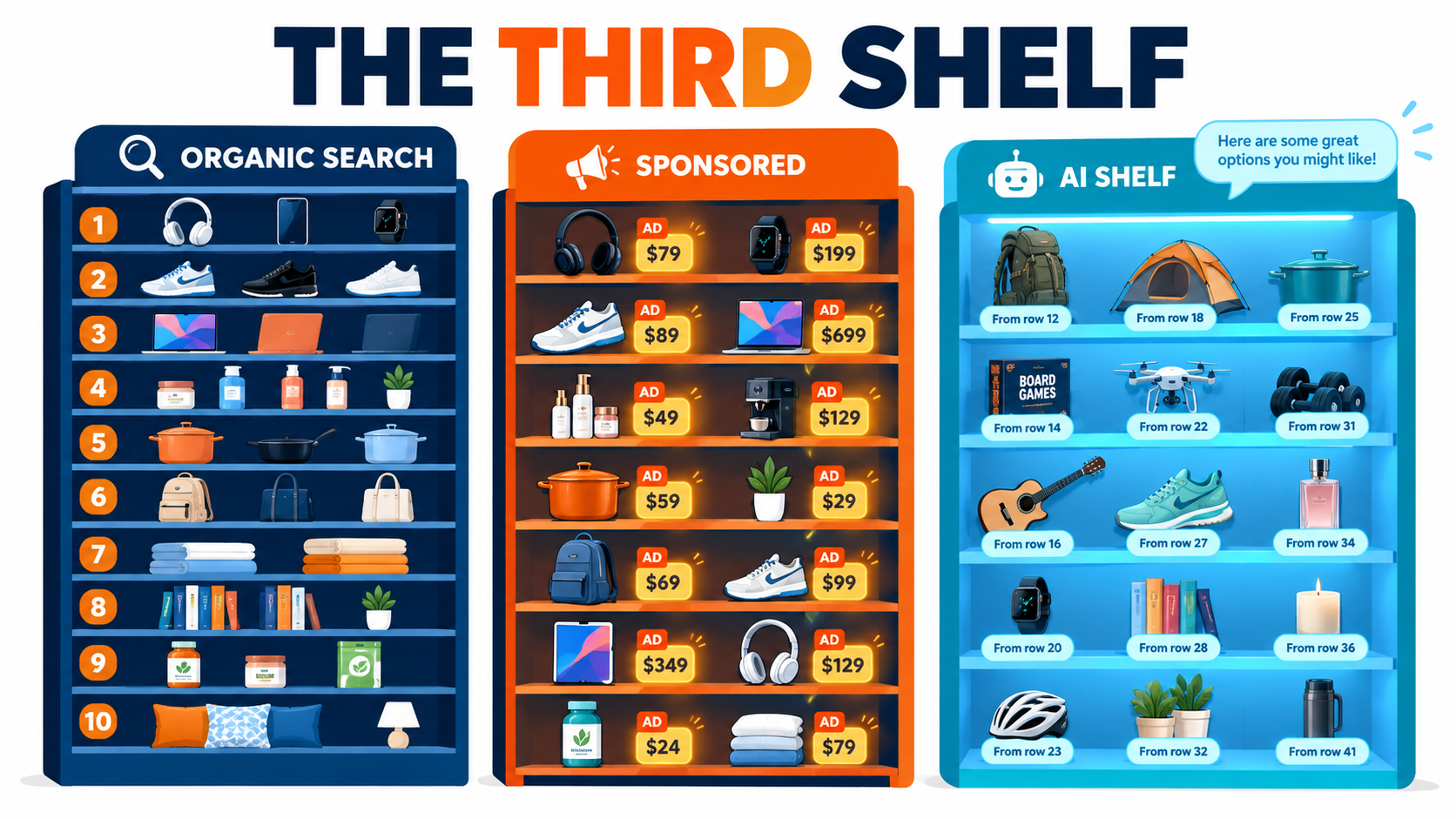
Marketplace Pulse calls this a “third shelf.” It sits next to organic search and paid placement, and for now it follows different rules. This article covers what the data says, how the assistant got here, why recommending a product is a different job from ranking one, and what sellers can actually do to be the product the AI chooses.
This is not another list of general Amazon tips. It is about one structural change in how Amazon shoppers find products, the economics around that change, and a working method for sellers who want to compete on this surface before the advertising fully arrives.
The Study That Broke the “Rank Equals Visibility” Assumption
The data comes from Autopilotbrand.com, a vendor that works on AI optimization, and was reported by Marketplace Pulse in July 2026. In May and June, the researchers ran 1,963 non-branded queries and captured 12,810 recommendations from Alexa for Shopping, the assistant formerly called Rufus.
How the test was designed
The method was simple. For each category, researchers asked the assistant a “best-of” question, such as “what is the best queen mattress?” They then compared its picks with the plain category search, “queen mattress,” on Amazon’s results page.
That makes the gap specific. When the assistant is asked to recommend instead of list, it returns a noticeably different set of products, and often a deeper one, than the search page most sellers work to rank on.
The three numbers that matter
- 63.9% of the assistant’s picks were outside the organic top 10 for the matching search term.
- 40.9% did not appear anywhere on the visible results page.
- 14.3% were products running a sponsored listing on that page. And 83% of those already ranked organically anyway.
Read the last number carefully. Advertising on the search page did not appear to buy a place in the AI’s answer. In most cases where an advertised product was recommended, it was already a strong organic performer. The ad was there, but it probably was not the reason.
Why rank is the bigger omission
Marketplace Pulse points out that search has two routes to visibility. Rank is earned slowly through sales velocity, which ad budgets are often spent to create. Ads are bought outright at auction. Neither seems to shape AI discovery yet.
Of the two, rank is the more surprising one to be ignored. It is the metric Amazon teams track most closely, and it is the thing the assistant most clearly does not follow. A seller who spent heavily to reach position three for “queen mattress” may find that a competitor sitting at position 40 is the one the AI names.
The caveat that belongs on every slide
This is one snapshot, taken early, from a single US account. Personalization, timing, and category mix can all change results. The finding is directional, not settled. But it lines up with a pattern that has been building all year, and the direction is consistent enough that sellers should start testing now instead of waiting for certainty.
From Rufus to Alexa for Shopping: How Amazon Got Here
The assistant did not start out this independent. Its history explains why its recommendations now differ so much from search.
The early version: a search engine with a chat interface
Amazon launched Rufus in beta as a generative AI shopping assistant “trained on Amazon’s extensive product catalog, customer reviews, community Q&As, and information from across the web.” According to Amazon, it was built to handle broad research (“what to consider when buying running shoes?”), comparisons (“trail vs. road running shoes”), shopping by occasion (“what do I need for cold weather golf?”), and specific product questions on a detail page (“is this pickleball paddle good for beginners?”).
In practice, Marketplace Pulse noted, the early assistant mostly returned links to searches shoppers could have run themselves. Later it became “more confident but not more intelligent.” For sellers, this meant rank still decided everything, because the assistant largely repeated the search page.
Growth in usage
Usage grew quickly. On its Q1 2026 earnings call, Amazon reported that Rufus monthly active users were up 115% year over year and engagement was up nearly 400%. CEO Andy Jassy credited the assistant with an estimated $12 billion in incremental sales.
Shopper behavior outside Amazon points the same way. Adobe Digital Insights reported a 393% year-over-year increase in AI-driven retail traffic in Q1 2026. AI-referred visitors now convert 42% better than non-AI traffic, a reversal from a year earlier when they converted at roughly half the rate. McKinsey and ICSC estimate US agentic commerce could reach $1 trillion by 2030, and say 68% of consumers used at least one AI tool for shopping in the previous three months.
The rename and what it signals
On May 13, 2026, Amazon renamed Rufus to Alexa for Shopping, folding the recommendation engine into its wider assistant. This was more than branding. It placed the shopping assistant inside a product many households already talk to every day, and it presented recommendation as Amazon’s core shopping experience rather than a side feature.
A two-thirds disconnect from search rank, in Marketplace Pulse’s words, is “the measure of a system that stopped reprinting its own results.” The assistant now selects products. It does not just retrieve them.
Why “Recommend” Is a Different Job From “List”
To compete on the third shelf, sellers need to understand why an assistant answering a best-of question would pick different products from a search algorithm ranking a keyword.
Search ranks against a keyword; assistants match against a need
A search results page answers “which products are most relevant and most likely to sell for this string of words?” Sales history carries a lot of weight in that answer. A product that has sold many units for “queen mattress” has shown it converts on that term, so it ranks.
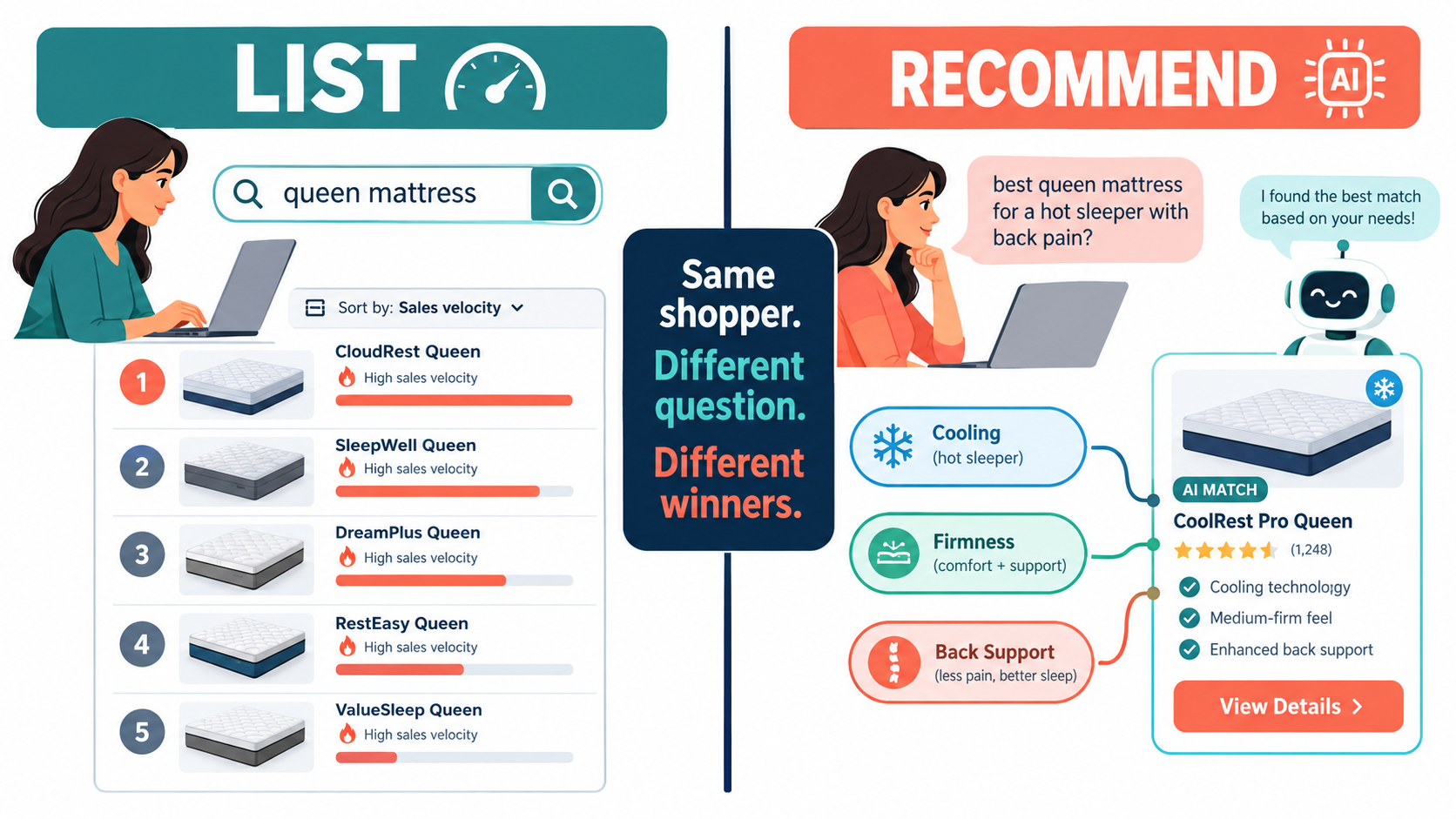
A recommendation answers a different question: “Given what this person told me, which product best fits?” A shopper who asks for “the best queen mattress for a hot sleeper with lower back pain” has given the assistant constraints. A product that has sold well to the general “queen mattress” audience is not automatically the best match for that person.
Velocity is a weak signal for fit
Sales velocity is a popularity signal. It shows that many people bought something. It says much less about whether a product suits a specific use case. A best-selling mattress might sell well because of price, brand recognition, or years of review buildup, none of which mean it sleeps cool.
An assistant drawing on catalog attributes, review language, Q&A threads, and outside web content can pick up fit signals that velocity cannot. If many reviews for a lower-ranked product say “finally a mattress that doesn’t trap heat,” that text is evidence the assistant can use. The search algorithm may give it very little weight.
Long-tail intent was always there; now it has a surface
Shoppers have always had specific needs. Before conversational search, they had to compress those needs into a two- or three-word query, scroll, and filter by hand. The assistant lets them state the full need, and that brings back the long tail of intent that keyword search used to flatten.
For sellers, the implication is direct. The product that best fits a specific need can now win that shopper without winning the head term. That favors smaller, specialized, well-documented products over broad, generic best-sellers, at least for now.
What this does not mean
Search still matters, and it still drives most Amazon purchases. Rank still pays. The point is narrower: rank is no longer the only route to being seen, and on the AI surface it may not be the main one. Sellers who track only rank will miss a growing share of how shoppers decide.
The Money Is Already Moving In
The third shelf looks fairly open today. That will probably not last, and the commercial setup around it is moving quickly.
Ads inside the assistant
Amazon launched Sponsored Products and Sponsored Brand Prompts inside Rufus in Q1 2026. On the earnings call, Amazon said nearly 20% of shoppers who interact with a sponsored brand prompt continue the conversation about that brand. Jassy added that “it is early.” It is one of the first concrete data points any major platform has shared about ad performance inside an AI shopping interface.
Read the metric precisely. It measures whether shoppers keep talking about a brand, not whether they buy. Still, it shows Amazon is building the measurement tools it needs to sell this inventory at scale.
The non-ad alternative disappeared
Six months earlier, ChatGPT seemed to offer a different model: a 4% transaction fee through Instant Checkout that would let merchants be found without buying ads. That option no longer exists in its original form. According to Marketplace Pulse, OpenAI launched ChatGPT ads to selected US advertisers in February 2026, dropped Instant Checkout in March citing execution problems, and in May opened its ads manager to all US advertisers while removing its $50,000 minimum spend.
Marketplace Pulse’s conclusion is blunt. The convergence “eliminates the most plausible non-ad path to scale in agentic commerce.” Agentic shopping is settling into an ad-supported model.
The scale of Amazon’s ad business
Amazon generated $68.6 billion in advertising revenue in 2025, up 22%. Ad revenue kept growing about 22% in Q1 2026 on a trailing-twelve-month base above $70 billion. That growth comes from a smaller active seller base than a year earlier. Fewer sellers are paying more.
Search shows where this tends to go. It once had plenty of room for organic visibility. Over time, sponsored placements filled the results page, and organic position moved further down. Marketplace Pulse warns: “Search looked like that once too, before the ad load found it.”
Why the window matters
Right now, the study suggests paid placement and the AI’s organic recommendations are mostly separate. Sellers who learn how the assistant chooses products while that holds will build knowledge and catalog depth that carries over once ads fill the surface. Sellers who wait will probably meet the third shelf only as another place to bid.
As Marketplace Pulse put it, “The sellers learning how it selects now are the ones who will notice the day that changes.”
The Competitive Backdrop: Fewer Sellers, More Traffic, Tougher Rivals
The third shelf matters more because of what is happening in the rest of the marketplace. The numbers show a platform that is consolidating fast and rewarding operational skill.
The customer pie is growing while seller count shrinks
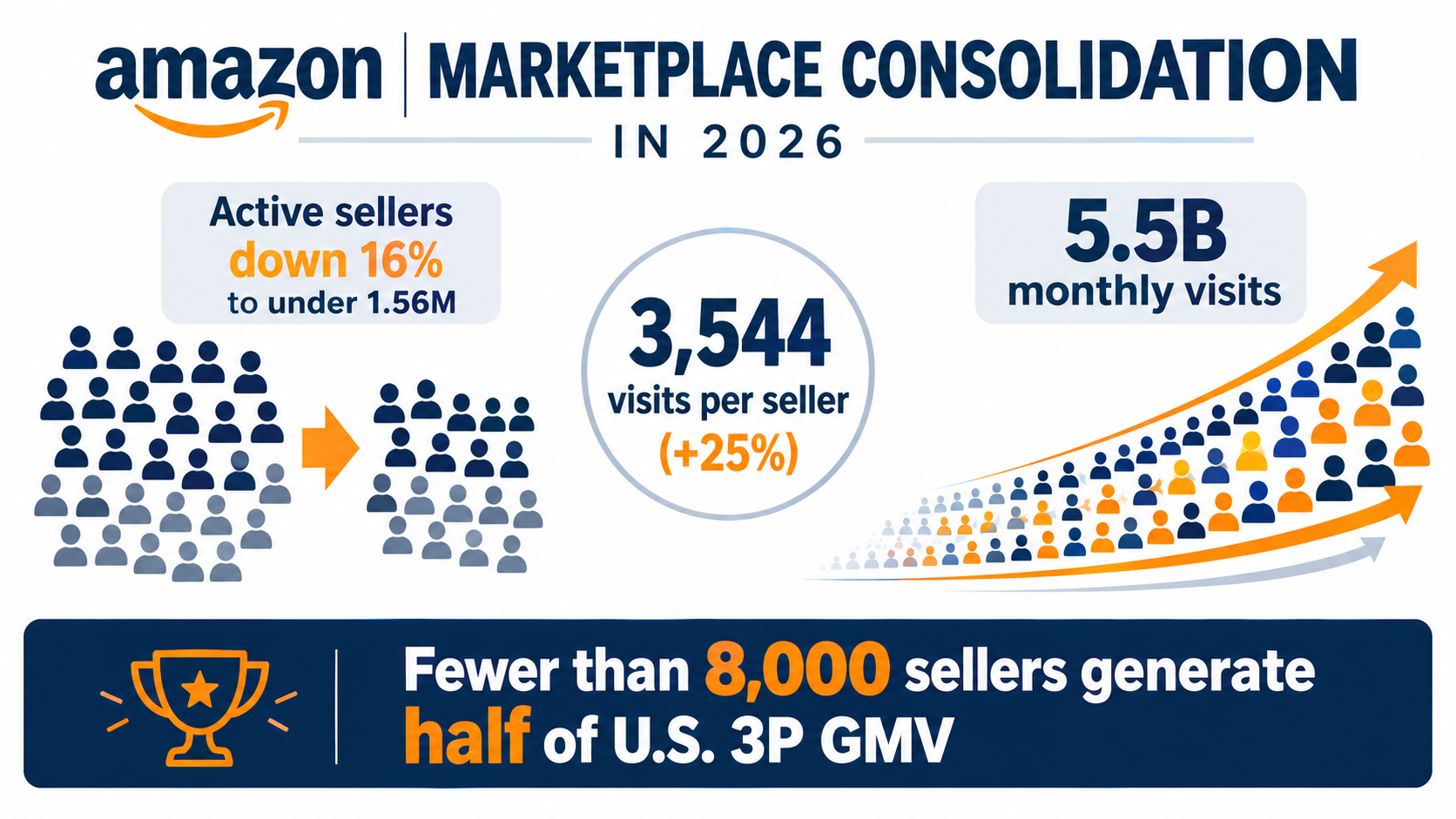
Marketplace Pulse data from May 2026 shows combined traffic across Amazon’s 23 marketplaces grew nearly 5% to 5.5 billion monthly visits. Active sellers, meaning those who received at least one feedback in the past year, fell 16% to under 1.56 million worldwide.
As a result, average traffic per active seller rose 25% to 3,544 monthly visits. That is faster growth than the 31% increase recorded over the previous four years combined. In the US, traffic per seller rose 19%. Brazil, Mexico, France, Poland, and the Netherlands saw increases of 40% to 57%.
Concentration at the top
More attention per seller does not mean it is spread evenly. Fewer than 8,000 sellers now produce half of Amazon’s US third-party GMV, down from about 15,000 less than three years ago. The top is becoming more concentrated and harder to dislodge.
Turnover among the top 10,000 sellers has stayed almost exactly where it was seven years ago: 68.6% of today’s top sellers held that position a year ago, compared with 67% in 2019. Nearly half (49.6%) were already in the top 10,000 three years ago, up from 41% in 2019.
Who is taking the open spots
The seats come open at the same rate as before, but different sellers are taking them. Since July 2020, Chinese sellers have gained 1,342 positions in the top 10,000 and US sellers have lost 1,320. Chinese sellers now hold 55.9% of the cohort, up from 42.5%. American sellers fell from 53.7% to 40.5%.
Marketplace Pulse attributes much of this to factory-direct sellers with manufacturing proximity, export subsidies, and “AI tooling that erased the listing-quality gap once protecting domestic sellers.” Those sellers often work on thinner product margins and can outbid veterans for sponsored placement.
Where US sellers still hold value
Headcount does not tell the whole story. US sellers still produce 65.3% of the GMV generated by the top 10,000, compared with 28.6% for Chinese sellers. In the top 100, American sellers make up 81.4% of sellers and 93.2% of GMV, with an average selling price of $47.62 versus $22.03.
Why this connects to the third shelf
Put these trends together. Sponsored search is getting more expensive, and well-funded competitors are bidding it up. Organic rank is harder to take from long-standing incumbents. The AI shelf is currently the rare place where, in Marketplace Pulse’s words, “rank incumbency is a weaker moat and a product outside the search winners can appear where a category leader does not.”
Higher-priced, differentiated products with clear use-case advantages, the kind US brands often sell, are exactly what a recommendation engine looking for “best for X” is built to surface. A cheaper copy competes on price and ad spend. A well-explained product built for a specific need competes on fit.
What “Giving the AI Context” Actually Means
Christian Umbach, co-founder and CEO of Autopilotbrand.com, summarized the challenge in the Marketplace Pulse report:
“Brands cannot simply buy or rank their way onto it; they need to give Amazon’s AI Alexa enough context to understand when and why their product is the right recommendation. That means richer catalog data, optimization around shopper intent, and continuous updates as seasonal use cases and product differentiators evolve.”
That is a useful principle, but sellers need specifics. Based on what Amazon says the assistant draws from (catalog data, reviews, community Q&A, and web information), here is how to apply it.
1. Structured attributes are the foundation
Backend attributes in Seller Central, such as material, dimensions, compatible devices, age range, care instructions, and intended use, were long treated as a compliance task. Many sellers filled in the required fields and skipped the rest.
For a recommendation system, those fields are machine-readable facts. If a shopper asks for a “dishwasher-safe water bottle that fits a car cup holder,” a product with those attributes clearly filled in is easier to match than one where the information is only in an image. Fill in every relevant attribute, not just the required ones.
2. Write for use cases, not only keywords
Traditional listing copy packs keywords into titles and bullets. Copy that serves a recommendation engine states who the product is for, what problem it solves, and in what situation it beats the alternatives.
Compare these two bullets:
- “Premium stainless steel insulated water bottle, BPA free, leak proof, 24 oz”
- “Built for school lunchboxes: the 24 oz size fits standard lunch bags, the leak-proof lid survives being tossed in a backpack, and kids can open it with one hand.”
The first lists features. The second links features to a context. An assistant answering “best water bottle for a kid’s lunchbox” has much more to go on with the second.
3. Treat customer Q&A as source material
Amazon names community Q&A as a training input. Questions shoppers ask about your product and its competitors show the needs that are hard to answer from the listing. Each unanswered or poorly answered question is a gap the assistant may also struggle with.
Answer questions thoroughly and accurately. When the same question comes up repeatedly, add the answer to the listing itself.
4. Reviews are evidence you shape indirectly
Sellers cannot write reviews and must never manipulate them. They can shape the experience that produces them. Inserts, onboarding emails where permitted, and clear usage instructions influence what customers notice and later write about.
If your product’s main advantage is that it sleeps cool, make sure customers understand that feature. Then reviews are more likely to mention it, which gives the assistant more evidence.
5. Don’t ignore off-Amazon content
The assistant also draws on “information from across the web.” Reviews on independent sites, comparison articles, brand-site FAQs, and expert roundups can all add to the context it uses. A brand with no presence off Amazon is giving the assistant less to work with.
6. Keep it current
Umbach’s point about “continuous updates” matters. Use cases change by season. A cooler is for beach trips in July and tailgates in October. Listings that reflect current use cases give the assistant timely reasons to recommend them.
A Query-Mapping Workflow for the Third Shelf
Principles do not ship products, so here is a process a small team can run in a few weeks. It turns the “context” idea into specific listing changes.
Step 1: Generate the questions shoppers actually ask
For each hero product, write 20 to 40 natural-language questions a real shopper might ask the assistant. Mix the types Amazon describes:
- Best-of: “What’s the best ___ for ___?”
- Occasion or purpose: “What do I need for ___?”
- Comparison: “What’s the difference between ___ and ___?”
- Constraint-driven: “___ under $50 that’s ___ and ___”
- Persona-driven: “Good ___ for a beginner / a senior / a small apartment”
Pull language from your reviews, competitor reviews, Q&A threads, Brand Analytics search terms, and customer service tickets. Shoppers’ own words beat marketing language.
Step 2: Run the questions and record the results
Ask each question in Alexa for Shopping, ideally from more than one account and device, since results can vary. For each one, note:
- Whether your product appears
- Which competitors appear, and where they rank in organic search for the related head term
- What reason, if any, the assistant gives for each pick
The reasons are especially useful. When the assistant explains a pick (“this one is praised for staying cool”), it shows which attributes and evidence it is weighing.
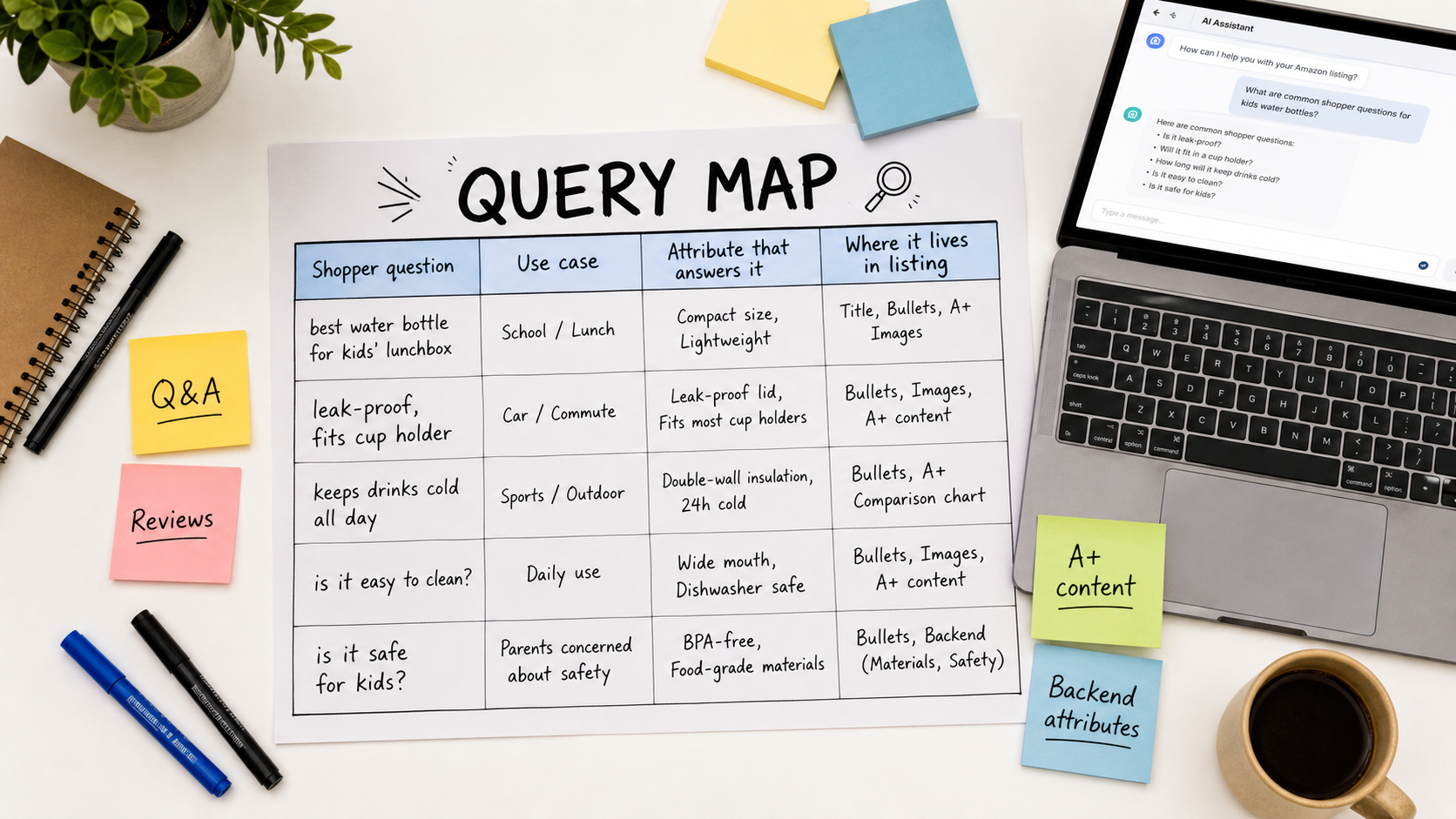
Step 3: Build the query map
Make a simple grid with four columns: Shopper question → Use case → Attribute that answers it → Where it lives in your listing. For each question where you do not appear, the last column often shows the problem: the answer is missing, buried in an image, or only implied.
Step 4: Close the gaps
Rewrite bullets and descriptions to name use cases directly. Fill in empty backend attributes. Add A+ content modules that address specific scenarios. Update Q&A. If the honest answer is that your product does not fit a use case, leave that query alone. False claims damage trust and conversion.
Step 5: Re-run on a schedule
Repeat the question set every four to six weeks. Track your recommendation rate, meaning the share of questions where you appear, over time. Since this is a new surface, the trend line matters more than any single result.
A note on scope
Do not try this across your whole catalog at once. Start with three to five products where you have a real fit advantage but weak organic rank. That is where the third shelf is most likely to produce gains.
Measuring a Surface You Can’t Fully See
The hardest part of competing on the AI shelf is that standard Seller Central reports were built for search. Rank trackers follow keyword positions. Search query performance reports show impressions and clicks. None of them clearly separate traffic the assistant sent.
What you can measure today
- Recommendation rate: From the query-mapping workflow, the share of a fixed set of questions where your product appears. This is your most direct indicator.
- Sessions vs. rank divergence: If sessions or units for a product rise while its keyword rank stays flat or falls, something other than search is sending traffic. The AI shelf is one possible cause.
- Conversion rate shifts: Adobe’s data shows AI-referred visitors convert better. A product gaining AI-referred traffic may see conversion rise even with flat sessions.
- Branded search lift: Shoppers who hear a recommendation in conversation may later search your brand directly. Watch branded search term volume in Brand Analytics.
What to avoid
Do not credit every unexplained sales change to the assistant. Seasonality, competitor stockouts, price changes, and promotions all create noise. Use a control group: compare products you have updated for the third shelf with similar products you have not, over the same period.
Watch the ad side closely
As Sponsored Prompts and Sponsored Products inside the assistant mature, Amazon’s ad console will probably report more on this surface. When it does, compare paid-assistant results with your organic recommendation rate. If Amazon’s 20% conversation-continuation figure holds up and turns into purchases, the economics of paid prompts may justify a test budget, especially for products that already earn organic recommendations.
The reporting gap is temporary
Search had the same problem in its early years. Measurement tends to arrive with monetization. The sellers who benefit most will be the ones with months of their own data when Amazon’s official reporting shows up.
Sellers Are Using AI on the Wrong Side of the Equation
The third shelf also shows a mismatch in how sellers use AI compared with how Amazon uses it.
Broad adoption, narrow use
According to the Marketplace Pulse 2026 Seller Index, a survey of 181 marketplace sellers with more than $2 billion in combined annual revenue, 83.4% use AI somewhere in their operations, with an average of 3.2 use cases each. Usage clusters around content: listing optimization (63.5%) and image and video creation (49.2%). Advertising management, competitive intelligence, pricing, and inventory forecasting trail well behind.
The impact problem
The most common answer about AI’s impact was that no area had produced measurable results yet: 25.4%, more than any specific benefit. That figure barely changed across revenue levels. Larger sellers use AI for more tasks (3.67 use cases above $5M versus 2.42 below $500K) but report about the same lack of measurable results.
The clearest difference was by business health. Among “thriving” and “grinding” sellers, whose revenue is rising, about 16% reported no measurable AI impact. Among “consolidating” and “distressed” sellers, the figure was about double.
The mismatch
Most sellers use AI to produce content faster: more bullet points, more lifestyle images, more A+ modules. Amazon uses AI to decide which products to recommend. Those are different problems.
Generating more keyword-heavy copy quickly does not help a recommendation engine looking for specific fit evidence. AI-generated text can even make things worse, because it tends toward generic language that sounds like every competitor. If every water bottle listing says “premium,” “durable,” and “perfect for any adventure,” the assistant has nothing to tell them apart.
A better use of AI tooling
Sellers can point AI at the third-shelf problem directly:
- Review mining: Use AI to group thousands of your reviews and competitors’ reviews by use case, and find the scenarios where your product is praised and competitors are criticized.
- Question generation: Use AI to expand a seed list of shopper questions into a broader query-mapping set.
- Gap analysis: Feed your listing and a list of shopper questions to an AI model and ask which questions the listing cannot answer.
- Specificity editing: Use AI to replace generic adjectives with concrete, verifiable claims.
Marketplace Pulse notes that some nine-figure sellers are already building their own internal AI tools. Back in 2023, the publication predicted AI would become “not a differentiator but a new foundational level.” For platforms and consumers, that has happened. For most sellers, AI is still just “a tool that writes bullet points.”
The Multichannel Hub and the Dependence Question
One more 2026 development affects how sellers should think about the AI shelf: Amazon now wants to run your other channels too.
What Amazon announced
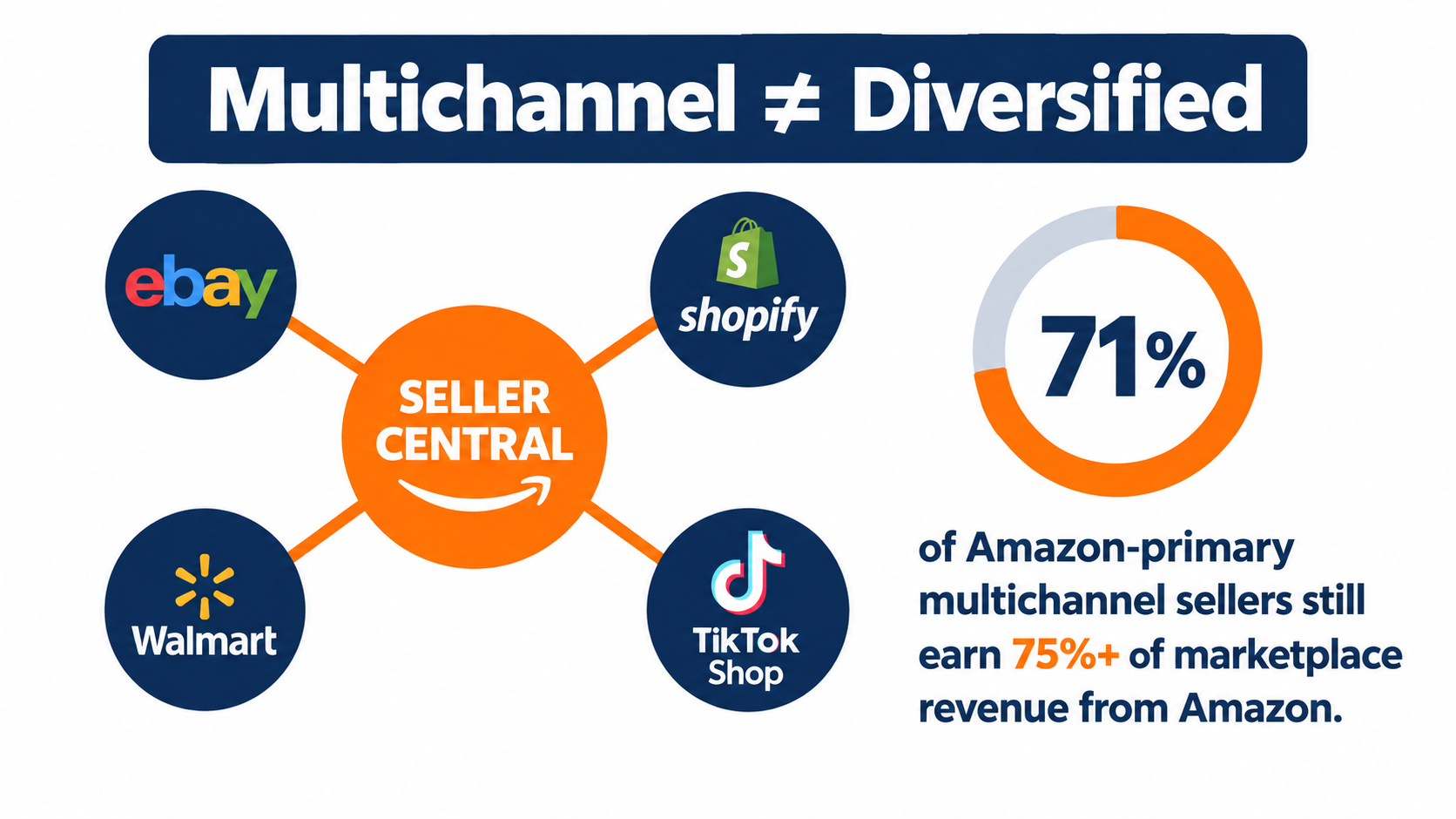
At its Accelerate seller conference in September 2026, Amazon said sellers will be able to manage their eBay, Shopify, TikTok Shop, and Walmart businesses from inside Seller Central. The tools are rolling out gradually to US sellers at no extra cost. They bring listings, orders, and profitability from each connected channel into one workspace.
A seller can edit a product description once and have Amazon reformat and publish it to linked listings on eBay, Walmart, and Shopify. Shopify and Walmart orders appear next to Amazon’s and can be fulfilled through Amazon in a few clicks. A profitability view shows what each product earns on each channel.
The five-year arc
This is a big change from Amazon’s earlier position. Five years ago, FBA charged more to ship off-Amazon orders, and products priced lower elsewhere could be suppressed, as they still can be. Then came Buy with Prime and expanded Multi-Channel Fulfillment, which Amazon said served more than 200,000 US sellers by Accelerate 2024, plus MCF integrations with Walmart and Shein. The new tools move Amazon from the warehouse behind other channels to the interface in front of them.
Multichannel is not the same as diversified
Amazon says more than 95% of its sellers sell on multiple channels. But the Marketplace Pulse 2026 Seller Index found that 71% of Amazon-primary sellers active on at least one other marketplace still earn three-quarters or more of their marketplace revenue from Amazon.
Other channels are growing. Walmart’s US marketplace grew nearly 50% in Q1 of its fiscal 2027, and Walmart’s ad business grew 46% to $6.4 billion in 2025. Still, Amazon’s estimated $300 billion in US third-party sales is more than seven times eBay’s and about 20 times Temu, TikTok Shop, or Walmart’s marketplace.
How this connects to the AI shelf
There is a useful overlap here. The work that earns AI recommendations on Amazon (rich structured data, clear use-case copy, detailed Q&A, off-platform content) also helps on Walmart’s Sparky assistant, in ChatGPT shopping, and in Google’s AI results. Walmart is already embedding Sparky inside ChatGPT, with Gemini next. Shopify has released connector apps for ChatGPT and Claude.
Sellers who build strong product context once can use it across every AI surface. That is a more lasting kind of diversification than copying the same thin listing onto four marketplaces. Be aware, though: if all of that context lives in Seller Central’s hub, your dependence on Amazon grows. Keep a master copy of your product data that you control.
Risks, Caveats, and What Could Change
A fair look at the third shelf has to include its uncertainties. Here is what could weaken or reverse the opportunity.
The data is early and narrow
The main study covers one US account over two months, conducted by a vendor that sells AI-optimization services. That does not make it wrong, but it does mean sellers should check it against their own query testing. Personalization may mean that accounts with different purchase histories see different recommendations.
Monetization will narrow the window
Amazon’s ad business is built to monetize every surface that gets attention. Sponsored Prompts already exist. As ad load inside the assistant grows, the share of organic recommendations will probably fall, as it did on the search page. The third shelf’s current openness is a window, not a permanent feature.
The algorithm may start weighting rank
Nothing guarantees the assistant will keep ignoring sales velocity. Amazon could adjust it to favor proven sellers, especially if recommending lesser-known products leads to more returns or lower satisfaction. Sellers should treat the current disconnect as a condition to use, not a rule to count on.
Retail competition is shifting too
Third-party sellers accounted for 60% of paid units on Amazon in Q1 2026, down from 62% two quarters earlier. It was the first two-quarter decline since Amazon began reporting the metric in 2004. If Amazon’s first-party business keeps gaining unit share, its own products could become stronger candidates for AI recommendations in some categories.
Don’t abandon search
The biggest risk is overcorrecting. Search still drives most purchases. The best approach is additive: keep the rank and advertising basics in place, and put a focused share of effort, perhaps 10% to 20% of listing work, into AI-shelf readiness for the products where it fits best.
Conclusion: A 90-Day Plan for the Third Shelf
Amazon selling in 2026 sits on three surfaces. Organic search rewards velocity and history. Sponsored placement rewards budget. And the AI shelf, for now, rewards fit, meaning whether your product clearly and verifiably answers a specific shopper’s need.
The data is early but consistent. Nearly two-thirds of the assistant’s recommendations fall outside the organic top 10. Ads on the search page do not seem to buy a place in its answers. Shopper adoption is rising quickly, and AI-referred traffic now converts better than standard traffic. Meanwhile, the rest of the marketplace is consolidating, competitors are bidding up sponsored search, and incumbents hold organic rank longer than ever.
For sellers outside the top of search, the third shelf is one of the few open paths left. For established brands, it is a surface where a lead is less secure than it appears.
Days 1–30: Baseline
- Pick three to five hero products, ideally ones with a clear use-case advantage but weak head-term rank.
- Write 20 to 40 natural-language shopper questions per product using reviews, Q&A, and Brand Analytics.
- Run every question in Alexa for Shopping and record your recommendation rate, competitor picks, and the reasons the assistant gives.
- Audit backend attributes and note every empty but relevant field.
Days 31–60: Close the gaps
- Build a query map for each product: question → use case → attribute → listing location.
- Rewrite bullets and A+ content to name specific use cases and back them with concrete claims.
- Fill in every relevant backend attribute.
- Answer open Q&A thoroughly and add recurring answers to the listing.
- Use AI tools for review mining and gap analysis, not just more copy.
Days 61–90: Measure and expand
- Re-run the full question set and compare recommendation rates with your baseline.
- Compare sessions, conversion, and branded search for updated products against a control group.
- Test a small Sponsored Prompts budget on products that already earn organic recommendations.
- Expand the process to the next group of products, and reuse your improved product data on Walmart, Shopify, and other AI surfaces.
The sellers who did well on Amazon search in its early years were the ones who learned its logic before everyone else and before ads filled it. The AI shelf is at a similar stage now. Its economics are not settled yet, and the work you put into explaining your products clearly will still count after they are.