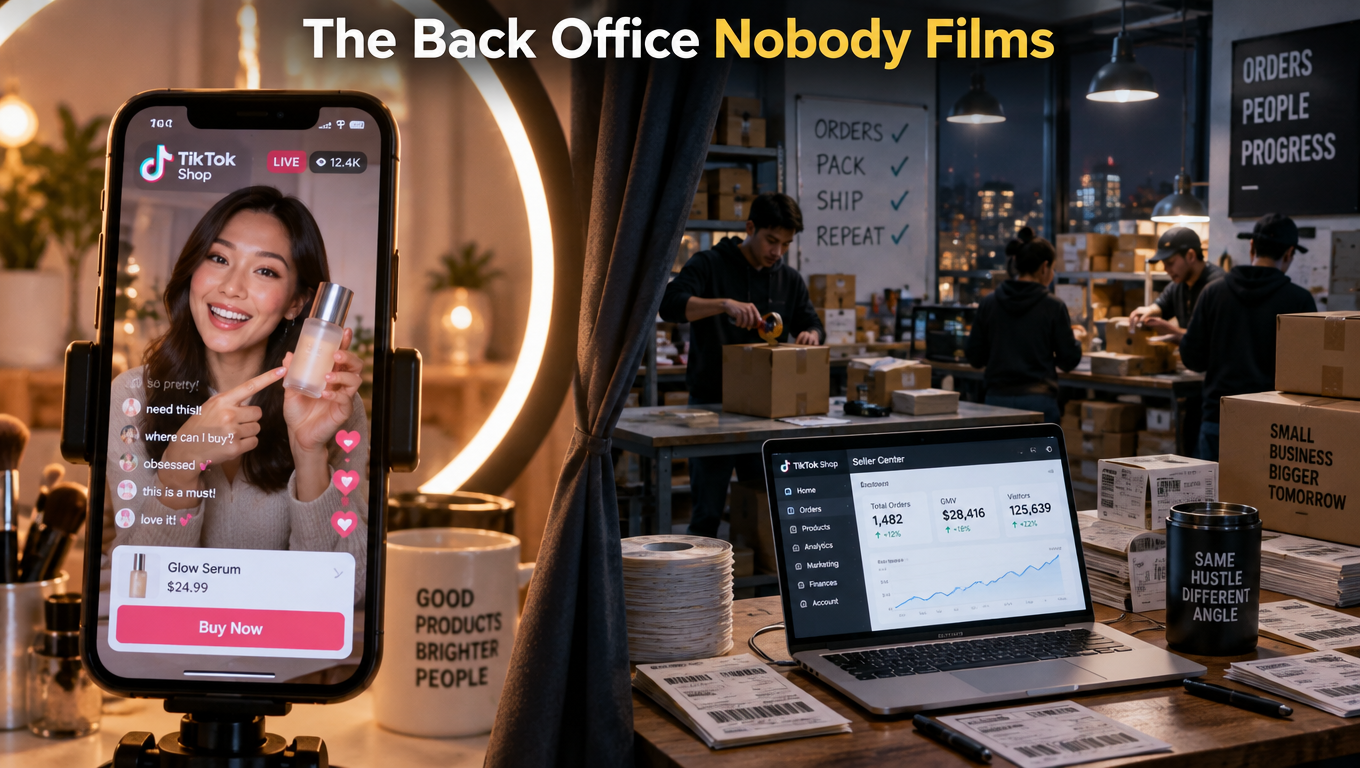

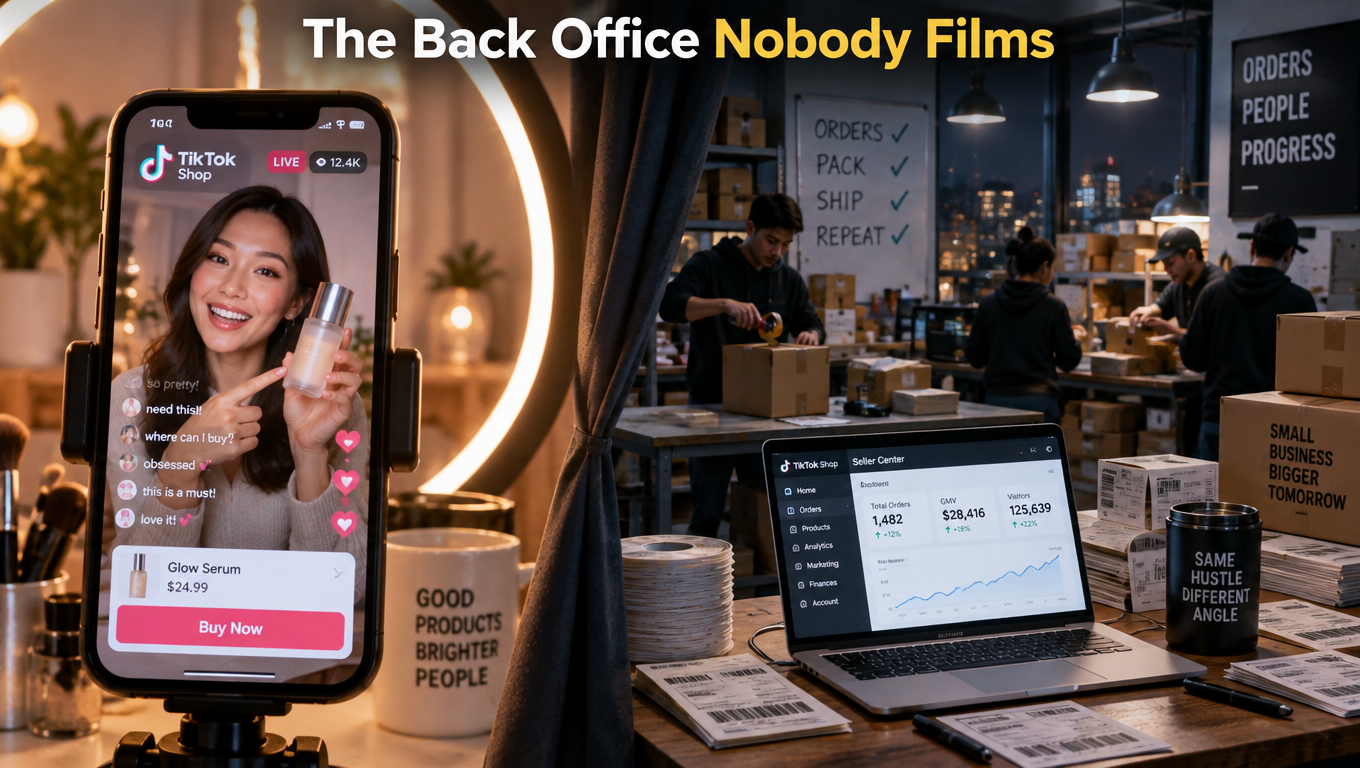
Most TikTok Shop advice is about the part you can see: hooks, trending sounds, creator outreach, the 15-second demo that drives thousands of orders overnight. That content matters. But it covers roughly the first ten minutes of a sale’s life.
Everything after “Place Order” happens off camera. Someone has to pick, pack, and ship the item. Someone has to upload valid tracking and answer the buyer who messages at 11 p.m. asking where their package is. Someone has to process the return, handle the dispute, and keep the listing within policy so it doesn’t get pulled during your best week.
That off-camera work is what this guide is about. Not how to go viral, but how to survive going viral, and how to build a shop that the platform keeps sending traffic to because your operations make TikTok look good to its own customers.
The stakes are rising. TikTok Shop is estimated to reach $123.5 billion in global GMV in 2026, nearly double the $64.3 billion recorded in 2025, according to figures compiled by DemandSage from Statista and other sources. In the US alone, sales reached about $15.8 billion in 2025, and US GMV in the first half of 2026 hit $11.8 billion, more than double the same period a year earlier.
More buyers means more orders. More orders means more chances for something to go wrong. And on a platform with more than 15 million sellers worldwide, the shops that handle the unglamorous parts well are the ones that get the second, third, and fiftieth sale.
Why the Back Office Matters More in 2026 Than It Did Two Years Ago
In the early days of TikTok Shop, the platform was hungry for supply. Sellers who could simply list products and get a few creators posting often saw traffic regardless of how tight their operations were. That window has closed.
The marketplace has matured
TikTok Shop launched in the US in September 2023, when daily sales averaged roughly $7 million. By Black Friday 2024, the platform generated over $100 million in a single day. US sales are projected to reach about $23.4 billion in 2026, which would represent nearly 23% of all US social commerce.
A marketplace at that scale behaves differently from a startup marketplace. It cares about buyer retention, not just buyer acquisition. And the fastest way for a marketplace to lose buyers is a bad delivery experience, which is why platforms at this stage tend to tie traffic allocation more tightly to seller reliability.
The seller mix has shifted
When the US ended the de minimis import exemption in May 2025, sales from foreign sellers dropped sharply, and domestic businesses picked up more of the demand. That changed the competitive landscape in two ways.
- More domestic competition: More than 215,000 US small businesses now sell on the platform, many with similar products and similar shipping origins.
- Higher buyer expectations: When most competitors ship domestically, fast delivery stops being a differentiator and becomes the baseline. A slow shipper stands out for the wrong reasons.
Seller count is not store count
One detail worth noting from the DemandSage research: the number of stores on TikTok Shop is much larger than the number of businesses actually selling. Many stores have never made a sale. That means the real competition is a smaller, more serious group of operators, and those operators are increasingly professional about fulfillment and service.
Takeaway: In 2026, operational quality isn’t a “nice to have” you fix after you scale. It’s part of how you get scale in the first place.
The Shop Performance Score: The Number That Quietly Governs Everything
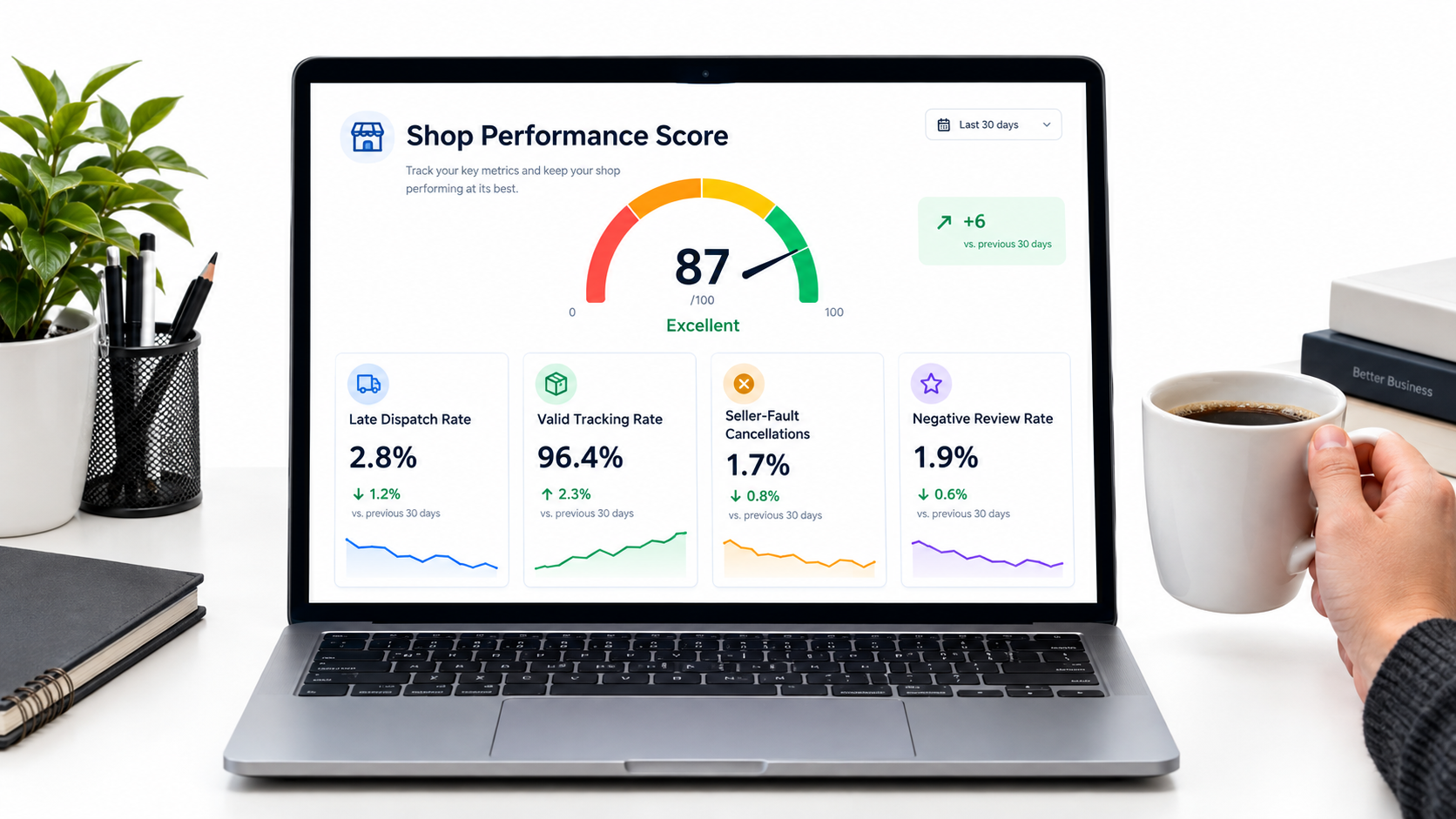
TikTok Shop grades sellers on a composite health metric called the Shop Performance Score (SPS). Sellers usually think of it as a report card. It’s more useful to think of it as a gate.
A strong score keeps doors open: eligibility for campaigns, promotions, certain programs, and steady traffic. A weak score closes them, sometimes gradually, sometimes all at once. The exact thresholds and weighting vary by region and change over time, so always confirm current rules in Seller Center and Seller University.
What feeds the score
While the specifics evolve, SPS generally draws from three families of metrics:
- Fulfillment metrics: How quickly you hand orders to the carrier, whether tracking numbers are valid, and how often you cancel orders for reasons that are your fault (usually stock problems).
- Product and buyer satisfaction metrics: Negative review rate, return and refund rates tied to product quality or “not as described” claims.
- Service metrics: How fast and how consistently you respond to buyer messages.
Notice what is missing: views, likes, follower count, and creator reach. The score that controls your access to growth is built almost entirely on things that happen after the video.
Why a score drop hurts more than it looks
Health metrics are typically calculated over a rolling window of recent orders. That has two consequences sellers often underestimate.
- Bad weeks linger. A shipping meltdown during a viral spike can drag your score down for weeks after the problem is fixed, because those orders stay in the window.
- Volume cuts both ways. A spike means a large batch of orders entering the window at once. If those orders are handled poorly, they dominate the calculation.
That’s why the most dangerous moment for a TikTok Shop seller is often not a slow month. It’s the best day they’ve ever had.
How to monitor it properly
Check SPS and its component metrics at least weekly, and daily during campaigns or spikes. Don’t just look at the headline score. Look at which sub-metric is moving and trace it back to a specific cause: a carrier, a SKU, a warehouse shift, a template reply that isn’t answering the real question.
Takeaway: Treat SPS as a lagging indicator. By the time the score moves, the problem happened days ago. Your job is to watch the leading indicators covered in the next sections.
Dispatch and Tracking: Where Most Points Are Actually Lost
If you ask experienced operators where account health problems start, the answer is usually the same: the gap between an order arriving and a carrier scanning the package.
Handling time is a promise, not a guideline
When a buyer checks out, TikTok shows them an estimated delivery window based partly on your stated handling time. If your package isn’t scanned by the carrier within that window, the order counts as late, even if it ultimately arrives on time.
The critical detail is the carrier scan. Printing a label is not dispatch. A label created on Monday and scanned on Thursday is a Thursday dispatch in the eyes of most marketplace systems.
The common causes of late dispatch
- Label-first, pack-later workflows: Sellers print labels in bulk to “clear” orders from the queue, then fall behind on packing.
- Carrier pickup gaps: Relying on a single daily pickup with no backup drop-off plan.
- Weekend and holiday blind spots: Orders that spike on Saturday from a weekend video, with no one packing until Monday.
- Bundles and variants: Multi-item orders or specific color/size combinations that require manual picking and slow the line.
Valid tracking is its own metric
Uploading a tracking number isn’t enough. It needs to be a real, scannable number from a supported carrier that actually shows movement. Reusing numbers, uploading numbers before the package exists, or using carriers the platform can’t read will hurt your valid tracking rate.
Practical fixes
- Set your handling time to what you can do on your worst day, not your best. You can always beat a promise. You can’t un-break one.
- Schedule a second pickup or a fixed drop-off run during high-volume periods.
- Create a “same-day cutoff” rule: orders in by a fixed time ship today, everything else ships tomorrow, no exceptions.
- Pre-kit your best sellers. If one SKU is 60% of your volume, pre-pack a buffer of ready-to-label units every evening.
- Audit tracking uploads weekly by spot-checking a sample of orders for real carrier scans.
Takeaway: The cheapest account-health insurance you can buy is a conservative handling time and a disciplined same-day cutoff.
Self-Fulfillment, Fulfilled by TikTok, or a 3PL: Choosing Who Ships Your Orders
The single biggest operational decision a TikTok Shop seller makes is who physically ships the product. There are three main paths, and each fits a different stage and product type.
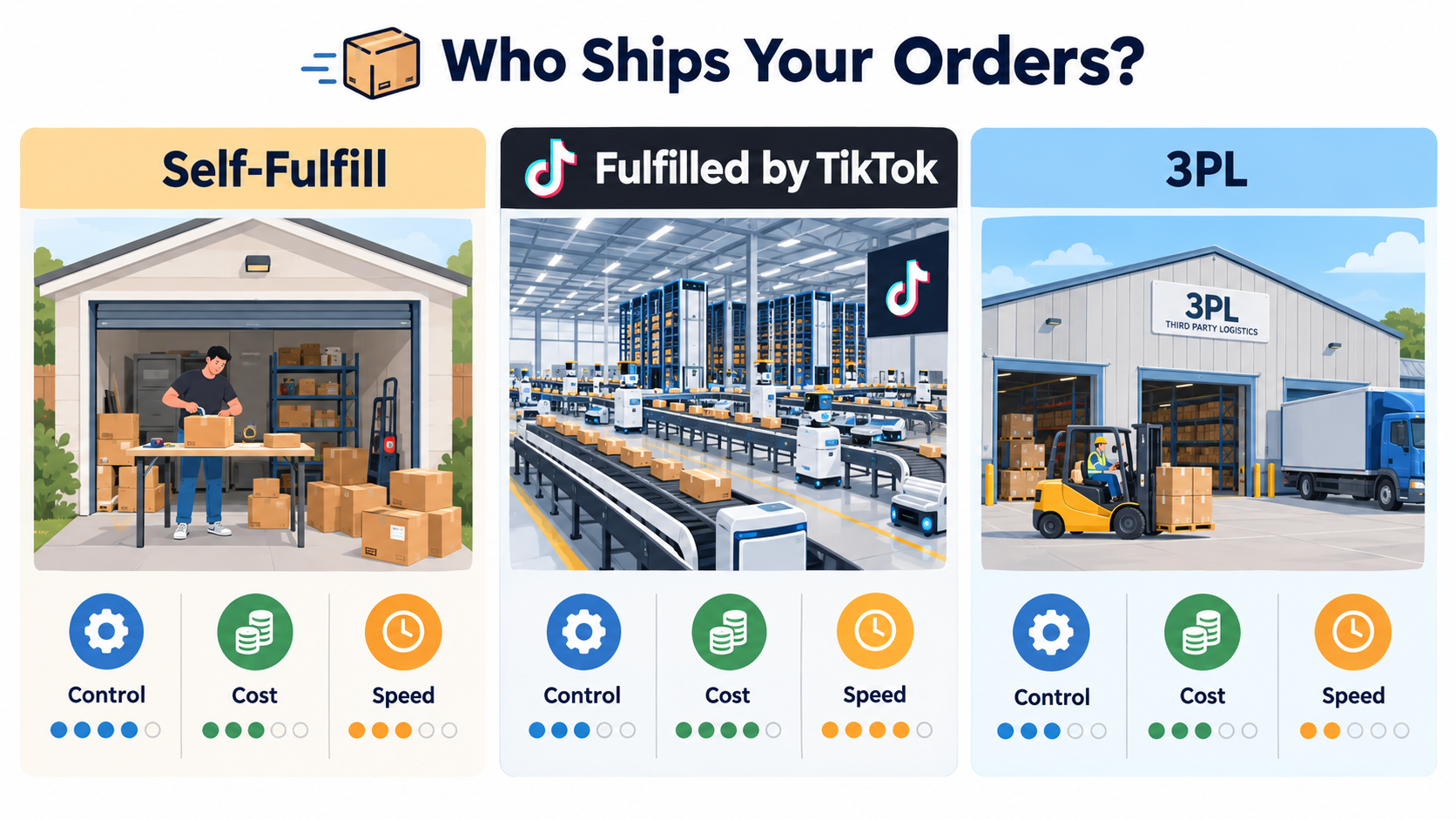
Self-fulfillment
You store inventory, pack orders, and hand them to carriers yourself, whether from a garage, a small unit, or a retail backroom.
- Best for: New shops testing products, handmade or customized goods, and sellers with low and predictable volume.
- Strengths: Full control over packaging, inserts, and quality checks. Lowest fixed cost.
- Weaknesses: Capacity is capped by your labor. A viral spike can overwhelm you in hours, which is exactly when dispatch metrics are most exposed.
Fulfilled by TikTok (FBT)
TikTok’s own fulfillment program, available in the US, where you send inventory to TikTok-operated or partner warehouses and the platform handles picking, packing, and shipping.
- Best for: Sellers with proven products and steady volume who want shipping performance handled by the platform itself.
- Strengths: Fulfillment is managed by the marketplace, which typically means fulfillment-related metrics are handled for you, and listings may get faster delivery promises shown to buyers. Check Seller Center for the current benefits, which change over time.
- Weaknesses: Fees for storage and fulfillment, inbound shipment requirements, less control over packaging and unboxing, and inventory that lives in a system you don’t fully control.
Third-party logistics (3PL)
An independent warehouse stores your inventory and ships orders across channels, usually via an integration with TikTok Shop and your other storefronts.
- Best for: Multichannel brands that sell on TikTok Shop, Amazon, Shopify, and wholesale from one inventory pool.
- Strengths: One stock pool for every channel, professional throughput, and custom packaging options.
- Weaknesses: You’re responsible for the integration working. If the 3PL’s system fails to push tracking back to TikTok on time, your metrics take the hit, not theirs.
A simple decision framework
- Under steady daily volume you can pack yourself? Self-fulfill, but build a surge plan before you need it.
- Mostly TikTok-driven sales with a few proven SKUs? Test FBT on your top sellers while keeping long-tail SKUs in-house.
- Selling meaningfully on multiple channels? A 3PL usually wins on inventory efficiency, as long as the integration is reliable.
Many mature sellers end up with a hybrid: hero SKUs in FBT or a 3PL, slower or customized items shipped in-house. That split keeps the highest-volume orders in the most reliable pipeline.
Takeaway: Don’t choose fulfillment based on today’s volume. Choose it based on what happens to your metrics if volume triples overnight.
Inventory Planning for a Platform Where Demand Arrives Sideways
On search-driven marketplaces, demand tends to build. Rankings climb, sales grow, and you can forecast from last month. On TikTok Shop, demand often arrives sideways: a creator you’ve never spoken to posts a video, it catches, and you sell a month of inventory before lunch.
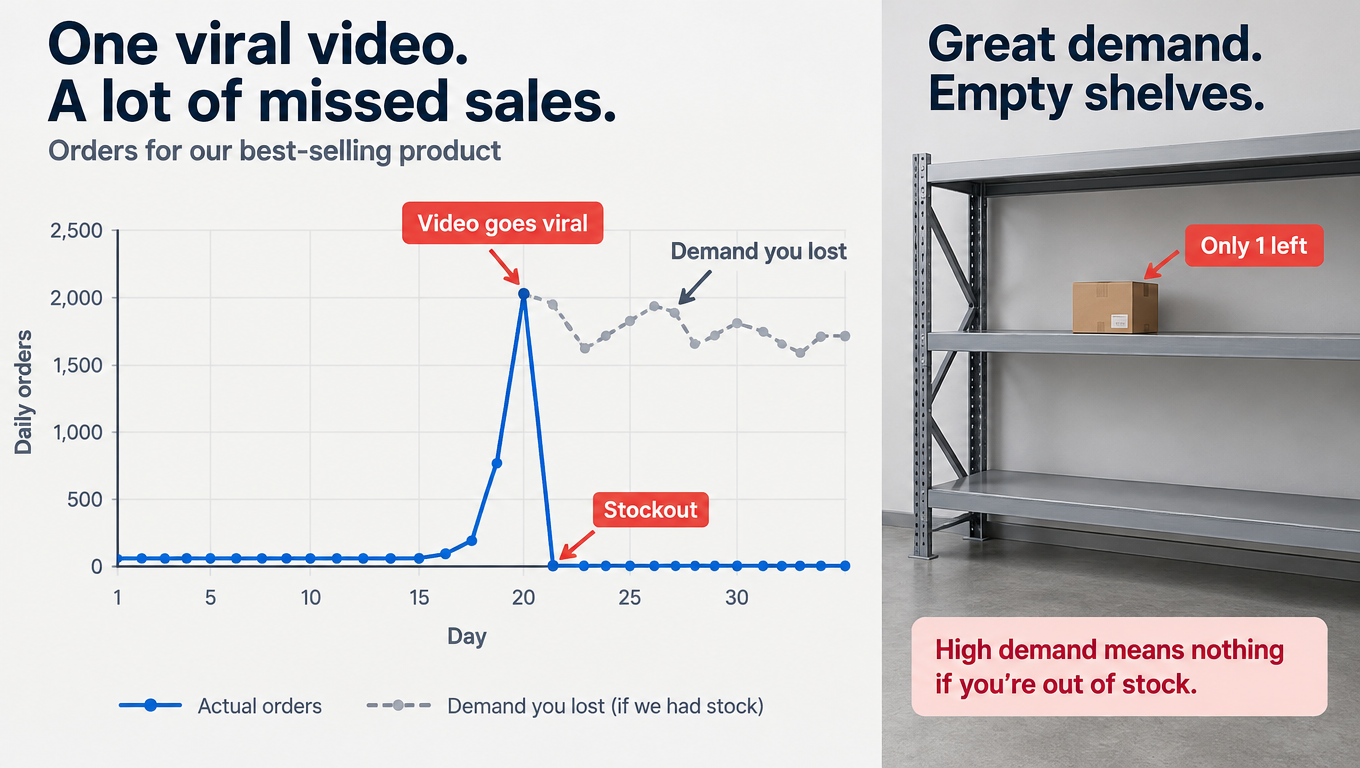
The stockout tax
Running out of stock on TikTok Shop costs more than the lost sales. It creates a chain of secondary damage:
- Seller-fault cancellations if orders are accepted for stock you don’t have.
- Wasted creator momentum. Affiliates who drove the spike move on to products that are in stock, and they remember who left them with dead links.
- Lost social proof. The spike that should have produced hundreds of reviews and a strong sales count stalls.
Because creators drive around 42% of US TikTok Shop sales, according to DemandSage’s compiled data, a stockout doesn’t just hurt you. It hurts the people who sell for you, and that affects whether they come back.
Planning for spikes you can’t predict
You can’t forecast virality, but you can plan for it in tiers.
- Baseline stock: What you need for normal weekly sales, plus your supplier’s lead time.
- Surge buffer: An extra layer on your top one to three SKUs, sized to cover a realistic spike long enough to reorder.
- Supplier surge agreement: A pre-negotiated option for a rush production run or partial early shipment, agreed before you need it.
Watch the leading signals
Spikes rarely come from nowhere. They often show early signs that sellers can catch with daily checks:
- A jump in affiliate sample requests for a specific SKU.
- One creator video outperforming their own average by a wide margin.
- Rising add-to-cart activity before conversions catch up.
- Seasonal timing, such as the run-up to major sales events like Black Friday, where TikTok Shop has already shown nine-figure single-day sales.
Inventory sync across channels
If you sell the same SKU on TikTok Shop, Amazon, and your own site, sync delays become a real risk during spikes. Ten minutes of lag can mean dozens of oversold units. Use inventory software with frequent syncing, and consider reserving a dedicated allocation for TikTok during known campaign periods.
Takeaway: Keep your surge buffer concentrated on the few SKUs most likely to break out. Spreading safety stock across your whole catalog protects nothing.
Returns, Refunds, and the Negative Review Loop
Returns on TikTok Shop carry a weight that goes beyond the refund amount. Impulse-driven purchases, which are common on a discovery platform, are also more prone to buyer regret. And every unhappy buyer has a public outlet: the review section that every future buyer will see.
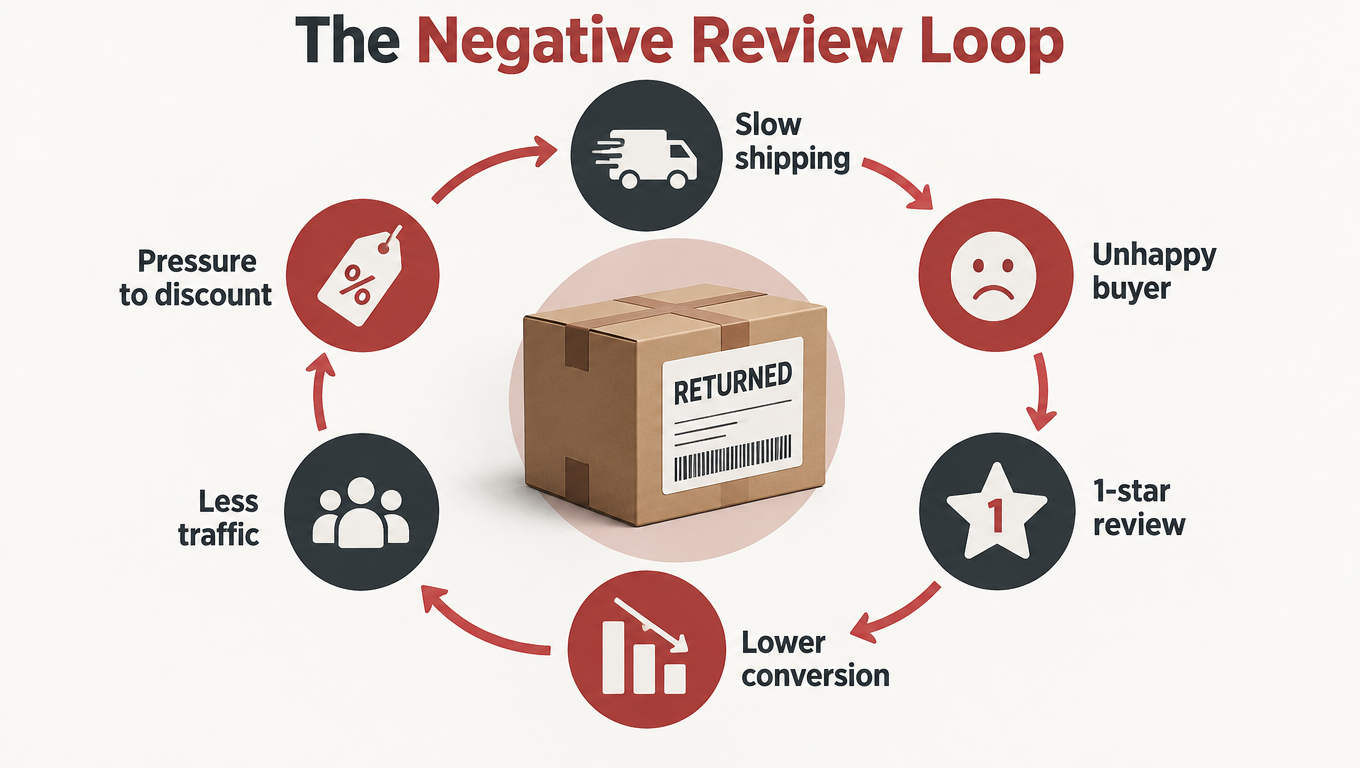
How the loop works
The pattern is self-reinforcing. Slow shipping or a mismatch between video and product produces an unhappy buyer. The buyer leaves a low rating. The rating lowers conversion for everyone who sees the listing next. Lower conversion means the platform shows the product less. Less traffic creates pressure to discount, which squeezes margin and often leads to cutting corners on packaging or quality, which produces more unhappy buyers.
Breaking the loop means intervening early, ideally before the review gets written.
The “not as described” problem
On TikTok, the product is often sold by someone other than the seller: a creator with their own lighting, phrasing, and enthusiasm. That creates a specific risk. A creator may describe a product as larger, softer, stronger, or faster than it is. The buyer’s expectations are set by the video, not your listing.
Ways to reduce mismatch:
- Give creators a short fact sheet with exact dimensions, materials, and what the product doesn’t do.
- Show scale in your own listing images: product in hand, next to common objects, on a person.
- Review top-performing affiliate videos for claims that could trigger returns or policy issues, and ask for corrections politely and quickly.
Running returns as a data source
Every return reason is feedback. Tag and categorize them weekly:
- Damaged in transit: A packaging problem. Fix with better inserts or box sizing.
- Wrong item or variant: A picking problem. Fix with barcode scanning or clearer bin labels.
- Not as expected: A content or listing problem. Fix the listing and creator briefs.
- Quality or defect: A supplier problem. Raise it with the factory with photos and counts.
- Changed mind: Partly unavoidable, but a high rate may signal over-promising in videos.
Refund decisions
For low-cost items, it’s often cheaper to issue a refund without requiring a return, since return shipping plus inspection can cost more than the item. Just track these cases so you can spot abuse patterns, such as repeated claims from the same accounts.
Takeaway: A return is a cost. An unexplained return is a cost you’ll keep paying. Categorize every one.
Customer Service as a Ranking Input, Not a Cost Center
On many marketplaces, customer service is something sellers handle when they can. On TikTok Shop, response behavior is typically one of the inputs into your health metrics, which makes it part of how your shop gets distributed.
Speed matters, but so does substance
Buyers on TikTok are used to instant interaction. They comment, they DM, they expect replies. A fast but useless response (“Thanks for reaching out, we’ll look into it!”) may protect a response-time metric while pushing the buyer toward a return or a bad review anyway.
Good service on this platform looks like:
- Specific answers: “Your order shipped Tuesday with USPS and was scanned in Ohio this morning” instead of “It’s on the way.”
- Proactive messages: Telling buyers about a delay before they ask.
- Clear resolution paths: Offering a replacement, partial refund, or return with one clear next step.
Build a reply library, then customize it
Most buyer messages fall into a handful of categories: “Where’s my order?”, sizing and fit, how to use the product, damage, and returns. Write a template for each, but design them with blanks to fill in specific details. Templates save time. Unedited templates cost trust.
Coverage during spikes
Message volume rises with order volume, and it rises fastest when something has gone wrong, such as a shipping delay. Plan service coverage the same way you plan packing coverage:
- Assign a named person to watch messages daily, including weekends during campaigns.
- Set a target reply window that’s comfortably within platform expectations.
- Escalate any message mentioning “damaged,” “wrong,” “never arrived,” or “scam” to priority handling.
Service is also where you save reviews
A buyer who gets a damaged item and a fast, generous fix will often leave a neutral or even positive review. A buyer who gets ignored rarely stays quiet. Customer service is the last place in your operation where a bad experience can still be turned around.
Takeaway: Measure service by outcomes (problems resolved, reviews protected), not just by how fast the first reply goes out.
Policy, Violations, and Listing Compliance
TikTok Shop runs a policy enforcement system that can restrict listings, withhold features, or suspend shops for violations. For a fast-moving seller, policy risk is often invisible until it suddenly isn’t.
Where violations commonly come from
- Prohibited or restricted products: Categories that require approval or are banned outright. Rules vary by region and change over time.
- Misleading claims: Health, weight-loss, medical, or “guaranteed results” language in listings or videos. This is a particular risk in beauty and personal care, which leads TikTok Shop product sales.
- Intellectual property: Using brand names, logos, or copyrighted images you don’t have rights to.
- Listing manipulation: Misleading pricing, keyword stuffing, or mismatched images and titles.
- Fulfillment abuse: Fake tracking or shipping empty packages to inflate metrics.
Affiliate content counts
Sellers sometimes assume that what a creator says is the creator’s responsibility. In practice, claims made in affiliate content about your product can create problems for your listing, especially if they cross into restricted territory. That’s one more reason to give creators a written brief of approved and prohibited claims.
Build a compliance habit
- Read Seller University updates monthly. Policy pages change, and “it was allowed last quarter” won’t help you.
- Keep documentation ready: Invoices, brand authorization letters, safety certificates, and lab results for regulated categories.
- Audit your top 20 listings quarterly for claims, images, and category placement.
- Respond to violation notices quickly, and appeal with evidence when you believe a decision is wrong.
Don’t build on one shop alone
Even well-run shops can face sudden restrictions due to errors or policy shifts. Sellers who have their whole business on one TikTok Shop account carry concentration risk. A second channel, such as an owned website or another marketplace, doesn’t have to be large. It just has to exist and be ready to take orders if needed.
Takeaway: Compliance work is boring and unbilled. It’s also the only part of the operation that can take your revenue to zero in a single day.
Creators and Samples: The Operational Load Affiliates Create
Creator partnerships are usually discussed as a marketing topic. They’re also a logistics topic, and an expensive one if handled loosely.
Samples are inventory
Every free sample is a unit you paid for, packed, and shipped, with no revenue attached unless the creator posts and the post converts. Sellers running large affiliate programs can send out hundreds of samples per month. Without tracking, it becomes impossible to tell which samples are paying back.
Track the sample pipeline like a sales funnel
For every sample, record:
- Date shipped and date delivered.
- Whether the creator posted, and how many days later.
- Orders attributed to their content.
- Whether they posted more than once.
Over a few months, patterns emerge. Some creator types post reliably. Some never post. Some post once and drive real volume. That data lets you tighten approval rules and spend sample budget where it returns sales.
Ship samples like real orders
Creators judge your brand by the unboxing. A sample that arrives late, damaged, or poorly packed tends to produce a weaker video or no video at all. Ship samples with the same care and speed as paid orders, ideally with a short card that includes key product facts and approved talking points.
Coordinate with inventory
When a campaign sends samples to many creators at once, you’re scheduling potential demand spikes in advance. Tell whoever manages inventory. A wave of 50 samples to mid-size creators should trigger a check on surge stock for that SKU two to three weeks later, when posts typically start landing.
Takeaway: Your affiliate program and your warehouse should share a calendar. Samples out today are orders coming in next month.
A Weekly Operating Cadence for TikTok Shop Sellers
Good operations don’t come from one big fix. They come from small, repeated checks that catch problems before the platform does. Here’s a simple weekly rhythm that works for shops from a few dozen orders a day to several thousand.
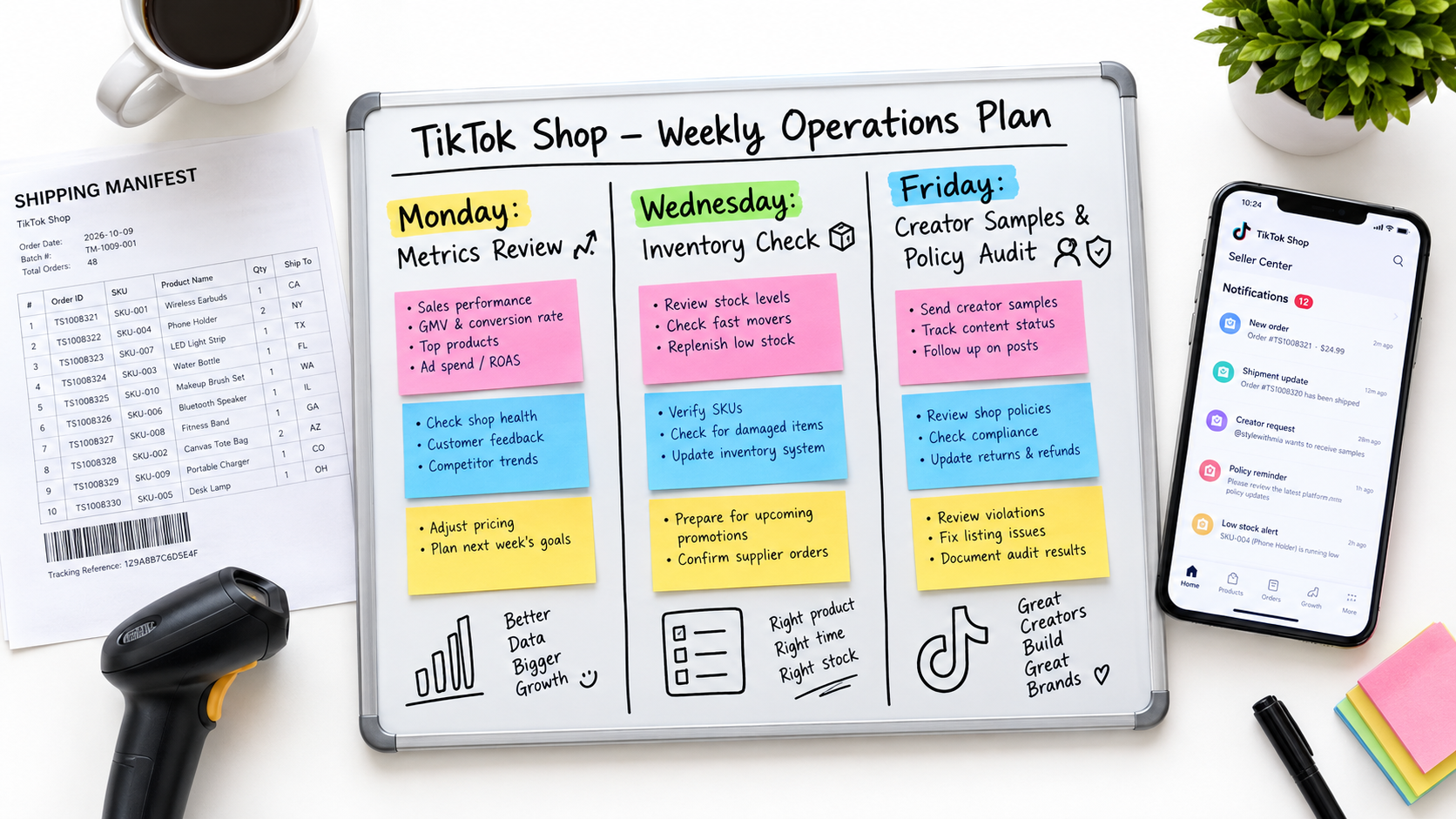
Daily (15 minutes)
- Confirm all orders past the cutoff have carrier scans, not just labels.
- Clear the message inbox, escalating anything about damage, missing items, or wrong items.
- Glance at sales by SKU for unusual jumps that might signal an incoming spike.
Monday: Metrics review
- Shop Performance Score and each component metric, compared with last week.
- Any orders flagged late, any cancellations, any invalid tracking.
- New reviews below four stars, with notes on cause.
Wednesday: Inventory and supply
- Weeks of cover for each top SKU at current sales pace.
- Status of open purchase orders and inbound shipments, including any FBT or 3PL inbounds.
- Surge buffer status for the SKUs most likely to break out.
Friday: Creators, returns, and policy
- Sample pipeline: shipped, delivered, posted, converting.
- Return reasons for the week, categorized and assigned to an owner.
- Policy update check and a spot audit of a few listings and top affiliate videos.
Monthly: Step back
- Is your fulfillment model still right for your volume?
- Are your handling time and shipping promises still realistic?
- Which SKUs generate the most returns, service contacts, or bad reviews relative to sales, and should any be fixed or dropped?
Takeaway: Write the cadence down and assign every item to a named person. Operations that live in someone’s head fail the week that person is sick.
Common Back-Office Mistakes and How to Avoid Them
Across the operating areas above, the same handful of mistakes come up again and again. Most are easy to prevent once you know to look for them.
Mistake 1: Scaling ads or affiliates before operations are ready
Pushing traffic into a shop that can’t ship it doesn’t create growth. It creates late orders, cancellations, and bad reviews that take weeks to roll out of your metrics. Before any major push, run a simple stress test: could you ship three times your current daily volume on time for a week?
Mistake 2: Treating the listing and the video as separate products
Buyers don’t distinguish between what a creator said and what you listed. If they disagree, the buyer is disappointed and the return is yours. Align creator briefs, listing copy, and images so they describe the same product.
Mistake 3: Optimistic handling times
Setting a short handling time to look faster at checkout feels like a conversion win. It becomes a liability the first time something goes wrong. Promise what you can deliver on a bad day.
Mistake 4: Ignoring small negative signals
One review mentioning a broken clasp is noise. Three in a week is a supplier problem. Sellers who read reviews and return reasons weekly catch these patterns while they’re still cheap to fix.
Mistake 5: No backup plan
Single carrier, single supplier, single sales channel, single person who knows how the 3PL integration works. Each is a point of failure. You don’t need redundancy everywhere, but you do need it in the places where a failure would stop orders from shipping.
Conclusion: The Sellers Who Last Are the Ones Buyers Never Have to Think About
TikTok Shop is growing fast. Global GMV is estimated at $123.5 billion for 2026, US sales are projected above $23 billion, and an estimated 54 million US users are buying through the platform. That growth will keep pulling in new sellers, many of them focused entirely on content.
Content gets you the first order. Operations decide whether there’s a second. The best-run shops on TikTok Shop are the ones where the buyer never has to message, never has to wonder where their package is, and gets exactly what the video showed them. That buyer leaves a good review, buys again, and helps the platform decide your shop deserves more traffic.
Your back-office checklist
- Check your Shop Performance Score weekly and trace every dip to a specific cause.
- Set a conservative handling time and enforce a same-day cutoff.
- Verify carrier scans, not just labels, every day.
- Choose fulfillment based on your spike scenario, not your average day. Consider a hybrid of FBT or a 3PL for hero SKUs.
- Hold surge buffer stock on your top one to three SKUs and pre-negotiate rush options with suppliers.
- Categorize every return and assign each category an owner.
- Give creators a fact sheet with approved and prohibited claims.
- Track samples like a sales funnel and share the calendar with inventory planning.
- Audit listings and policy updates monthly.
- Keep at least one backup sales channel ready to take orders.
None of this will show up in a viral video. That’s exactly why it works: most of your competitors aren’t doing it.
Sources: Market and seller figures from DemandSage’s 2026 TikTok Shop statistics compilation (citing Statista, eMarketer, CNBC, and Modern Retail) and Wikipedia’s TikTok Shop entry. Shop Performance Score metrics, thresholds, and Fulfilled by TikTok terms vary by region and change over time. Confirm current details in TikTok Shop Seller Center and Seller University.