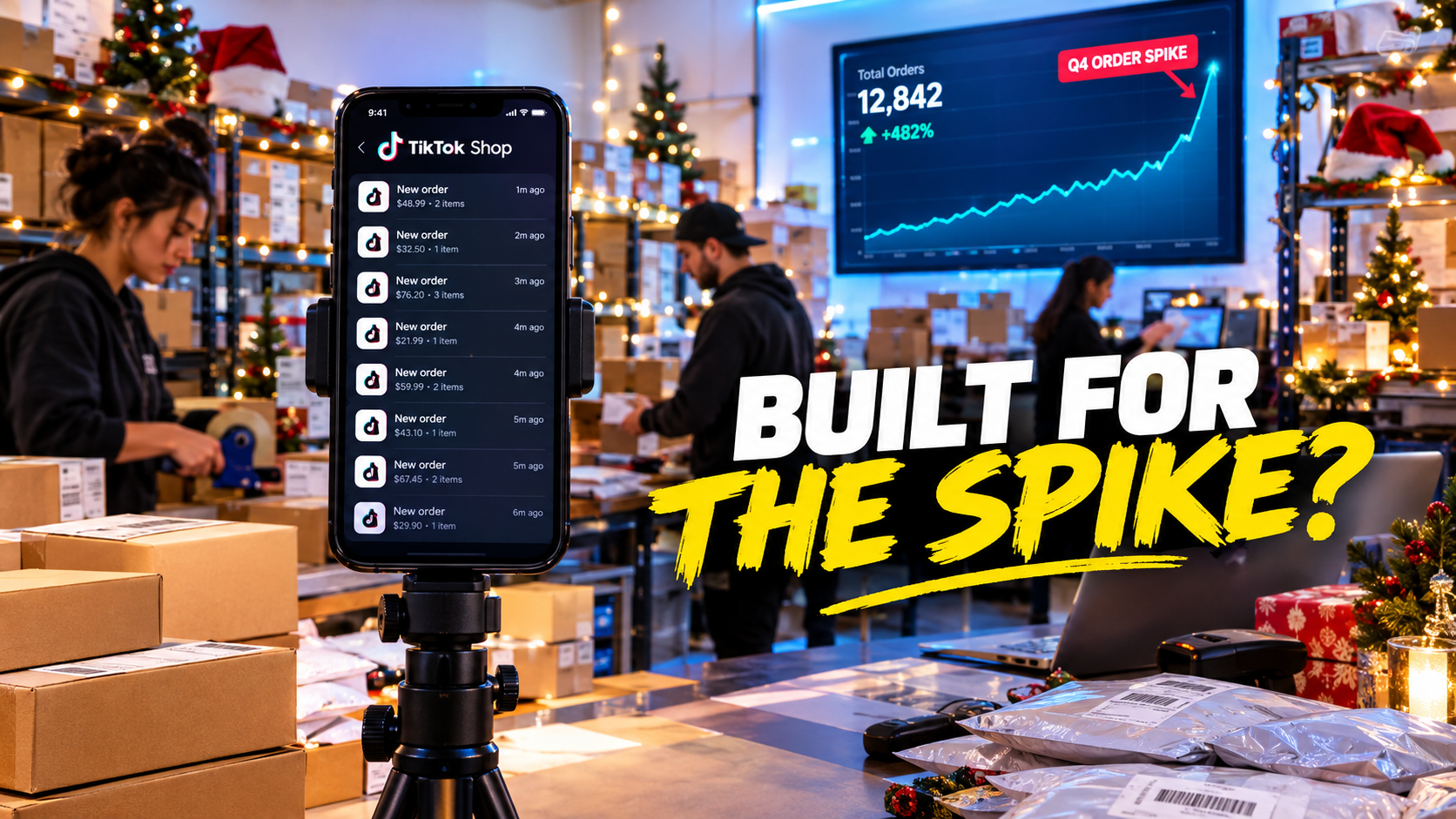

Most TikTok Shop advice is about the front end: hooks, creators, product selection, ad spend. That makes sense, because that’s the visible part of the business. But each holiday season, a lot of sellers learn the hard way that the front end can easily produce more demand than the back end can ship.
A creator video takes off on a Tuesday. Orders that used to come in at 40 a day suddenly come in at 2,000. Inventory sells out by Thursday. Late-dispatch numbers rise, and customer messages go unanswered. Returns from the rushed orders land in January, just as the cash from December gets swallowed by restocking costs.
This guide skips the marketing playbook and looks at the operations layer: what goes wrong when TikTok Shop volume spikes during Q4, and how to set up inventory, fulfillment, account health, creator logistics, LIVE selling, cash flow and returns so a good week doesn’t cause a bad quarter.
The stakes are higher than ever. Global TikTok Shop GMV is estimated at $123.5 billion in 2026, nearly double 2025’s $64.3 billion, according to Statista and Momentum data compiled by DemandSage. In the US, sales are projected to hit $23.41 billion this year. That’s a lot of holiday demand, and most of it will arrive in sudden bursts instead of a steady climb.
Why Q4 2026 Is a Different Kind of Peak Season
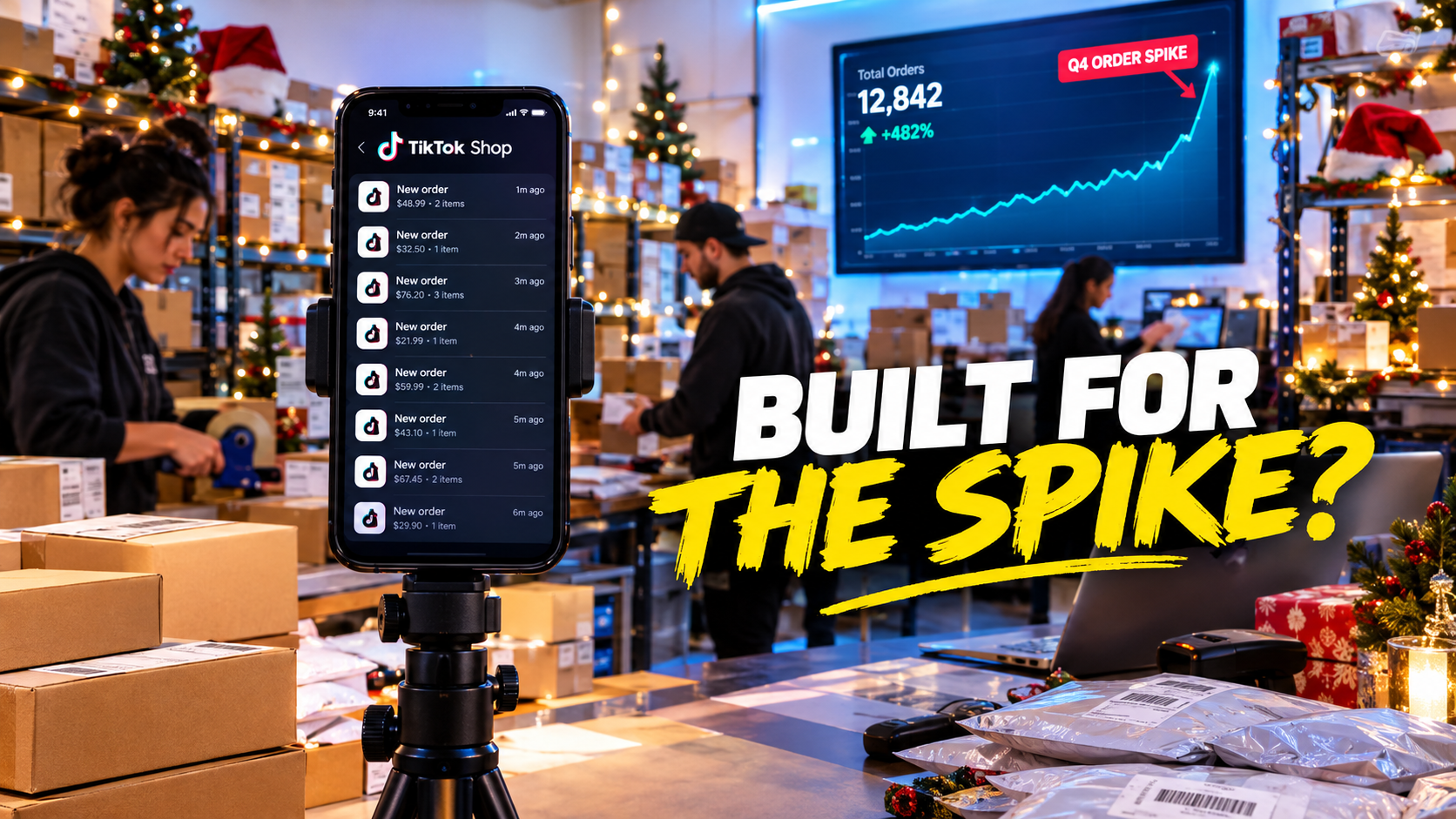
TikTok Shop is a young channel. It launched globally in September 2023, which makes this only its fourth full holiday season. Each of those seasons has been much bigger than the one before, and 2026 continues the pattern.
The numbers behind the pressure
Here’s where things stand, based on figures compiled by DemandSage from Statista, eMarketer, CNBC and Modern Retail:
- US TikTok Shop sales reached about $15.8 billion in 2025, or 18.2% of all US social commerce.
- The 2026 US projection is $23.41 billion, which would be 22.8% of social commerce. The 2027 projection is $28.56 billion.
- First-half 2026 US GMV hit $11.8 billion, more than double the same period a year earlier.
- More than 15 million sellers operate worldwide, including more than 215,000 small businesses in the US and roughly 200,000 small and midsize sellers in the UK.
- Creators drive around 42% of US TikTok Shop sales.
For context, TikTok Shop did more than $100 million in sales during Black Friday 2024. With H1 2026 GMV more than doubling year over year, Q4 2026 demand will reach sellers whose operations were built for much smaller numbers.
The seller mix has shifted toward domestic operators
One structural change matters a lot for operations. When the US ended the de minimis import exemption in May 2025, sales from foreign sellers dropped sharply and domestic businesses picked up more of the demand. More US-based sellers are now handling their own warehouses, carriers and returns, often for the first time at holiday volume.
That’s an opportunity, but it also means more sellers are learning peak-season logistics in real time. Shoppers have no patience for the learning curve. They compare your shipping speed to every other store they’ve bought from.
The takeaway
Plan Q4 around the demand you could get, not the demand you got last year. If your shop grew along with the platform, last December’s volume is the minimum for this year.
The Spike Problem: Why TikTok Demand Doesn’t Behave Like Marketplace Demand
Search marketplaces and TikTok Shop produce demand in very different ways. That one difference explains most of the operational failures sellers run into.
Intent-based vs. discovery-based demand
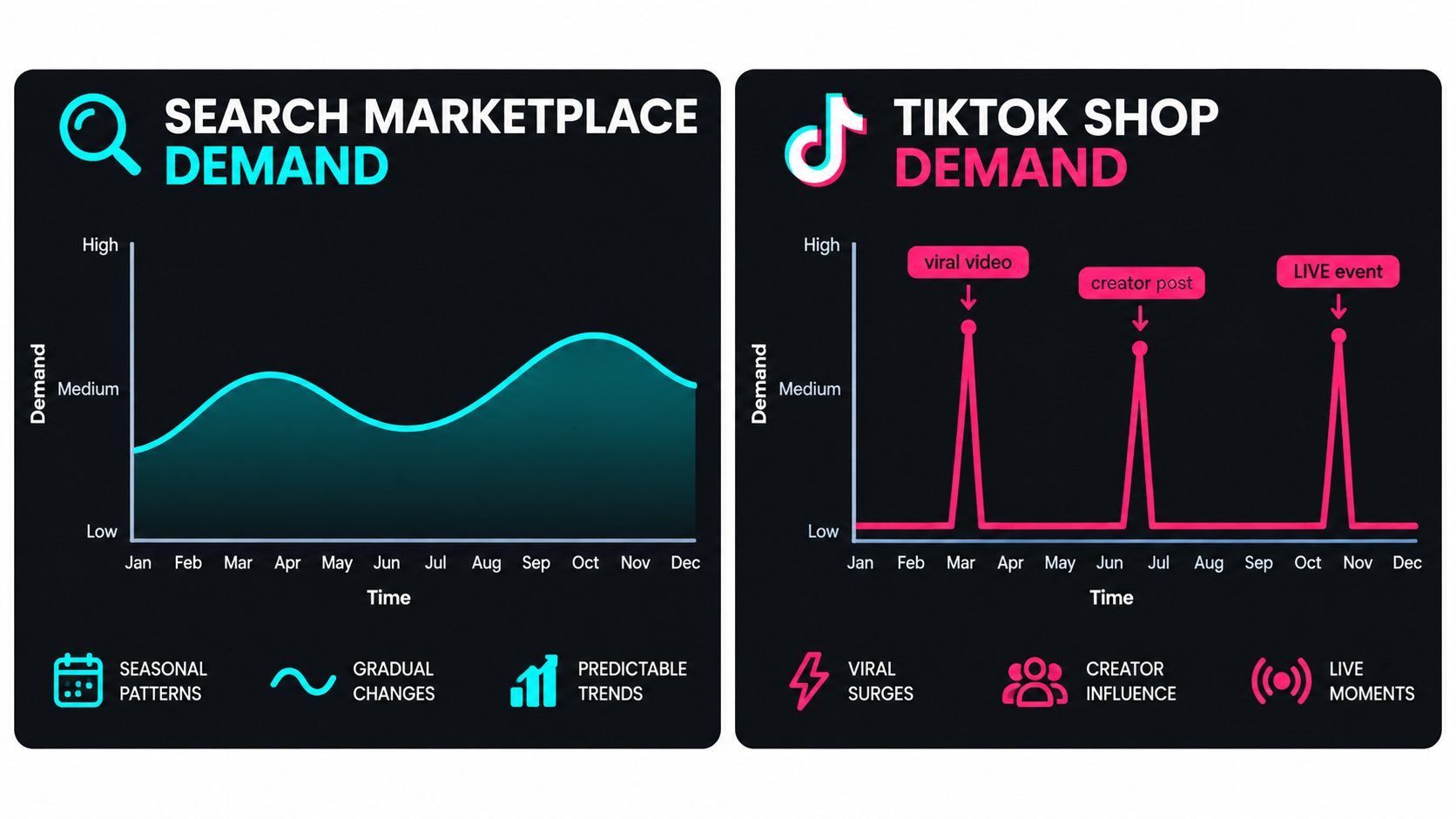
On a search marketplace, a shopper types what they want and the platform matches them to a listing. Demand follows seasonality, search trends and your ranking, so it’s fairly predictable. Holiday volume goes up, but it goes up in a curve you can forecast from last year’s data.
TikTok Shop is mostly discovery-based. A shopper wasn’t looking for your product until a video showed it to them. Demand comes from content distribution, and content distribution is lumpy. One creator post can produce more orders in 48 hours than your shop saw in the previous month.
The three spike triggers
- Viral organic video. Either your own content or an affiliate creator’s gets pushed into a wide For You distribution. You can’t schedule these, and they often happen on content you didn’t expect to work.
- Creator wave. Several affiliates post about the same product within a few days, often because samples landed at the same time. This one is semi-predictable if you track your sample pipeline.
- LIVE events and platform campaigns. Scheduled LIVE sessions and platform-wide sales events like Black Friday and Cyber Monday. These are the most predictable spikes and the easiest to staff for.
Why the shape matters operationally
A smooth curve gives you time to react. A spike doesn’t. By the time you notice a video is taking off, the orders that will break your packing capacity have already been placed.
The practical conclusion is that TikTok Shop operations need pre-built surge capacity: inventory buffers, overflow fulfillment and response protocols that are set up before the spike, not improvised during it.
Inventory Planning When You Can’t Forecast the Spike
Classic inventory planning assumes you can forecast demand reasonably well. On TikTok Shop that assumption only partly holds, so the planning model needs to change.
Separate baseline from surge
Split your forecast in two:
- Baseline demand. What the product sells on an average day without a viral moment. This is usually stable and can be forecast from trailing data, adjusted upward for holiday seasonality.
- Surge demand. The extra volume from spikes. Don’t try to predict its exact timing. Decide how much surge you’re willing to fund, and hold that as a buffer.
Thinking about the surge buffer as a decision about how much risk you’ll fund, rather than as a forecast, helps a lot. A stockout during a viral moment costs you the sales, and the content momentum stops as well, because the algorithm has little reason to keep pushing a video whose product can’t be bought.
Tier your SKUs by spike exposure
Not every product needs a large buffer. Put your catalog into three tiers:
- Hero SKUs: Products with active creator coverage, recent viral history or planned LIVE features. These get the deepest buffer.
- Supporting SKUs: Bundle partners, variants and add-ons that sell alongside the heroes. Their demand moves with the heroes at a lower ratio.
- Long-tail SKUs: Everything else. Stock to baseline only.
Beauty and personal care is the top-selling category on TikTok Shop, and spike behavior is especially sharp there. Sellers in that category should treat buffer sizing on hero SKUs as their main Q4 planning task.
Know your replenishment lead time cold
Your surge buffer only has to last until replenishment arrives. If you can restock in 10 days from a domestic supplier, a thinner buffer is fine. If restocking means a six-week overseas production run plus ocean freight, the buffer you bring into November may be everything you’ll have until January.
Write down the real lead time for every hero SKU, including how long components, packaging and inbound receiving take. Holiday-season carrier and warehouse congestion stretches every one of those numbers.
Watch for the variant trap
Viral videos often show one specific color, size or scent. Demand piles onto that one variant while the others sit on the shelf. If you buffer at the parent-product level, you can end up out of stock on the variant everyone wants while holding plenty of total inventory. Plan buffers at the variant level for hero products.
Choosing a Fulfillment Model for Peak Volume
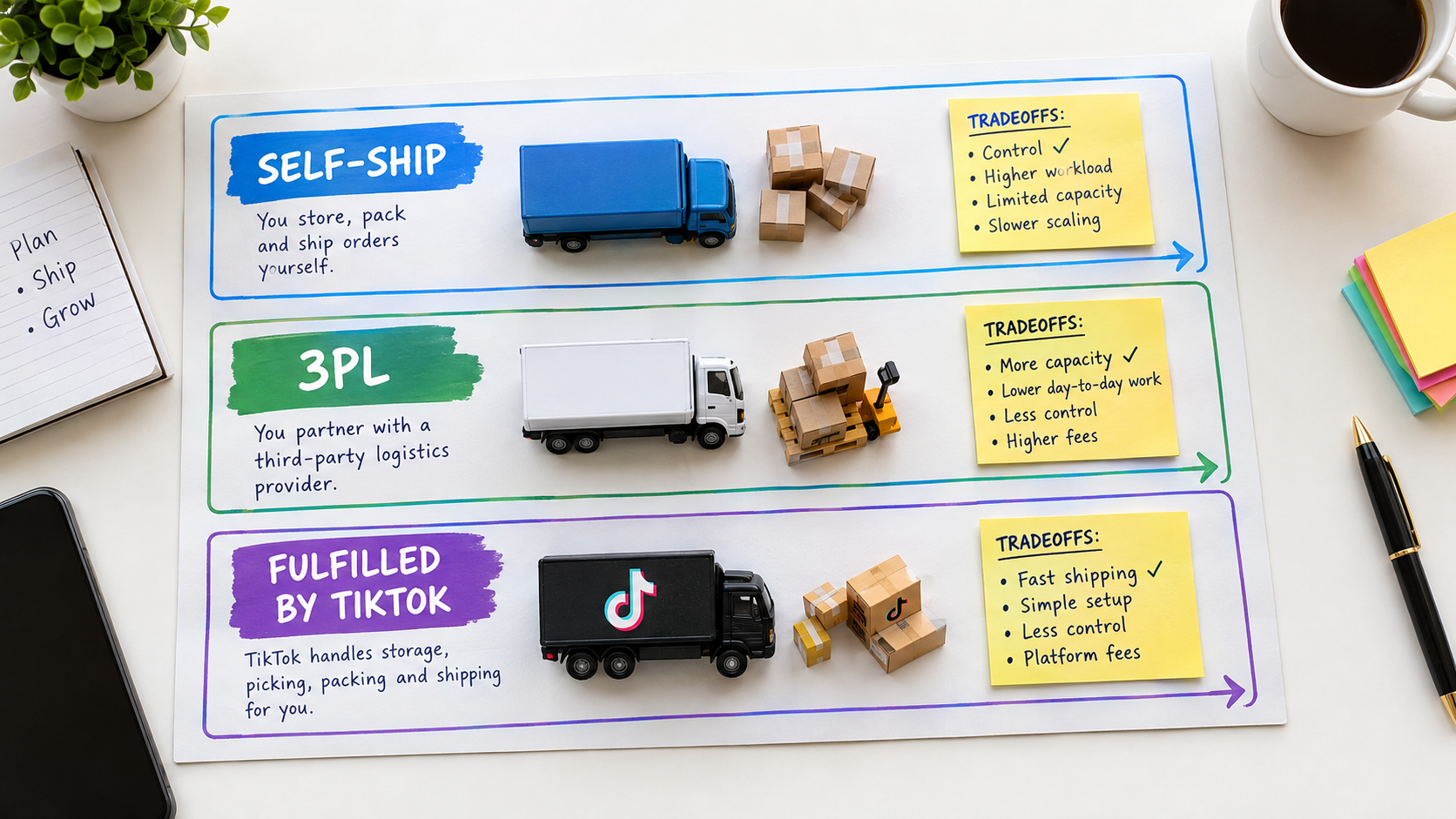
Your fulfillment setup decides how much surge you can actually ship. TikTok Shop sellers generally pick from three models, and many run a hybrid.
Self-fulfillment
You pick, pack and ship from your own space. You get the most control over packaging, inserts and quality checks, and the lowest variable cost at small volumes.
The weak point is capacity. Self-fulfillment depends on the people available, and a spike can bring ten times your normal order count overnight. If you self-ship, you need a written surge plan covering who can pack, how fast, and how many orders a day you can realistically get out the door.
Third-party logistics (3PL)
A 3PL takes on the warehousing and shipping. Capacity is much more elastic, and you can usually serve several sales channels from one inventory pool, which matters if you also sell on Shopify or Amazon.
The risk in Q4 is that every 3PL client wants capacity at the same moment. Before peak season, confirm:
- Their stated holiday processing times and order cutoffs.
- Whether they cap volume per client during peak.
- How quickly your TikTok Shop orders sync to their system, and what happens if the integration lags.
- Their receiving times for mid-season replenishment shipments.
Fulfilled by TikTok
TikTok runs its own fulfillment program in which sellers send inventory to TikTok-operated warehouses and the platform handles picking, packing and delivery. Platform-managed fulfillment usually works well with the platform’s own shipping-speed expectations, and it moves some dispatch responsibility off you.
The tradeoffs are the same as with any marketplace-run fulfillment: inventory sits in a pool you only partly control, it serves just that channel, and you need to read the current fee schedule and inbound requirements in Seller Center rather than assume. Eligibility and terms change, so check the current program details before you commit holiday inventory.
The hybrid approach
Many established sellers split the work. Steady-selling SKUs go to platform or 3PL fulfillment for reliable speed, while a reserve of hero inventory stays somewhere they can redirect it quickly. Others keep self-fulfillment for baseline volume and have a pre-negotiated 3PL overflow arrangement that switches on above a set daily order count.
Whatever you choose, test it before November. Run a simulated surge with a day of heavy ad spend or a scheduled LIVE in October, and see where the process breaks while the stakes are still low.
Account Health Under Pressure: Protecting Your Shop When Things Break
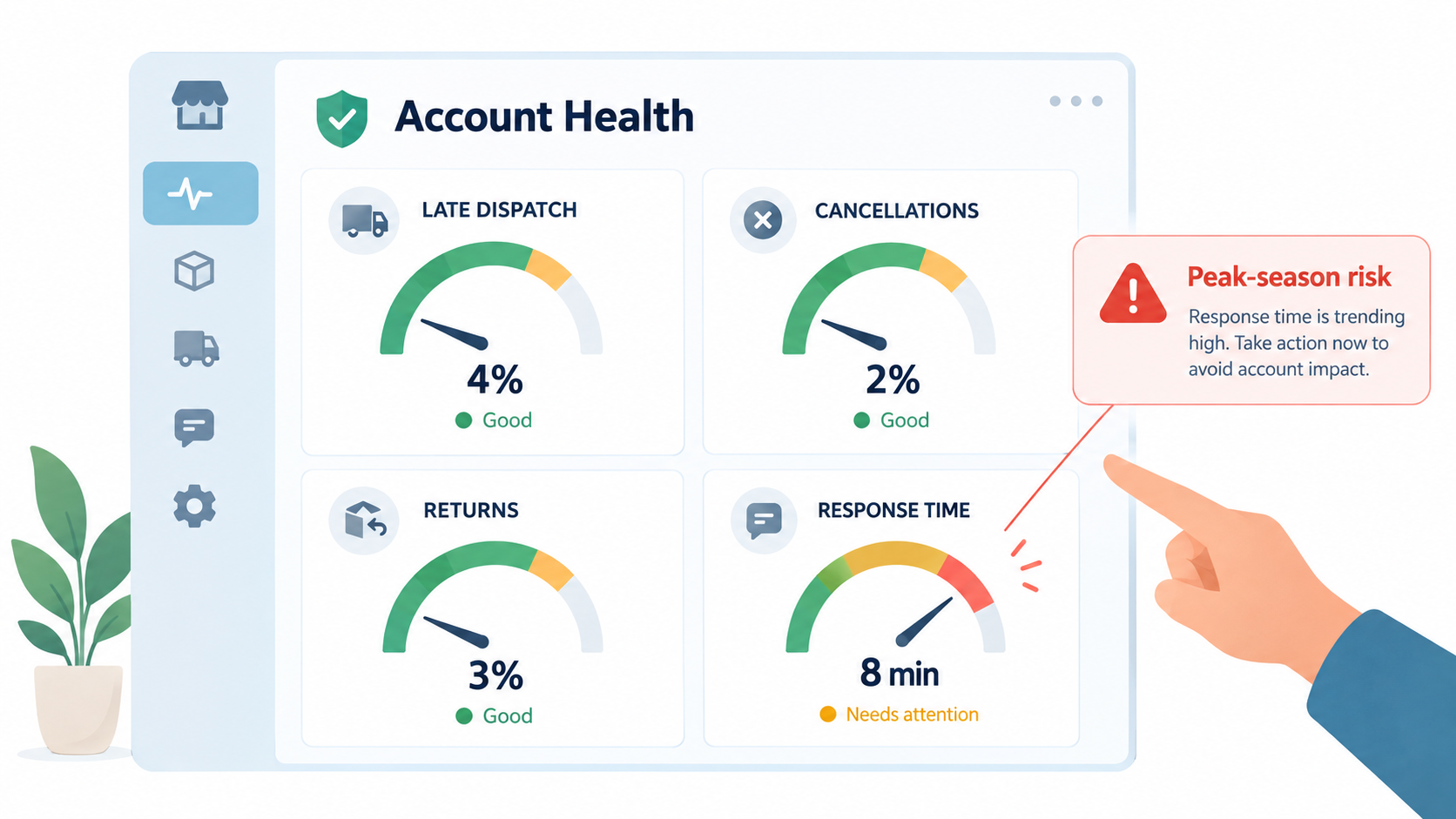
Peak season is when account health problems pile up. Sellers who look healthy at 50 orders a day can drift into warning territory at 1,500, not because they got careless, but because each small failure rate now applies to a much bigger number of orders.
What TikTok Shop measures
TikTok Shop scores sellers on performance metrics shown in Seller Center. They cover fulfillment speed (dispatching orders within the required window), order cancellations by the seller, return and refund rates, product quality signals, and how quickly you respond to customer messages. Falling short can lead to reduced visibility, restrictions or other enforcement.
Exact thresholds and how the metrics are weighted get updated, so check the current figures in your Seller Center instead of relying on numbers repeated in forums. What matters for planning is that every one of these metrics gets harder to hit at holiday volume.
The failure chain to avoid
Peak-season account health problems usually follow a predictable chain:
- A spike outruns packing capacity, so late dispatches climb.
- Inventory runs out mid-spike, so the seller cancels orders it can’t fill.
- Customers whose orders are late or cancelled send messages, and response times slip.
- Rushed packing increases damage and wrong-item shipments, which pushes up returns and refunds.
A single operational gap ends up hurting four metrics. That’s why inventory and fulfillment planning count as account health planning too.
Defensive moves that work
- Sync inventory accurately and often. Overselling is the most avoidable cause of seller cancellations. If you sell on several channels, make sure stock levels update quickly everywhere.
- Set handling times you can actually meet. A slightly longer stated handling time that you always hit is better than a short one you miss under pressure.
- Pause or throttle before you break. If a SKU is about to sell through faster than you can ship, reducing exposure by pausing ads or adjusting stock counts is better than taking orders you’ll have to cancel.
- Monitor daily, not weekly. During peak, look at your performance dashboard every day. A metric that drifts on Monday can be fixed by Wednesday. Found on Friday, it’s already a violation.
The Creator Sample Pipeline: Timing Is an Operations Problem
Creators drive roughly 42% of US TikTok Shop sales. Most sellers treat the affiliate program as a marketing function, but in Q4 it’s also a logistics schedule, and getting the timing wrong is expensive.
Work backward from the content date
A creator can’t post about a product until they have it, have tried it and have filmed it. Count backward from the dates you want content live, around Black Friday, Cyber Monday and the December gifting window:
- Time for the creator to film, edit and post.
- Time for the creator to actually use the product, especially in beauty and wellness where credible reviews need real use.
- Shipping transit, which slows down in November and December.
- Your own internal processing time to approve requests and send samples.
For content you want live during Black Friday week, samples often need to go out in October. Samples sent in mid-November get stuck in the same carrier congestion as customer orders.
Coordinate the creator wave with inventory
This is where marketing and operations have to meet. If you send 200 samples of one hero SKU in October, you’re scheduling a demand spike for November. Your inventory buffer for that SKU should reflect the creator wave you’ve set up.
Track the sample pipeline in the same place you track stock: samples shipped, samples delivered, content posted, and sales attributed per creator. That turns a mysterious viral spike into a demand curve you can partly forecast.
Don’t neglect sample operations themselves
Samples are physical shipments that need packing, tracking and follow-up. Sellers who scale affiliate outreach quickly often find sample fulfillment competing with customer orders for the same packing capacity. In peak season, schedule sample shipments around customer order flow, or give them a separate lane.
LIVE Selling as a Planned Peak-Season Engine
If viral videos are the spikes you can’t control, LIVE sessions are the ones you can. That makes LIVE shopping one of the most useful operational tools in a TikTok Shop seller’s holiday plan.
Shoppers are already buying on LIVE
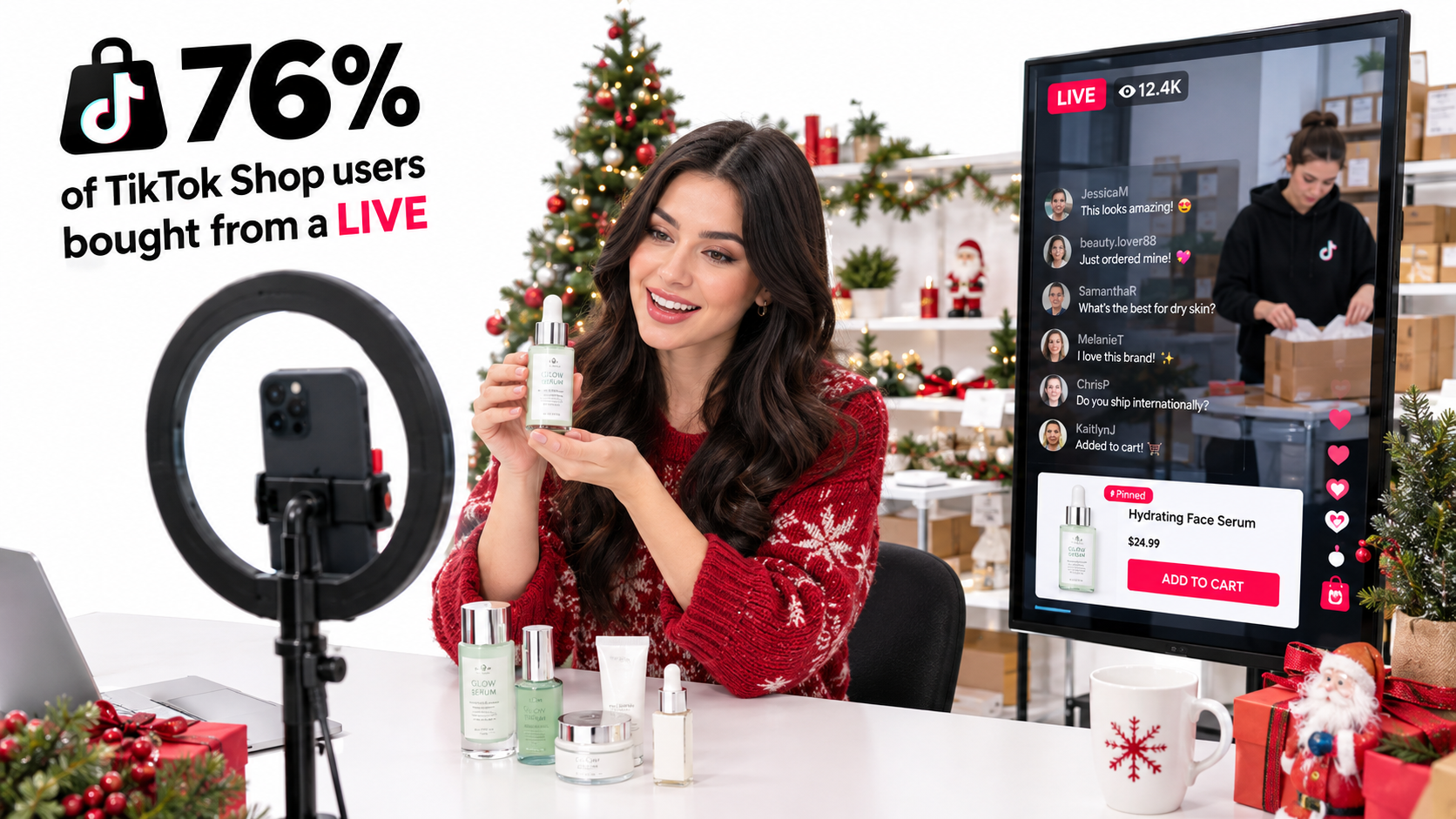
A 2025 GlobalData survey, cited by Shopify, found that 76% of consumers who used TikTok Shop had bought an item from a livestream in the previous year. LIVE is a mainstream buying behavior on the platform now, and holiday shoppers already know how it works.
Why LIVE is easier on operations
A LIVE session concentrates demand into a known window. You choose the date, time, products and offer. That means you can:
- Pre-position inventory for the exact SKUs you’ll feature.
- Schedule packing staff for the hours right after the stream.
- Prepare customer service for the questions that follow, like shipping times, sizing and gift options.
- Set stock caps on LIVE-exclusive offers so you never sell more than you can ship.
Compare that with a viral video, where you find out about the spike after it has started. Shifting part of your holiday revenue into scheduled LIVE events makes your demand profile more predictable.
Running LIVE at holiday scale
A few operational practices separate smooth holiday LIVEs from chaotic ones:
- Run a two-person minimum. One host on camera and one operator managing product pins, inventory counts and comment moderation. Solo LIVEs at holiday volume tend to miss problems.
- Build a run-of-show. List products in order with talking points, offers and inventory caps. Improvising in front of thousands of viewers leads to mistakes, such as announcing a deal on a variant that’s already sold out.
- Feature products with stock depth. Avoid showcasing SKUs you can’t replenish before the shipping cutoff.
- Brief the packing team. They should know which products are going live and roughly how many orders to expect.
- Test your setup. Connection drops, audio failures and lighting problems cost more on a big holiday stream. Rehearse with a low-stakes LIVE first.
Use creators for LIVE, too
Affiliate creators can host LIVEs featuring your products. The same coordination rules apply: agree on the date in advance, confirm inventory, and treat the creator’s LIVE schedule as a scheduled demand event in your operations calendar.
Building a Q4 Promotions and Shipping Calendar
Holiday selling on TikTok Shop runs on several overlapping calendars: platform campaigns, your own promotions, creator content dates and carrier cutoffs. Sellers who manage these separately end up with conflicts.
The four phases of a TikTok Shop Q4
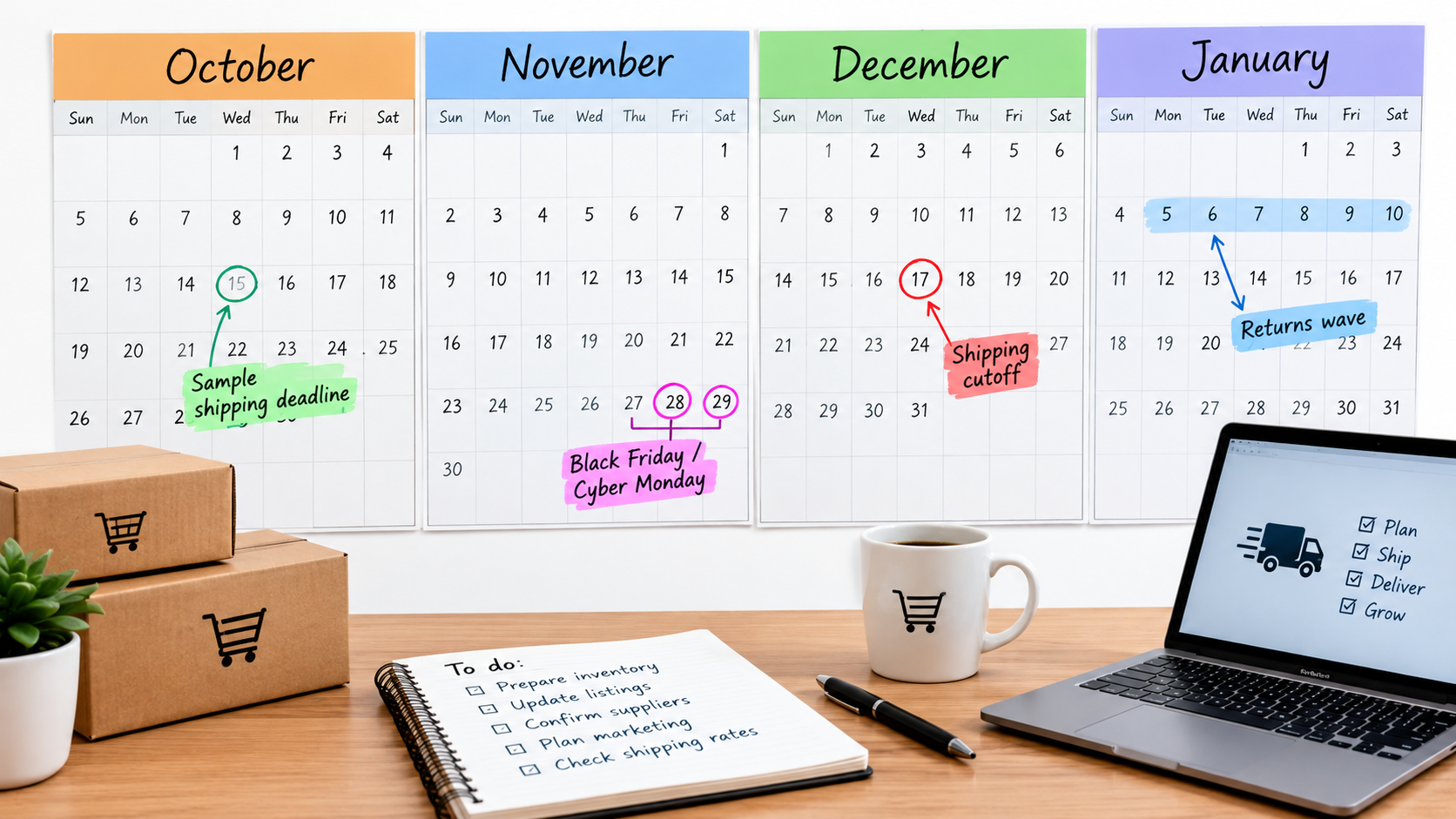
- October: Build phase. Ship creator samples, finalize inventory buys, stress-test fulfillment, enroll in platform campaigns, and run trial LIVEs. Get most of your heavy work done here.
- November: Peak demand phase. Black Friday and Cyber Monday bring the biggest scheduled spikes. Monitor account health daily and keep replenishment moving.
- December: Cutoff phase. Gifting demand stays strong, but every sale has to arrive on time. Post clear shipping-deadline messaging, and slow down promotions on products that can’t reach customers before the holiday.
- January: Recovery phase. Returns arrive, gift-card and self-purchase demand shows up, and you reconcile the season’s real profitability.
Promotion design with operations in mind
Discounts generate demand, and demand uses up capacity. When you set up holiday promotions, check each one against operations:
- Bundles raise average order value without raising order count proportionally, which makes them operationally efficient. One packed box with three items costs less to fulfill than three separate orders.
- Flash deals create sharp, short spikes. Cap quantities.
- Free-shipping thresholds push order sizes up. Check that the threshold covers your real holiday shipping costs, which often rise with peak surcharges.
- Stacked discounts (seller discount + platform campaign + creator commission + ad spend) can make an order unprofitable at full holiday volume. Work out margin on the fully stacked case, not the headline discount alone.
Shipping cutoffs are customer communication
Late-December complaints usually come down to a mismatch between what the shopper expected and when the package arrived. Publish your holiday delivery cutoffs clearly in product descriptions, in LIVE sessions and in customer replies. Being direct about timing heads off a lot of “where is my order” messages.
Customer Service, Returns and the Post-Purchase Experience
The order is only part of the work. On a discovery platform, shoppers often buy on impulse, which affects what they expect after checkout and how often they return items.
Impulse purchases raise the post-purchase stakes
Someone who searched for a product, compared options and chose yours is a different customer from someone who tapped “buy” 30 seconds into a video they hadn’t planned to watch. The impulse buyer wanted the product, but they have less invested in the decision, so slow shipping, mismatched expectations or a product that looks different from the video make them more likely to cancel or return.
That puts some of the responsibility on the content. If creators show your product accurately, including real size, real results and real use cases, your returns will be lower than if the content oversells it. When briefing creators, ask for accurate demonstrations rather than only maximum hype.
Set up customer service for surge volume
- Build saved replies for the predictable questions: shipping times, holiday cutoffs, sizing, ingredients, gift wrapping and return steps.
- Assign coverage for weekends and holidays. Black Friday weekend messages can’t wait until Monday.
- Escalate fast on anything that suggests a product defect or a wrong-item pattern. One customer complaint might be a fluke. Five on the same issue usually means a batch or packing problem.
Plan for the January returns wave
Holiday returns arrive after the holiday. Set aside cash, warehouse space and staff for January. Decide ahead of time how returned items will be inspected, restocked, refurbished or written off. Returned inventory that sits uninspected is cash you can’t use.
Track return reasons by SKU. Peak season produces enough data to show patterns, like a size chart that runs small or a shade that looks different on camera, that are hard to see at normal volume. Fix those before the next spike.
Cash Flow: The Constraint Nobody Plans For
The most dangerous Q4 failure isn’t running out of inventory. It’s running out of cash while you have strong sales.
Why growth eats cash
Think about the order in which money moves during a spike. You pay for inventory weeks or months in advance. You pay for ads, sample shipping and packaging as you go. Creator commissions and platform fees come out of each sale. Platform settlement, meaning the money reaching your bank account, comes after delivery and any applicable holding period.
When volume suddenly jumps, your costs grow right away and your payouts grow later. A seller whose sales triple in November may have to pay for a large replenishment order before November’s revenue has settled. Fast growth with thin cash reserves is a common way profitable shops end up in trouble.
Model the cash curve, not just the P&L
Before peak season, build a simple week-by-week cash projection covering:
- Inventory payments and their due dates.
- Ad spend by week.
- Expected payouts, lagged by your actual settlement timing (check your Seller Center payment schedule).
- Peak-season shipping surcharges and 3PL fees.
- A reserve for January refunds.
If the projection shows a cash trough in late November or early December, deal with it now through a credit line, staggered supplier payments or a smaller buffer on lower-priority SKUs, rather than in the middle of a spike.
Calculate contribution margin at holiday cost levels
Holiday costs aren’t the same as the rest of the year. Ad auctions get more expensive, carriers add surcharges, and discounts stack up. Recalculate contribution margin per SKU at Q4 cost levels, after platform fees, creator commissions, ad cost per order, shipping, packaging and an expected return allowance. Some products that are profitable in the spring lose money at holiday prices. Better to find that out in October than in February.
The Post-Peak Playbook: Turning Q4 Volume Into a Stronger Q1
The weeks after the holidays are when sellers decide whether Q4 was a one-time spike or the start of a bigger business.
Hold a real post-mortem
Go through the season systematically. Which SKUs stocked out, and how many days of sales did that cost? Where did fulfillment slow down? Which metrics drifted, and why? Which creators drove sales, and which samples produced nothing? Which promotions made money after all costs, and which only added volume?
Write the answers down. Next year’s peak plan should start from this document, not from memory.
Keep the customers you acquired
Q4 brings in more first-time buyers than any other period. Following the shop, repeat purchases of consumables, and post-holiday LIVEs aimed at gift recipients can turn some of those buyers into repeat customers. Products with natural replenishment cycles, common in beauty and personal care, are especially well suited to this.
Reset inventory carefully
Avoid over-ordering in January based on December’s peak. Separate the baseline demand from the holiday surge, look at the returns data, and re-tier your SKUs. Some hero products from the holidays will fall back to supporting roles, and some long-tail products may have shown spike potential worth investing in.
Refine creator relationships
Your Q4 affiliate data shows which creators actually move product for your brand. Put more into the ones who did, through ongoing partnerships, earlier sample access and coordinated LIVE schedules, and stop sampling the ones who didn’t. A smaller, proven roster is easier to coordinate operationally than a large, untested one.
Conclusion: Treat the Spike as a Certainty, Not a Surprise
TikTok Shop’s growth (an estimated $123.5 billion in global GMV in 2026, more than $23 billion in projected US sales, and creators behind roughly 42% of US purchases) means this holiday season will put real demand in front of a lot of sellers. Getting demand isn’t the hard part. The hard part is that it arrives as sudden spikes, and any weakness in inventory, fulfillment, customer service or cash shows up fast.
Sellers who come out of Q4 stronger tend to plan their operations around spikes. They hold surge buffers on purpose, test fulfillment before November, check account health daily, schedule samples and LIVEs as demand events, and model cash flow week by week.
Your Q4 operations checklist
- Split forecasts into baseline and surge, and size surge buffers at the variant level for hero SKUs.
- Document real replenishment lead times, including holiday congestion.
- Choose and stress-test your fulfillment model, with a defined overflow plan.
- Confirm current account health thresholds in Seller Center and monitor them daily during peak.
- Ship creator samples in October and match inventory to the creator wave you’re setting up.
- Schedule LIVE events with run-of-show plans, stock caps and briefed packing teams.
- Build one master calendar that combines campaigns, promotions, content dates and shipping cutoffs.
- Calculate fully stacked margins at Q4 cost levels before launching discounts.
- Model weekly cash flow, including settlement lag and a January refund reserve.
- Run a written post-mortem in January, and use it to plan Q1 and next year’s peak.
On TikTok Shop, your marketing determines how much demand shows up, and your operations determine how much of it you can actually fulfill and keep. This Q4, plan for both.