



TikTok Shop is on track to generate $23.41 billion in US sales in 2026 — a number that would put it ahead of brick-and-mortar giants like Costco and Target. That headline has pulled tens of thousands of sellers onto the platform in the past two years, all chasing a piece of a commerce phenomenon that didn’t exist three years ago.
Most of them will stall out within sixty days.
Not because TikTok Shop doesn’t work. It does — spectacularly, for sellers who understand what they’re actually operating. But the gap between sellers who treat TikTok Shop like a product listing page and those who treat it like a live commerce ecosystem is enormous, and it shows up fast in the numbers.
This post isn’t about the algorithm, the SEO mechanics, or the commission structure — those topics have been covered extensively elsewhere. This is about the operational system underneath the surface: how to pick products that are built for this platform, how to activate all four selling surfaces simultaneously, how to build an affiliate flywheel without destroying your margins, and how to measure the right things so you know when you’re actually growing rather than just busy.
If you’re setting up your first TikTok Shop or trying to figure out why your existing one has plateaued, this is the framework that separates stores that scale from stores that just exist.
Why Most TikTok Shop Sellers Hit a Wall After Month Two
The early days of a TikTok Shop often feel deceptively good. You list a product, a video gets some traction, a few hundred orders come in, and the dopamine hit convinces you that you’ve figured it out. Then traffic drops, creators stop posting, and the orders dry up. By month three, you’re spending more on ads than you’re making in margin and wondering what changed.
What changed is that you used up your novelty. TikTok’s recommendation engine amplifies content that generates engagement signals quickly — saves, shares, comments, and ultimately purchases. A new product in a new store gets a small burst of algorithmic generosity because the platform is learning what it is. Once that discovery window closes, you need genuine, repeatable demand-generation to maintain momentum.
The Three Traps That Kill Early Momentum
Trap 1: Treating TikTok Shop like a passive storefront. Sellers who list products and wait for the platform to do the work are confused when nothing happens after week three. TikTok Shop is an active commerce channel. It requires fresh content, live selling sessions, and creator activity on a near-daily basis to stay visible. There is no “set it and forget it” version of this platform.
Trap 2: Launching too many products too soon. Spreading inventory across fifteen SKUs sounds like a hedge against failure. In practice, it fragments your content effort, dilutes your affiliate outreach, and makes it impossible to build momentum behind any single product. The sellers who scale fastest on TikTok Shop almost always start with one or two proven hero products, generate real velocity, and expand only when that foundation is solid.
Trap 3: Confusing views with sales infrastructure. A video can get a million views without generating a single order if the product page is weak, the price is off, the reviews are not there, or the checkout friction is too high. Views are top-of-funnel. The rest of the system has to work to turn that attention into revenue. Sellers who obsess over view counts while ignoring conversion rate are running a vanity metrics operation, not a business.
What the Wall Actually Signals
When growth plateaus in month two, it’s almost never because the product is bad. It’s because the seller has exhausted one channel — usually organic video — without building the other surfaces that sustain ongoing demand. Live selling, affiliate partnerships, and the Shop tab each have their own discovery logic. Sellers who activate all four surfaces create compounding exposure rather than relying on any single source of traffic to carry the whole operation.
Understanding this is the first step. The second step is making sure your products are actually suited for the platform before you invest in building the system around them.
Picking the Right Product: The Four Filters That Separate Winners from Catalog Fillers
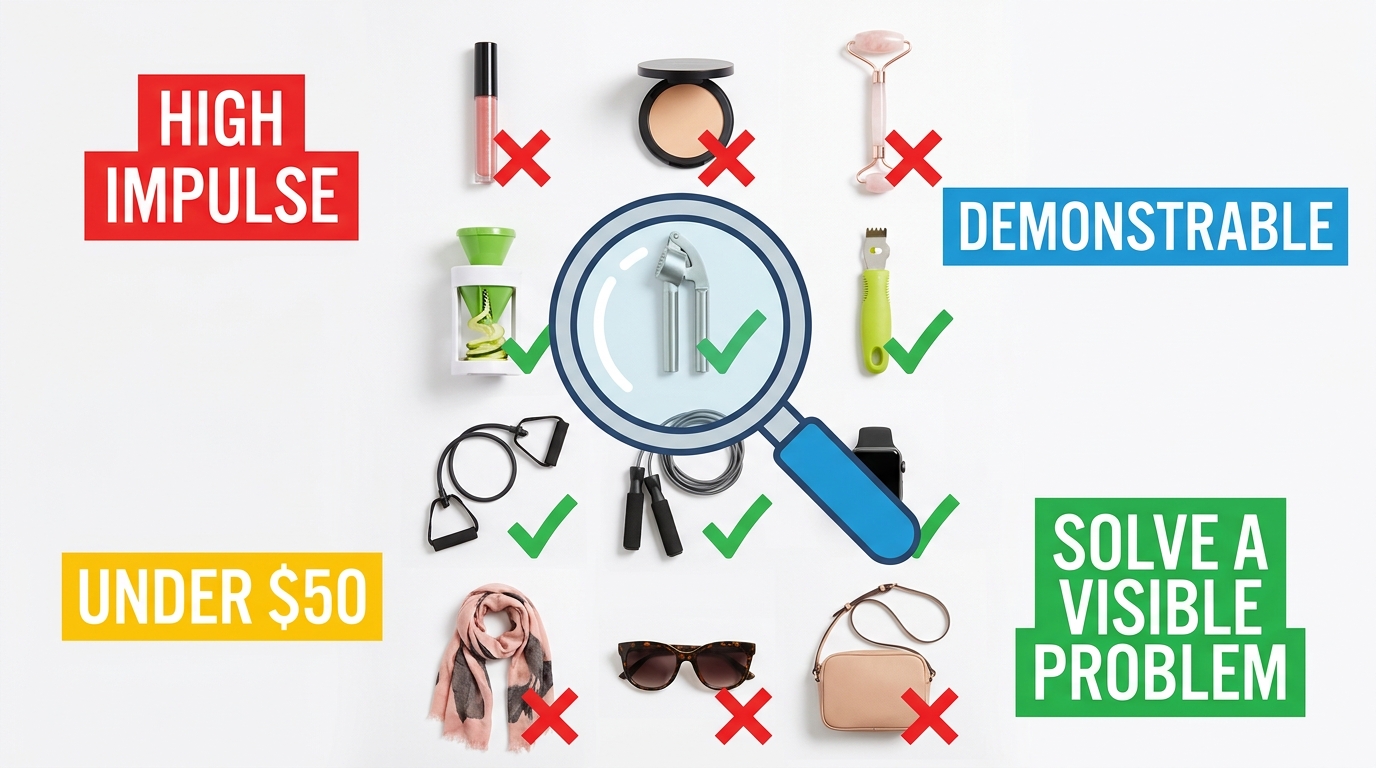
Not every product belongs on TikTok Shop. This is not a criticism of product quality — it is a statement about platform mechanics. TikTok is a discovery-first environment. Users are not searching for what they need; they are encountering things they did not know they wanted. That behavioral context shapes exactly what sells and what sits.
Filter 1: Visual Demonstrability
The single most reliable predictor of TikTok Shop success is whether a product can be shown doing something compelling in under fifteen seconds. A kitchen gadget that shreds mozzarella in a spiral. A stain remover that dissolves a coffee spill on camera. A posture corrector that noticeably changes someone’s silhouette. These products create their own marketing moment — the demonstration IS the content.
Commodity products, products that require long explanations, or products whose value is entirely conceptual (supplements with invisible benefits, insurance products, B2B software) are extraordinarily hard to sell through short-form video. They can work in a LIVE context with enough time to explain, but they fight the format rather than working with it.
Filter 2: Impulse Price Point
TikTok Shop thrives in the sub-$50 range. Not because users cannot afford more, but because the purchase decision has to happen fast. A viewer who pauses on your product link has maybe thirty seconds before they scroll to the next video. At $12, $18, or $34, the mental friction of the purchase decision is low enough that impulse buying kicks in. At $150 or $200, the viewer needs to think about it — and once they close TikTok to think, they usually do not come back.
This does not mean high-ticket products are impossible. They work in LIVE selling, where the host has time to build desire, handle objections, and create urgency. But for shoppable video — the bread and butter of most seller strategies — the impulse price point is a hard filter worth taking seriously.
Filter 3: Visible Problem Solving
The most viral TikTok Shop content follows a pattern: problem shown in three seconds, product introduced, solution demonstrated. The “aha moment” is the hook, the resolution is the close. Products that solve problems viewers can immediately recognize in their own lives — tangled cables, messy drawers, dry skin, uncomfortable sleep — generate the emotional resonance that makes someone stop scrolling and tap the cart button.
Products that solve abstract or non-urgent problems struggle because there is no emotional trigger in the content. “Better than what you have” is a weak hook. “Here is the thing that fixes the exact annoying problem you have every morning” converts.
Filter 4: Repeatability and Margin Stack
A one-time purchase product can generate spikes, but a sustainable TikTok Shop business needs products that either have repeat purchase cycles (consumables, skincare, supplements) or a portfolio of adjacent products that let you cross-sell and upsell. A customer who buys your kitchen gadget this month is a customer who might buy your storage organizer next month — if you have structured your shop and content to make that second purchase obvious.
On margin: TikTok’s referral fee sits at around 6–8% of the sale price, and if you are running affiliate commissions on top of that (which you should be — more on this later), you are losing another 10–20% of revenue before fulfillment costs. A product with 60–70% gross margins can absorb this. A product with 30% margins cannot — and trying to make it work will mean doing high revenue at near-zero profit.
The Four Selling Surfaces — And How to Work All of Them
TikTok Shop gives sellers four distinct surfaces to drive purchases: shoppable video, TikTok LIVE, the Shop tab, and the product showcase on your profile page. Most sellers use one or two. The ones generating consistent, growing revenue use all four — because each surface reaches buyers at a different moment in their decision-making journey.
Shoppable Video: The Discovery Engine
Shoppable video — in-feed content with embedded product links — is where most new customers first encounter your products. These appear both in the For You feed as organic content and as paid placements. The product link appears as a small shopping bag icon at the bottom of the video, and tapping it opens a product card overlay without leaving the video.
The critical insight here: shoppable video is a discovery surface, not a closing surface. Its job is to generate enough product interest that the viewer taps through to your product page. The product page then does the closing. This two-stage view of the funnel changes how you think about video content — you are not trying to complete the sale in the video, you are trying to build enough curiosity or desire that the tap feels irresistible.
TikTok LIVE: The Conversion Engine
LIVE is where TikTok Shop sells the most per hour of activity, consistently. The interactive format — real-time Q&A, countdown timers, limited-quantity offers — creates urgency and social proof simultaneously. Viewers watch other viewers buying. That social validation drives more buying. A 2025 GlobalData survey found that 76% of TikTok Shop users purchased a product from a livestream in the prior year. That is not a niche behavior — it is the dominant purchasing mode on the platform.
What distinguishes LIVE from shoppable video is the conversion efficiency. A well-run LIVE session generates far more revenue per viewer than a shoppable video because the host can handle objections in real time, adjust pricing to create urgency, and use social proof (watching others buy on screen) to accelerate purchase decisions. LIVE is uncomfortable for many sellers to start, but it is also the channel with the highest ceiling.
Shop Tab: The Search-Adjacent Surface
The Shop tab is TikTok’s marketplace — a browsable product discovery environment that shows personalized recommendations based on a user’s viewing and purchase history. Unlike the For You feed, users who land on the Shop tab have shifted into an active shopping mindset rather than passive content consumption. Your product listings here compete on thumbnail quality, price, review count, and delivery speed — much closer to a traditional marketplace dynamic than social commerce.
Because Shop tab visibility is heavily influenced by your seller score, review volume, and fulfillment reliability, optimizing for this surface means getting your operational fundamentals right. It is the platform rewarding sellers who play by the rules with passive discovery — buyers who arrive without any content hook, already looking for something in your category.
Product Showcase: The Trust Surface
When a viewer is intrigued by your video and taps on your profile to learn more, your product showcase is what they see: a curated gallery of your shop’s products. This surface converts visitors who are already warm — they liked your content, they want to see what else you sell. Keeping this showcase clean, current, and visually coherent matters more than most sellers realize. It is often the last thing a potential customer sees before deciding whether to buy or leave.
Treat the showcase like a window display: feature your best-sellers prominently, remove stale listings, and ensure pricing and availability are accurate. A cluttered or outdated showcase communicates disorganization — which is not a signal that encourages checkout confidence.
Building Your Content-Commerce Engine: Shoppable Video That Actually Converts
The phrase “content is king” has been repeated so many times it has lost most of its meaning. On TikTok Shop, a more precise version is: content that converts is the only content that counts. Views without tap-throughs, and tap-throughs without purchases, are just traffic with no revenue attached. Building a content-commerce engine means designing your video output so that each piece actively pulls people toward a transaction.
The Hook-Demo-Proof-CTA Framework
The most reliably converting shoppable video format follows a four-part structure, usually delivered in 30–60 seconds:
- Hook (0–3 seconds): Lead with the problem or the payoff — not a product introduction. “I spilled wine on my couch every week until I found this” outperforms “Hi everyone, today I am going to show you a product I love” every time. The first three seconds determine whether the viewer stays or scrolls.
- Demo (3–20 seconds): Show the product doing the thing. No voiceover essay, no lengthy backstory — the product in action. This is the moment that generates saves and shares, the engagement signals TikTok’s algorithm uses to decide how widely to distribute your content.
- Proof (20–35 seconds): One or two credibility signals. A before/after comparison, a review quote on screen, a specific number (“used by 40,000 people this month”), or a genuine reaction shot. This is where fence-sitters become buyers.
- CTA (final 5 seconds): A clear, low-friction call to action. “Tap the cart icon on this video” is the platform-native move. Direct, simple, and it tells people exactly what to do next.
Volume and Consistency Beat Perfection
One beautifully produced video per week generates less revenue than five authentic, direct-to-camera videos shot on a phone. The TikTok algorithm rewards posting frequency partly because more posts mean more chances to hit the discovery lottery — but also because frequent posters signal active engagement with the platform, which the recommendation engine rewards with wider distribution.
The practical implication: build a content calendar that batches filming, aims for daily or near-daily posting, and uses a mix of original seller content and repurposed creator affiliate content (with permission and proper tagging). Variety in format — talking head, demonstration, unboxing, lifestyle context — helps reach different viewer psychographics within the same audience.
The Product Page Problem Most Sellers Ignore
Every shoppable video drives traffic to your product listing. If that listing has three low-quality photos, a generic description copied from a supplier sheet, and no reviews, the click-to-purchase conversion rate will be poor regardless of how good the video was. A video can generate 50,000 views and result in fewer than twenty orders if the product page does not do its job.
Your TikTok Shop product page should have: high-quality images that show the product in actual use (not just on a white background), a first sentence of the description that repeats the problem your product solves (for buyers who skim), variant images for each color or size option, and at minimum ten customer reviews before you push serious traffic to a listing. Treat the product page as a landing page, not an afterthought. It is the last step between a viewer and a buyer.
TikTok LIVE Selling: The Anatomy of a High-Converting Stream
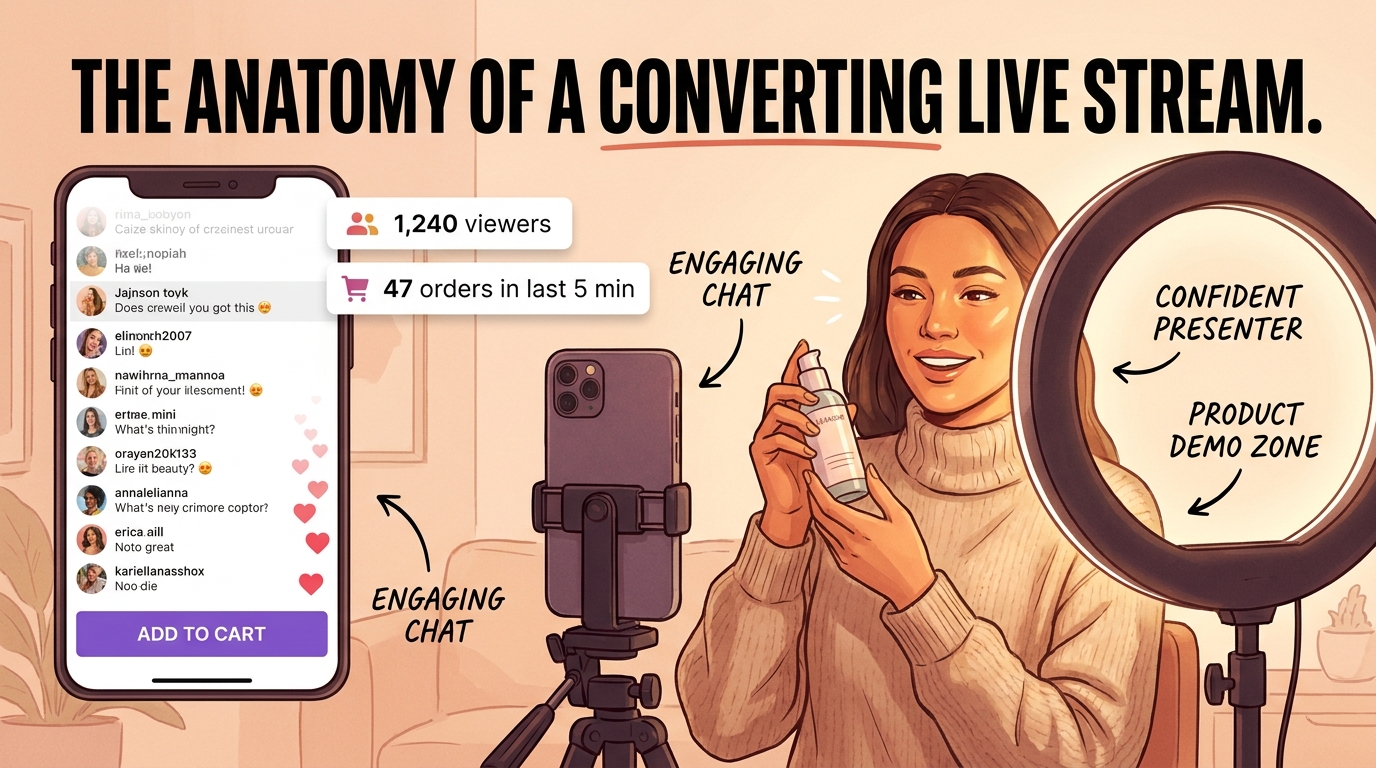
LIVE selling is the highest-leverage activity available to a TikTok Shop seller. It is also the one most people avoid because it feels uncomfortable, technically complicated, or time-intensive. All three concerns are valid — and worth addressing directly, because the revenue gap between sellers who LIVE sell and those who do not is substantial and well-documented.
The Optimal Stream Structure
Effective TikTok LIVE selling sessions are not improvised — they follow a rhythm that experienced hosts develop over dozens of streams. The basic structure looks like this:
- Pre-live promotion (1–2 hours before): Post a short video or story teasing what you will be selling, any exclusive deals, and the stream time. This seeds your notification audience and ensures you have a base of viewers from the first minute. Empty streams struggle to gain algorithmic momentum — arriving viewers are more likely to stay when others are already present.
- Opening (0–5 minutes): Welcome viewers, introduce yourself briefly, establish the session theme. Pin your best-priced or most visually compelling product immediately so arriving viewers see something worth staying for.
- Feature rotation (5–90 minutes): Cycle through products every 8–12 minutes. For each product: demonstrate it live, read and respond to comments in real time, quote the price with deal framing (“normally $45, for the next ten minutes it is $28”), and show the limited quantity counter. Create urgency without manufacturing false scarcity — real-time stock levels are a legitimate urgency driver.
- Mid-stream re-hook (every 20–30 minutes): New viewers are always arriving. Periodically re-introduce yourself and summarize what you are selling — “if you just joined, here is what we have covered and here is what is coming up.” This is how top live sellers manage longer streams with constantly rotating audiences.
- Close: End with your highest-demand product to capture late-session buyers, thank viewers warmly, and promote your next stream time clearly.
Technical Setup That Actually Matters
You do not need a broadcast studio. You need: adequate lighting (a $30 ring light transforms how products look on a phone screen), a stable camera mount so the product stays in frame during demonstrations, and reasonable audio quality — a lavalier microphone or a phone used in a quiet environment. The single most common LIVE selling failure mode is poor lighting that makes products look flat and unappealing. Buyers make snap judgments based on how a product looks in the stream, and washed-out or shadowy footage kills purchase intent regardless of how good the product actually is.
Stream at consistent times. TikTok’s algorithm learns your streaming schedule and begins surfacing your content to past viewers as your scheduled time approaches. Sellers who stream daily at the same time — even for 45 minutes — consistently outperform sporadic marathon sessions. Consistency trains both the algorithm and your audience to show up.
Reading the Room in Real Time
The comments section during a LIVE session is a real-time focus group. Questions about sizing signal purchase intent. Questions about shipping tell you your fulfillment messaging needs work. Comments comparing your product to a competitor’s give you the objection you need to handle on-air. Hosts who engage with comments authentically — not just reading them out, but actually responding and adapting the pitch — consistently see higher conversion rates than those who deliver scripted monologues over a live backdrop.
The best LIVE sellers think of comments as a buying signal dashboard. When the same question appears five times in a row, answer it clearly and let the questioner know their concern is resolved. Those five people are five potential buyers who were one answer away from purchasing. Treat them accordingly.
The Affiliate Flywheel: Recruiting Creators Without Blowing Your Margin
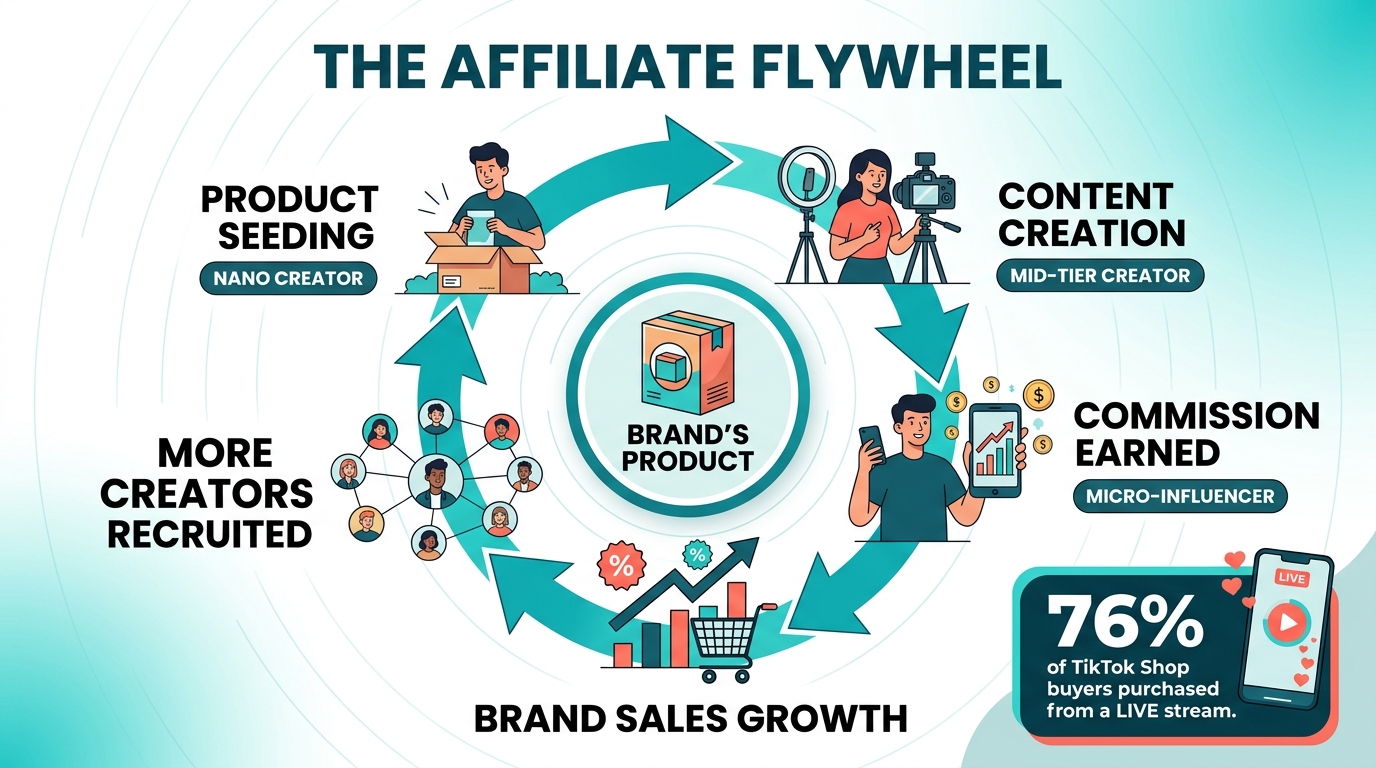
TikTok Shop’s affiliate program is one of its most powerful features — and one of the most consistently mismanaged by sellers who are new to creator-driven commerce. The concept is straightforward: creators browse your product catalog, select items to feature in their content, and earn a commission on every sale they drive. For sellers, it is performance-based marketing with no upfront cost per placement. For creators, it is a revenue stream tied directly to their audience’s purchase behavior.
In theory, this creates a perfectly aligned incentive structure. In practice, it generates a lot of low-quality content from creators who grab your product at the highest commission rate, post once, generate no sales, and disappear.
The Product Seeding Approach
The most effective affiliate strategy does not start with the affiliate program’s open marketplace. It starts with targeted product seeding: identifying creators in your niche with 5,000–100,000 followers (the micro-to-mid tier), and sending them your product before asking for anything in return. No commission requirement, no content brief, no demands. Just the product and a short note about what it does.
Why this works: a creator who experiences your product organically — who actually uses it, has a genuine reaction to it, and chooses to post about it — produces content that their audience can feel is authentic. That authenticity is what converts. A scripted post from a creator who has not touched your product converts at a fraction of the rate of genuine enthusiasm shared with a trusted audience.
The math pencils out clearly. You might seed 50 creators to find 8 who post genuinely, 3 of whom generate meaningful sales volume. Those 3 become ongoing partners. Your cost was 50 product units at cost price (not retail) — potentially $200–$500 total — for a set of performing affiliates who now promote your product for a percentage of sales you have already made. That is a very efficient customer acquisition cost structure.
Setting Commission Rates That Attract Quality
The commission rate you offer in the open affiliate marketplace determines the quality of creators you attract. Too low (under 5%), and you attract no one worth attracting — most creators evaluate commission rates quickly and skip past anything that does not justify their effort. Too high (over 25%), and you attract volume-chasers who will promote anything at any commission, producing low-quality content at high volume with poor conversion rates because their audiences have learned not to trust their recommendations.
For most consumer products, the 10–20% range attracts creators who are selective enough to care about what they promote and motivated enough to put real effort into the content. If you are worried about margin at 15%, revisit your pricing strategy — if a 15% affiliate commission makes your product unviable, the problem is the product’s margin structure, not the commission rate itself.
Building Long-Term Creator Relationships
The sellers who build durable affiliate revenue treat their best-performing creators as genuine partners, not contractors to be managed at arm’s length. That means regular communication about new product launches, exclusive early access to new SKUs before the open marketplace, occasional performance bonuses for exceptional months, and sometimes co-creating content together rather than just briefing creators and stepping back.
A creator who feels genuinely invested in your brand’s success promotes differently than one who sees you as a line item in their commission report. That difference in investment shows up in the content quality — and in the conversion rate that content generates. Relationship equity with top-performing creators is one of the most undervalued assets a TikTok Shop seller can build.
Fulfilled by TikTok vs. Self-Fulfillment: The Trade-Off Most Sellers Get Wrong
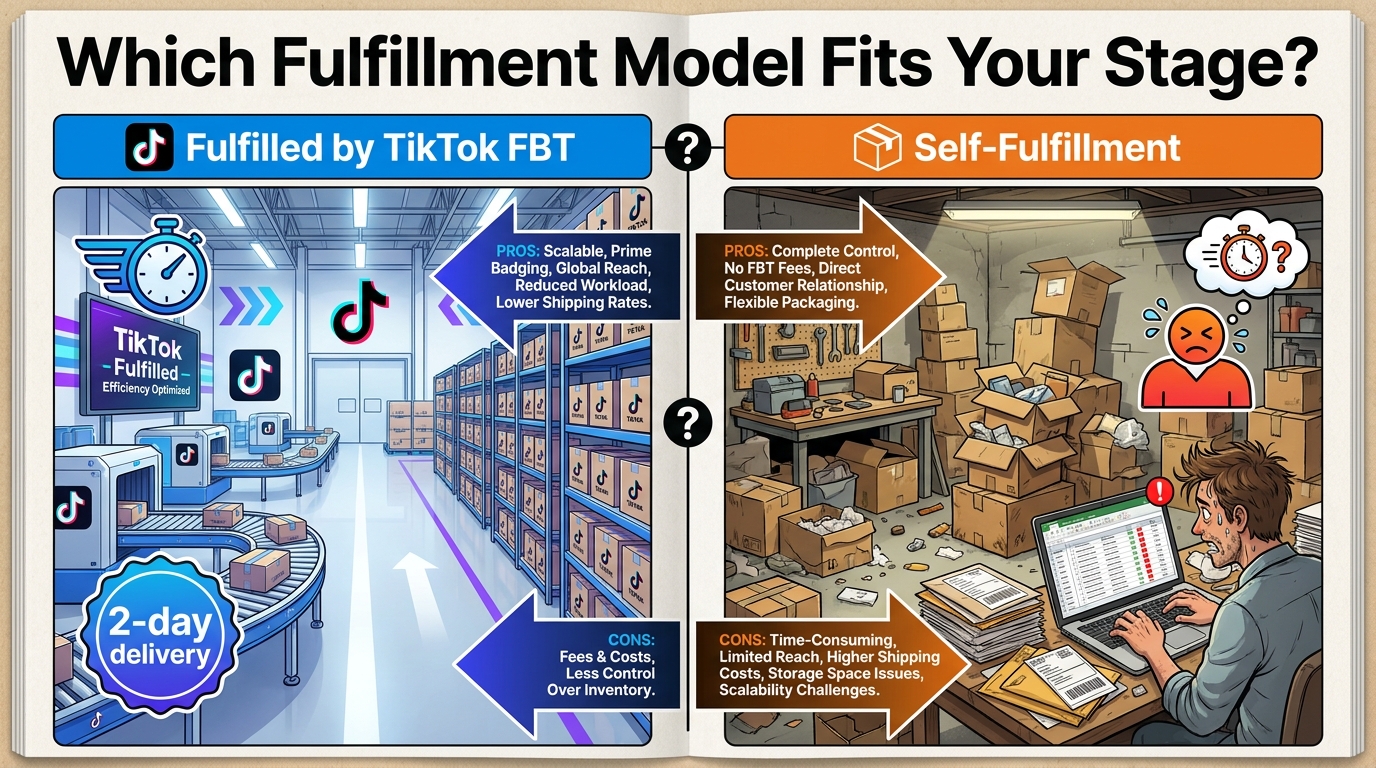
Fulfillment is one of the least glamorous decisions in TikTok Shop selling and one of the most consequential. Get it wrong and your reviews crater, your seller score drops, and the algorithm starts limiting your product visibility in the Shop tab and search results. Get it right and it becomes a quiet competitive advantage that compounds over time.
What Fulfilled by TikTok (FBT) Actually Offers
Fulfilled by TikTok, operated in partnership with third-party logistics providers including ShipBob in the US market, lets sellers send inventory to a TikTok-managed fulfillment network. TikTok then handles picking, packing, and shipping when orders come in. The benefits are real and specific:
- Fast delivery badges: FBT-eligible products display delivery speed estimates prominently on the product page. In a marketplace where buyer expectations have been shaped by two-day delivery, a “Arrives in 2 days” badge visibly increases conversion rate compared to an unspecified “ships within 3 business days.” Faster promised delivery is a trust signal as much as a logistical fact.
- Seller metric protection: Because TikTok controls the fulfillment process, late shipment rates and order defect rates typically stay lower than self-fulfillment, protecting your seller score and the visibility that comes with it. Seller score is one of the factors that determines Shop tab prominence — protecting it is worth treating as a priority.
- Operational resilience during scale events: When a video goes viral overnight and you suddenly have 800 orders instead of your usual 50, FBT handles the spike without degrading quality. Self-fulfilling that kind of surge is a logistics challenge that generates negative reviews regardless of how hard you work to keep up.
When Self-Fulfillment Makes More Sense
FBT is not the right choice for everyone at every stage. For sellers with:
- Very low volume (under 30 orders per day): The inventory positioning costs and inbound shipping fees to get products into FBT warehouses may exceed the benefit. Self-fulfillment with a reliable shipping account is often more cost-effective at this scale.
- Highly customized or fragile products: If your product requires specific packing — custom inserts, fragile glassware, multi-component kits — handing off fulfillment introduces quality control risk that standardized warehouse operations cannot easily accommodate. Sellers who take pride in their unboxing experience sometimes find FBT’s approach too generic for their brand positioning.
- Products with demand uncertainty: Sending 500 units to an FBT warehouse for a product you have not yet validated creates real inventory risk. New product launches are often better handled through self-fulfillment until you have enough demand data to right-size your FBT inventory position.
The Hybrid Approach That Most Mature Sellers Land On
Most experienced TikTok Shop sellers end up running a hybrid: core SKUs with proven, consistent demand in FBT, newer or experimental products in self-fulfillment. This gives you the speed and metric protection on your revenue-generating products while keeping flexibility on your testing pipeline. The key is being intentional about which products go where, rather than defaulting to one model across everything for the sake of simplicity.
Reviews, Ratings, and Trust Signals: The Silent Conversion Lever
Every seller on TikTok Shop is trying to generate views. Far fewer are systematically managing the trust infrastructure that converts those views into buyers. Reviews, ratings, and the visual signals of credibility on your product page do more to determine conversion rate than most sellers realize — and they are among the elements most directly within your control to influence legitimately.
The Review Velocity Problem
A product with two reviews and a 4.2 average rating converts at a fraction of the rate of the same product with 150 reviews and a 4.6 average. This is not irrational buyer behavior — it is sensible risk management. Buyers on TikTok Shop cannot physically inspect your product before purchase. Reviews are their primary proxy for “does this thing actually work as described?”
Building review velocity in the early weeks is critical. The legitimate strategies: include a printed card in every order that directs buyers to leave a review directly in the TikTok Shop app (platform-native review requests outperform external links); use the TikTok Seller Center’s post-purchase messaging feature to send a friendly, low-pressure reminder 7–10 days after delivery; and for FBT orders, work with your prep team to ensure a well-designed insert is included in every package. The goal is to make reviewing feel easy and natural, not transactional.
Responding to Negative Reviews
Negative reviews are inevitable. How you respond to them matters as much as the review itself — prospective buyers read seller responses and draw conclusions about how you treat customers after the sale. A professional, empathetic response that acknowledges the issue and offers resolution (“We are sorry the product arrived damaged — please DM us and we will send a replacement immediately”) communicates to every future buyer that you stand behind what you sell. A defensive or dismissive response does the opposite, often damaging confidence more than the original negative review did.
The Trust Signals Beyond Stars
Review count and star rating are the most visible trust signals, but they are not the only ones that matter. TikTok Shop also surfaces: seller rating (separate from product rating), response rate to customer messages, return policy clarity, and recency of orders fulfilled. Sellers who maintain high scores across all these dimensions receive preferential Shop tab placement — the algorithm treats consolidated trust metrics as a quality signal that directly affects product visibility, not just conversion rate on existing traffic.
Paid Amplification: When and How to Add Shop Ads Without Torching Profit
TikTok Shop Ads — the platform’s native advertising system for commerce products — can dramatically accelerate growth when deployed correctly and equally dramatically accelerate losses when deployed against a system that is not yet working. The most common and expensive mistake: turning on ads before the organic system is proven, in an attempt to buy your way past problems that should have been solved first.
The Organic-First Principle
Ads should amplify what is already working, not create demand where none exists. Before putting money behind a product, you want to see organic proof of concept: at minimum one video that has generated meaningful engagement (comments asking where to buy, saves, shares), and a product page that is converting at a baseline rate from organic traffic. Running ads to a product that does not convert organically does not reveal the problem — it just makes the problem more expensive to discover.
The practical checkpoint: if your product page has received 500 or more organic clicks and converted fewer than 2% of them into purchases, fix the page before running ads. If it is converting at 4% or above, you have something worth amplifying with paid budget.
Video Shopping Ads vs. LIVE Shopping Ads
TikTok Shop’s ad formats break into two primary channels that function very differently and serve different goals:
Video Shopping Ads boost your shoppable video content into paid placement in the For You feed. These are best for discovery — reaching new audiences who have not encountered your brand. They run on a cost-per-click or cost-per-purchase bidding model, and the creative quality of the underlying video matters enormously. Ads that look like ads underperform ads that look like organic content. Your best-performing organic videos are almost always your best ad creatives — do not rebuild them for the ad format.
LIVE Shopping Ads promote your active LIVE stream to users likely to engage and purchase. These run on a CPM basis and are most effective during the first 20–30 minutes of a stream, when you need to build initial viewership quickly. Think of them as the audience-seeding mechanism that gets your LIVE stream past the low-viewer threshold where algorithmic amplification kicks in organically.
Budget Discipline and Evaluation Timelines
Start with small daily budgets ($20–$50 per day) on your highest-converting content. Evaluate performance at the campaign level after seven days minimum — TikTok’s learning phase requires enough data before results stabilize enough to draw conclusions. The metric to watch is cost per purchase, not CPM or CPC. If your cost per purchase is below your product margin at meaningful volume, scale cautiously. If it is at or above your margin, optimize the creative or the product page before increasing spend.
Metrics That Actually Matter: What to Measure Beyond GMV
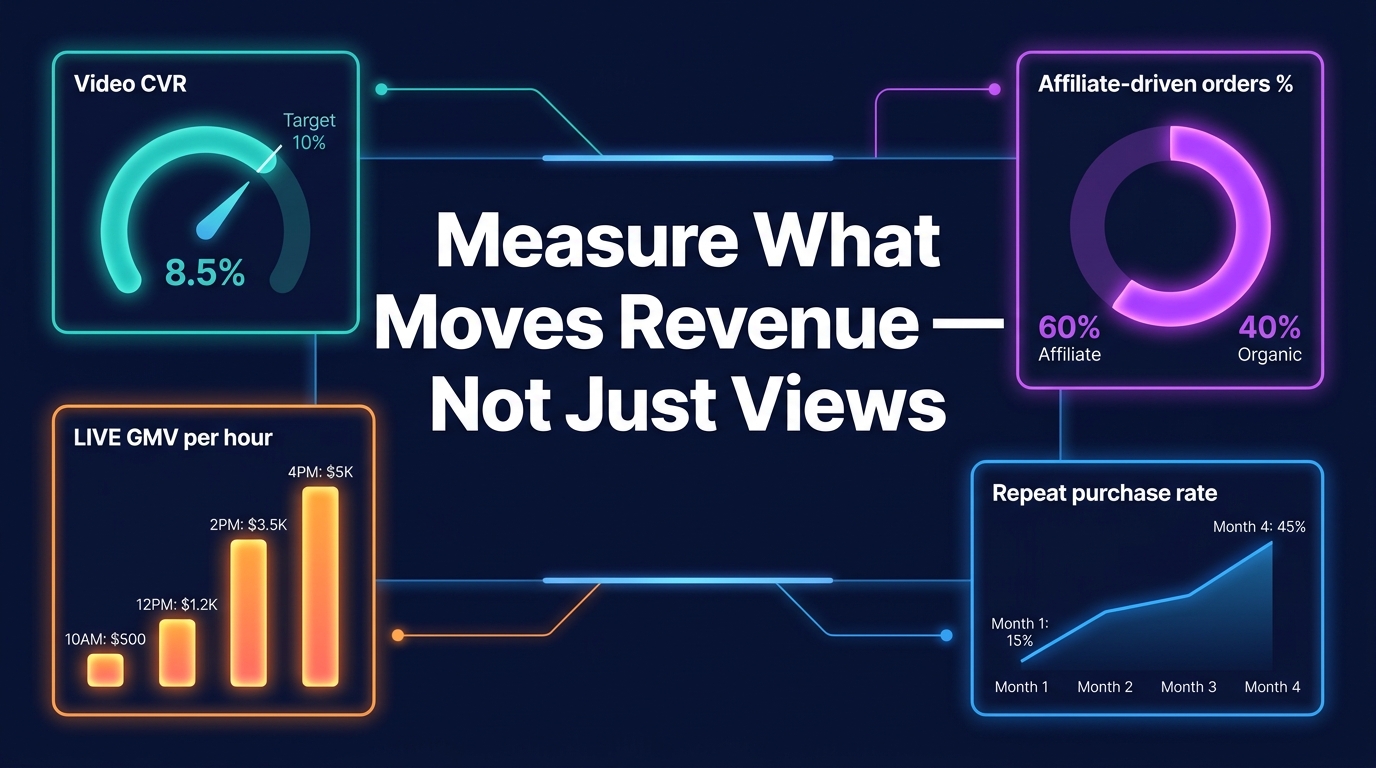
Gross Merchandise Value is the number everyone cites because it sounds impressive and it is easy to report. “We did $80k last month” makes for a satisfying milestone post. It also tells you almost nothing about whether your TikTok Shop business is actually healthy or growing on a foundation that will hold.
The Metrics Dashboard That Actually Matters
Video Click-Through Rate (CTR) and Conversion Rate (CVR): For each shoppable video, how many viewers tapped the product link? Of those who tapped, how many purchased? These two numbers together tell you whether your content is generating interest and whether your product page is closing it. A video CTR under 1% typically signals a weak hook or an irrelevant audience match. A product page CVR under 2% signals a listing problem that paid traffic will not fix.
LIVE GMV per Hour: Total revenue generated per hour of live selling. This is the productivity metric for your live channel. Tracking it over time tells you whether your hosting skills, product selection, and audience development are genuinely improving. A growing LIVE GMV per hour is one of the clearest indicators of a maturing TikTok Shop operation — it is the number that separates sellers who are getting better at the channel from those running in place.
Affiliate-Driven Order Percentage: What percentage of your orders come from affiliate creator content? This reveals how diversified your demand generation actually is. A business where 100% of orders come from your own content is fragile — if you cannot post for a week, revenue disappears. A business where 40–60% of orders come from creator affiliates has demand generation that continues even when you are not personally producing content that day.
Repeat Purchase Rate: What percentage of buyers order from you a second time within 90 days? This is the metric that separates product operations from brand businesses. A repeat purchase rate above 20% within 90 days suggests you are building genuine customer relationships that have value beyond the initial transaction. Below 10% means you are running on constant customer acquisition with no compounding return — an expensive and exhausting place to operate from.
Return Rate by SKU: High return rates on a specific product are a warning sign that is easy to miss when you are watching aggregate numbers. High returns mean the product is underperforming its description, or your content is attracting buyers who are not a good fit for what you are selling. Either way, unchecked return rates will damage your seller score and eat margin faster than almost any other operational failure. Track this at the SKU level, not just the account level.
Building a Weekly Review Cadence
Rather than checking metrics sporadically when something feels off, build a structured weekly rhythm: Monday, pull last week’s video CTR and CVR data and identify which content performed in the top quartile — those are your templates. Wednesday, review affiliate partner performance — who drove orders, who has gone quiet, where are the engagement trends among your creator cohort. Friday, review LIVE session performance data and seller score metrics against the prior week. This cadence keeps decision-making tight enough that you can course-correct within weeks rather than discovering problems after months of drift.
Scaling Without Breaking: What Sustainable TikTok Shop Growth Looks Like
The sellers who do $50,000 in their first month and then disappear are a known archetype in the TikTok Shop seller community. A viral video or a coordinated creator push can generate a massive short-term spike that overwhelms fulfillment operations, generates negative reviews from shipping delays, crashes the product’s rating, and damages the account’s seller score. Ironically, the very success they chased destroys the business that was supposed to capture it.
Sustainable scaling on TikTok Shop looks different from what most people imagine. It is slower at the start, more deliberate in its sequencing, and significantly more durable over a 12–24 month horizon.
The Sequencing of a Scalable TikTok Shop
Months 1–2: Validate and fortify. One or two products. Own-brand content only. No paid ads. Build to at least 25 reviews per SKU. Establish LIVE selling at least twice a week. Prove that organic traffic converts at an acceptable rate. At this stage, you are not trying to grow fast — you are building the structural foundation that can support growth without fracturing under the weight of it.
Months 3–4: Activate the affiliate layer. Begin targeted creator outreach and product seeding. Identify 3–5 affiliates who are genuinely performing, and invest in deepening those relationships. Start testing small paid amplification budgets on your top-converting organic videos. Track your metrics dashboard weekly and iterate based on what the data actually shows rather than what you hope to see.
Months 5–6: Add surface and SKU depth. With a working system on your hero products, introduce 1–2 complementary SKUs that give existing customers a natural next purchase. Ensure your FBT vs. self-fulfillment mix is optimized for your current volume levels. Begin scaling LIVE sessions — longer durations, higher frequency, more product variety per stream as your hosting confidence grows.
Month 6 and beyond: Systematize and build for leverage. The sellers who build real businesses eventually systematize the repeatable parts — content production scheduling, affiliate outreach sequences, customer service workflows — so that the operation does not depend entirely on the founder’s daily involvement. This is not about removing yourself from the business. It is about building infrastructure that lets you focus on strategy, product development, and creator relationships rather than packing boxes and personally responding to every customer message.
The Compounding Advantage of Doing It Right
TikTok Shop rewards accounts with strong historical performance in ways that become increasingly valuable over time. High seller scores, consistent positive reviews, reliable fulfillment history, and engagement depth all feed into the platform’s evaluation of how prominently to feature your products in the Shop tab, in search results, and in personalized recommendations. An account built carefully over six months has structural advantages that a new competitor launching today cannot replicate quickly.
That is the real argument for patience and deliberate sequencing: the platform’s trust signals, once built, become a competitive moat. Every good review, every reliably fulfilled order, every creator relationship that generates consistent content, every high-performing LIVE session is a brick in that moat. Speed without infrastructure produces volume temporarily. Infrastructure built with discipline produces something that competitors will find genuinely difficult to match.
The Seller’s Reality Check: What TikTok Shop Is and Is Not
Before closing, it is worth being direct about what TikTok Shop actually is and what it is not — because the hype cycle around social commerce has set expectations that do not always survive contact with operational reality.
TikTok Shop is not a passive income channel. It requires consistent content creation, active LIVE selling, ongoing creator relationship management, and careful operational discipline around fulfillment and reviews. The sellers generating substantial, consistent revenue are working hard at all of these simultaneously, not one or two of them.
TikTok Shop is not an overnight business. The accounts doing impressive, durable revenue in 2026 almost all started building their foundation in 2023 or 2024. The ones who launched more recently and are performing well consistently report a 3–6 month period of low returns before the system started producing meaningful results.
What TikTok Shop is is one of the most compelling commerce opportunities available to a product seller right now. The combination of discovery reach, purchase frictionlessness, and creator economics creates a flywheel that — once genuinely spinning — is hard to replicate in any other channel. The platform’s trajectory toward $23.41 billion in US GMV in 2026 means the total opportunity is still expanding rapidly, even as the seller base grows more sophisticated and competitive.
The question is not whether TikTok Shop represents a real opportunity. It clearly does. The question is whether you are building a system to capture it in a way that will still be working a year from now, or whether you are hoping that one viral moment does the sustained work for you.
Key Takeaways for TikTok Shop Sellers in 2026
- Pick products that work with the format, not against it. Visual demonstrability, impulse-friendly pricing under $50, and clear problem-solving are the filters that matter most. Products built for discovery-driven purchasing dramatically outperform those that require research or consideration.
- Activate all four selling surfaces. Shoppable video drives discovery. LIVE drives conversion. The Shop tab captures search-adjacent intent. Your profile showcase closes warm visitors. Each one needs deliberate attention — leaving any of them unmanaged is leaving revenue on the table.
- Structure your content using the Hook-Demo-Proof-CTA framework. The first three seconds stop the scroll. The middle section demonstrates value visually. The proof section closes skeptics. The CTA makes the purchase step obvious. Repeat this consistently and iterate on what works.
- Build your affiliate flywheel through seeding, not just the open marketplace. The best-performing affiliate content comes from creators who genuinely experience and value your product. Invest in seeding the right people before expecting the marketplace alone to deliver quality at scale.
- Match your fulfillment model to your stage and SKU profile. FBT makes sense for validated, high-velocity products. Self-fulfillment makes sense for new SKUs, low-volume operations, and products requiring customized packing. Most mature operations run a hybrid of both.
- Track video CVR, LIVE GMV per hour, affiliate order percentage, repeat purchase rate, and SKU-level return rate. These metrics tell you far more about business health than GMV alone.
- Scale in deliberate sequence — validate, then affiliate, then ads, then additional SKUs. Each layer should be functioning before you add the next. Scaling a broken system faster produces bigger, more expensive problems, not solutions.
The sellers who will look back on 2026 as the year they built something genuinely durable on TikTok Shop are the ones building operational systems right now — not chasing spikes, not waiting for one viral video to change everything, but doing the unglamorous daily work that makes compounding growth possible. That is a harder story to tell on social media. It is a much better business to own.