


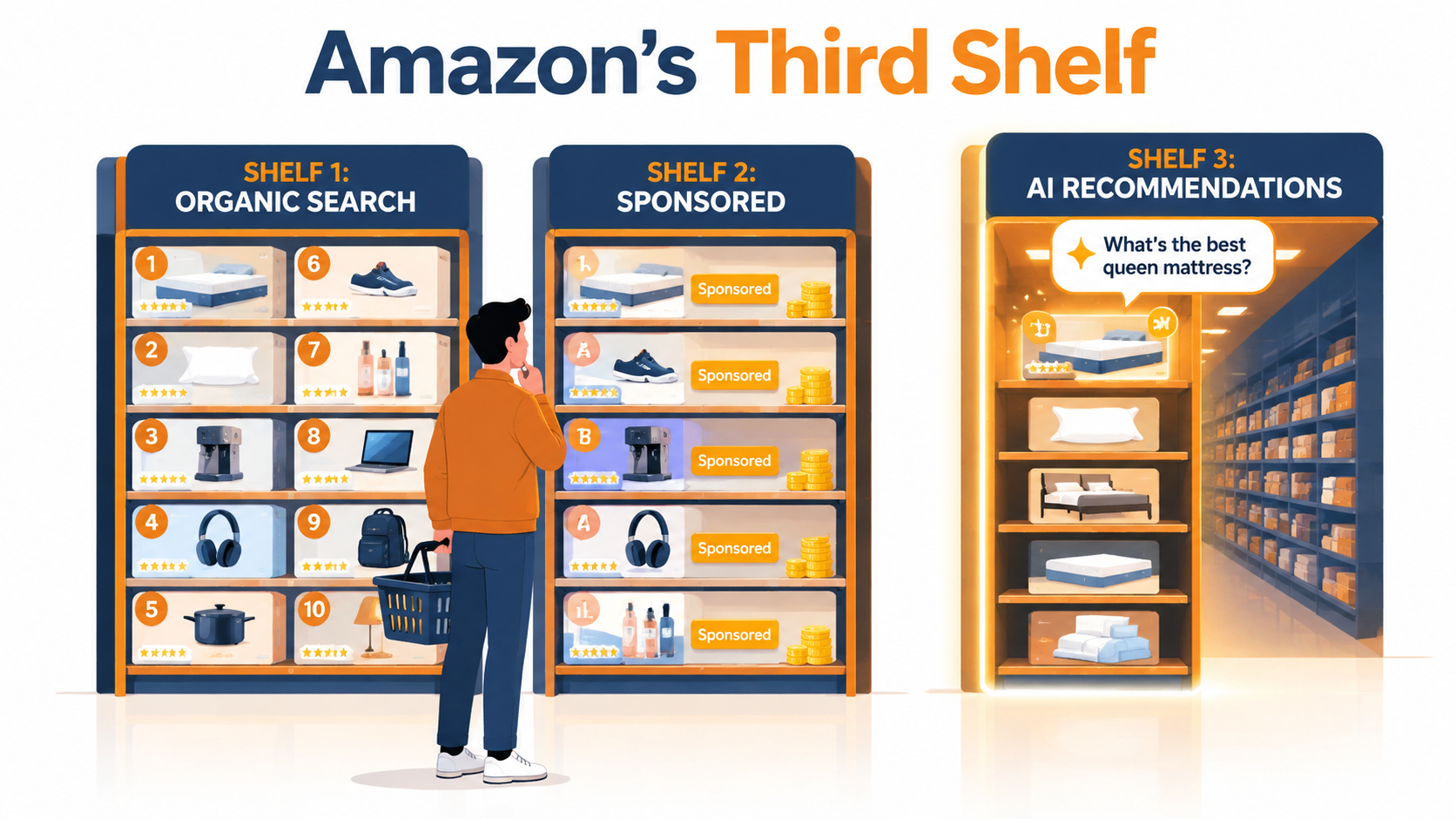

For most of the last decade, selling on Amazon came down to two places a product could show up. You earned the first one, organic search, slowly: sales velocity, reviews, conversion rate and time. You bought the second, sponsored placements, at auction. Almost every Amazon dashboard, agency retainer and launch plan was built around moving products up those two shelves.
In 2026, a third shelf showed up. Amazon’s AI shopping assistant, called Rufus until Amazon renamed it Alexa for Shopping in May 2026, now answers questions like “what’s the best queen mattress?” with its own picks. Early evidence says those picks often have little to do with search rank.
One large study of the assistant’s recommendations found that 63.9% of its picks fell outside the organic top 10 for the matching search term. And 40.9% never appeared on the visible results page at all. If you’ve spent years climbing search, that should get your attention. If you haven’t climbed it yet, it may be the most useful opening you’ve had in a long time.
This article is about selling on Amazon in that three-shelf environment. It isn’t a list of listing tips. It looks at how the marketplace has changed underneath sellers: who is winning, where the money goes, how AI discovery is being monetized, and why the real gap between sellers is no longer effort but whether they understand which shelf they’re competing on.
The data comes mainly from Marketplace Pulse’s 2026 research, its Seller Index survey of 181 sellers with more than $2 billion in combined revenue, Amazon’s own earnings disclosures, and a third-party study of 12,810 recommendations from Alexa for Shopping. Where the evidence is thin or early, we say so.
The Marketplace Sellers Are Actually Operating In: Fewer Rivals, More Traffic, Higher Stakes
Before getting to the AI shelf, it helps to look at the market it sits in. The headlines about Amazon being “too competitive” are partly right and partly out of date.
The customer base is growing while the seller count falls
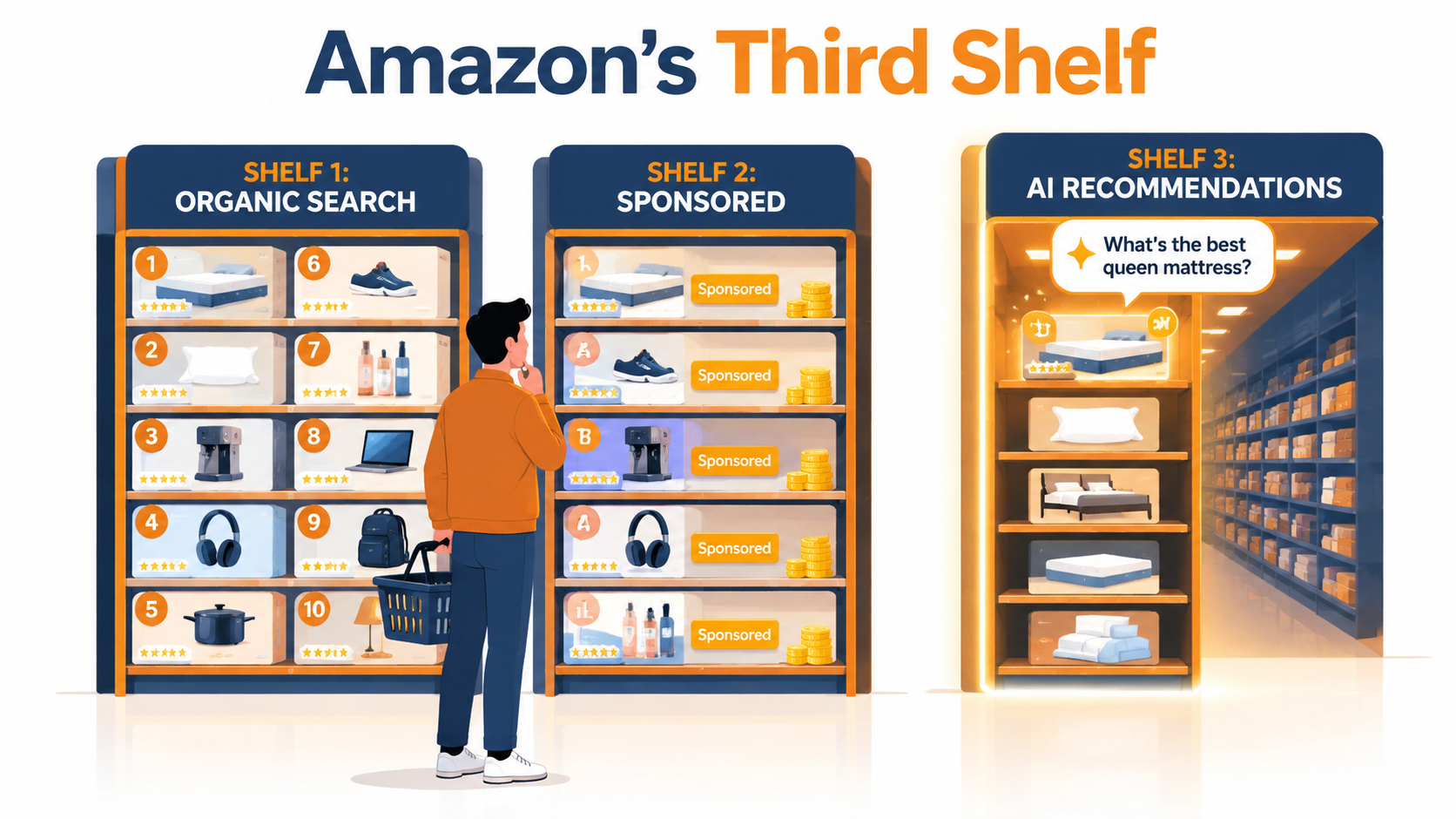
According to Marketplace Pulse, combined web traffic across all 23 Amazon marketplaces grew nearly 5% to about 5.5 billion monthly visits. Over the same period, the number of active sellers (those who got at least one feedback in the past year) dropped 16% to under 1.56 million globally.
Put those together and average traffic per active seller rose 25% in one year to 3,544 monthly visits. That’s a sharp speed-up: the metric rose 31% across the previous four years combined. In the U.S., traffic per seller grew 19%. Brazil, Mexico, France, Poland and the Netherlands grew 40% to 57%.
Saying “Amazon is saturated” misses this. On average there are more shoppers per seller now, not fewer. The hard part is turning that traffic into sales.
But concentration is getting sharper
The same research shows that fewer than 8,000 sellers now generate half of Amazon’s U.S. third-party GMV. Less than three years ago that figure was about 15,000. More traffic per seller hasn’t been spread evenly. It has gone mostly to operators who can handle tariffs, fee changes, advertising complexity and pricing pressure all at once.
Marketplace Pulse names the pressures: tariffs and inflation complicating cost of goods, Chinese sellers (now more than half of Amazon’s active sellers worldwide) pushing prices down, and AI raising the bar for operations. Sellers name marketplace fees as their top margin concern, with advertising spend close behind.
Amazon is also taking back unit share
One quieter signal: third-party sellers made up 60% of paid units sold on Amazon in Q1 2026, down from 61% in Q4 2025 and 62% the quarter before. Marketplace Pulse notes that this is the first time the figure has fallen two quarters in a row since Amazon started reporting it in 2004. It’s a small move, but it means sellers are competing with Amazon’s own retail business as well as with each other.
Takeaway: Amazon in 2026 isn’t closed to new sellers. It rewards operational quality more heavily than before. The opportunity per seller is bigger, but so is the gap between sellers who capture it and sellers who don’t.
Shelf One: Organic Search Is Stickier Than Ever, and That Cuts Both Ways
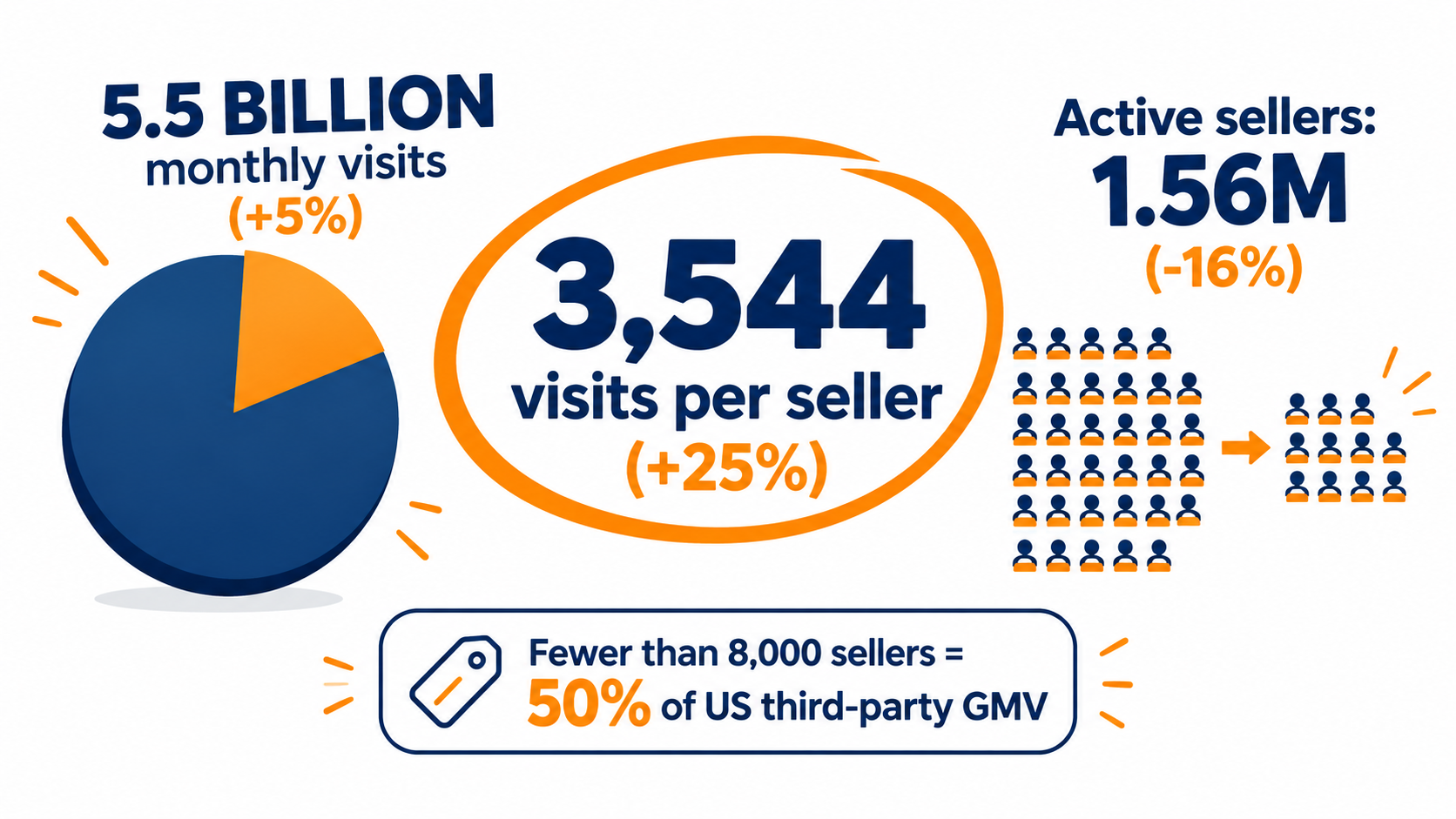
Organic search is still the base of Amazon selling. In 2026 it has a specific feature that matters a lot for strategy: the sellers at the top stay there longer.
Incumbency is getting more durable
Marketplace Pulse’s tracking of the top 10,000 sellers on Amazon.com found that 68.6% of today’s top sellers held that position a year ago, about the same as the 67% it recorded in 2019. Over longer periods the stickiness has grown: 49.6% were already in the top 10,000 three years ago, up from 41% in 2019.
That fits how organic rank works. Sales velocity improves rank, rank brings more sales, and review history piles up into something like a moat. Once you hold a top spot, you have structural advantages that a newcomer can’t easily copy.
Who holds those positions has changed a lot
Turnover rates have stayed flat, but the people turning over have not. Since July 2020, Chinese sellers have gained 1,342 positions in the top 10,000 and U.S. sellers have lost 1,320. Chinese sellers went from 42.5% of the group to 55.9%. American sellers fell from 53.7% to 40.5%.
Marketplace Pulse links this partly to manufacturing proximity, direct factory relationships, export subsidies, and AI tools that “erased the listing-quality gap once protecting domestic sellers.” Copywriting and imagery quality used to be a clear advantage for domestic brands. That advantage has largely gone.
Headcount isn’t revenue
The count hides an important detail. U.S. sellers still hold 65.3% of the GMV generated by the top 10,000, against 28.6% for Chinese sellers. At the very top the gap is wider: American sellers are 81.4% of the top 100 and produce 93.2% of that group’s GMV.
Average selling price explains much of this. In the top 100, U.S. sellers average $47.62 per item against $22.03 for Chinese sellers. The higher-priced, brand-led end of the catalog is still held mostly by domestic brands. The high-volume, price-competitive middle has moved.
The cohort that got squeezed
Among today’s top sellers, the smallest registration cohort is 2019–2021, at 17.5%. That’s the pandemic group, which entered when the marketplace peaked and has been pressured since by veterans with history on one side and low-cost factory-direct entrants on the other. Pre-2016 sellers hold 21.9% of top positions, and sellers who registered in the last 18 months already hold 6.3%.
What this means for organic strategy
- If you’re an incumbent: your rank is worth more than ever. Don’t lose it to stockouts, suppressed listings or pricing errors. Getting it back costs far more than keeping it.
- If you’re a challenger: taking organic rank head-on from an incumbent is slow and costly, especially against sellers with lower costs who can outspend you on ads. You need another way in. The third shelf may be one.
- If you sell premium: the ASP data suggests price and brand positioning still protect sellers better than volume does.
Shelf Two: The Ad Shelf and What It Costs to Stay Visible
When organic rank is sticky, the obvious way around incumbents is to pay for placement. Sellers have been doing that at a huge scale.
The size of the toll
Marketplace Pulse estimates sellers spent $68.62 billion on Amazon search advertising in 2025. Amazon’s own figures point the same way: in Q1 2026, advertising revenue grew 22% on a constant-currency basis on a trailing-twelve-month base above $70 billion, continuing a multi-year pattern of ads growing faster than Amazon’s total revenue.
Marketplace Pulse also points out that this record ad revenue comes from a smaller active seller base than a year earlier. Fewer sellers are paying more per seller to be seen.
Why ads have swallowed organic real estate
Rank and ads used to be fairly separate. Now they’re tightly linked. Ad budgets are spent to create the sales velocity that rank rewards. As Marketplace Pulse puts it, organic real estate “has steadily given way to sponsored placement,” and factory-direct sellers with thin product margins can outspend veterans for it.
That loop is a big reason the Seller Index finds so many sellers growing revenue while margins shrink. Ad spend is easy to scale. Margin isn’t.
The ad shelf in practice
For most sellers, the ad shelf now does three separate jobs, and it helps to budget for each one on its own:
- Launch velocity: spend meant to create the early sales history that organic rank needs. Treat it as an investment with an end date, not an ongoing cost.
- Defense: spend on your own branded terms and top category terms so competitors can’t take the space next to your listings. This is often the hardest spend to cut and the easiest to over-spend.
- Conquest: spend targeting competitor terms and products. This one deserves the toughest unit-economics review, because it’s where low-margin rivals usually win the auction.
The point isn’t to stop advertising. It’s that the ad shelf has become a required running cost for staying visible on search. A seller whose whole growth plan depends on buying the second shelf is exposed to whoever is willing to accept the worst margin.
Shelf Three: What the Alexa for Shopping Study Actually Found
Here’s the third shelf, and the data that suggests it works differently from the other two.
The study design
In May and June 2026, Autopilotbrand.com, a vendor focused on AI visibility, captured 1,963 non-branded queries and 12,810 recommendations from Alexa for Shopping. Marketplace Pulse reported it as one of the first large-scale studies of what the assistant recommends.
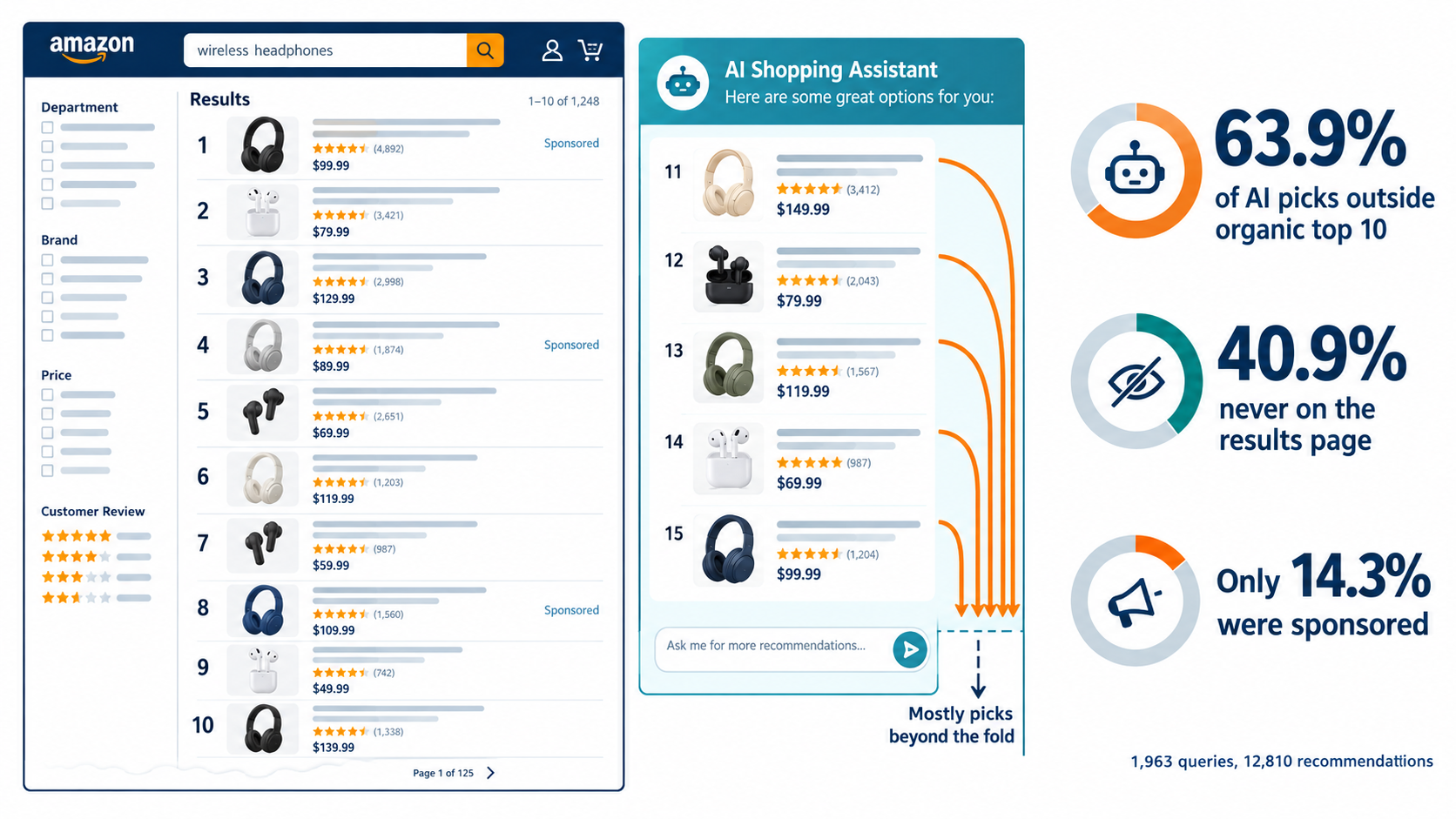
The method was simple. The researchers asked the assistant a “best-of” question (for example, “what is the best queen mattress?”) and compared its answers with the plain category search (“queen mattress”). That isolates one question: when asked to recommend rather than list, does the assistant follow the search page?
The headline numbers
- 63.9% of the assistant’s picks fell outside the organic top 10 for the matching search term.
- 40.9% never appeared on the visible search results page at all.
- Only 14.3% of picks were products running a sponsored listing on that search page.
- Of that 14.3%, 83% already ranked organically anyway, which suggests the ad wasn’t what got them picked.
In plain terms, neither of the two traditional visibility routes, earned rank or bought placement, seemed to shape AI recommendations much. Marketplace Pulse calls rank “the sharper omission”: it’s the metric Amazon teams build their dashboards around, and it’s the one the assistant most clearly doesn’t follow.
How the assistant got here
This is a big change from where the assistant started. Marketplace Pulse notes that two years ago it “merely returned links to searches shoppers could have run themselves,” then became more confident without becoming much smarter. A two-thirds split from search rank is, in their words, “the measure of a system that stopped reprinting its own results.”
The caveats worth taking seriously
This is one snapshot, from one U.S. account, taken early. It was run by a vendor that sells AI visibility services, which is worth keeping in mind even though the method is clear. The assistant’s behavior may vary by account, history, category and time. Treat the findings as a strong directional signal, not a fixed law.
The direction is still worth acting on. Christian Umbach, co-founder and CEO of Autopilotbrand.com, described it this way:
“We’re seeing the emergence of a third shelf alongside organic search and paid placements. Brands cannot simply buy or rank their way onto it; they need to give Amazon’s AI Alexa enough context to understand when and why their product is the right recommendation.”
Why an AI Assistant Would Ignore Search Rank
The study shows that the assistant departs from search rank. It doesn’t explain why. Amazon hasn’t published how Alexa for Shopping picks products, so this section is reasoning, not documentation. Still, the logic helps explain what kinds of products might do well.
Search answers “what sells,” assistants answer “what fits”
Organic rank is mostly a record of past behavior: which products sold, converted and kept customers for a keyword. That’s a good signal for “what do most people buy when they type this?” It’s a weaker signal for “what’s right for this particular person with these needs?”
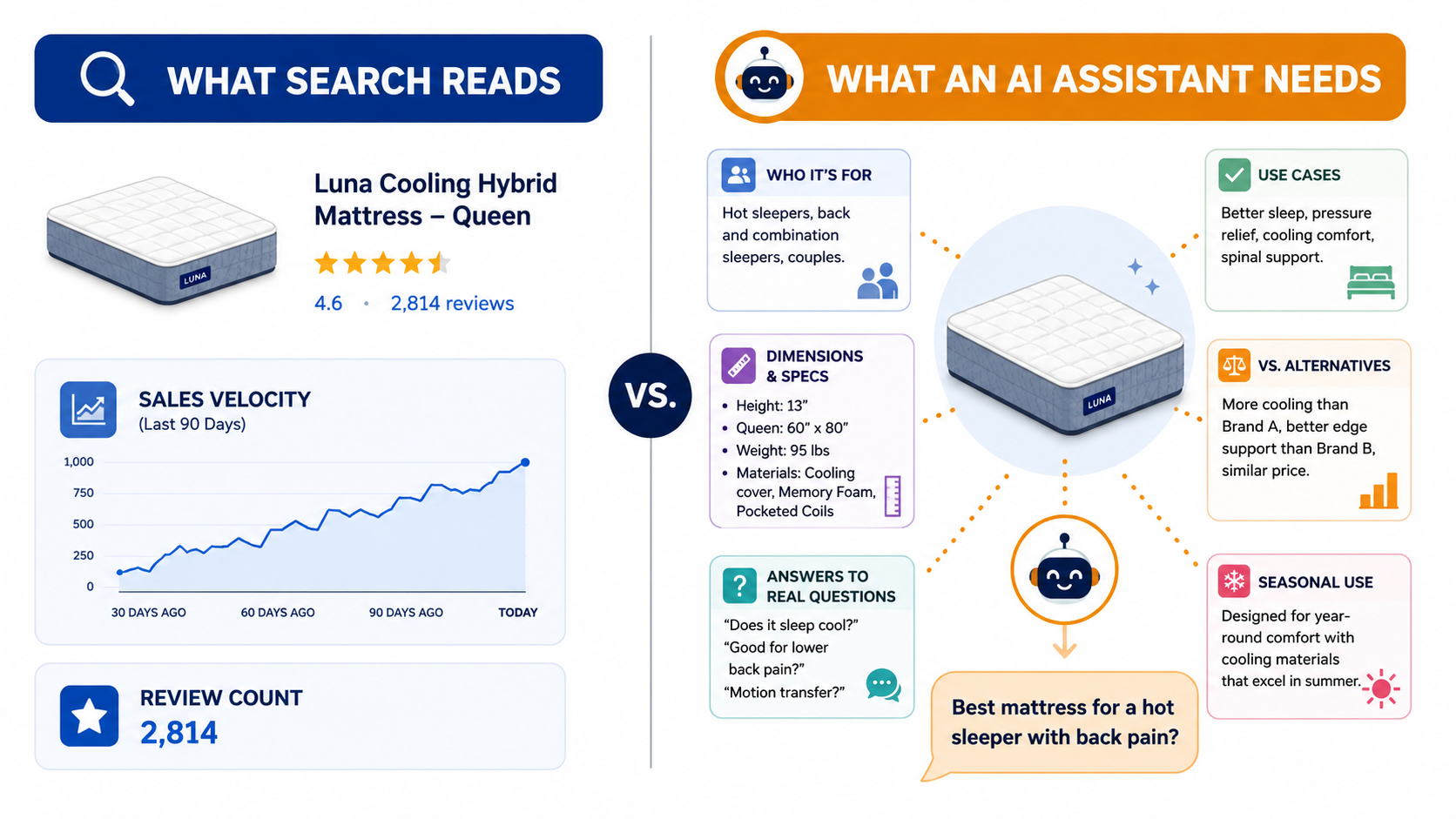
A best-of question asks for judgment. A shopper who asks for the best queen mattress for a hot sleeper with back pain is asking something a ranked list built on aggregate sales can’t answer well. An assistant that reasons over product attributes, reviews and descriptions can reach deeper into the catalog for a better match.
Rank reflects incumbency, not suitability
As covered above, organic rank is becoming stickier. Products that ranked well three years ago probably still rank well, partly because they ranked well. That self-reinforcing pattern is useful for search but carries no extra information about fit. A recommendation system has no reason to copy it.
Depth is the point
For a shopper, an assistant that just repeats the first page of search adds nothing. The value of asking an AI is that it might surface something you wouldn’t have found yourself. The 40.9% of picks that never appear on the visible results page is that value in action: it’s the part of the catalog most shoppers never scroll to.
What this implies for sellers
If the reasoning is roughly right, products that could do well on the third shelf share a few traits:
- They fit a clearly defined use case or shopper profile.
- Their listings spell out that fit in plain language, not keyword strings.
- Their reviews back up the claims with specific, real-world detail.
- They have real differences from the category leader that an assistant can explain.
Note what’s absent: search rank, sales velocity, ad spend. Those still matter a great deal for shelves one and two. They just don’t seem to be what gets a product onto shelf three.
Building Listings an AI Can Actually Recommend
If the third shelf rewards context over incumbency, the practical question is how to give Amazon’s assistant that context. Umbach’s summary is a good starting point: “richer catalog data, optimization around shopper intent, and continuous updates as seasonal use cases and product differentiators evolve.”
Here’s what that looks like in a catalog.
1. Write for questions, not just keywords
Traditional Amazon copy is built to match search strings. Assistant-friendly copy is built to answer questions. Look at the questions shoppers actually ask about your category, from customer Q&A, review complaints, return reasons and support emails, and make sure the listing answers them directly.
For example, a mattress listing tuned for search might stack “queen mattress, memory foam, cooling gel, medium firm.” A listing written for the assistant would also state who it’s for (back sleepers, hot sleepers, couples with different firmness preferences) and why.
2. Fill in every structured attribute
Backend attributes and item specifics are easy to rush through when you’re focused on titles and bullets. For a system matching products to needs, structured data such as dimensions, materials, compatibility, certifications, age ranges and use conditions may be some of the most useful information you can provide. Gaps are lost chances to be matched.
3. State your difference from the category leader
An assistant recommending something other than the top seller needs a reason. Spell it out: lighter, quieter, better for small spaces, made for a specific skill level, easier to clean. Vague claims like “premium quality” give a recommendation system nothing to work with.
4. Treat reviews as evidence, not just social proof
Star ratings help on the search shelf. On the assistant shelf, what reviews say may matter just as much. Reviews that mention particular use cases (“I use this on my boat,” “works great for my 6-year-old”) back up the claims in your listing. Encourage customers, within Amazon’s rules, to describe how they actually use the product.
5. Update for seasons and new use cases
Umbach mentions “continuous updates as seasonal use cases and product differentiators evolve.” A cooler is a beach product in July, a tailgating product in October and a camping product in spring. A listing that only describes one season gives the assistant fewer reasons to recommend it the rest of the year.
6. Test what the assistant says about you
The simplest research method is the one the study used. Ask Alexa for Shopping the best-of questions your customers would ask, and write down what it recommends and why. Run the same questions every few weeks. You can’t control the results, but you can see which listings it understands and which it ignores.
One caution: these practices are sensible inferences from limited public evidence, not tactics Amazon has confirmed. They also happen to be good listing hygiene that helps human shoppers, which is a decent sign they’re worth doing either way.
The Ad Layer Is Already Moving Onto the Third Shelf
The third shelf is valuable right now because rank and ad spend don’t control it yet. That may not last.
Sponsored Prompts arrive
In Q1 2026, Amazon launched Sponsored Products and Brand Prompts inside Rufus (now Alexa for Shopping). On its Q1 earnings call, Amazon said nearly 20% of shoppers who interact with a sponsored brand prompt continue the conversation about that brand. Andy Jassy explicitly cautioned that “it is early,” and the figure measures continued conversation, not purchases.
It’s still one of the first concrete performance numbers any major platform has published for advertising inside an AI shopping interface.
The assistant’s commercial weight
Amazon has strong reasons to monetize this surface. In its Q1 disclosures, Rufus monthly active users were up 115% year over year and engagement was up nearly 400%. Jassy credited the assistant with about $12 billion in incremental sales in Amazon’s 2025 results.
Broader consumer behavior points the same way. Adobe Digital Insights reported a 393% year-over-year increase in AI retail traffic in Q1 2026. AI-referred visitors now convert 42% better than non-AI traffic, a reversal from about half the rate a year earlier. McKinsey and ICSC forecast U.S. agentic commerce reaching $1 trillion by 2030, citing 68% of consumers who used at least one AI tool for shopping in the previous three months.
The picture isn’t uniformly positive. Walmart reported that purchases made inside a chat converted at about a third of the rate of users who clicked through to its website. Even so, the direction of consumer adoption is clear.
The rest of the market has settled on ads
Six months earlier there seemed to be a real alternative. ChatGPT’s Instant Checkout, with a 4% transaction fee, looked like a path to AI discovery that didn’t depend on ad spend. That path closed quickly. OpenAI launched ChatGPT ads in February 2026 to selected U.S. advertisers, dropped Instant Checkout in March citing execution problems, and then opened its ads manager to all U.S. advertisers and removed its $50,000 minimum spend.
Marketplace Pulse’s conclusion: agentic commerce “is settling into an ad-supported model,” and the convergence “eliminates the most plausible non-ad path to scale.”
So why does the organic third shelf still matter?
Because ads can be added to the AI shelf without immediately changing which products the assistant picks organically. The study measured the latter. Marketplace Pulse’s framing is a warning: search was once open in the same way, “before the ad load found it.”
The practical conclusion is about timing. The sellers who learn now how the assistant chooses products, while that choice isn’t yet heavily shaped by spend, will be best placed to notice when it changes. They’ll also have built the catalog context that sponsored placements on that shelf will probably need to perform anyway.
Where Amazon Demand Actually Comes From Now
All three shelves sit inside Amazon. A growing share of the demand that lands on them starts somewhere else, and one-way traffic in particular should shape your strategy.
TikTok creates demand, Amazon settles it
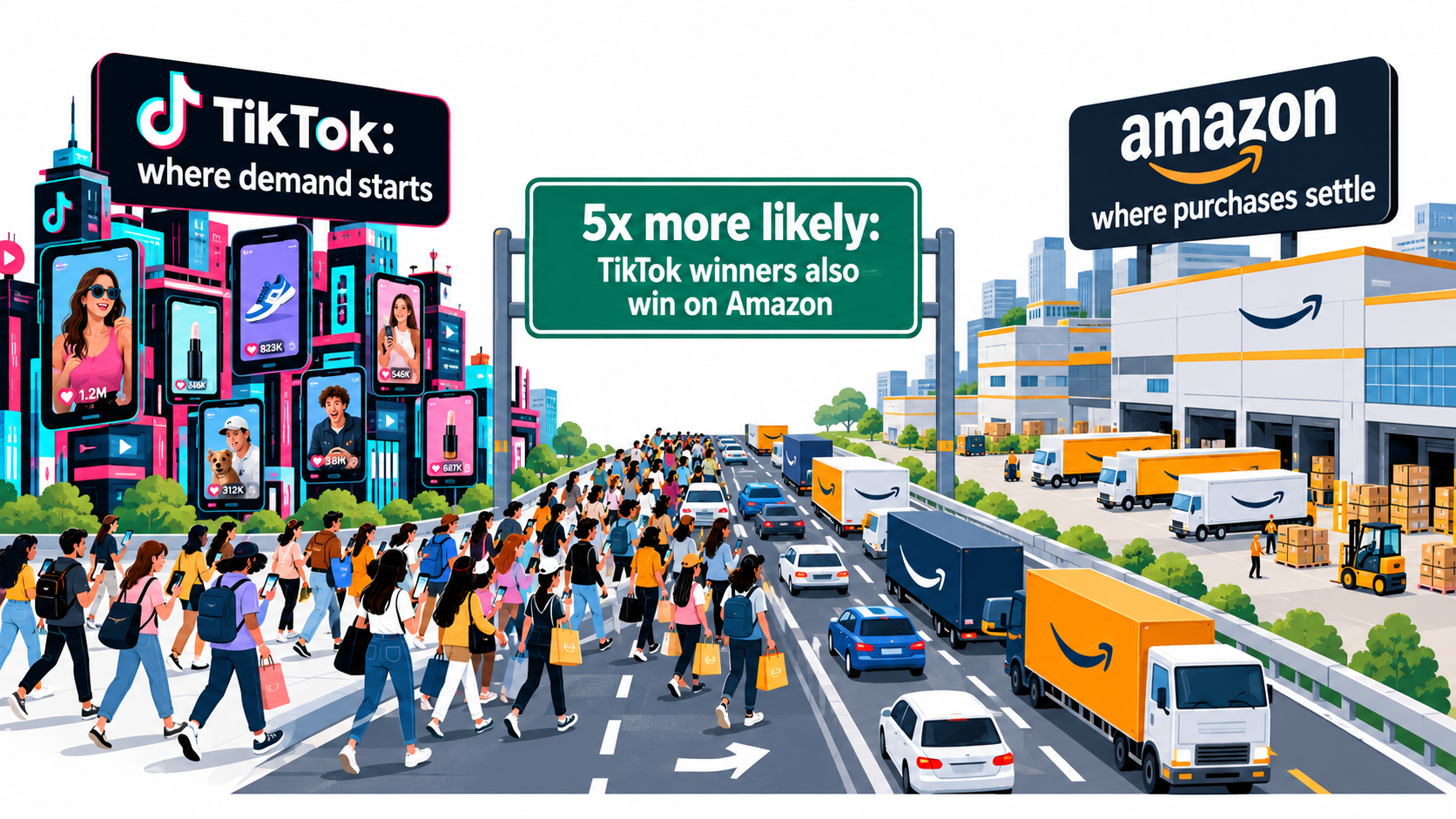
Marketplace Pulse matched the 10,000 largest sellers on Amazon and on TikTok Shop by business name. Only 498 appear on both lists, about 5% of either. The direction is lopsided: one in five of TikTok Shop’s 100 largest U.S. sellers ranks in Amazon’s top 10,000, while only one in twenty-five of Amazon’s 100 largest ranks in TikTok Shop’s top 10,000.
A brand that wins on TikTok is five times more likely to also win on Amazon than the other way round. The explanation is habit. Many shoppers who see a product demonstrated in a video don’t buy it there. They open Amazon, search the brand name and buy where their card is saved and delivery is promised.
Amazon has repeatedly failed to become a discovery platform
Amazon’s attempts to start demand itself haven’t stuck. Marketplace Pulse notes that Amazon Live struggled to hold a thousand viewers on a normal day, and Inspire, its TikTok-style feed launched in 2022, was shut down in 2025. Amazon is where shoppers go to finish buying, not usually where they first find a product.
The AI assistant may be Amazon’s most credible step toward in-platform discovery so far, but Marketplace Pulse argues that “reorganizing a catalog is still a search-first idea.” The shopper still comes in with intent.
Measure off-Amazon marketing in Amazon branded search
For an existing Amazon seller, this changes how to evaluate external channels. Marketplace Pulse suggests TikTok’s value “is therefore best measured in Amazon branded searches, not TikTok Shop orders.” If your product can be filmed and shown off, fund creators and expect much of the return to show up on Amazon.
If your product can’t be filmed (a replacement cable, storage bins, printer paper), TikTok probably isn’t a growth channel for it. Your time is better spent on the three Amazon shelves.
The link to the third shelf
Branded demand and AI discovery work together. A shopper who saw your product elsewhere might ask the assistant to compare it with alternatives. If your listing gives the assistant clear context, you’re more likely to hold that shopper through the comparison. If it doesn’t, external demand you paid to create could be sent somewhere else.
Multichannel From Inside Seller Central: Diversification or Deeper Dependence?
The most strategically interesting Amazon announcement of 2026 may not be about Amazon’s own marketplace.
What Amazon announced
At its Accelerate seller conference in September 2026, Amazon said sellers will be able to manage their eBay, Shopify, TikTok Shop and Walmart businesses from inside Seller Central. The tools are rolling out gradually to U.S. sellers at no extra cost. They pull listings, orders and profitability from every connected channel into one workspace.
In practice, a seller edits a product description once and Amazon reformats it and publishes it to linked listings on eBay, Walmart and Shopify. Shopify and Walmart orders appear next to Amazon orders and can be fulfilled through Amazon in a few clicks. A profitability view shows what each product earns on each channel.
How Amazon got here
Marketplace Pulse describes this as the latest step in a five-year shift. Five years ago, Amazon got in the way of multichannel commerce: FBA charged more to ship off-Amazon orders, and products priced lower elsewhere could be suppressed (which can still happen). Then came Buy with Prime. At Accelerate 2024, Amazon said Multi-Channel Fulfillment served more than 200,000 U.S. sellers, with order volume up 70%. At the 2025 event it announced MCF integrations with Walmart and Shein.
Those earlier steps made Amazon the warehouse behind other channels. The new tools put Amazon in front of them.
The diversification illusion
Amazon says more than 95% of its sellers sell on multiple channels. Being on several channels isn’t the same as being diversified, though. Marketplace Pulse’s 2026 Seller Index found that 71% of Amazon-primary sellers active on at least one other marketplace still earn three-quarters or more of their marketplace revenue from Amazon.
Other channels are growing. Walmart’s U.S. third-party marketplace grew nearly 50% in the first quarter of its fiscal 2027, its fastest pace in years. Scale is still very uneven: Marketplace Pulse estimates Amazon’s U.S. third-party sales at about $300 billion, more than seven times eBay’s and roughly 20 times Temu, TikTok Shop and Walmart, which sit between $15 billion and $22 billion.
The strategic trade-off
The new tools will make it easier to run Walmart, eBay and Shopify alongside Amazon. That’s useful. But Marketplace Pulse makes a fair point: “The tools make it easier to run other channels, but those channels still orbit Amazon.” Amazon says data from these tools won’t inform its retail business, but it can now see how much its sellers sell elsewhere, not just what they charge.
A reasonable approach:
- Use the tools for operational convenience where they clearly save time.
- Keep an independent record of your multichannel numbers, and keep your customer relationships, outside any single platform’s dashboard.
- Judge diversification by revenue share, not by how many channels you’re on. If Amazon is still 75%+ of your marketplace revenue, you aren’t diversified yet, however many accounts you have.
What Separates the 23% Who Are Thriving
All of these changes land unevenly. The 2026 Seller Index shows how unevenly.
Four cohorts on the same platform
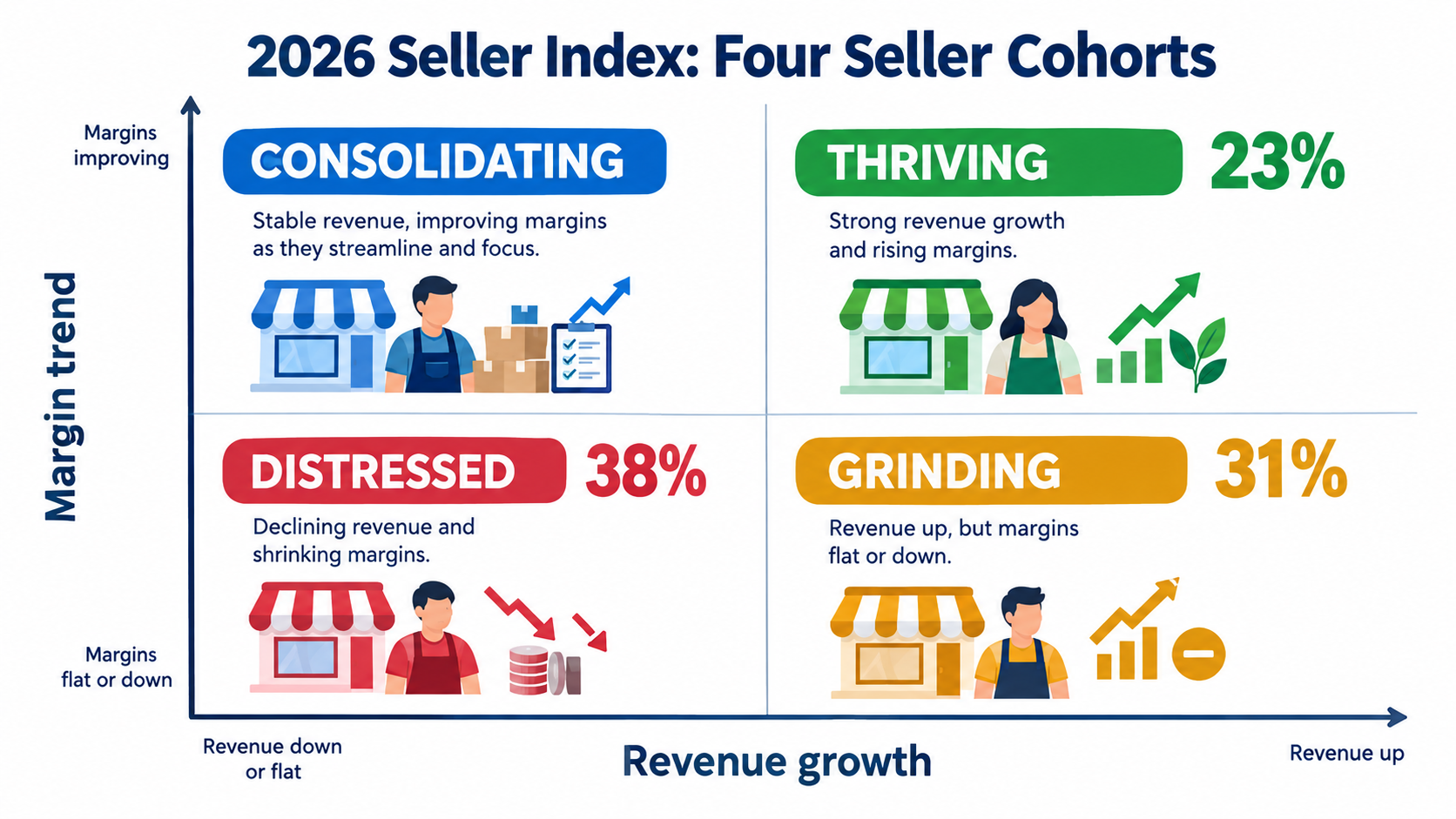
Marketplace Pulse surveyed 181 marketplace sellers with more than $2 billion in combined annual revenue and sorted them by revenue and margin direction:
- Thriving (23%): revenue growing and margins improving at the same time.
- Grinding (31%): revenue up, margins flat or falling, which Marketplace Pulse calls “a potentially unsustainable treadmill.”
- Consolidating: revenue flat or down, margins up.
- Distressed (38%): at best no growth in sight, at worst revenue and margins both falling.
These cohorts work on the same marketplaces under the same conditions. The platform-level growth story hides how differently individual businesses are doing.
The grinding trap
The grinding group is worth a close look because so many growth-focused sellers end up there. Revenue goes up, usually through ad spend on the second shelf, while fees, advertising costs and price competition eat the margin. Topline dashboards look fine and the bank balance doesn’t.
The three-shelf model offers one way out. A seller who relies only on bought visibility is stuck with that shelf’s economics. A seller who also earns visibility on the organic shelf and the AI shelf spreads acquisition costs across channels that aren’t fully priced by auction.
AI adoption: broad, shallow and unevenly useful
The Seller Index also looked at AI use. 83.4% of sellers now use AI somewhere in their operations, averaging 3.2 use cases each. Use is concentrated in content: listing optimization (63.5%) and image and video creation (49.2%). Advertising management, competitive intelligence, pricing and inventory forecasting lag well behind.
The most common answer to the impact question was that no area has delivered measurable results yet: 25.4%, more than any specific win. Use grows with revenue (2.42 use cases for sellers under $500K, 3.67 for those over $5M), but the “no impact” share barely changes across revenue bands.
The bigger split is by seller health. Among thriving and grinding sellers, about 16% report no measurable AI impact. Among consolidating and distressed sellers, the figure is about double. Marketplace Pulse is careful here: it isn’t clear whether AI is driving growth or whether growing sellers just have more capacity to get value from it.
The gap in how sellers think about AI
Marketplace Pulse makes a point that ties back to the third shelf: “Most sellers still describe AI as a tool that writes bullet points. It’s increasingly becoming the operating layer and the channel itself.”
That gap matters. Sellers using AI only to produce listing copy faster are treating it as a cost-saver. AI is also now a distribution channel, where an assistant decides which products to recommend. Sellers who treat it only as a writing tool are missing half of what’s changed.
A 90-Day Plan for Selling Across All Three Shelves
Here’s how to turn the analysis into work. The plan assumes an established catalog. Newer sellers can compress or reorder the steps.
Days 1–30: Audit your shelf exposure
- Split revenue by visibility source. Using your advertising reports and business reports, estimate how much revenue comes from sponsored traffic versus organic. If ads drive most of your growth, you’re probably in grinding territory or close to it.
- Run a third-shelf baseline. Write 20–50 best-of questions your customers might ask (“best X for Y”). Ask Alexa for Shopping each one and record whether your products appear, which competitors do, and what reasons the assistant gives.
- Find rank-dependent products. Mark which ASINs rely on holding a top-10 organic spot. Those are the most exposed if rank matters less in AI-led discovery, and the most valuable to protect on search.
- Check true diversification. Work out Amazon’s share of your marketplace revenue. Above 75% puts you with the 71% of multichannel sellers the Seller Index flags.
Days 31–60: Build catalog context
- Rewrite your top 10–20 listings for questions. Add plain statements of who each product is for, the use cases it handles and how it differs from the category leader.
- Complete every structured attribute. Treat item specifics and backend fields as primary content, not an afterthought.
- Mine reviews and returns. Pull out the questions and complaints that keep coming up, and answer them in the listing.
- Plan seasonal updates. Map each product’s use cases across the year and schedule listing refreshes before each season starts.
Days 61–90: Rebalance spend and measure
- Re-run the third-shelf baseline. Ask the same questions and compare. Look for products that started appearing, and for changes in how the assistant describes your products.
- Split ad budgets by job. Separate launch, defense and conquest spend. Cut conquest campaigns where low-margin competitors keep winning the auction.
- Test sponsored prompts carefully. If you have access, run small tests of Sponsored Brand Prompts. Remember that Amazon’s “nearly 20%” figure measures conversation continuation, not purchases. Judge it on sales.
- Measure external channels in Amazon branded search. If you run TikTok or other social programs, track branded search volume and branded sales on Amazon alongside platform-native orders.
- Use multichannel tools without giving up control. Try the Seller Central multichannel features for convenience, and keep your own records of cross-channel performance.
What to track going forward
- Share of tracked best-of questions where your products appear in assistant answers.
- Ad spend as a percentage of revenue, by job (launch, defense, conquest).
- Contribution margin trend, the number that separates thriving sellers from grinding ones.
- Amazon’s share of total marketplace revenue.
- Branded search volume on Amazon.
Conclusion: The Sellers Who Notice First
Selling on Amazon in 2026 is neither the crowded race to the bottom it’s sometimes described as nor the easy-money opportunity of 2019. It’s a more concentrated, more demanding marketplace where traffic per seller is rising and the gap between strong and weak operators keeps widening.
Most sellers still compete on two shelves. Organic search rewards incumbents more than ever and has shifted toward factory-direct sellers by count, while U.S. brands keep the high-value top. The ad shelf took in $68.62 billion from sellers in 2025 and is a big reason 31% of sellers are growing revenue while their margins shrink.
The third shelf, Amazon’s AI assistant, is different for now. Early evidence suggests it reaches past search rank and ad spend to recommend products based on fit, often from parts of the catalog shoppers never scroll to. Amazon is already selling ads there, and the rest of the industry has moved to the same model. The window in which the AI shelf rewards catalog context over spend may not stay open long.
Key takeaways
- The market rewards operational quality. Traffic per seller rose 25% in a year, but fewer than 8,000 sellers now produce half of U.S. third-party GMV.
- Organic rank is sticky. Protect it if you have it. Look for other routes if you don’t.
- Ad spend is now a running cost. Budget it by job and scrutinize conquest spend hardest.
- The AI shelf doesn’t follow rank, yet. In one large study, 63.9% of assistant picks fell outside the organic top 10.
- Context is the currency of the third shelf. Clear use cases, complete attributes, stated differences and specific reviews.
- Measure off-Amazon demand on Amazon. Branded search is the clearest signal of whether external marketing works.
- Multichannel presence isn’t diversification. Track revenue share, not channel count.
- Treat AI as a channel, not just a writing tool. The sellers getting the most from it understand that it now decides which products shoppers see.
As Marketplace Pulse put it, “The AI shelf’s economics are not yet written. The sellers learning how it selects now are the ones who will notice the day that changes.” Start testing it now so you’re ready when ads arrive there in force.