


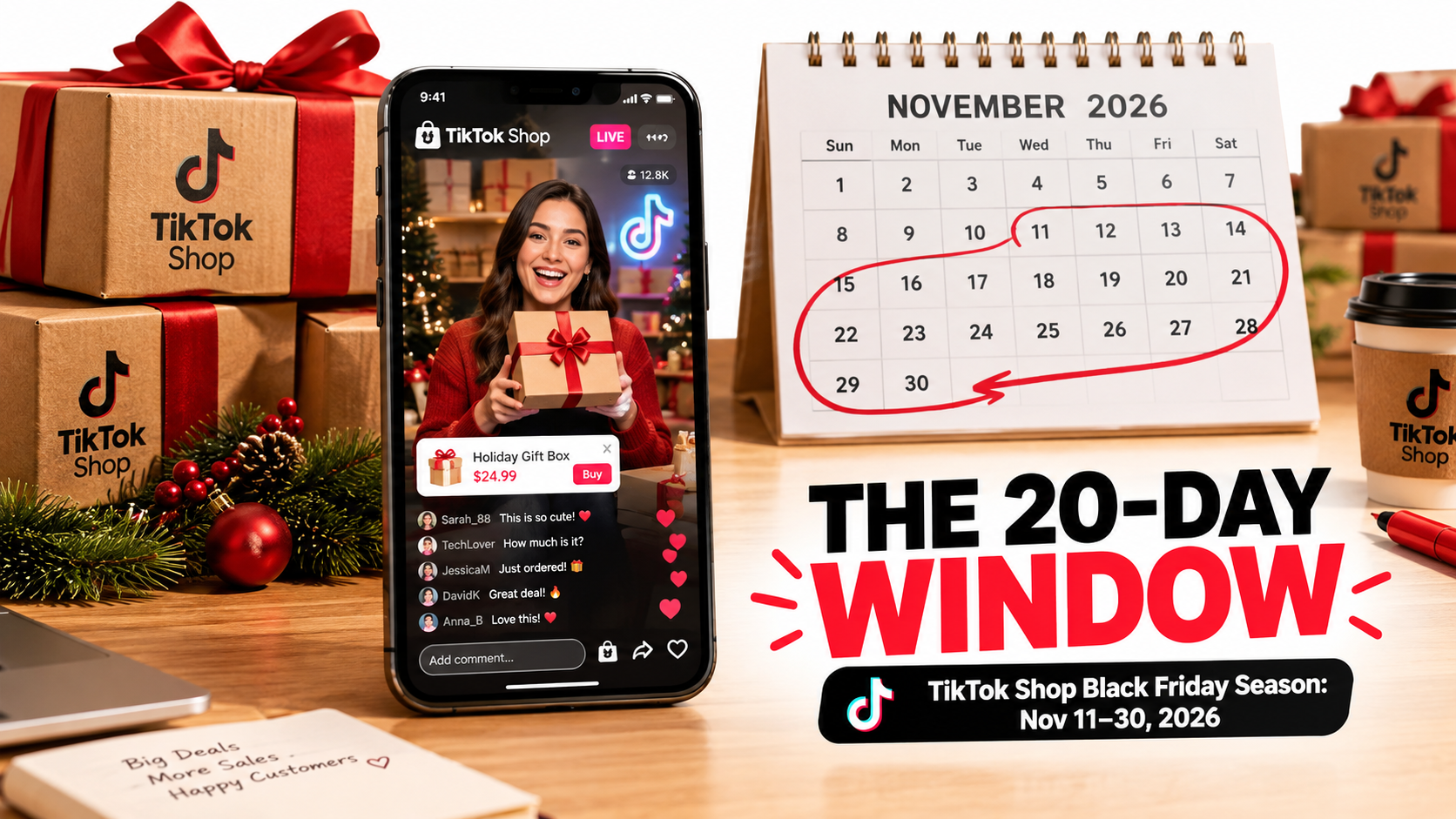

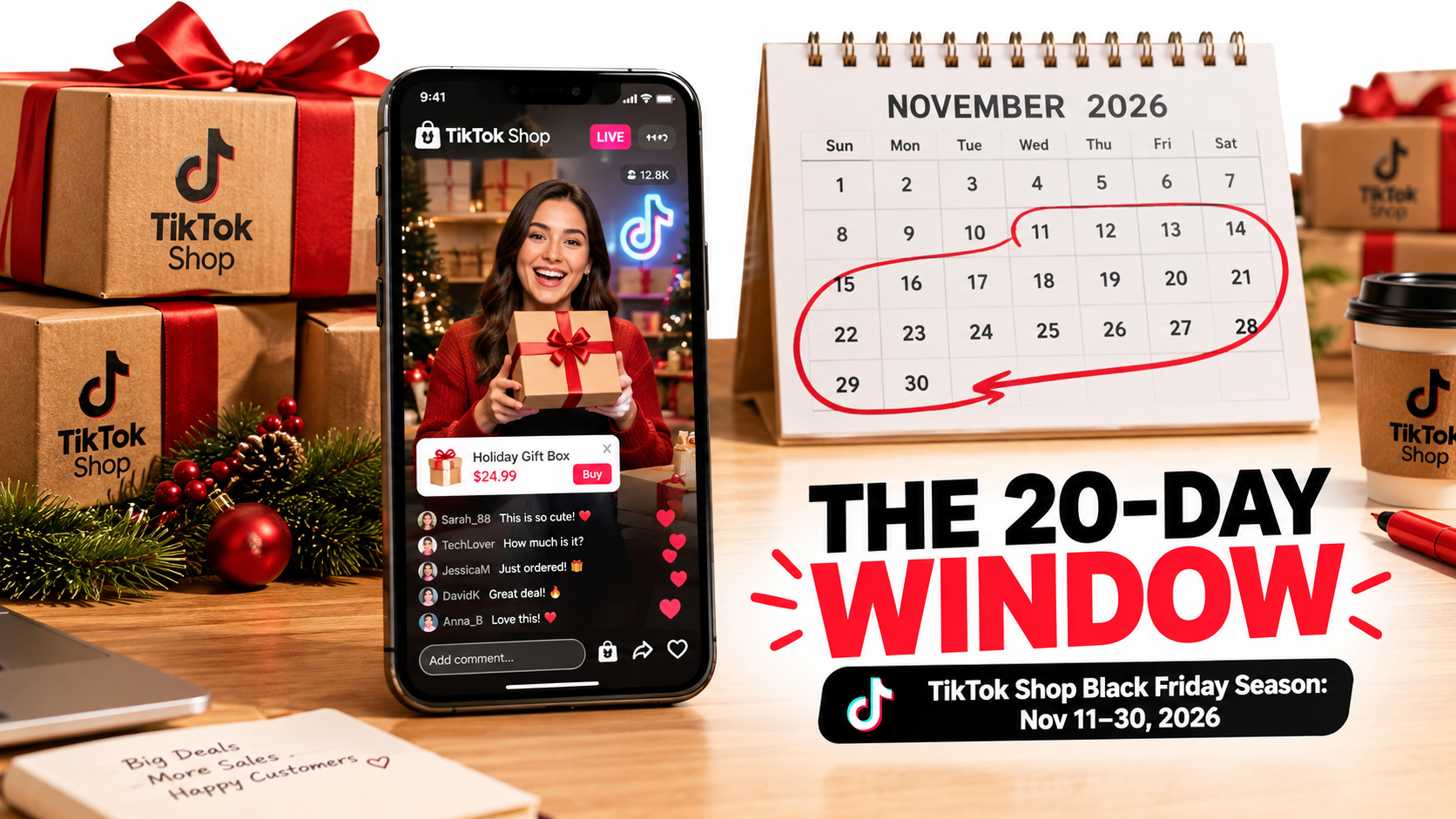
TikTok Shop has set its dates. Black Friday and Cyber Monday run on the platform from November 11 to November 30, 2026. That’s a 20-day event, not one weekend. For sellers, the length changes most of what you need to plan.
Most holiday advice for social commerce is about creative: hooks, trends, viral formats. Those matter, but they aren’t usually what decides a TikTok Shop seller’s Q4. What decides it is operations. Do you have stock when a video takes off? Will your fulfilment hold when order volume triples overnight? Did your creator samples land early enough for the content to be live on day one? And can your margins absorb the discounts, commissions and ad spend all at once?
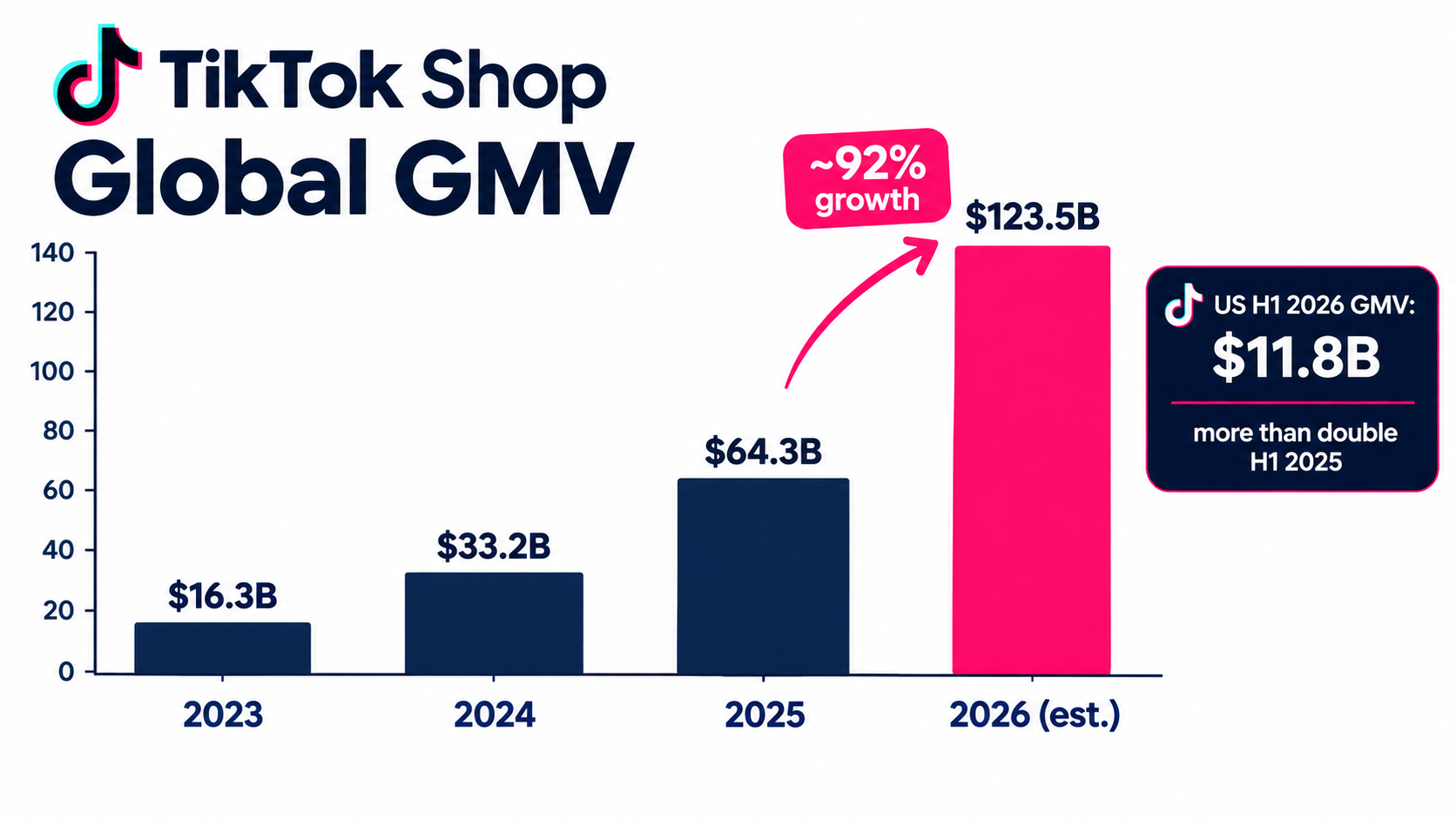
The stakes are higher this year. Statista and Momentum data compiled by DemandSage puts global TikTok Shop GMV at an estimated $123.5 billion in 2026, close to double 2025’s $64.3 billion. In the US, first-half 2026 GMV reached $11.8 billion, more than double the same period a year earlier. TikTok also says product selection across categories has grown more than 1,200% since 2024, and Sephora, Best Buy, Ulta Beauty, Michael Kors and Victoria’s Secret all joined the platform this year.
So demand is bigger, and so is the competition. This guide skips viral tactics and works through the operating decisions in the order you need to make them: reading demand, planning inventory, choosing fulfilment, building the creator pipeline, scheduling LIVE, capturing gift searches, setting up offers, competing with big brands, and handling the weeks after November 30.
Why the 2026 Holiday Season Works Differently on TikTok Shop
Before you plan, it helps to know what has actually changed. Three changes matter most, and each one affects how you should prepare.
The platform is far bigger than it was last year
Growth has stayed steep. According to the DemandSage figures, global GMV went from $16.3 billion in 2023 to $33.2 billion in 2024, then $64.3 billion in 2025. The 2026 estimate is $123.5 billion. The US alone accounted for about $15.8 billion in retail ecommerce sales in 2025, which eMarketer-sourced estimates put at 18.2% of all US social commerce. The 2026 projection is $23.41 billion, or 22.8%.
In practice, last year’s holiday sales are a weak guide to this year’s. If the platform roughly doubled, a seller who simply held market share would need about twice the inventory, twice the fulfilment capacity and twice the customer service coverage. Most sellers aren’t planning at anything close to that scale.
The seller mix has shifted toward domestic businesses
The US ended the de minimis import exemption in May 2025. CNBC and eMarketer reporting cited by DemandSage says sales from foreign sellers fell sharply afterward, and domestic businesses picked up more of the demand. More than 215,000 US small businesses now sell on TikTok Shop.
For a domestic seller, this cuts both ways. You face fewer ultra-cheap cross-border listings that win on price alone. But other domestic sellers saw the same opening, and many of them are entering their first or second full holiday season with more capital and better systems than they had before.
Large retailers are now competing for the same feed
With Sephora, Ulta Beauty, Best Buy and others joining in 2026, big brands with big budgets are on the same platform. TikTok cites GlobalData research showing that 67% of Americans on the platform trust a large brand the same or more when they see it on TikTok Shop compared with another platform. Among users aged 18 to 24, that figure rises to 82%.
That number matters to smaller sellers. Big brands aren’t paying a credibility penalty for selling on TikTok. If your plan rested on being the only option in your niche, assume it no longer works. We come back to positioning later in this guide.
What the 20-day format changes
A three- or four-day event rewards one big push. A 20-day event rewards stamina. Your best-performing content from November 12 may be worn out by November 25. A creator who posts on day one is worth less to you if the stock runs out by day six. Plan for three phases: an opening surge, a mid-event stretch where you keep things moving, and the Black Friday to Cyber Monday peak at the end.
Reading the Demand Signals TikTok Has Already Published
Most marketplaces don’t say much about holiday demand ahead of time. TikTok published quite a lot in its October 2026 holiday announcement. Read it carefully, because percentage growth can easily give the wrong impression.
The category signals
TikTok highlighted three gift categories:
- Pre-owned luxury: US TikTok users are 2.5 times more likely to buy a luxury item as a gift this Black Friday and Cyber Monday. The most expensive item bought on TikTok Shop in the US this year was a pre-owned luxury bag that sold for $25,580.
- Jewelry: 22% of US TikTok users expect to buy accessories, including jewelry, during BFCM. Sales of single IGA-certified lab diamonds more than quadrupled from May to September. In September, searches for “gold jewelry” rose 1,134% and “opal rings” 825% month over month. Searches for #friendshipbracelet were up 120%.
- Collectibles: Sales of trading cards, memorabilia, coins, figurines and squishy toys grew 230% year over year in October. Searches for “squishy toys” were up 149% in September.
Seasonal hashtags also rose in September compared with August: #fallwishlist (450%), #giftsforwomen (440%), #holidayshopping (263%), #holidaygiftideas (248%) and #holidaydecor (97%).

How to interpret month-over-month spikes
A 1,134% jump in “gold jewelry” searches sounds huge. But it’s a month-over-month figure taken from September, a month when seasonal interest always rises. TikTok didn’t publish the baseline volume, so a large percentage could sit on a modest base. Treat these numbers as direction, not as a sales forecast.
Ask three questions before you act on any of them:
- Is the signal about intent or entertainment? #bananabreadrecipes grew 1,503% in September. That’s people looking for recipes, not product demand, unless you sell baking pans or loaf tins.
- Does it apply to your catalogue? If you sell gold-tone fashion jewelry, the gold jewelry trend may help you. If you sell stainless steel, it may not.
- Can you show up in time? A trend you can’t stock, list and get creators posting about before November 11 is only useful as a lesson for next year.
Turning signals into catalogue decisions
The most practical move is usually to reframe what you already sell rather than add new products. A seller of personalised bracelets doesn’t need a new SKU to benefit from rising #friendshipbracelet searches. They need titles, thumbnails and creator briefs that present the product as a gift. A home goods seller can do the same with #holidaydecor. Reframing costs almost nothing. Bringing in new inventory four weeks before a peak is one of the riskiest things you can do.
Bundles are the exception, and TikTok named them directly: “exclusive offerings, product bundles, and one-of-a-kind collaborations” will run all season. Bundles let you build gift products out of stock you already have, which is safer than buying new stock.
Inventory Planning for a 20-Day Event
On TikTok Shop, running out of stock costs more than the lost sales. When one video drives demand, every hour you’re out of stock is an hour the algorithm keeps showing that video to people who can’t buy. Some affiliates will also stop promoting products they can’t rely on.
Why marketplace forecasting habits fail here
On search-led marketplaces, holiday demand tends to rise in a fairly predictable curve. On TikTok Shop, demand comes in spikes driven by content. One creator video can produce more orders in 48 hours than you sold in the previous month, and the timing isn’t something you control.
So a single forecast number won’t work. Plan with scenarios instead.
A three-scenario approach
- Base case: Your normal daily sales times a holiday multiplier based on how much your own sales rose during last year’s peak. If this is your first season, use a cautious multiplier and write down why you chose it.
- Breakout case: What happens if one creator video takes off? Look at your best single day ever and ask what three to five of those in a row would do to your stock.
- Floor case: What if your holiday content flops? How much stock would be left over in January, and what would carrying or clearing it cost you?
Stock between the base and breakout cases, weighted by how quickly you can reorder. If your supplier can restock in a week, you can lean toward the base case and reorder as needed. If it takes six weeks, whatever you have on November 11 is what you’ll sell, so lean toward the breakout case on your proven products.
Concentrate depth, not breadth
The 1,200% growth in platform selection means buyers have more choice than ever. Sellers often respond by widening their catalogue. For a holiday peak, the better approach is usually the reverse: carry deep stock on the 3 to 5 products with proven conversion, and keep everything else lean.
Creators and the algorithm both favour products with steady sales. A product that sells out on day four loses its momentum. A product with stock through day 20 keeps it.
Set reorder triggers now
Decide your reorder points before the event, not during it. For each hero SKU, write down:
- The stock level that triggers an emergency reorder
- Who places the order, and their authority to spend
- Your backup supplier, if you have one
- At what stock level you’ll pause ad spend to slow sales and avoid running out
That last point is often missed. Turning ads down on purpose when stock is low protects your fulfilment metrics and keeps you from overselling. It feels wrong mid-event, but it’s usually the right call.
Fulfilment Under Peak Load: Fulfilled by TikTok vs. Self-Shipping
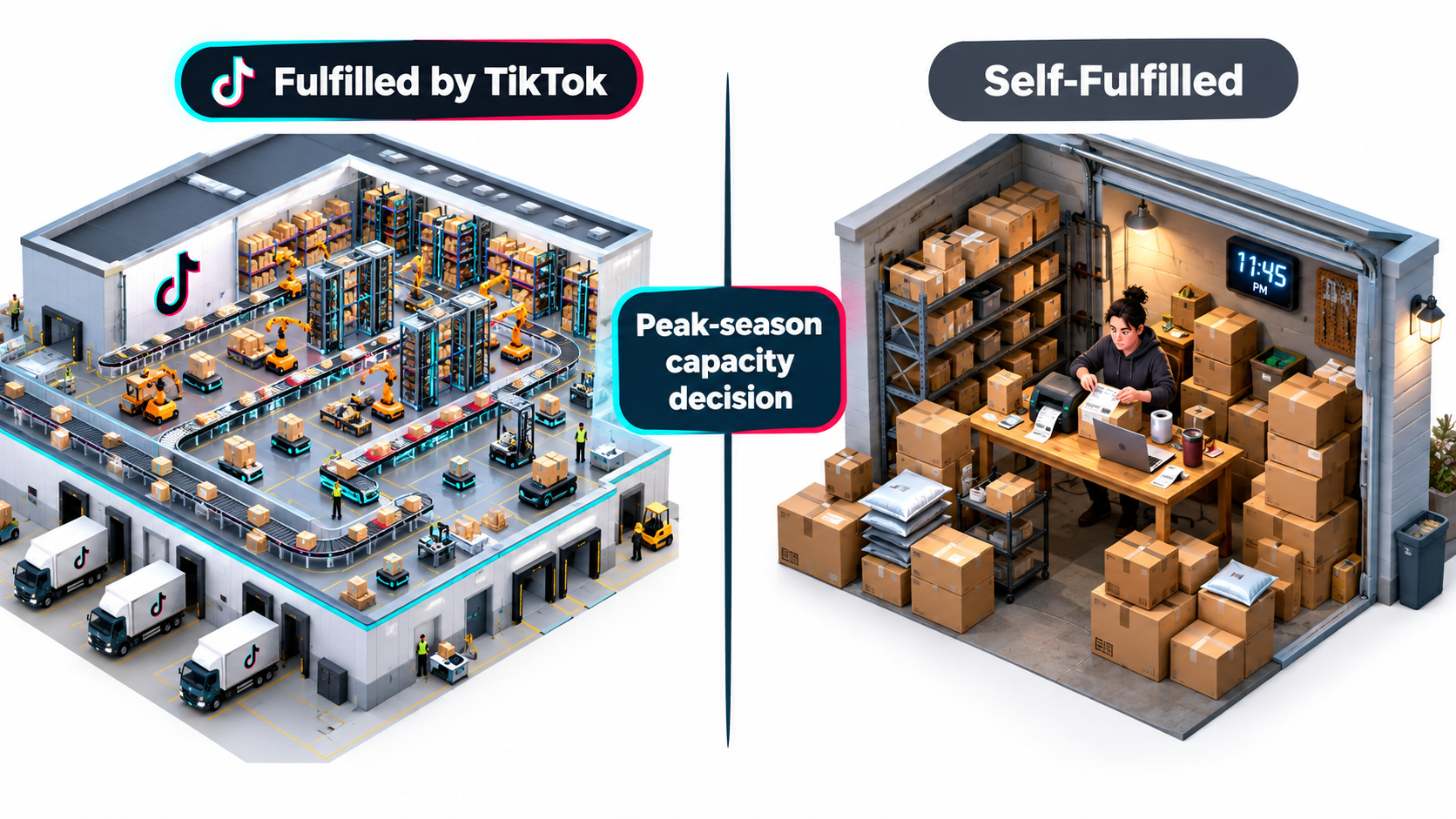
TikTok introduced Fulfilled by TikTok (FBT) at its 2023 US launch, describing it as a service where TikTok Shop “stores, picks, packs, and then ships sellers’ products to customers.” Whether to use it, and for which SKUs, is a capacity question you need to answer before November.
The real question is whether you can handle the spike
Most sellers compare FBT fees with their own shipping costs. That comparison matters, but it misses the bigger risk at peak: can your operation handle sudden spikes in volume without late shipments? A business that packs 80 orders a day comfortably can fall apart at 600. Late shipments and cancellations hurt account health metrics that TikTok uses to judge seller reliability. They also produce unhappy buyers right when reviews count most.
When self-fulfilment makes sense
- Your products are bulky, fragile or customised, so standard warehouse handling is a risk
- You’ve already run a 3x to 5x volume day and shipped everything on time
- You can add temporary packing staff or a 3PL partner quickly
- Your margins are thin enough that extra per-unit fees would wipe out profit on discounted orders
When moving hero SKUs to FBT makes sense
- Your best sellers are small, standard and easy to ship
- You’ve never gone through a real volume spike
- You’d rather spend November on creators and LIVE than on packing
- You want faster delivery promises on your top products
The hybrid approach
Many sellers do best with a split. They send their 2 to 3 top SKUs to TikTok’s fulfilment network and ship the long tail themselves. This puts warehouse capacity where the spikes are most likely and keeps control over the slower products.
Whatever you decide, check fees, inbound shipment requirements and cut-off dates directly in your Seller Center. TikTok changes them periodically, and peak-season inbound deadlines usually come weeks before the event. If you miss them, the stock sits in transit while orders pile up.
Carrier cut-offs and delivery promises
The event ends on November 30, but holiday gift buying continues into December. Know your carriers’ holiday cut-offs and decide how you’ll show delivery expectations in listings and LIVE streams. Overpromising delivery before December 25 brings complaints, refunds and bad reviews in the weeks when new buyers are reading them.
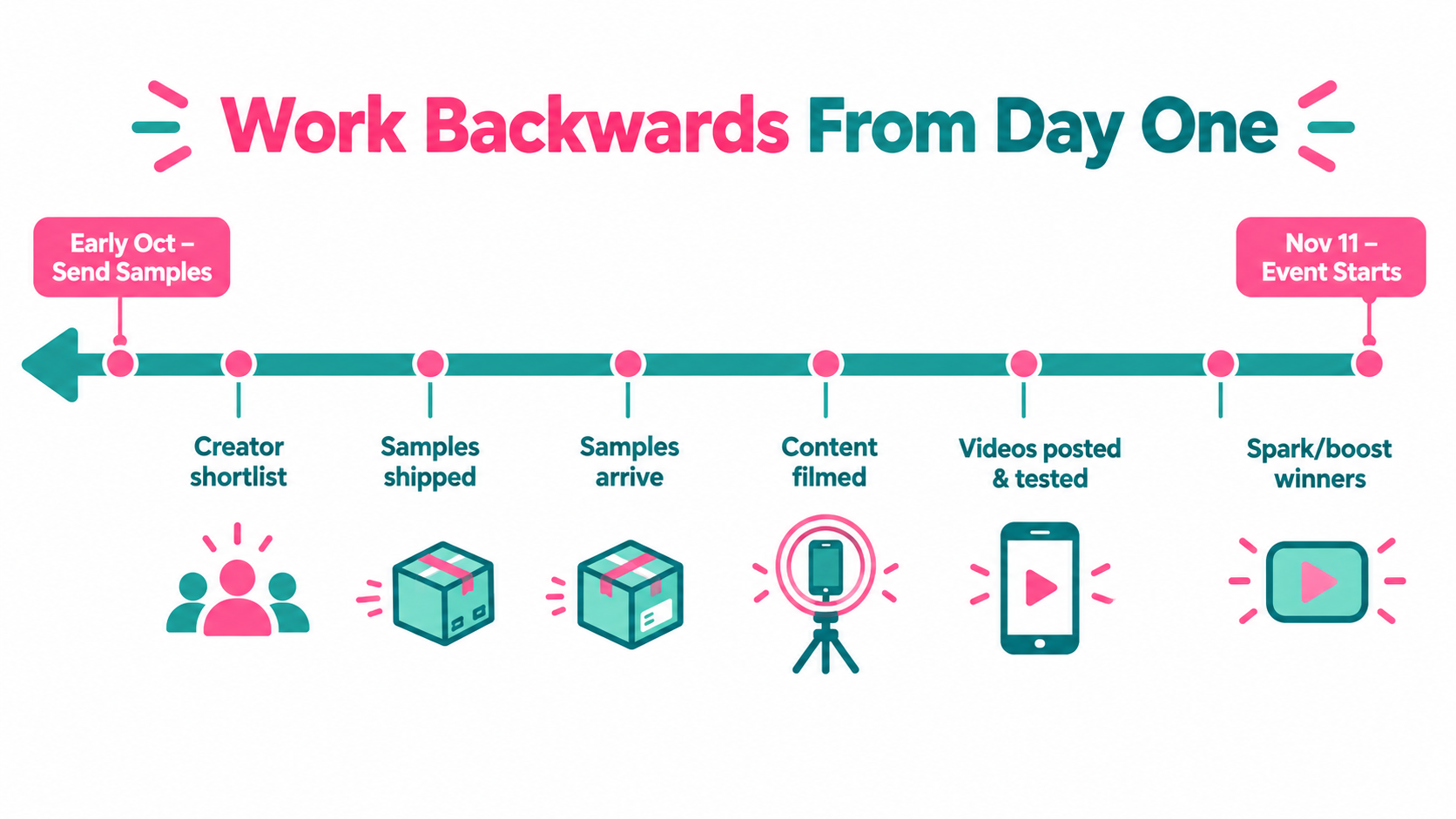
Building the Creator Pipeline Backwards From November 11
DemandSage estimates that creators drive about 42% of US TikTok Shop sales. For many sellers in fashion, beauty and gifting, the share is much higher. Yet creator programmes are where holiday timelines most often slip.
Count the days
Work backwards from November 11 and include every step:
- Testing and boosting (about 7 to 10 days before launch): Creator videos should be live before the event so you can see which ones convert and put ad budget behind them.
- Filming and posting (about 7 to 14 days before that): Creators juggle many brands in Q4. Expect them to need time.
- Sample delivery (3 to 7 days in transit): Longer if carriers are already busy.
- Outreach and approval (1 to 2 weeks): Includes finding creators, waiting for replies and approving sample requests.
Add those up and the deadline for starting creator outreach for day-one content falls in early to mid-October. If you’re reading this later, don’t panic. Shift your creator focus to the mid-event phase and the Black Friday to Cyber Monday peak, which still leaves you weeks.
Pick creators for the format, not just the audience
Holiday content follows a few formats: gift guides (“gifts for her under $50”), unboxings, “what I got my family” hauls, and LIVE demos. Look at each creator’s past content and match them to a format. A creator who makes excellent tutorials may not be good at gift-guide videos.
Brief for gifting
Most product briefs explain what the product does. Holiday briefs need to cover who it’s for. Give creators the recipient angle (“for the friend who has everything,” “for teenage nieces”), the price point and any bundle or gift-ready packaging. Searches like “giftsforwomen” and “holidaygiftideas” reflect buyers thinking about the recipient, so creator content should do the same.
Plan for content fatigue
Twenty days is long. Content posted in early November may be worn out before Black Friday. Plan a second wave of creator content, either from new creators or as follow-ups from your best performers, to go live around November 24 to 27. Budget for it now, because creators fill their late-November schedules early.
Commission strategy for the window
Raising commission rates for the event period can attract creators who’d otherwise pick other brands. But calculate the effect on your margin first, accounting for discounts and platform fees. A higher commission on a 30%-off product can leave you selling at a loss. If you can’t afford higher commissions across the board, offer them only on bundles or higher-priced items.
Scheduling LIVE Shopping Across the Event
TikTok’s holiday announcement specifically mentions “exclusive LIVE Shopping events from great brands and trusted creators” as part of the season. LIVE is where gift shoppers can ask questions and get immediate answers, which helps a lot with higher-priced items like jewelry and luxury resale.
Why LIVE suits gift buying
People buying gifts are less sure of themselves than people buying for themselves. They wonder about size, whether the recipient will like it, whether it will arrive on time, and what the packaging looks like. A LIVE host can answer each of those in real time. That’s also why collectible and luxury resale sellers have done well with LIVE: buyers want to see the exact item, its condition and its authenticity before they pay.
Build a calendar, not a one-off
A good LIVE plan for a 20-day event usually has:
- A launch stream around November 11 that introduces holiday bundles and event pricing
- Regular mid-event streams on fixed days and times so returning viewers know when to come back
- Themed streams such as “gifts under $25,” “stocking stuffers,” or “for him” that match what people search for
- Extended or back-to-back streams across Black Friday weekend and Cyber Monday
Consistency usually matters more than length. Three reliable streams a week tend to build more repeat viewers than one long, irregular stream.
Run LIVE like an operation
The busiest LIVE sessions often break on the back end. Before each stream, check stock on every featured product, confirm that limited-time prices are set up correctly, and have a second person watching comments and orders. Selling stock you don’t have during a LIVE is one of the quickest ways to rack up cancellations at peak.
Use streams to collect information
Viewer questions during LIVE streams tell you what to fix. If people keep asking about sizing, update your listing. If they keep asking about delivery dates, put the delivery promise in your thumbnail or title. Keep a running list from every stream and update listings within 24 hours.
Capturing Gift-Intent Search
TikTok says there were more than 100 billion searches with e-commerce intent on TikTok Shop in the US in 2025. In its words, discovery and search “go hand in hand during the holidays.” Many people who find a product in their feed go on to search for it, or for similar products, before they buy.
Searches for products vs. searches for gifts
During the year, most product searches are about the product itself: “lip oil,” “posture corrector.” In the holidays, a lot of searches are about the recipient and the occasion: “gifts for mom,” “stocking stuffers for teens,” “secret santa under $20.” A listing written only around product features may miss that traffic completely.
Practical listing updates for the season
- Titles: Where it reads naturally and stays within platform rules, add recipient or occasion wording (“Gift for Her,” “Stocking Stuffer”) alongside your main product keywords.
- Images: Add at least one gift-context image, such as the product wrapped, in a gift box, or next to holiday décor. Buyers scrolling for gifts look for those cues.
- Descriptions: State who it’s for, what’s included, gift-wrap or packaging details, and delivery expectations.
- Price-band language: Many gift searches include a budget. If your product sits under a common price point like $25 or $50, make that easy to see.
Line up content and search
When a creator video says “the perfect gift for your sister,” a viewer who searches later might type something close to that. Make sure the words in your creator briefs show up in your listing titles and descriptions. Content creates the search, and the listing needs to match it.
Change them back in January
Gift wording loses value after the holidays. Put a calendar reminder in early January to switch titles and images back to their everyday versions so seasonal language doesn’t drag down relevance after the season ends.
Building Offers That Protect Your Margin
Holiday promotions on TikTok Shop stack costs. You may be paying a platform fee, affiliate commission, ad spend, seller-funded discounts and higher shipping rates on the same order. Each one looks fine on its own. Combined, they can turn a profitable product into a loss.
Do the stacked-cost check
Before you finalise any holiday price, write out the full cost of one order at that price:
- Sale price after discount
- Minus product cost (landed)
- Minus platform referral or transaction fees (check your current rate in Seller Center)
- Minus affiliate commission (if the sale came through a creator)
- Minus fulfilment and shipping cost
- Minus estimated ad cost per order
- Minus a returns allowance
If the result is negative for creator-driven orders, which tend to be the most common in many categories, the offer isn’t sustainable at holiday volume.
Bundles beat straight discounts
TikTok named bundles as a holiday theme, and they make financial sense too. A bundle raises order value, spreads fulfilment cost over more units, and makes it harder for buyers to compare your price directly with a competitor’s. It also fits gift buying: a “complete set” or “starter kit” is easier to give than a single item.
Some bundle patterns that work for gifts:
- Good-better-best tiers at three price points so buyers can choose based on budget
- “Gift-ready” versions of existing products with upgraded packaging
- Multi-recipient packs (e.g., a 3-pack of the same item for teachers, coworkers, friends)
- Exclusive event-only combos that you can show in LIVE streams as limited editions
Phase your pricing across the 20 days
If you set your deepest discount on day one, you have nothing new to announce later. Many sellers do better with a three-step structure: a solid launch offer, mid-event promotions such as daily deals or LIVE-only prices, and a final Black Friday to Cyber Monday offer. This gives creators and LIVE hosts something new to talk about each week.
Set a floor price and stick to it
Decide the lowest price you’ll accept for each SKU before the event starts. Mid-event, when competitors cut prices and daily numbers dip, it’s tempting to keep discounting. A floor set in advance keeps panic from making your pricing decisions.
How Smaller Sellers Can Compete With Big Brands
With Sephora, Ulta Beauty, Best Buy and other large retailers on TikTok Shop, and 67% of users saying they trust big brands the same or more there, smaller sellers need to plan for direct competition. Big brands can outspend you. They usually can’t outmanoeuvre you.
Compete on specificity
Large brands sell to broad audiences. Small sellers can go after very specific recipients and interests: “gifts for nurses,” “for the person who keeps houseplants,” “for hockey moms.” Specific framing like that is difficult for a large brand to match, and it fits the recipient-based way people search for gifts.
Compete on personality and access
A founder hosting a LIVE stream, answering questions and showing how products are made gives buyers something no corporate account can. In a category crowded with large brands, a recognisable face and honest product demos can be the reason someone buys from you.
Compete on speed
Small sellers can change a listing, launch a bundle, or reply to a trend in hours. Large brands often need approval from several teams. Over a 20-day event, that speed adds up. If a hashtag or format starts trending mid-event, you can respond while bigger companies are still in meetings.
Compete in categories where big retailers are weak
TikTok’s own holiday signals point to areas where large retailers have little presence: pre-owned luxury, collectibles, and personalised items like friendship bracelets. These categories rely on unique stock, specialist knowledge or customisation. A small seller with a real edge in one of them can compete well during peak.
Don’t fight over the same creators
Large brands often book the biggest creators for Q4. Instead of bidding against them, build relationships with mid-sized and smaller creators whose audiences match your niche closely. They tend to be more responsive and better aligned with your product, and they’re more likely to post on your schedule.
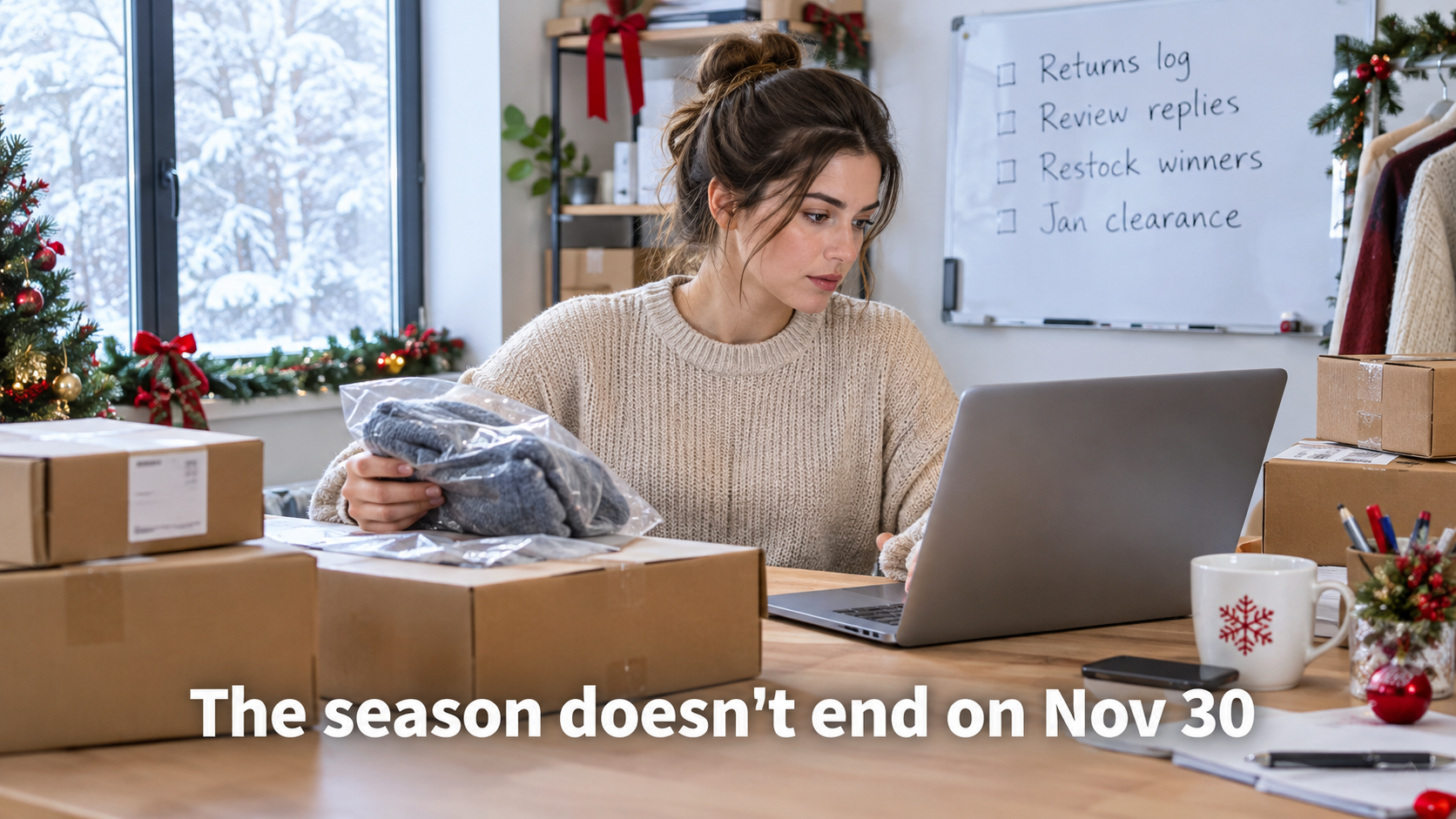
After November 30: Returns, Reviews and January
The event ends on November 30. The consequences don’t. How you handle December and January decides whether the holiday surge leaves you with a stronger business or a messy one.
Plan for gift returns
Gifts get returned more often than personal purchases, for reasons like wrong size, duplicates or the recipient’s taste. Expect returns from holiday orders to keep coming well into January. Before the season, decide:
- Who processes returns, and how quickly
- What happens to returned stock (resell, refurbish, write off)
- How you’ll respond to return reasons that suggest a listing problem
Returns are information. If one SKU gets many returns for “not as described,” your listing or creator content oversold it. Fix it before you promote that product again.
Use the review wave
Holiday orders bring in a burst of reviews in December and January. Those reviews will shape how well your products convert into the new year. Respond to negative reviews quickly and professionally, follow up on problems, and look for repeated complaints you can fix.
Decide what to restock and what to drop
Go through SKU-level data in early December while it’s fresh. Which products had steady sales, not just a single spike? Which creators drove orders that didn’t come back as returns? Which LIVE formats got repeat viewers? Those are the things to repeat. Products that only sold at deep discounts and produced lots of returns probably shouldn’t come back in 2027.
Clear leftover stock carefully
If you planned inventory around the breakout case and it didn’t happen, you’ll have extra stock. January clearance through LIVE “after-holiday deals” or bundles can move it. Selling it below your floor price, though, can teach buyers to wait for discounts. Clear in small batches and through specific channels instead of cutting prices across the board.
Keep the December sales
Buyers are still shopping for gifts in early December, after the official event ends. Don’t drop all promotional activity on December 1. Keep content and LIVE going at a lower level until your delivery cut-off, and make the “arrives before the holidays” message clear.
A Week-by-Week Countdown for the Rest of the Season
Here’s how the steps above fit into a calendar. Change the timing to match your lead times, but keep the order.
Mid-to-late October: lock in the basics
- Pick your 3 to 5 hero SKUs and confirm stock against your base and breakout scenarios
- Decide on FBT, self-fulfilment or a hybrid, and check inbound deadlines in Seller Center
- Finish creator outreach and ship samples for day-one content
- Run the stacked-cost check on every planned offer and set floor prices
- Design and list holiday bundles
Early November (before the 11th): prepare and test
- Update listings with gift-intent titles, gift-context images and delivery messaging
- Watch early creator videos and pick winners for ad support
- Publish your LIVE schedule and promote it in content
- Write down reorder triggers and decide who has authority to reorder
- Line up temporary packing or customer service help if you’re self-fulfilling
November 11 to 17: launch
- Run your launch LIVE stream and launch offer
- Check stock levels daily against your triggers
- Track shipping times and cancellations closely, since this is when capacity problems first show up
- Collect viewer questions and update listings within 24 hours
November 18 to 23: keep momentum
- Run themed LIVE streams on your fixed schedule
- Switch on mid-event promotions
- Confirm second-wave creator content for the final week
- Rebalance ad spend: increase on products with stock, decrease on products running low
November 24 to 30: the peak
- Push second-wave creator content and extended LIVE sessions
- Release your final Black Friday to Cyber Monday offer
- Staff up customer service for the heaviest order days
- Keep checking stock every day and don’t oversell
December: keep selling and review
- Continue at a lower level until carrier holiday cut-offs
- Do the SKU, creator and LIVE review while the data is fresh
- Prepare for gift returns and the review wave
January: reset
- Switch seasonal listing wording back
- Clear excess stock in controlled batches
- Write down what you learned while you still remember it, for the 2027 plan
Conclusion: Plan Operations Before Content
The 2026 holiday season on TikTok Shop is the biggest the platform has run. Global GMV is estimated at $123.5 billion for the year, US first-half GMV more than doubled to $11.8 billion, selection has grown more than 1,200% since 2024, and well-known retailers are now in the feed alongside small sellers. The Black Friday and Cyber Monday event lasts 20 days, from November 11 to November 30, which rewards endurance more than a single big push.
The sellers who come out ahead usually won’t be the ones with the cleverest hook. They’ll be the ones who still have stock on day 18, whose fulfilment held up at peak, whose creator content was live on day one with a second wave ready for Black Friday, and whose offers made money even after commissions and ad costs.
Key takeaways
- Plan for scale, not last year. The platform roughly doubled. Size inventory and capacity using base, breakout and floor scenarios.
- Stock deep on a few products. Hold plenty of stock on 3 to 5 proven SKUs instead of spreading thin across many.
- Choose fulfilment based on spike capacity. Fees matter, but late shipments at peak cost more. A hybrid FBT setup suits many sellers.
- Plan creators backwards from November 11. Allow time for outreach, shipping, filming and testing, and book a second content wave for the final week.
- Run LIVE on a schedule. Fixed, themed streams build repeat viewers and answer the questions gift buyers have.
- Write listings for the recipient. Gift searches focus on who it’s for and the budget. Match your titles and images to that.
- Check every offer for stacked costs. Bundles and phased pricing protect margin better than deep discounts on day one.
- Compete on specificity, personality and speed against big brands, and focus on categories where they’re weak.
- Plan for after November 30. Returns, reviews, December sales and January clearance all affect whether the season actually paid off.
The data TikTok has published shows where demand is heading. What you earn from it depends mostly on preparation done before November 11.