
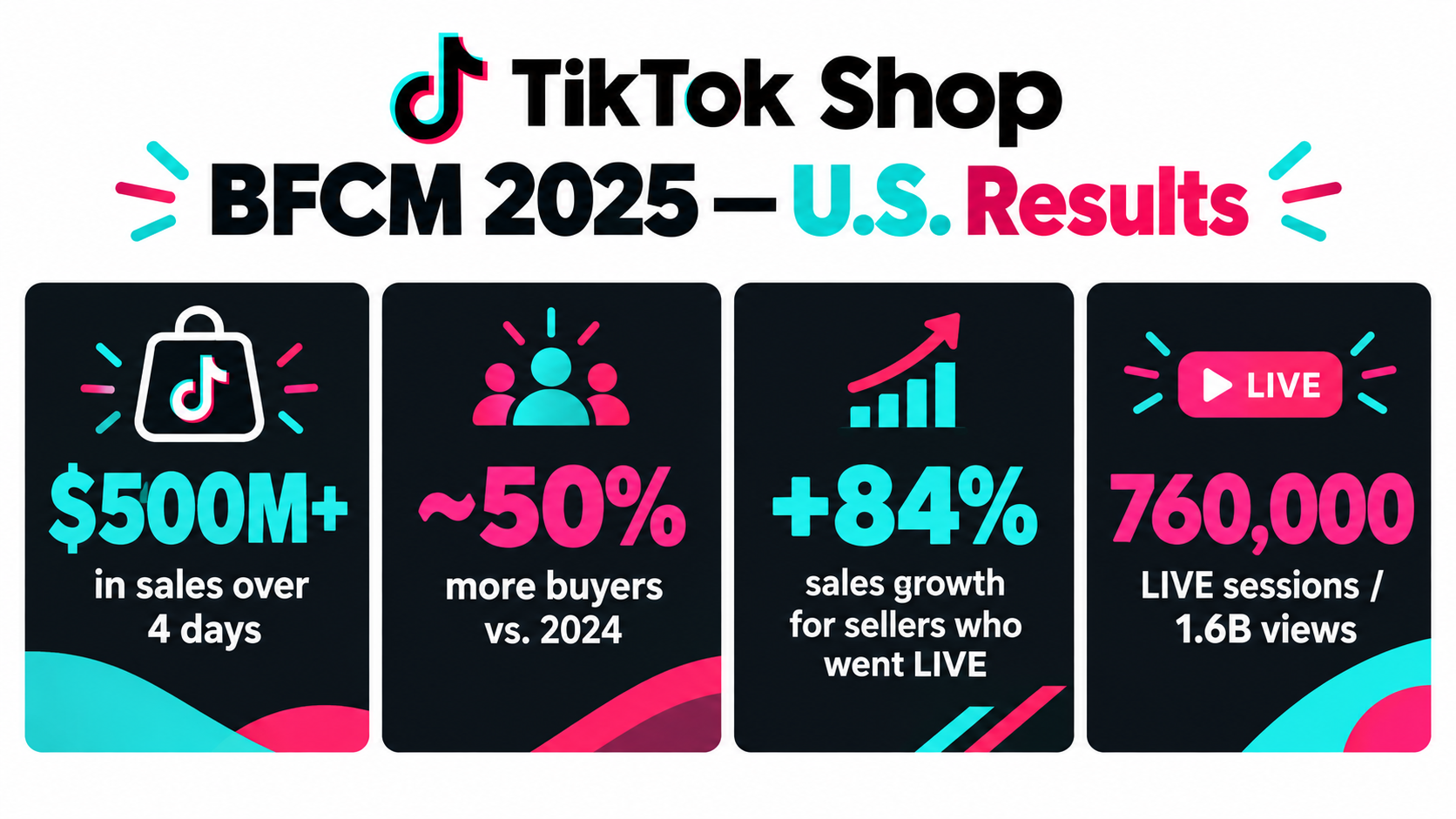
Last year, TikTok Shop pulled in more than $500 million in U.S. sales across the four days from Black Friday to Cyber Monday. That was a record for the platform. The number most sellers should study, though, is a different one. According to a TikTok spokesperson quoted by Modern Retail, sellers who hosted livestreams during the 2025 holiday push grew sales by 84%.
This year the event is longer. TikTok has confirmed that Black Friday and Cyber Monday return to TikTok Shop from November 11 to November 30, 2026. That’s a 20-day campaign, not a four-day sprint. Plans built for a single weekend tend to fall apart over a window that long.
This article isn’t about ranking factors, commission rates, or the economics of getting past a revenue plateau. It’s about the season itself: what the 2025 results tell you, what’s changed for 2026, and how to plan inventory, LIVE sessions, creator content, pricing, and returns so the window actually adds to your profit.
Plenty of sellers had a “record” holiday on TikTok Shop and still lost money once the returns came back in February. Others ran out of stock on day nine of a 20-day event. Some missed the main campaign completely because their account metrics didn’t qualify. Most of these failures come from planning, and nearly all of them can be avoided if you start in October.
Below, we go through the published data, the lessons brands have shared about running holiday operations, and a week-by-week calendar running from now to mid-February, which is when you’ll finally know your true holiday margin.
What the 2025 Holiday Numbers Actually Tell Sellers
TikTok doesn’t publish detailed marketplace data. When it does share numbers, they’re worth reading closely. Here’s what the company told Modern Retail about the 2025 Black Friday–Cyber Monday period.
- More than $500 million in U.S. sales over the four-day BFCM period, a company record.
- Nearly 50% more shoppers made a purchase compared with the 2024 event.
- Sellers who hosted livestreams saw 84% sales growth.
- Shoppers watched 760,000 livestream sessions, which generated 1.6 billion views.
- Brands with more than $10 million in annual revenue grew TikTok Shop sales 76% during the holiday sprint.
Read the growth in buyers, not only the sales total
The 50% rise in buyers matters more than the headline sales figure. It means the extra volume came mostly from new people checking out, not from existing customers spending more. For sellers, that changes what the holiday is for. It’s the biggest customer-acquisition moment of the year, and the buyers you win in November are the ones you can sell to again in the spring.
For context, TikTok said the platform did about $100 million on Black Friday 2024 alone. Growth since then has been steep. DemandSage, citing eMarketer and CNBC, puts U.S. TikTok Shop sales at about $15.8 billion in 2025, or 18.2% of U.S. social commerce. U.S. GMV in the first half of 2026 reportedly reached $11.8 billion, more than double the same period a year earlier.
The LIVE gap is the real headline
An 84% growth rate for sellers who went LIVE doesn’t prove that livestreaming caused the growth. Sellers who livestream tend to be more active, carry more inventory, and work harder at the platform in general. Still, the gap is large enough that a seller with no LIVE plan this year is making a deliberate choice to skip the format that clearly carried the most momentum last season.
The bigger-brand number is worth noting too. Brands with more than $10 million in revenue grew 76%, and TikTok told Modern Retail that the number of larger brands (at least $30 million in annual revenue) joining TikTok Shop grew 95% year over year in the first half of 2025. Small merchants still account for more than a third of the platform’s revenue, but the competition for holiday attention now includes Samsung, Disney, Glossier, Sephora, Best Buy, and Ulta Beauty.
Why a 20-Day Window Changes the Whole Plan
The 2026 campaign runs November 11 to November 30. Thanksgiving falls on November 26 this year, so Black Friday is November 27 and Cyber Monday is November 30, the last day of the campaign. That gives you roughly two weeks of build-up followed by a four-day peak.
A sprint plan breaks over three weeks
Most sellers plan the holidays as one big push: deepest discount, biggest LIVE, all creator content timed for the weekend. Spread across 20 days, that approach causes three predictable problems.
- Discount fatigue. If your best deal goes live on November 11, there’s nothing left to escalate when the actual peak arrives. Shoppers who bought early also notice when prices drop again later.
- Inventory drain. A good first week can empty stock you’d planned for Black Friday. Running out during the four highest-traffic days is costly.
- Team burnout. A daily LIVE schedule that looks fine on paper becomes 20 straight days of streaming, packing, and customer service. Energy drops, and viewers can see it.
Think in three phases
A more workable approach splits the window into phases, each with its own job.
- Phase 1 — Warm-up (Nov 11–19): Mostly discovery. Use moderate offers, gift-guide content, and smaller LIVE sessions to test which products and hooks convert. Treat this as live market research while traffic is still building.
- Phase 2 — Build (Nov 20–26): Put spend and creator content behind the products that won Phase 1. Tease Black Friday offers. Confirm inventory against real sell-through, not forecasts.
- Phase 3 — Peak (Nov 27–30): Best offers, longest LIVE sessions, full creator push. Keep something in reserve, such as a bundle or limited drop, for Cyber Monday.
The phases also make your data cleaner. When each stage has a separate goal, you can tell afterward whether early discovery content actually fed peak-weekend sales or whether everything simply landed on the busiest days.
Interest starts before the campaign does
TikTok’s own newsroom shows holiday intent building well ahead of November. The platform reported that #holidayshopping content rose 263% in September 2026 versus August. It also reported large month-over-month jumps in #fallwishlist (450%), #giftsforwomen (440%), and #holidaygiftideas (248%). Shoppers are building lists now, so content you publish in October can still be surfacing when the campaign opens.
Shoppers Are Paying More — Design Deals Around Value, Not Rock-Bottom Prices
When TikTok Shop launched in the U.S. in September 2023, it was known for very low prices supported by heavy platform subsidies. That’s no longer the case, and it should change how you build holiday offers.
The data on rising unit prices
E-commerce intelligence firm Charm analyzed product-level prices and sales counts that are visible in the app and shared the results with Modern Retail. Average unit prices rose across more than a dozen key categories.
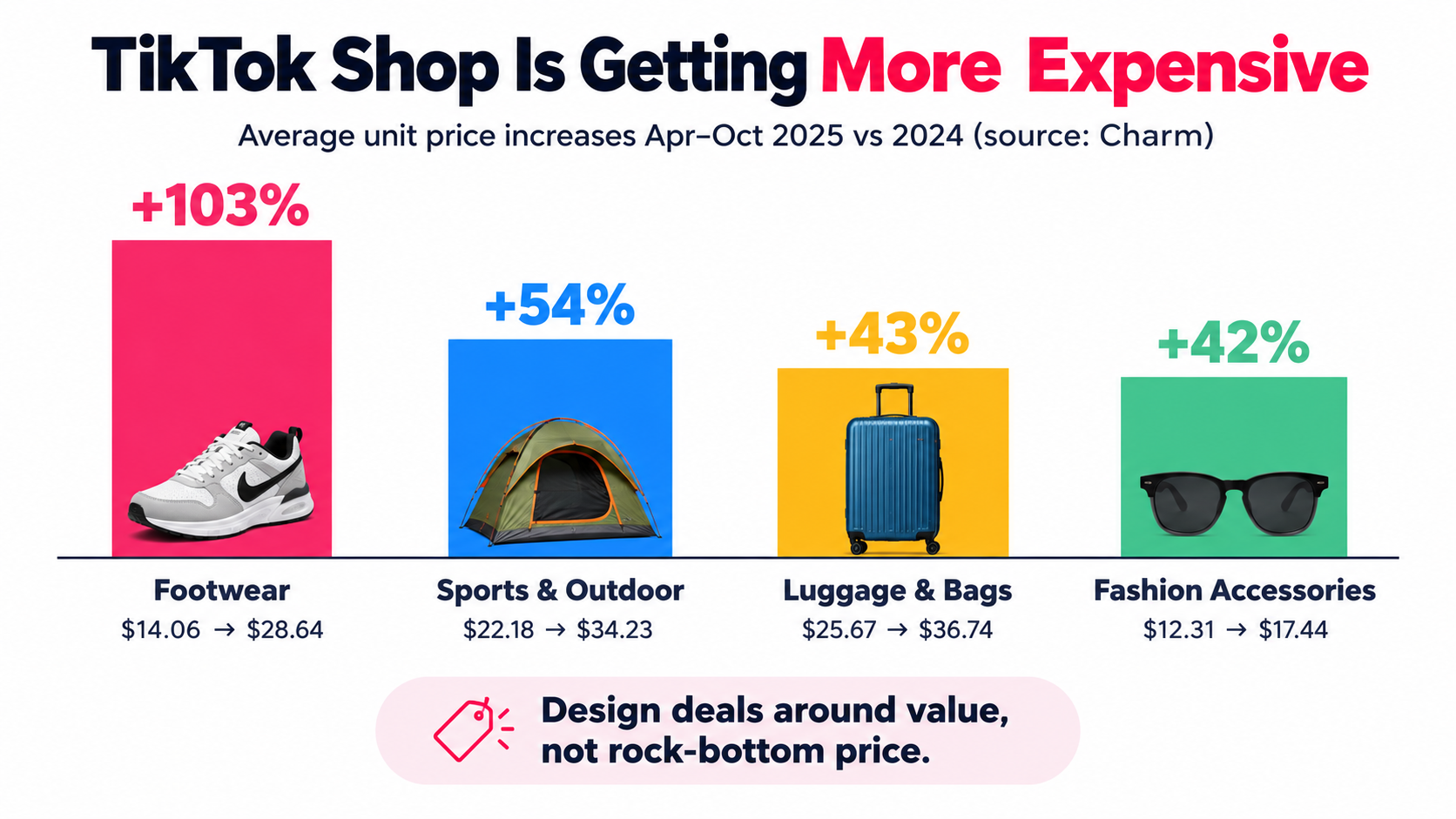
- Footwear: from $14.06 (April–October 2024) to $28.64 (same period 2025), up 103%.
- Sports and outdoor: up 54%.
- Luggage and bags: up 43%.
- Fashion accessories: up 42%.
Toys, women’s apparel, and computers and office equipment also rose by double digits. Charm CEO Alex Nisenzon named two main drivers: more established brands joining the platform, and tariffs. “As you have more established brands entering, you’re going to see prices rise across all the categories those brands are playing in,” he told Modern Retail.
TikTok’s newsroom adds another data point. The most expensive item bought on TikTok Shop in the U.S. this year was a pre-owned luxury bag that sold for $25,580. Some shoppers are clearly willing to spend real money in the app.
What this means for offer design
If buyers will pay more, you don’t need to compete only on the size of the discount. Several offer types protect margin better than a flat markdown.
- Gift bundles. Grouping a hero product with complementary items raises average order value and makes the deal harder to compare directly with a competitor’s price. MAC Cosmetics, for example, ran discounts and bundles on TikTok Shop for Black Friday 2025 and expected lip combos to perform especially well.
- Gift-ready packaging. A gift box or included card gives shoppers a reason to buy from you rather than chase a cheaper listing.
- Tiered offers. “Spend $50, get a free mini” encourages larger baskets without cutting the price of your best-seller.
- LIVE-only drops. Short, time-limited offers inside a livestream create urgency without permanently lowering the listed price.
Watch your tariff-adjusted margins
Many brands are absorbing at least part of their tariff costs. Bespoke Beauty Brands told Modern Retail that its KimChi Chic line raised prices “in the single digits” on about 10% of its catalog and absorbed the rest. Before you set holiday discounts, rebuild landed cost per SKU with current duties included. A 30% discount that worked in 2024 might be unprofitable at your 2026 cost base.
Where Holiday Demand Is Heading in 2026
TikTok’s October 2026 newsroom post gives a fairly specific view of where shopper interest is building this season. Even sellers outside these categories can learn something from how the demand is forming.
Pre-owned luxury
TikTok says U.S. users are 2.5 times more likely to buy a luxury item as a gift this Black Friday and Cyber Monday. Resale of brands like Hermès and Chanel is growing on the platform. The broader point is that trust and authentication now matter as much as price. TikTok also reported GlobalData research showing that 67% of Americans on the platform trust a large brand the same or more when they see it on TikTok Shop, rising to 82% among users aged 18–24.
Jewelry
According to TikTok, 22% of U.S. users expect to buy accessories, including jewelry, during BFCM. Sales of single IGA-certified lab diamonds more than quadrupled from May to September. U.S. searches for “gold jewelry” rose 1,134% and “opal rings” 825% month over month in September. Eligible jewelry purchases can also come with a year of third-party insurance protection, which helps reduce the hesitation buyers feel with higher-priced items.
Collectibles
TikTok says collectibles sales, including trading cards, memorabilia, coins, figurines, and squishy toys, grew 230% year over year in October. That fits the wider live-commerce trend. Whatnot, a livestream marketplace focused largely on collectibles, reported more than $75 million in single-day live sales on Black Friday 2025, triple the previous year. One sports card seller did over $1 million in a single show.
Search is half the story
TikTok reported more than 100 billion searches with e-commerce intent on TikTok Shop in the U.S. in 2025. The platform also says it has expanded selection across product categories by more than 1,200% since 2024. More products means more competition for each search, so holiday listings need titles and descriptions that match how gift shoppers search: “gifts for her under $50,” “stocking stuffers for teens,” and so on.
How to use these signals
- Map your catalog against gifting language. Which SKUs could fit “gifts for women,” “gifts for dad,” or “stocking stuffers”?
- If you sell in a hot category, expect more competition and higher affiliate commission expectations. Book creators early.
- If you don’t, look at the formats behind the growth: authentication, collector-style limited runs, and live “unboxing” or reveal sessions all carry over to other categories.
Campaign Eligibility: Your October Account Health Audit
This step gets overlooked most often. TikTok doesn’t automatically include every seller in its flagship holiday campaign. In a November 2025 interview with Modern Retail, Nicolas Waldmann, head of TikTok Shop’s global governance and experience external affairs team, explained how participants are chosen.
“We also carefully select sellers and creators who are part of the holiday campaign. They have to meet several criteria, including being able to fulfill a high volume of orders, ship on time and provide strong customer service.”
So your operational metrics in October may decide whether you get campaign placement in November. Fixing them on November 10 is too late.
What to audit now
- Shipping performance. Look at late dispatch and on-time delivery rates for the past 30–60 days. If you’re slipping, fix the cause (staffing, carrier pickup times, pick-and-pack flow) now.
- Cancellation rate. Seller-initiated cancellations, often caused by inventory sync errors, hurt both account health and campaign eligibility. Reconcile stock across every channel you sell on.
- Customer service response times. Slow replies to buyer messages count against you. Set up coverage, including weekends, before the campaign starts.
- Policy violations. Clear any open violations and review listings for claims that could get flagged. TikTok’s AI moderation has been criticized for flagging compliant products by mistake. You don’t want an appeal in progress during peak week.
Expect more enforcement during peak
TikTok’s safety report for January–June 2025 said the platform rejected more than 1.4 million seller applications, blocked 70 million products before listing, and removed about 700,000 sellers for policy violations. It says 99.5% of violating listings are caught before reaching customers. “The volume of sales and fraud attempts goes up during this period,” Waldmann said. Higher volume means more screening, and legitimate listings sometimes get caught up in it.
In practice: get new holiday SKUs, bundles, and gift sets listed and approved by early November. Don’t launch a new listing on November 26 and hope it clears review in time for Black Friday.
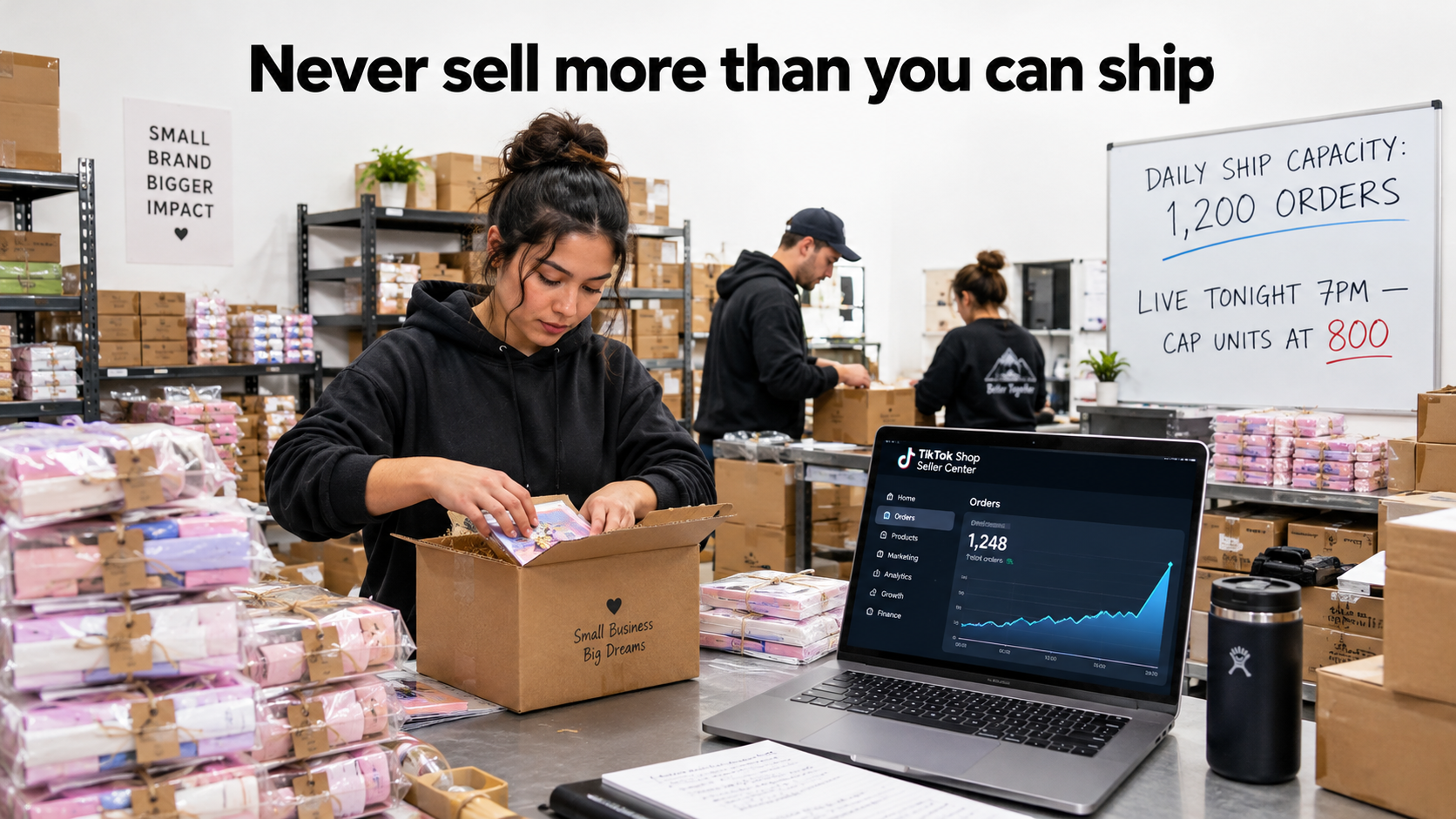
Fulfillment Capacity: Never Sell More Than You Can Ship
Beachwaver CEO Sarah Potempa, whose hair-tool brand runs daily TikTok livestreams and ships from a family-run warehouse in Illinois, put it plainly when she spoke to Modern Retail: one of the biggest risks in Q4 is selling more than your logistics can handle.
“How much can you sell, and still have your warehouse fulfill it on time? A couple of years ago, it was challenging because we were almost too busy and had too many orders. And we were like, ‘OK, we’ve got to balance that, because what if we can’t ship them on time? We are not Amazon.'”
Work out your real daily ceiling
LIVE selling makes this harder than standard e-commerce. A good stream can bring in a day’s worth of orders in 40 minutes. Before the campaign:
- Measure throughput. How many orders can your team pick, pack, and hand to the carrier per shift? Use actual timing data, not estimates.
- Set unit caps for LIVE offers. If you can ship 1,000 orders a day, don’t run a flash deal with unlimited quantity. Limited quantities also add real urgency.
- Watch sell-through in real time. Potempa said Beachwaver now monitors TikTok Shop sales closely so it doesn’t run out of stock. During peak days, someone should be checking inventory every hour.
- Tell buyers what to expect. Potempa has told LIVE viewers directly that her team works night shifts to get orders out. Being honest about shipping times builds goodwill and cuts down on “where’s my order” messages.
Staff and cross-train early
Brands that run their own warehouses told Modern Retail that Cyber Week depends on enough staff, good forecasts, clear communication about promotions, and cross-trained teams. Leatherology roughly triples its warehouse staff for the period. Whisker, maker of the Litter-Robot, starts scaling manufacturing staff as early as June and July and keeps about 10% of its roughly 700 workers as seasonal support.
For most TikTok Shop sellers, that means arranging temp help, 3PL overflow, or extra shifts now. Over a 20-day campaign you need cover for three weeks, not one weekend.
Bundles help operations too
Beachwaver has relied on bundled holiday deals for several years partly because they make fulfillment simpler. Pre-kitting gift sets in October means each order becomes one pick instead of three or four. That speeds up packing when volume is highest and reduces mis-ships.
Shipping expectations are tight
Blue Yonder’s 2025 Global Consumer Holiday Shipping Survey found that about 53% of respondents expect standard shipping within two to four days. Late shipments lead to cancellations, bad reviews, and account health problems that can follow you into the new year.
LIVE as the Holiday Engine: Three Formats Worth Running
Given the 84% growth figure for LIVE sellers, livestreaming should be central to your holiday plan. The question is which format suits your brand.
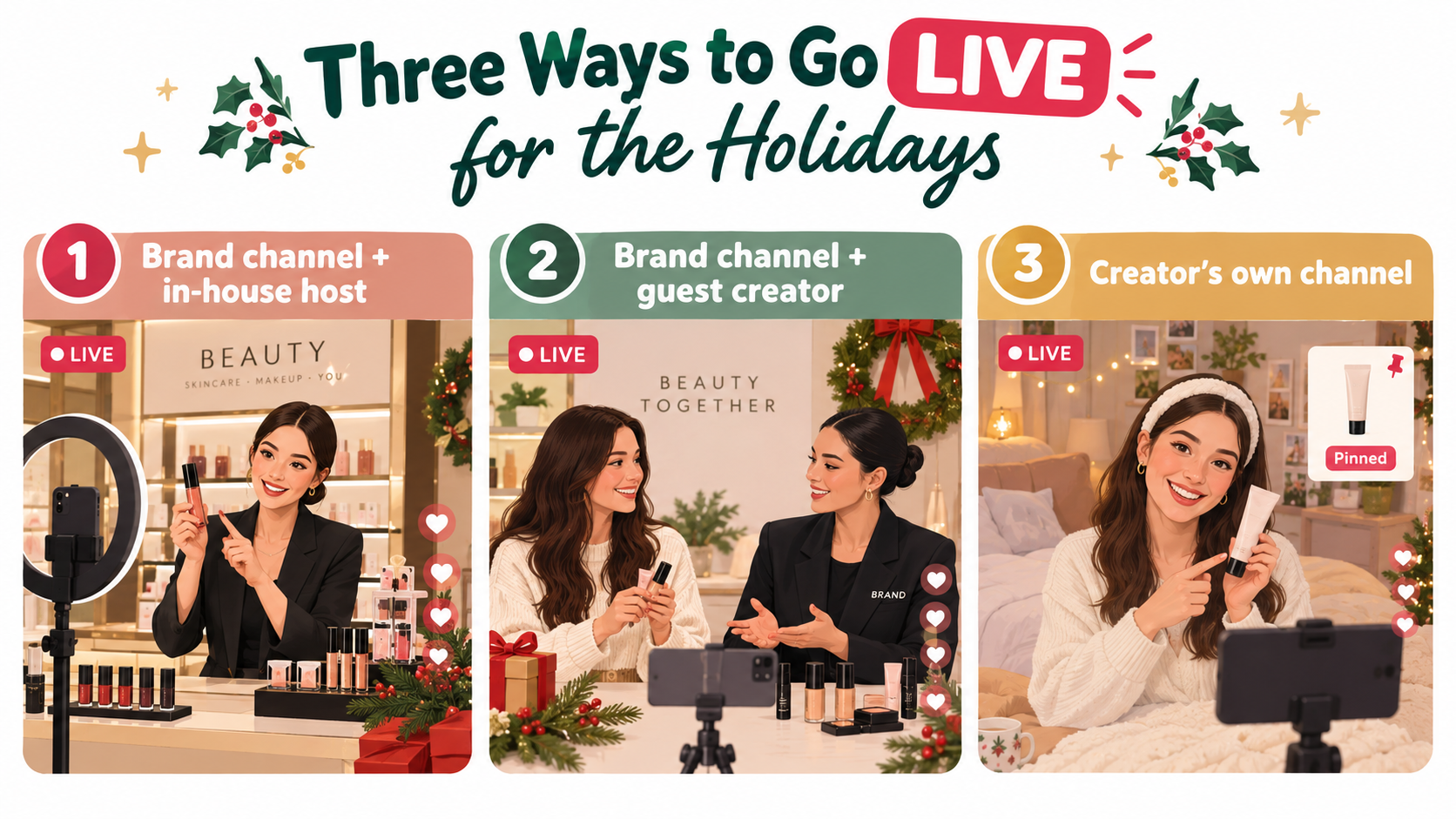
MAC Cosmetics gives a useful example. It ran its first U.S. TikTok Shop holiday season in 2025, having sold more than 160,000 units on the platform within a few months of joining. Emily Bromfield, SVP of global marketing, told Modern Retail that MAC was using three LIVE formats at the same time.
Format 1: Brand channel, in-house host
MAC streamed with its own makeup artists from its own stores. This works when your team has real expertise and the product benefits from demonstration. You control the message, the offers, and the schedule. The downside is that you need staff who are comfortable on camera for long stretches.
Format 2: Brand channel, guest creator
MAC also brought outside creators onto its own channel. The creator brings personality and some of their audience, while your account collects the follower growth and watch-time history. It’s a good way to build up your own LIVE audience before the peak.
Format 3: Creator’s own channel
MAC also joined creators on their channels. This reaches audiences you wouldn’t otherwise reach, but you’re dependent on the creator’s schedule and style. It works best during Phase 2 and Phase 3, when you know which products convert.
Tie streams to specific moments
Bromfield also noted that going LIVE is most effective “when it’s paired with a specific moment in your brand — whether you’ve got a really exciting new launch, a new face that you’re announcing or a really high-traffic moment.” MAC has years of experience in China, where she said half of its Douyin sales come from livestreaming, and it applied lessons from Singles’ Day (Double 11) to its U.S. plans.
For a 20-day window, that means every major stream needs a reason to exist: a gift-set launch, a one-night bundle, a creator collaboration, or a Black Friday reveal. Streams without a hook tend to get low viewership.
Combine teaching with entertainment
“TikTok is about immediate gratification,” Bromfield said. “You see immediate payoff. You see a result. You see a transformation.” She compared it to QVC: “It was entertainment and shopping at the same time.” Holiday LIVE sessions that perform well usually show the product working, answer questions in real time, and keep things moving with giveaways, countdowns, and limited drops.
Keep expectations realistic
Live shopping is growing in the U.S., but it’s still a small part of overall e-commerce. Coresight Research projected it would make up only about 5% of total U.S. e-commerce by 2026. A 2024 VTEX survey found that 45% of U.S. consumers had browsed or bought from a live-shopping event in the past year. The audience exists and is growing, but LIVE should support your short-video and search strategy, not replace it.
Creator Timing: Working Backward From November 11
DemandSage reports that creators drive about 42% of U.S. TikTok Shop sales. In the holiday season, the hard part is usually timing rather than finding creators. Experienced creators fill their calendars early, and content that goes up late misses the build phase.
Lead times to plan for
- Sample shipping: Allow for shipping time plus the time creators need to actually use the product. Samples sent in mid-November usually produce content after the peak.
- Content production: Good creators test the product, script, shoot, and edit. Rushed briefs lead to generic videos.
- Posting cadence: Ask creators to stagger posts across your three phases instead of all posting on Black Friday, when feeds are most crowded.
Brief creators for gifting, not just product features
Holiday buyers often aren’t buying for themselves. Briefs should cover who the product is for (“for the sister who has everything”), budget-based framing (“under $40”), and how it looks unboxed. TikTok’s own trend data, such as the 440% jump in #giftsforwomen, suggests these are the angles shoppers respond to.
Agree on LIVE commitments early
If you want creators to host or co-host streams, settle the dates, offers, and unit caps in writing ahead of time. A creator stream on November 28 with a sold-out hero SKU will annoy both the creator and their audience.
The Returns Tail: Why Your Holiday Isn’t Over Until February
This is the part that turns some “record” holidays into losses. During the 2025 season, TikTok Shop offered an extended return period. According to Waldmann, “Anything bought between November 12 and December 30 can be returned up until mid-February.” TikTok hasn’t detailed its 2026 return terms in the sources we reviewed, so check your Seller Center notices. Plan on the assumption that a similar policy will apply.
Why this affects your margin
With an extended return window, November revenue isn’t final. Gift recipients return items in January. Sizing problems, duplicate gifts, and buyer’s remorse all show up weeks after the sale. If you spend November revenue on December inventory or January ad budgets, you could face a cash crunch when refunds arrive.
Protect cash flow
- Set aside a returns reserve. Use your historical return rate by category and hold that share of holiday revenue until the window closes.
- Cut avoidable returns. Clear size charts, accurate photos, and honest LIVE demonstrations reduce “not as described” returns.
- Plan for restocking. Returned units need inspecting, repackaging, and relisting. Arrange labor for January.
Watch for return fraud
Waldmann said fraudulent returns tend to rise during peak periods and that TikTok has a dedicated buyer review and fraud team. Its systems look at signals such as how many returns a buyer makes, what kinds of items are returned, and whether the seller accepts returns. Sellers can report suspicious returns and, where fraud is confirmed, TikTok says it compensates the seller.
Document everything: photograph high-value items before shipping, record serial numbers, and inspect returns before accepting them. Investigations depend on collecting enough evidence. As Waldmann put it, “we need to accumulate enough signals to be able to investigate.”
A Week-by-Week Holiday Calendar for TikTok Shop Sellers
Here’s how everything above fits into a timeline. Adjust it to your category and team size, but keep the order. Each step depends on the one before it.
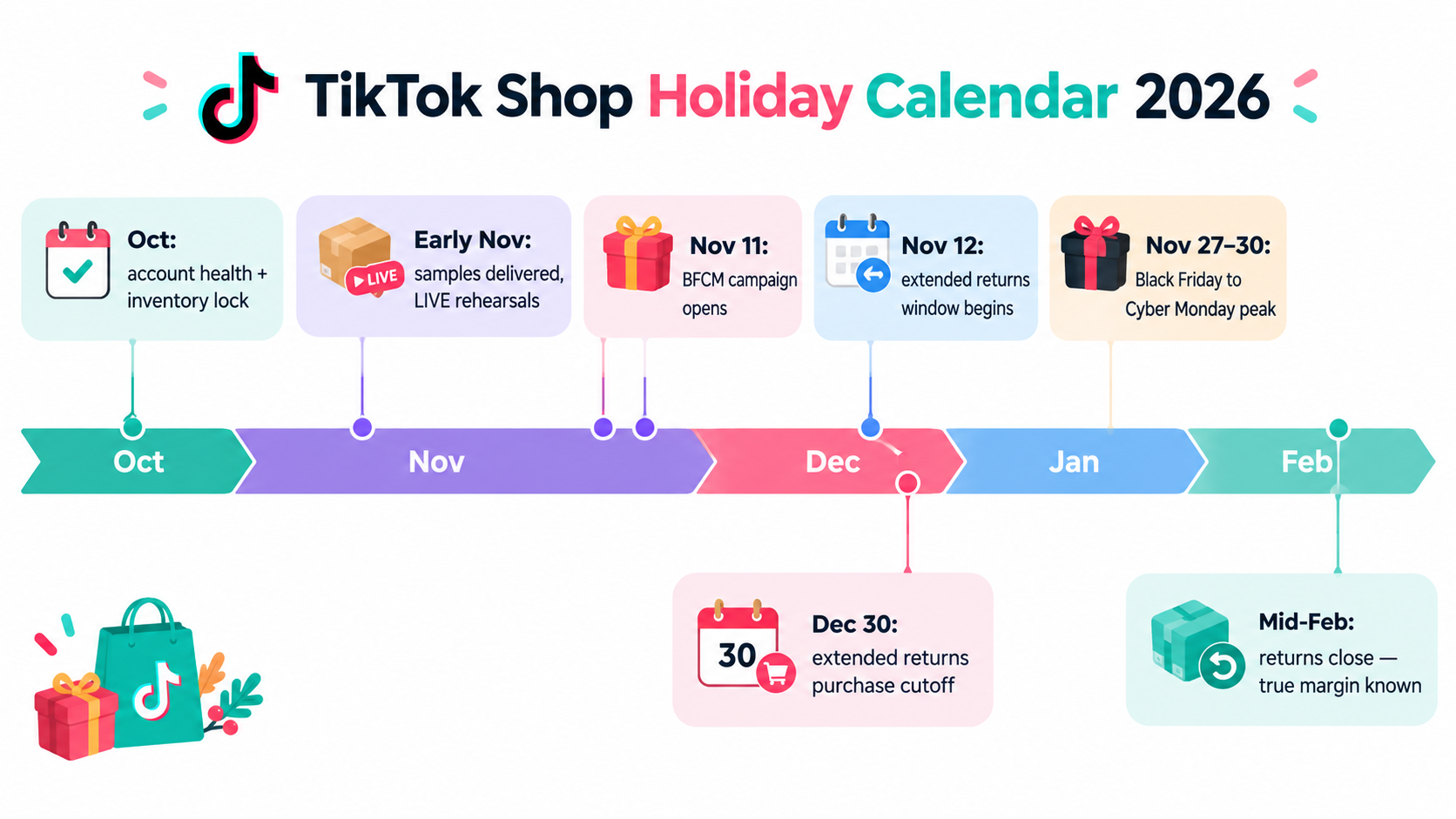
Mid-to-late October: Foundation
- Audit account health: shipping speed, cancellations, response times, open violations.
- Recalculate landed costs with current tariffs. Set your discount floor per SKU.
- Finalize gift bundles and pre-kit them in the warehouse.
- Lock inventory orders. Reorders placed in November may not arrive in time.
- Confirm creator partnerships and ship samples.
- Update listing titles and descriptions with gifting search terms.
November 1–10: Rehearsal
- Get every holiday SKU and bundle listed and approved.
- Run practice LIVE sessions to test lighting, hosts, offer mechanics, and inventory sync.
- Set up seasonal staffing and customer service coverage, including weekends.
- Write your LIVE schedule, giving each stream a specific moment or hook.
November 11–19: Phase 1 (Warm-up)
- Moderate offers. Save the best deals for later.
- Run smaller, frequent LIVE sessions to find out which products and hooks convert.
- Check daily which SKUs are pulling ahead and adjust Phase 2 plans.
November 20–26: Phase 2 (Build)
- Put creator content and ad spend behind the winning products.
- Compare inventory to actual sell-through and reallocate if needed.
- Tease Black Friday offers in videos and streams.
- Thanksgiving (Nov 26): decide ahead of time whether your team works and plan coverage either way.
November 27–30: Phase 3 (Peak)
- Best offers, longest streams, full creator push.
- Check inventory hourly. Use unit caps on flash deals.
- Keep one exclusive offer back for Cyber Monday.
December: Ship, serve, sustain
- Clear the order backlog and keep on-time shipping rates high.
- Run last-minute gifting content up to your shipping cutoff dates.
- Follow up with new buyers. They’re your best list for repeat sales.
January to mid-February: Close the books
- Process returns quickly and flag suspected fraud with documentation.
- Restock and relist returned inventory that’s still sellable.
- Calculate true holiday profit only after the return window closes.
Measuring What Actually Worked
The weekend’s sales number shouldn’t be your final score. The holiday season produces a lot of data, and sellers who review it properly start 2027 with a real advantage.
Metrics that matter more than GMV
- Net revenue after returns. The most honest number, available only in mid-February.
- Contribution margin by SKU and offer type. Did bundles beat flat discounts on profit, not just volume?
- New buyers acquired. Given the reported 50% jump in buyers last year, customer acquisition may be the most valuable result of the season.
- LIVE performance by format. Compare in-house, guest-creator, and creator-channel streams on views, conversion rate, and average order value.
- Phase attribution. Did warm-up content and Phase 1 LIVE learnings show up in peak-weekend results, or did peak sales come from new traffic?
- Operational health. On-time shipping, cancellations, and response times through the busiest days. These affect your eligibility for future campaigns.
Write it down while you remember
Hold a review in early December while details are fresh, then a second one after returns close in February. Record which hooks worked, which creators delivered, where operations struggled, and which SKUs ran out early. Next October’s plan should start from that document.
Look beyond the holidays
Live shopping keeps growing year-round. Whatnot reported passing $6 billion in goods sold, up from about $2 billion the previous year. TikTok continues to put LIVE commerce at the center of its plans. The LIVE skills, creator relationships, and operational habits you build for this window carry into the rest of 2027.
Conclusion: The Holiday Rewards Sellers Who Prepared in October
TikTok Shop’s 2025 holiday results show a platform that has grown up quickly. It’s no longer a discount bin. It now has household-name brands, rising prices, and a strong shift toward live shopping. The 2026 window is longer, more crowded, and more operationally demanding than any previous year.
The sellers who come out ahead won’t necessarily be the ones with the deepest discounts or the most viral video. They’ll be the ones who qualified for the campaign because their account health was in order, built offers that protected margin, scheduled LIVE sessions around real moments, matched sales to shipping capacity, and kept cash aside for the February returns.
Key takeaways
- Plan for 20 days, not four. Split November 11–30 into warm-up, build, and peak phases with separate goals.
- Treat LIVE as essential. LIVE sellers grew 84% last year. Run a mix of in-house, guest-creator, and creator-channel streams, each tied to a specific hook.
- Compete on value. Unit prices are rising across categories. Bundles, gift packaging, and tiered offers protect margin better than flat markdowns.
- Fix account health now. TikTok picks campaign participants partly on shipping, fulfillment volume, and customer service.
- Cap what you sell to what you can ship. Use unit caps on LIVE offers and monitor inventory hourly during peak.
- Reserve cash for returns. If last year’s extended window applies again, your holiday profit won’t be final until mid-February.
- Measure net, not gross. New buyers acquired and margin after returns tell you more than headline GMV.
The campaign opens November 11, and the preparation that decides how it goes is happening right now.
Sources: TikTok Newsroom (October 2026); Modern Retail reporting from November–December 2025, including interviews with TikTok Shop, MAC Cosmetics, Beachwaver, Leatherology, Whisker, and Charm; DemandSage TikTok Shop Statistics (2026), citing eMarketer, CNBC, and Statista.