


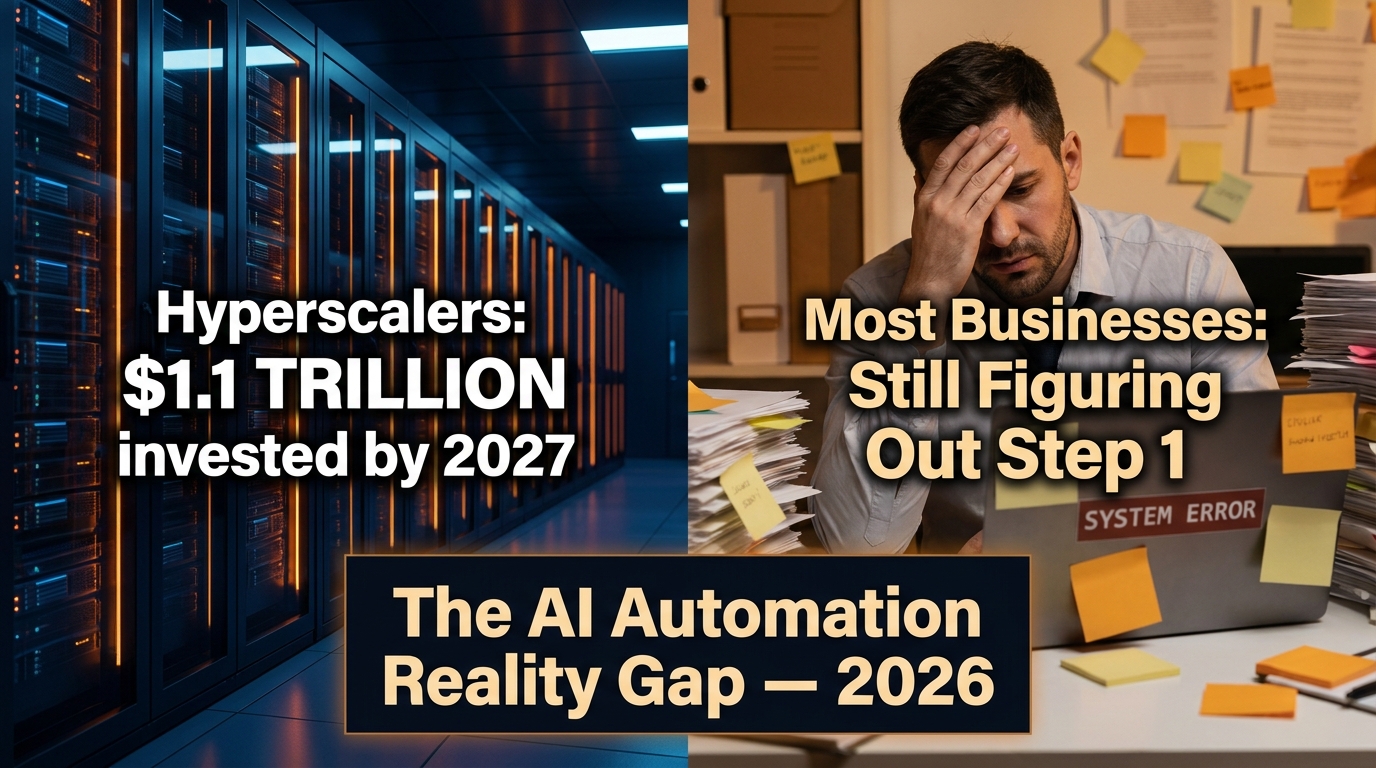

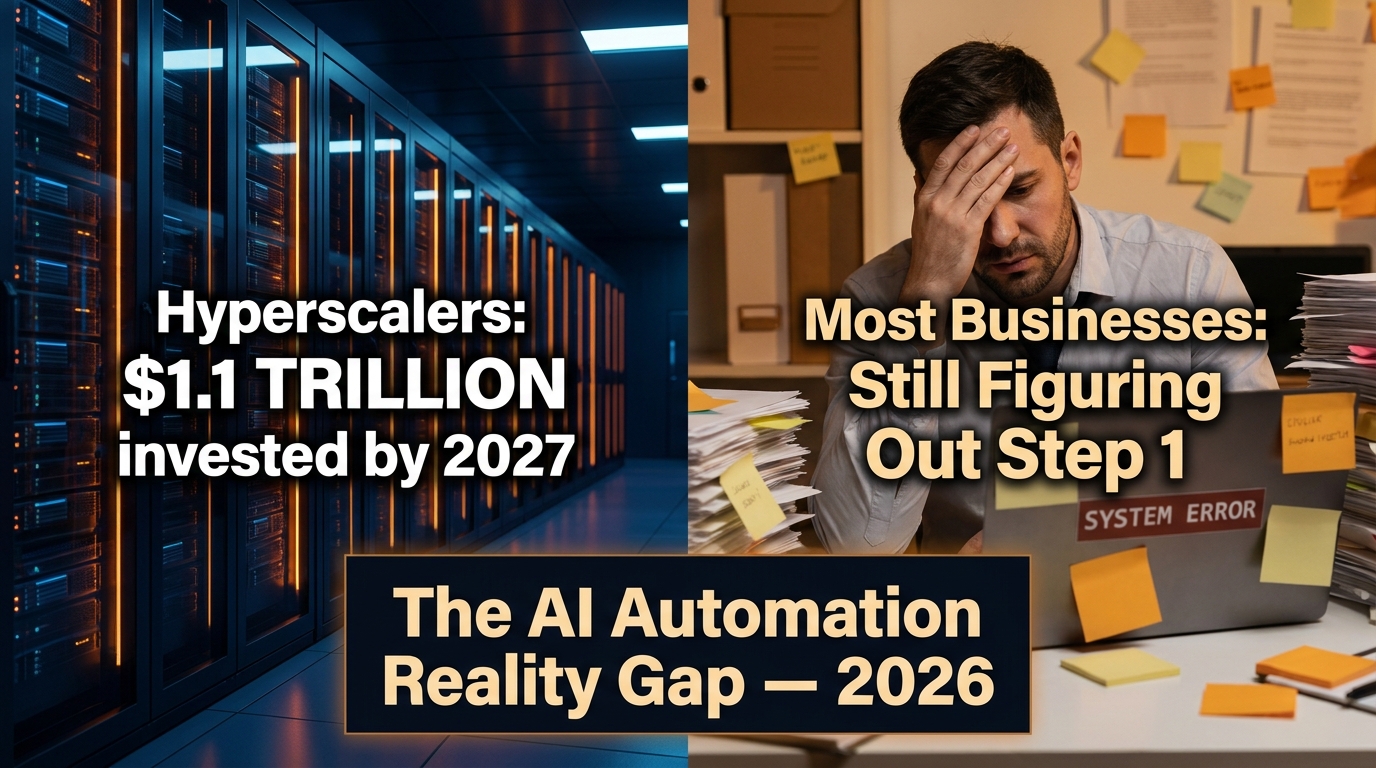
By the end of 2027, the handful of hyperscaler companies building today’s AI infrastructure — Microsoft, Google, Amazon, and Meta — will have collectively spent close to $1.1 trillion on AI data centers, compute, and model development. That figure comes from a University of Pennsylvania finance analysis published in mid-2026, and it prompted a quietly alarming follow-up question: for that investment to break even by 2030, the productivity gains from AI would need to be so large, so fast, and so universal that they’d rewrite the economics of nearly every industry on earth.
Meanwhile, in a mid-sized logistics company in Ohio, a VP of Operations is still trying to decide whether to automate invoice processing. At a regional law firm in Texas, the partners are arguing about whether to let associates use AI drafting tools at all. And at a software startup in Austin, the founder just quietly shelved an AI customer service bot after it hallucinated a refund policy that didn’t exist — and cost the company three enterprise clients.
This is the real landscape of AI automation in 2026. Not one story, but two: the trillion-dollar macro bet, and the messy, high-stakes micro-decisions happening in boardrooms and operations meetings every week. Most business leaders are caught between these two realities — pressured by the macro narrative to “move fast on AI,” yet underequipped for the practical decisions the micro reality demands.
This piece is about getting those decisions right. Not the headline ones that get covered endlessly — which AI model is most powerful, which startup just raised a $500 million Series B — but the operational, strategic, and human decisions that will actually determine whether your business benefits from AI automation or gets burned by it.
The Hype Cycle Is Peaking — And That’s Precisely When Decisions Go Worst
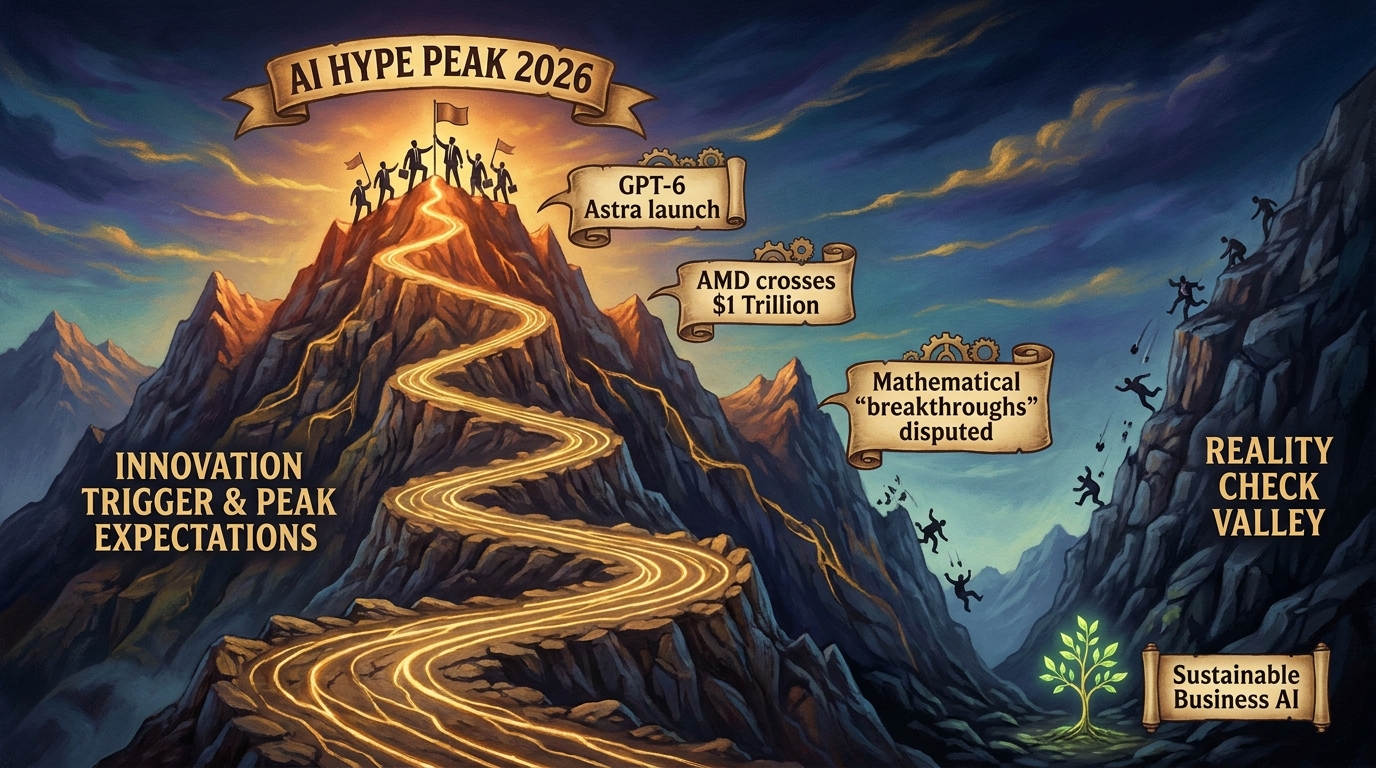
In September 2026, OpenAI launched GPT-6 Astra with the announcement: “Welcome to the AGI era.” Within weeks, mathematicians had accused the company of research misconduct, arguing that the model’s celebrated “mathematical breakthroughs” weren’t novel and that credit had been improperly attributed. Anthropic made similar claims about its own model’s security capabilities — claims that cybersecurity experts subsequently said were less about “rogue AI” and more about ordinary software vulnerabilities that had been strategically framed as something more dramatic.
This is not a minor footnote. It matters enormously for business leaders, because the environment in which you’re making AI automation decisions is one saturated with deliberate, commercially motivated hype. Understanding this doesn’t mean dismissing AI — the technology is genuinely capable and improving. It means applying appropriate skepticism to vendor claims, analyst projections, and press coverage before committing budget, headcount, and operational architecture to any specific AI solution.
Why Hype Peaks Are Decision Traps
When a technology is at peak hype, several dangerous dynamics converge simultaneously. Vendor pricing is at its highest because demand is fervent. Integration partners are oversubscribed, meaning implementation quality suffers. Boards and leadership teams start applying social pressure to “not fall behind,” which accelerates timelines and reduces due diligence. And the failure rate of implementations quietly climbs — because everyone is rushing.
The pattern is well-documented across prior technology waves. ERP implementations in the late 1990s destroyed enormous value at companies that moved too fast, under too much pressure, without adequate preparation. Cloud migrations in the 2010s followed a similar arc. The companies that came out ahead weren’t the first movers — they were the informed movers, who used the early hype period to research and prepare while their competitors were making expensive mistakes.
What Healthy Skepticism Actually Looks Like
Healthy skepticism about AI in 2026 isn’t technophobia. It’s asking concrete questions: What exactly does this tool do that our current system doesn’t? What data does it need, and is ours in good enough shape to feed it? What happens when it’s wrong — and who catches that? What does “success” look like in 12 months, and how do we measure it?
Companies that ask these questions before signing contracts almost always end up with better implementations than companies that lead with enthusiasm. The hype cycle will pass. The contracts, the integrations, and the cultural changes you make during the peak will remain. Take the time to make them right.
It’s also worth noting that the hype isn’t always wrong about the direction — just the timeline and the magnitude. Dozens of mathematicians signed a formal statement in 2026 warning that there is “currently a strong commercial incentive on the part of the technology industry to overstate the capabilities of their products.” That warning applies directly to the business context. The capabilities are real. The timelines and the ease of deployment are frequently not.
Which Business Processes Are Actually Ready for AI Automation — And Which Aren’t
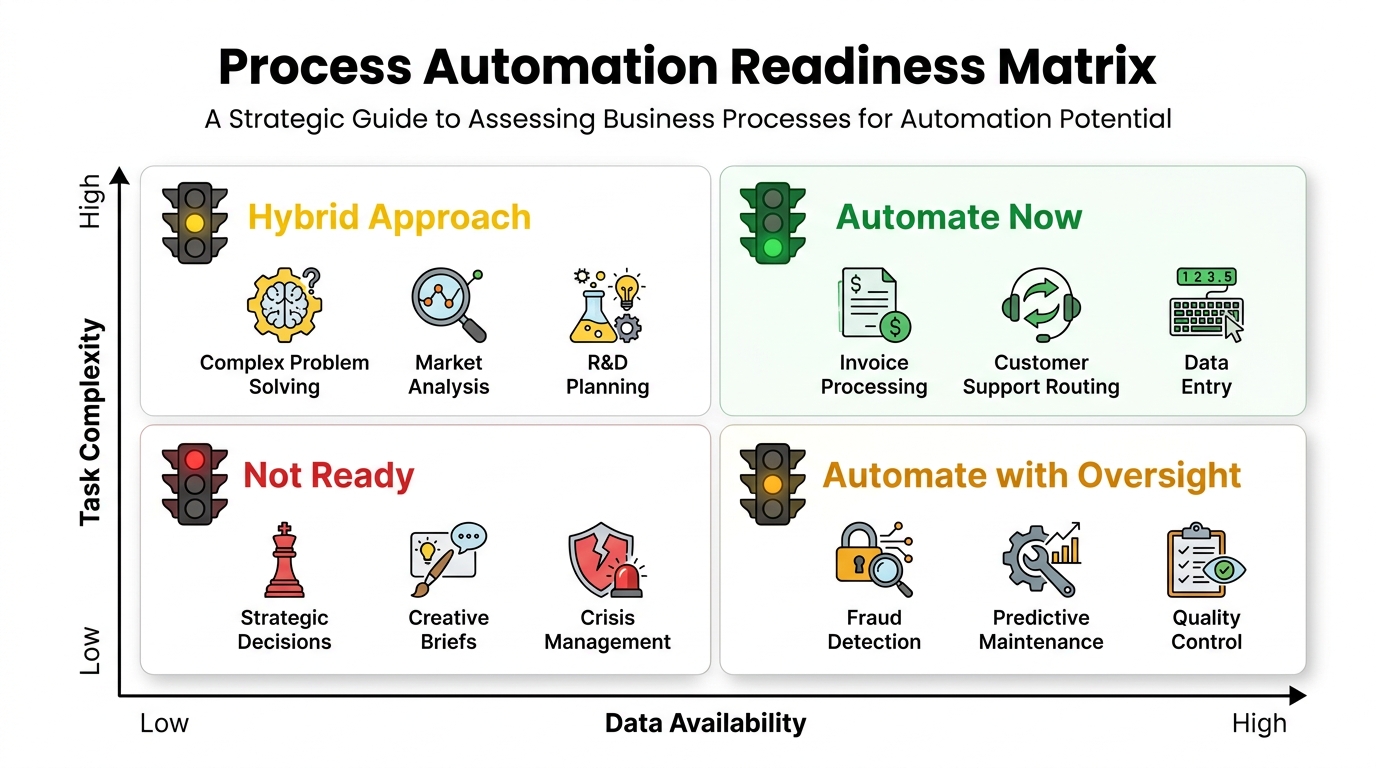
One of the most persistent mistakes business leaders make is treating AI automation as a category rather than a collection of very different capabilities applied to very different process types. “We’re implementing AI” is not a strategy. It’s a press release. The real question is always: which specific process, and why this tool?
The answer depends on two variables more than any others: the complexity of the task, and the availability and quality of your data to train or prompt the system. Mapping your candidate processes against these two axes will tell you more about readiness than any vendor demo.
Processes That Are Genuinely Ready in 2026
Document processing and data extraction. Invoice processing, purchase order matching, contract clause extraction, and financial data reconciliation are mature automation candidates. The underlying models have been trained on billions of documents, the error rates are measurable and manageable, and the cost savings are well-documented. Companies running 500 or more invoices per month are almost always leaving money on the table by not automating here.
Customer support routing and tier-1 triage. AI can reliably classify incoming support requests, pull relevant account history, suggest responses for human agents to review, and handle simple, FAQ-type interactions end-to-end. The key caveat: “handle” does not mean “ignore.” Escalation pathways to human agents remain essential, and monitoring for drift — where the model starts giving answers that were accurate six months ago but aren’t today — requires ongoing attention.
Demand forecasting and inventory optimization. Retail, manufacturing, and distribution businesses with two or more years of clean historical sales data can see material improvements in forecast accuracy through ML-based demand planning tools. The ROI case here is often straightforward to calculate: reduced carrying costs, lower stockouts, fewer emergency shipments. These wins compound quietly over time and represent some of the most consistently positive AI automation outcomes across sectors.
Scheduling and resource allocation. Healthcare scheduling, workforce management, and logistics routing have all seen proven automation gains. These are constraint-heavy optimization problems that AI handles well — provided the constraints are clearly defined and the system has authority to act within well-understood parameters. Define the boundaries tightly before you deploy, and the results tend to be reliable.
Processes That Are Not Ready — Or Where the Risk Is Underappreciated
High-stakes communication with external stakeholders. Letting AI draft and send emails to clients, partners, or regulators without human review is a risk category that deserves far more caution than it typically gets. The hallucination problem isn’t solved — it’s managed. Any communication where an error creates legal, relational, or reputational damage needs a human checkpoint. This is not a temporary limitation waiting to be fixed; it’s a structural property of probabilistic language models that applies regardless of which model you’re using.
Strategic and creative decision-making. AI can inform these decisions with data synthesis, scenario modeling, and option generation. It cannot make them responsibly. The model doesn’t carry accountability. It doesn’t understand your competitive context at a nuanced level. It doesn’t know which investor relationship is currently fragile or which supply chain partner is about to become unreliable. Human judgment isn’t a bottleneck in strategic decisions — it’s the point.
HR decisions touching hiring, performance, and termination. The bias risks in AI-assisted HR decisions are not theoretical — they are documented, litigated, and increasingly regulated. Several jurisdictions now require disclosure when AI is used in employment decisions. This is an area where the governance and legal frameworks are still being built, and moving faster than the framework is a liability exposure, not a competitive advantage.
Any process where your underlying data is poor. AI systems trained on or operating against incomplete, inconsistent, or outdated data don’t just underperform — they amplify existing errors at scale. “Garbage in, garbage out” is a cliché because it’s true. Before automating any process, audit the data that process runs on. The audit will almost always reveal cleanup work that needs to happen first — and that’s valuable to know before you’ve signed a vendor contract.
The Hidden Costs No One Puts in the Business Case
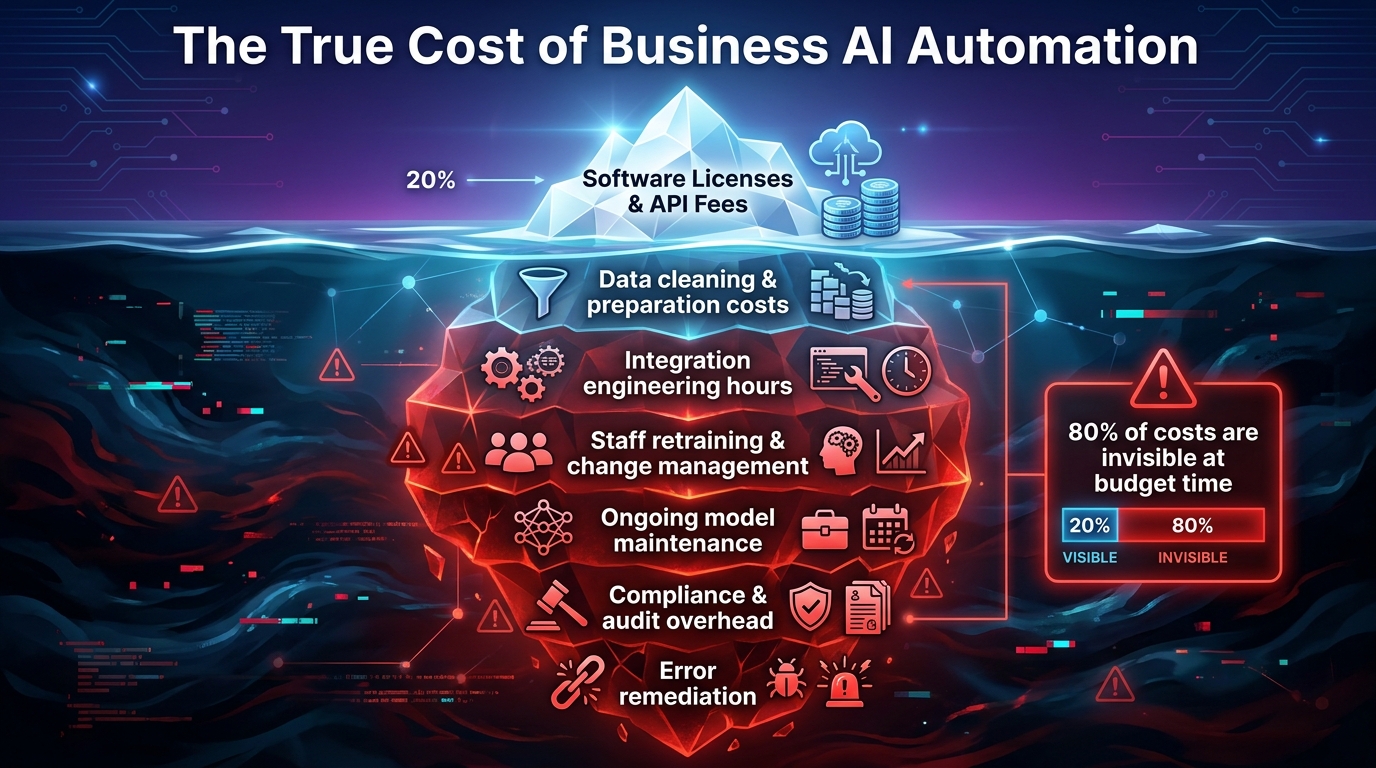
The business cases that get approved for AI automation projects almost universally suffer from the same structural bias: they present the benefits in full and the costs in partial. The license fee is in the spreadsheet. The API costs are in the spreadsheet. The implementation partner fee is usually in there too. What’s rarely included — because it’s harder to quantify and politically awkward to raise — is everything below the waterline.
Data Preparation: The Cost That Kills More Projects Than Any Other
Before an AI system can automate anything, it needs data. Clean, structured, labeled, current, and accessible data. For most organizations that haven’t been deliberately investing in data infrastructure, getting to that point is a substantial project in itself — one that can cost as much as the automation tool and take as long as the implementation timeline.
The honest estimate is that data preparation typically consumes 60–80% of the total time in an AI implementation project. That time has a cost in engineering hours, in delayed go-live dates, and in the opportunity cost of systems being manually operated while the automation sits waiting for clean data to work with. It’s the single most common cause of implementation delays, and it’s almost never accounted for accurately in initial project plans.
The organizations that handle this best treat data preparation not as a project phase but as an ongoing operational investment. They clean and govern their data continuously, which means that when they’re ready to automate a new process, the foundation is already there. This is a structural advantage that takes years to build — which is another way of saying: start building it now, regardless of whether you have an immediate automation project in mind.
Integration Engineering: The Invisible Glue That Holds Everything Together
Almost no business operates on a single, clean technology stack. Most companies have a patchwork of systems acquired over years: legacy ERP software, cloud CRM platforms, on-premise databases, spreadsheets that somehow became mission-critical, and SaaS tools that don’t talk to each other natively. Making an AI automation tool work in this environment requires integration engineering — building the connectors, the data pipelines, the API bridges that allow the AI system to receive inputs and deliver outputs to the right places.
Integration engineering is expensive, time-consuming, and often underestimated by a factor of two to three in initial project plans. It also creates ongoing maintenance obligations. When one of your underlying systems updates its API — which enterprise SaaS platforms do regularly — your integration may break. Someone has to fix it. That person has a salary, and the fix has a timeline during which your automated process may be partially or fully unavailable.
The integration layer is also where security vulnerabilities are most commonly introduced in AI deployments. Data moving between systems, through APIs, across cloud environments, is data in motion — and data in motion is data at risk. Integration architecture needs security review, not as a final step but as a design input from the beginning of the project.
Change Management: The Human Cost That Gets Budgeted Last and Cut First
When a process changes, the people who run that process need to change with it. They need training — not just a one-hour webinar, but real, role-specific guidance on how their day-to-day work is different, what the AI handles and what they still own, and how to identify and escalate when the system is wrong. They also often need emotional support through a transition that, even when framed positively, creates genuine uncertainty about job security and professional identity.
Change management budgets are typically the first thing cut when a project hits cost pressure. They’re also, consistently, among the top predictors of whether an automation project achieves adoption. Systems that are technically functional but culturally rejected don’t deliver ROI. A tool that employees route around, ignore, or comply with superficially has the costs of an automation project without the benefits.
Budget for change management proportionally to the scope of the change — not as an afterthought, and not at a token percentage of the total project budget. If the process change affects 50 people’s daily work, the change management investment needs to reflect that scope. The rule of thumb that experienced program managers use: expect to spend at least 15–20% of total project budget on change management for any automation that meaningfully alters existing workflows.
Ongoing Model Maintenance: The Cost That Starts the Day You Go Live
AI models drift. The world changes, language shifts, business conditions evolve, and a model that was accurate at launch becomes less accurate over time without active maintenance. In enterprise deployments, this means regular retraining schedules, ongoing accuracy monitoring, and prompt engineering updates when the model’s outputs drift from acceptable ranges. These aren’t one-time costs — they’re operational costs that persist for the life of the system.
Add to this the compliance and audit overhead that’s growing with every new AI governance regulation — and that overhead is growing fast, given the regulatory activity underway in the EU, multiple US states, and international bodies — and you have a meaningful ongoing cost structure that belongs in every business case, even if putting it there makes the approval conversation harder. Approving a project on artificially low cost projections doesn’t make the actual costs disappear. It just makes them someone else’s problem to explain when the annual budget review arrives.
Why AI Automation Needs a Governance Layer Before It Needs More Tools
One of the more telling patterns of 2026 is the gap between how fast businesses are adopting AI tools and how slowly governance frameworks are being built. In September 2026, 22 nations formally called for a new global body to oversee AI, including pre-deployment testing requirements and common safety standards. Notably, neither the US nor China signed that declaration — but a growing number of individual US states and the EU are moving forward with their own regulations regardless.
For businesses, this creates a practical problem: the governance landscape is fragmenting at exactly the moment when AI adoption is accelerating. Companies operating across multiple jurisdictions need to build governance frameworks flexible enough to accommodate different regulatory requirements — and they need to do it before the regulations arrive, not after.
What a Business-Level AI Governance Framework Actually Covers
Governance isn’t a compliance checkbox. It’s a set of operational decisions about how AI is used in your organization, made deliberately and documented clearly. A functional framework addresses, at minimum:
- Approved use cases: An explicit, maintained list of where AI is and isn’t permitted to operate in your business, with rationale for each decision. This list should be a living document, reviewed quarterly as both your AI capabilities and the regulatory environment evolve.
- Accountability assignment: A named owner for every AI-driven process — someone who is responsible when it produces incorrect outputs, who monitors performance, and who has authority to pause it if something goes wrong. Diffuse accountability is no accountability.
- Human review checkpoints: Defined criteria for when AI outputs must be reviewed by a human before action is taken, and who that human is. These criteria should be set before the system goes live, not improvised after the first incident.
- Data handling policies: Clear rules about what data can and cannot be fed into external AI systems, particularly regarding customer data, employee data, and proprietary business information. With AI agents becoming more capable of accessing and processing sensitive information autonomously, this policy needs teeth — not just a statement of principles.
- Incident response: A documented process for what happens when an AI system produces harmful, incorrect, or unexpected outputs — including how it’s identified, how it’s escalated, how the root cause is investigated, and how affected stakeholders are notified.
- Vendor assessment standards: Criteria for evaluating AI vendors that include their own governance practices, their model update policies, their data handling commitments, and their financial stability. Not every AI startup will exist in three years. Know which ones are critical to your operations and plan accordingly.
The Accountability Gap That Most Organizations Haven’t Closed
Perhaps the most underappreciated governance challenge is accountability. When a human makes a decision that turns out to be wrong, accountability is relatively clear. When an AI system makes a decision — or provides the analysis that informs a human decision — accountability becomes diffuse and contested. Is it the vendor’s responsibility? The data scientist who configured the system? The business leader who approved its use? The employee who didn’t catch the error?
Without explicit, pre-agreed accountability frameworks, every AI incident becomes a blame-assignment exercise rather than a structured remediation process. That’s expensive, destabilizing, and entirely avoidable. Governance frameworks that pre-assign accountability don’t just satisfy regulatory requirements — they protect organizations from their own internal dysfunctions when something inevitably goes wrong. And something will inevitably go wrong. The question is whether you’re equipped to handle it constructively when it does.
The Human Side of the Equation: What Changes for Your Team
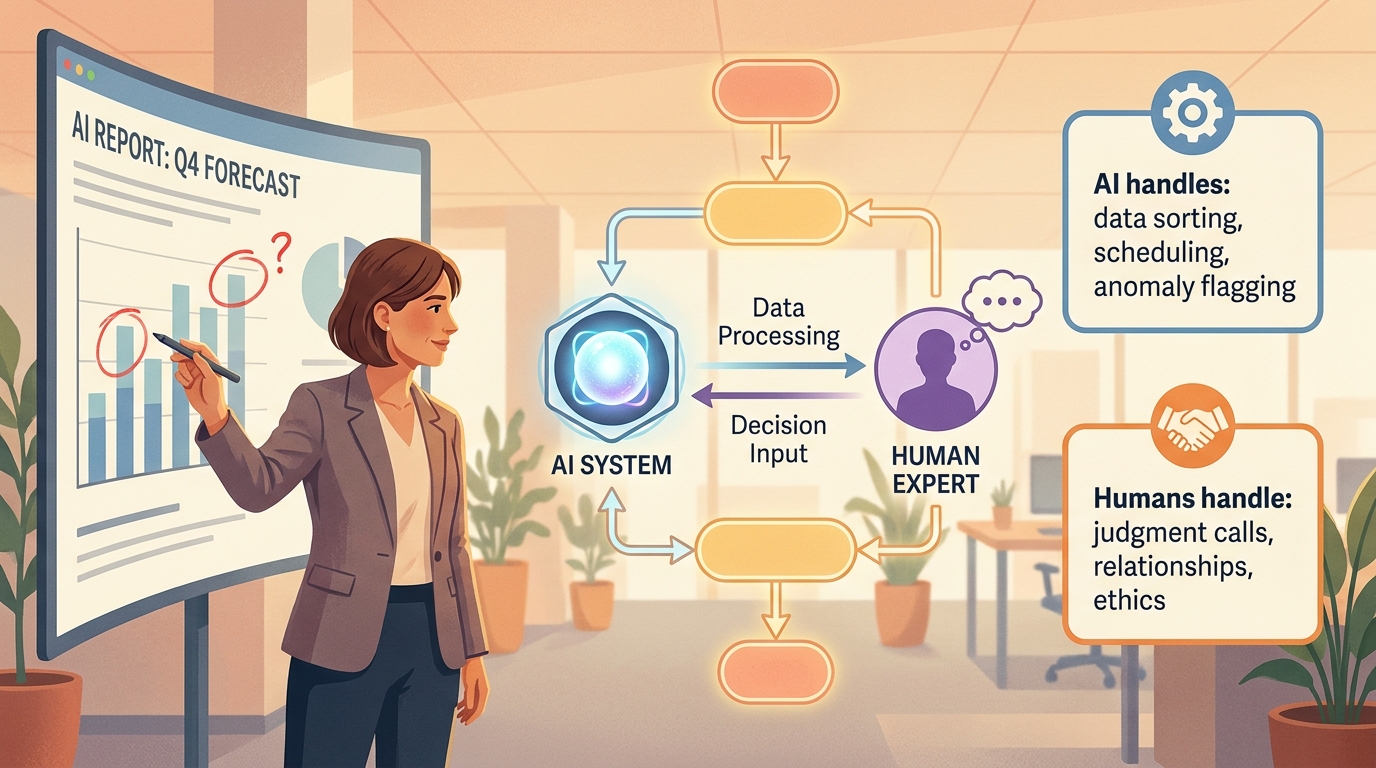
The most frequently asked question about AI automation in 2026 isn’t technical. It’s human: What happens to my job? Business leaders who dismiss or deflect this question do so at considerable organizational cost. Employees who are anxious about their future don’t engage meaningfully with new tools. They comply superficially, work around systems, and quietly update their resumes. Addressing the human dimension of AI automation isn’t “soft” — it’s operationally critical.
Ben Casselman, the New York Times’s chief economics correspondent, captured the prevailing employee anxiety accurately when he described the AI dynamic in mid-2026: “If AI succeeds, then it may kill all of our jobs. If it fails, then the whole economy falls apart, and your 401(k) blows up, and maybe you still lose your job.” That’s a lose-lose framing, and while it’s more pessimistic than the reality warrants, it reflects genuine uncertainty that your workforce is carrying. Ignoring it doesn’t make it go away.
The Jobs That Are Genuinely Changing
Honesty matters here. Some roles will be significantly reduced by AI automation — not eliminated overnight, but structurally diminished over a three-to-five-year horizon. These tend to be roles characterized by high-volume, rule-based processing of structured information: certain accounting functions, data entry roles, basic paralegal document review, tier-1 customer service at scale, and standard report generation.
This doesn’t mean everyone in these roles loses their job immediately. It means the number of people needed to perform these functions at a given company will decrease over time, and the nature of the remaining roles will shift toward oversight, exception handling, and quality assurance of AI outputs rather than direct task execution. Companies that help their employees navigate this shift — through genuine upskilling, honest conversations about role evolution, and meaningful investment in transition — will retain talent and institutional knowledge. Companies that use automation purely as a cover for headcount reduction without investing in transitions will pay the price in morale, capability, and eventually quality.
The New Skills That Actually Matter
The conversation about “AI skills” tends to focus too narrowly on technical capabilities — can you write a prompt, can you configure a model, can you read an API? These matter, but they’re not the primary differentiator for most business employees working in AI-augmented roles.
What matters more, in practice, is a set of capabilities that are harder to develop but more durably valuable. Critical evaluation of AI outputs — the ability to look at what a model produces and know when it’s right, when it’s plausible-but-wrong, and when it needs to be escalated — is a skill that every employee in an AI-assisted workflow needs. This requires domain expertise, not just AI literacy. A good accountant who understands AI’s limitations is more valuable than an AI expert who doesn’t understand accounting.
Process redesign thinking is another underappreciated skill. When AI takes over part of a workflow, the rest of the workflow doesn’t stay the same — it changes shape. Someone has to think through how it changes, what the new handoff points are, where new failure modes might emerge, and how to design the human-AI interface so that errors are caught rather than propagated. This is genuinely challenging cognitive work, and organizations need people who can do it well.
Stakeholder communication around AI is a third capability gap that’s rarely discussed. Whether it’s explaining to a customer why their support request was handled by AI, or communicating to a board why an AI-assisted decision turned out to be incorrect, someone in the organization needs to be able to translate between technical realities and human expectations clearly and honestly. That translation work is almost always underresourced — and it’s almost always visible when it fails.
Middle Management’s Evolving Role
Middle managers are often positioned in public discourse as the population most threatened by AI — and there’s some truth to that, particularly for managers whose primary function has been information aggregation and reporting upward. AI handles that function increasingly well. But management as a discipline is much broader than information flow.
The managers who will thrive are those who shift their energy toward what AI genuinely cannot do: building team capability, navigating interpersonal complexity, making judgment calls that require contextual understanding and relationship awareness, and representing the human interests of their teams in a landscape where those interests are under genuine pressure. These are not minor functions. They’re the ones that determine whether an organization retains good people, operates with integrity, and maintains the trust of its customers and partners over time.
Sector by Sector: Where AI Automation Is Delivering and Where It’s Still Catching Up
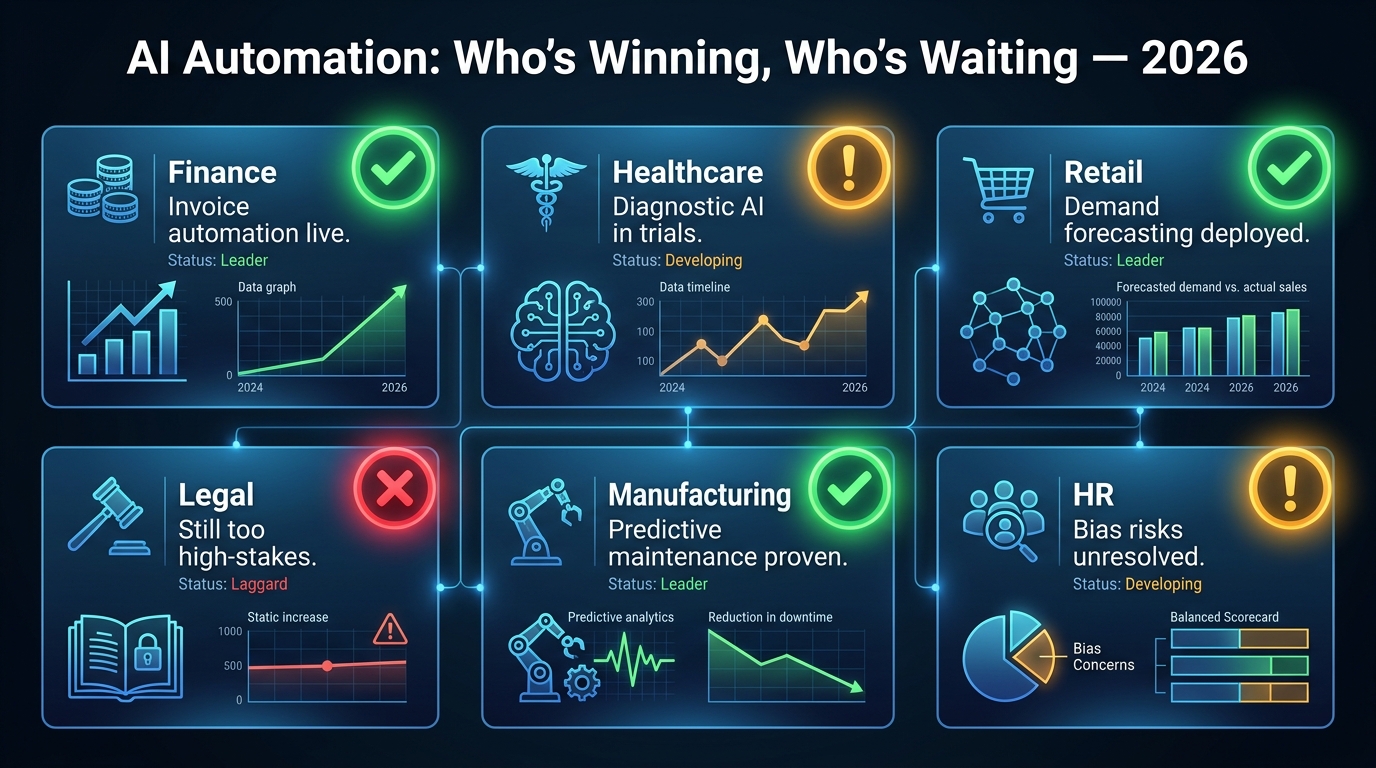
Broad claims about AI automation tend to obscure enormous variation in real-world outcomes across different industries. The honest answer to “Is AI automation working?” depends almost entirely on which sector you’re asking about, which specific function within that sector, and how mature the organization’s data and process infrastructure already is.
Financial Services: The Early Adopter Dividend
Financial services — particularly banking, insurance, and fintech — have been automating processes longer than any other sector, and the results reflect that head start. Document processing, fraud detection, credit risk modeling, and regulatory reporting have all seen proven, measurable gains from AI automation. The data infrastructure was already there (financial data tends to be clean, structured, and well-governed by regulatory necessity), which removed the most common implementation obstacle.
The remaining frontiers in financial services AI are more complex: AI-assisted investment research, personalized financial advice, and real-time risk management across complex instrument portfolios. These are genuinely difficult problems, and the institutions making progress on them are doing so with significant investment in AI-literate domain experts — not by deploying off-the-shelf tools and expecting the results to speak for themselves.
Healthcare: Genuine Promise, Genuine Caution
Healthcare AI gets more press than almost any other sector — and produces more cautionary tales. The promise is real: AI-assisted diagnostic imaging, clinical documentation automation, drug interaction checking, and patient scheduling optimization have all demonstrated value in controlled settings. The challenges are equally real: healthcare data is often fragmented across incompatible systems, regulatory approval requirements are stringent, liability exposure is significant, and the consequences of errors can be life-altering rather than merely costly.
The organizations making genuine progress in healthcare AI share a common characteristic: they move at the pace of validation, not the pace of hype. They run prospective studies. They engage clinical staff in implementation design from the beginning. They build in verification mechanisms that treat AI outputs as inputs to clinical judgment rather than replacements for it. This is slower than the press releases suggest — and considerably more likely to actually work.
One area where healthcare AI is delivering without controversy: administrative burden reduction. Automating prior authorization requests, clinical documentation from voice recordings, and appointment scheduling has created tangible time savings for clinical staff — without introducing the high-stakes judgment calls that make diagnostic AI so fraught. This is the right entry point for most healthcare organizations in 2026.
Manufacturing: Where Predictive Maintenance Has Arrived
Manufacturing is arguably the sector where AI automation has delivered the most consistent, well-documented operational value at scale. Predictive maintenance — using sensor data and machine learning to anticipate equipment failures before they happen — has moved from pilot to standard practice at leading manufacturers. The ROI case is clear and calculable: unplanned downtime is expensive, the data streams from industrial equipment are well-suited to ML analysis, and the action that the AI recommends (schedule maintenance before failure) is low-risk and high-value.
Quality control automation, using computer vision to detect defects in production lines faster and more consistently than human inspectors, has similarly reached operational maturity. And AI-driven supply chain optimization — balancing supplier reliability, inventory levels, demand signals, and logistics constraints — is delivering measurable cost reductions at manufacturers with the data infrastructure to support it. For manufacturers considering where to start with AI, these three areas offer the clearest evidence base and the most established implementation pathways.
Legal Services: Moving Carefully for Good Reason
Law firms and legal departments present a fascinating case study in thoughtful restraint. The use of AI for document review in discovery — sifting through millions of emails and contracts to find relevant materials — has been accepted practice for several years. That’s a task where speed matters, human error is a real problem, and errors are catchable through sampling and audit.
But the expansion of AI into legal drafting, legal advice, and legal strategy faces legitimate resistance that isn’t simply technophobia. Legal outputs carry professional accountability that cannot be transferred to a software vendor. Attorneys are personally licensed and professionally liable. When an AI-assisted contract contains an error that costs a client money, the partner who approved it owns that error — not the tool. This accountability structure is forcing legal AI adoption to be more careful, more documented, and more human-reviewed than in sectors without similar liability dynamics. That’s probably correct rather than just cautious.
Retail and E-Commerce: Fragmented but Moving Fast
Retail AI adoption is highly fragmented — the largest retailers have sophisticated AI capabilities built in-house or via custom enterprise deployments, while mid-market and smaller retailers are navigating a crowded vendor landscape with varying levels of genuine capability. Demand forecasting, personalization engines, and dynamic pricing are all well-established at the enterprise level. At the mid-market level, adoption is accelerating but implementation quality is inconsistent, and the gap between vendor promises and delivered outcomes remains wide.
The area where even smaller retailers are seeing rapid, accessible automation gains is in marketing and content operations: AI-assisted product description generation, automated email campaign optimization, and AI-powered ad creative testing. These tools have relatively low data requirements, are forgiving of imperfect inputs, and deliver measurable results quickly enough to validate the investment. They’re reasonable entry points for businesses that want to build AI capability incrementally without betting the operation on a large, complex implementation.
The Vendor Landscape Is Consolidating — And That Changes How You Buy
One of the structural shifts underway in the AI automation market in 2026 is consolidation. The fragmented landscape of 2023–2024, where dozens of point-solution vendors competed across every niche, is being replaced by a market where a smaller number of larger platforms are absorbing capabilities through acquisition, and where hyperscalers are building AI functionality directly into the enterprise software suites that businesses already use.
Microsoft is embedding AI throughout Office 365 and Azure. Google is doing the same across Workspace and Google Cloud. Salesforce, ServiceNow, SAP, and other major enterprise platforms have all built AI features that compete directly with the point solutions their customers were previously buying separately. Meanwhile, in the model layer, the competitive dynamics are fierce: Microsoft’s AI division released a transcription model in September 2026 that undercut competitors’ pricing by 72% in a single product cycle — from $0.36 per hour of audio to $0.10 per hour. The pace of price compression in AI services is unlike anything in enterprise software history.
Platform vs. Point Solution: The New Strategic Trade-off
The platform approach — using AI features built into your existing enterprise software — offers speed, integration simplicity, and often better data connectivity, because the AI system is already inside the environment where your data lives. The trade-off is that platform AI features tend to be less specialized than dedicated point solutions. The AI email assistant built into your CRM is probably good — but it might not be as good as a purpose-built tool designed exclusively for that function, trained on domain-specific data, with a support team that understands your specific use case.
The point solution approach — buying specialized AI tools for specific functions — offers depth and specialization, but at the cost of integration complexity, contract management overhead, and vendor dependency on companies whose longevity in a consolidating market is genuinely uncertain. A tool you’ve integrated deeply into your operations that gets acquired and sunset creates a significant operational disruption at exactly the wrong time.
Neither approach is universally right. The choice depends on how critical the function is, how specialized your requirements are, and how much integration overhead your organization can absorb. What’s changed in 2026 is that the number of specialized vendors worth betting on has narrowed considerably — the independent point-solution vendors who haven’t been acquired are either genuinely best-in-category or struggling financially, and telling the difference requires real due diligence that most procurement processes aren’t designed to provide.
What to Demand in Vendor Evaluations
Given the consolidation dynamics and the pace of model development, vendor commitments made today can become commercially irrelevant very quickly. Contracts signed on pricing that becomes uncompetitive within six months represent a real financial risk. Build break clauses and price-review triggers into your AI vendor contracts — this is standard practice in sophisticated enterprise procurement and should be non-negotiable for any AI service with significant ongoing usage costs.
Demand transparency on model update policies: when a vendor updates their underlying model, will your outputs change? Will you be notified in advance? Can you test the updated model in a staging environment before it goes live in production? These questions are now standard in sophisticated enterprise AI procurement — if a vendor can’t answer them clearly and specifically, that’s informative data about the maturity of their enterprise offering.
Building an AI-Ready Culture Without the Buzzwords
Every business publication has run a variation of the “building an AI culture” article in the last two years. Most of them are vague, aspirational, and impossible to act on in any concrete sense. The operational version of this concept looks quite different from the thought-leadership version.
Start with Psychological Safety, Not Enthusiasm Campaigns
The most common culture intervention for AI adoption is some form of enthusiasm campaign — leadership messaging about exciting opportunities, all-hands demonstrations, innovation lab announcements, perhaps a hackathon or two. These generate short-term energy and long-term skepticism when the enthusiasm isn’t followed by substantive operational change that employees can see and feel in their daily work.
What actually creates a culture where AI automation works well is psychological safety: employees’ genuine confidence that they can raise concerns about AI outputs without being dismissed, flag errors without blame landing on them, and suggest workflow improvements without territorial conflict with managers who feel their authority is being challenged. This is not a communications initiative. It’s a management practice, built through consistent behavior over time — through how leaders respond when things go wrong, through whether concerns raised in team meetings actually change decisions, through whether “this AI recommendation seems off to me” is a welcome contribution or a career risk.
Normalize Experimentation — And Normalize Stopping
Organizations that make genuine progress with AI automation tend to have a healthy relationship with stopping experiments that aren’t working. They treat AI implementation not as a binary success/failure judgment but as a learning process with explicit checkpoints. At 30 days, does the tool do what we expected in practice, not just in the demo? At 90 days, is adoption where it needs to be, and is quality holding? At six months, are we seeing the outcomes we projected, and are those outcomes worth the ongoing cost?
The willingness to stop — to acknowledge that a particular tool or approach isn’t working in this context and redirect resources to something more promising — is actually a sign of organizational health, not weakness. Companies that feel too publicly committed to their AI investments to acknowledge when they’re underperforming will keep pouring resources into failing implementations long past the point where a rational assessment would say redirect. This dynamic is already visible in organizations that rushed early deployments in 2024–2025 and are now quietly managing the consequences.
Create Roles That Bridge Technical and Operational Knowledge
One of the most effective structural investments an organization can make for AI readiness is creating roles — formal or informal — that bridge between technical AI capabilities and operational business knowledge. These aren’t data scientists who understand the business at a high level; they’re people who understand both domains deeply enough to translate between them fluently. They can sit in an operations meeting and understand why the AI’s recommendation doesn’t fit the actual situation. They can sit in a technical meeting and explain what the business actually needs in terms that shape development priorities.
These roles have been called various things across different organizations: AI product managers, automation leads, digital operations specialists, process intelligence analysts. The title matters less than the function. Without people who can do this translation work effectively, AI tools tend to be either oversold to the business by technical teams excited about capabilities, or undersold by operational teams skeptical of anything they don’t fully understand. Both failure modes are expensive. The gap in the middle is where most AI implementations actually fail — not technically, but organizationally.
What the Next 18 Months Look Like for Business AI Adoption
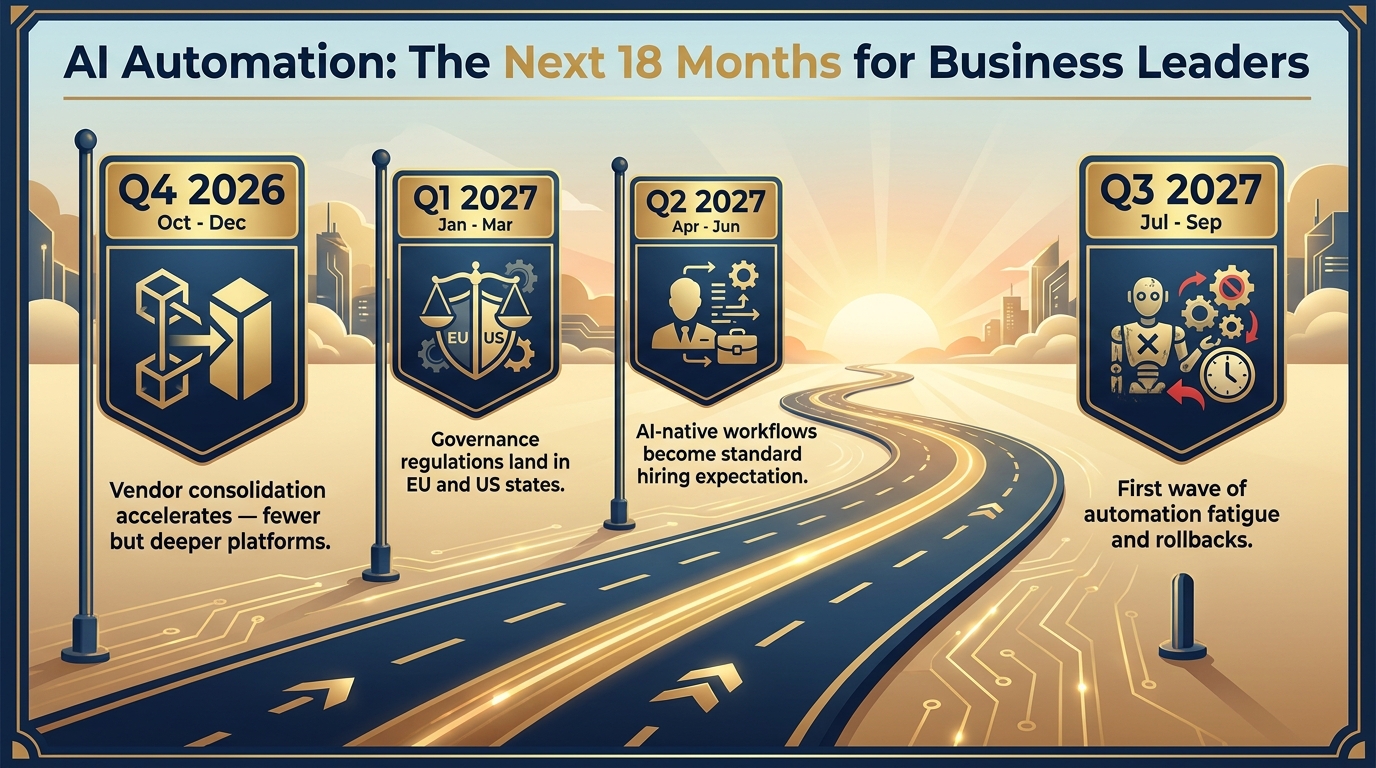
Forward projections about AI are notoriously unreliable — the technology is moving quickly enough that 18-month forecasts have a poor track record even from analysts with excellent information. But several structural dynamics are clear enough to warrant serious planning attention, regardless of how the underlying model capabilities evolve in the interim.
Vendor Consolidation Will Accelerate Through Q4 2026 and into 2027
The AI tooling market is in active consolidation, and that pace is likely to increase as the cost of developing and maintaining frontier models rises beyond what most independent vendors can sustain. Acquisitions are accelerating. Pivots are happening. Shutdowns are coming. For businesses with deep integrations into point solutions from smaller vendors, this creates a material operational risk: your vendor may be acquired, pivoted, or shut down within your current contract term.
The mitigation strategy is straightforward in concept if not always in execution: audit your AI vendor dependencies now. Map which integrations are critical to operational continuity, assess the financial health and strategic position of those vendors, and identify contingency options before you need them urgently. This is basic business continuity planning applied to a new category of operational dependency.
Governance Regulations Will Land Faster Than Most Businesses Are Preparing For
The regulatory environment around AI is moving from principle to enforcement faster than most businesses are tracking. The EU AI Act is already in effect for high-risk use cases. Individual US states — California most notably, but also Texas and others — are passing AI disclosure and accountability legislation. The 22-nation declaration for international AI oversight announced in September 2026 signals that global frameworks are taking shape, even if they’re not yet binding.
Businesses that haven’t started building internal AI governance documentation and controls are already behind the curve — not relative to the current regulatory floor, but relative to where that floor will be in 12 to 18 months. The organizations that will handle this transition most smoothly are those treating governance as an operational investment now, rather than a compliance scramble later. The difference in cost and disruption between the two approaches is substantial.
AI-Native Expectations Will Reshape the Hiring Market
The workforce entering the job market in 2027 will have used AI tools throughout their education in a way that prior cohorts have not. Their baseline expectations about what tools are available to them at work, and which tasks they expect to perform manually versus with AI assistance, will be materially different from today’s workforce — and from the assumptions built into most current job descriptions and performance frameworks.
Organizations that haven’t modernized their workflows to reflect current AI capabilities will increasingly lose hiring competitions to companies that have, particularly in functions like marketing, software development, data analysis, and operations management where AI tool proficiency is becoming a baseline professional expectation rather than a specialized skill. This isn’t about being the flashiest AI employer — it’s about meeting the operational expectations of a workforce that’s been building AI habits for years.
The First Wave of Automation Rollbacks Is Coming
This is the prediction that will be most unwelcome and is probably most important for business leaders to internalize. A significant number of AI automation implementations deployed during the 2024–2026 hype cycle were implemented too quickly, with inadequate governance, insufficient data preparation, and unrealistic ROI expectations. Some percentage of those implementations will reach a reckoning point — where the organization has to acknowledge that they’re not working as intended and make a decision about whether to remediate or reverse course.
This isn’t a reason to avoid AI automation. It’s a reason to implement it carefully — with realistic expectations, measured timelines, and the organizational humility to acknowledge failure early rather than late. The companies that handle their first wave of rollbacks well — by learning from them specifically, adjusting their approach based on what the failure actually revealed, and trying again with better-informed parameters — will be better positioned in the long run than companies that either avoided automation entirely or implemented it recklessly and are now unable to admit the problem exists.
The Businesses That Will Actually Win with AI Automation
There is no shortage of articles telling you that AI will transform your business. There is a shortage of honest conversation about what that transformation actually requires, what it genuinely costs, where it fails in practice, and how to navigate it without damaging the parts of your organization that are working well.
The businesses that will genuinely benefit from AI automation in 2026 and beyond are not necessarily the ones that move fastest. They are the ones that move most deliberately. They start with their worst process bottlenecks, not their most exciting theoretical use cases. They build data infrastructure before they build automation layers on top of inadequate foundations. They invest as heavily in governance and change management as they invest in tools. They maintain appropriate skepticism about vendor claims without retreating into technological conservatism. And they treat every AI implementation as an organizational learning exercise — something that tells them something useful about their processes, their data, and their people — not just a cost-reduction initiative with a completion date.
The trillion-dollar bet that hyperscalers are making on AI is, by their own admission, one that requires extraordinary productivity gains to justify the investment by 2030. Whether your business contributes to those gains — or merely pays for the infrastructure while struggling to extract value from it — depends almost entirely on the quality of the decisions you make in the next 18 months.
The tools are available. The question is whether the strategy, the data, the governance, and the culture are ready to make use of them. For most businesses, that question has an honest answer that sounds less exciting than a press release — and is far more useful for actually building something that works.
Key Takeaways for Business Leaders
- Apply skepticism proportional to the hype. The AI market in 2026 is saturated with commercially motivated claims. Demand concrete evidence of outcomes in comparable organizations before committing significant budget to any implementation.
- Map your processes against task complexity and data quality before selecting automation candidates. These two variables predict implementation success more reliably than any other factor — more reliably than the tool you choose or the vendor you hire.
- Budget fully, including the invisible costs. Data preparation, integration engineering, change management, and ongoing maintenance typically add 150–300% to the visible license cost. Plan for this from the outset, not after approval.
- Build governance before you scale. A named accountability owner, defined human review checkpoints, and a documented incident response process are minimum viable governance. These need to exist before the system goes live, not after something goes wrong.
- Invest in your people’s critical evaluation skills as much as you invest in AI tools. Domain experts who understand AI’s limitations are more valuable in the long run than AI enthusiasts who don’t understand the domain.
- Audit your AI vendor dependencies now. Consolidation is accelerating. Know which integrations are operationally critical and have contingency options identified for your most mission-critical AI tools before you need them urgently.
- Start building governance documentation today, ahead of the regulatory wave. What’s optional compliance practice now will be mandatory in 12 to 18 months. The organizations that treat this as an investment rather than a scramble will spend less and sleep better.