


Here is the uncomfortable truth about AI automation in 2026: most businesses have it somewhere, most can’t fully explain what it’s doing, and a surprising number are paying for systems that haven’t changed a single outcome that matters.
That’s not a criticism of the technology. It’s a diagnosis of how the technology has been sold, adopted, and deployed. The conversation about AI automation has been dominated for years by vendor promises, pilot announcements, and sweeping projections — McKinsey estimates, Gartner hype cycles, conference keynotes. What gets talked about far less is the granular, department-level reality: which workflows are genuinely suited to AI automation, which ones only look suited to it on a slide deck, and what separates the teams quietly winning from the teams quietly bleeding budget.
This article is not about whether to adopt AI automation. That question is largely settled for any business competing in 2026. The question that actually matters now is where — which specific processes in which specific departments, in what sequence, with what change management behind them. The answers are more concrete and more nuanced than most coverage suggests.
What follows is a department-by-department breakdown of what the evidence actually shows: where AI automation is delivering returns, where it’s creating as many problems as it solves, what the hidden costs look like before they surface in a quarterly review, and how to build a roadmap grounded in process reality rather than technology enthusiasm.
What “AI Automation” Actually Means in 2026 — Beyond the Buzzwords
The term “AI automation” has been stretched to cover an enormous range of things, and that ambiguity is itself one of the biggest obstacles to making sound decisions about it. Before any meaningful conversation about deployment, it’s worth being precise about what the phrase actually encompasses — because the differences between types of AI automation are not cosmetic. They determine budget, complexity, risk profile, and realistic time-to-value.
Rule-Based Automation vs. Intelligent Automation
The oldest and most reliable form of automation is rule-based: if X happens, do Y. No intelligence required. Robotic Process Automation (RPA), as it has existed for the past decade, fits largely into this category. It’s deterministic, predictable, and brittle — it works perfectly until the interface it’s scraping changes, the data format shifts, or an exception appears that no rule was written to handle.
Intelligent automation adds a layer of machine learning or large language model capability on top of that rule-following foundation. The critical difference is that intelligent automation can handle variation. It can read a supplier invoice that doesn’t match your standard template. It can classify a customer complaint as “urgent churn risk” rather than “billing question” based on sentiment, not keywords. It can extract structured information from unstructured text — meeting notes, emails, PDFs — without needing the document to follow a fixed format.
This distinction matters enormously for expectation-setting. Teams that buy “AI automation” expecting the intelligence layer and receive a slightly fancier rules engine are going to be disappointed. Teams that implement a rules engine thinking they’ve deployed AI are going to be confused when it fails on anything outside the narrow set of scenarios it was programmed for.
Generative AI vs. Predictive AI in Workflows
A further distinction that shapes what’s realistic: generative AI (large language models producing text, code, or images) and predictive AI (models that forecast outcomes based on historical patterns) have very different use cases in business automation. Generative AI excels at drafting, summarizing, and translating — it produces outputs that a human still typically reviews. Predictive AI excels at scoring, ranking, and flagging — it processes data at scale and surfaces the cases that warrant human attention.
Many of the most effective AI automation implementations in 2026 combine both. A customer support workflow might use predictive AI to triage incoming tickets by urgency and topic, then use generative AI to draft a suggested response, which a human agent reviews and sends. Neither component alone is as useful as the combination — and understanding which type of AI you’re working with tells you a lot about where human oversight should live in the process.
Agentic AI: Promising, Fragile, Not Yet Mainstream
The newest category — autonomous AI agents that can plan, act across multiple systems, and self-correct — is attracting significant investment and significant hype in equal measure. Agentic systems represent a genuinely different capability: the ability to pursue a goal across a series of steps without a human directing each one. But in most business environments in 2026, full agent autonomy is still an aspirational state rather than a dependable one. The failure modes are harder to predict, the oversight requirements are higher, and the processes that are truly ready for autonomous agents are narrower than the marketing suggests. This article focuses primarily on the intelligent automation tier — AI embedded into workflows at the task level — because that’s where the preponderance of real-world business value is currently being created.
The Automation Maturity Ladder — Where Most Businesses Actually Are
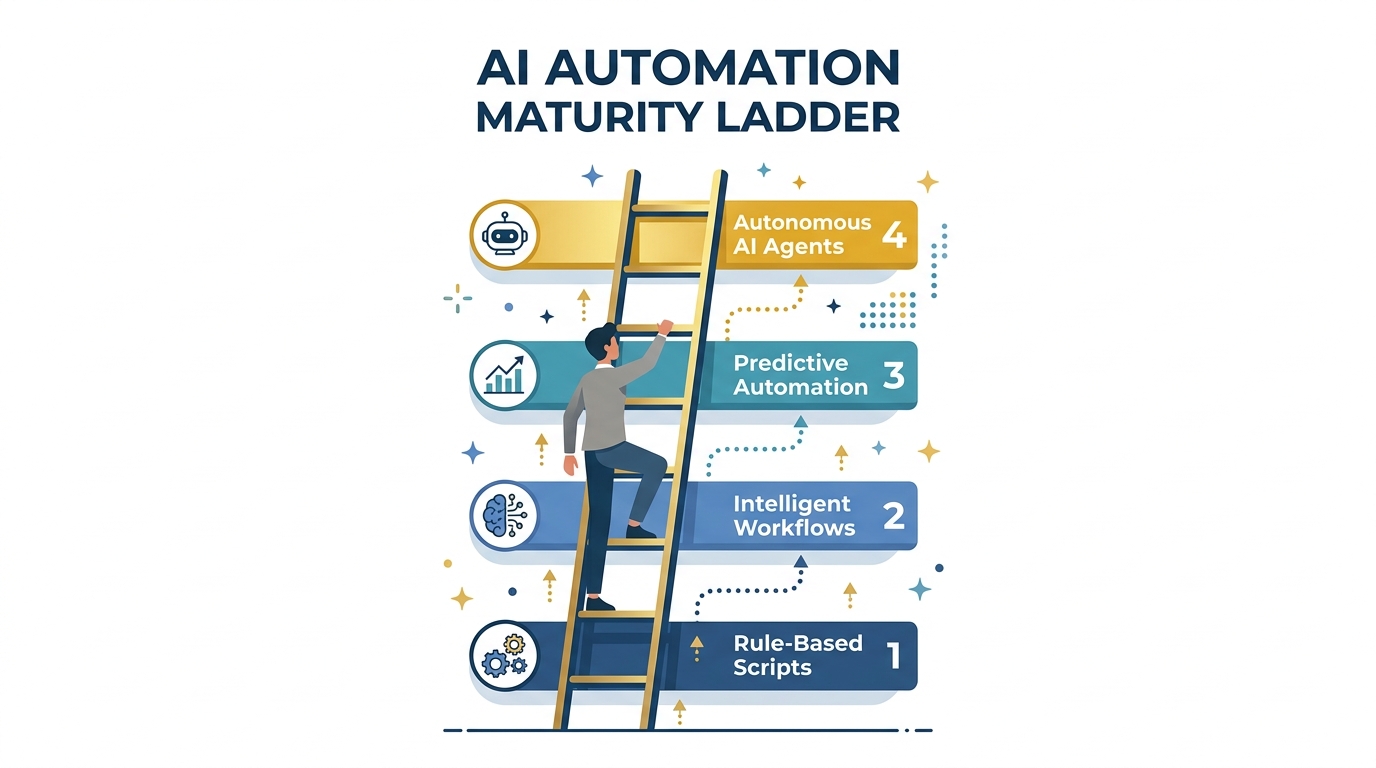
If you’ve read any industry research on AI adoption, you’ve likely seen the statistic about the percentage of businesses “using AI.” It’s usually a large number — often cited above 70% or 80%. That statistic is technically accurate and practically misleading, because it treats a company using a spell-checker with AI features the same as a company running predictive demand forecasting across its supply chain. The reality is that businesses sit at very different rungs of an automation maturity ladder, and confusing your current rung with a higher one is one of the most reliable ways to waste money on AI initiatives.
Rung 1: Rule-Based Scripts and Simple Triggers
Most businesses that believe they’ve “started on AI automation” are actually at rung one. This includes automated email sequences based on user actions, scheduled data exports and report generation, basic RPA tasks like copying data between systems, and simple chatbots that follow decision trees. These tools deliver real value — they free up human time on clearly defined, repetitive tasks — but they are not AI in any meaningful sense, and they will not scale beyond the specific scenarios they were programmed for.
A business at rung one has laid groundwork, but it hasn’t yet touched the class of problems where AI’s judgment capabilities create differentiated value. The gap between rung one and rung two is often underestimated — it requires not just different tools but different data infrastructure, different process documentation, and different change management practices.
Rung 2: Intelligent Workflows
Rung two is where genuine AI integration begins: systems that can classify inputs, adapt to variation, and make decisions based on learned patterns rather than explicit rules. Document processing that handles non-standard formats, sentiment-aware customer routing, dynamic pricing that responds to real-time signals, AI-assisted recruiting that screens candidates against multi-factor criteria — these are rung-two capabilities. They require clean, accessible data; clear definitions of what “good” output looks like; and ongoing monitoring to catch drift as conditions change.
Companies at this rung often find that their first major AI initiative forces a data quality reckoning they weren’t expecting. The AI works fine — but the data it’s learning from turns out to be inconsistent, incomplete, or structured in ways that reflect old processes rather than current ones. Addressing this is not glamorous work, but it is arguably the most valuable thing a business can do to prepare for everything above rung two.
Rung 3: Predictive Automation
Rung three introduces forecasting and proactive action: AI systems that don’t just react to inputs but anticipate outcomes and trigger responses before a problem materializes. Predictive maintenance in manufacturing, churn prediction in SaaS, demand sensing in retail, anomaly detection in financial transactions — these systems are operating at rung three. They are also the systems where the financial returns become most significant, because they’re preventing costs rather than just reducing processing time.
Rung 4: Autonomous Agents
Rung four — fully autonomous AI agents that plan and execute multi-step tasks without human direction — is where most enterprise ambition currently lives and where most enterprise implementation currently stalls. The technology is advancing rapidly, but the organizational infrastructure to deploy it safely (adequate oversight mechanisms, clear accountability structures, robust error correction) is developing more slowly. Businesses that claim to be at rung four in most of their functions are almost certainly describing a narrower set of use cases than they realize.
Knowing which rung you’re on is not a source of shame — it’s a prerequisite for making rational decisions about where to invest next. Most mid-size businesses in 2026 are navigating the transition from rung one to rung two. Most enterprises have a patchwork of rung-two implementations and a few rung-three capabilities in specific high-data domains. Almost nobody is broadly at rung four.
Finance and Accounting — The Highest-Return Starting Point
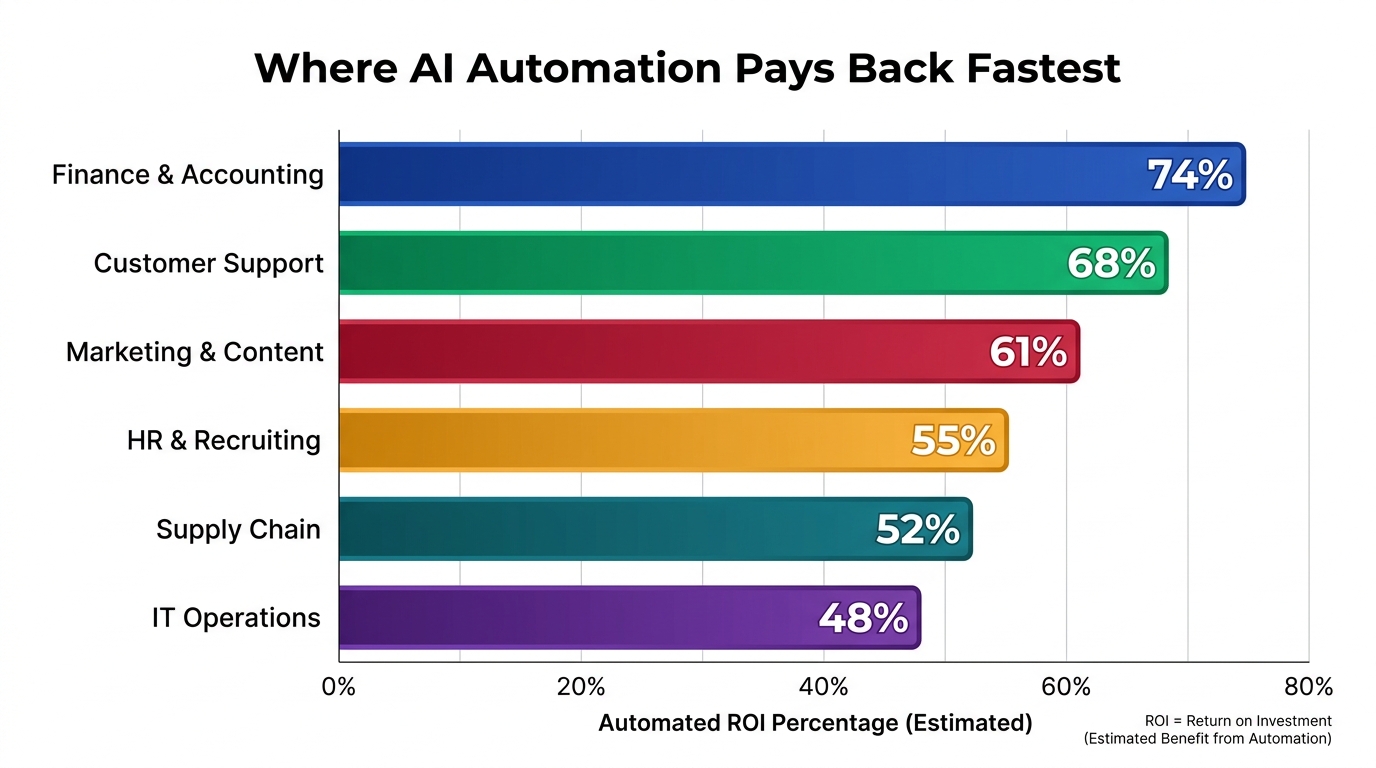
If you are deciding where to begin an AI automation program — or where to refocus one that has underdelivered — finance and accounting is the department the evidence consistently points to first. The reasons are structural: the processes are highly repetitive, the data is (relatively) structured, the success criteria are unambiguous, and the compliance stakes create a strong organizational incentive to get it right. That combination produces some of the most reliable automation ROI available across any business function.
Accounts Payable and Invoice Processing
Accounts payable is frequently cited as the single most impactful early AI automation target in finance departments. The reason is the volume of variation: most mid-size companies receive invoices in dozens of formats from hundreds of vendors, each with different field layouts, date conventions, currency handling, and line-item structures. Processing them manually is expensive, slow, and error-prone. AI document processing systems — trained to extract key fields regardless of format — can reduce processing time per invoice from minutes to seconds, and error rates from several percentage points to fractions of a percent.
The productivity gains are measurable and fast. Finance teams that automate invoice processing typically report reclaiming 60–70% of the time their teams spent on manual data entry within the first six months. What they often don’t account for upfront is the volume of exceptions — invoices the AI flags for human review because something is ambiguous or anomalous. Managing the exception queue well is what separates teams that achieve those time savings from teams that swap one manual process for a slightly different one.
Reconciliation, Reporting, and Audit Preparation
Beyond invoices, AI automation is demonstrating strong results in bank reconciliation, inter-company transaction matching, and the preparation of standard management reports. Reconciliation in particular is a task ideally suited to AI: it involves matching large volumes of structured data across multiple sources according to defined rules, with anomalies flagged for investigation. Machine learning models can be trained to recognize matching patterns that rule-based systems would miss and to categorize discrepancies by likely cause, dramatically reducing the human time required to resolve them.
The adjacent opportunity — automated report generation — is perhaps less technically impressive but often more immediately impactful from a time-saving perspective. Finance teams in many organizations spend substantial hours each period pulling data from multiple systems, formatting it consistently, and distributing it to stakeholders. Automating that pipeline doesn’t require sophisticated AI: it requires clear data connections and consistent structure. But adding an AI summarization layer — which generates the narrative commentary that accompanies the numbers — turns a data dump into a genuinely useful document and can cut report preparation time by more than half.
Fraud Detection and Expense Management
Predictive AI in finance has perhaps its clearest ROI case in fraud detection and anomalous expense identification. The pattern-recognition requirements of these problems — finding the transactions that don’t fit the baseline of normal behavior — are precisely what machine learning models are designed for. The economic math is compelling: a system that catches even a small percentage more fraudulent transactions than a rules-based system, at enterprise scale, pays for itself rapidly.
Expense management automation represents a softer but still meaningful win. AI systems that classify expense submissions, flag policy violations, and route approvals can reduce finance team workload substantially while also improving policy compliance — because automated enforcement is consistent in a way that human review at scale is not.
Customer Support — Where AI Has Earned Its Seat at the Table
Customer support is the department where AI automation has logged the most real-world hours and produced the most documented outcomes — both positive and negative. It’s also the department where the gap between well-implemented AI and poorly-implemented AI is most visible, because the customer feels it directly. Getting this right has become a competitive differentiator; getting it wrong has become a measurable driver of churn.
What AI Can Handle Well — and What It Still Can’t
The use cases where AI automation in customer support genuinely works in 2026 are well-established: answering high-volume, low-complexity inquiries (order status, account information, standard policy questions), triaging and routing tickets to the right human agent with relevant context pre-populated, summarizing long customer conversations for agents who are picking up an escalated case, and generating draft responses that agents can review and personalize.
What AI support automation still handles poorly: high-stakes, emotionally charged interactions where the customer’s trust needs to be actively rebuilt; complex multi-issue problems that don’t fit a single category; situations where the resolution requires judgment about precedent, business context, or relationship history; and any interaction where the customer explicitly signals they want to speak to a human. Organizations that fail to create fast, friction-free escalation paths from AI to human agents don’t just have bad AI support — they have a customer relationship problem.
The Triage and Routing Opportunity
One of the most consistently high-value applications of AI in support is ticket triage and intelligent routing. Traditional support routing is based on simple category selection (the customer picks from a menu) or keyword matching. Both approaches are crude and result in significant misdirected volume. AI triage that reads the full content of an inquiry, classifies it by topic and urgency, and routes it to the agent with the relevant specialization and lowest queue can reduce resolution times by 30–40% and improve first-contact resolution rates significantly — without the customer ever interacting with AI at all.
This “invisible AI” use case — AI working behind the scenes to make human operations more efficient, rather than AI talking directly to the customer — is arguably the most mature and reliable form of customer support automation available. It also tends to face the least employee resistance, because it makes agents’ jobs easier without creating any sense of replacement.
Measuring What Actually Matters
One consistent failure mode in AI support automation is measuring the wrong things. Deflection rate — the percentage of inquiries handled entirely by AI without human involvement — is the metric that vendors lead with. It’s a useful number, but it’s incomplete. A high deflection rate achieved by making it difficult to reach a human agent is not a success. The metrics that actually tell the story: customer satisfaction (CSAT) scores before and after AI implementation, first-contact resolution rates, average handle time for escalated cases, and — critically — the rate at which customers who interact with AI support return to do business again. That last one is the number that integrates everything else.
Marketing and Content — Massive Potential, Fragile Without Guardrails
Marketing is the department that has adopted generative AI fastest and most visibly, and it’s also the department where the gap between “using AI” and “using AI well” is widest. Content generation, campaign personalization, SEO research, ad copy testing, audience segmentation — the surface area of AI application in marketing is enormous. But the results are highly variable, and the risks of undisciplined adoption are more real than most marketing teams have acknowledged.
Where Generative AI Is Genuinely Productive
The honest answer is: drafting and iteration, not creation. Generative AI is at its most valuable in marketing when it’s handling the first draft — giving a human writer a starting point rather than a blank page — or when it’s generating multiple variations of an existing concept for A/B testing. Both use cases require a human to make the final quality and accuracy call, but they meaningfully accelerate the process. Content teams report being able to produce two to three times the volume of tested copy in the same time when AI drafting is built into the workflow effectively.
Personalization at scale is a more technically sophisticated application but potentially a more valuable one. AI models trained on customer behavior data can generate individualized content recommendations, subject line variations, and product suggestions that genuinely outperform one-size-fits-all messaging. The companies seeing the most impact here are those that have both the behavioral data to train on and the email/web personalization infrastructure to deploy the outputs. Both conditions are more demanding than they sound.
The Brand Voice and Quality Control Problem
The most common failure mode in marketing AI adoption is brand voice erosion. Teams that use AI to generate content at scale without robust review processes end up with output that is tonally inconsistent, factually loose, and stylistically generic. This is not a flaw in the AI — it’s a workflow design flaw. The AI is producing what it was asked to produce; the problem is that nobody defined precisely what “on-brand” means in operational terms that an AI can reflect.
Teams that avoid this problem invest upfront in training their models (or prompting their systems) with detailed brand style guides, tone documents, example content that represents the ideal, and explicit guardrails about factual claims. They also build human review into the workflow at the point where it’s most efficient — typically at the brief or draft stage rather than post-publication. The output isn’t perfect, but it’s consistently reviewable and consistently on-direction.
SEO and Research Automation
Beyond content creation, AI automation in marketing has produced strong results in research and competitive intelligence functions. Keyword research, competitor content analysis, sentiment monitoring across review platforms, and social listening are all tasks where AI systems can process far more data in far less time than a human analyst — and where the bottleneck has historically been the sheer volume of inputs rather than the complexity of the analysis. Automating these research functions frees marketing analysts to spend time on strategic interpretation and decision-making rather than data collection and cleaning.
HR, Recruiting, and Onboarding — The Quiet Automation Win
Human Resources is a department that tends to appear lower on AI automation priority lists — often because it’s perceived as inherently relationship-dependent and therefore resistant to automation. The reality is more nuanced. There are significant portions of the HR workflow that are highly repetitive, document-intensive, and poorly suited to human time — and there are other portions where human judgment is genuinely irreplaceable. The teams that have done well with HR automation have been clear-eyed about which is which.
Recruiting: The High-Volume Filtering Problem
The most documented AI application in HR is candidate screening. For high-volume roles, organizations can receive hundreds or thousands of applications for a single position. Human review of that volume is expensive, slow, and inconsistent — different reviewers apply different criteria, energy levels fluctuate, and cognitive load leads to pattern-matching shortcuts that may not reflect the actual hiring criteria. AI systems trained on the characteristics of historically successful hires can provide a consistent first-pass filter that surfaces the candidates most likely to advance.
The significant caveat here is bias. AI recruiting tools trained on historical data will replicate historical patterns — including historical biases — unless the training data and model outputs are explicitly audited for disparate impact. Several high-profile cases of AI recruiting tools producing discriminatory outcomes have made this a genuine compliance risk, not just an ethical concern. Teams implementing AI in recruiting need bias auditing built into the process from the start, not added as an afterthought after the system is in production.
Onboarding Automation
New employee onboarding is a process where the benefits of AI automation are less controversial and the risks are lower. Onboarding involves significant document processing (contracts, tax forms, benefits enrollment), repetitive informational tasks (explaining policies, walking through systems access, providing company context), and workflow coordination across multiple departments (IT provisioning, payroll setup, facilities access). All of these are strong automation candidates.
AI-assisted onboarding systems can guide new employees through required steps, answer FAQ-level questions about company policy, and automate the multi-department coordination tasks that traditionally fall through the cracks and create negative first impressions. The human elements — team introductions, manager check-ins, culture conversations — remain human. The administrative plumbing gets automated. The result is an onboarding experience that is more consistent, less error-prone, and less dependent on one HR manager’s availability on a given day.
HR Operations and Employee Queries
Internal HR service desks deal with high volumes of repetitive employee queries: leave balances, payroll questions, benefits questions, policy clarifications. AI chatbots trained on HR policy documents can handle a large percentage of these queries accurately without human involvement — freeing HR business partners to spend their time on the advisory and strategic work that actually requires human expertise. This is one of the cleaner automation wins in the HR space: the queries being automated are genuinely routine, the benefit to the employee (faster response, 24/7 availability) is real, and the HR team’s time is freed for higher-value activities.
Supply Chain and Operations — Data-Rich, Insight-Poor
Supply chain and operations functions represent one of the highest-potential domains for AI automation — and also one of the most common sites of expensive implementation failures. The reason for both is the same: supply chain operations generate enormous volumes of data from multiple systems, sensors, and trading partners, but that data is often siloed, inconsistently structured, and historically difficult to integrate. AI models that depend on clean, connected data to function are therefore both tremendously valuable here (because the analytical questions are complex and consequential) and particularly vulnerable to failure (because the data reality often doesn’t match the theoretical architecture).
Demand Forecasting
AI-powered demand forecasting represents one of the most mature and well-documented supply chain automation applications. Traditional statistical forecasting methods — moving averages, linear regression — work reasonably well under stable conditions and struggle with disruption, seasonality, promotional effects, and external signals. Machine learning forecasting models can incorporate far more variables, weight them dynamically, and adapt more quickly to changing patterns. Organizations with sufficient historical data and adequate data infrastructure have seen meaningful improvements in forecast accuracy — reductions in forecast error of 20–40% are documented in multiple industry case studies, which translates directly into reduced inventory carrying costs and lower stockout rates.
The prerequisites are significant: at minimum, several years of clean transaction history, reliable integration between demand data and the forecasting system, and a willingness to re-examine human overrides carefully. Planners who habitually override model recommendations with gut-feel adjustments are a consistent failure mode — not because human judgment is always wrong, but because unsystematic overrides prevent the model from receiving clean feedback about its own performance and learning from it.
Supplier Risk and Procurement Intelligence
AI applications in procurement — supplier risk scoring, contract analysis, spend analytics — are at an earlier stage of adoption but showing strong early results. Supplier risk models that monitor financial health signals, news sentiment, logistics disruptions, and geopolitical indicators can flag emerging risks weeks before they surface in formal review processes. Contract analysis AI that reads supplier agreements and flags non-standard terms, missing clauses, or compliance gaps can dramatically reduce the legal review burden on procurement teams.
These are not simple implementations — they require integration with external data sources, careful model training, and thoughtful change management with procurement teams whose expertise and judgment the tools need to complement rather than override. But for organizations with significant supplier complexity, the early results are compelling enough to justify the investment.
The Hidden Costs Nobody Puts in the Budget
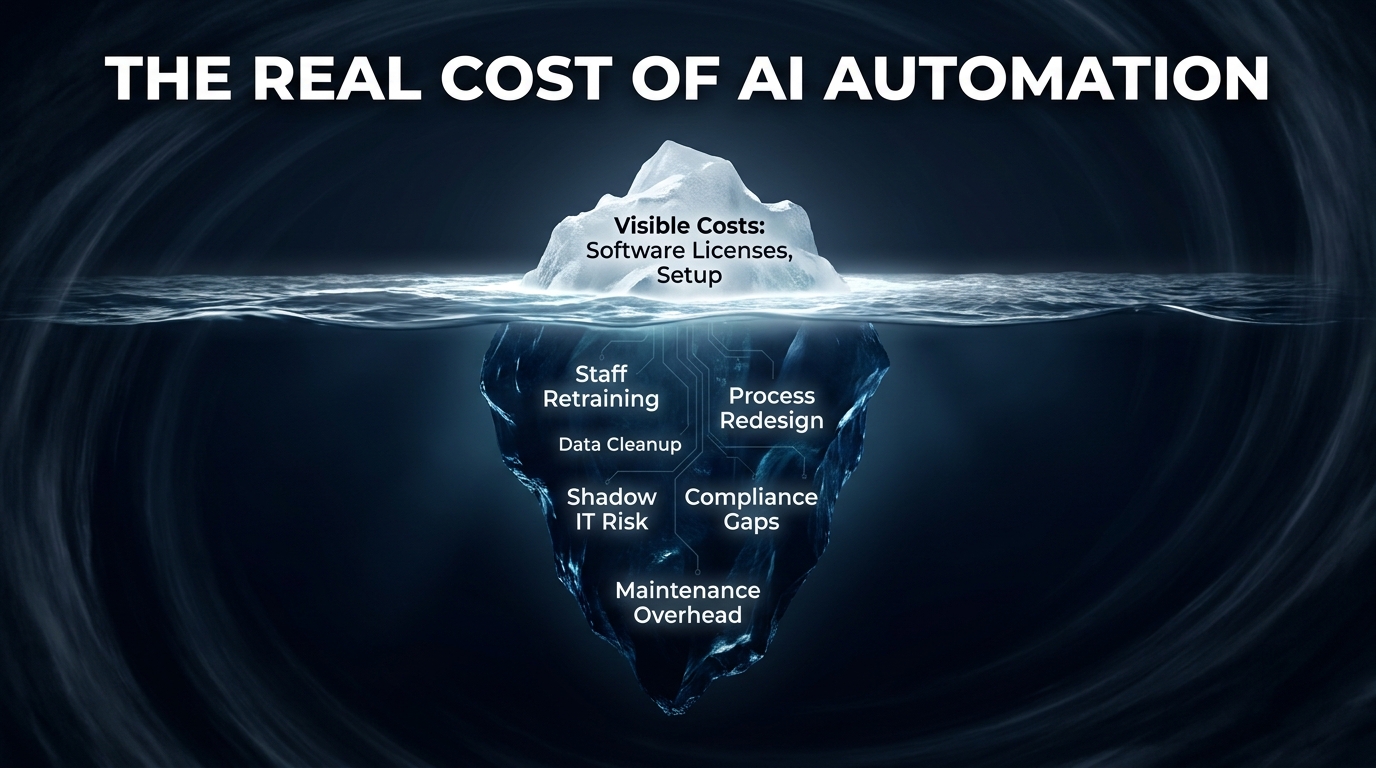
One of the most reliable predictors of AI automation disappointment is a budget that only accounts for the visible costs: software licenses, implementation fees, and perhaps some initial training. These are the costs above the waterline. The costs below the waterline are often larger, slower to surface, and far more consequential for whether the implementation delivers the projected value.
Data Cleanup and Preparation
Every AI system needs data — and almost every organization’s data is messier than it appears on a vendor demo. Data may be stored in incompatible formats across different systems. Fields may be inconsistently populated. Historical records may reflect processes that no longer exist. Duplicate records are common. Organizational definitions of key terms (what counts as a “customer,” how “revenue” is recognized across business units) may vary across systems in ways that have never mattered before but will poison an AI training dataset.
Data preparation — cleaning, structuring, deduplicating, and integrating the data an AI system needs — is frequently the largest single cost in an AI automation project. It’s also the cost that’s most frequently underestimated in proposals, because vendors rightly point out that it’s outside their scope of work. Organizations that don’t budget a meaningful data preparation phase before model training often find themselves three months into an implementation with a technically complete AI system that can’t reliably perform because the data it’s working with is too inconsistent.
Process Redesign
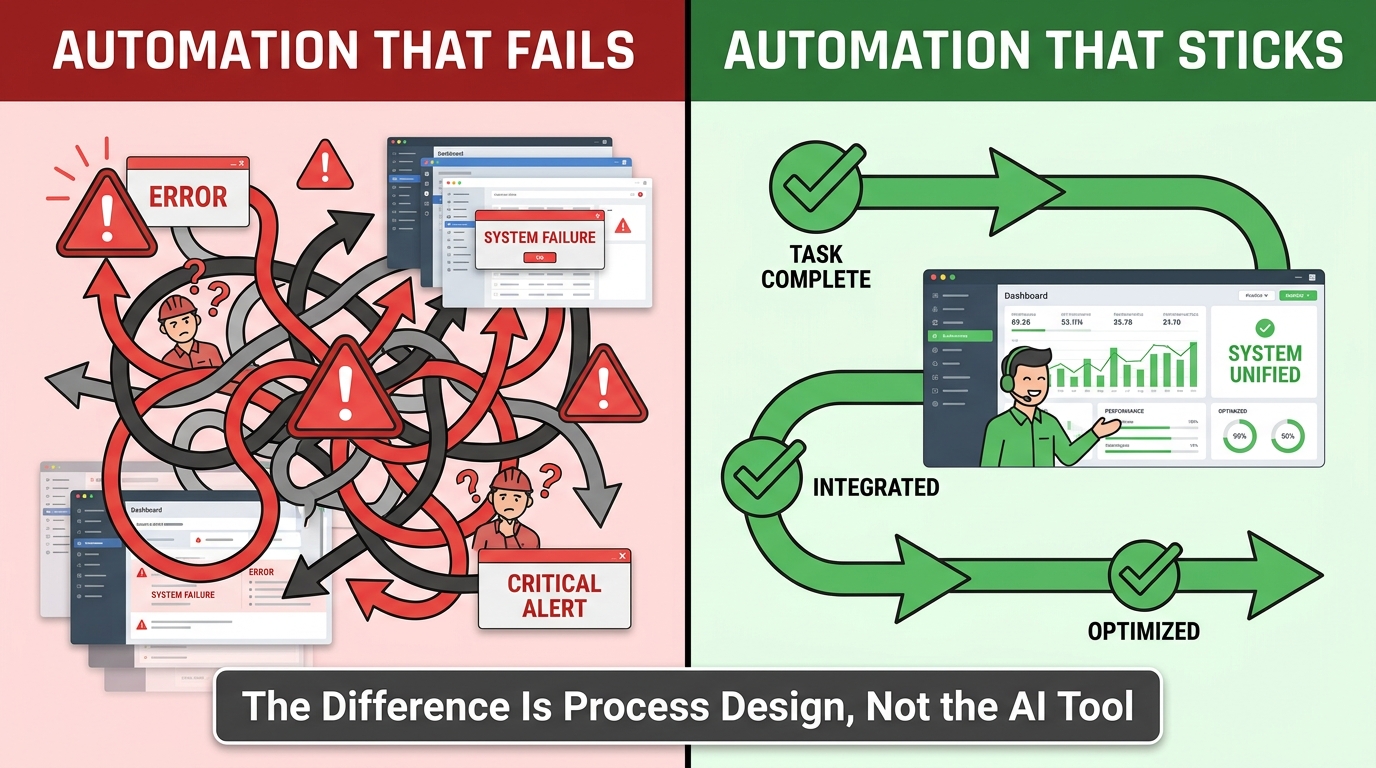
Automating a broken process produces a faster broken process. This is one of the oldest lessons in process improvement and one that the AI generation is reliably rediscovering. Before any workflow is handed to an AI system, the workflow needs to be examined and, in most cases, redesigned. The inputs need to be defined, the decision points need to be mapped, the exceptions need to be catalogued, the success criteria need to be articulated. This is process design work, and it takes time that most AI automation timelines don’t account for.
The organizations that consistently get better outcomes from AI automation are the ones that treat the AI tool as the last step in a process redesign exercise, not the first. They map the current process, identify where value is being lost, redesign the process with AI capability in mind, and then select and configure the tool to fit the redesigned process. The organizations that struggle are the ones that bolt AI onto an existing process and wonder why the results are disappointing.
Change Management and Skill Development
Technology implementations that don’t account for the human side of change consistently underperform. AI automation is no exception. When a team’s workflow changes significantly — when the tool they’ve been using is replaced, when their role shifts from executing a task to overseeing an AI system’s execution of it — there is real adjustment required. People need time to build trust in the new system. They need training not just in how to use the tools but in how to evaluate the AI’s outputs critically. They need to understand what oversight their role requires now that the routine work is automated.
Change management costs — the manager time, the training development, the productivity dip during transition — are routinely omitted from AI automation business cases because they’re internal costs that don’t appear in vendor proposals. Including them produces a more accurate ROI timeline and, more importantly, prompts the planning conversations that make change management successful rather than an afterthought.
Process Design vs. AI Tool Selection — Getting the Order Right
If there is a single most common mistake in AI automation decision-making, it’s this: starting with tool selection rather than process design. The market for AI automation tools is vast, well-funded, and excellent at selling. It is very easy to walk out of a vendor demonstration convinced that a particular platform will solve a business problem, when the conversation about what exactly the business problem is — and whether the tool is actually the right fit for it — has barely begun.
Defining the Problem Before Evaluating the Solution
Effective AI automation starts with a clear, specific problem statement. Not “we want to automate our customer support” but “we have 1,400 inbound support tickets per week, 60% of which are variations on five FAQ topics, and our agents are spending an average of 4.2 minutes per ticket on issues that shouldn’t require human judgment, at a cost of approximately $X per month.” That specificity is what enables a meaningful evaluation of whether a proposed solution actually addresses the problem, at what cost, and with what likelihood of success.
The discipline of writing that problem statement — which requires process mapping, data collection, and stakeholder alignment — is also the discipline that surfaces whether the problem is actually a data problem, a process design problem, a training problem, or a technology problem. Many processes that appear to need AI actually need clearer internal procedures first. Implementing AI on top of an unclear process creates an expensive layer of automation on top of a confusion problem that hasn’t been solved.
Evaluating AI Tools Against Specific Criteria
Once the problem is defined, tool evaluation should be grounded in specific criteria that reflect the actual requirements of the process: Can the tool handle the volume of transactions we process? Can it accommodate the variation in our inputs — the different document formats, the irregular data structures? What does exception handling look like, and how does it integrate with our human review workflow? What data does the tool need to be trained on, and do we have it? What does the vendor’s track record look like for organizations with similar process complexity?
These questions replace the more common evaluation framework of “which tool has the most impressive demo” and “which vendor is most prominent in analyst reports.” Both of those inputs have their place, but neither of them tells you whether the tool will actually work for your specific process with your specific data in your specific organizational context. Pilot programs — small-scale implementations against a real process with real data — are the most reliable way to generate that information, and they should be designed with enough discipline to produce genuinely useful learning rather than just providing justification for a decision already made.
The Build vs. Buy Decision
An increasingly relevant question for organizations with significant technical resources is whether to build custom AI automation solutions or purchase and configure off-the-shelf platforms. The honest answer in 2026 for most business functions is: start with off-the-shelf and build custom only when the off-the-shelf limitations are genuinely constraining your specific use case. Custom-built solutions offer flexibility but require ongoing maintenance, depend on technical talent that may not stay, and are expensive to update as underlying models evolve. Off-the-shelf platforms trade flexibility for speed, reliability, and vendor-managed model updates. For most standard business processes, the trade is worth making.
Building a Human-AI Collaboration Culture That Actually Sticks
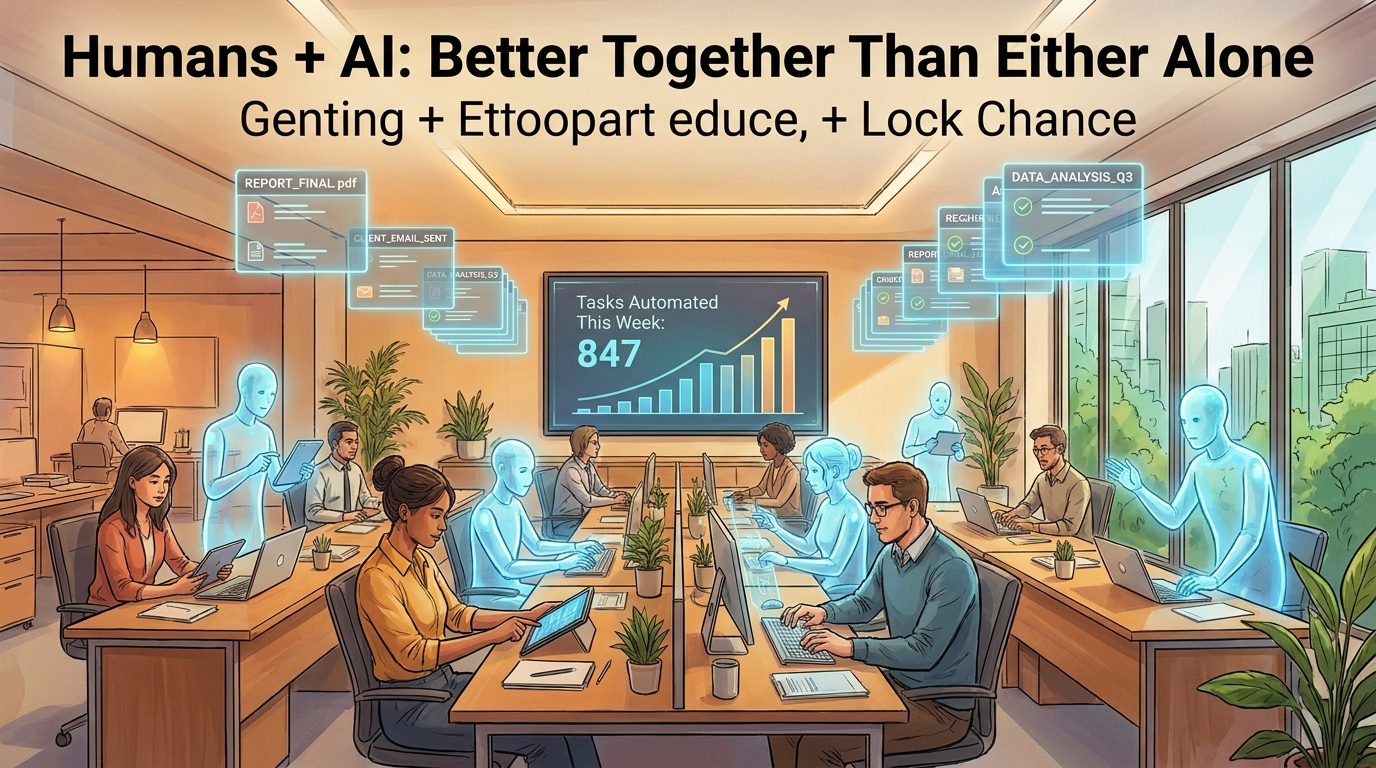
The most technically sophisticated AI automation implementation can fail if the humans working alongside it don’t trust it, don’t understand it, or don’t see how their role contributes meaningfully to outcomes. Culture is not separate from AI automation strategy — it is part of it, and organizations that treat it as a secondary concern are setting up their implementations to underperform.
The Fear Problem — and Why It’s Not Irrational
Employee concern about AI automation is often framed as a communication problem: if leadership just explains the strategy clearly enough, the fear will dissipate. That framing underestimates what employees are actually responding to. In many cases, the concern is not a misunderstanding of the strategy — it’s a rational response to genuine uncertainty about how their role will evolve and whether the organization has a credible plan for that evolution.
Organizations that manage this well do several things consistently: they are honest about which tasks will be automated and why, rather than offering vague reassurances that “no jobs are at risk”; they invest in upskilling programs that give employees a genuine path to the roles that exist after automation; and they involve employees in the design of automated workflows, which both improves the workflow design (people who do the work know where the edge cases are) and gives employees a sense of agency over the change rather than having it done to them.
Calibrating Human Oversight Appropriately
A critical design decision in any AI automation system is where human oversight lives and what form it takes. Too little oversight and you create a system that compounds errors at scale without anyone catching them — a particularly damaging failure mode in customer-facing and compliance-sensitive applications. Too much oversight and you’ve built an expensive process that is effectively slower than the manual version, because every AI output requires human review before action is taken.
The right level of oversight depends on the stakes of the decision, the maturity of the model, and the cost of errors in each direction. New systems with limited training history warrant more oversight. High-stakes decisions (credit approvals, compliance flagging, healthcare applications) warrant more oversight than low-stakes ones regardless of model maturity. As confidence in the model’s performance builds through monitored output review, oversight can be calibrated down — but this should be a data-driven decision based on tracked error rates, not a cost-cutting assumption made upfront.
Making AI Outputs Explainable
One of the most consistent sources of employee distrust toward AI systems is opacity — the system produces a recommendation or a decision, and there’s no clear explanation of why. “The model said so” is not a satisfying basis for action, especially for employees who are being asked to stake their professional judgment on an AI output they can’t interrogate. Explainability — the ability to understand, at least at a high level, what factors drove an AI recommendation — is not just a compliance requirement in an increasing number of jurisdictions. It’s a prerequisite for the human-AI collaboration that makes automated systems reliable rather than brittle.
A Practical Roadmap for Getting Started — or Getting Unstuck
Whether you’re beginning an AI automation program from scratch or trying to rescue one that has stalled, the practical path forward follows the same sequence. The sequence matters because skipping steps doesn’t save time — it creates the expensive problems you’ll need to go back and fix after you’ve already invested in tools and implementations.
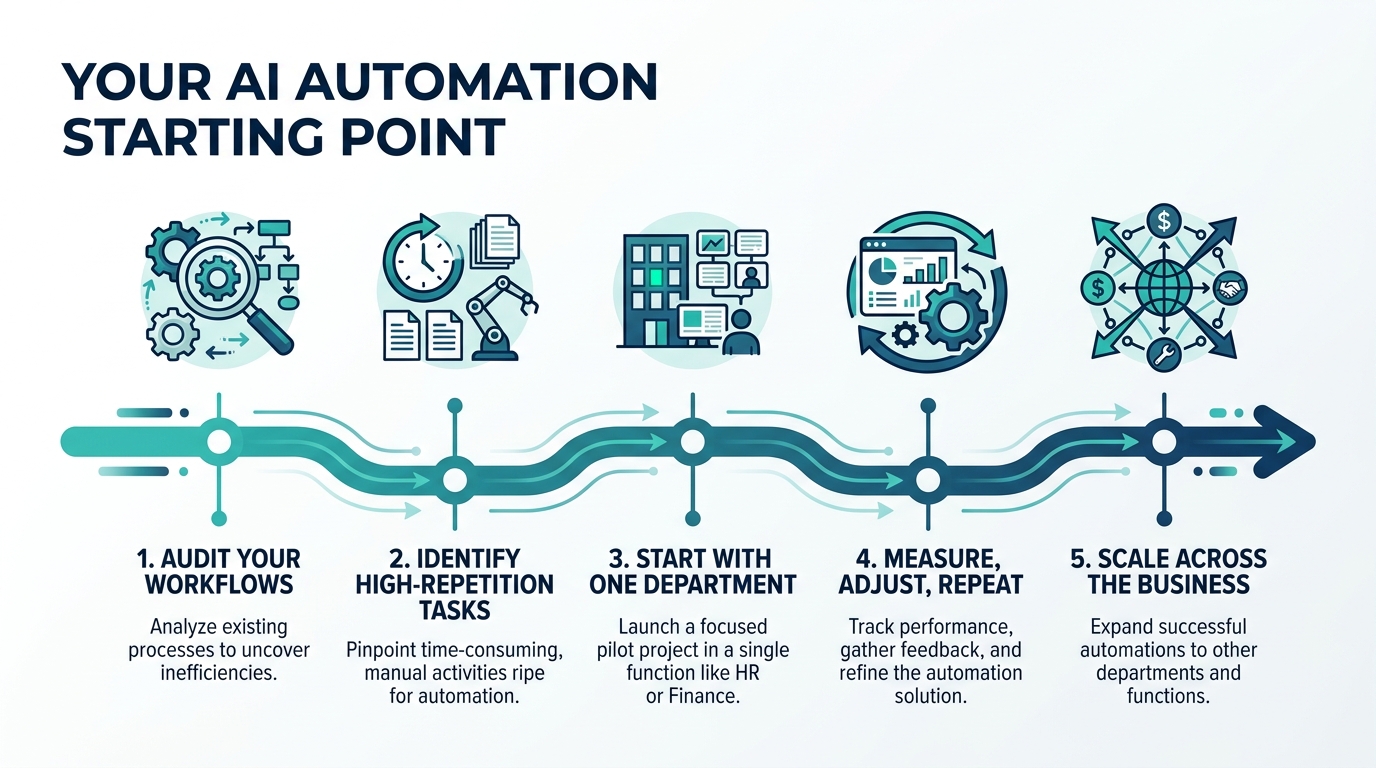
Step 1: Audit Your Actual Workflows
Before considering any technology, map the processes you run. Not the idealized process in the procedure manual — the actual process as it’s currently executed, including the workarounds, the exceptions, the handoffs that sometimes get dropped, and the tribal knowledge that lives in one person’s head. Process discovery is unglamorous work, and it often reveals that the process is more complex, more inconsistent, or more dependent on individual expertise than anyone realized. That’s valuable information — it tells you both where automation is feasible and what preparation is required before it can succeed.
A useful heuristic for identifying high-value automation candidates during this audit: look for processes that are high-volume, rule-describable (even if complex), data-intensive, and consequential enough that errors matter. High-volume ensures the time savings justify the investment. Rule-describable means the task has enough logic to train or configure a system. Data-intensive means AI’s ability to process information at scale is relevant. And consequential means the business cares about the outcome, which creates the organizational motivation to implement well.
Step 2: Identify the Highest-Value, Lowest-Risk First Target
Your first AI automation implementation should not be your most ambitious one. It should be the one that has the clearest ROI, the most tractable data situation, and the lowest risk of damaging something important if it underperforms. The purpose of a first implementation is not just to automate a process — it’s to build organizational knowledge about how to select, implement, and manage AI automation tools; to demonstrate value that builds internal support for subsequent initiatives; and to identify the friction points (data quality, change management, exception handling) that will need to be addressed in every subsequent project.
Finance teams often provide the ideal first target for these reasons: the process criteria are clear, the data is relatively structured, and the outcomes are measurable. Customer support automation is often a close second, particularly the invisible-AI applications like ticket triage and routing that improve human performance without replacing customer interaction.
Step 3: Invest in Data Before You Invest in AI
This is the step that project timelines most commonly skip, and it’s the step that most commonly causes implementations to underperform. Before selecting a tool, assess the data situation honestly: Is the relevant data accessible in a usable format? Is it clean enough for a model to learn from reliably? Are there integration challenges between the systems that need to share data with the AI? How long will data preparation take?
Organizations that budget two to three months for data preparation before model training, rather than treating it as a concurrent activity that will sort itself out, consistently report smoother implementations and faster time to reliable model performance. It is not glamorous to spend budget on data quality before you have anything to show for an AI initiative. It is, however, the difference between an AI system that performs as expected and one that confidently produces wrong answers because it was trained on inconsistent data.
Step 4: Pilot Small, Measure Ruthlessly, Scale What Works
A pilot that is designed to succeed — run on the most favorable data, with the most favorable conditions, measured by the metrics that look best — is not a pilot. It’s a justification exercise. A useful pilot is designed to generate real learning: it runs against representative data, it measures the metrics that actually reflect business value, and it includes a structured analysis of where the system underperformed and why before any scaling decision is made.
The measurement framework should be established before the pilot begins, not after results are in. Define the baseline: what is the current cost, time, error rate, or throughput of the process without automation? Define the success threshold: what improvement is needed for the automation to be worth scaling? Define the measurement period: how long do you need to run the pilot to get statistically meaningful performance data? Answering these questions upfront prevents the post-hoc rationalization that often turns an ambiguous pilot into a confident scale recommendation.
Step 5: Scale With Discipline and Continue Monitoring
Scaling AI automation across more processes, more departments, or higher transaction volumes is not just a matter of buying more licenses. The process redesign work, the data preparation work, and the change management work all need to happen for each new implementation. Organizations that try to achieve scaling efficiencies by skipping these foundational steps typically find that problems multiply rather than diminish.
Ongoing monitoring is non-negotiable for any AI system in production. Models drift — their performance degrades over time as the data distribution they encounter shifts away from the distribution they were trained on. Business processes change. Regulatory requirements evolve. An AI system that performed well at launch can perform significantly worse six months later without anyone noticing if nobody is watching the right metrics. Building monitoring and periodic retraining into the operational model of every AI system is not optional maintenance — it’s what makes the difference between a system that continues to deliver value and one that quietly becomes a liability.
The Honest Conclusion: AI Automation Is a Management Discipline, Not a Technology Purchase
The narrative arc of AI automation in business has moved through several phases: initial excitement, followed by disappointment as pilots underdelivered, followed by renewed enthusiasm as the technology improved, followed by the current moment — which is characterized by significant real capability, significant real complexity, and a persistent gap between what organizations expect and what they’re operationally prepared to achieve.
The organizations consistently extracting real value from AI automation in 2026 are not distinguished by having access to better technology than their peers. The technology is largely the same — the major platforms are widely accessible, the core capabilities are not proprietary secrets. What distinguishes them is management discipline: clarity about which problems they’re solving, investment in the data infrastructure that makes AI systems reliable, process redesign that precedes tool selection, change management that takes the human side of the change seriously, and ongoing monitoring that catches problems before they compound.
That’s a less exciting conclusion than “find the right AI platform and watch the results roll in.” It’s also a more useful one. AI automation is an operational discipline that happens to use advanced technology — not a technology purchase that produces operational results automatically. The businesses that have internalized that distinction are the ones quietly building durable competitive advantages, one well-implemented automation at a time.
Key Takeaways
- Start with finance and accounting. Invoice processing, reconciliation, and report generation offer some of the fastest, most measurable automation returns available — with relatively tractable data requirements.
- In customer support, invisible AI outperforms chatbots. Triage, routing, and agent-assistance applications consistently outperform customer-facing chatbots on satisfaction and resolution metrics.
- Marketing AI needs guardrails. Generative AI accelerates content production substantially, but brand quality and factual accuracy require human review built into the workflow — not applied as an afterthought.
- Know your maturity rung. Most businesses are at rung one or early rung two. Realistic planning based on where you actually are beats optimistic planning based on where you’d like to be.
- Budget for the hidden costs. Data cleanup, process redesign, and change management are the largest and most underestimated costs in most AI automation projects.
- Fix the process before you automate it. AI on top of a broken process produces a faster broken process. Process redesign precedes tool selection.
- Monitor continuously. Models drift. Business conditions change. An AI system without ongoing performance monitoring is a liability waiting to surface.