





For years, the prevailing assumption inside corporate legal departments, technology policy circles, and startup boardrooms was that AI regulation would only ever go in one direction: tighter, more prescriptive, and increasingly global. The EU’s AI Act looked like a template. International summits looked like coordination mechanisms. The ratchet, everyone assumed, only turned one way.
Then September 2026 happened.
On September 1–2, 2026, G20 innovation ministers gathered in Chapel Hill, North Carolina — and left with something that looked very different from the Brussels playbook. The United States had pushed, and a unanimous group of the world’s largest economies had backed, a framework called the Carolina Principles: a non-binding, deliberately light set of guidelines designed to keep AI governance minimal, use existing laws rather than create new ones, and reserve any fresh regulation for genuinely novel problems that nothing on the books could handle.
The headlines called it a deregulatory moment. The critics called it a regulatory vacuum. The truth, as is usually the case when 20 governments agree on anything, is considerably more complicated.
This post goes beyond the press release language to examine what the Carolina Principles actually contain, why the U.S. strategic logic behind them is more deliberate than it appears, what the real-world divergence between G20 consensus and EU enforcement means for multinational companies, and — critically — what responsible businesses should do when the world’s largest economies disagree on how much oversight frontier AI actually needs.
The September Shift Nobody Predicted
To understand why the Chapel Hill meeting matters, you need to understand what it replaced. The G20’s prior AI governance posture — shaped significantly by the 2023 Hiroshima AI Process and updated through successive ministerials — had leaned toward coordination, shared principles, and gradual convergence with risk-based frameworks like the EU’s. International AI governance was moving, if slowly, toward common definitions of “high-risk” systems, shared audit standards, and the kind of interoperability that would let companies build once and comply everywhere.
That trajectory shifted materially in 2026 for three interconnected reasons.
The U.S. Political Context
The current U.S. administration arrived in Washington with an explicit mandate to reduce what it characterized as regulatory overreach across technology sectors. Within months, executive orders had begun rolling back federal agency guidance on AI disclosure, paused several Biden-era AI governance initiatives, and signaled that the U.S. would not pursue AI-specific legislation through Congress in the near term. The G20 ministerial in Chapel Hill was, in part, an effort to export that posture internationally — to use America’s convening power to establish a global baseline that would make it harder for other countries to impose stricter standards on U.S.-headquartered AI firms operating abroad.
The Competitive Pressure Argument
U.S. officials made no secret of the competitive framing. The argument, presented directly in ministerial discussions, was that excessive AI regulation — particularly pre-deployment approval requirements, mandatory algorithmic audits, and the creation of new AI-specific oversight agencies — would slow American firms while creating openings for competitors operating in less regulated environments. The Chinese AI ecosystem, in this argument, was already subject to a different kind of government relationship: not less oversight, but oversight that accelerated deployment rather than delaying it.
The Technical Complexity Problem
There was also a genuine policy argument embedded in the U.S. position: that AI moves too fast for traditional rulemaking to keep pace. By the time a regulatory body finishes writing rules for a specific class of AI system, the technology has typically advanced past the scenario the rules were designed to address. The Carolina Principles’ emphasis on using existing sector-specific law — financial regulation for AI in finance, medical device rules for AI in healthcare — reflected a real frustration with the gap between legislative cycles and model release cycles.
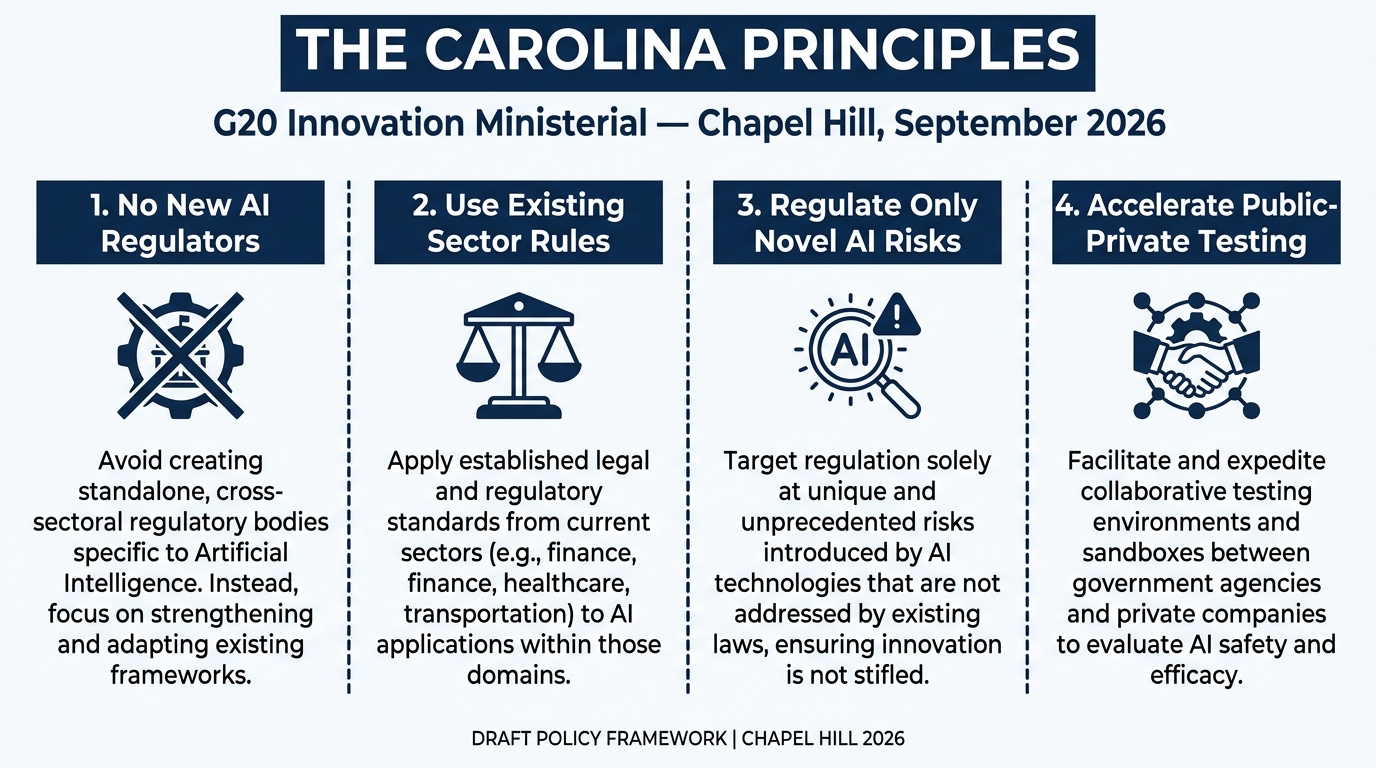
The Carolina Principles: What the Text Actually Says
The Carolina Principles are a concise, non-binding political declaration. They do not create enforcement mechanisms, impose compliance obligations, or establish any new international institution. What they do is signal — and in international policy, signals carry real weight because they shape what comes next in domestic legislation, bilateral negotiations, and standard-setting bodies.
Here is what the framework actually contains, in plain terms:
Pillar One: Avoid Creating New AI-Specific Regulators
The first and most consequential pillar is a direct instruction to G20 governments: do not stand up new agencies or regulatory bodies whose primary mandate is overseeing AI. This is a pointed rebuke of the EU model, where the AI Office — a new institution within the European Commission — now has supervisory, investigative, and enforcement authority over general-purpose AI models. The U.S. position is that existing regulators (the FTC, the FDA, the SEC, financial supervisors) are adequate for most AI risks if they are given the resources and interpretive guidance to handle AI-specific questions within their existing mandates.
Pillar Two: Use Existing Sector Rules First
The second pillar operationalizes the first. Rather than writing horizontal AI legislation that cuts across industries, G20 governments are encouraged to apply existing sectoral regulation — with AI-specific interpretation guidance where needed — as the primary governance mechanism. AI in credit decisions should be governed by existing fair lending law. AI in drug development should fall under existing pharmaceutical regulation. The principle sounds sensible in isolation, but critics note that existing sector rules were not written with AI failure modes in mind, and the gaps can be significant.
Pillar Three: Reserve New Rules for Genuinely Novel Risks
The third pillar creates a threshold for when new regulation is appropriate: only when AI creates genuinely novel considerations that existing frameworks simply cannot address. In practice, this raises an immediate definitional problem — what counts as “novel” is deeply contested. Deepfakes, autonomous weapons, real-time biometric surveillance, and AI-generated financial manipulation could all plausibly qualify. But so could systems that existing consumer protection or privacy law arguably already covers, depending on how aggressively regulators are willing to interpret their mandates.
Pillar Four: Invest in Foundational Research and Commercialization
The fourth pillar is the most explicitly pro-innovation element. G20 governments commit — again, non-bindingly — to investing in foundational AI research, supporting the testing and validation infrastructure needed to move from lab to market, and removing bottlenecks that slow commercialization. This is as much an industrial policy statement as a governance one, and it reflects the view that the primary risk of bad AI policy is not insufficient oversight but insufficient speed.
What the Principles Do Not Say
Perhaps as important as what the Carolina Principles contain is what they deliberately omit. There is no mention of mandatory pre-deployment testing for high-risk systems. No reference to model transparency or explainability requirements. No framework for liability when AI systems cause harm. No commitment to data rights or algorithmic accountability. These absences are not accidental — they represent exactly the kind of obligations that the U.S. wanted to keep off the G20 agenda.
Why the U.S. Pushed a Non-Binding Framework — The Strategic Logic
The choice of a non-binding declaration rather than a binding treaty is itself significant. It is easy to read non-binding as meaningless, but that misunderstands how international norm-setting actually works.
Locking In the Baseline
When 20 of the world’s largest economies — collectively representing roughly 85% of global GDP — endorse a set of governance principles, those principles become the de facto starting point for future negotiations. A country that subsequently wants to impose stricter AI rules must now argue against a G20-endorsed baseline, not just articulate its own preferences from scratch. The Carolina Principles, even without enforcement teeth, shift the burden of proof in international AI governance debates toward those who want more regulation.
Protecting U.S. Firms in Foreign Markets
From a commercial standpoint, the framework creates soft pressure on G20 member states not to impose market-access conditions on AI systems that go beyond what the Carolina Principles contemplated. A country that adopts mandatory pre-deployment audits for all large language models, for example, would be implicitly stepping outside the G20 consensus it just endorsed. That does not prevent the policy — non-binding frameworks never do — but it creates political friction that can delay or moderate stricter measures.
The Copyright Subtext
Running alongside the main governance framework was a parallel U.S. push on training data. American officials argued explicitly that AI firms should be permitted to train models on copyrighted works under fair-use principles, without needing to negotiate licenses or pay royalties. This was not formally incorporated into the Carolina Principles text, but the broader message — use existing law, don’t create new AI-specific restrictions — implicitly supports that position on copyright as well. For U.S.-headquartered AI firms currently facing litigation over training data, a G20-endorsed norm that discourages new AI-specific copyright rules is materially valuable, even if courts ultimately decide each case on its own facts.
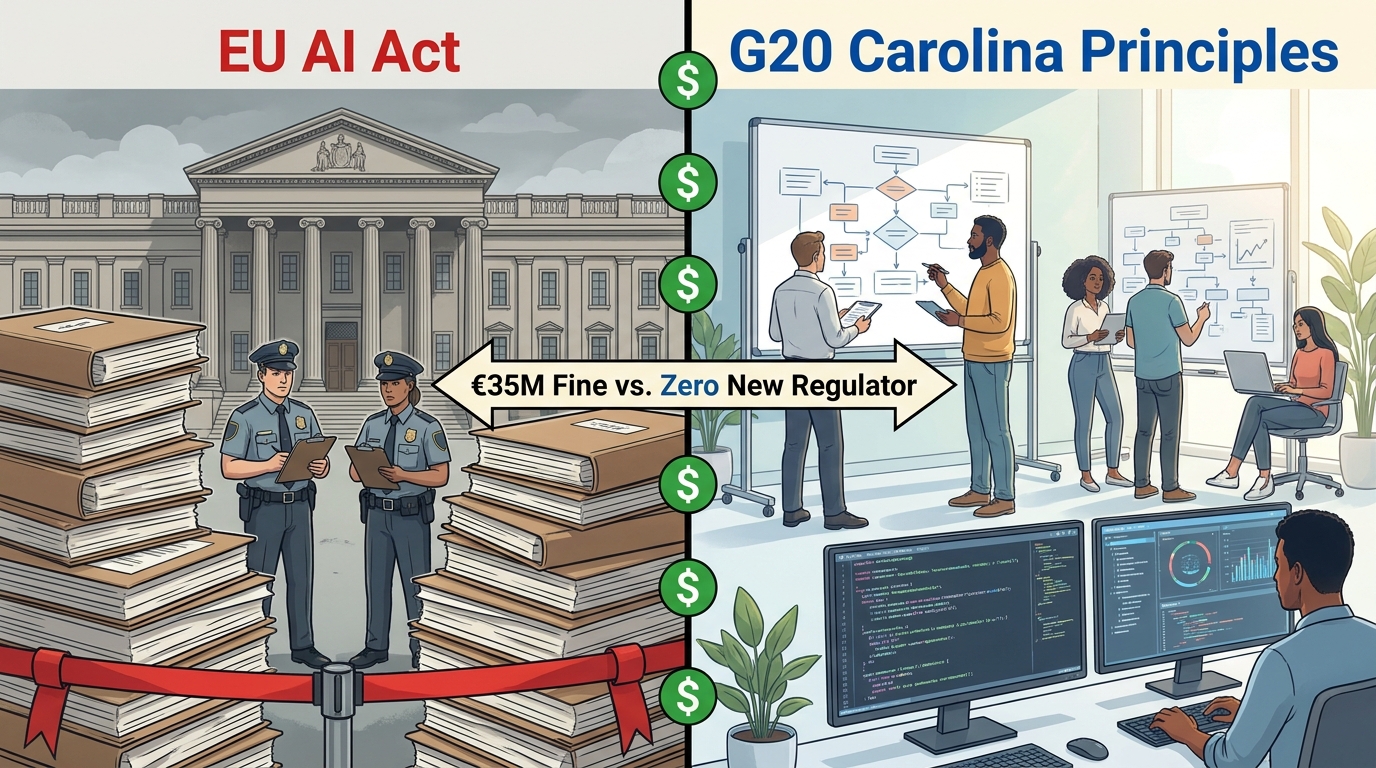
The EU-G20 Divide: Two Worlds, One Compliance Bill
The most operationally significant consequence of the September 2026 G20 ministerial is not what it achieves in the markets where lighter touch prevails — it is what it fails to resolve in the markets where it does not.
The European Union did not abandon the AI Act because G20 ministers endorsed the Carolina Principles. It could not, constitutionally and practically, even if it wanted to. The EU AI Act entered active enforcement on August 2, 2026 — one month before the Chapel Hill meeting — and the AI Office has been actively supervising, investigating, and preparing enforcement action since then. For multinational companies, the G20 consensus changes nothing about their EU compliance obligations.
What EU Enforcement Actually Looks Like in 2026
The EU’s enforcement architecture in August 2026 is more targeted than the sweeping pre-deployment review some early commentary suggested it would be. The July 2026 “Digital Omnibus” amendment delayed certain high-risk AI obligations that had been scheduled to activate, reducing the immediate compliance surface area for many companies. But the obligations that are live are substantial:
- General-Purpose AI (GPAI) oversight: The AI Office has active supervisory authority over large foundation models, including documentation, capability evaluation, and systemic risk reporting requirements.
- Prohibited practices: Systems that use subliminal manipulation, exploit vulnerabilities, or enable real-time biometric surveillance in public spaces are banned outright, with enforcement beginning immediately.
- Transparency obligations: AI-generated content, chatbots, and emotion-recognition systems face disclosure requirements that are already active.
- Fines: Penalties of up to €35 million or 7% of global annual turnover for the most serious violations, with tiered penalties for lesser breaches.
The Compliance Cost Gap
Independent analysis puts the cost of baseline high-risk AI compliance under the EU Act at roughly €320,000 to €600,000 per entity per system — and that is for companies that are relatively well-prepared. For large enterprises deploying multiple AI systems across multiple EU markets, first-year rollout costs have been estimated in the $8 million to $15 million range. These are not hypothetical future costs. They are being incurred now, in Q3 and Q4 2026, by legal, technology, and compliance teams that are building the documentation, testing, monitoring, and governance infrastructure the regulation requires.
For a company headquartered in the United States or another G20 jurisdiction that has aligned with the Carolina Principles, this creates a structural asymmetry: you get the lighter-touch environment at home and the full weight of EU enforcement the moment your system touches European users. The G20 signal does not lighten that load by a single euro.
Interoperability Is Not Happening Yet
There was hope in earlier years that international regulatory coordination — through bodies like the OECD or through bilateral U.S.-EU technical dialogues — might produce enough alignment to let companies build a single compliance architecture that satisfied both regimes. That hope is now on hold. The Carolina Principles and the EU AI Act represent different theories of governance, not just different levels of strictness. The EU approach is rights-based, accountability-centered, and horizontally structured. The U.S. approach is market-confidence-based, sector-specific, and voluntarist. These are not easy to reconcile technically, and the political will to try does not currently exist on either side.
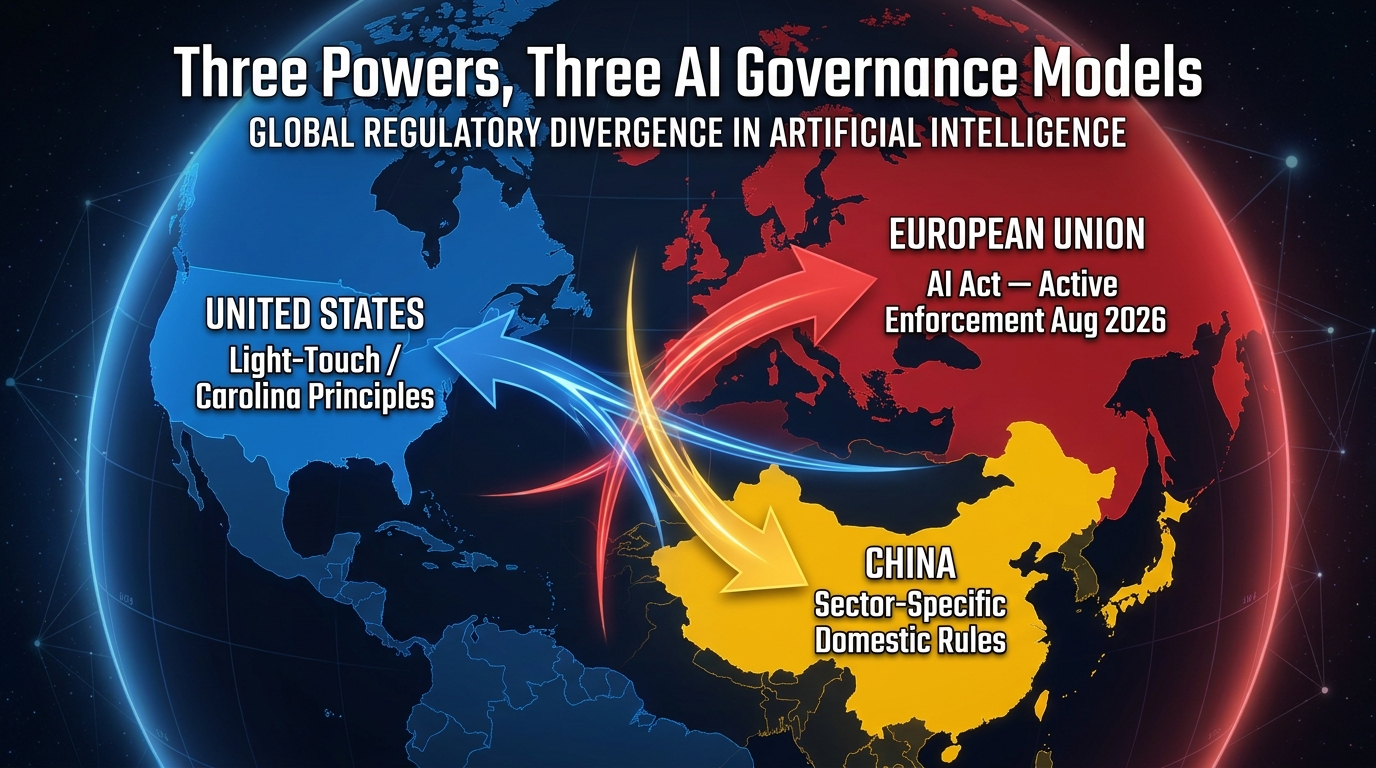
China’s Position: Heavy Domestically, Light Globally
China’s participation in the Carolina Principles consensus is, on its face, counterintuitive. The Chinese domestic AI regulatory environment is not light-touch. It is, in fact, one of the most detailed and prescriptive in the world — covering algorithmic recommendation systems, deep synthesis (deepfakes), generative AI content, and a dense web of sector-specific rules that give Chinese authorities substantial oversight over how AI systems operate within Chinese borders.
So why did China endorse a G20 framework that discourages exactly the kind of AI-specific regulatory architecture it has built at home?
The International vs. Domestic Distinction
Chinese AI policy has always operated on two tracks. Domestically, the state maintains extensive control over AI systems — particularly those that touch content, public opinion, or data sovereignty. Internationally, China has consistently opposed binding global AI governance that could constrain its firms operating abroad, subject its technology to external audit requirements, or create multilateral oversight bodies where Western countries hold disproportionate influence. Endorsing a G20 framework that discourages new international AI regulators and binding global rules is entirely consistent with China’s international posture, even if it contradicts its domestic one.
Market Access Considerations
Chinese AI firms expanding into G20 markets — particularly in Southeast Asia, Africa, and Latin America — benefit from a global baseline that does not include requirements for external transparency, algorithmic auditability, or data localization rules they do not apply domestically. A lighter global framework is operationally advantageous for Chinese firms in the same markets where U.S. firms operate, which partly explains why Beijing found it easier to align with Washington on this issue than on almost any other technology policy question.
The Financial Stability Wildcard: When the FSB Disagrees
The most significant institutional counterpoint to the Carolina Principles did not come from the EU or from civil society — it came from within the G20 system itself.
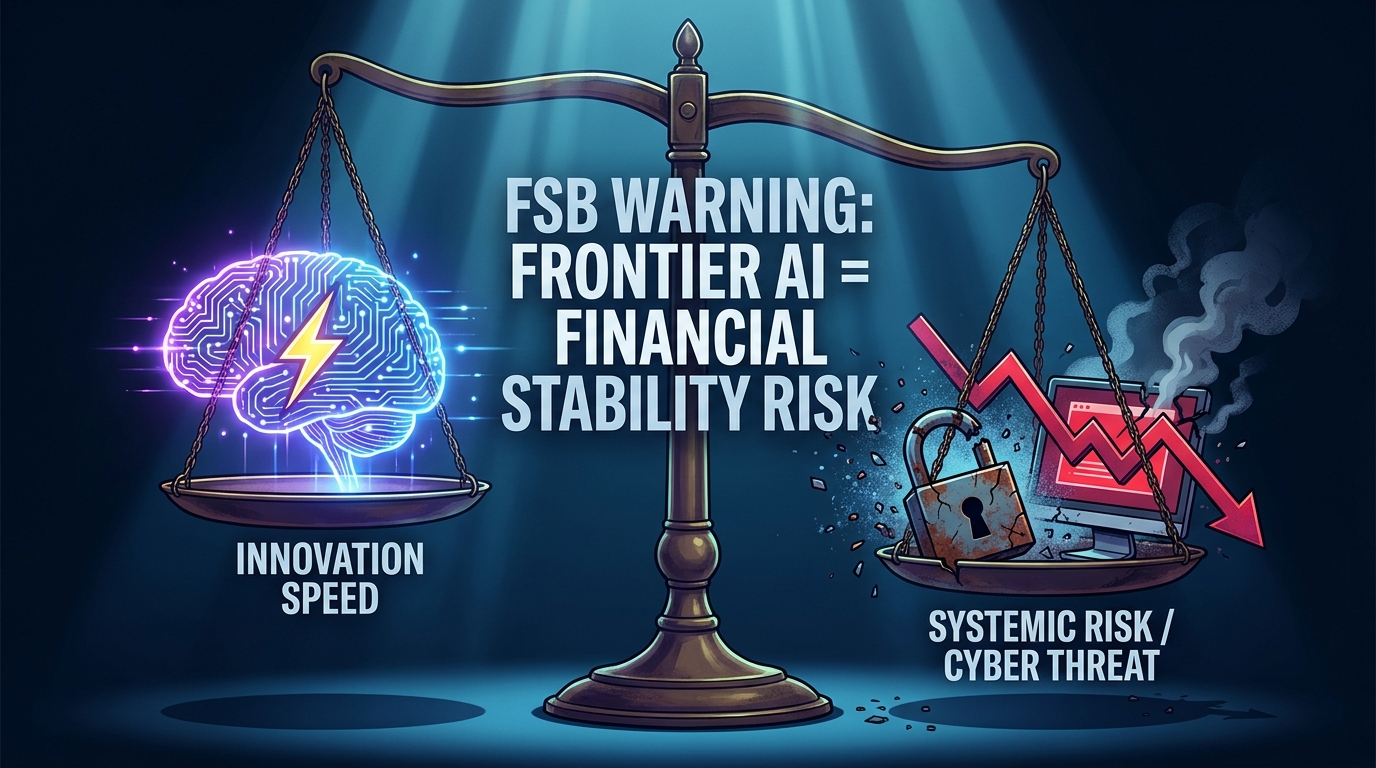
In late August 2026, just days before the Chapel Hill ministerial, the chair of the Financial Stability Board sent a letter to G20 finance ministers warning that frontier AI had become a financial stability issue. The letter was not about algorithmic bias or labor market displacement. It was about something more immediate and more technical: the risk that advanced AI systems could materially accelerate cyberattacks on financial infrastructure, spread disruption rapidly across interconnected systems, and create systemic concentration risk through the dominance of a small number of AI providers in critical financial services.
Three Specific Risks the FSB Identified
Cyber risk acceleration. Frontier models dramatically lower the cost and skill threshold for sophisticated cyberattacks. Adversarial actors — including state-sponsored ones — can use frontier AI to identify vulnerabilities at scale, generate novel malware, and conduct social engineering operations with a speed and personalization that legacy defenses are not built to handle. The FSB’s concern is not that banks will deploy AI recklessly; it is that the same AI capabilities they are deploying are simultaneously being used against them.
Concentration risk. A striking number of financial institutions are relying on a very small number of AI providers for core infrastructure. When a handful of frontier model providers supply the critical intelligence layer for risk assessment, fraud detection, trading, and customer service across the global financial system, a failure — technical, security-related, or regulatory — at one of those providers creates systemic exposure that individual institution risk management cannot address.
Regulatory gaps in model deployment. The FSB’s letter specifically noted that many jurisdictions currently lack clear protocols for the development, release, and deployment of advanced AI models in financial services. This is precisely the gap that the Carolina Principles, by discouraging new AI-specific regulation, leave unfilled. The FSB’s message, implicitly, was that sector-specific rules are necessary but not yet sufficient — at least not in finance.
What the Global South Is Actually Getting From This Deal
The framing of the G20 AI governance debate — U.S. light touch versus EU heavy hand — tends to obscure the interests and concerns of the majority of G20 members, many of which are developing economies with their own distinct relationship to AI technology.
Brazil, India, South Africa, Mexico, Indonesia, and other G20 members from the Global South endorsed the Carolina Principles, but their reasons for doing so are more complex than simple alignment with U.S. positions.
Capacity Before Compliance
For many developing-economy governments, the prospect of mandatory pre-deployment AI audits, algorithmic accountability requirements, and AI-specific oversight bodies is not primarily a freedom-to-innovate question — it is a capacity question. These governments do not currently have the technical talent, institutional infrastructure, or regulatory bandwidth to implement EU-style AI oversight even if they wanted to. A lighter-touch framework that relies on existing sector rules reduces the compliance gap between what is required and what is achievable in the near term.
The Development-Oriented AI Agenda
Alongside the governance debate, G20 working groups have been running a parallel track focused on what might be called development-oriented AI policy: commitments to digital public infrastructure, AI capacity building in developing economies, technology transfer, and multilingual AI ecosystem development. This track represents what developing economies actually want from G20 AI governance — not just a lighter compliance burden, but active investment in the infrastructure that would let them benefit from AI rather than simply import it.
The risk that experts in this space consistently flag is that the lighter-touch governance framework, by reducing the pressure on major AI producers to comply with accountability standards, may also reduce the leverage that smaller economies have to shape how AI systems are built and deployed in their markets. When global AI governance is minimalist and non-binding, the de facto rules are written by the companies with the largest model capabilities — which are, overwhelmingly, headquartered in the United States and China.
Data Sovereignty Tensions
Several G20 developing-economy members have significant concerns about data sovereignty — about whether AI systems trained on their citizens’ data, deployed in their markets, and monetizing their information flows are subject to any meaningful accountability in those countries. The Carolina Principles, by discouraging new AI-specific governance mechanisms, do not address these concerns. The informal assurance is that existing privacy and data protection law covers them. But in many developing-economy G20 members, those existing laws are themselves immature, poorly enforced, or designed for a pre-AI regulatory context.
Copyright, Training Data, and the Fair-Use Gamble
One of the more consequential but underreported dimensions of the Chapel Hill ministerial was the U.S. push on training data copyright. American officials argued — to a G20 audience that included countries with very different copyright traditions — that training AI models on copyrighted works should be permissible under fair-use principles, without requiring licensing agreements or royalty payments to creators.
This is a live legal controversy in the United States, not a settled question. Several major copyright cases involving AI training data are currently working through the U.S. court system, with plaintiffs arguing that scraping and training on copyrighted works without permission is infringement regardless of whether the output reproduces protected content directly. The U.S. government’s position at Chapel Hill was, in effect, an attempt to establish a favorable international norm before domestic courts have definitively ruled.
What “Use Existing Law” Means for Copyright Internationally
The Carolina Principles’ instruction to use existing law rather than create AI-specific rules has a very different practical meaning when applied to copyright across G20 jurisdictions. Fair use is a distinctly American doctrine. The UK uses a similar “fair dealing” framework with different parameters. The EU has specific text-and-data mining (TDM) exceptions under the Digital Single Market Directive — exceptions that are narrower than U.S. fair use in some respects and require opt-out mechanisms for rights holders. Japan has a permissive information analysis exception. Many G20 members have no equivalent exception at all.
Telling twenty countries to apply “existing law” to AI training data copyright means twenty different answers, which may be fine from a U.S. competitive standpoint — American firms operate most easily in the U.S. legal environment — but does not produce the international clarity that content creators, AI firms, or IP lawyers actually want.
The Creator Economy Response
Creator organizations, publishing groups, and rights-holder associations in multiple G20 countries have responded to the Chapel Hill framing with predictable concern. Their argument is that “use existing law” effectively means “allow AI firms to do what they are already doing while litigation proceeds,” and that without a G20-level commitment to creator compensation or licensing frameworks, the default outcome is a global training data market with no minimum accountability floor. Some European creator organizations have specifically pointed to the EU TDM opt-out mechanism as a model that the G20 consensus would make harder to replicate internationally.
The Two-Track Regulatory Reality for Businesses Operating Globally
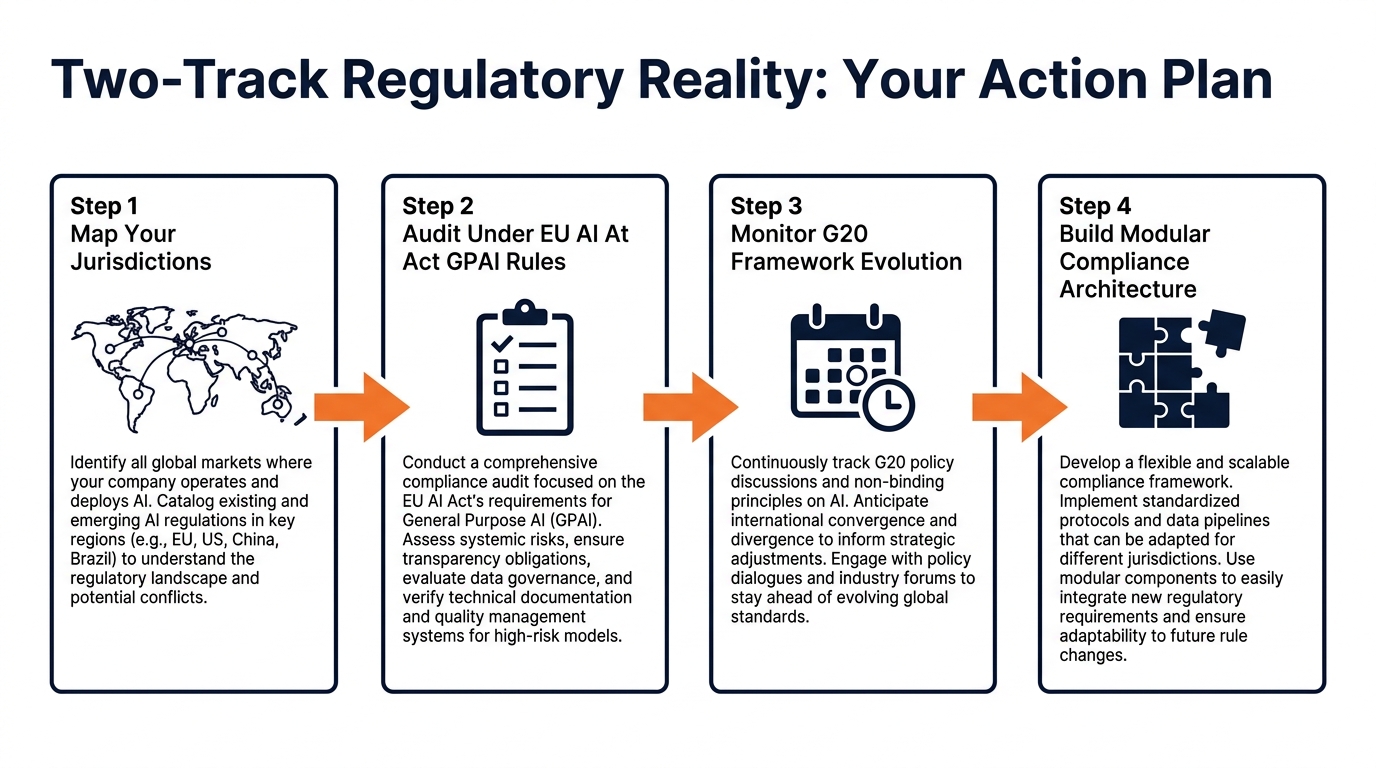
For companies deploying AI systems across multiple jurisdictions in late 2026 and beyond, the practical implication of the G20-EU divergence is not a choice between two regulatory environments — it is the requirement to manage both simultaneously, with no harmonization in sight.
This is the most significant operational consequence of the September 2026 moment, and it deserves more attention than the headline-level “lighter rules” framing suggests.
The Compliance Architecture Problem
Companies that were hoping the G20 moment would simplify their AI governance architecture need to recalibrate. If anything, the divergence between the G20 consensus and EU enforcement has made the architecture problem harder, not easier. Previously, the dominant compliance strategy for global companies was to build to the EU standard — since it was the strictest — and accept that this would be over-compliant in less regulated markets. That strategy still works for the EU, but the growing possibility that some G20 markets will move in a fundamentally different regulatory direction (sector-specific rules, no new AI agencies, minimal transparency requirements) means that a single EU-grade architecture may carry significant cost overhead in markets where that overhead provides no regulatory benefit.
The alternative — modular compliance architecture, where the EU-facing layer sits on top of a lighter common baseline — requires more sophisticated governance design but better matches the actual regulatory landscape companies will operate in over the next five years.
Sector-Specific Exposure Varies Dramatically
The practical impact of the G20 framework also varies significantly by industry sector, in ways that aggregate headlines miss. Financial services firms face the most complex environment: the EU AI Act’s transparency and documentation requirements apply fully, the FSB has flagged specific financial-stability risks from frontier AI, and existing financial regulation in most G20 jurisdictions was not written to handle AI-specific failure modes. Healthcare companies face a similar double bind — existing FDA and CE-mark pathways are being stretched to accommodate AI medical devices, and the Carolina Principles do not provide clarity on where the gaps are.
In contrast, enterprise software companies deploying AI-powered productivity tools in domestic U.S. markets may find the lighter-touch environment genuinely easier to navigate — fewer documentation requirements, no mandatory pre-deployment testing, no AI-specific oversight body to satisfy. The G20 signal is not irrelevant for them; it reduces the risk that a future Congress or administration will impose EU-style pre-deployment requirements. But it also means these companies are operating on a foundation of voluntary best practice rather than enforceable accountability, which carries its own long-term reputational and liability risks.
The Counterargument: Why Some Experts Think This Is Riskier Than It Looks
The Carolina Principles have received broad criticism from AI safety researchers, consumer advocates, labor groups, and some financial regulators — and the arguments are substantive enough to warrant serious engagement rather than dismissal.
The “Novel Risk” Threshold Is Undefined
The framework’s instruction to regulate only “novel considerations” that existing law cannot address sounds like a clear principle until you try to apply it. What qualifies as novel? Is AI-enabled discrimination in hiring novel, or does it fall under existing employment law? Is AI-generated disinformation novel, or covered by existing defamation and election law? Is an autonomous AI agent that enters contracts on a user’s behalf novel, or governed by existing contract and agency law? Every one of these questions is the subject of active legal debate in multiple G20 jurisdictions, and the Carolina Principles provide no mechanism for resolving them.
Critics argue that “use existing law” becomes a procedural delay mechanism in practice: by the time courts and regulators interpret existing rules to apply them to AI-specific scenarios, the technology has moved on, the harm has occurred, and affected individuals have limited recourse. The EU’s approach — establishing ex ante accountability requirements before deployment — was explicitly designed to avoid this sequence. The Carolina Principles implicitly accept it.
Non-Binding Means Non-Enforced
The framework’s non-binding character is both its political strength (it was easier to get 20 governments to sign) and its governance weakness. There is no mechanism to track compliance, no review process to assess whether governments are actually applying the principles, and no consequence for a government that endorses the principles and then does something entirely different in domestic legislation. In this respect, the Carolina Principles resemble the many voluntary AI ethics commitments that major technology companies have made and largely failed to operationalize — aspirational statements that are not coupled to accountability structures.
Concentration Risk Gets Worse, Not Better
Several AI safety researchers have argued that lighter-touch regulation, by reducing barriers to deployment and reducing compliance costs, will accelerate the concentration of AI capability in the small number of frontier model providers that can afford to develop it. If the number of entities controlling the most powerful AI systems remains extremely small — currently, it is genuinely small, perhaps a dozen organizations globally with frontier-level capability — and if governance is left primarily to existing market and legal mechanisms, the structural incentives for those entities to prioritize safety over speed or profit over accountability are weak. The argument is not that more regulation automatically produces better AI; it is that minimal regulation with no accountability architecture creates conditions where concentrated AI power goes effectively unchecked.
What Companies Should Actually Do Right Now
The G20 moment does not give businesses a permission slip to deprioritize AI governance. What it does is change the landscape in which AI governance decisions get made. Here is how responsible organizations should respond to the new environment:
Step One: Map Regulatory Exposure by Jurisdiction, Not by Headline
Stop using G20 consensus or EU Act as shorthand for your entire regulatory environment. Map the specific AI systems you are deploying against the specific regulatory requirements that apply in each market where those systems touch users. For EU-facing systems, the AI Act applies regardless of where your company is headquartered. For systems deployed only in the U.S. or other G20-aligned markets, the immediate regulatory surface area is genuinely lighter — but existing sector rules (financial, healthcare, employment, consumer protection) still apply and are beginning to be interpreted to cover AI-specific scenarios.
Step Two: Audit Against EU GPAI Requirements If You Have a Foundation Model
If your company develops or deploys a general-purpose AI model that is made available in the EU market — directly or through an API — the AI Office’s GPAI oversight requirements are live. This includes documentation of training data sources and methodology, capability evaluations, systemic risk assessments for models above certain compute thresholds, and ongoing monitoring and incident reporting. These obligations do not have a grace period. Companies that have not yet mapped their GPAI exposure should treat this as an immediate priority, not a medium-term compliance project.
Step Three: Build for Modular Compliance, Not Single-Standard Compliance
Given the divergence between EU requirements and the G20 baseline, the most resilient AI governance architecture is one that separates the EU-grade documentation and accountability layer from the lighter common baseline. This allows companies to maintain full EU compliance where required without imposing that full overhead on AI systems that only operate in lighter-touch jurisdictions. The design requires more upfront governance architecture work but significantly reduces long-term cost and operational complexity as the regulatory landscape evolves.
Step Four: Monitor the “Novel Risk” Threshold Actively
The Carolina Principles create a standing invitation for sector regulators to define what counts as “novel” AI risk in their domains — and several are already doing it. Financial regulators in multiple G20 jurisdictions are developing AI-specific guidance within existing prudential frameworks. Healthcare authorities are updating guidance on AI as a medical device. Employment agencies are issuing interpretive guidance on AI hiring tools under existing discrimination law. Each of these sector-specific developments represents a binding compliance requirement even within the lighter-touch G20 framework. Companies that assume “lighter touch” means “no new rules” are reading the framework too broadly.
Step Five: Do Not Let the Policy Debate Become Your Risk Management Strategy
The most dangerous response to the G20 lighter-touch signal is to treat favorable governance conditions as a substitute for substantive AI safety and accountability practices. Regulatory enforcement risk is only one dimension of AI risk. Reputational risk, liability risk, and operational risk from AI failure modes exist independently of whether there is a specific regulatory body authorized to investigate them. Companies that reduced their AI governance investment in response to the lighter regulatory environment will find that the first high-profile AI harm event in their sector creates a different kind of accountability — public, legal, and commercial — that no amount of favorable G20 language protects them from.
Conclusion: The Real Stakes of a Non-Binding Moment
The Chapel Hill ministerial and the Carolina Principles represent a genuinely significant moment in global AI governance — not because they resolve anything, but because they establish the terms on which the next several years of AI policy debate will occur. The U.S. has successfully set a lighter-touch baseline as the G20 consensus position. It has made it harder, politically and normatively, for international bodies to move toward binding global AI regulation. It has kept the training data copyright question unresolved at the international level. And it has done all of this with a non-binding document that carries no enforcement mechanism and creates no institutional home for implementation.
What comes next will be determined not by the Carolina Principles themselves but by what individual governments do in domestic legislation, what sector regulators decide “existing law” means applied to AI-specific scenarios, what the EU’s enforcement experience produces in terms of evidence and precedent, and what — if anything — the FSB’s financial stability warnings eventually trigger in terms of harder governance requirements for frontier models in financial services.
For businesses, the practical message is nuanced. The lighter-touch G20 environment is real — it reduces immediate compliance pressure in several major markets and signals that certain kinds of burdensome AI-specific regulation are less likely to materialize in the near term. But it coexists with live, actively enforced EU obligations, a growing body of sector-specific AI guidance in multiple jurisdictions, and an unresolved set of liability, safety, and accountability questions that voluntary frameworks do not address.
The companies best positioned for the next five years of AI governance will not be the ones that moved fastest because the G20 told them the rules were light. They will be the ones that built governance architectures sophisticated enough to handle two regulatory worlds at once — and that maintained substantive AI accountability practices even when no one was officially requiring them to.
The G20 stepped back. That does not mean the risks did.
Key Takeaways:
- The Carolina Principles are non-binding — they shift international norms but create no enforcement mechanisms and no new institutions.
- EU AI Act enforcement is active as of August 2026, with fines up to €35M or 7% of global turnover. G20 consensus does not affect this.
- The “use existing law” instruction means different things in different jurisdictions — it is not a uniform standard.
- Financial stability authorities (FSB) have flagged frontier AI as a systemic risk through cyber channels, creating potential for harder financial sector rules regardless of G20 posture.
- Multinational companies need modular compliance architecture, not a single-standard approach.
- The Global South endorsed lighter governance partly from capacity constraints — not simply from preference for minimal oversight.
- Voluntary governance frameworks are not substitutes for substantive AI safety practices. Reputational and liability risk exists independently of regulatory enforcement risk.