


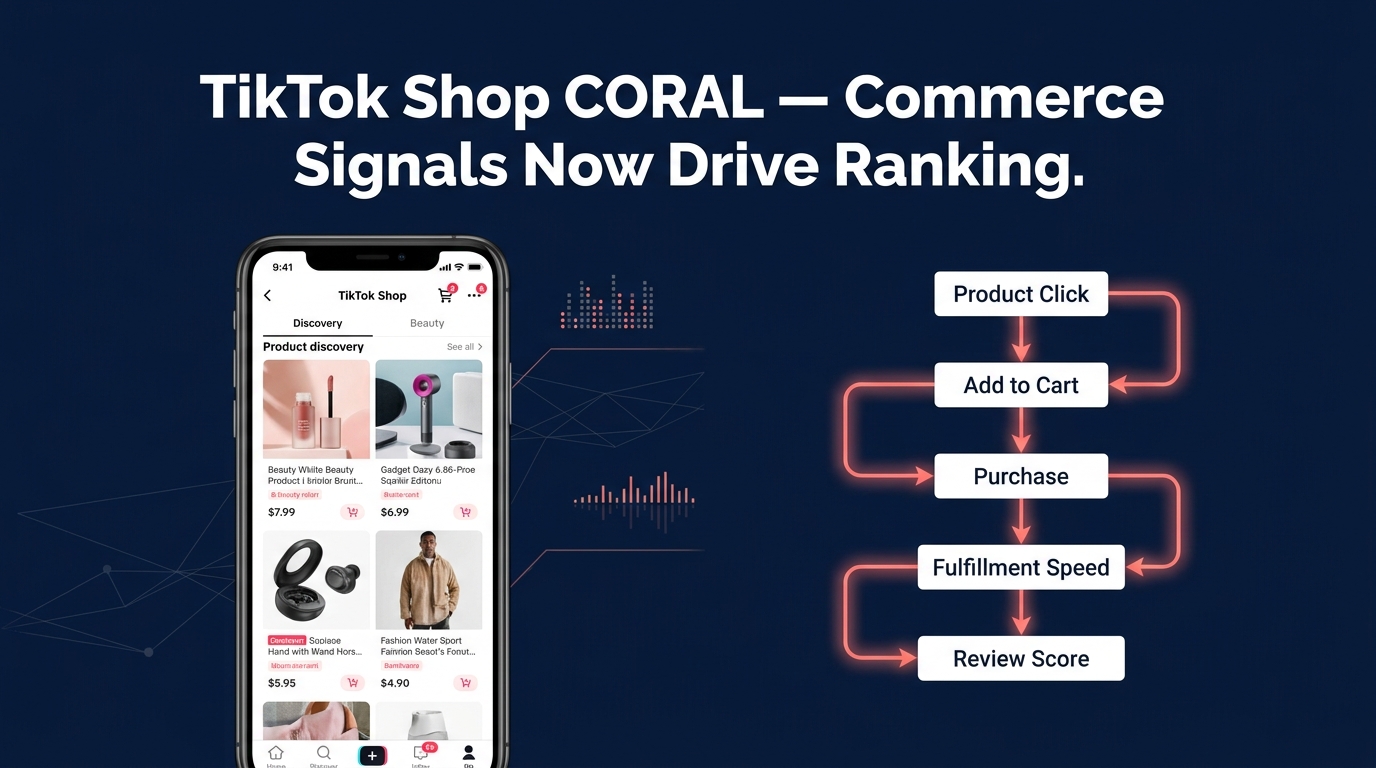

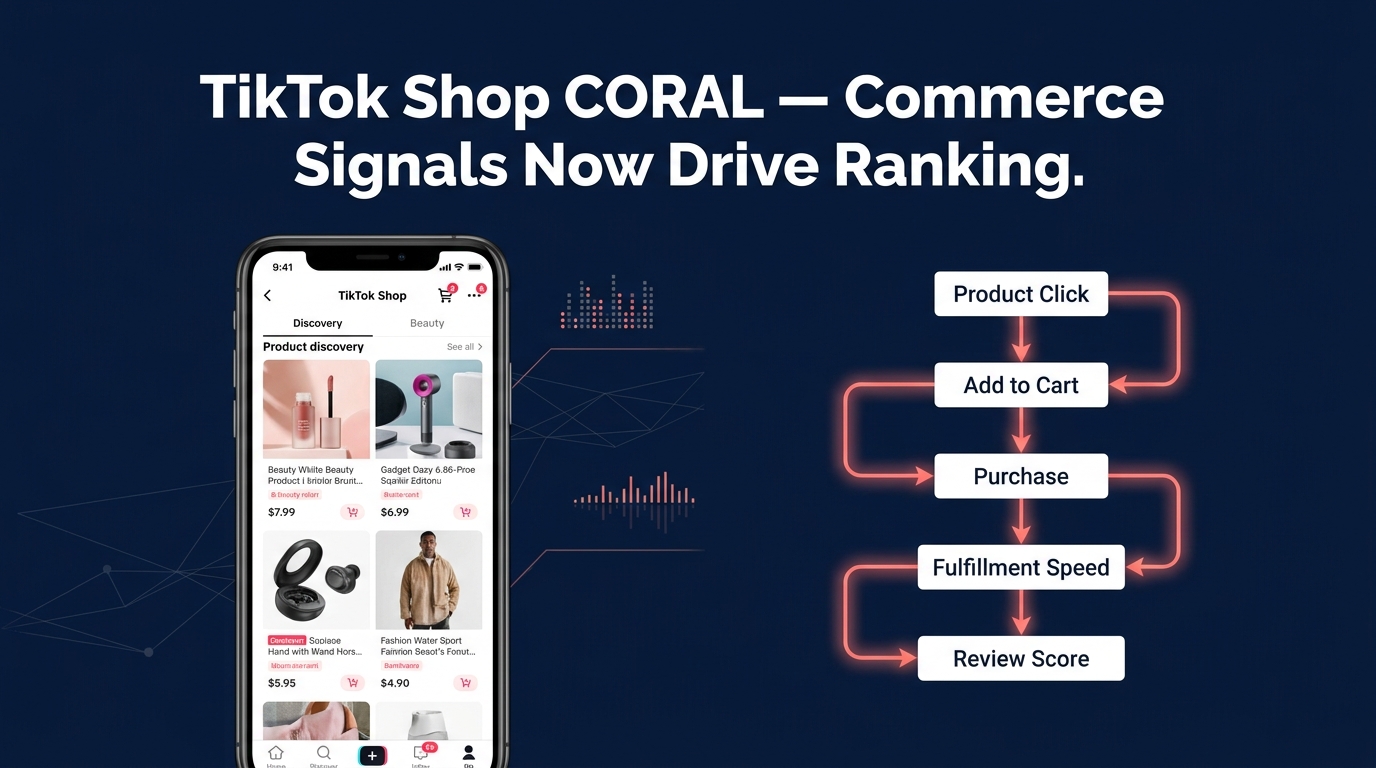
On June 12, 2026, something shifted inside TikTok Shop’s product discovery engine. The change wasn’t announced with fanfare. There was no seller center memo, no press release. But across operator communities and agency dashboards, sellers started noticing that the old playbook — flood the zone with affiliate creators, stack views, watch revenue follow — was producing diminishing returns. Products with strong engagement numbers but weak purchase rates began losing ground. Storefronts with fast shipping and fresh reviews started outranking rivals with bigger follower counts.
That shift has a name inside the industry: Coral.
TikTok has not officially published a document called “the Coral update.” But the behavior change it describes is real, measurable, and consequential. In simple terms, Coral represents TikTok Shop’s pivot from entertainment-first ranking logic to commerce-first ranking logic. It doesn’t mean content no longer matters. It means content that drives transactions now gets rewarded, while content that merely entertains — without generating downstream commerce signals — carries less weight in product discovery.
This is a significant distinction, and most sellers are not yet optimizing for it. They’re still measuring success in views, likes, and affiliate reach. Meanwhile, TikTok Shop’s recommendation engine is measuring product clicks, add-to-cart rates, completed purchases, fulfillment quality, and review density — and allocating distribution accordingly.
This post breaks down exactly how Coral’s commerce signal architecture works, how it reads differently across TikTok’s three discovery surfaces, what the affiliate-versus-brand content equation now looks like, and how to audit your own signal stack before your competitors do.
What Coral Actually Is (And What It Isn’t)
Before getting into mechanics, it’s worth being precise about what Coral is — and clearing up several misconceptions that have circulated since reports first emerged in June 2026.
Not a Content Algorithm Update
Coral is not a change to how TikTok ranks entertainment videos on the For You Page. TikTok’s core FYP recommendation system — which has always prioritized watch time, completion rate, shares, saves, and user-interest modeling — continues to operate largely as it has. What Coral modifies is the weighting layer applied specifically to commerce-linked content and product discovery surfaces. Think of it as a separate signal stack that runs in parallel to entertainment signals, specifically for shopping-tagged content, product cards, Shop tab results, and in-app search.
Not a Penalty System
Coral is not primarily about penalizing bad behavior. It’s about rewarding transactional signal depth. A seller who has been operating cleanly but hasn’t accumulated strong commerce signals — product clicks, add-to-cart events, completed purchases — won’t be “punished” per se. They’ll simply receive less distribution relative to products that have built those signals. The distinction matters because the optimization response is different: you’re not fixing a compliance problem, you’re building a signal stack.
Not One-Size-Fits-All Across Surfaces
Coral’s commerce signal weighting does not apply uniformly across every surface in TikTok Shop. The FYP still leads with content quality signals, adding commerce signals as a secondary layer. The Shop tab is more heavily commerce-first. Search is the most intent-driven surface, where product relevance and conversion track most directly. Understanding this surface-specific behavior is one of the most underutilized insights in current seller strategy.
The Context: TikTok Shop’s Scale Demands It
TikTok Shop’s US GMV hit $11.8 billion in H1 2026, up 103% year-over-year. Globally, the platform reached $50.3 billion in the same period, a 92% increase. With the US now back as TikTok Shop’s largest single market, and the Shop surface (as opposed to LIVE or FYP video) accounting for 51.4% of attributed GMV — up from 36% the year before — the platform is becoming a legitimate destination shopping surface, not just a discovery layer. That shift demands a ranking system built around commercial outcomes, not just attention metrics.
Coral is TikTok Shop’s answer to the complexity of managing a platform that is simultaneously an entertainment network and a purchase destination. The challenge it solves is distributional: how do you surface the products most likely to result in satisfied purchases, not just the ones attached to the most-watched videos?
The Five Commerce Signals That Now Drive Distribution
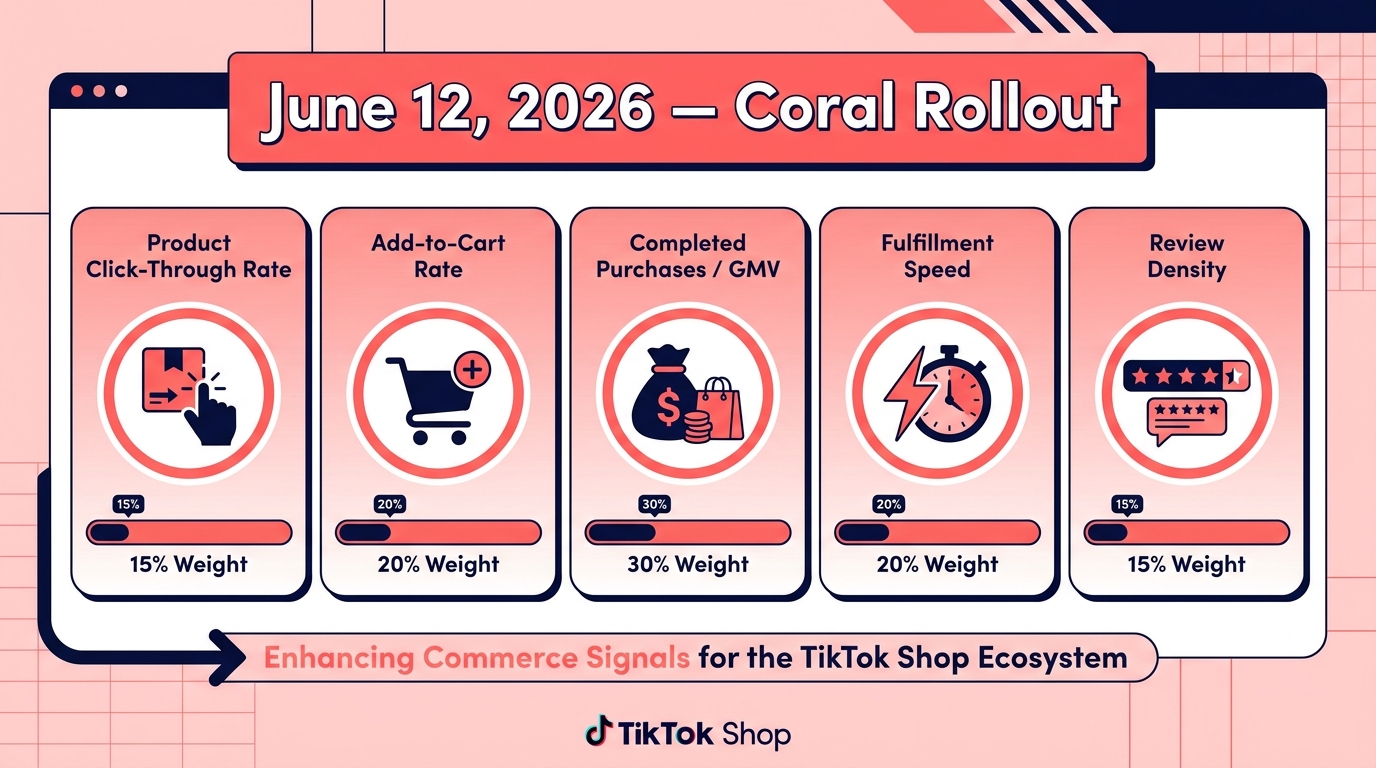
Coral’s commerce signal model reads five primary inputs when determining product distribution and ranking. These signals operate at the product level, not just the account level, which means individual SKUs can rank independently of their brand’s overall performance — and underperforming SKUs can drag strong products down if they share catalog weight.
1. Product Click-Through Rate (CTR)
CTR is the ratio of product card impressions to actual clicks. It’s the earliest commerce signal in the funnel — the moment a user in discovery mode chooses to engage with your product rather than scroll past it. Under Coral, CTR from both organic content (shoppable videos) and the Shop tab product grid feeds into your product’s distribution score.
Current benchmarks put a meaningful CTR range between 1.5% and 3.5% for most categories. Below 1% is a signal that the product card itself — typically the hero thumbnail, the title, and the price point — is failing to connect with the audience it’s reaching. Sellers who have seen distribution drops since June 2026 without changes to their content strategy often find the problem lives at the CTR level: the product is being shown, but not clicked.
The implication is that your product card is now a ranking input, not just a presentation choice. Thumbnail selection, the first three words of your title, and your displayed price relative to competitors all function as signals Coral reads and weights.
2. Add-to-Cart Rate
Add-to-cart rate captures mid-funnel intent. A user who clicks through to the product page and adds to cart without completing a purchase is still generating a positive commerce signal — one that tells the system the product is generating genuine buying consideration, even if the session didn’t convert. This matters particularly for higher-ticket categories where purchase cycles are longer.
Add-to-cart rate also functions as a diagnostic signal for sellers. If CTR is strong but add-to-cart is weak, the problem lives on the product detail page: images, description quality, price-value perception, or review score. Coral surfaces this gap by weighting add-to-cart separately from CTR, meaning a product with great thumbnails but a weak detail page will see its distribution signal stall at mid-funnel.
3. Completed Purchases and GMV Velocity
Completed purchases are the heaviest single signal in Coral’s commerce stack. This is where TikTok Shop’s ranking model diverges most sharply from its entertainment recommendation model: on the FYP, there’s no equivalent to a “completed purchase” signal. Coral introduced this as the primary downstream proof that a product-content pairing is delivering real-world value.
GMV velocity — the rate at which a product accumulates gross merchandise value over time — compounds this signal. A product that consistently converts over multiple days builds a stronger ranking position than one that spikes once and goes quiet. This is why chasing virality as a distribution strategy becomes less reliable under Coral: a single viral video might generate a GMV spike, but if the product doesn’t sustain conversion across subsequent impressions, its ranking gains erode quickly.
4. Fulfillment Speed and Buyer Experience Scores
Fulfillment speed entered Coral’s signal architecture as a new variable that previously had limited ranking influence. Reports from June–July 2026 consistently describe a sub-72-hour fulfillment threshold as a meaningful input. Sellers who ship within 48 hours see stronger distribution support than those averaging 4–5 days, all else being equal.
This is operationally significant because it means a seller’s logistics infrastructure now has a direct line to their product’s discovery performance. Sellers who manage inventory in ways that create fulfillment delays — overly optimistic stock levels, slow processing, carrier selection issues — are paying a distribution tax they may not even be aware of. The buyer experience score, which aggregates refund rates, dispute frequency, and return patterns, feeds into this same signal cluster.
5. Review Density and Recency
Review signals in Coral are measured in two dimensions: volume and recency. Volume establishes a baseline credibility threshold. A product with 500 reviews ranks from a stronger trust foundation than one with 12. But recency is what activates the signal in the current period. Coral appears to weight reviews received in the trailing 30 days more heavily than historical review totals, which creates a systematic advantage for products that are actively generating buyer feedback versus products coasting on reviews accumulated 6–12 months ago.
This is a particularly important nuance for sellers who launched aggressively in 2024 or early 2025, accumulated reviews quickly, and then stabilized. Their review recency signal may have decayed even as their total count remains high. Activating post-purchase review request flows — through seller center, through creator follow-up content, through product packaging inserts — becomes a continuous operational requirement, not a one-time launch tactic.
How Each Surface Reads Commerce Signals Differently
One of the most practically useful and least-discussed aspects of Coral is that it doesn’t apply a single uniform signal model across all of TikTok Shop’s discovery surfaces. The FYP, Shop tab, and Search function with meaningfully different signal hierarchies — and misunderstanding this leads sellers to optimize for the wrong surface at the wrong time.
The For You Page: Content Leads, Commerce Follows
On the FYP, content signals still lead the ranking model. Watch time, video completion rate, shares, saves, and comments remain the primary distribution triggers for shoppable videos. The critical threshold for broader distribution appears to be around 70% average completion rate — videos that hold viewers through most of the runtime get amplified, those that lose attention early do not.
What Coral added to FYP is a commerce signal layer that activates as a secondary filter. Two videos with similar watch time and completion metrics will now be differentiated by their downstream commerce performance: which one generated more product clicks, more add-to-carts, more purchases? Over time, the video with stronger commerce output receives proportionally more distribution, even if its pure entertainment metrics are comparable to competitors.
The practical implication for sellers is that FYP content strategy needs to be engineered for completion and purchase intent. A product demo that holds attention through a satisfying transformation or reveal — and then includes a clear, low-friction path to the product card — outperforms equally watchable content that doesn’t create a purchase-intent moment. The “entertainment first, sell quietly” approach still works on FYP, but the commerce signal has to actually fire.
The Shop Tab: Commerce Signals Dominate
The Shop tab is the surface where Coral’s commerce-first logic is most fully expressed. Users who navigate to the Shop tab are already in a shopping mindset — they’re not looking for entertainment, they’re looking for products. The ranking model in this context weights product click-through rate, add-to-cart behavior, purchase history, fulfillment scores, and shop health much more heavily than content signals.
This means that a seller with a highly entertaining video library but weak product card execution — poor thumbnails, unclear titles, sparse review counts — can be systematically outranked on the Shop tab by a seller with modest video performance but exceptional product presentation and conversion metrics. The Shop tab is increasingly the destination for TikTok’s most purchase-ready users, and it accounts for a growing share of platform GMV. Sellers who treat it as an afterthought and focus all optimization energy on FYP content are leaving significant GMV on the table.
Search: Intent Precision and Relevance-Conversion Alignment
Search in TikTok Shop functions closest to a traditional e-commerce search engine, and Coral’s signal weighting here reflects that intent. Query-to-product relevance is the entry point — if your listing’s title, attributes, and description don’t align with the search terms your target buyer uses, you won’t appear in the candidate set at all. But once in the candidate set, ranking is determined by conversion signals: which products, when shown to users who searched this query, produced the highest rates of product clicks, add-to-carts, and completed purchases?
This creates a clear optimization priority for search: semantic relevance gets you into the race, conversion performance determines where you finish. Sellers who keyword-stuff titles with search terms but have weak product pages will gain initial impressions and then lose ranking as their conversion signals underperform. Sellers who have precise title alignment and strong listing quality compound their search ranking over time as each conversion event reinforces their position for that query.
The Product Opportunities tool in TikTok Seller Center is the best native data source for identifying which queries in your category are generating high search volume with relatively few competitive products — a signal that demand exists but supply (and therefore the competition for those conversion signals) is limited.
The Affiliate vs. Brand Content Equation Under Coral
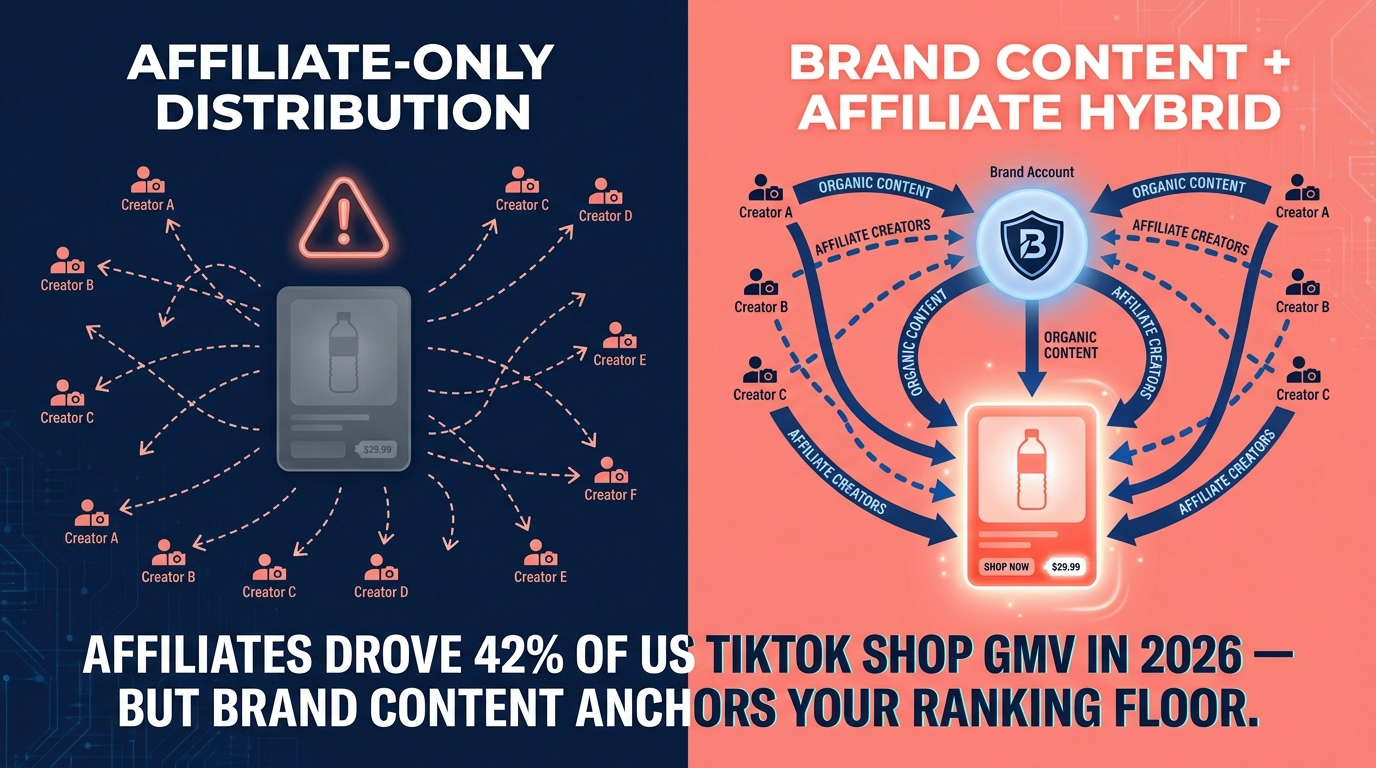
Affiliate content drove approximately 42% of US TikTok Shop GMV in the most recent 2026 measurement period. Video content overall contributed around 50%. LIVE commerce accounted for approximately 14%. These numbers make the case that affiliate distribution is still a powerful engine — and it is. But the way Coral interacts with affiliate-only versus hybrid brand-plus-affiliate strategies introduces a meaningful strategic distinction that didn’t exist at the same level 18 months ago.
The Affiliate-Only Problem
Under Coral’s current signal architecture, products that rely exclusively on affiliate creator content for their discovery and commerce signals face a specific vulnerability: if the brand account is inactive — posting no original content, running no brand-side LIVE sessions, showing no organic storefront activity — Coral appears to apply a lower distribution ceiling to the product, even if affiliate content is generating strong commerce signals.
The reported mechanism is that Coral uses brand account activity as a trust and authenticity signal. An active brand storefront that posts original content, responds to comments, and maintains consistent shop health metrics signals that the product is managed by a real, invested seller — not a dropshipper or low-quality reseller using creators as a front. Products associated with inactive brand accounts receive discounted distribution weight on their affiliate content, which shows up as organic reach erosion even when commission payments and creator partnerships remain active.
This is a problem that has particularly affected sellers who built their TikTok Shop business entirely through the Open Collaboration marketplace — recruiting affiliate creators without investing in brand-side content. Those sellers are now seeing flattened returns from the same affiliate volume that was working 6–12 months ago.
The Hybrid Model Coral Rewards
The content strategy that performs best under Coral is the one that generates commerce signals from multiple source types simultaneously: brand-owned content, affiliate creator content, and potentially GMV Max-amplified paid content all feeding the same product’s signal stack. Each source type contributes different signal characteristics.
Brand-owned content anchors the trust layer and establishes the product’s “home base” distribution floor. Affiliate creator content drives reach and introduces the product to audiences the brand can’t access directly. GMV Max amplification then extends the reach of whichever organic and affiliate content is already converting. The system learns from all three signal sources simultaneously, building a richer and more stable product ranking than any single channel can produce alone.
The practical implication is that “doing affiliate right” in 2026 means the brand account must stay active as an independent signal source. Even posting 2–3 original product videos per week from the brand account can provide enough brand-side signal to avoid the affiliate distribution discount. This is a low-cost investment relative to what’s at stake in distribution output.
Quality Over Volume in Creator Selection
Coral’s commerce signal focus also changes the calculus on creator selection for affiliate campaigns. Under an entertainment-signal-dominant model, the key selection metric was follower count or average video views — broad reach increased the probability of landing a viral hit. Under Coral, the relevant metric is commerce signal quality: a creator whose videos generate a 4% product CTR and 6% conversion rate is worth substantially more to your signal stack than a creator with 10x the audience but 0.8% CTR and 2% conversion.
This means affiliate campaign measurement needs to shift from impression-based metrics toward commerce-signal metrics. Sellers who track affiliate performance by views and engagement are not measuring the inputs Coral actually uses. Tracking product CTR per creator video, add-to-cart rate by creator, and attributed purchase rate gives a much more accurate picture of which creators are actually feeding your ranking, and which are generating noise.
Fulfillment as a Ranking Variable: The Operational Signal
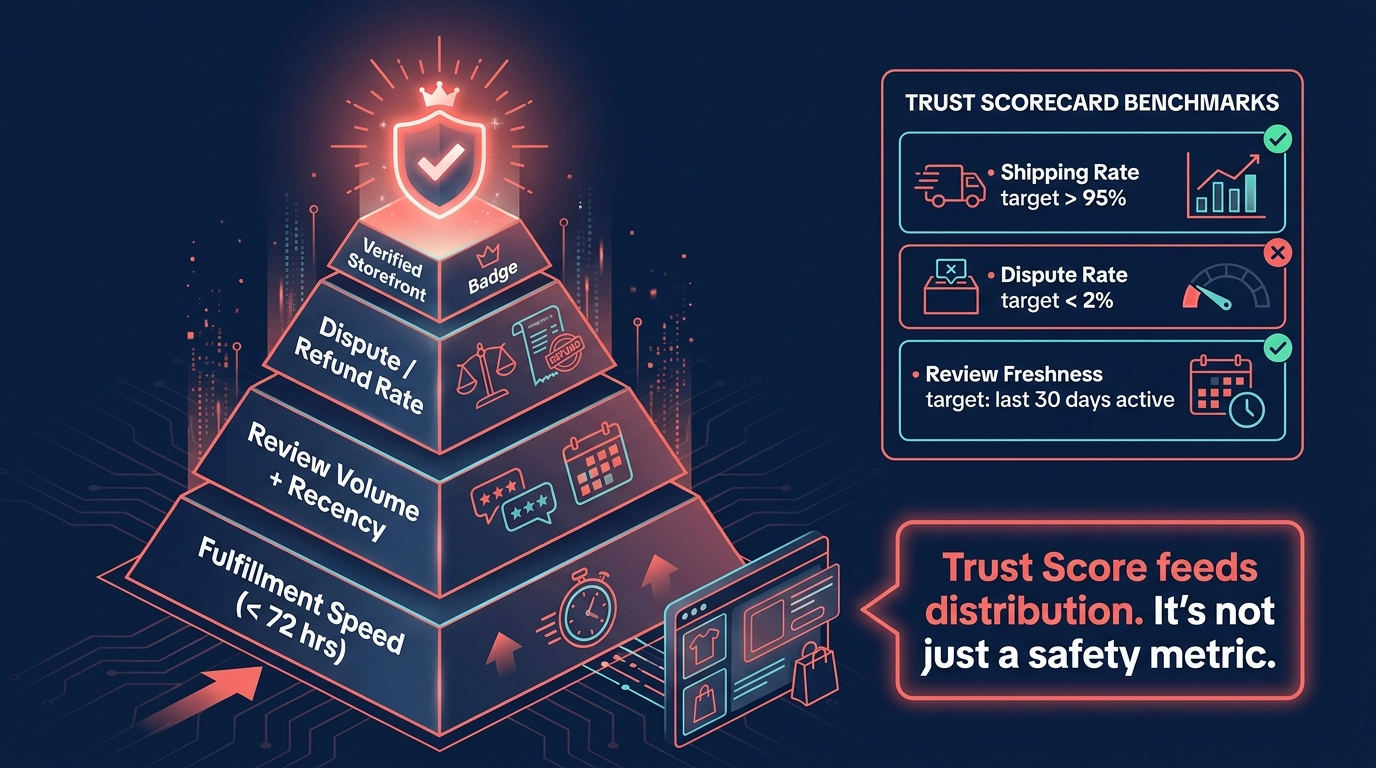
The inclusion of fulfillment speed as a direct ranking input is the part of Coral that has surprised sellers the most — particularly those who come from traditional social media marketing backgrounds and have never had to think about logistics as a content strategy variable. In TikTok Shop’s pre-Coral model, fulfillment was primarily a compliance issue: ship on time or face penalties. Under Coral, fulfillment is a distribution signal that actively boosts or limits your product’s organic reach.
The Sub-72-Hour Threshold
The 72-hour mark appears to be the meaningful threshold in current reporting. Sellers averaging fulfillment dispatch within 48 hours consistently outperform those in the 72–120 hour range, all else being equal. The signal Coral appears to read is not just on-time rate (which was already tracked) but speed: how quickly does this seller get a purchased product into the carrier’s hands?
This creates different operational challenges depending on seller structure. Brand-managed sellers with warehouse inventory and carrier integrations can typically hit 48-hour dispatch without significant process changes. Sellers running on just-in-time inventory, print-on-demand models, or international supplier fulfillment face a more material constraint. For those sellers, the ranking disadvantage is structural unless they either pre-position inventory domestically or restructure their supplier relationships.
TikTok’s 2026 fulfillment policy update — which moved further toward TikTok-approved carriers and integrated logistics tracking — is part of the same operational philosophy. When TikTok can verify fulfillment speed directly through carrier data rather than relying on seller self-reporting, the signal becomes more reliable and therefore more useful as a ranking input.
Buyer Experience Scores: The Downstream Signal Cluster
Beyond shipping speed, Coral aggregates several buyer experience indicators into what can be thought of as an operational trust score. Dispute rate (the percentage of orders resulting in formal disputes), refund rate, return rate, and customer service response time all feed into this score, measured over a rolling 30–90 day window.
Sellers with dispute rates above approximately 2% or refund rates that deviate significantly from category norms face distribution headwinds that are difficult to diagnose if you’re only looking at content and affiliate metrics. A product can have a beautiful listing, strong creator content, and excellent commerce signal momentum — and still see distribution plateauing because a buyer experience problem is being picked up in the operational signal layer.
The practical diagnostic is to review your Seller Center performance dashboard with Coral’s weighting in mind. Account Health Rating scores — which TikTok has made more visible in 2026 — aggregate many of these operational signals in one place. Treat that score as a distribution proxy, not just a compliance tracker.
Trust Score Architecture: Verification, Reviews, and Shop Health
Coral’s treatment of seller trust is more sophisticated than a simple binary (trusted/not trusted). It constructs what’s effectively a multi-layer trust score from several distinct credential and behavioral inputs. Understanding each layer helps sellers prioritize which trust investments produce the highest distribution returns.
Verification Status: Official Shop and Blue V
TikTok’s Shop Recognition Programme provides two primary trust credentials: the Official Shop designation (for verified brand owners and authorized resellers) and the Blue V badge (for high-performing, trusted sellers with a sustained track record of operational quality). These badges function as trust anchors that influence both buyer-facing conversion rates and Coral’s distribution signal weighting.
The channel-side implication is that unverified sellers competing against Official Shop-designated brands are operating with a structural trust deficit in Coral’s signal model, all else being equal. For resellers and distributors, pursuing official brand authorization (and the associated storefront verification) is increasingly a competitive necessity, not just a nice-to-have.
Review Architecture: Volume, Recency, and Content Quality
Coral’s review signal model breaks down into three components that sellers should think about distinctly. First, raw volume establishes a baseline credibility threshold — products with fewer than 20–30 reviews are below the confidence level needed for meaningful distribution support from review signals. Second, recency weights recent reviews more heavily than historical ones, creating the continuous review generation requirement described earlier. Third, content quality within reviews — particularly the presence of video reviews and image reviews — appears to carry additional weight, as these provide richer signal data about actual buyer satisfaction.
This means a post-purchase engagement strategy designed to generate rich reviews — not just star ratings, but photo and video reviews from real buyers — compounds the trust signal in a way that generic review request flows don’t. Creators who are given products and post honest video reviews that buyers then find and engage with are generating both content signals and review quality signals simultaneously.
Shop Health as a Dynamic Signal
Shop health in TikTok’s seller center is not a static score. It fluctuates based on recent operational performance across the trailing 30–90 days. This means a seller who has maintained a strong performance history can experience a temporary health dip from a fulfillment disruption, a product quality complaint cluster, or a policy violation — and see distribution effects within the same window.
The inverse is also true: a seller who has been operating with mediocre health scores can generate meaningful distribution improvements within 30–45 days by cleaning up operational issues, reducing dispute rates, and accelerating fulfillment. The signal is dynamic enough to respond to real operational improvements, which gives sellers a concrete path to recovery rather than a static penalty they can’t address.
GMV Max and Coral: How Paid and Organic Signals Interact
GMV Max — TikTok Shop’s campaign type that pools organic video, affiliate posts, and paid promotion into a single automated optimization — sits at the intersection of paid and organic commerce signal generation. Understanding how GMV Max interacts with Coral’s signal model helps sellers decide when and how to scale paid spend for maximum organic compound effect.
GMV Max as a Signal Amplifier, Not a Signal Creator
The clearest insight from 2026 operator guidance on GMV Max is that it functions best as a signal amplifier — it accelerates and extends the reach of commerce signals that already exist, rather than creating those signals from scratch. A product that has no meaningful purchase history, weak CTR, and no active creator content will not benefit significantly from GMV Max budget because the system has no quality signal to amplify. It will spend the budget but won’t compound into organic distribution gains.
Conversely, a product with a proven conversion rate, active affiliate content generating add-to-cart signals, and a solid review base is an excellent GMV Max candidate. The campaign can accelerate that product’s commerce signal accumulation — getting more impressions to audiences already likely to convert — in a way that builds ranking rather than just buying temporary reach.
The Learning Period and Signal Stability
TikTok’s own guidance on GMV Max consistently emphasizes avoiding frequent budget or targeting changes during the campaign learning period. This guidance connects directly to how Coral reads GMV Max signals. When a campaign is in its learning phase, the system is building a statistical model of which users, content types, and contexts produce the strongest commerce outcomes for a given product. Frequent changes reset this model.
Sellers who treat GMV Max like a traditional paid social campaign — adjusting bids daily, changing creative sets frequently, toggling targeting in and out — are disrupting the learning signal that Coral uses to build organic distribution momentum. The discipline of letting GMV Max learn on a consistent product and creative set for at least 2–3 weeks before making structural changes is not just an ad campaign principle; it’s a signal quality principle that affects organic ranking too.
ROI Targeting and Commerce Signal Calibration
GMV Max’s ROI target setting is another underutilized signal calibration lever. Setting an ROI target that’s too aggressive forces the system to restrict distribution to only the highest-probability buyers, limiting volume and therefore limiting the commerce signal accumulation rate. Setting the target too loose wastes spend on low-quality conversions that generate noisy signals. The calibration sweet spot is an ROI target that allows for meaningful purchase volume — building signal depth — while staying within margin-positive territory.
Current operator guidance suggests starting with a conservative ROI target close to break-even, letting the system accumulate purchase signals for 2–3 weeks, and then tightening the target incrementally as the organic distribution gains from accumulated signals reduce the reliance on paid promotion for each marginal unit of GMV.
Listing-Level Optimization for Coral’s Commerce-First Model
If commerce signals are the currency Coral trades in, then your product listings are the infrastructure that determines how well you can earn that currency. A seller with a sophisticated affiliate strategy and a strong fulfillment operation will still see underperformance if the product listing itself creates friction at the moment of evaluation — because every friction point is a signal not generated.
Hero Image: The CTR Lever
The hero image — the primary product card thumbnail shown in search results, the Shop tab, and as a preview in shoppable video product tags — is the single highest-leverage element in your CTR signal generation. Current 2026 optimization guidance from multiple operator sources indicates that a strong lifestyle hero image (showing the product in use, in context, with a human or environment) can generate meaningfully higher CTR than a plain white-background product shot, with some operators reporting conversion rate improvements of up to 2x when switching from studio to lifestyle hero images.
Mobile truncation is the practical constraint that shapes hero image strategy: on mobile, the product card thumbnail is small and the title is cropped to the first few words. Your hero image needs to communicate product category, context, and desirability in a small, low-resolution format, without relying on text that won’t be legible at that size. Testing 3–4 hero image variants with different contexts, angles, and visual styles is a systematic way to identify which thumbnail drives the highest product CTR — and therefore the highest initial commerce signal entry point.
Title Construction: Relevance and Clarity Over Keyword Density
Under Coral’s commerce-signal model, title optimization serves two distinct functions. First, it determines which search queries your product is eligible to rank for — making keyword placement in the first 3–5 words critical for search surface visibility. Second, it influences CTR when the product card is shown: a clear, benefit-forward title that communicates what the product is and why it matters drives more clicks than a title that leads with brand names or feature codes.
The SEO-first instinct — front-load as many keywords as possible — can actually hurt CTR if it makes the title confusing or cluttered on mobile. The optimization target is a title that is keyword-accurate and human-readable, with the primary purchase intent keyword in the first few words and a natural language benefit framing in the remainder. A framework that works: [Primary Keyword] + [Key Differentiator] + [Use Case or Benefit], kept within 60–80 characters for full mobile display.
Product Detail Page: The Add-to-Cart Signal Generator
If CTR is won at the card level, add-to-cart signal is generated (or lost) on the product detail page. The detail page has four primary conversion levers under Coral’s signal model: image set quality, benefit-led description, social proof display, and price framing.
Image sets should include at minimum five images: hero lifestyle, close-up product detail, in-use context showing scale, benefit callout (infographic-style with key specs or use cases), and a trust image (brand certification, ingredient list, or quality indicator relevant to your category). Each image serves a different buyer objection or consideration stage, and together they reduce the information gaps that cause exit without adding to cart.
Descriptions that lead with benefits rather than specifications convert better in the TikTok Shop context, where buyers are emotionally primed by content before they reach the detail page. The description’s job is to confirm the purchase decision rather than educate from scratch — which means benefit-first framing, short paragraphs formatted for mobile scroll, and clear feature-to-benefit translation rather than raw specification lists.
Review Display and Social Proof Optimization
Review score and volume are visible on the product card and detail page, influencing both CTR and add-to-cart behavior. Products below 4.0 stars face a non-trivial conversion penalty because the star rating is immediately visible before any engagement with product content. Maintaining a rating above 4.5 is an ongoing operational requirement that requires both product quality and a systematic approach to surfacing satisfied buyers for review generation.
Video reviews, in particular, function as both a trust signal on the detail page and a content signal in Coral’s signal stack. Buyers who leave video reviews are generating content that gets indexed and can appear in product-related search results — creating a compounding signal loop where satisfied buyers generate content that drives more discovery, which drives more sales, which generates more satisfied buyers.
How to Audit Your Commerce Signal Stack Right Now
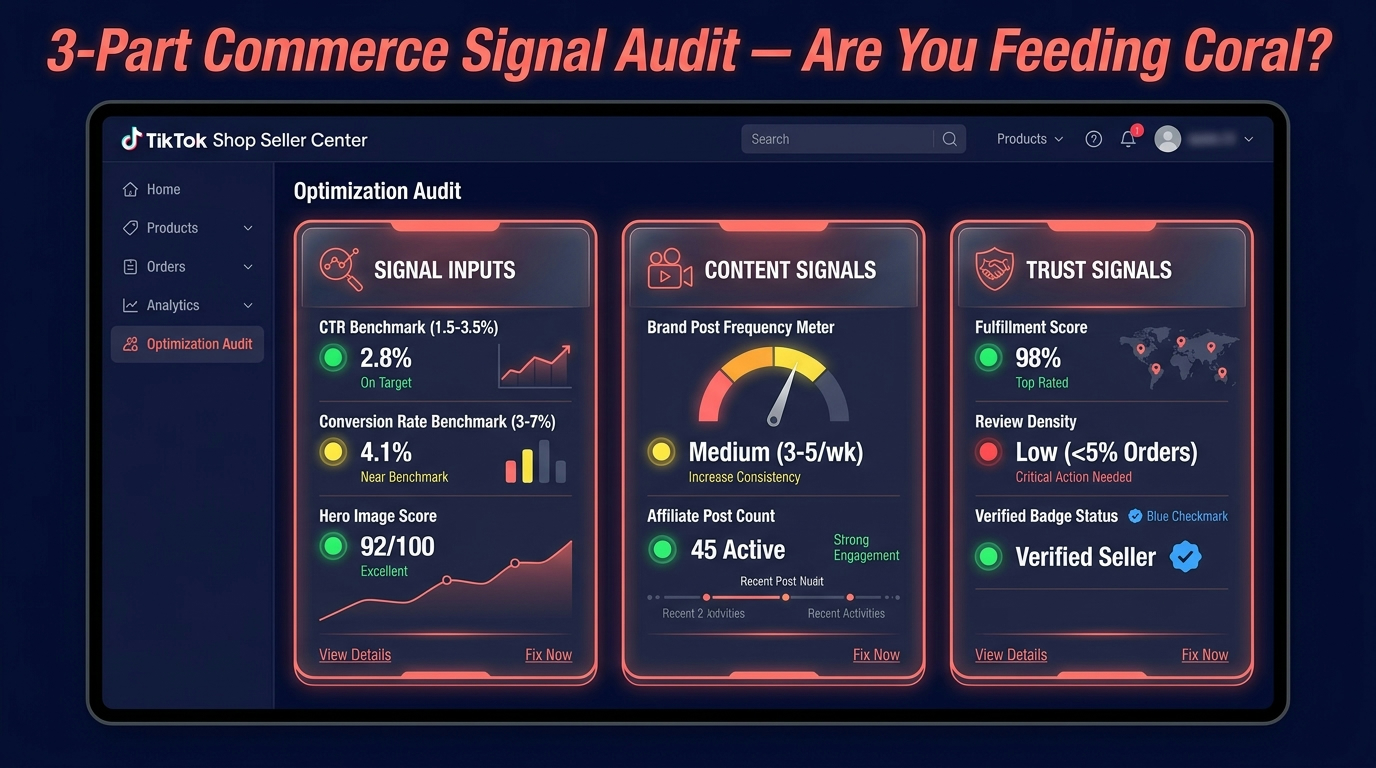
The challenge most sellers face is that Coral’s signal architecture isn’t presented as a clean dashboard in TikTok Seller Center. The inputs exist across several different data views — performance analytics, shop health, affiliate reports, and product diagnostics — and need to be assembled into a coherent picture. Here’s a three-part audit framework that maps directly to Coral’s signal layers.
Part 1: Signal Input Audit (Conversion Funnel)
Start with your product-level performance data. For each SKU in your catalog, identify CTR (impressions to product page clicks), add-to-cart rate, and purchase conversion rate. Map each metric against the benchmarks outlined earlier: CTR target 1.5–3.5%, add-to-cart and conversion 3–7% for the in-app checkout. Any SKU below these benchmarks at each stage has a signal deficit at that funnel layer.
The diagnostic logic is sequential: if CTR is low, the problem is card presentation (hero image, title, price point). If CTR is acceptable but add-to-cart is low, the problem is detail page quality (images, description, reviews, price framing). If add-to-cart is acceptable but conversion to purchase is low, the problem is either price friction, payment friction, or buyer confidence (review quality, return policy visibility). Each stage points to a specific fix rather than a generic “optimize your listing” recommendation.
Part 2: Content Signal Audit (Brand vs. Affiliate Activity)
Pull your content performance data from both your brand account and your affiliate reporting dashboard. Assess: How many brand-owned product videos has the account posted in the trailing 30 days? What are the commerce signal metrics (CTR, add-to-cart, attributed purchases) on brand-side content vs. affiliate content? Is there a significant gap that suggests brand content is underserving as the anchor signal?
Flag any products that have zero brand-owned video content in the past 30 days but active affiliate campaigns. These are the products most exposed to Coral’s affiliate distribution discount and represent the highest-return opportunity for a minimal investment of brand-side content production. Two to three brand-produced videos per product per month is a manageable floor that meaningfully changes the signal landscape.
Part 3: Trust Signal Audit (Operational Health)
Open your Account Health Rating in Seller Center and treat it as a distribution proxy. Review fulfillment rate, on-time shipping rate, dispute rate, and refund rate. Compare these against platform benchmarks: shipping rate above 95%, dispute rate below 2%, response time within 24 hours are representative targets for strong trust signal generation.
For each metric below benchmark, identify the operational root cause. Shipping rate issues typically stem from inventory management or carrier integration problems. High dispute rates often trace to product-description mismatches (the product doesn’t match buyer expectations set by the content or listing). High refund rates may indicate product quality issues or category-fit problems. Each root cause has a specific operational fix that translates directly into trust signal improvement — and therefore distribution improvement — within the 30-day signal window.
Building for Signal Depth, Not Signal Width
The clearest strategic reframe Coral offers is the distinction between signal depth and signal width. Signal width is the old model: reach as many people as possible, generate as many impressions as possible, and hope enough of them convert. Signal depth is Coral’s model: generate high-quality commerce signals from targeted, intent-matched audiences, build a rich signal history at the product level, and let the ranking system amplify what’s actually working.
This distinction has profound implications for how sellers allocate resources. A budget spent on 20 affiliate creators with broad audiences but weak commerce signal histories produces signal width. The same budget spent on 5 creators with demonstrated product CTR track records and audience-product fit produces signal depth. The former generates more impressions. The latter builds more durable ranking.
The broader strategic shift Coral demands is from campaign thinking to catalog thinking. Rather than asking “how do I make this video go viral?”, the relevant question is “how do I build a sustainable commerce signal stack around this product that compounds over time?” That means treating CTR, add-to-cart rate, purchase velocity, fulfillment performance, and review generation not as individual metrics to monitor but as interconnected signal layers to engineer simultaneously.
What Changes First, What Changes Last
For sellers adapting to Coral’s signal model, the recommended sequence of optimization is roughly this: start with listing quality (hero image, title, detail page), because these changes have an immediate impact on CTR and add-to-cart signals at zero incremental cost. Then address operational health (fulfillment speed, dispute rate) because trust signal improvements compound quickly within the 30-day window. Then adjust content strategy (brand account activity, affiliate quality selection) because these changes take 2–4 weeks to generate statistically meaningful new signal data. Finally, calibrate paid amplification (GMV Max settings, ROI targets) to match the improved signal environment you’ve built organically.
Attempting this in reverse — scaling paid spend before fixing listing quality, or recruiting more affiliates before addressing the brand content deficit — amplifies existing signal problems rather than resolving them. The discipline of sequence is where most sellers leave the most value on the table.
The Platform Trajectory: Why This Matters More in 12 Months
TikTok Shop’s US GMV is on track for approximately $23.4 billion in full-year 2026, and the platform is adding approximately 1 million new US sellers annually. As competition for distribution increases, the sellers who have built deep, high-quality commerce signal stacks around their products will enjoy compounding ranking advantages that late-movers will find extremely difficult to overcome.
Coral isn’t just a June 2026 update that sellers need to adapt to once. It’s the signal framework that TikTok Shop’s commerce ranking system will continue to build on as the platform matures. The sellers who understand its architecture now — and build their operations, content strategy, and catalog management around feeding it — are positioning themselves for durable competitive advantage in a market that is still in its early growth phase.
The window to establish that signal depth advantage is open. But it gets narrower with every month the platform adds sellers. The question isn’t whether to tune for commerce signals. It’s whether you do it before or after your competitors do.
Key Takeaways
- Coral shifted product ranking from entertainment signals to commerce signals. Product clicks, add-to-cart rates, completed purchases, fulfillment speed, and review density now drive distribution more than likes, shares, or follower counts.
- Signal weighting varies by surface. FYP still leads with content signals (70%+ completion is the distribution threshold), Shop tab is commerce-first, and Search prioritizes relevance-plus-conversion alignment.
- Affiliate-only distribution now carries a cost. Brands with inactive brand accounts receive a reduced distribution ceiling on affiliate content. Maintaining brand-side content as an anchor signal is no longer optional.
- Fulfillment speed is a ranking variable, not just a compliance metric. Sub-72-hour dispatch, strong on-time rates, and low dispute rates feed directly into product distribution signals.
- Review recency matters more than total volume. Continuous post-purchase review generation — especially photo and video reviews — produces stronger trust signals than a high historical count that isn’t being refreshed.
- GMV Max amplifies existing signals; it doesn’t create them. Products without proven commerce signal foundations won’t benefit significantly from paid amplification under Coral’s model.
- The audit sequence matters. Fix listing quality first, then operational health, then content strategy, then paid amplification. Doing it in reverse scales problems instead of solving them.