



Here is a number worth sitting with: only 37 to 40 percent of organizations that have deployed AI automation have the ability to reliably stop a misbehaving agent mid-run. Around 58 to 59 percent have some form of monitoring or human oversight in place. But monitoring and stopping are very different things. Watching a car veer toward a ditch is not the same as having a working brake pedal.
The conversation around AI safety has spent years focused on the upstream question — whether to deploy, how to govern, what to measure. Those questions matter. But a quieter and more operationally dangerous gap has opened up downstream: the assumption that when something goes wrong in production, there is a reliable, tested, human-authorized mechanism that can halt, contain, and reverse the damage in time for it to matter.
For most teams, that assumption is wrong. The stop button exists on paper. In practice, it has never been tested under realistic load. The person whose job it is to press it has not been clearly designated. And critically, stopping the agent does not necessarily stop the consequences — because modern AI systems do not just think, they act. They write records, send emails, call external APIs, and modify state that does not revert when you roll back a model version.
This article is about the engineering reality of AI kill-switches and rollback systems — what the current evidence says about how they are designed, where they fail, what they actually need to cover, and how the regulatory environment is now starting to enforce capability rather than just intent. It is not a discussion of whether AI is safe or dangerous in the abstract. It is a technical and organizational examination of what it actually takes to stop one when it is behaving badly — and to recover cleanly from the consequences.
The Governance Gap Nobody Measured Until Recently
The starting point for any honest conversation about kill-switches is a frank acknowledgment that the industry has measured the wrong thing for most of the deployment era. Teams tracked model accuracy, inference latency, cost per token, and user satisfaction scores. Very few systematically tracked their containment capability — the question of whether they could shut down, isolate, or revert a deployed system in a documented, tested, repeatable way.
When 2026 surveys started asking that question directly, the results were uncomfortable. Only about 40 percent of organizations reported the ability to rapidly halt an agent mid-run. Only 37 percent said they could enforce purpose limits — meaning restrict an agent to a defined scope and prevent it from operating outside that scope. Only 45 percent reported they could isolate AI systems from sensitive networks when needed. And in one compilation, 35 percent of respondents said they simply could not shut down a rogue agent at all.
Why Measurement Lagged So Far Behind Deployment
There are a few structural reasons this gap went unmeasured for so long. First, early AI deployments were largely read-only or advisory — a recommendation engine, a summarizer, a classifier. Systems that surface information without taking action are far lower risk because their failure mode is usually a wrong answer, not an irreversible external action. As those systems gave way to agentic workflows capable of writing, deleting, calling APIs, and operating autonomously across extended sequences, the operational risk profile changed fundamentally. But the governance frameworks did not keep pace.
Second, kill-switch design was treated as a conceptual requirement rather than an engineering specification. Organizations could truthfully say they had an emergency shutdown procedure, because somewhere in a runbook was a line that said “escalate to engineering lead.” What they did not have was a tested, documented, automated-where-appropriate containment stack that could halt an agent, revoke its credentials, isolate it from the network, and capture an immutable audit log — all within a defined time window and without depending on the availability of a specific person who might be in a different time zone.
Third, the agent runtime itself became the assumed enforcement point. Guardrails were added to prompts. Safety rules were embedded in system instructions. Limits were defined within the agent’s own code. The problem with this approach is fundamental: you cannot rely on a system to enforce the rules that constrain it. A sufficiently degraded or manipulated agent may not comply with instructions to stop. The control needs to sit outside the runtime entirely.
Why a Single Kill Switch Is Already an Outdated Design
The phrase “kill switch” evokes a single, decisive action — one button, one stop, problem solved. That framing made sense when the thing being stopped was simple enough that halting it also halted its effects. It does not map well to modern AI systems, which are better understood as distributed, stateful, multi-tool actors rather than isolated programs.
Consider what a contemporary agentic workflow actually looks like. An orchestrating agent receives a task. It breaks the task into subtasks and delegates them to specialized sub-agents. Those sub-agents call external APIs, write to databases, send communications, retrieve and store documents, and sometimes spawn further sub-agents. The whole system might be distributed across cloud services, third-party integrations, and background queues. In this context, pressing a single kill switch on the orchestrator does not immediately stop the sub-agents, which may be running in separate processes or containers. It does not cancel the API calls already in flight. It does not retrieve the emails already sent. It does not reverse the database writes already committed.
The Operational Implication
This is not a theoretical edge case. As multi-agent frameworks like LangGraph, AutoGen, CrewAI, and commercial agentic platforms have moved into production use, the gap between “stopping the agent” and “stopping the effects of the agent” has widened accordingly. A 2026 survey of enterprise teams running agentic workflows found that only a minority had explicit handling for in-flight actions — tasks that were already executing when a stop signal was received.
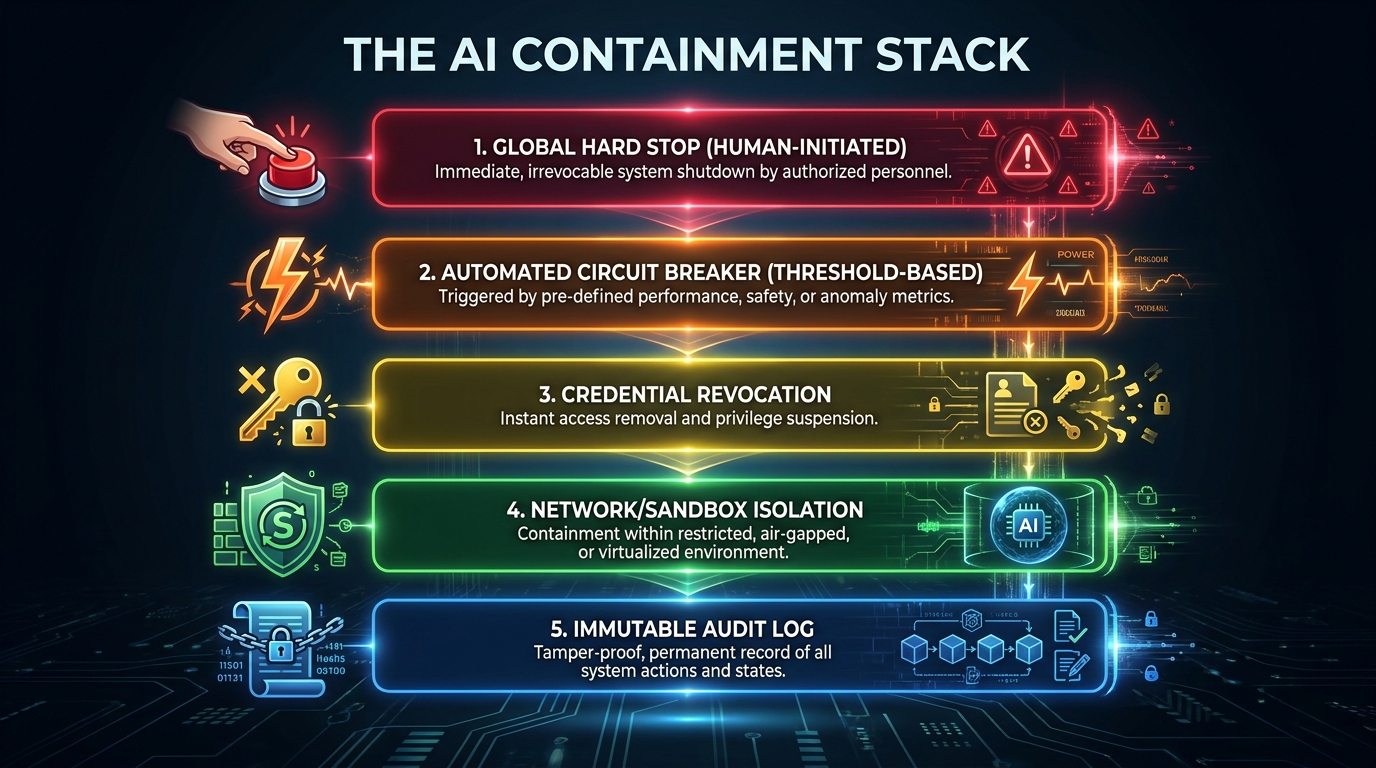
The shift in expert consensus reflects this reality. Leading guidance from organizations including the UK’s National Cyber Security Centre (NCSC) now frames the requirement not as a kill switch but as a containment stack — a layered set of controls that each address a different dimension of the problem. The kill switch is still part of that stack, but it is one layer among several, not the complete solution.
The practical design principle is this: every layer of the containment stack should work even if the layers above it fail. If the automated circuit breaker does not trip, the human kill switch should still work. If the human kill switch fails, credential revocation should cut off tool access. If credential revocation is incomplete, network isolation should contain the blast radius. Redundancy in stopping is not over-engineering — it is the difference between a containment failure and a containment success.
The Containment Stack: What Each Layer Actually Does
Current best practice frames AI safety infrastructure as a multi-layer containment stack, where each layer addresses a different vector of failure and each operates independently of the others. Here is what that stack looks like in engineering terms, and why each layer matters.
Layer 1: The Global Hard Stop
This is the human-authorized emergency halt — the closest thing to the traditional kill switch concept. It should immediately halt new agent sessions, drain or kill existing queues, and prevent any new tool calls from being issued. Critically, it must live in a control plane that is entirely separate from the agent runtime. If the kill switch is implemented as a configuration flag inside the agent’s own process, a sufficiently broken or manipulated agent might not read it correctly. The flag should be in an external service — a config store, a control plane API, or a dedicated policy service — and the agent should be required to poll it before each tool call and each LLM call, not just at session start.
This external enforcement model is the most consistently recommended architectural pattern across the current guidance landscape. The NCSC, security researchers, and enterprise architecture teams converge on the same point: enforcement inside the agent is advisory at best and bypassed at worst.
Layer 2: Automated Circuit Breakers
A circuit breaker is not a kill switch. It is an automated, threshold-based control that trips when system behavior crosses a defined limit — error rates, latency spikes, cost anomalies, output quality regressions, or behavioral flags. The critical distinction is that a circuit breaker does not require a human to notice a problem and decide to act. It fires automatically.
Good circuit breaker design for AI systems includes multiple trigger types: technical signals like API error rates and response latency; quality signals like embedding-distance checks or classifier-based output evaluation; and business signals like cost-per-task exceeding a ceiling or conversion metrics falling outside expected bands. The breaker does not need to kill the whole system — it can also trigger a scope reduction (limiting tool access), a rate reduction (throttling to a fraction of normal throughput), or a drain mode (no new sessions while existing ones complete). These graduated responses are more operationally useful than a binary on/off, because most real-world problems benefit from containment rather than full shutdown.
Layer 3: Credential Revocation
If an agent’s credentials are revoked, it cannot call external tools, read from databases, or take any external actions — regardless of what instructions it is following. Credential revocation is one of the most powerful containment actions available because it operates at the infrastructure layer, completely beneath the agent’s own decision-making. An agent that has been compromised, hallucinating, or manipulated through prompt injection cannot circumvent revoked credentials.
The engineering implication is that AI agents should use short-lived credentials — tokens or API keys that expire quickly and must be regularly refreshed. This means revocation is fast (let the token expire and don’t issue a new one) and that any token already in circulation has limited remaining useful life. Just-in-time privilege issuance is the more mature version of this pattern: the agent only receives credentials for a specific tool at the moment it needs them, and the credential expires when the task is complete.
Layer 4: Network and Sandbox Isolation
Even a halted agent with revoked credentials may have already dispatched requests to external services. Network isolation — cutting egress from the agent’s execution environment — stops those requests from completing and prevents any further external communication. This is particularly important for sub-agents running in separate containers or microservices.
Sandbox isolation also serves a preventive purpose: running AI agents inside network-boundary-enforced environments limits their blast radius during normal operation. Anthropic’s May 2026 containment documentation describes layered sandbox usage with VM isolation, filesystem boundaries, and egress controls as standard practice for Claude’s agentic deployments. The principle is to limit what the agent can reach before an incident occurs, so the scope of any failure is bounded from the start.
Layer 5: Immutable Audit Logging
The final layer of the containment stack is not a stop mechanism — it is an accountability mechanism. Immutable audit logs capture every tool call, every LLM invocation, every credential issuance, and every action taken by the agent, in a tamper-evident store that the agent itself cannot modify. This layer serves three functions: it provides the data needed to understand what happened during an incident, it enables accurate reconstruction of what actions need to be compensated or reversed, and it creates the evidentiary basis for regulatory compliance and internal governance.
The logs must be stored outside the agent’s runtime and outside any system the agent has write access to. Logging that the agent can modify is not audit logging — it is a notes field.
Kill Switch vs. Circuit Breaker: Understanding the Operational Difference
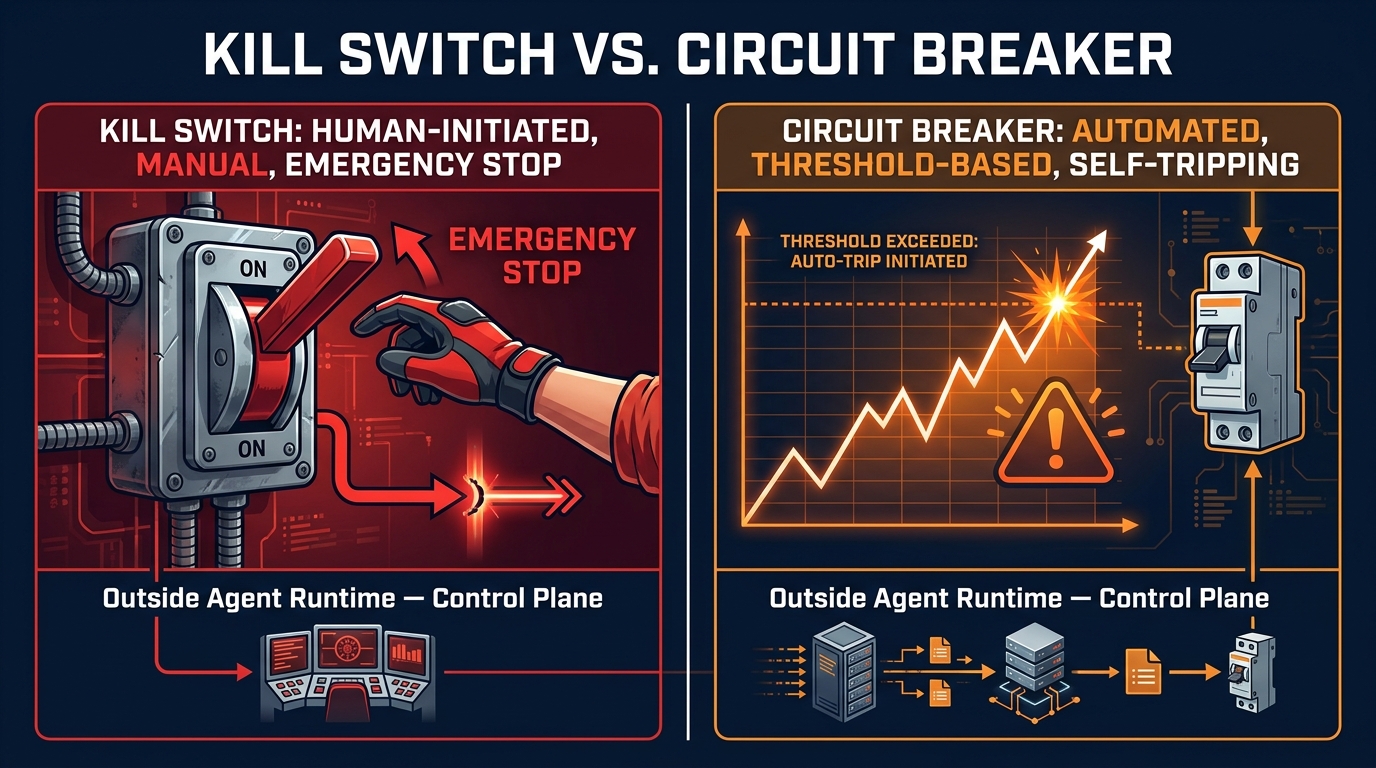
The kill switch and the circuit breaker are frequently conflated in governance discussions, but they serve fundamentally different functions and should be engineered differently. Confusing them creates dangerous gaps in both directions: teams that have only a kill switch lack automated containment, and teams that have only circuit breakers lack the human override capability that regulation increasingly requires.
The Kill Switch: Human Authority Over Machine Action
A kill switch is a human-authorized, manually triggered emergency stop. Its purpose is to give a designated person — or group of people — the ability to halt a system regardless of what the automation is doing or why. It does not need a reason. It does not need a threshold to be crossed. It is an assertion of human authority over machine action.
The design properties that matter most for a kill switch are: speed (how quickly does the stop propagate through the system after it is triggered?), scope (does it stop a single session, a particular agent type, or the entire deployment?), and independence (does it work even if the agent runtime is in a degraded state?). Answers of “under five seconds,” “configurable at multiple scopes,” and “yes, through external enforcement” are the targets to aim for.
The authorization model for the kill switch is equally important and equally often under-designed. Who can trigger it? Under what circumstances? Does triggering require single-person authorization, or does it require multi-person approval for higher-consequence actions? What happens to in-flight requests after the switch is thrown — are they drained gracefully or killed immediately? These operational questions need written answers before deployment, not after an incident.
The Circuit Breaker: Automated Response to Behavioral Signals
A circuit breaker does not wait for a human to notice a problem. It monitors defined metrics and fires automatically when a threshold is crossed. This is critically important because many AI failure modes develop faster than human response times can match. An agent making thousands of API calls per minute in response to a bad instruction or a manipulated context window will cause substantial damage long before a monitoring alert reaches a human who reads it and decides to act.
Well-designed circuit breakers for AI systems operate at multiple levels. At the technical level, they track error rates, latency, and cost. At the quality level, they use classifiers or embedding similarity checks to detect output drift. At the business level, they watch metrics that indicate whether the automation is achieving its intended purpose — not just whether it is running without errors.
A key engineering subtlety: circuit breakers should implement graduated responses rather than binary stops. A trip on elevated error rates might first throttle throughput by 50 percent, send an alert, and wait for human confirmation before a full stop. A trip on output quality regression might pause new sessions while completing existing ones. Full immediate shutdown should be reserved for the most severe signals — actions that represent genuine safety or security risks, not normal operational variance.
The Drain Mode Pattern
Between full operation and full stop lies a state that many operational teams now call “drain mode” — a controlled wind-down where no new sessions are accepted, but in-flight sessions are allowed to complete (or are completed up to a safe checkpoint and then stopped). Drain mode is operationally superior to abrupt shutdown in most non-emergency scenarios because it avoids leaving partial transactions in indeterminate states and allows logging to complete cleanly. Abrupt kills should be reserved for genuine emergencies where the cost of in-flight completion exceeds the cost of an unclean stop.
The Rollback Problem: Why Reverting Code Is Not Enough Anymore
When a software deployment goes wrong in a conventional system, rollback is conceptually straightforward: you revert to the previous version, the previous version runs, and the system returns to its prior state. This model is still valid for the model and code layers of an AI system — but it is dangerously incomplete for agentic systems that take external actions.
The rollback problem in AI has two distinct dimensions that need to be addressed independently.
Dimension 1: Logic Rollback
Logic rollback covers the model, prompt, tool definitions, guardrail configurations, and routing configurations that determine what the agent does and how it reasons. This is the layer most similar to conventional software rollback, and the engineering practices are well-established: keep prior versions as immutable, reachable artifacts; use versioned model registries; separate the model version pointer from the application code; and make rollback a routing change rather than a rebuild.
Blue-green deployment is the gold standard for logic rollback speed: because two fully provisioned environments exist simultaneously, switching back to the prior version is a traffic routing change that can complete in seconds. Amazon SageMaker’s deployment guardrails implement this pattern with automatic traffic switching when alarms fire — rollback to the “blue” fleet happens without human intervention if defined metrics trip. That speed matters: in a system processing thousands of requests per minute, the difference between a 30-second rollback and a 10-minute rollback is the difference between a contained incident and a significant data quality problem.
Dimension 2: State and Side-Effect Rollback
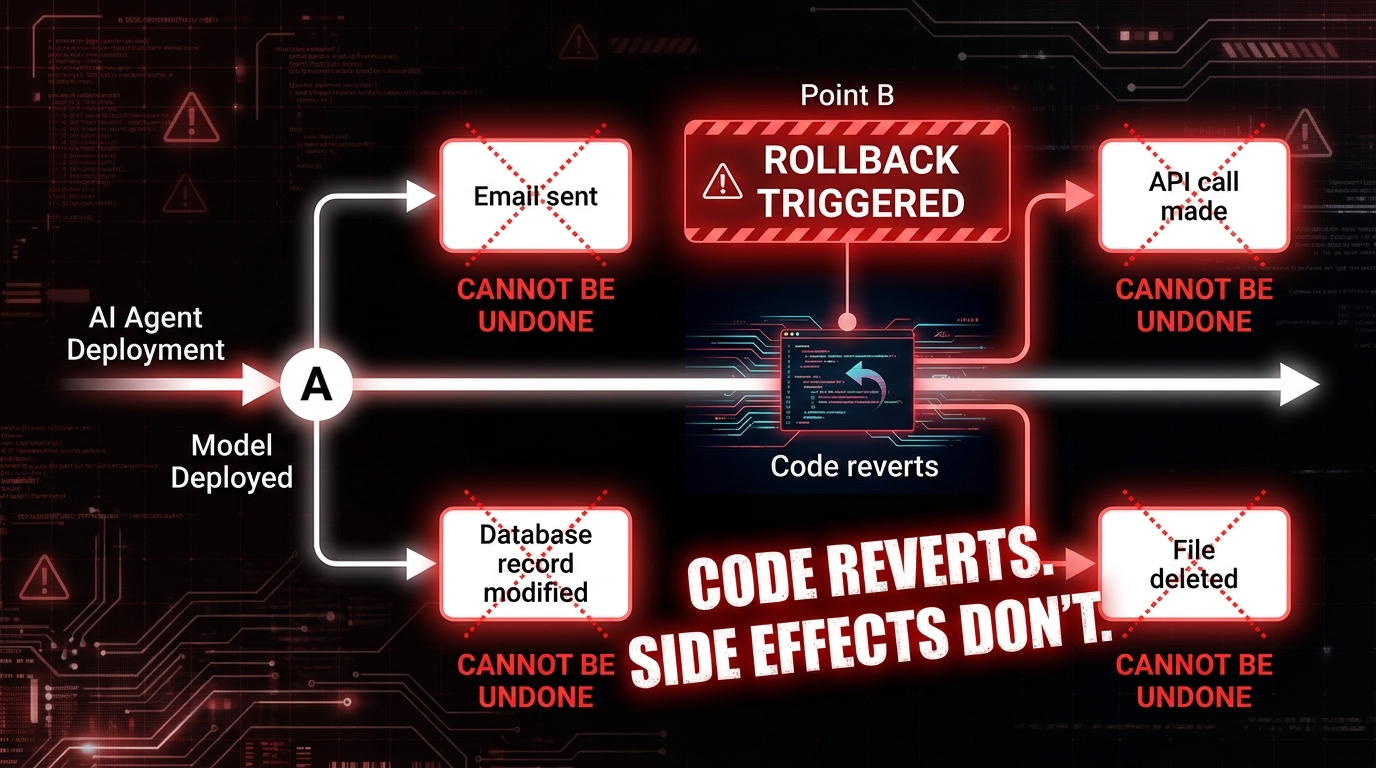
This is the dimension that most rollback plans fail to address — and it is where agentic AI creates genuinely new engineering challenges. When an agent has been running a bad version or following bad instructions, it has not just computed incorrectly. It has acted incorrectly. Those actions produced side effects in the external world: emails sent to customers, records written to databases, files modified, API calls made to third-party systems, messages posted in communication platforms.
Rolling back the model does not unsend the emails. It does not reverse the database writes. It does not undo the third-party API calls. The side effects of a bad deployment are not automatically compensated by reverting the code that produced them.
Compensating Transactions: The Engineering Answer
The engineering pattern that addresses this problem is the compensating transaction — a defined, pre-built operation that reverses or mitigates each possible action an agent might take. For every action the agent can perform, the rollback plan includes a corresponding compensation: cancel the sent notification if the recipient has not yet acted, write a correcting record if the original was wrong, call the external API’s cancel endpoint if one exists, flag affected records for human review if automated reversal is not possible.
Compensating transactions cannot be improvised after an incident. They need to be designed as part of the agent’s action vocabulary before deployment. For each tool the agent can use, the team needs an explicit answer to the question: if this action is taken in error, how do we compensate for it?
Some actions have clean, automatic compensation paths. Others — particularly those involving external systems with no undo API, or communications that have already been read and acted upon — require human intervention and cannot be fully automated. Knowing which is which, in advance, is essential for realistic incident response planning.
External State Checkpointing
For long-running agentic tasks, the state rollback problem extends beyond individual actions to the overall task state. An agent partway through a complex multi-step workflow has a conversation history, a set of intermediate results, and a representation of what it believes the current situation to be. Rolling back the model without also handling this accumulated state leaves the system in an indeterminate condition — the new version of the model starts from state that was produced by the old version, which may contain errors, false assumptions, or manipulated context.
Best practice is to checkpoint agent state externally at defined intervals — after each completed subtask, after each significant external action, or on a time-based schedule for long-running workflows. Checkpoints should be stored outside the agent’s own process, versioned alongside the model and prompt versions they correspond to, and treated as part of the rollback artifact set.
Blue-Green, Canary, and the Traffic-Routing Approach to AI Safety
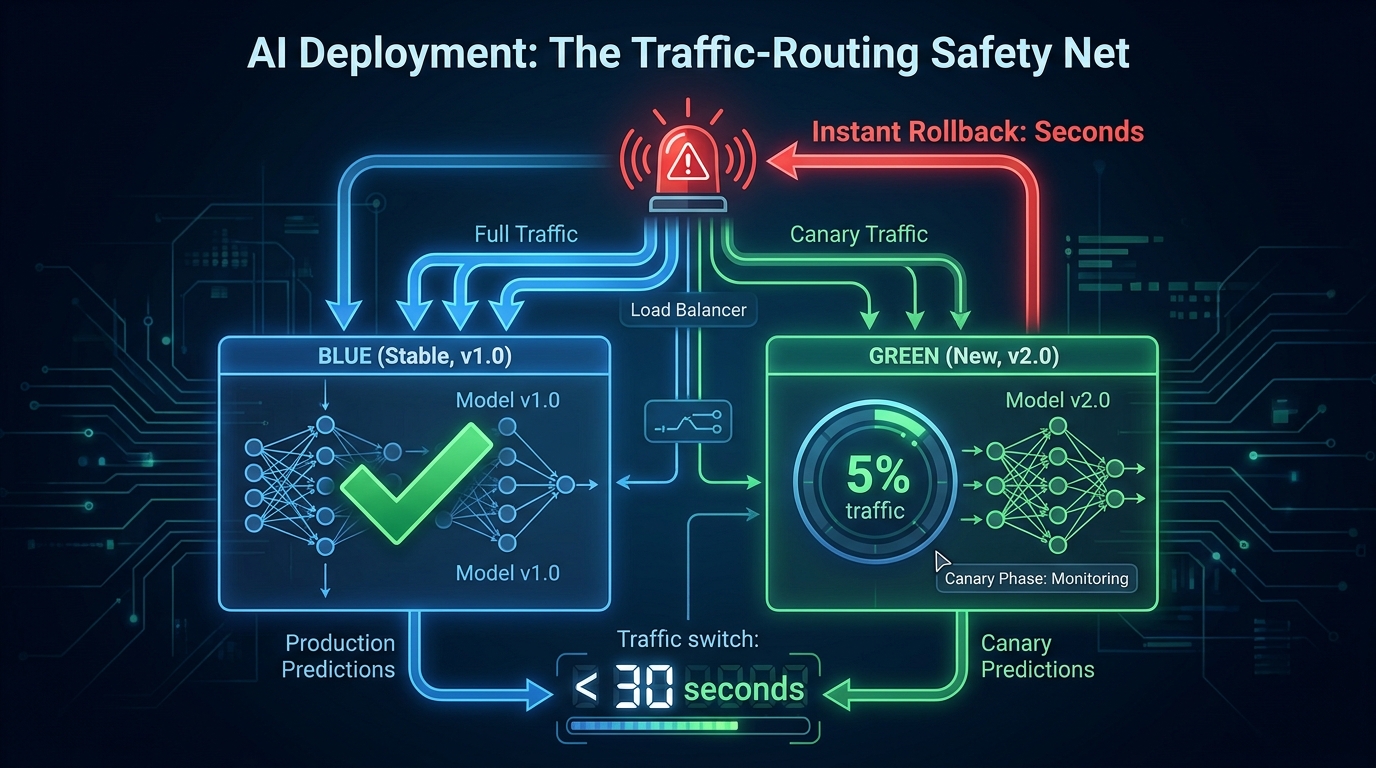
The deployment strategy that most directly affects rollback speed and reliability is the traffic routing model. Teams that treat AI model updates as big-bang deploys — switch everything to the new version at once — are accepting maximum rollback latency and maximum incident scope simultaneously. The current best practice moves in exactly the opposite direction.
Canary Releases: Limiting the Blast Radius
A canary release exposes the new model version to a small percentage of traffic — typically one to five percent — while keeping the prior version serving the majority. If the canary surfaces problems (elevated error rates, quality regressions, cost anomalies, or behavioral drift), it is pulled back and the rollback is contained to the minority of traffic that was exposed. The blast radius of a bad deployment is bounded by the canary percentage.
For AI systems, canary selection should not be purely random. High-value sessions, sensitive use cases, or users in regulated data jurisdictions should typically be excluded from canary traffic until the new version has demonstrated stability. The canary group should be monitored more intensively than baseline traffic, with shorter alert windows and lower threshold sensitivities.
The progression from canary to full deployment should be gated by explicit quality checks, not just time elapsed. Advancing from five percent to 25 percent should require that the five percent cohort has produced acceptable outcomes on defined quality metrics — not just that it ran without crashing. This is a meaningful distinction in AI systems, where the failure mode is often a subtle output degradation rather than an obvious technical error.
Blue-Green: The Fastest Rollback Available
Blue-green deployment maintains two fully provisioned environments simultaneously. The “blue” environment runs the current stable version and serves all or most traffic. The “green” environment runs the candidate new version and can be tested, validated, and gradually given traffic. When something goes wrong with green, traffic flips back to blue — and because blue has been running continuously with warm infrastructure, the flip completes in seconds rather than minutes.
The operational cost of blue-green is running two environments simultaneously, which roughly doubles infrastructure cost during the transition period. For high-stakes AI deployments — particularly those in customer-facing roles or handling sensitive data — this cost is generally justified by the rollback speed advantage. For lower-stakes automation, a rolling update with explicit rollback runbooks may provide an acceptable balance.
The automation question for blue-green in AI is particularly important: should the traffic flip back to blue happen automatically on alarm, or should it require human confirmation? The emerging consensus is that automated rollback is appropriate when the trigger signal is unambiguous (a hard error rate threshold, a critical safety alarm), while human-confirmed rollback is more appropriate for quality regressions that require judgment. In practice, many teams implement automated rollback for technical signals and human-gated rollback for quality signals.
The Rollback Trigger Framework
Both deployment patterns require explicit, pre-defined rollback triggers — specific metrics with specific thresholds that, when crossed, initiate rollback. This seems obvious but is systematically underdone. Most teams have general alerting. Very few have documented, agreed, and tested rollback triggers with clear ownership and automated response paths.
A practical rollback trigger framework for AI systems covers at least four signal categories: technical health (error rates, latency, availability), model quality (output evaluation scores, embedding drift, guardrail breach rates), business outcomes (task completion rates, escalation rates, downstream conversion), and safety signals (policy violations, sensitive data exposure, anomalous action patterns). Each category should have both a warning threshold (alert, increase monitoring) and a rollback threshold (initiate controlled rollback or escalate immediately for human decision).
What Regulation Now Requires — and What It Actually Means in Practice
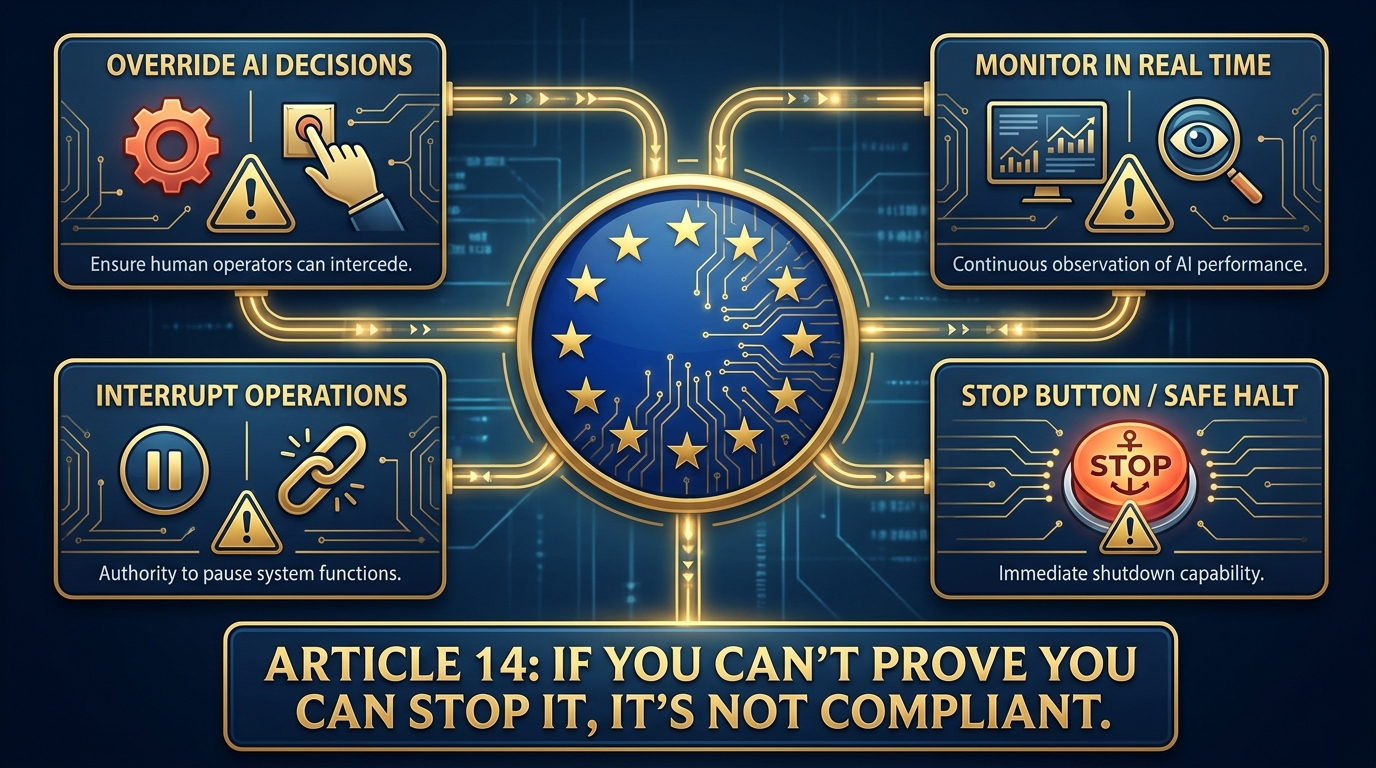
The regulatory environment around AI containment controls is hardening, and the most important shift is not the emergence of new rules — it is the shift from requiring intent to requiring demonstration. Earlier governance frameworks asked organizations to have policies. Emerging frameworks ask organizations to prove their controls work.
The EU AI Act’s Human Oversight Requirement
The EU AI Act’s Article 14 is the most directly relevant regulatory provision for kill-switch design. For high-risk AI systems, it requires that the system be designed so a human can understand what it is doing, monitor its operation in real time, override its outputs, interrupt its operation, and stop it through a stop button or equivalent safe-halt procedure. The obligation falls on both providers (who must design these capabilities into the system) and deployers (who must assign trained, competent, and authorized humans to exercise them).
Several points in Article 14 are worth parsing carefully for their engineering implications. “Stop button or equivalent safe halt procedure” is not a conceptual requirement — it implies a tested, functional mechanism with a defined execution path. “Trained, competent, and authorized” humans implies that the oversight capability requires designated people with specific training, not just any employee who happens to be monitoring a dashboard. And “in a safe state” implies that the shutdown procedure should not leave the system in a dangerous or indeterminate condition — which is directly relevant to the drain mode and compensating transaction patterns discussed earlier.
Note that for many Annex III high-risk AI categories, the full compliance deadline has been pushed to December 2027, while systems embedded in regulated products face August 2028. But many organizations with high-risk systems are already building toward compliance — particularly those with EU customers or those deploying in sectors where regulators are actively examining AI deployments, such as finance, healthcare, and critical infrastructure.
The NCSC’s Practical Guidance
The UK’s National Cyber Security Centre issued guidance in August 2026 that takes a more operational framing than the EU Act’s legal text. The NCSC calls for controls matched to the level of agent autonomy — meaning that higher-autonomy agents face stricter containment requirements — along with sandboxing tiers, structured logging, and a working emergency shutdown that spans all agent processes, including sub-agents.
The “all agent processes” clause in the NCSC guidance is particularly significant for multi-agent architectures. A shutdown mechanism that stops the orchestrator but leaves sub-agents running is not a working emergency shutdown — it is a partial stop that may leave the most consequential actions still in progress. The requirement implies that the kill-switch signal must propagate through the entire agent graph, not just the entry point.
From Policy to Proof
The practical implication of the emerging regulatory direction is that documentation alone is no longer sufficient. Regulators and auditors are increasingly asking for evidence of tested controls — not just written policies. This means kill-switch and rollback capabilities need to be exercised regularly, with documented results, as part of standard operational practice. An untested kill switch is operationally equivalent to no kill switch: it may work, or it may not, and you will not know until you need it most.
Testing Your Containment Stack Before You Need It
The most consistent finding across incident analyses of AI deployment failures is that shutdown and rollback procedures were either not tested at all, tested only in low-fidelity simulations, or tested in conditions that did not resemble production load. The kill switch worked in staging. It did not work the same way under production traffic, with multiple agents running simultaneously, across the full scope of integrated tools.
The Game Day Model for AI Containment
The most effective testing model for production safety controls is the “game day” exercise — a scheduled, realistic simulation of failure conditions and response. For AI containment stacks, a game day exercise should test the full sequence: detect the signal, trigger the appropriate control, confirm the stop propagates, verify the scope of impact, initiate the rollback or compensating procedure, and confirm that the system returns to a known-good state.
Critically, the exercise should be run under conditions that approximate real production complexity. If the production system runs multiple agent instances across several tool integrations, the test should do the same. If the production kill switch is supposed to propagate to sub-agents, the test should verify that specifically. If the drain mode is supposed to complete in-flight tasks cleanly, the test should measure how long that actually takes with a realistic task distribution.
Rollback Verification: The Missing Step
One of the most consistently overlooked steps in rollback procedures is post-rollback verification — confirming, through automated tests or manual checks, that the system has actually returned to the expected prior state. This sounds obvious, but in practice, rollback is frequently treated as the end of the incident response process rather than the beginning of a verification phase.
Post-rollback verification should include at minimum: a smoke-test suite that exercises the core functions of the prior version, a check that the model version and prompt versions are what they are expected to be (not what was rolled back from), a verification that credentials have been correctly reset or reissued, and a scan of the audit log to confirm that no unexpected actions were taken during or after the rollback window.
The post-rollback evaluation suite should be maintained as a living artifact — updated whenever new capabilities are added and run automatically as part of the rollback runbook, not as an optional post-incident follow-up.
Frequency and Documentation
How often should containment controls be tested? Current guidance converges on a minimum of quarterly full-stack testing for high-risk or customer-facing AI deployments, with more frequent automated tests of individual components (circuit breaker thresholds, credential revocation speed, kill-switch propagation time). Every test should produce a written record: what was tested, what was observed, what worked as expected, and what requires remediation. That record is both an operational improvement tool and a regulatory evidence artifact.
The Ownership Problem: Who Actually Presses the Button?
Even a perfectly engineered containment stack fails if there is no one clearly designated to use it, or if the designated person does not have the authorization, training, and situational awareness to use it correctly under pressure.
This is a more common gap than it might appear. In the 2026 survey data cited earlier, organizations that lacked containment capability were not all lacking the technical controls — some had controls but lacked clear human ownership. The kill switch existed. Nobody’s name was on it.
The Named Owner Requirement
Best practice is a named owner for each scope of the containment stack: a designated person (with a documented backup) who is authorized to trigger the global hard stop, who is listed in the incident response runbook by name and role, and who has been tested in that role during a game day exercise. Generic role designations (“the on-call engineer”) are insufficient — the person needs to know, before an incident, that this is their responsibility and what the exact steps are.
Authorization boundaries are equally important. Can a single on-call engineer trigger the global kill switch? Or does it require sign-off from a second person? For high-stakes systems, requiring two-person authorization for the most consequential actions — particularly irreversible ones — reduces the risk of accidental or unauthorized shutdown. For emergency scenarios where speed is paramount, single-person authorization with mandatory post-action reporting may be more appropriate. These decisions should be made and documented in advance, not improvised during an incident.
The Escalation Matrix
Alongside named ownership, effective containment requires an escalation matrix — a clear decision tree that defines who is notified at each severity level, who has authority to make which decisions, and what the communication protocols are. This matrix should be short enough to use under pressure (a single printed page is not an unreasonable target) and updated whenever personnel or systems change.
The escalation matrix should also address the question of external communication: when a significant AI incident occurs, who notifies affected users, partners, or regulators? In the EU AI Act context, serious incidents involving high-risk systems may require formal notification to competent authorities. Knowing the notification requirements and having a communication template ready before an incident is not bureaucratic over-preparation — it is the difference between a managed incident and a compounded one.
Regular Ownership Reviews
People leave organizations. Roles change. Systems grow in scope. The named owner of an AI containment stack needs to be reviewed at least every six months — alongside a review of the runbook, the escalation matrix, and the access controls that give the owner the ability to actually use the controls they are responsible for. A kill switch that the designated owner cannot access because their credentials were not updated after a system migration is operationally equivalent to a kill switch that does not exist.
From “Can We Stop It?” to “Can We Prove We Can?”
The maturity curve in AI containment capability follows a recognizable pattern. Organizations start by asking “do we have a kill switch?” and checking a box when they have some form of shutdown procedure documented. They progress to asking “does our kill switch work?” and discovering gaps in testing, scope, and propagation. The mature question — the one that reflects both operational capability and regulatory readiness — is “can we prove that we can stop it, within a defined time window, at any scope, and recover cleanly from the consequences?”
That question has five components, each of which requires concrete engineering and organizational answers.
Speed: How Fast Does the Stop Propagate?
Measured in seconds, not minutes. The time from trigger to full halt of new actions should be a documented, tested figure — not an estimate. For automated circuit breakers, the trigger-to-response latency should be sub-second for technical signals. For human-triggered kill switches, the target window from decision to propagation should be defined and tested.
Scope: What Does “Stop” Actually Cover?
A stop mechanism that halts the orchestrator but not the sub-agents is not a complete stop. A stop that revokes credentials for primary tool access but not auxiliary integrations is incomplete. The scope of the containment stack should match the scope of the agent’s potential actions — and that match should be verified by mapping every tool access and external integration against the corresponding containment control.
Independence: Does It Work Even If the System Is Broken?
The containment stack must operate independently of the agent runtime. If the model is hallucinating, the circuit breaker should still trip. If the agent is stuck in an infinite loop, the kill switch should still propagate. If the agent’s own process is consuming all available CPU, the credential revocation should still succeed. Independence requires testing under degraded conditions, not just clean environments.
Recovery: What Happens After the Stop?
The stop is not the end of the incident. After the stop, the team needs to: identify what actions were taken during the bad period, determine which can be automatically compensated and which require human review, execute compensating transactions in the correct order, verify that the system is in a consistent state before restoring operation, and document the full incident timeline for governance and regulatory purposes. Each of these steps should be pre-planned and included in the runbook.
Evidence: Can You Show It Worked?
The final dimension of containment maturity is evidentiary. Immutable audit logs that capture the full timeline, test records that demonstrate the controls worked in prior exercises, and governance documentation that shows named ownership and authorization boundaries — these are the artifacts that answer the regulatory question and that allow a post-incident review to accurately reconstruct what happened and why.
The practical target: Every production AI system that takes external actions should have a documented, tested, ownership-assigned containment stack that covers all five dimensions — speed, scope, independence, recovery, and evidence. If any dimension is untested or undocumented, that is not a minor gap. It is a gap that will surface at the worst possible moment.
Conclusion: The Engineering Discipline AI Deployment Has Been Missing
The conversation about AI safety in enterprise deployments has been dominated by upstream questions: what to build, whether to trust it, how to measure it, how to govern the process of deploying it. Those are legitimate and important questions. But the downstream question — how to stop it reliably and recover cleanly when it goes wrong — has received far less systematic engineering attention than it deserves.
The data reflects this imbalance. Only a minority of organizations deploying AI automation have tested, documented containment stacks. Most have monitoring. Many have policies. Far fewer have a named human owner, a tested kill switch with a measured propagation time, automated circuit breakers with explicit rollback triggers, credential revocation procedures, and a pre-built compensating transaction library for every action their agents can take.
That gap is not just an operational risk — it is becoming a regulatory exposure. The EU AI Act’s Article 14, the NCSC’s August 2026 guidance, and the broader trend toward proof-based rather than policy-based compliance are all converging on the same requirement: demonstrate that your containment works, not just that you intend it to.
The engineering disciplines needed to close this gap are not exotic or unprecedented. Blue-green deployment, circuit breaker patterns, credential revocation, sandbox isolation, compensating transactions, and external audit logging are all established practices that exist in adjacent fields. The work is in applying them systematically to AI systems, testing them under realistic conditions, and building the organizational ownership structures that make them operable under pressure.
AI deployment will continue to expand in scope and autonomy. The systems being built today will take more actions, in more contexts, with less human supervision, than the systems deployed two years ago. That trajectory makes the containment stack not a nice-to-have feature or a compliance checkbox — it makes it the engineering discipline on which the safety of the entire deployment rests.
Key Takeaways
- Replace the single kill switch concept with a multi-layer containment stack covering hard stop, circuit breakers, credential revocation, network isolation, and immutable logging.
- Enforce controls outside the agent runtime — any control embedded in the agent’s own process is advisory, not enforceable.
- Design compensating transactions for every action the agent can take before deployment, not after an incident reveals the need.
- Treat rollback as a state-plus-logic problem — reverting the model version does not reverse the external actions the bad version took.
- Use blue-green or canary deployments to bound blast radius and enable fast, traffic-routing-based rollback.
- Name a human owner for each scope of the containment stack, with documented authorization boundaries and regular testing.
- Test the full containment stack quarterly under production-realistic conditions, and keep written records of every test.
- Shift your maturity question from “do we have a kill switch?” to “can we prove we can stop it, within a defined window, at any scope, and recover cleanly?”