


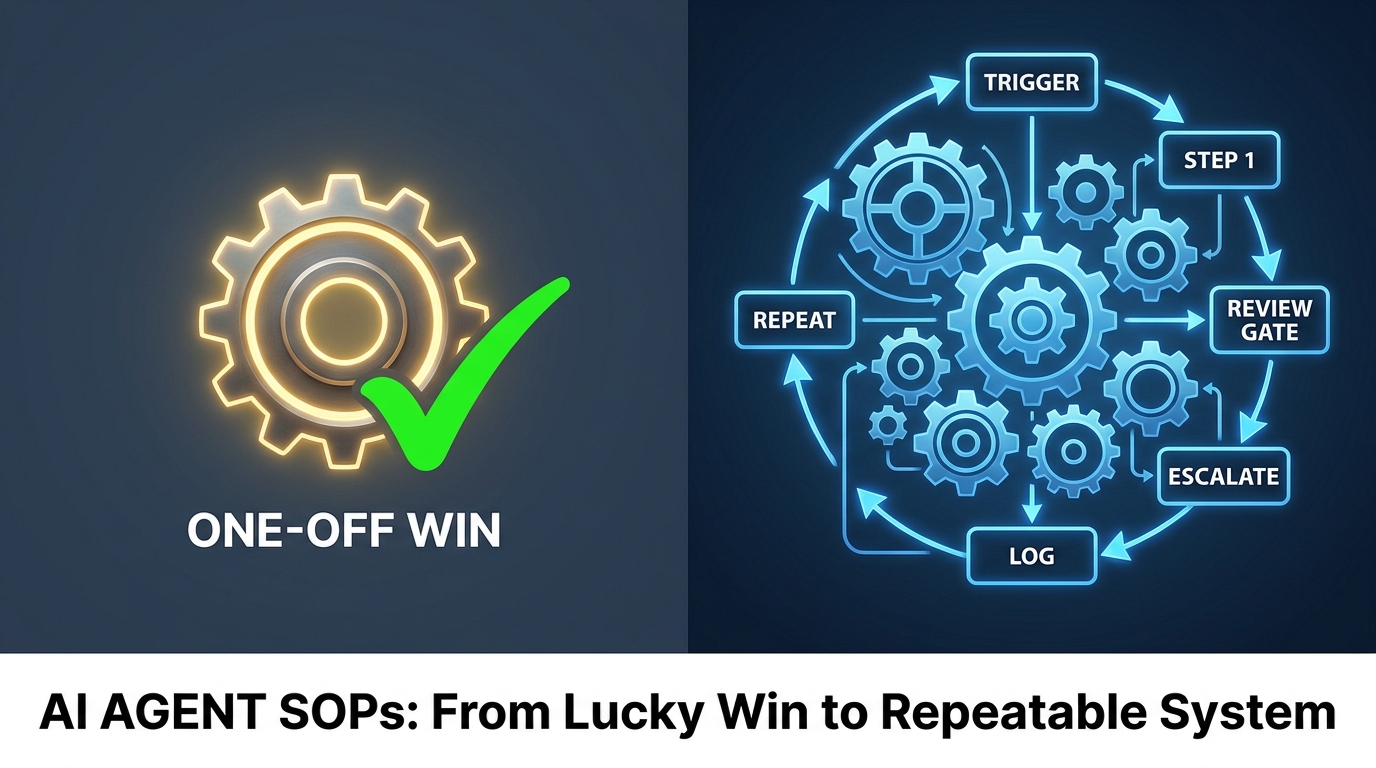

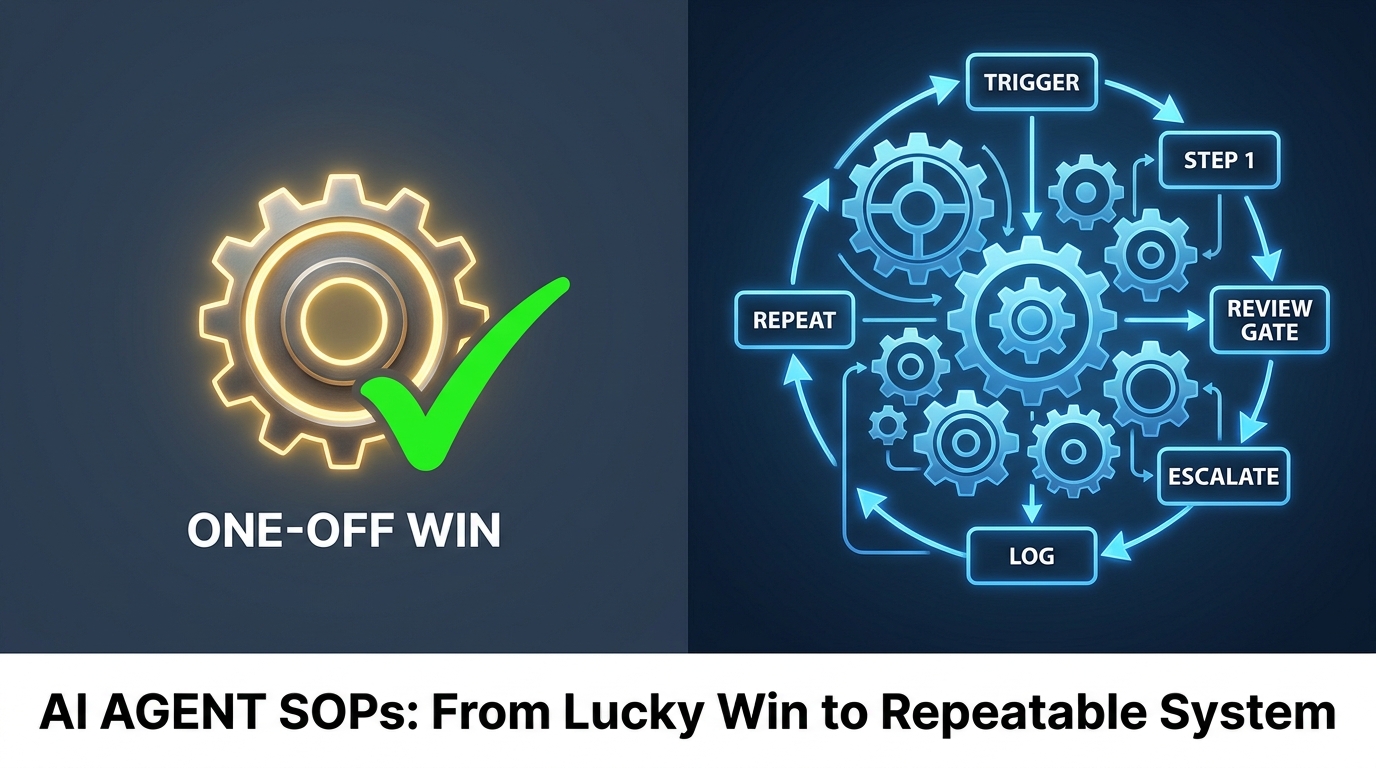
Every team has a version of the same story. An engineer or ops lead spots a process that could be automated — customer refund requests, invoice reconciliation, lead qualification, whatever it is — and they wire up an AI agent over a weekend. It works. It works beautifully. Stakeholders are excited. Someone puts together a slide about productivity gains. There is talk of rolling this out across three other departments.
Six weeks later, the agent is silently failing on edge cases nobody documented. The engineer who built it has moved to another project. The inputs it depends on changed format. Nobody knows what the agent is supposed to do when it hits an ambiguous approval scenario, so it just… decides. Sometimes correctly. Sometimes not.
This is the one-win wonder problem, and it is the defining failure mode of AI automation in 2026. Not that the technology does not work — it does — but that teams keep treating first-run success as if it were proof of a working system, when what they have actually built is a lucky demo that happens to live in production.
The fix is not more sophisticated agents or better models. It is better Standard Operating Procedures — SOPs designed specifically for how agents behave, fail, hand off, and evolve. This article breaks down what those SOPs actually look like, what happens without them, and how to build a library of repeatable agent workflows that hold up under the pressure of real operations. The angle here is not deployment logistics or ROI frameworks. It is the structural question: what does a properly documented AI agent actually need to stay reliable over time?
The Distinction That Changes Everything: Wins vs. Systems
Before getting into SOP mechanics, it is worth being precise about what separates a one-off win from a repeatable system. They are not just different by degree — they are different in kind.
What a win looks like
A win is an agent that succeeds in a narrow, well-controlled set of conditions. The inputs are clean. The task is bounded. Someone is watching. The edge cases that would break it simply have not appeared yet because the task volume is low or the data has been curated for the demo. In a pilot environment, this looks like 95% accuracy and glowing feedback.
The problem is that the pilot environment is a fiction. It is a carefully managed slice of reality designed to show the technology working. When that same agent enters production — facing real input variation, real system load, real API behavior, and real human inconsistency — the gap between “it worked” and “it works reliably” becomes very visible, very fast.
What a system looks like
A system is not a smarter agent. It is a documented, tested, versioned workflow that defines: what starts the process, what data the agent is allowed to use, what actions it is permitted to take, where it must stop and ask a human, how failures are detected and handled, and what success looks like in measurable terms.
The difference is legible even in the language. A win is described with enthusiasm: “The agent handles our refund requests automatically.” A system is described with specificity: “When a refund request arrives tagged Priority-1 in the CRM, the agent retrieves the order record from the billing API, checks the 30-day return window, and either approves refunds under $150 or escalates to Tier 2 with a structured summary. It must not modify any payment records directly. It logs every decision to the audit trail. If the billing API returns a 500 error, it retries twice and then opens a human task.”
That specificity is not bureaucracy. It is the difference between automation that holds up at 10,000 runs and automation that degrades at run 47.
Why teams skip this step
The reason most teams never write this down is that the pilot worked without it. There is a natural cognitive bias at play: when something succeeds, we attribute the success to the agent’s capability rather than the controlled conditions. Writing an SOP feels like unnecessary paperwork after a successful result. It is only when the production failures start accumulating that the absence of documentation becomes obvious — and by then, the original builder has often moved on.
Anthropic’s own guidance on building effective agents, based on working with dozens of production deployments, points to simple, composable patterns — not complex frameworks — as the mark of durable agent work. What makes those patterns durable is that they are explicitly defined, not improvised each time.
The Real Failure Stack: Why Agent Wins Don’t Repeat
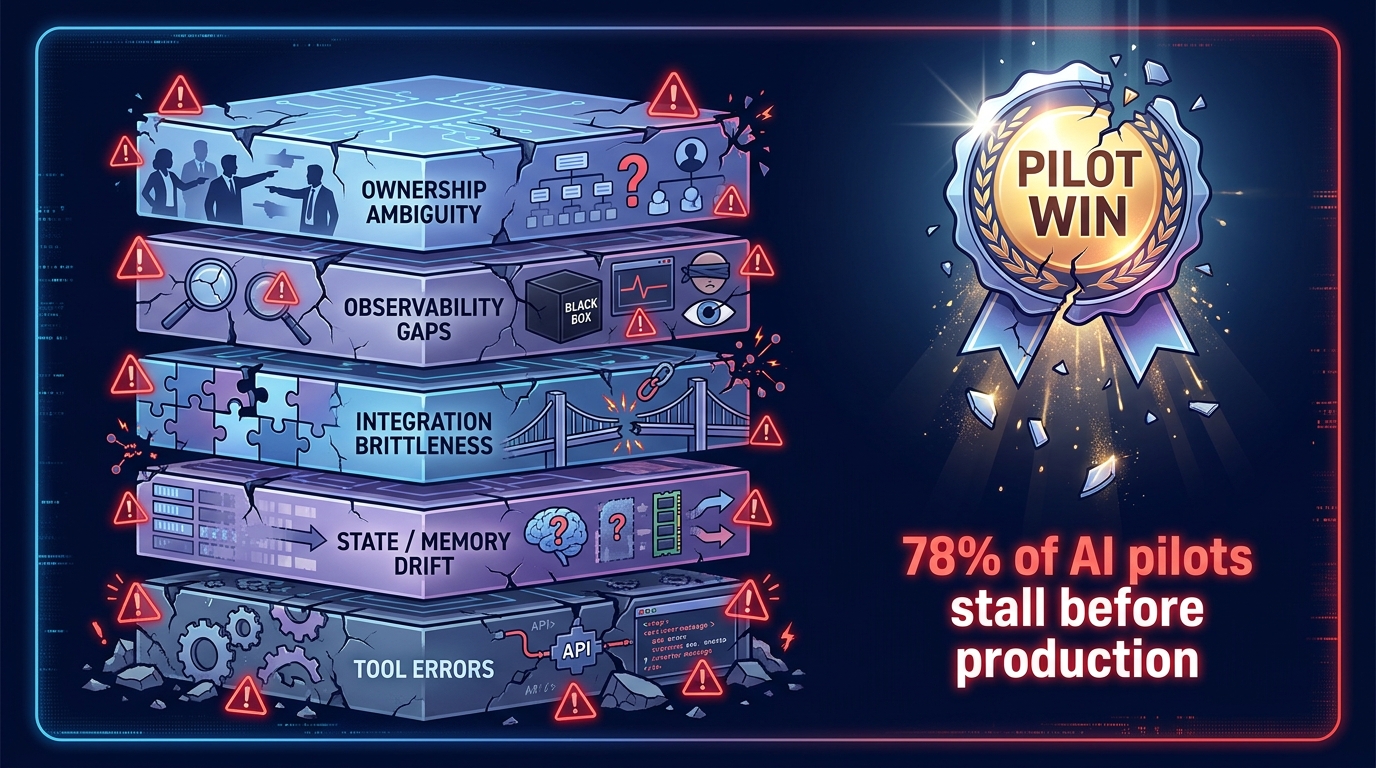
The popular narrative about why AI agents fail focuses on hallucination — the model confidently generating wrong information. But in production environments in 2026, hallucination is not the primary failure mode. The real failure stack is more systemic, and more solvable, than bad model outputs.
Layer 1: Tool errors and brittle integrations
Agents depend on external tools: APIs, databases, search functions, internal systems. When those tools return unexpected formats, rate-limit the agent, go offline, or change their schema, the agent has to do something. Without an explicit SOP that defines what that “something” is, the agent either makes something up, silently skips the step, or crashes in an undocumented way that someone discovers three days later when a downstream report shows bad data.
Tool reliability is consistently cited in 2026 production guidance as one of the top causes of repeatability failure — not because APIs are unreliable in general, but because agents call them in higher-volume, more diverse, and less predictable ways than human users do. A tool that handles 500 manual queries per day may buckle under an agent making 5,000 calls with unusual parameter combinations.
Layer 2: Memory and state drift
This is the failure mode that surprises teams the most, and it is covered in depth later in this article. For now: agents that run multi-step workflows accumulate context — retrieved facts, prior decisions, intermediate outputs — and that accumulated context can become stale, contradictory, or simply wrong by step 15 of a 20-step workflow. The agent does not know its context is degraded. It keeps going. The output looks plausible. The error is invisible until someone audits the result manually.
Layer 3: Integration debt and legacy system friction
Many enterprise systems were not designed to be called by autonomous software. Authentication models, rate limits, pagination behaviors, and data formats vary enormously. A pilot that uses clean test data from a staging environment will not expose this friction. Production does. The result is an agent that works in the demo environment and fails in the real one for reasons that have nothing to do with the agent itself.
Layer 4: Observability gaps
If you cannot see what the agent is doing at each step, you cannot tell when it starts failing. Many pilot deployments have no structured logging, no per-step latency tracking, no tool-call monitoring, and no alerting. The first signal that something has gone wrong is a downstream complaint — not a monitoring alert. By the time the failure is detected, it may have been running for hours or days.
Layer 5: Ownership ambiguity
Who owns this workflow? Who updates the prompt when the business process changes? Who gets paged at 2am when it errors? Who decides when the agent needs a human review gate added? Without defined ownership, agents become technical orphans — still running, nobody’s problem until they cause one. Enterprise analysis consistently flags ownership ambiguity as a top-five reason that AI automation stalls or regresses after initial deployment.
Taken together, these five layers explain why the industry benchmark data is sobering: roughly 78% of enterprise AI pilots stall before reaching stable production. The agents were not wrong. The systems around them were incomplete.
The Anatomy of an AI Agent SOP: What It Actually Needs to Contain
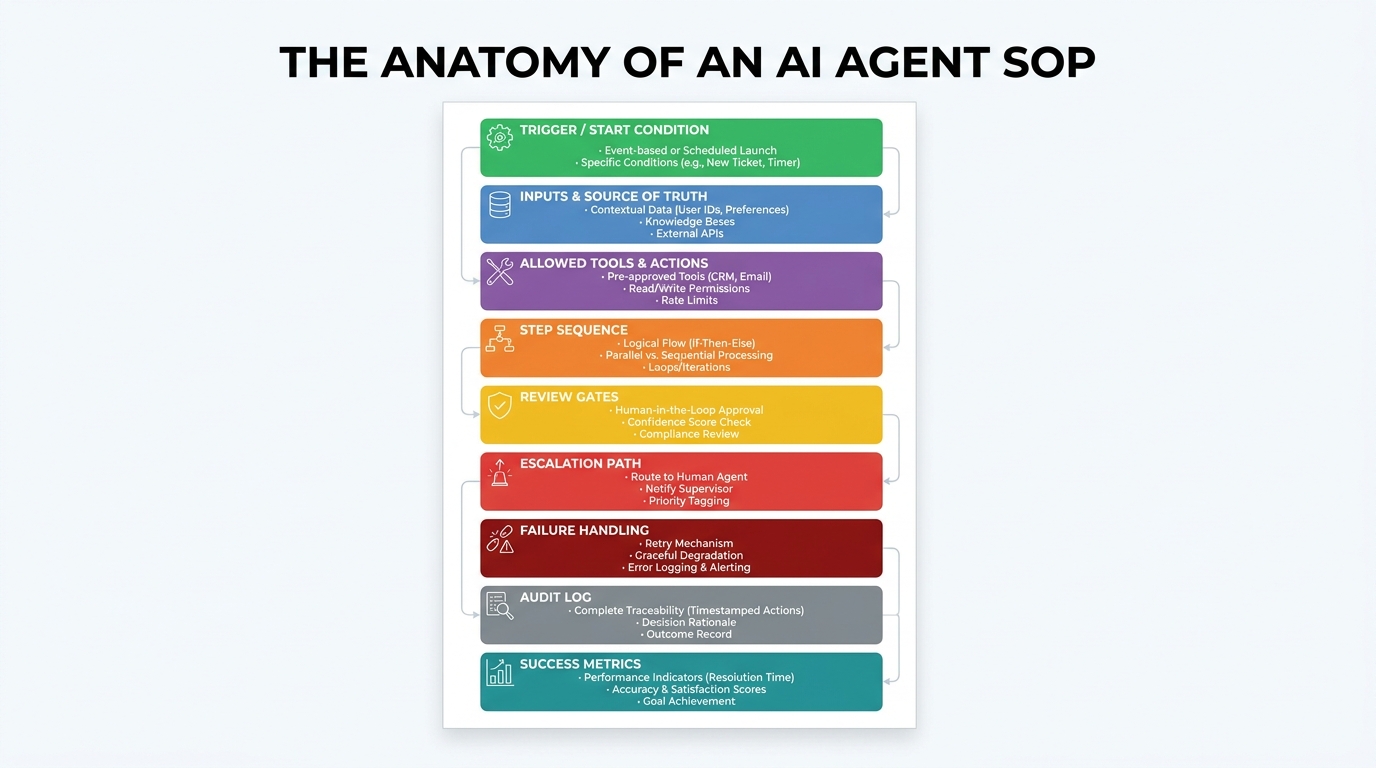
An AI agent SOP is not a prompt. It is not a flowchart. It is not a Confluence page that describes what the agent does in general terms. It is a structured, machine-legible, version-controlled workflow specification that tells the agent — and every human who touches it — exactly what the boundaries of this automation are.
Here is what a well-constructed agent SOP must contain, based on converging enterprise guidance in 2026:
1. Trigger and start condition
Define precisely what initiates the workflow. A trigger is not “when a support ticket comes in.” A trigger is: “When a ticket is created in the support system with category=Billing, priority=P1 or P2, and account_tier=Enterprise, the agent starts.” Ambiguous triggers create ambiguous scope. If the agent does not know exactly when it should run, it will sometimes run when it should not, and not run when it should.
Triggers can be event-based (webhook, queue message, file upload), scheduled (daily at 06:00 UTC), or conditional (when a CRM field changes to a specific value). The type matters because it determines how the agent is invoked and what startup state it can assume.
2. Scope, owner, and risk level
Document what this SOP covers and — critically — what it does not. Scope boundaries prevent agents from expanding into adjacent tasks they were not designed for. Include the workflow owner by name or role, the business outcome this SOP is meant to deliver, and an explicit risk classification (low / medium / high) that determines what governance controls apply.
3. Required inputs and source of truth
Every piece of data the agent will use should be explicitly listed: where it comes from, what format it must be in, and what happens if it is missing or malformed. This section prevents the agent from improvising data — a common source of plausible-looking but factually wrong outputs.
4. Allowed tools and actions — with explicit prohibitions
List every tool the agent is permitted to call. Then list what it is explicitly prohibited from doing. Prohibition lists matter as much as permission lists. “The agent may read from the billing database but must not write to it directly” is a control that, if left unstated, gets violated by an agent optimizing for task completion. Least-privilege scoping — giving the agent only the minimum access it needs — reduces blast radius when something goes wrong.
5. Step sequence with decision branches
This is the heart of the SOP: a numbered, step-by-step breakdown of what the agent does, in what order, with explicit decision branches at key points. Do not use vague language like “the agent analyzes the request.” Write: “Step 3: The agent calls the order_lookup API with the order_id from the trigger payload. If the API returns a 404, the agent proceeds to Step 7 (escalation). If it returns a 200, it extracts the order_date and item_count fields and proceeds to Step 4.”
This level of specificity is what makes the SOP machine-executable, not just human-readable.
6. Human review gates
Every SOP should define at least one point where a human must approve before the agent proceeds. High-risk SOPs may have several. These gates are not signs of a failing system — they are what makes the system safe to scale. The gate conditions should be explicit: “If the refund amount exceeds $500, the agent must pause and send a structured approval request to the billing manager before proceeding.”
7. Escalation paths
Separate from error handling, escalation paths define what happens when the agent encounters ambiguity that is within the normal range of inputs but outside the scope of its decision authority. The agent should never improvise in an escalation scenario. It should follow a defined handoff protocol: who to notify, what context to include in the handoff, and what state to preserve so the human or next agent can pick up cleanly.
8. Failure handling and rollback conditions
Define explicitly what constitutes a failure for this workflow, not just at the individual step level but at the SOP level. What is the rollback plan if the workflow completes partially? What cleanup actions does the agent take? Are retries idempotent? These questions sound tedious to answer in advance, but they are the questions that determine whether a failure at 3am is a five-minute fix or a four-hour incident.
9. Audit log requirements
Specify what must be logged, in what format, and to what destination. The audit log is not optional — it is the mechanism by which the SOP proves it worked. Logs should capture at minimum: trigger data, step sequence executed, tool calls made with inputs and outputs, any human decisions made during review gates, the final outcome, and the agent version and model ID used.
10. Success metrics and review cadence
Define what “working” means for this SOP in measurable terms, and schedule when those metrics will be reviewed. Without this, the SOP will be deployed, forgotten, and gradually degrade without anyone noticing until the damage is significant.
RFC 2119 and the Language of Constraint: MUST, SHOULD, MAY
One of the most practical advances in AI agent SOP design in 2026 is the adoption of RFC 2119 terminology — the same standard used in internet protocol specifications — to distinguish between mandatory behaviors, recommended behaviors, and optional behaviors.
The three key terms:
- MUST / MUST NOT: The agent has no discretion. This is a hard constraint enforced at the system level. “The agent MUST NOT modify any record in the payments table.” Violation of a MUST is a bug, not an edge case.
- SHOULD / SHOULD NOT: The recommended behavior under normal conditions, with allowance for documented exceptions. “The agent SHOULD complete the verification step before generating the output, except when the input source is pre-validated.” This gives the agent flexibility while signaling the preferred path.
- MAY: An explicitly permitted but not required action. “The agent MAY include a confidence score in the output summary.” This prevents agents from treating optional behaviors as mandatory, or from omitting them when they would be genuinely useful.
AWS’s open-source Agent SOPs framework — released in 2026 as a markdown-based workflow specification — uses this RFC 2119 vocabulary precisely because it sits at the intersection of human-readable and machine-enforceable. A SOP written with MUST/SHOULD/MAY can be read by a human reviewer, understood by a developer, and referenced by a quality assurance process to check whether the agent’s actual behavior matches specification.
Why natural language with constraints beats pure code
A fully coded workflow (hardcoded decision trees, explicit conditional logic) is maximally precise but inflexible — every edge case requires a code change. A pure prompt (“handle refund requests professionally”) is maximally flexible but produces inconsistent behavior that drifts over time and across model versions.
RFC 2119-structured natural language sits in a productive middle ground: it is precise enough to constrain the high-risk behaviors (MUSTs), flexible enough to let the agent use judgment on lower-stakes decisions (MAYs), and human-readable enough to be reviewed, updated, and audited by people who are not engineers. This is why it has been adopted as the backbone of serious enterprise SOP frameworks rather than just prompt templates.
For teams building their first SOPs, the practical implication is this: go through every step in your workflow and ask, for each behavior, whether it is a MUST, a SHOULD, or a MAY. The exercise will surface assumptions you did not know you were making, and it will force you to decide on guardrails before a production failure forces the decision for you.
Memory, State, and the Silent Killer of Repeatability
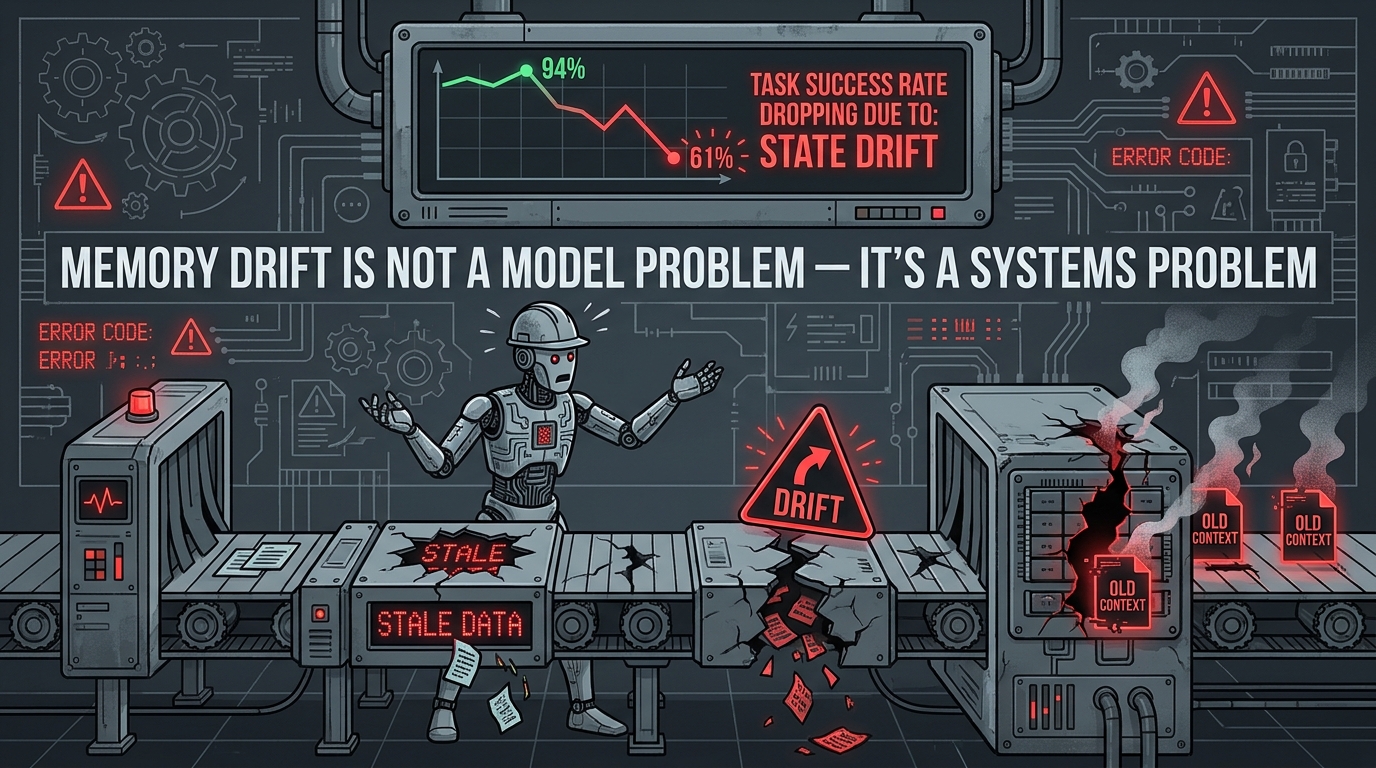
If there is one technical problem that kills more AI agent SOPs than any other, it is memory and state drift. This is not the same as hallucination — the model generating wrong information from nothing. State drift is subtler and more dangerous: the agent’s accumulated context becomes gradually incorrect over the course of a workflow run, and the agent has no way to know this has happened.
How state drift occurs
Consider a multi-step financial reconciliation agent. In step 1, it retrieves an account balance — $14,230. In steps 2 through 9, it processes a series of transactions, retrieves additional data from multiple APIs, and builds an intermediate summary. By step 12, the original balance figure it retrieved is still in its context window — but it was fetched 45 seconds ago, and in a live financial system, that number may have changed. The agent does not re-fetch it. It uses the stale value. The final reconciliation output is wrong by the amount of any transactions that occurred in those 45 seconds.
This example is illustrative, but the pattern generalizes across any domain where data changes during a workflow run. In healthcare intake, patient records are updated in real time. In logistics, inventory counts change continuously. In customer support, ticket status can shift while the agent is mid-resolution.
Four types of state that SOPs must address
Enterprise guidance in 2026 has converged on treating agent memory as an engineered subsystem with four distinct layers, each of which needs explicit SOP provisions:
- Session state: Data that is valid for the duration of a single workflow run. SOPs should define which data points are session-scoped and must be re-fetched if the session pauses or restarts.
- Workflow state: The position of the agent in the step sequence — what has been done, what has not, what decisions have been made. This must be checkpointed to persistent storage so that a crash mid-workflow can be recovered without re-running completed steps.
- Memory / retrieval state: Any information the agent has retrieved from knowledge bases, document stores, or prior runs. SOPs must specify how long retrieved information is considered fresh, and when it must be re-retrieved.
- Audit state: The immutable record of what happened, used for compliance and debugging. This must be written as it happens — not reconstructed after the fact.
The SOP provisions that address this
Practical SOP design for state management includes: explicit TTLs (time-to-live values) on any data retrieved more than a defined period before use; mandatory checkpoint writes after each high-stakes step; re-fetch requirements before any decision that involves time-sensitive data; and session isolation rules that prevent context from one workflow run contaminating another.
The deeper lesson here is that state management failures are not model failures. They are systems failures. No version of a better prompt will fix an agent that is working with stale context. Only explicit SOP provisions around data freshness, checkpointing, and retrieval hygiene will.
Designing Human Review Gates and Escalation Paths That Actually Work
There is a persistent myth in enterprise AI that human review gates are a sign of a system that has not matured yet — a temporary measure until the model gets good enough to handle everything autonomously. This is wrong, and the organizations that treat it as correct tend to have the most catastrophic automation failures.
Human review gates are permanent features of well-designed SOPs for any workflow that involves significant financial, legal, reputational, or safety consequences. The question is not whether to have them but how to design them so they add control without adding friction that defeats the purpose of automation.
What makes a review gate effective
An effective review gate has three components: a clearly defined trigger condition, a structured context package, and a defined response window with fallback behavior.
The trigger condition specifies exactly when the agent must pause and request human input. This should be written in specific, measurable terms — not “when the situation is complex” but “when the contract value exceeds $50,000, when the customer account has had more than two escalations in the past 90 days, or when the agent’s confidence score for the recommended action is below 0.80.”
The structured context package is what the agent provides to the human reviewer. A gate that says “please review this” is useless. A gate that says “here is the customer record, the recommended action, the three alternatives the agent considered, the data points supporting the recommendation, and the specific decision being requested” gives the human everything they need to respond in under two minutes. The quality of the context package determines whether humans engage meaningfully or rubber-stamp.
The response window defines how long the agent waits, and what it does if no response arrives. A well-written SOP will specify: “If no response is received within four business hours, the agent escalates to the next approval tier. If no response within 24 hours, the agent flags the workflow as stalled and notifies the workflow owner.”
Escalation paths vs. error handling
Teams frequently conflate escalation with error handling. They are different. Error handling covers what happens when something technically fails — an API is down, a required field is missing, a tool returns an unexpected format. Escalation covers what happens when everything works technically but the agent has reached the edge of its decision authority.
An agent that cannot distinguish between these two scenarios will handle both badly. Error handling involves retries, fallbacks, and failure notifications. Escalation involves structured handoffs with full context preserved, human decision collection, and the agent resuming from the escalation point once the decision is returned — not restarting the entire workflow.
SOPs should document both paths with equal care. Escalation paths are particularly easy to skip in a first-draft SOP because they feel like edge cases. They are not. In any complex workflow run at production volume, escalation scenarios occur regularly. Without a defined path, agents improvise — and improvised escalation usually means lost context, frustrated humans, and inconsistent outcomes.
Versioning Your SOPs: Treating Workflows Like Software
The most durable shift in enterprise AI thinking in 2026 is the recognition that an agent SOP is not a document — it is a software artifact. And like software, it needs version control, release gates, regression testing, and rollback capability.
What SOP versioning means in practice
Every SOP should have a version number. Every change to the SOP — whether it is a new decision branch, a revised tool permission, a changed threshold, or an updated prompt — increments the version. Every agent run should be tagged with the SOP version it executed, so that when a production issue surfaces, you can immediately identify which version was running and compare it to the previous stable version.
This is not hypothetical best practice. In production environments where multiple teams are updating agent workflows concurrently, the ability to trace a failure back to a specific SOP version is the difference between a 15-minute diagnosis and a four-hour war room session.
Release gates for SOP updates
Just as software releases require testing before deployment, SOP updates should require evidence of performance before going to production. The release criteria for an SOP update should include: successful completion of a defined test suite against synthetic or sampled real inputs, no regression in task success rate versus the prior version, and sign-off from the workflow owner.
This sounds heavyweight for what might be a small prompt change, but the lightweight version of this process takes less than an hour and has saved teams from deploying changes that looked innocuous but broke an edge case that was not tested.
Rollback capability
Every production SOP should have a defined rollback procedure: revert to the previous version, with a defined trigger condition (task success rate drops more than 5 percentage points below baseline over a rolling window, or tool-call error rate crosses a defined threshold). This rollback should be executable by the workflow owner, not just by engineering. If rolling back an SOP requires a deployment pipeline, the friction is high enough that people will wait too long before doing it.
Changelogs as operational records
Maintain a changelog for every SOP — not just a version number, but a human-readable record of what changed, why it changed, who approved the change, and when it went live. This changelog becomes invaluable when troubleshooting intermittent issues, when onboarding a new workflow owner, or when auditing the system for compliance purposes. It is also the mechanism by which institutional knowledge about the workflow survives team changes.
Observability and the Metrics That Actually Matter
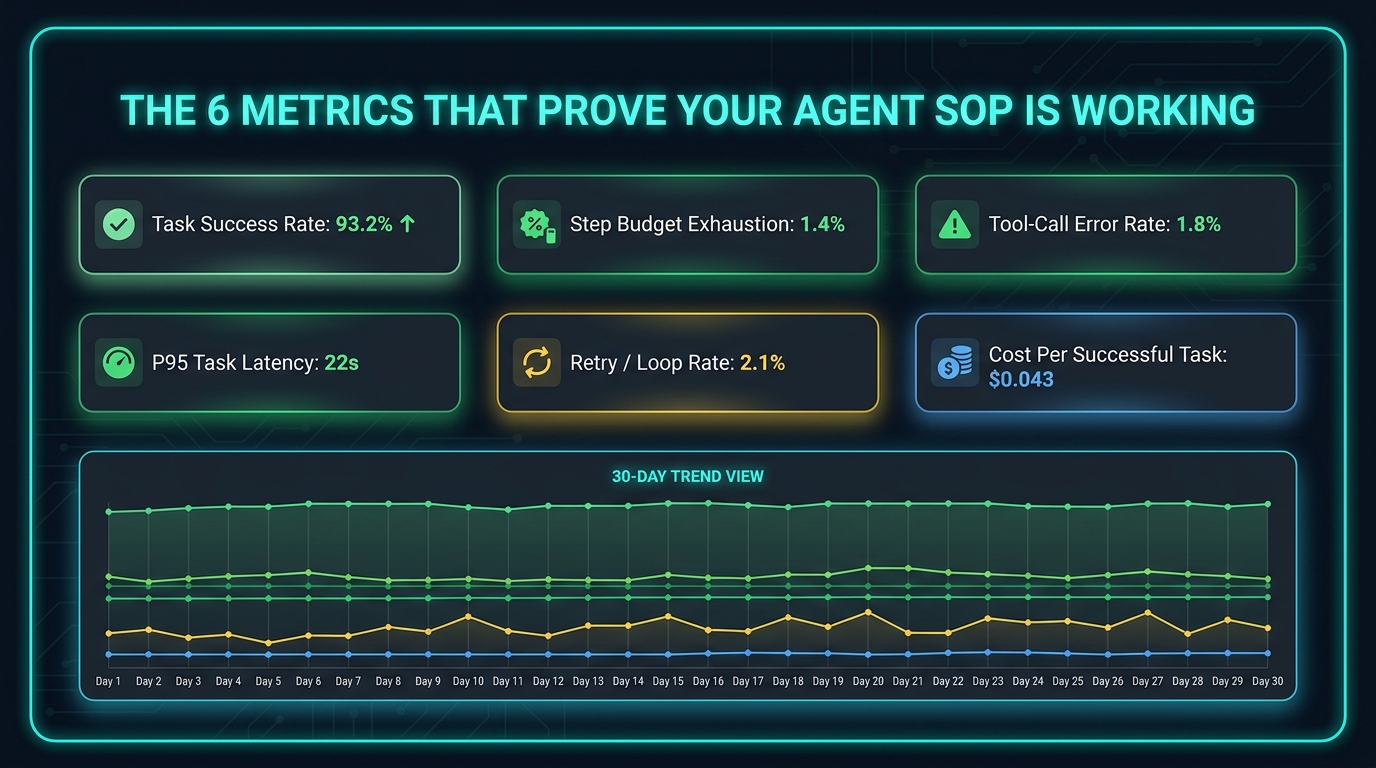
An agent SOP without observability is an agreement with no enforcement mechanism. You have written down what the agent should do; without monitoring, you have no way to know whether it is actually doing it, or whether it degraded last Tuesday and nobody noticed.
The metrics that matter for production agent SOPs are not the same as general infrastructure metrics. CPU usage and uptime are largely irrelevant. What matters is behavioral observability — are the agents executing the workflow as specified?
The six core metrics for SOP health
Based on converging production guidance in 2026, well-instrumented agent SOPs track these six metrics at minimum:
- Task success rate: The percentage of workflow runs that reach the defined success state. This is the headline metric. A target of 90% or above is commonly cited for production-grade SOPs; below 80% typically indicates a structural problem requiring SOP revision rather than just model tuning.
- Step budget exhaustion rate: How often does the agent hit its maximum step count without completing the task? This catches infinite loops, decision paralysis, and unbounded tool chains before they become resource-expensive. A target below 2% is achievable with well-scoped SOPs.
- Tool-call error rate: The percentage of tool invocations that return errors (API failures, malformed responses, authorization failures). A rate above 2% typically signals integration problems that need attention at the infrastructure level, not the SOP level.
- P95 task latency: How long does the workflow take from trigger to completion at the 95th percentile? This metric catches long-tail performance problems — runs that are taking far longer than the median and likely experiencing tool failures, retry storms, or state management issues.
- Retry and loop rate: How often is the agent retrying failed steps or entering repeated decision loops? A rising retry rate is an early warning signal for tool degradation or SOP gaps in error handling. Monitor the trend, not just the absolute value.
- Cost per successful task: The total compute and API cost divided by the number of successfully completed tasks. This metric matters more than raw cost because it accounts for failed runs that consume resources without delivering value. A creeping cost-per-task metric often indicates that failed runs are becoming more frequent before the task success rate clearly shows it.
Trace-level attribution and version tracking
Beyond these six metrics, production observability requires that every workflow run be tagged with the SOP version, model version, session ID, and any relevant context identifiers. This trace-level attribution is what makes metrics actionable: without it, a drop in task success rate tells you something is wrong but not which version change caused it or in which subset of inputs.
The operational practice of linking every trace to a specific SOP version — rather than retrofitting this after failures — is what separates teams that can diagnose production issues in minutes from teams that spend hours in war rooms running manual audits.
Alert thresholds and automated rollback triggers
Define your alert thresholds in the SOP itself, not separately in a monitoring tool. This ensures they travel with the workflow documentation and are reviewed whenever the SOP is updated. Standard thresholds used in enterprise deployments: alert when task success rate drops more than 5 percentage points below baseline over any 4-hour window; alert when tool-call error rate exceeds 5%; alert when P95 latency exceeds 2x the established baseline; page the workflow owner if any threshold is breached for more than 30 consecutive minutes.
Multi-Agent Handoffs: Governing the Chains, Not Just the Nodes
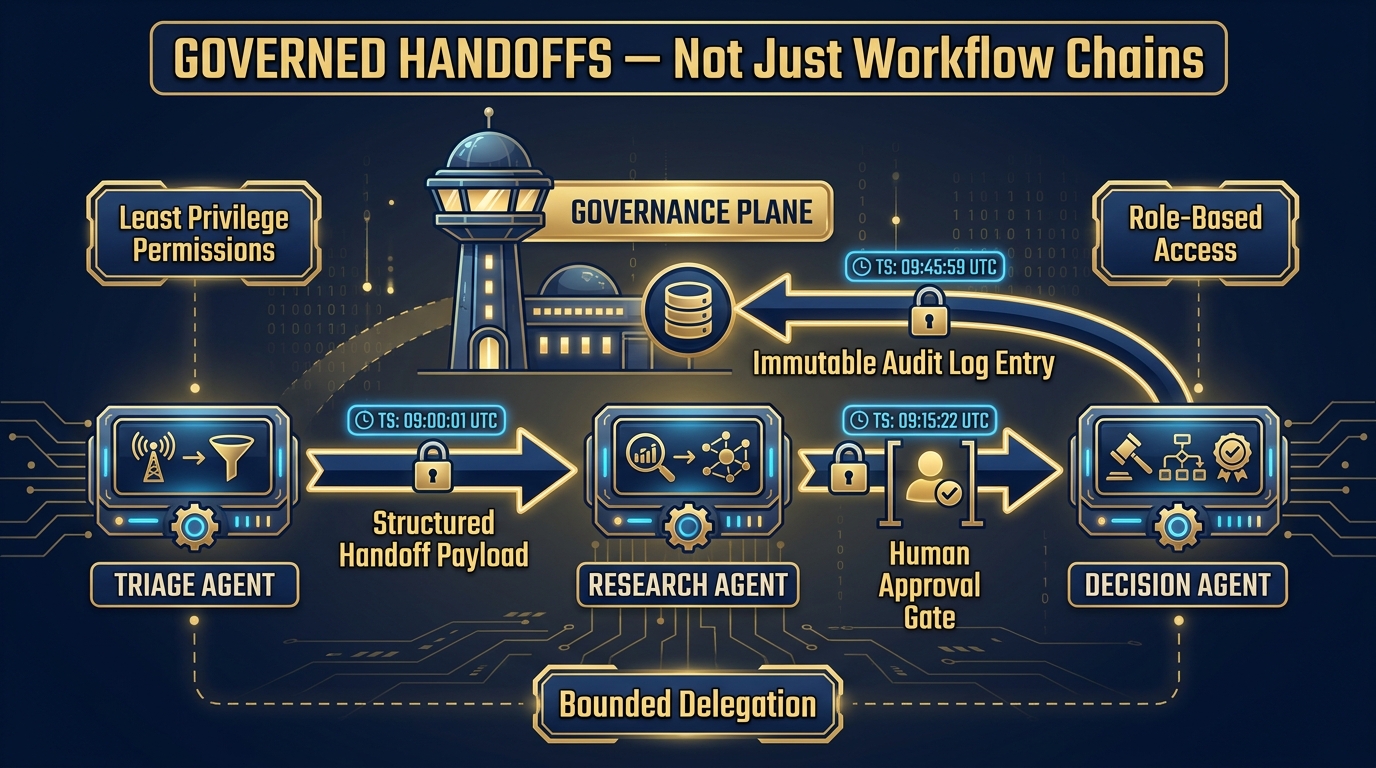
Single-agent SOPs are the foundation. But production deployments increasingly involve chains of agents — where the output of one becomes the input of the next, and where failures can cascade across the entire pipeline if the handoffs are not governed carefully.
Why chaining agents without governance is dangerous
In a multi-agent chain, each agent typically has its own scope, its own tools, and its own decision authority. The problem arises at the transitions. When Agent A hands off to Agent B, several things can go wrong: the context payload is incomplete, forcing Agent B to make assumptions; the permissions granted to Agent A inadvertently carry over to Agent B, creating a privilege escalation vulnerability; the handoff itself is not logged, creating an audit gap; or Agent B interprets the incoming context differently than Agent A intended it.
Each of these failure modes is individually manageable. In combination, across a five-agent pipeline running thousands of times per day, they create production incidents that are genuinely difficult to diagnose because the failure point is in the handoff, not in any individual agent.
Structured handoff payloads
Every handoff between agents in a multi-agent workflow should use a defined, typed payload schema — not just a free-text summary or a forwarded conversation thread. The schema should specify exactly what fields are required, what types they must be, and what the receiving agent should do if any field is missing or malformed.
This is one of the places where the distinction between a workflow and an agent matters most. In a workflow system, the handoff format is enforced by the orchestration layer. In a fully autonomous agent system, the sending agent constructs the handoff dynamically. Both approaches can work, but both require an explicit SOP that defines the expected format, because the receiving agent’s behavior will depend on it.
The governance plane: controlling the chain, not just the nodes
Enterprise guidance in 2026 has converged on the concept of a governance plane for multi-agent systems — a centralized layer that enforces policy across all agents in a pipeline, independent of any individual agent’s own controls.
The governance plane handles: real-time policy enforcement for each tool call and handoff; identity verification at each agent transition (ensuring that Agent B is receiving a handoff from the authorized Agent A, not from a spoofed or compromised source); immutable audit log writes at each transition; human approval gate enforcement; and permission boundary checks that prevent privilege creep as context passes through the chain.
An example from enterprise claims processing illustrates what this looks like at scale: a global insurer deployed a three-agent pipeline — triage, research, decision — to process 15,000 claims per day with a 94% accuracy rate. The architecture included explicit handoff schemas between all three agents, human approval gates before any decision agent output was written to the claims system, and a governance plane that logged every transition with a timestamp, agent identity, and decision record. Resolution time dropped from five business days to under eight hours. The governance infrastructure was not the glamorous part of the deployment, but it was the part that made 15,000 daily runs feasible without a compliance failure.
Least-privilege scoping across the chain
Each agent in a multi-agent pipeline should have only the minimum permissions required for its specific role. The triage agent does not need write access to the claims system. The research agent does not need access to the payment database. The decision agent should not be able to modify its own decision criteria.
This principle — least-privilege scoping applied per agent, not per pipeline — is what prevents a compromise or malfunction in one node from having unlimited reach across the system. It also simplifies debugging: when something goes wrong, least-privilege scoping bounds the set of things that could have been affected.
What SOP-Bench Tells Us About Where Agents Actually Stand
It is easy to write confident prescriptions about what AI agent SOPs should contain. It is also useful to look at what happens when agents are actually tested against real SOPs at scale — and the data is humbling.
SOP-Bench, an execution-based benchmark released publicly in 2026 and presented at KDD 2026, evaluates LLM-based agents on over 2,000 tasks drawn from expert-authored real-world business procedures across 12 industrial domains — healthcare intake, finance, content moderation, logistics, warehouse inspection, and others. Unlike benchmarks that test isolated prompt-following, SOP-Bench uses functioning tools and ground-truth scoring. The agent either completes the SOP correctly or it does not.
The performance data
The results across frontier agents show wide variance — task success rates ranging from 26.7% on the most complex domain-specific SOPs to 94.3% on well-bounded, lower-ambiguity procedures. The average across domains is approximately 64% for function-calling agent architectures and around 55% for ReAct-style agents. These are not numbers from weak or outdated models — these are current frontier systems evaluated against real enterprise procedures.
What the benchmark data shows is that agent performance is highly domain-sensitive and SOP-structure-sensitive. Well-written SOPs with explicit steps, clear decision criteria, and functioning tool interfaces produce dramatically better agent performance than ambiguous or poorly specified procedures. This is a direct validation of the SOP design principles outlined in this article: the quality of the SOP is as important as the quality of the model.
What the variance tells practitioners
The gap between 26.7% and 94.3% success across domains is not explained by model capability alone. It is explained by the degree to which the SOP provides clear, structured guidance that the agent can follow reliably. Domains with highly standardized procedures, explicit decision trees, and well-defined tool interfaces cluster at the top end. Domains with ambiguous criteria, high variability in inputs, and complex judgment calls cluster at the bottom.
The practical implication: when scoping which workflows to automate first, prioritize those with the most structured, explicit, and deterministic SOPs. Use the less structured workflows as development targets for improving SOP quality before deploying agents to execute them. SOP-Bench data suggests that investing in SOP design before deploying the agent can lift task success rates more effectively than switching to a better model.
Building Your SOP Library: From First Win to Repeatable Portfolio
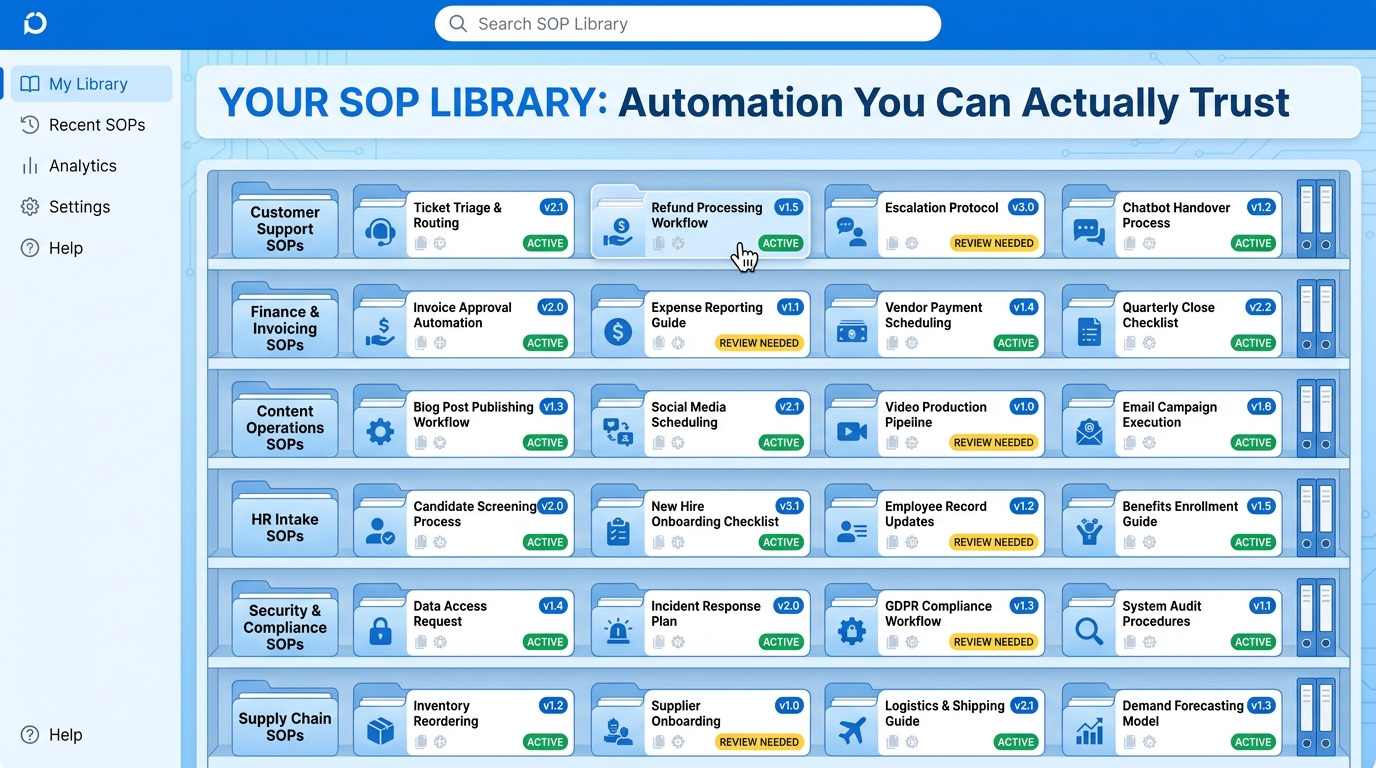
Individual SOPs are useful. A library of SOPs — organized, versioned, interoperable, and governed — is the actual enterprise asset. The difference is the difference between having one reliable process and having a durable automation capability that can be extended, maintained, and handed off across teams and over time.
What a SOP library contains
A mature SOP library is not a collection of documents. It is a structured repository of versioned workflow specifications, each with its own owner, status, test suite, performance baseline, and changelog. The organizational structure should reflect how the business uses the automations — grouped by functional domain, risk tier, or operational area — not by the technology stack that implements them.
Each entry in the library should be immediately actionable by a new team member: who owns it, what it does, what its current performance metrics show, when it was last reviewed, and how to run the test suite against it. If it takes more than ten minutes to understand a SOP in the library, the SOP is not documented well enough to be safely maintained by anyone other than its original author.
SOP lifecycle stages
Treat every SOP as having a defined lifecycle: Draft (being designed), Staging (being tested against real or synthetic data), Active (running in production), Under Review (performance has degraded or the underlying process has changed), Deprecated (the workflow is no longer in use). The lifecycle stage should be visible in the library at a glance.
The review trigger is the mechanism that prevents the library from becoming a graveyard of outdated automations. Every SOP should have a defined review cadence — typically quarterly for high-volume workflows, semi-annually for lower-frequency ones — and a performance-based trigger that moves it to Under Review status automatically when metrics cross a defined threshold.
Cross-SOP reuse and component libraries
As a SOP library matures, patterns emerge: the same authentication flow, the same audit log format, the same escalation protocol appear across multiple SOPs. These reusable components should be extracted into a shared library and referenced rather than duplicated. This is not just efficiency — it is a safety practice. When a shared component is updated (say, the authentication flow changes when an API updates), updating the shared component propagates the change to every SOP that references it, rather than requiring a manual update to each.
This is the point at which a SOP library starts to function like a software framework rather than a document archive: reusable, tested, maintained, and extended systematically rather than rebuilt from scratch with each new workflow.
Governance for the library itself
Who can add a new SOP to the library? Who can approve changes to an active SOP? Who can deprecate a SOP? These are governance questions that need explicit answers before the library gets large enough that ad hoc management breaks down. Common patterns include a workflow review board for high-risk SOPs, delegated ownership for lower-risk workflows, and mandatory peer review for any change that modifies a MUST-level constraint.
The governance model for the library should also define what happens when a workflow owner leaves the organization. Every SOP should have a successor path — either a named backup owner or a functional role that assumes ownership by default. Orphaned SOPs are a genuine risk: an active automation with no accountable owner is an automation that will eventually cause a problem and have no one responsible for fixing it.
From Documentation to Infrastructure: The Mindset Shift That Makes It Work
Every principle in this article points to the same underlying shift: treating AI agent SOPs as infrastructure rather than documentation. Documentation describes. Infrastructure delivers — reliably, repeatedly, at scale, under conditions that nobody anticipated when the first version was written.
The teams that build durable AI automation do not build it by making their agents smarter. They build it by making their systems more deliberate. They write trigger conditions instead of general descriptions. They define forbidden actions as carefully as permitted ones. They instrument before they deploy. They version before they iterate. They test before they ship. They govern the handoffs between agents with the same rigor they apply to the agents themselves.
The wins will still come. In fact, they will come faster, because a well-written SOP makes an agent more capable in practice — not by expanding what the model can do, but by reducing the operational overhead of everything around it. When the agent knows exactly when to escalate, exactly what data to re-fetch, exactly what counts as done, and exactly what to log along the way, it does not have to improvise. And improvisation is where automation goes wrong.
Practical starting points
If you have one workflow that is currently running in production without a formal SOP, that is the right place to start. Not a new workflow, not a greenfield build — the one that is already working, because working workflows are the easiest ones to document accurately. Spend half a day writing the SOP for it: trigger, scope, steps, escalation paths, failure handling, metrics. Get it reviewed by someone who uses the output, not just someone who built the system. Then instrument it.
The experience of writing that first SOP will do more to improve your team’s instincts for what makes automation repeatable than any amount of reading about it. The specificity required — “what exactly happens when the API returns a 429?” — will surface gaps you did not know you had. Those gaps are not embarrassing discoveries. They are the thing you are building: an organization that knows what its agents are doing and can prove it.
Key Takeaways
“The pilot environment is a fiction. The SOP is what makes the production environment safe.”
- Treat SOPs as infrastructure, not documents. An AI agent SOP should be versioned, tested, and governed with the same rigor as production software.
- The failure stack is systemic, not model-level. Tool errors, state drift, integration brittleness, observability gaps, and ownership ambiguity account for most production failures — not hallucination.
- Use RFC 2119 language (MUST/SHOULD/MAY) to make SOPs both human-readable and precisely constrained. The exercise of classifying each behavior will surface hidden assumptions.
- State management is a first-class concern. Define TTLs on retrieved data, mandatory checkpoint writes, and session isolation in every SOP that involves multi-step, time-sensitive workflows.
- Human review gates are permanent features, not temporary scaffolding. Design them to provide structured context, defined response windows, and clear fallback behaviors.
- Govern the handoffs in multi-agent chains, not just the agents. Structured handoff payloads, least-privilege scoping per agent, and an explicit governance plane prevent cascading failures.
- Measure SOP health with six behavioral metrics: task success rate, step budget exhaustion, tool-call error rate, P95 latency, retry/loop rate, and cost per successful task.
- Build a SOP library, not just a collection of SOPs. Reusable components, defined lifecycle stages, and clear governance for the library itself are what turn individual workflows into an organizational capability.
- SOP-Bench data confirms: SOP quality is as important as model quality. Well-specified procedures lift agent performance more reliably than switching models.
- Start with the workflow already in production. Document it fully, instrument it properly, and use the experience to build the habits that make the next SOP faster to write and safer to deploy.