



If you sell on Amazon, you already know the Buy Box isn’t just a button. It’s a revenue gate. Industry estimates consistently place roughly 80–83% of all Amazon sales flowing through that single “Add to Cart” prompt — meaning if your offer isn’t in it, you’re competing for what amounts to a footnote at the bottom of the page. Most customers never scroll that far.
That’s why a rule change to how the Buy Box works isn’t a minor policy update. It changes the entire competitive landscape on every multi-seller listing you’re on. And in July 2026, Amazon made exactly that kind of change — quietly, but with significant implications for how sellers of every type need to operate.
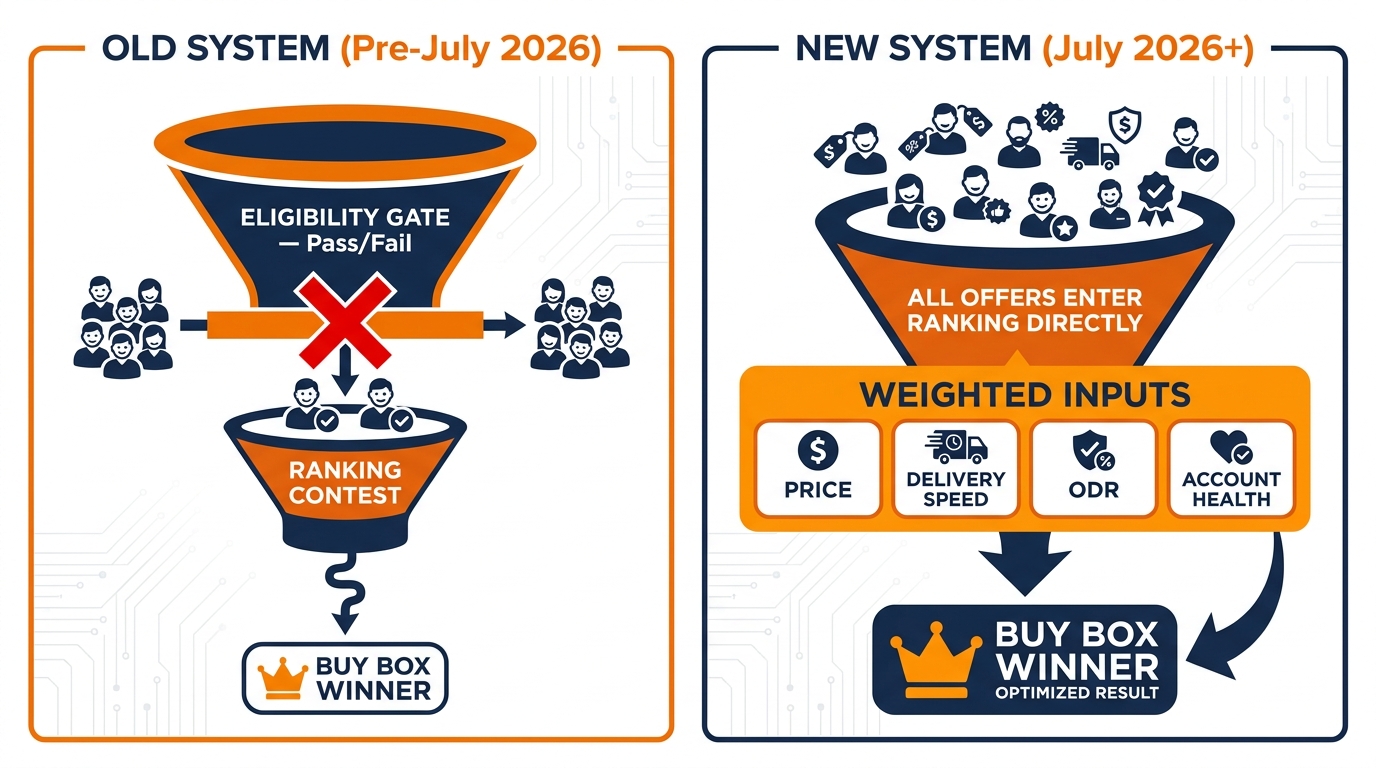
The specific change: Amazon retired the separate seller-performance eligibility gate that used to act as a binary pass/fail filter before any offer could enter the Buy Box competition. That gate is now gone. All offers move directly into a single ranking contest, with performance signals folded in as weighted inputs rather than blockers.
On the surface, this sounds like a relaxation of the rules. More sellers in the pool, easier access, fewer barriers. But dig into the mechanics and the picture gets more complex — and more demanding. The removal of the eligibility gate doesn’t lower the bar for winning the Buy Box. It changes where that bar sits and what it’s measuring. For sellers who understood how to game the old two-step system, the learning curve is steeper than it looks. For sellers who were shut out by the old gate, there’s a genuine new opportunity — but only if they show up with the right offer mechanics.
This article breaks down exactly what changed, why Amazon made this move, what the new ranking system actually rewards, and how sellers need to adapt their strategy right now.
How the Old Two-Step System Actually Worked
To understand what changed, you need to understand what the old system was actually doing — and why it was built that way in the first place.
Until July 2026, Amazon’s Buy Box operated as a two-stage process. In Stage One, Amazon ran a binary eligibility check against each seller account. This check evaluated a range of seller-level performance metrics — Order Defect Rate (ODR), chargeback rate, Voice of the Customer (VoC) complaints, late shipment rates, and pre-fulfillment cancellation rates, among others. If your account cleared those thresholds, your offers were marked “Featured Offer Eligible.” If you didn’t clear them, you were out. Full stop. Your offers couldn’t even enter the ranking contest, regardless of how competitive your price was or how fast you could deliver.
Stage Two was the actual ranking competition among eligible offers. Here, Amazon’s algorithm compared all the eligible offers on a given ASIN and selected a winner — or more precisely, decided how to distribute Buy Box rotation time across the competing offers. Price, delivery speed, Prime eligibility, seller feedback scores, and fulfillment quality all fed into this stage.
Why the Gate Made Sense — Initially
The eligibility gate was built during an era when Amazon’s seller base was scaling rapidly and its quality controls were still maturing. The gate served as a blunt instrument: exclude sellers with demonstrably poor performance from the competition so that customers were never exposed to genuinely bad offers through the Buy Box. The logic was sound. If a seller had a 5% Order Defect Rate, there was little point in letting their offer compete for the most prominent purchase position on the platform.
For years, this structure served Amazon’s customer-protection goals reasonably well. But it created a specific problem over time: it became an all-or-nothing system at the account level. If any metric on your account dipped below the threshold — even temporarily, even due to a spike in sales volume or a category-specific issue — your entire account’s offer pool was excluded from the competition. The punishment didn’t scale to the offense. A seller with 1.2% ODR was treated exactly the same as one with 12% ODR, even though their customer experience impact was dramatically different.
What the Gate Couldn’t See
The other structural problem was that the eligibility gate operated at the seller account level, not the offer level. Two completely different products from the same seller would both be excluded if the account-level metric failed — even if the specific products causing the bad metrics were unrelated to the ones being blocked. A seller might have had a defect rate issue driven entirely by one problematic ASIN, but all of their other, perfectly healthy offers would lose Buy Box access too.
This inflexibility became harder to justify as Amazon’s ranking data got more sophisticated. Amazon now has enough offer-level and ASIN-level performance signal to make much finer distinctions. A blanket account-level gate started looking like a legacy mechanism that was generating collateral damage without proportionate benefit.
Amazon’s own description of the change confirms this framing: the company said the old eligibility gate “is no longer delivering additional value to customers.” That’s a carefully worded statement. It’s not saying seller performance doesn’t matter — it’s saying the separate, binary gate isn’t adding value over and above what the ranking system itself can evaluate.
The July 2026 Rollout: Timeline, Scope, and What “Global” Actually Means
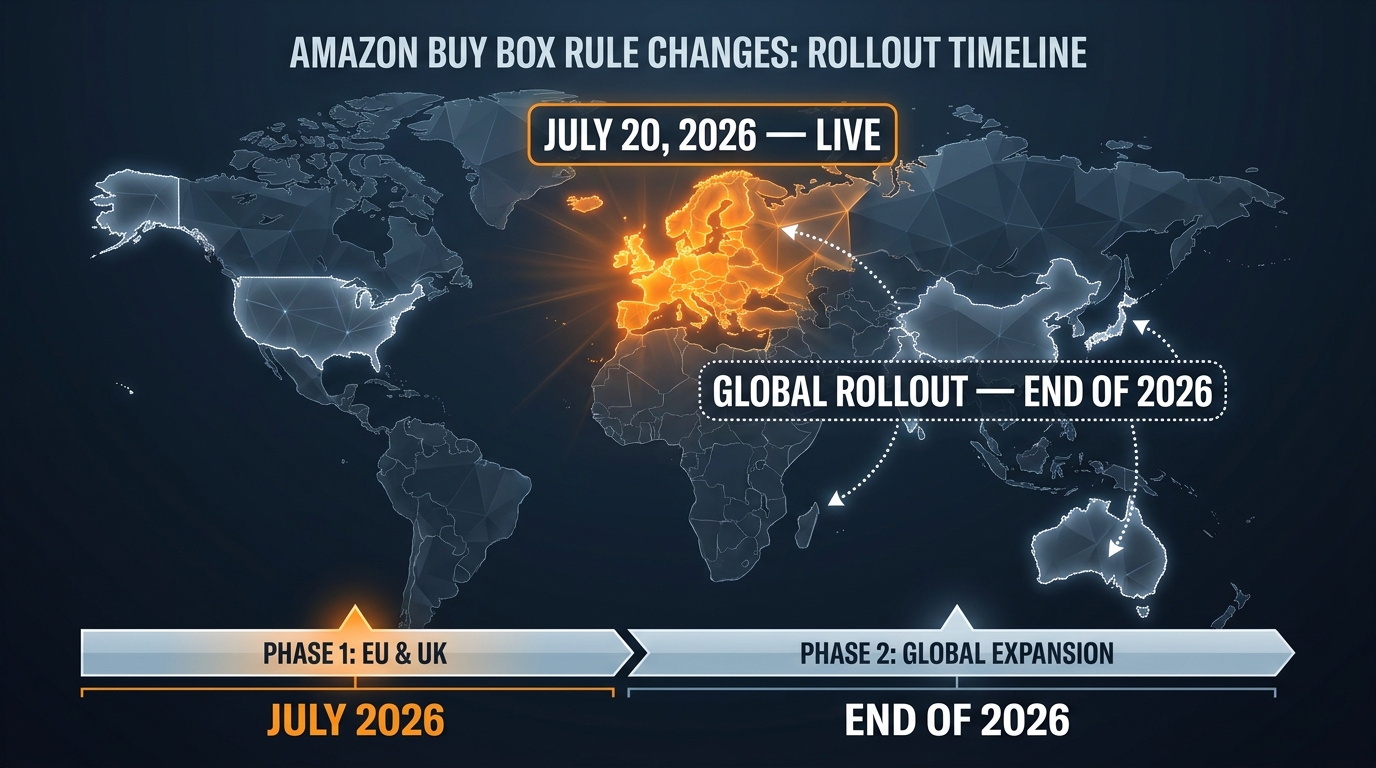
Amazon began this rollout with the EU and UK marketplaces on July 20, 2026. The broader global expansion — covering the US, Canada, Japan, Australia, India, and other Amazon storefronts — is expected to complete by end of 2026.
The staged rollout isn’t unusual for Amazon. The company frequently tests and deploys policy changes in European markets first, partly because EU regulatory requirements mandate greater transparency and non-discrimination in marketplace operations (more on that in a later section), and partly because the EU marketplace gives Amazon a controlled environment to observe behavior before touching the higher-volume US storefront.
What “Automatic Inclusion” Actually Means for Your Offers
One of the practical details that hasn’t received enough attention: Amazon is not asking sellers to do anything to take advantage of the new system. Existing offers are being automatically included in the Featured Offer competition as the rollout reaches each marketplace. If you had offers that were previously marked ineligible due to account-health metrics, those offers may now be entering the competition pool without any action on your part.
This has a double-edged implication. On the positive side, sellers who had been unjustly excluded from competition — particularly those with temporarily elevated defect rates that have since recovered — will see their Buy Box exposure increase automatically. On the negative side, sellers who were previously winning the Buy Box on certain ASINs because fewer competitors were eligible will suddenly face more competition, potentially losing rotation share without having done anything wrong.
The US Timeline Matters Most for Revenue Impact
For most sellers, the US marketplace represents the highest revenue concentration. The EU/UK rollout, while meaningful, is a preview of the real impact that will arrive when the changes reach Amazon.com. Sellers who are paying attention to the EU change now have a window — however narrow — to observe what happens to their Buy Box percentages on European ASINs and adjust their offer mechanics before the same dynamics hit their US catalog.
Sellers with cross-marketplace operations should be actively monitoring their Featured Offer percentage in EU/UK Seller Central right now. A meaningful change in rotation share on an EU ASIN is a signal of what’s coming across your entire catalog.
From Pass/Fail to Weighted Inputs: How the New Ranking Architecture Works
The most important conceptual shift in the 2026 change is not that seller performance stopped mattering — it’s that performance metrics moved from being binary disqualifiers to weighted ranking inputs. The distinction sounds subtle, but it changes the competitive calculus significantly.
What “Weighted Input” Actually Means in Practice
Under the old system, if your ODR was 1.1% and the threshold was 1.0%, you were out. Full exclusion. A seller with 0.1% ODR and a seller with 0.9% ODR were treated identically in the gate stage — both got through — even though their underlying performance differed meaningfully.
Under the new system, a seller with 0.3% ODR and a seller with 0.9% ODR are both in the competition pool, but they don’t compete on equal footing. The 0.3% ODR seller gets a stronger positive signal from that metric, which translates into a larger share of Buy Box rotation. The performance difference that the old system couldn’t see — because both sellers cleared the gate — now shows up in the ranking output.
This means the new system is actually more granular, not less demanding. The old gate created false equivalence among the sellers who cleared it. The new system surfaces performance differences that were previously invisible to the Buy Box algorithm.
The Ranking Factors That Now Drive Everything
Based on current analysis of Amazon’s Featured Offer selection logic, the primary weighted inputs in the new unified ranking system are:
- Landed price (item price + shipping cost to customer): Still one of the most significant factors. Amazon optimizes for customer value, and price is the most visible dimension of that value. However, price is no longer the only lever — and being the lowest price is no longer sufficient if your delivery offer lags competitors.
- Delivery speed and promise: This signal has gained considerable weight in recent analysis. Amazon increasingly surfaces the fastest reliable delivery promise as a proxy for customer satisfaction. The shift matters especially on ASINs where price differentiation among sellers is minimal — delivery speed becomes the tiebreaker, and often more than that.
- Prime eligibility / fulfillment method: FBA offers continue to benefit from a structural advantage in this dimension. FBA’s promise to Amazon is more reliable and auditable than FBM’s self-reported handling times, so FBA naturally scores better on delivery-related inputs. Seller Fulfilled Prime (SFP) can close the gap, but the bar for SFP is high.
- Order Defect Rate (ODR): The headline metric that used to gate eligibility now functions as a ranking weight. The industry consensus is to target below 1% for competitive relevance, with below 0.5% positioning you favorably relative to most competitors.
- Seller feedback score and recency: Aggregate feedback rating and the volume of recent feedback both feed into the ranking. A high rating based on stale feedback counts for less than a high rating sustained by recent reviews.
- Inventory depth and stock consistency: Amazon doesn’t want to feature a seller who is likely to go out of stock mid-cycle. Consistent availability — tracked over time — positively influences Buy Box rotation share.
- Late shipment rate and cancellation rate: These remain important reliability signals, now weighted directly rather than used as pass/fail gates. Late shipment rate should stay below 4%; cancellation rate below 2.5%.
What Delivery Speed’s New Weight Means for FBM Sellers
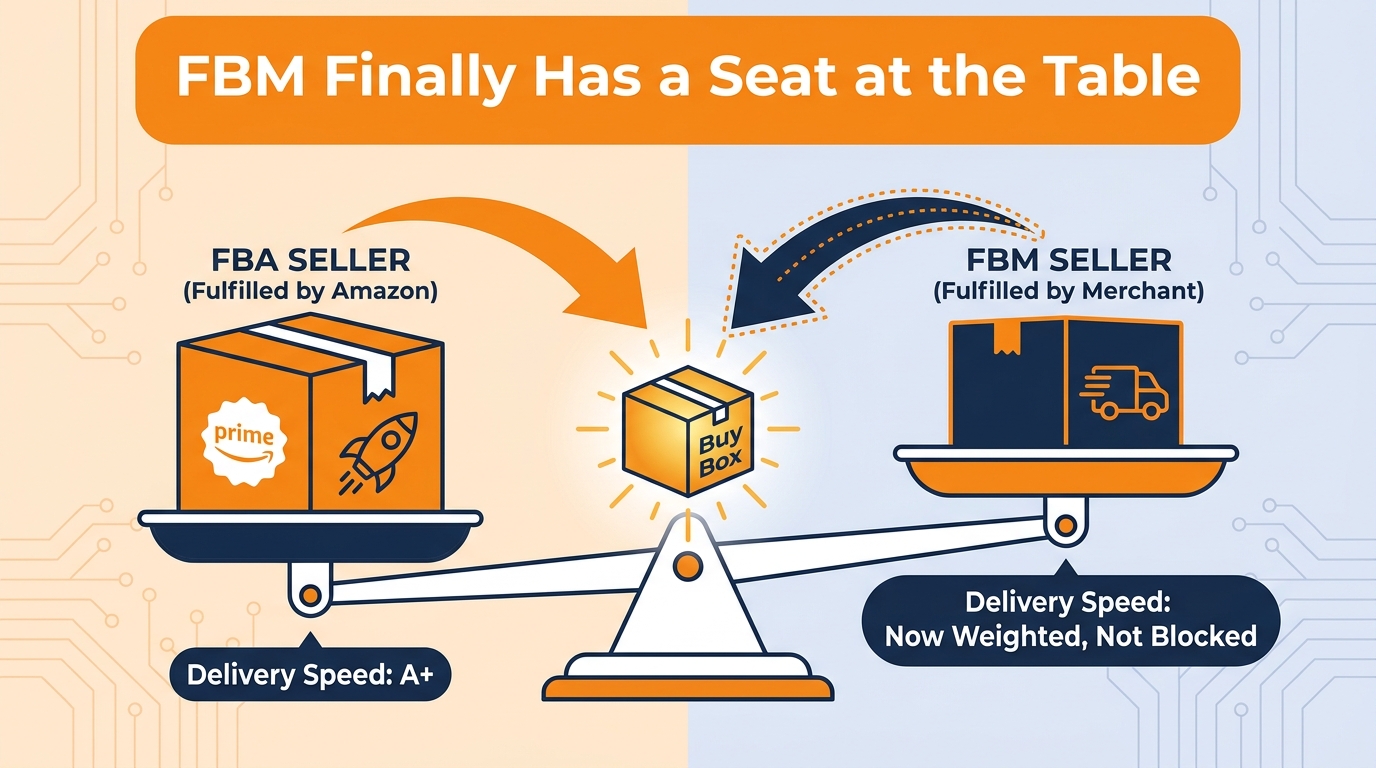
The removal of the eligibility gate has been framed by many in the seller community as a win for Fulfillment by Merchant (FBM) sellers. There’s truth to this — but the picture is more complicated than a simple “FBM wins” narrative.
The Old Gate Was Especially Punishing for FBM
Under the old two-step system, FBM sellers were more vulnerable to disqualification than FBA sellers. FBA sellers benefit from Amazon’s own fulfillment infrastructure, which gives them a structural buffer against late shipment rates, tracking validity, and order defect issues related to shipping. When an FBA seller’s shipment was late, Amazon’s logistics network typically absorbed the complaint. When an FBM seller’s shipment was late, it hit the seller’s account metrics directly.
The eligibility gate was therefore disproportionately exclusionary for FBM sellers — particularly smaller operations, seasonal sellers, and those in categories where self-fulfillment made more economic sense than paying FBA fees. The gate sometimes blocked legitimate, quality sellers from Buy Box competition simply because the metric thresholds didn’t account for the structural differences between fulfillment methods.
What FBM Sellers Gain Under the New System
With the gate removed, FBM sellers who were previously excluded due to marginal metric failures can now compete. An FBM seller with 1.1% ODR who previously would have been fully blocked is now in the pool, competing with a proportionally lower ranking signal from that metric — but competing nonetheless. That’s a meaningfully better position than being shut out entirely.
The new system also rewards FBM sellers who have invested in genuine fulfillment speed. A self-fulfilling seller with same-day or next-day handling times, reliable carrier performance, and consistently accurate tracking data can now compete on delivery speed in a way the old gate didn’t fully recognize. If you’re an FBM seller who has built real fulfillment infrastructure, you’re no longer blocked by a blunt account-level metric — you’re rewarded by the quality of your actual delivery execution.
What FBM Sellers Should Not Expect
The removal of the gate does not level the playing field between FBA and FBM. FBA still has significant structural advantages on delivery speed and delivery reliability scoring. Amazon’s promise engine is built around Prime-eligible offers, and FBA remains the most reliable path to Prime eligibility for most sellers. On competitive ASINs where delivery speed carries high weight, FBA sellers will continue to outperform FBM sellers all else being equal.
The practical implication: FBM sellers are now in the competition pool, but winning meaningful rotation share requires genuinely competitive delivery execution — not just clearing a threshold. The new system is more meritocratic, not more charitable.
The Repricing Problem Has Changed Shape
If you use an automated repricing tool — and most competitive multi-seller Amazon operations do — the rule change requires you to rethink what your repricing strategy is actually optimizing for.
The Old Repricing Logic Was Built Around the Gate
Under the old system, repricing tools were often set up with a two-objective structure: first, stay above the performance thresholds to maintain eligibility; second, price competitively within the eligible pool to win rotation. The gate was effectively a guardrail that constrained who you were competing against. If a competitor’s account was disqualified by the gate, they weren’t in your competitive set — you didn’t need to price against them.
That logic no longer holds. The competitive set on any given ASIN is now larger, because more sellers are eligible to compete. Repricing tools that were calibrated against a narrower eligible-offer pool may now be underreacting to competitive pricing pressure from offers that weren’t previously in scope.
What Needs to Change in Your Repricing Configuration
The most important operational adjustment is expanding your competitive monitoring scope. If your repricing tool was filtering out “ineligible” offers when calculating competitive price benchmarks, you need to revisit that filter. Those offers may now be in the competition pool, and if you’re not pricing against them, you may be losing rotation share to sellers you’re not even tracking.
The second adjustment is recognizing that price isn’t the only repricing lever. The new system’s heavier weighting of delivery speed means that a seller who is 2–3% higher in price than the lowest offer but delivers in one day versus two can still win rotation share. This doesn’t mean abandon competitive pricing — it means your repricing strategy should be informed by your delivery position, not just your price position.
If you’re an FBA seller with reliable Prime-eligible delivery, you may have more room to hold price than you did under the old system. If you’re an FBM seller with slower delivery, you may need to compensate through more aggressive pricing. The new system makes this trade-off more explicit and more granular than before.
The Floor Pricing Risk
One well-documented risk that the rule change amplifies: the addition of more competitors to the eligible pool can accelerate downward price pressure on certain ASINs. If previously gated sellers now enter the competition and reprice aggressively to gain initial rotation share, the landing price on that ASIN can drop before stabilizing. Sellers on those ASINs need to watch their price floors carefully. Automated repricing tools without well-set floors can be pulled into a race to the bottom faster than in the pre-change environment.
The EU and DMA Context: Why This Change Happened Now
Amazon’s timing and sequencing of this rollout — EU/UK first, global later — isn’t arbitrary. The regulatory environment in Europe has been pushing Amazon toward exactly this kind of structural change for several years.
The 2022 Antitrust Settlement and Its Ongoing Requirements
In December 2022, the European Commission closed its antitrust investigation into Amazon’s Buy Box practices with a set of binding commitments. Those commitments were specifically designed to prevent Amazon from self-preferencing — favoring its own retail offers or sellers using Amazon’s own logistics — in the Buy Box ranking. Amazon committed to treating third-party sellers non-discriminatorily in the Buy Box ranking and to showing a second competing offer when applicable, among other requirements.
Those commitments remain in force: most remedies run for five years, with the Prime/second-offer terms running seven years. That means Amazon is legally obligated through 2027–2029 to operate the Buy Box in a non-discriminatory manner toward third-party sellers across EU marketplaces.
The Digital Markets Act Adds Another Layer
The Digital Markets Act (DMA), which came into force progressively through 2023–2024, adds a separate compliance obligation under Article 6(5): gatekeepers — which Amazon qualifies as — must not favor their own products or services in ranking relative to third-party offerings. The European Commission is actively monitoring Amazon’s DMA compliance and has confirmed it remains in regulatory dialogue with the company on marketplace self-preferencing.
The removal of the eligibility gate is consistent with both the 2022 antitrust commitments and DMA Article 6(5) obligations. An eligibility gate that could theoretically be structured in ways that favor Amazon’s own retail offers over third-party sellers is exactly the kind of mechanism that EU regulators would scrutinize. By replacing the binary gate with a weighted ranking system applied uniformly, Amazon creates a more defensible regulatory posture: all offers are evaluated by the same criteria, applied continuously, rather than by a gatekeeping mechanism that could be questioned on self-preferencing grounds.
What This Means for Future Rule Changes
The DMA compliance pressure is ongoing, not one-time. The Commission’s monitoring means Amazon knows its Buy Box mechanics will continue to face scrutiny. This creates an incentive for Amazon to keep its ranking system transparent enough to defend and structured in a way that demonstrably applies the same factors to all sellers. Sellers should expect that the direction of Buy Box policy in EU/UK will continue to trend toward greater access and more transparent ranking criteria — not because Amazon is feeling generous, but because the regulatory environment demands it.
Understanding Weighted Rotation: Why “Winning” Is the Wrong Goal
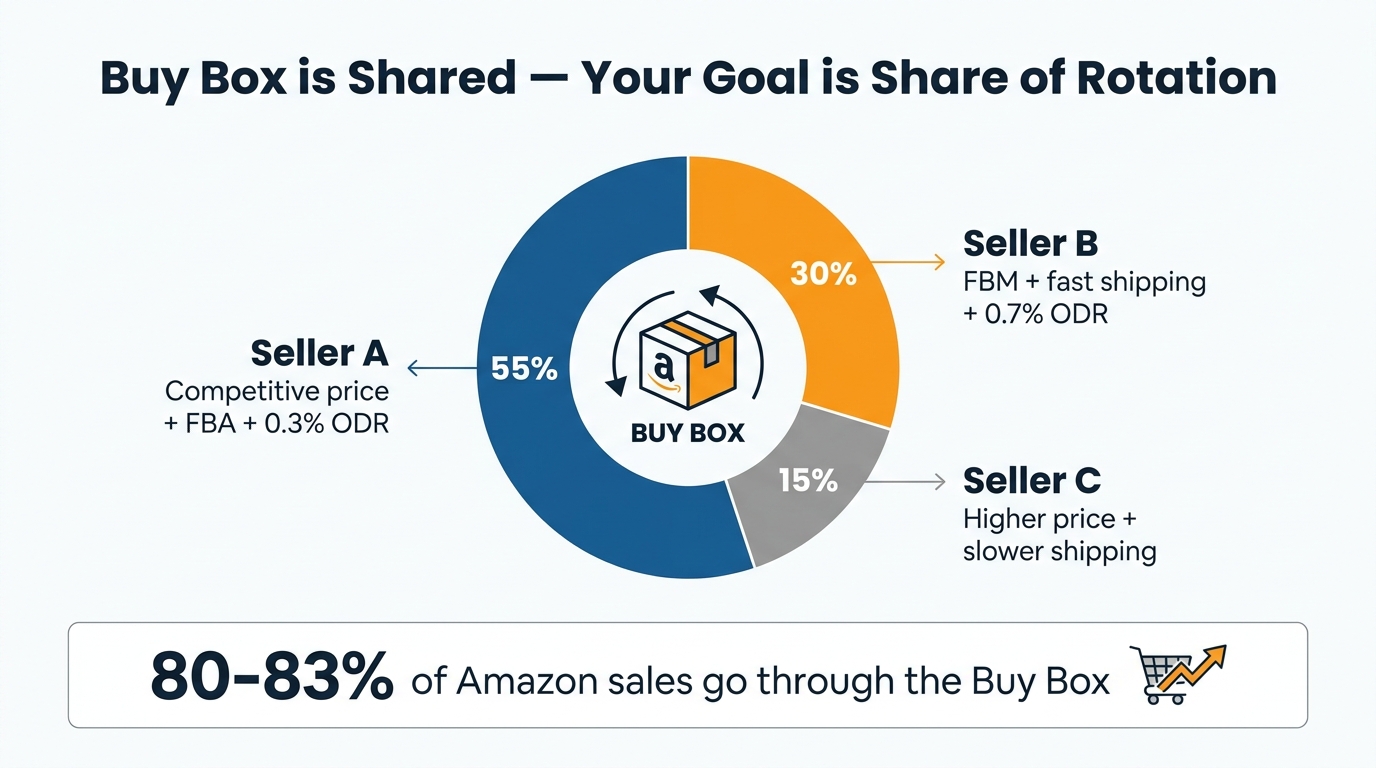
One of the most persistent misconceptions about the Amazon Buy Box is the idea of “winning” it. The language of winning implies a binary state — you either have it or you don’t. The reality, especially under the new system, is more nuanced: the Buy Box is distributed in weighted rotation among eligible sellers, and the goal is to maximize your share of that rotation.
How Weighted Rotation Actually Works
When multiple sellers are eligible to compete for the Buy Box on a given ASIN, Amazon doesn’t simply award the Buy Box to the single best offer and leave it there. Instead, Amazon rotates the Buy Box among competing offers, allocating rotation time proportionally based on offer strength. A seller with a significantly more competitive offer than everyone else will hold the Buy Box for a larger proportion of time — sometimes close to 100% — while a seller with a slightly weaker offer will hold a smaller proportion.
This rotation happens dynamically and frequently. The algorithm isn’t re-evaluating offers once a day — it’s continuously recalculating which offer to surface based on real-time signals. Your Buy Box percentage at any given moment is a product of where your offer stands in the ranking at that moment, across all the customer sessions being served.
The Strategic Implication: Small Improvements Have Large Effects
Under a winner-take-all binary system, an offer improvement that moves you from “slightly below best” to “slightly above best” would represent a dramatic outcome shift — the difference between 0% and 100%. Under weighted rotation, improvement is more continuous. Moving from a weaker competitive position to a slightly stronger one shifts your rotation share incrementally — but even a shift from 20% to 45% of Buy Box rotation on a high-volume ASIN can represent substantial additional revenue without requiring you to “beat” everyone else outright.
This means the ROI on small operational improvements — shaving a day off your handling time, nudging your landed price down by 2%, recovering 0.3 percentage points on your ODR — can be meaningful even when they don’t move you to the top of the competitive stack. Every improvement translates into more rotation time, and more rotation time translates directly into more revenue from the same listing.
Monitoring the Right Metric
If you’re not already tracking your Buy Box percentage by ASIN, you’re operating blind in this environment. Seller Central’s Business Reports section (Detail Page Sales and Traffic by Child Item) shows your Featured Offer percentage for each product. This is the number to watch. It’s a real-time indicator of your competitive position on that ASIN — and under the new weighted rotation system, it’s a more meaningful signal than it’s ever been. Changes in your Buy Box percentage on specific ASINs can tell you when a new competitor has entered the pool, when your own metrics have shifted, or when your pricing is drifting out of range.
The Metrics That Now Function as Ranking Signals, Not Blockers
With the gate removed, every metric that used to serve as a pass/fail criterion now operates as a continuous competitive input. Understanding this distinction in operational terms is critical — because the way you manage these metrics should change.
Order Defect Rate (ODR)
ODR was the headline metric under the old gate system, set at a 1% threshold. Under the new system, the 1% mark doesn’t disappear as a reference point — Amazon will still take action on accounts with severely elevated ODR — but it no longer functions as the binary gate it once was. The competitive implication is that ODR now operates on a spectrum. A seller at 0.8% ODR and a seller at 0.3% ODR both clear the old threshold, but under the new weighted system, the 0.3% seller gets a meaningfully stronger ranking signal from this metric. The practical target has shifted: below 0.5% ODR is now the benchmark for genuine competitiveness, not just compliance.
Late Shipment Rate
Late shipment rate (LSR) — the percentage of orders shipped after the expected ship date — feeds into the delivery reliability component of the ranking. The formal threshold is 4%, but again, under the new weighted system, being at 3.9% is no longer equivalent to being at 0.5%. The gap in ranking signal between those two positions is now visible in your Buy Box rotation share. For FBM sellers especially, LSR is one of the most actionable metrics: it responds directly to improvements in fulfillment processes, carrier selection, and cutoff time management.
Pre-Fulfillment Cancellation Rate
The cancellation rate threshold is 2.5%. This metric is straightforward: it reflects how often you’re accepting orders you can’t actually fulfill. It’s a proxy for inventory accuracy and purchasing reliability. Under the new weighted system, a seller with chronic cancellation issues — even below the formal threshold — will see this reflected in their rotation share. The fix is operational: better inventory synchronization, more conservative stock commitments, and faster sell-through monitoring.
Voice of the Customer (VoC) Complaints
VoC complaint data was a formal input to the old eligibility gate and remains a signal in the new ranking system. VoC tracks post-delivery customer dissatisfaction at the ASIN level, which makes it a more granular signal than ODR (which is account-wide). Under the new architecture, ASIN-level VoC data can influence ranking on specific products even when your overall account health is strong. This is one area where the new system’s more granular approach could surface problems that the old account-level gate would have missed — in both directions.
What FBA Sellers Get Wrong About the New Rules
There’s a temptation among FBA sellers to read the 2026 Buy Box change as someone else’s problem — a story about FBM sellers getting more access, while FBA sellers carry on as before. That reading is wrong, and the sellers who hold it are going to be surprised by what happens to their Buy Box percentages over the next six months.
Your Competition Pool Just Got Larger
If you’re an FBA seller who has been winning comfortable Buy Box rotation on certain ASINs, part of that comfort may have been structural: some competing sellers were gated out of the pool, not because their offers were genuinely worse than yours, but because their account metrics triggered the old eligibility filter. Those sellers are now in the pool. Their offers are competing against yours. On ASINs where you previously held 80% or more of the rotation, you might now find that number has dropped — not because you’ve done anything wrong, but because the competitive field expanded.
Price Complacency Is Now More Costly
FBA sellers who were winning the Buy Box partly on fulfillment strength — letting their Prime eligibility do the heavy lifting while holding a price premium — may find that strategy under more pressure. The new system doesn’t diminish delivery speed as a factor, but it does add more competitors who can now articulate a credible delivery promise. If those newly eligible competitors are pricing more aggressively, the equation changes. Holding a 5–8% price premium over the next-best offer was defensible in a tighter eligibility pool. In a wider pool, that premium may need to compress.
Account Health Maintenance Is Now Maintenance of Competitive Position
Previously, an FBA seller who cleared the eligibility gate could treat the gate as cleared and move on. Their ODR was below 1% — done. Under the new weighted system, that framing is obsolete. Your ODR isn’t just a threshold to clear; it’s a ranking input that’s continuously influencing how much of the Buy Box rotation you hold. Letting your ODR drift from 0.4% to 0.8% — both safely below the old 1% threshold — now has a tangible cost in rotation share. Account health management becomes a continuous competitive activity, not a periodic compliance check.
Practical Action Plan: What to Audit, Fix, and Monitor Right Now
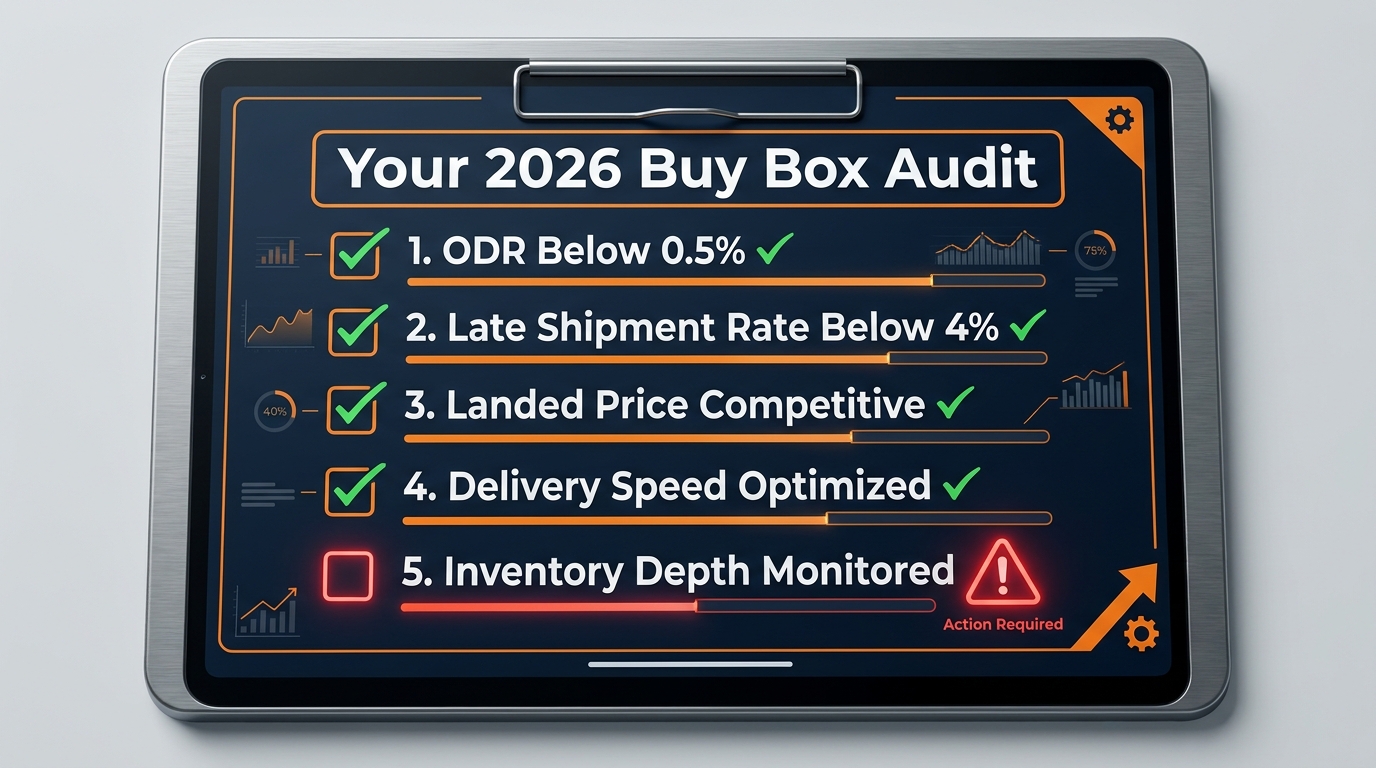
Given everything above, here is a structured action framework for adapting to the new Buy Box environment. These are concrete steps — not general advice — organized by priority and timeline.
Immediate (This Week)
- Pull your Buy Box percentage by ASIN. In Seller Central, go to Reports → Business Reports → Detail Page Sales and Traffic by Child Item. Export the last 60–90 days. Identify ASINs where your Buy Box percentage has changed significantly in the past 30 days — particularly any that dropped. These are your early signals of the new competitive dynamics.
- Check your current ODR, LSR, and cancellation rate. Go to Performance → Account Health. Note your exact numbers, not just whether they’re “in the green.” Your goal under the new system is to be significantly below thresholds, not just below them. If your ODR is 0.9%, you’re technically compliant but competitively disadvantaged.
- Audit your repricing tool’s competitive set. Review how your repricing tool is defining the competitive offers it prices against. If it’s filtering to “eligible” offers only based on old logic, that filter may now be excluding competitors who are in the pool. Update your competitive monitoring scope accordingly.
Short-Term (Next 30 Days)
- Identify your highest-revenue ASINs and assess competitive vulnerability. For each top-10 revenue ASIN, research how many other sellers are on the listing and whether any of them may have previously been gated out. If you were the only eligible competitor, you now need to prepare for additional entrants.
- Review your delivery promise accuracy. For FBM sellers: audit whether your actual ship times match your advertised handling times. Consistent mismatches hurt your LSR and your delivery speed ranking signal. Tighten your promised handling time or fix your fulfillment process — don’t let the gap persist.
- Set floor prices with explicit rationale. If your repricing tool is running without price floors, add them now. A wider eligible pool can accelerate price erosion on competitive ASINs. Your floor should be based on your actual landed cost plus the minimum margin you can sustain — not a guess or a round number.
- Review inventory depth on high-velocity ASINs. The new system rewards consistent availability. If you’re running lean inventory on high-velocity products, you’re trading rotation share for working capital optimization. Find the right balance — ideally keeping safety stock that covers at least your peak daily velocity for 7–10 days.
Medium-Term (Next 90 Days)
- Build a Buy Box monitoring dashboard. Whether through Seller Central reports, a third-party tool, or a custom export, set up a weekly cadence where you review your Buy Box percentage across your full catalog. Flag any ASIN that drops more than 10 percentage points week-over-week for investigation.
- For FBM sellers: assess the economics of SFP or FBA for key ASINs. If the new Buy Box dynamics are showing you that delivery speed is consistently costing you rotation share on certain ASINs, it may be time to run a genuine cost comparison between your current FBM setup, Seller Fulfilled Prime, and FBA. The comparison should account for total landed cost, not just FBA fees in isolation.
- Improve your seller feedback collection process. Feedback volume and recency matter to the ranking. If you’re not actively (and compliantly) requesting feedback from buyers, you’re leaving a ranking signal on the table. Review Amazon’s messaging guidelines and set up automated feedback requests for every fulfillable order.
- Track the US rollout. Keep monitoring Amazon’s communications about the global expansion of the eligibility gate removal. When the US rollout date is confirmed, you’ll want your strategy adjustments already in place — not being built in reaction.
Conclusion: The Buy Box Is More Meritocratic — and More Demanding — Than Before
The headline of this change — Amazon removed the Buy Box eligibility gate — sounds like it makes life easier. And for some sellers, particularly FBM operators who were unjustly excluded from competition by the old binary filter, it does represent a genuine improvement in access.
But the deeper story is that Amazon has made its Buy Box selection system more sophisticated, not more lenient. The old gate was a blunt instrument that generated false equivalence — treating all sellers who cleared it as equivalent, and excluding all who didn’t regardless of the degree of the shortfall. The new weighted ranking system surfaces the full spectrum of performance differences, rewarding sellers who operate genuinely well across every dimension and penalizing those who are merely “good enough.”
For sellers who have been running tight operations — competitive pricing, fast and reliable fulfillment, strong account metrics — the new system should ultimately reward them more fairly than the old one did. For sellers who were coasting inside the eligibility window without genuinely optimizing, the new system will make that coasting visible in their rotation share.
The three strategic reframes that matter most going forward:
- Stop thinking about the Buy Box as something you win or lose. Think about it as a percentage of rotation time you earn through the strength of your offer across price, speed, and performance. Every improvement earns you more time. Every lapse costs you time.
- Stop managing account metrics to thresholds. The thresholds haven’t disappeared, but managing to them is now a suboptimal strategy. Managing your ODR, LSR, and cancellation rate to be as low as practically possible — not just below the line — is now a genuine competitive activity with direct revenue implications.
- Stop treating the competition pool as fixed. The pool just got wider. It will likely continue to evolve as Amazon completes the global rollout and as the market adjusts. Staying informed about who is competing on your key ASINs is now a regular operational task, not an occasional check.
The Buy Box has always been consequential. It now operates in a way that more directly reflects the quality of your entire Amazon operation — not just whether you clear a single binary checkpoint. The sellers who understand that distinction, and operate accordingly, are the ones who will increase their rotation share in the months ahead.