

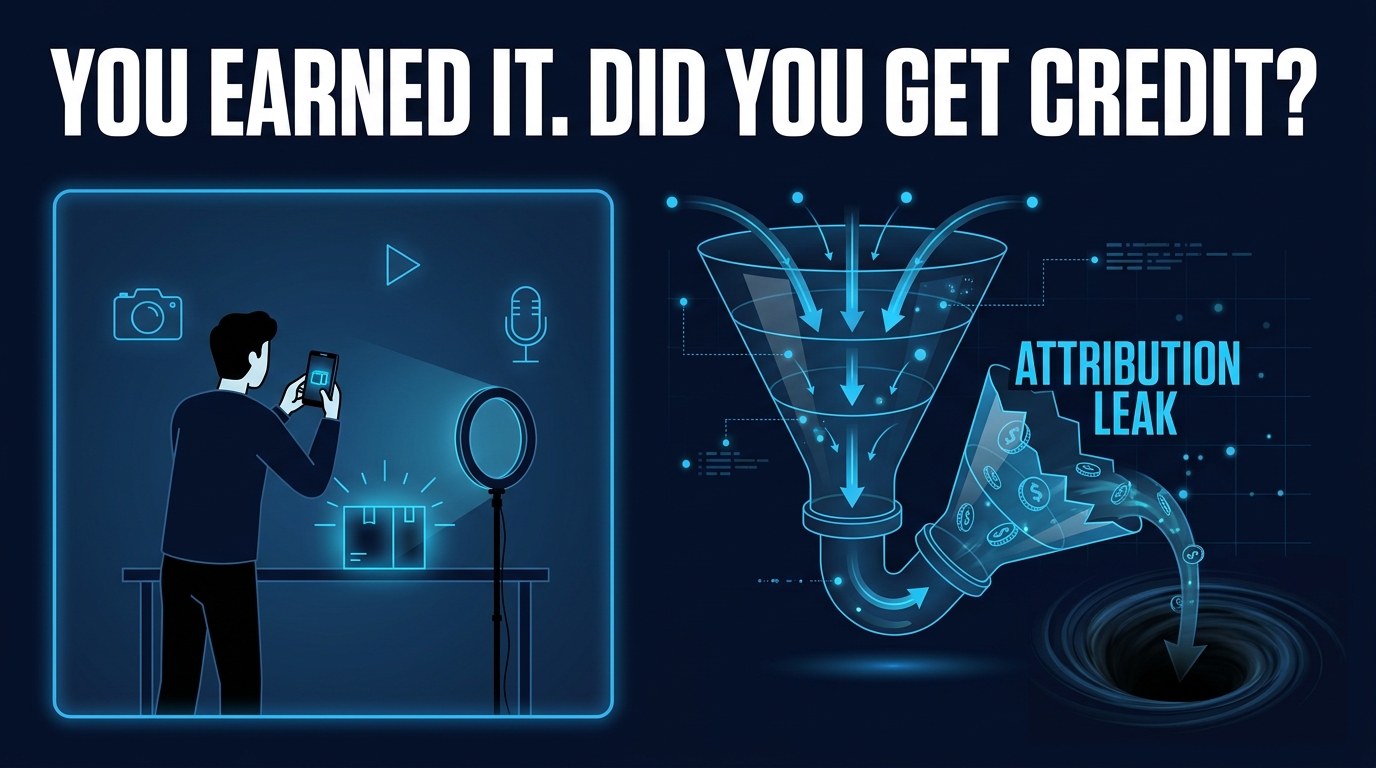

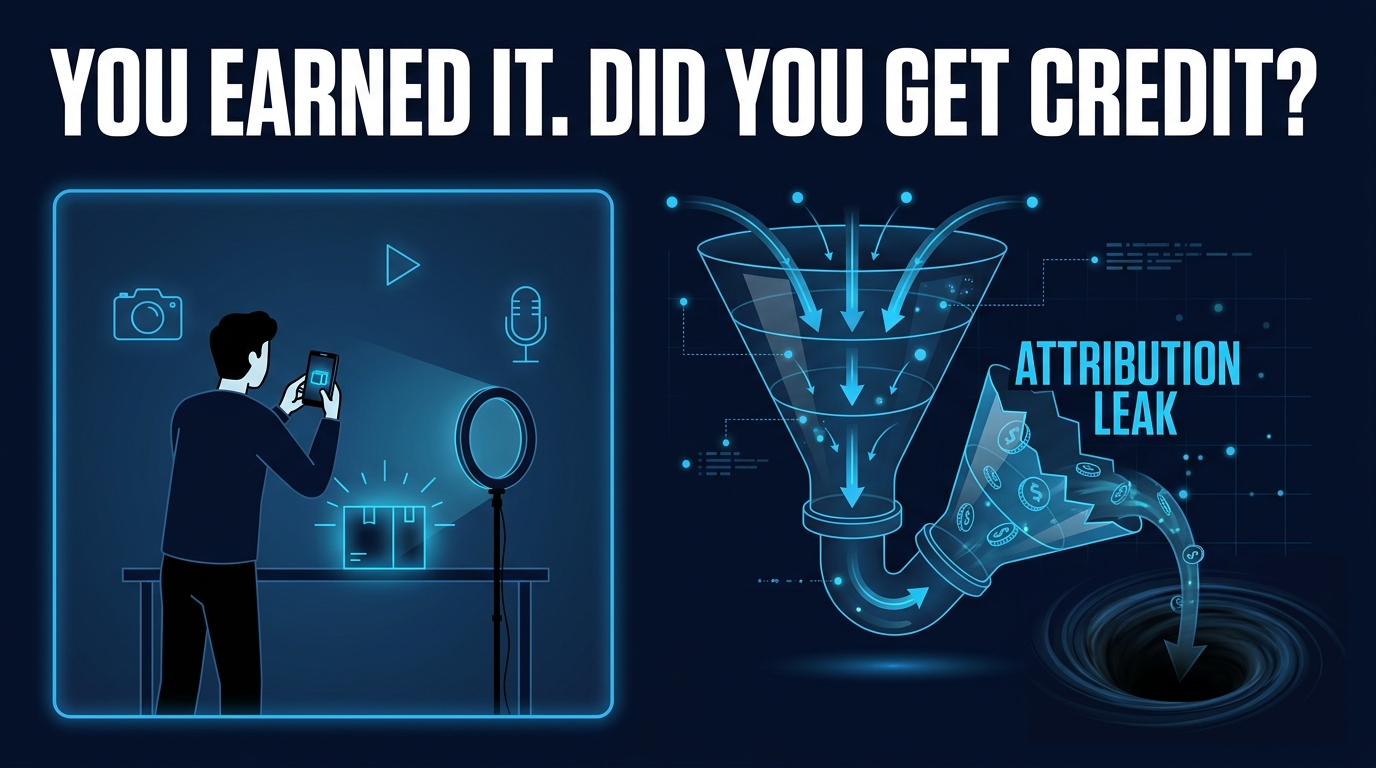
There is a quiet revenue problem running through creator programs right now, and it has nothing to do with content quality, audience size, or posting frequency. It is happening at the tracking layer — in the gap between a viewer watching a creator’s video and the moment a platform decides who gets credit for the sale that follows.
That gap is where creators lose money they already earned.
Attribution “bad cuts” is the umbrella term for every failure mode that severs the connection between a creator’s actual influence and the commission or revenue recorded against their account. It includes last-click bias routing credit to a coupon site that appeared ten seconds before checkout. It includes attribution windows so short they expire before a considered purchase decision completes. It includes broken UTM parameters, missing product tags, mismatched promo codes, and cookie loss from privacy-conscious browsers. It also increasingly includes the structural compression of platform rules — programs narrowing what counts as an attributable sale to reduce payout obligations.
The result is a systematic underpayment of creators who drive discovery, consideration, and conversion — while partners who intercept at checkout capture a disproportionate share of the commission pool.
This post maps every significant failure mode in creator attribution, explains what causes each break, and walks through the fixes that actually work — from technical tracking stacks to program-level structural changes. It also covers where the industry is heading, including the shift toward content provenance standards like C2PA that are beginning to extend attribution from commission tracking into content ownership itself.
If you manage a creator program, run an affiliate strategy, or earn revenue through creator affiliate links, the frameworks here are directly applicable to your current setup.
What “Bad Cuts” in Creator Attribution Actually Means
The phrase “bad cut” in video editing refers to a splice that jars the viewer — a moment where continuity breaks and the edit becomes visible. In creator attribution, a bad cut is conceptually the same: it is a break in the tracking chain that makes the creator’s contribution invisible to the measurement system, even when their content was genuinely responsible for the sale.
Understanding the anatomy of a bad cut requires separating attribution into its component stages. A creator generates a piece of content — a review, a haul video, a tutorial, a recommendation post. A viewer engages with that content and develops intent to purchase. That viewer then takes some path to checkout, which may include clicking the creator’s affiliate link, searching for the product again, using a cashback browser extension, applying a coupon code, or visiting the brand’s site directly. At checkout, the platform’s attribution logic assigns credit to one or more of those touchpoints. The creator earns commission only if their touchpoint wins that logic.
Every point in that chain is a potential bad cut. The link may not fire correctly. The cookie may be blocked or overwritten. The attribution window may have expired. The platform may apply a last-click rule that favors the coupon over the creator’s earlier link. The promo code may not map correctly to the creator’s account in the backend system. The purchase may happen on mobile after the click happened on desktop, breaking the cross-device match.
The difference between tracking failures and structural cuts
It is useful to distinguish between two types of bad cuts: technical tracking failures and structural attribution decisions. Technical failures are bugs or gaps in your measurement infrastructure — broken links, misconfigured pixels, missing parameters. Structural decisions are deliberate choices by platforms or programs about which touchpoints count and which windows apply. Both cost creators money, but they require different fixes.
Technical failures are recoverable. A server-side tracking layer catches what client-side pixels miss. Unique promo codes provide a parallel attribution signal when link tracking fails. Systematic UTM audits catch malformed parameters before they contaminate your data for weeks.
Structural cuts are harder. When Amazon narrows its operating agreement so that only the promoted ASIN — not the same-category halo — earns commission, no amount of better tracking recovers the lost revenue. The fix there is program design: negotiating terms, diversifying programs, or building owned-audience channels that are less dependent on any single platform’s attribution rules.
Most real attribution problems involve both. A program uses last-click rules (structural) and has a broken pixel on mobile (technical). Fixing one without the other recovers only partial revenue. Comprehensive attribution repair requires addressing the full stack.
The Last-Click Trap: Why 64% of Programs Still Overcredit the Wrong Partner
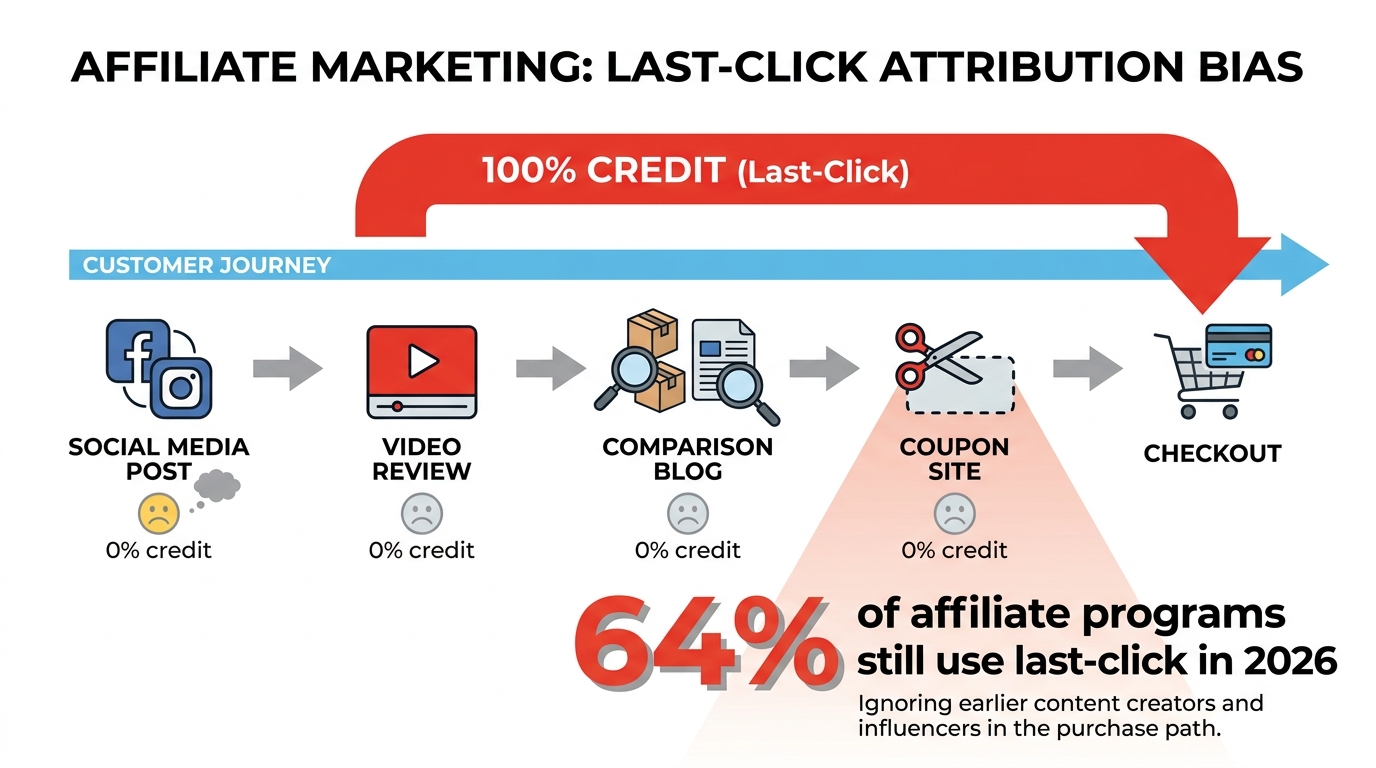
Last-click attribution is the rule that awards 100% of the commission for a sale to whichever tracked touchpoint appeared most recently before checkout. It is simple to implement, easy to explain to partners, and deeply flawed as a measure of actual contribution.
As of 2026, last-click remains the dominant model in affiliate programs. Sixty-four percent of programs still use it as their default rule, according to current industry benchmarking — down from 82% in 2022, but still a substantial majority. That means the majority of creator commissions are determined by who was last, not who mattered most.
The coupon and cashback interception problem
The structural beneficiaries of last-click attribution are coupon sites, cashback platforms, and browser extensions. These tools are specifically engineered to appear at the final moment of purchase. A user who found a product through a creator’s video, watched the review, visited the brand site, and then — at the point of checkout — opened a browser extension to search for discount codes will trigger a last-click event that belongs to the extension, not the creator.
The creator drove the entire discovery and consideration process. The coupon tool contributed nothing to the purchase decision. Under last-click rules, the coupon tool earns the commission.
This is not a marginal edge case. Browser extension hijacking of affiliate commission is an industrywide problem. Extensions like Honey, Capital One Shopping, and dozens of regional cashback tools are installed on hundreds of millions of browsers. They are explicitly designed to overwrite affiliate cookies at checkout. The programs that reward them via last-click are, in effect, taxing their creator partners to fund checkout interception.
Last-paid-click as a partial fix
The industry’s emerging response to this problem is the last-paid-click model, now used by 17% of programs. Last-paid-click applies the same final-touch logic as last-click, but excludes coupon and cashback partners from the eligible pool — meaning those partners can still participate in programs but cannot win commission simply by appearing at checkout. When coupon/cashback is excluded, the commission credit flows to the most recent genuinely content-driven touchpoint, which is usually a creator or publisher.
The revenue shift from this change is material. Programs that have moved from last-click to last-paid-click report reallocating 11–19% of total program revenue from coupon/cashback partners toward content and creator partners. For a program paying out $1 million per month, that is $110,000 to $190,000 per month moving back to the creators who actually influence purchases.
First-click and position-based alternatives
For programs where creators primarily drive awareness and discovery rather than final-stage conversion, first-click attribution is a more honest model. It awards full credit to the initial touchpoint — often a creator’s content — and ignores subsequent interceptors. Fewer than 8% of programs use it, partly because it disadvantages retargeting and performance partners who contribute lower-funnel value.
A more balanced option is position-based attribution, which splits credit across touchpoints with a configurable weighting. A common setup gives 40% to first touch, 40% to last touch, and distributes the remaining 20% across middle touches. This rewards discovery and conversion contributors proportionately, though it requires more sophisticated tracking infrastructure to implement reliably.
“Last-click attribution is not a measurement model. It is a payment rule that rewards whoever was last — regardless of who mattered.”
Attribution Window Compression: The Slow Squeeze on Creator Revenue
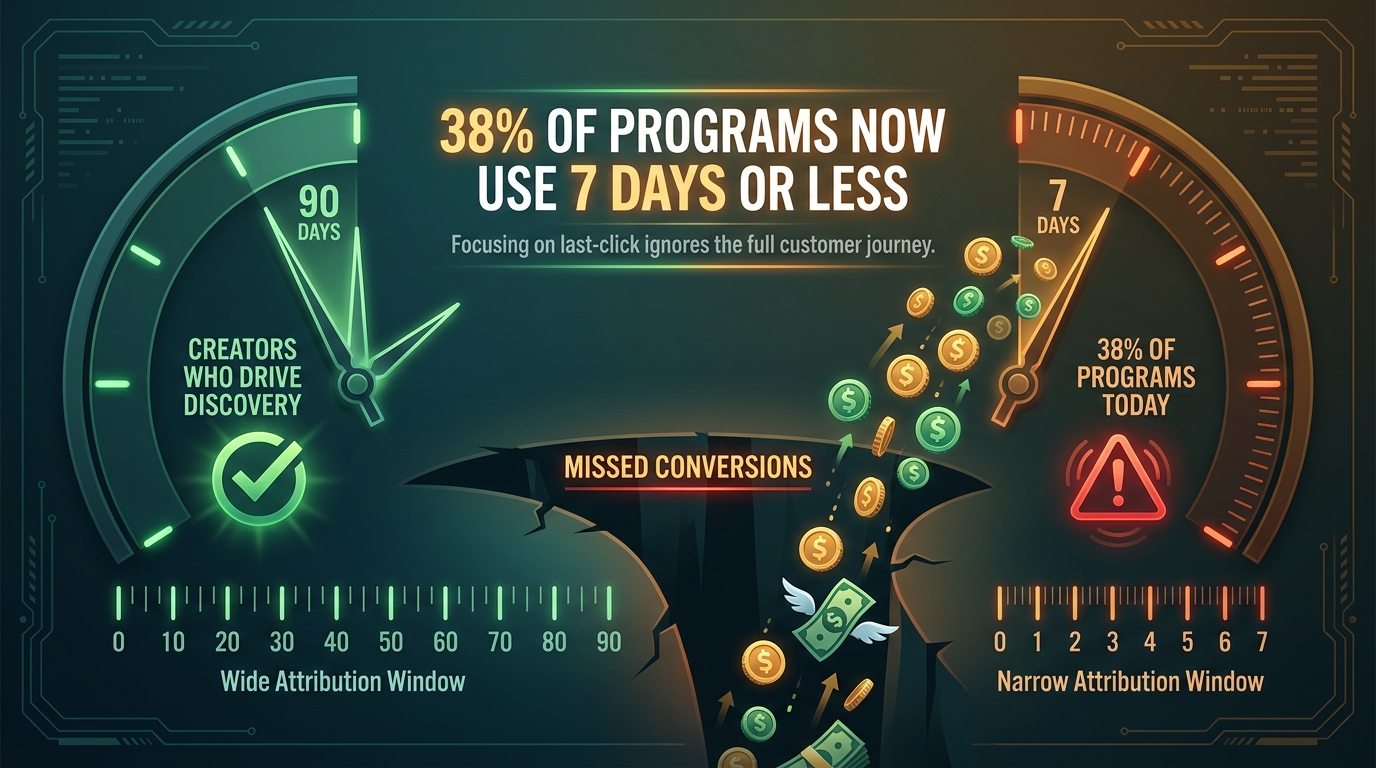
An attribution window is the period of time during which a tracked click or visit can still receive credit for a subsequent purchase. A creator’s affiliate link fired on Monday will earn commission on a purchase made on Wednesday — if the window is at least two days. If the window is one day and the purchase happens on Thursday, the creator earns nothing, even though their content clearly drove the sale.
Attribution windows are compressing across the industry. In 2026, 38% of programs use windows of seven days or less, a significant increase from prior years. Only 21% now use windows of 60 days or longer. The 30-day default that was standard for most of the affiliate industry’s history is increasingly rare.
Why windows matter more for creators than for paid media
The mismatch between short attribution windows and creator content cycles is particularly damaging to creator revenue. Paid media operates on short purchase cycles — a user who clicks a retargeting ad typically converts within hours or days. Creator content operates on much longer consideration cycles, especially for higher-value products.
A viewer who watches a creator’s detailed review of a $300 skincare device, reads the linked product page, and then purchases three weeks later after their next paycheck arrives has made a clear creator-influenced purchase. Under a seven-day window, that purchase earns zero commission for the creator who drove it.
Research across creator affiliate programs consistently shows that a meaningful share of conversions happen in the 8–30 day window after first engagement — the exact range being eliminated by window compression. Programs that have measured this report that moving from a 7-day to a 30-day window increases creator-attributed revenue by 15–25%, simply by capturing purchases that were already happening but not being credited.
Amazon’s ASIN-level attribution narrowing
Amazon’s Associates program executed a different kind of attribution cut in 2026: narrowing what products could earn commission under a single click. The April 2026 operating-agreement update removed the “same-category halo” rule that allowed creators to earn commission on any product a user purchased within the attribution window after clicking an affiliate link — even if the user bought something different from what the creator reviewed.
Under the new rules, a creator who links to a specific ASIN earns commission only on that ASIN and its direct variants. If the user adds it to their cart, keeps shopping, and also buys a dozen other Amazon items, the creator earns nothing on those additional purchases. The combined effect of this narrowing and concurrent commission-rate reductions in some categories means creators relying on Amazon Associates have seen measurable revenue declines in 2026 that tracking fixes alone cannot reverse.
Negotiating better windows
For creators with significant program leverage, attribution windows are negotiable. Many mid-tier brands running their own affiliate infrastructure — through platforms like Impact, CJ, ShareASale, or Partnerstack — can and do offer 30-, 60-, or 90-day windows to high-performing creator partners. The key is requesting it explicitly during onboarding or contract negotiation, and framing it in terms of the purchase consideration cycle for the product category rather than abstract fairness arguments.
A creator who can demonstrate that their audience typically takes 14–21 days to convert based on post-purchase survey data has a strong case for a 30-day minimum window. That data is worth collecting.
The Four Most Common Technical Attribution Failures
Structural problems with program rules are important, but most day-to-day attribution revenue loss comes from technical failures in tracking setup. These are recoverable — if you know where to look.
1. Broken or malformed affiliate links
The most common tracking failure is also the most preventable: a creator using a broken link. This happens when affiliate links are copy-pasted incorrectly, when link-shortening tools strip tracking parameters, when the destination URL changes without the creator updating their link, or when platform-generated links expire. On TikTok Shop specifically, reporting delays of 24–48 hours after a valid sale cause creators to prematurely conclude links are broken when they are actually working — triggering unnecessary troubleshooting that can introduce actual breaks.
The fix is a standardized link audit protocol: test every new affiliate link in an incognito browser before publishing, verify the tracking parameter fires in the platform dashboard, and set a recurring calendar reminder to re-test live links every 30 days against the current destination URL.
2. Cookie loss from privacy settings and browser behavior
Client-side cookies — the foundation of most affiliate tracking — are increasingly unreliable. Safari’s Intelligent Tracking Prevention limits cookie lifespans to 24 hours for most third-party tracking. Firefox’s Enhanced Tracking Protection blocks many affiliate cookies by default. iOS and Android privacy controls further reduce cookie persistence across sessions. The net effect is that cookie-only affiliate programs lose an estimated 20–35% of conversions under standard tracking conditions, with some high-privacy-audience segments losing 50% or more.
Browser-based cookie loss is not a failure you can fix by adjusting the link. It requires switching to a tracking architecture that does not depend on client-side cookies as the sole signal.
3. Missing or misconfigured product tags (platform-specific)
On TikTok Shop, Instagram Shopping, and YouTube Shopping, sales attribution requires not just a link but a correctly configured product tag embedded in the content. A video without the product tag — or with the tag pointing to an incorrect ASIN or SKU — will not pass attribution data to the affiliate dashboard regardless of how many sales the video drives. This is a structural platform dependency that many creators and their managers overlook, particularly when posting across multiple platforms with different tag systems.
The fix is a pre-publish checklist: verify the product tag is present, active, and linked to the correct product ID before the content goes live. Post-publication, verify the product appears correctly in the creator’s storefront or affiliate dashboard within 24 hours.
4. Cross-device and cross-session attribution gaps
Modern purchase journeys routinely span multiple devices. A viewer watches a creator’s video on mobile, clicks the affiliate link, browses the product on a desktop computer later that evening, and completes the purchase on mobile during lunch the next day. Each device switch is a potential attribution break. Unless the platform uses deterministic cross-device matching — logged-in user identity linking the mobile session to the desktop session — the purchase may register as unattributed or attribute to a different session entirely.
For programs that support it, enabling logged-in user tracking dramatically reduces cross-device attribution loss. For programs that do not, deploying unique promo codes as a parallel tracking mechanism allows the creator to capture commission on purchases where the link-click-to-checkout chain broke but the customer still redeemed the creator-specific discount code.
The Stacked Attribution Fix: Building a System That Does Not Leak
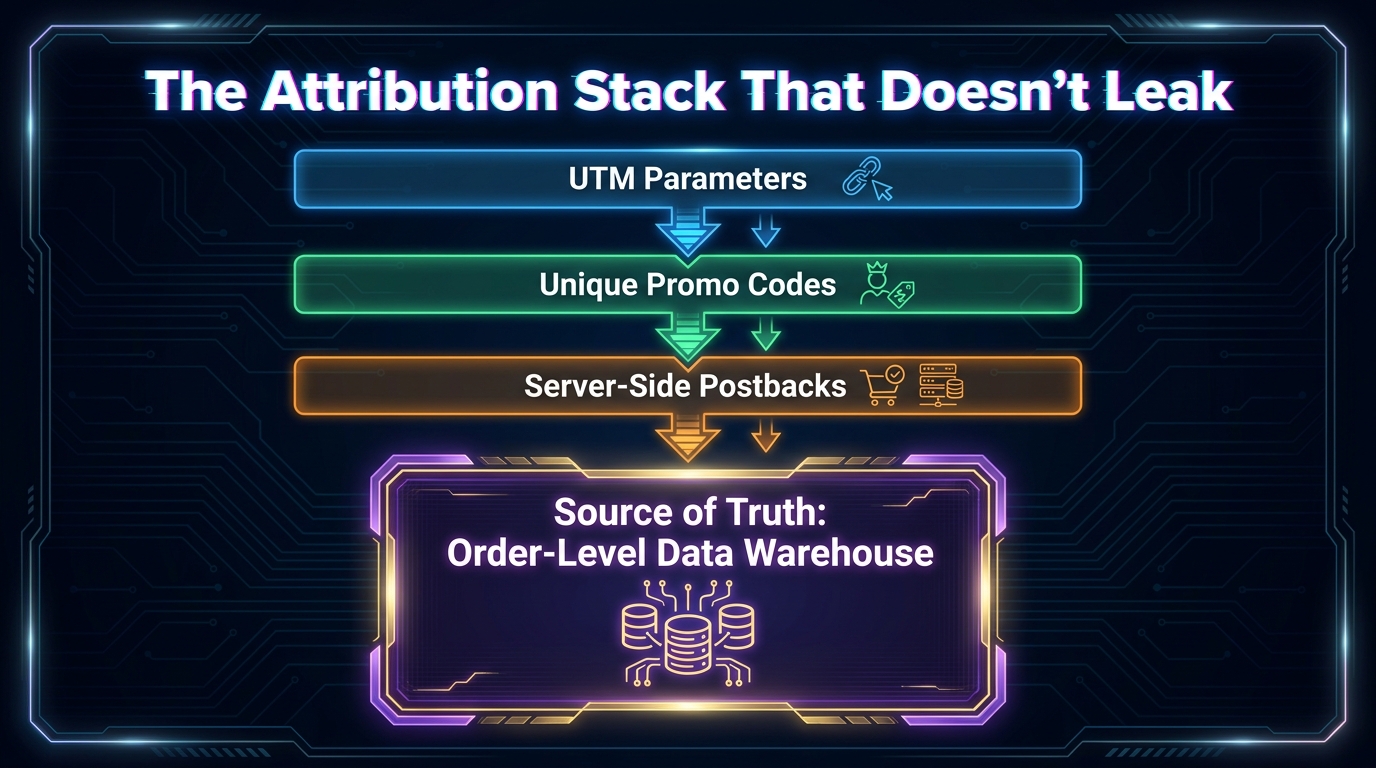
The most reliable creator attribution setups in 2026 use a layered approach that does not depend on any single tracking method surviving intact through the full purchase journey. The principle is redundancy: if one signal fails, another captures the conversion.
Layer 1: Standardized UTM parameters
UTM parameters are the baseline tracking layer. Every creator link should include a standardized, unique UTM string that identifies at minimum the source (platform), medium (affiliate, influencer, ugc), campaign (product or promotion name), and content (unique creator ID). The UTM string should be consistent and machine-readable — not free-text entered by hand, but generated from a naming convention template that enforces uniformity across your creator roster.
A consistent UTM structure means that when a sale happens, your analytics platform can unambiguously map it to a specific creator, content piece, and platform. Without this, even a successful click chain produces attribution data that is too noisy to act on.
The limitation of UTMs is that they are session-based and client-side. They are overwritten if a user clicks a different link before purchasing, and they do not survive across devices unless your analytics tool has cross-device matching enabled.
Layer 2: Unique promo codes per creator
Promo codes provide an attribution signal that is completely independent of click tracking. When a customer redeems a creator-specific promo code at checkout, that redemption is attributed to the creator regardless of how the customer arrived at the store, which device they used, or whether any affiliate link was ever clicked.
Promo codes capture the significant percentage of conversions where click tracking fails — cross-device purchases, purchases made after watching a video without clicking, and purchases by customers who remembered the code from a video they watched days earlier. For categories with high consideration periods, promo codes often attribute 20–40% more conversions than link-only tracking captures.
The management discipline required is strict: each creator gets one code, that code maps to exactly one creator ID in the backend, codes are never reused or recycled across creators, and codes are deactivated when a creator partnership ends. Code hygiene failures — two creators sharing a code, or a retired code accidentally reactivated — introduce false attribution data that can corrupt commission calculations for months.
Layer 3: Server-side tracking as the source of truth
Server-side conversion tracking — also called server-to-server (S2S) postbacks — sends conversion data directly from your order management system to your attribution platform, bypassing the browser entirely. Because it does not rely on a browser cookie or a client-side pixel firing correctly, it is immune to the cookie deprecation, browser privacy restrictions, and ad blocker interference that degrade client-side tracking.
Setting up server-side tracking requires development resources: an integration between your checkout or order system and your attribution platform (Meta CAPI, Google’s Enhanced Conversions, or your affiliate network’s S2S postback URL). For brands managing large creator programs, this is a one-time infrastructure investment that permanently improves attribution accuracy across all partners, not just creators.
The recommended architecture is to treat server-side postbacks as the primary attribution signal and client-side pixels as a secondary validation layer. When both signals agree, you have high-confidence attribution data. When they disagree, investigate — it usually indicates either a data delay or a tracking configuration error worth correcting.
Reconciling the layers: the order-level data warehouse
The final piece of a leak-proof attribution stack is an order-level reconciliation table in your data warehouse. Every completed order should have a row that includes: the order ID, the customer ID (hashed), the order value, the conversion event timestamp, the UTM source/medium/campaign/content values, any promo code applied, and the creator ID those signals map to.
With this table, you can do something no single-platform dashboard allows: identify every order that was attributed (with high, medium, or low confidence) and every order that is unattributed. Unattributed orders are not the same as orders with no creator influence — they are orders where your tracking failed to capture the connection. Auditing them regularly shows you exactly which part of your stack is leaking.
Platform-Specific Attribution Problems and How to Fix Them
Attribution failures are not generic. Each platform introduces its own specific failure modes, and the fixes vary by platform. Here is what matters most on the three platforms where creator attribution disputes are most active in 2026.
TikTok Shop
TikTok Shop’s attribution system is entirely native — it relies on TikTok-generated product tags and affiliate links rather than external tracking parameters. Using external link redirectors or third-party URL shorteners strips TikTok’s tracking parameters and breaks attribution entirely. All TikTok Shop affiliate links should use TikTok’s native link generation tools and must not pass through external redirects.
The most frequently reported problem on TikTok Shop is the 24–48 hour reporting delay. Sales that occurred today may not appear in the dashboard until tomorrow or the day after. This creates a support ticket loop: creators see no sales, contact the brand, the brand escalates to TikTok, and the data appears the next day — after a significant interruption in trust. The fix is a clear communication standard: wait a full 48 hours before treating missing sales as a genuine attribution failure, and communicate that expectation to creators during onboarding.
TikTok’s attribution model is also last-click based with a rolling attribution window that varies by creator tier and product category. For brands, reconciling TikTok’s dashboard numbers against your own order export — matching TikTok-attributed order IDs to your backend order system — is the only reliable way to verify the numbers. Do not rely solely on TikTok’s dashboard as the source of truth.
YouTube
YouTube’s creator attribution problem is different in nature. YouTube’s Content ID system processes over 2 billion claims per year, according to YouTube’s 2025 Transparency Report. When a Content ID claim is filed on a creator’s video, ad revenue from that video can be redirected to the claimant — sometimes incorrectly. A creator using licensed music, a sound effect included in stock video footage, or even ambient audio recorded at a public event can trigger a Content ID claim that diverts their monetization.
The fixes YouTube offers within Studio — trim the segment, replace the audio, mute the audio, or dispute the claim — are effective but require the creator to identify and execute them. The practical workflow is to dispute any Content ID claim immediately if you have documentation of your license or rights, and to use the timestamp information YouTube now requires claimants to provide (updated in 2026) to identify exactly which moment triggered the claim before editing.
For affiliate attribution specifically, YouTube’s affiliate links in descriptions and pinned comments use standard URL parameters that are subject to the same cookie and cross-device limitations as any other link. YouTube Shopping tag attribution through the product shelf feature is separate and follows YouTube’s own attribution logic, which is distinct from external affiliate tracking. Running both in parallel — YouTube Shopping tags and external affiliate links with promo codes — covers more of the conversion surface.
Amazon Associates and the Influencer Program
Amazon’s attribution environment changed materially in 2026. The April operating agreement update narrowed attribution so that commission is earned only on the promoted ASIN and its direct variants, removing the same-category halo that previously credited creators for ancillary purchases made during the same session. Commission rates in several premium categories were also reduced — in some cases by up to 50%.
For creators whose Amazon earnings relied heavily on the halo effect — promoting one product while earning commission across a buyer’s entire session cart — the structural change requires a program redesign. Creators who link to specific product lists, storefront pages featuring multiple products, or frequently purchased product bundles maintain more attributable surface area than those linking to a single ASIN.
Amazon’s attribution window remains 24 hours for standard purchases and 90 days for items added to the cart within the window. The cart-add window is an underutilized mechanism: if a user adds a product to their cart via an affiliate link, the creator earns commission on that product for 90 days even if the purchase happens weeks later — as long as the item remains in the cart. Educating creators to encourage “add to cart” behaviors (not just immediate purchase) can meaningfully increase attributed revenue under Amazon’s current rules.
Content Credentials and C2PA: When Attribution Extends Beyond the Commission

Most attribution discussions focus on commission credit — who gets paid for a sale. But attribution has a second dimension that is becoming more commercially significant in 2026: content provenance. Who made this piece of content? When was it created? How was it edited? Did it involve AI?
These questions matter for commission attribution, but they also matter for content licensing, legal protection, brand trust, and the growing AI-training-data economy. The industry standard beginning to address them is C2PA — the Coalition for Content Provenance and Authenticity — whose Content Credentials specification provides a cryptographically signed, tamper-evident record of content origin, creation metadata, and edit history.
What Content Credentials actually record
A piece of content signed with Content Credentials carries a manifest that can include: the creator’s verified identity (optionally), the timestamp of creation, the device or software used, a full edit history showing what was changed and when, and disclosure of whether any AI tools were involved in creation or editing. The credential is bound to the file in a way that persists even when the file is shared, downloaded, re-uploaded, or embedded elsewhere.
For creators, the immediate value is dispute resolution. If a piece of content is reused without permission, a Content Credential provides verifiable evidence of original authorship and creation date — dramatically simplifying DMCA claims, licensing disputes, and platform takedown requests compared to screenshot-based documentation.
For brands, Content Credentials create an auditable record of what was created, when, and under what conditions — useful for compliance in regulated industries, for validating that creator-produced content meets FTC disclosure requirements, and for establishing provenance in cases where content is later repurposed in paid media.
The state of adoption in 2026
The Content Authenticity Initiative — the industry body behind C2PA — reached 5,000 organizational members in 2025 and has continued to grow into 2026. The January 2026 state-of-the-industry assessment from the CAI described 2026 as “a turning point for Content Credentials, interoperable provenance, and trust in an AI-driven media world.” A Singapore Content Authenticity Summit in May 2026 drew nearly 200 policymakers, technologists, and platform representatives.
Practically, Adobe’s Creative Cloud tools now export Content Credentials by default. Camera manufacturers including Sony, Leica, and Nikon have implemented C2PA-compliant signing at the capture stage. The C2PA 2.x specification adds support for live video, OGG audio, AVI, and cloud-linked provenance — extending coverage beyond still images to the formats creators actually work with.
The friction point is viewer-facing verification. Content Credentials do not automatically surface to content consumers in most distribution environments. A TikTok viewer or YouTube subscriber cannot currently see a C2PA badge on a video without using a separate verification tool. Platform-level verification integration — where TikTok, YouTube, or Instagram display a provenance indicator natively — is the next adoption gate that the industry is working toward.
Why creators should start using Content Credentials now
The early-adopter advantage of implementing Content Credentials is that the credential record begins accumulating from the moment of first use. A creator who starts signing content with C2PA in 2026 builds an unbroken, verified provenance record that becomes increasingly valuable as platform adoption grows, as AI-content labeling requirements expand, and as licensing markets develop around proven-human-created content.
Waiting until platforms require it means starting without history. Starting now means your entire 2026 catalog is verifiably attributed to you when attribution systems mature enough to use that data.
Incrementality Testing: The Check That Keeps Attribution Honest
No attribution model — even a well-implemented multi-touch system with server-side tracking and promo codes — tells you whether a creator actually caused a sale or merely appeared in the customer journey coincidentally. A viewer might have searched for the product independently, encountered the creator’s content, clicked the affiliate link, and purchased — but would have purchased anyway without the content. Standard attribution credits the creator regardless.
Incrementality testing answers the question that attribution models cannot: how many of these purchases would have happened without the creator’s content?
How creator incrementality tests work
The standard incrementality test design uses a holdout group. A segment of users who would normally have been exposed to a creator’s content is instead withheld — they do not see the content during the test window. The purchase rate of the holdout group is compared to the purchase rate of the exposed group. The difference is the incremental lift attributable to the creator’s content.
Running this at scale requires a platform that supports audience holdout testing — Meta’s Conversion Lift, Google’s Matched Markets, or custom solutions built on your CRM segmentation. For creator programs specifically, it is often easier to run a simplified version: give a subset of your creator partners unique promo codes that are not promoted in any other channel for a defined test period, then compare the revenue attributed to those codes against your baseline conversion rate for the same audience segment.
What incrementality data changes about program decisions
The most common finding from incrementality tests is that credited conversions significantly overstate actual incremental impact — typically by 30–50% on average across a creator program, though individual creator performance varies enormously. Some creators produce high incrementality — their audiences convert at rates far above baseline, indicating genuine influence. Others produce low incrementality — their audiences would have purchased anyway, and the creator is capturing credit for organic demand that exists independently of their content.
This data directly informs which creators to invest in, at what scale, and at what commission rate. A creator with 100,000 attributed conversions and 20% incrementality is delivering 20,000 truly incremental sales. A creator with 40,000 attributed conversions and 65% incrementality is delivering 26,000 truly incremental sales — and may deserve higher investment despite the smaller headline attribution number.
Running incrementality tests quarterly, rotating the holdout groups, and tracking incrementality rate alongside attributed revenue gives creator program managers a fundamentally more accurate picture of ROI than attribution data alone ever can.
Multi-Touch Attribution Models: Matching the Model to the Creator’s Role
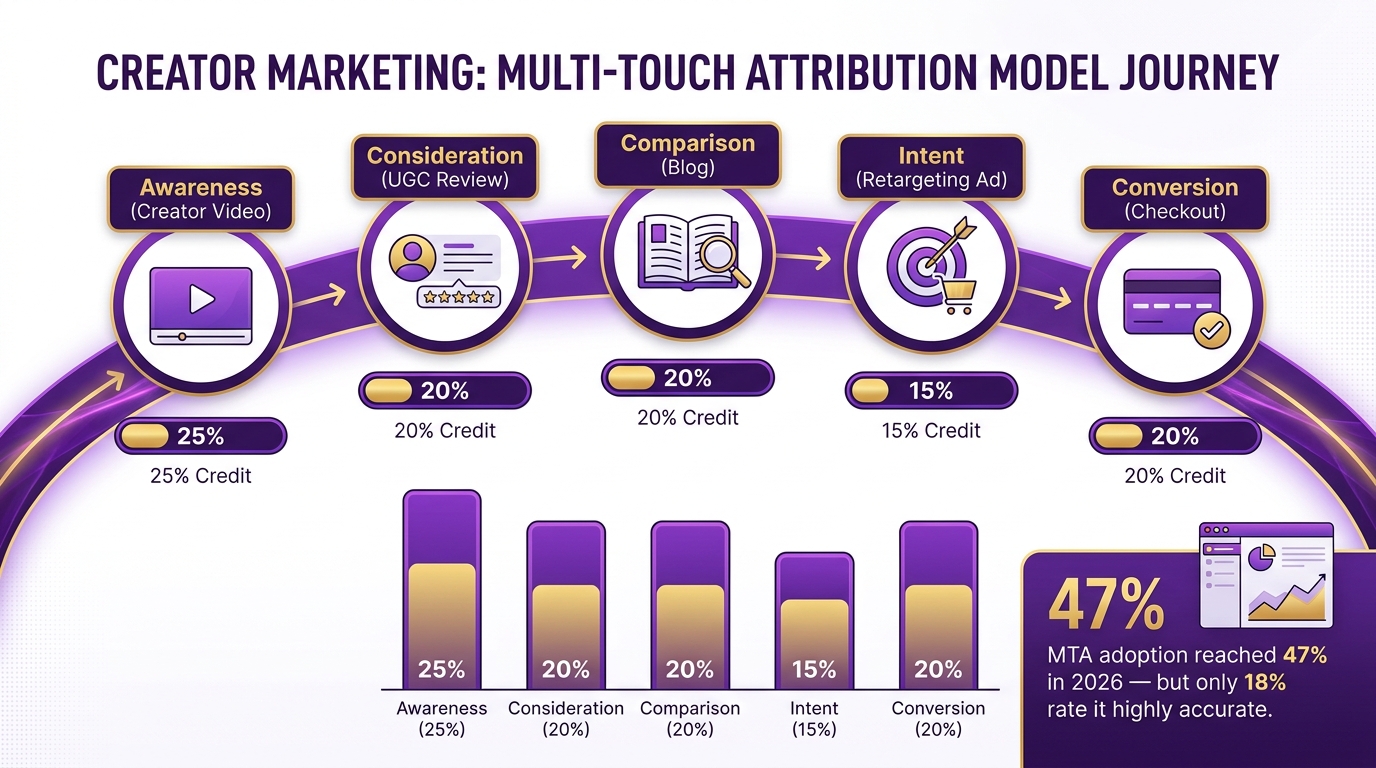
Multi-touch attribution (MTA) attempts to distribute commission credit across multiple touchpoints in a customer journey rather than awarding all credit to a single point. In 2026, MTA adoption has reached approximately 47% of programs using some form of multi-touch model, up from 31% in 2023. The market for MTA software and services is estimated at $2.76 billion in 2026.
Adoption growth, however, does not equal accuracy. Only 18% of MTA implementations are rated highly accurate by their own teams, according to current analytics benchmarking. The gap between adoption and confidence reflects real technical challenges: MTA requires complete, cross-device tracking data to function well, and the privacy changes of the past several years have reduced the quality of that data significantly.
Which MTA model fits creator programs
There are five main MTA models in common use. Understanding which fits creator workflows depends on where in the customer journey your creators operate.
Linear attribution distributes credit equally across all touchpoints. If there are five touchpoints in a journey, each gets 20% of the commission. It is fair in a naive sense but rewards low-contribution touchpoints (like a coupon at checkout) as much as high-influence ones (like a detailed creator review).
Time-decay attribution gives more credit to touchpoints closer to conversion. This is sensible for high-purchase-intent channels but systematically undervalues creator content that influences awareness at the beginning of the journey — exactly where most creator content lives.
Position-based attribution (also called U-shaped) gives the most credit to first and last touch, with the remainder distributed across middle touches. For creator programs where the creator typically drives first awareness and a checkout page or retargeting ad closes the sale, this often produces the most accurate picture of contribution.
Data-driven attribution uses machine learning to assign credit based on the observed statistical contribution of each touchpoint to conversion probability. It is the most accurate model when the data is complete and the model is well-calibrated, but it requires volume — typically at least 10,000 conversion events per model training cycle — to produce reliable output.
First-touch attribution gives all credit to the initial touchpoint. For creators whose role is discovery and awareness, first-touch is a useful supplementary metric even if it is not used for commission calculation. It shows how much demand a creator introduces to the funnel that eventually converts through other channels.
MTA as directional guidance, not ground truth
The current expert consensus is that MTA should be treated as directional insight rather than authoritative commission calculation. Privacy-driven data gaps mean that no MTA model has complete visibility into the full customer journey — it is always working with a partially observed dataset. Pairing MTA data with marketing mix modeling (MMM) for macro-level budget decisions and incrementality testing for creator-level performance decisions produces better decisions than any single model alone.
Auditing Your Creator Program for Attribution Leakage
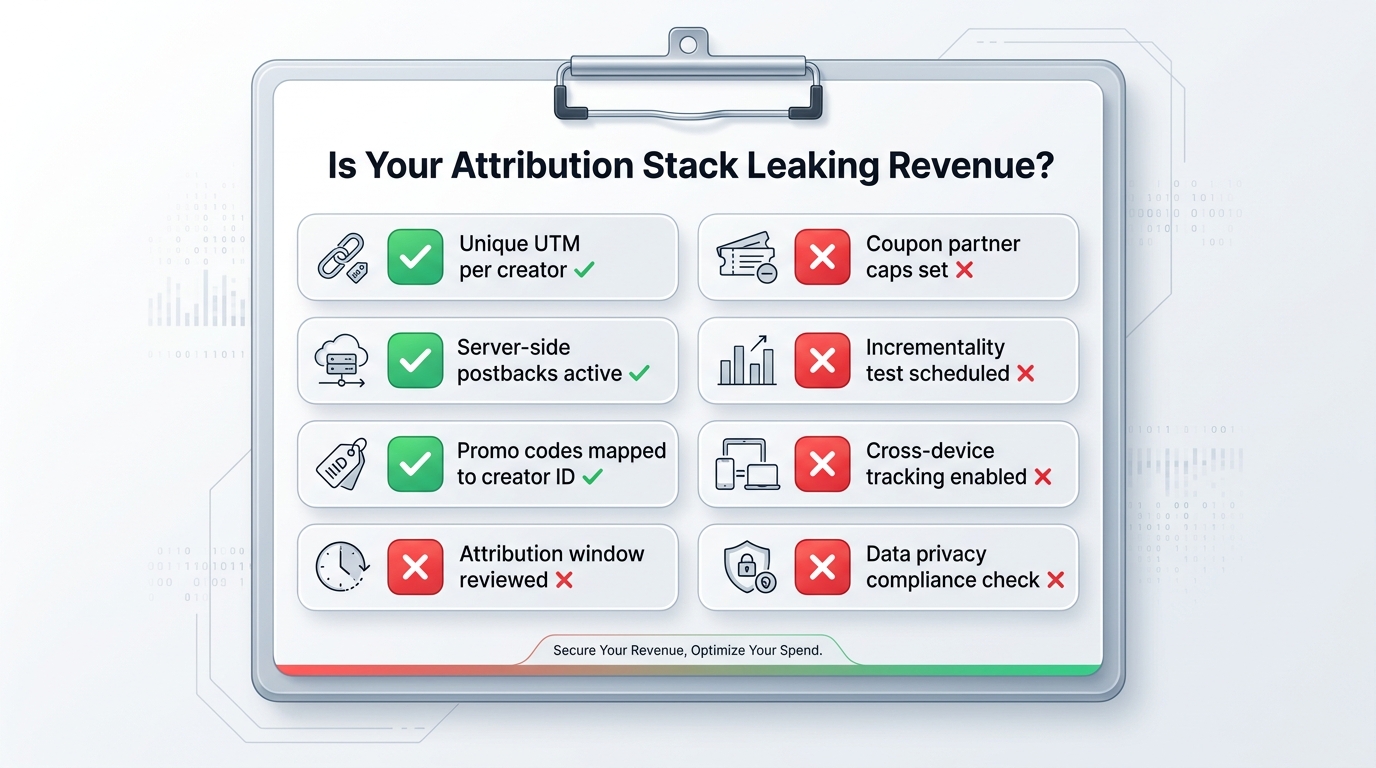
Most attribution leakage goes undetected not because it is undetectable but because no one runs a systematic audit. The following checklist covers the most common leak points across technical tracking, program structure, and platform configuration. Work through it against your current creator program setup.
Technical tracking audit
- Unique UTM parameters per creator: Is every creator using a distinct, consistently formatted UTM string? Pull your analytics source/medium/campaign report and look for any undefined, misformatted, or duplicate creator IDs.
- Server-side tracking active: Is your primary conversion signal coming from server-side postbacks or from client-side pixels? If client-side pixels are your only conversion source, estimate your loss rate based on the iOS/Safari share of your traffic and plan the migration.
- Promo code-to-creator mapping clean: Pull a list of all active promo codes and verify each maps to exactly one creator in your backend. Identify any codes that have been used by multiple creators or that are assigned to departed partners.
- Product tags verified on live content: Spot-check 10% of live creator content pieces monthly. Verify the product tag is present, the product is in stock, and the tag links to the correct SKU.
- Cross-device matching enabled: Does your analytics or affiliate platform support cross-device attribution via logged-in user matching? If not, what percentage of your traffic is cross-device? (Google Analytics 4 provides a cross-device report under Reports > User > Tech Detail.)
Program structure audit
- Attribution model reviewed: Is your program running last-click? Have you evaluated last-paid-click or position-based alternatives? When was the model last reviewed against actual conversion data?
- Coupon and cashback partner rules defined: Does your program explicitly exclude coupon/cashback partners from last-touch credit, or are they competing with creator partners under the same rules? If competing, estimate how much commission is routing to coupon/cashback vs. creator content.
- Attribution window benchmarked against purchase cycle: What is the median time-to-purchase for your product category? Is your attribution window at least as long as that median? If not, calculate the percentage of orders occurring outside your current window using your order data.
- Creator-specific window negotiation: For your top 10 creator partners, is the attribution window in their agreement appropriate for their content type and audience? High-ticket and high-consideration categories typically warrant 30–90 day windows.
Revenue reconciliation check
- Attributed vs. total order comparison: What percentage of your total monthly orders are attributed to any partner? If attribution coverage is below 70%, you have material tracking gaps to investigate.
- Promo code vs. link attribution comparison: For creators using both affiliate links and promo codes, compare the attributed revenue from each method. If promo codes are attributing significantly more than links for the same creators, you have a client-side tracking reliability problem.
- Incrementality test scheduled: When was the last incrementality test run for any creator partner? If never, or more than 6 months ago, schedule one for your top five creator partners in the next 60 days.
What Good Attribution Actually Changes for Creators and Brands
There is a tendency to treat attribution as a technical concern — a measurement problem that lives in dashboards and tracking settings. But attribution is fundamentally an economic and trust question. How revenue is assigned determines how creators are paid, which creators grow, which partnerships continue, and what content gets made.
The brand side of the equation
Brands running creator programs with broken attribution are making spend decisions based on misleading data. They are underpaying creators who drive genuine demand and potentially overpaying partners who intercept credit without contributing influence. Over time, this produces a creator roster that skews toward bottom-funnel interceptors and away from genuine discovery drivers — the opposite of what creator marketing is designed to achieve.
The commercial case for investing in proper attribution infrastructure is straightforward: programs that fix their tracking and move away from last-click consistently find that 11–19% of commission budget can be redirected toward higher-impact creator partnerships. That reallocation does not require spending more; it requires measuring better.
The creator side of the equation
For creators, attribution quality directly determines career viability. A creator who consistently drives purchases but whose attribution stack fails to capture those conversions will be perceived as underperforming and may lose partnerships or commission rates as a result — even while their content is genuinely effective.
Creators who take an active role in their own attribution — deploying promo codes alongside affiliate links, documenting their tracking setup, requesting longer attribution windows, checking their dashboard data against post-purchase survey feedback from their audience — are systematically better positioned to demonstrate their actual value than creators who rely entirely on platform-generated attribution numbers.
The shift toward performance-based creator compensation makes this increasingly important. As brands move from flat-fee sponsorships toward hybrid models that include affiliate commissions and revenue share, creators who can prove their attribution accuracy are more credible negotiating partners. And creators who understand where their attribution breaks can fix those breaks — rather than accepting an undercount as the final word.
Building an Attribution System Worth Trusting
Creator attribution in 2026 is simultaneously more important and more fragile than it has ever been. Important because more creator revenue is directly tied to tracked performance metrics. Fragile because the tracking infrastructure most programs use was designed for a privacy environment that no longer exists, running attribution models that systematically misdirect credit.
The fixes are not exotic. They are available to any brand or creator willing to invest the time to implement them properly.
At the technical level: move server-side tracking from optional enhancement to primary infrastructure. Deploy unique promo codes for every creator partner. Standardize UTM naming and enforce it with templates. Build an order-level reconciliation table that lets you see attributed and unattributed orders in the same view.
At the program level: evaluate whether last-click attribution is the right model for your creator mix, or whether last-paid-click or position-based alternatives better reflect how your creators actually contribute. Benchmark your attribution windows against your actual purchase consideration cycle. Set explicit rules for coupon and cashback partner behavior so they cannot override creator credit at checkout.
At the measurement level: run incrementality tests. Use multi-touch attribution as a directional tool, not a commission calculator. Reconcile attributed revenue against total order data monthly. When the two diverge significantly, investigate — do not normalize the gap.
And at the provenance level: start implementing Content Credentials for creator content now. The infrastructure is available, the standard is mature, and the early-mover advantage in verified content ownership will only grow as AI-generated content expands and platforms begin requiring provenance disclosure.
Attribution bad cuts are fixable. But only if you stop treating them as an inevitable tax on creator revenue and start treating them as an engineering problem with a known set of solutions.
Key takeaways
- Last-click attribution routes commission to coupon and cashback partners who intercept at checkout rather than creators who drive discovery — switching to last-paid-click can reallocate 11–19% of program spend back to content creators.
- Attribution window compression (38% of programs now use 7 days or less) is cutting off credit for purchases that happen outside a narrow window despite being clearly creator-influenced.
- The most resilient attribution setup combines unique UTMs, unique promo codes, and server-side postbacks — three independent signals that together cover what any single method misses.
- Platform-specific fixes matter: TikTok Shop requires native tags and a 48-hour reporting patience window; YouTube Content ID disputes should be filed immediately with documentation; Amazon’s cart-add window (90 days) is an underused mechanism worth leveraging.
- Content Credentials (C2PA) are an emerging layer of attribution that extends beyond commission to content ownership, provenance, and AI disclosure — early adoption now builds a verifiable content record for future use.
- Incrementality testing is the only way to determine whether attributed conversions represent genuine creator influence — run it quarterly and use it to inform investment decisions alongside attribution data.