




TikTok didn’t ask sellers whether they wanted GMV Max. As of mid-2025, it became the default and only supported campaign type for TikTok Shop Ads, replacing the legacy formats — Video Shopping Ads, Product Shopping Ads, and LIVE Shopping Ads — for any new campaign creation. If you are running paid traffic to your TikTok Shop today, you are running GMV Max, whether you chose it or not.
That mandatory shift has created two very different camps among sellers. The first camp accepted the automation at face value, set a budget, picked a target ROI, and let TikTok do its thing. The second camp looked at the reported results — 7x ROI, 136% GMV lift, 10 hours a week saved — and immediately asked the obvious question: how much of that is actually real?
Both camps are missing something. The first group is likely overpaying for sales they would have made anyway. The second group is so skeptical of the platform’s reporting that they are not running the structured tests that would tell them what GMV Max is actually doing to their business. This post is for neither camp — it is for sellers who want to approach GMV Max the way you would approach any automated system: with clearly defined hypotheses, controlled experiments, and measurement that does not depend entirely on the platform doing the reporting.
What follows covers how GMV Max actually works under the hood, the specific levers that matter most, and the four tests you should be running right now to determine whether — and how much — to scale it.
What GMV Max Actually Is (And What TikTok’s Marketing Leaves Out)
The official description makes GMV Max sound simple: set a product set, a daily budget, and a target ROI, and TikTok’s system automatically allocates spend, selects creatives, chooses placements, and drives purchases. That description is accurate, but it is incomplete in ways that matter operationally.
It is not just a bidding tool — it is a creative routing engine
GMV Max does not just decide how to bid. It decides what creative asset to serve, to whom, at what placement, at what time. The system pulls from a pool of eligible assets that includes your organic brand videos, any paid video assets you have uploaded, and authorized affiliate content linked to your Shop. It then routes those assets across four main placement types: the For You feed, TikTok search results, the Shop tab, and Pangle (TikTok’s off-platform display network).
This is why creative supply — the number and diversity of eligible video assets — is treated as a first-order input to campaign performance, not a secondary concern. A campaign with three videos gives the system very little to work with. A campaign with 15 pre-authorized assets, including organic posts that already have real engagement signals, gives the algorithm enough variation to identify what is actually converting and double down on it.
Attribution is broader than most sellers realize
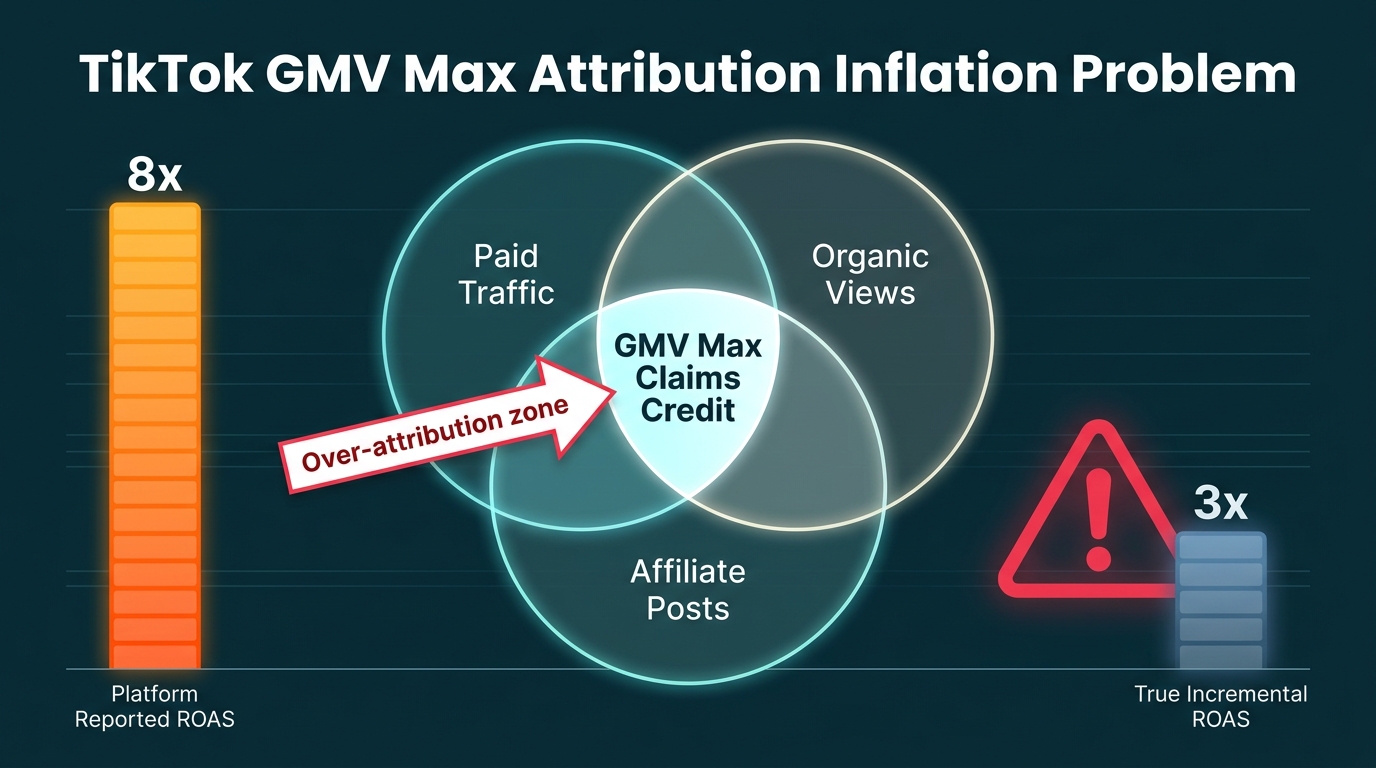
GMV Max does not just report on purchases that came from paid ad clicks. It attributes paid, organic, and affiliate-driven orders within its attribution window to the campaign. That is by design — the system is optimizing for total channel GMV, not just direct paid conversions — but it also means the ROI figure you see in Ads Manager is not comparable to a standard ROAS metric from Meta or Google. A seller who runs a successful affiliate campaign, sees organic views surge on a trending video, and also has GMV Max active during the same week will likely see GMV Max claim credit for much of that lift. Whether any of it is actually incremental is a separate measurement question, and one TikTok’s native reporting does not answer for you.
What you can and cannot control
Compared to legacy TikTok Shop ad formats, GMV Max removes significant manual controls. You cannot specify exact audiences, exclude segments, set manual bids, or choose specific placements. The inputs you retain are: the product set (which SKUs are eligible), the daily budget, the ROI target mode and value, the creative assets you authorize, and the campaign scheduling. Everything else is automated. For sellers accustomed to hands-on campaign management, that loss of control is the most common friction point — and the reason structured testing matters more, not less, under this system.
LIVE GMV Max vs. Product GMV Max: Choosing the Right Mode for Your Business
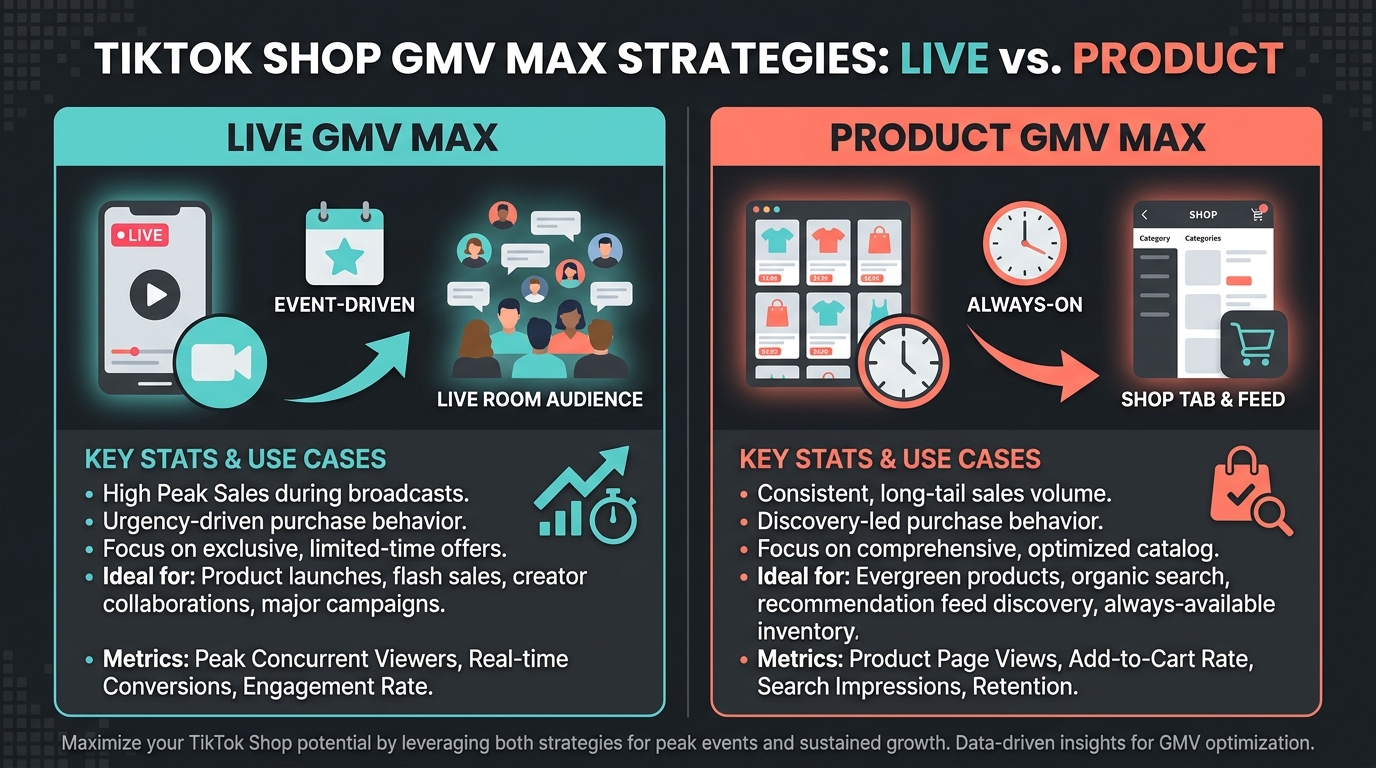
GMV Max is not a single campaign type — it is a framework with two distinct operating modes, and the choice between them shapes everything from your creative requirements to how you schedule spend.
LIVE GMV Max: event-based, room-fill optimization
LIVE GMV Max is designed specifically for sellers who use TikTok Live shopping. Its optimization goal is to push traffic into a live broadcast session and maximize revenue generated during that live event. Think of it as a demand concentration tool: you schedule a live, you activate LIVE GMV Max, and the system floods your live room with high-intent viewers for the duration of the event.
The practical implication is that LIVE GMV Max is not always-on — it is event-triggered. You configure it around scheduled broadcast windows, and its value is directly proportional to the quality of your live selling operation. If your live room has weak hosts, poor product demonstrations, or inconsistent production quality, LIVE GMV Max will fill the room with viewers who do not convert, which will surface in poor ROI data quickly. The paid traffic amplification only multiplies what is already working organically in your live room, it does not fix fundamental live-room conversion problems.
Product GMV Max: always-on catalog optimization
Product GMV Max is the mode most sellers will use as their primary ongoing campaign. It promotes specific product listings — or your full catalog — and runs continuously, optimizing for product page conversions across all supported placements. Unlike LIVE GMV Max, it does not require you to be broadcasting; it works while your store is dormant, while your team is asleep, and across any content that is linked and authorized in your creative pool.
Product GMV Max is also where the creative-supply strategy matters most, because the algorithm needs a diverse pool of videos to test across multiple placements and audience signals. A live room is a single context; product page promotions happen across many contexts simultaneously, which means the system needs more material to work with.
Running both together: the complementary strategy
The most sophisticated sellers are running both modes concurrently but treating them as separate budget lines with separate measurement goals. Product GMV Max handles baseline, always-on demand capture. LIVE GMV Max is activated for scheduled promotional events, product launches, or seasonal pushes. When both are active simultaneously, there is potential for budget overlap and attribution duplication — the same viewer may be touched by a Product GMV Max creative and then convert during a live session. Keeping these campaigns in separate ad accounts or at minimum in separately budgeted campaigns reduces that noise when you are trying to evaluate either mode independently.
The Attribution Problem No One Talks About Loudly Enough
The attribution problem with GMV Max deserves its own section because it is not a minor edge case — it is a structural feature of how the system is designed, and misunderstanding it leads to decisions that erode actual margins while looking great on a dashboard.
Three traffic channels, one attribution model
When GMV Max runs, it attributes orders from three distinct traffic sources to the campaign: direct paid ad clicks, organic TikTok traffic (views on your videos that result in shop purchases), and affiliate-driven purchases from creator posts that are linked to your Shop. All of these can occur simultaneously. The platform’s reported ROI — calculated as gross revenue divided by ad cost — stacks all of that revenue on top of your paid spend. If your organic content has strong momentum, or if you have a well-functioning affiliate program, a significant portion of the GMV Max attribution may have nothing to do with paid media at all.
This is not a bug in TikTok’s system — it is the intended behavior, because GMV Max is explicitly designed to optimize for total channel efficiency, not pure paid media efficiency. The problem arises when sellers use the platform-reported ROI figure as a proxy for whether their paid investment is generating incremental returns. Those are different questions, and the platform’s native reporting only answers the first one.
The case study numbers can mislead at face value
TikTok’s published case studies report outcomes like 7.79x ROI, 8.82x ROI, +136% in TikTok product sales, and +84% GMV uplift. These are real reported numbers, but they are platform-attributed metrics, not independently verified incrementality studies. TikTok’s own UK beauty and wellness study, which used Causal Impact Analysis methodology, found a more conservative +15% average revenue uplift and +8% average ROI gain across 11 advertisers — meaningful numbers, but a fraction of the headline case study figures.
The gap between “platform reported ROI of 7x” and “independently measured incremental lift of 15–20%” is not a scandal — it is just the difference between gross attribution and causal measurement. Sellers who plan budgets and margin calculations against the former will consistently overspend. Sellers who build their measurement methodology around the latter will make far better scaling decisions.
What the platform actually tells you vs. what you need to know
GMV Max’s native reporting surfaces: cost, orders, gross revenue, and ROI. It does not surface: organic sales that would have happened without the campaign, affiliate commissions paid, refund rates, or actual profit margin per order. For a seller with a 30% gross margin and a $0.15 cost per acquisition, a reported 7x ROI can be highly profitable. For a seller with a 15% margin and significant affiliate co-funding baked into the attributed revenue, the same 7x platform ROI could be masking a negative-margin situation. The number on its own does not tell you which scenario you are in.
The Cold Start: Budget Floors, Learning Phase, and the Critical First 72 Hours
The learning phase is one of the most consequential — and most mismanaged — parts of a GMV Max campaign. The system needs a minimum volume of signals to calibrate its targeting and delivery, and the decisions you make in the first three to five days have an outsized influence on how the campaign behaves at scale.
Budget minimums that actually work
The platform-documented minimum daily budget for GMV Max is $50. That number is largely useless as a planning figure. At $50/day, the system does not accumulate conversion signals fast enough to exit learning in a reasonable timeframe, and delivery tends to be erratic. Practitioners and agency guides that have run large volumes of GMV Max campaigns consistently recommend a practical starting range of $100–$200 per day for new campaigns. TikTok’s own guidance adds a more useful rule: set your daily budget at at least 10× your average order value. For a store with a $35 AOV, that means a $350/day floor. For a store with an $85 AOV, it means $850/day.
These numbers feel aggressive for sellers used to starting Meta or Google campaigns at $30/day and scaling from there. But GMV Max’s learning is conversion-signal dependent — it needs to see purchase events, not just impressions or clicks, to optimize. Underfeeding the budget in the first week is the most common reason campaigns get stuck in a permanently underperforming state.
Max delivery first, then Target ROI
TikTok’s own guidance explicitly recommends starting GMV Max in Max delivery mode for the first three to five days before switching to Target ROI mode. Max delivery does not constrain spend efficiency — it prioritizes volume and signal accumulation over cost discipline. Running it first gives the algorithm the conversion data it needs to make ROI-constrained delivery viable. Sellers who skip this step and immediately apply a tight ROI target often see the campaign fail to spend at all, because the system cannot find enough qualifying users to hit the target efficiently without prior learning.
What to watch — and what not to touch — in the first week
During the learning phase, resist the instinct to make changes based on daily performance swings. GMV Max’s delivery will be uneven in the first three to five days. A poor day two does not mean the campaign is failing — it often means the system is still mapping audience signals. Changing the ROI target, budget, or product set during this period resets the learning clock. The metric to watch during cold start is not ROI — it is whether the campaign is spending. If it is spending and generating conversion signals, the learning is progressing. If it is not spending despite a sufficient budget, the likely culprits are an ROI target set too high, too few creative assets, or product catalog eligibility issues.
ROI Target Setting: The Math Behind the Number
The ROI target is the most important lever in a GMV Max campaign, and it is consistently the most poorly calibrated one. Too high, and the system throttles delivery trying to find buyers who meet an unrealistic efficiency threshold. Too low, and you are effectively subsidizing sales with no efficiency constraint. Getting this number right — and evolving it methodically — is where experienced GMV Max operators separate themselves from beginners.
The formula TikTok recommends (and its limitations)
TikTok’s official guidance for calculating an initial ROI target is: historical non-LIVE GMV ÷ historical ad cost from a recent representative period. This gives you a baseline ROI that reflects what the campaign already achieved organically, and you target around that number to maintain efficiency while scaling volume. The limitation is that this formula works best for sellers with at least 30–60 days of shop history and reasonably stable baseline sales. For newer shops, or shops launching on TikTok after success on other platforms, there is no meaningful historical baseline, which means the initial target is necessarily a hypothesis.
Starting ranges by seller maturity
The practitioner consensus in 2026, across agency guides and operator communities, has converged on the following starting ranges for Target ROI mode:
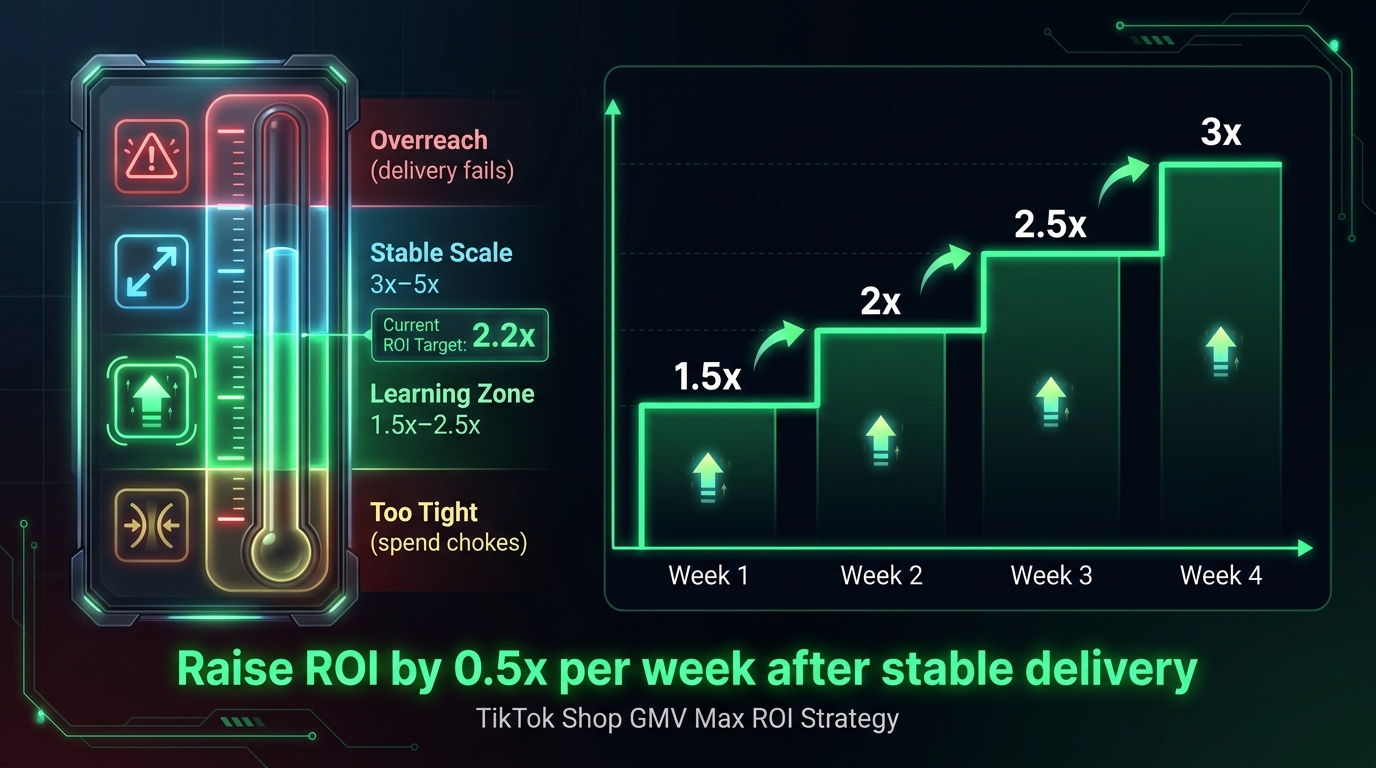
- New shops with less than 60 days of TikTok Shop history: Start between 1.5x and 2x. The goal at this stage is signal accumulation and category data, not margin optimization.
- Established shops with stable sales history: Start at or slightly below your calculated historical ROI baseline, typically in the 2x–3x range for most product categories.
- High-volume shops trying to maximize GMV at scale: Target ROI of 3x–5x is achievable for well-optimized campaigns with strong creative supply and broad catalogs, but requires at least two to three weeks of learning history first.
The step-up approach: why gradual beats aggressive
Increasing the ROI target in large jumps — say, from 2x to 5x in one edit — almost always triggers delivery suppression. The algorithm’s optimization function needs time to find a new equilibrium at each efficiency level. The standard guidance is to raise ROI by no more than 0.5x per week after campaign delivery has stabilized, defined as consistent daily spend and an actual ROI within 10–15% of target for at least three consecutive days. This is slow by the standards of sellers used to manual campaign management, but it is the approach that produces sustainable scaling rather than a performance cliff.
Calculating your floor: the margin-first approach
Before setting any ROI target, calculate the minimum ROI that keeps a transaction profitable given your actual cost structure: product cost, TikTok’s platform commission (which varies by category and has increased in 2026), affiliate co-funding if applicable, shipping, and returns. If your all-in cost leaves you with a 22% margin after product and commission, and your average affiliate commission rate is 10%, your actual threshold for a profitable sale is higher than the platform ROI alone would suggest. Many sellers discover, when they do this calculation explicitly, that the GMV Max ROI needed for profitability is materially higher than what they initially set — meaning they have been running at a loss while showing impressive dashboard numbers.
Product Set Strategy: Broad Catalog vs. Segmented Campaigns
The product set decision — whether to include your entire catalog in a single GMV Max campaign or split it across multiple campaigns by segment — is one of the few structural choices that remains entirely in the seller’s hands. It has meaningful consequences for both performance and measurement.
The case for broad catalog inclusion
TikTok’s official guidance favors starting with broad catalog inclusion for Product GMV Max. The logic is straightforward: broader product sets give the algorithm more options to match products to high-intent audiences, which increases the probability of finding efficient conversion pathways. A narrow product set limits the system’s ability to discover which SKUs perform best for which audience signals, reducing the optimization surface.
Broad catalog campaigns also tend to exit the learning phase faster, because there are more potential conversion events across a larger product surface. For sellers with 50+ active SKUs, starting with all products eligible gives GMV Max the best conditions for discovering natural winners from the catalog.
When segmentation makes sense
Segmentation becomes valuable in three specific scenarios. First, when your catalog has SKUs with wildly different ROI profiles — a $12 accessory and a $200 hero product should not share the same ROI target because the economics of optimizing for each are completely different. Running them in the same campaign forces a single efficiency target onto two incompatible margin structures.
Second, when you have identified hero SKUs with strong conversion history and want to concentrate budget on them without the algorithm diluting spend across slower-moving items. A “hero SKU” campaign with a higher ROI target, running alongside a broader catalog campaign with a lower target, can capture both efficiency and discovery simultaneously.
Third, when you need cleaner measurement. If you are trying to evaluate whether GMV Max is genuinely driving incremental sales for a specific product line, including that product line in a mixed campaign makes isolation nearly impossible. A segmented campaign gives you a cleaner signal for that product group.
The ROI-grouping rule
TikTok’s product set guidance includes one practical rule that is easy to overlook: group products with similar ROI targets in the same campaign. Mixing high-margin and low-margin products under a single ROI target either constrains spend on the low-margin items (if the target is set to the high-margin products’ threshold) or erodes efficiency on the high-margin items (if the target is set to accommodate the lower-margin products). The system cannot apply different efficiency thresholds to different products within a single campaign — one target governs the whole set.
Creative Supply as a Ranking Input: More Than Just Ads

One of the most important — and most counterintuitive — aspects of GMV Max is that it treats creative supply as a first-order performance variable, not a secondary input. Sellers who approach GMV Max purely as a bidding and budget exercise, while neglecting the creative pool, consistently underperform sellers who invest in building a broad, high-quality, frequently refreshed set of eligible assets.
The three creative streams GMV Max can pull from
Stream 1: Organic brand videos. Any video your brand account has posted and linked to a product in your Shop is potentially eligible for GMV Max delivery. Critically, this includes videos that have already generated organic engagement — meaning the algorithm can see real-world watch time, comment sentiment, and save rates before amplifying them with paid spend. This is a significant advantage over paid-only creative approaches: you are not guessing at what will resonate, you are amplifying what already does.
Stream 2: Authorized affiliate content. Affiliate creators who have posted product-linked videos for your Shop can have their content authorized for inclusion in GMV Max campaigns. This is a powerful lever because it dramatically expands the diversity of creative angles, voices, and use-case demonstrations available to the algorithm without requiring the brand to produce everything in-house. The authorization process requires explicit permissioning through Business Center, but once set up, it means your GMV Max campaign can run on the back of a wide creator network rather than a narrow in-house content operation.
Stream 3: Paid video assets and Spark Ads codes. Standard paid video creatives uploaded directly to the campaign, plus Spark Ads video codes for content you want to boost as branded content, round out the creative pool. These are the most controllable stream — you know exactly what message and format you are paying to amplify — but they are also the most expensive to produce at scale and lack the organic validation signals of the other two streams.
How many assets is enough?
There is no published minimum from TikTok on creative asset count for optimal GMV Max performance, but practitioner guidance has converged around a practical floor: at least five to eight videos per campaign at launch, with ongoing refresh cycles of two to three new assets per week once the campaign is running. Campaigns running with three or fewer assets tend to see creative fatigue accelerate faster, because the system exhausts the variation options within the pool and starts serving the same assets repeatedly to the same audiences. When this happens, CPM typically rises and conversion rate declines — both observable in the reporting — but the system has no new material to rotate in.
The “organic-first” creative strategy for GMV Max
The most efficient creative pipeline for GMV Max starts outside of the ad system entirely. Post a high volume of organic product videos — ideally 15–20 per month at minimum — and track which ones generate meaningful engagement, saves, and organic shop purchases. Videos that already demonstrate conversion signals organically are strong candidates for Spark Ad authorization into the GMV Max pool. This approach front-loads the creative testing in a zero-cost environment and routes only validated performers into the paid amplification system, which is significantly more cost-efficient than testing creative hypotheses with paid spend.
The affiliate content layer adds another dimension: brief your affiliate network with two or three key product narratives and specific hooks you want tested, review what performs organically across their posts, and authorize the strongest performers into your GMV Max pool. Done well, this turns your entire affiliate network into a distributed creative testing operation, with GMV Max amplifying the winners.
The Four Tests Every Seller Should Run Right Now
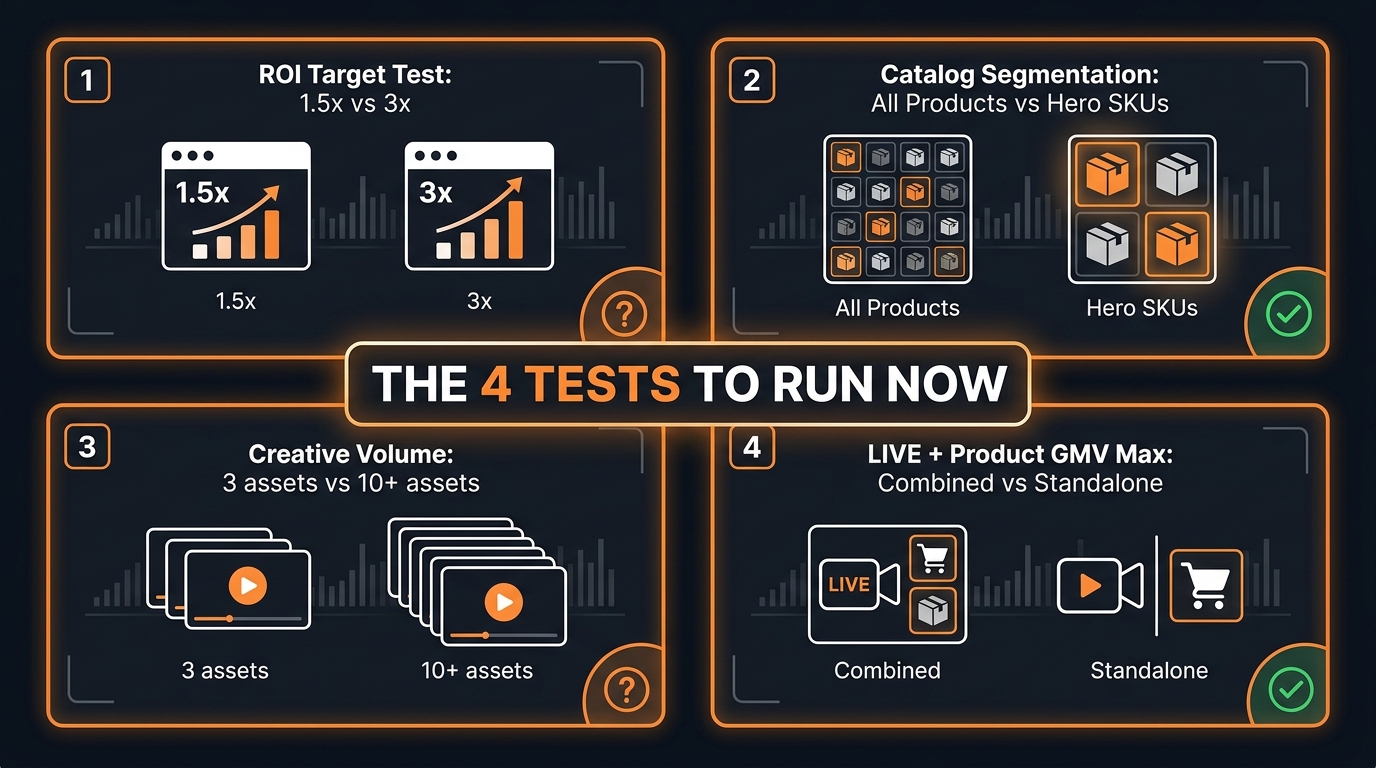
GMV Max being mandatory doesn’t mean you’ve exhausted all your options for experimentation. Within the structure TikTok has given you, there are four high-value tests that most sellers haven’t run systematically. These are not theoretical — they are the experiments that separate operators who understand their actual GMV Max performance from operators who are trusting a dashboard number.
Test 1: ROI Target Ceiling — where does delivery actually break?
What to test: Run two campaigns with identical product sets, budgets, and creative pools, but different ROI targets. Set one at your current target (or at 2x as a baseline if you are starting fresh) and one at your desired efficiency target — wherever you believe your margin requires the campaign to run. Run both for two weeks. Compare not just reported ROI but actual daily spend, order volume, and whether the higher-target campaign is delivering at all.
What you will learn: The ceiling at which the algorithm stops delivering reliably for your specific shop and product category. This is different for every seller — a shop with strong conversion history and high purchase intent signals can hit higher ROI targets than a new shop with thin data. Knowing your actual delivery ceiling prevents you from setting targets that choke spend without realizing it.
Test 2: Catalog Scope — all products vs. hero SKUs
What to test: Run one campaign against your full eligible catalog. Run a second campaign with only your top five to eight converting SKUs, at the same budget and ROI target. After two weeks, compare total GMV, cost per order, and which specific products the algorithm gravitates toward in each campaign. Pay particular attention to whether any SKUs that you expected to be strong performers are being ignored by the broad-catalog campaign.
What you will learn: Whether your catalog’s long tail is helping or hurting GMV Max optimization. If the hero SKU campaign outperforms the broad campaign on a cost-per-order basis, it suggests the algorithm is spending meaningful resources exploring low-converting catalog items in the broad campaign rather than concentrating on your actual winners. This also tells you which products are carrying disproportionate weight in GMV Max delivery — useful data for content and inventory decisions entirely separate from ads.
Test 3: Creative Volume — minimum viable vs. maximum available
What to test: Run one campaign with the minimum viable creative pool — three to four videos, a mix of organic and paid. Run a second campaign with as many authorized assets as you can aggregate in two weeks — ideally 10 to 15 videos spanning brand, affiliate, and Spark Ads sources. Keep budget, product set, and ROI target identical. Track not just performance metrics but creative-level reporting to see which assets the algorithm serves most heavily in the expanded pool.
What you will learn: The marginal value of creative volume for your specific shop. If the expanded-asset campaign significantly outperforms the minimal-asset campaign, it confirms that your current creative pipeline needs more investment. It also reveals which specific asset types (brand-owned vs. affiliate vs. Spark Ads) the algorithm prefers for your category — a signal you can use to prioritize your content production resources.
Test 4: LIVE + Product GMV Max Combined — additive or cannibalistic?
What to test: For sellers who run TikTok Lives, run a three-week period with Product GMV Max only (no LIVE GMV Max), followed by a three-week period running both simultaneously with separate budgets and separate budget tracking. Compare total shop GMV, cost per order across both campaigns, and whether the combined setup resulted in budget overlap or attribution duplication for the same purchase events.
What you will learn: Whether LIVE GMV Max is genuinely additive to your Product GMV Max results, or whether you are paying for the same purchase events twice through overlapping attribution. For shops with strong live sales that already have good organic live room traffic, LIVE GMV Max is often highly incremental during events. For shops where live commerce is a smaller part of the business, the combined setup may create attribution noise without meaningful additional GMV — in which case keeping them separate and budget-capped is the right call.
Measuring True Incrementality: Beyond Platform ROAS
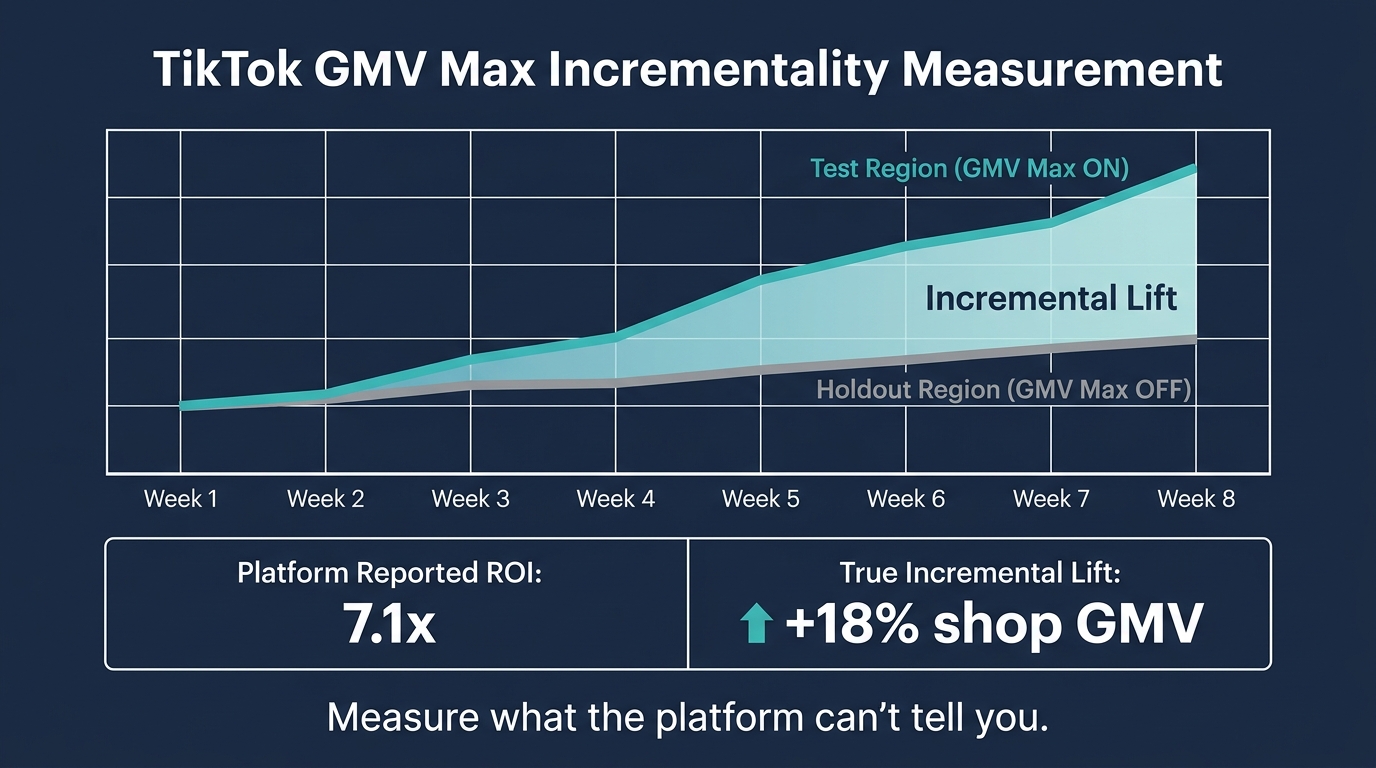
Platform ROAS is a starting point for understanding GMV Max, not an ending point. The sellers who are making the best decisions about how much to spend — and where to scale — are building an incrementality measurement layer on top of the native reporting. Here is what that actually looks like in practice.
The before-and-after baseline comparison
TikTok’s own Seller Center includes a native report called the GMV Max Before and After Comparison for Incremental Lift, which compares the 30 days of shop sales before campaign launch against up to three months after campaign creation. This is imperfect — it does not control for external factors like seasonality, viral organic content, or affiliate program changes — but it is the most accessible starting point for estimating whether GMV Max is actually moving the needle at the shop level.
To use this report meaningfully, you need to run it in a period without major promotions, new product launches, or unusual affiliate activity that could confound the comparison. A clean 30-day baseline against a clean 30-day post-launch window, with no major external changes in either period, gives you a reasonable directional signal for whether total shop GMV increased after GMV Max started.
The geo-holdout test: the most defensible methodology
For sellers with sufficient scale, the most defensible way to measure GMV Max incrementality is a geo-based holdout experiment. The setup: identify two geographically matched markets where your shop sells — similar baseline sales volumes, similar demographics, similar seasonal patterns. Run GMV Max in one market and deliberately hold it off in the other. After three to four weeks, compare total shop GMV in both regions. The difference is your incremental lift estimate, controlling for everything both regions experienced in common.
TikTok’s own UK study, which used Causal Impact Analysis on 11 beauty and wellness advertisers, found an average incremental revenue uplift of 15% and an average ROI improvement of 8% using this type of methodology. The divergence from headline case study numbers (which showed individual campaigns at 4x–8x+ ROI) illustrates exactly how much the attribution model can overstate true lift when measured on a gross basis.
Marketing Efficiency Ratio as your north star metric
The most practical ongoing measurement framework for GMV Max — especially for sellers running multiple channels simultaneously — is Marketing Efficiency Ratio (MER), calculated as total store revenue divided by total marketing spend across all channels. Unlike platform-specific ROAS, MER captures the holistic effect of paid advertising on the entire business without getting distracted by attribution disputes between channels.
To use MER effectively with GMV Max: establish your baseline MER before launching, calculated over 30–45 days of stable business operation. Then run GMV Max and track whether MER improves, stays flat, or declines as spend scales. If adding $5,000/month to GMV Max increases total store revenue by $8,000/month while other variables remain constant, MER reflects that incrementality cleanly. If adding $5,000/month shows no change in total store revenue — or a decline — it tells you the attributed GMV in the platform’s reporting is largely cannibalistic of sales that would have happened anyway.
What to do when MER and platform ROI diverge
When MER is flat or declining while platform-reported GMV Max ROI looks strong, the most likely explanation is attribution over-counting: the campaign is taking credit for organic and affiliate sales that do not depend on paid amplification. The correct response is not to turn off GMV Max immediately — it is to systematically reduce the authorized creative assets to only paid-specific content (removing organic and affiliate assets from the pool) and then re-run the MER comparison. This isolates the pure paid contribution from the attributed-but-not-incremental revenue in the reporting.
When GMV Max Underdelivers — Diagnosing the Real Problem
Not every GMV Max campaign scales. Sellers regularly encounter campaigns that either fail to spend their daily budget, deliver but show steadily deteriorating ROI, or produce strong early results that plateau without explanation. Each failure mode has a different root cause and a different fix.
The campaign that won’t spend
The most common underdelivery pattern is a campaign that has sufficient budget but consistently spends only a fraction of it. The primary causes, in order of frequency: an ROI target set too high for the shop’s current conversion history; too few creative assets for the algorithm to find high-quality delivery pathways; product catalog eligibility issues (products not fully listed, pricing inconsistencies, or policy violations flagging SKUs); or an ad account without enough historical purchase data to support aggressive spend pacing. The fix sequence is: check catalog eligibility first, then check creative asset count, then check the ROI target against a more conservative baseline, then verify ad account status.
The campaign with declining ROI over time
A campaign that started strong and is now showing declining ROI week over week is most commonly experiencing creative fatigue: the algorithm has exhausted the variation in the creative pool and is reaching diminishing returns on audience segments it has already saturated. The fix is creative refresh — add at least three to five new videos to the pool, ideally with different formats, hooks, and product angles than the existing assets. Avoid changing the ROI target or budget at the same time; changing multiple variables simultaneously makes it impossible to identify which change drove any subsequent improvement.
The campaign that performs well but doesn’t scale
Some GMV Max campaigns hit a ceiling where they perform well at moderate budgets but delivery drops off when budgets are increased significantly. This typically indicates that the algorithm has found a narrow but high-quality audience segment that it is efficiently serving, and cannot find an equally efficient expansion pathway. Two approaches work here: broadening the product set to increase the conversion surface, and expanding the creative pool with assets that target meaningfully different use cases or audience contexts. The goal is to give the algorithm new entry points into different audience segments rather than trying to scale the same approach into a saturated group.
The Seller’s Honest Checklist Before Scaling GMV Max
Before increasing GMV Max budgets based on strong platform-reported numbers, run through this checklist. Each item represents a point where sellers commonly make expensive scaling decisions based on incomplete information.
- Have you calculated your margin-based ROI floor? Before trusting the platform’s suggested ROI target, know the minimum ROI at which a transaction is genuinely profitable after product cost, TikTok commission, affiliate co-funding, shipping, and expected returns.
- Has the campaign run for at least two weeks post-cold-start? Platform results in the first five to seven days of a campaign are not representative of steady-state performance. Wait for at least two stable weeks before drawing scaling conclusions.
- Is your total shop GMV (not campaign-attributed GMV) also improving? Compare Seller Center’s total shop revenue to the pre-GMV Max baseline. If shop GMV is flat or declining while campaign GMV looks strong, attribution over-counting is likely the explanation.
- Do you have at least eight to ten authorized creative assets in the pool? Campaigns running on three or fewer assets are working with a handicapped optimization surface. Creative volume is a prerequisite for meaningful scaling, not an afterthought.
- Are you tracking MER, not just platform ROAS? If your total marketing spend is going up while total revenue is flat, the platform dashboard is misleading you regardless of the ROI it shows.
- Have you separated LIVE GMV Max and Product GMV Max budgets? Running both under a combined budget without separate tracking makes it impossible to evaluate either mode’s contribution independently.
- Is your ROI target step-up schedule gradual? Aggressive target increases that exceed 0.5x per week consistently cause delivery suppression. If you have made large target jumps recently and performance has degraded, the target increase is likely the cause.
What Comes Next for GMV Max in 2026
GMV Max is not static. TikTok continues to evolve the system’s capabilities, and several developments in 2026 are worth tracking for their implications on seller strategy.
Expanding placement options
GMV Max’s reach across TikTok’s placement inventory — For You feed, search, Shop tab, and Pangle — is likely to expand as TikTok deepens its commerce integrations. Search placement in particular is an area of active development: TikTok’s search ad product has grown significantly, and GMV Max campaigns are increasingly showing up in high-intent search result contexts. Sellers with strong organic search presence for their product category should track whether GMV Max is generating incremental orders from search placements specifically, as this is one area where paid delivery is most clearly additive to organic performance.
Product-level attribution improvements
One of the most-requested features from experienced GMV Max operators is product-level attribution data — the ability to see not just campaign-level ROI but which specific SKUs are driving conversions at what cost. TikTok has gradually expanded reporting granularity in the Ads Manager, and 2026 should see further improvements here. Better product-level data will make the catalog segmentation decision significantly more data-driven and reduce the need for the hero SKU vs. broad catalog test outlined earlier.
Cross-channel attribution developments
TikTok is also working on attribution tooling that better distinguishes incremental paid contribution from organic and affiliate attribution within GMV Max campaigns. Third-party measurement integrations — including MMPs and pixel-based tracking improvements — are expanding in 2026, which should make the incrementality measurement challenge described in this post more tractable without requiring elaborate geo-holdout experiments. For now, MER remains the most accessible proxy for true incremental lift, but cleaner cross-channel attribution infrastructure is coming.
Conclusion: What to Actually Do This Week
GMV Max is TikTok Shop’s mandatory advertising infrastructure. It is well-designed for its stated goal — maximizing total channel GMV through automated optimization — and there are sellers generating genuine, profitable, incremental revenue from it at scale. But it is also a system that is remarkably easy to run at a nominal profit on the dashboard while eroding actual margins at the shop level, if you are not measuring it carefully.
The sellers who will build durable, scalable GMV Max operations in 2026 are not the ones who set the highest budgets or the most aggressive ROI targets. They are the ones who treat it like the complex, attribution-heavy automated system it is: with controlled experiments, externalised measurement, and a healthy skepticism toward any single number the platform surfaces.
This week’s action items: (1) Calculate your margin-based ROI floor before touching any target settings. (2) Count your authorized creative assets — if you have fewer than eight, this is your highest-leverage task. (3) Pull your total shop GMV for the 30 days before your most recent GMV Max campaign started, and compare it to the 30 days since. (4) If you are running both LIVE and Product GMV Max, separate their budgets and start tracking them independently. (5) Set a two-week minimum review window — do not make target or budget changes more frequently than once per week during stable delivery periods.
The platform will keep automating more. Your job is not to fight the automation — it is to make sure you are measuring it honestly enough to know when to feed it more and when to constrain it.