

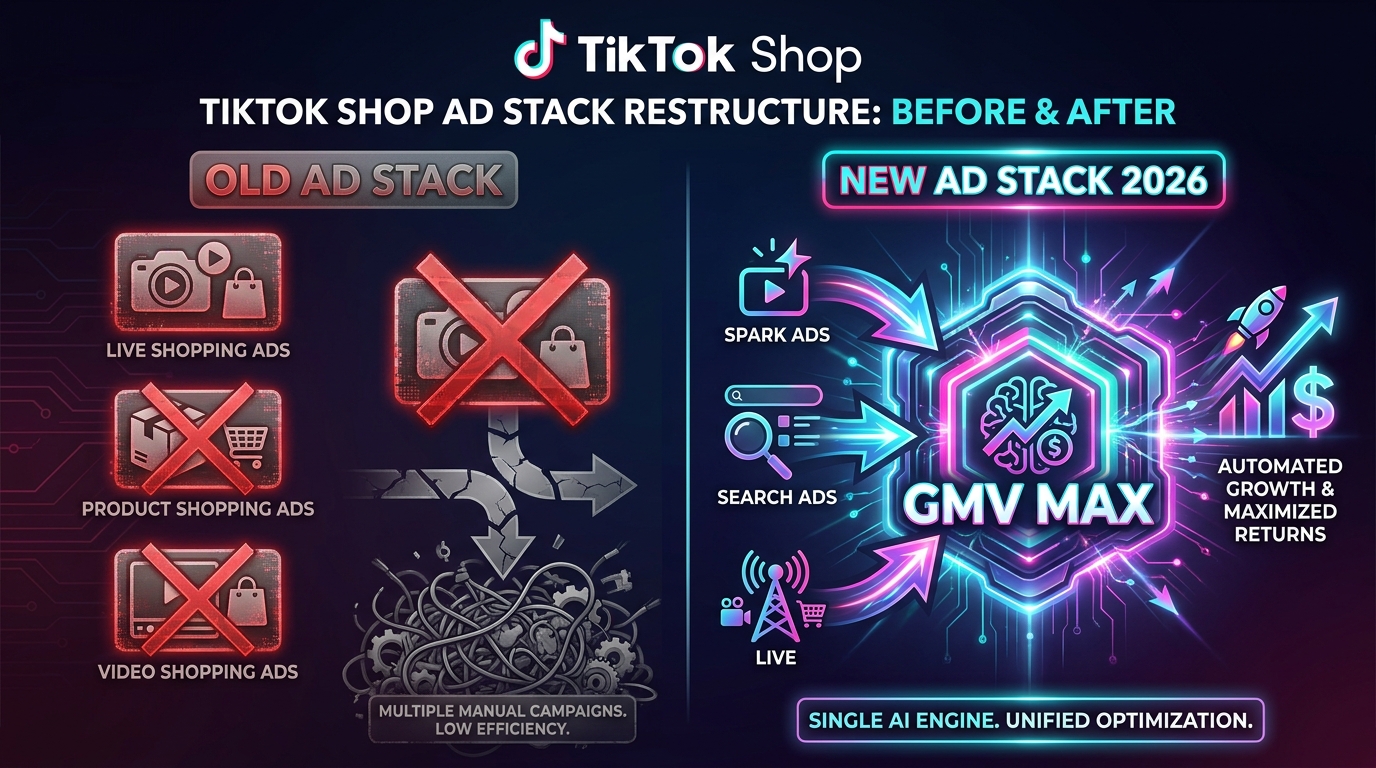

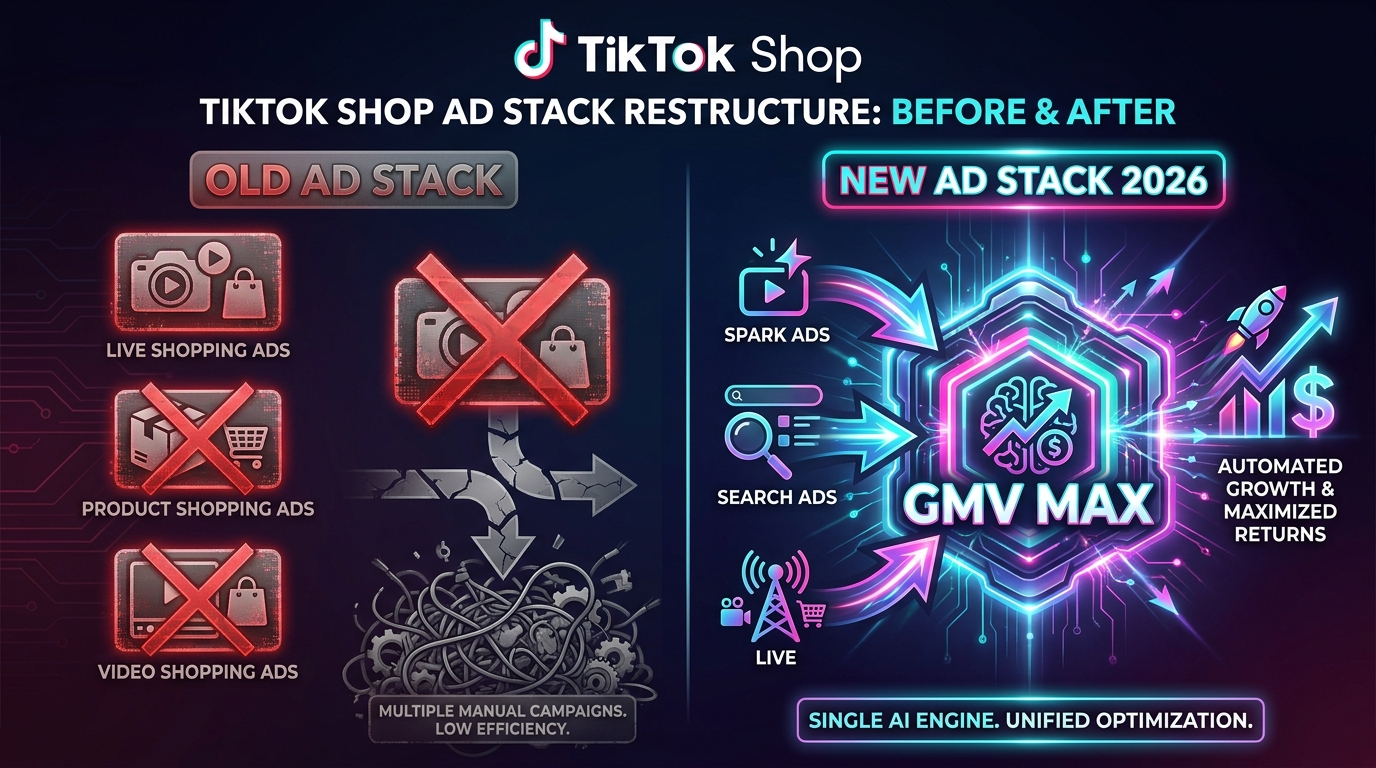
There was no single announcement. No press release. No countdown clock in Ads Manager warning sellers that the platform they’d spent months mastering was about to change underneath them. TikTok’s retirement of manual Shop Sales campaigns — LIVE Shopping Ads, Product Shopping Ads, and Video Shopping Ads as standalone Sales-objective formats — rolled out quietly through 2025, and by 2026 the migration was effectively complete. The new default for TikTok Shop advertisers is GMV Max, an AI-automated campaign type that operates on fundamentally different logic than anything sellers used before.
The problem isn’t that sellers don’t know GMV Max exists. Most do at this point. The problem is that a significant share of TikTok Shop advertisers are treating it like a renamed version of their old campaigns — plugging in the same budgets, the same creatives, the same measurement habits, and wondering why results are inconsistent. They’re driving a new car using the manual for the old one.
This post is about the structural rewiring that’s actually happened to TikTok Shop’s ad stack, what it demands from sellers in terms of campaign architecture, signal building, creative volume, and budget logic, and why the sellers who adapt fastest aren’t just performing better — they’re pulling spend share from those who haven’t caught up yet. We’ll cover what got retired and why, how GMV Max actually works as a system rather than a campaign type, the attribution distortions that are silently warping performance data, and the migration path sellers should be following right now.
What Actually Got Retired — And Why Most Sellers Are Still Confused
The retirement of manual Shop Sales campaign types is worth unpacking clearly, because the confusion around it is still causing real operational errors in 2026.
Prior to July 2025, TikTok Shop advertisers had three distinct campaign formats under the Sales objective when TikTok Shop was the destination: LIVE Shopping Ads, which drove viewers into active livestreams; Product Shopping Ads, which surfaced individual products in shopping tabs and feeds; and Video Shopping Ads (VSAs), which placed shoppable video content in the For You Page feed. Each had its own setup logic, its own bidding mechanics, and its own optimization signals. Sellers ran them in parallel, often managing three or four separate campaigns per product cluster, with dedicated budgets and creative sets per format.
TikTok retired these as independent Sales-objective formats. You can no longer create or edit these ad types under a Sales campaign when TikTok Shop is the destination. They didn’t vanish entirely — elements of Video Shopping Ads and LIVE promotion still exist as placements — but they can no longer be run as the primary vehicle for driving Shop conversions. GMV Max absorbed that function.
Why the Confusion Persists
The confusion stems from three places. First, TikTok’s documentation changed gradually and not always in sync with the actual product changes, leaving some sellers operating on outdated guidance. Second, legacy campaigns that were created before the retirement were allowed to continue running in some cases, so sellers saw active campaigns that technically no longer existed as a creatable format. Third, and most importantly, the names and some UI elements persisted in non-Sales contexts — you can still run Video Shopping Ads under Awareness or Traffic objectives, which are entirely different things serving entirely different purposes.
This means sellers sometimes believe they’re still running performance-focused Shop Sales campaigns when they’re actually running awareness placements with no direct path to purchase attribution. If your campaign structure includes VSAs under a Traffic objective and you’re measuring them as revenue drivers, you’re almost certainly misreading your data.
What the Retirement Actually Signaled
The retirement wasn’t just a product decision — it was a signal about TikTok’s platform direction. Manual campaign formats give sellers control, but they also require sellers to make decisions the algorithm is increasingly better at making: which products to promote, which creatives to surface, which audiences to reach, and how to allocate spend across formats in real time. By consolidating into GMV Max, TikTok is explicitly choosing automation over seller control as its commerce advertising model. That’s a philosophical shift as much as a technical one, and sellers who resist it are working against the grain of how the entire system now operates.
GMV Max Is Not Just a New Campaign Type — It’s a Different Philosophy
Understanding GMV Max requires a conceptual shift in how you think about what an ad campaign is doing. Traditional campaign structures put the seller in the role of decision-maker: you choose the audience, the bid, the budget allocation per format, the placement, and the creative rotation. The platform executes your decisions. GMV Max inverts this relationship. The seller sets the objective (maximize gross merchandise value) and the guardrails (a Target ROI, a daily budget), and the platform makes all the tactical decisions.
GMV Max operates across all TikTok inventory simultaneously — For You Page video placements, product search, shopping tab surfaces, LIVE discovery — and it dynamically shifts spend between them based on which conversion signals are strongest at any given moment. It’s doing auction-level optimization across formats that sellers used to manage manually, and it’s doing it faster and with more data than any human campaign manager can replicate.
The Attribution Model Behind GMV Max
One of the most important — and most misunderstood — aspects of GMV Max is its attribution model. Unlike standard TikTok ad campaigns that use click-through and view-through attribution tied to specific ad interactions, GMV Max uses a blended attribution approach that counts all paid and organic orders for the promoted products while the campaign is running. This means that if a consumer discovers your product through an organic TikTok video, searches for it, and buys it, GMV Max may attribute that sale to the campaign even though no ad directly influenced the conversion.
The practical effect is that GMV Max-reported ROAS in Seller Center is almost always higher than the true incrementally-driven return from paid advertising. Sellers who take the platform’s reported numbers at face value and allocate budgets accordingly are making decisions based on inflated data.
What the Algorithm Needs to Function Well
GMV Max is a powerful system, but it has real prerequisites. It needs sufficient conversion volume to optimize — campaigns running on products with fewer than 30–50 orders per week are data-thin, which means the algorithm is making decisions from a small and potentially unrepresentative sample. It needs a learning phase of typically seven to fourteen days before performance stabilizes, and that learning phase resets when campaigns are significantly edited. And it needs creative diversity — multiple video assets at different hook types, durations, and messaging angles — so it has material to test and rotate.
Sellers who launch GMV Max on a new product with a $50 daily budget, an aggressive ROI target, and two video creatives, and then check it after 48 hours and start adjusting settings, are actively breaking the system they’re trying to use. The algorithm cannot learn from insufficient data, cannot survive constant interference, and cannot optimize creative rotation without options to choose from.
The Blended ROAS Trap: Why Your Numbers Are Lying to You
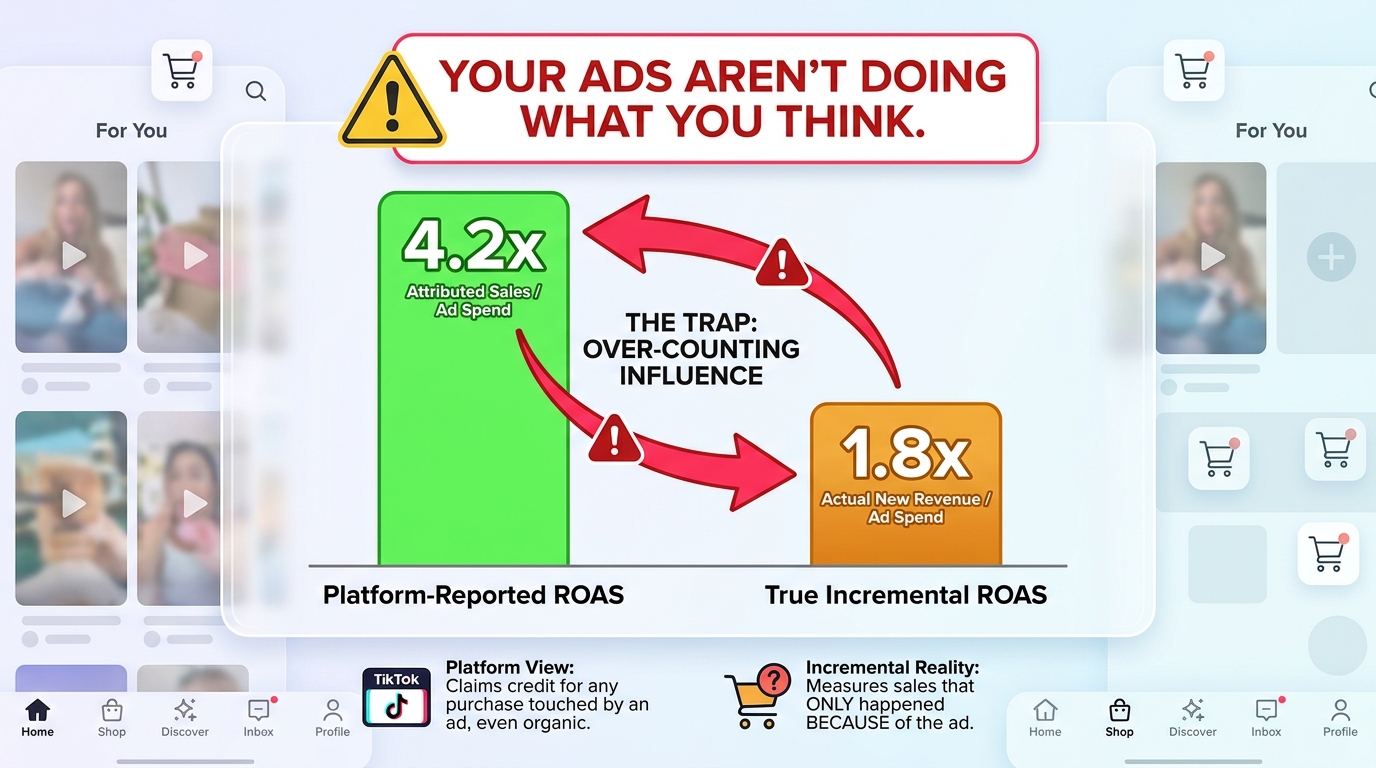
This is arguably the most operationally dangerous issue in TikTok Shop advertising right now, and it deserves direct treatment rather than a footnote. The blended ROAS problem is not a minor reporting quirk — it is a systematic distortion that causes sellers to dramatically overestimate the contribution of paid advertising to their business, which in turn leads to misallocated budgets, incorrect scaling decisions, and SKUs being kept in active promotion well past the point of incremental return.
Independent analyses comparing TikTok’s platform-reported ROAS to incrementally-measured ad contribution consistently show a wide gap. Platform-reported ROAS figures of 3x to 5x are common for active GMV Max campaigns. Properly isolated, incremental ROAS — the revenue that would not have occurred without the ad — typically sits in the 1.2x to 2.0x range for the same campaigns. The difference is not fraud or manipulation by TikTok. It’s the natural consequence of how GMV Max attributes sales.
Three Sources of ROAS Inflation
Organic overlap: GMV Max counts all orders for promoted products during the campaign window, including orders driven by organic TikTok content, direct searches, and referrals. If your brand has meaningful organic presence — which is common for sellers doing well on TikTok Shop — a significant portion of what GMV Max claims as ad-driven revenue would have occurred without the ads.
Affiliate overlap: Affiliate-driven sales are a major component of TikTok Shop revenue for many brands. Depending on how your attribution windows are configured and how GMV Max counts Shop-wide activity, affiliate conversions can be double-counted — appearing in both your affiliate program reporting and your GMV Max campaign metrics.
View-through attribution windows: Default attribution windows on TikTok include a 1-day view-through window, meaning that if a user sees your ad but doesn’t click it, and then purchases your product within 24 hours through any other means, that sale may be attributed to the ad. For high-awareness products with broad organic reach, this inflates reported figures significantly.
What to Measure Instead
Serious TikTok Shop operators are moving away from platform-reported ROAS as a primary decision-making metric and toward two more reliable signals: blended MER (Marketing Efficiency Ratio, calculated as total revenue divided by total ad spend across all channels), and incrementality testing using holdout experiments where ad spend is paused or withheld from a portion of the audience to measure the true lift from paid advertising. Neither is simple to implement, but both give a more honest picture of whether your ad stack is actually driving growth or just taking credit for it.
Building the Signal Stack GMV Max Actually Needs
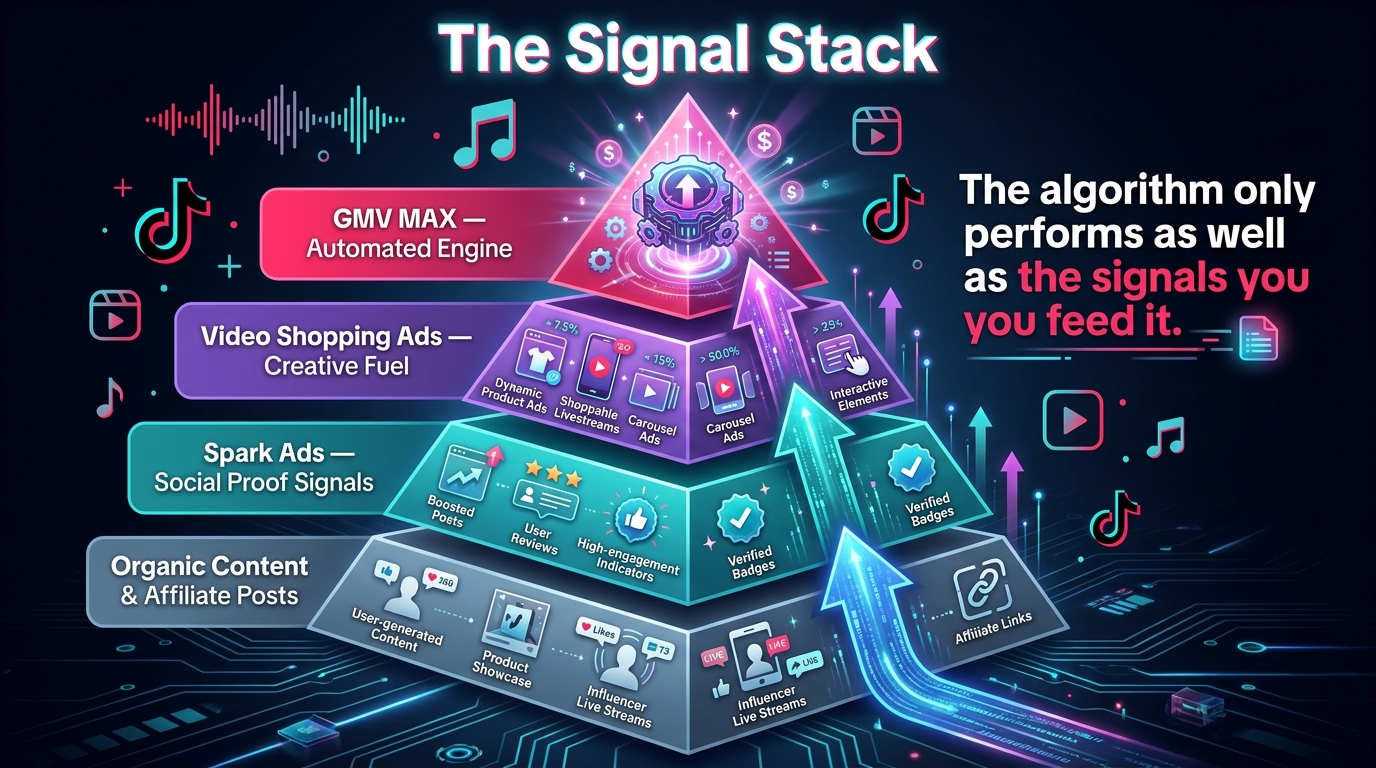
GMV Max is only as intelligent as the signals you feed it. This is the single most important operational insight for sellers transitioning to a GMV Max-first ad stack, and it’s the one most sellers are under-investing in because it requires work that happens outside Ads Manager.
TikTok’s algorithm learns which users are likely to purchase your products by observing behavioral signals: who watches product videos to completion, who taps through to the product page, who adds to cart, who purchases, and — critically — who becomes a repeat buyer. The richer and more consistent this signal stream, the better GMV Max can target, and the faster it exits its learning phase and starts optimizing efficiently.
Layer 1: Organic Content as the Foundation
Organic TikTok content from your brand account and from affiliate creators generates behavioral signals about your products at zero ad cost. Every organic video that gets significant watch time, shares, or profile clicks is teaching the algorithm something about your audience. Sellers who maintain consistent organic posting schedules — even relatively modest ones of three to five posts per week — give GMV Max a continuous stream of behavioral data to work from before a single dollar is spent on paid promotion.
This is why the advice to “build organic first, then pay to amplify” is more than a budget efficiency tip. It’s about creating the signal foundation that makes paid campaigns worth running. Launching GMV Max on a product your account has never posted organic content about is harder than launching it on a product with 30 organic posts and thousands of authentic engagement signals.
Layer 2: Spark Ads as Social Proof and Signal Amplifiers
Spark Ads — which boost existing organic content from your account or from affiliate creators — serve a dual purpose in the new ad stack. Commercially, they’re efficient at generating reach on proven content. Algorithmically, they inject high-quality engagement signals into GMV Max’s learning set. Because Spark Ads promote content that already has organic social proof (real views, comments, and shares), they generate engagement rates that native ads rarely match, and those engagement signals feed directly into GMV Max’s audience modeling.
The practical workflow many top sellers now follow: identify organic posts or affiliate videos that outperform on engagement metrics (3-second view rate above 30%, comment sentiment positive, save rate elevated), request Spark Ad access from the creator if needed, run the content as a Spark Ad for a 7–14 day window to accumulate signal, and then feed those assets into GMV Max’s creative pool. You’re essentially pre-qualifying creative material before committing full GMV Max budget to it.
Layer 3: Video Shopping Ads as Creative Fuel
Video Shopping Ads under the awareness and traffic objective categories — distinct from the retired Sales-objective VSAs — still serve a function in the new stack as creative testing and audience warming vehicles. Running VSAs with a smaller budget before a GMV Max launch allows sellers to test hook performance, watch time, and product page click-through at lower stakes, generating additional behavioral data before the higher-budget GMV Max campaign needs to learn.
Search Ads: The High-Intent Layer Most Sellers Are Leaving on the Table
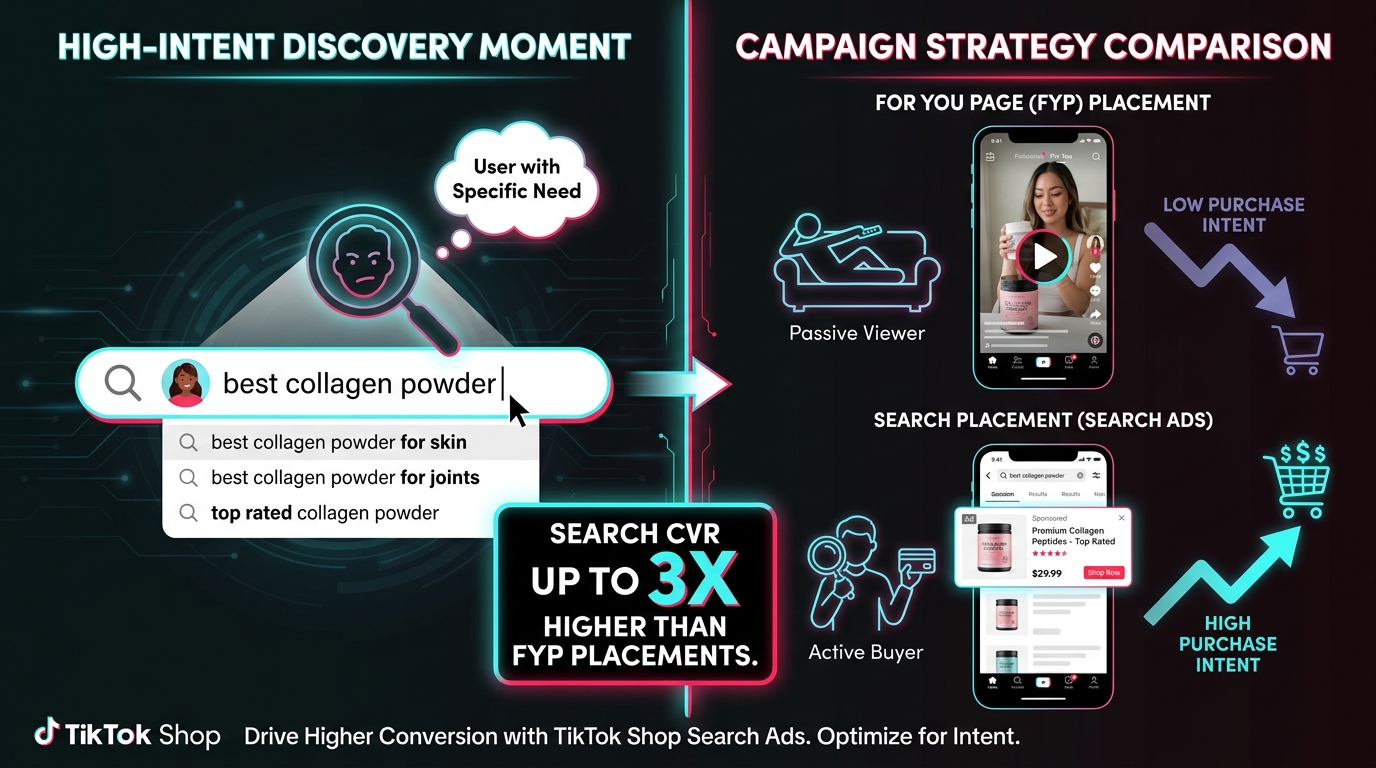
TikTok’s search functionality has matured considerably over the past 18 months, and in 2026 it represents one of the clearest under-exploited advertising surfaces in TikTok Shop. The user behavior in TikTok search is fundamentally different from For You Page discovery: a user who types “best collagen powder” or “waterproof running shoes women” into TikTok’s search bar is in an active buying consideration mode. They’re not passively scrolling past your product — they’re looking for it or something like it. That intent gap translates directly into conversion rates.
Search placement conversion rates on TikTok Shop consistently run materially higher than For You Page placements. While FYP placements typically convert in the 1%–3% range, search placements for commercial queries regularly hit 5%–9% CVR for well-optimized product listings. The audience pool is smaller, but the purchase signal is dramatically stronger. For high-consideration products — anything over $40 where a consumer would plausibly research before buying — search placement should be a non-negotiable layer in the ad stack.
How to Structure TikTok Shop Search Campaigns
TikTok’s Search Ads Campaign is a dedicated campaign type designed specifically for capturing in-app search traffic and routing it to Shop product pages. The setup differs from GMV Max in important ways: you’re providing keyword inputs rather than relying entirely on algorithmic audience discovery, and the creative needs to reflect search intent rather than being designed primarily for interruption-style FYP capture.
The structural guidelines that consistently produce strong results in 2026 include targeting 20 or more tightly themed keywords per ad group (not broad match-all approaches), organizing ad groups by search intent cluster (problem-aware vs. product-aware vs. brand-specific), and allocating budget at a ratio of roughly 20:1 between daily budget and maximum bid. Bidding too aggressively on individual keywords limits the algorithm’s ability to explore the full search query space around your themes.
Creative Strategy for Search Placements
The creative requirements for Search Ads differ from FYP-style content in a meaningful way. FYP creatives need to stop a scroll — the hook is everything, and the first two seconds are make or break. Search placement creatives can open more directly because the viewer has already self-selected based on the query; they’re predisposed to engage. The strongest search ad creatives in 2026 lead with the product solution, include social proof within the first five seconds, and push to a product page with a clear price and review count visible. Curiosity-gap hooks that work brilliantly on FYP often underperform in search placements because searchers want answers, not questions.
Layering Search and GMV Max
The best-performing TikTok Shop ad stacks treat Search Ads not as an alternative to GMV Max but as a complementary layer running concurrently. GMV Max handles broad audience discovery and algorithmic optimization across formats. Search Ads capture the high-intent users who are already in a buying mindset. Together they cover both ends of the purchase funnel. Sellers running both formats consistently report lower blended CPAs than those running either in isolation — the combination produces better customer quality mix than GMV Max alone, which tends to skew toward impulse purchases at lower AOV.
LIVE Shopping Ads: Where They Fit and Where They Don’t
Live commerce remains one of TikTok Shop’s most distinctive capabilities, and LIVE Shopping Ads — despite the confusion around the retired Sales-objective LIVE format — still exist as a real, functional ad type within the GMV Max framework and as standalone campaign options under different objectives. The question of whether they belong in your stack isn’t yes or no; it’s conditional, and getting the conditions wrong is expensive.
The fundamental rule that distinguishes sellers who profit from LIVE Shopping Ads versus those who waste budget on them: LIVE ads amplify a proven live operation. They do not build one. If your livestream infrastructure — hosting talent, offer structure, product staging, session consistency — is not already generating satisfactory organic viewership and converting viewers to buyers, adding paid promotion to it will accelerate losses rather than build a live commerce business.
The Right Sequence for LIVE Ads
The operational sequence that consistently produces positive ROAS on LIVE Shopping Ads starts with establishing a repeatable live schedule — at least three to four sessions per week — and proving organic conversion. This means your host can sell on camera, your offers are compelling at scale, and your operational logistics (order fulfillment, inventory management during live) are reliable. Once organic live sessions are converting at a GMV level that justifies the investment, adding LIVE Shopping Ads becomes a straightforward amplification play: you’re buying more eyeballs for a room that already knows how to convert them.
Sellers who’ve tried to shortcut this sequence report a consistent pattern: LIVE ad spend drives viewers into sessions that aren’t ready to convert them, CAC skyrockets, and ROAS on the live format is negative. The proper sequence isn’t conventional wisdom — it’s a hard lesson about the difference between audience acquisition tools and audience conversion tools.
LIVE Ads Inside GMV Max
When running LIVE events, GMV Max can be configured to include the LIVE as a conversion destination alongside product pages. In this configuration, GMV Max automatically allocates budget between LIVE-directed traffic and product page-directed traffic based on real-time conversion signals. This tends to work better than manually budgeting each separately because the algorithm can identify micro-windows during a LIVE session — flash offers, restocks, peak host engagement moments — where LIVE conversion rates spike and automatically push more spend into the LIVE placement during those windows.
The practical implication: if you’re running GMV Max and hosting live sessions simultaneously, ensure your TikTok Shop LIVE is properly connected to your GMV Max campaign and the algorithm knows the LIVE is active. Disconnected live sessions run alongside GMV Max campaigns rather than inside them, which forfeits the optimization benefit entirely.
The Creative Testing System That Actually Feeds the Algorithm
Creative is the highest-leverage variable in the GMV Max system. Budget discipline, campaign structure, and ROI targets all matter — but no amount of algorithmic optimization rescues weak creative. In the new ad stack architecture, creative is not just about capturing attention; it’s about generating the behavioral signals GMV Max needs to find and target buyers at scale. The creative that drives completion rates, product page clicks, and add-to-cart events is teaching the algorithm what kind of person buys your product.
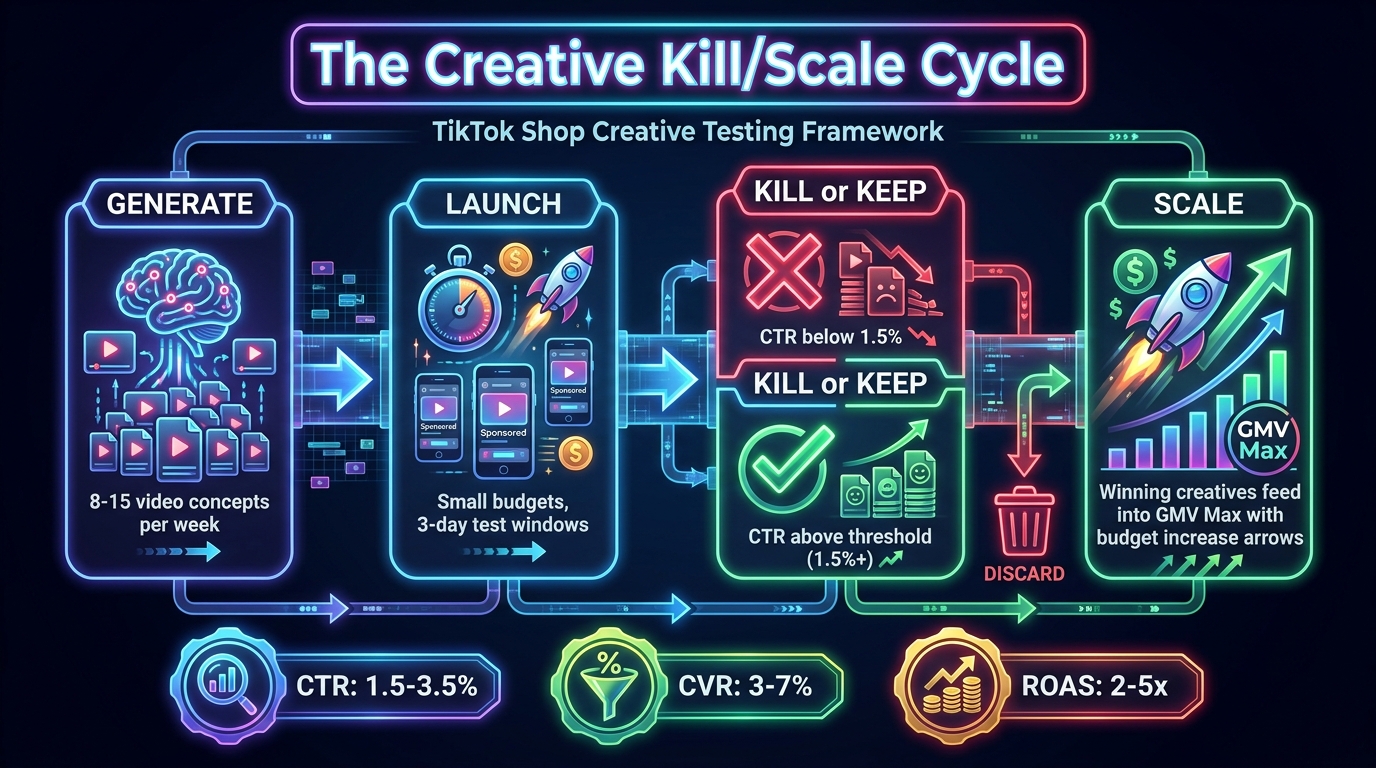
The pace of creative production that top TikTok Shop operators maintain in 2026 is considerably higher than most sellers expect. Eight to fifteen new creative concepts per week is the benchmark among serious operators, not as a one-time testing sprint but as a continuous operating rhythm. This sounds like an enormous content burden, and it is — which is why the industry has moved decisively toward creator-driven and AI-assisted production as the two primary supply chains for creative volume.
The Kill-and-Scale Framework
High creative volume only produces value if it’s paired with disciplined, fast evaluation cycles. The framework used by top TikTok Shop operators follows a clear four-stage process:
Generate: Produce 8–15 new creative concepts per week, spanning different hook approaches (problem-first, result-first, social proof-first, curiosity-based), different video durations (15–20 seconds versus 30–45 seconds), and different presenter types (brand creator, micro-affiliate, UGC-style self-shot). The goal is surface area — enough variation that the algorithm has genuinely different options to evaluate.
Launch: Deploy new creatives in small-budget test scenarios — $30–$75 per day per creative — with a defined evaluation window of three to five days. Keep the campaign structure consistent across test creatives so you’re isolating creative as the variable.
Kill or Keep: At the end of the evaluation window, apply objective thresholds. Industry benchmarks for 2026 suggest killing creatives below 1.5% CTR on the video-to-product-page click, below 30% three-second view rate, or below category-appropriate CVR. Don’t extend the window hoping a weak creative improves — it rarely does, and extending costs you spend and algorithm signal quality.
Scale: Winning creatives — those that clear the kill thresholds and show positive ROAS — get added to the GMV Max creative pool at full budget. The algorithm takes over from there, dynamically surfacing the winning creative to audiences most likely to convert.
AI Creative Tools and Where They Fit
TikTok’s Symphony suite — their AI-assisted creative production toolset — has matured substantially in 2026 and is now genuinely useful for certain creative production tasks: generating script variations on proven hooks, producing avatar-based videos for initial concept testing, and creating localized or segmented versions of winning human-led creatives. Symphony is not a replacement for authentic creator-driven content, and sellers who’ve tried to run purely AI-generated creative libraries through GMV Max report lower performance than those using human creators. But as a velocity tool — producing 30 variants from three proven concepts, testing them all, and identifying the top five for human-directed production — Symphony meaningfully expands what a small team can test per week without proportionally increasing production costs.
The Affiliate Creator Pipeline
Affiliate creators are the most undervalued creative asset in the TikTok Shop ad stack, particularly for sellers who don’t have in-house content capabilities. An affiliate creator who produces an organic video that performs well is generating free creative testing data. If that video converts viewers to buyers, it has proven its commercial value organically before a dollar of ad spend is committed. Running that video as a Spark Ad or feeding it into GMV Max as a boosted creative starts with a verified winner rather than an untested hypothesis.
Building a structured affiliate creator program — with clear brief templates, performance-based commission tiers, and a systematic process for identifying and amplifying top performers — is not optional for brands competing seriously on TikTok Shop in 2026. It’s the most cost-efficient creative supply chain available.
Budget Architecture for a GMV Max-First Ad Stack
Budget architecture in the new TikTok Shop ad stack operates on different principles than most sellers are applying. The dominant budget mistakes — setting ROI targets too aggressively, underfunding the learning phase, making abrupt budget changes — all share a common root cause: sellers are applying manual campaign logic to an automated system that operates on different timing and sensitivity.
Learning Phase Requirements
Every GMV Max campaign needs a learning phase in which the algorithm collects enough conversion data to model which users are likely to purchase. The minimum threshold for reliable learning is typically 30–50 conversion events within a seven-day window. This means your daily budget needs to be set high enough to generate that conversion volume, not just to generate impressions or clicks. If your product converts at 3% of product page visits and your AOV is $45, you need enough daily spend to drive 450–700 product page visits per day to clear the learning threshold consistently. Many sellers launch GMV Max at budgets too small to achieve this, then interpret the algorithm’s uncertainty as underperformance and start making changes that reset the learning cycle.
The 20% Rule for Budget Changes
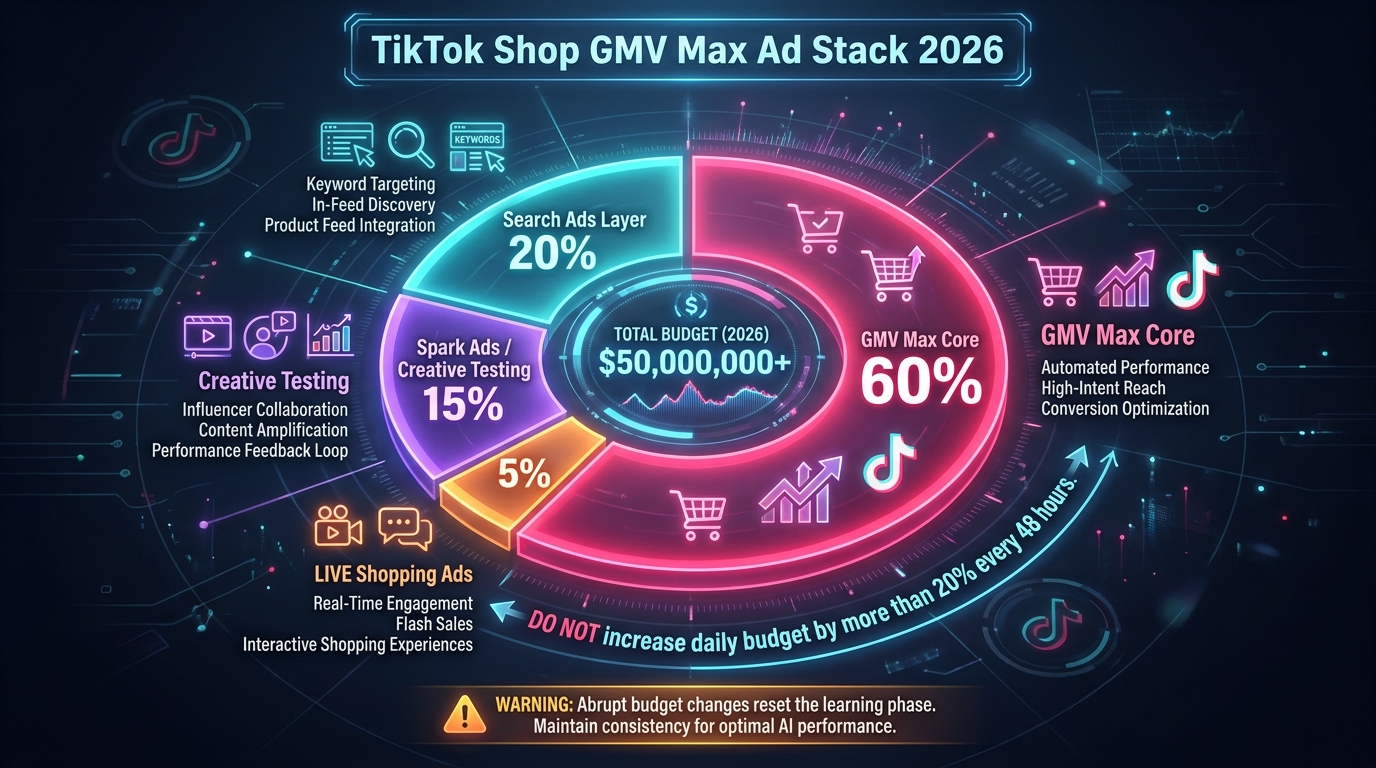
One of the most consistently cited operational rules for GMV Max management in 2026 is the 20% rule: do not increase or decrease daily budget by more than 20% within a 48-hour window. Larger changes than this can destabilize the campaign’s optimization state — the algorithm’s model of who to target and when to bid was built at the previous spend level, and too large a change forces it to relearn in a new budget environment. Gradual scaling, uncomfortable as it is for sellers used to more direct control, produces more stable performance curves than aggressive budget increases when results look positive.
Target ROI Calibration
Target ROI is the primary guardrail sellers set inside GMV Max, and the most common mistake is setting it too high from the outset. Starting with an aggressive ROI target — say, 5x ROAS when your actual economics are producing 3x — tells the algorithm to only bid on conversion opportunities that meet a threshold it rarely encounters, which throttles delivery severely. The recommended approach is to launch with a Target ROI set at or slightly below your break-even ROAS, let the campaign exit the learning phase and reach stable delivery, and then incrementally increase the Target ROI in 0.2x–0.5x steps every 7–10 days as the algorithm demonstrates it can hit higher thresholds without sacrificing volume.
Budget Allocation Across the Full Stack
For sellers running a full GMV Max-first ad stack with search, Spark, and occasional LIVE components, a reasonable starting budget distribution for a mid-size seller spending $3,000–$10,000 per month on TikTok Shop ads is approximately: 55%–65% to GMV Max as the core conversion engine, 15%–20% to Search Ads Campaigns for high-intent capture, 15%–20% to Spark Ads and creative testing, and 5%–10% to LIVE-specific promotion when live sessions are scheduled. These ratios shift as you learn more about which surfaces convert best for your specific product category and audience.
Attribution Reality Check: How to Measure What’s Actually Working
Given everything covered above — the blended attribution of GMV Max, the organic overlap, the affiliate double-counting — the logical question is: how do you actually measure whether your TikTok Shop ad stack is working? This is where most sellers are furthest behind, and where the gap between good and excellent operators is widest.
North Star Metrics vs. Platform Vanity Metrics
The metrics TikTok Ads Manager surfaces most prominently — Campaign ROAS, GMV, LIVE Revenue, and GMV Max’s attributed orders — are useful for directional monitoring but are not reliable bases for budget allocation decisions. They’re too susceptible to the attribution distortions described earlier. Sophisticated TikTok Shop operators use platform metrics as health indicators (is something obviously broken?) while making actual budget decisions based on business-level metrics.
The primary business-level metric is Marketing Efficiency Ratio (MER): total revenue from TikTok Shop divided by total TikTok ad spend. Unlike platform-reported ROAS, MER doesn’t require you to trust TikTok’s attribution model — it’s a direct ratio of business output to advertising investment. MER doesn’t tell you which specific campaign type is working best, but it tells you clearly whether your total TikTok ad investment is generating a positive return at the business level.
Incrementality Testing on TikTok Shop
For sellers with sufficient scale, holdout-based incrementality testing is the most rigorous way to measure true ad contribution. The simplest version: select a geographic market or audience segment that represents roughly 10%–15% of your TikTok Shop traffic, pause all paid promotion to that segment for two to three weeks, and compare purchase rates between the holdout and the fully-served audience. The difference in purchase rate represents your true incremental lift from paid advertising.
TikTok does not natively offer robust holdout testing tools inside Ads Manager as of 2026, which means implementing incrementality tests requires either using TikTok’s Research and Measurement API or working with third-party measurement providers. The operational lift is real, but for sellers spending $10,000 or more per month on TikTok Shop ads, the clarity it provides on true returns is worth the implementation effort.
Cross-Channel Attribution Hygiene
TikTok Shop attribution becomes even more complex when it exists alongside other marketing channels — Meta ads, Google Shopping, email, influencer partnerships — all of which may be driving traffic to the same TikTok Shop storefront simultaneously. Without a clear last-touch versus multi-touch attribution model applied consistently across all channels, sellers end up in a situation where every channel claims credit for the same purchases and the total attributed ROAS across channels adds up to more than 100% of actual revenue. Clean cross-channel attribution requires third-party measurement tools (Northbeam, Triple Whale, and Rockerbox are the most commonly used in e-commerce contexts as of 2026) and a clear house rule about how attribution is assigned when multiple channels touch a single conversion.
The 90-Day Migration Roadmap for Sellers Rebuilding Their Stack
For sellers who are currently running a fragmented combination of legacy campaign structures, misunderstood GMV Max setups, and unmeasured ad stacks, here is a sequential 90-day framework for rebuilding on a sound foundation. The sequencing matters: attempting all changes simultaneously creates a signal disruption that makes it impossible to know what’s working.
Days 1–30: Audit and Foundation
Before touching any live campaigns, conduct a full audit of your current ad account structure. Identify any campaigns running under outdated formats that should have been migrated to GMV Max. Document your current performance metrics — platform-reported ROAS, GMV, spend by campaign type — as your pre-migration baseline. Calculate your current MER by dividing your total TikTok Shop revenue by total TikTok ad spend.
During this period, establish your signal foundation: ensure your brand account is posting organic content consistently, identify your top five to ten organic posts by completion rate and engagement, and request Spark Ad access for any high-performing affiliate creator posts in your niche. These are the inputs GMV Max will use to learn.
Set up a Search Ads Campaign as a parallel test — not a replacement for existing campaigns — targeting 30–50 keywords organized into three to five intent-based ad groups. This runs alongside your existing stack and begins accumulating data without disrupting current performance.
Days 31–60: GMV Max Consolidation
With your signal foundation in place and your Search Ads Campaign gathering data, migrate your primary product campaigns to GMV Max if you haven’t already. Start with your top-selling products — those with the strongest conversion history and most organic engagement — because these give GMV Max the richest data environment for its learning phase. Set initial Target ROI at or slightly below break-even ROAS. Fund the learning phase appropriately: minimum daily budgets that can generate 30+ conversions per week are the target.
Implement the creative kill-and-scale framework: establish your weekly production process, define your kill thresholds, and commit to the evaluation cadence. Resist the urge to make campaign adjustments during the first 14 days after launch.
Days 61–90: Optimization and Measurement
At this stage, your GMV Max campaigns have exited their initial learning phase and have stable delivery. Your Search Ads Campaign has enough data to evaluate keyword performance. Begin incrementally adjusting GMV Max Target ROI upward — 0.2x–0.5x per 7–10 day window — to find the threshold at which delivery is maintained at an improving return. Pause or restructure Search Ad groups that aren’t generating positive ROAS at the keyword level.
Implement your MER tracking discipline: pull weekly MER figures and compare them to your pre-migration baseline. This is your primary evidence that the restructured stack is working. Anecdotally, sellers who complete this migration with proper signal building and GMV Max setup typically see 20%–40% improvement in MER within 90 days compared to their pre-migration fragmented stack — though results vary significantly by category, creative quality, and organic presence.
What Not to Do During the Migration
Equally important as the steps to take are the moves that derail migrations. Don’t pause GMV Max campaigns within the first 14 days to check on them — pausing resets the learning cycle. Don’t run duplicate campaigns for the same products across multiple campaign types simultaneously, as this creates internal auction competition that drives up your own CPMs. Don’t use TikTok’s platform-reported ROAS as the primary metric for migration success evaluation — use MER. And don’t add new products to an active, well-performing GMV Max campaign; new products should be launched in separate campaigns so their data doesn’t contaminate the optimization signals of proven SKUs.
What the Rewired Stack Demands From Sellers in 2026
The core theme running through every element of TikTok Shop’s ad stack transformation is a shift in where seller expertise needs to be applied. The old stack rewarded campaign management skills: knowing how to structure bidding, allocate budgets manually across formats, and squeeze efficiency from manual levers. The new stack rewards something different — the ability to build the conditions in which an automated system can perform at its potential.
That means organic content strategy matters to your paid performance in a way it never did with traditional PPC. It means creative production volume and quality are now advertising infrastructure, not just marketing support. It means measurement discipline — understanding what numbers actually reflect reality versus what’s algorithmically flattering — is a competitive differentiator rather than an optional analytical exercise. And it means understanding GMV Max’s behavioral requirements deeply enough to set it up correctly and leave it alone long enough to learn.
The Sellers Who Will Win
The sellers positioned to outperform in TikTok Shop advertising over the next 12 months share several characteristics. They have consistent organic content engines — whether from an in-house team or a managed affiliate network — feeding behavioral signals to their paid campaigns continuously. They’re running GMV Max with properly funded learning phases and conservative initial ROI targets, scaling gradually rather than in jumps. They have Search Ads capturing the high-intent tail of their category at 15%–20% of total ad spend. Their creatives are produced at volume, killed quickly when underperforming, and scaled systematically when they win. And they’re measuring performance at the business level using MER rather than accepting platform-reported ROAS at face value.
None of these are technically complicated. They don’t require proprietary tools or advanced engineering. They require a clear-eyed understanding of how the new system actually works, the discipline to operate it correctly, and the patience to let automated optimization do its job rather than constantly intervening in ways that reset its progress.
The Competitive Opportunity in the Chaos
Every major platform change creates a period of competitive disparity between sellers who adapt quickly and those who don’t. TikTok Shop’s ad stack restructuring is no different. The sellers still running fragmented legacy structures, misreading blended ROAS as real performance data, and treating GMV Max like a renamed version of old campaigns are leaving efficiency on the table. That efficiency doesn’t disappear — it gets captured by competitors who understand the system they’re actually operating in.
The sellers who treat the ad stack shake-up as a forcing function to build better foundations — stronger organic content, higher creative volume, cleaner measurement, and properly configured automation — will find that the new stack, once set up correctly, is more powerful than anything TikTok has offered before. The auction dynamics are more sophisticated, the optimization signals are richer, and the platform’s ability to find buyers across all surfaces simultaneously is genuinely impressive when it has the inputs it needs. The rewiring has happened. The question is whether you’re wiring yourself in to the new system, or still trying to plug into an outlet that no longer exists.