

Every large enterprise has a dashboard problem. Not a shortage of dashboards — quite the opposite. The average Fortune 500 company runs dozens of BI tools, hundreds of reports, and thousands of scheduled queries, all producing data that by the time it reaches an executive’s inbox is already hours or days old. Someone has reconciled three conflicting revenue figures. Someone else has added a footnote explaining why the churn number looks wrong this week. A VP has manually pulled the real answer from a spreadsheet they trust more than the system.
This is the environment into which the phrase “AI Ops Room” has arrived. And like most enterprise technology concepts, it is being misapplied almost as fast as it is being adopted.
The most common version of an AI Ops Room in 2026 is a better-looking dashboard with a chatbot bolted on the side. Ask it a question, get a chart. The underlying data is still stale. The metric definitions still disagree across departments. The executives still don’t trust it. And the team that built it is already planning the next iteration, wondering why adoption is low.
This post is about what an AI Ops Room actually needs to be — the architecture, the governance model, the agentic layer, and the hard decisions that make the difference between a system executives actually use and one that gets quietly abandoned after six months. The global AI automation market sits at $169.46 billion in 2026, growing at a 31.4% CAGR. The organizations getting real value from that investment share a small number of architectural choices that most teams are making in the wrong order.
Here’s what separates the ones that work.
What an AI Ops Room Actually Is (And What Most People Build Instead)
The term “AI Ops Room” emerged from two converging traditions. The first is the military and emergency management concept of the “operations room” — a physical or virtual space where decision-makers receive real-time situational awareness and coordinate responses. The second is AIOps (Artificial Intelligence for IT Operations), a category of tools that use machine learning to automate incident detection, correlation, and remediation in IT infrastructure.
What enterprise leaders are now building — or trying to build — is a synthesis: a command-center-style environment where AI continuously monitors business health across multiple operational domains, surfaces anomalies and risks before they escalate, and increasingly takes automated action to resolve them. The executive dashboard is the front-end. But a true AI Ops Room is the entire pipeline from raw data to executive decision to closed-loop action.
The Three Maturity Levels
It helps to distinguish three distinct maturity levels that organizations often conflate:
- Level 1 — Automated Reporting: Scheduled data pulls, refreshed dashboards, and PDF reports delivered to inboxes. Still manual in terms of interpretation and action. Most organizations are here.
- Level 2 — AI-Assisted Decision Support: AI surfaces anomalies, generates natural-language summaries of what’s changing and why, and recommends actions. Humans make all final calls. A growing minority of organizations are reaching this level.
- Level 3 — Closed-Loop Operations: AI agents not only detect and recommend but execute predefined responses autonomously — rerouting workflows, triggering procurement actions, adjusting resource allocation — with human oversight reserved for high-risk or irreversible decisions. Fewer than 15% of AIOps adopters are genuinely operating here.
The mistake most teams make is designing for Level 3 visually (the impressive command-center interface) while building on Level 1 infrastructure (disconnected, siloed, inconsistently defined data). The result is a system that looks authoritative but cannot be trusted.
What an AI Ops Room Is Not
It is not a BI platform refresh. It is not a new data warehouse layer. It is not an AI chatbot connected to your existing reports. And critically, it is not primarily a technology problem — it is a decision-architecture problem. The technology follows the decisions about which metrics matter, who owns them, what actions are permissible at which thresholds, and who is accountable for the outcomes that automated systems produce.
The Five-Layer Architecture That Makes It Work
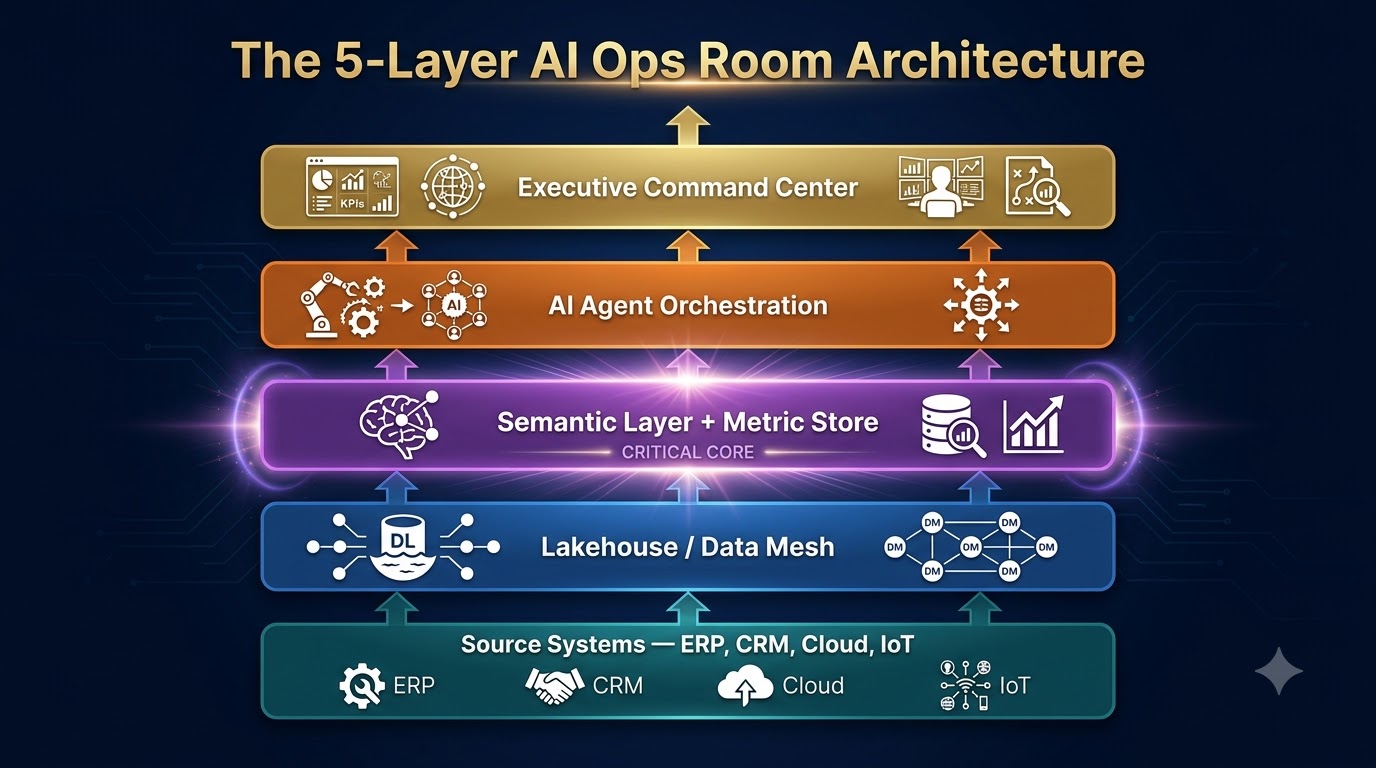
Organizations that have successfully deployed AI Ops Rooms share a common architectural pattern, even when they’ve used different vendors and tools to implement it. It has five distinct layers, and the order in which you build them matters as much as what you build.
Layer 1: Source Systems and Real-Time Ingestion
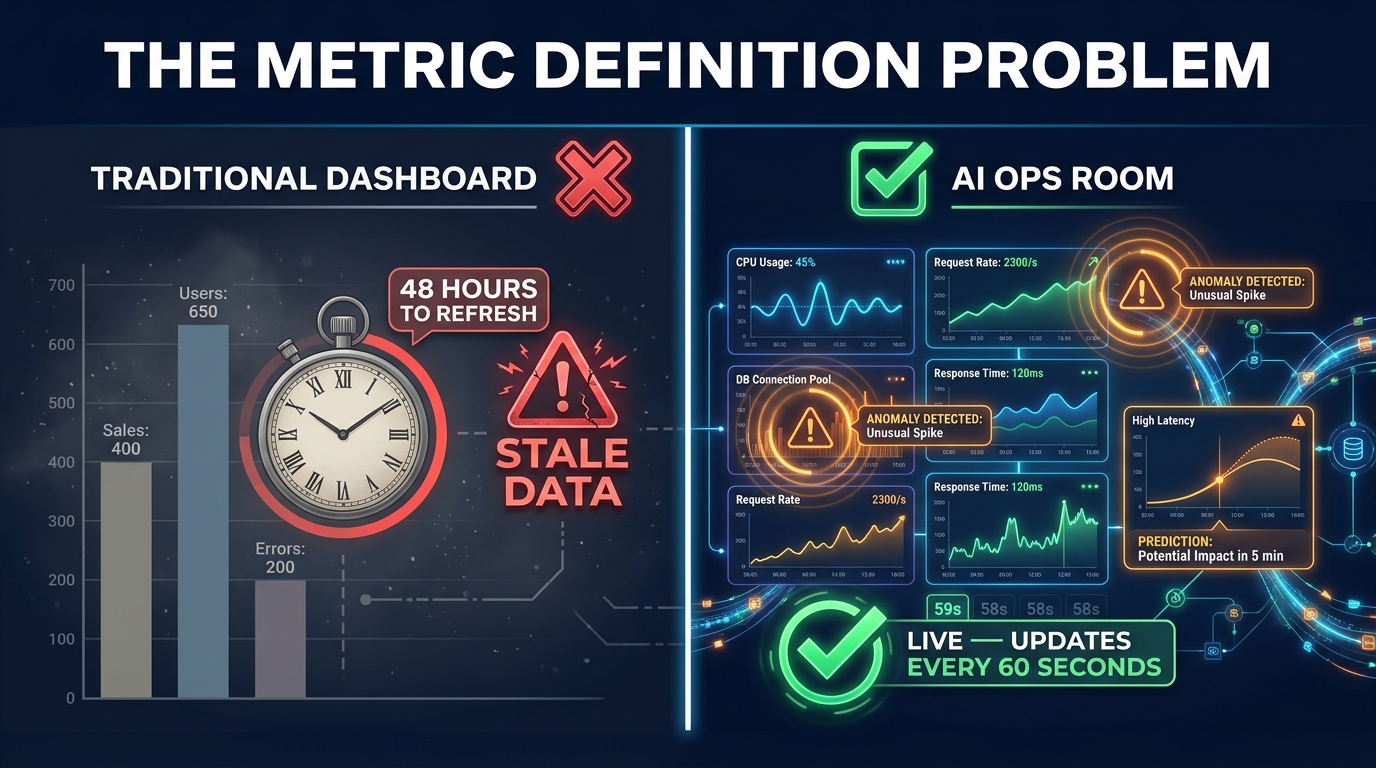
The foundation of any AI Ops Room is the ability to ingest data from the full range of operational systems — ERP, CRM, HRIS, supply chain platforms, cloud infrastructure telemetry, IoT sensors, financial systems, and third-party market feeds — in real time or near-real time. Batch ingestion, where data arrives once a day or once a week, is the single biggest killer of executive trust in dashboards. If a CEO asks “what’s our cash position right now?” and the answer was true 18 hours ago, the system fails its most basic purpose.
Modern ingestion architectures use event streaming platforms (Apache Kafka, Confluent, Amazon Kinesis) alongside change data capture on transactional databases to create continuous data flows rather than scheduled extracts. The target is a latency of seconds to minutes for operational data, not hours.
Layer 2: The Lakehouse and Data Mesh
Raw ingested data lands in a governed lakehouse — a unified storage layer that combines the flexibility of a data lake with the structure and ACID compliance of a data warehouse. The architectural pattern gaining dominance in 2026 is the data mesh: domain-oriented data products owned and maintained by business teams rather than a central IT function.
In a data mesh model, the finance team owns and certifies financial data products. The supply chain team owns logistics data. Each domain publishes well-defined data contracts — schemas, SLAs, quality guarantees — that downstream consumers, including the AI Ops Room, can rely on. This shifts data quality accountability from a central team that is perpetually overwhelmed to the domain experts who actually understand the data.
Layer 3: The Semantic Layer and Metric Store
This is the layer most organizations skip, and skipping it is fatal. The semantic layer sits between raw data and consumption. It translates physical table schemas into business concepts — not “tbl_ord_rev_q2” but “Quarterly Revenue,” defined precisely, with a documented calculation method, agreed upon by finance and business ops.
A metric store goes further: it maintains a single, governed catalog of all metrics the organization cares about, their definitions, owners, lineage, and approved calculation logic. When the AI Ops Room surfaces a revenue number, it comes from the metric store. When an AI agent compares this week’s gross margin to last quarter’s, it uses the same metric definition for both. Inconsistency at this layer is the root cause of the most damaging dashboard failure mode: “beautiful lies” — charts that look authoritative but are measuring different things depending on which system they came from.
Layer 4: AI Agent Orchestration
This is where the intelligence lives. On top of the governed data foundation, an orchestration layer of AI agents continuously monitors the metric store for anomalies, threshold breaches, and pattern changes. Different agents specialize in different domains — a financial health agent, a supply chain risk agent, an infrastructure reliability agent, a customer satisfaction agent — and a meta-agent coordinates their outputs into a unified operational picture.
The orchestration layer handles three types of work: detection (finding what changed and why), synthesis (correlating events across domains to identify root causes), and action (triggering remediation workflows, generating notifications, escalating to humans, or executing approved automated responses). The sophistication of this layer is what distinguishes a Level 2 from a Level 3 AI Ops Room.
Layer 5: The Executive Command Center
Only now — after four layers of data infrastructure are solid — does the executive-facing interface deserve serious design attention. The command center has two modes: ambient and active. In ambient mode, it presents the current state of the business across strategic KPIs with enough context to detect problems at a glance. In active mode, when an agent has detected something significant, it presents a structured briefing: what happened, what the AI determined as likely cause, what options exist, and — where automation is approved — what action has already been taken.
Natural language querying is increasingly standard at this layer, allowing executives to ask conversational questions (“why did our European gross margin drop 2.3 points this week?”) and receive synthesized, source-cited answers rather than raw charts.
The Data Problem Nobody Talks About: Metric Definitions and Semantic Consistency
Ask any team that has deployed an AI Ops Room what surprised them most, and the answer is almost always the metric definition problem. Not the technology. Not the AI models. The fact that the organization does not agree on what its most important numbers mean.
Consider “monthly active users.” Does that mean users who logged in? Users who performed at least one meaningful action? Users active within the last 28 days or the last calendar month? Does it include internal users? Free-tier users? Users on legacy plans? Every choice changes the number, and different teams have been making different choices in their local reporting for years. When you connect those teams’ data sources into a unified AI Ops Room without first resolving these definitions, you get a system that produces different numbers depending on how you ask the question — which destroys trust faster than any technical failure.
The Metric Definition Audit
The single most important pre-build activity for an AI Ops Room is a metric definition audit: an inventory of the 15-25 metrics that executives genuinely make decisions from, with explicit documentation of how each is currently calculated across all source systems, where those calculations differ, and what the agreed canonical definition will be going forward.
This is not a technical exercise. It requires business leaders from finance, operations, sales, and product to sit in the same room, often for the first time, and reach genuine consensus. The disagreements are frequently heated, because metric definitions encode business priorities and organizational politics. Finance calculates revenue on recognition; sales calculates it on booking. Both are “right” in their context. The AI Ops Room needs to know which one to show the CEO and in which context.
Data Contracts and Quality SLAs
Once definitions are agreed, they need to be enforced through data contracts — formal agreements between data producers (the source system teams) and the AI Ops Room. These contracts specify the schema, refresh frequency, acceptable null rates, validation rules, and consequences of contract breach. When a source system fails to deliver conforming data, the AI Ops Room should flag the gap rather than silently display stale or invalid numbers.
Organizations that implement data contracts before building their executive layer report dramatically higher executive trust in the resulting dashboards. Those that skip contracts find that executives revert to spreadsheets within weeks, having lost confidence in the automated system after too many inconsistencies.
Building the Agentic Layer: From Passive Monitoring to Closed-Loop Action
The word “agentic” has become overloaded in enterprise technology circles, but in the context of AI Ops Rooms it has a specific and useful meaning: the system doesn’t just observe and report — it acts. The transition from passive monitoring to closed-loop action is what separates a genuinely transformative AI Ops Room from an expensive dashboard refresh.
What AI Agents Actually Do in an Ops Room
In a mature AI Ops Room, agents are continuously running a set of operations that would otherwise require analyst time or simply would not happen at all:
- Anomaly detection: Continuously comparing current metrics to historical baselines, seasonal patterns, and peer benchmarks. Not just “the number changed” but “this change is statistically unusual given the context.”
- Root cause analysis: When an anomaly is detected, tracing back through related metrics and event logs to identify probable causes. A drop in conversion rate might correlate with a deployment 4 hours ago, a competitor pricing change, or a payment gateway latency spike — the agent finds the connection.
- Cross-domain correlation: Connecting signals across business domains that human analysts rarely have visibility across simultaneously. Supply chain delays correlating with customer satisfaction scores correlating with renewal risk — the agent holds the full picture.
- Automated remediation: For pre-approved, reversible actions, executing directly: restarting failed services, rerouting traffic, flagging orders for review, triggering purchase orders for inventory below threshold.
- Executive briefing generation: Synthesizing the above into a structured, board-readable narrative that explains the current state, highlights what needs attention, and documents what automated actions have already been taken.
The Architecture of an Agentic Ops Layer
Effective agentic layers follow a consistent design pattern. A domain-specialist agent handles detection and analysis within its area of expertise. A coordinator agent assembles domain signals into a unified business picture and decides what requires human escalation. A memory layer maintains context across sessions so that agents understand the history of an issue, not just its current state. And a tool registry defines what external systems agents are permitted to interact with, what parameters are acceptable, and what a safe undo looks like if an automated action needs to be reversed.
The tool registry is not optional. Without it, agentic systems have caused significant operational problems in early deployments — canceling orders that should not have been canceled, overwriting configurations, triggering alerts in external systems. The registry is the governance mechanism that constrains agent behavior to a predefined safe operating envelope.
Human-in-the-Loop Governance: Why Blanket Approval Kills the System
Every AI Ops Room will eventually have a human governance debate, and it usually goes like this: “We need humans to approve every action the AI takes, so we don’t lose control.” This sounds responsible. It is actually one of the most reliable ways to ensure the system delivers no value.
The Problem With Blanket Human Approval
When every AI action requires human sign-off, three things happen. First, approvals become a bottleneck that negates the speed advantage the system was built to deliver. Second, humans faced with a constant stream of low-stakes approval requests begin rubber-stamping them without genuine review — which is not oversight, it is theater. Third, the volume of required approvals drives alert fatigue, making genuine high-risk situations harder to distinguish from routine ones.
Research from security operations centers — which faced the same problem at scale before AI governance frameworks caught up — found that SOCs receive an average of 4,484 alerts per day, with 67% being ignored due to false-positive fatigue. More than 90% of SOCs report being overwhelmed by alert backlogs. An AI Ops Room with blanket approval requirements recreates this problem inside the executive layer, where the cost of ignored alerts is even higher.
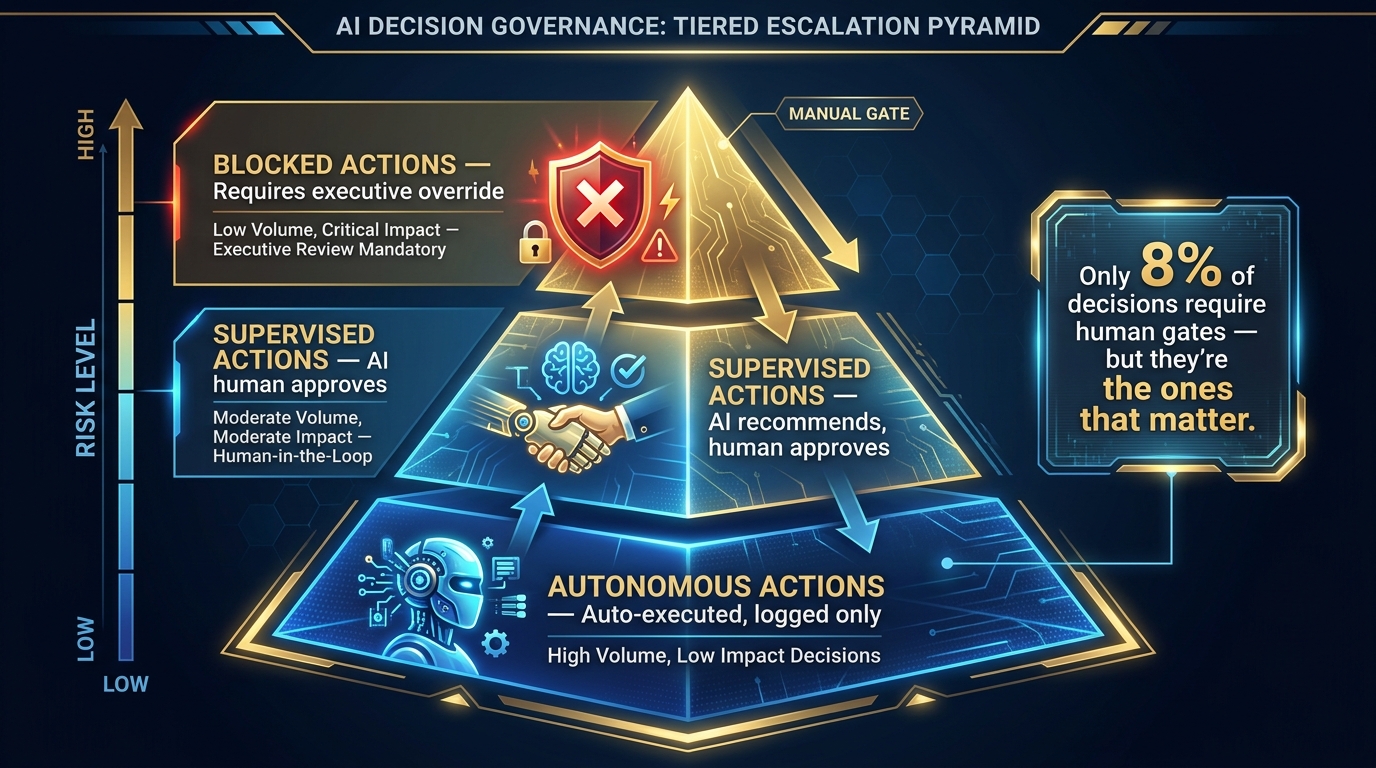
Tiered Governance: The Right Framework
The governance model that works in practice is tiered by risk, not by action type. Actions are classified along two dimensions: reversibility (can this be undone easily?) and blast radius (how many systems, customers, or dollars does this affect?). The intersection of these two dimensions determines the governance tier.
Tier 1 — Autonomous execution: Low reversibility concern, small blast radius. Examples: restarting a single service, flagging a record for internal review, generating a scheduled report. These execute automatically and are logged for audit.
Tier 2 — Supervised execution: Moderate impact, reversible with effort. Examples: adjusting inventory thresholds, routing customer escalations, modifying campaign budgets within predefined bounds. AI recommends, a designated operator approves with a single click.
Tier 3 — Gated execution: High impact, difficult to reverse, or outside normal operating parameters. Examples: large procurement actions, pricing changes, personnel-related decisions. These require explicit executive sign-off with full audit trail.
In a well-calibrated AI Ops Room, the vast majority of automated actions — typically 80-90% by volume — fall into Tier 1. Only a small fraction requires the human gates that genuinely matter. The result is that when a Tier 3 escalation arrives, the executive receiving it can engage with genuine attention rather than fatigue-dulled rubber-stamping.
The Audit Trail Is Not Optional
Regardless of tier, every action the AI Ops Room takes must be logged with full provenance: what data triggered it, which agent made the decision, what alternatives were considered, and what the expected and actual outcome was. This is not bureaucracy — it is the mechanism by which trust in the system is earned over time and maintained during audits, regulatory reviews, and incident post-mortems. Organizations deploying AI Ops Rooms in regulated industries (financial services, healthcare, energy) are increasingly finding that audit trail completeness is a non-negotiable requirement, not an enhancement.
Alert Fatigue Is a Design Problem, Not a Volume Problem
The alert fatigue problem in AI Ops Rooms deserves its own treatment, because it is almost universally misdiagnosed. Teams that encounter alert fatigue in their ops rooms typically respond by adjusting thresholds — raising the bar for what triggers a notification. This reduces volume but does not solve the root problem, and it introduces a new one: real issues are now more likely to be missed because the threshold was set to reduce noise rather than to match operational sensitivity.
Why Threshold Tuning Fails
Alert thresholds are typically set based on historical data and a general sense of “what’s important.” But the relevance of any given alert is context-dependent. A 3% drop in conversion rate on a Tuesday afternoon is different from the same drop on Black Friday. A 10-minute infrastructure latency spike is different at 2am versus during a product launch. Static thresholds cannot capture this context, so they produce both false positives (alarms for things that don’t matter in context) and false negatives (silence when something actually important is happening).
Context-Aware Alerting
The alternative is context-aware alerting, where the AI Ops Room evaluates the significance of a change relative to the current business context, not just a static baseline. This requires the system to have awareness of the organizational calendar (planned launches, promotional periods, maintenance windows), external factors (market conditions, known competitor moves), and the history of similar events and their actual impact.
With context-aware alerting, the AI Ops Room can distinguish between a conversion rate drop that is consistent with a promotional period ending and one that represents genuine customer experience degradation. It can flag the second and not the first, regardless of whether the numerical change is identical.
Role-Based Alert Routing
A second design principle: alerts must be routed to the person who can act on them, not to everyone who might be interested. An infrastructure latency issue is relevant to the CTO, not the CFO. A gross margin anomaly in the European segment is relevant to the VP of Operations EMEA, not the CTO. Sending everything to everyone is not inclusive — it is noise generation. Role-based routing, combined with intelligent summarization that abstracts domain alerts into business-impact language for executive-level views, is what makes the system actually useful for C-suite audiences.
What Real Deployments Actually Look Like in 2026
The hype around AI Ops Rooms tends to describe the ideal-state future. What organizations are actually deploying in 2026 is more nuanced — and more instructive.
The Enterprise Pattern: AI-Assisted, Not Autonomous
Across large enterprises, the dominant deployment pattern is still Level 2: AI-assisted decision support rather than closed-loop autonomy. Companies like Microsoft, Salesforce, and SAP have publicly discussed agentic operations capabilities, but their internal deployments — and those of their enterprise customers — are primarily using AI to accelerate the analysis-to-recommendation cycle, not to execute without human involvement.
A characteristic real-world deployment looks like this: A financial services firm deploys a unified ops room across its trading operations, risk management, and client servicing divisions. The system ingests real-time market data, position data from trading systems, and client activity from CRM. AI agents monitor for unusual position concentrations, anomalous trading patterns, and client behavioral signals (increased portal logins, changed risk tolerance surveys) that may indicate impending requests or issues. When the system detects a combination of signals that historically precedes a large client withdrawal, it surfaces a structured briefing to the relevant relationship manager and the risk team — not to execute an action, but to enable a faster, better-informed human response.
The result in this type of deployment is not automation of decisions but compression of the decision cycle. The relationship manager who previously would have spent 40 minutes pulling data to understand a client situation now has that context in 90 seconds. That time savings, multiplied across all the decisions executives make in a week, compounds into material operational advantage.
Mid-Market Deployments: Faster Progress, Different Trade-offs
Interestingly, mid-market organizations (typically $100M-$1B in revenue) are reaching higher automation maturity faster than large enterprises, partly because they have fewer legacy systems to integrate and fewer internal politics around metric definitions. A documented case from a $40M ARR SaaS company illustrates the pattern: the executive team relied on weekly reports built by three analysts over 2-3 days. An AI Ops Room compressed that to a continuous live view, eliminated the analyst bottleneck for routine reporting, and freed those analysts for higher-value work. Decision speed improved by 65% across the C-suite, measured as the time from “question raised in meeting” to “answer available.” The system reached positive ROI within seven months.
Where Closed-Loop Automation Is Actually Live
Genuine Level 3 closed-loop automation exists today primarily in domains where the decisions are high-frequency, well-defined, and have clear rollback mechanisms. IT infrastructure operations (auto-scaling, auto-remediation, incident triage), supply chain reordering within predefined inventory bands, and digital marketing budget reallocation within approved ranges are the most common. These are not glamorous executive decisions — but they are decisions that previously required analyst time and now happen autonomously, freeing that time for higher-order analysis.
The Decision-Speed Dividend: Quantifying Executive ROI
The ROI case for AI Ops Rooms is real and measurable, but it requires a different accounting framework than most technology investments. Traditional IT ROI is measured in cost reduction: fewer servers, fewer licenses, fewer FTEs. AI Ops Room ROI is primarily a decision-speed dividend — the compounding value of making better decisions faster.
What the Data Shows
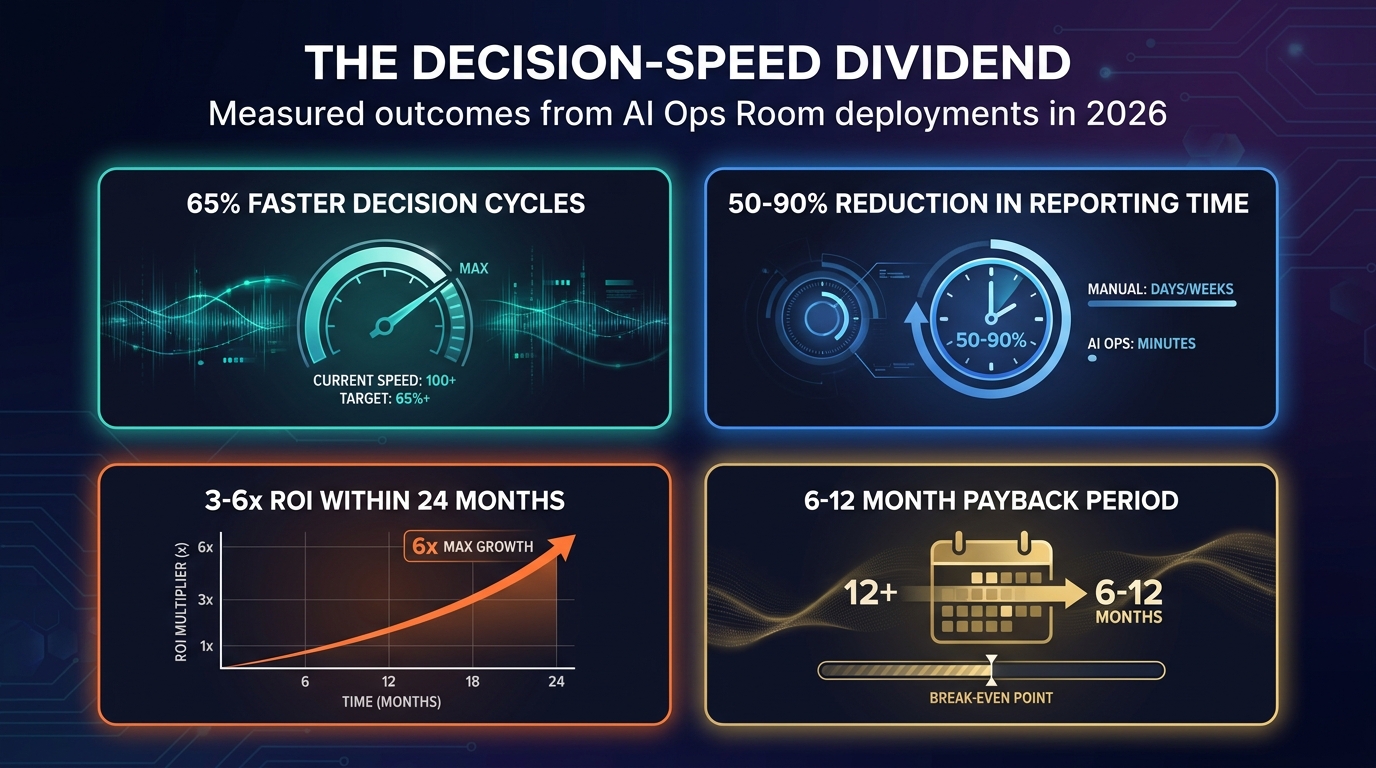
Across documented deployments in 2026, the measurable outcomes cluster around several categories:
- Reporting time reduction: 50-90% reduction in time spent by analysts and executives on data gathering and reconciliation. In absolute terms, this often translates to 3-5 hours per executive per week returned to higher-value work.
- Decision cycle compression: 50-65% improvement in decision speed across the C-suite, measured from question to answer. The Conference Board’s 2026 C-Suite Outlook Survey reports that 43% of C-suite respondents named AI and technology as a top investment priority — and decision speed is the most commonly cited driver.
- Forecast accuracy improvement: AI-assisted forecasting in ops rooms typically improves forecast accuracy by 15-25% over human-driven processes, primarily by removing the optimism and anchoring biases that affect manual forecasting.
- Direct cost avoidance: Organizations using AI Ops Rooms for supply chain and infrastructure report material reductions in emergency procurement costs, SLA breach penalties, and incident recovery costs from faster detection and response.
- Overall ROI: Well-implemented deployments report 3-6x ROI over 12-24 months, with payback periods of 6-12 months for mid-market organizations and 12-18 months for larger enterprises where integration complexity is higher.
How to Build the Business Case
The most credible business cases for AI Ops Rooms start with a baseline measurement of decision latency: how long does it currently take, on average, to go from “question raised” to “decision made” across the organization’s most frequent and highest-stakes decision types? This baseline is almost always surprising — most organizations discover that decisions they believe happen in hours actually take days once the data-gathering cycle is accounted for.
The business case then models the value of compressing that latency. A procurement decision that currently takes three days and involves $2M can be modeled: if the AI Ops Room reduces that cycle to four hours, what is the financial value of acting faster in terms of cost avoidance, supplier relationships, and opportunity cost? Replicate that calculation across the organization’s decision portfolio, and the ROI potential becomes concrete rather than aspirational.
Measuring Success After Launch
Post-launch, the most useful success metrics for an AI Ops Room are not technology metrics — uptime, query latency, agent success rate — but decision-quality metrics: How many escalations from the AI Ops Room led to action? What percentage of those actions had the expected outcome? How has forecast accuracy changed since deployment? How many decisions that previously required analyst support are now self-served by executives directly? These measures connect the technology investment to business outcomes in a language that matters to boards and CFOs.
The Five Things That Kill AI Ops Room Projects Before They Ship
Enough AI Ops Room projects have now been attempted — and failed — that the failure modes are well-documented. None of them are technology failures. They are all organizational and architectural failures that happen before a line of code is written.
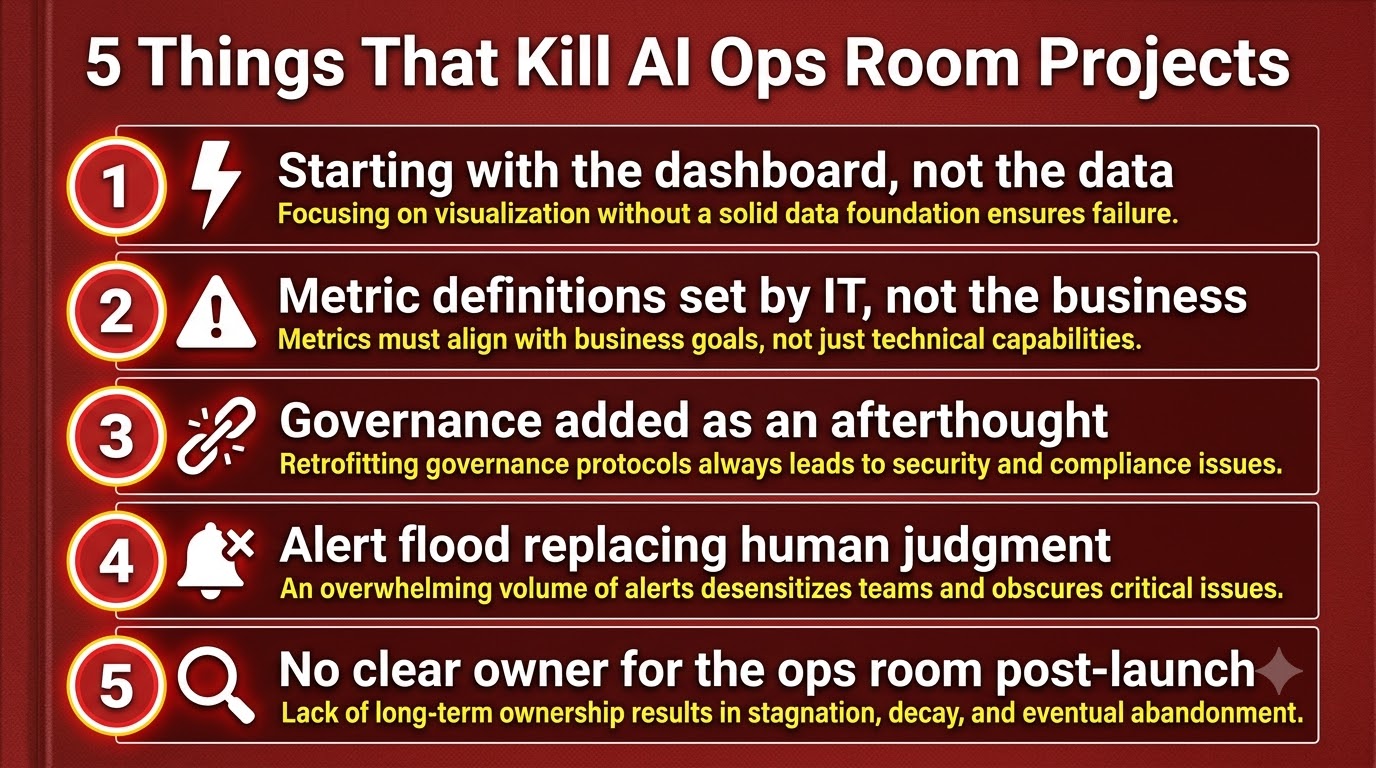
1. Starting With the Dashboard, Not the Data
The most common failure pattern: a team spends three months building a beautiful executive interface on top of unresolved data infrastructure. The dashboard goes live, executives ask questions, the data doesn’t add up, trust collapses. The technical term is “connecting dirty data to a beautiful dashboard produces beautiful lies.” The lesson is that data infrastructure and semantic layer work must precede dashboard design, not follow it. A working prototype built on solid data is always more valuable than a polished interface built on unreliable inputs.
2. Metric Definitions Set by IT, Not the Business
When technology teams define metrics without genuine business stakeholder involvement, they make technically correct but organizationally wrong choices. The CRM team defines “active customer” as any account with a login in the last 90 days. Finance defines it as any account with a positive balance in the last quarter. Both are defensible. Neither is the right definition for the CEO’s view. Metric definition is a business conversation that happens to use technical tools — not a technical task that occasionally involves business input.
3. Governance Added as an Afterthought
Teams that build the AI layer first and add governance later face a painful retrofit. Agents that were designed without governance constraints are difficult to instrument after the fact. Audit trails that were not built into the data pipeline from the start cannot be reconstructed. And organizations that deploy agentic systems without clear governance policies tend to discover their gaps through incidents rather than through proactive design. Governance — ownership, escalation paths, audit requirements, action classification — should be designed before any agentic capability is deployed.
4. Alert Flood Replacing Human Judgment
Systems designed to be comprehensive rather than targeted generate so many alerts that executives stop engaging with them. When every metric deviation triggers a notification, executives learn to ignore the system. The operational instinct to include everything “just in case” is counterproductive — the system’s value comes from its ability to distinguish signal from noise, not from its ability to surface all noise simultaneously.
5. No Clear Owner for the Ops Room Post-Launch
AI Ops Rooms require ongoing curation. Metric definitions need updating as the business evolves. Agent thresholds need recalibration as organizational baselines shift. New data sources need to be onboarded. Executive feedback on alert relevance needs to be incorporated. Organizations that treat an AI Ops Room as a project with an end date, rather than a capability that needs a permanent owner, find that it drifts out of calibration within months and gradually loses executive engagement. The question of who owns this system after launch — and what their mandate and resources are — needs to be answered before the system goes live.
How to Scope and Stage Your Own AI Ops Room Build
Given the complexity of a full AI Ops Room, the right approach for most organizations is a staged build over 9-18 months that delivers value at each stage rather than attempting a comprehensive deployment that takes two years and risks mid-project scope collapse.
Stage 1 (Months 1-3): Data Foundation and Metric Definition
The first stage is entirely pre-dashboard. Conduct the metric definition audit. Identify the 15-25 executive-level metrics that will form the core of the ops room. Resolve definitional conflicts. Document agreed calculations in a centralized metric catalog. Inventory current data sources and assess their quality, freshness, and schema documentation. Identify the two or three data quality issues most likely to undermine executive trust and fix them before building anything visible.
Deliverable: A governed metric catalog and a data quality assessment with remediation plan. This is not glamorous work. It is the work that determines whether everything built on top of it succeeds or fails.
Stage 2 (Months 3-6): Semantic Layer and Live Dashboard
With a solid data foundation, build the semantic layer — the translation between raw data and business-defined metrics. Then build the first version of the executive dashboard against certified metrics, with real-time or near-real-time refresh. This version is intentionally limited: it shows the right numbers reliably rather than attempting to show everything. Keep the interface simple. Executive adoption at this stage is the primary success metric.
Deliverable: A live executive dashboard showing 15-25 certified metrics, refreshing continuously, trusted by at least the CFO and COO as the authoritative source. If those two executives are quoting numbers from this system in meetings, Stage 2 has succeeded.
Stage 3 (Months 6-12): AI Analysis Layer
With executive trust established and data quality confirmed, introduce the AI analysis layer. Deploy anomaly detection across key metrics. Add natural-language querying. Begin generating automated narrative summaries of weekly and daily business state. Introduce the tiered governance model. Classify all potential automated actions by risk tier. Enable Tier 1 autonomous actions for the safest, most reversible operations.
Deliverable: An AI system that proactively surfaces issues, answers executive questions in natural language, and handles a defined set of routine operational responses autonomously. The executive experience shifts from “I query the dashboard” to “the system briefs me.”
Stage 4 (Months 12-18): Agentic Expansion
Based on the outcomes and trust built in Stage 3, expand agentic capabilities progressively. Add new domains. Introduce Tier 2 supervised actions for higher-impact operations. Begin cross-domain correlation for root cause analysis. Develop the executive briefing generation capability into a full board-ready reporting layer. At this stage, the organization is approaching Level 3 maturity for its most mature operational domains, while newer domains continue through earlier stages.
Deliverable: An AI Ops Room operating at genuine Level 2-3 maturity across core business domains, with a clear roadmap for expansion and a permanent owner accountable for ongoing calibration and development.
What to Watch For at Each Stage
At every stage transition, the risk is the same: pressure to accelerate to the visible, impressive parts before the foundation is solid. The dashboard is visible. The metric definition audit is not. The agentic layer is impressive. The data contracts are not. Stakeholder pressure will consistently favor the exciting over the essential. The teams that succeed at AI Ops Room deployment are the ones whose leadership understands and can articulate why the invisible infrastructure work is the actual source of value — and can hold that line long enough to do it properly.
The Organization That Decides Faster Wins
There is a strategic argument underneath all of the architecture and governance detail, and it is worth stating plainly: in a competitive environment where AI is compressing execution cycles across every business function, the organization that can make better decisions faster has a compounding advantage. Not a one-time advantage — a compounding one. Because every faster, better-informed decision generates learning, cash flow, and market position that funds the next round of decisions. An AI Ops Room is, at its best, a flywheel for organizational intelligence.
The organizations that will capture that advantage are not the ones with the most impressive dashboards. They are the ones that did the hard, unglamorous work of governing their data, defining their metrics with precision, and building trust in their systems before asking those systems to operate autonomously. They are the ones that treated governance not as a constraint on AI but as the foundation that makes AI trustworthy enough to act.
The AI Ops Room concept is real, the ROI is documented, and the architecture is understood. What separates organizations that realize it from those that don’t is almost entirely a matter of execution discipline and organizational willingness to do foundational work before visible work.
That is, as it has always been, the hardest part.
Actionable Takeaways
- Audit your metrics before touching your technology. Identify your 15-25 executive metrics, document current calculations across all source systems, and resolve definitional conflicts before building any new infrastructure.
- Invest in the semantic layer. A centralized, governed metric store is the highest-leverage architectural component of an AI Ops Room. It pays dividends across every downstream system that consumes data.
- Design governance before deploying agents. Classify potential automated actions by reversibility and blast radius. Build the tiered governance model before enabling any autonomous execution.
- Measure decision latency as your baseline. Before building, measure how long your most important decisions currently take from question to action. Use that baseline to quantify the value of compression.
- Stage the build to deliver trust at each step. Executive adoption of a modest but reliable system is worth more than executive skepticism of an ambitious but inconsistent one.
- Appoint a permanent owner before launch. An AI Ops Room is a living capability, not a project. Decide who owns it, calibrates it, and develops it before it goes live — not after drift sets in.