

There is a version of TikTok Shop that many sellers still think they are operating in: a relatively freewheeling social commerce platform where moving fast and worrying about the fine print later is an acceptable strategy. That version of TikTok Shop no longer exists.
What replaced it — gradually through 2025, and then sharply in mid-2026 — is a compliance-first marketplace with a formal points-based enforcement system, mandatory documentation gates on dozens of product categories, a rewritten logistics rulebook, and the ability to hold seller funds for up to a full calendar year over policy violations. The rules are not hypothetical. The penalties are not rare edge cases. According to data from TikTok’s own seller reporting and enforcement patterns, an estimated 68% of new sellers on TikTok Shop encounter a compliance-related restriction within their first 90 days.
This article is not about TikTok Shop’s SEO algorithm, its affiliate commission structure, or its creative content best practices. Those topics have been covered. This is a deep-dive into the operational compliance layer that sits underneath all of that — the rules that determine whether your shop stays open, your listings stay live, and your money stays accessible. We’ll work through each major compliance domain in the order that matters most to a seller trying to build something durable: account health scoring, identity verification, category gating, content claim restrictions, intellectual property, fulfillment mandates, fund holds, and finally, what the sellers who are navigating this well actually do differently.
The Account Health Rating: TikTok’s New Enforcement Engine, Explained
On June 15, 2026, TikTok Shop officially retired its old Violation Points system and replaced it with the Account Health Rating — referred to internally and in Seller University documentation as the AHR. By July 1, 2026, the AHR was active for every seller on the platform. Understanding how it works is now a prerequisite for operating on TikTok Shop at all.
How the AHR Score Is Structured
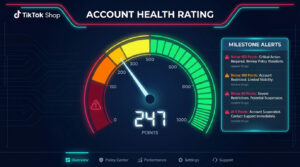
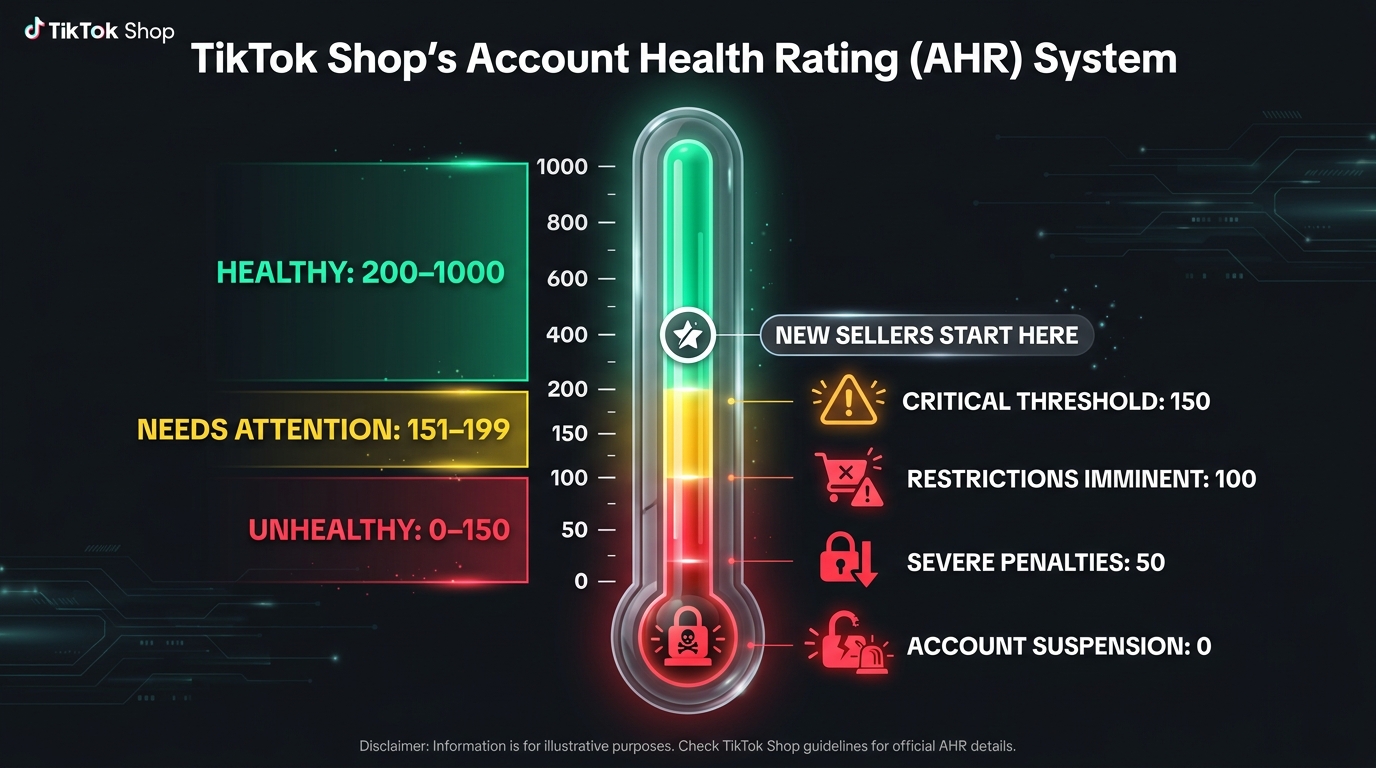
The AHR runs on a scale of 0 to 1,000 points. It is not a static grade — it is a continuously recalculated score that reflects your rolling compliance and performance history. New sellers start at 200 points, which is the baseline healthy threshold. Points are earned through completed orders and through completing TikTok Seller University compliance quizzes. Points are deducted for policy violations, performance failures, and content infractions.
TikTok has defined four enforcement tiers based on AHR score:
- 200–1,000 points: Healthy status. Normal platform access. No restrictions applied.
- 151–199 points: Needs Attention. Warning notifications issued. Sellers are expected to take corrective action before the score drops further.
- 150 points and below: Unhealthy. Enforcement actions can begin. Listing suppression, order caps, and feature restrictions activate at specific sub-thresholds.
- 0 points: Account deactivation eligible. At zero, TikTok can permanently deactivate the shop with no appeal pathway in cases of severe or repeated violations.
What the AHR Replaced — and Why That Matters
The old Violation Points system was accumulative and relatively blunt: rack up enough violation points and get penalized. The AHR is bidirectional and dynamic — scores go up as well as down, and the rolling window means that old violations age off over time if the account recovers. On paper, this is a more nuanced system. In practice, it means a single severe violation can crater a score that took months to build, and that the enforcement threshold at 150 points is deceptively close to the 200-point starting position for a new shop.
The AHR also ties directly into other platform systems. Shops with lower AHR scores see reduced organic visibility in the Shop tab, experience slower listing approval times in gated categories, and are deprioritized in the affiliate creator matching pool. The score is not just a compliance metric — it functions as a platform reputation signal that affects commercial performance across every channel.
What Deducts Points and by How Much
TikTok has not published a universal deduction table, but enforcement patterns from Seller University and case analysis reveal a tiered deduction structure. Minor violations — a single late shipment, a minor listing accuracy issue — typically result in small deductions of 5 to 15 points. Moderate violations, such as repeated late dispatch or a content claim issue, can cost 30 to 75 points. Severe violations — prohibited product listings, INFORM Act non-compliance, IP infringement — can trigger deductions of 100 to 200 points in a single event. For a new seller sitting at 200 points, a single severe violation can push them directly into unhealthy territory and trigger enforcement actions before they’ve ever processed a hundred orders.
INFORM Act Compliance: The Identity Verification Rules That Can Freeze Your Shop
The INFORM Consumers Act is a US federal law that went into effect in 2023, requiring online marketplaces to collect, verify, and publish certain information about high-volume third-party sellers. TikTok Shop’s enforcement of this law has tightened considerably through 2026, and the documentation requirements are now a significant source of account freezes — particularly for sellers who grew quickly and didn’t realize they had crossed the verification threshold.
Who Qualifies as a High-Volume Seller
TikTok Shop’s INFORM policy defines a high-volume seller as any seller who, in any continuous 12-month period within the past 24 months, has made 200 or more separate sales of new or unused products AND generated $5,000 or more in gross revenue from those sales. Both conditions must be met simultaneously. If you hit 200 sales but stay below the revenue threshold, or cross $5,000 in revenue with fewer than 200 transactions, INFORM verification is not triggered.
The significance of the 200-sale / $5,000 threshold is that it catches sellers earlier than they often expect. On a platform where viral moments can move hundreds of units in 48 hours, a seller who launched as a small operation can become INFORM-eligible before they’ve even thought about compliance documentation. Once triggered, TikTok requires annual re-verification — not a one-time check.
What Documents TikTok Accepts (and What It Doesn’t)
TikTok’s 2026 INFORM verification workflow requires one of three document types, submitted through Seller Center:
- A government-issued photo ID for the authorized representative of the business
- An IRS-issued tax document that shows the business name, Employer Identification Number (EIN), and physical business address
- A business registration document showing the business name and physical address
One document type that is explicitly not accepted: W-9 forms. This catches sellers off guard regularly. W-9s are standard US tax documents and feel like they should satisfy an IRS documentation requirement — but TikTok’s policy specifically excludes them from the acceptable documents list. Submitting a W-9 will not complete verification, and if a seller assumes it has, they may be unknowingly out of compliance.
Beyond identity documents, TikTok also collects a working email address, a verified phone number, and bank account information for legal entities. All of these must match across the submission — discrepancies between the name on the ID, the name on the bank account, and the name in the Seller Center business profile are among the most common triggers for verification failures.
The Annual Re-Verification Requirement
A critical detail that many sellers miss: INFORM verification is not a one-time event. TikTok requires annual re-verification for qualifying sellers. This means a seller who successfully completed verification in early 2025 needs to go through the process again in 2026. Failure to complete re-verification on time — or allowing the submitted documents to expire — can result in listing suspension while the account is held in compliance review. TikTok does issue reminders through Seller Center, but sellers who aren’t actively monitoring their notification inbox frequently miss them.
The 16-Category Gate: What Restricted Products Actually Require Now
One of the most significant structural changes TikTok Shop implemented in its June 2026 compliance reset was converting a large portion of its product catalog from a post-publication review model to a pre-approval gating model. Under the old system, you could often list products and have them reviewed after going live. Under the new system, certain categories require documentation to be submitted and approved before a listing can go live at all.
The 16 Gated Categories (US Market)
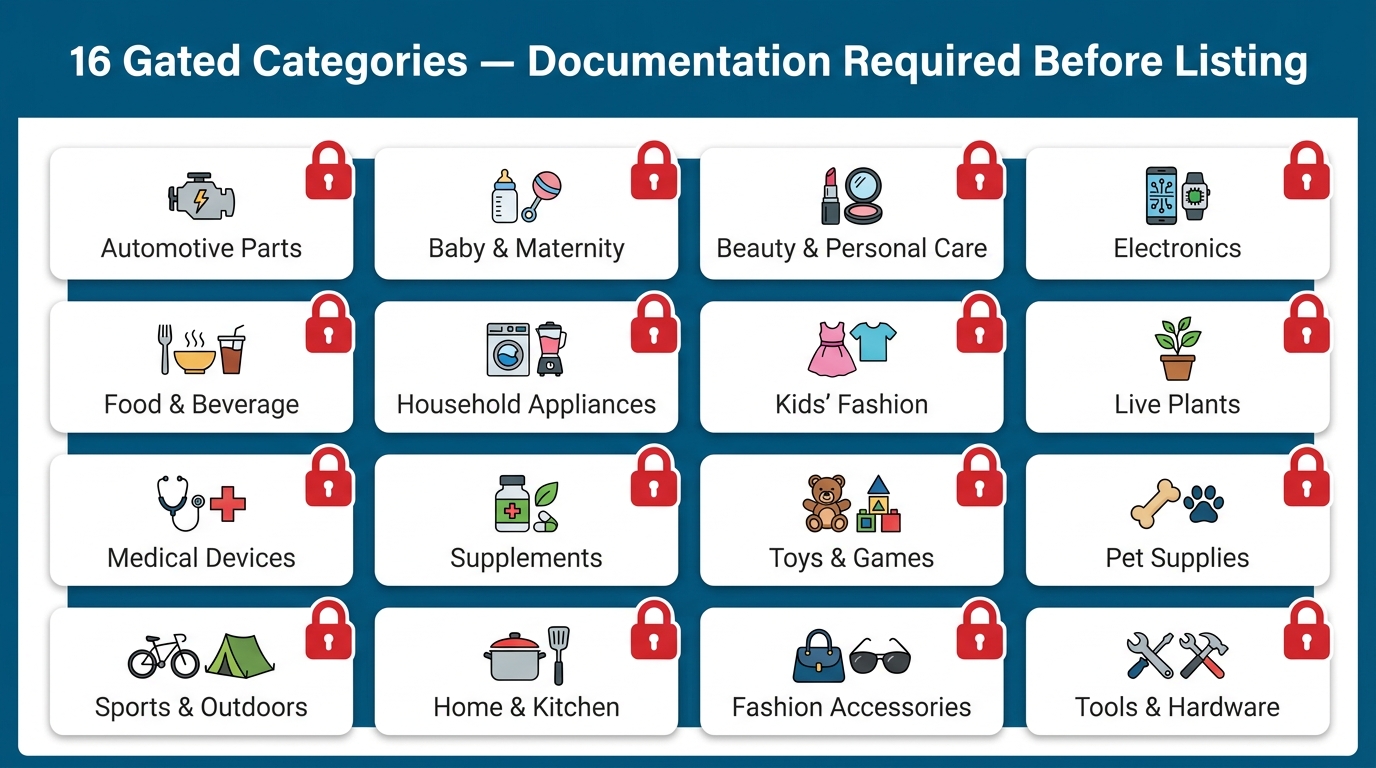
TikTok Shop US now maintains 16 formally gated categories. Sellers attempting to list in any of these categories without first obtaining category-level approval will find their listings blocked at the submission stage:
- Automotive Parts
- Baby & Maternity
- Beauty & Personal Care
- Electronics
- Food & Beverage (Shelf-Stable)
- Household Appliances
- Kids’ Fashion
- Live Plants
- Medical Devices & Medical Supplies
- Nutritional Supplements & Vitamins
- Pest Control & Pesticides
- Pet Supplies
- Sports & Outdoors
- Toys & Games
- Tools & Hardware
- Personal Safety & Security Equipment
For many sellers, this list covers the majority of their catalog. A beauty brand selling skincare, a supplement company, a baby products retailer — all of them now operate in gated territory from the moment they open a shop.
Category-Level vs. Product-Level Documentation
The gating system operates on two levels, and understanding the distinction matters. Category-level approval establishes that your business is qualified to sell within a given category. It typically requires business registration, proof of brand ownership or authorized reseller status, and sometimes relevant industry certifications. Once category-level approval is granted, it doesn’t need to be re-submitted for every new listing in that category.
Product-level documentation is different. For certain high-risk items within gated categories — specific supplements, children’s products subject to CPSC regulations, medical devices requiring FDA clearance, food items with specific labeling requirements — TikTok now requires product-specific compliance documentation at the listing level. This means that even after you’ve been approved at the category level, individual listings for these items require their own supporting documentation before going live.
What Happens to Listings That Miss the Gate
Sellers who attempt to work around the documentation requirements — submitting listings without required documents, miscategorizing products to avoid gated categories, or listing in sub-categories that appear to fall outside the gate — face escalating consequences. First offense: the listing is removed and an AHR deduction is applied. Repeat offenses in the same category can result in loss of selling privileges for that category entirely. In cases where miscategorization appears deliberate, TikTok has been applying the incident as an integrity violation rather than a simple policy breach, which carries significantly heavier AHR penalties.
The practical implication: sellers need a documentation library. The days of listing products with a photograph and a title and seeing what happens are over in a significant portion of the TikTok Shop catalog.
Health Claims, False Advertising, and TikTok’s 31% Violation Problem
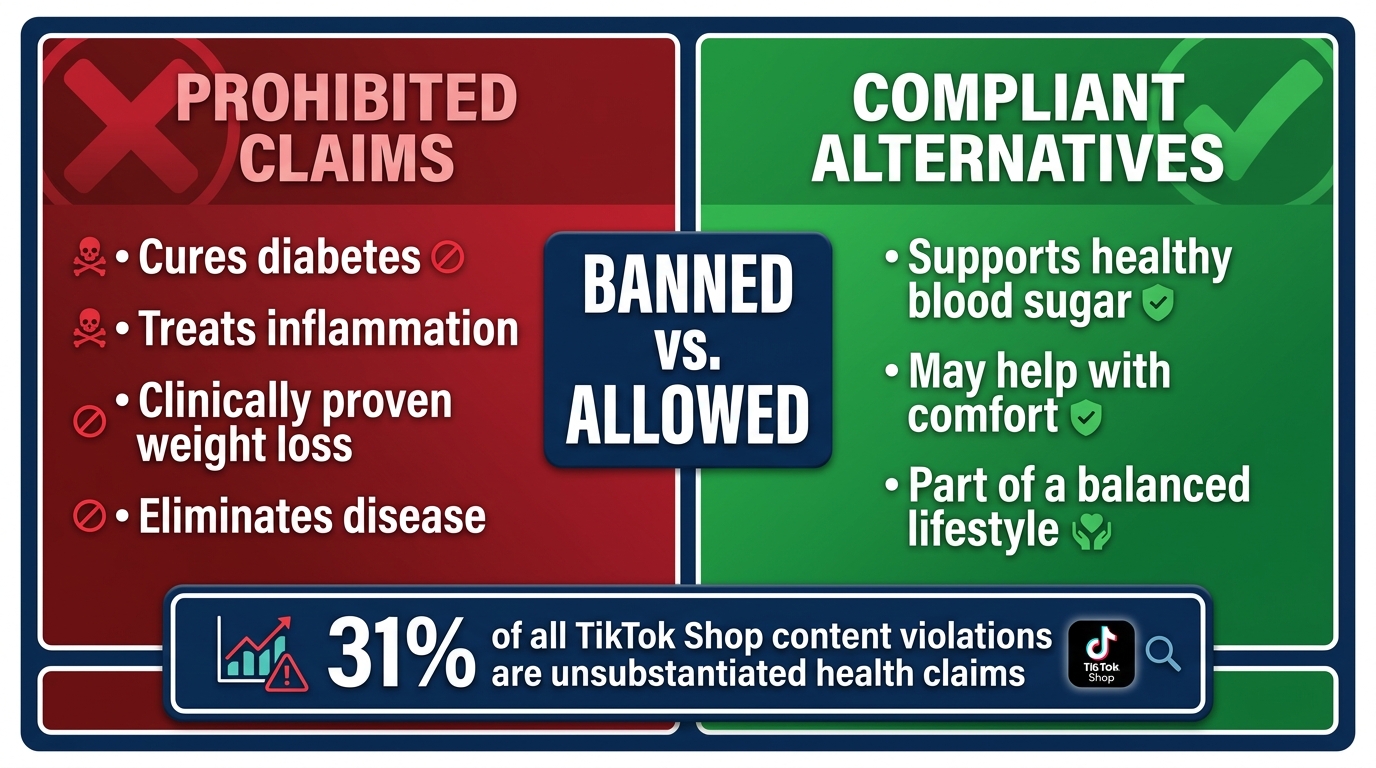
Unsubstantiated health claims are now the single largest violation category on TikTok Shop, accounting for approximately 31% of all active content violations tracked in 2026. That is a remarkable concentration in one area, and it reflects a fundamental misalignment between how many sellers and creators have been writing product copy and what TikTok’s content policy now permits.
The Absolute Prohibitions
TikTok Shop’s content policy draws a hard line around medical and disease-related claims. No listing, video, livestream, or creator-generated content associated with a TikTok Shop product may make any of the following types of statements:
- Claims that a product cures, treats, prevents, heals, eliminates, or eradicates any disease or medical condition
- Claims that use the language of clinical diagnosis (e.g., “reduces symptoms of,” “effective against,” “clinically proven to treat”)
- Weight-loss claims with specific numerical guarantees (“lose 10 pounds in two weeks”)
- Muscle-gain claims with specific performance guarantees
- Claims using phrases like “FDA approved” for products that are not actually FDA-approved drugs
- Testimonials that describe medical outcomes in a way that functions as an implicit disease treatment claim
These prohibitions apply not just to listing descriptions but to any content that a seller or affiliated creator publishes in connection with the product. A creator who makes a prohibited health claim in a video promoting your product can trigger a violation on your seller account — even if your listing copy is perfectly compliant. This creator liability extension is one of the more operationally complex aspects of the 2026 enforcement tightening.
The Structure-Function Language That Is Allowed
The compliance path for health and wellness sellers runs through structure-function language — a term borrowed from FDA dietary supplement regulations that describes claims about how a product supports normal body function without asserting that it treats a disease. The distinction sounds subtle but matters enormously in practice.
What is permitted: “supports healthy blood sugar levels already within normal range,” “may contribute to joint comfort,” “formulated with ingredients that support immune function.” What is not permitted: “lowers blood sugar,” “treats joint inflammation,” “boosts immunity against illness.” The difference is the implied causal relationship to a disease state. Structure-function language describes support; prohibited language describes treatment.
Sellers in the health, wellness, and beauty categories should treat this framework as non-negotiable. Every piece of copy — listings, ads, affiliate briefings, creator scripts — needs to be reviewed against these standards before going live. The enforcement system does not distinguish between an intentional violation and an inadvertent one.
False Advertising Beyond Health Claims
The false advertising prohibition extends beyond health claims. TikTok’s content policy requires that all product descriptions, pricing claims, comparison statements, and performance assertions be accurate and substantiated. This includes:
- Fake reviews and social proof manipulation: Purchasing fake reviews, manufacturing testimonials, or inflating social proof metrics is explicitly prohibited and is treated as an integrity violation
- Misleading pricing: Claiming a false “original price” to inflate the appearance of a discount is a violation
- Counterfeit or unauthorized brand use: Using brand names or product imagery without authorization in listings or content
- Material omissions: Omitting information that would materially affect a consumer’s purchasing decision
Intellectual Property Enforcement: Brand Protection Gets Real Teeth
TikTok Shop’s approach to intellectual property violations underwent a significant upgrade in 2026. The platform’s Intellectual Property Protection Center (IPPC) has been expanded with new tools and faster takedown workflows, and enforcement against counterfeit listings and unauthorized trademark use has shifted from reactive to proactive in several key areas.
What the IP Policy Covers
TikTok Shop’s IP policy prohibits a comprehensive range of intellectual property violations across all seller listings and associated content:
- Counterfeit goods: Products that imitate or copy branded items and are sold without authorization from the rights holder
- Unauthorized trademark use: Using a registered trademark in a product name, description, or image without being the rights holder or an authorized seller
- Copyright infringement: Using protected images, design elements, product photography, or written descriptions without permission
- Patent violations: Selling products that infringe on registered patents
- Brand circumvention: Attempting to list products in ways specifically designed to avoid IP detection — such as misspelling brand names or using visual similarities without direct copying
The Brand Circumvention Problem
The brand circumvention update is particularly notable. TikTok’s 2026 IP policy explicitly covers attempts to work around brand protection through obfuscation — sellers who list products with deliberate misspellings or who use product photography that is clearly derivative of a protected brand’s visual identity without directly copying their name. The enforcement system has been updated to catch these patterns through image-matching technology and keyword proximity analysis, not just exact-match trademark lookups.
For legitimate sellers, the practical implication is that you need clear documentation of your authorization to sell branded products. Authorized resellers should have their authorization letters stored in Seller Center and be prepared to submit them if a listing is flagged. Direct brands should have their trademark registrations on file. Grey-market goods — products purchased through unauthorized distribution channels and resold — do not qualify for protection under the authorized reseller framework and are increasingly being treated as IP violations even when the physical product is genuine.
The Intellectual Property Protection Center Workflow
For brand owners, TikTok’s IPPC provides a formal channel for reporting violations, submitting takedown requests, and tracking enforcement actions. The 2026 version of the IPPC processes takedown requests significantly faster than its predecessor, with standard cases now resolved in hours rather than days in many instances. Sellers who receive an IP takedown notice have a right of appeal, but appeals require demonstrating either that the violation report was in error or that proper authorization exists — and the burden of proof sits with the seller, not the complainant.
Shipping and Fulfillment Compliance: Seller Shipping Is Gone
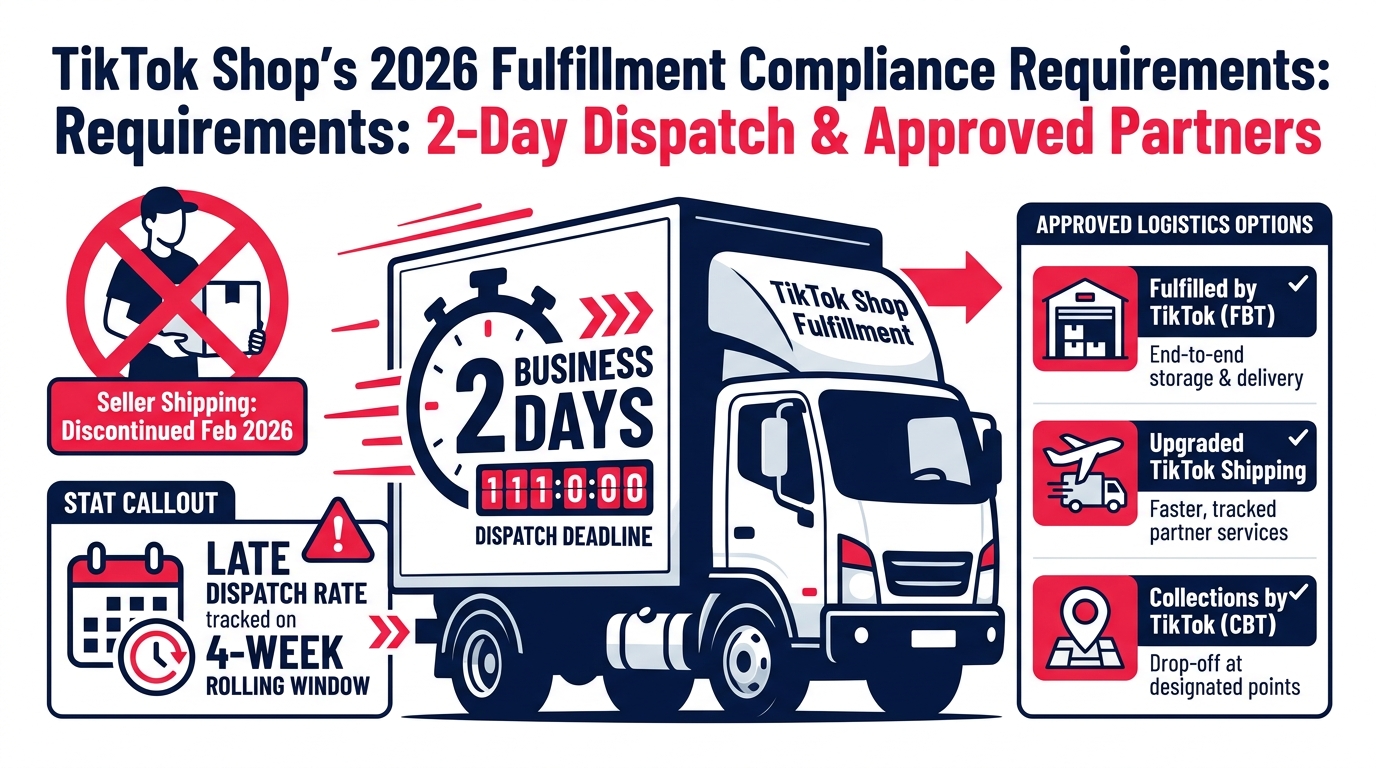
The fulfillment compliance changes that TikTok Shop implemented in the first quarter of 2026 were arguably the most disruptive operational change for US sellers in the platform’s short history. The discontinuation of Seller Shipping — the model where sellers bought their own labels and dispatched independently — fundamentally changes the operational model for every US-based local seller.
The Logistics Mandate: What’s Required Now
As of February 25, 2026, all US local sellers must ship exclusively through one of three TikTok-controlled logistics services:
- Fulfilled by TikTok (FBT): TikTok’s first-party fulfillment service, similar in concept to Amazon FBA. Sellers ship inventory to TikTok’s warehouse network, and TikTok handles pick, pack, and ship operations. FBT-fulfilled orders are given preferential display in the Shop tab and generally score better on fulfillment compliance metrics.
- Upgraded TikTok Shipping: A seller-managed model where sellers purchase TikTok-issued labels through Seller Center and manage their own warehouse operations. The key difference from the old Seller Shipping model is that labels must be purchased within the TikTok system — not through third-party carriers directly.
- Collections by TikTok (CBT): A model for sellers with high-volume operations where TikTok collects inventory from seller locations and manages the downstream shipping. Eligibility requirements apply.
Sellers who attempt to use third-party labels, ship through personal carrier accounts, or otherwise operate outside the three approved logistics frameworks will find their shipments flagged for compliance review and their AHR score penalized for each infraction.
The 2-Business-Day Dispatch Requirement
The dispatch SLA — the maximum time between an order being placed and the order being marked “In Transit” with a first carrier scan — is two business days. This is not a target or a recommendation; it is the compliance threshold that defines whether an order is counted as a late dispatch. Orders that miss the two-day window are recorded as late dispatches and accumulate toward the seller’s Late Dispatch Rate (LDR).
The LDR is evaluated on a four-week rolling window. TikTok’s enforcement on LDR was paused for several months in late 2025 but was formally reinstated on April 6, 2026. The penalty structure for high LDR is tiered: early-stage violations trigger visibility reductions and warnings. Sustained high LDR triggers listing suppression and order caps. Persistent non-compliance escalates to selling privilege restrictions.
On-Time Delivery Rate and the Full Fulfillment Picture
Beyond dispatch timing, TikTok tracks On-Time Delivery Rate (OTDR) — the percentage of orders that arrive within the expected delivery window shown to the customer at checkout. OTDR is partially outside seller control in that it depends on carrier performance after handoff, but it nonetheless feeds into the compliance scoring system. Sellers who consistently use faster and more reliable logistics options within TikTok’s approved framework will naturally maintain better OTDR scores. Sellers who gravitate toward the slowest or cheapest options will struggle to maintain compliant OTDR rates, particularly during high-volume periods.
Fund Holds: Understanding How TikTok Withholds Your Money
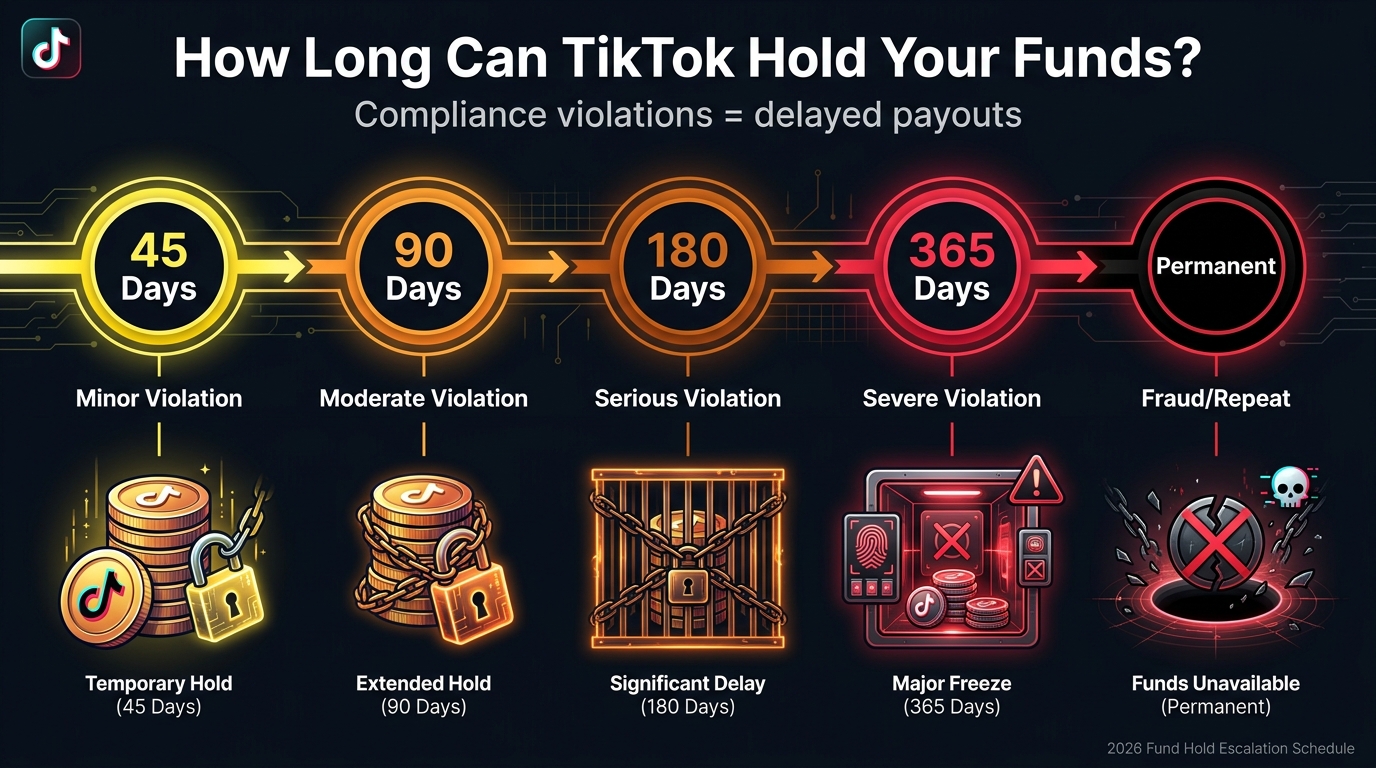
Fund holds are one of the most financially impactful compliance mechanisms on TikTok Shop, and they are also one of the least discussed — possibly because they happen quietly, without the visibility of a suspended listing or a public policy violation notice. A seller can be running what appears to be a functioning shop while their earned revenue is being held in escrow by TikTok for compliance reasons they may not fully understand.
Normal Settlement Holds vs. Compliance-Based Withholding
It’s important to distinguish between two types of fund holds that can affect TikTok Shop sellers. Normal settlement holds are part of TikTok’s standard payout schedule — funds are held for a period after delivery to account for returns, refunds, and chargebacks. These are expected and not compliance-related.
Compliance-based withholding is different. This is triggered by policy violations, risk flags, or enforcement actions, and it operates on a separate and much longer timeline than the normal settlement cycle. The two types can coexist simultaneously — meaning a seller facing a compliance hold may also be waiting through the normal settlement window on top of it.
The Fund Hold Escalation Structure
TikTok Shop’s 2026 compliance framework establishes a tiered fund hold structure tied to violation severity:
- 45-day holds: Applied for minor to moderate compliance violations. These are the most common fund hold triggers and can result from recurring content violations, documentation lapses, or borderline fulfillment metric failures.
- 90-day holds: Applied for moderate to serious violations, including first-time IP violations, restricted category breaches, or a pattern of repeated minor violations.
- 180-day holds: Applied for serious violations including significant false advertising findings, serious IP infringement, or INFORM Act non-compliance.
- 365-day holds: Reserved for severe violations — large-scale policy breaches, systemic listing policy fraud, or significant consumer safety concerns.
- Permanent holds: Applied in cases of confirmed fraud, large-scale counterfeiting, or repeat severe violations. Funds held under a permanent hold may not be released at all.
The Cash Flow Reality of a Fund Hold
For sellers who are running their TikTok Shop revenue through normal operating cycles — using this week’s sales to fund next week’s inventory — a compliance-triggered fund hold can be catastrophically disruptive even before accounting for any AHR-related selling restrictions. A 90-day hold on a shop generating $50,000 per month means $150,000 in locked revenue. A 180-day hold means $300,000 sitting in escrow while the seller is still expected to fulfill orders, pay suppliers, and operate normally.
This is not a hypothetical worst case. Sellers in high-violation categories — health supplements, beauty, electronics — have reported these scenarios in 2026 at a frequency that suggests systemic compliance challenges in those spaces. The practical response is to maintain enough working capital to operate independently of TikTok Shop payout cycles, treating those payouts as a cushion rather than a funding source for ongoing operations.
The 68% First-90-Days Failure Rate: What’s Actually Causing It
The figure that surfaces repeatedly in TikTok Shop compliance data — that approximately 68% of new sellers encounter a compliance-related restriction within their first 90 days — demands some unpacking. This isn’t primarily a story of bad actors getting caught. The data suggests the majority of these early violations are made by well-intentioned sellers who simply didn’t understand that TikTok Shop had become a compliance-intensive environment before they launched.
The Most Common First-90-Day Violations
Analysis of enforcement patterns reveals a consistent set of early violations that account for the majority of first-90-day compliance restrictions:
Identity and KYC document mismatches are the single most common onboarding failure. Sellers who submit documents where the business name on the tax document doesn’t exactly match the business name in Seller Center — even by a single word, abbreviation, or punctuation difference — fail verification. The system is not forgiving of informal variations. “Joey’s Kitchen LLC” and “Joeys Kitchen LLC” are not the same entity in TikTok’s verification system.
Listing in gated categories without pre-approval is the second most common early violation. Many sellers who migrate from Amazon or Shopify to TikTok Shop assume the listing process works the same way. They import their catalog, including products in gated categories, and submit listings without realizing the documentation requirement exists. The listings are rejected or removed, AHR points are deducted, and in some cases the seller’s access to that category is placed under review before they’ve sold a single unit.
Inherited non-compliant content from other platforms is a particularly insidious early violation source. Sellers who copy their Amazon listing copy or their Shopify product descriptions directly into TikTok Shop frequently carry health claims, comparison claims, or performance language that was acceptable (or at least tolerated) on other platforms but violates TikTok’s stricter content policy. The phrase “helps relieve joint pain” might be routine description language on Amazon; on TikTok Shop, it reads as a medical treatment claim.
Missing or expired INFORM documentation catches sellers who hit the 200-sale threshold faster than expected after a viral moment and haven’t yet initiated verification. The platform issues a verification requirement notification, sellers miss or misunderstand it, and the account is placed in compliance review while documentation is collected.
Why the Problem Compounds Quickly
Early violations have a compounding effect because of the AHR’s starting position. A new seller at 200 points is not far above the 150-point unhealthy threshold. Two or three early violations of moderate severity can push a new shop into unhealthy status before the seller even understands what the AHR system is. Once in unhealthy status, listing approvals slow down, organic visibility drops, and the path to recovery requires sustained clean performance over a rolling window — time that many new sellers don’t have the runway to wait out.
The seller experience in this scenario is deeply disorienting: the shop appears to be operating, content is going out, but sales are lower than expected, listings are taking longer to approve, and the Seller Center notifications keep piling up with warnings that aren’t immediately legible to someone who launched without compliance preparation.
Building a Compliance Operations Stack: What Sustainable Sellers Do Differently
The sellers who are navigating TikTok Shop’s 2026 compliance environment successfully share a common characteristic: they treat compliance as an operational function rather than a legal formality. Compliance isn’t something they handle reactively when a listing gets flagged — it’s a process layer that’s built into catalog management, content production, creator partnerships, and logistics operations.
Pre-Launch Compliance Audits
Before listing a single product, sustainable sellers run a pre-launch compliance audit against TikTok Shop’s policy stack. This covers five areas:
- Category eligibility: Is this product in a gated category? If so, has category-level approval been obtained? Is product-level documentation available and current?
- Identity verification status: Has INFORM verification been completed? Are all business documents current and consistent across the Seller Center profile?
- Content review: Does any existing copy, imagery, or creator content contain prohibited claims? This includes copy imported from other platforms.
- IP clearance: Is there clear authorization to sell this product, including any branded products? Are authorization documents accessible if requested?
- Logistics readiness: Is the fulfillment model set up within TikTok’s approved logistics framework, and is the dispatch workflow capable of meeting the 2-business-day SLA?
Creator Briefing Protocols
The most overlooked compliance gap in TikTok Shop operations is the creator brief. Because creator content — affiliate videos, LIVE streams, product review posts — can trigger violations on the seller’s account, sellers who work with creator networks need to build compliance training into their creator onboarding and briefing process. This means providing creators with a clearly written list of approved claims and prohibited claim categories for each product category, reviewing creator content before it goes live where possible, and establishing clear contractual language about compliance responsibility.
Sellers who are running large affiliate programs on TikTok Shop and haven’t addressed this gap are operating with a significant and growing compliance surface area. Every creator who posts about your product without understanding TikTok’s content rules is a potential AHR deduction event.
AHR Monitoring as a Weekly Operational Task
Sellers who stay compliant track their AHR score on a weekly basis, not just when they receive a notification. The AHR dashboard in Seller Center shows current score, recent deductions with associated reasons, and the rolling performance data that feeds the score. Weekly review allows sellers to catch emerging issues — a pattern of LDR increases, a cluster of content violation flags — before they compound into a serious score decline. Sellers who only check their AHR when something goes wrong are typically already in the Needs Attention zone before they notice.
Documentation Library Management
Maintaining an organized, up-to-date library of compliance documentation is a basic operational hygiene requirement for serious TikTok Shop sellers. This library should include business registration documents, tax records, INFORM verification submissions, product safety certifications relevant to gated categories, brand authorization letters for any non-owned brands being resold, and FDA or CPSC compliance documentation for applicable products. The documents need to be current — certificates expire, authorizations are time-limited, and TikTok’s verification processes require submissions that are within acceptable validity windows.
Capital Reserves for Fund Hold Scenarios
Financially mature TikTok Shop sellers treat the possibility of a compliance-triggered fund hold as a business continuity risk to plan against. This means maintaining operating reserves that don’t depend on TikTok Shop payouts, building supplier relationships that allow for payment flexibility, and treating TikTok Shop revenue as income to be collected on a delay rather than a real-time cash flow source. This is a higher bar than many marketplace sellers are accustomed to, but the fund hold structure makes it a realistic operational requirement.
The Practical Compliance Checklist: Where to Start This Week
For sellers assessing their own compliance posture right now, here is a prioritized set of actions organized by urgency and potential impact on AHR score and business continuity:
Immediate Actions (This Week)
- Log into Seller Center and check your current AHR score. If you’re below 200, identify which violations have driven the deductions and address them before the score drops further.
- Verify your INFORM Act status. If you’ve crossed the 200-sale / $5,000 threshold, confirm that verification is complete and that your submitted documents haven’t expired.
- Audit your active listings for any copy that makes health, medical, or performance claims that would fail TikTok’s content policy — particularly treatment or cure language, numerical outcome promises, or “FDA approved” claims for non-approved products.
Short-Term Actions (This Month)
- Map your catalog against the 16 gated categories. For any products in gated categories, confirm that category-level approval has been obtained and that product-level documentation is on file.
- Review your logistics setup. If you were using Seller Shipping before February 2026, confirm that you’ve fully transitioned to an approved TikTok logistics service.
- Build or update your documentation library with all current certificates, authorizations, and identity documents.
- If you work with creator affiliates, draft and distribute a compliance brief outlining permitted and prohibited claim language for each product category in your shop.
Ongoing Operations
- Review your AHR score weekly, not just when you receive a notification.
- Track your Late Dispatch Rate on a rolling basis and maintain warehouse processes that reliably meet the 2-business-day SLA.
- Set calendar reminders for annual INFORM re-verification and document expiry dates.
- Before adding new product categories, complete the gating pre-approval process before creating listings.
- Maintain operating capital reserves that don’t depend on TikTok Shop payouts, sized to cover at least 90 days of operations independently.
Compliance as Competitive Position — Not Just a Cost of Business
Here is the counterintuitive conclusion that the data supports: TikTok Shop’s compliance reset, as disruptive as it has been for many sellers, creates a meaningful competitive advantage for the sellers who navigate it correctly.
The 68% first-90-days failure rate means that a substantial portion of sellers who enter the platform quickly hit compliance friction. Some fix it and continue. Many don’t. The sellers who exit the platform due to compliance challenges — or who continue operating at reduced capacity because their AHR score is suppressed — are creating market share opportunities for sellers who’ve built compliant operations from the ground up.
There are structural reasons for this dynamic. TikTok’s algorithm actively favors shops with high AHR scores in organic distribution and listing prioritization. In gated categories, the documentation barrier means that not everyone can enter, creating less competition at the listing level for sellers who’ve cleared the gate. In health and wellness, strict enforcement of health claim rules means that sellers who build compliant copy frameworks aren’t competing against a sea of exaggerated claims — they’re operating in an increasingly leveled environment.
Additionally, the logistics mandate has a quality signal embedded in it. FBT-fulfilled products receive display preference in the Shop tab. Sellers who commit to FBT operations are not just meeting a compliance requirement — they’re accessing a visibility advantage that non-FBT competitors can’t match regardless of their AHR score.
The Long-Term Platform Signal
TikTok Shop’s compliance tightening in 2026 is consistent with what happens at every major e-commerce marketplace when it reaches a certain scale and regulatory scrutiny: the permissive early phase ends, and the platform either builds a real seller governance system or faces regulatory consequences that force one on it. Amazon went through this evolution. eBay went through it. TikTok Shop is going through it now, and the timeline is compressed because the regulatory environment that marketplace commerce operates in is significantly stricter in 2026 than it was when those other platforms were scaling.
Sellers who understand this trajectory — who recognize that TikTok Shop is building toward being a regulated marketplace, not a social app where people happen to sell things — will position themselves for the long term. Sellers who are still treating compliance as someone else’s problem are likely to find that TikTok’s enforcement systems are increasingly efficient at making it their problem whether they’re prepared or not.
Conclusion: The Seller Who Survives TikTok Shop’s Compliance Reset
The TikTok Shop compliance reset of 2026 is not a temporary enforcement surge that sellers can wait out. The Account Health Rating system, the INFORM Act documentation requirements, the 16-category gating framework, the logistics mandate, and the fund hold escalation structure are permanent features of how the platform operates now. The sellers who treat this as a one-time cleanup are likely to find themselves cycling in and out of compliance issues perpetually as the platform continues to tighten enforcement and introduce new requirements.
The sellers who will build durable businesses on TikTok Shop are the ones who’ve made a different decision: that compliance is an operational function, not a legal footnote. They have documentation libraries, creator briefing protocols, AHR monitoring workflows, and capital reserves. They treat the gated category approval process as a competitive moat rather than a bureaucratic hurdle. They build their listing copy to TikTok’s content standards from the first draft, not after a violation flag forces a revision.
TikTok Shop is a genuinely significant commerce channel — one that continues to grow in reach and average order value even as it tightens its operating requirements. The compliance reset has raised the floor for who can operate effectively on the platform. Sellers who clear that floor don’t just survive — they operate in a less crowded, more professionally managed marketplace than existed 18 months ago. That’s not a bad position to be in.
The question is whether you’re going to build the compliance infrastructure to access it, or whether you’re going to find out the hard way that TikTok’s enforcement systems are faster and more comprehensive than they used to be.