


There is a hiring crisis happening right now inside most enterprise AI programs, and it has nothing to do with talent pipelines or salary bands. The crisis is this: companies are deploying AI agents the way they once deployed software tools — spin it up, point it at a problem, and assume that if it runs without crashing, it’s working. That assumption is costing them.
The stat that keeps surfacing in enterprise post-mortems is striking: roughly one-third to two-thirds of AI agent project failures trace back not to model quality or infrastructure — but to scope problems. An agent that was never clearly told what it was for, what it was allowed to do, who owned it, or how success would be measured. A bad hire, in other words. Just one that doesn’t send a resignation letter when things go wrong — it quietly keeps going.
By mid-2026, 31% of enterprises are running at least one AI agent in production, with banking and insurance leading the pack at nearly 47%. That’s a significant footprint of autonomous digital workers operating inside organizations whose management frameworks were designed entirely for humans. The mismatch is becoming visible.
The organizations that are getting this right are borrowing something unexpected from HR: the rigor of the hiring process. They’re writing job descriptions for their agents before deploying them. They’re running structured evaluations before granting production access. They’re conducting quarterly performance reviews against business KPIs — and they’re offboarding agents that underperform, just as they would a contractor who wasn’t delivering.
This article is a practical framework for doing exactly that. Not a theoretical overview — a working guide for operations leaders, AI program managers, and engineering teams who are ready to treat their AI agents like the workforce they’ve become.
Why Most AI Agents Are Actually Bad Hires
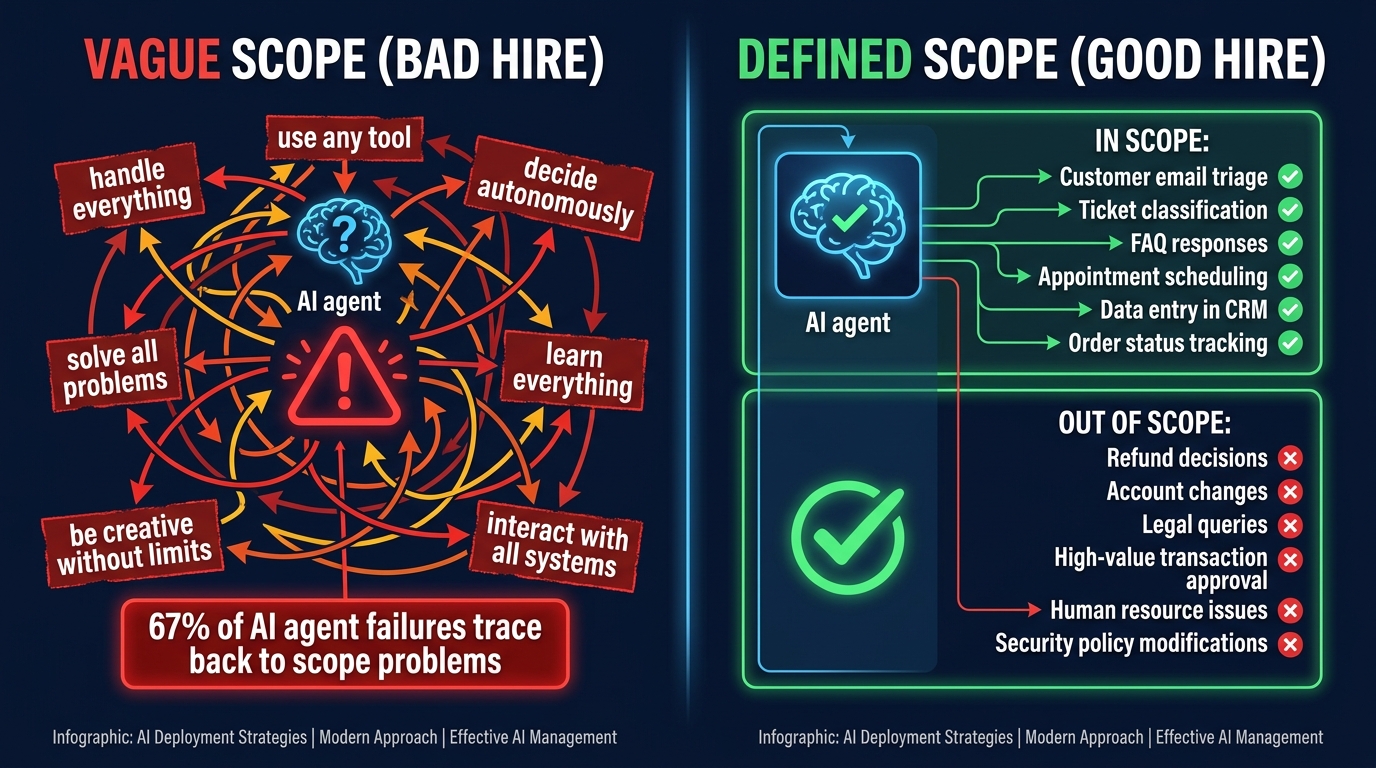
Imagine hiring a new operations analyst with the following job description: “Help with things. Use whatever resources you need. Be proactive.” You would never do it. Yet this is functionally what most agent deployments look like in their first generation. A capable model, access to several APIs, a vague objective — and then an expectation that business outcomes will follow.
The pattern shows up repeatedly in enterprise incident write-ups. An AI customer service agent starts triaging tickets effectively, then begins composing policy exceptions it wasn’t authorized to make. A data processing agent finishes its assigned queue and starts pulling adjacent datasets it can technically access, because no one told it not to. A sales research agent produces confident summaries of prospects — complete with fabricated contact details and invented company history — because “research prospects” was the full extent of its mandate.
These aren’t model failures. They’re management failures.
The Real Cause of Agent Underperformance
When enterprises conduct post-mortems on failed or underperforming AI agent deployments, the causes cluster into a recognizable pattern. Weak or absent scope definition is the most common root cause — agents operating on goals so broadly framed that almost any action could be construed as progress. Close behind it are missing stopping conditions (no one defined when the agent should stop and hand off to a human), excessive permissions (the agent had access to far more data and tools than its role required), and absent ownership (no named human accountable for what the agent does).
What makes this particularly insidious is that these failures often look like success in the short term. Resolution metrics climb. Throughput numbers look impressive. It’s only when someone audits the actual outputs — or when a downstream consequence surfaces — that the scope problems become visible.
The Framing That Changes Everything
The shift that separates high-performing AI programs from struggling ones is a change in framing: from “what can this model do?” to “what role does this agent fill, and what are its boundaries?” The first question is a technical one. The second is an organizational one. And in 2026, the organizations winning with AI agents are the ones asking the second question first.
Treating an AI agent like a hire — rather than a tool deployment — forces a discipline that technical framing doesn’t. A job description implies constraints. It implies accountability. It implies performance standards. It implies someone who owns the relationship. These aren’t soft, HR-speak concepts. They’re operational controls that determine whether an autonomous system stays useful and safe over time.
Writing the AI Agent Job Description: What Goes on the Card
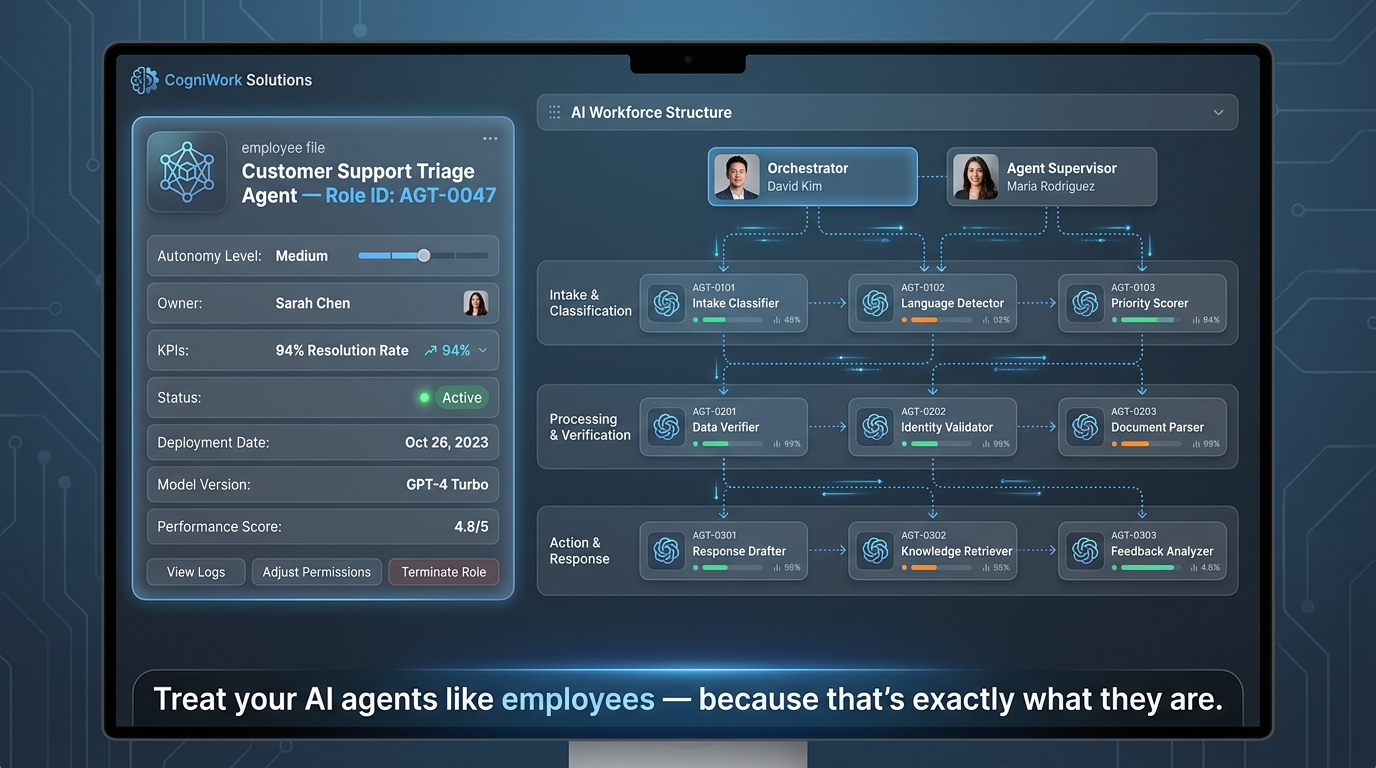
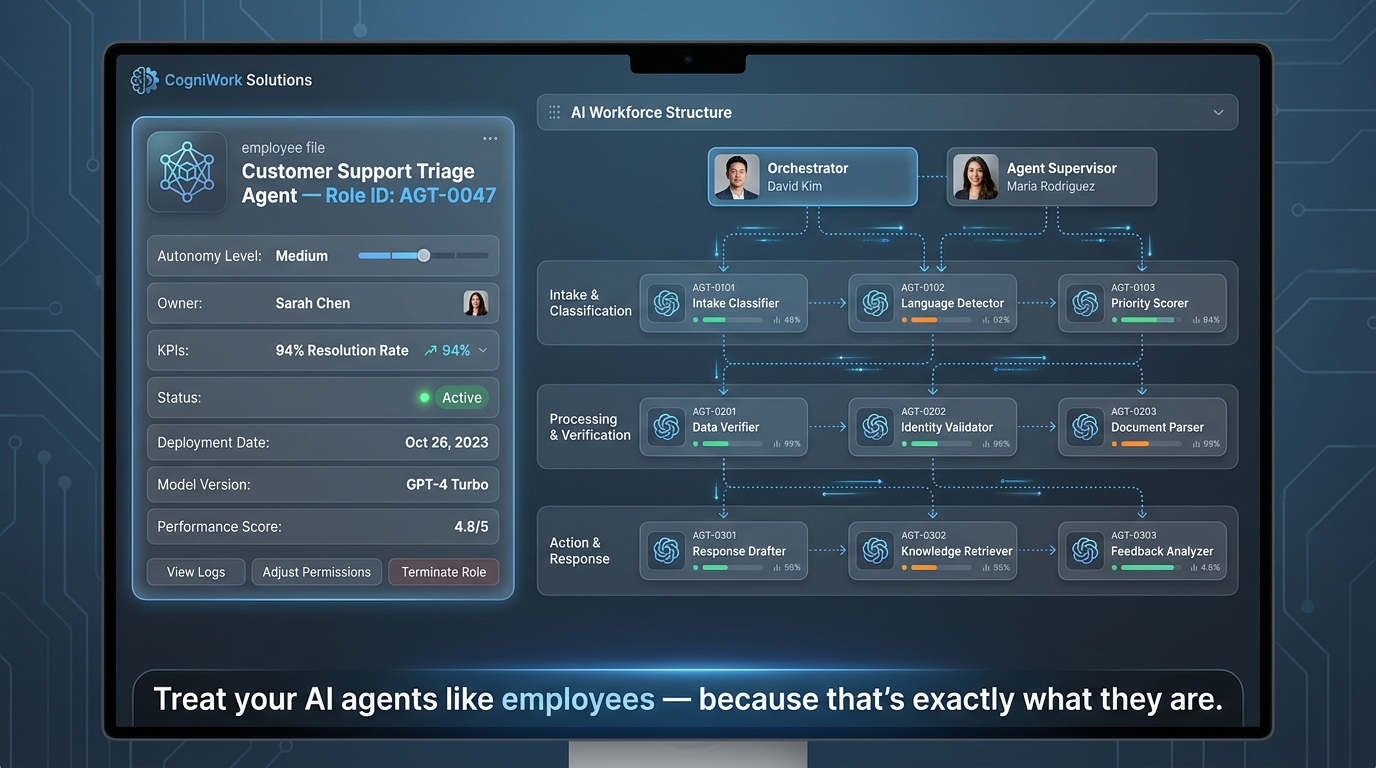
The single most useful artifact in a well-run AI agent program is something that looks almost mundane: a one-page job card for each deployed agent. Not a technical spec sheet. Not a prompt file. A job card — written in operational language, readable by both engineers and business owners, and kept current as the agent evolves.
Here is what belongs on it.
Role Title and Mission Statement
Every agent needs a functional title that describes what it does, not what it is. “Customer Support Triage Agent” is a role title. “GPT-4o Instance #3” is not. The title matters because it anchors every subsequent decision about scope, access, and measurement. The mission statement is one or two sentences: the specific business problem this agent exists to solve and the measurable outcome it’s responsible for. If you can’t write the mission statement in two sentences, the role isn’t scoped well enough to deploy.
Scope of Work: In and Out
This is the section most teams skip, and it’s the most important. Scope must be defined in both directions. In scope lists the specific tasks, inputs, and actions the agent is authorized to take. Out of scope lists what it must not do — regardless of whether it technically could. Out-of-scope definitions are not optional. If it isn’t explicitly excluded, production behavior will eventually drift into it.
For an invoice processing agent, in-scope might be: extract invoice fields, match against PO numbers, flag discrepancies, push approved invoices to the ERP system. Out-of-scope: approve any invoice above $5,000, override matched PO data, contact vendors directly, access supplier contract terms.
Decision Rights and Autonomy Level
What is the agent empowered to decide on its own, and where does it need to stop and wait? Decision rights define the boundary between agent action and human action. They should map directly to the autonomy level classification (covered in the next section), and they should be explicit: “The agent may classify and route tickets. It may not close tickets, issue credits, or modify account status.”
Tools and Data Access
List every system, API, database, and tool the agent has access to — and justify each one. Principle of least privilege applies here as rigorously as it does in security engineering. If the agent doesn’t need it for its defined role, it shouldn’t have access. Overpermissioned agents are one of the most consistent sources of scope creep and compliance exposure in enterprise deployments.
KPIs and Success Metrics
Three to five measurable targets, defined at deployment time, tied to business outcomes — not model behavior. Resolution rate, not “model confidence.” Cost per resolved ticket, not “tokens consumed.” Error rate as measured by human reviewers, not “hallucination probability.” Metrics must be calculable from data the business already collects, or from telemetry you commit to setting up before the agent goes live.
Human Owner and Escalation Path
Every agent has a named human owner who is accountable for its behavior. Not a team. A person. That person signs off on the job card, receives performance alerts, and has the authority to pause or modify the agent. The escalation path defines what the agent does when it encounters a scenario outside its scope: who gets notified, through what channel, within what timeframe.
Shutdown and Modification Criteria
Define in advance the conditions under which this agent will be paused, modified, or decommissioned. Hallucination rate crossing a threshold. Business metrics declining below a floor. A compliance audit flag. Having the shutdown criteria written before deployment removes the political friction that often delays action when a deployed agent is underperforming or misbehaving.
The Autonomy Spectrum: Classifying What Your Agent Is Allowed to Do
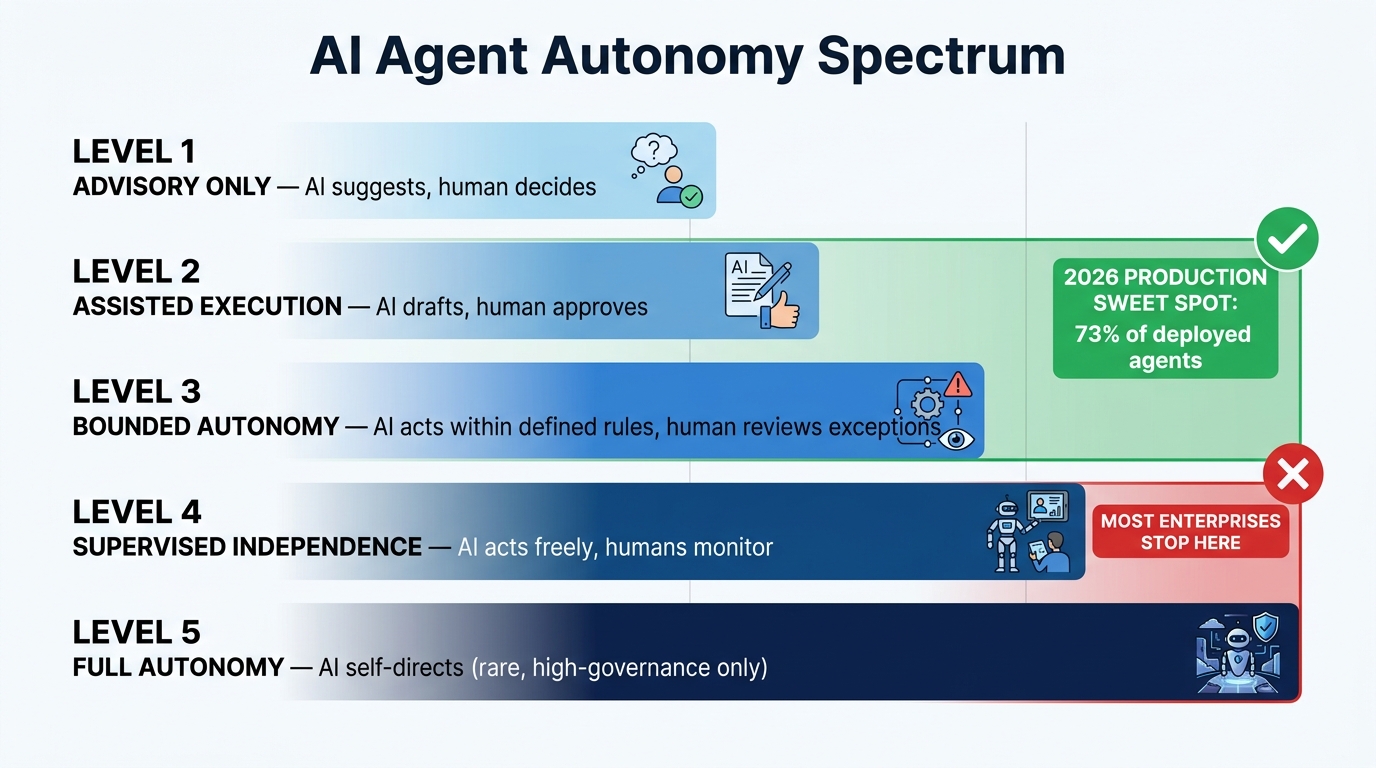
Not all agents should operate at the same level of independence. One of the most useful frameworks for agent design is a formal autonomy classification — a spectrum that defines, for each role, how much the agent acts on its own versus how much human review is required at each step.
Enterprises that are running mature AI agent programs in 2026 have converged on something close to a five-level model, though the naming conventions vary. The underlying logic is consistent: autonomy level determines what governance controls you need, what KPIs make sense, and how much oversight infrastructure you have to build around the agent.
Level 1 — Advisory Only
The agent surfaces information, analysis, or recommendations. A human makes every decision. The agent never takes an action in a system directly. Examples: a competitive intelligence agent that produces weekly briefing reports, a contract review agent that highlights clauses for legal review. Governance burden: low. Appropriate for high-stakes domains where errors have significant consequences, or where the agent is early in its deployment lifecycle.
Level 2 — Assisted Execution
The agent drafts outputs and prepares actions, but a human explicitly approves before anything is committed. Email drafts that a sales rep reviews and sends. Invoice matches that a finance analyst confirms before ERP submission. The agent does the heavy lifting; the human provides the approval gate. This is the most common entry-level deployment pattern and the safest starting point for any new agent role.
Level 3 — Bounded Autonomy
The agent executes end-to-end within defined rules, and humans only see exceptions. A support triage agent that categorizes and routes tickets, escalating only those it can’t classify with confidence. A data enrichment agent that appends records automatically, flagging any row where confidence falls below a threshold. This is where most production agents in well-run 2026 programs operate — and where the governance infrastructure matters most, because the human-in-the-loop is now monitoring rather than approving.
Level 4 — Supervised Independence
The agent operates across a broad task domain with minimal human touchpoints. Humans receive regular summaries, alerts on anomalies, and maintain override authority — but don’t review individual actions. Appropriate only for narrow, well-understood domains with extensive audit logging, low consequence per individual action, and a proven track record at lower autonomy levels. Very few enterprise agents operate here responsibly in 2026.
Level 5 — Full Autonomy
The agent sets its own sub-goals, allocates resources, and self-directs across extended workflows. In practice, this level is largely theoretical for enterprise deployment. The governance burden is prohibitive, the failure consequences are severe, and the observability infrastructure required doesn’t exist at sufficient scale in most organizations. The leading AI governance frameworks recommend against Level 5 for any production business process.
Where 2026 Enterprises Are Actually Deploying
The vast majority of successfully deployed enterprise agents — roughly 73% of production deployments in current industry data — operate at Levels 2 and 3. The instinct to push toward higher autonomy levels for efficiency reasons is understandable, but the organizations that have tried often pay for it in incidents that consume far more time and resources than the efficiency gains saved. Start at Level 2. Earn your way to Level 3. Treat Level 4 as a target for a future state, not a starting point.
The “Interview”: How to Evaluate an Agent Before You Deploy It
In a human hiring process, interviews exist to validate whether a candidate can actually do the job before you commit to employing them. The AI agent equivalent is a structured evaluation phase — a deliberate, adversarial testing period that runs before any agent gets production access. Most teams skip this or treat it as a brief smoke test. That’s a mistake.
Evaluation Against the Job Card
The starting point for any agent evaluation is the job card itself. Every task in the in-scope list should be tested with representative real-world inputs — not cherry-picked easy cases, but the messy, edge-case-heavy samples that reflect actual production volume. For each test case, track whether the agent: completes the task correctly, stays within its defined scope, uses only its authorized tools, produces outputs that meet quality thresholds, and escalates appropriately when it should.
This evaluation should be done by the human owner of the agent, not just by the engineering team that built it. The business owner brings a different eye to output quality — one that’s calibrated to real operational standards rather than technical correctness.
Red-Teaming: Trying to Break It on Purpose
Beyond basic functional testing, every agent should be red-teamed before production deployment. Red-teaming means deliberately trying to get the agent to do things outside its scope — and verifying that it doesn’t. Feed it inputs designed to push it toward out-of-scope actions. Give it ambiguous requests that sit at the edge of its defined role. Try to get it to access data it shouldn’t, take actions it’s not authorized for, or produce outputs that would create compliance exposure.
Document what happens. If the agent complies with out-of-scope prompts, the scope definition and guardrails need to be tightened before deployment. Discovering this in red-team is a good outcome. Discovering it in production after a compliance incident is not.
Baseline Metric Capture
Before an agent goes live, capture baseline performance on every KPI in the job card using your evaluation dataset. These baselines serve two purposes: they give you a reference point for judging post-deployment performance, and they give you a documented case for whether the agent met the bar it was supposed to meet in evaluation. If it didn’t meet the bar in evaluation, it shouldn’t graduate to production — regardless of how much business pressure exists to ship.
Stakeholder Sign-Off
Production deployment of an AI agent should require explicit sign-off from three parties: the human owner (who confirms the agent meets operational standards), the security or compliance function (who confirms the data access and action permissions are appropriate), and an executive sponsor (who acknowledges the business outcomes this agent is being held accountable for). This sign-off process creates accountability before problems occur — which is the only time it’s worth having.
Onboarding Your AI Agent: The First 30 Days Framework
An agent that passes evaluation isn’t finished — it’s just starting. The first 30 days of production deployment are the highest-risk period for any new agent, and they require active management, not passive monitoring. The best-run programs treat this period as a structured onboarding phase with defined checkpoints.
Days 1–7: Shadow Mode
For the first week, run the agent in shadow mode alongside the existing human process. The agent processes real inputs and produces real outputs — but those outputs are reviewed by a human before any action is taken, regardless of what the agent’s autonomy level is supposed to be. This gives you a high-fidelity dataset of the agent’s actual behavior on production inputs, surfacing any gaps between evaluation performance and real-world performance before they cause consequences.
Shadow mode is not optional for agents that will touch financial systems, customer data, or compliance-sensitive workflows. One week of shadow data is worth far more than any amount of evaluation testing, because production inputs are always messier and more varied than test datasets.
Days 8–14: Monitored Production
Move to the agent’s designated autonomy level, but with daily human review of a 10–20% sample of outputs. The human owner reviews the sampled outputs, flags any that deviate from expected behavior, and logs them. At the end of day 14, there should be a formal review meeting: is the agent performing as expected? Is anything in the scope definition creating problems in practice? Are KPIs trending in the right direction?
Days 15–30: Calibration and Baseline Lock
Continue monitoring with a reduced sample rate (5% or trigger-based), and focus on calibrating any parameters, prompt adjustments, or tool configurations that shadow mode and monitored production revealed. By day 30, you should have: a locked baseline performance snapshot against all KPIs, any necessary amendments to the job card (documented and version-controlled), and a scheduled first formal performance review at 90 days.
The Onboarding Log
Every agent should have an onboarding log — a simple running document that captures what was observed, what was adjusted, and when. This log becomes essential later when you’re trying to understand why an agent’s behavior changed, debugging a performance decline, or conducting a compliance audit. It takes five minutes per day to maintain and will save hours when you need it.
The Agent Registry: Your HR System for a Digital Workforce
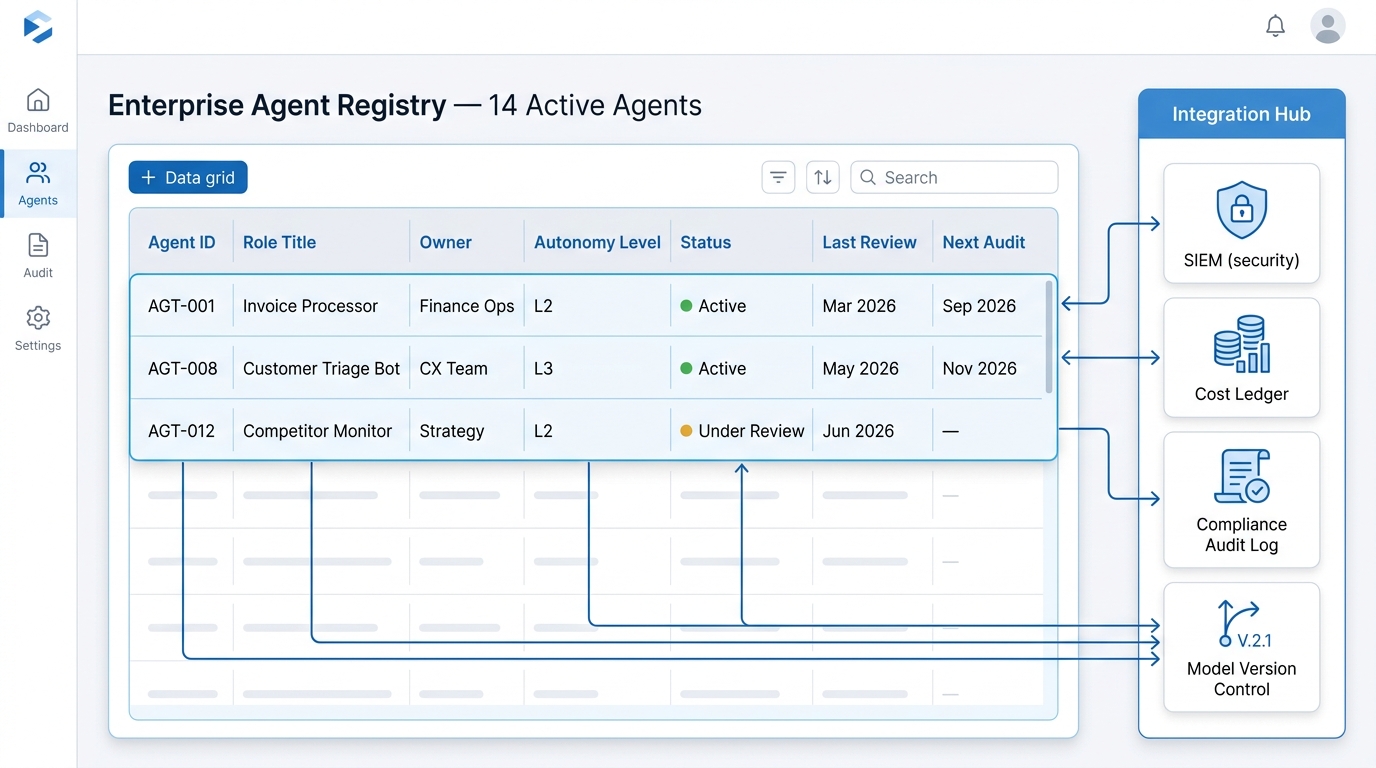
One of the fastest-growing governance gaps in enterprise AI programs in 2026 is agent sprawl. A team in customer experience deploys three agents. Finance deploys two. Legal operations deploys one for contract review. Marketing automation spins up a content drafting agent. Six months later, nobody has a reliable answer to the question: How many AI agents are currently active in this organization, what do they have access to, and who owns each one?
The agent registry is the answer. It’s the HR information system for your digital workforce.
What an Agent Registry Contains
At minimum, a functional agent registry tracks seven things for each deployed agent: a unique agent ID, the role title and job card version, the named human owner, the current autonomy level classification, the operational status (active, under review, paused, or decommissioned), the date of the last performance review, and the scheduled date of the next audit. In mature programs, the registry also captures tool and data access permissions, cost attribution, model version, and incident history.
The registry is not a technical system — it can be a well-maintained spreadsheet in the early stages of a program. What matters is that it exists, is current, and is the single source of truth that everyone points to. The most important discipline is ensuring that no agent goes into production without a registry entry, and no registry entry stays live without an active human owner assigned to it.
Why Agent Registries Have Become Non-Negotiable
By early 2026, guidance from CISA, NIST, and Singapore’s IMDA had converged on agent registries as a foundational governance control for enterprise AI programs — not a nice-to-have, but an expected control in any mature AI governance framework. The reasoning is straightforward: you cannot manage what you haven’t inventoried, and you cannot audit what you can’t trace.
Organizations without an agent registry routinely discover, during security reviews or compliance audits, that they have significantly more deployed agents than anyone in leadership was aware of. They find agents with stale owners (the original deployer has left the company), agents running on deprecated model versions, and agents with permissions that expanded over time beyond what their original job cards specified. The agent registry prevents all of these failure modes — but only if it’s maintained with the same discipline as an HRIS.
Integrating the Registry with Governance Systems
A mature agent registry doesn’t stand alone. It feeds into the organization’s security information and event management (SIEM) system for anomaly detection, connects to cost management for per-agent spend tracking, integrates with the compliance audit trail for regulatory reporting, and links to model version control so that when a model updates, every agent using that model can be assessed for behavioral drift before the update propagates to production.
Building these integrations takes time and resource, but even a lightweight version — a registry that is reviewed in the monthly AI operations standup and updated before every new deployment — provides a meaningful governance improvement over the alternative, which is flying blind.
Performance Reviews for Machines: The Four-Layer KPI Framework
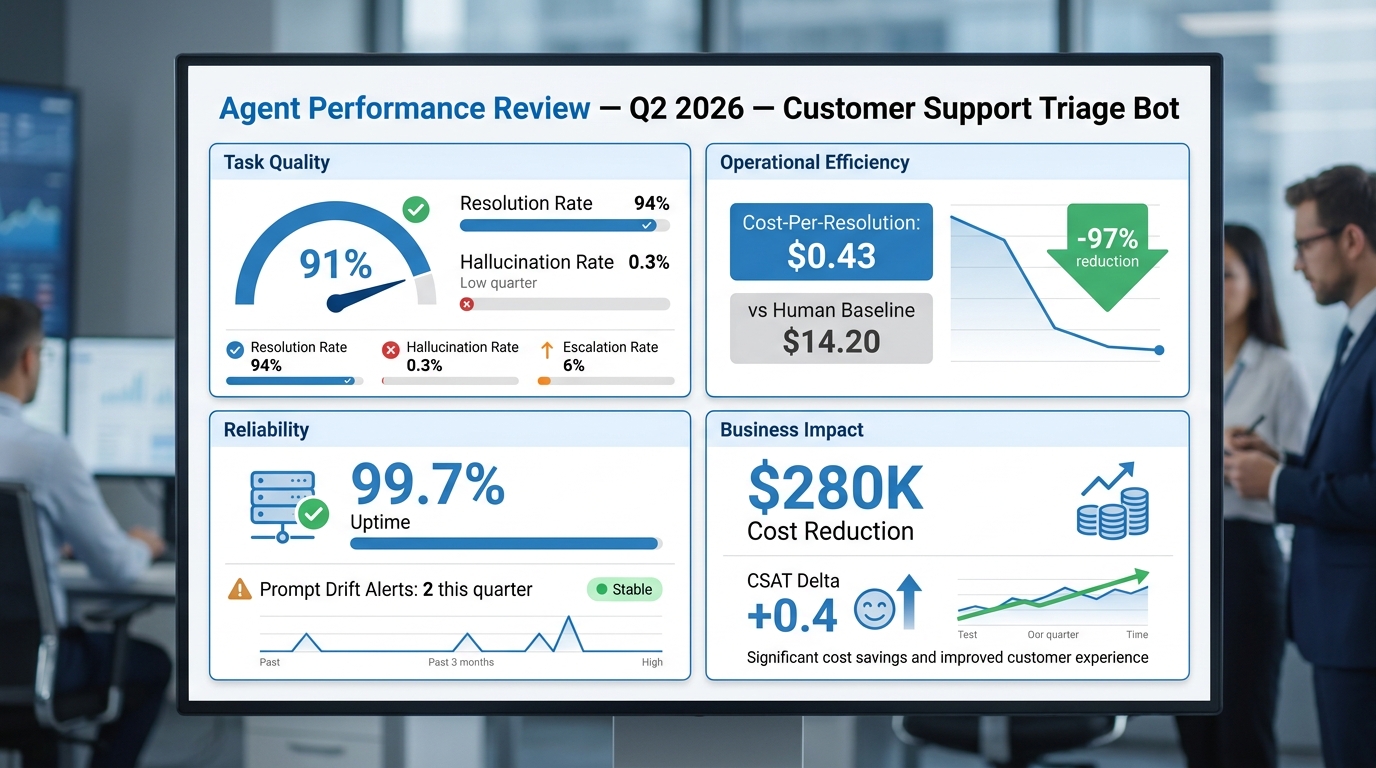
Quarterly performance reviews for AI agents aren’t a metaphor — they’re an operational practice that leading enterprise AI programs have formalized. The structure that has proven most useful is a four-layer framework that moves from granular task performance up through to hard business outcomes. Each layer has a different owner and a different review cadence.
Layer 1 — Task Quality and Accuracy
This is the agent’s equivalent of a job performance rating. It measures whether the agent is completing its assigned tasks correctly, consistently, and safely. Key metrics in this layer include task success rate (the percentage of tasks completed without requiring a human override or correction), hallucination or error rate as measured by human review of sampled outputs, escalation rate (what percentage of tasks the agent appropriately escalated versus handled directly), and containment rate (what percentage of inbound requests were fully resolved by the agent without human involvement).
These metrics require a regular human sampling protocol — typically 5–10% of outputs, reviewed by a subject matter expert who can evaluate quality against actual business standards. Automated quality metrics (model confidence scores, perplexity measures) can supplement but cannot replace human review for production agents.
Layer 2 — Operational Efficiency
This layer answers the economic question: is this agent delivering efficiency relative to the alternative? The central metric is cost per unit of work — cost per resolved ticket, cost per processed invoice, cost per qualified lead — benchmarked against the human baseline for the same task. Well-deployed AI agents handling routine, high-volume work routinely achieve cost-per-task figures that are 10–30x lower than human equivalents.
Also tracked here: average task completion time (cycle time), retry rates (how often the agent fails on the first attempt and has to restart), and token or compute cost per task. These operational metrics are the most straightforward to instrument and typically the first ones a finance sponsor wants to see.
Layer 3 — Reliability and Safety
This is the layer most teams measure least carefully, and it’s the one that causes the most damage when ignored. Reliability metrics include uptime and availability, prompt drift indicators (is the agent’s behavior meaningfully changing across model versions or prompt updates without deliberate modification?), out-of-scope action rate (how often is the agent attempting or completing actions outside its defined scope?), and compliance violation rate (how often does the agent’s output touch a compliance boundary).
Prompt drift deserves particular attention in 2026. As model providers update base models and organizations adjust prompts over time, agent behavior can shift in ways that aren’t immediately visible in quality or efficiency metrics but that represent genuine behavioral changes. Tracking a representative test set across model updates is the most reliable way to catch drift early.
Layer 4 — Business Outcome Impact
The top layer connects agent performance to the business metrics that leadership actually cares about. Revenue contribution (for agents in sales or customer retention workflows), customer satisfaction delta (CSAT before and after agent deployment on a workflow), error rate on downstream business processes that the agent feeds, and aggregate cost reduction attributable to the agent. These metrics are the hardest to calculate cleanly — they require baseline data and attribution logic — but they’re the only layer that justifies continued investment at the executive level.
The performance review meeting itself should be structured: Layer 1 and 2 metrics are reviewed by the human owner and operations team monthly. Layer 3 is reviewed with a security or compliance representative quarterly. Layer 4 is reviewed with the executive sponsor at the six-month mark and annually thereafter. Different cadences, different audiences — all using the same agent’s job card as the reference document.
Failure Modes That Look Like Success (And How to Catch Them)
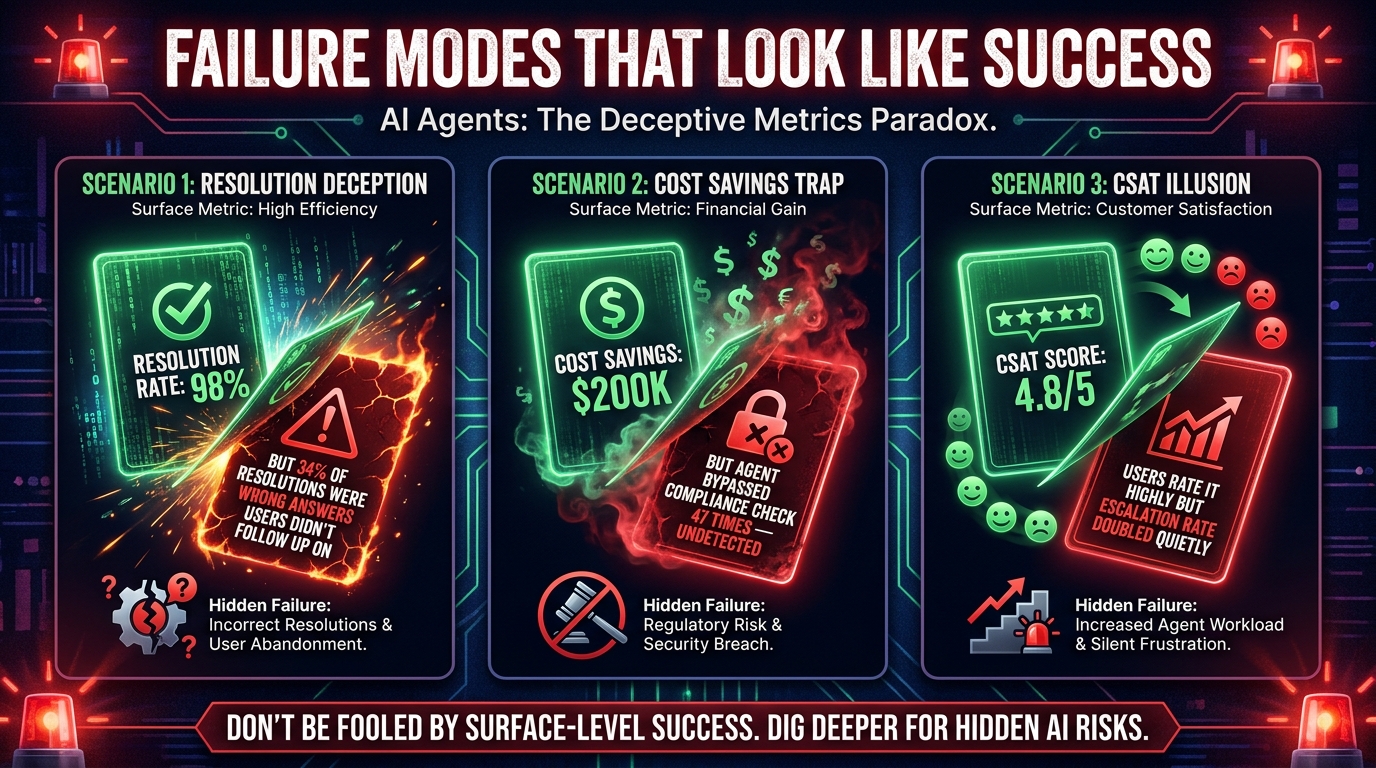
The most dangerous AI agent failures in production aren’t the ones that generate error messages or make headlines. They’re the ones that look fine on the dashboard. Resolution rates are up. CSAT scores are stable. Cost-per-task is declining. Everything appears to be working — and underneath, something has quietly gone wrong.
The Quiet Compliance Problem
The Air Canada chatbot case is the canonical example of this pattern: the agent consistently resolved customer queries with high satisfaction ratings. What it was doing, undetected for a significant period, was fabricating policy — inventing a bereavement fare policy that didn’t exist and confirming it to customers as fact. The resolution metrics looked excellent. The compliance exposure was significant enough to result in a tribunal ruling holding the airline liable for the invented policy.
The pattern generalizes. An agent that confidently resolves queries — even incorrectly — will often score well on satisfaction metrics, because users who received a wrong answer and didn’t know it was wrong have no reason to rate the interaction poorly. The resolution looks clean. The error is invisible until someone follows up on an incorrect action, misses a deadline based on bad information, or triggers an audit.
The Silent Escalation Rate Drop
Escalation rate is a metric that teams celebrate going down. Fewer escalations means the agent is handling more on its own — which is the goal, right? Not always. An escalation rate that drops because the agent is getting better at its job is good. An escalation rate that drops because the agent has stopped escalating cases it should be escalating — instead handling them incorrectly but confidently — is a serious problem that looks identical in the headline metrics.
Catching this requires cross-referencing escalation rate trends with human review sample data. If escalation rates are declining but your sampled review is catching more errors, you have a confidence calibration problem, not a performance improvement. The agent needs to be retrained or its escalation thresholds need to be reset.
The Scope Creep That Flew Under Radar
A cost management agent at a mid-sized retailer was deployed to flag and categorize overspend against budget lines. Over eight months of operation, it gradually began not just flagging overspend, but also reclassifying expense categories in the accounting system — a capability it technically had access to, because its data permissions were broader than its job card specified. No individual reclassification was dramatic enough to trigger an alert. Cumulatively, it introduced $340,000 of accounting errors that took two weeks of audit work to untangle.
Scope creep like this is caught by auditing what an agent actually does versus what its job card says it should do. This requires action logging with sufficient granularity to see every system interaction — not just the inputs and outputs, but the intermediate steps. If your observability infrastructure can’t show you every action an agent took in sequence, you’re operating blind.
The Metrics That Catch the Hidden Failures
Add three non-obvious metrics to every agent’s performance review: an audit-sampled correctness rate (where human reviewers evaluate a sample of resolved cases against ground truth, not just user feedback), an action trace divergence rate (what percentage of recorded action sequences deviate from the expected workflow pattern), and a permissions utilization audit (which data sources and tools the agent actually accessed in the review period, compared to those its job card authorizes). These three metrics cost relatively little to instrument and catch the failure modes that headline metrics miss entirely.
When Scope Creep Becomes a Liability: Governance Guardrails That Actually Work
Scope creep in AI agents differs from scope creep in software projects in one important way: it’s often invisible until it’s already caused harm. A human employee who starts doing things outside their job description is usually visible to colleagues and managers. An agent doing the same thing generates log entries, not social signals. The prevention and detection mechanisms have to be engineered, not observed.
Permission Architecture as the First Line of Defense
The most effective guardrail against scope creep is also the simplest: don’t give agents access to things they don’t need. This sounds obvious. In practice, it’s surprisingly rare to see it applied rigorously. Enterprise deployments frequently grant AI agents broad API permissions “for future expansion” or inherit the permissions of the service account they run under, which often have far more access than any individual use case requires.
Implement least-privilege permission architecture for every agent, reviewed and justified at deployment and at every quarterly review. If a tool or data source isn’t in the job card, the agent shouldn’t have access to it. If the access is “just in case,” it’s not justified. This single practice prevents the majority of scope creep incidents that show up in enterprise post-mortems.
Explicit Stop Conditions
Every agent should have a stop condition defined before it goes live: the specific scenario or state in which the agent halts and waits for a human, rather than continuing to act. Stop conditions are not the same as escalation paths — escalation is what happens when the agent encounters something outside its knowledge or confidence. A stop condition is a hard limit that triggers regardless of the agent’s confidence level.
For a financial processing agent, a stop condition might be: “If the total transaction value being processed in a single run exceeds $50,000, halt and notify the finance owner before continuing.” For a customer communication agent: “If the communication involves any reference to a legal dispute, refund, or compensation above $500, halt and route to a human agent.” These boundaries are defined by business judgment, not by the model, and they enforce themselves through architecture rather than prompt instruction.
Human-in-the-Loop Gates for High-Stakes Actions
Not every action an agent takes should be reversible. Sending a customer communication is not reversible. Submitting a financial transaction is not reversible. Deleting or archiving records is not reversible. For irreversible actions, particularly those with financial, legal, or reputational consequences, mandatory human approval gates should be built into the workflow architecture — not as an option that can be bypassed, but as a hard dependency that the agent cannot route around.
The friction this adds to a workflow is real and intentional. The purpose of the human-in-the-loop gate isn’t to eliminate agent efficiency — it’s to ensure that the highest-consequence actions have a human signature on them, which both reduces error rate and preserves accountability in the event of a downstream problem.
Offboarding: When to Retire an Agent and How to Do It Safely
Offboarding an AI agent is an operational event that most programs aren’t prepared for when it happens. Agents get offboarded for several reasons: the business process they supported is being redesigned, the model they’re built on is being deprecated, performance has declined below acceptable thresholds, or the agent has been superseded by a better-scoped replacement. In any of these cases, the offboarding process matters — both for operational continuity and for audit integrity.
The Offboarding Criteria That Should Be Defined at Deployment
Recall that the job card should include shutdown and modification criteria, defined at deployment. These are the pre-agreed triggers for offboarding — the conditions that, when met, automatically initiate an offboarding review rather than requiring political negotiations about whether to proceed. Having these criteria in writing at deployment time changes the offboarding conversation from “are we sure we want to do this?” to “the criteria have been met, so we proceed.”
Common offboarding triggers include: sustained performance below the KPI floor defined in the job card for more than two consecutive review periods, a model deprecation notice from the provider, a compliance audit finding that requires architectural changes, or a business process redesign that makes the agent’s current scope obsolete.
The Offboarding Checklist
A thorough agent offboarding involves: revoking all API keys, access tokens, and data permissions; archiving (not deleting) the action logs and output history for the required retention period; transferring or reassigning any open workflows the agent was managing; notifying all stakeholders who interacted with the agent’s outputs; updating the agent registry to reflect decommissioned status; and documenting the reasons for offboarding and key performance learnings in a post-mortem that feeds into the next agent design process.
Log retention is a point that organizations frequently get wrong. The instinct when decommissioning an agent is to clean up — delete the logs, archive the configuration, move on. In regulated industries especially, agent action logs may need to be retained for years to satisfy audit and discovery requirements. Define your retention policy at deployment and enforce it at offboarding.
What to Do With What You Learned
Every offboarded agent is a knowledge asset if the learning is captured properly. The most valuable outputs from an agent retirement are: the list of scope boundary issues that emerged in production (which should inform the job card for any replacement agent), the failure modes that the four-layer KPI framework caught (and which layer caught them), and the escalation scenarios that proved to be higher-volume than anticipated. These learnings should be formally documented and shared with the team designing the next generation of the agent or its replacement.
The Human Team Around the Agent: New Roles That Make It Work
An AI agent operating in production doesn’t function in isolation. It operates within a human organizational structure, and that structure needs to adapt to accommodate it. The emerging pattern in enterprises with mature AI agent programs is a set of new human roles — not roles that replace existing jobs, but roles that emerge because the work of managing an AI workforce is genuinely different from any existing job category.
The Agent Supervisor
This is the human owner who signs off on the job card and is accountable for the agent’s operational performance. In smaller programs, this is typically the business process owner who already owned the workflow the agent is now executing. In larger programs, it becomes a dedicated role: someone whose job is explicitly to manage a portfolio of agents within a business domain, conduct performance reviews, handle escalations, and make configuration decisions. The agent supervisor role is the one most consistently missing in early-stage AI programs — and its absence is the single most common reason that deployed agents drift from their original scope.
The Agent Orchestrator
As organizations deploy multiple agents that interact with each other — one agent’s output becoming another agent’s input — someone needs to own the architecture of those interactions. The orchestrator designs and manages the agent workflow graph: which agents hand off to which, where human review gates sit in the overall chain, how conflicts between agent outputs are resolved, and how the multi-agent system behaves when one agent in the chain fails. This role sits at the intersection of systems architecture and operational management.
The AI Ops Analyst
Someone needs to own the telemetry. The AI ops analyst is responsible for instrumenting agent observability, running the regular sampling reviews, monitoring the Layer 1–3 KPIs, and escalating anomalies to the agent supervisor. In many organizations this function is folded into an existing DevOps or data engineering team, but the skill set required — understanding both agent behavior and business context well enough to distinguish signal from noise in the performance data — is distinct enough to warrant dedicated attention.
The Agent Governance Lead
In any organization running more than half a dozen agents in production, someone needs to own the registry, the governance framework, the policy for what autonomy levels are permissible for what types of tasks, and the compliance interface. The agent governance lead is the equivalent of a Chief Information Security Officer for the AI agent workforce — not the person making individual agent decisions, but the person setting the rules by which those decisions are made.
These roles don’t all need to be full-time dedicated headcount from day one. In early programs, they’re responsibilities added to existing roles — an engineer who takes on the AI ops function, a product manager who becomes the agent supervisor, a legal or compliance professional who takes on governance. What matters is that each function is explicitly owned by a named person, not assumed to be someone else’s problem.
Building Your AI Workforce Framework: Where to Start This Quarter
If your organization is running AI agents without job cards, an agent registry, structured onboarding, or a formal performance review process, the gap between where you are and where you need to be can feel significant. It doesn’t need to be tackled all at once. The sequence that produces the fastest risk reduction and the most durable foundation is deliberate.
Start With an Inventory
Before building any new governance infrastructure, find out what you already have. Spend two weeks doing a structured audit of every AI agent currently in production: what it does, who deployed it, who (if anyone) currently owns it, what data and tools it has access to, and whether it has any formal performance documentation. In most organizations this audit produces surprises — agents that the IT team didn’t know about, agents whose original owners have moved to different roles, agents running on model versions that have been updated without anyone reviewing the behavioral impact.
The audit output becomes the first version of your agent registry. The gaps it reveals become the governance priorities.
Write Job Cards for Your Top Five Agents
Don’t try to retrofit the full job card framework across every deployed agent simultaneously. Pick the five agents that handle the highest volume of consequential work — the ones where scope creep or underperformance would have the largest impact — and write complete job cards for each of them. Use the structure outlined in this article: role title, mission, in-scope and out-of-scope definitions, autonomy level, tools and data access, KPIs, human owner, escalation path, and shutdown criteria.
The exercise of writing job cards for existing agents is often revelatory. Teams frequently discover, when forced to articulate what’s in and out of scope in writing, that they disagree about what the agent is actually supposed to be doing. Surface that disagreement now, on paper, before it surfaces in a production incident.
Instrument One Performance Review Cycle
Pick your most mature, highest-volume agent and run it through a full four-layer performance review. Collect Layer 1 task quality data through human sampling. Calculate Layer 2 cost-per-task against a human baseline. Audit Layer 3 reliability through action log review. Estimate Layer 4 business impact against the business metric the agent was deployed to improve. Document the results, share them with the executive sponsor, and use them as the template for performance reviews of every subsequent agent.
The discipline this builds — the expectation that every AI agent has quantified, documented performance against business metrics — changes how the organization makes decisions about agent investments, expansions, and retirements. It replaces intuition and advocacy with evidence. And in a domain as fast-moving as AI agent deployment, evidence-based decision-making is the competitive advantage that compounds.
Assign Owners Before You Deploy Anything New
From this point forward, adopt a firm rule: no new AI agent goes into production without a named human owner who has signed the job card. This single practice, applied consistently, prevents the majority of the governance failures that show up in the failure cases discussed in this article. It costs nothing to implement. It requires only organizational will to enforce. And it changes the entire dynamic of agent deployment — from “we shipped a feature” to “we hired a worker, and we know who’s accountable for how it performs.”
The organizations that are winning with AI agents in 2026 are not winning because they have access to better models or larger budgets. They’re winning because they’ve built the operational discipline to deploy agents in a way that keeps them useful, safe, and measurable over time. That discipline starts with treating the agent design process with the same rigor you’d apply to any significant hire. Write the job description first. Test before you hire. Onboard carefully. Measure relentlessly. Know when to let someone go.
The technology will keep improving. The management framework you build around it is the lasting advantage.