
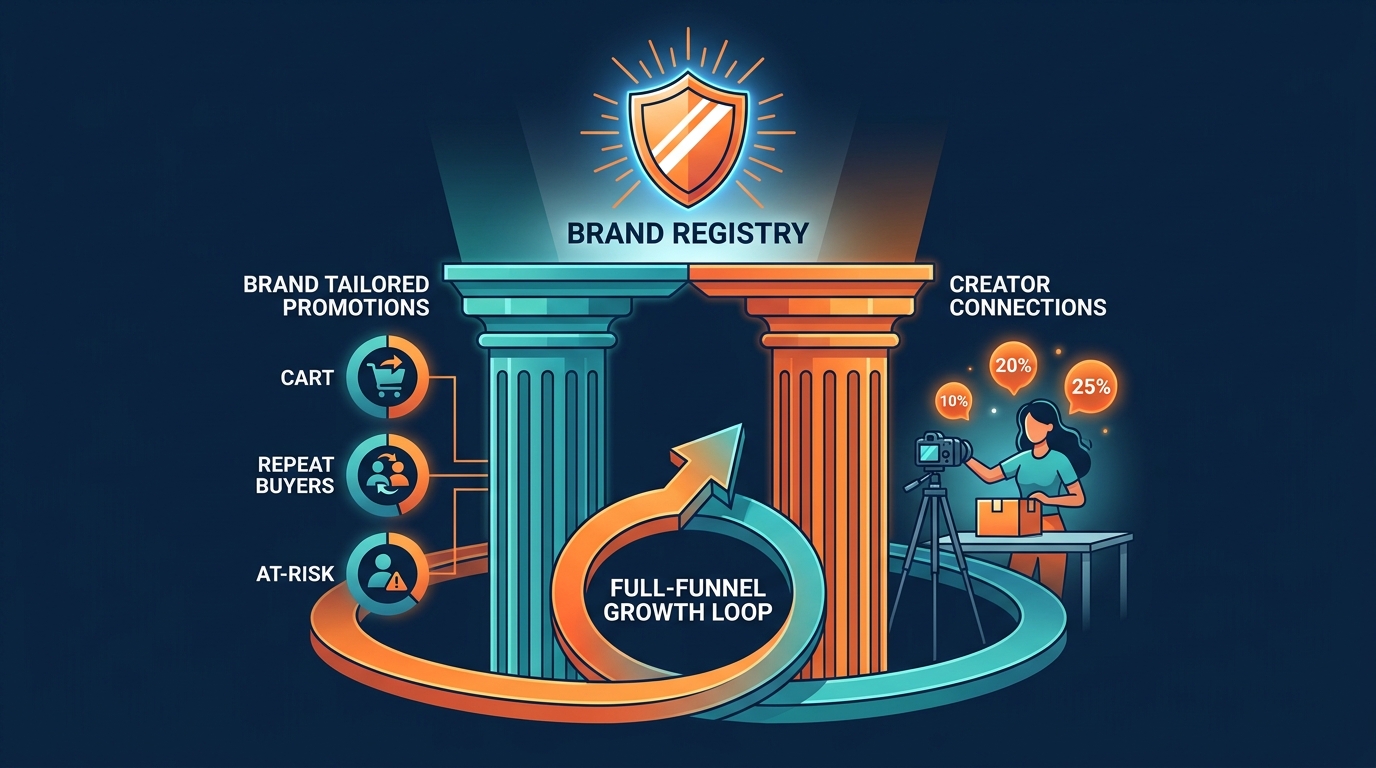

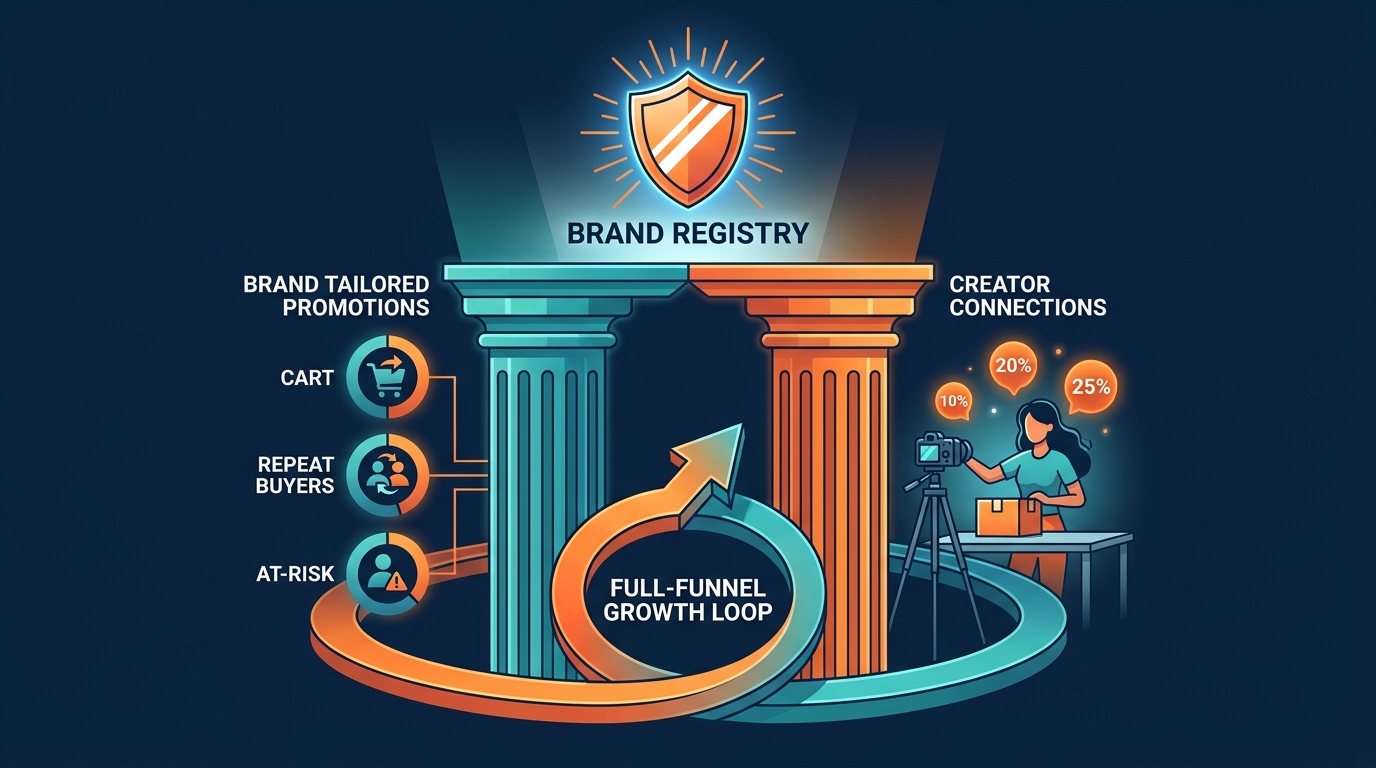
Most Amazon sellers treat Brand Registry as a box to tick — apply your trademark, get the badge, move on. That’s a significant misread of what Amazon actually built here. Brand Registry in 2026 is less a credential and more a layered operating system: brand protection tools running in the background, a suite of analytics most sellers never open, and two promotional programs — Brand Tailored Promotions and Creator Connections — that together form one of the most cost-efficient growth loops available on the platform.
The gap between brands that use these tools passively and those that use them with intention is measurable. Brand Tailored Promotions (BTP) lets you run fee-free, segmented discounts to specific customer cohorts using Amazon’s own first-party behavioral data. Creator Connections lets you run performance-based influencer campaigns where you pay only on attributed sales. Neither requires a media buy. Neither demands an upfront platform fee. But most brands either ignore them entirely or use them in isolation, leaving the compounding effect of running both in sync completely untouched.
This post is a full operational breakdown: what each tool actually does under the hood, how the audience segmentation logic in BTP maps to real customer lifecycle stages, how Creator Connections commission economics work in practice, and — crucially — how to sequence and stack both programs so they reinforce each other rather than run as disconnected experiments. If you’re Brand Registry–enrolled and not actively using both, you’re funding your competitors’ customer retention without realizing it.
The Full Map: What Brand Registry Actually Unlocks
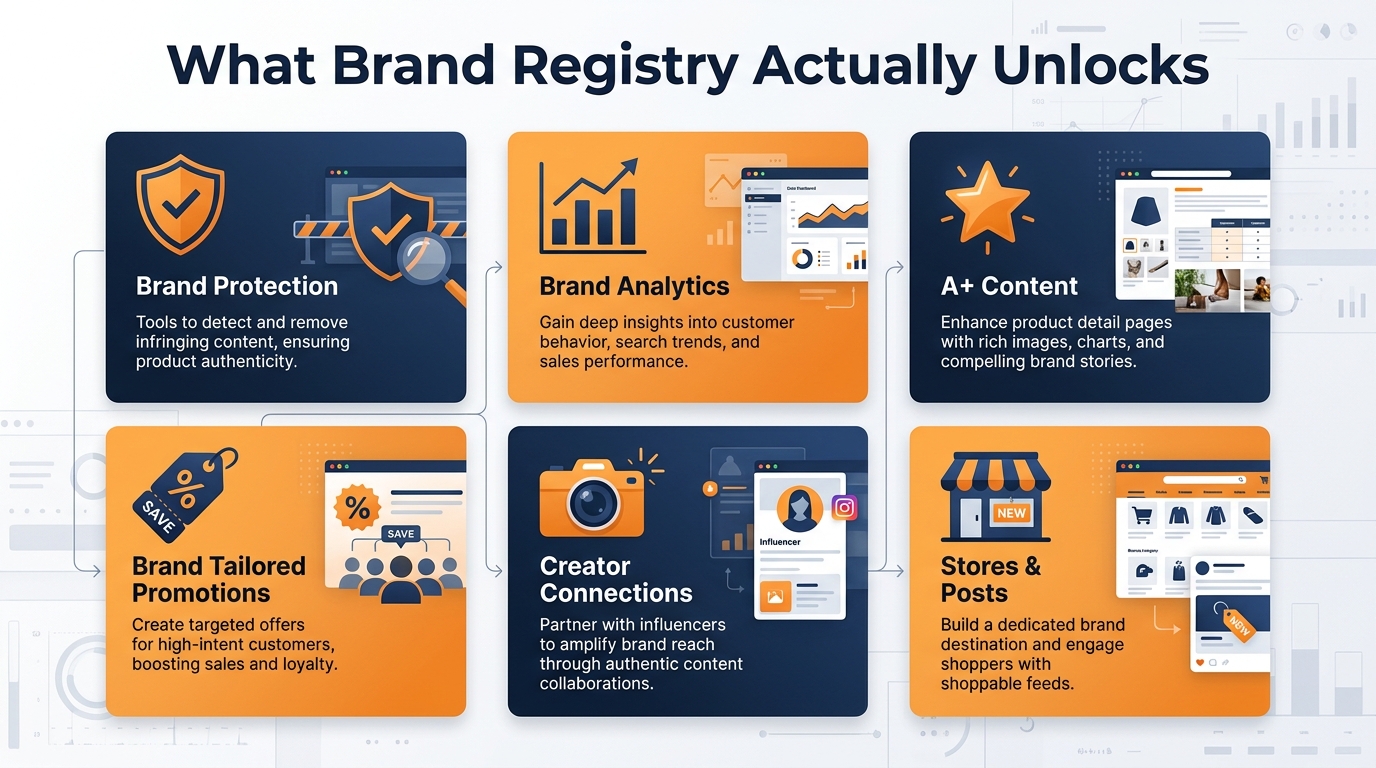
Before going deep on promotions and creator programs, it’s worth anchoring the full picture. Brand Registry isn’t a single feature — it’s an access layer that unlocks a cluster of tools across protection, analytics, content, and marketing. Understanding the full map helps you see how BTP and Creator Connections sit within a larger ecosystem, rather than treating them as standalone features.
Brand Protection: The Background Layer
The protection suite is what most sellers enroll for, and it’s genuinely strong. Amazon’s machine-learning models use your submitted trademark, logo, and listing data to predictively block bad listings before they go live — not just flag them after the fact. The Report a Violation tool gives brand owners a direct IP enforcement pipeline. Project Zero takes this further, granting brands the ability to remove counterfeit listings independently, without waiting for Amazon’s review cycle.
Transparency is Amazon’s product serialization program: each unit gets a unique barcode scanned at fulfillment to verify authenticity before delivery. For brands in high-counterfeit categories — electronics accessories, supplements, beauty — this is the most direct way to close the fake-product loop. These tools run quietly in the background, but they matter commercially: counterfeit and listing hijack activity directly suppresses conversion rates and review quality, which flows into ranking. Protection isn’t just legal hygiene; it’s performance infrastructure.
Content and Storefront Tools
Brand Registry unlocks A+ Content (enhanced product description modules with image carousels, comparison tables, and rich text), Brand Story modules on the product detail page, a full Amazon Store (a multi-page branded microsite within Amazon), and Posts (a social-feed-style content channel visible on product pages and in category feeds). None of these cost anything to run — they’re access-gated, not paid features.
A+ Content consistently shows measurable conversion improvement. Amazon’s own data has cited average conversion lifts in the 3–10% range for listings with A+ versus basic descriptions, though real-world results vary by category and execution quality. The point is that these content features are table stakes: if your Brand Registry–enrolled listing doesn’t have A+ Content, you’re leaving both conversion rate and content quality on the floor.
Analytics: The Underused Engine
Brand Registry unlocks several analytics tools that don’t exist for non-registered sellers: Brand Analytics (search frequency ranking, market basket analysis, item comparison reports, demographics), Search Query Performance (how your ASINs appear and convert across specific search terms), and Brand Metrics (funnel data: awareness, consideration, and purchase rates benchmarked against category peers). These three tools together give you a full-funnel view of how Amazon shoppers interact with your brand — from first impression through to purchase — and where you’re losing them relative to competitors. We’ll return to this analytics layer later because it directly informs how you should set up BTP campaigns.
Brand Tailored Promotions: The Mechanics Behind the Zero-Fee Discounting System
Brand Tailored Promotions is the promotional tool that deserves the most strategic attention right now. The concept is straightforward: run percentage-off discounts that are only visible to specific pre-defined customer segments — not to all shoppers. The discount is your only cost. There’s no listing fee, no placement fee, no CPC charge. Amazon shows your promotion to the targeted audience on search results pages, product detail pages, your Store, and a dedicated promotions shopping page.
How BTP Actually Works Technically
You set up campaigns inside Seller Central’s Advertising console. You select the target audience segment, choose the eligible ASINs (you can target at the ASIN level, not just brand-wide), set the discount percentage, and define the campaign window. Amazon uses its own first-party behavioral data to identify which of your shoppers fall into each segment — you don’t import a list or integrate a CRM. Amazon owns and operates that customer data; you’re just specifying which cohort receives the offer.
This is both a strength and a constraint. The strength: Amazon’s behavioral data is far more granular and reliable than anything a third-party could build from cookie-based tracking. The constraint: you can’t customize who is in each segment — you work with Amazon’s definitions. Understanding those definitions precisely is therefore the most important thing you can do before setting up a single campaign.
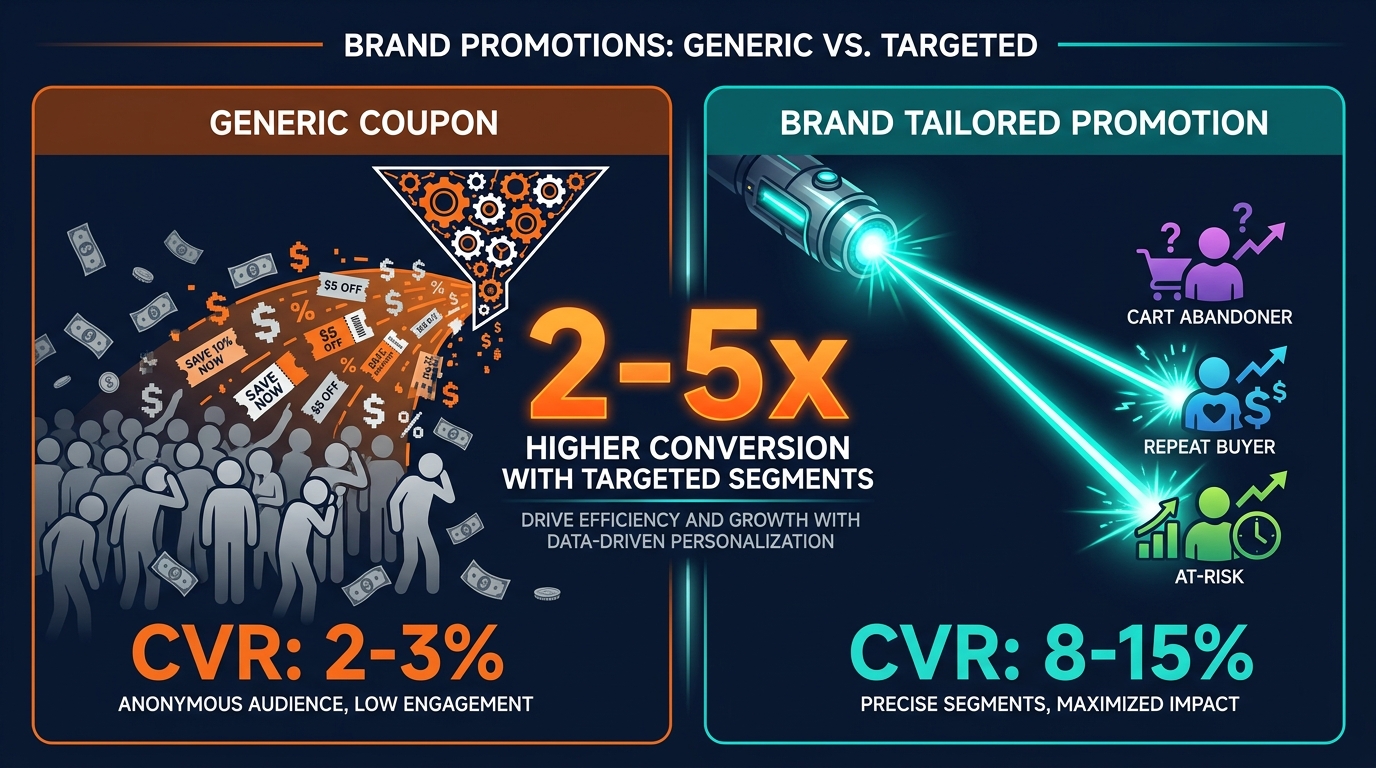
Promotions appear as a visual highlight on the listing — a “promotion available” badge or price strikethrough — but only to the targeted audience. A shopper not in your target segment sees the standard price. This audience-specificity is the key differentiator from a public coupon, which any shopper can clip regardless of purchase history or intent level.
The 2026 Expansion: ASIN-Level and Complementary Targeting
In early 2026, Amazon expanded BTP capabilities in two significant ways. First, ASIN-level targeting became more granular — brands can now segment promotion eligibility down to specific product variants rather than brand-wide. This matters enormously for brands with wide catalogs: you can run a recovery promotion on a slow-moving SKU to cart abandoners of that specific ASIN, rather than blasting a discount across your entire catalog to a blunt audience.
Second, complementary product targeting arrived — the ability to reach customers who purchased or browsed complementary ASINs, enabling cross-sell promotions. If you sell a coffee grinder, you can now serve a BTP discount to customers who recently bought your coffee beans ASIN. This flips the promotional model from retention-only to active cross-sell, which expands the addressable use case considerably.
The Nine Audience Segments — and Which Ones Actually Pay Off
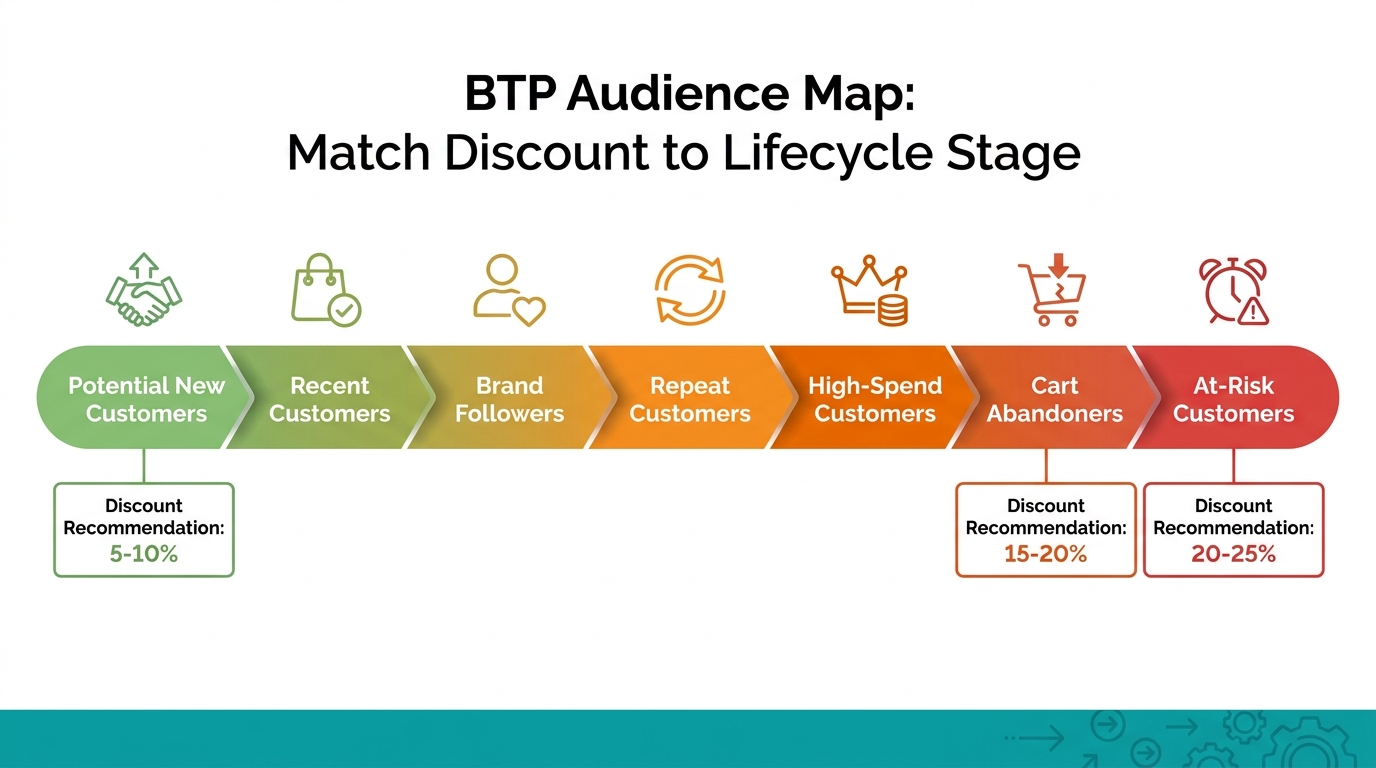
Amazon’s official documentation describes six core BTP segments. Reports from the first half of 2026 indicate up to nine segments are now accessible in practice, depending on brand enrollment level and category. Here’s what each segment means and where smart brands are actually putting their budget.
The Core Six Segments
- Brand Followers: Shoppers who have explicitly followed your brand on Amazon. High intent, already self-selected as fans. This is your lowest-risk segment for small discounts — they’re already engaged. A 5–8% offer here drives purchase velocity without unnecessary margin sacrifice.
- Repeat Customers: Shoppers who have purchased from your brand more than once. These are your most valuable customers by lifetime value metrics. The goal with this segment isn’t deep discounts — it’s reward signals. An exclusive 5–10% “loyalty offer” reinforces brand preference without training them to wait for discounts.
- Recent Customers: Shoppers who purchased from you recently (typically within the past 90 days). The primary use case is cross-sell: get a first-purchase customer to try a second product category. Pair with complementary ASIN targeting for maximum relevance.
- High-Spend Customers: Your top spenders by total order value. Treat this segment like a VIP tier. Exclusive offers here are about retention and reciprocity, not conversion pressure. These customers are least likely to churn but most worth protecting.
- Potential New Customers: Shoppers who have browsed your listings or engaged with your brand content but haven’t purchased. This is your acquisition-adjacent segment — the highest volume, but also the lowest intent. Keep discounts conservative here (5–10%) to avoid margin erosion on customers who might have converted anyway.
- Brand Cart Abandoners: Shoppers who added your product to their cart within the last 90 days but didn’t complete a purchase. This is consistently the highest-performing BTP segment. The commercial intent is already expressed — they wanted it, something interrupted the purchase. Data from early adopters shows cart abandoner campaigns drive 2–5x higher conversion rates than generic coupons. Discounts of 15–20% are the most commonly cited effective range.
The Extended Segments (2026 Additions)
- At-Risk Customers: Previously loyal customers whose purchase frequency has dropped. This is the churn-prevention segment. The discount needed to re-activate these customers is generally higher (20–25%) because they’ve already demonstrated some level of disengagement. The data on this segment is strong — re-activated customers tend to revert to repeat-purchase behavior if the re-engagement offer is timed correctly.
- Complementary Product Purchasers: Customers who bought a related or complementary ASIN (part of the 2026 cross-sell expansion). Useful for multi-product brands where the natural next purchase is predictable.
- Brand Basket Abandoners: Shoppers who had multiple brand products in their cart but didn’t complete the order. A more specific subset of cart abandoners, potentially warranting a slightly higher discount given the multi-product intent signal.
Prioritization Framework
If you’re starting from scratch and want the fastest return on BTP investment, the rank order is: Cart Abandoners first, At-Risk Customers second, Brand Followers third. Cart abandoners are your highest-intent segment with the shortest time-to-conversion window. At-risk customers represent revenue you’re already losing — re-activation cost is almost always lower than new customer acquisition cost. Brand followers are the safest loyalty play. Potential New Customers should be your last segment to activate, not your first, because the conversion uncertainty is highest and the volume most likely to dilute margin.
Discount Depth Strategy: Matching Your Offer to the Lifecycle Stage
The most common BTP mistake isn’t choosing the wrong segment — it’s applying a flat, undifferentiated discount rate across all segments. Discount depth should be a function of two variables: the intent signal strength of the segment, and the margin headroom of the ASIN being promoted.
The Intent-Discount Ladder
Think of it as a ladder where higher intent justifies a larger discount because the probability of conversion is already elevated — your investment in the discount is more likely to be redeemed by a buyer who was going to convert anyway with minimal nudge. But that logic inverts for low-intent segments: offering 20% off to a Potential New Customer who was borderline interested effectively teaches them to expect discounts, erodes perceived brand value, and costs margin unnecessarily.
A practical framework by segment:
- Potential New Customers: 5–10% (minimal nudge, acquisition signal)
- Brand Followers: 5–8% (recognition reward, not purchase pressure)
- Recent Customers: 8–12% (cross-sell incentive)
- Repeat Customers: 5–10% (loyalty acknowledgment)
- High-Spend Customers: 5–10% (VIP signal — don’t over-discount your best buyers)
- Cart Abandoners: 15–20% (high intent, needs a decisive nudge)
- At-Risk Customers: 20–25% (churn prevention, justify the cost against re-acquisition cost)
Margin Math Before You Set Rates
Before configuring any campaign, run your margin math at the ASIN level. BTP discounts come directly off the selling price, so a 20% promotion on a product with a 25% margin leaves you with very thin net economics — especially once FBA fees and ad spend are factored in. For lower-margin products, cap BTP offers at 10–12% regardless of segment. Reserve 20%+ offers for products with enough margin to absorb it while staying profitable. High-margin, low-velocity products (typically consumables, proprietary formulations) are the ideal BTP vehicles at the deeper discount tiers.
Running BTP Without Cannibalizing Organic Conversions
One concern brands raise is whether BTP promotions suppress the perceived value of products that would have converted at full price anyway. The segment specificity addresses this — you’re not discounting the listing publicly. But for the Potential New Customer segment in particular, where the population is largest, monitor your organic conversion rate during active campaigns. If it holds flat or improves, the BTP is additive. If organic CVR drops during BTP periods, that’s a signal the segment overlap with your natural buyer is too high and the discount is displacing full-price conversions.
Brand Metrics and Search Query Performance: The Analytics You Need Before Running Either Program
Neither BTP nor Creator Connections should be launched cold. Amazon’s analytics tools — specifically Brand Metrics and Search Query Performance (SQP) — give you the diagnostic data to set up campaigns with actual strategic intent rather than guesswork.
What Brand Metrics Tells You
Brand Metrics quantifies your brand’s performance at three funnel stages: Awareness (how often your brand appears in relevant search results), Consideration (how often shoppers engage with your listings — views, clicks, cart adds), and Purchase (actual conversion). Critically, it benchmarks each stage against category peers, so you can see whether your conversion problem is a top-of-funnel awareness issue or a bottom-of-funnel hesitation issue.
This distinction directly informs which BTP segments to prioritize. If your Brand Metrics data shows high Awareness but weak Consideration (lots of impressions, low engagement), your problem is listing quality or price perception — not audience targeting. BTP won’t fix that. But if Consideration is strong and Purchase is weak, you have a conversion gap that Cart Abandoner and At-Risk BTP campaigns are designed to close. Run the diagnostic first.
How Search Query Performance Sharpens BTP Targeting
Search Query Performance (SQP) breaks down how your ASINs perform across specific search queries: impressions, clicks, cart adds, and purchases per query. This data tells you which products have the most unfinished purchase journeys — which ASINs are generating cart adds that don’t convert. Those are your highest-priority BTP candidates for the Cart Abandoner segment.
SQP also reveals which queries drive the most top-of-funnel traffic to your brand but the fewest purchases — which informs Creator Connections strategy. If a particular keyword is generating brand awareness but not converting, that’s a creator brief opportunity: content that addresses the specific purchase hesitation associated with that search intent.
Market Basket Analysis for Cross-Sell Targeting
The Market Basket Analysis report inside Brand Analytics shows which products shoppers buy in the same session as your ASINs — both your own and competitors’. This is the most direct input for the 2026 BTP cross-sell targeting feature: it tells you exactly which complementary ASIN pairings Amazon’s data has already validated as natural purchase combinations. Use it to identify which products to pair in a “Recent Customers of ASIN A get 10% off ASIN B” cross-sell BTP campaign.
Creator Connections: How the Program Actually Works
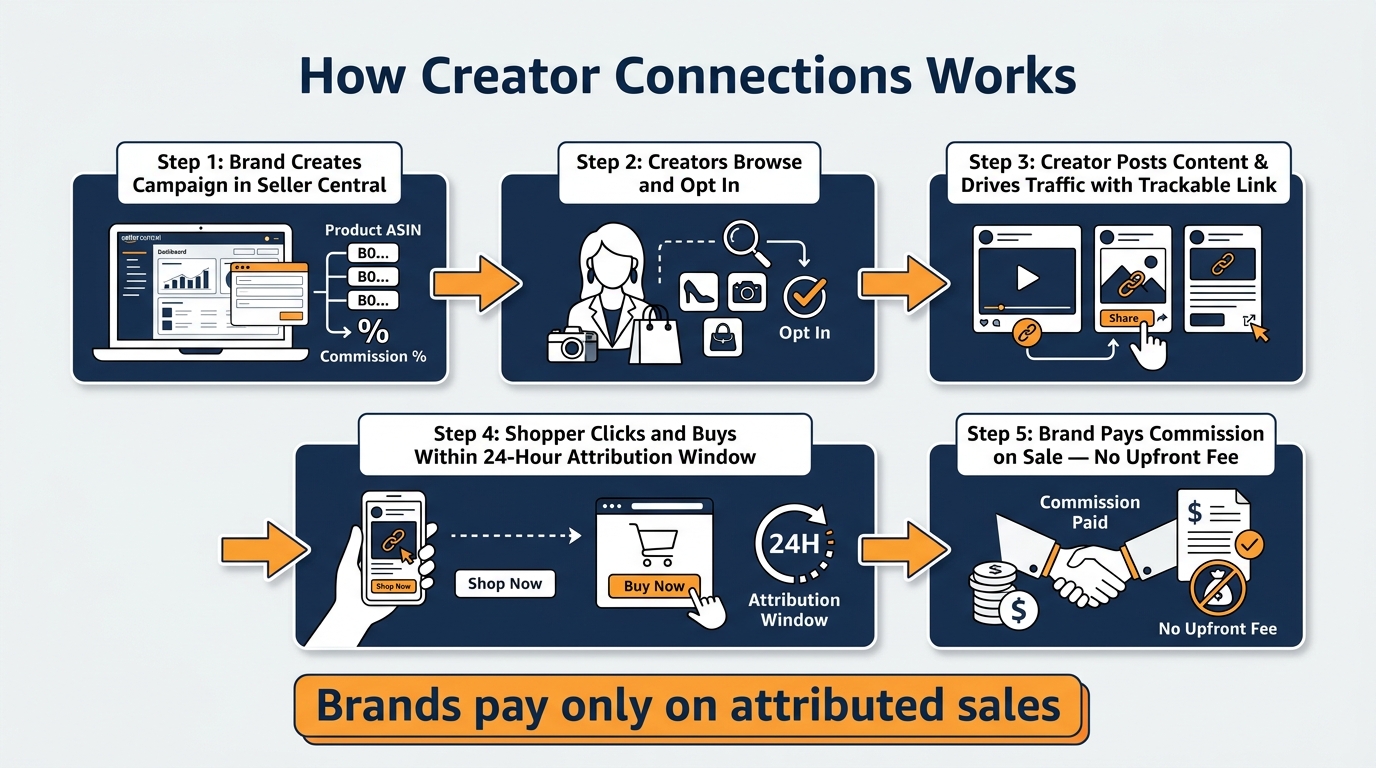
Creator Connections is Amazon’s structured, performance-based influencer marketplace — and it’s architecturally different from traditional influencer marketing in ways that matter for how you approach it.
The Fundamental Structure
A brand creates a campaign inside Seller Central or the Amazon Ads console. You select the eligible ASINs, set a bonus commission rate, define a budget cap, and set the campaign duration. Amazon Influencers and qualifying Amazon Associates then browse available campaigns and opt in to the ones that fit their content focus. When they drive a sale attributed to their link within a 24-hour click window, they earn the bonus commission on top of their standard Associates/Influencer earnings. You pay nothing until a sale occurs. There are no upfront placement fees, no guaranteed minimums per creator, no lock-in.
Amazon requires a minimum 10% bonus commission to list a campaign, and brands need a minimum campaign budget of approximately $5,000. Each campaign can attract up to roughly 800 participating creators, though active participants on any given campaign are typically a much smaller subset — typically 10–25 actively promoting at a meaningful volume.
The Creator Side of the Equation
To understand how to run successful Creator Connections campaigns, you need to understand what creators are optimizing for. Amazon Influencers earn commissions through their storefronts, shoppable videos, and Idea Lists on Amazon — they’re essentially monetizing their audience’s shopping behavior. Creator Connections campaigns represent an opportunity to earn a bonus on products they were potentially already featuring or recommending.
Creators browse campaigns the way you’d browse a job board: they look for commission rates that make financial sense relative to their audience’s likely purchase behavior, products that fit their content niche, and brands they’re comfortable endorsing. A 10% commission on a $12 product generates cents per sale — unattractive. A 20% commission on a $120 product generates $24 per attributed sale — meaningfully different. This math is the first filter creators apply when selecting campaigns.
Content Types and Attribution
Creators can drive traffic to your ASINs via Amazon Storefront pages, Shoppable videos embedded on product pages or in search results, Idea Lists (curated product collections), and external content (social posts, YouTube videos) with Amazon Affiliate links. The 24-hour attribution window applies uniformly — a shopper who clicks a creator’s link and purchases within 24 hours generates the bonus commission, regardless of whether they navigated elsewhere on Amazon between the click and the purchase.
Amazon added Sponsored Content Requests in late 2025, which lets brands proactively request specific content from qualifying creators within a campaign — narrowing the gap between a passive marketplace model and a directed influencer brief. This gives brands more control over messaging alignment without abandoning the performance-only payment structure.
Setting Commission Rates That Actually Attract Good Creators
Commission rate is the single biggest determinant of whether your Creator Connections campaign attracts high-quality, high-volume creators or sits dormant. Most brands set rates based on what they can afford, not based on what the market requires to be competitive. The gap between those two calculations is where campaigns fail.
The Market Rate Reality
The 10% floor is the minimum required by Amazon — but campaigns at 10% largely go unnoticed by experienced creators who have many options. The effective range where campaigns attract consistent creator participation is 15–25%. Niche or high-margin categories (supplements, specialty tools, premium beauty) can run 25–50% because the absolute dollar value per sale is attractive even at higher percentages.
Positioning your commission rate requires thinking in absolute dollar terms, not percentage terms. A 15% commission on a $30 product is $4.50 per sale — low motivation for a creator with significant reach. A 15% commission on a $150 product is $22.50 per sale — worth producing a video for. If your ASIN’s price point is under $30–40, you need to go deeper on percentage (20–30%) to make the per-sale economics attractive enough to compete for creator attention.
Budget Sizing and Campaign Duration
The $5,000 minimum budget is a floor, not a recommendation. The practical budget question is: how many sales can you support at your commission rate before the economics tip negative? If you’re offering 20% commission and your product sells at $50, each attributed sale costs you $10 in creator commission. A $5,000 budget can support 500 attributed sales before being depleted. If your product has a 4-week purchase cycle and you’re targeting 50+ creators, that budget can evaporate faster than you expect.
Set campaign budgets with a monthly horizon and track spend velocity weekly. Most successful brands run Creator Connections as always-on evergreen campaigns rather than short bursts — creators need time to produce content, publish, and generate purchase velocity. A two-week campaign rarely gives the program enough runway to work.
Product Selection Criteria for Creator Campaigns
Not every ASIN in your catalog is suitable for Creator Connections. The highest-performing products share common characteristics: they’re visually demonstrable (creators can show the product being used), they solve a relatable problem (easy for creators to explain the value in a short format), and they have a price point that generates meaningful per-sale commission. Products with very low review counts (<20 reviews) also benefit disproportionately from creator traffic because the social proof from creator content partially substitutes for the missing review volume. Conversely, high-review commodity products where the creator adds little differentiation tend to see weaker results because shoppers already trust the listing enough to buy without external social proof.
The Stacking Strategy: Running BTP and Creator Connections Together
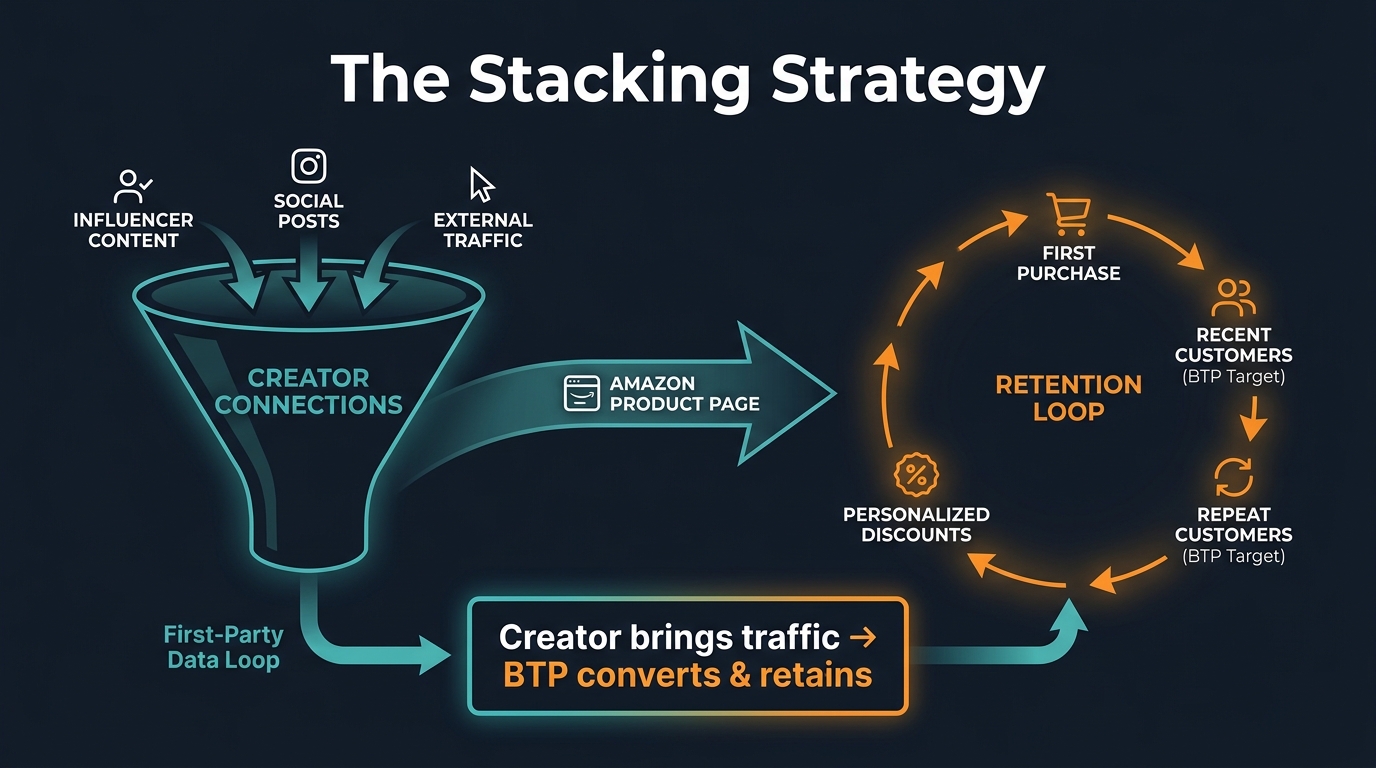
The real leverage in Brand Registry’s promotional toolkit isn’t in running BTP well or Creator Connections well — it’s in understanding how they interact and sequencing them to feed each other. Here’s the mechanism.
How Creator Connections Feeds BTP Audiences
When a creator drives a sale through Creator Connections, that customer enters Amazon’s first-party data ecosystem as a purchaser of your brand. They become eligible for BTP’s Recent Customers segment almost immediately. If they don’t return within a defined window, they become eligible for the At-Risk segment later. If they add a second product to cart but don’t complete the order, they enter the Cart Abandoners segment.
This means Creator Connections is effectively seeding your BTP audience pools. Every creator-driven first purchase is a new entry point into your brand’s retention funnel on Amazon. Without an active BTP strategy, those customers cycle into Amazon’s general recommendations and may buy a competitor’s product next. With an active BTP strategy targeting Recent Customers and Cart Abandoners, you’re using Amazon’s own data to re-engage exactly the people your creator campaigns acquired.
The Practical Sequencing
The recommended sequencing works like this:
- Activate Creator Connections first for your target ASINs — 4–8 weeks minimum before expecting meaningful volume.
- Monitor the Brand Metrics funnel during this period. As creator traffic increases, watch for rising Consideration and Purchase rates in Brand Metrics. That’s confirmation the creator traffic is converting, not just clicking.
- Launch BTP for Recent Customers at the 4–6 week mark — this is when your creator-acquired buyers are fresh enough to be in the Recent Customers window and warm enough to respond to a cross-sell or repeat-purchase offer.
- Add Cart Abandoner and At-Risk BTP campaigns at the 8–10 week mark, when the cohort of creator-acquired buyers who didn’t repurchase becomes large enough to be meaningful.
- Run Market Basket Analysis at 90 days to identify which product pairings are emerging from creator-driven buyers, and build cross-sell BTP campaigns around them.
Why This Beats Running Either Tool Alone
Creator Connections alone is a traffic driver — it gets new buyers to your listing, but the conversion economics depend entirely on listing quality, reviews, and price competitiveness. BTP alone is a retention tool — it’s powerful for existing customer cohorts but has limited ability to grow the raw size of those cohorts. Together, Creator Connections continuously refreshes the pool of customers BTP can target, and BTP monetizes the lifetime value of the buyers Creator Connections brings in. The combination produces a compounding effect that neither tool achieves independently.
For brands with existing customer bases, the loop runs in the opposite direction too: BTP campaigns that re-activate At-Risk customers generate new purchase signals that can re-qualify those customers for Creator Connections campaigns featuring complementary products. The data flows both ways.
Measuring What Actually Matters: KPIs for Both Programs
Running these programs without the right measurement framework leads to premature conclusions — either killing campaigns that were working on a lag, or continuing campaigns that look active but are driving zero incremental value.
BTP Measurement
Amazon’s BTP dashboard reports three primary metrics: Sales, Spends, and Redemptions. Redemptions tells you how many customers used the promotion. Sales tells you the revenue associated with those redemptions. Spend is the total discount cost (redemptions × discount amount per unit).
The metric most brands neglect is incrementality — whether the promoted sales are genuinely additional revenue or would have occurred at full price anyway. The cleanest way to test this is to alternate BTP campaigns on and off for the same segment over 2-week windows and compare conversion rates during on vs. off periods. If CVR during the BTP-on window is materially higher than CVR during the off window for the same audience, the campaign is driving incremental purchases. If they’re flat, the promotion is discounting sales that were going to happen regardless.
For at-risk customer segments specifically, track 90-day repurchase rate for customers who redeemed a BTP offer versus those who received no offer. Re-activation rate is the most meaningful long-term signal for whether your at-risk campaigns are genuinely restoring customer lifetime value or just generating one discounted repeat transaction.
Creator Connections Measurement
Creator Connections reports Spend, Sales, Orders, and Clicks within the campaign portal. The primary efficiency metric is ROAS (return on ad spend, where “ad spend” is the total commission paid). Published benchmarks from practitioners typically show 2–5x ROAS for well-structured campaigns, with standout cases exceeding 10x on high-margin, high-price products.
Beyond raw ROAS, watch creator-level attribution data closely. Most campaigns find that a small number of creators (often 3–5 out of 20+ active participants) drive 80%+ of attributed sales. Identify those high-performers early and, where possible, move to a deeper relationship: send product samples, provide early access to new ASINs, and consider offering higher commission rates for exclusive or priority promotion. Creator Connections is the starting point; the high-value relationship is built outside the platform after you’ve identified who’s actually moving product.
Combined Program Metrics
Track the following at the brand level monthly:
- New-to-brand customer rate from Creator Connections: Available in the Brand Analytics New-to-Brand data within sponsored ads reporting (approximate proxy — not directly in Creator Connections UI)
- 90-day repeat purchase rate for Creator Connections customers vs. organic customers: Gives you the lifetime value comparison between creator-acquired and organic buyers
- BTP redemption rate by segment: Track which segments are actually engaging with promotions versus which are generating impressions without redemptions
- Blended ROAS across both programs combined: Total (BTP discount cost + Creator Connections commission spend) ÷ Total attributed incremental revenue
Common Mistakes That Kill Results in Both Programs
The mechanics of BTP and Creator Connections are relatively straightforward. The failures are almost always strategic or operational.
BTP Mistakes
Running BTP without first optimizing the listing. BTP drives targeted shoppers to your detail page — but if the listing has low reviews, weak images, or a confusing title, the promotion drives traffic that still doesn’t convert. Fix the listing before amplifying traffic to it with any promotion, including BTP.
Discounting high-intent segments unnecessarily. High-Spend Customers and Repeat Customers often don’t need a 20% offer to repurchase — they were going to buy again anyway. Running deep discounts on these segments is effectively giving away margin to your most loyal buyers. Keep loyalty offers to your highest-margin products and keep discount depth modest (5–10%) for these cohorts.
Setting and forgetting. BTP campaigns need regular review. Customer segment compositions shift — a “Recent Customers” segment from 6 months ago is a different behavioral cohort than one populated last week. Campaigns need to be reviewed and refreshed every 60–90 days to remain relevant and margin-efficient.
Not coordinating with ad campaigns. Running BTP Cart Abandoner campaigns while also running broad retargeting Sponsored Display ads against the same audience creates redundant spend. Coordinate BTP segments with your advertising team or account — decide which program owns re-engagement for each audience bucket to avoid doubling up on promotion costs.
Creator Connections Mistakes
Setting a 10% commission rate and wondering why no one joins. The minimum is not the market rate. If your campaign sits at 10% on a mid-price product and hasn’t attracted meaningful participation after two weeks, raise the rate. The incremental commission cost is almost always lower than what you’d spend on a PPC campaign to drive equivalent traffic.
Treating Creator Connections as a short-term launch tactic. Creator-driven content takes time to accumulate — videos get indexed, Storefronts build traffic, Idea Lists compound in discovery. Campaigns that run for less than 60 days rarely have enough time for the content ecosystem to build momentum. Budget for a 90-day minimum window.
Selecting products with thin listing content. Creators producing shoppable video content will naturally reference your listing’s images, title, and features. If the listing has only one main image and a sparse bullet point description, creators have less material to work with — and shoppers clicking through from creator content will encounter a listing that doesn’t match the quality of the creator’s endorsement. Strong A+ Content and premium images are prerequisites for Creator Connections campaigns, not afterthoughts.
Ignoring the Sponsored Content Request feature. Brands that use Sponsored Content Requests to give creators clear briefs — specific use cases to highlight, specific claims to emphasize, specific competitors to distinguish from — consistently see better content alignment and higher conversion from that content. Don’t rely on creators to guess what messaging will convert your specific audience.
Putting It All Together: A 90-Day Activation Checklist
For brands that are Brand Registry–enrolled but haven’t activated both programs, here’s a practical 90-day roadmap:
Days 1–14: Diagnostic and Preparation
- Pull Brand Metrics data — identify your weakest funnel stage (Awareness, Consideration, or Purchase)
- Run Search Query Performance report — identify ASINs with high cart-add rates but low purchase rates (prime BTP candidates)
- Run Market Basket Analysis — identify natural cross-sell pairs for future BTP campaigns
- Audit listing quality on target ASINs — confirm A+ Content, 6+ images, and strong bullet copy are in place before any campaign launches
- Calculate per-sale margin on target ASINs at varying discount depths (10%, 15%, 20%) to define your discount ceiling
Days 15–30: Creator Connections Launch
- Select 2–3 ASINs that are visually demonstrable, have strong reviews (>4.2 stars), and generate meaningful per-sale commission at competitive rates
- Set commission rate at 15–20% (higher if price point is under $40)
- Fund campaign with at least a 90-day budget horizon
- Draft a creator brief using the Sponsored Content Request feature — specific use cases, key differentiators, brand tone
- Begin weekly monitoring of creator participation rates and early click data
Days 30–60: BTP Launch
- Launch Cart Abandoner BTP campaign first — highest priority, fastest return
- Launch Brand Followers campaign at conservative discount (5–8%) to establish the habit of monitoring BTP results
- Set 30-day campaign windows with explicit review dates in your calendar
- Begin tracking BTP Redemptions and Sales versus non-BTP CVR baseline
Days 60–90: Optimization and Stacking
- Add Recent Customers BTP campaign targeting creator-acquired buyers with cross-sell offer
- Identify top 3–5 Creator Connections performers — consider direct outreach for deeper relationship
- Add At-Risk Customer BTP campaign if cohort size is meaningful (check segment size in BTP setup)
- Review blended ROAS across both programs — reallocate budget toward highest-performing combination
- Run Market Basket Analysis again with creator-period data included to identify emerging cross-sell patterns
The Bigger Picture: Why These Tools Have More Staying Power Than Most Amazon Promotions
Most Amazon promotional mechanics are zero-sum or race-to-the-bottom by nature: coupons train buyers to discount-shop, PPC bids inflate as more advertisers pile in, and external traffic promotions are hard to measure and harder to scale. BTP and Creator Connections are structurally different.
BTP uses first-party behavioral data that only Amazon possesses — no external platform can replicate the audience precision of a Cart Abandoner or At-Risk segment built from Amazon’s actual transaction history. This data moat means the tool doesn’t commoditize the way keyword-based advertising does. The brand with the best BTP strategy beats the brand with the highest ad budget, which is a more durable competitive advantage.
Creator Connections operates on a performance-only model that scales with results rather than with spend — the commission structure means your creator marketing cost is inherently tied to revenue generated. Compare this to traditional influencer contracts where you pay a flat fee regardless of sales outcome. The performance alignment fundamentally changes the risk profile of influencer marketing for brands on Amazon.
Neither program requires significant technical sophistication or a large team. A solo brand operator or a small agency can manage both programs effectively with the right measurement approach and enough patience to let campaigns build momentum. The tools aren’t exotic — they’re just consistently underused. The brands running BTP and Creator Connections in 2026 aren’t doing something complicated. They’re simply doing what Brand Registry makes possible, systematically.
Conclusion
Amazon Brand Registry was never just about trademark protection and A+ Content. In 2026, it’s the access layer to two of the most capital-efficient promotional programs available on any marketplace: Brand Tailored Promotions, which lets you reach your own customer segments with zero media fee, and Creator Connections, which builds a performance-based creator ecosystem where you pay only for results.
The strategic insight isn’t about either program in isolation. It’s that Creator Connections continuously populates the audience segments that BTP targets, and BTP systematically maximizes the lifetime value of every buyer Creator Connections brings in. Run together and sequenced correctly, the two programs form a self-reinforcing growth loop that improves with scale rather than plateauing.
The diagnostic comes first: use Brand Metrics to understand where your funnel is leaking, and Search Query Performance to identify which ASINs have the most unfinished purchase journeys. Build Creator Connections campaigns around demonstrable products with competitive commission rates and clear briefs. Then layer BTP behind it — Cart Abandoners first, At-Risk second, loyalty segments third. Review every 60 days. Track incrementality, not just redemptions. Identify your high-performing creators and build those relationships beyond the platform.
The brands winning on Amazon in 2026 aren’t outspending their competitors on PPC — they’re building retention systems that make customer acquisition costs compound rather than stack. Brand Registry gives you the infrastructure. BTP and Creator Connections give you the mechanism. What you do with both is the only variable left.