



Here is the uncomfortable truth most vendors won’t put in their pitch decks: approximately 79% of enterprises have deployed AI agents in some form in 2026, but only around 11% are running them in production. The gap between those two numbers is not a model problem. It is not a data problem. It is not even a budget problem.
It is a playbook problem.
The teams that successfully crossed from “agent that demos well in a sandbox” to “agent that runs reliably in a live workflow” share one consistent trait: they wrote down exactly how the agent was supposed to behave before they gave it any autonomy. They defined the triggers, the boundaries, the tools it could use, the actions that required human sign-off, the metrics that would tell them it was working, and the conditions under which it would be shut down. They built a playbook — a formal operational document — before they built a production system.
The teams that did not do this burned 6–18 months on brittle automations, escalation paths that went nowhere, agents that hallucinated actions with real-world consequences, and stakeholder trust that took years to rebuild.
This article is for the ops leads, platform engineers, and COOs who already have agents running — or who are about to run them — and who need a structured framework for writing agent playbooks that hold up in production. Not theory. Not a vision for where AI is going. A working operating model for the agents you are responsible for today.
We will cover the anatomy of a production-grade agent playbook, how to select the right workflows, what tool contracts actually are and why they matter, how approval gates and escalation paths are designed to be used rather than bypassed, the three-phase rollout pattern most reliable teams use, how agent sprawl emerges and how to contain it, what metrics actually tell you whether your agent is performing, and how the AgentOps function is structured in organizations that are getting this right.
Why Your Agents Don’t Have a Playbook (And Why That’s the Real Problem)
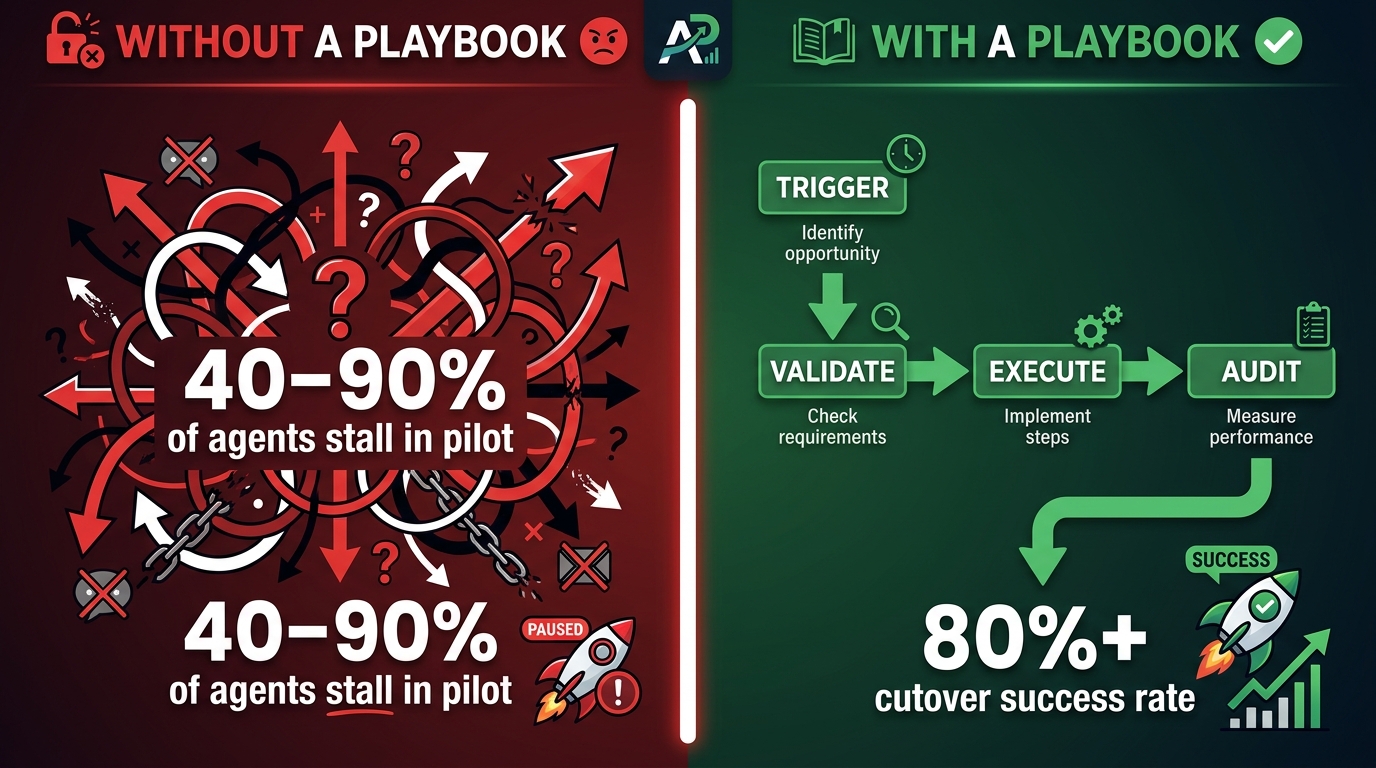
The dominant failure mode for agentic AI in 2026 is not that the model makes wrong decisions. It is that the agent was never given a proper operating procedure in the first place. Research across enterprise deployments this year finds that 40–90% of agentic AI projects either stall in pilot or get cancelled before they reach reliable production. The reasons cluster into four categories: missing guardrails, bad process design, weak integration, and no clear ROI linkage.
What unites all four? The absence of a structured playbook.
How agents end up running without playbooks
The path is almost always the same. An engineering team or a business unit sees a compelling demo. A model gets connected to a few tools. The agent works surprisingly well in testing. Someone gives it a green light to run on real data. Then the edge cases arrive — and there is no documented decision tree for what happens when the agent encounters a vendor record that does not match its expected format, or when the confidence score is ambiguous, or when the action it wants to take requires permissions it was not supposed to have.
Without a playbook, the agent either fails loudly (which is recoverable) or continues operating in a degraded state while producing incorrect outputs that compound over time (which is not). The Microsoft red-team findings from early 2026 identified human-in-the-loop bypass, prompt injection, and session contamination as the most frequent failure modes in deployed systems — all of which are downstream consequences of not defining operating boundaries upfront.
The cultural resistance to writing playbooks
Most ops teams understand that they need operational documentation for their human-run processes. But there is a persistent assumption that AI agents are somehow self-governing — that the model’s intelligence will compensate for the absence of structure. This assumption is wrong, and it is costing organizations significantly.
Agents are not self-governing. They are context-dependent systems that behave differently when inputs deviate from their training distribution, when tool calls return unexpected schemas, when retries fail to preserve state, or when multiple agents operating in the same environment produce conflicting actions. A playbook is the mechanism by which an ops team encodes its operational knowledge into the system — not as a constraint on intelligence, but as the framework within which intelligence can operate safely.
What changes when you write the playbook first
Teams that adopt a playbook-first approach — writing the operating procedure before connecting any tools or deploying any model — report materially better outcomes. Shadow mode agreement rates exceed 85–94% in properly scoped deployments. Rollout success rates jump to 80%+. Mean time to resolution drops 30–60% in IT operations, and first-contact resolution rates for customer support agents improve by 20–40 percentage points. These are not model improvements. The same models, with better playbooks, produce dramatically different production results.
The Anatomy of an Agent Playbook: What It Contains vs. What Most Teams Skip
An agent playbook is a formal operational document that defines how an AI agent behaves under normal conditions, abnormal conditions, and boundary conditions. It is not a system prompt. It is not a README file. It is the agent equivalent of a standard operating procedure — and like any good SOP, it needs to be tested, versioned, and owned.
The six core sections every playbook needs
1. Outcome definition. A single, unambiguous statement of what the agent is supposed to accomplish, in what timeframe, and by what measure. “Triage inbound IT support tickets by priority class within 90 seconds of receipt, with a misclassification rate below 3%.” Not “help with support tickets.” The outcome definition is the north star against which every other playbook element is evaluated.
2. Trigger conditions. The exact signals that start an agent run. Trigger conditions should be binary and deterministic — either the condition is met or it is not. Ambiguous triggers (“when a ticket seems urgent”) are the single most common source of agent misbehavior in production. Triggers should specify the data source, the exact field or event, the threshold or pattern, and any pre-conditions that must be true before the trigger fires.
3. Permitted actions and tool contracts. An explicit list of what the agent is allowed to do, structured as typed contracts with input schemas, output schemas, error behaviors, and rate limits. This section should also define what the agent is expressly prohibited from doing — and how those prohibitions are enforced technically, not just stated as policy.
4. Approval gates and escalation paths. The specific conditions under which the agent must pause and hand off to a human, the escalation routing logic, the maximum wait time before fallback, and what the agent does if a human does not respond within that window. This section often gets stripped out to reduce friction — which is exactly when catastrophic failures occur.
5. Failure modes and rollback procedures. What happens when a tool call fails. What happens when state is lost across retries. What happens when the agent reaches a decision point it cannot resolve. Rollback procedures need to be documented and tested — not invented under pressure during an incident.
6. Observability and audit requirements. Every action the agent takes should produce a structured log entry. The playbook should define what must be logged, how logs are stored, retention periods, and which events trigger alerts to the AgentOps team. Audit trails are not a compliance add-on — they are the primary mechanism for diagnosing failures and proving to stakeholders that the agent is behaving as specified.
What most teams skip — and pay for later
In practice, most teams write a rough version of sections 1, 2, and 3, then skip directly to deployment. The sections they skip — approval gates, failure modes, and observability — are precisely the ones that matter most when things go wrong. And in production, things always eventually go wrong. The question is whether you have a written procedure for handling it or you are improvising.
Workflow Selection: The Criteria That Separate Production-Ready Candidates from Time Wasters
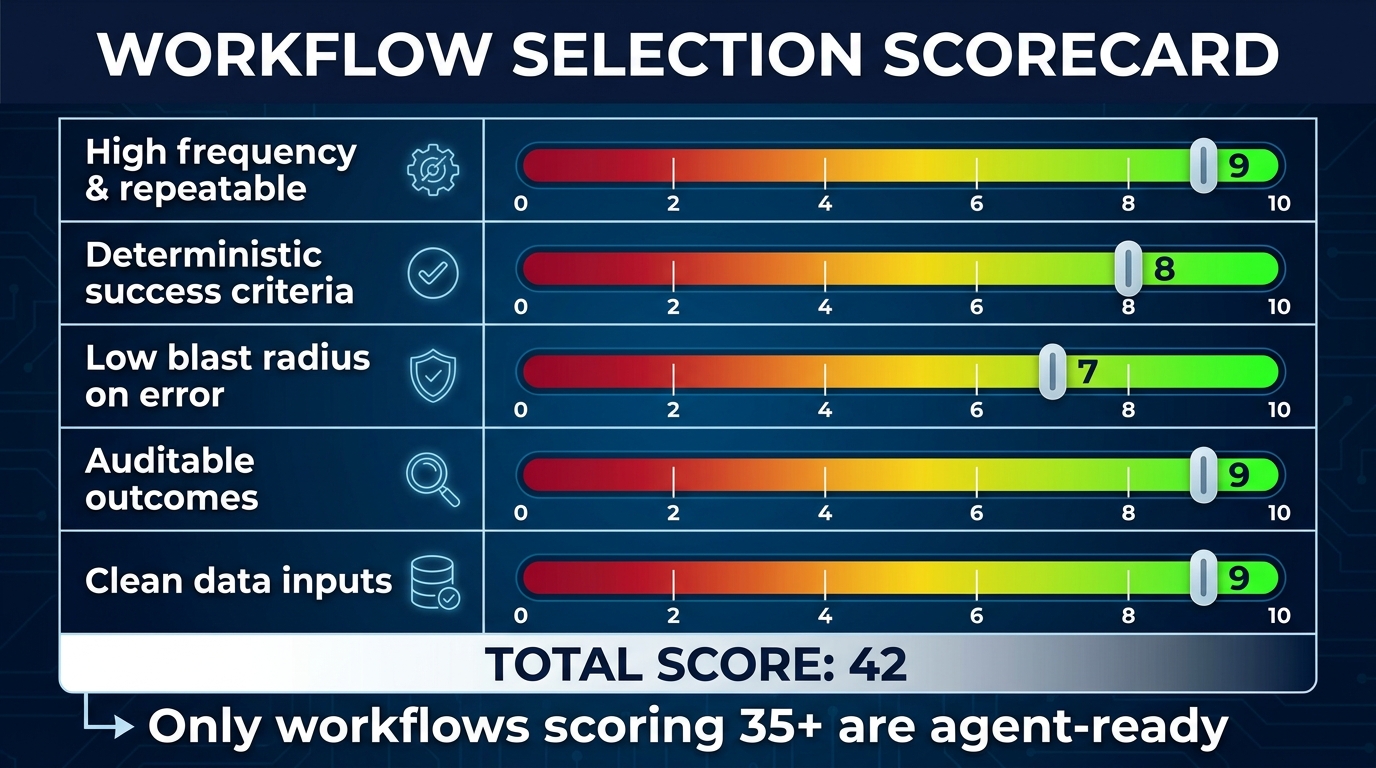
Not every workflow is a good candidate for an AI agent. One of the most expensive mistakes ops teams make is selecting high-visibility, high-complexity workflows for their first agent deployments — exactly the cases where brittle automations cause the most damage. The playbook discipline that matters most before you write a single line of agent logic is workflow selection.
The five-criteria scorecard
High frequency and repeatability. Workflows that run daily or weekly across dozens or hundreds of instances are the best candidates. The economics of agent automation are worst for low-volume, low-frequency work — the overhead of playbook design, testing, and governance does not pay back unless the workflow runs at scale. Ticket triage, invoice matching, report generation, quality assurance checks, and contract routing are high-frequency. Board presentation preparation is not.
Deterministic success criteria. You need to know, from the output of the workflow, whether the agent succeeded or failed — without relying on human judgment to make that call. If the success condition requires subjective assessment (“was this response good?”), you cannot measure agent performance reliably, and you cannot gate your rollout on objective thresholds. Workflows with deterministic success criteria include: correctly routing a ticket to the right tier, correctly extracting an invoice field, correctly flagging a contract clause for review. Workflows without them include: drafting creative copy, resolving a nuanced customer complaint, or producing a strategic recommendation.
Low blast radius on error. The agent should be able to make a mistake without that mistake propagating through multiple downstream systems before anyone notices. This rules out workflows where a single incorrect action triggers irreversible commitments — financial transactions above defined thresholds, customer-facing communications sent without review, or data deletions without backup. The best early-stage agent candidates are workflows where errors are caught quickly, are easy to reverse, and affect a limited scope.
Auditable outcomes. Every action the agent takes in this workflow should leave a traceable record. Workflows that operate on structured data with clear system-of-record writes are auditable. Workflows that involve ephemeral state, verbal communications, or multi-party handoffs without logs are not.
Clean and accessible data inputs. Agents break most often not because the model cannot reason, but because the input data does not match the expected format. Before selecting a workflow, audit the data sources the agent will consume: Are they structured or unstructured? Are they real-time or batched? Do they contain the fields the agent needs, consistently and with acceptable null rates? Data quality problems do not disappear when you add an agent — they become agent failures.
Where the best first deployments actually come from
In practice, the workflows that generate the fastest, most defensible returns from agentic AI are deeply unsexy. IT ticket triage. Invoice field extraction and routing. Inbound email classification. Security questionnaire triage. Regulatory document change detection and alerting. Contract redline suggestion. These workflows are not strategically glamorous, but they are high-frequency, deterministic, low-blast-radius, and data-clean — exactly the combination that makes an agent playbook manageable and a deployment successful.
The strategic, high-value workflows come later — once your team has built the operational muscle, the governance infrastructure, and the stakeholder confidence to manage higher-autonomy agents safely. That sequencing is not a limitation. It is the discipline that separates the 11% running agents in production from the 89% stuck in pilot.
Trigger Conditions and State Logic: Writing the Rules That Actually Run Your Agent
Trigger conditions are the mechanism by which an agent decides when to act. State logic is the mechanism by which an agent tracks what it has already done and what it still needs to do across a multi-step workflow. Together, they form the operational spine of any agent playbook — and they are among the most underspecified elements in most real-world deployments.
What a well-specified trigger condition looks like
A trigger condition should answer five questions: What data source does it monitor? What field or event signals the trigger? What is the exact threshold or pattern that fires the trigger? What pre-conditions must be true? And what is the cooldown period to prevent duplicate fires on the same event?
Compare these two trigger specifications for an invoice processing agent:
Weak trigger: “Fire when a new invoice arrives.”
Strong trigger: “Fire when a new record appears in the
invoices_inboxtable withstatus = 'received',vendor_idnot null, andamount_usdbetween 0 and 50,000. Pre-condition:vendor_idmust exist in theapproved_vendorstable. Cooldown: 60 seconds perinvoice_idto prevent duplicate processing.”
The strong trigger eliminates an entire category of agent misbehavior before the agent runs a single reasoning step. It bounds the agent’s operating domain through the trigger itself, not through instructions inside the model context.
State management across retries and handoffs
State loss is one of the most common production failure modes for long-running agentic workflows. When a tool call fails and the agent retries, does it know what it has already done? When a human takes over an escalated task and then hands it back, does the agent resume from the correct point? When the agent runs across multiple sessions, does session context carry over or reset?
Every agent playbook should define the state model explicitly: what state variables exist, where they are stored, how long they persist, how they are checkpointed between steps, and what happens to state when the agent fails or is interrupted. Teams that treat state as an implementation detail rather than a playbook requirement consistently report the same class of production failures: agents that repeat already-completed steps, agents that lose track of partial completions, and agents that produce conflicting outputs across retry sequences.
When to use hard stops vs. soft escalations
Not all failure conditions should produce the same response. A well-specified playbook distinguishes between hard stops — conditions under which the agent immediately ceases operation and flags a human — and soft escalations, where the agent can continue operating in a degraded mode while a human reviews a specific decision point.
Hard stops should be reserved for: security policy violations, financial thresholds being exceeded, PII being encountered in an unexpected context, tool calls failing more than a defined number of times, or confidence scores dropping below a defined floor on high-risk decisions. Soft escalations handle the majority of ambiguous cases — and they need their own documented routing logic so they do not simply disappear into a shared inbox.
Tool Contracts: The Unsexy Discipline That Stops Agents from Going Rogue
If trigger conditions define when an agent acts, tool contracts define what an agent can do. A tool contract is a typed, validated interface specification for every external capability the agent can invoke — APIs, databases, file systems, communication channels, external services. Tool contracts are the operational equivalent of access controls, and they are the single most effective mechanism for keeping agent behavior within defined boundaries.
The three components of a production-grade tool contract
Input schema with validation. Every tool the agent can call should have a defined input schema — the exact fields, types, and value constraints that constitute a valid invocation. The schema is enforced at the tool layer, not inside the model. If the agent produces an invocation that does not match the schema, the call is rejected before it reaches the target system. This prevents a whole class of failures where agents call tools with malformed arguments because they inferred the wrong interface from incomplete context.
Output schema and error handling. The tool contract should also specify what a successful response looks like, what an error response looks like, and exactly how the agent is supposed to handle each error type. Does a 429 rate-limit error trigger an exponential backoff retry? Does a 404 trigger an escalation to the AgentOps team? Does a network timeout trigger a hard stop? These behaviors need to be specified in the contract, not left to the model to figure out from the error message.
Rate limits, quotas, and idempotency guarantees. Every tool contract should include the maximum invocation rate the agent is permitted, the per-run and per-period quotas, and whether the tool is idempotent — meaning whether calling it twice with the same inputs produces the same result as calling it once. Idempotency is critical for retry logic. If a database write is not idempotent and the agent retries after a timeout, it may create duplicate records without realizing it has already succeeded.
Why “just use the model” fails at the tool layer
A common shortcut is to give the agent access to a broad set of tools and rely on the model’s reasoning to use them correctly. This works in demos. In production, it produces action errors from weak schemas, agents choosing the wrong tool for a task because their context is ambiguous, and agents combining multiple tool calls in sequences that produce unintended side effects.
The most reliable production deployments use narrow, purpose-built tool contracts — sometimes called “action catalogs” — that expose only the specific operations the agent needs for a given workflow. A ticket-triage agent should not have access to the payment-processing tool, even if both tools are technically available on the same platform. The scope of the action catalog is a governance decision, not a technical default.
Versioning and deprecation of tool contracts
Tool contracts need to be versioned just like APIs. When a downstream system changes its schema, the tool contract must be updated — and the agent playbook must specify what happens during the transition period. Teams that treat tool contracts as static configuration files and fail to version them find themselves debugging mysterious agent failures that trace back to silent schema changes in upstream systems.
Approval Gates and Escalation Paths: Designing Human-in-the-Loop That Teams Actually Use
The most common way that human-in-the-loop safeguards fail is not that they are poorly designed. It is that they are designed as theoretical safeguards rather than as usable workflows — and the people who are supposed to use them find them impractical, redundant, or too slow to be worth the effort. The result is that approval gates get bypassed, escalation alerts get ignored, and the “human-in-the-loop” label becomes a formality that provides no real protection.
What makes an approval gate actually usable
Usable approval gates share three characteristics. First, they arrive in a context where the reviewer has enough information to make a decision without leaving their primary workflow. An approval request that requires the reviewer to open three separate systems, cross-reference two documents, and reconstruct the agent’s reasoning from scratch will be rubber-stamped or ignored. The approval interface needs to surface the agent’s proposed action, the confidence level, the relevant context, and a clear recommendation — all in a single view.
Second, they have a defined response window with a documented fallback behavior. “Someone will review this” is not an approval gate. “A human must approve within 15 minutes; if no response is received, the task is flagged as pending and escalated to the team lead’s queue” is an approval gate. The fallback behavior prevents approval gates from becoming indefinite hangs that block downstream workflows.
Third, they are calibrated to the actual risk level of the decision. Over-gating — requiring human approval for every action, regardless of risk — trains reviewers to approve without thinking and makes the entire control mechanism meaningless. The playbook should define the specific conditions that trigger approval requirements, based on criteria like financial exposure, customer impact, data sensitivity, and action reversibility.
Designing escalation paths that route correctly
An escalation path is only as good as its routing logic. When an agent cannot resolve a decision point, the escalation must reach the right person — someone with the authority, context, and capacity to make the decision — within the required timeframe. Routing to a generic “AI team” inbox or a shared Slack channel fails because accountability is diffuse and response times are unpredictable.
Escalation routing should be defined by: the type of exception (confidence failure, policy violation, tool error, ambiguous input), the domain the workflow belongs to (IT, finance, procurement, customer success), the severity tier (low, medium, high, critical), and the time of day or business context. A playbook that routes all escalations to a single destination, regardless of these dimensions, will produce response times that make human-in-the-loop impractical at scale.
The propose–validate–execute model
The most effective pattern for high-stakes agentic workflows in 2026 is what practitioners call the “propose → validate → execute” model. Rather than the agent executing an action and then logging it for review, the agent proposes the action, receives explicit validation from a human or a deterministic rule engine, and only then executes. The latency cost of the validation step is a known operational trade-off — one that most ops teams find preferable to the forensic cost of auditing incorrect actions after the fact.
Shadow Mode and Staged Rollout: The Three-Phase Deployment Pattern That Works
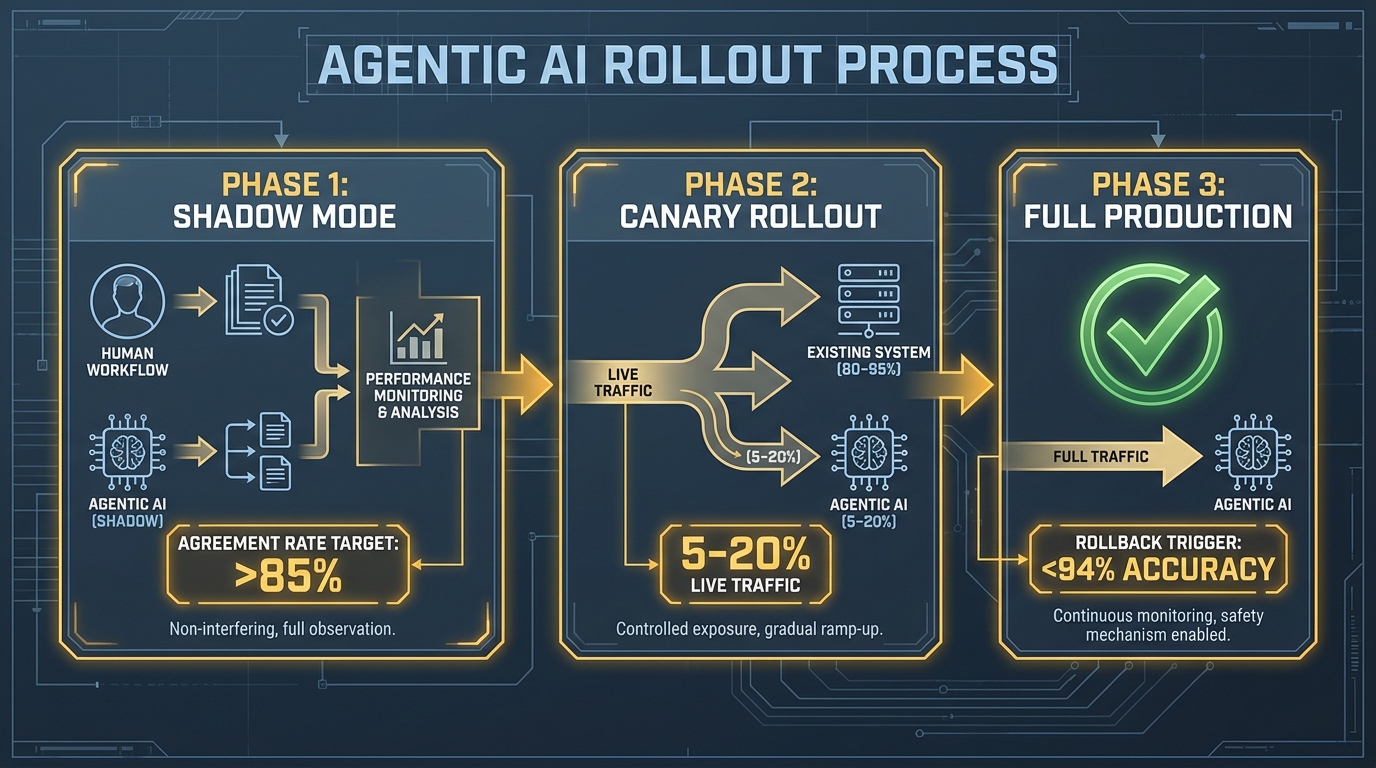
The gap between a completed agent playbook and a live production agent should not be crossed in a single step. The teams with the highest production success rates — those 80%+ cutover figures — consistently use a three-phase rollout that builds confidence in the agent’s behavior progressively, at each stage testing a larger scope of the real operating environment before expanding autonomy further.
Phase 1: Shadow mode
In shadow mode, the agent runs in parallel with human operators on real production traffic. The agent makes decisions and proposes actions, but those actions are not executed — they are logged alongside the human operator’s actual decisions. The primary metric is the agreement rate: what percentage of the time does the agent’s proposed action match what the human actually did?
The target agreement rate for advancing from shadow mode to the next phase is typically set at 85–94%, depending on the risk profile of the workflow. Teams that advance with agreement rates below this threshold — because the demo looked impressive or there is schedule pressure — tend to find themselves debugging production incidents within the first 30 days.
Shadow mode is also where you discover that your playbook is wrong. The trigger conditions fire in situations you did not anticipate. The tool contract schemas do not cover all the edge-case inputs the real data produces. The state model breaks when the same invoice ID appears in two different queue systems simultaneously. Shadow mode exposes these issues at zero cost, in the real operating environment, before any real-world consequences.
A well-run shadow mode phase typically takes 2–4 weeks for a medium-complexity workflow, running against at least several hundred real instances to generate statistically meaningful agreement rate data.
Phase 2: Canary rollout
Once shadow mode agreement rates consistently meet the threshold, the agent moves to canary rollout: it begins executing real actions on a small slice of live traffic — typically 5–20%, depending on blast radius and workflow volume. The remaining traffic continues to be handled by humans.
During canary rollout, the metrics shift from agreement rate to production outcome metrics: error rate, autonomous resolution rate, escalation rate, and mean time to resolution. The playbook should specify the exact metric thresholds that must be maintained to continue the rollout, and the exact thresholds that trigger an automatic rollback to shadow mode.
Common rollback triggers in canary phase: error rate exceeding 3–5% for three consecutive hours, escalation rate exceeding 20% (indicating the agent is not actually handling the workflow autonomously), or any hard-stop condition firing more than a defined number of times in a given period.
Phase 3: Gated full production
Full production does not mean unconstrained autonomy. It means the agent handles the full volume of the target workflow, with the playbook’s full set of guardrails active, and with ongoing monitoring against the performance thresholds defined in the playbook. The rollout gate from canary to full production should require a formal review — typically documented sign-off from the workflow owner, the AgentOps lead, and (for high-risk workflows) a compliance or risk representative.
Most production agents retain the ability to rollback to a lower autonomy level at any time — a capability that should be exercised promptly rather than treating rollback as an admission of failure. The operational discipline of staged rollout is not a workaround for immature agents; it is the standard operating procedure for responsible production deployment of any autonomous system.
Agent Sprawl: What Happens When You Scale Without a Control Plane
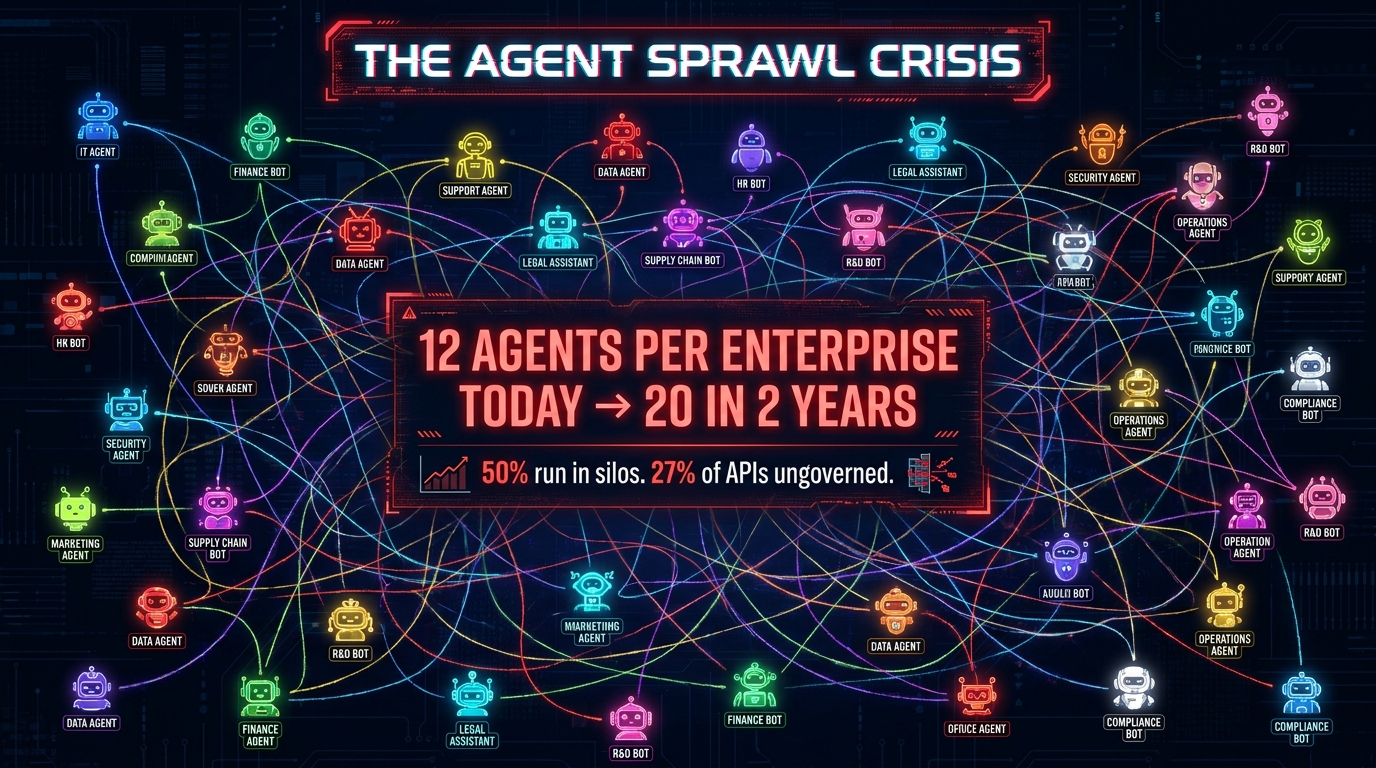
Enterprises running agentic AI at scale in 2026 are dealing with a problem most of them did not plan for: agent sprawl. The average enterprise is now running approximately 12 AI agents across its operations, a number projected to reach 20 within two years. Of those agents, roughly 50% operate in silos with no connection to a central management layer, and 27% of the APIs those agents are calling are ungoverned — meaning there is no documented policy controlling what those agents can do, in what context, or with what data.
A 2026 survey of 1,900 IT leaders found that 94% of enterprises say agent sprawl is actively increasing complexity, technical debt, and security risk. And only 12% report having a centralized platform for managing their agent fleet. The remaining 88% are managing — or failing to manage — a growing population of autonomous systems through a combination of tribal knowledge, individual team responsibility, and post-incident reaction.
How sprawl happens
Agent sprawl follows a predictable trajectory. An engineering team deploys a successful agent for IT ticket triage. A marketing ops team, inspired by the success, deploys one for campaign performance reporting. Finance deploys one for invoice matching. Customer success deploys one for renewal risk flagging. Each of these deployments is reasonable in isolation. But without a central control plane, each one has its own logging format, its own escalation path, its own access credentials, its own playbook (or lack thereof), and its own definition of what “working correctly” means.
The compounding problem is non-human identity. Every agent needs credentials to call tools, access systems, and write to databases. In a sprawled environment, these identities proliferate without central inventory — meaning security teams cannot audit what agents have access to, cannot revoke access cleanly when an agent is decommissioned, and cannot determine after an incident whether an agent or a human made a particular change.
The control plane as the solution
The answer to agent sprawl is a centralized agent control plane: a platform that maintains an inventory of all deployed agents, their playbooks, their tool contracts, their access credentials, and their current operational status. The control plane does not need to manage every detail of every agent’s behavior — that would recreate the bottleneck problem that autonomous agents are supposed to solve. But it does need to provide visibility into the full agent fleet, enforce baseline governance requirements (logging, audit trail, escalation path), and provide a kill-switch mechanism that can immediately suspend any individual agent or class of agents.
Teams that build their agent control plane early — before they have 12 agents running — find that the governance overhead per new deployment drops significantly as each new agent is onboarded into an existing framework rather than built in isolation. Teams that build it reactively, after sprawl has already set in, face a difficult remediation effort: discovering all the agents already running, auditing their access and behavior retroactively, and retrofitting governance onto systems that were not designed with it in mind.
Agent orchestration and the supervisor pattern
As multi-agent deployments mature, the orchestration layer becomes critical. The supervisor pattern — where a single orchestrating agent coordinates the behavior of multiple specialist agents and maintains the shared state of a complex workflow — is emerging as the most reliable architecture for multi-agent production systems. The supervisor agent does not do the domain work; it manages sequencing, resolves conflicts between sub-agents, and owns the escalation path when a sub-agent cannot proceed. This pattern limits the blast radius of individual agent failures and provides a single point of accountability for the end-to-end workflow.
Playbook Metrics: How to Know If Your Agent Is Performing or Just Running
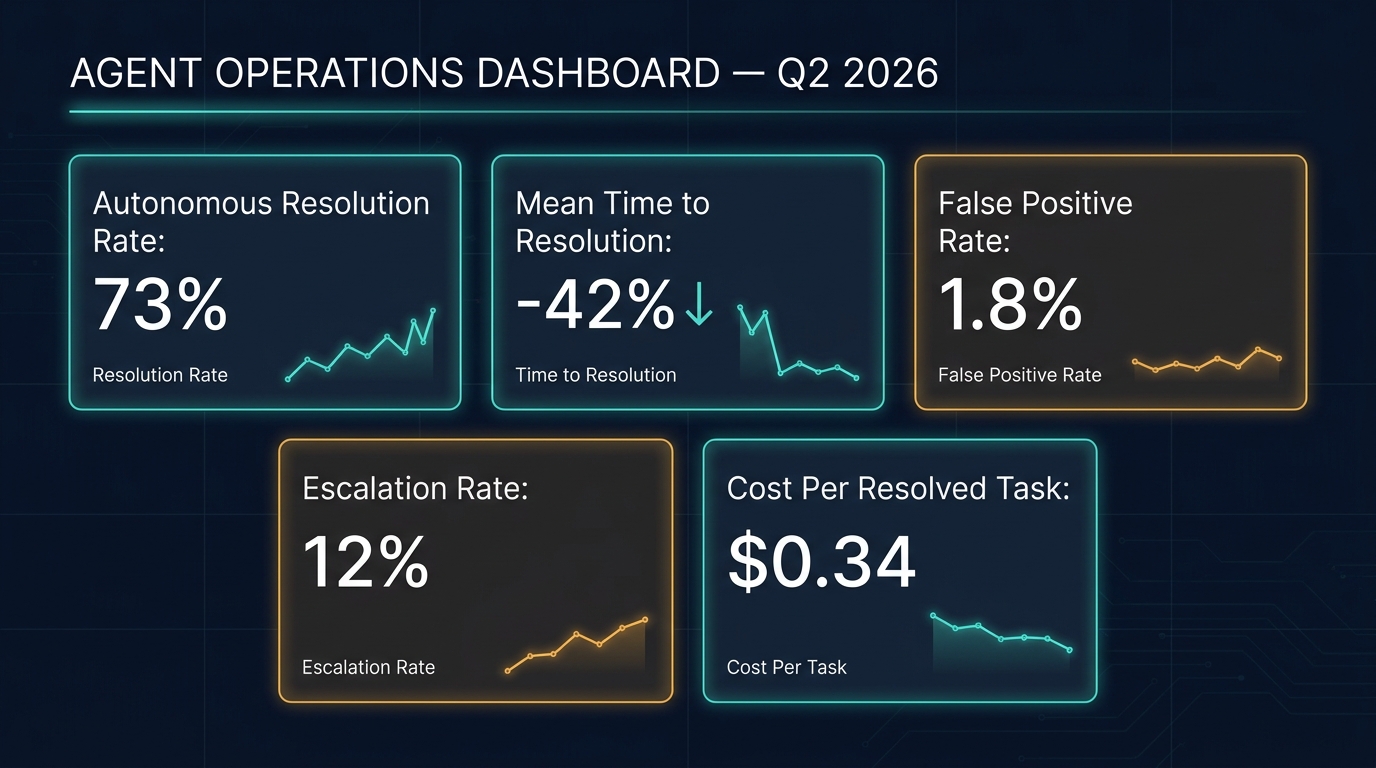
One of the most disorienting things about running agents in production is that activity is not the same as performance. An agent can process thousands of tasks per day, log every action, and never trigger a hard-stop condition — while simultaneously resolving a shrinking percentage of those tasks correctly, escalating an increasing share to humans, and costing more per completed task than the manual process it replaced.
Agent performance measurement requires a purpose-built metric set. Generic system health metrics — uptime, response time, error rate — are necessary but not sufficient. The playbook should define the specific outcome metrics that determine whether the agent is delivering on its purpose.
The five metrics that matter most
Autonomous Resolution Rate (ARR). The percentage of workflow instances the agent completes without human intervention, within the defined performance thresholds. This is the primary measure of whether the agent is actually doing the job it was deployed for. An agent with a 73% ARR is completing nearly three-quarters of the workload autonomously; a 40% ARR means the agent is generating more escalations than it is resolving, and the workflow economics need to be revisited.
Mean Time to Resolution (MTTR). How long does it take the agent to complete a workflow instance, from trigger to logged output? Compare this against the pre-agent baseline to calculate actual efficiency gains. Best-in-class agentic deployments in IT operations are showing MTTR reductions of 30–60% in 2026. Deployments that show flat or increasing MTTR usually have escalation path problems — the agent is fast on easy cases but slow on everything else because escalations are unmanaged.
False Positive Rate (FPR) and False Negative Rate (FNR). For classification-heavy workflows — ticket triage, invoice routing, risk flagging — these are the metrics that capture whether the agent is making the right call on the cases that matter. A low error rate in aggregate can mask high false negative rates on the high-risk tail of the distribution, which is exactly where misclassification is most consequential.
Escalation Rate. The percentage of workflow instances that the agent escalates to a human. A very low escalation rate may indicate that the agent is not appropriately surfacing uncertain decisions. A very high escalation rate — typically above 20–25% — indicates either that the workflow is not a good agent candidate, or that the trigger conditions are too broad. The playbook should specify the target escalation rate range and treat deviations outside that range as operational signals requiring investigation.
Cost Per Resolved Task (CPRT). The total operational cost of the agent — compute, tooling, licensing, AgentOps team time — divided by the number of tasks resolved within SLA. This is the metric that answers the business question: is this agent actually cheaper than the alternative? KPMG and McKinsey benchmarks for 2026 put average returns at 4.5x for high-performing enterprise deployments, but those returns are only visible when cost attribution is tracked at this level of granularity.
Metric review cadence and escalation thresholds
Metrics are only useful if they are reviewed on a defined cadence and if deviations trigger defined responses. The playbook should specify: the frequency of automated metric checks (hourly, daily, weekly), the thresholds that trigger automated alerts, and the thresholds that trigger operational reviews where the AgentOps team evaluates whether the playbook itself needs to be revised. Metric review is not a background task — it is a first-class operational responsibility.
The AgentOps Function: Who Owns the Playbooks, and How to Structure the Team
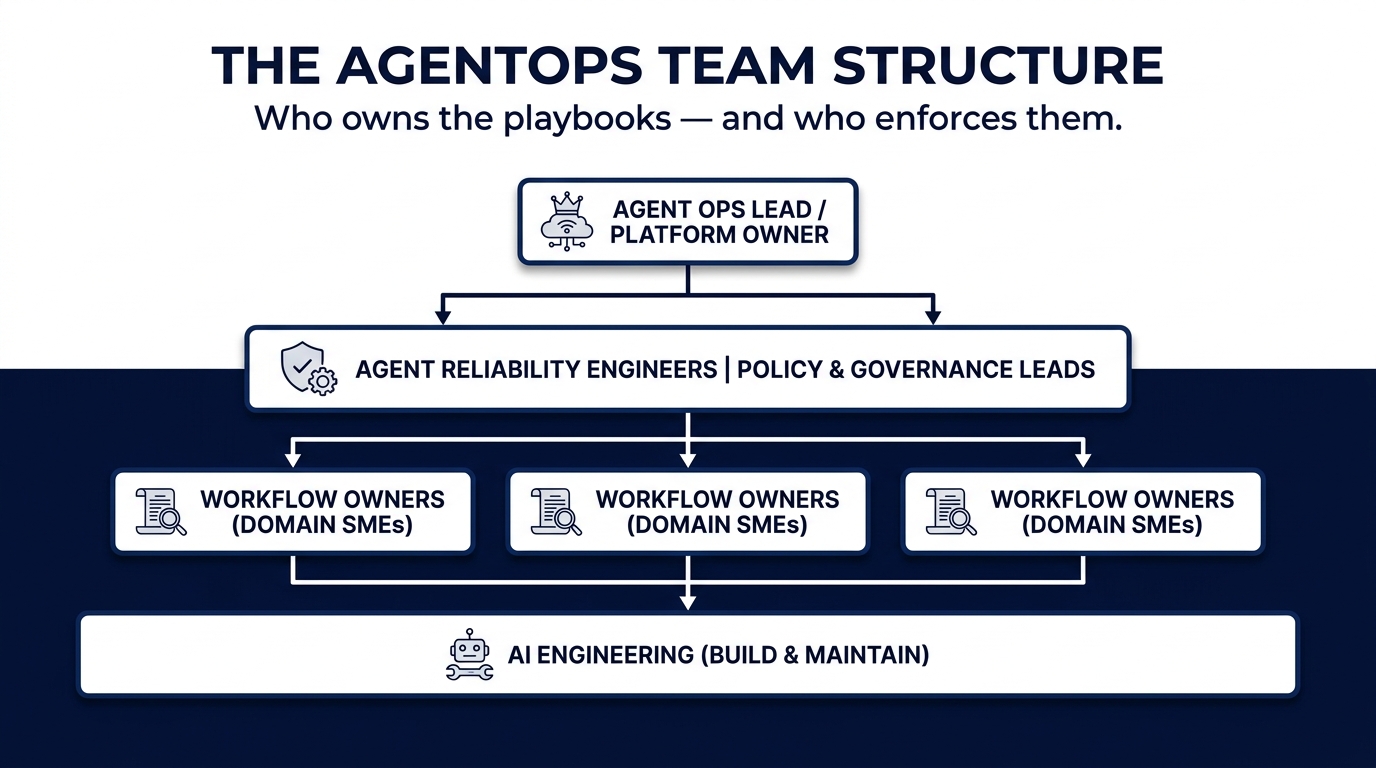
The single most important organizational question for agentic AI at scale is: who owns the playbooks? In most enterprises in 2026, the answer is unclear. Engineering teams own the agent code. Business units own the workflows. Risk and compliance own the governance policies. Security owns the access credentials. And nobody owns the operational document that binds all of these together — the playbook itself.
The organizations producing the best results from agentic AI have formalized a new function — AgentOps — that explicitly owns playbook development, playbook maintenance, agent performance monitoring, and escalation management. This function is not the same as an AI engineering team, and it is not the same as traditional IT operations. It sits at the intersection of the two.
The core roles in an AgentOps function
Agent Ops Lead / Platform Owner. The senior accountability point for the entire agent fleet. This person owns the agent control plane, sets the governance standards for playbook structure, approves production deployments, and is the escalation owner for major incidents. In smaller organizations, this role may be filled by a senior platform engineer or a head of operations. In larger enterprises, it typically reports to the CTO or COO.
Agent Reliability Engineers (AREs). Analogous to site reliability engineers, AREs own the operational health of the deployed agent fleet. They monitor the metric dashboards, manage the on-call rotation for agent incidents, investigate alert escalations, and own the rollback procedures. AREs need to be comfortable working across the full agent stack: understanding enough about model behavior to diagnose prompt-level issues, enough about infrastructure to diagnose tool-call failures, and enough about the business workflows to determine whether an escalation rate change is a technical anomaly or a shift in the underlying data.
Policy and Governance Leads. These are the people who define and enforce the standards that all playbooks must meet — the equivalent of a security policy or a data governance framework, but for agent behavior. They own the approval process for new agent deployments, the audit trail requirements, the escalation path standards, and the compliance documentation for regulated industries. In organizations subject to GDPR, SOC 2, or financial services regulation, this role interfaces directly with legal and compliance.
Workflow Owners (Domain SMEs). These are business-side stakeholders — the IT ops lead, the finance ops manager, the customer success director — who own the specific workflows their teams run. They define the outcome requirements for the playbook, validate that the trigger conditions reflect real operational logic, and participate in the shadow mode review process. Workflow owners are not responsible for building agents, but they are accountable for whether the agent is doing the right job in their domain.
AI Engineering. The team that builds and maintains the agents — model selection, tooling, integration, prompt design, evaluation frameworks. AI Engineering produces agents to the specifications defined in the playbook; they do not define those specifications unilaterally. In organizations that get this wrong, AI Engineering becomes both the builder and the operator — which is how you get systems that are optimized for technical elegance rather than operational reliability.
The separation of concerns that makes it work
The most important structural insight is the separation between platform ownership (the control plane, the governance standards, the fleet visibility) and workflow ownership (the specific use case, the domain knowledge, the operational metrics). These cannot be collapsed into the same team without creating either a bottleneck or an accountability gap. Platform ownership scales horizontally across all agents; workflow ownership stays close to the business domain.
Teams that have built this structure — even informally, without dedicated headcount — report significantly faster time from playbook draft to production approval, significantly lower incident rates in the first 90 days of production, and significantly easier conversations with legal, compliance, and executive stakeholders who want to understand what the agents are doing and how.
The Playbook Is the Product: A Closing Framework for Ops Teams
There is a tempting mental model for agentic AI in which the agent is the product: the thing you build, the thing you launch, the thing that creates value. This mental model is wrong, and it is responsible for most of the failures catalogued across this article.
The agent is infrastructure. The playbook is the product.
The playbook is the artifact that encodes operational knowledge, defines acceptable behavior, specifies the conditions under which autonomy is extended and the conditions under which it is revoked, and provides the documentation trail that makes the agent trustworthy to the organization and its stakeholders. Without a good playbook, a capable agent is a liability. With a good playbook, even a modest agent can deliver consistent, auditable, measurable value.
The five things to do before your next agent goes into shadow mode
1. Write the outcome definition. One unambiguous sentence about what the agent is supposed to accomplish, measurable without subjective interpretation. If you cannot write this sentence, the workflow is not ready for an agent.
2. Score the workflow against the five selection criteria. High frequency, deterministic success, low blast radius, auditable outcomes, clean data. Any criterion that scores below a 6/10 needs to be addressed before deployment — not after.
3. Specify trigger conditions in deterministic terms. Binary conditions only. No “when it seems appropriate” language. Include the data source, the exact field or event, the threshold, the pre-conditions, and the cooldown period.
4. Write the tool contracts before touching the prompt. Define what the agent can call, what a valid input looks like, what a valid output looks like, and how every error type is handled. Treat the action catalog as a security boundary, not a convenience.
5. Assign a workflow owner and a named AgentOps contact. Every agent in production needs a human who is accountable for its performance and a human who is accountable for its operational health. If you cannot name both people before deploying, you are not ready to deploy.
Why this discipline compounds over time
Every playbook you write makes the next one easier. The workflow selection criteria become institutional knowledge. The tool contract templates get reused across deployments. The escalation routing logic becomes a platform capability rather than a per-agent design problem. The metric definitions become a shared language across the AgentOps team and the business stakeholders who depend on them.
The organizations that are building durable agentic AI capabilities in 2026 are not necessarily the ones with the most advanced models or the largest AI budgets. They are the ones that have made playbook development a core operational discipline — the ones where writing a structured agent playbook before deploying any autonomous system is simply how the work gets done.
That is not a constraint. It is a competitive position. Because as the agent fleet grows and the workflows expand in complexity, the organizations with mature playbook practices will compound their advantage, while those still improvising will keep rediscovering the same failure modes and paying the same remediation costs on repeat.
The playbook is the product. Build it like one.