


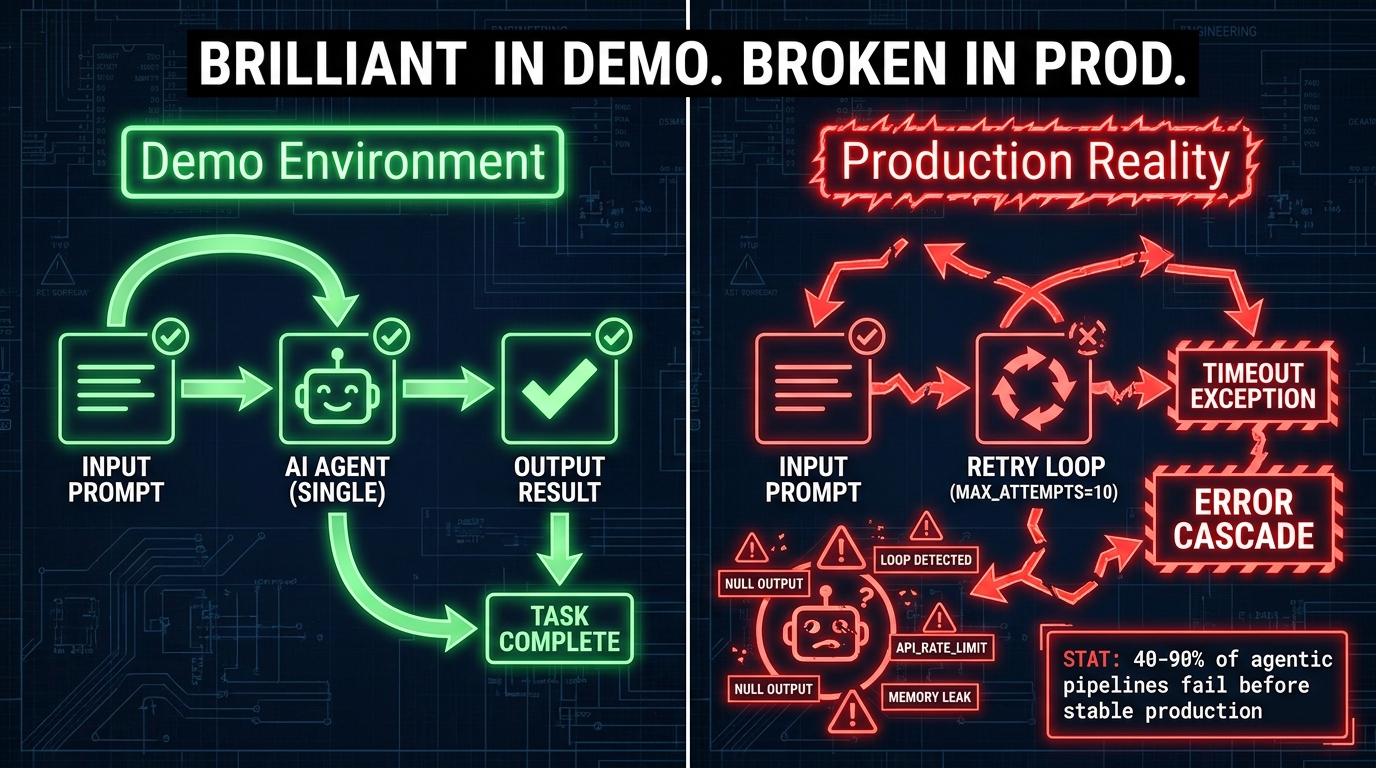

There is a moment every AI engineering team eventually experiences. The demo runs flawlessly. The agent finds the right documents, calls the right APIs, synthesizes a clean summary, and hands the result to the downstream system — all without a human touching a single step. Everyone in the room nods. Someone says something like “we could productionize this in a sprint.” And then the sprint turns into three months, and the sprint after that is spent debugging why the pipeline occasionally goes into a retry loop for 45 minutes before returning a hallucinated result that gets silently accepted by the next stage in the chain.
This is the pipeline gap. And it is not a model problem.
Across the past 18 months of enterprise agentic deployments, the consistent finding is that between 40% and 90% of agentic AI projects stall or collapse before reaching stable production — and when researchers and engineers trace the root causes, model quality is rarely the culprit. The failures land in system design: how state is managed, how tools are permissioned, how agents coordinate with each other, how failures cascade, how observability is (or isn’t) instrumented, and how human oversight is (or isn’t) embedded as a first-class design primitive.
This post is a technical treatment of those failure modes and the architectural decisions that separate pipelines that survive production from ones that don’t. It is not a framework comparison, and it is not a vendor guide. It is an engineering-first examination of why agentic systems break — and how to build the ones that don’t.
The angle here is specific: not whether to use agentic AI (that decision has largely been made at most forward-looking organizations), but how to architect it so the systems you ship are reliable enough to trust with real operations.
The Taxonomy of Agentic Pipeline Failure
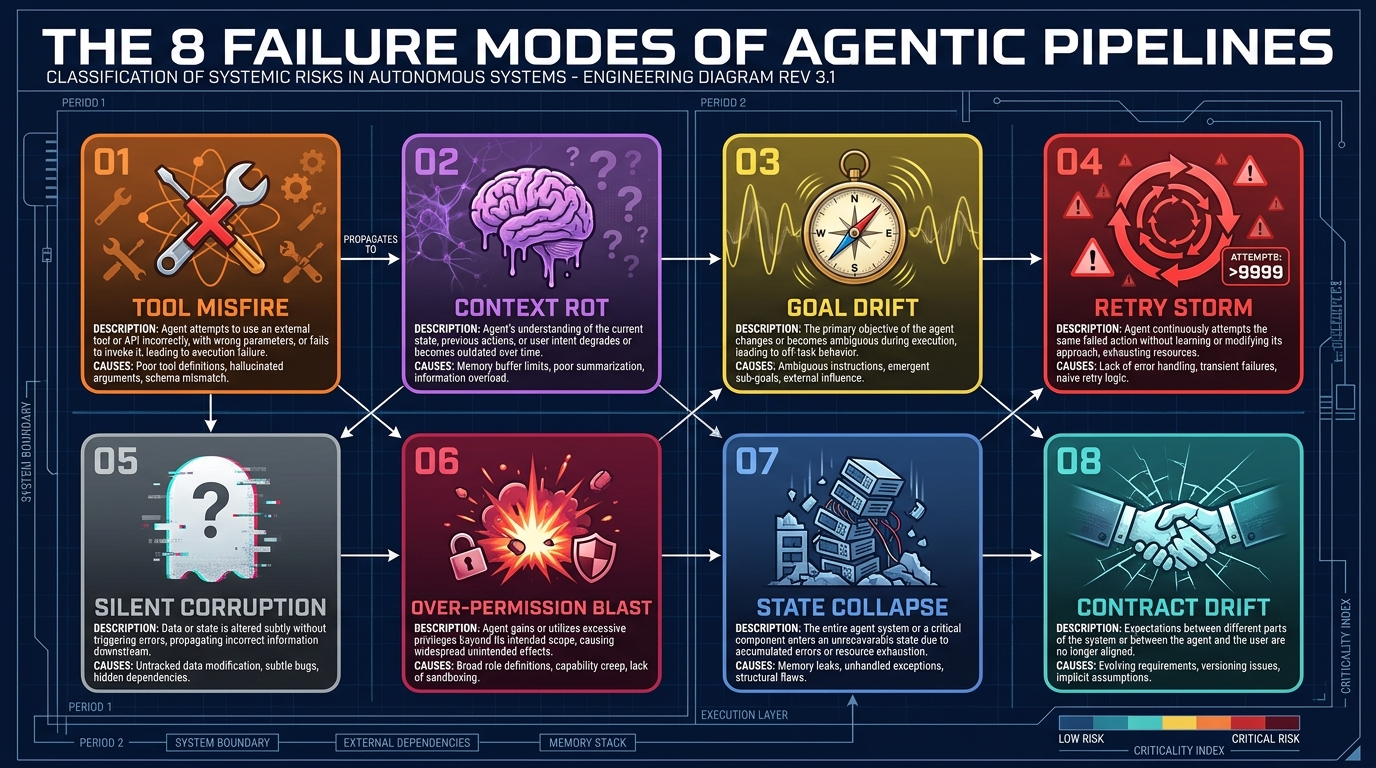
Before you can build pipelines that don’t break, you need a clear-eyed classification of how they actually break. The failure modes in agentic systems differ meaningfully from those in traditional software, and applying conventional debugging instincts — looking at error logs, checking service uptime — will leave the most damaging failures invisible.
1. Tool Misfire
The most common surface-level failure in agentic pipelines is tool misuse: an agent calls the right tool but passes incorrect, malformed, or contextually inappropriate parameters. A bad argument early in a multi-step workflow doesn’t always surface as an error. It surfaces three steps later as a result that is subtly wrong — a database query that returns the right schema but the wrong rows, a file write that overwrites the correct path but with corrupted data.
The reason this is so damaging is that downstream agents in the chain receive plausible-looking inputs and proceed confidently. By the time a human or automated check catches the anomaly, the corrupted state has often propagated through several steps. Teams that treat tool calls as a happy path — defining the happy case carefully in prompts but providing no schema validation or contract checking at the tool interface — will encounter this failure regularly.
2. Context Rot
In long-running agents or multi-step pipelines, context degrades. The agent’s working memory becomes cluttered with early-step data that is no longer relevant, instructions that were valid three tool calls ago but conflict with the current state, and retrieved documents that were accurate when pulled but have since been superseded.
Anthropic’s engineering team describes this directly: agents that “carry full history in-prompt” without rolling summarization or managed retrieval accumulate what practitioners increasingly call context rot — a gradual degradation of reasoning quality as the signal-to-noise ratio in the context window worsens. The agent doesn’t fail with an error. It just gets progressively less accurate, and that degradation is nearly impossible to detect through conventional error monitoring.
3. Goal Drift
This failure mode is specific to systems where agents have significant autonomy over their own reasoning paths. Given an underspecified objective and the freedom to choose its own tools and sub-tasks, an agent can begin pursuing an intermediate goal that it has internally promoted to a primary objective. The original task gets deprioritized or forgotten.
In practice, goal drift often manifests as an agent that successfully completes a large amount of work — and produces output — but the output addresses the wrong problem. It passed all intermediate checks because each step was locally coherent. The error was in the goal representation, not the execution.
4. Retry Storms
Agentic systems that lack carefully designed retry logic — specifically, logic that includes exponential backoff, circuit breakers, and hard iteration caps — are susceptible to retry storms. An agent that encounters a transient failure (a rate limit, a slow API response) will retry. If retries are uncapped and the failure is not transient, the agent enters a loop that can run for minutes or hours before a timeout eventually terminates it. In multi-agent systems, if the looping agent is a dependency of other agents, the storm propagates upstream.
5. Silent Corruption
Perhaps the most insidious failure mode: the pipeline completes successfully, returns a result, logs no errors — and produces wrong output. Silent corruption occurs when a data transformation step applies an incorrect logic without triggering an exception, when a model produces a subtly incorrect extraction that falls within the expected format, or when a summarization step drops a critical piece of information without triggering any downstream validation.
Silent corruption is detected by business outcome monitoring — not infrastructure monitoring. If you are only watching for errors and latency, silent corruption is invisible until users or downstream systems report problems.
6. Over-Permission Blast
Agents that are granted broader tool, API, and data access than the specific task requires create a disproportionate risk surface. A 2026 Kiteworks security report found that 60% of organizations cannot terminate a misbehaving AI agent once detected. When an over-permissioned agent encounters a bad prompt injection, a reasoning error, or simply executes a valid plan that has unintended consequences, the damage radius is defined entirely by what it had permission to touch.
7. State Collapse
Multi-agent systems that share a common state store — a scratchpad, a shared memory object, a database table — without strict access semantics will eventually experience state collapse. Two agents writing to the same key with incompatible formats, or an agent reading state that was written by an earlier agent under different assumptions, produces a corrupted shared state that causes downstream agents to reason from a broken foundation.
8. Contract Drift
In systems where agents hand off work to other agents, the implicit contract between them — what data format is expected, what fields are populated, what the downstream agent assumes about completeness — tends to drift as individual agents are updated independently. An orchestrator updated to add a new output field breaks a worker agent that was not updated to handle it. Contract drift is the agentic system’s equivalent of an API versioning failure, and it compounds quickly in systems with many specialist agents.
The Context Window Is Not a Database — Memory Architecture Done Right
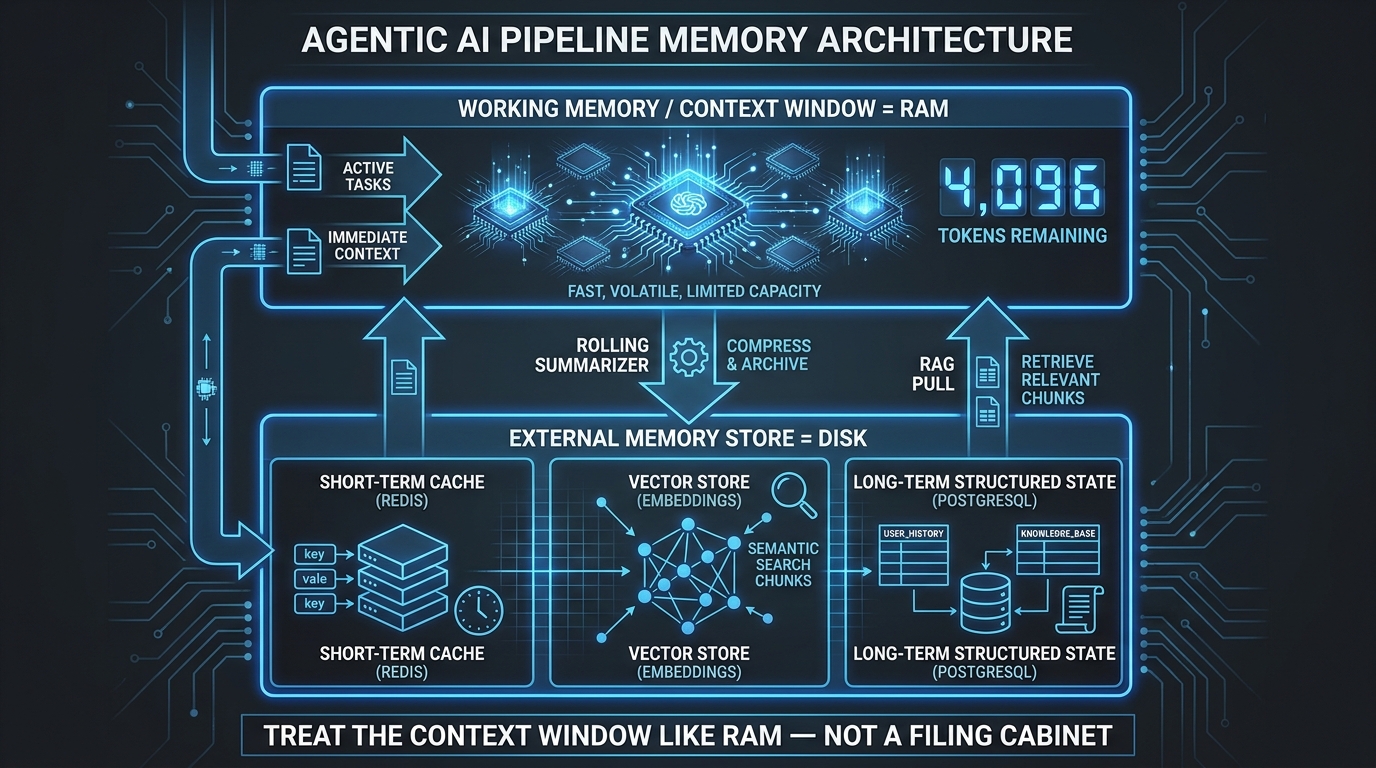
One of the most fundamental architectural mistakes in agentic pipeline design is treating the context window as a general-purpose data store. Teams that pass entire conversation histories, full document contents, and cumulative tool outputs into a single growing prompt are building on a foundation that will buckle under real workloads.
The expert consensus in 2026 is direct: treat the context window like RAM, not a filing cabinet. It is fast, it is immediately accessible to the model, and it is finite. What lives there should be the minimum necessary for the current reasoning step — not the accumulated record of everything that has happened in the session.
The Two-Tier Memory Model
Production-grade agentic systems increasingly implement a two-tier memory architecture that separates working memory from persistent memory:
- Working memory (the context window): Contains the current task objective, the immediately relevant context, the last few tool results, and any active constraints or guardrails. Token budgets are enforced explicitly — the orchestrator knows how much space each component is permitted to consume and trims aggressively when limits approach.
- External memory (governed storage): Contains the complete execution history, full document content, embeddings for semantic retrieval, and long-term structured state. This tier is broken into sub-components: a short-term cache (Redis or equivalent) for recently accessed data, a vector store for embedding-based retrieval, and a structured relational store for long-lived state that needs exact-match querying.
The bridge between these tiers is the retrieval mechanism — a RAG layer that pulls the most relevant chunks from external memory into working memory on demand, rather than pre-loading all available context. Rolling summarization handles the transition: as earlier steps become history, they are compressed by a lightweight summarizer and written to the external store, keeping the context window clear for current reasoning.
Governing What Gets Written and What Gets Read
A memory architecture without write governance is a state collapse waiting to happen. In multi-agent systems, every agent that has write access to the shared state store is a potential vector for corruption. Production systems need explicit schemas for what each agent is permitted to write, versioned records so that overwrites are traceable, and read-access controls that prevent agents from pulling data they weren’t intended to see.
This is not bureaucracy for its own sake. It is the difference between a system where a state corruption event is traceable and recoverable versus one where a corrupted shared store cascades invisibly through every downstream agent for hours before anyone notices.
Memory Lifecycle Management
Long-running agents accumulate state that eventually becomes stale. Cached documents reference data that has since changed. Embeddings generated from an earlier version of a database become semantically misaligned with current content. Production systems need explicit TTL (time-to-live) policies for every type of stored data, periodic re-indexing jobs for vector stores, and invalidation events that trigger retrieval refreshes when upstream data sources change.
Treating memory as a static asset — something you set up once at deployment — is a common source of the slow degradation that organizations often misattribute to model drift. In many cases, it is not the model that has changed. It is the memory the model is reasoning from.
Orchestration Patterns That Actually Hold Under Load
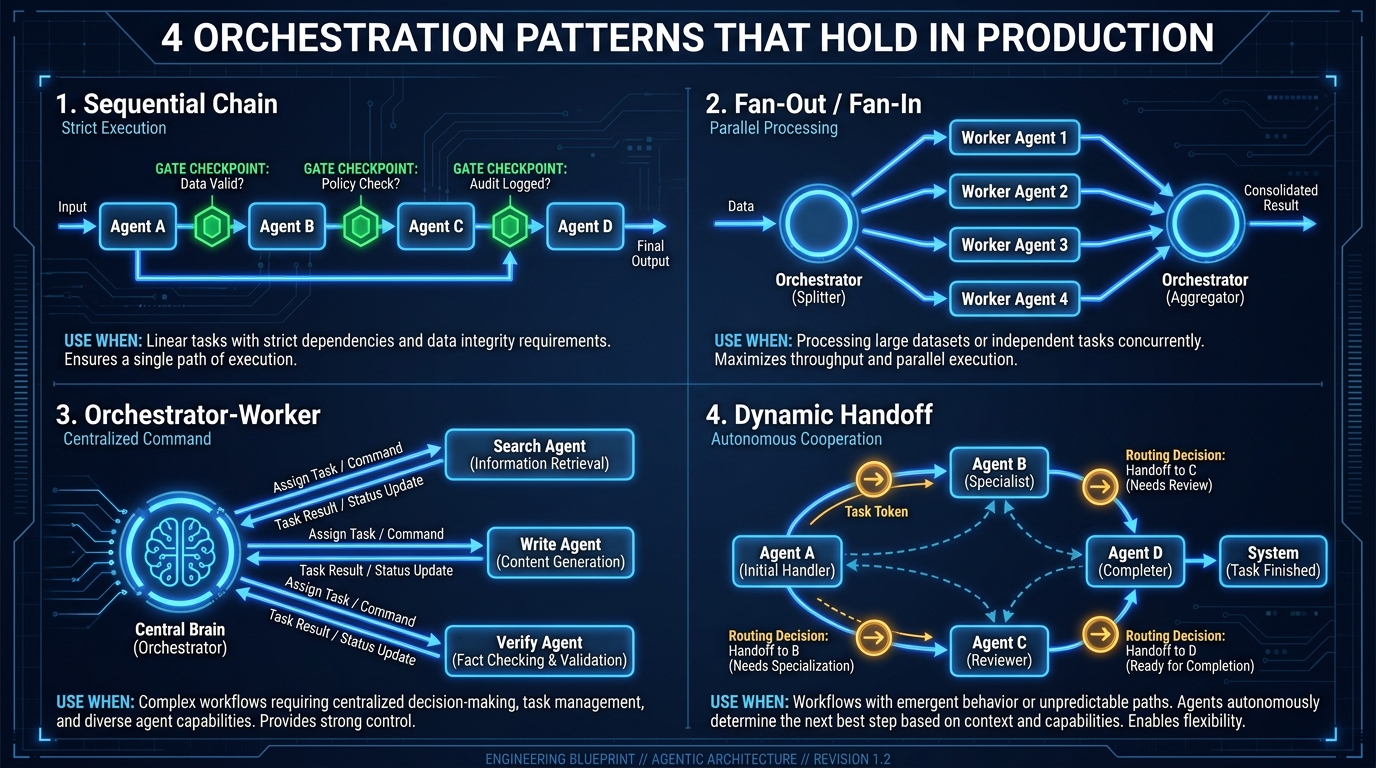
Not all orchestration approaches age equally under production load. The patterns that work in a constrained demo often collapse when agent counts scale, when task complexity increases, or when the data inputs become messier than the test suite anticipated. There are four orchestration patterns that appear repeatedly in stable production deployments — and understanding when to use each is as important as understanding how to implement them.
Pattern 1: Sequential Chaining with Gate Checks
The simplest and most predictable pattern: a task is decomposed into discrete steps, each handled by a separate LLM call or specialized agent, with the output of each step feeding the input of the next. What distinguishes production-grade sequential chains from naive prompt chaining is the gate check — a deterministic, programmatic validation step inserted between each link in the chain.
Gate checks verify that the output of a step meets the expected schema, is within acceptable quality thresholds, and does not contain known failure signatures before passing it downstream. They are not LLM calls — they are code. Hard rules, regex patterns, schema validators, or lightweight classifiers that can run in milliseconds and halt the pipeline before corrupted data propagates.
Use when: The task can be cleanly decomposed into a fixed sequence of subtasks, each of which is independently verifiable. Sequential chaining is ideal for document processing pipelines, structured data extraction, content generation workflows with review stages, and any scenario where predictability and auditability are higher priorities than flexibility.
Pattern 2: Fan-Out / Fan-In
A central orchestrator dispatches the same task (or parallel subtasks) to multiple worker agents simultaneously, then aggregates their outputs into a synthesized result. This pattern is effective for tasks that benefit from independent parallel execution — comparing multiple research paths, generating multiple candidate solutions for evaluation, or processing independent documents in a batch.
The critical design decision in fan-out/fan-in is the aggregation logic. Naive aggregation (concatenate all outputs and ask another LLM to synthesize) frequently produces low-quality synthesis when worker outputs conflict or overlap. Production implementations use structured aggregation: workers return outputs in a defined schema, and the aggregator applies explicit merge logic before passing to a synthesis step.
Use when: Subtasks are independent of each other, execution time is a constraint that parallelism can address, and the aggregation problem is well-defined. This pattern is common in research summarization, multi-source data reconciliation, and A/B generation workflows.
Pattern 3: Orchestrator-Worker
A planning agent (the orchestrator) receives the top-level objective, decomposes it into subtasks, assigns each subtask to a specialist worker agent, monitors completion, and re-plans if subtasks fail or produce unexpected outputs. Workers do not communicate directly with each other — all coordination goes through the orchestrator.
This pattern provides the clearest separation of concerns and the most tractable failure model: when something breaks, you can inspect the orchestrator’s plan to understand what it intended, and inspect the worker’s output to understand where the discrepancy arose. The failure modes are localized.
The engineering cost is in the orchestrator’s planning quality. A weak planner produces poorly scoped subtasks that overwhelm workers or produce gaps — parts of the problem that no worker was assigned to address. Production implementations often use a two-stage orchestrator: a planning pass that generates the task graph, followed by a validation pass that checks for coverage gaps before dispatching workers.
Use when: Tasks require dynamic planning, the set of required subtasks cannot be determined in advance, and different subtasks require genuinely different capabilities (retrieval, code execution, structured data manipulation, etc.).
Pattern 4: Dynamic Handoff
Agents pass a task token to each other based on routing decisions made at runtime. Rather than a central orchestrator that controls the full flow, each agent assesses its own output and decides whether to complete the task, escalate, delegate to a peer specialist, or route to a human review queue.
This pattern is the most flexible and the most failure-prone. Without strict routing rules and hard limits on the number of handoffs a task can undergo, dynamic handoff systems are vulnerable to routing loops (two agents that keep handing off to each other), infinite delegation chains, and progressive context loss as the task history is compressed with each handoff.
Production implementations of dynamic handoff impose a maximum handoff count, a task TTL, and explicit escalation rules — if a task has not reached a terminal state after N handoffs, it is routed to a human review queue rather than attempting another delegation.
Use when: The task domain is genuinely unpredictable and benefits from agent specialization by type rather than by step, and when routing flexibility is more valuable than routing predictability. Customer service automation and IT incident triage are common use cases.
Blast Radius Engineering: Least Privilege for AI Agents
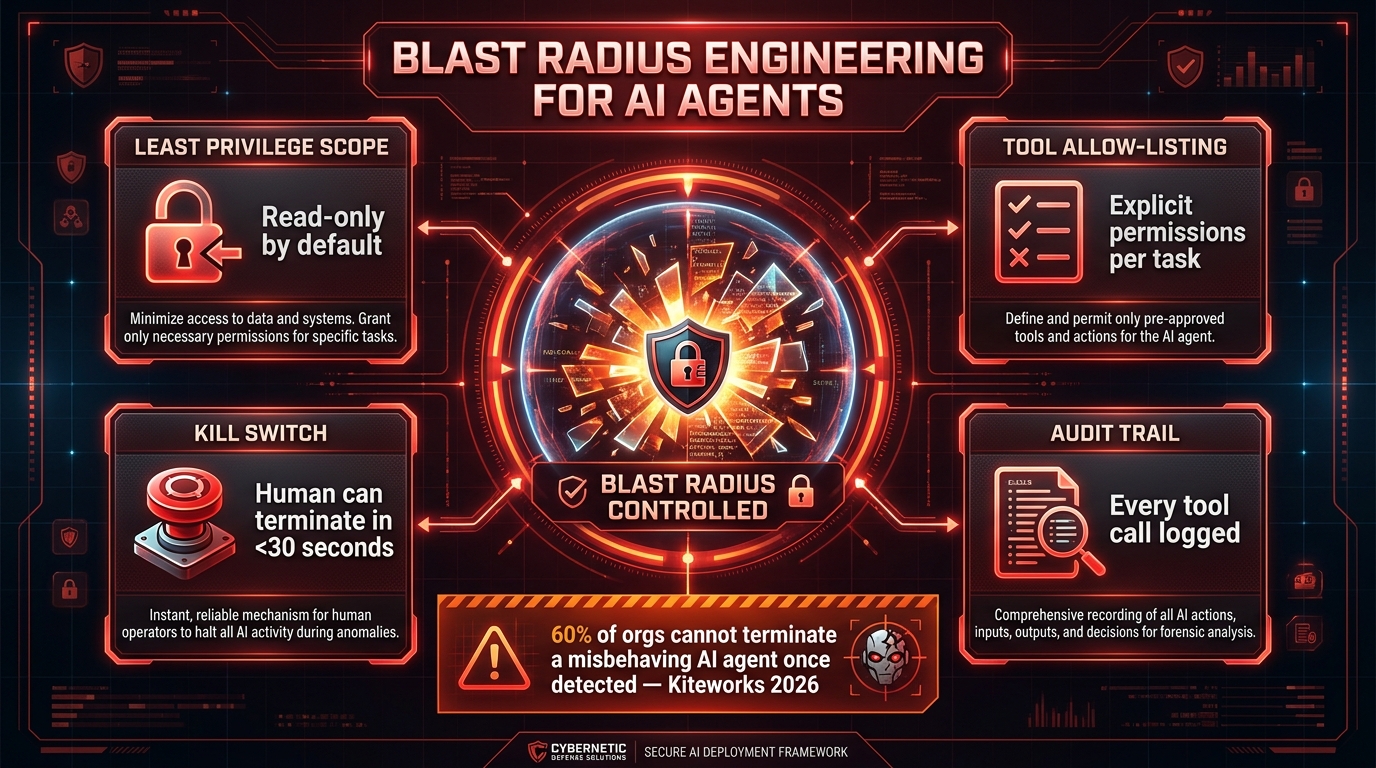
Security teams have spent decades building the principle of least privilege into software systems — granting each component only the access it needs to do its specific job, and no more. That discipline has largely not carried over into early agentic AI deployments, and the consequences are becoming visible.
The 2026 Kiteworks Data Security and Compliance Risk Forecast contains a finding that should be a forcing function for every team building agentic systems: 60% of organizations cannot terminate a misbehaving AI agent once detected. Not 60% of organizations haven’t gotten around to building that capability. Sixty percent genuinely cannot do it. The architecture doesn’t allow for it.
This is a blast radius problem, and blast radius engineering needs to be a first-class concern in agentic pipeline design — not an afterthought added after the first incident.
Defining Blast Radius in Agentic Contexts
Blast radius in agentic systems refers to the total damage — to data, to downstream systems, to external services — that a single agent can inflict if it misbehaves, is compromised, or executes a valid plan with unintended consequences. It is determined by three factors: what the agent can read, what it can write, and what it can trigger.
An agent with read access to a full customer database, write access to a production API, and the ability to trigger email sends to external addresses has an enormous blast radius. An agent scoped to read from a single read-only data view, write to a staging table, and trigger no external actions has a minimal blast radius — even if its model quality is identical.
Tool Allow-Listing Over Tool Blocking
The default configuration for most early agentic deployments is permissive: the agent has access to all configured tools, and specific dangerous actions are blocked. This is backwards. Production security requires an allow-list model: each agent is granted access only to the specific tools it needs for its specific tasks, and all other tools are unavailable — not blocked, but simply absent from the agent’s capability set.
Allow-list scoping should be task-specific, not agent-specific. An orchestrator agent that sometimes needs write access (during a data correction task) and sometimes doesn’t (during a read-and-summarize task) should have write access provisioned for the duration of the write task and revoked immediately after — not as a permanent capability.
Non-Human Identity Management
AI agents are, from an identity management perspective, non-human principals. They authenticate to services, hold credentials, and perform actions that are indistinguishable from those of a human user — except they can act at machine speed and at scale. Every agent in a production system should have its own dedicated identity with scoped credentials, just as every service account in a microservices architecture does.
Shared credentials across multiple agents make blast radius analysis impossible: if an incident occurs, you cannot determine which agent performed which action. Dedicated per-agent identities make every tool call attributable and auditable.
The Kill Switch Is Not Optional
Every production agentic deployment needs a documented, tested procedure for terminating a misbehaving agent within a defined time window — typically under 30 seconds. This means not just sending a termination signal, but ensuring the agent’s pending tool calls are cancelled, its in-progress state changes are rolled back or quarantined, and downstream agents that depend on it are notified and halted.
A kill switch that exists on paper but has never been exercised under realistic conditions is not a kill switch. It is a note that says “we’ll figure it out when we need to.” Chaos engineering practices — deliberately terminating agents in staging environments to test recovery behavior — should be standard for any agentic pipeline running in production.
The Protocol Layer: MCP and A2A as Production Infrastructure
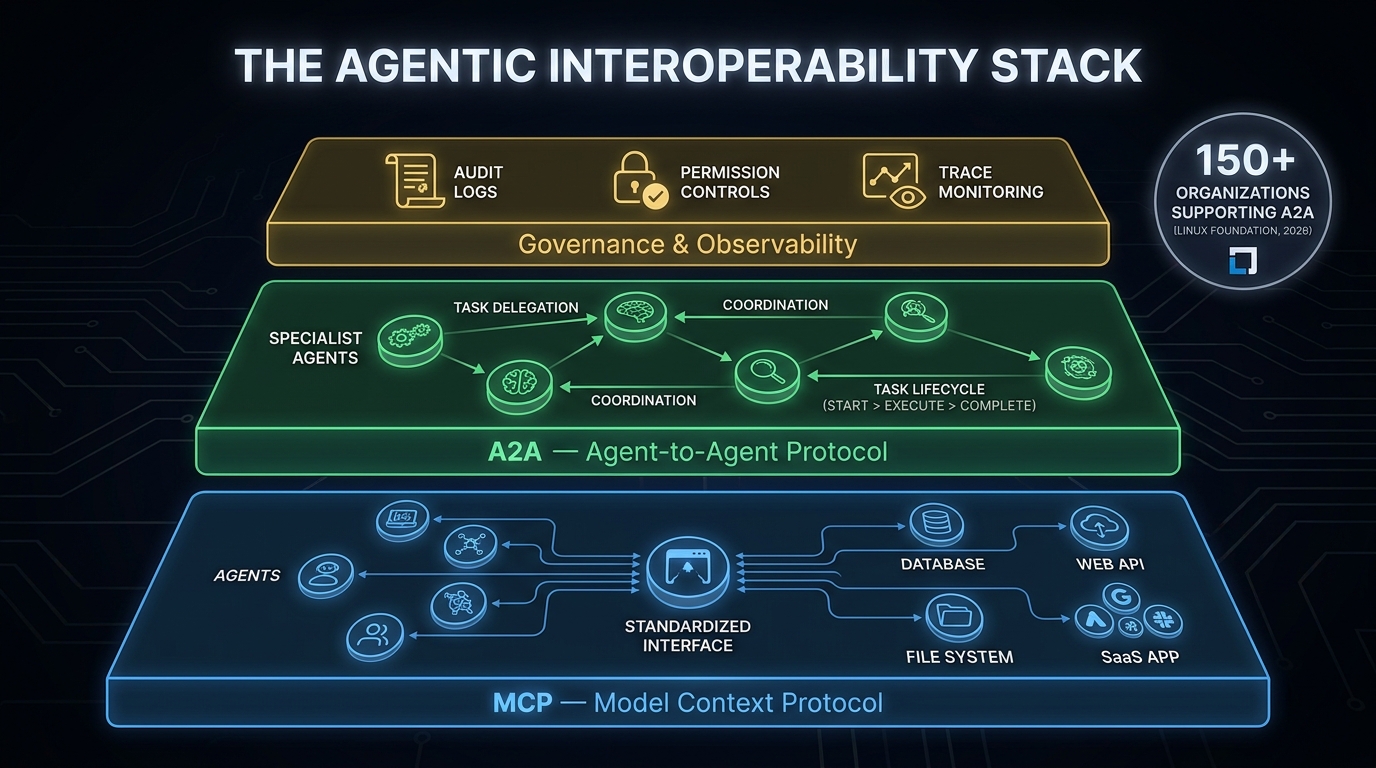
For the first two years of enterprise agentic deployments, the dominant infrastructure pattern was bespoke: each team built custom connectors between their agents and the tools, APIs, and data sources those agents needed. The result was a proliferation of brittle, one-off integrations that broke when tool APIs changed, couldn’t be reused across agent projects, and were impossible to audit consistently.
In 2026, that pattern is being replaced by two emerging protocol standards that are rapidly becoming the default infrastructure layer for agentic systems: the Model Context Protocol (MCP) and the Agent-to-Agent Protocol (A2A).
MCP: Standardizing Agent-to-Tool Access
The Model Context Protocol, developed by Anthropic and now adopted broadly across the industry, standardizes how agents connect to tools, APIs, databases, and file systems. Rather than each agent implementing its own connector for each tool, MCP provides a standard client interface that agents use to discover and call any MCP-compliant tool server.
The production benefits are significant. Tool integrations become reusable across agent projects — an MCP server for your CRM can be used by any agent in your organization without rebuilding the integration. Tool behavior is consistent and testable: the same MCP interface for a database connector behaves the same way regardless of which agent is calling it. And tool access is auditable: every MCP call goes through a standardized interface that can be logged, rate-limited, and permissioned uniformly.
For teams still building bespoke connectors, the migration path is worth prioritizing. Bespoke connectors are a maintenance burden that compounds with agent count — every new agent that needs access to an existing tool requires a new integration implementation. MCP amortizes that cost across the entire agent ecosystem.
A2A: Standardizing Agent-to-Agent Coordination
While MCP handles agent-to-tool connections, A2A (the Agent-to-Agent Protocol, now backed by the Linux Foundation with over 150 supporting organizations as of mid-2026) handles agent-to-agent coordination: task delegation, capability discovery, and multi-agent task lifecycle management.
Without a coordination standard, multi-agent systems develop ad-hoc communication patterns: direct API calls between agents, shared message queues with no schema enforcement, or orchestrators that maintain hardcoded awareness of every worker agent’s capabilities. These patterns don’t scale and they don’t compose. When you add a new specialist agent to the system, you have to update every orchestrator that might want to use it.
A2A allows agents to advertise their capabilities through a standardized discovery mechanism, accept and return task assignments in a standardized format, and report task status through a common lifecycle model. An orchestrator agent built on A2A can discover and use a new specialist agent without being modified — the new agent announces its capabilities, and the orchestrator learns them through the protocol.
MCP + A2A as Complementary Layers
The two protocols are not competing — they address different integration surfaces. MCP is the horizontal layer connecting agents to the world of tools and data. A2A is the vertical layer connecting agents to each other. Production architectures in 2026 are increasingly building on both: MCP for all tool access, A2A for all inter-agent coordination, with a governance and observability wrapper providing unified logging, permissioning, and monitoring across both protocol layers.
The engineering discipline required here is to resist the temptation to skip the protocol layer in the interest of shipping faster. A bespoke integration takes less time to write than an MCP server for the first agent that needs it. But the second, third, and fourth agents that need the same tool will each require the same bespoke work — and unlike MCP servers, bespoke connectors don’t compose. The compounding cost of the shortcut eventually exceeds the upfront investment in the standard.
Human-in-the-Loop Is Not a Safety Net — It’s a Design Primitive
In many early agentic deployments, human oversight was treated as a backup — something that would catch the cases the agent couldn’t handle, applied at the end of the pipeline as a final review. This framing consistently produces systems where human reviewers are reviewing outputs rather than decisions, where the interesting choices have already been made autonomously, and where the human’s only meaningful action is to approve or reject a completed artifact.
That is not human oversight. That is human rubber-stamping. And it provides almost none of the reliability benefits that genuine oversight is supposed to deliver.
HITL vs. HOTL: Knowing the Difference
Two distinct oversight patterns have emerged in production agentic systems, and confusing them produces poor architectural decisions:
- Human-in-the-Loop (HITL): Humans retain decision authority at specific, pre-defined points in the pipeline — particularly for high-stakes or irreversible actions. The agent proposes; the human approves or rejects before execution proceeds. HITL introduces latency but provides genuine decision authority. It is the right pattern for actions with significant downstream consequences: deleting production data, sending external communications, executing financial transactions, or changing customer-facing configurations.
- Human-on-the-Loop (HOTL): Agents execute autonomously, with humans monitoring in real time and retaining the authority to intervene. HOTL provides speed at the cost of reaction time — if something goes wrong, the human must notice and intervene before the damage compounds. It is appropriate for actions that are reversible, low-risk, or sufficiently fast that a monitoring human can catch problems before they propagate.
Designing the Intervention Surface
Neither HITL nor HOTL works unless the intervention surface — the interface through which humans exercise their oversight role — is designed with the same care as the agent’s task interface. An intervention surface that requires the human to understand the agent’s internal state to make a decision is not usable under time pressure. An alert that fires without actionable context produces alert fatigue and gets ignored.
Production HITL checkpoints should present the human with: (1) a plain-language description of what the agent is about to do, (2) the reasoning that led to this proposed action, (3) the expected outcome and any known risks, and (4) a binary or small-set decision with clear consequences for each choice. Not a raw API payload. Not a model log. A decision interface.
Escalation Logic as Pipeline Architecture
The escalation rules that determine when an agent routes to a HITL checkpoint versus proceeding autonomously should be treated as explicit pipeline logic — not implicit model behavior. Teams that rely on the model to decide when to ask for help produce systems where the agent’s escalation threshold is undefined, untestable, and not auditable.
Explicit escalation rules are codified outside the model: action X always requires human approval; confidence below threshold Y triggers a review request; an action that modifies data in category Z escalates regardless of confidence. These rules are testable, versionable, and reviewable — properties that matter enormously for organizations operating under regulatory frameworks that require documented governance of autonomous decision-making.
Evaluation Harnesses and Golden Datasets: Testing Agentic Systems
Traditional software testing is built around determinism: given input X, the correct output is Y, and you write a test that verifies Y is produced. Agentic systems break this model at every level. The agent may take multiple valid paths to a correct answer. The correct answer itself may be fuzzy — “a good summary” rather than “this exact string.” And the failure modes — context rot, goal drift, silent corruption — do not surface as exceptions that a test runner can catch.
The evaluation discipline that is emerging for production agentic systems is built around a different set of primitives.
The Evaluation Harness
An evaluation harness for agentic systems is infrastructure that runs end-to-end task evaluations: it sets up task environments, runs the agent, records the full trajectory (every tool call, every intermediate output, every state transition), grades the outcome against defined criteria, and aggregates results into dashboards that surface trends over time.
Critically, the harness grades trajectories, not just final outputs. A correct final answer produced via an inefficient or fragile reasoning path is a warning sign — not a pass. Teams that only check final output quality miss the class of fragile pipelines that happen to produce correct results on current inputs but break on any meaningful distribution shift.
Golden Datasets as Versioned Assets
Golden datasets — curated sets of representative tasks with known-good outputs — serve as the test corpora for agentic evaluation harnesses. The key word here is versioned. A golden dataset that is static quickly becomes unrepresentative as the agent’s task domain evolves, as upstream data changes, or as known failure patterns get added to the test corpus.
Production teams treat golden datasets as living assets maintained alongside the agent codebase: new failure cases from production incidents are added to the golden dataset so that regression testing catches them in future deployments. Coverage gaps — areas of the task domain not represented in the golden set — are actively identified and filled.
Online Evaluation for Production
Offline evaluation (running the harness against the golden dataset before each deployment) is necessary but not sufficient. Agentic systems deployed in production encounter distributions that no golden dataset fully anticipates. Online evaluation — sampling live production trajectories, running them through the grading infrastructure, and monitoring quality metrics continuously — provides the signal that offline evaluation cannot.
The metrics that matter for online agentic evaluation differ from conventional ML monitoring. Rather than just tracking error rates, production teams track goal completion rate (did the agent achieve the stated objective?), trajectory efficiency (how many tool calls did it take relative to the optimal?), semantic quality scores (does the output meet quality criteria beyond binary correctness?), and escalation frequency (is the agent routing to HITL more or less often than expected?).
Drift in any of these metrics — even without a corresponding increase in error rates — is a signal worth investigating. The most common cause is not a model change. It is a data change: upstream data the agent retrieves has evolved, making the agent’s reasoning from that data progressively less accurate.
Observability for Agentic Systems: Beyond Error Rates
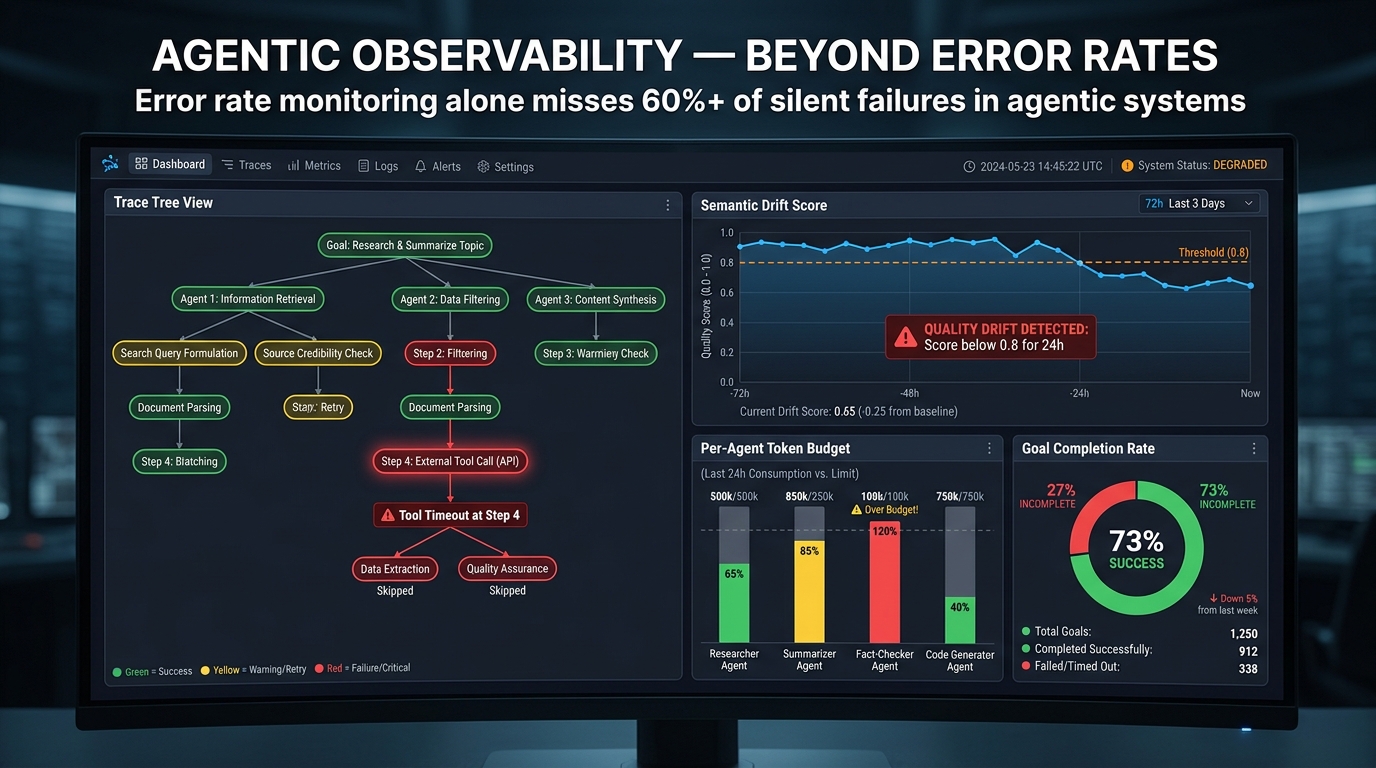
Conventional application observability — latency percentiles, error rates, service uptime — is necessary but structurally inadequate for agentic systems. A pipeline that runs to completion in acceptable time with no logged exceptions and an HTTP 200 response may still have produced useless, harmful, or wrong output. Conventional monitoring will report it as a success.
Agentic observability requires a fundamentally different instrumentation model, built around two concepts that conventional APM tools don’t natively support: trace trees and semantic evaluation.
Trace Trees: The Unit of Agentic Debugging
In a multi-step agentic workflow, the relevant unit of analysis is not the request-response pair — it is the full execution trace: every reasoning step, every tool call and its arguments, every intermediate output, every state transition, and the branching decisions that led from objective to terminal state.
A trace tree represents this structure visually and queryably. Each node in the tree is a reasoning step or tool call, with metadata including the input context, the output, the latency, and the pass/fail status relative to any gate checks. When a pipeline produces a wrong output, the trace tree tells you where the error originated — not just where it was finally detected.
Implementing trace trees requires instrumentation that most agentic frameworks provide in rudimentary form but that teams often need to extend. Every tool call needs to emit a structured span with input, output, latency, and a correlation ID that links it to the parent reasoning step. Every agent handoff needs to carry the trace ID forward so that cross-agent traces can be reconstructed.
Semantic Evaluation as a Monitoring Signal
For quality metrics that can’t be expressed as pass/fail rules — whether a summary is accurate, whether a generated plan is coherent, whether an extracted entity is correct — production teams are implementing automated semantic evaluation as a continuous monitoring signal.
The pattern is lightweight: a fast, cheap evaluator model (or a deterministic classifier trained on labeled examples from the golden dataset) runs against sampled production outputs and produces a quality score. This score is tracked as a time-series metric alongside conventional infrastructure metrics. A downward trend in semantic quality over 72 hours is as actionable as a spike in latency — and often provides earlier warning of impending failures.
The Metrics That Actually Matter
For engineering teams instrumenting agentic pipelines for the first time, the following metric categories provide meaningful signal beyond conventional error rates:
- Goal completion rate: What percentage of initiated tasks reach a terminal success state? This catches retry storms, infinite loops, and high abandonment rates that don’t produce errors.
- Tool call efficiency: How many tool calls does the agent make per task, relative to the minimum necessary? Rising inefficiency indicates context rot or goal drift before they produce visible output failures.
- Token budget utilization: What percentage of the context window is the agent consuming? Consistent near-limit utilization signals that context management is failing and degradation is imminent.
- Escalation rate: How often does the pipeline route to a human review queue? Rising escalation rates indicate that the agent is encountering inputs it is not equipped to handle autonomously — a signal to expand the golden dataset and retrain or adjust system prompts.
- State write conflicts: In multi-agent systems with shared state, how frequently do write conflicts occur? Rising conflict rates indicate that agent coordination is breaking down.
Frameworks: When They Help and When They Hurt
One of the most practically important decisions an engineering team makes when starting an agentic pipeline project is whether to build on an orchestration framework (LangGraph, CrewAI, AutoGen, Strands, and their peers) or to build closer to the raw API layer. The framework ecosystem has matured significantly, and the decision is no longer a simple “build vs. buy” — it is a question of where abstraction helps and where it obscures.
What Frameworks Actually Give You
Orchestration frameworks reduce the boilerplate cost of common patterns. Defining tools and parsing their outputs, managing the turn structure of multi-step LLM conversations, handling retries at the LLM call level, and wiring together basic pipeline topologies — all of these are faster to implement with a framework than from scratch, particularly for teams new to agentic development.
Frameworks also provide community-maintained integrations with common tools and services: vector databases, document loaders, API connectors, and evaluation utilities. For teams building on standard infrastructure, these integrations save meaningful time.
What Frameworks Hide From You
Anthropic’s engineering guidance on this point is direct: frameworks “often create extra layers of abstraction that can obscure the underlying prompts and responses, making them harder to debug.” They also “make it tempting to add complexity when a simpler setup would suffice.”
In practice, this means that teams relying heavily on framework magic — using high-level APIs without understanding the underlying LLM calls they generate — produce systems that are difficult to debug when something goes wrong. The abstraction that sped up development becomes friction when you need to inspect why the agent made a particular decision three steps into a twelve-step workflow.
The reliable pattern that production teams report is: start by understanding the raw API behavior for your specific task. Prototype the core reasoning pattern directly against the model API, without framework wrappers, until you understand exactly what inputs produce the outputs you need. Then introduce framework abstractions incrementally, verifying at each step that the abstraction is producing the same underlying behavior as your reference implementation. Never use a framework abstraction you cannot explain at the level of LLM calls and tool inputs.
Choosing Simplicity as a Design Principle
Across multiple teams building agentic systems, the pattern that Anthropic’s engineering team summarizes as “find the simplest solution possible, and only increasing complexity when needed” holds up consistently in practice. The teams that build the most reliable production pipelines are not the ones using the most sophisticated orchestration. They are the ones who identified the minimum viable architecture for their specific task and built that — rather than building a generalized multi-agent system because multi-agent systems are what the demos show.
Many tasks that get designed as multi-agent workflows would produce better results and dramatically simpler operational profiles as a well-engineered prompt chain with deterministic gate checks. The question to ask before adding an agent is: what specific capability does this agent provide that a deterministic function or a single additional LLM call cannot? If the answer is unclear, the agent probably isn’t needed.
When Not to Use an Agent — And What to Use Instead
There is a structural pressure in organizations that have invested significantly in agentic AI to use agents everywhere. They have the infrastructure, the teams are trained, and the capabilities are available. The result is a pattern where agentic architectures get applied to problems that don’t warrant them — and produce systems that are slower, more expensive, harder to debug, and less reliable than a non-agentic alternative would have been.
The Agentic Appropriateness Test
A task is a good candidate for an agentic approach when all of the following are true:
- The task cannot be fully specified in advance — it requires dynamic decision-making based on intermediate results.
- The task benefits from tool use: the model needs to retrieve, execute, or act — not just reason over static context.
- The performance improvement from agentic execution (accuracy, coverage, capability) is worth the costs: increased latency, higher compute cost, and additional operational complexity.
- The failure modes of autonomous execution are acceptable given appropriate guardrails — the cost of an agent making a wrong decision can be bounded and managed.
If a task fails any of these criteria, the agentic approach is likely the wrong tool.
Better Alternatives for Common Over-Agentic Patterns
Retrieval over a document corpus: Many tasks framed as “build an agent that can answer questions about our documentation” are better addressed by a well-tuned RAG pipeline — retrieval-augmented generation with good chunking, good embedding, and a single LLM call for synthesis. No agent needed, far lower latency, far simpler to debug.
Data extraction and transformation: Structured data extraction from documents — parsing invoices, extracting entities from contracts, classifying support tickets — often produces better and more consistent results with a carefully engineered single-step prompt than with an agent that dynamically decides how to approach the extraction. Deterministic outputs are easier to validate and easier to fix when wrong.
Sequential content workflows: Tasks like “draft a blog post, then write a social caption for it, then generate image prompts” are sequential prompt chains — not multi-agent systems. Each step is well-defined, takes the previous step’s output as input, and can be validated deterministically. Adding an orchestrator agent that dynamically decides how to sequence these steps introduces complexity without benefit.
The discipline of actively choosing not to use an agent when a simpler architecture suffices is one of the clearest differentiators between engineering teams that ship reliable agentic systems and those that accumulate agentic complexity faster than they can manage it.
The Engineering Contract for AI-First Operations
The organizations that are building agentic pipelines that survive production are, in almost every case, approaching them with the same engineering discipline they bring to any other critical piece of infrastructure. Not “AI is different, the usual rules don’t apply,” but “AI introduces specific new failure modes, and we need to extend our engineering practices to address them.”
The new engineering contract for AI-first operations can be summarized in five commitments:
1. Design for Failure, Not for the Happy Path
Every component in the pipeline — every tool call, every agent handoff, every state write — should be designed with explicit failure handling. What happens when this tool returns a null? What happens when this agent times out? What happens when this state write conflicts with a concurrent write? If the answer is “we haven’t specified,” the pipeline will produce emergent failure behavior in production — and emergent behavior in agentic systems is rarely benign.
2. Make Complexity Earn Its Place
Every added agent, every additional orchestration layer, every new tool integration adds surface area for failure. Complexity should be added incrementally, with each addition validated against the evaluation harness before it goes to production. The baseline should always be the simplest architecture that meets the quality bar — and the quality bar should be defined before the architecture is designed, not after.
3. Instrument Before You Ship
Observability is not a post-launch concern. Trace trees, semantic evaluation, and the metrics described in this post should be in place before the pipeline reaches production — because you cannot debug failures you cannot observe, and the first production failure is not the right time to be building your monitoring infrastructure.
4. Treat Humans as Architecture, Not Exception Handlers
Human oversight in agentic systems is most effective when it is designed in — specific HITL checkpoints for specific action classes, with clear intervention interfaces and documented escalation rules. Human oversight that is applied reactively, when the autonomous system has already done something wrong, is not a governance control. It is an incident response.
5. Own the Failure Taxonomy
The eight failure modes described at the opening of this post — tool misfire, context rot, goal drift, retry storms, silent corruption, over-permission blast, state collapse, and contract drift — are a starting taxonomy, not a complete list. Every team operating agentic systems in production will discover failure modes specific to their task domain and their architecture. The teams that build reliable systems maintain a living failure taxonomy, add to it with each incident, and use it to drive both architectural improvements and evaluation harness coverage.
“Consistently, the most successful implementations weren’t using complex frameworks or specialized libraries. Instead, they were building with simple, composable patterns.” — Anthropic Engineering Team
The pipeline gap — the distance between a compelling demo and a reliable production system — is not closed by better models. It is closed by better engineering. By understanding how agentic systems actually fail, by designing memory architectures that degrade gracefully, by scoping tool permissions to the minimum necessary, by embedding human oversight as a first-class design decision, and by building the observability infrastructure to know what is happening inside the system at every step.
Agentic pipelines that don’t break are not lucky. They are designed.
Key Takeaways
- Model quality is rarely the root cause of agentic pipeline failure. Architecture, governance, and observability gaps account for the overwhelming majority of production failures.
- Treat the context window as RAM, not storage. Implement two-tier memory architectures with explicit token budgets, rolling summarization, and governed external state stores.
- Choose the right orchestration pattern for the task. Sequential chaining with gate checks, fan-out/fan-in, orchestrator-worker, and dynamic handoff each have specific use cases — using the wrong pattern for the wrong task is a reliability risk.
- Blast radius is a first-class design metric. Every agent needs scoped, task-specific tool permissions, dedicated identity, and a tested kill switch procedure.
- MCP and A2A are rapidly becoming production infrastructure standards. Bespoke connectors accumulate maintenance debt that compounds with agent count. Investing in standard protocol adoption now reduces long-term operational cost.
- Human-in-the-loop is architecture, not backup. HITL checkpoints should be explicitly designed for specific action classes, with decision interfaces built for human use — not raw model state.
- Evaluation harnesses and golden datasets need to be versioned, living assets. Offline evaluation against static test corpora plus online evaluation of production trajectories provides the quality signal that conventional monitoring cannot.
- Error rates alone miss the majority of meaningful agentic failures. Goal completion rate, semantic quality scores, token budget utilization, and escalation frequency are the metrics that matter for agentic systems.
- Simplicity is a reliability property, not a capability trade-off. Before adding an agent, verify that a simpler approach — a prompt chain, a deterministic function, a single LLM call — cannot meet the same quality bar.