

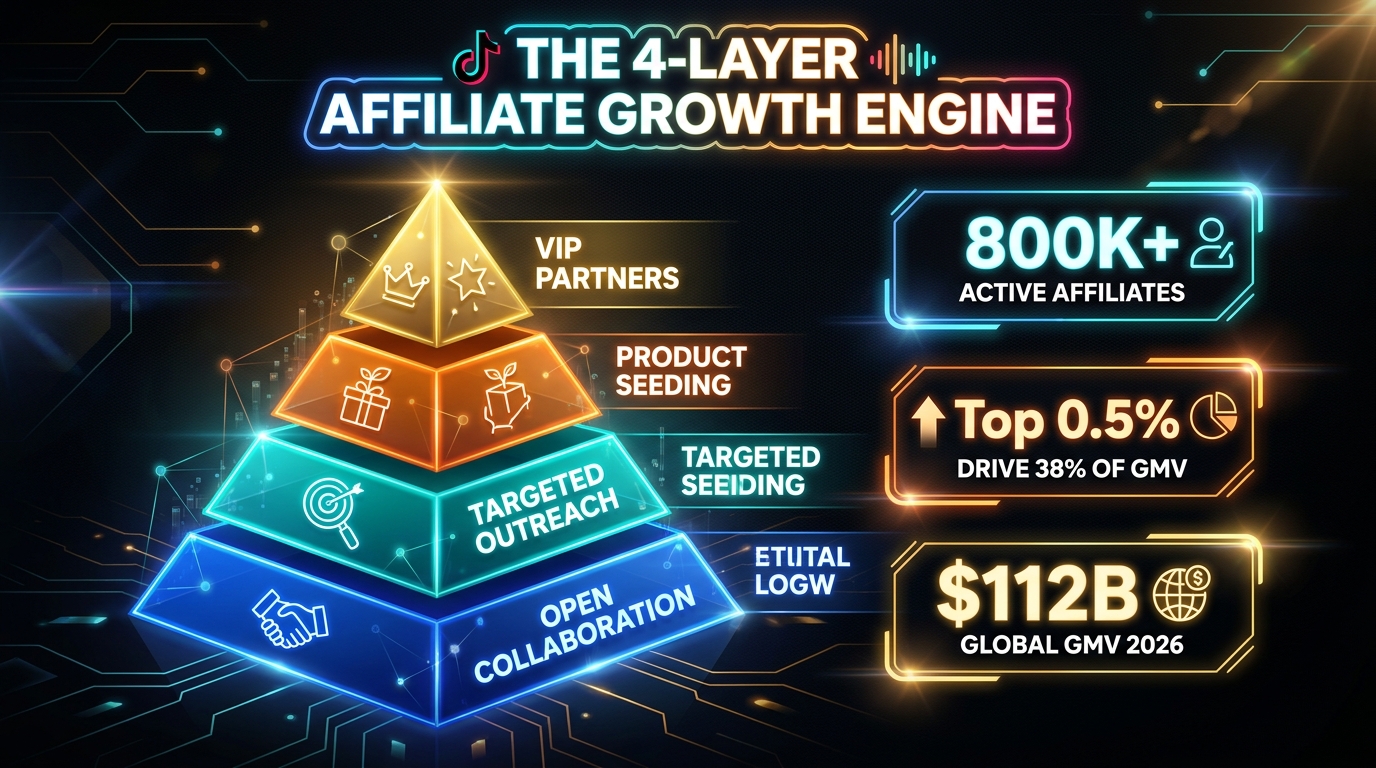

TikTok Shop is projected to surpass $112 billion in global GMV in 2026, a number that would have seemed absurd just two years ago. In the US market alone, conservative estimates sit around $23 billion in annual gross merchandise value, with more aggressive projections crossing $30 billion. Behind virtually every breakout brand on the platform, there is one common structural thread: a deliberate, tiered approach to working with creators that goes far beyond setting up an affiliate link and waiting.
Yet most brands operating on TikTok Shop today are running what can only be described as a one-layer program. They open up an affiliate collaboration, post a commission rate, and then sit back hoping that creators discover their products in the marketplace and start selling. Some do. Most do not. And the ones that do rarely generate enough volume to build a sustainable channel, because there is no system designed to find, develop, and retain the creators who actually convert.
The brands growing fastest on TikTok Shop right now have figured out something different. They are not just running an affiliate program. They are architecting a four-layer creator ecosystem — each layer serving a different purpose, requiring different inputs, and unlocking a different ceiling on what is possible. This post breaks down exactly how that architecture works, what each layer is designed to do, and why the order in which you build them determines your GMV trajectory more than any other single variable.
The Problem With One-Layer Thinking
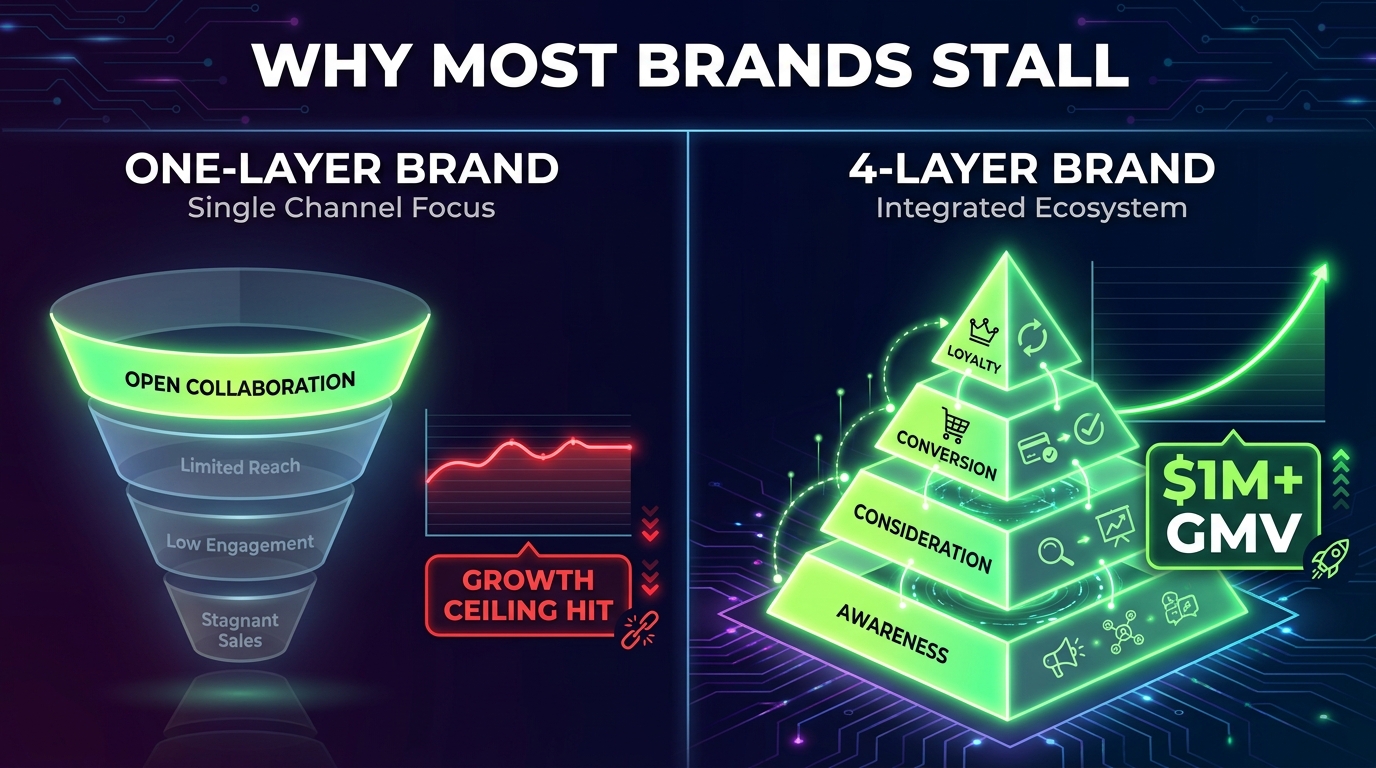
Before building a better model, it helps to understand why the one-layer approach is structurally limited — not just strategically lazy.
The passive discovery problem
Open collaboration, the foundational layer of TikTok Shop’s affiliate system, works by listing your products in the platform’s Product Marketplace with a commission rate attached. Any creator who meets eligibility thresholds can pick up your product and start promoting. In theory, this is a powerful self-service engine. In practice, it creates a passive discovery problem.
With more than 800,000 active affiliate creators registered in the US market as of mid-2026, and hundreds of thousands of products available in the marketplace, your listing is competing for attention from creators who have no particular reason to choose you over anyone else. Brands with strong conversion data and high commission rates get picked up more readily. Brands without that track record — which describes most brands that are new to the platform — often languish with low creator uptake even after weeks of being live.
Open collaboration generates an average conversion rate of 2 to 4 percent from creator posts to product sales. That is not a bad number by most affiliate marketing standards, but it is significantly lower than the 8 to 12 percent conversion seen from targeted collaborations where a brand has specifically recruited and equipped the right creator with the right offer. The gap between those two numbers is not random. It is the product of effort, specificity, and relationship-building — exactly what one-layer programs skip.
Why brands confuse activity for progress
Another common trap is measuring the wrong things. A brand opens up an affiliate plan, sees 40 creators sign up in the first month, and interprets that as traction. But signing up and posting are very different events. Industry data shows that only 40 to 60 percent of creators who join an affiliate program ever produce content, and a much smaller fraction produce content that actually drives sales. The signup number is mostly noise. The active posting rate is signal.
Brands operating at Layer One only have access to the noise. They do not have the infrastructure to identify who is actually posting, what that content looks like, which creators are generating clicks, or which ones are converting. Without that visibility, every decision about the program is based on incomplete information — and the program never improves because there is no feedback loop.
The ceiling effect
Open collaboration has a natural GMV ceiling determined by the size and quality of the creator pool that happens to discover your product. For some products in highly visual categories like beauty and skincare, this ceiling can be surprisingly high, because creators in those niches are actively looking for new products to feature. But for brands in more niche categories, or brands that have not yet built social proof on the platform, the ceiling arrives quickly — usually somewhere between $10,000 and $50,000 in monthly GMV — and then stops moving regardless of how much time passes.
The brands that consistently break through that ceiling are not posting higher commissions on the same single layer. They are adding structural layers that change the nature of their creator relationships entirely.
Layer 1 — Open Collaboration: Building the Base (The Right Way)
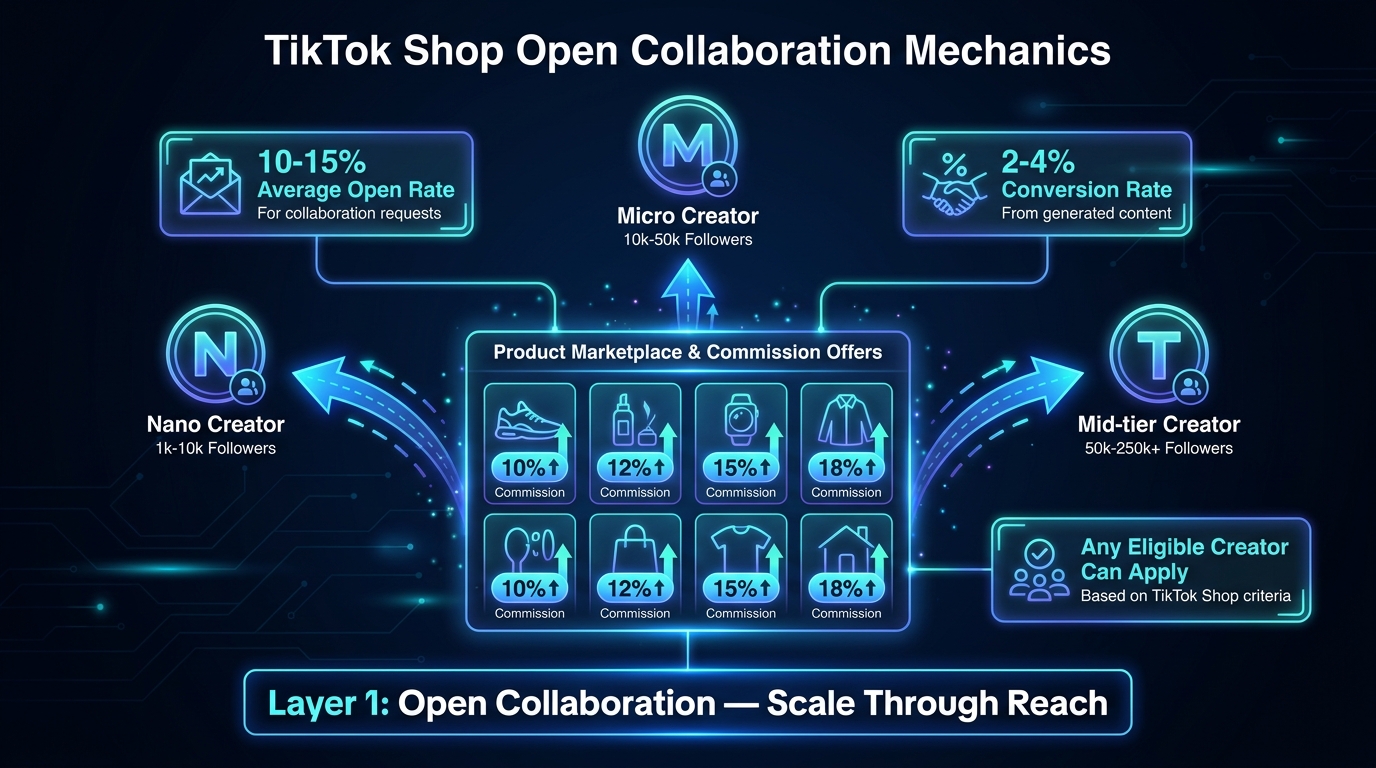
Every four-layer program starts at the same place: open collaboration. The mistake is not using this layer — it is treating it as the only layer, or treating it as a passive set-it-and-forget-it configuration that does not require active management.
How the product marketplace actually works
When a brand enables open collaboration in the TikTok Seller Center, their products appear in the Product Marketplace — the discovery engine that eligible creators use to browse affiliate opportunities. Creators search by category, commission rate, product type, and conversion metrics, and request to promote products they find compelling. Brands can auto-approve or manually approve these requests, and can set commission rates anywhere from 1 to 80 percent per sale.
The commission rate you set is not just a cost consideration. It is the primary signal creators use to assess whether your product is worth their time. A creator with 50,000 followers who produces three videos a week will prioritize products that pay them meaningfully per sale. In most categories, the market rate for open collaboration sits between 10 and 15 percent. Beauty and skincare brands regularly operate at 15 to 20 percent, with aggressive launch rates reaching 20 to 25 percent. Electronics and commoditized goods sit lower, often at 5 to 10 percent, because margins do not support higher payouts.
Getting your commission rate right is the first optimization lever at this layer. Too low and your product disappears from the consideration set of creators with commercial experience. Too high and you erode margin without necessarily improving creator quality, since inflated rates attract opportunistic creators rather than authentic advocates.
What makes Layer 1 actually perform
Well-run open collaboration programs share several characteristics that distinguish them from brands that simply list their products and wait. The first is a strong organic content foundation. Brands that launch affiliate programs before building any organic presence on their TikTok Shop storefront tend to see poor creator uptake, because creators do their own due diligence. They look at your page, your product reviews, your content history. A storefront with no posts and no reviews is a credibility dead end.
The second distinguishing factor is product tile quality. TikTok Shop’s marketplace surfaces products with high-quality images, clear benefit-driven copy, and strong review scores. Creators browsing the marketplace are making fast decisions based on visual appeal and perceived sellability. A product that looks generic or difficult to demonstrate will be skipped in favor of products with obvious hook potential.
The third factor is payout velocity. Brands that pay quickly and consistently develop reputations among creator communities, both through word of mouth and through the performance data that surfaces in creator analytics tools. This matters more than most brand operators realize, because a meaningful portion of creator selection behavior is driven by conversations in creator Discord channels, private groups, and content creator forums where brand reputation is actively discussed.
The role of Layer 1 in the larger system
Even after adding three more layers, open collaboration remains essential as a discovery and recruitment engine. Creators who find your product organically through the marketplace and generate early sales are prime candidates for outreach at Layers 2 and 3. The open collaboration layer functions as a continuous audition — you do not know who will show up, but the ones who show up and convert are often your most valuable future partners. Building infrastructure to capture and act on that signal is what separates brands that scale from brands that plateau.
Layer 2 — Targeted Outreach: Recruiting With Precision
If open collaboration is the wide net, targeted outreach is the spear. It is the layer where brands take an active rather than passive role in creator relationship development, identifying specific creators whose content, audience, and niche align with the product — and directly inviting them into a collaboration structured around higher incentives and deeper partnership.
The mechanics of targeted collaboration
TikTok Shop’s Targeted Collaboration system allows brands to send direct collaboration requests to specific creators, with a private commission rate that overrides the public open collaboration rate. This override is significant: a creator who sees your product listed at 12 percent in the marketplace will see a 25 percent offer in a direct invite, and that gap is often enough to change their decision calculus entirely.
Targeted collaboration rates in 2026 typically fall between 18 and 30 percent, with top-tier offers for proven sellers reaching 40 to 50 percent on specific SKUs. That sounds expensive, but the math usually works in the brand’s favor because targeted creators convert at two to three times the rate of marketplace-found creators. A creator who consistently drives 8 to 12 percent conversion on product visits is worth a materially higher commission than a creator driving 2 to 3 percent, even before accounting for the volume difference.
How to identify the right creators
The biggest mistake at Layer 2 is using follower count as the primary selection criterion. Follower count is a reach metric, not a commerce metric. TikTok Shop has fundamentally different success drivers than traditional influencer marketing, and the creators who sell reliably are not always the ones with the largest audiences.
The most effective creator identification approach focuses on four signals in roughly this order of importance:
- Category authority: Has this creator consistently posted content in your product’s category? A 30,000-follower creator who posts daily skincare routines is more valuable for a skincare brand than a 500,000-follower lifestyle creator who occasionally features beauty products.
- Shoppable content history: Has this creator previously sold through TikTok Shop? Creators with a track record of driving shoppable video clicks have already figured out how to blend entertainment with commerce — arguably the hardest skill to develop.
- Video engagement quality: Comments that mention buying intent (“where do I get this?”, “does it actually work?”, “just ordered”) are a more reliable signal than raw like counts. High-comment, moderate-view videos often outperform high-view, low-comment content on shoppable conversion.
- Audience demographics: Does the creator’s audience match your buyer profile? TikTok provides demographic data within the Seller Center for creators you are considering inviting, and this data should inform whether the collaboration is likely to reach the right purchasers.
What converts a creator to yes
Brands that get high acceptance rates on targeted outreach tend to structure their invitations around creator benefit, not brand need. Generic outreach messages that say “we love your content, we think you’d be great for our product” get ignored at roughly the same rate as cold email spam. Invitations that open with a specific reason why the creator’s existing content signals a fit — “we noticed your unboxing videos in the skincare category consistently drive high comment engagement, and we think our SPF serum is exactly what your audience has been asking about” — convert significantly better.
The invitation should also lead with the offer specifics upfront: commission rate, sample product availability, any exclusive promo codes or bundles for the creator’s audience. Creators making commercial decisions want to see the terms before they invest time reading further. Front-loading that information signals that you understand their business.
Layer 3 — Product Seeding: Putting Skin in the Game
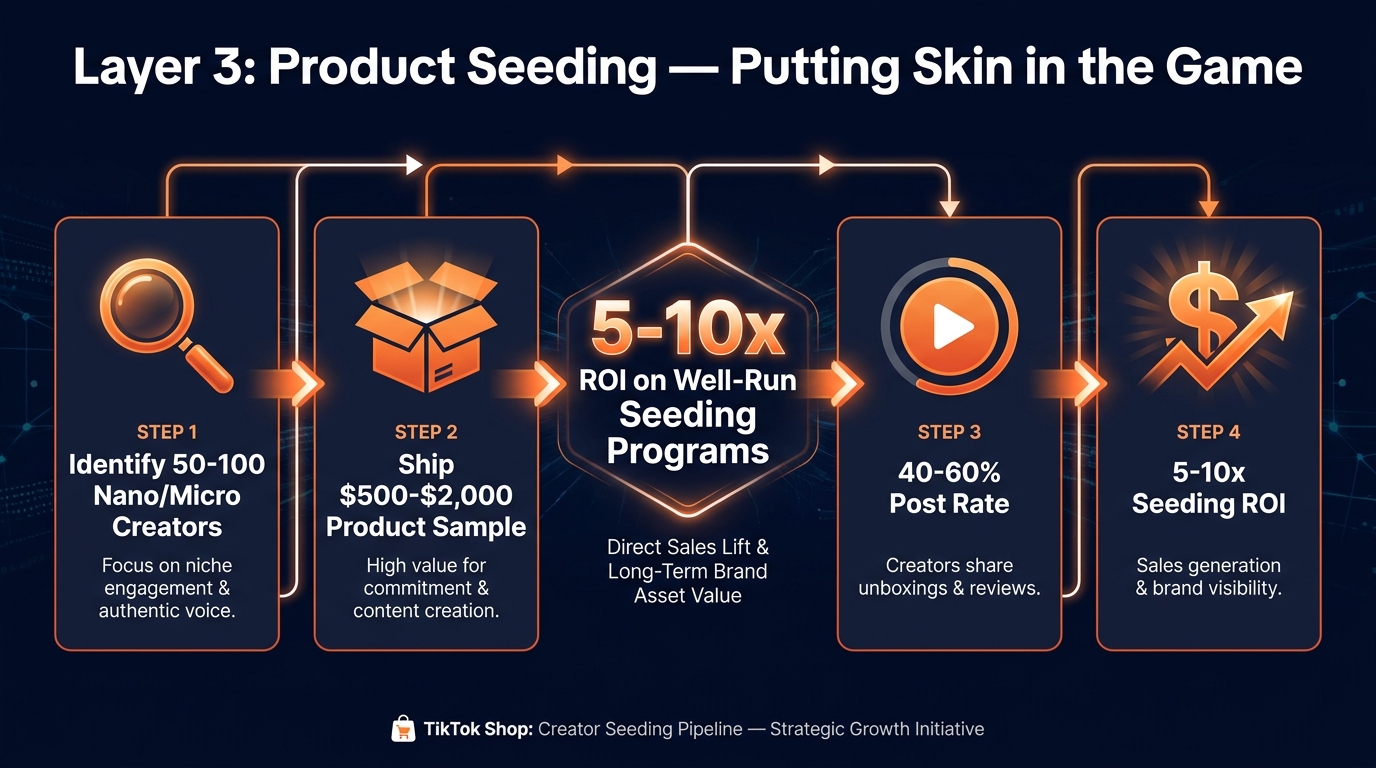
Product seeding is the layer that most brands either skip entirely or execute poorly — and yet it is often the highest ROI activity in the entire program. The core logic is straightforward: send free product to a meaningful number of creators, and let the authentic experience drive content creation without the transactional friction of a formal paid campaign.
The seeding economics
A well-structured seeding program in 2026 typically involves sending product to between 20 and 100 creators in the first wave, representing a total sample investment of $500 to $2,000 in product cost. The expected post rate from a properly recruited seeding cohort is 40 to 60 percent — meaning roughly half of creators who receive a sample will produce content. The content quality and post frequency will vary, but the economics of seeding tend to look favorable at scale: industry data from the past year consistently shows 5 to 10x ROI on the cost of samples when programs are managed with a minimum level of rigor.
What drives the ROI differential between a 5x and 10x outcome? The two biggest variables are creator selection and product fit. Seeding random creators from a broad list produces the lower end of outcomes. Seeding creators who have already demonstrated engagement in your product category, who have a history of producing genuine reaction content, and whose audience profile matches your buyer persona produces results closer to the upper range.
How to structure a seeding cohort
The most effective seeding programs are not mass sends to every nano creator you can find. They are structured cohorts — groups of 20 to 30 creators assembled around a specific product, a specific content angle, or a specific audience segment. Running multiple cohorts with different positioning hypotheses (e.g., one cohort focused on the “daily routine” angle, another focused on the “before and after results” angle) gives you not just creators but also creative intelligence. You learn which hooks your audience responds to before you have spent anything on paid amplification.
The packaging of the seeding kit matters more than most brands expect. A plain envelope with a product and a QR code sends a signal about how much the brand values the relationship. A thoughtful kit — product plus a personalized note, a brief brief with suggested content angles, a unique discount code for the creator’s audience — sends a different signal entirely. It says: this brand has thought about this collaboration as a real partnership, not a checkbox activity. Creators notice, and their content quality reflects it.
The follow-up structure that makes seeding scale
Seeding without follow-up is essentially donation. The operational layer that makes seeding a scalable channel is a structured outreach sequence after product delivery: a check-in message confirming receipt and offering to answer questions, a soft nudge at the 7-day mark if no content has appeared, and a direct request for a posting timeline at day 14. This does not need to be aggressive or transactional. Done well, it reads as genuine support — brand as collaborator, not brand as employer.
Creators who post after seeding and generate meaningful engagement should be moved immediately to Layer 2 targeted outreach for a formal commission arrangement. This is the graduation moment the seeding layer exists to create. Treating every seeded creator as a potential Layer 2 partner changes how the team manages the program — it is no longer about sending product, it is about identifying candidates for a deeper, more structured relationship.
Layer 4 — VIP and Partner Tier: Turning Top Performers Into a Growth Engine
Layer 4 is where the program transitions from creator marketing into creator commerce infrastructure. VIP partnerships are not just higher commission deals — they are structured, ongoing relationships with a small number of proven creators who have demonstrated the ability to drive consistent, predictable GMV for the brand.
What a VIP creator relationship actually looks like
At this layer, the arrangement moves beyond transactional commission. VIP creators in a well-run TikTok Shop program typically receive a combination of benefits that are not available to creators at lower tiers:
- Elevated commission rates: 25 to 50 percent, depending on category and creator performance history, typically negotiated directly rather than through the platform’s standard tools.
- Early access to new products: VIP creators get first look at upcoming launches, which allows them to produce content ahead of the public release — creating pre-launch momentum and giving the brand valuable feedback before scale.
- Exclusive SKUs or bundles: Some brands create product configurations that only VIP creators can offer, providing genuine exclusivity for the creator’s audience and deepening their incentive to actively promote.
- Co-creation input: The best VIP relationships involve creators in product development conversations, not just content creation. Creators who feel invested in the product’s success at a conceptual level become authentic advocates rather than paid promoters.
- Spark Ads authorization and GMV Max inclusion: VIP creators grant brands the right to amplify their organic content through Spark Ads and to include it in GMV Max campaigns, creating a direct bridge between organic creator content and paid distribution.
How many VIP creators do you need?
The number that comes up consistently in practitioner playbooks is between five and twenty active VIP creators — enough to generate meaningful volume and reduce dependency on any single creator, but small enough to manage the relationships with the attention they require. Running a VIP program with 100 creators is not a VIP program. It is just a slightly higher-touch version of open collaboration.
The power-law nature of creator performance (explored in the next section) means that the top 5 to 10 creators in a well-designed program will generate the majority of program GMV. Identifying those creators early, investing disproportionately in those relationships, and structuring the program to retain them over time is one of the highest-leverage activities a TikTok Shop operator can pursue.
Managing VIP relationships without creating dependency
The risk at Layer 4 is creator concentration. A brand that has 60 percent of its TikTok Shop GMV flowing through two or three VIP creators is exposed to significant disruption if those creators change platforms, take a break, or move on to other brand relationships. Managing this risk requires maintaining an active pipeline of creators at Layers 1, 2, and 3 — which is one of the less obvious reasons why running all four layers simultaneously matters. The lower layers are not just growth engines. They are insurance against the fragility of VIP concentration.
The Power-Law Problem: Why Concentration Data Should Change How You Recruit
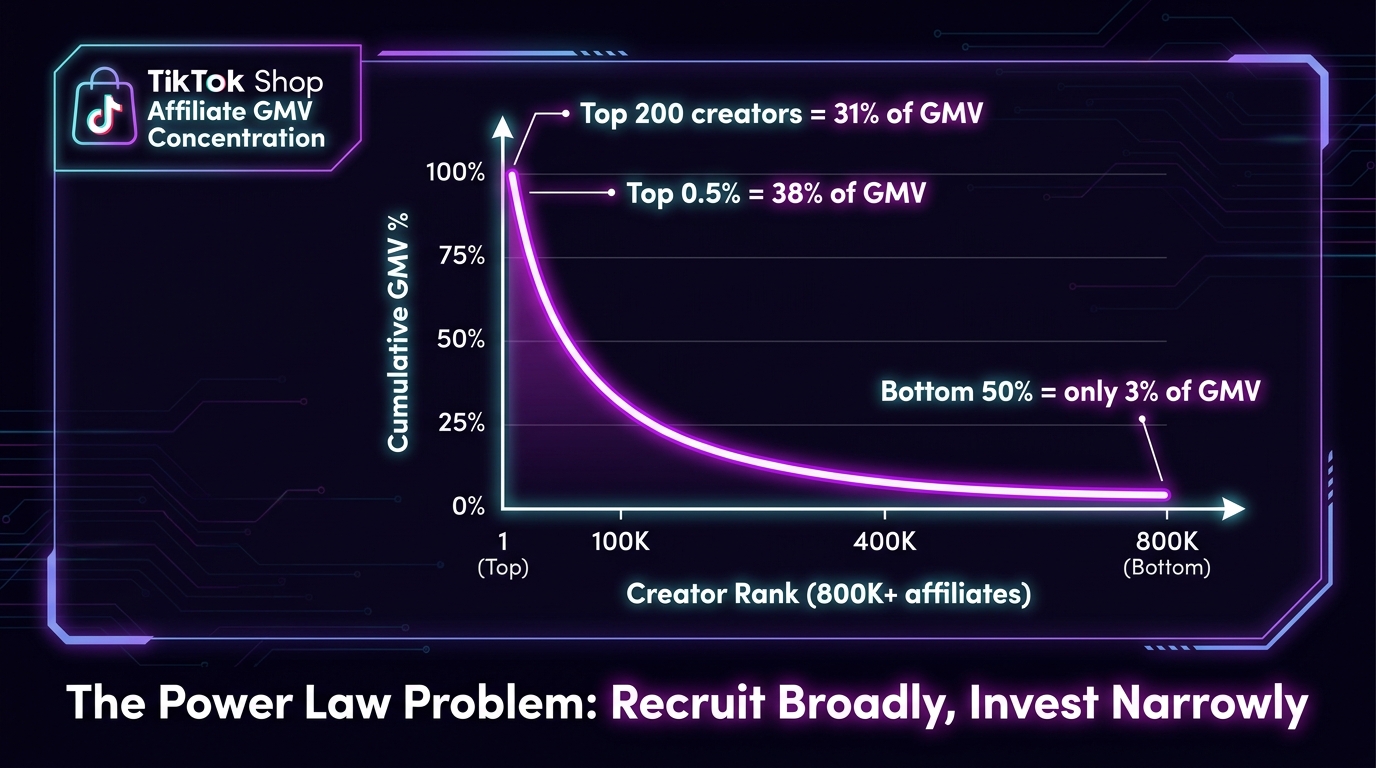
One of the most clarifying datasets available about TikTok Shop’s creator ecosystem is the GMV concentration data. Across a network analysis of more than 1.2 million TikTok Shop affiliates, the distribution of sales looks like a textbook power law — and understanding what that means practically has significant implications for how you structure your program.
What the numbers actually show
The data is stark. With 800,000-plus active US affiliate creators in 2026, the GMV distribution breaks down roughly as follows: the top 0.5 percent of creators — approximately 4,000 accounts — generate 38 percent of all affiliate GMV. The top 200 creators alone account for 31 percent of affiliate GMV on the platform. The bottom 50 percent of registered affiliates collectively contribute only 3 percent of volume.
This is not a small skew. This is an extreme concentration that means the overwhelming majority of affiliate creators produce almost no commercial impact. And yet brands that understand this data do not conclude “we should only recruit the top creators.” They conclude something more nuanced: recruit broadly to find the few, invest narrowly in the proven.
The talent identification problem
The reason you cannot simply start at the top of the power-law distribution and skip the broad recruitment phase is that TikTok Shop’s creator hierarchy is not static. A creator who sits in the bottom third of the performance distribution today might break through to the top tier in three months, driven by a single viral video, a trend alignment, or an audience demographic shift. The brands that spot those moments early — because they have been tracking creator performance across Layers 1 and 2 — are positioned to deepen the relationship before the creator becomes obviously valuable and therefore expensive.
Conversely, creators who appear at the top of general influencer rankings or who have large followings on Instagram or YouTube do not automatically translate to TikTok Shop performance. The skill of driving shoppable conversion in short-form video is distinct from the skill of building a large following, and those two things correlate less strongly than most brands assume going in.
What this means for your recruiting numbers
Brands that run effective four-layer programs tend to maintain a creator funnel that looks roughly like this: 50 to 200 creators in open collaboration at any given time, 15 to 30 in active targeted outreach relationships, 10 to 20 currently in seeding cohorts, and 5 to 20 in VIP tier. The wide top of that funnel is not waste. It is the engine that feeds the narrow, high-value bottom — and every brand that has succeeded at scale on TikTok Shop has maintained that ratio rather than trying to shortcut to a small, curated creator list.
The Paid Amplification Bridge: GMV Max, Spark Ads, and When to Push Winning Content
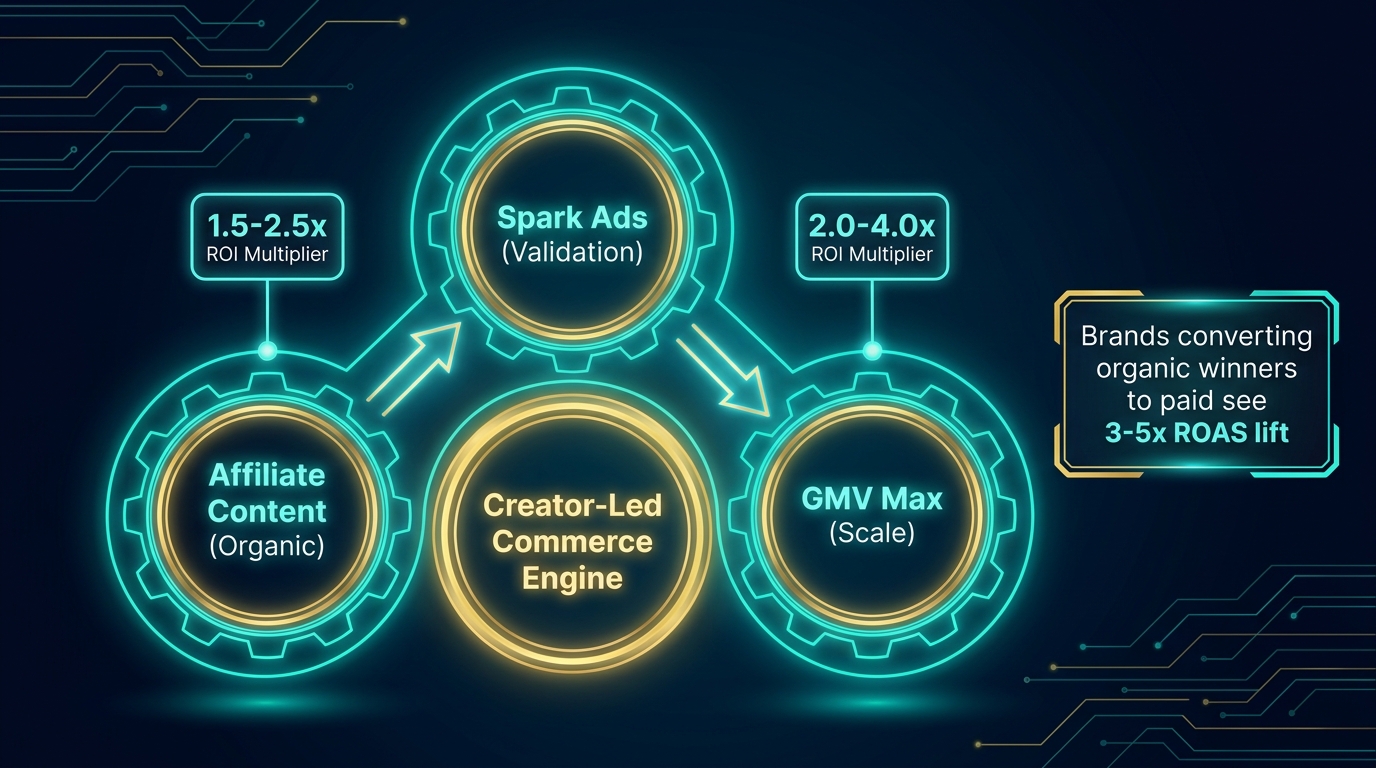
The four-layer creator program and the paid advertising stack on TikTok Shop are not separate strategies — they are interdependent systems, and understanding how they connect changes how you think about both.
Why GMV Max needs creator content to function at full capacity
GMV Max became the default and only supported TikTok Shop Ads campaign type in mid-2025, which fundamentally changed the role of creator content in the paid ecosystem. GMV Max is an automated campaign format that uses TikTok’s algorithm to optimize toward incremental GMV. It can draw from multiple creative sources: your own brand videos, product images, and — critically — authorized affiliate creator content.
The reason this matters for the creator program is that GMV Max performs materially better when fed with authentic creator content that has already demonstrated organic traction. The algorithm has access to the engagement signals from those organic posts — watch rate, comment sentiment, click behavior — and uses that data to optimize paid delivery. Synthetic brand content, regardless of production quality, typically does not have the same engagement foundation to work from.
In practice, this means the brands getting the highest ROAS from GMV Max are the ones running the most active creator programs. The creator program is not just generating organic GMV. It is generating the creative fuel that makes the paid engine work.
The Spark Ads validation layer
Between organic creator content and full GMV Max campaign inclusion, Spark Ads serves as an intermediate validation step. When a creator’s post generates above-threshold engagement in the first 24 to 72 hours — typically defined as click-through rates, comment volume, and save rates that outperform category benchmarks — a brand can use Spark Ads to boost that specific post to a broader audience without removing it from its original creator context.
This distinction matters. A Spark Ad amplifies the creator’s post as it exists, maintaining the social proof of the organic engagement and the creator’s authentic voice. It does not replace the creator’s content with a brand version. For audiences on TikTok, this difference is detectable: content that feels native to a creator’s account converts better than the same content repurposed into obvious brand advertising, even when the visuals are identical.
The practical implication is that Spark Ads should be used as a signal-responsive tool, not a scheduled spend. The trigger for running a Spark Ad should be organic performance data, not a pre-determined calendar slot. This requires daily or near-daily monitoring of creator content performance — something that one-layer programs without the operational infrastructure for creator management rarely have in place.
The timing of paid amplification
One of the most common tactical errors brands make is waiting too long to amplify winning content. TikTok’s organic algorithm surfaces content most aggressively in the first 48 hours after posting. Spark Ads layered on top of a post that has already generated strong organic engagement in that window can extend the reach curve dramatically. Spark Ads applied to a post that is three weeks old are working against the algorithm rather than with it, because the initial engagement signal has largely expired.
The operational implication is that the team managing the creator program needs to have a defined process for identifying and acting on high-performing content within 24 hours of posting. That requires clear performance thresholds, a decision-making protocol, and budget flexibility — all of which need to be established before the creators start posting, not reactively after a breakout video appears.
Building the Creator Progression Pipeline
The four layers only generate compounding returns if creators are actively moving through them — from open collaboration to targeted outreach, from seeding to VIP. Without a defined progression mechanism, creators get stuck at the layer they entered, the program fails to develop depth, and the layered architecture becomes a naming convention rather than an actual system.
Defining graduation criteria
Every transition between layers should have explicit performance criteria. The thresholds that work best in practice are:
- Open Collaboration → Targeted Outreach: A creator who has generated a minimum of three posts and driven measurable clicks or sales from your product within 30 days of joining the affiliate program. The threshold does not need to be high — even modest early performance signals creator intent and audience alignment that justifies a direct relationship.
- Targeted Outreach → Seeding: A creator who has accepted a targeted collaboration and produced at least one piece of content warrants consideration for a seeding kit, particularly if their first post showed good engagement even without strong conversion. Seeding deepens the relationship and gives the creator better content material.
- Seeding → VIP: This is the most consequential graduation. A creator who has received product, produced authentic content, and driven sales at conversion rates above the program average (typically 6 percent or better) is a strong VIP candidate. The graduation conversation should happen quickly — within 48 hours of identifying the performance threshold being crossed — because top-performing creators receive outreach from multiple brands, and timing matters.
Tracking the pipeline without enterprise tooling
Brands at early stages of building this system often ask about the tooling required. The answer is less complex than it sounds. A well-maintained spreadsheet or lightweight CRM — tracking each creator by layer, join date, number of posts, total clicks, GMV attributed, and most recent contact — provides enough visibility to manage a program of up to 100 active creators. Above that scale, dedicated TikTok Shop analytics platforms or influencer management tools become worth the investment, but they are not prerequisites for getting started.
What matters more than the tool is the cadence: someone on the team reviewing creator performance data at minimum weekly, acting on graduation signals within 48 hours, and managing the outreach queue consistently rather than in sporadic bursts driven by panic about GMV shortfalls.
Creator communication standards
One of the most overlooked elements of pipeline management is the consistency and quality of brand communication with creators at every layer. Creators talk to each other. They share experiences with brands in group chats, forums, and casual conversations that brand operators never see. Brands that are responsive, clear about expectations, prompt with payments, and genuinely interested in the creator’s success develop reputations that make every layer of recruitment easier. Brands that go silent after sending a product, dispute commission calculations, or respond to creator questions days later develop the opposite reputation — and it circulates faster than any marketing they could do.
What Brands Get Wrong About Running a Creator Program
Given how much is now known about what makes TikTok Shop creator programs work, it is worth being specific about the failure modes that are still common — because many of them are not obvious, and some of them are counterintuitive.
Launching before the storefront is ready
The most frequently cited failure mode in practitioner communities is launching an affiliate program before the TikTok Shop storefront has the social proof and content foundation to convert the traffic that creators send. A creator’s video can drive viewers to a product page, but if that page has no reviews, no brand content, and a generic product image, the conversion rate will be negligible regardless of how compelling the creator’s video was. Creators learn this quickly. After one or two failed promotions of a product that does not convert, they stop promoting it — and they remember the brand.
The minimum viable storefront before launching any creator program includes: at least 20 product reviews, at least 10 pieces of brand-owned content (product demos, tutorials, before-and-afters), and a complete product page with lifestyle imagery and clear benefit copy. This is not a high bar, but it is one that many brands skip in their eagerness to get creators promoting quickly.
Over-indexing on follower count
As noted in the targeted outreach section, follower count is a weak predictor of TikTok Shop performance. Brands that recruit primarily based on follower size end up overpaying for reach that does not convert and undervaluing the nano and micro creators (10,000 to 100,000 followers) who drive disproportionate commerce outcomes because of their high engagement rates and audience trust. The mid-tier creator (100,000 to 500,000 followers) is often the sweet spot for commerce-driven content: large enough to generate meaningful volume, engaged enough to convert at rates that justify the higher commission structure that tier typically requires.
Treating affiliate management as a part-time responsibility
The operational reality of running a four-layer creator program is that it requires dedicated, consistent attention. Brands that treat creator program management as something a marketing coordinator handles alongside five other responsibilities consistently underperform brands that assign clear ownership with specific creator program KPIs. The complexity is not technical — it is relational and operational. It requires daily monitoring, fast decision-making on content amplification, regular creator communication, and a structured pipeline review process. That is a full-time focus, not a side project.
Neglecting the financial structure of the deal
Brands sometimes structure creator deals that look generous but inadvertently create friction or misaligned incentives. Examples include: setting commission windows that are too short (14-day cookies when the product has a 30-day consideration cycle), failing to provide exclusive discount codes that give creators a tangible hook for their audience, or building commission structures that do not account for returns. Creators who see chargebacks on commissions they have already earned lose trust quickly. Getting the deal mechanics right — cookie windows, return policies, payment timing, commission audit trails — is not glamorous work, but it determines whether creators actually commit to promoting the product or treat it as a one-off test.
Measuring the 4-Layer Program: The Metrics That Actually Matter
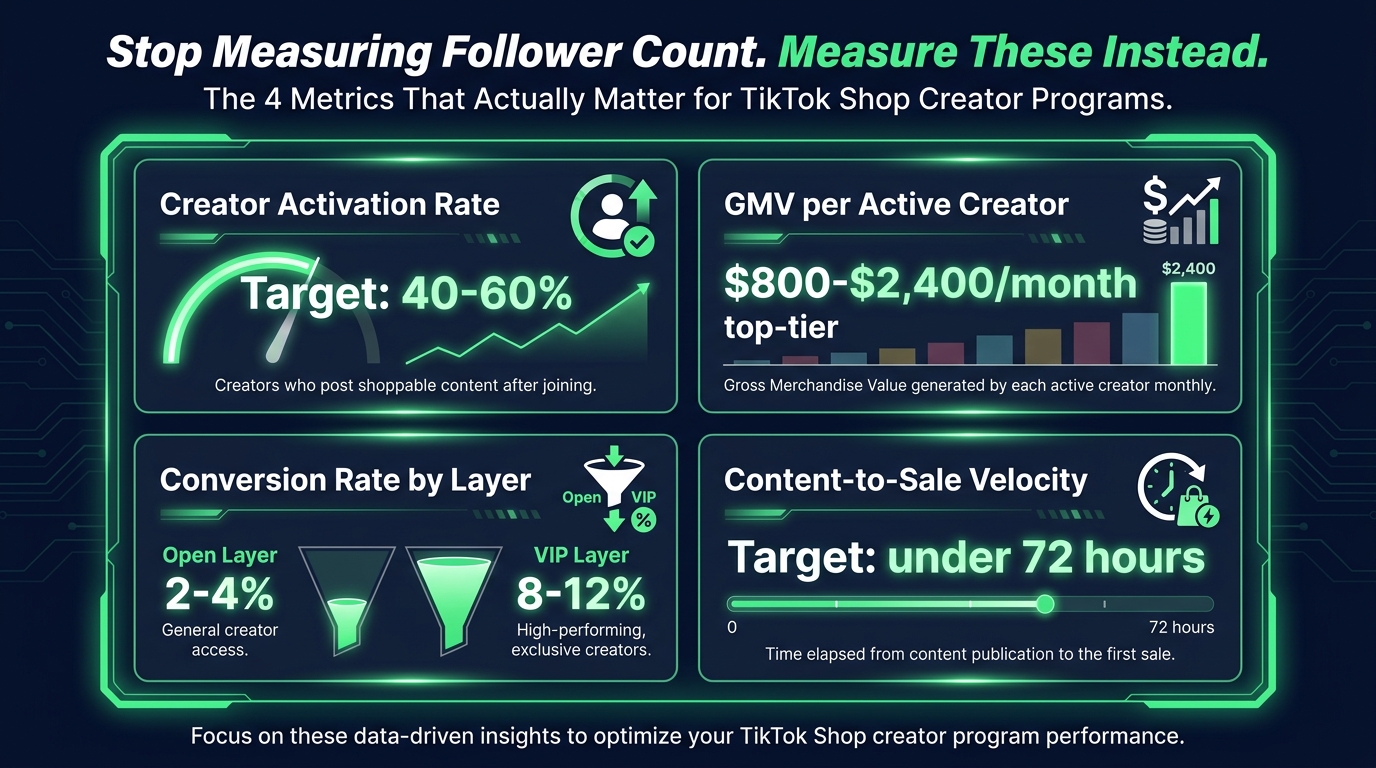
Most TikTok Shop brands measure their creator programs with the wrong metrics. Follower counts, total creators recruited, number of posts, and total impressions are the vanity metrics of this channel. They feel like progress but do not tell you whether the program is healthy or whether it is actually driving compounding commercial results.
Creator activation rate
This is the percentage of creators who join any given layer and produce at least one piece of content within 30 days. Industry data suggests a healthy activation rate for open collaboration is 40 to 60 percent; targeted collaboration and seeding programs should aim for 60 to 80 percent, since those are opt-in relationships where the creator has already demonstrated intent. Below 40 percent in any layer is a signal that either the creator selection criteria are too broad, the onboarding communication is insufficient, or the commission structure is not competitive enough to motivate action.
GMV per active creator
This is the revenue generated per creator who actually produced content during the measurement period. Tracking this by layer reveals the ROI differential between layers and tells you where to invest additional resources. Top-tier VIP creators generating $800 to $2,400 or more per month in GMV are straightforward to justify. Open collaboration creators generating $30 per month require a larger volume of participants to move the overall number, which informs how wide you need to keep the top of the funnel.
Conversion rate by layer
Tracking video-to-purchase conversion rate by collaboration layer is the clearest signal of program architecture health. Open collaboration should deliver 2 to 4 percent conversion. Targeted outreach should deliver 5 to 8 percent. VIP partnerships with highly aligned creators should deliver 8 to 12 percent or better. If your targeted and VIP layers are performing at open collaboration rates, the creator selection criteria are off — you are paying premium commissions for average performance, which erodes margins without proportionate return.
Content-to-sale velocity
This measures the time between a creator posting content and the first sale being attributed to that content. Shorter velocity (under 72 hours) indicates strong audience-product fit and a creator whose audience is primed to purchase. Longer velocity (7 days or more) is not necessarily a problem — some products have longer consideration cycles — but it does affect how quickly you can make Spark Ads decisions and how you should structure your payment cycles for the creator.
Graduation rate
What percentage of creators at each layer advance to the next within 90 days? A graduation rate below 5 percent from open collaboration to targeted outreach suggests the program is not identifying and acting on early-performing creators fast enough. A graduation rate of 10 to 15 percent suggests an efficient pipeline. Above 20 percent may indicate the graduation criteria are too loose and the system is promoting creators who have not yet demonstrated enough commercial signal to justify the investment increase.
From Campaign to Commerce Engine: The Mindset Shift That Changes Everything
The deepest reason brands stall on TikTok Shop is not a tactical gap — it is a mental model problem. They bring to the platform the assumptions of traditional influencer marketing: campaigns have start and end dates, creators are vendors who deliver a defined output, performance is measured in impressions and reach, and the relationship ends when the campaign invoice is paid.
None of those assumptions survive contact with how TikTok Shop actually works. The platform rewards continuous, compounding creator relationships over discrete, transactional ones. A creator who has been promoting your product for six months, who knows your messaging, who has developed a genuine connection with your brand story, generates content that converts at a fundamentally different rate than a creator doing a one-off paid post. The algorithm rewards content with authentic engagement history. The audience rewards familiarity and trust. Neither of those things is available in a campaign model.
The operational shift
Treating TikTok Shop as a commerce engine rather than a campaign channel requires operational changes that go beyond the creator program itself. It requires inventory forecasting that accounts for creator-driven demand spikes. It requires customer service infrastructure that can handle the volume of questions a breakout creator video generates within the first hour. It requires review collection processes designed for the speed of social commerce, not the slow cadence of email follow-ups. Every function that touches the post-purchase experience needs to be designed for the speed and volume that creator-led commerce generates at scale.
What affiliate-first actually means at program maturity
At full maturity, an affiliate-first program inverts the traditional relationship between content and commerce. Rather than creating content to support product sales, you are building creator relationships that generate both content and sales simultaneously — and using the data from those organic interactions to inform every other marketing decision: which products to feature in paid ads, which benefit claims resonate most, which audience segments are most responsive, and which content formats are worth investing in across other channels.
The brands winning on TikTok Shop in 2026 are not treating the creator program as a marketing channel. They are treating it as a market intelligence system, a content factory, a demand generation engine, and a customer acquisition channel simultaneously. That is the output of a mature four-layer program — and it is fundamentally inaccessible to brands still operating at Layer One.
Actionable starting points
For brands at the beginning of this journey, the path forward does not require doing everything at once. A practical 90-day sequence looks like this:
- Days 1–30: Build the storefront foundation — 20+ reviews, 10+ pieces of brand content, competitive commission rates in open collaboration. Identify the first 5 to 10 creators who engage organically with your product or category.
- Days 31–60: Launch the first targeted outreach cohort to the 5 to 10 identified creators. Simultaneously assemble the first seeding kit and identify 20 to 30 nano/micro creators for the first seeding wave. Establish the performance tracking spreadsheet.
- Days 61–90: Review early performance data. Graduate any creators who have hit activation and conversion thresholds. Begin VIP conversations with the one or two creators who have demonstrated the strongest commercial signal. Authorize Spark Ads on the 2 to 3 best-performing organic videos. Identify what is working and double down on it rather than expanding the program laterally.
The three-month window will not produce a fully mature four-layer program. But it will produce enough data to make evidence-based decisions about where to invest, which creators to prioritize, and what the realistic GMV ceiling looks like for the next stage — which is the only foundation a sustainable creator commerce program can be built on.