

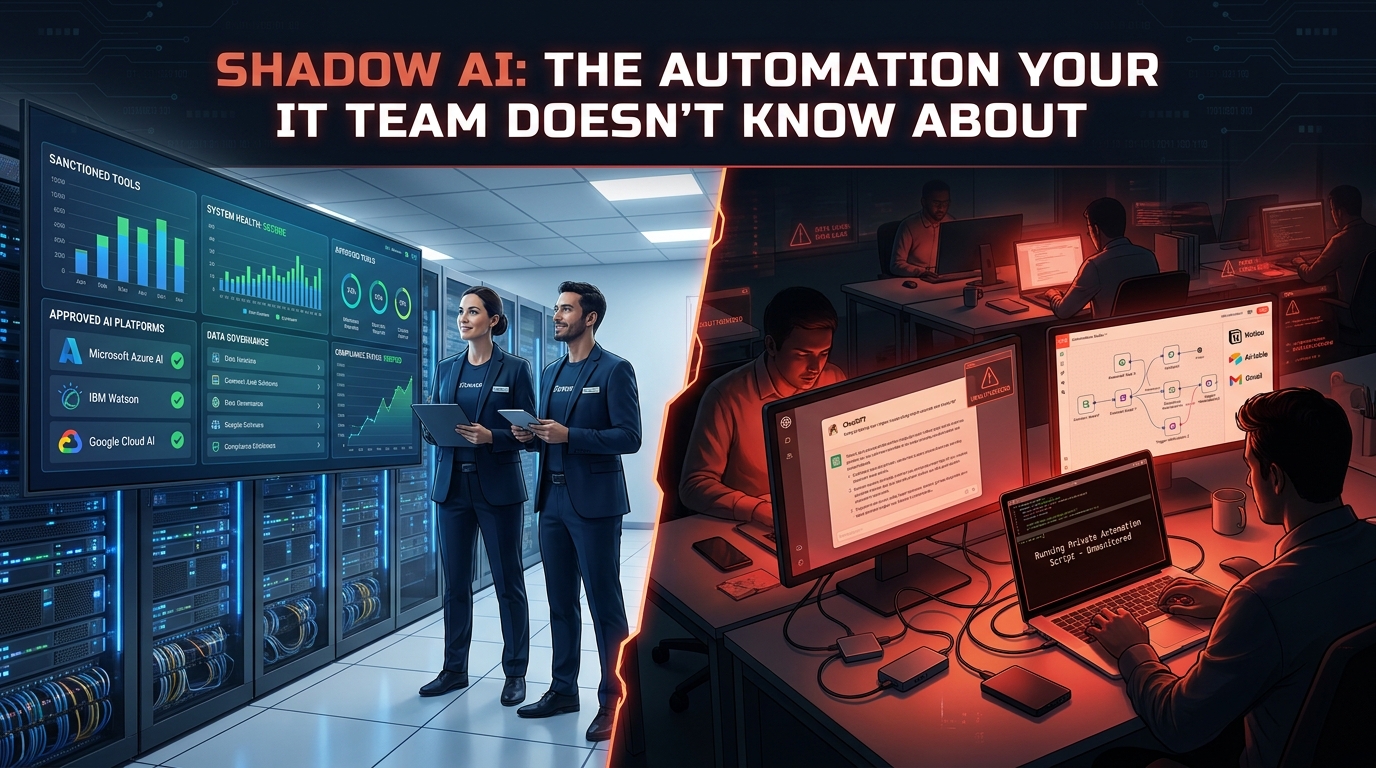

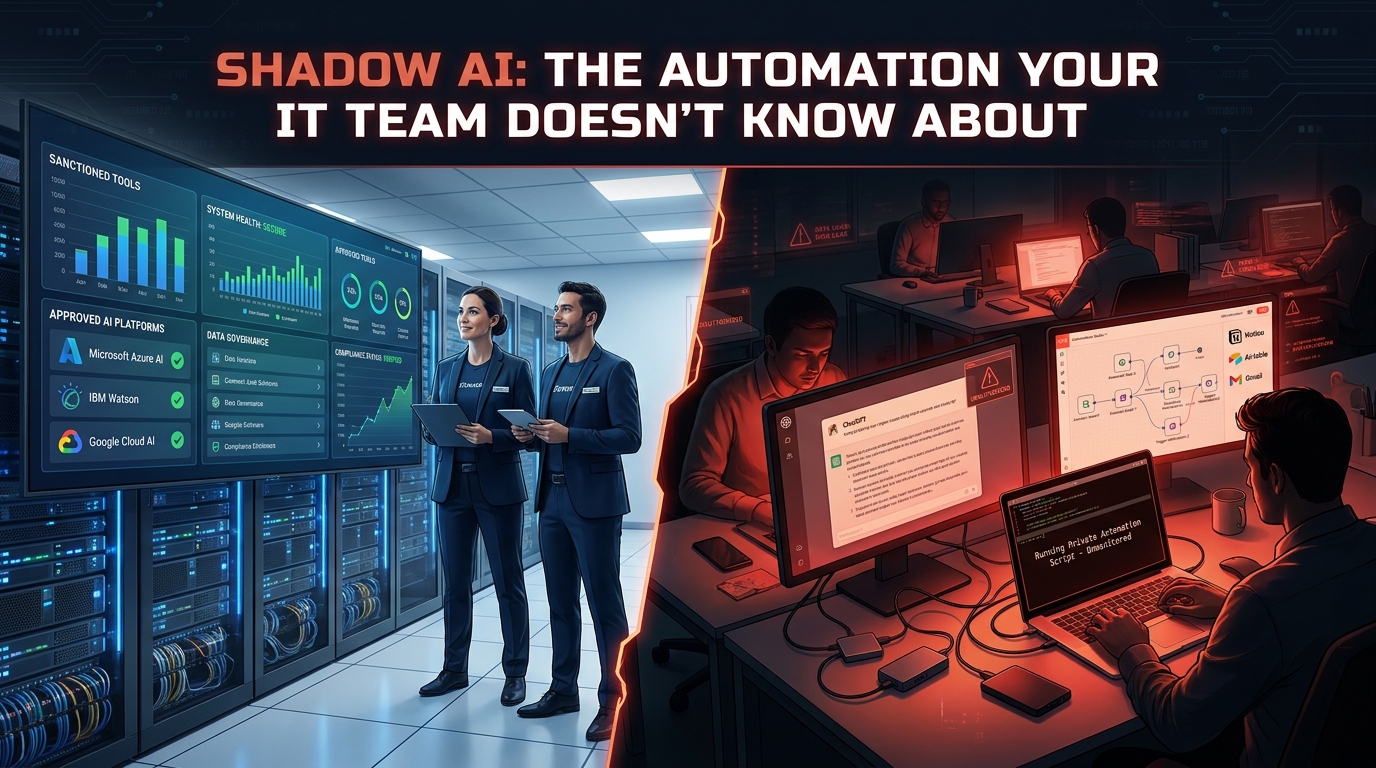
Here is a scenario that plays out dozens of times a day in large organisations. A marketing analyst is drowning in weekly performance reports. Her IT-approved toolset takes two hours to compile the data she needs. So she opens a browser tab, pastes a spreadsheet export into a public AI model, adds a prompt, and has a formatted summary in ninety seconds. She does not tell her manager. She definitely does not file a request with IT. She just gets it done.
Now multiply that across ten thousand employees in different departments, each making their own quiet decisions about which AI tools are fast enough to be useful and which official processes are too slow to bother with. Some of them are building Zapier workflows that connect company CRM data to third-party AI APIs. Others have installed browser extensions that silently summarise every email they open. A few have spun up n8n instances on personal cloud accounts and pointed them at shared Salesforce credentials.
This is what shadow AI looks like in 2026 — not rogue hackers, not malicious insiders, just ordinary employees trying to do their jobs faster with tools that genuinely work. The problem is not their intention. The problem is that most organisations have no idea how many of these unofficial automations are running, what data they are touching, or what happens when one of them fails or leaks.
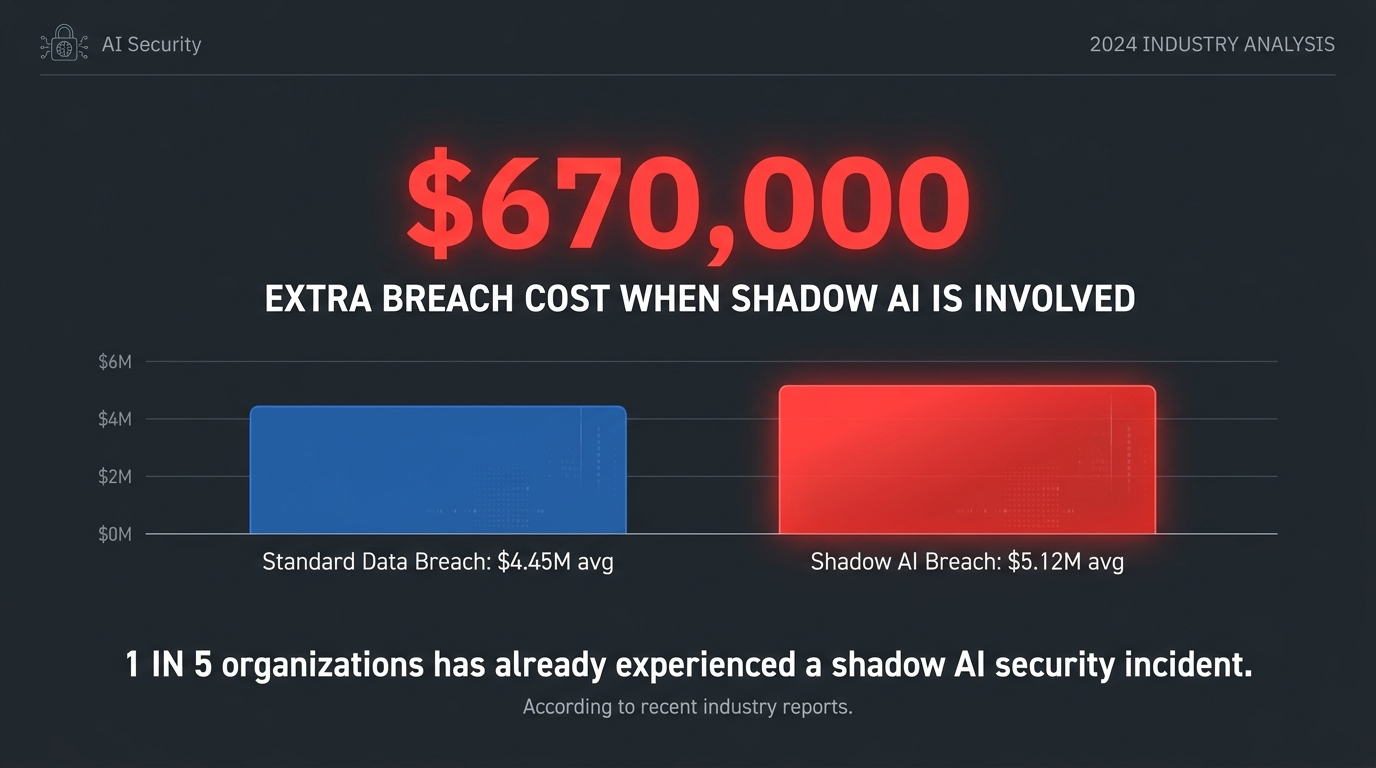
Seventy percent of companies now have shadow AI operating in their environment according to Vanta’s 2026 research. One in five of those organisations has already experienced a security incident linked to it. And the average cost premium when a data breach involves shadow AI sits at roughly $670,000 above the standard breach cost, based on IBM security research. These are not theoretical projections. They are observations from systems that are already running.
This article is about understanding what shadow AI automation actually looks like across an organisation in 2026, why conventional shadow IT controls cannot keep up with it, and how to build governance that addresses the problem without turning into a ban-everything bureaucracy that drives the behaviour even deeper underground.
What Shadow AI Actually Looks Like in 2026
The mental model most IT and security teams still carry of shadow AI is outdated. The dominant image is an employee typing into a free ChatGPT account. That version of the problem still exists, but it is now the least sophisticated and most visible form of what is actually happening.
By 2026, shadow AI has diversified across at least four distinct categories, each with different risk profiles and different detection challenges.
Personal AI tool usage
This is the ChatGPT-and-Claude layer. Employees use public or freemium AI models via browser interfaces, paste in company data, and use the outputs for work. A recent Cybernews survey of approximately one thousand U.S. employees found 59% use shadow AI tools of this kind. The BlackFog equivalent put it at 49%. The specific number varies by survey methodology, but every credible dataset from 2025 and 2026 lands in the same general range: roughly half of your workforce is doing this.
What gets pasted in is not trivial. IBM research found that 38% of employees acknowledge sharing sensitive work information with AI tools without employer permission. “Sensitive” in this context means customer PII, internal financial forecasts, proprietary source code, and confidential legal documents — not just low-stakes memos.
No-code and low-code workflow automation
This layer is growing faster and is considerably harder to detect. Platforms like Zapier, Make (formerly Integromat), and n8n have shipped increasingly capable AI features — natural language workflow builders, embedded LLM steps, AI-powered decision nodes. The result is that non-technical employees can now build multi-step automations connecting company data systems to external AI APIs in under an hour, without writing a single line of code.
A sales operations manager might build a workflow that exports new leads from Salesforce, sends them to an OpenAI API for qualification scoring, and writes the result back to the CRM. It works. It costs fifteen dollars a month on a personal credit card. IT has no record of it. The data leaving the corporate boundary is real customer information, and it is flowing through a third-party integration that has never been reviewed by security.
SaaS AI feature sprawl
A quietly underestimated vector. Enterprise SaaS platforms have been shipping embedded AI capabilities at pace throughout 2024 and 2026. Slack AI, Microsoft Copilot features embedded in third-party apps, Notion AI, HubSpot’s AI content tools, Salesforce Einstein — each one potentially introduces new data flows that were not part of the original procurement conversation. When a department head activates an AI add-on in a SaaS tool the organisation already licenses, it may not feel like shadow IT. But if that feature routes data through a model or infrastructure not covered by the organisation’s data processing agreements, it functionally is.
Agentic AI deployments
This is the newest and highest-risk category. Employees are now deploying AI agents — systems that do not just respond to a prompt but take sequences of actions over time. These agents may hold OAuth connections to email, calendar, Slack, and file storage. They run on schedules. They make decisions and execute tasks without a human reviewing each step. When an employee spins up an autonomous agent using a personal API key and grants it access to corporate tools via standard OAuth flows, the organisation has effectively introduced an autonomous actor into its systems with no audit trail, no change management process, and no visibility into what that agent is doing or storing externally.
A 2026 audit of community-built agent skill libraries found that 12% of skills — 341 out of 2,857 reviewed — contained malicious or high-risk behaviours. Employees building shadow agents are not just borrowing community-built components at random; they are often doing so precisely because the vetted, approved alternatives do not yet exist.
The Data Behind the Risk
Shadow AI risk is often discussed in abstract terms — data leakage, compliance exposure, reputational damage. These are real, but they are also vague enough to be deprioritised in a busy security backlog. The numbers are less easy to dismiss.
The breach cost premium
IBM’s security research identified a clear financial penalty for organisations where shadow AI is implicated in a data breach. The premium is approximately $670,000 per incident above the already-substantial average breach cost. This is not a marginal rounding error on the overall figure. It represents the cost of extended detection timelines, additional forensics complexity, and the complications introduced when incident responders have to reverse-engineer data flows through systems that were never documented in the first place.
Breaches involving unsanctioned data flows are materially harder to scope. If an employee has been pasting customer records into an AI tool for six months, the organisation cannot easily determine exactly how much data was exposed, what the model did with it, or whether outputs containing that data were shared further. Each unknown adds investigation time, and investigation time is extraordinarily expensive when lawyers, forensics teams, and regulatory notifications are all running in parallel.
Regulatory exposure is no longer theoretical
GDPR enforcement has moved decisively toward data flow traceability. Processing personal data through a third-party AI system without a valid data processing agreement is a violation regardless of whether any harm resulted. GDPR major infringement penalties reach up to EUR 20 million or 4% of global annual revenue — whichever is higher. For a mid-sized enterprise with one billion euros in revenue, a finding that employees were routinely processing customer data through unapproved AI tools could trigger an eight-figure fine.
The EU AI Act adds a further compliance dimension. Certain AI applications are classified as high-risk, requiring specific conformity assessments and human oversight requirements. If employees are building or using AI tools in contexts that would qualify as high-risk under the Act — HR screening, credit assessment, safety-critical logistics — without those assessments being completed, the organisation faces regulatory liability regardless of whether IT knew about the tool.
The Samsung case: a reference point
In March 2023, Samsung allowed its semiconductor engineers to use ChatGPT for coding assistance. Within weeks, three separate incidents had been reported. Engineers had pasted proprietary source code, an internal program used for defect identification and testing, and the content of a confidential internal meeting transcript into the public model. Each piece of data had been transmitted to OpenAI’s servers and potentially stored for model training purposes.
Samsung’s response was immediate: restrict and then ban external generative AI tools on corporate devices and networks, begin investigating the employees involved, and accelerate the development of internal AI alternatives. The organisation had not anticipated the behaviour, had no controls to prevent it, and could not fully scope the exposure after the fact. This is now the canonical shadow AI case study, and it happened before the current generation of agentic and no-code AI tools had become mainstream. The surface area in 2026 is orders of magnitude larger.
The governance gap is measurable
The most striking data point in current shadow AI research is not about breaches. It is about the gap between usage and governance. Across multiple 2025–2026 surveys, approximately 77% of employees admit to using generative AI at work. Only 28% of their leaders say the organisation has a formal generative AI usage policy. That is a gap of nearly fifty percentage points between actual behaviour and governance infrastructure. In no other domain of enterprise risk would a 50-point policy coverage gap be considered acceptable.
Why Employees Build Shadow Automations (And Why That Signal Matters)
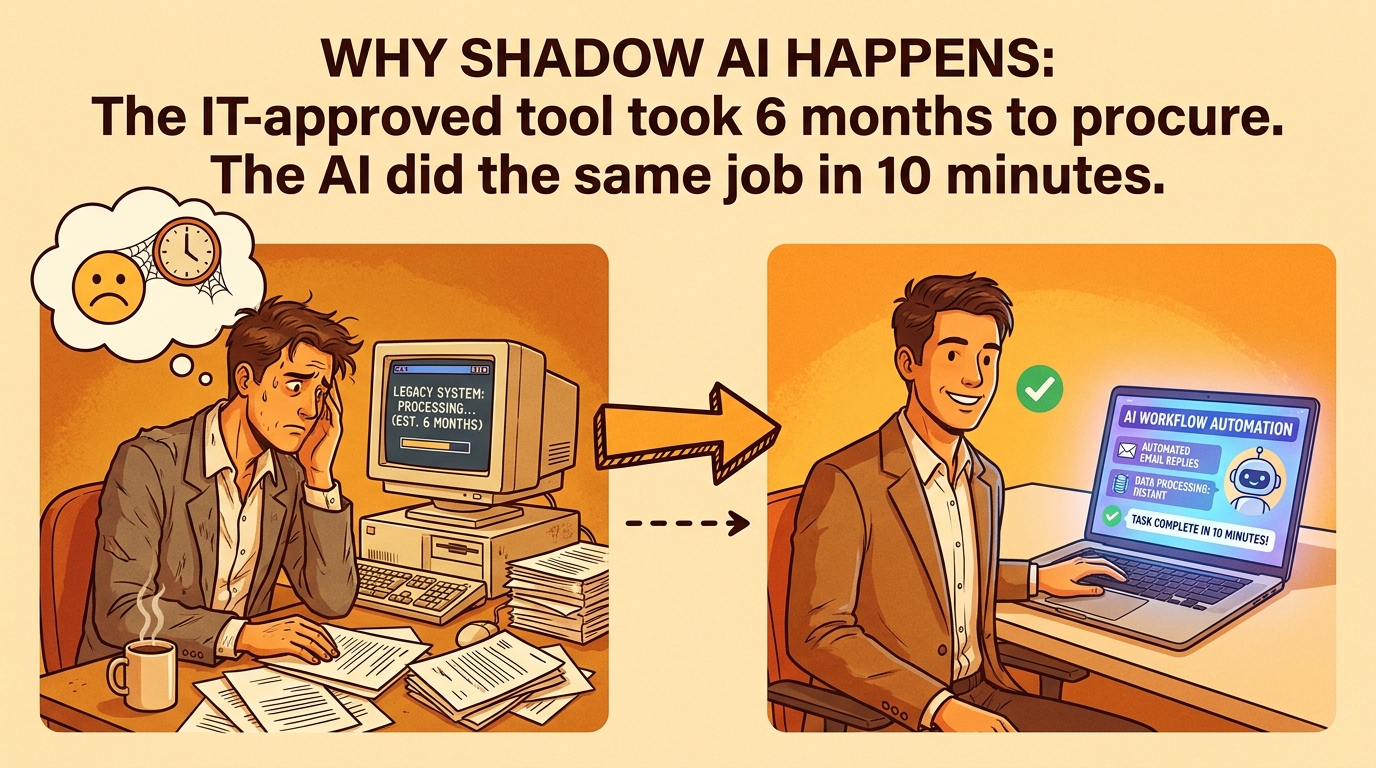
Before designing a governance response, it is worth understanding the supply-and-demand dynamics that produce shadow AI in the first place. Framing this as a compliance or behaviour problem misses the point. Shadow AI is primarily a procurement and process problem that manifests as a security risk.
The approved toolchain is too slow
Enterprise software procurement cycles average between three and nine months from initial request to deployment. AI tools are proliferating on a timescale measured in weeks. By the time a formal procurement process for a specific AI capability is complete, the underlying technology may have already been superseded, the original use case may have changed, and several employees will have found their own solutions and moved on. The structural pace mismatch between enterprise procurement and the AI tooling ecosystem makes some degree of shadow adoption almost inevitable without deliberate counter-design.
The productivity differential is real and immediate
Employees who use AI tools for appropriate tasks see measurable productivity gains that are personally and professionally motivating. A two-hour manual process that becomes a ten-minute automated workflow is not a marginal improvement — it is a fundamental change in how that person experiences their job. When the choice is between completing five reports in a week or twenty, motivated employees choose the twenty. The fact that their method involves an unsanctioned tool is a secondary consideration, and often one they have not thought through carefully.
This is important for governance design. A policy response that simply removes the productivity benefit without replacing it will face persistent non-compliance. Employees who experience the value of AI automation firsthand do not easily return to slower alternatives, particularly when they have seen colleagues using those alternatives and falling behind on output.
The behaviour hides because the culture discourages honesty
Research consistently shows that a significant proportion of employees using shadow AI hide that use from their managers. This is not simply risk-awareness — it is often a rational response to an organisational culture in which using unofficial tools is perceived as career risk. If the implicit message is that deviating from approved tooling will attract scrutiny, employees will deviate and not report it, which is significantly worse from a governance perspective than deviating and being transparent about it.
Shadow AI governance programmes that begin with disclosure amnesties — where employees can register what they are already using without penalty — consistently surface substantially more unauthorised tool usage than detective controls alone. The disclosure pathway only works if the cultural context around it is genuinely non-punitive.
The demand signal is valuable intelligence
When security or IT teams discover a cluster of employees all using the same unauthorised AI tool, that is not just a compliance finding. It is a clear signal that a legitimate business need is going unmet by the current approved toolchain. Shadow AI usage patterns, if treated as product requirements data rather than policy violations, provide a prioritised view of where the official AI strategy needs to move next. Some of the most effective AI governance programmes have reframed shadow AI discovery as a listening exercise as much as an enforcement exercise.
The Three Tiers of Shadow AI Risk
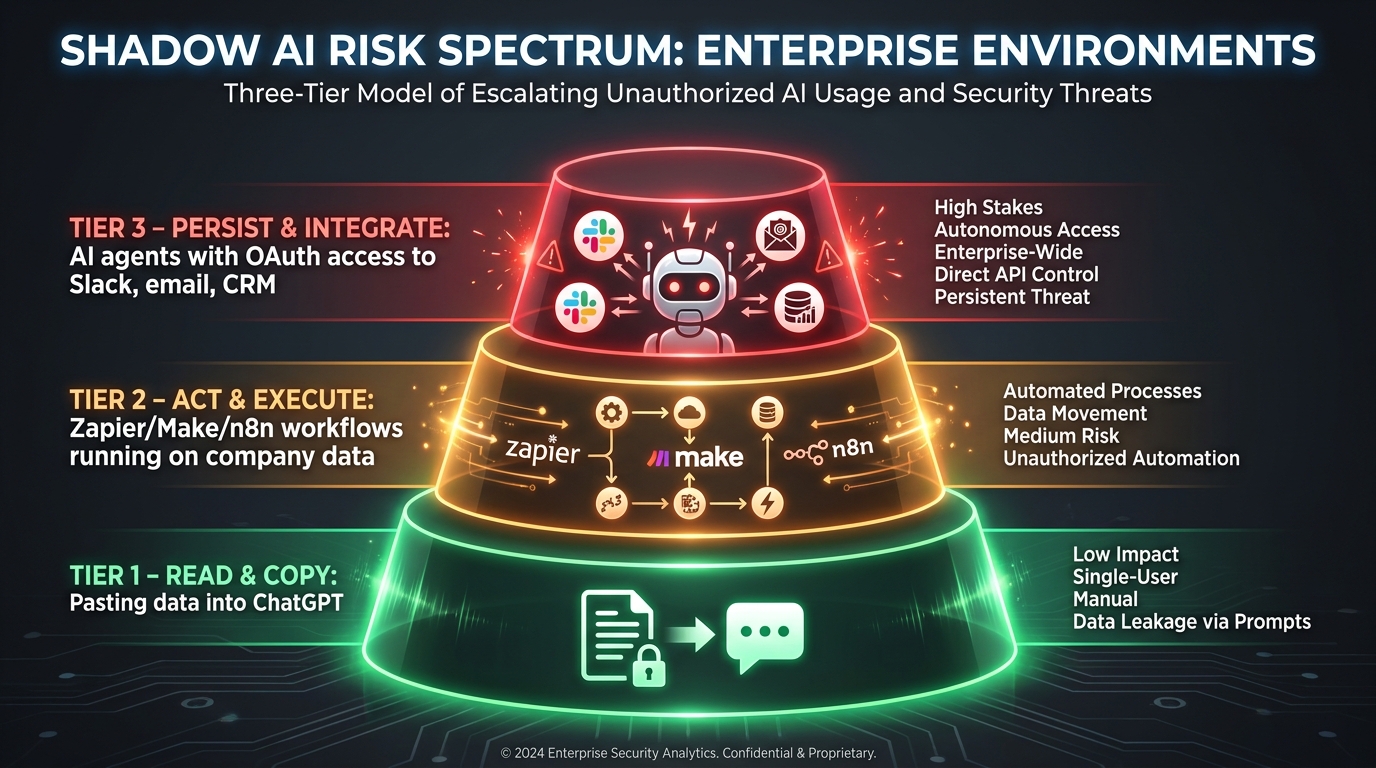
Not all shadow AI carries the same risk profile. One of the most useful contributions IT and security teams can make to governance design is helping the business understand that the analyst pasting a meeting transcript into Claude and the engineer who built an autonomous agent with OAuth access to the company’s production environment are not the same problem, and should not be governed the same way.
A three-tier model provides a workable starting framework for risk classification, incident prioritisation, and policy design.
Tier 1 — Read and Copy
At this tier, the employee is interacting with an AI tool by providing input and receiving output, with no ongoing data connection or automated action. The risk is primarily data exfiltration: sensitive information is transmitted to a third-party service, may be stored or used for model training, and the organisation has no record of what was shared. This is serious, but the blast radius is typically limited to whatever the employee manually chose to paste. Remediating this tier focuses on classification awareness (ensuring employees understand which data categories should never leave the organisation boundary), technical controls like browser-based DLP, and clear policy guidance with accessible alternatives.
Tier 2 — Act and Execute
At this tier, the employee has built or deployed an automated workflow that takes recurring action using company data. This might be a Zapier flow that pulls from Salesforce and pushes to an AI API on a scheduled basis, or a Make scenario that processes new customer support tickets through a classification model and routes them automatically. The key risk escalation factors here are persistence (the data flow continues indefinitely without further employee action), volume (the workflow may process hundreds or thousands of records per day), and invisibility (the workflow is running whether or not the employee is present, and may outlast their tenure). Remediating this tier requires workflow discovery tools, integration access audits, and a process for registering and reviewing automated flows that touch company data.
Tier 3 — Persist and Integrate
At this tier, an AI agent or automated system has been granted durable access to corporate systems via OAuth grants, API keys, or shared credentials. The agent may have the ability to read and write email, post to Slack, update CRM records, or access cloud storage — all on an ongoing, autonomous basis, without human review of individual actions. This tier represents the most serious category of shadow AI risk because the governance challenge extends beyond data exfiltration to autonomous action: the agent may be taking consequential steps — sending emails, deleting records, executing transactions — that are difficult to audit and potentially irreversible. Detecting Tier 3 shadow AI requires OAuth grant auditing, service account monitoring, and API key tracking, not just network traffic analysis.
The practical value of this tiering is that it allows governance teams to sequence their response rationally. Tier 3 issues warrant immediate investigation and action. Tier 2 issues warrant systematic discovery and a structured registration process. Tier 1 issues are addressable through policy, training, and accessible approved alternatives, without requiring the same level of technical intervention.
Why Traditional Shadow IT Controls Cannot Keep Up
Most enterprise security teams already have shadow IT governance programmes — CASB (Cloud Access Security Broker) solutions, network monitoring, application whitelisting, and software inventory management. The reasonable assumption is that these tools should cover shadow AI. In practice, they have significant blind spots that AI’s specific characteristics expose.
The domain diversity problem
Traditional shadow IT controls often work by blocking or flagging access to known unauthorised domains. This worked reasonably well when shadow IT consisted of employees using Dropbox instead of SharePoint, or Trello instead of Jira. The list of known domains was manageable. AI tools now number in the thousands, and the landscape expands weekly. New models, new interfaces, new API endpoints, and new embedded features within already-approved SaaS platforms mean that a domain blocklist is perpetually obsolete. By the time a tool is added to the blocklist, a newer version or interface has emerged.
The encrypted traffic problem
A significant proportion of AI tool usage happens over HTTPS, within existing approved applications (Gmail, Slack, browser extensions), or via API calls that look indistinguishable from normal SaaS traffic at the network layer. CASB solutions that perform SSL inspection can detect some of this, but browser-based AI usage via personal accounts on managed devices — the most common Tier 1 pattern — may route entirely through standard browser traffic that does not trigger existing controls.
The agent invisibility problem
Conventional shadow IT detection focuses on user-initiated access to known services. AI agents invert this model: they are systems that initiate their own access, often through OAuth tokens granted at setup and then operating autonomously. The initial OAuth grant may look like a normal SaaS authorisation event, indistinguishable from an employee connecting a legitimate calendar app. The ongoing autonomous access that follows may never generate another detectable authentication event. Standard identity access management audits, if they run at all, may not surface third-party app grants in a form that flags them as AI agents.
The SaaS feature creep problem
When a department activates an AI add-on within a pre-approved SaaS subscription, there is often no change event that triggers security review. The AI capability is not a new application — it is a new feature of an existing one. Existing procurement and security review processes may not have a mechanism for reviewing new AI capabilities added to already-approved tools, meaning an entire category of data flows can appear without any of the standard controls activating.
Addressing these gaps requires a fundamentally different detection architecture — one built around the specific characteristics of AI data flows rather than adapted from legacy shadow IT tooling.
How to Surface What You Can’t See: A Detection Framework
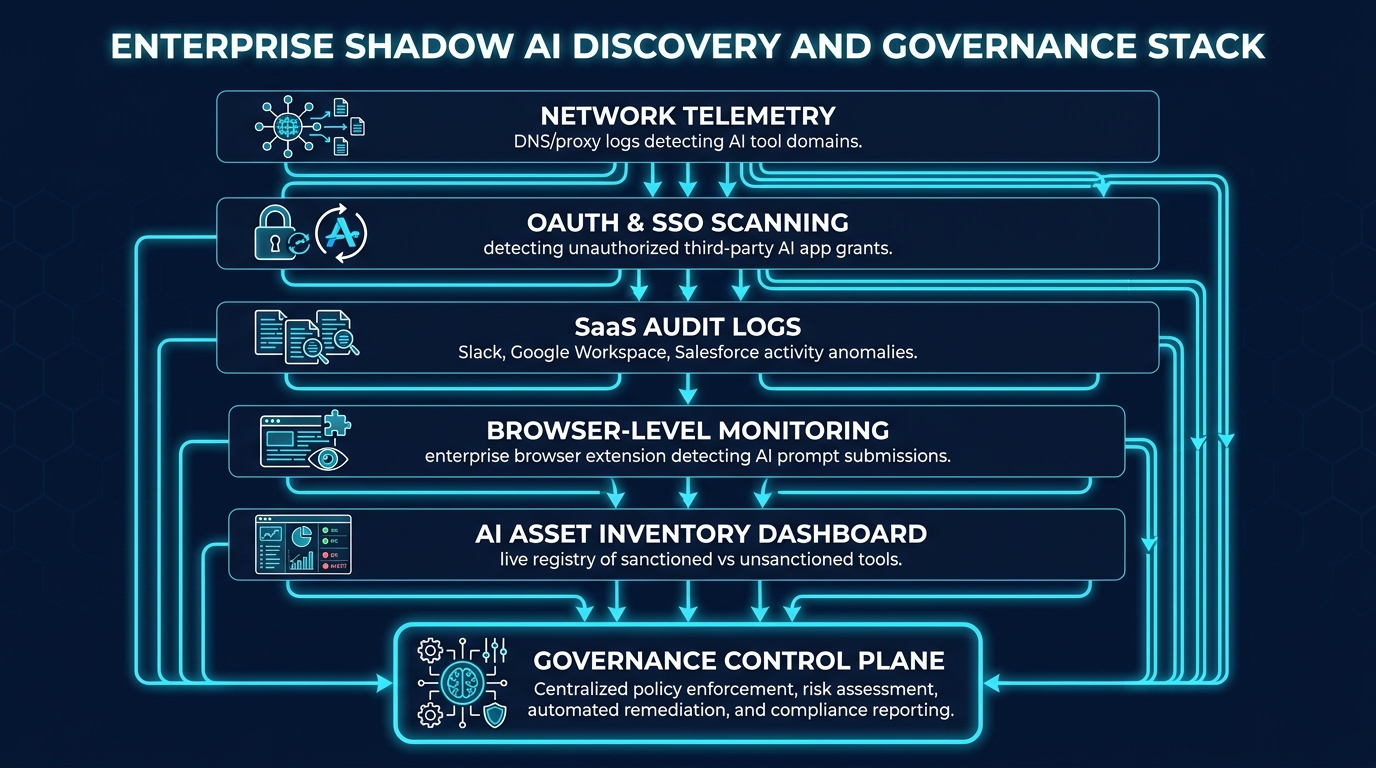
Effective shadow AI detection in 2026 requires a multi-signal approach. No single control provides adequate coverage. The strongest programmes combine several complementary techniques that, together, provide reasonable visibility across the Tier 1, 2, and 3 categories described above.
Network and DNS telemetry
While DNS-based detection cannot catch everything, it remains a high-value starting point for identifying AI tool categories in use across the estate. Maintaining a regularly updated taxonomy of AI service domains — LLM providers, AI API endpoints, no-code AI platforms, and AI-embedded SaaS tools — and analysing DNS resolution patterns against that taxonomy will surface the majority of direct AI tool usage. Volume anomalies (high-frequency calls to AI API domains from a single subnet) can indicate automated workflows rather than manual usage, helping distinguish Tier 1 from Tier 2 activity.
OAuth and SSO grant auditing
For organisations using Google Workspace, Microsoft 365, or similar identity providers, regular auditing of third-party OAuth application grants is one of the highest-signal methods for detecting Tier 3 shadow AI. Employees who create AI agents and grant them calendar, email, or drive access will generate OAuth grants that are visible in identity provider admin consoles. The challenge is that most organisations do not review these grants systematically. Building a regular process — even monthly — to review new OAuth grants against an approved application list, with a clear process for investigating unknown grants, provides material coverage at the agentic layer.
SaaS audit log enrichment
Enterprise SaaS platforms generate detailed audit logs of user and API activity. Enriching these logs with AI-specific indicators — unusual API call patterns, third-party API key usage, integration events involving known AI tool categories — enables detection of shadow automation at the application layer. This is particularly effective for identifying Tier 2 shadow AI, where Zapier or Make workflows are accessing corporate SaaS data. Many SaaS platforms’ audit logs will show the API client name and integration source; a workflow automation platform appearing in Salesforce audit logs as the client for bulk data access is a clear signal worth investigating.
Browser-level monitoring
For Tier 1 shadow AI, enterprise browsers or browser extension deployments provide the most direct detection capability. Some organisations have deployed managed browser extensions that can detect prompt submission events to known AI services, log them against user identity, and — where policy requires — block data transmission containing specific data classifications. This is technically the most invasive approach and requires careful policy design around employee privacy, but it provides coverage that network-layer controls cannot match for standard browser-based AI tool usage.
Treating inventory as a continuous operational capability
Perhaps the most important shift in detection philosophy is moving from periodic audits to continuous inventory. Shadow AI is not a state that gets fixed after a point-in-time assessment. New tools appear, new employees join, existing employees find new AI capabilities within approved tools. The organisations that manage shadow AI most effectively treat AI asset inventory — both authorised and discovered unauthorised assets — as a live operational artefact that is maintained on an ongoing basis, with defined ownership, update cadence, and escalation paths for new discoveries. This sounds obvious, but most organisations currently treat their AI inventory as a project output, updated annually at most.
Building a Governance Framework That Doesn’t Kill Innovation
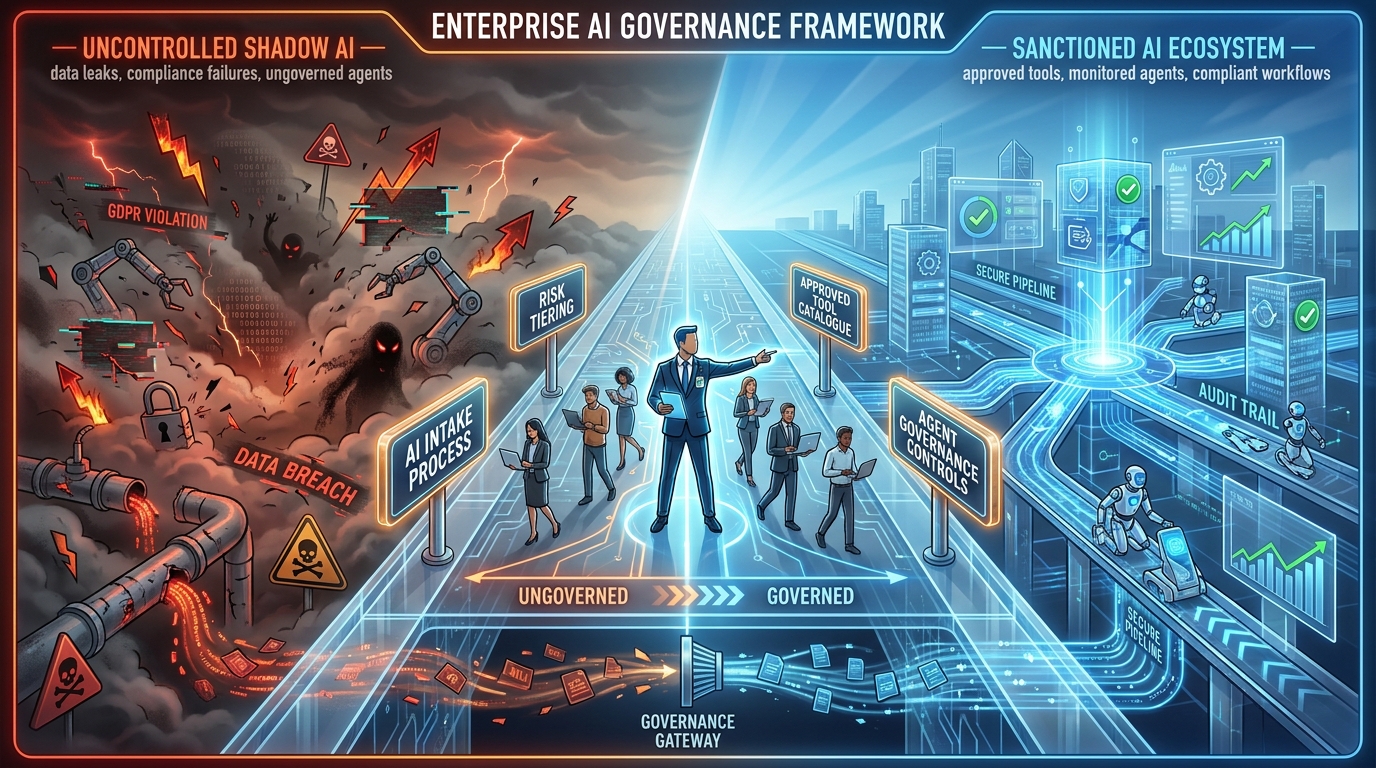
The single greatest failure mode in shadow AI governance is over-correction. Organisations that respond to shadow AI discovery with comprehensive blocks, punitive policies, and a general message of “wait for IT to approve something” almost universally experience the same outcome: the behaviour continues, but more covertly. The governance programme creates the illusion of control while eliminating the visibility that detection programmes had started to generate.
Effective governance is architecture, not prohibition. The goal is to make the sanctioned path faster and easier than the shadow path — not to make the shadow path impossible.
The AI intake process
A fast, lightweight AI tool intake process is foundational. If the standard IT procurement cycle takes months, employees will not use it for AI tools that they need now. Organisations that have reduced this cycle to a two-to-four week review for low-risk AI tools — with a defined checklist covering data processing agreements, data classification limits, user access controls, and monitoring requirements — see significantly lower rates of shadow AI among employees who know the fast-track process exists and trust that it will actually be fast.
The intake process should also include a “register, don’t request” pathway for Tier 1 tools that employees are already using with non-sensitive data. Asking employees to register their current usage — with a clear description of what data they are providing and for what purpose — dramatically improves visibility without requiring them to stop doing something productive. The goal at this tier is not elimination but documentation.
Risk tiering as the backbone of policy
Not all AI tools warrant the same level of scrutiny. A framework that treats a public summarisation tool with no persistent data storage the same as an agent with OAuth access to production systems will either overburden the review process or underprotect high-risk deployments. Data classification integration is key: the risk tier of an AI tool should be determined primarily by what data it will touch, not just what capabilities it has. A sophisticated agent that only processes publicly available data may represent less risk than a simple chatbot interface configured to answer questions from a database containing customer payment records.
Effective risk tiering typically works on two axes: data sensitivity and AI action scope. The intersection of these two dimensions drives review depth, approval authority, and ongoing monitoring requirements. A tool touching low-sensitivity data with read-only behaviour might require a lightweight manager-plus-IT review. A tool touching regulated data and capable of autonomous action warrants CISO involvement, legal review, and formal data processing agreement verification before deployment.
An approved tool catalogue employees actually use
Shadow AI proliferates fastest in organisations where the gap between what employees need and what the official catalogue offers is largest. Maintaining a genuinely useful, regularly updated catalogue of approved AI tools — including use-case guidance for each tool, clear data handling limits, and contact points for queries — reduces the pressure that drives employees to source their own solutions. The catalogue should be searchable, organised by use case rather than vendor, and updated on a cadence that tracks actual tool availability rather than annual review cycles.
Several organisations have also found value in publishing an “AI waitlist” within their catalogue — approved-in-principle tools that are currently under data processing review — which gives employees visibility into what is coming and a reason to wait rather than improvise.
Cross-functional governance, not IT-only enforcement
Shadow AI governance that sits entirely within the IT or security function tends to be viewed by the business as a constraint rather than an enabler, and tends to lack the business-unit context needed to make proportionate risk decisions. The most effective governance programmes in 2026 are run by cross-functional AI governance committees that include Legal, Compliance, HR, a representative sample of business unit leads, and senior IT/security leadership. This structure accomplishes two things: it brings domain-specific risk context to tool reviews (the HR team understands the EU AI Act implications of an AI screening tool in a way that a security analyst may not), and it signals to the business that governance is a shared responsibility rather than an IT tax.
Agent-Specific Controls: The New Governance Frontier
Agentic AI represents a qualitatively different governance challenge from any prior form of shadow IT. When an AI agent acts autonomously — sending communications, modifying records, executing processes — the organisation is effectively delegating consequential decisions to a system it may not have reviewed, approved, or even know exists. The governance frameworks that apply to tools (what data can it access?) are necessary but not sufficient for agents (what actions can it take, in what contexts, with what oversight?). New control categories are emerging specifically for this layer.
Agent identity and registration
Just as human identities are managed through identity providers and access control systems, AI agents need formal identity management. An agent that has been granted OAuth access to corporate systems should have a service identity — a registered, named, auditable account — rather than operating under a human employee’s credentials or an anonymous API key. This allows the organisation to track what actions the agent has taken, revoke its access in a controlled way, and scope its permissions accurately. Service accounts and API keys used by AI agents should be inventoried separately from those used by traditional software, with additional metadata capturing the underlying AI model, the workflow or application it serves, and the human owner accountable for its behaviour.
Scoped and revocable permissions
AI agents — like any system with access to corporate infrastructure — should operate under the principle of least privilege. The specific permissions required for the agent’s defined tasks should be granted explicitly, with no broader access scope. OAuth grants for AI agents should specify the minimum necessary access (read-only where possible, limited to specific resources), and all grants should carry an expiry date and be subject to regular reauthorisation review. Indefinite, broad-scope OAuth grants for AI agents are a persistent vulnerability in most enterprise environments.
Human oversight checkpoints
For agents operating in high-stakes contexts — those touching financial systems, customer communications, regulated data, or production infrastructure — governance frameworks should require explicit human oversight checkpoints at defined action thresholds. An agent that can draft and queue email responses but cannot send without human approval presents a substantially different risk profile from an agent with full send authority. The placement of these checkpoints is a business risk decision, not purely a technical one, and should involve the business units affected.
Audit logging as a non-negotiable requirement
Every action taken by a sanctioned AI agent should generate an immutable, queryable audit log entry. This is not just a governance nicety — in regulated industries, it is increasingly a legal requirement. For shadow agents discovered during governance sweeps, the retrospective audit challenge is significant: the organisation may have no record of what actions the agent took over months of operation. Building audit logging into the agent approval process — requiring it as a condition of sanctioning rather than adding it later — is far more effective than trying to retrofit it after deployment.
Metrics That Tell You If Governance Is Actually Working
Governance programmes are notoriously prone to measuring activity rather than outcomes — the number of policies published, training sessions completed, or tools reviewed. These inputs are not without value, but they say nothing about whether actual shadow AI risk is decreasing. A mature shadow AI governance programme uses outcome-oriented metrics that track the state of the risk, not just the volume of governance activity.
Shadow AI coverage ratio
This metric expresses the proportion of AI tools known to be in use across the organisation that have completed a formal governance review and received a documented risk classification (approved, conditionally approved, or blocked). A high coverage ratio does not mean all AI usage is sanctioned — it means the organisation has visibility and a recorded position on the tools in its environment. A coverage ratio below 60% typically indicates that detection mechanisms are immature and a significant proportion of the estate remains uncharacterised. Targets in the range of 80–90% coverage are achievable with continuous inventory and represent a reasonable operational goal.
Time-to-govern for new tool requests
If the primary driver of shadow AI is the gap between employee need and approved tool availability, then reducing governance cycle time directly reduces shadow AI pressure. Tracking the median time from intake submission to a documented approval or rejection decision — disaggregated by risk tier — provides a clear indicator of whether the intake process is functioning as designed. Tier 1 reviews should complete in days, not weeks. Tier 2 reviews in one to two weeks. Tier 3 in three to four weeks with appropriate depth. Deviations from these targets are indicators of process bottlenecks worth investigating.
OAuth grant anomaly rate
The proportion of active third-party OAuth grants in the organisation’s identity provider that have been reviewed and approved within the last ninety days provides a proxy measure for Tier 3 shadow AI prevalence. A high proportion of unreviewed grants — particularly recent ones — indicates that agentic shadow AI may be more prevalent than official records suggest. This metric is most useful when tracked over time; a sudden spike in new OAuth grants from an unexpected department is an early-warning indicator worth investigating.
Self-disclosure rate
In organisations with disclosure-based governance programmes, tracking the rate at which employees voluntarily register AI tools they are using — versus tools discovered through detective controls — is a useful measure of cultural alignment with the governance programme. A high self-disclosure rate indicates that employees trust the process enough to be transparent about their usage. A low self-disclosure rate alongside high detective discovery suggests the governance culture is not yet functioning as designed and employees perceive disclosure as risky.
Incident attribution rate
Of data security incidents and near-misses investigated by the security team, what proportion involved an AI tool — sanctioned or unsanctioned — in the data flow? Tracking this over time shows whether AI-related risk is growing, stable, or reducing relative to overall incident volume. A rising AI attribution rate in the context of improving governance coverage is a paradox worth examining; it may indicate that detection is improving (more incidents are being correctly attributed to AI) rather than that risk is increasing.
The Long-Term Challenge: AI Governance as a Living Programme
One of the most common mistakes in shadow AI governance is treating it as a problem to be solved rather than a condition to be managed. The organisations that complete a thorough shadow AI audit, publish a comprehensive policy, deploy detection tooling, and then consider the matter closed will find themselves back at the beginning within twelve months. The AI tool landscape evolves too quickly, organisational needs change too rapidly, and employee behaviour is too adaptive for any static governance approach to remain effective.
Continuous policy review cycles
AI governance policies should be reviewed on a quarterly basis at minimum — not because policies change every quarter, but because the context in which they operate does. New capabilities in existing approved tools, new regulatory guidance, new categories of AI risk (the shift to agentic AI being the most recent example), and organisational changes all create conditions where existing policy may no longer provide adequate coverage. Quarterly reviews with a cross-functional governance committee allow the policy to stay current without requiring emergency responses to every new development.
Regulatory alignment as a governance driver
The EU AI Act’s phased enforcement schedule, NIST AI RMF adoption in the U.S., and emerging ISO 42001 certification programmes for AI management systems all create external governance deadlines that can provide useful forcing functions for internal programme development. Organisations that align their shadow AI governance timeline to these external milestones — rather than treating regulatory compliance as a separate exercise — tend to build more durable programmes and avoid the compliance theatre that results from treating governance as a box-ticking exercise conducted in parallel with actual operations.
Turning governance into competitive advantage
The most forward-looking framing of shadow AI governance is not risk mitigation but trust infrastructure. Organisations that can demonstrate to customers, regulators, and partners that they have comprehensive visibility and control over their AI deployments — including mechanisms to quickly identify and address unauthorised usage — are building a governance capability that will become a differentiator as AI regulation matures and enterprise procurement processes start incorporating AI governance assessments as standard vendor requirements.
The question for security, IT, and business leaders is not whether to govern shadow AI — the risk statistics and the regulatory environment make that a settled question. The real question is whether to govern it in a way that builds trust and enables the productive use of AI across the organisation, or to govern it reactively in a way that creates friction without reducing risk. The former requires investment, cross-functional commitment, and cultural change. The latter is available immediately, costs less in the short term, and reliably fails.
Conclusion: Governance Before the Next Incident
Shadow AI in 2026 is not a fringe phenomenon or a future risk. It is a current operational condition in the majority of large organisations. Seventy percent of companies have it running in their environment. Half of their employees are using tools IT does not know about. One in five has already experienced a security incident linked to it. And the problem is materially more complex than it was two years ago, because the tools have shifted from chatbot interfaces to autonomous agents with persistent access to production systems.
The organisations that manage this well share a common set of characteristics. They treat discovery as continuous rather than periodic. They tier their risk classification around data sensitivity and action scope rather than tool category. They build intake processes fast enough to compete with the shadow alternative. They govern agents with the same rigour as human identities. And they measure governance effectiveness through outcomes, not activity.
Perhaps most importantly, they listen to the demand signal that shadow AI represents. When a large number of employees in a given function are all independently finding the same unofficial AI tool useful enough to risk using it without approval, that is not a compliance problem. It is a product requirement that the official AI strategy has not yet addressed. The organisations that read that signal correctly — and respond with fast, proportionate governance rather than broad prohibition — are the ones that end up with both lower shadow AI risk and higher sanctioned AI adoption. The two are not in tension. The governance approach is what determines which direction you move in both dimensions simultaneously.
Actionable starting points
- Run an OAuth grant audit this week. Pull the full list of third-party app grants in your Google Workspace or Microsoft 365 tenant. Any grant you cannot immediately explain is a shadow AI candidate worth investigating.
- Open a disclosure channel before you open a detection programme. Announce a 60-day amnesty for employees to register AI tools they are currently using. The voluntary disclosures will likely exceed what your detection controls would find in the same period.
- Publish a fast-track intake process with a meaningful SLA. Two weeks for Tier 2 tool reviews is achievable with the right cross-functional committee structure. Publish the SLA, hold to it, and measure your adherence rate monthly.
- Classify your agents separately from your tools. Any system with OAuth access, a service account, or an API key that takes autonomous action should be in a separate inventory category with its own governance requirements, not lumped with read-only AI assistants.
- Treat shadow AI patterns as product requirements. Brief your AI strategy team quarterly on which unofficial tools are being discovered and in which departments. That usage data is your most accurate signal of where official AI adoption needs to accelerate.